Phenotypic Variation in Water-Use Efficiency, Heat Tolerance, and Carbon Isotope Discrimination Across Canadian Spring Wheat Cultivars Under Climate Stress

 ,
,  ,
,  , and
, and
Abstract
1. Introduction
2. Results
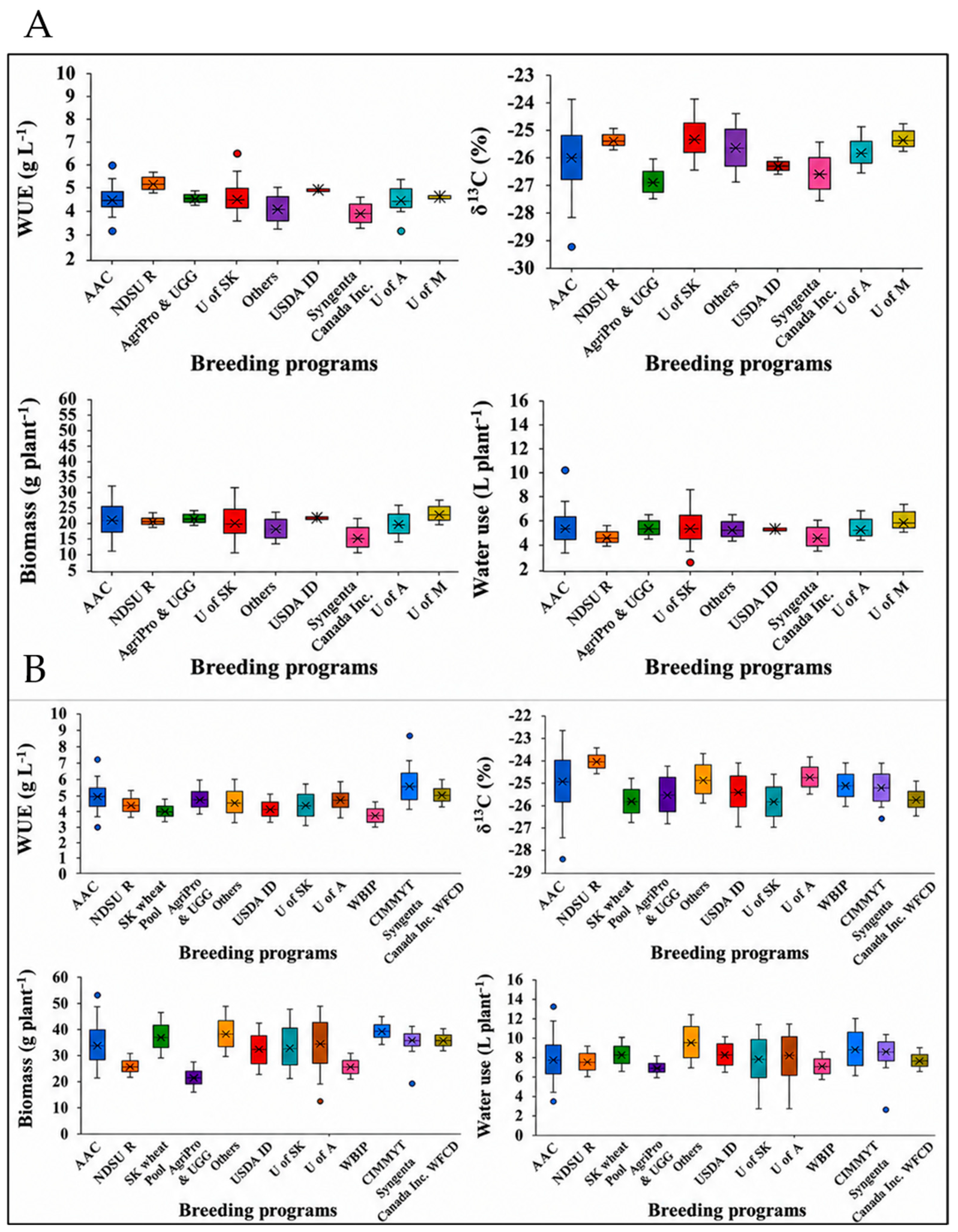
2.1. Variation in WUEWP, δ13C, Biomass Accumulation and Water Use per Plant
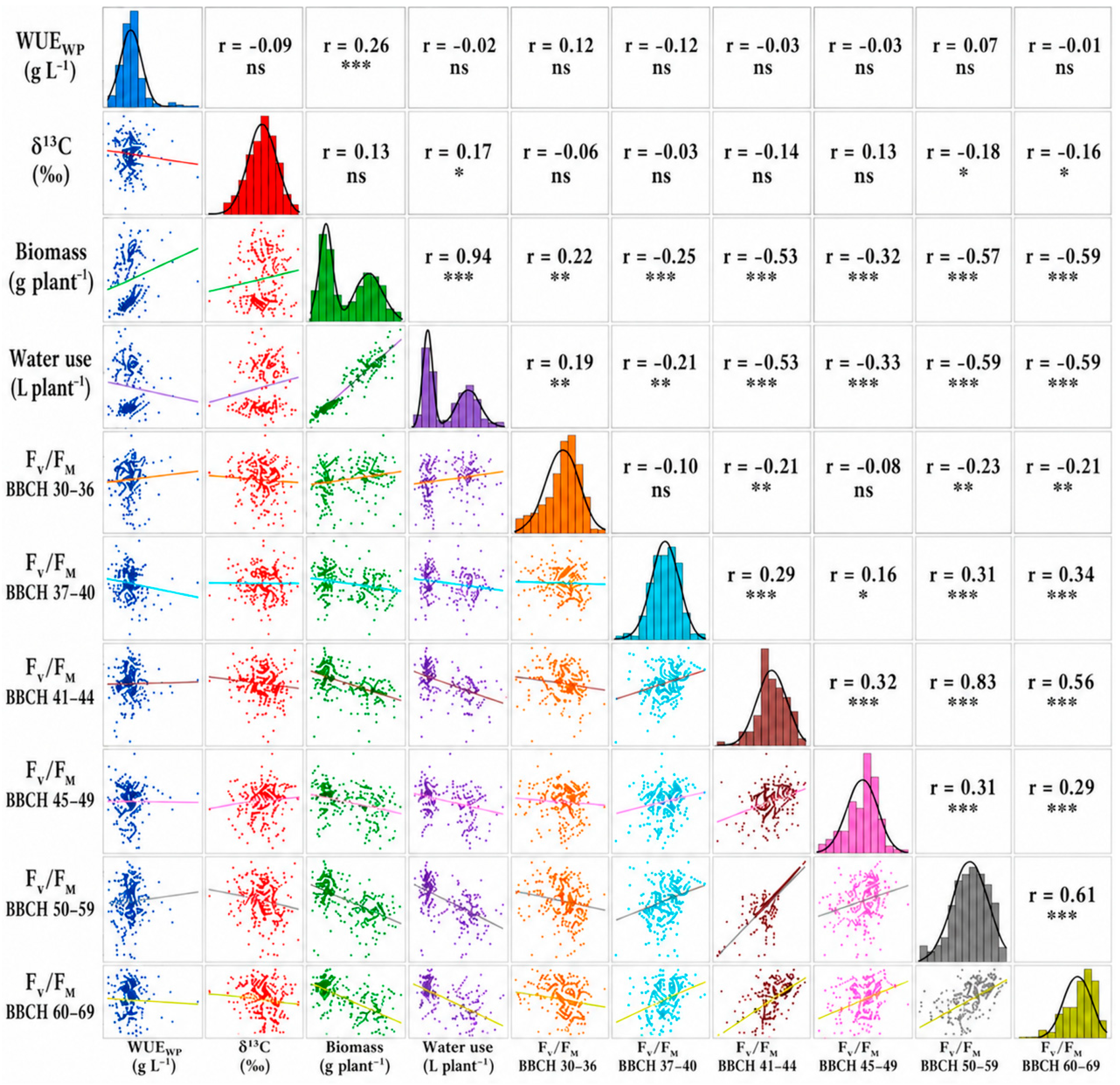
2.2. Relationship Among WUEWP, δ13C, Biomass, Water Use per Plant, and Maximum Quantum Efficiency of Photosystem II (FV/FM) Under Non-Stress and Stress Conditions
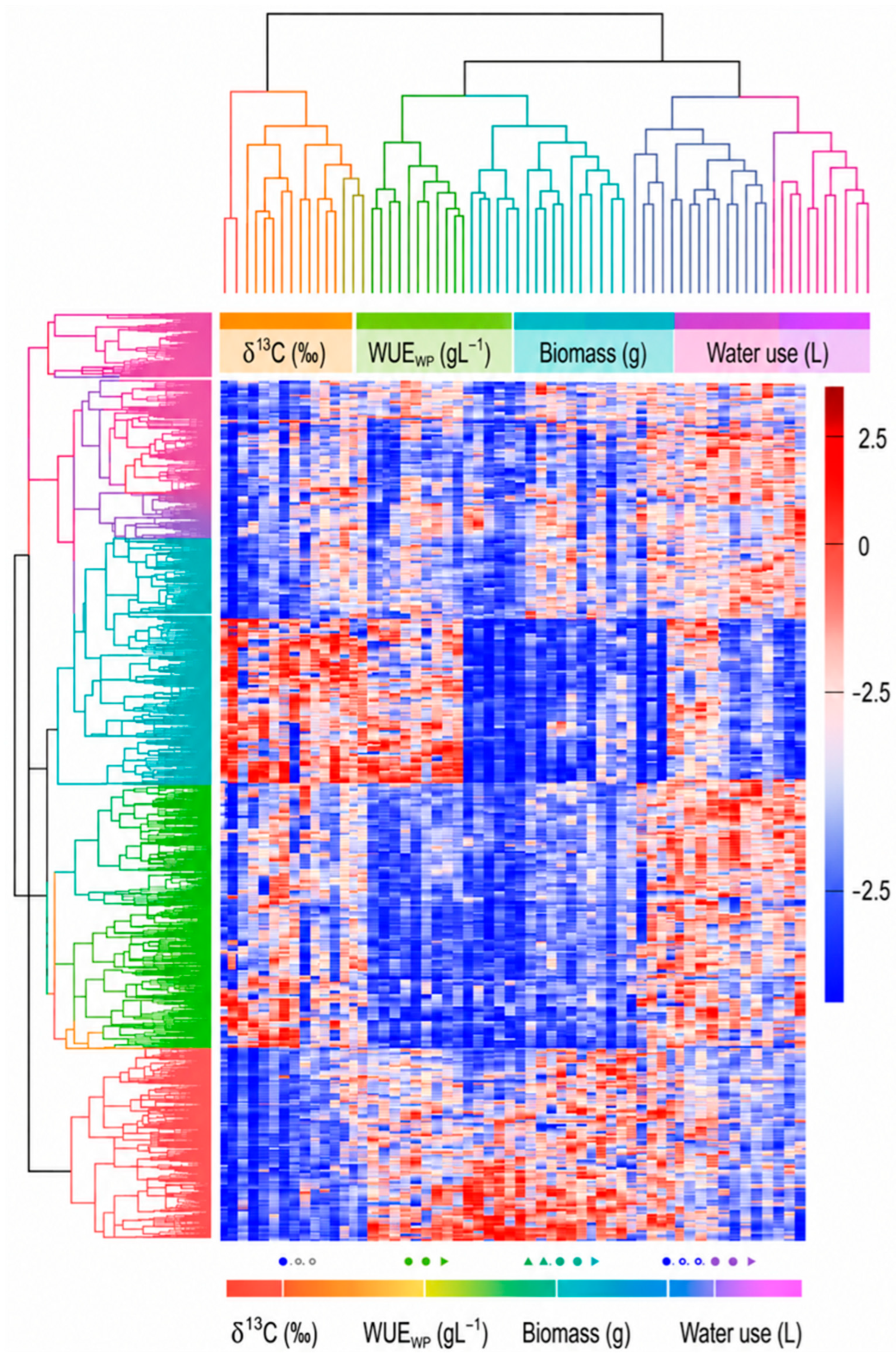
2.3. Hierarchical Clustering and Heatmap Analysis of Physiological Traits
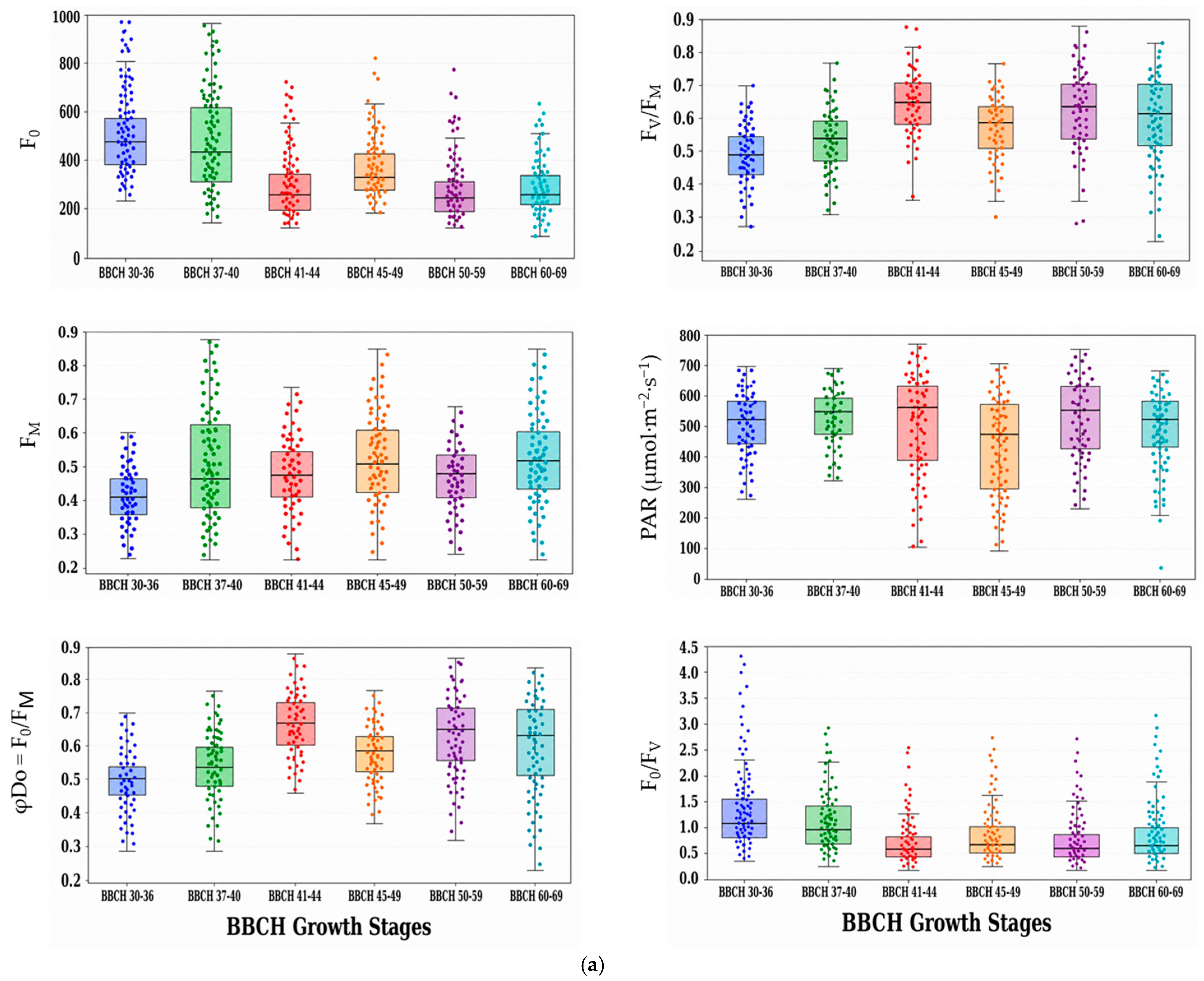
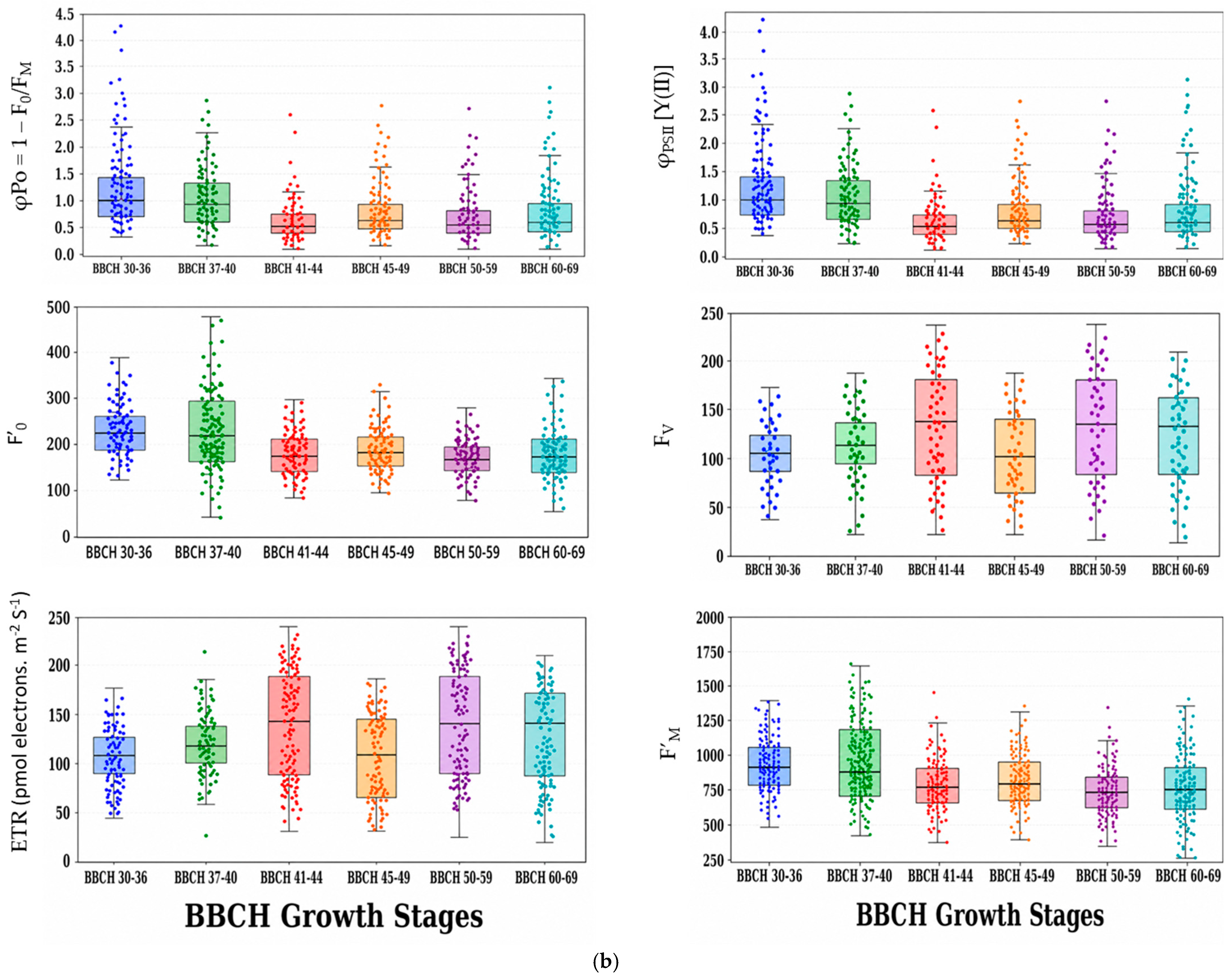
2.4. Variation in Chlorophyll Fluorescence Parameters
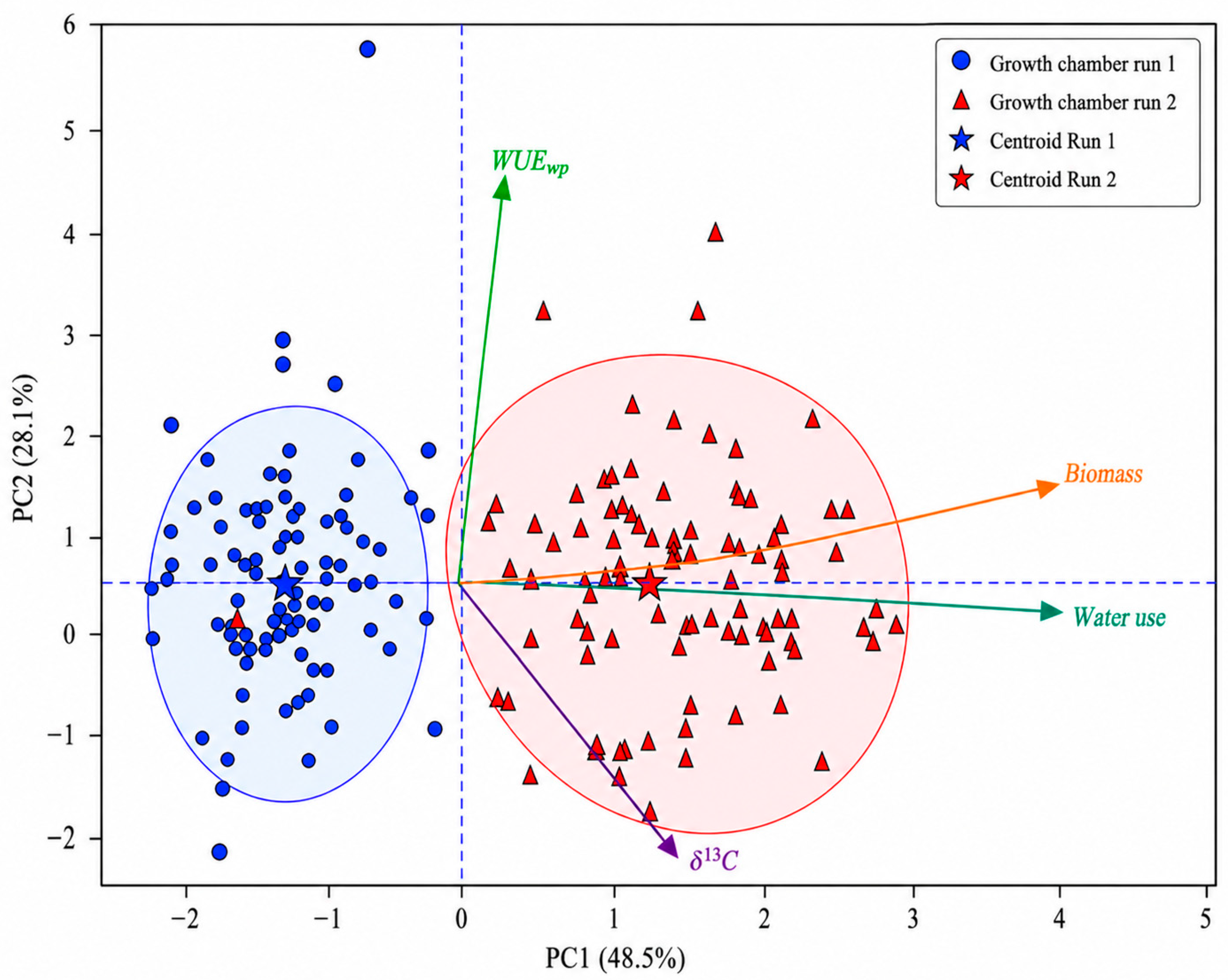
2.5. Principal Component Analysis (PCA) Among Agronomic and Water-Related Traits
3. Discussion
3.1. Phenotypic and Physiological Variation in Canadian Spring Wheat Cultivars
3.2. Phenotypic Diversity and Breeding Program Structure
3.3. Carbon Isotope Discrimination and Water-Use Efficiency Relationships
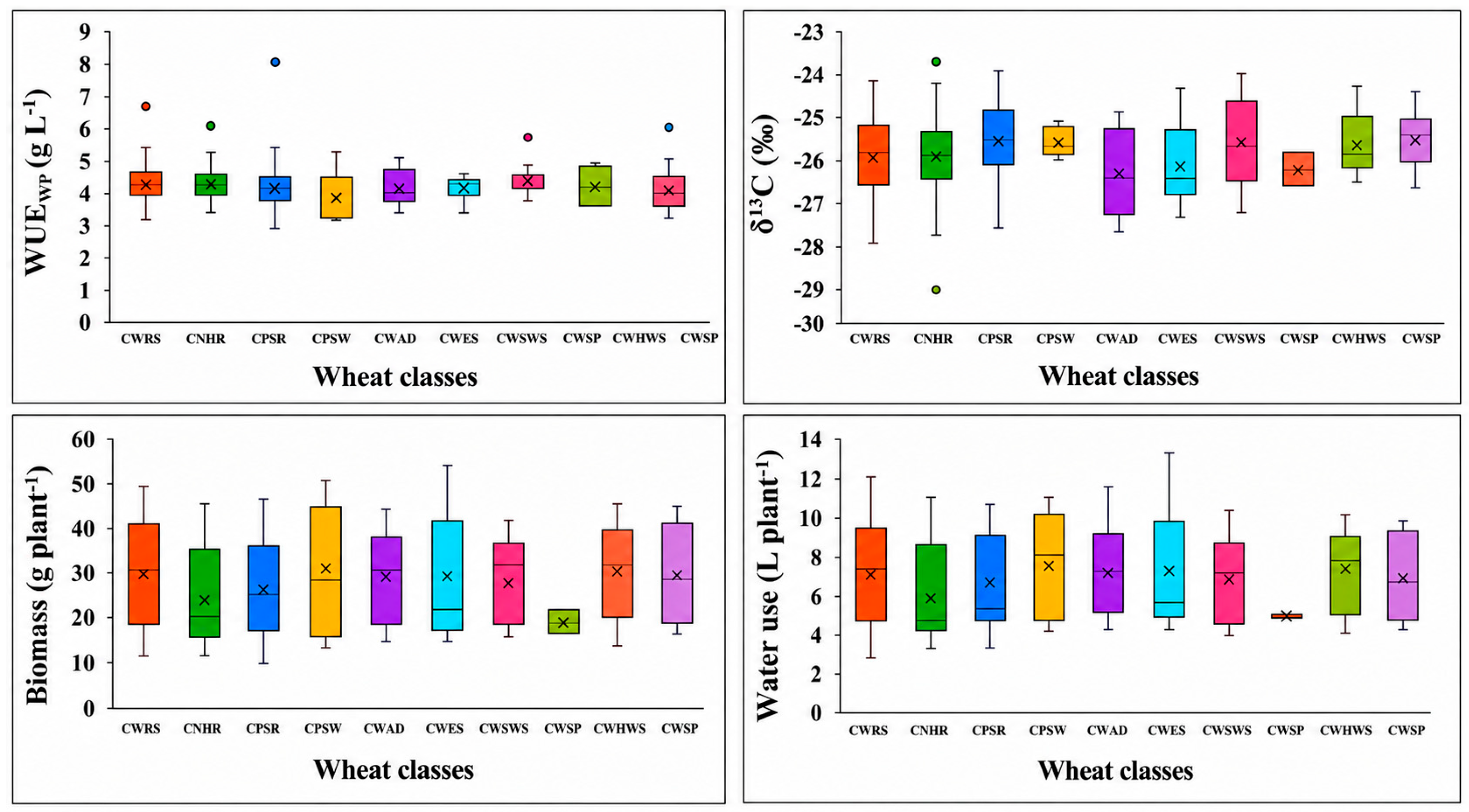
3.4. Phylogenetic and Market Class Analysis of Physiological Traits
3.5. Chlorophyll Fluorescence Responses and PSII Stability Under Combined Drought and Heat Stress
4. Materials and Methods
4.1. Plant Material
4.2. Controlled Growth Conditions and Drought–Heat Stress Treatment
4.3. Determination of WUE at the Whole Plant Level
- Dry weight of final biomass = total dry biomass produced per plant (g)
- Total water consumed = cumulative water used per plant during the experiment (L)
4.4. Determination of Carbon Isotope Discrimination (δ13C) in Flag Leaf
4.5. Chlorophyll Fluorescence Measurements and Physiological Assessment Under Drought–Heat Stress
4.6. Experimental Design and Data Analysis
5. Conclusions
Supplementary Materials
Author Contributions
Funding
Data Availability Statement
Acknowledgments
Conflicts of Interest
Abbreviations
| ANOVA | Analysis of Variance |
| BBCH | Biologische Bundesanstalt, Bundessortenamt and Chemical industry scale (growth stage scale) |
| CF-IRMS | Continuous-Flow Isotope Ratio Mass Spectrometry |
| Chla | Chlorophyll a |
| CNHR | Canada Northern Hard Red |
| CPSR | Canada Prairie Spring Red |
| CPSW | Canada Prairie Spring White |
| CWAD | Canada Western Amber Durum |
| CWES | Canada Western Extra Strong |
| CWHWS | Canada Western Hard White Spring |
| CWRS | Canada Western Red Spring |
| CWSP | Canada Western Special Purpose |
| CWSWS | Canada Western Soft White Spring |
| FV | Variable Fluorescence |
| F0 | Minimum Fluorescence Yield (dark-adapted state) |
| FM | Maximum Fluorescence Yield (dark-adapted state) |
| FV/FM | Maximum Quantum Efficiency of Photosystem II |
| H′ | Shannon Diversity Index |
| IRMS | Isotope Ratio Mass Spectrometer |
| PAM | Pulse-Amplitude-Modulated (fluorometry) |
| PCA | Principal Component Analysis |
| PSII | Photosystem II |
| ΦPSI | Quantum Yield of Photosystem I |
| r | Pearson Correlation Coefficient |
| SWC | Soil Water Content |
| VPDB | Vienna Pee Dee Belemnite (carbon isotope standard) |
| WD | Water-Deficient (treatment) |
| WUE | Water Use Efficiency |
| WUEWP | Whole-Plant Water Use Efficiency |
| Carbon Isotope–Related Terms | |
| δ13C | Carbon Isotope Composition (relative difference in 13C/12C ratio) |
| Ra | 13C/12C Ratio of Atmospheric CO2 |
| Rp | 13C/12C Ratio of Plant Material |
| Rsample | 13C/12C Ratio of Sample |
| Rstd | 13C/12C Ratio of Standard |
| Statistical/Mathematical Terms | |
| Ln | Natural Logarithm |
| Σ | Summation Symbol |
| Pi | Proportion of the ith genotype in the population |
| Units | |
| °C | Degrees Celsius |
| kPa | Kilopascal (pressure unit) |
| µmol m−2 s−1 | Micromoles per square meter per second (light intensity) |
| g L−1 | Grams per liter |
| g plant−1 | Grams per plant |
References
- Mapfumo, E.; Chanasyk, D.S.; Puurveen, C.; Elton, S.; Acharya, S. Historic climate change trends and impacts on crop yields in key agricultural areas of the prairie provinces in Canada: A literature review. Can. J. Plant Sci. 2023, 103, 100–115. [Google Scholar] [CrossRef]
- Environment Canada. Canada’s Changing Climate Report; Government of Canada: Ottawa, ON, Canada, 2019. [Google Scholar]
- Barbosa, M.A.M.; Kuki, K.N.; Bengala, P.S.P.; Pereira, E.D.S.; de Barros, A.F.; Montoya, S.G.; Pimentel, L.D. Phenological and physiological evaluation of first and second cropping periods of sorghum and maize crops. J. Agro. Crop Sci. 2020, 206, 263–276. [Google Scholar] [CrossRef]
- Statistics Canada. Production of Principal Field Crops; Statistics Canada: Ottawa, ON, Canada, 2024. [Google Scholar]
- Zhao, C.; Liu, B.; Piao, S.; Wang, X.; Lobell, D.B.; Huang, Y.; Huang, M.; Yao, Y.; Bassu, S.; Ciais, P.; et al. Temperature increase reduces global yields of major crops in four independent estimates. Proc. Natl. Acad. Sci. USA 2017, 114, 9326–9331. [Google Scholar] [CrossRef] [PubMed]
- Zahra, N.; Wahid, A.; Siddique, K.H.M.; Farooq, M. Plant photosynthesis under heat stress: Effects and management. Environ. Exp. Bot. 2023, 206, 105178. [Google Scholar] [CrossRef]
- Hafeez, M.B.; Zahra, N.; Kausar, A.; Li, J.; Rehman, A.; Farooq, M. Influence of heat stress during grain development on wheat grain yield, quality, and composition. J. Soil Sci. Plant Nutr. 2023, 23, 2955–2969. [Google Scholar] [CrossRef]
- Djanaguiraman, M.; Narayanan, S.; Erdayani, E.; Prasad, P.V.V. Effects of high temperature stress during anthesis and grain filling periods on photosynthesis, lipids and grain yield in wheat. BMC Plant Biol. 2020, 20, 268. [Google Scholar] [CrossRef] [PubMed]
- Zhai, Y.; Bai, Y.; Shen, X.; Zhang, T.; Jia, Y.; Ren, K.; Zhou, X.; Cheng, Z.; Hong, J. Provincial water availability footprint evaluation and transfer analysis of China’s grain products: A life cycle perspective. Agric. Water Manag. 2023, 276, 108050. [Google Scholar] [CrossRef]
- Hatfield, J.L.; Dold, C. Water-use efficiency: Advances and challenges in a changing climate. Front. Plant Sci. 2019, 10, 103. [Google Scholar] [CrossRef] [PubMed]
- Han, T.; Feng, Q.; Yu, T.; Liu, W.; Ma, J.; Zhao, C.; Yang, L.; Zhang, J.; Li, H. Contrasting response of water use efficiency to soil moisture availability. Ecol. Indic. 2023, 143, 109964. [Google Scholar] [CrossRef]
- Harder, P.; Helgason, W.D.; Johnson, B.; Pomeroy, J.W. Crop water use efficiency from eddy covariance methods in cold water-limited regions. Agric. For. Meteorol. 2023, 341, 109657. [Google Scholar] [CrossRef]
- Vadez, V.; Luquet, D.; Kholová, J.; Zaman-Allah, M.; Passot, S. Water use efficiency across scales: From genes to landscapes. J. Exp. Bot. 2023, 74, 4770–4788. [Google Scholar] [CrossRef] [PubMed]
- Cernusak, L.A.; Ubierna, N.; Winter, K.; Holtum, J.A.M.; Marshall, J.D.; Farquhar, G.D. Environmental and physiological determinants of carbon isotope discrimination in terrestrial plants. New Phytol. 2013, 200, 950–965. [Google Scholar] [CrossRef] [PubMed]
- Zhang, Y.; Liu, B.; Jia, G.; Yu, X.; Zhang, X.; Yin, X.; Zhao, Y.; Wang, Z.; Cheng, C.; Wang, Y.; et al. Scaling up from leaf to whole-plant level for water use efficiency estimates based on stomatal and mesophyll behaviour. Water 2022, 14, 263. [Google Scholar] [CrossRef]
- Tortosa, I.; Douthe, C.; Pou, A.; Balda, P.; Hernandez-Montes, E.; Toro, G.; Escalona, J.M.; Medrano, H. Variability in water use efficiency of grapevine Tempranillo clones and stability over years at field conditions. Agronomy 2019, 9, 701. [Google Scholar] [CrossRef]
- Petrík, P.; Petek-Plaščak, A.; Rascher, U. Leaf physiological and morphological constraints of water-use efficiency in C3 plants. AoB Plants 2023, 15, plad047. [Google Scholar] [CrossRef] [PubMed]
- Richards, R.A.; Condon, A.G. Challenges ahead in using carbon isotope discrimination in plant breeding programs. In Stable Isotopes and Plant Carbon-Water Relations; Ehleringer, J.R., Hall, A.E., Farquhar, G.D., Eds.; Academic Press: San Diego, CA, USA, 1993; pp. 451–462. [Google Scholar]
- Farquhar, G.D.; Ehleringer, J.R.; Hubick, K.T. Carbon isotope discrimination and photosynthesis. Annu. Rev. Plant Biol. 1989, 40, 503–537. [Google Scholar] [CrossRef]
- Ma, W.T.; Yu, Y.Z.; Wang, X.; Gong, X.Y. Estimation of intrinsic water-use efficiency from δ13C signature of C3 leaves: Assumptions and uncertainty. Front. Plant Sci. 2023, 13, 1037972. [Google Scholar] [CrossRef] [PubMed]
- Condon, A.G.; Richards, R.A.; Farquhar, G.D. Carbon isotope discrimination is positively correlated with grain yield and dry matter production in field grown wheat. Crop Sci. 1987, 27, 996–1001. [Google Scholar] [CrossRef]
- Condon, A.G.; Richards, R.A.; Rebetzke, G.J.; Farquhar, G.D. Improving intrinsic water use efficiency. Crop Sci. 2002, 42, 122–131. [Google Scholar] [CrossRef] [PubMed]
- Condon, A.G.; Richards, R.A.; Rebetzke, G.J.; Farquhar, G.D. Breeding for high water-use efficiency. J. Exp. Bot. 2004, 55, 2447–2460. [Google Scholar] [CrossRef] [PubMed]
- Dixon, L.; Carter, A.H. Toward a New Use for Carbon Isotope Discrimination in Wheat Breeding. Agronomy 2019, 9, 385. [Google Scholar] [CrossRef]
- Becker, N.; Schmidhalter, U. Evaluation of yield–drought relationships and trait stability of winter wheat cultivars using carbon isotope discrimination, canopy temperature and yield traits. Field Crops Res. 2017, 210, 107–117. [Google Scholar] [CrossRef]
- Aravinda Kumar, B.N.; Azam-Ali, S.N.; Snape, J.W.; Weightman, R.M.; Foulkes, M.J. Relationships between carbon isotope discrimination and grain yield in winter wheat under well-watered and drought conditions. J. Agric. Sci. 2011, 149, 257–272. [Google Scholar] [CrossRef]
- Flexas, J.; Barbour, M.M.; Brendel, O.; Cabrera, H.M.; Carriquí, M.; Díaz-Espejo, A.; Douthe, C.; Dreyer, E.; Ferrio, J.P.; Gago, J.; et al. Mesophyll diffusion conductance to CO2: An unappreciated central player in photosynthesis. Plant Sci. 2012, 193–194, 70–84. [Google Scholar] [CrossRef] [PubMed]
- Beauclaire, Q.; Dillen, M.; Vincke, C.; Jonard, M.; Ponette, Q.; Drake, J.E.; Gillon, J.S.; Aubinet, M.; Heinesch, B.; Delpierre, N. Key role played by mesophyll conductance in limiting photosynthesis under elevated CO2 and soil water deficit in oak saplings. Front. Plant Sci. 2024, 15, 1500624. [Google Scholar] [CrossRef] [PubMed]
- Bao, X.; Hou, X.; Duan, W.; Yin, B.; Ren, J.; Wang, Y.; Liu, X.; Gu, L.; Zhen, W. Screening and evaluation of drought resistance traits of winter wheat in the North China Plain. Front. Plant Sci. 2023, 14, 1194759. [Google Scholar] [CrossRef] [PubMed]
- Bacon, M.A. (Ed.) Water Use Efficiency in Plant Biology; Blackwell Publishing: Oxford, UK, 2004. [Google Scholar] [CrossRef]
- Hoover, D.L.; Abendroth, L.J.; Browning, D.M.; Saha, A.; Snyder, K.; Wagle, P.; Witthaus, L.; Baffaut, C.; Biederman, J.A.; Bosch, D.D.; et al. Indicators of water use efficiency across diverse agroecosystems: Interpreting and applying WUE within and across agricultural systems. Sci. Total Environ. 2023, 864, 160992. [Google Scholar] [CrossRef] [PubMed]
- Morison, J.I.L.; Baker, N.R.; Mullineaux, P.M.; Davies, W.J. Improving water use in crop production. Philos. Trans. R. Soc. B Biol. Sci. 2008, 363, 639–658. [Google Scholar] [CrossRef] [PubMed]
- Ncisana, L.; Nyathi, M.K.; Mkhize, N.R.; Mabhaudhi, T.; Tjelele, T.J.; Mbambalala, L.; Modi, A.T. Water use efficiency (WUE) and nutrient concentration of selected fodder radish (Raphanus sativus L.) genotypes for sustainable diets. Sci. Rep. 2024, 14, 31315. [Google Scholar] [CrossRef] [PubMed]
- Mutanda, M.; Shimelis, H.; Chaplot, V.; Shamuyarira, K.W.; Figlan, S. Agronomic performance and water use efficiency of newly developed wheat populations under drought-stressed and non-stressed conditions. Discov. Appl. Sci. 2025, 7, 176. [Google Scholar] [CrossRef]
- Wehner, G.G.; Balko, C.C.; Enders, M.M.; Humbeck, K.K.; Ordon, F.F. Identification of genomic regions involved in tolerance to drought stress and drought stress induced leaf senescence in juvenile barley. BMC Plant Biol. 2015, 15, 125. [Google Scholar] [CrossRef] [PubMed]
- Alsina, M.M.; Smart, D.R.; Bauerle, T.; de Herralde, F.; Biel, C.; Stockert, C.; Negron, C.; Save, R. Seasonal changes of whole root system conductance by a drought-tolerant grape root system. J. Exp. Bot. 2011, 62, 99–109. [Google Scholar] [CrossRef] [PubMed]
- Buesa, I.; Escalona, J.M.; Tortosa, I.; Marín, D.; Loidi, M.; Santesteban, L.G.; Douthe, C.; Medrano, H. Intracultivar genetic diversity in grapevine: Water use efficiency variability within cv. Grenache. Physiol. Plant. 2021, 173, 2226–2237. [Google Scholar] [CrossRef] [PubMed]
- Iseki, K.; Olaleye, O. Dual tolerance to soil drought and excess moisture stresses in cowpea genetic resources assessed using multiple indicators. Front. Plant Sci. 2025, 16, 1573313. [Google Scholar] [CrossRef] [PubMed]
- Gelaye, Y.; Luo, H. Optimizing Peanut (Arachis hypogaea L.) Production through genetic and climate adaptation strategies. Plants 2024, 13, 2988. [Google Scholar] [CrossRef] [PubMed]
- Pignon, C.P.; Leakey, A.D.B.; Long, S.P.; Kromdijk, J. Drivers of natural variation in water-use efficiency under fluctuating light are promising targets for improvement in sorghum. Front. Plant Sci. 2021, 12, 627432. [Google Scholar] [CrossRef] [PubMed]
- Costa Netto, J.R.; Almtarfi, H.; Li, J.; Anderson, D.T.; Fritschi, F.B. Soybean water-use efficiency increased over 80 years of breeding. Crop Sci. 2024, 65, e21404. [Google Scholar] [CrossRef]
- Pinnamaneni, S.R.; Anapalli, S.S.; Fisher, D.K.; Reddy, K.N. Water Use Efficiencies of Different Maturity Group Soybean Cultivars in the Humid Mississippi Delta. Water 2021, 13, 1496. [Google Scholar] [CrossRef]
- Ghimire, O.P.; Spivey, W.W.; Kuraparthy, V.; Campbell, B.T.; Jones, M.; Thomas, J.; Bridges, W.C., Jr.; Narayanan, S. Phenotypic variability in the U.S. upland cotton core set for root traits and water use efficiency. Crop Sci. 2024, 64, 1831–1845. [Google Scholar] [CrossRef]
- Akhtar, M.N.; Akhtar, M.W.; Rahi, A.A.; Ul Haq, T. Enhancing Water Use Efficiency by Using Potassium-Efficient Cotton Cultivars Based on Morphological and Biochemical Characteristics. In Best Crop Management and Processing Practices for Sustainable Cotton Production; IntechOpen: London, UK, 2023. [Google Scholar] [CrossRef]
- Mosalam, M.; Nemr, R.A.; Aljabri, M.; Said, A.A.; El-Soda, M. Exploring genomic loci and candidate genes associated with drought tolerance indices in spring wheat evaluated under two levels of drought. BMC Plant Biol. 2025, 25, 408. [Google Scholar] [CrossRef] [PubMed]
- Sangha, J.S.; Ruan, Y.; DePauw, R.M.; Hucl, P.; Knox, R.; Singh, A.K.; Singh, A.; Pozniak, C.; Fowler, B.; Kirkham, C.; et al. Phenotypic plasticity of bread wheat contributes to yield reliability under heat and drought stress. PLoS ONE 2025, 20, e0312122. [Google Scholar] [CrossRef] [PubMed]
- Soares, G.F.; Ramos, M.L.G.; Pereira, L.F.; Keller, B.; Muller, O.; de Lima, C.A.; da Silva, P.C.; Malaquias, J.V.; Chagas, J.H.; Ribeiro Junior, W.Q. Phenotyping for Drought Tolerance in Different Wheat Genotypes Using Spectral and Fluorescence Sensors. Plants 2025, 14, 2216. [Google Scholar] [CrossRef] [PubMed]
- Siahpoosh, M.R.; Dehghanian, S.E.; Kamgar Haghighi, A.A. Drought tolerance evaluation of bread wheat genotypes using water use efficiency, evapotranspiration efficiency, and drought susceptibility index. Crop Sci. 2011, 51, 1198–1204. [Google Scholar] [CrossRef]
- Prey, L.; Hu, Y.; Schmidhalter, U. High-throughput field phenotyping traits of grain yield formation and nitrogen use efficiency: Optimizing the selection of vegetation indices and growth stages. Front. Plant Sci. 2020, 10, 1672. [Google Scholar] [CrossRef] [PubMed]
- Khlila, I.; Baidani, A.; Hnizil, O.; Amamou, A. Integrated Management of Water, Nitrogen, and Genotype Selection for Enhanced Wheat Productivity in Moroccan Arid and Semi-Arid Regions. Agronomy 2025, 15, 612. [Google Scholar] [CrossRef]
- Lal, K.; Jatoi, W.A.; Memon, S.; Jatoi, I.A.; Rind, S.N.; Rajput, L.; Khan, N.M.; Khaskhali, I.A.; Depar, M.S.; Lund, M.I.; et al. Wheat (Triticum aestivum L.) Drought Tolerance Indices under Water Stress Conditions. SABRAO J. Breed. Genet. 2024, 56, 232–245. [Google Scholar] [CrossRef]
- Osman, R.; Tahir, M.N.; Ata-Ul-Karim, S.T.; Ishaque, W.; Xu, M. Exploring the Impacts of Genotype–Management–Environment Interactions on Wheat Productivity, Water Use Efficiency, and Nitrogen Use Efficiency under Rainfed Conditions. Plants 2021, 10, 2310. [Google Scholar] [CrossRef] [PubMed]
- Ingver, A.; Koppel, R.; Tamm, I.; Kangor, T.; Koppel, M.; Koppel, R. Phenotypic Diversity of Key Adaptive Traits in Advanced Nordic and Baltic Spring Wheat (Triticum aestivum L.) breeding material. Euphytica 2024, 220, 142. [Google Scholar] [CrossRef]
- Babalola, K.O.; Mhlanga, B.; Maphosa, M.; Shimelis, H.; Tsilo, T.J. Genetic Diversity and Climate Change Adaptation in Wheat: A Systematic Review. Front. Sustain. Food Syst. 2025, 9, 1504922. [Google Scholar] [CrossRef]
- Semagn, K.; Iqbal, M.; Alachiotis, N.; N’Diaye, A.; Pozniak, C.; Spaner, D. Genetic diversity and selective sweeps in historical and modern Canadian spring wheat cultivars using the 90K SNP array. Sci. Rep. 2021, 11, 23773. [Google Scholar] [CrossRef] [PubMed]
- Zeibig, F.; Kilian, B.; Frei, M. The grain quality of wheat wild relatives in the evolutionary context. Theor. Appl. Genet. 2022, 135, 4029–4048. [Google Scholar] [CrossRef] [PubMed]
- Makebe, A.; Shimelis, H.; Mashilo, J.; Wanga, M.A. Breeding of Bread Wheat with Drought Adaptive Root Traits. Food Energy Secur. 2025, 14, e70168. [Google Scholar] [CrossRef]
- Mourad, A.M.I.; Morgounov, A.; Baenziger, P.S.; Esmail, S.M. Genetic Variation in Common Bunt Resistance in Synthetic Hexaploid Wheat. Plants 2023, 12, 2. [Google Scholar] [CrossRef] [PubMed]
- Oumata, S.; Monneveux, P.; Zaharieva, M.; Yahiaoui, S.; Mekliche-Hanifi, L.; David, J. Phenotypic Diversity of Saharan Wheat Landraces Growing on Oasis Farms in Algeria: The Influence of Climate and Geography on the Distribution of Traits. Genet. Resour. Crop Evol. 2025, 72, 299–316. [Google Scholar] [CrossRef]
- Xue, X.; Li, Y.; Zhang, H.; Liu, Y.; Wang, X.; Zhao, J.; Chen, W.; Li, Z.; Zhang, Y.; Ma, J. Identification and Evaluation of Phenotypic Characters and Genetic Diversity in Wheat Germplasm Resources. Front. Plant Sci. 2025, 16, 1624252. [Google Scholar] [CrossRef] [PubMed]
- Nei, M.; Li, W.H. Mathematical model for studying genetic variation in terms of restriction endonucleases. Proc. Natl. Acad. Sci. USA 1979, 76, 5269–5273. [Google Scholar] [CrossRef] [PubMed]
- Tang, W.; Dong, Z.; Gao, L.; Wang, X.; Li, T.; Sun, C.; Chu, Z.; Cui, D. Genetic diversity and population structure of modern wheat (Triticum aestivum L.) cultivars. BMC Plant Biol. 2023, 23, 542. [Google Scholar] [CrossRef] [PubMed]
- Cheng, S.; Feng, C.; Wingen, L.U.; Cheng, H.; Riche, A.B.; Jiang, M.; Leverington-Waite, M.; Huang, Z.; Collier, S.; Orford, S.; et al. Harnessing Landrace Diversity Empowers Wheat Breeding. Nature 2024, 632, 823–831. [Google Scholar] [CrossRef] [PubMed]
- Morgounov, A.; Divashuk, M.; Chernook, A.; Ulyanov, D.; Kuzmin, O.; Shreyder, E.; Bondarenko, N.; Volokitina, K.; Kazak, A.; Tajibayev, D.; et al. Climate, Weather, and Ecology in Evaluation of High Latitude Spring Wheat Breeding Sites and Germplasm. Plants 2025, 14, 3256. [Google Scholar] [CrossRef] [PubMed]
- Cavalet-Giorsa, E.; González-Muñoz, A.; Athiyannan, N.; Holden, S.; Salhi, A.; Gardener, C.; Quiroz-Chávez, J.; Rustamova, S.M.; Elkot, A.F.; Patpour, M.; et al. Origin and Evolution of the Bread Wheat D Genome. Nature 2024, 633, 848–855. [Google Scholar] [CrossRef] [PubMed]
- Fu, Y.-B. The vulnerability of plant genetic resources conserved ex situ. Crop Sci. 2017, 57, 2314–2328. [Google Scholar] [CrossRef]
- Alachiotis, N.; Pavlidis, P. A survey of methods and tools to detect recent and strong positive selection. J. Biol. Res. Thessalon. 2017, 24, 7. [Google Scholar] [CrossRef] [PubMed]
- Vitti, J.J.; Grossman, S.R.; Sabeti, P.C. Detecting natural selection in genomic data. Annu. Rev. Genet. 2013, 47, 97–120. [Google Scholar] [CrossRef] [PubMed]
- Sansaloni, C.; Franco, J.; Santos, B.; Percival-Alwyn, L.; Singh, S.; Petroli, C.; Campos, J.; Dreher, K.; Payne, T.; Marshall, D.; et al. Diversity analysis of 80,000 wheat accessions reveals consequences and opportunities of selection footprints. Nat. Commun. 2020, 11, 4572. [Google Scholar] [CrossRef] [PubMed]
- Shaukat, M.; Abbasi, A.; Ahmad, A.; Hussain, S.; Ali, B.; Irfan, M.; Maqsood, M.A.; Javed, T.; Saleem, M.H.; El Sabagh, A.; et al. Ameliorating Heat-Stressed Conditions in Wheat by Altering Its Physiological and Phenotypic Traits Associated with Varying Nitrogen Levels. Not. Bot. Horti Agrobot. Cluj-Napoca 2024, 52, 13471. [Google Scholar] [CrossRef]
- Araus, J.L.; Serret, M.D.; Edmeades, G.O. Phenotyping maize for adaptation to drought. Front. Physiol. 2012, 3, 305. [Google Scholar] [CrossRef] [PubMed]
- Jiang, F.; Pu, T.; Xue, Z.-J.; Ma, Y.-W.; Shi, X.-Y.; Shi, F.-X. Stable Carbon Isotope Composition and Intrinsic Water Use Efficiency in Plants along an Altitudinal Gradient on the Eastern Slope of Yulong Snow Mountain, China. Ecol. Process. 2024, 13, 36. [Google Scholar] [CrossRef]
- Mutanda, M.; Figlan, S.; Chaplot, V.; Madala, N.E.; Shimelis, H. Selection of Wheat Genotypes Using Agronomic Traits, Metabolites and Water-Use Efficiency under Drought Stress. J. Agron. Crop Sci. 2024, 210, e12766. [Google Scholar] [CrossRef]
- Furbank, R.T.; Sharwood, R.; Estavillo, G.M.; Silva-Perez, V.; Condon, A.G. Photons to food: Genetic improvement of cereal crop photosynthesis. J. Exp. Bot. 2023, 74, 5653–5668. [Google Scholar] [CrossRef] [PubMed]
- Blum, A. Effective use of water (EUW) and not water-use efficiency (WUE) is the target of crop yield improvement under drought stress. Field Crops Res. 2021, 112, 119–123. [Google Scholar] [CrossRef]
- Fahad, S.; Bajwa, A.A.; Nazir, U.; Anjum, S.A.; Farooq, A.; Zohaib, A.; Sadia, S.; Nasim, W.; Adkins, S.; Saud, S.; et al. Crop production under drought and heat stress: Plant responses and management options. Front. Plant Sci. 2017, 8, 1147. [Google Scholar] [CrossRef] [PubMed]
- Cossani, C.M.; Reynolds, M.P. Physiological traits for improving heat tolerance in wheat. Plant Physiol. 2021, 187, 1627–1640. [Google Scholar] [CrossRef] [PubMed]
- Zhang, X.; Li, H.; He, M.; Wang, Z.; Ma, S. Improving Wheat Yield and Water-Use Efficiency by Optimizing Irrigation Regimes under Semi-Arid Conditions. Sustainability 2023, 15, 10503. [Google Scholar] [CrossRef]
- Eitelberg, L.; Werner, C.; Cernusak, L.A.; Gessler, A. Water-Use Efficiency—Indications from Carbon and Oxygen Stable Isotopes. Plant Soil. 2025, 515, 77–108. [Google Scholar] [CrossRef]
- Kunz, K.; Hu, Y.; Schmidhalter, U. Carbon isotope discrimination as a key physiological trait to phenotype drought/heat resistance of future climate-resilient German winter wheat compared with relative leaf water content and canopy temperature. Front. Plant Sci. 2022, 13, 1043458. [Google Scholar] [CrossRef] [PubMed]
- Sommer, S.G.; Roznowski, B.; Schjoerring, J.K.; Petersen, K.K. The Chlorophyll Fluorescence Parameter Fv/Fm Correlates with Yield Performance in Wheat Exposed to Severe Drought Stress. Plants 2023, 12, 436. [Google Scholar] [CrossRef] [PubMed]
- Peco, J.D.; Centeno, A.; Moratiel, R.; Villena, J.; López-Perales, J.A.; Moreno, M.M.; Pérez-López, D. Intermittent versus continuous drought: Chlorophyll a fluorescence reveals photosystem resilience in tomato. Front. Plant Sci. 2025, 16, 1699777. [Google Scholar] [CrossRef] [PubMed]
- Posch, B.C.; Amoanimaa-Dede, H.; Aparecido, L.M.T.; Atkin, O.K.; Bison, N.N.; Blonder, B.W.; Coast, O.; Doughty, C.E.; Guo, J.S.; van Haren, J.; et al. High-Temperature Acclimation of Photosystem II in Land Plants. New Phytol. 2026, 249, 1108–1123. [Google Scholar] [CrossRef] [PubMed]
- Xia, Q.; Tang, H.; Fu, L.; Tan, J.; Govindjee; Guo, Y. Determination of Fv/Fm from chlorophyll a fluorescence without dark adaptation by an LSSVM model. Plant Phenomics 2023, 5, 0034. [Google Scholar] [CrossRef] [PubMed]
- Landi, M.; Guidi, L. Effects of abiotic stress on photosystem II proteins. Photosynthetica 2023, 61, 148–156. [Google Scholar] [CrossRef] [PubMed]
- Zivcak, M.; Brestic, M.; Kalaji, H.M.; Govindjee. Photosynthetic responses of sun- and shade-grown barley leaves to high light: Is the lower PSII connectivity in shade leaves associated with protection against excess of light? Photosynth. Res. 2014, 119, 339–354. [Google Scholar] [CrossRef] [PubMed]
- Sabouri, H.; Fakheri, B.A.; Mohammadi, R. Chlorophyll fluorescence responses and drought tolerance in wheat. Plant Physiol. Biochem. 2021, 162, 250–261. [Google Scholar] [CrossRef] [PubMed]
- Osipova, S.V.; Rudikovskii, A.V.; Permyakov, A.V.; Rudikovskaya, E.G.; Pomortsev, A.V.; Muzalevskaya, O.V.; Pshenichnikova, T.A. Using chlorophyll fluorescence parameters and antioxidant enzyme activity to assess drought tolerance of spring wheat. Photosynthetica 2024, 62, 147–157. [Google Scholar] [CrossRef] [PubMed]
- Guo, Y.; Ren, H.; Wang, H.Z.; Zhang, J.W.; Zhao, B.; Ren, B.C.; Liu, P. High temperature and drought combined stress inhibited photosystem II activity and grain yield in wheat. Sci. Agric. Sin. 2024, 57, 4205–4220. [Google Scholar] [CrossRef]
- Khadka, K.; Earl, H.J.; Raizada, M.N.; Navabi, A. A Physio-Morphological Trait-Based Approach for Breeding Drought Tolerant Wheat. Front. Plant Sci. 2020, 11, 715. [Google Scholar] [CrossRef] [PubMed]
- Blum, A. Osmotic adjustment is a prime drought stress adaptive engine in support of plant production. Plant Cell Environ. 2017, 40, 4–10. [Google Scholar] [CrossRef] [PubMed]
- Abdullaev, F.; Kusmangulova, M.; Brestic, M.; Zivcak, M. Chlorophyll Fluorescence in Wheat Breeding for Heat and Drought Stress Tolerance. Plants 2024, 13, 2778. [Google Scholar] [CrossRef] [PubMed]
- Mathur, S.; Mehta, P.; Jajoo, A. Effects of dual stress (high salt and high temperature) on the photochemical efficiency of wheat leaves (Triticum aestivum). Physiol. Mol. Biol. Plants 2013, 19, 179–188. [Google Scholar] [CrossRef] [PubMed]
- Naseer, M.A.; Hussain, S.; Mukhtar, A.; Rui, Q.; Ru, G.; Ahmad, H.; Zhang, Z.Q.; Shi, L.B.; Asad, M.S.; Chen, X.; et al. Chlorophyll fluorescence, physiology, and yield of winter wheat under different irrigation and shade durations during the grain-filling stage. Front. Plant Sci. 2024, 15, 1396929. [Google Scholar] [CrossRef] [PubMed]
- Kalaji, H.M.; Schansker, G.; Ladle, R.J.; Goltsev, V.; Bosa, K.; Allakhverdiev, S.I.; Brestic, M.; Bussotti, F.; Calatayud, A.; Dąbrowski, P.; et al. Frequently asked questions about in vivo chlorophyll fluorescence: Practical issues. Photosynth. Res. 2014, 122, 121–158. [Google Scholar] [CrossRef] [PubMed]
- Mirosavljević, M.; Mikić, S.; Župunski, V.; Abdelhakim, L.; Trkulja, D.; Zhou, R.; Špika, A.K.; Ottosen, C.-O. Effects of Heat Stress during Anthesis and Grain Filling Stages on Some Physiological and Agronomic Traits in Diverse Wheat Genotypes. Plants 2024, 13, 2083. [Google Scholar] [CrossRef] [PubMed]
- Farooq, M.; Wahid, A.; Kobayashi, N.; Fujita, D.; Basra, S.M.A. Plant drought stress: Effects, mechanisms and management. Agron. Sustain. Dev. 2009, 29, 185–212. [Google Scholar] [CrossRef]
- Barboričová, M.; Filaček, A.; Mlynáriková Vysoká, D.; Gašparovič, K.; Živčák, M.; Brestič, M. Sensitivity of Fast Chlorophyll Fluorescence Parameters to Combined Heat and Drought Stress in Wheat Genotypes. Plant Soil Environ. 2022, 68, 309–316. [Google Scholar] [CrossRef]
- Nahakpam, S.; Kesari, R. Advancing Crop Breeding Through Phenotyping: A Review of Methods, Applications and Low-Cost Solutions. Plant Breed. 2025, 145, 482–499. [Google Scholar] [CrossRef]
- Canadian Grain Commission. Wheat: Classes and Varieties. Canadian Grain Commission 2024. Available online: https://www.grainscanada.gc.ca/en/grain-quality/official-grain-grading-guide/04-wheat/classes-varieties.html (accessed on 15 June 2026).
- Cereals Canada. Canada Western Red Spring (CWRS). Cereals Canada 2025. Available online: https://cerealscanada.ca/2023-wheat-crop/cwrs/ (accessed on 15 June 2026).
- Zadoks, J.C.; Chang, T.T.; Konzak, C.F. A decimal code for the growth stages of cereals. Weed Res. 1974, 14, 415–421. [Google Scholar] [CrossRef]
- Craig, H. Isotopic standards for carbon and oxygen and correction factors for mass spectrometric analysis of carbon dioxide. Geochim. Cosmochim. Acta 1957, 12, 133–149. [Google Scholar] [CrossRef]
- Schreiber, U.; Bilger, W.; Neubauer, C. Chlorophyll fluorescence as a non-intrusive indicator for rapid assessment of in vivo photosynthesis. In Ecophysiology of Photosynthesis; Schulze, E.-D., Caldwell, M.M., Eds.; Springer: Berlin/Heidelberg, Germany, 1994; pp. 49–70. [Google Scholar]
- van Kooten, O.; Snel, J.F.H. The use of chlorophyll fluorescence nomenclature in plant stress physiology. Photosynth. Res. 1990, 25, 147–150. [Google Scholar] [CrossRef] [PubMed]
- Genty, B.; Briantais, J.-M.; Baker, N.R. The relationship between the quantum yield of photosynthetic electron transport and quenching of chlorophyll fluorescence. Biochim. Biophys. Acta 1989, 990, 87–92. [Google Scholar] [CrossRef]
- Schultz, H.R. Leaf absorptance of visible radiation in Vitis vinifera L.: Estimates of age and shade effects with a simple field method. Sci. Hortic. 1996, 66, 93–102. [Google Scholar] [CrossRef]
- Kramer, D.M.; Johnson, G.; Kiirats, O.; Edwards, G.E. New fluorescence parameters for the determination of QA redox state and excitation energy fluxes. Photosynth. Res. 2004, 79, 209–218. [Google Scholar] [CrossRef] [PubMed]
- Song, K.; Hong, S.; Shim, S. Responses of Photosynthetic Activity in Flag Leaves and Spikes as well as Seed Development of Wheat (Triticum aestivum L.) to Artificial Shading. Agronomy 2025, 15, 2577. [Google Scholar] [CrossRef]
- Khaliq, I.; Parveen, N.; Chowdhry, M.A. Correlation and path coefficient analyses in bread wheat. Int. J. Agric. Biol. 2008, 10, 633–635. [Google Scholar]
- Wickham, H. ggplot2: Elegant Graphics for Data Analysis; Springer: New York, NY, USA, 2016. [Google Scholar]
- Schloerke, B.; Cook, D.; Larmarange, J.; Briatte, F.; Marbach, M.; Thoen, E.; Elberg, A.; Crowley, J. GGally: Extension to ggplot2; R Package Version 2.4.0. Available online: https://ggobi.github.io/ggally/ (accessed on 23 May 2026).
- Kent, M.; Coker, P. Vegetation Description and Analysis: A Practical Approach; Belhaven Press: London, UK, 1992. [Google Scholar]
- Ward, J.H. Hierarchical grouping to optimize an objective function. J. Am. Stat. Assoc. 1963, 58, 236–244. [Google Scholar] [CrossRef]
- Murtagh, F.; Legendre, P. Ward’s hierarchical agglomerative clustering method: Which algorithms implement Ward’s criterion? J. Classif. 2014, 31, 274–295. [Google Scholar] [CrossRef]
- Wilkinson, L.; Friendly, M. The history of the cluster heat map. Am. Stat. 2009, 63, 179–184. [Google Scholar] [CrossRef]
- Jolliffe, I.T. Principal Component Analysis, 2nd ed.; Springer: New York, NY, USA, 2002. [Google Scholar]
- Abdi, H.; Williams, L.J. Principal component analysis. WIREs Comput. Stat. 2010, 2, 433–459. [Google Scholar] [CrossRef]
- Geel, C.; Versluis, W.; Snel, J.F.H. Estimation of oxygen evolution by marine phytoplankton from measurement of the efficiency of photosystem II electron flow. Photosynth. Res. 1997, 51, 61–70. [Google Scholar] [CrossRef]



| Parameters | Mean | Max | Min | CV (%) | LSD(0.05) | Stdev | p > F | H′ |
|---|---|---|---|---|---|---|---|---|
| Growth Chamber Run 1 | ||||||||
| δ13C (‰) | −26.37 | −24.28 | −29.33 | - | - | 0.92 | - | 2.62 |
| WUEwp (g L−1) | 4.17 | 5.71 | 3.07 | 9.48 | 0.79 | 0.43 | 0.0003 | 1.88 |
| Biomass (g) | 16.10 | 23.85 | 9.50 | 12.13 | 3.89 | 3.36 | <0.0001 | 1.57 |
| Water use (L) | 3.92 | 5.04 | 2.27 | 11.41 | 0.87 | 0.71 | 0.0269 | 1.43 |
| Growth Chamber Run 2 | ||||||||
| δ13C (‰) | −26.00 | −24.06 | −28.16 | - | - | 0.80 | - | 2.49 |
| WUEwp (g L−1) | 4.12 | 7.81 | 3.11 | 11.98 | 0.98 | 0.55 | <0.0001 | 2.02 |
| Biomass (g) | 35.24 | 50.60 | 24.80 | 12.33 | 8.68 | 5.54 | <0.0001 | 2.29 |
| Water use (L) | 8.73 | 12.34 | 3.17 | 18.42 | 3.21 | 1.31 | 0.34 | 2.15 |
| Growth Chamber Runs 1 and 2 | ||||||||
| δ13C (‰) | −26.18 | −24.06 | -29.33 | - | - | 0.88 | - | 2.61 |
| WUEwp (g L−1) | 4.15 | 7.81 | 3.07 | 11.95 | 1.18 | 0.57 | 0.0554 | 2.52 |
| Biomass (g) | 25.69 | 50.60 | 9.50 | 41.06 | 10.14 | 10.79 | <0.0001 | 2.52 |
| Water use (L) | 6.30 | 12.34 | 2.27 | 41.95 | 2.6 | 2.57 | <0.0001 | 1.98 |
| Breeding | Number of | Cultivars | |||||
|---|---|---|---|---|---|---|---|
| Program | Cultivars | ||||||
| AAFC | 116 | AACAwesome | AAC Iceberg | AC Abbey | Enchant | Peace | AC Barrie |
| AAC Bailey | AAC Innova | AC Andrew | Fieldstar | Pembina | AC Cora | ||
| AAC Brandon | AAC Jatharia | AC Cadillac | Garnet | PT472 | AC Crystal | ||
| AAC Cabri | AAC Penhold | AC Corinne | NRG097 | PT479 | AC Domain | ||
| AAC Cameron | AAC Prevail | AC Intrepid | GoodeveVB | RL6077 | AC Elsa | ||
| AAC Castle | AAC Proclaim | AC Meena | Helios | Sadash | AC Foremost | ||
| AAC Chiffon | AAC Raymore | AC Phil | HY320 | Sinton | AC Karma | ||
| AAC Cirrus | AAC Redwater | AC Snowbird | Kanata | Snowhite475 | AC Majestic | ||
| AAC Connery | AAC Ryley | AC Vista | Kane | Snowstar | AC Michael | ||
| AAC Crossfield | AAC Spitefire | Alvena | Manitou | Stettler | AC Minto | ||
| AAC Crusader | AAC Tenacious | Burnside | Marquis | Superb | AC Reed | ||
| AAC Current | AAC Tradition | Canuck | Minnedosa | Unity | AC Splendor | ||
| AAC Durafield | AAC Viewfield | Carberry | MuchMore | Waskada | AC Taber | ||
| AAC Elie | AAC W1876 | CDN Bison | Napayo | Whitehawk | Benito | ||
| AAC Entice | AAC Whitefox | Conquer | Neepawa | Cardale | Biggar | ||
| AAC Foray | AC 2000 | Cypress | Park | AC Eatonia | Bluesky | ||
| Bhishaj | SWS52 | BW278 | FL62R1 | Cardale | |||
| Columbus | Lancer | Lillian | Somerset | Infinity | |||
| Grandin | Laura | Pasqua | Vesper | Lovitt | |||
| Katepwa | Leader | Roblin | Wildcat | Harvest | |||
| CDC | 31 | CDC Carbide | CDC Kernen | CDC Stanley | CDC Fortitude | CDC Bradwell | CDC Titanium |
| U of S | CDC Abound | CDC Merlin | CDC Teal | CDC Cordon | CDC Go | ||
| CDC Alsask | CDC NRG003 | CDC Thrive | CDC TERRAIN | CDC Hughes | |||
| CDC Imagine | CDC Osler | CDC Utmost | CDC VR Morris | CDC Bounty | |||
| CDC Walrus | CDC Whitewood | BW970 | Conway | PT595 | |||
| Kenyon | Moats | CDC Plentiful | CDC Primepurple | CDC Rama | |||
| U of A | 20 | Alikat | Cutler | PT771 | Ellerslie | Coleman | |
| BW1039 | Go Early | PT778 | Tracker | Thorsby | |||
| BYT1411 | GP168 | PT780 | Jake | BW493 | |||
| BYT1419 | Zealand | Laser | Parata | RedNet | |||
| U of M | 2 | Amazon | Glenlea | ||||
| WPB | 1 | Pasteur | |||||
| Syngenta | 14 | 5604HR CL | GP112 | SY 433 | SY637 | SY985 | |
| Canada Inc. | 5605HR CL | SY087 | SY479 | 5702PR | WR859 CL | ||
| 5701PR | Invader | SY995 | 5700PR | ||||
| WFGD | 1 | WTF603 | |||||
| NDSU | 2 | Faller | Prosper | ||||
| SK Wheat | 4 | Prodigy | McKenzie | Oslo | Journey | ||
| CIMMYT | 2 | Pitic62 | SAAR | ||||
| USDA ID | 3 | Owens | Springfield | Fielder | |||
| Others | 2 | Red Bobs | Sumai3 | ||||
| Parameter and Calculation | Description |
|---|---|
| PAR | Photosynthetically available radiation (PAR) represents the portion of solar radiation within the 400–700 nm wavelength range that is utilized by plants for photosynthesis (μmol m−2 s−1) |
| F0 | Minimum chlorophyll a fluorescence yield measured in dark-adapted leaves when all PSII reaction centers are open. |
| FV = FM – F0 | Variable fluorescence (Fv) represents the difference between maximum fluorescence (FM) and minimum fluorescence (F0) in dark-adapted leaves and reflects the variable component of chlorophyll a fluorescence associated with photochemical activity of photosystem II (PSII). |
| FM | Maximum chlorophyll a fluorescence yield measured in dark-adapted leaves after application of a saturating light pulse. |
| FV/FM = (FM – F0)/FM | Maximum quantum yield of photochemistry in photosystem II (PSII) measured in the dark-adapted state (FV/FM) represents the maximum efficiency at which absorbed light energy can be converted into photochemical energy in PSII when all reaction centers are fully open. It is widely used as an indicator of photosynthetic performance and stress-induced damage to the photosynthetic apparatus. |
| FV/F0 = (FM – F0)/F0 | The ratio is commonly used as an indicator of the potential activity of PSII and the efficiency of the water-splitting complex on the donor side of PSII. Higher values generally indicate better photosynthetic performance and stress tolerance, whereas reductions often reflect damage or impairment of the photosynthetic apparatus under drought, heat, salinity, or other abiotic stresses. |
| F′0′ = F0/(FV/FM + F0/F′M) | Minimum yield of Chl a fluorescence measured under ambient light. F′0 can be measured after a brief (∼ 1 s) period of darkness to promote opening of all reaction centers |
| F′M | Maximum yield of Chl a fluorescence measured under ambient light. Fo′ can be measured after a brief (∼ 1 s) period of darkness to promote opening of all reaction centers |
| Y(II) = (F′M − F′) /F′M | Effective quantum yield of photochemical energy conversion in PSII. 0Y(II) is a measuring protocol that was developed by Bernard Genty with the first publications in 1989 and 1990. |
| ETR = Y(II) × PAR × 0.84 × 0.5. | Relative electron transport rate, is the product of the effective photochemical yield of PSII, ΦP = ΔF/F′M = (FM′-F)/F′M′ and photosynthetic photon flux density (PPFD) [106,119]. Electron transport rate (ETR), estimated from chlorophyll fluorescence, is a widely used indicator of photosynthetic activity. |
| φPo = 1 − F0/FM | Maximum quantum yield of primary photochemistry at time zero (ΦP0 or φP0) represents the maximum efficiency with which absorbed light energy is converted into photochemical energy in photosystem II (PSII) when all reaction centers are fully open in the dark-adapted state. It reflects the potential efficiency of primary photochemistry in PSII. |
| φDo = F0/FM | Fraction of absorbed light energy dissipated as heat and fluorescence when PSII reaction centers are fully open. Quantum yield of energy dissipation at time zero in dark-adapted leaves. |
Disclaimer/Publisher’s Note: The statements, opinions and data contained in all publications are solely those of the individual author(s) and contributor(s) and not of MDPI and/or the editor(s). MDPI and/or the editor(s) disclaim responsibility for any injury to people or property resulting from any ideas, methods, instructions or products referred to in the content. |
© 2026 by the authors. Licensee MDPI, Basel, Switzerland. This article is an open access article distributed under the terms and conditions of the Creative Commons Attribution (CC BY) license.
Share and Cite
Capo-chichi, L.J.A.; Chang, S.X.; Hucl, P.; Aljarrah, M.; Zantinge, J.; Holtz, M.; Elakhdar, A.; Iqbal, M.; Hernandez-Ramirez, G. Phenotypic Variation in Water-Use Efficiency, Heat Tolerance, and Carbon Isotope Discrimination Across Canadian Spring Wheat Cultivars Under Climate Stress. Plants 2026, 15, 1958. https://doi.org/10.3390/plants15131958
Capo-chichi LJA, Chang SX, Hucl P, Aljarrah M, Zantinge J, Holtz M, Elakhdar A, Iqbal M, Hernandez-Ramirez G. Phenotypic Variation in Water-Use Efficiency, Heat Tolerance, and Carbon Isotope Discrimination Across Canadian Spring Wheat Cultivars Under Climate Stress. Plants. 2026; 15(13):1958. https://doi.org/10.3390/plants15131958
Chicago/Turabian StyleCapo-chichi, Ludovic Joseph Anatole, Scott X. Chang, Pierre Hucl, Mazen Aljarrah, Jennifer Zantinge, Michael Holtz, Ammar Elakhdar, Muhammad Iqbal, and Guillermo Hernandez-Ramirez. 2026. "Phenotypic Variation in Water-Use Efficiency, Heat Tolerance, and Carbon Isotope Discrimination Across Canadian Spring Wheat Cultivars Under Climate Stress" Plants 15, no. 13: 1958. https://doi.org/10.3390/plants15131958
APA StyleCapo-chichi, L. J. A., Chang, S. X., Hucl, P., Aljarrah, M., Zantinge, J., Holtz, M., Elakhdar, A., Iqbal, M., & Hernandez-Ramirez, G. (2026). Phenotypic Variation in Water-Use Efficiency, Heat Tolerance, and Carbon Isotope Discrimination Across Canadian Spring Wheat Cultivars Under Climate Stress. Plants, 15(13), 1958. https://doi.org/10.3390/plants15131958