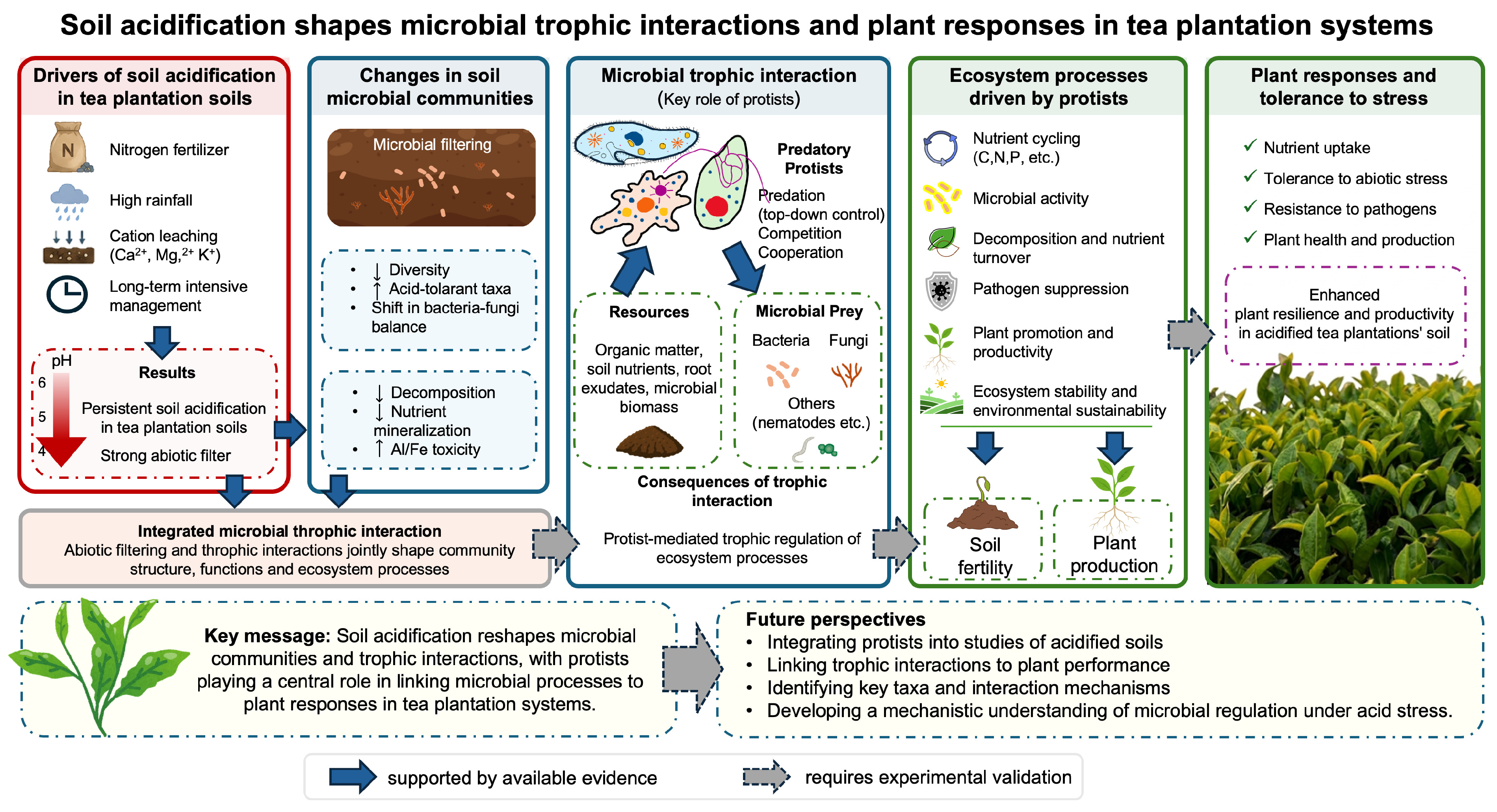
Soil Acidification Reshapes Microbial Trophic Interactions, with Implications for Plant Responses and Ecosystem Functioning in Tea Plantation Systems


Abstract
1. Introduction
2. Tea (Camellia sinensis) Plantations as Model Systems of Long-Term Soil Acidification
3. Microbial Communities in Tea (Camellia sinensis) Plantation Soils: Current Knowledge and Limitations
4. The Overlooked Role of Trophic Interactions in Acidified Soils
5. Trophic Interactions and Plant Responses to Soil Acidification
6. Future Research Priorities in Acidified Soils
7. Conclusions
Author Contributions
Funding
Data Availability Statement
Conflicts of Interest
References
- Yan, P.; Wu, L.; Wang, D.; Fu, J.; Shen, C.; Li, X.; Zhang, L.; Zhang, L.; Fan, L.; Wenyan, H. Soil Acidification in Chinese Tea Plantations. Sci. Total Environ. 2020, 715, 136963. [Google Scholar] [CrossRef] [PubMed]
- Guo, J.H.; Liu, X.J.; Zhang, Y.; Shen, J.L.; Han, W.X.; Zhang, W.F.; Christie, P.; Goulding, K.W.T.; Vitousek, P.M.; Zhang, F.S. Significant Acidification in Major Chinese Croplands. Science 2010, 327, 1008–1010. [Google Scholar] [CrossRef] [PubMed]
- Tian, D.; Niu, S. A Global Analysis of Soil Acidification Caused by Nitrogen Addition. Environ. Res. Lett. 2015, 10, 024019. [Google Scholar] [CrossRef]
- Zhu, Q.; Liu, X.; Hao, T.; Zeng, M.; Shen, J.; Zhang, F.; De Vries, W. Modeling Soil Acidification in Typical Chinese Cropping Systems. Sci. Total Environ. 2018, 613–614, 1339–1348. [Google Scholar] [CrossRef] [PubMed]
- Kochian, L.V.; Hoekenga, O.A.; Piñeros, M.A. How do crop plants tolerate acid soils? mechanisms of aluminum tolerance and phosphorous efficiency. Annu. Rev. Plant Biol. 2004, 55, 459–493. [Google Scholar] [CrossRef] [PubMed]
- Zheng, S.J. Crop Production on Acidic Soils: Overcoming Aluminium Toxicity and Phosphorus Deficiency. Ann. Bot. 2010, 106, 183–184. [Google Scholar] [CrossRef] [PubMed]
- Özyazıcı, M.A.; Dengiz, O.; Aydoğan, M. Reaction Changing and Distribution of Agricultural Land for Tea Cultivation. Soil Water J. 2013, 2, 23–29. [Google Scholar]
- Fierer, N.; Jackson, R.B. The Diversity and Biogeography of Soil Bacterial Communities. Proc. Natl. Acad. Sci. USA 2006, 103, 626–631. [Google Scholar] [CrossRef] [PubMed]
- Lauber, C.L.; Strickland, M.S.; Bradford, M.A.; Fierer, N. The Influence of Soil Properties on the Structure of Bacterial and Fungal Communities across Land-Use Types. Soil Biol. Biochem. 2008, 40, 2407–2415. [Google Scholar] [CrossRef]
- Rousk, J.; Bååth, E.; Brookes, P.C.; Lauber, C.L.; Lozupone, C.; Caporaso, J.G.; Knight, R.; Fierer, N. Soil Bacterial and Fungal Communities across a PH Gradient in an Arable Soil. ISME J. 2010, 4, 1340–1351. [Google Scholar] [CrossRef] [PubMed]
- Li, S.; Li, H.; Yang, C.; Wang, Y.; Xue, H.; Niu, Y. Rates of Soil Acidification in Tea Plantations and Possible Causes. Agric. Ecosyst. Environ. 2016, 233, 60–66. [Google Scholar] [CrossRef]
- Li, Z.; Gao, X.; Li, D.; Gao, J.; Li, J.; Cai, Z.; Sun, N.; Wu, L.; Xu, M. Differential Responses of Bacteria, Fungi, and C, N, P Functions to Soil Acidification in Farmland: A Meta-Analysis. Environ. Technol. Innov. 2025, 40, 104499. [Google Scholar] [CrossRef]
- Dong, X.; Yao, Y.; Han, B.; Rillig, M.C.; Zhong, Y.; Hu, H.; Li, Z. Anthropogenic Soil Acidification Severely Decreases Microbial Diversity and Functionality. Curr. Biol. 2026, 36, 1444–1453.e3. [Google Scholar] [CrossRef] [PubMed]
- Meng, C.; Tian, D.; Zeng, H.; Li, Z.; Yi, C.; Niu, S. Global Soil Acidification Impacts on Belowground Processes. Environ. Res. Lett. 2019, 14, 074003. [Google Scholar] [CrossRef]
- Wang, C.; Guo, L.; Shen, R.F. Rare Microbial Communities Drive Ecosystem Multifunctionality in Acidic Soils of Southern China. Appl. Soil Ecol. 2023, 189, 104895. [Google Scholar] [CrossRef]
- Bardgett, R.D.; van der Putten, W.H. Belowground Biodiversity and Ecosystem Functioning. Nature 2014, 515, 505–511. [Google Scholar] [CrossRef] [PubMed]
- Thakur, M.P.; Geisen, S. Trophic Regulations of the Soil Microbiome. Trends Microbiol. 2019, 27, 771–780. [Google Scholar] [CrossRef] [PubMed]
- Geisen, S.; Mitchell, E.A.D.; Adl, S.; Bonkowski, M.; Dunthorn, M.; Ekelund, F.; Fernández, L.D.; Jousset, A.; Krashevska, V.; Singer, D.; et al. Soil Protists: A Fertile Frontier in Soil Biology Research. FEMS Microbiol. Rev. 2018, 42, 293–323. [Google Scholar] [CrossRef] [PubMed]
- Gao, Z.; Karlsson, I.; Geisen, S.; Kowalchuk, G.; Jousset, A. Protists: Puppet Masters of the Rhizosphere Microbiome. Trends Plant Sci. 2019, 24, 165–176. [Google Scholar] [CrossRef] [PubMed]
- Oliverio, A.M.; Geisen, S.; Delgado-Baquerizo, M.; Maestre, F.T.; Turner, B.L.; Fierer, N. The Global-Scale Distributions of Soil Protists and Their Contributions to Belowground Systems. Sci. Adv. 2020, 6, eaax8787. [Google Scholar] [CrossRef] [PubMed]
- Bodur, S.O.; Fujino, M.; Asiloglu, R. Predatory Protists: The Key Players in the Quest for Sustainable Agricultural Practices. Tarım Bilim. Derg. 2024, 30, 436–443. [Google Scholar] [CrossRef]
- Dupont, A.Ö.C.; Griffiths, R.I.; Bell, T.; Bass, D. Differences in Soil Micro-eukaryotic Communities over Soil pH Gradients Are Strongly Driven by Parasites and Saprotrophs. Environ. Microbiol. 2016, 18, 2010–2024. [Google Scholar] [CrossRef] [PubMed]
- Asiloglu, R.; Kenya, K.; Samuel, S.O.; Sevilir, B.; Murase, J.; Suzuki, K.; Harada, N. Top-down Effects of Protists Are Greater than Bottom-up Effects of Fertilisers on the Formation of Bacterial Communities in a Paddy Field Soil. Soil Biol. Biochem. 2021, 156, 108186. [Google Scholar] [CrossRef]
- Bodur, S.O.; Samuel, S.O.; Polat, M.F.; Aycan, M.; Asiloglu, R. Protists Exhibit Community-Level Adaptation and Functional Redundancy under Gradient Soil Salinity. Sci. Total Environ. 2025, 981, 179606. [Google Scholar] [CrossRef] [PubMed]
- Zhao, Z.B.; He, J.Z.; Quan, Z.; Wu, C.F.; Sheng, R.; Zhang, L.M.; Geisen, S. Fertilization Changes Soil Microbiome Functioning, Especially Phagotrophic Protists. Soil Biol. Biochem. 2020, 148, 107863. [Google Scholar] [CrossRef]
- Hu, X.; Gu, H.; Liu, J.; Wei, D.; Zhu, P.; Cui, X.; Zhou, B.; Chen, X.; Jin, J.; Wang, G. Different Long-Term Fertilization Regimes Affect Soil Protists and Their Top-down Control on Bacterial and Fungal Communities in Mollisols. Sci. Total Environ. 2024, 908, 168049. [Google Scholar] [CrossRef] [PubMed]
- Bonkowski, M. Protozoa and Plant Growth: The Microbial Loop in Soil Revisited. New Phytol. 2004, 162, 617–631. [Google Scholar] [CrossRef] [PubMed]
- Trap, J.; Bonkowski, M.; Plassard, C.; Villenave, C.; Blanchart, E. Ecological Importance of Soil Bacterivores for Ecosystem Functions. Plant Soil 2016, 398, 1–24. [Google Scholar] [CrossRef]
- Fujino, M.; Bodur, S.O.; Harada, N.; Asiloglu, R. Guardians of Plant Health: Roles of Predatory Protists in the Pathogen Suppression. Plant Soil 2025, 509, 5–13. [Google Scholar] [CrossRef] [PubMed]
- Zhang, Y.; He, X.; Liang, H.; Zhao, J.; Zhang, Y.; Xu, C.; Shi, X. Long-Term Tobacco Plantation Induces Soil Acidification and Soil Base Cation Loss. Environ. Sci. Pollut. Res. 2016, 23, 5442–5450. [Google Scholar] [CrossRef]
- Cai, Z.; Wang, B.; Xu, M.; Zhang, H.; He, X.; Zhang, L.; Gao, S. Intensified Soil Acidification from Chemical N Fertilization and Prevention by Manure in an 18-Year Field Experiment in the Red Soil of Southern China. J. Soils Sediments 2015, 15, 260–270. [Google Scholar] [CrossRef]
- Yang, X.; Ni, K.; Shi, Y.; Yi, X.; Zhang, Q.; Fang, L.; Ma, L.; Ruan, J. Effects of Long-Term Nitrogen Application on Soil Acidification and Solution Chemistry of a Tea Plantation in China. Agric. Ecosyst. Environ. 2018, 252, 74–82. [Google Scholar] [CrossRef]
- Trivedi, P.; Leach, J.E.; Tringe, S.G.; Sa, T.; Singh, B.K. Plant–Microbiome Interactions: From Community Assembly to Plant Health. Nat. Rev. Microbiol. 2020, 18, 607–621. [Google Scholar] [CrossRef] [PubMed]
- Li, C.; Lu, X.; Chen, J.; Tan, Q.; Luo, G.; Wu, L.; Chen, F.; Ran, C.; Zhang, S.; Xiong, L.; et al. Silicate Chemical Weathering Disrupts the Global Patterns of Phosphorus Limitation. Nat. Commun. 2025, 16, 10742. [Google Scholar] [CrossRef] [PubMed]
- Andersson, M. Toxicity and Tolerance of Aluminium in Vascular Plants. Water Air Soil Pollut. 1988, 39, 439–462. [Google Scholar] [CrossRef]
- Lin, S.; Liu, Z.; Wang, Y.; Li, J.; Wang, G.; Zhang, W.; Wang, H.; He, H. Soil Acidification Associated with Changes in Inorganic Forms of N Reduces the Yield of Tea (Camellia sinensis). Arch. Agron. Soil Sci. 2023, 69, 1660–1673. [Google Scholar] [CrossRef]
- Lv, X.; Kong, H.; Luo, Y.; Dong, D.; Liu, W.; Wu, D.; Ye, Z.; Ma, J.; Liu, D. The Impact of Magnesium on the Growth, Physiology and Quality of Tea (Camellia sinensis L.) Plants under Acid Stress. Agronomy 2024, 14, 767. [Google Scholar] [CrossRef]
- Ye, F.; Luo, Z.; Ju, Y.; Huan, Q.; Liu, X. Roles of N and P in Soil Acidification, Metals Mobilization and Bioavailable Concentration-Based Soil Fertility Assessment in Tea Plantations in Yunnan, China. Agriculture 2025, 15, 543. [Google Scholar] [CrossRef]
- da Silva, R.C.; Guimarães, C.C.B.; de Azevedo, A.C.; Alves, M.R.; Demattê, J.A.M. Precipitation of Amorphous Iron and Aluminum during the Weathering of Rock Dust in Soil Columns. Sci. Agric. 2024, 81, e20230219. [Google Scholar] [CrossRef]
- Lee, K.K.; Liu, S.; Crocker, K.; Wang, J.; Huggins, D.R.; Tikhonov, M.; Mani, M.; Kuehn, S. Functional Regimes Define Soil Microbiome Response to Environmental Change. Nature 2025, 644, 1028–1038. [Google Scholar] [CrossRef] [PubMed]
- Kui, L.; Xiang, G.; Wang, Y.; Wang, Z.; Li, G.; Li, D.; Yan, J.; Ye, S.; Wang, C.; Yang, L.; et al. Large-Scale Characterization of the Soil Microbiome in Ancient Tea Plantations Using High-Throughput 16S RRNA and Internal Transcribed Spacer Amplicon Sequencing. Front. Microbiol. 2021, 12, 745225. [Google Scholar] [CrossRef] [PubMed]
- Ma, Z.; Tanalgo, K.C.; Xu, Q.; Li, W.; Wu, S.; Ji, Q.; Pan, G.; Wang, R. Influence of Tea- Pleurotus Ostreatus Intercropping on Soil Fungal Diversity and Community Structure. Can. J. Soil Sci. 2022, 102, 359–369. [Google Scholar] [CrossRef]
- Zhang, X.; Liu, W.; Zhang, G.; Jiang, L.; Han, X. Mechanisms of Soil Acidification Reducing Bacterial Diversity. Soil Biol. Biochem. 2015, 81, 275–281. [Google Scholar] [CrossRef]
- Ren, Y.; Xu, S.; Yan, Y.; Chen, Z.; Liu, L.; Zhou, X.; Cai, Z.; Huang, X. Defining PH-Associated Ecological Clusters and Their Responses to Agricultural Intensification. Geoderma 2025, 460, 117445. [Google Scholar] [CrossRef]
- Jones, R.T.; Robeson, M.S.; Lauber, C.L.; Hamady, M.; Knight, R.; Fierer, N. A Comprehensive Survey of Soil Acidobacterial Diversity Using Pyrosequencing and Clone Library Analyses. ISME J. 2009, 3, 442–453. [Google Scholar] [CrossRef] [PubMed]
- Hu, Z.; Delgado-Baquerizo, M.; Fanin, N.; Chen, X.; Zhou, Y.; Du, G.; Hu, F.; Jiang, L.; Hu, S.; Liu, M. Nutrient-Induced Acidification Modulates Soil Biodiversity-Function Relationships. Nat. Commun. 2024, 15, 2858. [Google Scholar] [CrossRef] [PubMed]
- Nicol, G.W.; Leininger, S.; Schleper, C.; Prosser, J.I. The Influence of Soil PH on the Diversity, Abundance and Transcriptional Activity of Ammonia Oxidizing Archaea and Bacteria. Environ. Microbiol. 2008, 10, 2966–2978. [Google Scholar] [CrossRef] [PubMed]
- Li, X.; Chen, D.; Carrión, V.J.; Revillini, D.; Yin, S.; Dong, Y.; Zhang, T.; Wang, X.; Delgado-Baquerizo, M. Acidification Suppresses the Natural Capacity of Soil Microbiome to Fight Pathogenic Fusarium Infections. Nat. Commun. 2023, 14, 5090. [Google Scholar] [CrossRef] [PubMed]
- Xiao, H.; Wang, B.; Lu, S.; Chen, D.; Wu, Y.; Zhu, Y.; Hu, S.; Bai, Y. Soil Acidification Reduces the Effects of Short-term Nutrient Enrichment on Plant and Soil Biota and Their Interactions in Grasslands. Glob. Change Biol. 2020, 26, 4626–4637. [Google Scholar] [CrossRef] [PubMed]
- Ye, G.; Lin, Y.; Liu, D.; Chen, Z.; Luo, J.; Bolan, N.; Fan, J.; Ding, W. Long-Term Application of Manure over Plant Residues Mitigates Acidification, Builds Soil Organic Carbon and Shifts Prokaryotic Diversity in Acidic Ultisols. Appl. Soil Ecol. 2019, 133, 24–33. [Google Scholar] [CrossRef]
- Cezar, R.M.; Vezzani, F.M.; Joris, H.A.W.; Barth, G.; Kaschuk, G. Crop Rotation Restructures Soil Microbial Communities in Subtropical Oxisol, South Brazil. Sci. Agric. 2025, 82, e20240134. [Google Scholar] [CrossRef]
- Fang, X.; Ji, L.; Zhu, C.; Chen, S.; Ni, K.; Wang, Y.; Ren, H.; Yang, Y. Understanding and Managing Soil Microorganisms for Sustainable Tea Production: A Review of Current Knowledge and Future Perspectives. Beverage Plant Res. 2026, 6, e010. [Google Scholar] [CrossRef]
- Chen, X.; Lin, M.; Wu, Z.; Yu, L.; Guo, Q. Long-Term Tea Cultivation Degrades Soil Health: Insights from Microbial Structure and Function in Tea Gardens. Soil Ecol. Lett. 2025, 7, 250347. [Google Scholar] [CrossRef]
- Lin, S.; Wang, T.; Zheng, J.; Lin, W.; Jia, X.; Zhang, Q.; Wang, Y.; Ye, J.; Wang, H. Soil Acidification Alters Phosphorus Fractions and PhoD-Harboring Microbial Communities in Tea Plantation Soils, Thus Affecting Tea Yield and Quality. Horticulturae 2025, 11, 1191. [Google Scholar] [CrossRef]
- Zheng, X.; Wu, Y.; Xu, A.; Lin, C.; Wang, H.; Yu, J.; Ding, H.; Zhang, Y. Response of Soil Microbial Communities and Functions to Long-Term Tea (Camellia sinensis L.) Planting in a Subtropical Region. Forests 2023, 14, 1288. [Google Scholar] [CrossRef]
- Gu, S.; Hu, Q.; Cheng, Y.; Bai, L.; Liu, Z.; Xiao, W.; Gong, Z.; Wu, Y.; Feng, K.; Deng, Y.; et al. Application of Organic Fertilizer Improves Microbial Community Diversity and Alters Microbial Network Structure in Tea (Camellia sinensis) Plantation Soils. Soil Tillage Res. 2019, 195, 104356. [Google Scholar] [CrossRef]
- Huang, X.; Wang, B.; Li, P.; Chen, A.; Cui, J.; Chen, Y.; Gao, W. Organic Management Promotes Nitrogen Transformation in Tea Plantations Soil: A Case Study from Southwestern China. Appl. Soil Ecol. 2025, 206, 105878. [Google Scholar] [CrossRef]
- Widder, S.; Allen, R.J.; Pfeiffer, T.; Curtis, T.P.; Wiuf, C.; Sloan, W.T.; Cordero, O.X.; Brown, S.P.; Momeni, B.; Shou, W.; et al. Challenges in Microbial Ecology: Building Predictive Understanding of Community Function and Dynamics. ISME J. 2016, 10, 2557–2568. [Google Scholar] [CrossRef] [PubMed]
- Bodur, S.O.; Suzuki, K.; Harada, N.; Asiloglu, R. Top-down Predators Shape Soil Bacterial Community Composition While Bottom-up Nutrients Drive Bacterial Abundance. Sci. Total Environ. 2024, 957, 177634. [Google Scholar] [CrossRef] [PubMed]
- Murase, J.; Asiloglu, R. Protists: The Hidden Ecosystem Players in a Wetland Rice Field Soil. Biol. Fertil. Soils 2024, 60, 773–787. [Google Scholar] [CrossRef]
- Xiong, W.; Song, Y.; Yang, K.; Gu, Y.; Wei, Z.; Kowalchuk, G.A.; Xu, Y.; Jousset, A.; Shen, Q.; Geisen, S. Rhizosphere Protists Are Key Determinants of Plant Health. Microbiome 2020, 8, 27. [Google Scholar] [CrossRef] [PubMed]
- Guo, S.; Tao, C.; Jousset, A.; Xiong, W.; Wang, Z.; Shen, Z.; Wang, B.; Xu, Z.; Gao, Z.; Liu, S.; et al. Trophic Interactions between Predatory Protists and Pathogen-Suppressive Bacteria Impact Plant Health. ISME J. 2022, 16, 1932–1943. [Google Scholar] [CrossRef] [PubMed]
- Asiloglu, R.; Shiroishi, K.; Suzuki, K.; Turgay, O.C.; Murase, J.; Harada, N. Protist-Enhanced Survival of a Plant Growth Promoting Rhizobacteria, Azospirillum sp. B510, and the Growth of Rice (Oryza sativa L.) Plants. Appl. Soil Ecol. 2020, 154, 103599. [Google Scholar] [CrossRef]
- Asiloglu, R.; Bodur, S.O.; Samuel, S.O.; Aycan, M.; Murase, J.; Harada, N. Trophic Modulation of Endophytes by Rhizosphere Protists. ISME J. 2024, 18, wrae235. [Google Scholar] [CrossRef] [PubMed]
- Singer, D.; Seppey, C.V.W.; Lentendu, G.; Dunthorn, M.; Bass, D.; Belbahri, L.; Blandenier, Q.; Debroas, D.; de Groot, G.A.; de Vargas, C.; et al. Protist Taxonomic and Functional Diversity in Soil, Freshwater and Marine Ecosystems. Environ. Int. 2021, 146, 106262. [Google Scholar] [CrossRef] [PubMed]
- Geisen, S.; Koller, R.; Hünninghaus, M.; Dumack, K.; Urich, T.; Bonkowski, M. The Soil Food Web Revisited: Diverse and Widespread Mycophagous Soil Protists. Soil Biol. Biochem. 2016, 94, 10–18. [Google Scholar] [CrossRef]
- Wardle, D.A.; Bardgett, R.D.; Klironomos, J.N.; Setälä, H.; van der Putten, W.H.; Wall, D.H. Ecological Linkages Between Aboveground and Belowground Biota. Science 2004, 304, 1629–1633. [Google Scholar] [CrossRef] [PubMed]
- Buchkowski, R.W. Top-down Consumptive and Trait-Mediated Control Do Affect Soil Food Webs: It’s Time for a New Model. Soil Biol. Biochem. 2016, 102, 29–32. [Google Scholar] [CrossRef]
- Xue, P.; Minasny, B.; McBratney, A.; Jiang, Y.; Luo, Y. Land Use Effects on Soil Protists and Their Top-down Regulation on Bacteria and Fungi in Soil Profiles. Appl. Soil Ecol. 2023, 185, 104799. [Google Scholar] [CrossRef]
- Asiloglu, R.; Kuno, H.; Fujino, M.; Bodur, S.; Aycan, M.; Ishizuka, H.; Kazama, S.; Iwasaki, S.; Murase, J.; Harada, N.; et al. Predator-Mediated Local Convergence Fosters Global Microbial Community Divergence. Nat. Commun. 2026, 17, 2499. [Google Scholar] [CrossRef] [PubMed]
- Buchkowski, R.W.; Bradford, M.A.; Grandy, A.S.; Schmitz, O.J.; Wieder, W.R. Applying Population and Community Ecology Theory to Advance Understanding of Belowground Biogeochemistry. Ecol. Lett. 2017, 20, 231–245. [Google Scholar] [CrossRef] [PubMed]
- Graham, E.B.; Knelman, J.E.; Schindlbacher, A.; Siciliano, S.; Breulmann, M.; Yannarell, A.; Beman, J.M.; Abell, G.; Philippot, L.; Prosser, J.; et al. Microbes as Engines of Ecosystem Function: When Does Community Structure Enhance Predictions of Ecosystem Processes? Front. Microbiol. 2016, 7, 214. [Google Scholar] [CrossRef] [PubMed]
- Asiloglu, R. Biochar–Microbe Interaction: More Protist Research Is Needed. Biochar 2022, 4, 72. [Google Scholar] [CrossRef]
- Geisen, S.; Tveit, A.T.; Clark, I.M.; Richter, A.; Svenning, M.M.; Bonkowski, M.; Urich, T. Metatranscriptomic Census of Active Protists in Soils. ISME J. 2015, 9, 2178–2190. [Google Scholar] [CrossRef] [PubMed]
- Liu, J.; Wang, Y.; Li, Y.; Peñuelas, J.; Zhao, Y.; Sardans, J.; Tetzlaff, D.; Liu, J.; Liu, X.; Yuan, H.; et al. Soil Ecological Stoichiometry Synchronously Regulates Stream Nitrogen and Phosphorus Concentrations and Ratios. Catena 2023, 231, 107357. [Google Scholar] [CrossRef]
- Guerrier, S.; Plattner, H.; Richardson, E.; Dacks, J.B.; Turkewitz, A.P. An Evolutionary Balance: Conservation vs Innovation in Ciliate Membrane Trafficking. Traffic 2017, 18, 18–28. [Google Scholar] [CrossRef] [PubMed]
- Fok, A.K.; Paeste, R.M. Lysosomal Enzymes of Paramecium caudatum and Paramecium tetraurelia. Exp. Cell Res. 1982, 139, 159–169. [Google Scholar] [CrossRef] [PubMed]
- Yuan, J.C.; Liu, J.Z.; Fan, W.; Liang, Y.; Cheng, S.; Zhang, S.M.; Zhang, C.; Ren, J.; Cai, H.G. Yield Benefit and Soil Fertility Improved by Different Fertilizer Application Placements and Supplementary Organic Manure in Maize (Zea mays L.). Sci. Agric. 2024, 81, e20230057. [Google Scholar] [CrossRef]
- Lopes, E.M.G.; Mota, M.F.C.; dos Santos Júnior, J.M.; Reis, M.M.; Frazão, L.A.; Fernandes, L.A. Biochar Alters the Soil Microbiological Activity of Sugarcane Fields over Time. Sci. Agric. 2024, 81, e20230289. [Google Scholar] [CrossRef]
- Bodur, S.O.; Samuel, S.O.; Suzuki, K.; Harada, N.; Asiloglu, R. Nitrogen-Based Fertilizers Differentially Affect Protist Community Composition in Paddy Field Soils. Soil Ecol. Lett. 2024, 6, 230221. [Google Scholar] [CrossRef]
- Asiloglu, R.; Samuel, S.O.; Sevilir, B.; Akca, M.O.; Acar Bozkurt, P.; Suzuki, K.; Murase, J.; Turgay, O.C.; Harada, N. Biochar Affects Taxonomic and Functional Community Composition of Protists. Biol. Fertil. Soils 2021, 57, 15–29. [Google Scholar] [CrossRef]
- Martinez, H.E.P.; de Andrade, S.A.L.; Santos, R.H.S.; Baptistella, J.L.C.; Mazzafera, P. Agronomic Practices toward Coffee Sustainability. Rev. Agric. Sci. 2024, 81, e20220277. [Google Scholar] [CrossRef]
- Clarholm, M. Interactions of Bacteria, Protozoa and Plants Leading to Mineralization of Soil Nitrogen. Soil Biol. Biochem. 1985, 17, 181–187. [Google Scholar] [CrossRef]


| Study Focus | Environmental Change | Microbiome Response | Reference |
|---|---|---|---|
| Comparison of long-term tea cultivation and adjacent natural forest | Long-term tea cultivation reduced soil pH and overall soil health | Reduced bacterial and fungal biomass, lower alpha diversity, and bacterial and fungal communities differed from adjacent forests | [53] |
| Soil acidification, phosphorus fractions, and phosphorus-cycling microbes | Soil acidification altered phosphorus fractions and availability | Altered phosphorus-cycling microbial communities | [54] |
| Long-term tea cultivation | Long-term cultivation altered soil properties and promoted acidification | Altered microbial community composition and functional potential | [55] |
| Large-scale characterization of ancient tea plantation soils | Variation in soil physicochemical properties across tea plantations | Distinct bacterial and fungal community compositions associated with soil characteristics | [41] |
| Conversion of forestland to tea plantations | Land-use conversion modified soil environmental conditions | Significant shifts in fungal community composition and ecological functions | [15] |
| Tea–Pleurotus ostreatus intercropping | Intercropping modified rhizosphere conditions | Altered fungal diversity and community structure | [42] |
| Organic fertilizer application | Organic fertilization modified soil conditions | Increased microbial diversity and altered microbial network structure | [56] |
| Organic management and nitrogen transformation | Organic management altered nutrient dynamics and soil functioning | Enhanced nitrogen transformation and microbial functional activity | [57] |
| Ecological Dimension | Known Acidification-Related Changes | Potential Protist-Mediated Trophic Roles | Possible Ecosystem and Plant Implications |
|---|---|---|---|
| Microbial community assembly | Reduced bacterial diversity; shifts toward acid-tolerant taxa; altered bacterial–fungal balance [8,10,43] | Altered prey availability; shifts in grazing selectivity; potential restructuring of bacterial and fungal communities through selective predation [17,19,24,59] | Altered microbiome stability and functional redundancy |
| Nutrient cycling | Reduced decomposition, nutrient mineralization, and nitrogen transformations under low pH [12,13,47] | Sustained microbial turnover through grazing; enhanced nutrient release via the microbial loop; potential support of N and P availability [17,18,27,28] | Changes in nutrient availability and plant nutrient acquisition |
| Microbial interactions | Disrupted microbial coexistence patterns; altered interaction networks; reduced ecosystem multifunctionality under acid stress [14,17,46,58] | Altered predator–prey encounter rates; shifts in prey preference; changes in the strength of top-down control [17,18,21,60] | Altered microbial network stability and ecosystem functioning |
| Pathogen suppression | Altered disease-suppressive microbiomes and weakened microbiome-mediated plant protection [48] | Promotion or destabilization of pathogen-suppressive microbial taxa; reshaping of suppressive microbiome functioning [29,61,62] | Changes in disease suppression and plant health |
| Plant responses | Nutrient limitation, aluminum toxicity, and altered stress responses under acidic conditions [5,6,14] | Modulation of rhizosphere functioning, nutrient uptake, and plant-associated microbiomes [63,64] | Feedbacks on stress tolerance and plant performance |
| Tea plantation soils | Chronic soil acidification driven by long-term fertilization and high rainfall [1,32] | Selection of acid-tolerant protist taxa; restructuring of microbial food webs under chronic low-pH conditions [19,65,66] | Model system for linking acidification, trophic regulation, and plant performance |
Disclaimer/Publisher’s Note: The statements, opinions and data contained in all publications are solely those of the individual author(s) and contributor(s) and not of MDPI and/or the editor(s). MDPI and/or the editor(s) disclaim responsibility for any injury to people or property resulting from any ideas, methods, instructions or products referred to in the content. |
© 2026 by the authors. Licensee MDPI, Basel, Switzerland. This article is an open access article distributed under the terms and conditions of the Creative Commons Attribution (CC BY) license.
Share and Cite
Bodur, S.; Asiloglu, R.; Yazici, K. Soil Acidification Reshapes Microbial Trophic Interactions, with Implications for Plant Responses and Ecosystem Functioning in Tea Plantation Systems. Plants 2026, 15, 1929. https://doi.org/10.3390/plants15131929
Bodur S, Asiloglu R, Yazici K. Soil Acidification Reshapes Microbial Trophic Interactions, with Implications for Plant Responses and Ecosystem Functioning in Tea Plantation Systems. Plants. 2026; 15(13):1929. https://doi.org/10.3390/plants15131929
Chicago/Turabian StyleBodur, Seda, Rasit Asiloglu, and Keziban Yazici. 2026. "Soil Acidification Reshapes Microbial Trophic Interactions, with Implications for Plant Responses and Ecosystem Functioning in Tea Plantation Systems" Plants 15, no. 13: 1929. https://doi.org/10.3390/plants15131929
APA StyleBodur, S., Asiloglu, R., & Yazici, K. (2026). Soil Acidification Reshapes Microbial Trophic Interactions, with Implications for Plant Responses and Ecosystem Functioning in Tea Plantation Systems. Plants, 15(13), 1929. https://doi.org/10.3390/plants15131929