Article

Correlative Changes in Endogenous Polyamines and Hormones Associated with Aging in Ancient Cinnamomum camphora


1
College of Forestry, Fujian Agriculture and Forestry University, Fuzhou 350002, China
2
Department of Forest and Conservation Sciences, Faculty of Forestry, University of British Columbia, 2424 Main Mall, Vancouver, BC V6T 1Z4, Canada
3
Ministry of Education International Joint Laboratory on Genetic Improvement of Multiple Cropping Crops, Jiangxi Agricultural University, Nanchang 330045, China
*
Authors to whom correspondence should be addressed.
Plants 2026, 15(11), 1752; https://doi.org/10.3390/plants15111752
Submission received: 5 May 2026 / Revised: 25 May 2026 / Accepted: 2 June 2026 / Published: 4 June 2026
(This article belongs to the Section Plant Physiology and Metabolism)

Abstract

Plant aging and senescence are key determinants of lifespan, yet the coordinated changes in endogenous polyamines and hormones during long-lived tree aging remain largely unclear. Cinnamomum camphora exhibits sequential senescence from leaves to trunk, with leaf physiology shifting toward senescence around 450 years. This study aimed to clarify the patterns of polyamines and hormones across a wide age gradient (10–810 years) and their associations with aging in ancient C. camphora. Newly expanded leaves were analyzed using curve fitting, correlation, regression, and path analysis. Tree age significantly influenced most polyamine and hormone indices, except for indole-3-acetic acid (IAA), abscisic acid (ABA), and salicylate glucoside (SAG). Spermidine (Spd) and gibberellic acid (GA) were negatively correlated with aging, and cytokinin (CK) and cadaverine (Cad) were positively correlated with aging. Free salicylic acid (SAF) was closely related to the senescence transition point. Polyamines and hormones interacted strongly. Cad was positively correlated with CK, and Spd was positively correlated with GA. A model combining Spd, GA/ABA, and CK/GA reliably predicted ancient tree age. Overall, Spd and CK exhibited the strongest negative and positive correlations with aging, respectively, providing insights into the physiological regulation of longevity in ancient trees.

1. Introduction

Aging and death are inevitable outcomes for plants, influenced by both genetic and external factors [1,2]. As plants age, they undergo gradual physiological changes [3]. This process involves slow, cumulative alterations that accumulate over development [4]. Senescence represents the final stage of aging, characterized by gradual functional decline or death of plant organs or tissues [5,6]. Therefore, aging and senescence collectively contribute to the lifespan of plants. These processes can be observed at three levels: the cell, tissue, and whole plant [7]. While recent research has predominantly focused on cellular and tissue-level aging and senescence, further insights are still needed to fully understand plant longevity [8,9].
Plant endogenous hormones and polyamines are widely reported to correlate with aging and senescence in cells and tissues [10,11]. Endogenous hormones in plants, such as indole-3-acetic acid (IAA), cytokinin (CK), gibberellin acid (GA), abscisic acid (ABA), and salicylic acid (SA), are synthesized within the plant and show strong physiological potential. Small changes in their levels and balance can be related to leaf or organ aging [12,13,14]. Research has shown that SA and ABA can be associated with accelerated aging [14,15], while CK, IAA, and GA can be associated with delayed aging [16,17]. However, some studies suggest that ABA and GA may not be clearly linked to aging [18,19]. Additionally, SA has been found to be associated with senescence in leaves but with delayed senescence in fruit organs [14,20]. Recent studies indicate that the ratios of IAA, ABA, GA, and CK are more strongly related to aging and senescence than individual hormones levels [12].
Polyamines (PAs), which are low-molecular-weight aliphatic nitrogenous bases with strong physiological activity, are related to cell growth, differentiation, proliferation, and senescence [21]. Common PAs include putrescine (Put), spermidine (Spd), spermine (Spm), and cadaverine (Cad) [22]. Different types of PAs show varying patterns with organ and cell aging and senescence [11,23]. Some studies have shown that endogenous PA levels in plant tissues decrease with organ age [24,25,26], while others have observed an initial increase followed by a decrease in PA content [27]. In summary, while progress has been made in understanding relationships between plant endogenous hormones, polyamines, and aging, controversy remains regarding their directional correlations with aging and senescence in cells and tissues. Moreover, whether endogenous hormones and PAs are more strongly affected by age or by the environment, and how their interactions correlate with aging and senescence, require further investigation.
Previous studies on plant aging and senescence related to endogenous hormones and PAs have predominantly focused on annual or perennial herbs, with relatively few investigations into perennial woody plants [28,29]. Ancient trees, generally defined as those over 100 years old [30], undergo a gradual process of aging and senescence [31]. Research into the aging and senescence of ancient trees not only helps us understand patterns related to longevity but also aids in rejuvenating these trees [11]. Timely detection of physiological senescence in ancient trees and implementing appropriate rejuvenation measures can help reduce their decline and death, thereby preserving historical landscapes [32,33]. In the Sanming area of China, within a 12 km radius, Cinnamomum camphora trees ranging from 100 to 800 years old have been preserved. This provides a unique opportunity to study plant longevity by examining the aging and senescence in perennial woody plants under relatively consistent environmental conditions. According to previous research, C. camphora undergoes programmed senescence from outside to inside, in the order of leaves, branches to the center growth (trunk). The center growth (crown width and diameter at breast height) of C. camphora remains vigorous growth within 0–800 years, but leaf physiological metabolism shifts toward senescence at 450 years [34]. Therefore, the leaves of ancient C. camphora trees can serve as an ideal model for researching this topic.
To better understand patterns related to plant longevity, it is important to explore relationships between aging and endogenous hormones and PAs. This study focused on the new leaves of ancient C. camphora trees, analyzing changes in endogenous PAs and hormone indices across ages ranging from 10 to 810 years. Using curve fitting, regression, and correlation analysis, we identified indices correlated aging and senescence, evaluated their statistical relationships, and developed a method to predict the age of ancient trees. By employing correlation and path analyses, we investigated the interrelationships between endogenous hormones and PAs to characterize patterns underlying the longevity of ancient trees.

2. Results

2.1. Tree Age and Endogenous Polyamine Content

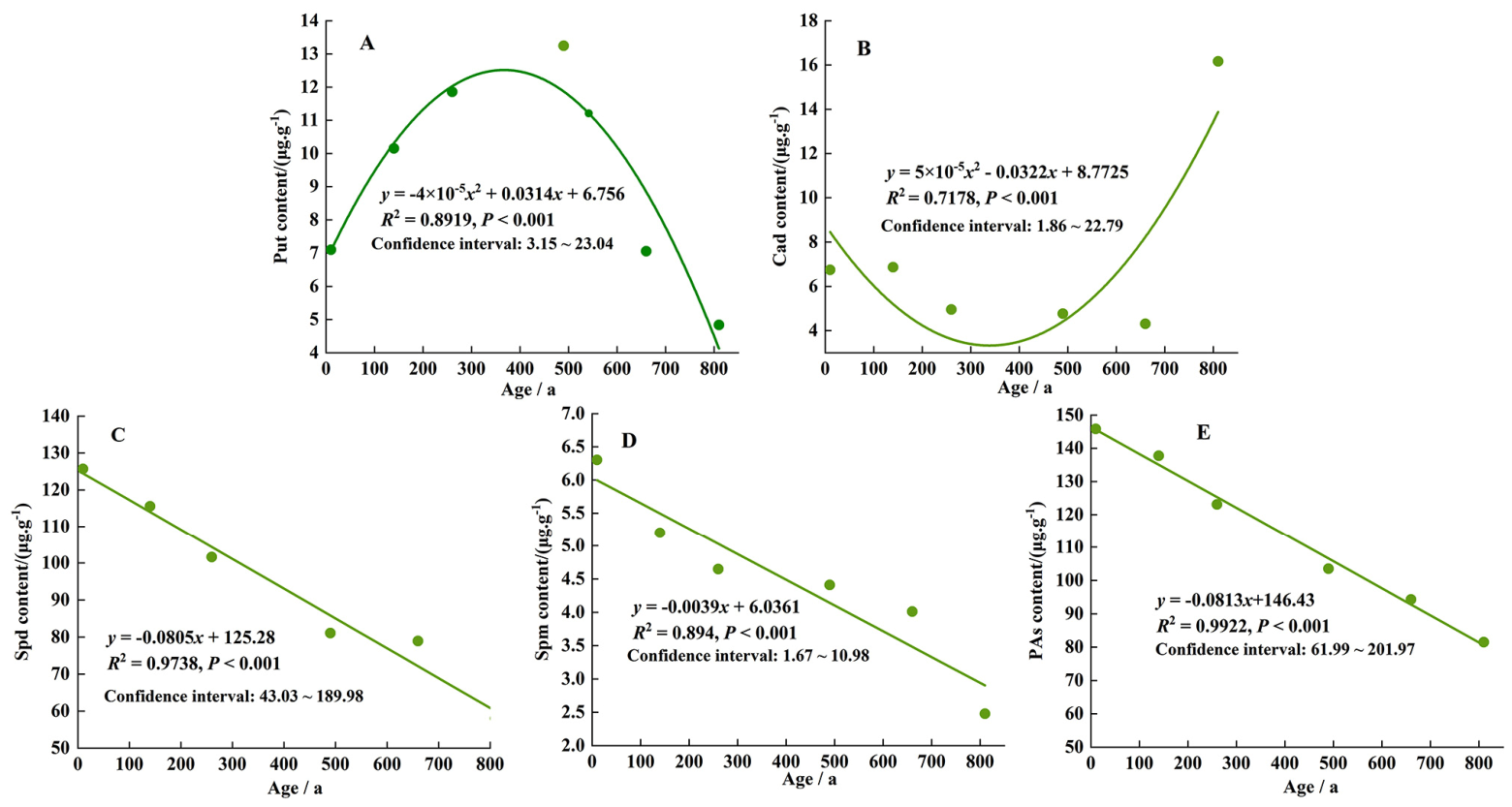
Contents of putrescine (Put), cadaverine (Cad), spermidine (Spd), spermine (Spm), and total polyamines (PAs) were significantly affected by the age of C. camphora trees (Figure 1). Curve fitting between polyamine contents and tree age yielded R2 > 0.71. Descending order of R2 were PAs, Spd, Spm, Put, and Cad. Contents of Put and Cad followed binomial models, while PAs, Spd and Spm followed linear models. As tree age increased, Put content initially increased and peaked at approximately 350 years, respectively. Meanwhile, contents of PAs, Spm and Spd decreased with tree age.

2.2. Tree Age and Endogenous Hormone Content

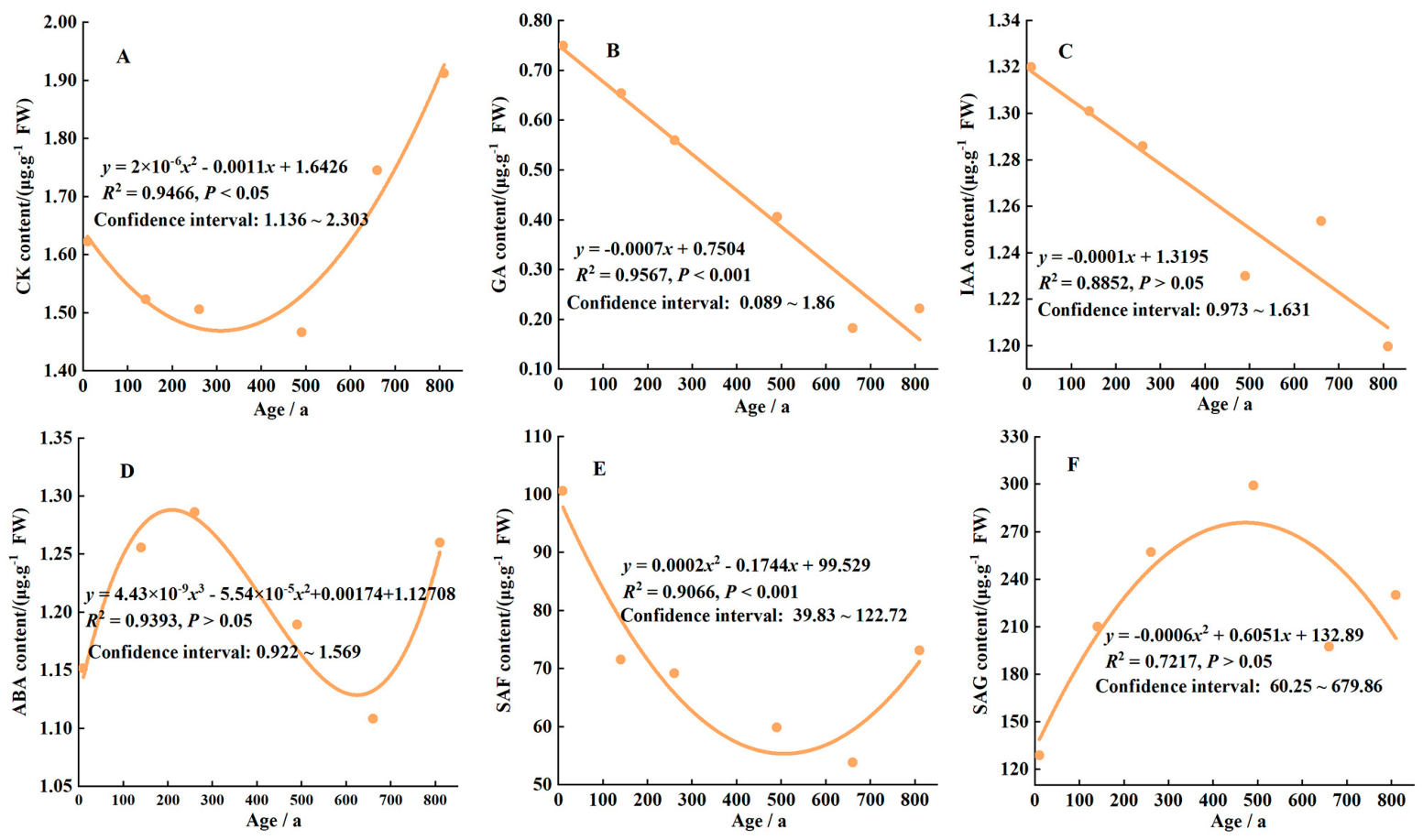
Contents of gibberellin (GA) and free salicylic acid (SAF) were extremely significantly affected by the tree age, while cytokinins (CK) content was significantly affected. In contrast, contents of indole-3-acetic acid (IAA), abscisic acid (ABA), and bound salicylic acid (SAG) were not significantly affected (Figure 2). Curve fitting between hormone contents and tree age yielded R2 > 0.72. Descending order of R2 was GA, CK, ABA, SAF, IAA, and SAG. Contents of CK, SAF, and SAG followed binomial models, GA and IAA followed linear models, and ABA content followed a piecewise plateau curve model. As tree age increased, CK and SAF contents first decreased and then increased, reaching minima at approximately 350 and 450 years, respectively. SAG content increased initially and then decreased, peaking at around 450 years. GA and IAA contents both decreased with increasing tree age. ABA content increased initially, then decreased, and increased again, reaching its highest point at about 200 years and lowest at about 600 years.

2.3. Tree Age and Endogenous Hormone Ratios

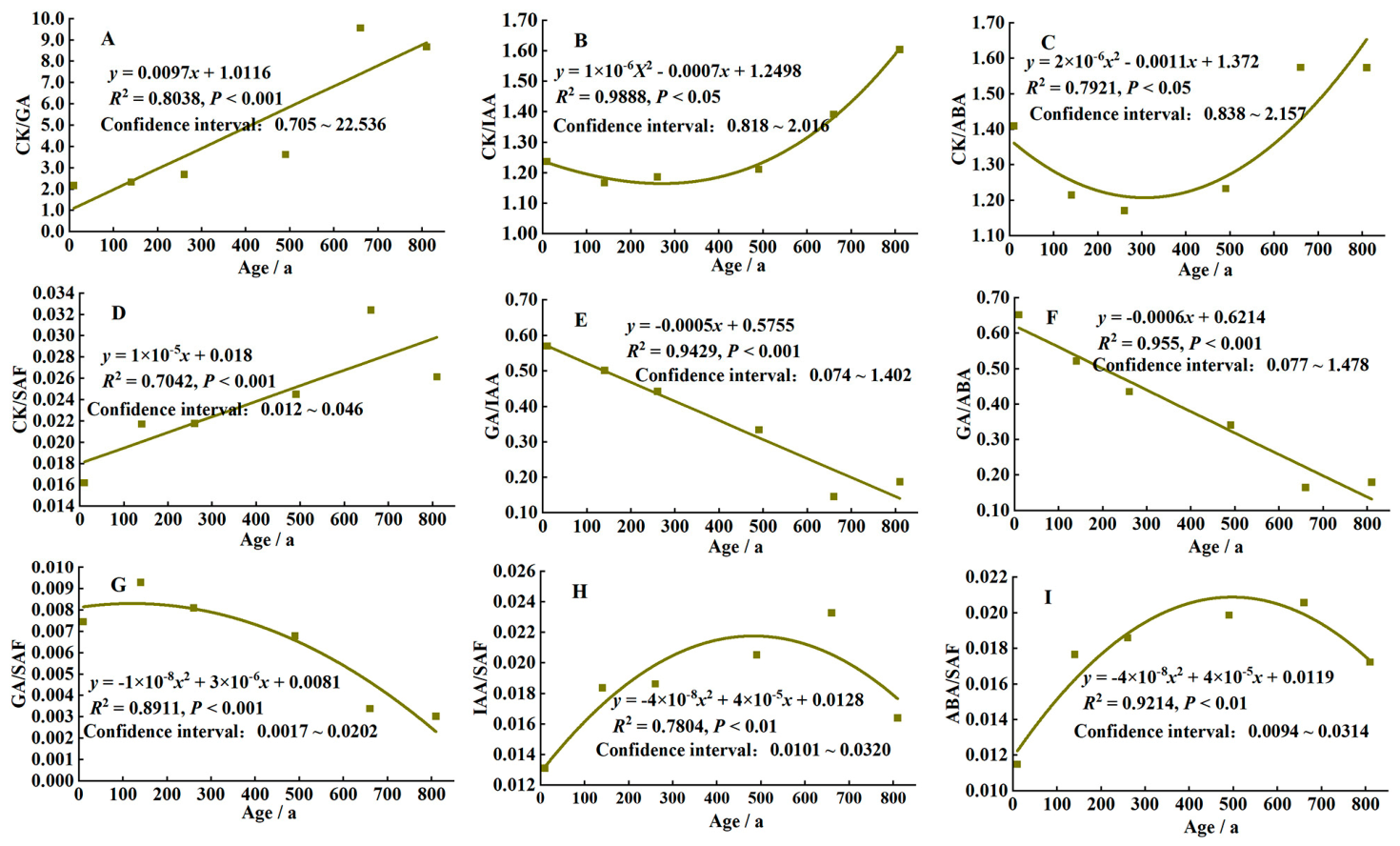
Tree age significantly affected the ratios CK/GA, CK/SAF, GA/IAA, GA/ABA, GA/SAF, IAA/SAF, and ABA/SAF, and also significantly affected CK/IAA, and CK/ABA ratios (Figure 3). Curve fitting between hormone ratios and the age yielded R2 > 0.70. Descending order of R2 was CK/IAA, GA/ABA, GA/IAA, ABA/SAF, GA/SAF, CK/GA, CK/ABA, IAA/SAF, and CK/SAF. Ratio CK/GA, CK/SAF, GA/IAA, GA/ABA and GA/SAF fit linear models, while CK/IAA, CK/ABA, IAA/SAF, and ABA/SAF fit binomial models. As tree age increased, ratios CK/GA and CK/SAF increased, whereas ratios GA/IAA, GA/ABA, and GA/SAF decreased. Ratios CK/IAA and CK/ABA first decreased and then increased, reaching their lowest point around 350 years. In contrast, ratios IAA/SAF and ABA/SAF increased initially and then decreased, peaking around 450 years.

2.4. Age and Environmental Effects

Age-associated effect was greater than the environmental effect for all polyamines contents. Average age-associated effect value was 0.96; the three strongest age-related indices were Cad, Spd, and PAs contents (Table 1).
Average age-associated effect of endogenous hormones indices was 0.73, and age-associated effects were stronger for hormone ratios than for individual contents. For IAA and SAG contents, environmental effects were greater than the age-associated effects. However, for Contents of CK, GA, ABA, and SAF, as well as all measured hormone ratios, age-associated effects were greater than the environmental effects (Table 2).

2.5. Path Analysis of Aging-Related Indices

Path analysis with tree age as the dependent variable and polyamine and hormone contents as independent variables showed that total coefficients of CK and Cad were positive, with CK > Cad content, indicating that CK and Cad contents were positively associated with aging. However, the direct coefficient of CK was near zero, indicating that CK positively associated with aging mainly through indirect effects, while its direct effect was negligible. Total coefficients of Put, Spd, Spm, GA, IAA, and SAF contents were negative, in absolute order with Spd > GA > Spm > SAF > Put > IAA (Table 3). This indicates that these six indices were negatively associated with aging, with Spd showing the strongest negative correlation, followed by GA, Spm, SAF, Put, and IAA. The total coefficient of ABA content was near zero, indicating little correlation between ABA and aging.

2.6. Correlation Analysis

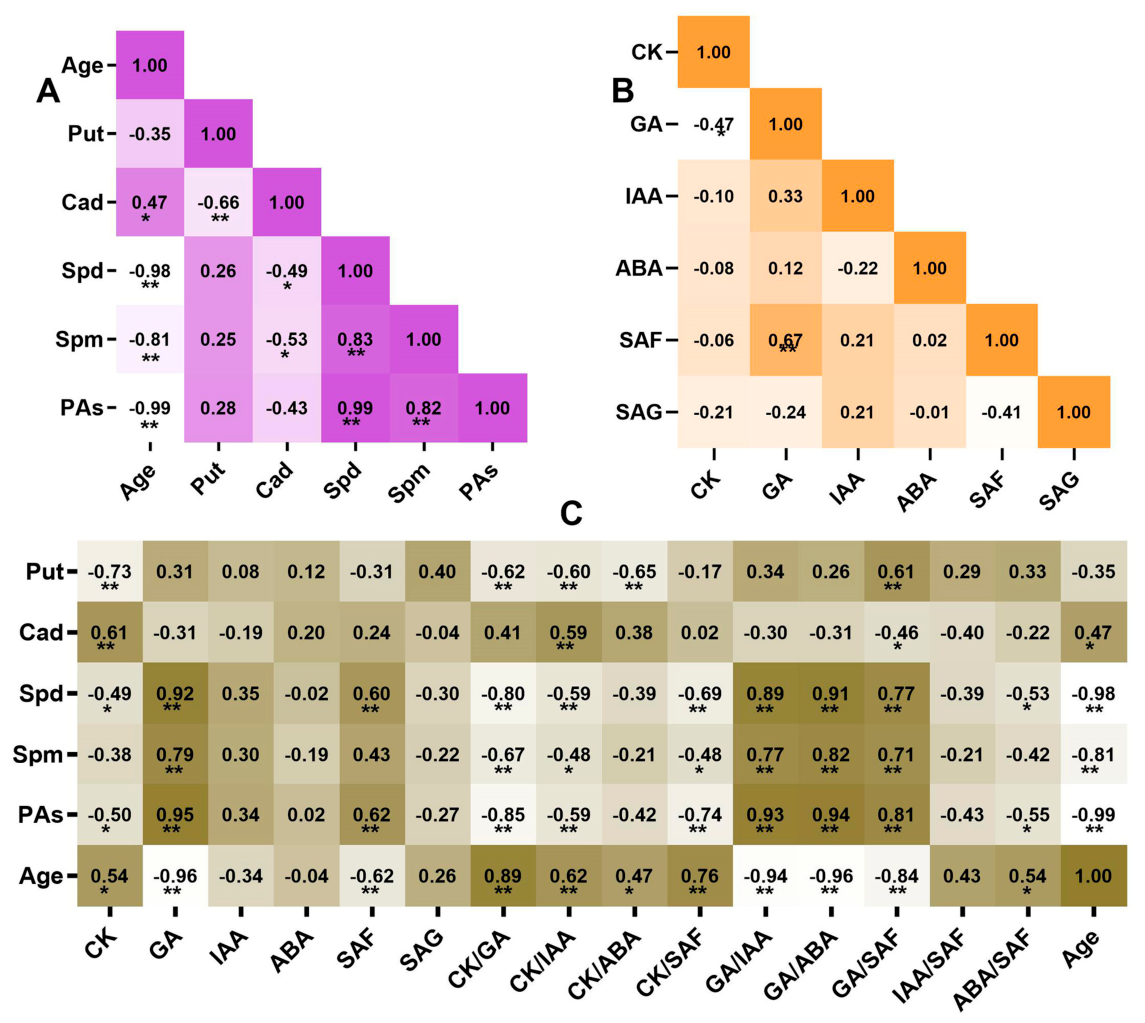
Correlation among polyamines showed that Put content was significantly negatively correlated with Cad content. Cad content was significantly negatively correlated with Spd and Spm contents. Spd content was strongly positively correlated with Spm and PAs contents. Spm content was strongly positively correlated with PAs content (Figure 4A). For hormones, CK content was negatively correlated with GA content. GA content was strongly positively correlated with SAF content (Figure 4B).
Tree age showed a strong positive correlation with CK/GA, CK/IAA, CK/SAF ratio, CK content, CK/ABA, and ABA/SAF ratio. Conversely, tree age was strongly negatively correlated with GA and SAF content, GA/IAA, GA/ABA, and GA/SAF ratio. Tree age was positively correlated with Cad content and negatively correlated with Spd, Spm, and PAs content (Figure 4C).
CK content was highly significantly positively correlated with Cad content, and highly significantly or significantly negatively correlated with Put, Spd, and PAs content. GA content showed a highly significant positive correlation with Spd, Spm, and PAs content. SAF content was highly significantly positively correlated with Spd and PAs content. The CK/GA ratio was highly significantly negatively correlated with Put, Spd, Spm, and PAs content. The CK/IAA ratio was highly significantly positively correlated with Cad content, and highly significantly or significantly correlated with Put, Spd, Spm, and PAs content. The CK/ABA ratio exhibited a highly significant negative correlation with Put content. The CK/SAF ratio was highly significantly or significantly negatively correlated with Spd, Spm, and PAs content. Both the GA/IAA and GA/ABA ratios were highly significantly positively correlated with Spd, Spm, and PAs content. The GA/SAF ratio was significantly negatively correlated with Cad content but highly significantly positively correlated with Put, Spd, Spm, and PAs content. Lastly, the ABA/SAF ratio was significantly negatively correlated with Spd and PAs content (Figure 4C).

2.7. Age Prediction Model

With tree age as the dependent variable Y (ranging from 10 to 810 years) and 20 polyamine and hormone indices as independent variables Xi, stepwise regression analysis yielded the following model:
Y = 123.891 − 7.663X3 + 20.341X13 − 290.560X18, adjusted R2 = 0.987, p < 0.001
In this model (1), X3 represents Spd content, X13 represents CK/GA, X18 represents GA/ABA). K-fold validation was performed, with a prediction error of 16.8 years, indicating high fitting accuracy but potential overfitting due to limited sample size. These results indicate that Spd content, CK/GA and GA/ABA ratio are key factors associated with tree age. The prediction model showed good fitting performance but should be used with caution due to overfitting risk. Independent validation is recommended for broader application.

3. Discussion

Aging and senescence in plants are natural developmental processes regulated by both environmental and internal factors [1,2,35]. Physiological aging refers to the gradual physiological decline of trees with age; senescence refers to the final functional degradation stage of organs; longevity markers are indices stably correlated with tree lifespan. As plants age, they exhibit progressive physiological changes leading to senescence in later life stages [3,5]. For all endogenous polyamine and most hormone indices in leaves of ancient C. camphora trees, age-associated effects were stronger than environmental effects, with fitting R2 > 0.70. This suggests that endogenous polyamines and hormones are potential correlative indicators for evaluating aging and senescence in C. camphora.
Plant endogenous hormones are closely related to growth and development and show strong correlations with tree aging and senescence [10,36]. In C. camphora, tree age showed a strong negative relationship with SAF content, consistent with previous reports linking SAF to delayed aging [14,37]. SAF content initially decreased and then increased with age, indicating that SAF is related not only to aging but also to the transition toward senescence. Tree age significantly affected GA content, which declined with age, consistent with reports linking GA to delayed aging [38]. CK content was significantly positively correlated with tree age; while this correlation indicates CK can serve as a descriptive indicator of senescence progression, it does not imply causal promotion of aging and senescence transitions. CK increase may be an adaptive physiological response of the plant to delay or mitigate aging and senescence, or a by-product of other concurrent metabolic processes mediated by other biochemical factors [39,40]. CK content also exhibited a pattern of initial decrease followed by increase, implying involvement in both aging and senescence transitions [41].
IAA and ABA contents showed not significant age-related trends in C. camphora, consistent with reports that these hormones alone are not reliable age markers [18,19]. Environmental effects exceeded age-associated effects for IAA content, which declined with age, suggesting a minor role related to aging that is environmentally modulated. ABA content was more strongly related to age than environment and showed a fluctuating pattern with age, indicating involvement in developmental transitions [40]. In summary, SAF and GA contents were negatively associated with aging, CK content was positively associated with aging, and SAF and ABA contents were related to transitions across aging stages.
Aging and senescence are more strongly related to hormone balance than to individual levels [20]. In C. camphora, age-associated effects on hormone ratios were stronger than on individual contents, indicating that aging is closely linked to hormonal balance. Tree age significantly affected multiple hormone ratios, indicating strong interactions among CK, IAA, ABA, GA, and SAF, with the exception of ABA and IAA. It is possible that the regulatory pathways of IAA and ABA are relatively independent in plant aging and senescence. With increasing tree age, CK/GA and CK/SAF ratios increased, while GA/IAA, GA/ABA, and GA/SAF ratios decreased. CK/IAA, CK/ABA, and ABA/SAF ratios showed nonlinear patterns related to age. All these ratios were significantly correlated with tree age, with age-associated effects exceeding environmental effects, suggesting that CK/GA and CK/SAF ratios are positively associated with aging, while GA/IAA, GA/ABA, and GA/SAF ratios are negatively associated with aging.
Senescence transition refers to the physiological shift point of leaves toward senescence. Among the hormone ratios influencing senescence transition, CK content had minimal significant correlations with IAA and ABA content, and ABA content showed little significant correlation with SAF content. Path analysis indicated that the indirect association of CK on aging via GA was substantial, and CK and GA contents were negatively correlated. This suggests that aging patterns are related to metabolic interactions between CK and GA, possibly involving competition for common precursors [42]. Increased CK accumulation may be related to higher oxidative status and accelerated aging [43,44]. GA/IAA, GA/ABA, and GA/SAF ratios were negatively associated with aging, with GA as a central hub correlated with IAA, ABA, and SAF. GA content was positively correlated with IAA and SAF contents and negatively correlated with SAG content, suggesting relationships consistent with coordinated growth and stress responses [45,46,47]. The absence of a strong negative correlation between GA and ABA contents suggests that their relationship is not based on mutual accumulation but on related physiological processes such as redox balance [48,49,50,51]. Among hormone ratios, CK/GA and GA/ABA showed the highest age-associated effects (0.99 and 0.96, respectively), indicating that aging in C. camphora is closely related to balance among CK, GA, and ABA.
Polyamines are closely associated with plant aging [11]. In C. camphora, age-associated effects exceeded environmental effects for all polyamine contents, indicating that polyamine metabolism is predominantly related to tree age. Aging was positively correlated with Cad content and negatively correlated with Spd, Spm, and PAs content, suggesting that Cad is associated with accelerated aging [52], while Spd, Spm, and PAs are associated with delayed aging [26,53,54]. Cad content was negatively correlated with Spd and Spm content, while Put was positively correlated with Spd and Spm. These patterns align with known polyamine biosynthesis pathways [55,56]. Path analysis revealed that Spd showed the strongest negative association with aging, followed by Spm and Put. As C. camphora trees aged, Spd content continuously decreased, indicating that Spd synthesis was crucial for delayed aging.
Polyamines interact with various hormones in plant tissues [57]. In C. camphora, polyamine levels were correlated with multiple hormones. GA was positively correlated with Spd and PAs accumulation, while CK was positively correlated with Cad. SAF was positively correlated with Spd and PAs, and ABA appeared to counteract this relationship. Thus, Spd and Cad levels are embedded in a correlative network involving GA, CK, SAF, and ABA. GA showed the strongest positive correlation with Spd, indicating that GA is closely related to Spd accumulation, while CK is closely related to Cad accumulation.
Based on the discussions above, the contents of Spd, SAF, and GA, as well as the ratios GA/IAA, GA/ABA, and GA/SAF, were associated with delayed aging in C. camphora plants. Conversely, Cad and CK contents, along with the CK/GA and CK/SAF ratios, were linked to aging. Among these indicators, Spd content, GA content, GA/ABA ratio, and CK/GA ratio showed high accuracy (R2 > 0.90) and significant age effects (>0.96). Therefore, Spd content, GA/ABA ratio, and CK/GA ratio are key markers for physiological aging in ancient trees, consistent with regression model results.
Cad, SAF, and ABA contents, as well as CK/IAA, CK/ABA, and ABA/SAF ratios, were related to senescence transition. SAF content and ABA/SAF ratio showed high fitting reliability (age effect > 0.80). SAF content decreased then increased with age, reaching a minimum at 450 years, while ABA/SAF ratio peaked at about 450 years. These patterns suggest that leaf senescence in C. camphora tends to initiate around 450 years, consistent with previous physiological studies [34]. Among aging and senescence markers, Spd is widely conserved across organisms including trees, fungi, nematodes, insects, and rodents [58,59,60,61], suggesting that Spd may represent a universal correlate of longevity across taxa.
However, this study has certain limitations. The number of repeated samples for different age groups is uneven and limited. For the age groups of 650 and 810, there is only one tree in each age group. Although this limitation can be understood due to the scarcity of ancient trees, it undermines the statistical reliability of the results.

4. Materials and Methods

4.1. Plant Materials

Sanming City, located in Fujian Province, China, lies in the subtropical zone and features primarily low mountains and hills (alt.: 150 m, 117°30′–117°47′ E, 26°14′–26°25′ N). The city experiences an average annual temperature of 19.5 °C. The hottest month sees an average of 29.5 °C, while the coldest month averages 7.1 °C, with an average daily temperature of 9.6 °C. The annual active accumulated temperature is 6550 °C, and frost-free period ranges from 272 to 328 days. Average annual precipitation is 1726 mm, while average annual evaporation is 1624 mm, and the average annual relative humidity is 79%. The predominant soil types are yellow soil and red soil.
According to the age of C. camphora trees recorded in The Records of Famous and Ancient Trees of Sanming City, test trees at six age stages were selected: 10, 150, 250, 500, 650, and 800 years. Based on actual availability, 1–6 replicate trees were sampled per age class: six trees at each of the first two age stages, three trees at the 250 years, three trees at the 500 years, and one tree at each of the last two age stages, totaling 20 sampled C. camphora trees (Table 4). The 650- and 810-year-old trees are single observational samples due to the scarcity of ancient trees. Sample trees were selected within an urban radius of 12 km in Sanming City, Fujian Province, China, to ensure relatively consistent site conditions under the same climatic background. In early June 2022, 15 shoots from the outer middle of the crown of each sampled tree were randomly selected at 120° intervals, ensuring they were robust and free of diseases and pests. From each shoot, one fully mature new leaf was randomly collected. Leaves were pooled within each individual tree (not across age classes), frozen in liquid nitrogen, and stored at −80 °C for the determination of endogenous PAs and hormones contents. Biological replicates in statistical analyses were individual trees, with 20 independent observations included in regression and path analyses.

4.2. Determination of PAs

Approximately 1.0 g of mixed leaves was homogenized with 3 mL of 0.5% perchloric acid in a pre-cooled mortar, placed on ice for 1 h, and then centrifuged at 12,000× g for 20 min at 4 °C. A 500 μL aliquot of the supernatant was mixed with 1 mL of 2 mol/L NaOH and 7 μL benzoyl chloride. This mixture was vortexed for 20 s and incubated for 30 min at 37 °C. Then, 2 mL of saturated NaCl and 2 mL ether were added and the mixture was centrifuged at 15,000× g for 5 min at room temperature. A 1 mL aliquot of the supernatant was transferred to a 10 mL centrifuge tube, concentrated using a nitrogen blower, and then redissolved in 100 μL 60% methanol. The solution was filtered through a 0.22 μm microporous filter membrane for measurement. Standard solutions of putrescine (Put), spermidine (Spd), spermine (Spm), and cadaverine (Cad) were prepared by dissolving 0.1 g of each standard (Sigma-Aldrich, St. Louis, MO, USA) in ultra-pure water to make 10 mg/mL stock solutions. For these, 20 μL aliquots were subjected to the benzoylation reaction mentioned above, and the resulting solutions were diluted with 60% methanol to prepare standards at 100, 50, 25, 10, 5, 2.5 and 1 μg/mL. The contents of Put, Cad, Spd and Spm were determined using a Waters High Performance Liquid Chromatograph (Waters600, Waters Corporation, Milford, MA, USA). Each sample (10 μL) was injected into a 4.6 mm × 250 mm reversed-phase C-18 column at a flow rate of 0.8 mL/min and a column temperature of 40 °C. Analysis was performed with a 40 min run time using a UV-visible detector (UA-2450, Shimadzu Corporation, Kyoto, Japan) set at 340 nm excitation and 515 nm emission. Standard curves were constructed by plotting standard concentration against peak area. Contents in samples were calculated from standard curves and peak areas. The total PAs content was calculated as the sum of Put, Cad, Spd, and Spm contents [55,62].

4.3. Determination of Hormones

Approximately 0.1 g of mixed leaves sample was ground in a mortar. Then, 1 mL of pre-cooled extraction solution (80% methanol containing 1% BHT antioxidant) was added. The mixture was soaked at 4 °C overnight and then centrifuged at 8000× g for 10 min to obtain the supernatant. The residue was extracted with 0.5 mL of extraction solution for 2 h, centrifuged again, and the supernatant was collected. The two supernatants were combined and concentrated using a nitrogen blower, with nitrogen at 40 °C until no organic phase was present. Next, 0.5 mL petroleum ether was added for decolorization, performed for three times at 60–90 °C. After discarding the upper ether phase, the solution was adjusted to pH 6.8, dried with nitrogen, and then 0.5 mL mobile phase (0.1% acetic acid water: methanol = 6:4) was added. The solution was vortexed and filtered through a 0.22 μm membrane before measurement. Standard solutions of auxin (IAA), cytokinin (CK), gibberellin acid (GA3), and abscisic acid (ABA) (Shanghai Zhenzhen Company, Shanghai, China) were prepared in methanol containing 0.1% formic acid, with concentrations of 0.1, 0.2, 0.5, 2, 5, 20, 50, 200 μg/mL. Contents of CK, GA3, IAA, ABA were determined using an Agilent high performance liquid chromatograph (Agilent 1100, Agilent Technologies, Inc., Santa Clara, CA, USA). Leaf samples and standard solutions (10 μL each) were analyzed using a Kromasil C18 reverse-phase column (250 mm × 4.6 mm × 5 μm, AkzoNobel, Bohus, Sweden) at a flow rate of 0.8 mL/min, a column temperature of 30°C, and run time of 40 min. Detection was performed at 254 nm with mobile phase of 0.1% acetic acid in water: methanol = 6:4. Standard curves were constructed and sample contents were calculated as above [63].

4.4. Determination of Salicylic Acid (SA)

Approximately 0.5 g of mixed leaf sample was weighed and ground in liquid nitrogen. Then, 1 mL 90% (v/v) methanol was added, and the mixture was vortexed and sonicated for 3 min. The sample was centrifuged at 10,000× g for 15 min to obtain the supernatant. The residue was extracted with 0.5 mL 100% methanol, and the process was repeated. The two supernatants were combined and dried under nitrogen. Next, 0.25 mL of 5% (v/v) trichloroacetic acid was added to dissolve the residues completely. The solution was extracted twice with 0.8 mL ethyl acetate: cyclohexane (1:1). The upper phase contained free salicylic acid (SAF), which was concentrated under nitrogen. The lower phase contained salicylate glucoside (SAG), which was acidified with 0.3 mL 8 M HCl and incubated in a water bath at 80 °C for 1 h to release SAF, then concentrated under nitrogen. Concentrated SAF and SAG were each dissolved in 600 μL mobile phase and filtered through a 0.22 μm filter for measurement. SA contents were determined using an Agilent high performance liquid chromatograph (Agilent 1100, Agilent Technologies Co., Ltd., Santa Clara, CA, USA). Standard solution of SA (Shanghai Zzbio Co., Ltd., Shanghai, China) was prepared at 0.1, 0.2, 0.5, 2, 5, 20, 50, and 200 μg/mL. Samples and standards were analyzed on a Kromasil C18 reverse-phase column (250 mm × 4.6 mm × 5 μm) at 0.8 mL/min, 30 °C, 40 min run time, excitation 305 nm, emission 407 nm. Mobile phase was 0.1% acetic acid water: methanol = 4:6. Standard curves were constructed and sample contents were calculated as above [64].

4.5. Data Analysis

A limited number of (xi, yi) measurement pairs were obtained through the experiment, and the approximate function was obtained using these data, where xi represents the age of the samples in the i age group, and yi represents the average value of an indicator in the i age group. Using the software Excel 2021, scatter plots were constructed with tree age as the X-axis and the average values of each polyamine and hormone index as the Y-axis. To better understand the trend of data changes with age, a trend line was added, and the goodness of fit for different fitting models was compared to select the best fitting model. This process yielded equations relating tree age to each polyamine and hormone index [65]. The average value of each polyamine and hormone index at a corresponding tree age is referred to as the phenotypic value (P). The phenotypic value of any quantitative trait is the result of the combined effect of age-associated (G) and environmental (E) factors.
P = G + E
Through ANOVA, the age-associated variance (VG), environmental variance (VE), and phenotypic variance (VP) were obtained. The age-associated effect (G) and environment effect (E) of polyamine and hormone indexes were estimated as follows [66]:
G = VG/(VG + VE)
E = VE/(VG + VE)
In order to select the most important variables from a large number of available options and explore the statistical relationships among the variables, ANOVA, correlation analysis, stepwise regression and path analysis were performed for each polyamine and hormone index data by SPSS 19.0 software.

5. Conclusions

Contents of polyamines, GA, SAF, and CK, as well as multiple hormone ratios, were significantly correlated with the age of C. camphora trees. In contrast, contents of IAA, ABA, and SAG were not significantly age-related. Age-associated effects were relatively weak for IAA and SAG but strong for polyamines and hormone ratios. Overall, polyamines showed the strongest age dependence, followed by hormone ratios, then individual hormone contents. Spd, SAF, and GA contents, as well as GA/IAA, GA/ABA, and GA/SAF ratios, were negatively correlated with aging in C. camphora, with Spd and GA showing the strongest negative associations. Conversely, Cad and CK contents, as well as CK/GA and CK/SAF ratios, were positively correlated with aging, with CK as the strongest positive correlate. Cad, SAF, and ABA contents, together with CK/IAA, CK/ABA, and ABA/SAF ratios, were related to senescence transitions, with SAF as a key marker. Leaf physiology in ancient C. camphora tends to shift toward senescence around 450 years. Polyamines and hormones formed a coordinated regulatory network. Cad is strongly correlated with CK, and Spd is strongly correlated with GA. Stepwise regression confirmed that Spd content, GA/ABA ratio, and CK/GA ratio are potential correlative indicators for evaluating physiological status and predicting the age of ancient C. camphora trees. Given that Spd is ubiquitous in living organisms, its abundance may serve as a conserved correlate of longevity across diverse taxa. These findings deepen our understanding of the hormonal and polyamine-mediated regulation of aging in ancient trees and provide practical correlative indicators for the conservation and rejuvenation of long-lived woody species.

Author Contributions

Conceptualization, J.F., Z.Y. and Y.A.E.-K.; methodology, M.H. and J.S.; software, M.H. and X.W.; validation, X.W., G.Y. and Z.Y.; formal analysis, G.Y. and Y.F.; investigation, M.H. and J.S.; resources, Z.Y.; data curation, Y.F. and Q.C.; writing—original draft preparation, J.F.; writing—review and editing, Y.A.E.-K.; visualization, Q.C. and H.W.; supervision, J.F. and Z.Y.; project administration, J.F. and Z.Y.; funding acquisition, J.F. and Z.Y. All authors have read and agreed to the published version of the manuscript.

Funding

This research was funded by the Science and Technology project of Fujian Provincial Construction Department (KH180011A), and Science and Technology Innovation Project of Fujian Agriculture and Forestry University (KFB23054A, KFB24070A).

Data Availability Statement

The original contributions presented in this study are included in the article. Further inquiries can be directed to the corresponding authors.

Acknowledgments

The authors would like to acknowledge Chen Xinyan from Sanming Landscape Architecture Center, Sanming, Fujian Province, China for supporting the research.

Conflicts of Interest

The authors declare no conflicts of interest.

Abbreviations

The following abbreviations are used in this manuscript:
PAsPolyamines
PutPutrescine
CadCadaverine
SpdSpermidine
SpmSpermine
GAGibberellin
CKCytokinins
IAAAuxin
ABAAbscisic acid
SASalicylic acid
SAFFree salicylic acid
SAGBound salicylic acid

References

  1. Liu, Y.; Zhou, Z.; Wu, S.; Ni, G.; Zhang, A.; Tsimring, L.S.; Hasty, J.; Hao, N. Enhanced cellular longevity arising from environmental fluctuations. Cell Syst. 2024, 15, 738–752.E5. [Google Scholar] [CrossRef] [PubMed]
  2. Mille, W.B., Jr.; Baluška, F.; Reber, A.S.; Slijepčević, P. Why death and aging? All memories are imperfect. Prog. Biophys. Mol. Bio. 2024, 187, 21–35. [Google Scholar] [CrossRef] [PubMed]
  3. Tunc, C.E.; von Wirén, N. Hidden aging: The secret role of root senescence. Trends Plant Sci. 2025, 30, 553–564. [Google Scholar] [CrossRef]
  4. Popov, V.N.; Syromyatnikov, M.Y.; Franceschi, C.; Moskalev, A.A.; Krutovsky, K.V. Genetic mechanisms of aging in plants: What can we learn from them? Ageing Res. Rev. 2022, 77, 101601. [Google Scholar] [CrossRef]
  5. Hussain, A.; Shah, F.; Ali, F.; Yun, B. Role of nitric oxide in plant senescence. Front. Plant Sci. 2022, 13, 851631. [Google Scholar] [CrossRef] [PubMed]
  6. Johnson, K.M.; Lucai, C.; Brodribb, T.J. In vivo monitoring of drought-induced embolism in Callitris rhomboidea trees reveals wide variation in branchlet vulnerability and high resistance to tissue death. New Phytol. 2022, 233, 207–218. [Google Scholar] [CrossRef]
  7. Pei, Z.; Huang, Y.; Ni, J.; Liu, Y.; Yang, Q. For a colorful life: Recent advances in anthocyanin biosynthesis during leaf senescence. Biology 2024, 13, 329. [Google Scholar] [CrossRef]
  8. Cao, J.; Liu, H.; Tan, S.; Li, Z. Transcription factors-regulated leaf senescence: Current knowledge, challenges and approaches. Int. J. Mol. Sci. 2023, 24, 9245. [Google Scholar] [CrossRef]
  9. Xu, W.; Luo, Y.; Yin, J.; Huang, M.; Luo, F. Targeting AMPK signaling by polyphenols: A novel strategy for tackling aging. Food Funct. 2023, 14, 56–73. [Google Scholar] [CrossRef]
  10. Guo, Y.; Ren, G.; Zhang, K.; Li, Z.; Miao, Y.; Guo, H. Leaf senescence: Progression, regulation, and application. Mol. Hortic. 2021, 1, 5. [Google Scholar] [CrossRef]
  11. Hofer, S.J.; Daskalaki, I.; Bergmann, M.; Friščić, J.; Zimmermann, A.; Mueller, M.I.; Abdellatif, M.; Nicastro, R.; Masser, S.; Durand, S.; et al. Spermidine is essential for fasting-mediated autophagy and longevity. Nat. Cell Biol. 2024, 26, 1571–1584. [Google Scholar] [CrossRef]
  12. Li, J.; Liu, B.; Li, X.; Li, D.; Han, J.; Zhang, Y.; Ma, C.; Xu, W.; Wang, L.; Jiu, S.; et al. Exogenous abscisic acid mediates berry quality improvement by altered endogenous plant hormones level in “Ruiduhongyu” grapevine. Front. Plant Sci. 2021, 12, 739964. [Google Scholar] [CrossRef]
  13. Wang, M.; Wang, Y.; Li, G.; Hu, G.; Fu, L.; Hu, S.; Yang, J.; Wang, Z. Do oxytetracycline and ciprofloxacin affect growth phenotype, leaf photosynthetic enzyme activity, nitrogen metabolism, and dndogenous hormone homeostasis in maize seedlings? Plants 2025, 14, 3021. [Google Scholar] [CrossRef]
  14. He, S.; Zhi, F.; Min, Y.; Ma, R.; Ge, A.; Wang, S.; Wang, J.; Liu, Z.; Guo, Y.; Chen, M. The MYB59 transcription factor negatively regulates salicylic acid-and jasmonic acid-mediated leaf senescence. Plant Physiol. 2023, 192, 488–503. [Google Scholar] [CrossRef]
  15. Liu, Z.; Tao, J.; Ma, C.; Wen, M.; Xi, R.; Deng, X. Dynamic changes in endogenous substances in flowering organs of Camellia drupifera during the flowering stage. Forests 2024, 15, 1391. [Google Scholar] [CrossRef]
  16. Xu, Y.; Li, K.; Zhu, K.; Tian, Y.; Yu, Q.; Zhang, W.; Wang, Z. Effect of exogenous plant hormones on agronomic and physiological performance of a leaf early-senescent rice mutant osled. Plant Growth Regul. 2020, 92, 517–533. [Google Scholar] [CrossRef]
  17. Cao, Y.; He, L.; Song, F.; Li, C.; Ji, Q.; Liu, J.; Peng, G.; Li, B.; Zeng, F.; Zhan, Y. Physiological and gene expression response of interspecific hybrids of Fraxinus mandshurica × Fraxinus americana to MJ or SNP under drought. Forests 2023, 14, 1277. [Google Scholar] [CrossRef]
  18. de Magalhães, J.P. An overview of contemporary theories of ageing. Nat. Cell Biol. 2025, 27, 1074–1082. [Google Scholar] [CrossRef] [PubMed]
  19. Zhang, S.; Dai, J.; Ge, Q. Responses of autumn phenology to climate change and the correlations of plant hormone regulation. Sci. Rep. 2020, 10, 9039. [Google Scholar] [CrossRef] [PubMed]
  20. Cheng, A.; Zhao, P.; Wang, X.; Luo, S.; Xu, P.; Ye, Y.; Yuan, H.; Ji, Y.; Ma, H.; Xu, J.; et al. Relationships between melatonin and salicylic acid treatments in delaying the senescence of postharvest pear fruit. Postharvest Biol. Technol. 2025, 219, 113288. [Google Scholar] [CrossRef]
  21. Yang, H.; Fang, Y.; Liang, Z.; Qin, T.; Liu, J.H.; Liu, T. Polyamines: Pleiotropic molecules regulating plant development and enhancing crop yield and quality. Plant Biotechnol. J. 2024, 22, 3194–3201. [Google Scholar] [CrossRef] [PubMed]
  22. Tyagi, A.; Ali, S.; Ramakrishna, G.; Singh, A.; Park, S.; Mahmoudi, H.; Bae, H. Revisiting the role of polyamines in plant growth and abiotic stress resilience: Mechanisms, crosstalk, and future perspectives. J. Plant Growth Regul. 2023, 42, 5074–5098. [Google Scholar] [CrossRef]
  23. Kaur, Y.; Das, N. Roles of polyamines in growth and development of the solanaceous crops under normal and stressful conditions. J. Plant Growth Regul. 2023, 42, 4989–5010. [Google Scholar] [CrossRef]
  24. Iddrisu, L.; Huang, L.; Mkulo, E.M.; Danso, F.; Asare, D.; Salifu, A.; Fang, Z. Natural defenses against cadmium toxicity: Mechanisms and emerging strategies—A review. Biol. Trace Elem. Res. 2026, 204, 4481–4503. [Google Scholar] [CrossRef] [PubMed]
  25. Chen, D.; Shao, Q.; Yin, L.; Younis, A.; Zheng, B. Polyamine function in plants: Metabolism, regulation on development, and roles in abiotic stress responses. Front. Plant Sci. 2019, 9, 1945. [Google Scholar] [CrossRef]
  26. Yang, K.X.; Xi, Z.A.; Zhang, Y.X.; Sheng, J.P.; Meng, D.M. Polyamine biosynthesis and distribution in different tissues of Agaricus bisporus during postharvest storage. Sci. Hortic. 2020, 270, 109457. [Google Scholar] [CrossRef]
  27. Shahroudi, E.; Zarinkamar, F.; Soltani, B.M. Impact of putrescine on essential oil composition, free polyamines content and expression of related genes (DXR and TPS2) in Thymus daenensis under drought stress. BMC Plant Biol. 2025, 25, 1247. [Google Scholar] [CrossRef]
  28. Volkava, D.; Riha, K. Growing old while staying young: The unique mechanisms that defy aging in plants. EMBO Rep. 2024, 25, 934–938. [Google Scholar] [CrossRef]
  29. Zhao, Y.; Zhang, Y.; Li, S.; Tan, S.; Cao, J.; Wang, H.L.; Luo, J.; Guo, H.; Zhang, Z.; Li, Z. Leaf senescence database v5. 0: A comprehensive repository for facilitating plant senescence research. J. Mol. Biol. 2024, 436, 168530. [Google Scholar] [CrossRef] [PubMed]
  30. Cannon, C.H.; Piovesan, G.; Munné-Bosch, S. Old and ancient trees are life history lottery winners and vital evolutionary resources for long-term adaptive capacity. Nat. Plants 2022, 8, 136–145. [Google Scholar] [CrossRef]
  31. Piovesan, G.; Biondi, F. On tree longevity. New Phytol. 2021, 231, 1318–1337. [Google Scholar] [CrossRef]
  32. Chang, Y.; Xue, T.; Peñuelas, J.; Sardans, J.; Zhou, J.; Zhou, Y.; Xu, C.; Zheng, X.; Peng, W.; Deng, Y.; et al. A novel rejuvenation approach to improve rooting capacity and its mechanism in Cunninghamia lanceolata. For. Ecol. Manag. 2024, 563, 121992. [Google Scholar] [CrossRef]
  33. Pasques, O.; Munné-Bosch, S. Ancient trees are essential elements for high-mountain forest conservation: Linking the longevity of trees to their ecological function. Proc. Natl. Acad. Sci. USA 2024, 121, e2317866121. [Google Scholar] [CrossRef] [PubMed]
  34. Xue, G.Y.; Xu, H.M.; Chen, H.; Huang, L.M.; Feng, J.L. Effect of age on programmed senescence of Cinnamomum Camphor tree. Acta Bot. Boreali-Occident. Sin. 2021, 41, 461–472. [Google Scholar] [CrossRef]
  35. Xu, S.-D.; Zheng, F.; Geng, X.-M.; Jiang, Z.-L.; Mao, L.-F.; Su, J.-L. Transcriptome sequencing reveals the senescence mechanism of ethylene-insensitive cut Rhododendron flowers. Postharvest Biol. Technol. 2023, 205, 112502. [Google Scholar] [CrossRef]
  36. Zhu, C.; Lu, X.; Gao, J.; Yun, X.; Jie, R. Integrating transcriptomic and metabolomic analysis of hormone pathways in Acer rubrum during developmental leaf senescence. BMC Plant Biol. 2020, 20, 410. [Google Scholar] [CrossRef]
  37. Wang, H.; Shi, H.; Li, X. Genome-wide analysis of the aldo-keto reductase (AKR) gene family and the role of PpAKR1 in salicylic acid-mediated delaying sand pear (Pyrus pyrifolia) fruit senescence. Postharvest Biol. Technol. 2026, 234, 114138. [Google Scholar] [CrossRef]
  38. Zhang, J.; Cao, Y.; Tang, J.; He, X.; Li, M.; Li, C.; Ren, X.; Ding, Y. Physiology and application of gibberellins in postharvest horticultural crops. Horticulturae 2023, 9, 625. [Google Scholar] [CrossRef]
  39. Danilova, M.N.; Kudryakova, N.V.; Doroshenko, A.S.; Daminova, A.G.; Oelmüller, R.; Kusnetsov, V.V. Versatile effect of cytokinin on detached senescing leaves of Arabidopsis in the light. Plant Growth Regul. 2023, 99, 313–322. [Google Scholar] [CrossRef]
  40. Qi, X.; Cherubin, P.; Treydte, K.; Li, M.H.; Wu, Z.; He, H.S.; Du, H.; Fang, K.; Saurer, M. Growth responses to climate warming and their physiological mechanisms differ between mature and young larch trees in a boreal permafrost region. Agric. For. Meteorol. 2023, 343, 109765. [Google Scholar] [CrossRef]
  41. Wu, W.; Du, K.; Kang, X.; Wei, H. The diverse roles of cytokinins in regulating leaf development. Hortic. Res. 2021, 8, 118. [Google Scholar] [CrossRef] [PubMed]
  42. Bajguz, A.; Piotrowska-Niczyporuk, A. Biosynthetic pathways of hormones in plants. Metabolites 2023, 13, 884. [Google Scholar] [CrossRef]
  43. Cui, X.; Lin, Q.; Liang, Y. Plant-derived antioxidants protect the nervous system from aging by inhibiting oxidative stress. Front. Aging Neurosci. 2020, 12, 209. [Google Scholar] [CrossRef]
  44. Fathy, M.; Saad Eldin, S.M.; Naseem, M.; Dandekar, T.; Othman, E.M. Cytokinins: Wide-spread signaling hormones from plants to humans with high medical potential. Nutrients 2022, 14, 1495. [Google Scholar] [CrossRef]
  45. Chen, H.; Li, Y.; Yin, Y.; Li, J.; Li, L.; Wu, K.; Lin, F.; Zeng, S. Gibberellic acid inhibits dendrobium nobile-piriformospora symbiosis by regulating the expression of cell wall metabolism genes. Biomolecules 2023, 13, 1649. [Google Scholar] [CrossRef]
  46. Wu, S.; Si, Q.; Yang, K.; Zhang, W.; Zhang, L.; Okita, T.W.; Yan, Y.; Tian, L. Transcriptome analysis reveals the effects of exogenous gibberellin on the germination of Solanum torvum seeds. Agronomy 2024, 14, 1736. [Google Scholar] [CrossRef]
  47. Yu, X.; Cui, X.; Wu, C.; Shi, S.; Yan, S. Salicylic acid inhibits gibberellin signaling through receptor interactions. Mol. Plant 2022, 15, 1759–1771. [Google Scholar] [CrossRef] [PubMed]
  48. Saeed, T.; Hassan, I.; Abbasi, N.A.; Jilani, G. Effect of gibberellic acid on the vase life and oxidative activities in senescing cut gladiolus flowers. Plant Growth Regul. 2014, 72, 89–95. [Google Scholar] [CrossRef]
  49. Anwar, T.; Qureshi, H.; Jabeen, M.; Zaman, W.; Ali, H.M. Mitigation of cadmium-induced stress in maize via synergistic application of biochar and gibberellic acid to enhance morpho-physiological and biochemical traits. BMC Plant Biol. 2024, 24, 192. [Google Scholar] [CrossRef]
  50. Boba, A.; Kostyn, K.; Kozak, B.; Wojtasik, W.; Preisner, M.; Prescha, A.; Gola, E.M.; Lysh, D.; Dudek, B.; Szopa, J.; et al. Fusarium oxysporum infection activates the plastidial branch of the terpenoid biosynthesis pathway in flax, leading to increased ABA synthesis. Planta 2020, 251, 50. [Google Scholar] [CrossRef]
  51. Rehman, R.S.; Ali, M.; Zafar, S.A.; Hussain, M.; Pasha, A.; Naveed, M.S.; Ahmad, M.; Waseem, M. Abscisic acid mediated abiotic stress tolerance in plants. Asian J. Res. Crop Sci. 2022, 7, 1–17. [Google Scholar] [CrossRef]
  52. Wang, J.; Gao, C.; Chen, X.; Liu, L. Engineering the Cad pathway in Escherichia coli to produce glutarate from L-lysine. Appl. Microbiol. Biotechnol. 2021, 105, 3587–3599. [Google Scholar] [CrossRef]
  53. Uemura, T.; Matsunaga, M.; Yokota, Y.; Takao, K.; Furuchi, T. Inhibition of polyamine catabolism reduces cellular senescence. Int. J. Mol. Sci. 2023, 24, 13397. [Google Scholar] [CrossRef]
  54. Buezo, J.; Urra, M.; González, E.M.; Alcázar, R.; Marino, D.; Moran, J.F. The urea cycle in connection to polyamine metabolism in higher plants: New perspectives on a central pathway. Physiol. Plant. 2025, 177, e70321. [Google Scholar] [CrossRef]
  55. Augustyniak, B.; Wojtasik, W.; Sawuła, A.; Burgberger, M.; Kulma, A. Spermidine treatment limits the development of the fungus in flax shoots by suppressing polyamine metabolism and balanced defence reactions, thus increasing flax resistance to fusariosis. Front. Plant Sci. 2025, 16, 1561203. [Google Scholar] [CrossRef] [PubMed]
  56. Nidhi; Iqbal, N.; Khan, N.A. Polyamines interaction with gaseous signaling molecules for resilience against drought and heat stress in plants. Plants 2025, 14, 273. [Google Scholar] [CrossRef] [PubMed]
  57. Yariuchi, Y.; Okamoto, T.; Noutoshi, Y.; Takahashi, T. Responses of polyamine-metabolic genes to polyamines and plant stress hormones in Arabidopsis seedlings. Cells 2021, 10, 3283. [Google Scholar] [CrossRef] [PubMed]
  58. Yu, L.; Pan, J.; Guo, M.; Duan, H.; Zhang, H.; Narbad, A.; Zhai, Q.; Tian, F.; Chen, W. Gut microbiota and anti-aging: Focusing on spermidine. Crit. Rev. Food Sci. 2024, 64, 10419–10437. [Google Scholar] [CrossRef]
  59. Men, Y.; Wei, P.; Huang, X.; Yang, L.; Cao, Z.; Wei, J.; Zhang, X.; Zhang, F.; Yang, Z. Proteomic and transcriptomic analysis of the action mechanism of spermidine in mitigating the aging of Allium mongolicum seeds. Sci. Rep. 2025, 15, 17443. [Google Scholar] [CrossRef]
  60. Hofer, S.J.; Simon, A.K.; Bergmann, M.; Eisenberg, T.; Kroemer, G.; Madeo, F. Mechanisms of spermidine-induced autophagy and geroprotection. Nat. Aging 2022, 2, 1112–1129. [Google Scholar] [CrossRef]
  61. Qu, L.; He, D.; Su, D.; Zhang, Y.; Sun, D.; Luo, J. Exogenous spermine delays the petal senescence of tree peony ‘Luoyanghong’ cut flowers by affecting physiological and molecular responses. Postharvest Biol. Technol. 2025, 228, 113684. [Google Scholar] [CrossRef]
  62. Tırıs, G.; Yanıkoğlu, R.S.; Ceylan, B.; Egeli, D.; Tekkeli, E.K.; Önal, A. A review of the currently developed analytical methods for the determination of biogenic amines in food products. Food Chem. 2023, 398, 133919. [Google Scholar] [CrossRef] [PubMed]
  63. Zhang, Y.; Zhang, J.; Yin, J.; Liu, Y.; Cai, X. Plant regeneration via organogenesis in Jerusalem artichokes and comparative analysis of endogenous hormones and antioxidant enzymes in typical and atypical shoots. Plants 2023, 12, 3789. [Google Scholar] [CrossRef]
  64. Gačnik, S.; Veberič, R.; Hudina, M.; Koron, D.; Mikulič-Petkovšek, M. Salicylate treatment affects fruit quality and also alters the composition of metabolites in strawberries. Horticulturae 2021, 7, 400. [Google Scholar] [CrossRef]
  65. Zhang, B.; Sajjad, S.; Chen, K.; Zhou, L.; Zhang, Y.; Yong, K.K.; Sun, Y. Predicting tree height-diameter relationship from relative competition levels using quantile regression models for Chinese fir (Cunninghamia lanceolata) in Fujian province, China. Forests 2020, 11, 183. [Google Scholar] [CrossRef]
  66. Assary, E.; Zavos, H.M.S.; Krapohl, E.; Keers, R.; Pluess, M. Genetic architecture of environmental sensitivity reflects multiple heritable components: A twin study with adolescents. Mol. Psychiatry 2021, 26, 4896–4904. [Google Scholar] [CrossRef] [PubMed]
Figure 1. Curve fittings of tree age and endogenous polyamine indexes in Cinnamomum camphora. (A) Put content; (B) Cad content; (C) Spd content; (D) Spm content; (E) PAs content. To better understand the change trend of endogenous polyamine indexes with age, trend lines and fitting models were obtained. Age stage of 10, n = 6; age stage of 150, n = 6; age stage of 250, n = 3; age stage of 500, n = 3; age stage of 650, n = 1; age stage of 800, n = 1. The R2 value indicates the closeness of the linear relationship between endogenous polyamines and age. The p is used to test whether the trend is significant. p < 0.001 indicates extremely significant. The age in the X-axis labels represents the age of C. camphor tree. Put, Cad, Spd, Spm, and PAs in the Y-axis labels represent putrescine, cadaverine, spermidine, spermine, and total polyamines, respectively. The single data point of 810-year-old tree in (B) may be a potential outlier due to only one replicate in this age class; exclusion of this point would significantly reduce the R2 value and alter the linear fitting trend.
Plants 15 01752 g001
Figure 2. Curve fittings of tree age and endogenous hormone content in C. camphor. (A) CK content; (B) GA content; (C) IAA content; (D) ABA content; (E) SAF content; (F) SAG content. To better understand the change trend of endogenous hormones content with age, trend lines and fitting models were obtained. Age stage of 10, n = 6; age stage of 150, n = 6; age stage of 250, n = 3; age stage of 500, n = 3; age stage of 650, n = 1; age stage of 800, n = 1. The R2 value indicates the closeness of the linear relationship between endogenous hormone content and age. The p is used to test whether the trend is significant. p > 0.05 indicates no significant. p < 0.05 indicates significant. p < 0.01 indicates extremely significant. The age in the X-axis labels represents the age of C. camphor tree; CK, GA, IAA, ABA, SAF, and SAG in the Y-axis labels represent cytokinins, gibberellin, auxin, abscisic acid, free salicylic acid, and bound salicylic acid, respectively, the same as Figure 3.
Plants 15 01752 g002
Figure 3. Curve fittings of tree age and endogenous hormone ratio in C. camphor. (A) Ratio CK/GA; (B) Ratio CK/IAA; (C) Ratio CK/ABA; (D) Ratio CK/SAF; (E) Ratio GA/IAA; (F) Ratio GA/ABA; (G) Ratio GA/SAF; (H) Ratio IAA/SAF; (I) Ratio ABA/SAF. To better understand the change trend of endogenous hormone ratios with age, trend lines and fitting models were obtained. Age stage of 10, n = 6; age stage of 150, n = 6; age stage of 250, n = 3; age stage of 500, n = 3; age stage of 650, n = 1; age stage of 800, n = 1. The R2 value indicates the closeness of the linear relationship between endogenous hormone ratio and age. The p is used to test whether the trend is significant. p > 0.05 indicates not significant. p < 0.05 indicates significant. p < 0.01 indicates extremely significant.
Plants 15 01752 g003
Figure 4. Correlation analysis of endogenous polyamines and hormones indexes on the aging of C. camphor. (A) Correlations among endogenous polyamine contents; (B) Correlations among endogenous hormone contents; (C) Correlations among endogenous polyamines, hormones, and tree age. Note: *, p < 0.05; **, p < 0.01. Put, Cad, Spd, Spm, PAs, CK, GA, IAA, ABA, SAF, and SAG represent putrescine, cadaverine, spermidine, spermine, total polyamines, cytokinins, gibberellin, auxin, abscisic acid, free salicylic acid, and bound salicylic acid, respectively.
Plants 15 01752 g004
Table 1. Age-associated and environmental effects of endogenous polyamine indexes in Cinnamomum camphora.
IndexAge-Associated VariationEnvironment VariationTotal VariationpAge-Associated EffectEnvironment Effect
Put content157.928.63166.55<0.0010.950.05
Cad content299.974.22304.19<0.0010.990.01
Spd content10,107.08191.0010,298.08<0.0010.980.02
Spm content24.713.2527.96<0.0010.880.12
PAs content9647.08204.239851.31<0.0010.980.02
Average----0.960.04
Note: Unit of endogenous polyamine content is μg/g. Age-associated effect = Age-associated variation/Total variation; Environment effect = Environment variation/Total variation.
Table 2. Age-associated and environmental effects of endogenous hormone indexes in C. camphor.
IndexAge-Associated VariationEnvironment VariationTotal VariationpAge-Associated EffectEnvironment Effect
CK content0.450.230.680.0200.660.34
GA content0.840.030.87<0.0010.970.03
IAA content0.030.200.230.8600.130.87
ABA content0.070.050.120.5100.580.42
SAF content3895.79208.814104.60<0.0010.950.05
SAG content24,395.3753,439.8677,835.220.3200.310.69
Average of individual hormones content----0.600.40
CK/GA169.752.10171.85<0.001 0.990.01
CK/IAA0.430.320.750.040 0.580.42
CK/ABA0.500.400.900.4900.560.44
CK/SAF0.000440.000090.00053<0.001 0.830.17
GA/IAA0.440.030.47<0.001 0.940.06
GA/ABA0.560.020.58<0.001 0.960.04
GA/SAF0.000100.000010.00011<0.001 0.900.10
IAA/SAF0.000180.000140.00022<0.0010.760.24
ABA/SAF0.000160.000050.00020<0.001 0.810.19
Average of hormones ratios ----0.810.19
Total average ----0.730.27
Note: Unit of endogenous hormone content is μg/g. Age-associated effect = Age-associated variation/Total variation; Environment effect = Environment variation/Total variation.
Table 3. Pathway analysis of endogenous polyamine and hormone contents on the aging of C. camphor.
FactorDirect CoefficientIndirect CoefficientTotal Coefficient
→Put→Cad→Spd→Spm→CK→GA→IAA→ABA→SAF
Put−0.104-−0.046−0.1440.0140.004−0.1140.0010.0010.036−0.353
Cad0.0700.069-0.279−0.028−0.0030.113−0.0010.002−0.0270.473
Spd−0.563−0.027−0.035-0.0440.003−0.3330.0020.000−0.069−0.977
Spm0.053−0.027−0.037−0.466-0.002−0.2860.002−0.002−0.049−0.810
CK−0.0060.0760.0420.276−0.020-0.170−0.001−0.0010.0070.544
GA−0.363−0.033−0.022−0.5160.0420.003-0.0020.001−0.078−0.963
IAA0.006−0.008−0.013−0.1970.0160.001−0.122-−0.003−0.025−0.345
ABA0.011−0.0130.0140.009−0.0100.000−0.044−0.001-−0.003−0.036
SAF−0.1150.0320.017−0.3360.0230.000−0.2450.0010.000-−0.622
Note: The direct coefficient represents the magnitude of the direct effect of the factor on aging. The indirect coefficient indicates the magnitude of how a factor indirectly affects aging through other factors. The Total coefficient represents the total magnitude of the effect of the factor on aging, i.e., direct coefficient + sum of indirect coefficient via other factors. The arrow (→) represents the indirect coefficient from the row factor to the column factor through the corresponding intermediate variable pathway.
Table 4. Age and location of the 20 studied C. camphora trees.
Ancient Tree CodeAge Stage (a)Age (a)Location
-1010Liedong Village, Liedong Street
-10Liedong Village, Liedong Street
350402003002150133Xubi Village, Xubi Street
350402003001143Bikou Village, Xubi Street
350402001006140Liedong Village, Liedong Street
350403101002145Yanqian Village, Yanqian Town
350403200007147Hospital of Integrated Traditional Chinese and Western Medicine
350402002011147Liexi Village, Liexi Street
350403200001250252Taijiang Village, Chengdong Town
350402002005260Liexi Village, Liexi Street
350402100024271Chendun Village, Chenda Town
350403101042500490Jikou Village, Yanqian Town
350403200001523Taijiang Village, Chengdong Town
3504032000014502Liexi Village, Liexi Street
350402100012650660Chendun Village, Chenda Town
350402100013800810Chendun Village, Chenda Town
Note: a: year(s). For both “Age Stage” and “Age” columns, “a” represents age in years.
Disclaimer/Publisher’s Note: The statements, opinions and data contained in all publications are solely those of the individual author(s) and contributor(s) and not of MDPI and/or the editor(s). MDPI and/or the editor(s) disclaim responsibility for any injury to people or property resulting from any ideas, methods, instructions or products referred to in the content.