Temperature-Dependent Clonal and Species-Level Growth Variation in Spirodela, Landoltia, Lemna, and Interspecific Lemna Hybrids
 and
and
Abstract
1. Introduction
2. Results
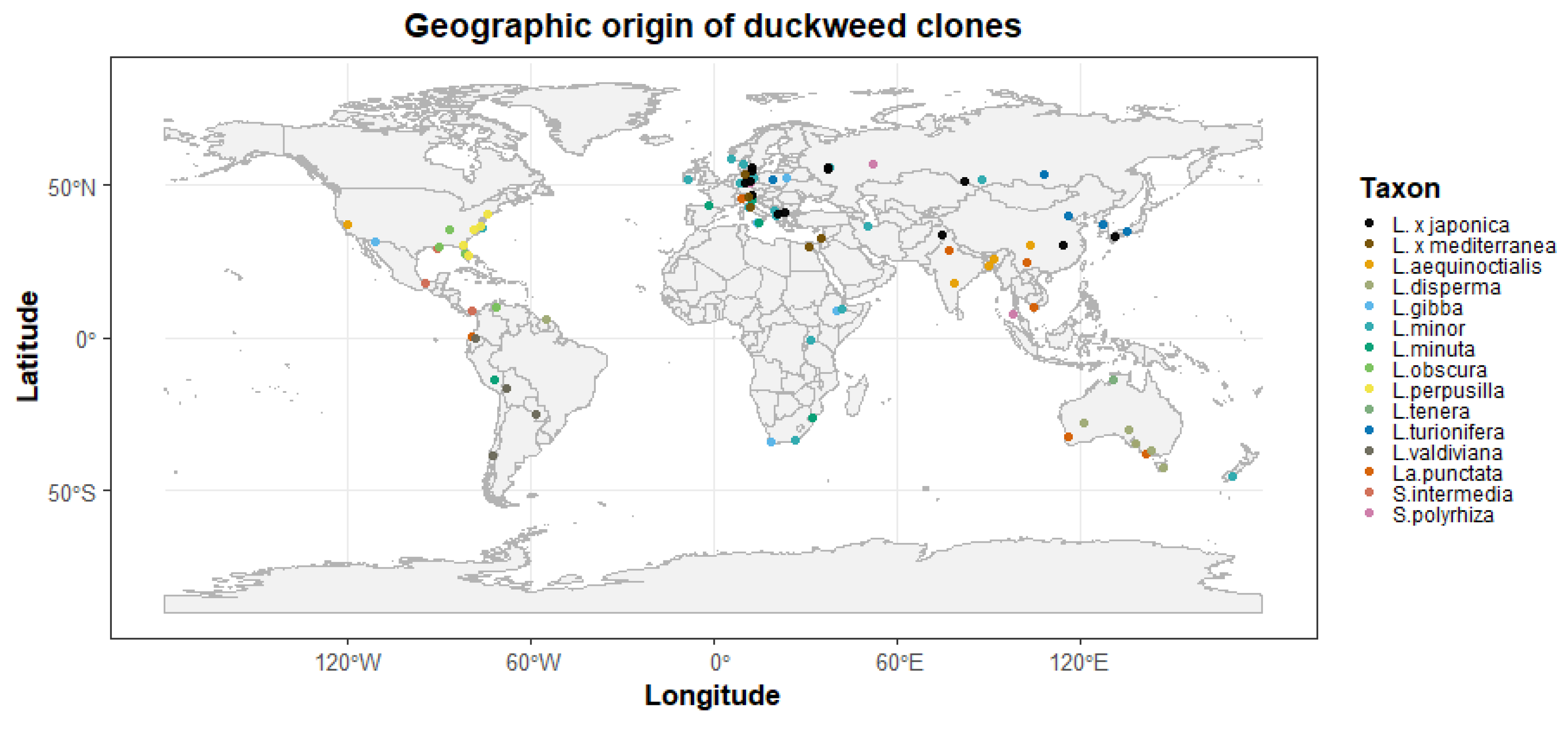
2.1. Clone Selection
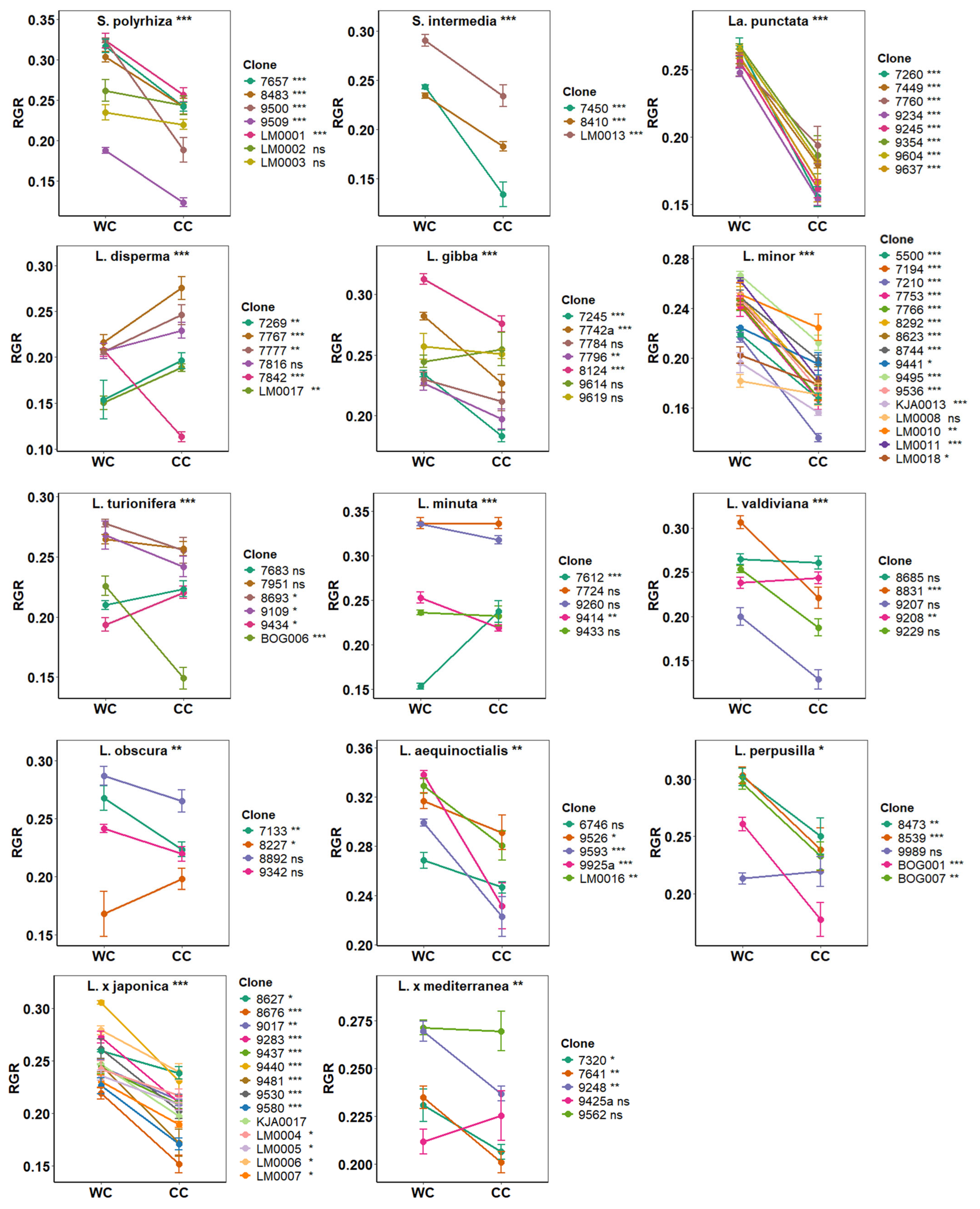
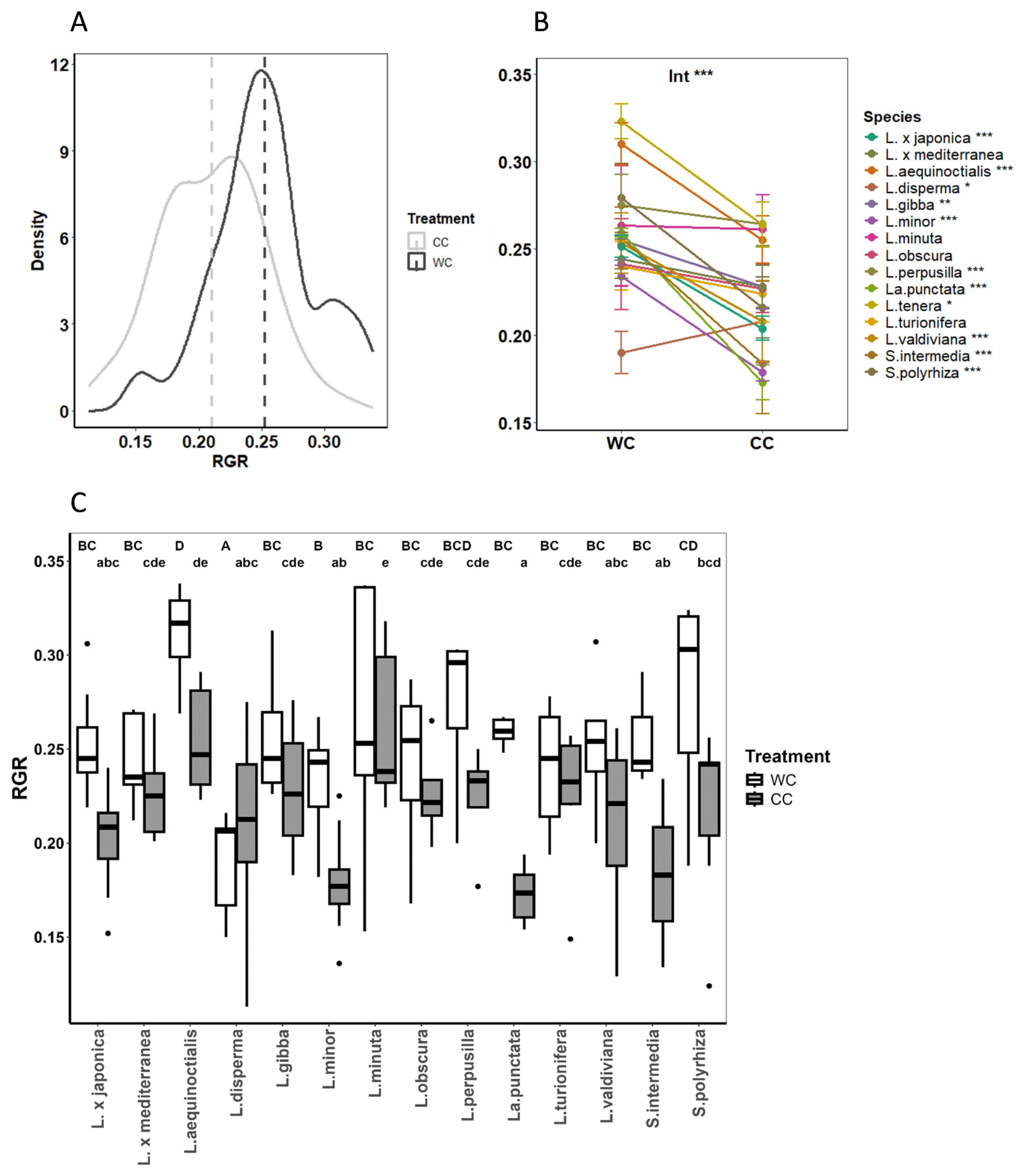
2.2. Growth Performance of Duckweed Under Near-Optimal and Optimal Temperature Conditions
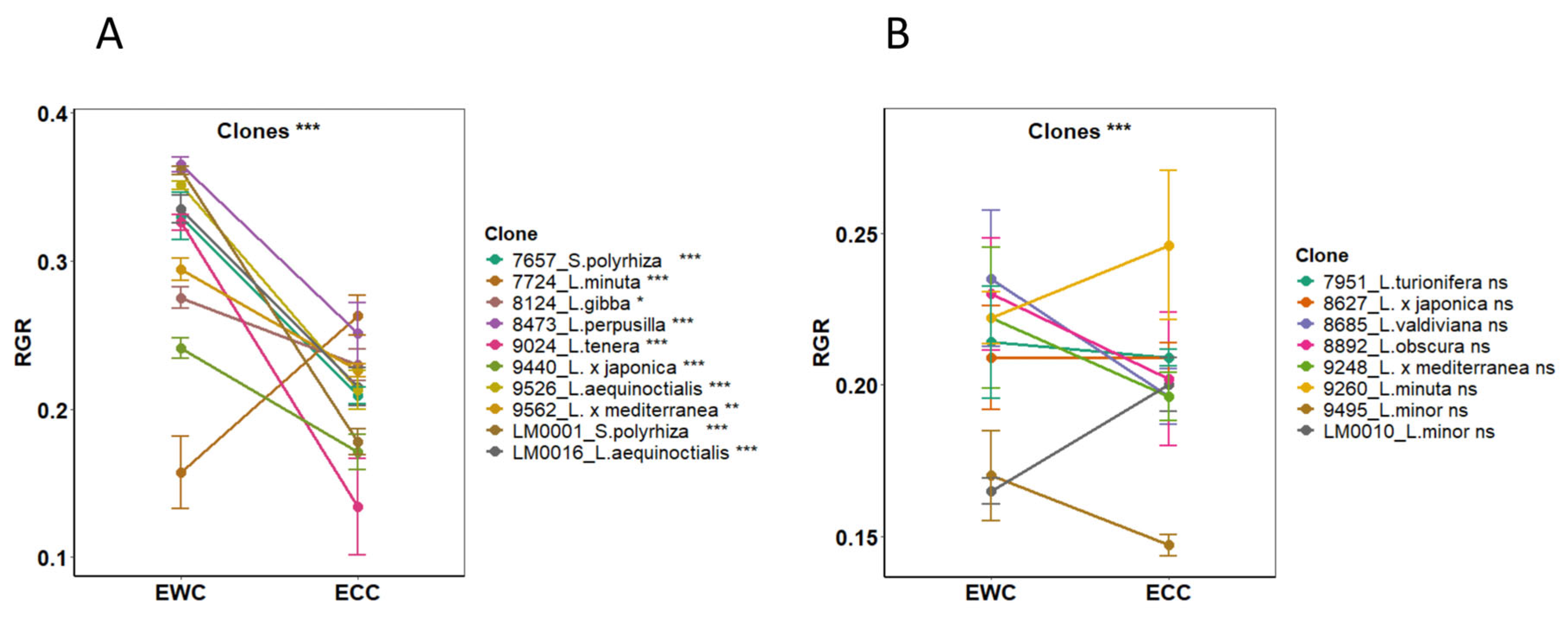
2.3. Growth Performance Under Severe Temperature Conditions
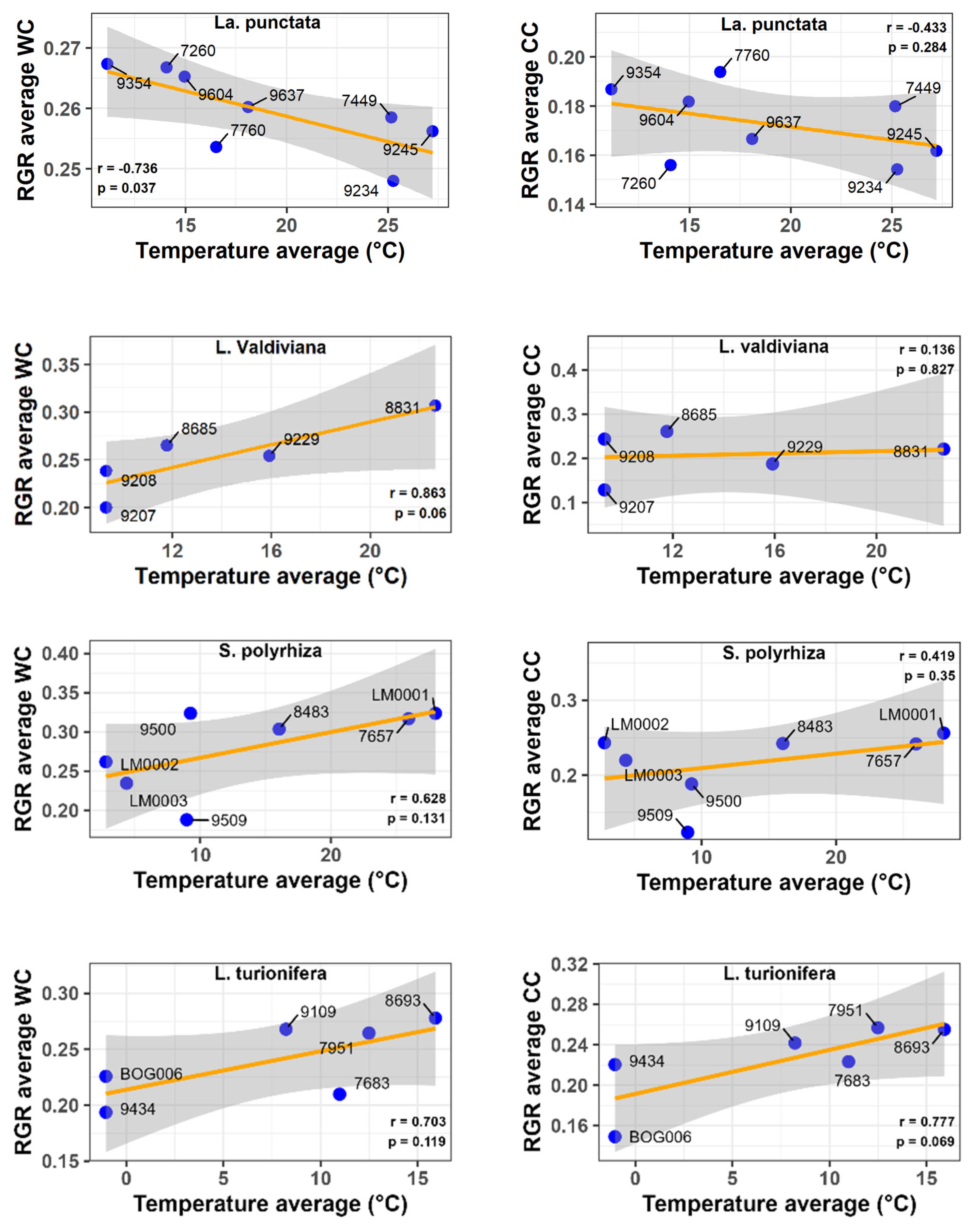
2.4. Correlation Between Duckweed Origin and Temperature Response
3. Discussion
4. Materials and Methods
4.1. Plant Material
4.2. Duckweed Temperature Screening Protocol
4.3. Climate Data
4.4. Statistical Analysis
Supplementary Materials
Author Contributions
Funding
Data Availability Statement
Acknowledgments
Conflicts of Interest
Abbreviations
| RGR | Relative growth rate |
| WC | Warm condition |
| CC | Cool condition |
| EWC | Extreme warm condition |
| ECC | Extreme cool condition |
References
- Stepanenko, A.; Braglia, L.; Fuchs, J.; Schubert, V.; Hoang, P.T.; Lee, Y.; Chen, G.; Gianì, S.; Morello, L.; Schubert, I. Genome diversity and evolution of the duckweed section Alatae comprising diploids, polyploids, and interspecific hybrids. Plant J. 2025, 122, e70158. [Google Scholar] [CrossRef]
- Schmid, M.W.; Moradi, A.; Leigh, D.M.; Schuman, M.C.; van Moorsel, S.J. Covering the bases: Population genomic structure of Lemna minor and the cryptic species L. japonica in Switzerland. Ecol. Evol. 2024, 14, e11599. [Google Scholar] [CrossRef]
- Morello, L.; Lee, Y.; Braglia, L. Exploring Duckweed Diversity at the Dawn of Its Cultivation Era: The Invaluable Legacy of the Landolt Collection. Plants 2026, 15, 345. [Google Scholar] [CrossRef]
- Acosta, K.; Appenroth, K.J.; Borisjuk, L.; Edelman, M.; Heinig, U.; Jansen, M.A.; Oyama, T.; Pasaribu, B.; Schubert, I.; Sorrels, S. Return of the Lemnaceae: Duckweed as a model plant system in the genomics and postgenomics era. Plant Cell 2021, 33, 3207–3234. [Google Scholar] [CrossRef]
- Ujong, A.; Naibaho, J.; Ghalamara, S.; Tiwari, B.K.; Hannon, S.; Tiwari, U. Correction: Duckweed: Exploring its farm-to-fork potential for food production and biorefineries. Sustain. Food Technol. 2025, 3, 1232–1233. [Google Scholar] [CrossRef]
- Wang, W.; Haberer, G.; Gundlach, H.; Gläßer, C.; Nussbaumer, T.; Luo, M.; Lomsadze, A.; Borodovsky, M.; Kerstetter, R.; Shanklin, J. The Spirodela polyrhiza genome reveals insights into its neotenous reduction fast growth and aquatic lifestyle. Nat. Commun. 2014, 5, 3311. [Google Scholar] [CrossRef] [PubMed]
- Van Hoeck, A.; Horemans, N.; Monsieurs, P.; Cao, H.X.; Vandenhove, H.; Blust, R. The first draft genome of the aquatic model plant Lemna minor opens the route for future stress physiology research and biotechnological applications. Biotechnol. Biofuels 2015, 8, 188. [Google Scholar] [CrossRef]
- Michael, T.P.; Bryant, D.; Gutierrez, R.; Borisjuk, N.; Chu, P.; Zhang, H.; Xia, J.; Zhou, J.; Peng, H.; El Baidouri, M. Comprehensive definition of genome features in Spirodela polyrhiza by high-depth physical mapping and short-read DNA sequencing strategies. Plant J. 2017, 89, 617–635. [Google Scholar] [CrossRef]
- Michael, T.P.; Ernst, E.; Hartwick, N.; Chu, P.; Bryant, D.; Gilbert, S.; Ortleb, S.; Baggs, E.L.; Sree, K.S.; Appenroth, K.J. Genome and time-of-day transcriptome of Wolffia australiana link morphological minimization with gene loss and less growth control. Genome Res. 2021, 31, 225–238. [Google Scholar] [CrossRef] [PubMed]
- Ernst, E.; Abramson, B.; Acosta, K.; Hoang, P.T.; Mateo-Elizalde, C.; Schubert, V.; Pasaribu, B.; Albert, P.S.; Hartwick, N.; Colt, K. Duckweed genomes and epigenomes underlie triploid hybridization and clonal reproduction. Curr. Biol. 2025, 35, 1828–1847. e1829. [Google Scholar] [CrossRef] [PubMed]
- Michael, T.P.; Hoang, P.T.; Abramson, B.W.; Mamerto, A.; Pasaribu, B.; Ernst, E.; Allsing, N.; Braglia, L.; Petrus, S.; Fuchs, J. Triploidy is prominent in the duckweed Lemna minor complex. bioRxiv 2025. [Google Scholar] [CrossRef]
- Appenroth, K.-J.; Sree, K.S.; Böhm, V.; Hammann, S.; Vetter, W.; Leiterer, M.; Jahreis, G. Nutritional value of duckweeds (Lemnaceae) as human food. Food Chem. 2017, 217, 266–273. [Google Scholar] [CrossRef] [PubMed]
- Appenroth, K.-J.; Sree, K.S.; Bog, M.; Ecker, J.; Seeliger, C.; Böhm, V.; Lorkowski, S.; Sommer, K.; Vetter, W.; Tolzin-Banasch, K. Nutritional value of the duckweed species of the genus Wolffia (Lemnaceae) as human food. Front. Chem. 2018, 6, 483. [Google Scholar] [CrossRef]
- Edelman, M.; Colt, M. Nutrient value of leaf vs. seed. Front. Chem. 2016, 4, 32. [Google Scholar] [CrossRef]
- Yan, Y.; Candreva, J.; Shi, H.; Ernst, E.; Martienssen, R.; Schwender, J.; Shanklin, J. Survey of the total fatty acid and triacylglycerol composition and content of 30 duckweed species and cloning of a Δ6-desaturase responsible for the production of γ-linolenic and stearidonic acids in Lemna gibba. BMC Plant Biol. 2013, 13, 201. [Google Scholar] [CrossRef] [PubMed]
- Ge, X.; Zhang, N.; Phillips, G.C.; Xu, J. Growing Lemna minor in agricultural wastewater and converting the duckweed biomass to ethanol. Bioresour. Technol. 2012, 124, 485–488. [Google Scholar] [CrossRef]
- Faizal, A.; Sembada, A.A.; Priharto, N. Production of bioethanol from four species of duckweeds (Landoltia punctata, Lemna aequinoctialis, Spirodela polyrrhiza, and Wolffia arrhiza) through optimization of saccharification process and fermentation with Saccharomyces cerevisiae. Saudi J. Biol. Sci. 2021, 28, 294–301. [Google Scholar] [CrossRef]
- Guo, L.; Fang, Y.; Jin, Y.; He, K.; Zhao, H. High starch duckweed biomass production and its highly-efficient conversion to bioethanol. Environ. Technol. Innov. 2023, 32, 103296. [Google Scholar] [CrossRef]
- Sree, K.S.; Adelmann, K.; Garcia, C.; Lam, E.; Appenroth, K.-J. Natural variance in salt tolerance and induction of starch accumulation in duckweeds. Planta 2015, 241, 1395–1404. [Google Scholar] [CrossRef] [PubMed]
- Guo, L.; Jin, Y.; Xiao, Y.; Tan, L.; Tian, X.; Ding, Y.; He, K.; Du, A.; Li, J.; Yi, Z. Energy-efficient and environmentally friendly production of starch-rich duckweed biomass using nitrogen-limited cultivation. J. Clean. Prod. 2020, 251, 119726. [Google Scholar] [CrossRef]
- Yin, Y.; Yu, C.; Yu, L.; Zhao, J.; Sun, C.; Ma, Y.; Zhou, G. The influence of light intensity and photoperiod on duckweed biomass and starch accumulation for bioethanol production. Bioresour. Technol. 2015, 187, 84–90. [Google Scholar] [CrossRef]
- Coughlan, N.E.; Walsh, É.; Bolger, P.; Burnell, G.; O’Leary, N.; O’Mahoney, M.; Paolacci, S.; Wall, D.; Jansen, M.A. Duckweed bioreactors: Challenges and opportunities for large-scale indoor cultivation of Lemnaceae. J. Clean. Prod. 2022, 336, 130285. [Google Scholar] [CrossRef]
- Paul, M.; Ma, J.K.C. Plant-made pharmaceuticals: Leading products and production platforms. Biotechnol. Appl. Biochem. 2011, 58, 58–67. [Google Scholar] [CrossRef]
- Li, Y.; Zhang, F.; Daroch, M.; Tang, J. Positive effects of duckweed polycultures on starch and protein accumulation. Biosci. Rep. 2016, 36, e00380. [Google Scholar] [CrossRef]
- Paolacci, S.; Harrison, S.; Jansen, M.A. The invasive duckweed Lemna minuta Kunth displays a different light utilisation strategy than native Lemna minor Linnaeus. Aquat. Bot. 2018, 146, 8–14. [Google Scholar] [CrossRef]
- Ceschin, S.; Crescenzi, M.; Iannelli, M.A. Phytoremediation potential of the duckweeds Lemna minuta and Lemna minor to remove nutrients from treated waters. Environ. Sci. Pollut. Res. 2020, 27, 15806–15814. [Google Scholar] [CrossRef] [PubMed]
- Sun, Z.; Guo, W.; Yang, J.; Zhao, X.; Chen, Y.; Yao, L.; Hou, H. Enhanced biomass production and pollutant removal by duckweed in mixotrophic conditions. Bioresour. Technol. 2020, 317, 124029. [Google Scholar] [CrossRef]
- Walsh, É.; Kuehnhold, H.; O’Brien, S.; Coughlan, N.E.; Jansen, M.A. Light intensity alters the phytoremediation potential of Lemna minor. Environ. Sci. Pollut. Res. 2021, 28, 16394–16407. [Google Scholar] [CrossRef]
- Petersen, F.; Demann, J.; Restemeyer, D.; Olfs, H.-W.; Westendarp, H.; Appenroth, K.-J.; Ulbrich, A. Influence of light intensity and spectrum on duckweed growth and proteins in a small-scale, re-circulating indoor vertical farm. Plants 2022, 11, 1010. [Google Scholar] [CrossRef] [PubMed]
- Sender, J.; Grzywna, A. Influence of temperature and photoperiod on the growth and development of Lemna trisulca and Lemna minor in controlled conditions. J. Ecol. Eng. 2025, 26, 56–72. [Google Scholar] [CrossRef]
- Kuehdorf, K.; Appenroth, K.-J. Influence of salinity and high temperature on turion formation in the duckweed Spirodela polyrhiza. Aquat. Bot. 2012, 97, 69–72. [Google Scholar] [CrossRef]
- Ziegler, P.; Appenroth, K.J.; Sree, K.S. Survival strategies of duckweeds, the world’s smallest angiosperms. Plants 2023, 12, 2215. [Google Scholar] [CrossRef]
- Pasos-Panqueva, J.; Baker, A.; Camargo-Valero, M.A. Unravelling the impact of light, temperature and nutrient dynamics on duckweed growth: A meta-analysis study. J. Environ. Manag. 2024, 366, 121721. [Google Scholar] [CrossRef]
- Lasfar, S.; Monette, F.; Millette, L.; Azzouz, A. Intrinsic growth rate: A new approach to evaluate the effects of temperature, photoperiod and phosphorus–nitrogen concentrations on duckweed growth under controlled eutrophication. Water Res. 2007, 41, 2333–2340. [Google Scholar] [CrossRef] [PubMed]
- Femeena, P.; Roman, B.; Brennan, R. Maximizing duckweed biomass production for food security at low light intensities: Experimental results and an enhanced predictive model. Environ. Chall. 2023, 11, 100709. [Google Scholar] [CrossRef]
- Braglia, L.; Ceschin, S.; Iannelli, M.A.; Bog, M.; Fabriani, M.; Frugis, G.; Gavazzi, F.; Gianì, S.; Mariani, F.; Muzzi, M. Characterization of the cryptic interspecific hybrid Lemna× mediterranea by an integrated approach provides new insights into duckweed diversity. J. Exp. Bot. 2024, 75, 3092–3110. [Google Scholar] [CrossRef]
- Braglia, L.; Lauria, M.; Appenroth, K.J.; Bog, M.; Breviario, D.; Grasso, A.; Gavazzi, F.; Morello, L. Duckweed species genotyping and interspecific hybrid discovery by tubulin-based polymorphism fingerprinting. Front. Plant Sci. 2021, 12, 625670. [Google Scholar] [CrossRef] [PubMed]
- Fick, S.E.; Hijmans, R.J. WorldClim 2: New 1-km spatial resolution climate surfaces for global land areas. Int. J. Climatol. 2017, 37, 4302–4315. [Google Scholar] [CrossRef]
- Landolt, E. Biosystematic investigations in the family of duckweeds (Lemnaceae) (Vol. 2.) The family of Lemnaceae-a monographic study. vol. 1. Veroff. Geobot. Inst. ETH 1986, 71, 1–563. [Google Scholar]
- Rapparini, F.; Tam, Y.Y.; Cohen, J.D.; Slovin, J.P. Indole-3-acetic acid metabolism in Lemna gibba undergoes dynamic changes in response to growth temperature. Plant Physiol. 2002, 128, 1410–1416. [Google Scholar] [CrossRef]
- Basiglini, E.; Pintore, M.; Forni, C. Effects of treated industrial wastewaters and temperatures on growth and enzymatic activities of duckweed (Lemna minor L.). Ecotoxicol. Environ. Saf. 2018, 153, 54–59. [Google Scholar] [CrossRef]
- Gillies, G.J.; Angert, A.L.; Usui, T. Temperature dependence and genetic variation in resource acquisition strategies in a model freshwater plant. Funct. Ecol. 2024, 38, 1600–1610. [Google Scholar] [CrossRef]
- Usui, T.; Angert, A.L. Range expansion is both slower and more variable with rapid evolution across a spatial gradient in temperature. Ecol. Lett. 2024, 27, e14406. [Google Scholar] [CrossRef]
- Islam, M.F.; Yang, J.; Zhao, X.; Kazmi, A.; Li, X.; Hu, H.; Sun, Z.; Chen, Y.; Heenatigala, P.; Hou, H. Elevated light intensity and temperature enhance biomass, protein, and starch accumulation in duckweed. Ind. Crops Prod. 2025, 237, 122118. [Google Scholar] [CrossRef]
- Van Dyck, I.; Vanhoudt, N.; i Batlle, J.V.; Horemans, N.; Van Gompel, A.; Nauts, R.; Vangronsveld, J. Effects of environmental parameters on starch and soluble sugars in Lemna minor. Plant Physiol. Biochem. 2023, 200, 107755. [Google Scholar] [CrossRef]
- Zhao, Z.; Shi, H.; Liu, Y.; Zhao, H.; Su, H.; Wang, M.; Zhao, Y. The influence of duckweed species diversity on biomass productivity and nutrient removal efficiency in swine wastewater. Bioresour. Technol. 2014, 167, 383–389. [Google Scholar] [CrossRef] [PubMed]
- Sree, K.S.; Appenroth, K.-J. Increase of starch accumulation in the duckweed Lemna minor under abiotic stress. Albanian J. Agric. Sci. 2014, 11–14. [Google Scholar]
- Ziegler, P.; Adelmann, K.; Zimmer, S.; Schmidt, C.; Appenroth, K.J. Relative in vitro growth rates of duckweeds (Lemnaceae)–the most rapidly growing higher plants. Plant Biol. 2015, 17, 33–41. [Google Scholar] [CrossRef] [PubMed]
- Sree, K.S.; Sudakaran, S.; Appenroth, K.-J. How fast can angiosperms grow? Species and clonal diversity of growth rates in the genus Wolffia (Lemnaceae). Acta Physiol. Plant. 2015, 37, 204. [Google Scholar] [CrossRef]
- Tang, J.; Zhang, F.; Cui, W.; Ma, J. Genetic structure of duckweed population of Spirodela, Landoltia and Lemna from Lake Tai, China. Planta 2014, 239, 1299–1307. [Google Scholar] [CrossRef]
- Senayai, A.; Harnvanichvech, Y.; Vajrodaya, S.; Oyama, T.; Kraichak, E. Genetic and morphological variation among populations of duckweed species in Thailand. Plants 2025, 14, 2030. [Google Scholar] [CrossRef]
- Kawecki, T.J.; Ebert, D. Conceptual issues in local adaptation. Ecol. Lett. 2004, 7, 1225–1241. [Google Scholar] [CrossRef]
- Leimu, R.; Fischer, M. A meta-analysis of local adaptation in plants. PLoS ONE 2008, 3, e4010. [Google Scholar] [CrossRef]
- Hitsman, H.W.; Simons, A.M. Latitudinal variation in norms of reaction of phenology in the greater duckweed Spirodela polyrhiza. J. Evol. Biol. 2020, 33, 1405–1416. [Google Scholar] [CrossRef]
- Kuehdorf, K.; Jetschke, G.; Ballani, L.; Appenroth, K.J. The clonal dependence of turion formation in the duckweed Spirodela polyrhiza—An ecogeographical approach. Physiol. Plant. 2014, 150, 46–54. [Google Scholar] [CrossRef]
- Petersen, F.; Demann, J.; Restemeyer, D.; Ulbrich, A.; Olfs, H.-W.; Westendarp, H.; Appenroth, K.-J. Influence of the nitrate-n to ammonium-n ratio on relative growth rate and crude protein content in the duckweeds Lemna minor and Wolffiella hyalina. Plants 2021, 10, 1741. [Google Scholar] [CrossRef]
- Van Dyck, I.; Vanhoudt, N.; i Batlle, J.V.; Horemans, N.; Nauts, R.; Van Gompel, A.; Claesen, J.; Vangronsveld, J. Effects of environmental parameters on Lemna minor growth: An integrated experimental and modelling approach. J. Environ. Manag. 2021, 300, 113705. [Google Scholar] [CrossRef]
- Yu, L.; Boström, C.; Franzenburg, S.; Bayer, T.; Dagan, T.; Reusch, T.B. Somatic genetic drift and multilevel selection in a clonal seagrass. Nat. Ecol. Evol. 2020, 4, 952–962. [Google Scholar] [CrossRef]
- Peterson, A.; Kishchenko, O.; Kuhlmann, M.; Tschiersch, H.; Fuchs, J.; Tikhenko, N.; Schubert, I.; Nagel, M. Cryopreservation of duckweed genetic diversity as model for long-term preservation of aquatic flowering plants. Plants 2023, 12, 3302. [Google Scholar] [CrossRef]
- Van Antro, M.; Prelovsek, S.; Ivanovic, S.; Gawehns, F.; Wagemaker, N.C.; Mysara, M.; Horemans, N.; Vergeer, P.; Verhoeven, K.J. DNA methylation in clonal duckweed (Lemna minor L.) lineages reflects current and historical environmental exposures. Mol. Ecol. 2023, 32, 428–443. [Google Scholar] [CrossRef]
- Zhou, W.; Wang, M.; Wang, L.; Liu, Y.; Tian, Z.; Xie, L.; Wang, Y. Epigenetics in plant response to climate change. Biology 2025, 14, 631. [Google Scholar] [CrossRef]
- Pigliucci, M. Evolution of phenotypic plasticity: Where are we going now? Trends Ecol. Evol. 2005, 20, 481–486. [Google Scholar] [CrossRef]
- Morello, L.; Braglia, L.; Iannelli, M.A.; Lauria, M.; Gavazzi, F.; Gianì, S.; Perna, C.; Bucci, G.; Ianigro, M. IBBA Duckweed Dataset (DUCKWEED-01); Occurrence Dataset; Institute of Agricultural Biology and Biotecnology (IBBA), Nation Research Coundil of Italy (CNR): Milano, Italy, 2025. [Google Scholar] [CrossRef]
- Naumann, B.; Eberius, M.; Appenroth, K.-J. Growth rate based dose–response relationships and EC-values of ten heavy metals using the duckweed growth inhibition test (ISO 20079) with Lemna minor L. clone St. J. Plant Physiol. 2007, 164, 1656–1664. [Google Scholar] [CrossRef]



Disclaimer/Publisher’s Note: The statements, opinions and data contained in all publications are solely those of the individual author(s) and contributor(s) and not of MDPI and/or the editor(s). MDPI and/or the editor(s) disclaim responsibility for any injury to people or property resulting from any ideas, methods, instructions or products referred to in the content. |
© 2026 by the authors. Licensee MDPI, Basel, Switzerland. This article is an open access article distributed under the terms and conditions of the Creative Commons Attribution (CC BY) license.
Share and Cite
Mascheretti, I.; Mallardi, A.; Liberatore, C.; Martinelli, T.; Lauria, M. Temperature-Dependent Clonal and Species-Level Growth Variation in Spirodela, Landoltia, Lemna, and Interspecific Lemna Hybrids. Plants 2026, 15, 1649. https://doi.org/10.3390/plants15111649
Mascheretti I, Mallardi A, Liberatore C, Martinelli T, Lauria M. Temperature-Dependent Clonal and Species-Level Growth Variation in Spirodela, Landoltia, Lemna, and Interspecific Lemna Hybrids. Plants. 2026; 15(11):1649. https://doi.org/10.3390/plants15111649
Chicago/Turabian StyleMascheretti, Iride, Alessandra Mallardi, Claudia Liberatore, Tommaso Martinelli, and Massimiliano Lauria. 2026. "Temperature-Dependent Clonal and Species-Level Growth Variation in Spirodela, Landoltia, Lemna, and Interspecific Lemna Hybrids" Plants 15, no. 11: 1649. https://doi.org/10.3390/plants15111649
APA StyleMascheretti, I., Mallardi, A., Liberatore, C., Martinelli, T., & Lauria, M. (2026). Temperature-Dependent Clonal and Species-Level Growth Variation in Spirodela, Landoltia, Lemna, and Interspecific Lemna Hybrids. Plants, 15(11), 1649. https://doi.org/10.3390/plants15111649