Allelopathic Activity of Ginseng-Cultivated Soil: Extracts on Seed Germination and Growth of Five Vegetables in China


Abstract
1. Introduction
2. Results
2.1. Allelopathic Effects of Water/Ethanol Extracts from Soil
2.1.1. Effects of Soil Extracts on Seed Germination
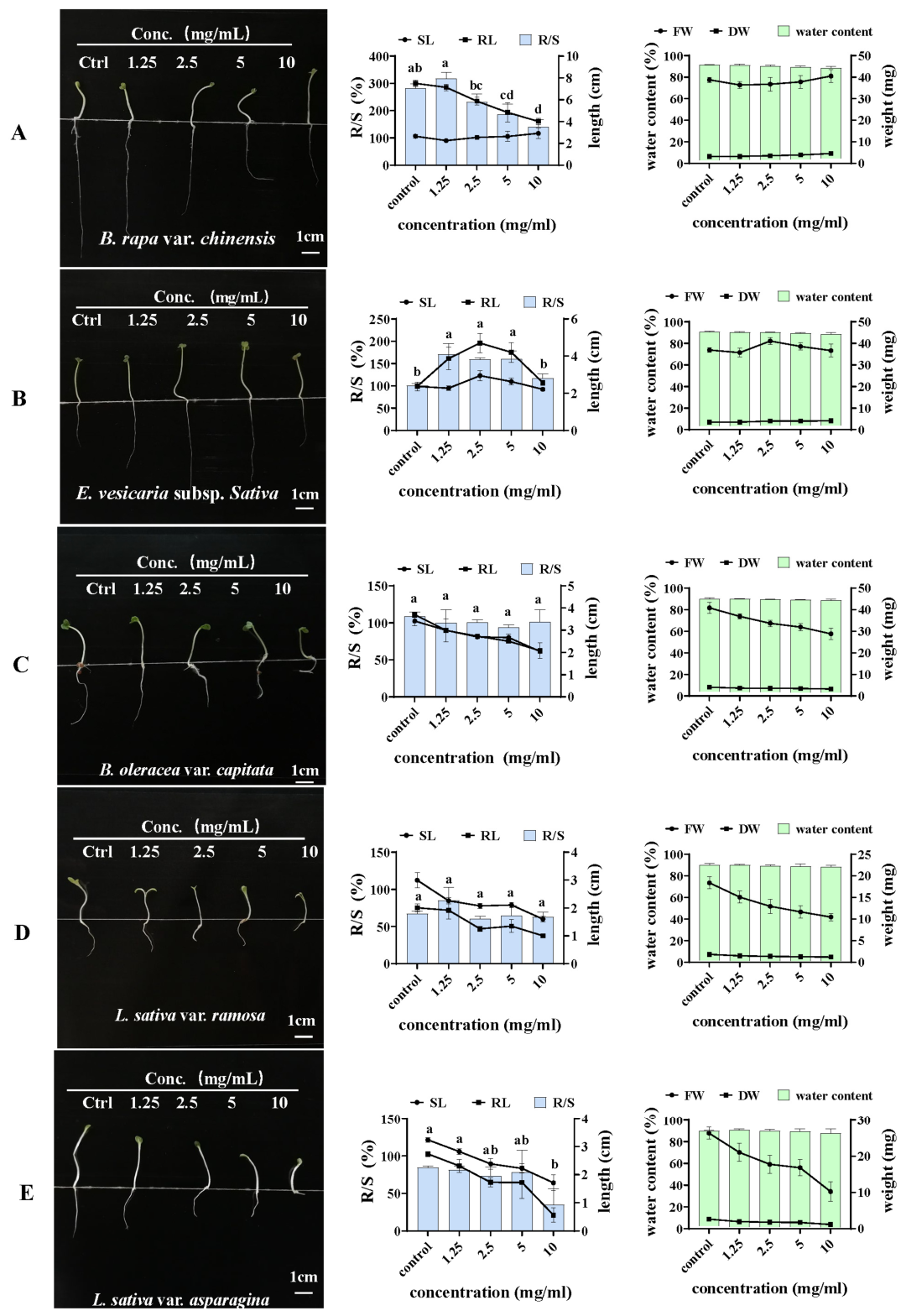
2.1.2. Effects of Soil Extracts on Seedling Growth
2.1.3. Effects of Soil Extracts on Biomass Production
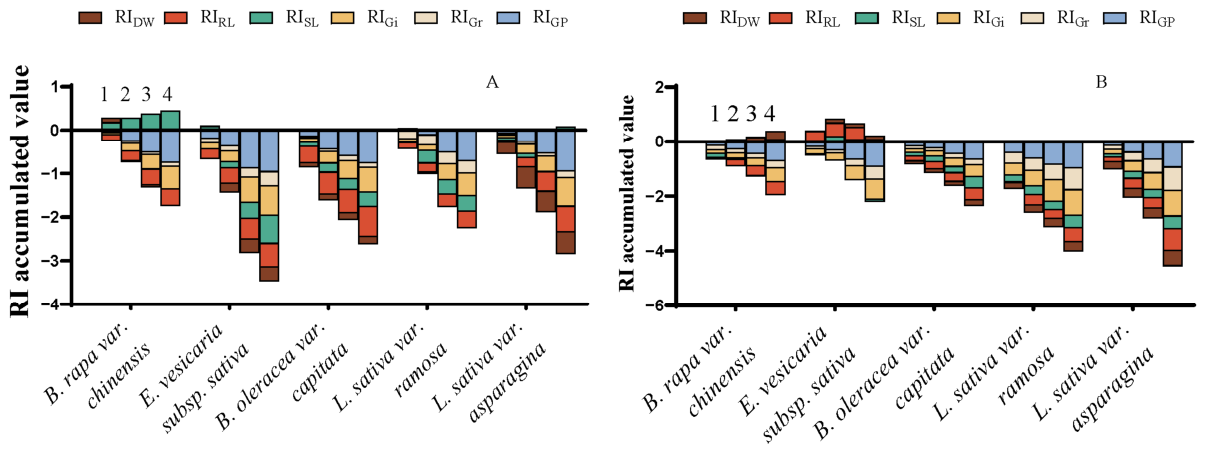
2.1.4. Effects of Extracts on RI Accumulated Value
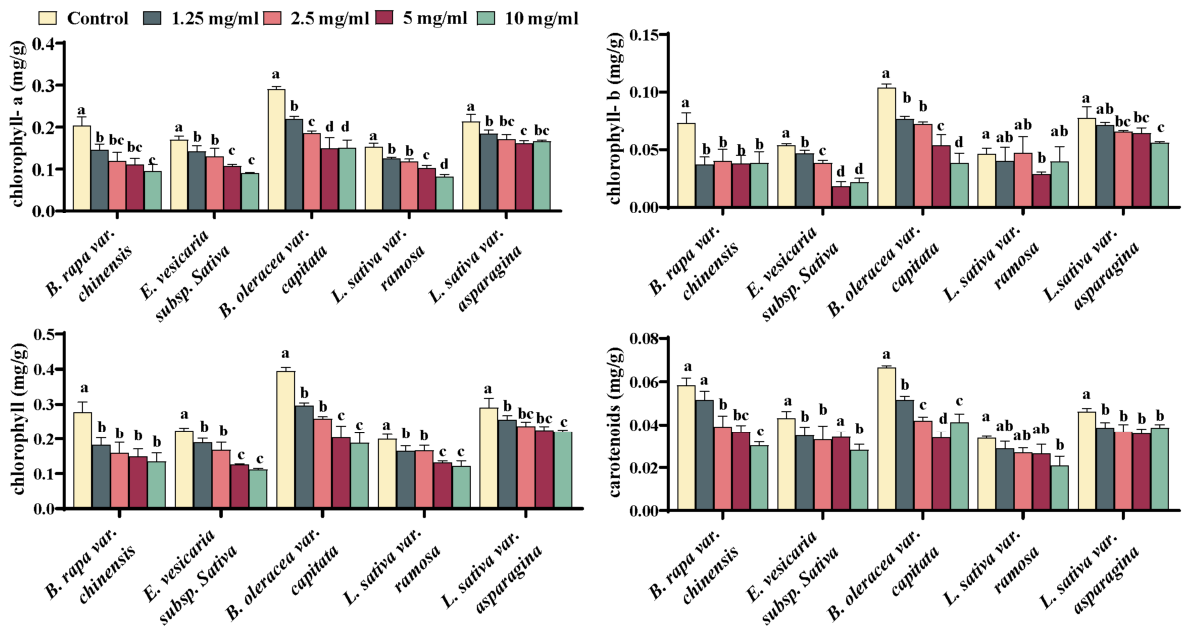
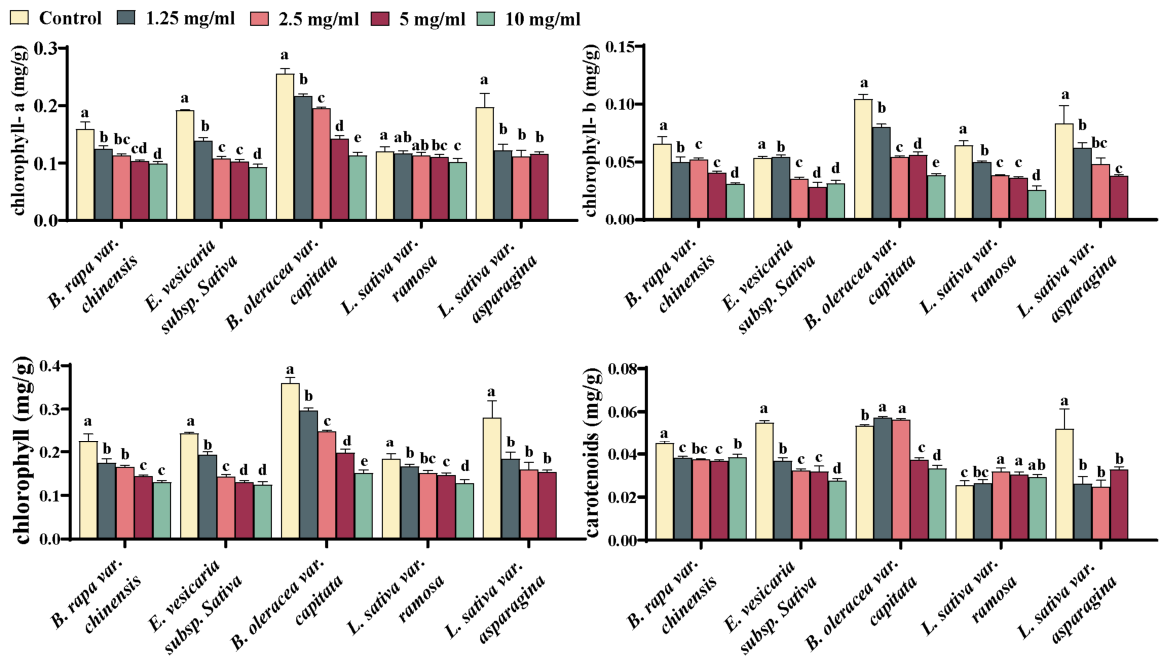
2.2. Effects of Soil Extracts on the Photosynthetic Pigments
2.3. Antioxidant Enzyme Activities
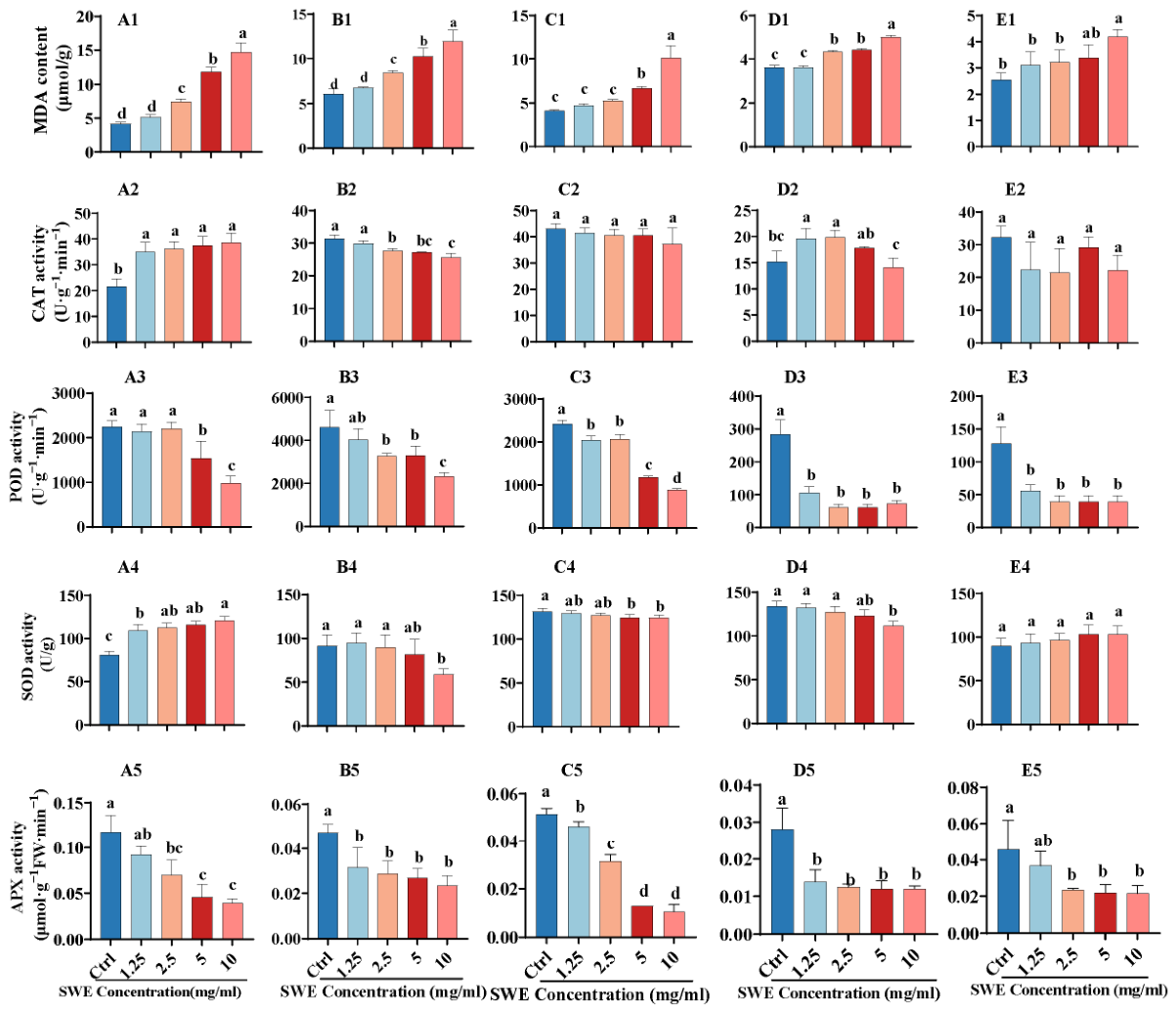
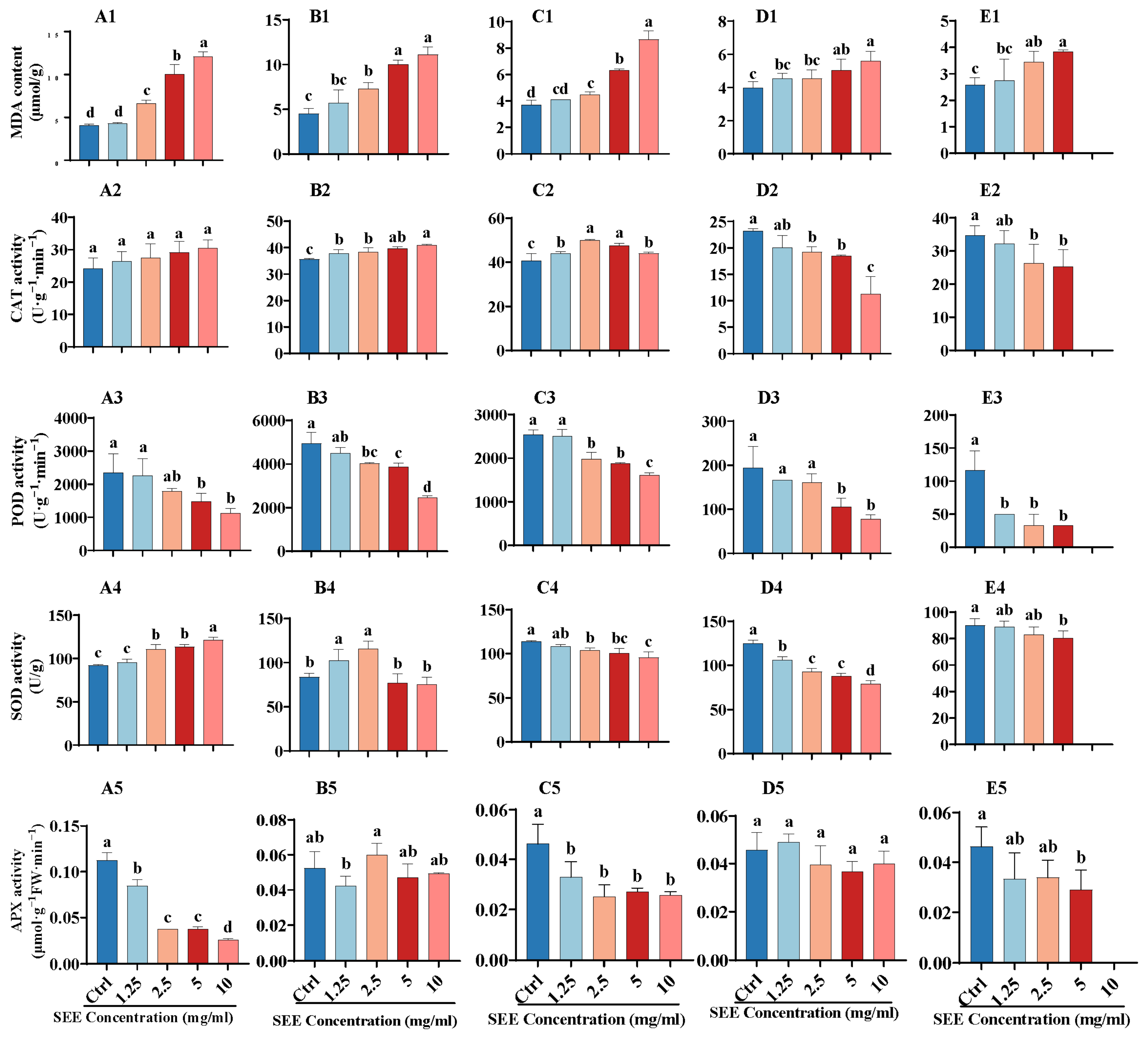
2.3.1. MDA Content
2.3.2. Antioxidant Enzyme Analysis
3. Discussion
4. Materials and Methods
4.1. Soil Material
4.2. Water Extract and Ethanol Extract Preparation
4.3. Plant Seeds
4.4. Determination of Seed Germination
4.5. Experiment of Seedling Growth
4.6. Determination of Photosynthetic Pigments Content
4.7. Antioxidant Enzymatic Activities Experiment
4.8. Statistical Analysis
5. Conclusions
Author Contributions
Funding
Data Availability Statement
Acknowledgments
Conflicts of Interest
References
- Wang, C.N.; Zhao, D.Q.; Wang, L.S.; Wang, J. Study on the two-way immune regulation mechanism and clinical application of Ginseng and Compound Preparation. Lishizhen Med. Mater. Medica Res. 2021, 32, 177–180. [Google Scholar]
- Li, Q.Y.; Tang, J.X.; Liu, S.W.; Xu, P.; Zhou, J.Q.; Yin, F.; Mi, J.W.; Yu, L.; Wang, L.N.; Bi, Y.F. Protective effects of black ginseng fermentation on fatigue stress-induced oxidative damage and comparison with white ginseng, red ginseng and ginseng berry. Food Sci. 2022, 43, 226–232. [Google Scholar]
- Liu, F.X.; Lin, Z.X.; Zhang, H.L.; Zhang, Z.Q.; Yang, K.Q. Analysis of anti-fatigue mechanism and potential targets of ginseng. China J. Chin. Mater. Medica 2019, 44, 5479–5487. [Google Scholar]
- Kim, J.H. Pharmacological and medical applications of Panax ginseng and ginsenosides: A review for use in cardiovascular diseases. J. Ginseng Res. 2018, 42, 264–269. [Google Scholar] [CrossRef]
- Luo, L.M.; Shi, Y.N.; Jiang, Y.N.; Zhan, J.H.; Qin, L.; Chen, N.H. Advance in components with antitumor effect of Panax ginseng and their mechanisms. Chin. Tradit. Herb. Drugs 2017, 48, 582–596. [Google Scholar]
- Liu, L.; Xu, F.R.; Wang, Y.Z. Traditional uses, chemical diversity and biological activities of Panax L. (Araliaceae): A review. J. Ethnopharmacol. 2020, 263, 112792. [Google Scholar] [CrossRef]
- Committee, C.P. Pharmacopoeia of the People’s Republic of China; China Medical Science Press: Beijing, China, 2020; p. 1451. [Google Scholar]
- Bian, X.; Xiao, S.; Zhao, Y.; Zhang, L. Comparative analysis of rhizosphere soil physiochemical characteristics and microbial communities between rusty and healthy ginseng root. Sci. Rep. 2020, 10, 71024–71028. [Google Scholar] [CrossRef] [PubMed]
- Xiao, C.; Yang, L.; Zhang, L.; Liu, C.; Han, M. Effects of Cultivation Ages and Modes on Microbial Diversity in the Rhizosphere Soil of Panax Ginseng. J. Ginseng Res. 2016, 40, 28–37. [Google Scholar] [CrossRef]
- Li, C.W.; Chen, G.Z.; Zhang, J.L.; Bai, X.F.; Zhu, P.; Hou, Y.P.; Zhang, X.X. Long-Term Changes in Soil Properties and Microbial Communities are Continuous Cropping Obstacles Associated with American Ginseng (Panax Quinquefolius L.) Cultivation. Preprints 2020, 2020080300. [Google Scholar]
- Behdarvandi, B.; Goodwin, P.H. Effect of Soil and Root Extracts on the Innate Immune Response of American Ginseng (Panax Quinquefolius) to Root Rot Caused by Ilyonectria Mors-Panacis. Plants 2023, 12, 2540. [Google Scholar] [CrossRef] [PubMed]
- Yang, M.; Zhang, X.D.; Xu, Y.G.; Mei, X.Y.; Jiang, B.B.; Liao, J.J. Autotoxic Ginsenosides in the Rhizosphere Contribute to the Replant Failure of Panax notoginseng. PLoS ONE 2015, 10, e0118555. [Google Scholar] [CrossRef]
- Liu, C.; Xia, R.; Tang, M.; Chen, X.; Zhong, B.; Liu, X.; Bian, R.; Yang, L.; Zheng, J.; Cheng, K.; et al. Improved ginseng production under continuous cropping through soil health reinforcement and rhizosphere microbial manipulation with biochar: A field study of Panax ginseng from Northeast China. Hortic. Res. 2022, 9, uhac108. [Google Scholar] [CrossRef] [PubMed]
- Li, J.; Chen, Y.; Zhao, G.; Chen, Y.; Zhang, N.; Yu, D. Herbal materials used as soil amendments alleviate root rot of Panax ginseng. Sci. Rep. 2024, 14, 1–14. [Google Scholar] [CrossRef]
- Peng, N.; Bi, Y.M.; Jiao, X.L.; Zhang, X.M.; Li, J.F.; Wang, Y.; Yang, S.S.; Liu, Z.Q.; Gao, W.W. A soil fumigant increases American ginseng (Panax quinquefolius L.) survival and growth under continuous cropping by affecting soil microbiome assembly: A 4-year in situ field experiment. Microbiol. Spectr. 2024, 12, e0175723. [Google Scholar] [CrossRef] [PubMed]
- Jin, J.R.; Ma, Q.L.; Wang, X.Q.; Dou, S.; Wang, Q.B. Study on Effect of Ecology Method on Panax Ginseng Continuous Cropping Ground Soil Improvement. J. Gensing Rearch 2010, 22, 35–38. [Google Scholar]
- Inderjit. Soil microorganisms: An important determinant of allelopathic activity. Plant Soil 2005, 274, 227–236. [Google Scholar] [CrossRef]
- Margaret, M. Rhizosphere allelopathy. Allelopath. J. 2007, 19, 75–84. [Google Scholar]
- Zhou, T.T.; Zhan, Y.; Li, Q.; Wang, E.P.; Huang, X.; Chen, C.B. Research progress on allelochemicals types and mechanisms of medicinal plants in the genus Panax. Spec. Wild Econ. Anim. Plant Res. 2025, 47, 184–188 + 195. (In Chinese) [Google Scholar]
- Bi, X.B.; Yang, J.X.; Gao, W.W. Autotoxicity of phenolic compounds from the soil of American ginseng (Panax quinquefolium L.). Allelopath. J. 2010, 25, 115–122. [Google Scholar]
- Jiao, X.L.; Bi, X.B.; Gao, W.W. Allelopathic effect of p-coumaric acid on American ginseng and its physiological mechanism. Acta Ecol. Sin. 2015, 35, 3006–3013. [Google Scholar]
- Li, Z.B.; Zhou, R.J.; Fu, J.F. Allelopathic effects of phenolic acids from Ginseng rhizosphere soil on Cylindrocarpon destructans (Zinss) Scholten. Allelopath. J. 2018, 43, 53–64. [Google Scholar] [CrossRef]
- He, C.N.; Gao, W.W.; Yang, J.X.; Bi, W.; Zhang, X.S.; Zhao, Y.J. Identification of autotoxic compounds from fibrous roots of Panax quinquefolium L. Plant Soil 2009, 318, 63–72. [Google Scholar] [CrossRef]
- Jiang, J.L.; Yu, M.; Li, L.; Li, Y.K.; Cao, X.L. Relationship between root rot and accumulation of ginsenosides in Panax quinquefolius. Chin. Tradit. Pat. Med. 2019, 41, 2164–2169. (In Chinese) [Google Scholar]
- Li, Q.; Zhang, L.X.; Guan, T.Z.; Xu, Y.H.; Chen, C.B. Allelopathic effects of ginsenoside Rg1 on seed germination and seedling growth of Panax ginseng. Allelopath. J. 2020, 49, 229–242. [Google Scholar] [CrossRef]
- Zhang, Q.J.; Geng, Y.Q.; Gao, Y.G.; Zhang, L.X. Effects of ginsenosides on seedling growth and development of Panax ginseng. Chin. Tradit. Herb. Drugs 2012, 43, 2503–2507. (In Chinese) [Google Scholar]
- Jia, F.G.; Chang, F.; Guan, M.; Jia, Q.G.; Sun, Y.; Li, Z. Effects of rotation and Bacillus on the changes of continuous cropping soil fungal communities in American ginseng. World J. Microbiol. Biotechnol. 2023, 39, 354. [Google Scholar] [CrossRef]
- Wang, Y.; Zhang, H.; Zhang, Y.; Fei, J.; Rong, X.; Peng, J.; Luo, G. Crop Rotation-Driven Changes in Rhizosphere Metabolite Profiles Regulate Soil Microbial Diversity and Functional Capacity. Agric. Ecosyst. Environ. 2023, 358, 108716. [Google Scholar] [CrossRef]
- Bian, X.; Yang, X.; Zhang, K.; Zhai, Y.; Li, Q.; Zhang, L.; Sun, X. Potential of Medicago Sativa and Perilla Frutescens for Overcoming the Soil Sickness Caused by Ginseng Cultivation. Front. Microbiol. 2023, 14, 1134331. [Google Scholar] [CrossRef]
- Zhang, J.; Zhou, D.; Yuan, X.; Xu, Y.; Chen, C.; Zhao, L. Soil Microbiome and Metabolome Analysis Reveals Beneficial Effects of Ginseng–Celandine Rotation on the Rhizosphere Soil of Ginseng-Used Fields. Rhizosphere 2022, 23, 100559. [Google Scholar] [CrossRef]
- Yu, H.Q.; Yu, H.R.; Liu, S.Y.; Zhang, X.; Lei, T.; Wang, Y.Q.; Cheng, L.; Han, M.; Yang, L.M. Effects of ginseng platycodon grandiflorum rotation on soilmicroecology in ginseng field. J. Jilin Agric. Univ. 2023, 25, 1–12. (In Chinese) [Google Scholar]
- Fan, D.; Zhao, Z.; Wang, Y.; Ma, J.; Wang, X. Crop-type-driven changes in polyphenols regulate soil nutrient availability and soil microbiota. Front. Microbiol. 2022, 13, 964039. [Google Scholar] [CrossRef]
- Ghimire, B.; Hwang, M.; Sacks, E.; Yu, C.; Kim, S.; Chung, I. Screening of Allelochemicals in Miscanthus sacchariflorus Extracts and Assessment of Their Effects on Germination and Seedling Growth of Common Weeds. Plants 2020, 9, 1313. [Google Scholar] [CrossRef] [PubMed]
- Gebregziabher, B.; Zhang, S.; Ghosh, S.; Shaibu, A.; Azam, M.; Abdelghany, A.; Qi, J.; Agyenim-Boateng, K.G.; Htway, H.; Feng, Y.; et al. Origin, Maturity Group and Seed Coat Color Influence Carotenoid and Chlorophyll Concentrations in Soybean Seeds. Plants 2022, 11, 848. [Google Scholar] [CrossRef] [PubMed]
- Duric, M.; Subotic, A.; Prokic, L.; Trifunovic-Momcilov, M.; Cingel, A.; Vujicic, M.; Milosevic, S. Morpho-Physiological and Molecular Evaluation of Drought and Recovery in Impatiens walleriana Grown Ex Vitro. Plants 2020, 9, 1559. [Google Scholar] [CrossRef]
- Zhang, Y.; Cao, G.; Li, X.; Piao, Z. Effects of Exogenous Ergothioneine on Brassica rapa Clubroot Development Revealed by Transcriptomic Analysis. Int. J. Mol. Sci. 2023, 24, 6380. [Google Scholar] [CrossRef] [PubMed]
- Ahmad, S.; Wang, G.Y.; Muhammad, I.; Chi, Y.X.; Zeeshan, M.; Nasar, J.; Zhou, X.B. Interactive Effects of Melatonin and Nitrogen Improve Drought Tolerance of Maize Seedlings by Regulating Growth and Physiochemical Attributes. Antioxidants 2022, 11, 359. [Google Scholar] [CrossRef]
- Ulhassan, Z.; Huang, Q.; Gill, R.A.; Ali, S.; Mwamba, T.; Ali, B.; Hina, F.; Zhou, W. Protective mechanisms of melatonin against selenium toxicity in Brassica napus: Insights into physiological traits, thiol biosynthesis and antioxidant machinery. BMC Plant Biol. 2019, 19, 507. [Google Scholar] [CrossRef]
- Li, Y.; Zhu, D.L.; Huang, X.F.; Ding, W.L. Inhibition of different soil extracts on growth of ginseng seeds. Chin. Tradit. Herb. Drugs 2008, 39, 1070–1074. (In Chinese) [Google Scholar]
- Meng, X.R.; Huang, X.; Li, Q.; Wang, E.; Chen, C.B. Application of UPLC-Orbitrap-HRMS targeted metabolomics in screening of allelochemicals and model plants of ginseng. J. Plant Physiol. 2023, 285, 153996. [Google Scholar] [CrossRef]
- Li, Y.; Huang, X.F.; Ding, W.L.; Zhang, R. Allelopathic effects of soil extracts on the growth of ginseng seeds and its chemical composition. Ecol. Environ. 2008, 17, 1173–1178. [Google Scholar]
- Chen, C.B.; Liu, J.Y.; Wang, Y.Y.; Yan, S.; Xu, S.Q. Allelopathy of ginseng rhizosphere and its effect on germination of seed. J. Jilin Agric. Univ. 2006, 28, 534–537. [Google Scholar]
- Chen, C.B.; Xu, S.Q.; Liu, J.Y.; Li, C.Y.; Wang, Y.P.; Zhang, L.X. Study on the influence of ginseng allelopathy on growth of ginseng callus. J. Tongji Univ. Med. Sci. 2006, 27, 37–38. [Google Scholar]
- Yao, D.D.; Wang, J.Y.; Zhou, Q.; Tang, Q.; Zhao, G.Q.; Wu, C.X. Effect of coumarin on Italian ryegrass seed germination and seedling growth. Acta Prataculturae Sin. 2017, 26, 136–145. [Google Scholar]
- Baziramakenga, R.; Simard, R.R.; Leroux, G.D. Effects of benzoic and cinnamic acids on growth, mineral composition, and chlorophyll content of soybean. J. Chem. Ecol. 1994, 20, 2821–2833. [Google Scholar] [CrossRef]
- Ibrahim, A.E.; Abd El, M.T.; Abohamid, Y.; Abdallah, H.; El-Saadony, M.; AbuQamar, S.; El-Tarabily, K.; Abdou, N.; Abdou, N. Exogenously Applied Proline Enhances Morph-Physiological Responses and Yield of Drought-Stressed Maize Plants Grown Under Different Irrigation Systems. Front. Plant Sci. 2022, 14, 897027. [Google Scholar] [CrossRef]
- Wang, P.; Liu, W.C.; Han, C.; Wang, S.; Bai, M.Y.; Song, C.P. Reactive oxygen species: Multidimensional regulators of plant adaptation to abiotic stress and development. J. Integr. Plant Biol. 2023, 66, 330–367. [Google Scholar] [CrossRef]
- Savchenko, G.E.; Klyuchareva, E.A.; Abramchik, L.M.; Serdyuchenko, E.V. Effect of Periodic Heat Shock on the Inner Membrane System of Etioplasts. Russ. J. Plant Physiol. 2002, 49, 349–359. [Google Scholar] [CrossRef]
- Lushchak, V. Free radicals, reactive oxygen species, oxidative stresses and their classifications. Ukr. Biochem. J. 2015, 87, 11–18. [Google Scholar] [CrossRef] [PubMed]
- Foyer, C.H. Reactive oxygen species, oxidative signaling and the regulation of photosynthesis. Environ. Exp. Bot. 2018, 154, 134–142. [Google Scholar] [CrossRef] [PubMed]
- Wang, G.P.; Zhang, X.Y.; Li, F.; Luo, Y.; Wang, W. Overaccumulation of glycine betaine enhances tolerance to drought and heat stress in wheat leaves in the protection of photosynthesis. Photosynthetica 2010, 48, 117–126. [Google Scholar] [CrossRef]
- Murshed, R.; Lopez-Lauri, F.; Sallanon, H. Microplate quantification of enzymes of the plant ascorbate–glutathione cycle. Anal. Biochem. 2008, 383, 320–322. [Google Scholar] [CrossRef]
- Gill, S.S.; Tuteja, N. Reactive oxygen species and antioxidant machinery in abiotic stress tolerance in crop plants. Plant Physiol. Biochem. 2010, 48, 909–930. [Google Scholar] [CrossRef]
- Dumanović, J.; Nepovimova, E.; Natić, M.; Kuča, K.; Jaćević, V. The significance of reactive oxygen species and antioxidant defense system in plants: A concise overview. Front. Plant Sci. 2021, 11, 552969. [Google Scholar] [CrossRef]
- Palma, J.M.; Mateos, R.M.; López-Jaramillo, J.; Rodríguez-Ruiz, M.; González-Gordo, S.; Lechuga-Sancho, A.M.; Corpas, F.J. Plant catalases as NO and H2S targets. Redox Biol. 2020, 34, 101525. [Google Scholar] [CrossRef]
- Sharma, P.; Jha, A.B.; Dubey, R.S.; Pessarakli, M. Reactive oxygen species, oxidative damage, and antioxidative defense mechanism in plants under stressful conditions. J. Bot. 2012, 2012, 1–26. [Google Scholar] [CrossRef]
- Anjum, N.A.; Gill, S.S.; Gill, R.; Hasanuzzaman, M.; Duarte, A.C.; Pereira, E.; Ahmad, I.; Tuteja, R.; Tuteja, N. Metal/metalloid stress tolerance in plants: Role of ascorbate, its redox couple, and associated enzymes. Protoplasma 2014, 251, 1265–1283. [Google Scholar] [CrossRef]
- Ozyigit, I.I.; Filiz, E.; Vatansever, R.; Kurtoglu, K.Y.; Koc, I.; Öztürk, M.X.; Anjum, N.A. Identification and Comparative Analysis of H2O2-Scavenging Enzymes (Ascorbate Peroxidase and Glutathione Peroxidase) in Selected Plants Employing Bioinformatics Approaches. Front. Plant Sci. 2016, 7, 301. [Google Scholar] [CrossRef]
- Singh, A.; Singh, D.; Singh, N.B. Allelopathic activity of Nicotiana plumbaginifolia at various phenological stages on sunflower. Allelopath. J. 2015, 36, 315–325. [Google Scholar]
- Xu, Q.S.; Wang, Y.; Ding, Z.T.; Fan, K.; Ma, D.X.; Zhang, Y.L.; Yin, Q. Aluminum induced physiological and proteomic responses in tea (Camellia sinensis) roots and leaves. Plant Physiol. Biochem. 2017, 115, 141–151. [Google Scholar] [CrossRef]
- Lichtenthaler, H.K.; Wellburn, A.R. Determinations of total carotenoids and chlorophylls a and b of leaf extracts in different solvents. Analysis 1983, 11, 591–592. [Google Scholar] [CrossRef]
- Giannopolitis, C.N.; Ries, S.K. Superoxide dismutase I. Occurrence in higher plants. Plant Physiol. 1972, 59, 309–314. [Google Scholar] [CrossRef]
- Cakmak, I.; Marschner, H. Magnesium Deficiency and High Light Intensity Enhance Activities of Superoxide Dismutase, Ascorbate Peroxidase, and Glutathione Reductase in Bean Leaves 1. Plant Physiol. 1992, 98, 1222–1227. [Google Scholar] [CrossRef]
- Zhu, H.F.; Li, X.F.; Zhai, W.; Liu, Y.; Gao, Q.Q.; Liu, J.Q.; Ren, L.; Chen, H.Y.; Zhu, Y.Y. Effects of low light on photosynthetic properties, antioxidant enzyme activity, and anthocyanin accumulation in purple pak-choi (Brassica campestris ssp. Chinensis Makino). PLoS ONE 2017, 12, e0179305. [Google Scholar] [CrossRef]
- Jiang, M.Y.; Zhang, J.H. Effect of Abscisic Acid on Active Oxygen Species, Antioxidative Defence System and Oxidative Damage in Leaves of Maize Seedlings. Plant Cell Physiol. 2001, 11, 1265–1273. [Google Scholar] [CrossRef]
- Aebi, H. Catalase in vitro. In Methods in Enzymology: Oxygen Radicals in Biological Systems; Academic Press: Cambridge, MA, USA, 1984; Volume 105, pp. 121–126. [Google Scholar]
- Zhang, X.Q.; Liang, Y.J.; Kai, Z.; Wu, C.X.; Yang, L.T.; Li, Y.R. Influence of inoculation of Leifsonia xyli subsp. Xyli on photosynthetic parameters and activities of defense enzymes in sugarcane. Sugar Tech 2016, 19, 394–401. [Google Scholar] [CrossRef]
- Bates, L.S.; Waldren, R.P.; Teare, I.D. Rapid determination of free proline for water-stress studies. Plant Soil 1973, 39, 205–207. [Google Scholar] [CrossRef]
- Kapoor, D.; Tiwari, A.; Sehgal, A.; Landi, M.; Brestic, M.; Sharma, A. Exploiting the Allelopathic Potential of Aqueous Leaf Extracts of Artemisia absinthium and Psidium guajava against Parthenium hysterophorus, a Widespread Weed in India. Plant 2019, 8, 552. [Google Scholar] [CrossRef]
- Wang, C.Y.; Xiao, H.G.; Zhao, L.L.; Liu, J.; Wang, L.; Zhang, F.; Shi, Y.C.; Du, D.L. The allelopathic effects of invasive plant Solidago canadensis on seed germination and growth of Lactuca sativa enhanced by different types of acid deposition. Ecotoxicology 2016, 25, 555–562. [Google Scholar] [CrossRef]
- Wang, C.Y.; Jiang, K.; Zhou, J.W.; Liu, J. Allelopathic suppression by Conyza canadensis depends on the interaction between latitude and the degree of the plant’s invasion. Acta Bot. Bras. 2017, 31, 212–219. [Google Scholar] [CrossRef]
- Zhao, T.L.; Deng, X.L.; Xiao, Q.Z.; Han, Y.F.; Zhu, S.J.; Chen, J.H. IAA priming improves the germination and seedling growth in cotton (Gossypium hirsutum L.) via regulating the endogenous phytohormones and enhancing the sucrose metabolism. Ind. Crops Prod. 2020, 155, 112788. [Google Scholar] [CrossRef]
- Williamson, G.B.; Richardson, D. Bioassays for allelopathy: Measuring treatment responses with independent controls. J. Chem. Ecol. 1988, 14, 181–187. [Google Scholar] [CrossRef]
- Zhang, Y.; Liu, S.L.; Xiao, D.; Chen, Z.G.; Ma, Z.Y.; Mu, Y.G. The inhibitory potential of green manure return on the germination and seedling growth of Eleusine indica L. Front. Plant Sci. 2024, 7, 1287379. [Google Scholar]





| Crops | EC (mg/mL) | SWE GP (%) | SWE GR (%) | SWE GI |
|---|---|---|---|---|
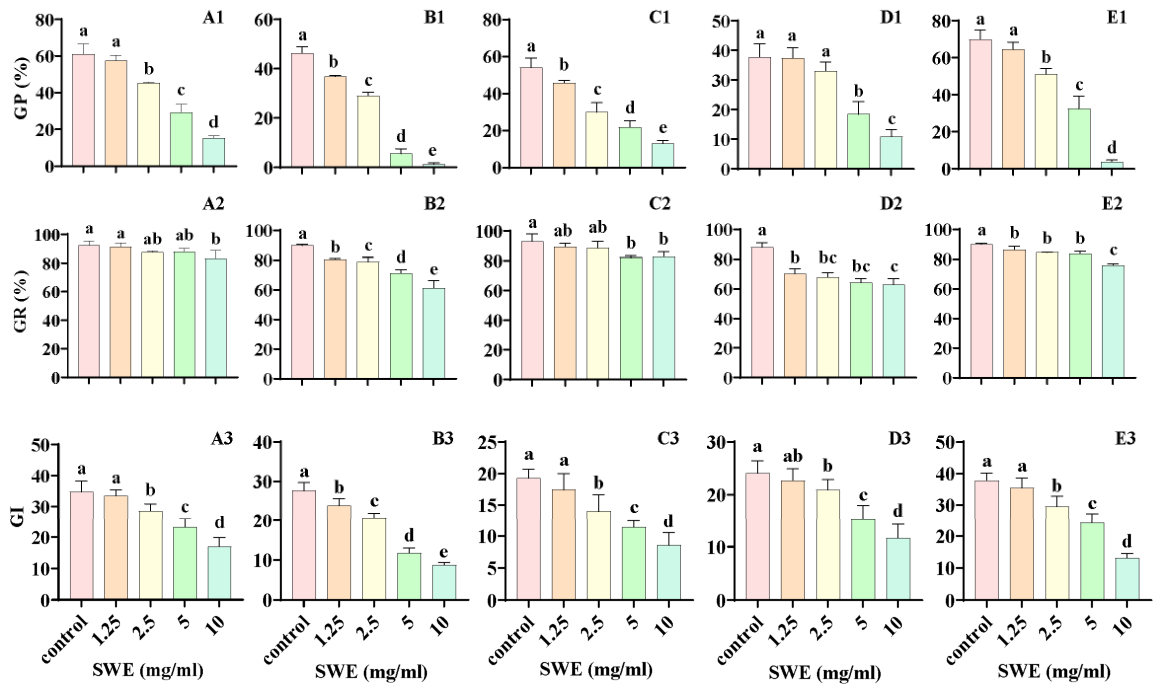
| Brassica rapa var. chinensis (L.) Kitam. | Control | 60.88 ± 5.74 a | 92.44 ± 3.01 a | 34.73 ± 3.47 a |
| 1.25 | 57.55 ± 2.77 a | 91.11 ± 2.69 a | 33.50 ± 1.80 a | |
| 2.5 | 45.33 ± 0.66 b | 87.56 ± 1.01 ab | 28.54 ± 2.32 b | |
| 5 | 29.11 ± 4.72 c | 88.00 ± 2.31 ab | 23.10 ± 2.83 c | |
| 10 | 15.33 ± 1.15 d | 83.11 ± 5.55 b | 16.91 ± 2.96 d | |
| Eruca vesicaria subsp. sativa (M.) Thellung | Control | 46.22 ± 2.77 a | 89.78 ± 0.77 a | 27.64 ± 2.05 a |
| 1.25 | 36.89 ± 0.38 b | 80.67 ± 0.67 b | 23.84 ± 1.79 b | |
| 2.5 | 29.11 ± 1.38 c | 78.89 ± 3.08 c | 20.69 ± 1.23 c | |
| 5 | 5.56 ± 2.03 d | 71.11 ± 2.69 d | 11.67 ± 1.28 d | |
| 10 | 1.33 ± 0.67 e | 61.11 ± 5.05 e | 8.75 ± 0.64 e | |
| Lactuca sativa var. asparagina L.H.Bailey ex Holub | Control | 70.00 ± 5.03 a | 90.00 ± 0.67 a | 37.76 ± 2.34 a |
| 1.25 | 64.44 ± 4.01 a | 86.22 ± 2.34 b | 35.47 ± 3.06 a | |
| 2.5 | 51.11 ± 3.15 b | 84.44 ± 0.38 b | 29.56 ± 3.30 b | |
| 5 | 32.44 ± 6.74 c | 83.56 ± 1.92 b | 24.20 ± 3.01 c | |
| 10 | 3.78 ± 1.01 d | 76.00 ± 1.15 c | 13.19 ± 1.43 d | |
| Brassica oleracea var. capitata L. | Control | 54.07 ± 5.01 a | 92.96 ± 5.25 a | 19.29 ± 1.46 a |
| 1.25 | 45.93 ± 1.28 b | 89.26 ± 2.57 ab | 17.46 ± 2.55 a | |
| 2.5 | 30 ± 5.09 c | 88.52 ± 4.63 ab | 14.01 ± 2.68 b | |
| 5 | 21.85 ± 3.57 d | 82.22 ± 1.11 b | 11.41 ± 1.02 c | |
| 10 | 12.96 ± 1.7 e | 82.59 ± 3.39 b | 8.55 ± 2.05 d | |
| Lactuca sativa var. ramosa Hort. | Control | 37.78 ± 4.44 a | 88.00 ± 2.9 a | 24.06 ± 2.38 a |
| 1.25 | 37.33 ± 3.52 a | 70.20 ± 3.36 b | 22.69 ± 2.21 ab | |
| 2.5 | 33.11 ± 3.01 a | 68.00 ± 3.06 bc | 20.93 ± 1.91 b | |
| 5 | 18.44 ± 4.34 b | 64.20 ± 2.78 bc | 15.16 ± 2.76 c | |
| 10 | 10.89 ± 2.34 c | 62.90 ± 4.07 c | 11.61 ± 2.69 d |
| Crops | EC (mg/mL) | SEE GP (%) | SEE GR (%) | SEE GI |
|---|---|---|---|---|
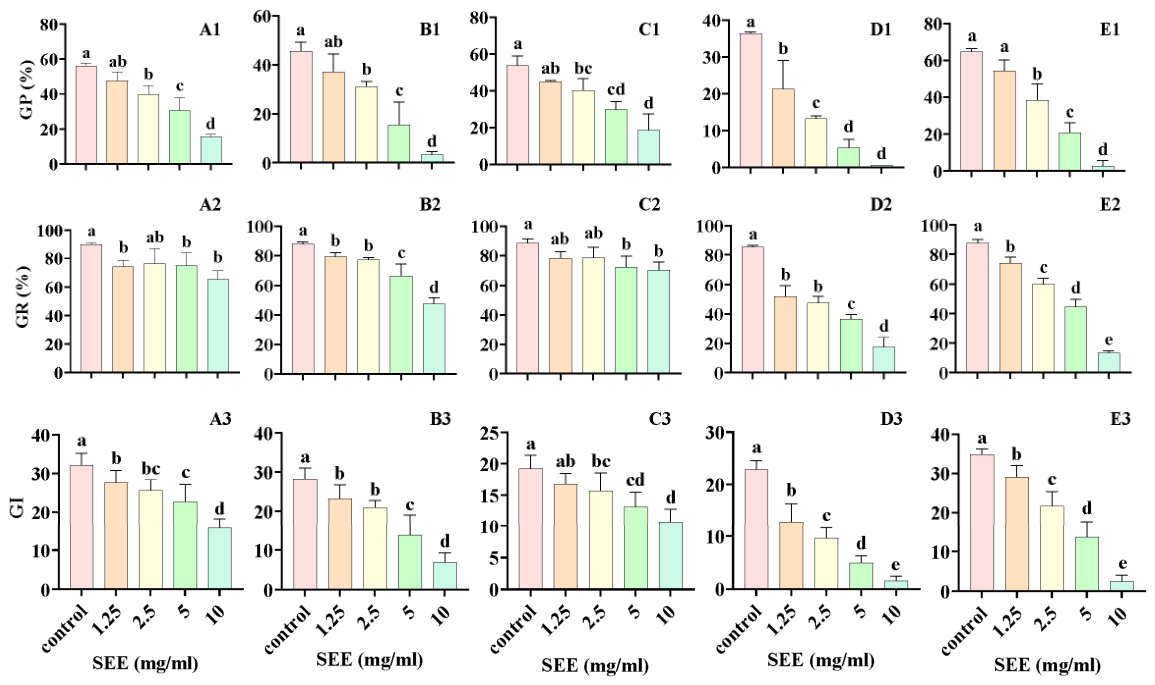
| Brassica rapa var. chinensis (L.) Kitam. | Control | 56.00 ± 1.76 a | 90.00 ± 1.15 a | 32.14 ± 3.09 a |
| 1.25 | 47.56 ± 5.05 ab | 74.67 ± 4.16 b | 27.64 ± 3.18 b | |
| 2.5 | 39.78 ± 4.91 b | 76.44 ± 10.36 ab | 25.64 ± 2.76 bc | |
| 5 | 30.44 ± 7.43 c | 75.33 ± 8.51 b | 22.75 ± 4.40 c | |
| 10 | 15.56 ± 1.39 d | 65.56 ± 6.19 b | 15.79 ± 2.40 d | |
| Eruca vesicaria subsp. sativa (M.) Thellung | Control | 45.56 ± 3.67 a | 87.78 ± 1.68 a | 28.21 ± 2.81 a |
| 1.25 | 37.11 ± 7.31 ab | 79.11 ± 2.78 b | 23.24 ± 3.53 b | |
| 2.5 | 31.11 ± 2.04 b | 77.33 ± 1.33 b | 21.02 ± 1.74 b | |
| 5 | 15.56 ± 9.19 c | 66.67 ± 7.57 c | 13.83 ± 5.16 c | |
| 10 | 3.33 ± 1.15 d | 47.33 ± 4.16 d | 6.95 ± 2.36 d | |
| Lactuca sativa var. asparagina L.H.Bailey ex Holub | Control | 64.67 ± 1.76 a | 87.78 ± 2.52 a | 34.81 ± 1.49 a |
| 1.25 | 54.44 ± 5.82 a | 74.22 ± 3.91 b | 29.13 ± 2.84 b | |
| 2.5 | 38.44 ± 8.88 b | 60.00 ± 4.06 c | 21.71 ± 3.70 c | |
| 5 | 20.89 ± 5.39 c | 44.89 ± 4.91 d | 13.64 ± 4.01 d | |
| 10 | 2.67 ± 2.91 d | 13.33 ± 1.33 e | 2.52 ± 1.56 e | |
| Brassica oleracea var. capitata L. | Control | 53.70 ± 5.13 a | 88.52 ± 2.80 a | 19.21 ± 2.14 a |
| 1.25 | 44.81 ± 0.64 ab | 78.15 ± 4.49 ab | 16.78 ± 1.66 ab | |
| 2.5 | 40.00 ± 6.67 bc | 78.51 ± 7.14 ab | 15.72 ± 2.82 bc | |
| 5 | 29.63 ± 4.49 cd | 72.59 ± 7.14 b | 13.19 ± 2.28 cd | |
| 10 | 18.52 ± 8.98 d | 70.37 ± 5.25 b | 10.74 ± 2.05 d | |
| Lactuca sativa var. ramosa Hort. | Control | 36.44 ± 0.38 a | 85.56 ± 1.02 a | 22.83 ± 1.73 a |
| 1.25 | 21.33 ± 7.69 b | 52.00 ± 7.33 b | 12.85 ± 3.44 b | |
| 2.5 | 13.33 ± 0.67 c | 47.78 ± 4.44 b | 9.66 ± 1.95 c | |
| 5 | 5.33 ± 2.31 d | 36.67 ± 2.91 c | 4.90 ± 1.40 d | |
| 10 | 0.67 ± 0.00 d | 17.33 ± 6.77 d | 1.60 ± 0.80 e |
| Crops | EC (mg/mL) | SWE Shoot Length | SWE Root Length | SEE Shoot Length | SEE Root Length |
|---|---|---|---|---|---|
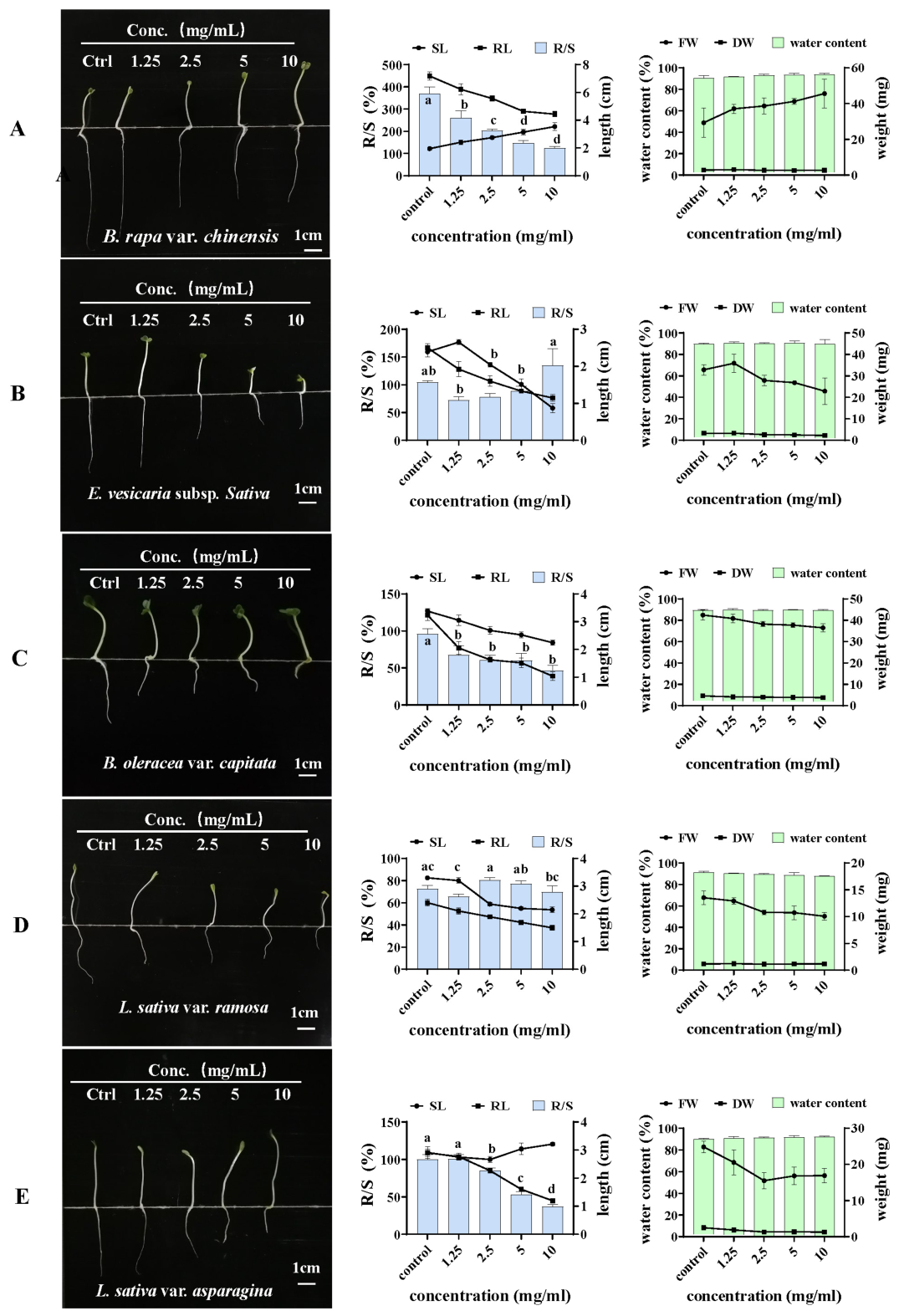
| Brassica rapa var. chinensis (L.) Kitam. | Control | 1.95 ± 0.10 d | 7.18 ± 0.30 a | 2.66 ± 0.16 a | 7.50 ± 0.31 a |
| 1.25 | 2.41 ± 0.16 c | 6.23 ± 0.39 b | 2.25 ± 0.11 a | 7.13 ± 0.29 a | |
| 2.5 | 2.74 ± 0.02 c | 5.57 ± 0.2 c | 2.55 ± 0.21 a | 5.87 ± 0.36 b | |
| 5 | 3.15 ± 0.22 b | 4.63 ± 0.02 d | 2.63 ± 0.46 a | 4.84 ± 0.87 c | |
| 10 | 3.53 ± 0.28 a | 4.43 ± 0.19 d | 2.92 ± 0.50 a | 4.01 ± 0.31 c | |
| Eruca vesicaria subsp. sativa (M.) Thellung | Control | 2.39 ± 0.13 a | 2.50 ± 0.12 a | 2.37 ± 0.23 bc | 2.37 ± 0.13 b |
| 1.25 | 2.65 ± 0.06 b | 1.92 ± 0.21 b | 2.27 ± 0.12 bc | 3.87 ± 0.61 a | |
| 2.5 | 2.04 ± 0.06 c | 1.60 ± 0.14 c | 2.95 ± 0.27 a | 4.70 ± 0.53 a | |
| 5 | 1.51 ± 0.14 d | 1.30 ± 0.04 d | 2.62 ± 0.19 ab | 4.20 ± 0.53 a | |
| 10 | 0.87 ± 0.12 e | 1.14 ± 0.10 d | 2.21 ± 0.08 d | 2.57 ± 0.14 b | |
| Lactuca sativa var. asparagina L.H.Bailey ex Holub | Control | 2.92 ± 0.20 bc | 2.90 ± 0.13 a | 3.24 ± 0.08 a | 2.74 ± 0.09 a |
| 1.25 | 2.75 ± 0.10 bc | 2.77 ± 0.13 a | 2.82 ± 0.10 b | 2.31 ± 0.22 ab | |
| 2.5 | 2.67 ± 0.11 c | 2.27 ± 0.67 b | 2.38 ± 0.19 c | 1.73 ± 0.17 b | |
| 5 | 3.04 ± 0.21 ab | 1.60 ± 0.07 c | 2.22 ± 0.16 c | 1.73 ± 0.58 b | |
| 10 | 3.21 ± 0.06 a | 1.19 ± 0.05 d | 1.71 ± 0.28 d | 0.57 ± 0.25 c | |
| Brassica oleracea var. capitata L. | Control | 3.38 ± 0.09 a | 3.24 ± 0.20 a | 3.41 ± 0.21 a | 3.70 ± 0.13 a |
| 1.25 | 3.05 ± 0.19 b | 2.05 ± 0.23 b | 3.00 ± 0.15 b | 2.99 ± 0.53 b | |
| 2.5 | 2.68 ± 0.14 c | 1.63 ± 0.09 c | 2.70 ± 0.06 c | 2.73 ± 0.10 b | |
| 5 | 2.52 ± 0.11 c | 1.51 ± 0.17 c | 2.67 ± 0.16 c | 2.51 ± 0.08 bc | |
| 10 | 2.24 ± 0.09 d | 1.04 ± 0.15 d | 2.05 ± 0.09 d | 2.08 ± 0.35 c | |
| Lactuca sativa var. ramosa Hort. | Control | 3.30 ± 0.07 a | 2.40 ± 0.12 a | 2.99 ± 0.27 a | 2.01 ± 0.14 a |
| 1.25 | 3.20 ± 0.10 a | 2.10 ± 0.11 b | 2.26 ± 0.11 b | 1.92 ± 0.31 a | |
| 2.5 | 2.35 ± 0.07 b | 1.90 ± 0.05 c | 2.07 ± 0.09 b | 1.25 ± 0.10 b | |
| 5 | 2.20 ± 0.05 c | 1.70 ± 0.07 d | 2.10 ± 0.09 b | 1.35 ± 0.23 b | |
| 10 | 2.15 ± 0.11 c | 1.50 ± 0.09 e | 1.60 ± 0.10 c | 1.00 ± 0.04 b |
| Plant Species | EC (mg/mL) | SWE FW (mg) | SWE DW (mg) | SEE FW (mg) | SEE DW (mg) |
|---|---|---|---|---|---|
| Brassica rapa var. chinensis (L.) Kitam. | Control | 29.30 ± 8.13 b | 2.75 ± 0.85 a | 38.77 ± 1.11 a | 3.23 ± 0.15 c |
| 1.25 | 37.10 ± 2.57 ab | 3.07 ± 0.23 a | 36.40 ± 1.64 a | 3.28 ± 0.20 c | |
| 2.5 | 38.70 ± 4.38 ab | 2.69 ± 0.70 a | 36.70 ± 3.20 a | 3.61 ± 0.21 bc | |
| 5 | 41.25 ± 1.71 a | 2.61 ± 0.62 a | 37.80 ± 2.96 a | 3.92 ± 0.29 b | |
| 10 | 45.65 ± 8.09 a | 2.74 ± 0.00 a | 40.53 ± 2.89 a | 4.61 ± 0.27 a | |
| Eruca vesicaria subsp. sativa (M.) Thellung | Control | 32.85 ± 2.47 ab | 3.30 ± 0.35 a | 36.93 ± 1.03 b | 3.47 ± 0.28 b |
| 1.25 | 35.90 ± 4.20 a | 3.32 ± 0.36 a | 35.73 ± 1.99 b | 3.51 ± 0.26 b | |
| 2.5 | 27.88 ± 2.52 bc | 2.66 ± 0.31 ab | 41.10 ± 1.50 a | 4.03 ± 0.11 a | |
| 5 | 26.86 ± 0.31 bc | 2.52 ± 0.54 ab | 38.60 ± 1.70 ab | 4.02 ± 0.10 a | |
| 10 | 22.88 ± 6.17 c | 2.23 ± 0.51 b | 36.70 ± 3.00 b | 4.09 ± 0.12 a | |
| Lactuca sativa var. asparagina L.H.Bailey ex Holub | Control | 24.83 ± 1.66 a | 2.49 ± 0.12 a | 26.33 ± 1.65 a | 2.66 ± 0.11 a |
| 1.25 | 20.57 ± 3.42 ab | 1.85 ± 0.12 b | 21.03 ± 2.53 b | 1.97 ± 0.05 b | |
| 2.5 | 15.50 ± 2.21 c | 1.30 ± 0.13 c | 17.76 ± 2.45 b | 1.81 ± 0.14 b | |
| 5 | 16.83 ± 2.40 bc | 1.35 ± 0.08 c | 16.80 ± 2.23 b | 1.73 ± 0.10 b | |
| 10 | 16.90 ± 1.93 bc | 1.26 ± 0.10 c | 10.27 ± 2.68 c | 1.20 ± 0.16 c | |
| Brassica oleracea var. capitata L. | Control | 42.43 ± 2.40 a | 4.55 ± 0.08 a | 40.83 ± 2.51 a | 4.04 ± 0.16 a |
| 1.25 | 40.87 ± 2.11 ab | 4.09 ± 0.14 b | 36.90 ± 1.11 ab | 3.66 ± 0.10 b | |
| 2.5 | 38.20 ± 1.18 bc | 3.96 ± 0.07 b | 33.70 ± 1.49 bc | 3.54 ± 0.21 b | |
| 5 | 37.73 ± 1.10 bc | 3.88 ± 0.04 c | 31.93 ± 1.69 cd | 3.46 ± 0.10 bc | |
| 10 | 36.47 ± 2.03 c | 3.79 ± 0.08 c | 28.80 ± 2.71 d | 3.22 ± 0.59 c | |
| Lactuca sativa var. ramosa Hort. | Control | 13.50 ± 1.30 a | 1.17 ± 0.01 a | 18.40 ± 1.37 a | 1.82 ± 0.15 a |
| 1.25 | 12.90 ± 0.61 ab | 1.23 ± 0.06 a | 15.10 ± 1.41 b | 1.48 ± 0.12 b | |
| 2.5 | 10.80 ± 0.40 bc | 1.14 ± 0.70 a | 12.97 ± 1.64 bc | 1.35 ± 0.08 bc | |
| 5 | 10.70 ± 1.29 bc | 1.18 ± 0.15 a | 11.67 ± 1.46 c | 1.28 ± 0.15 bc | |
| 10 | 10.00 ± 0.76 c | 1.20 ± 0.09 a | 10.47 ± 0.83 c | 1.19 ± 0.06 c |
| English Name | Latin Scientific Name | Cultivar |
|---|---|---|
| Bok Choy | Brassica rapa var. chinensis (L.) Kitam. | Creamy and Fast-Growing Chinese Broccoli |
| Rocket | Eruca vesicaria subsp. sativa (M.) Thellung | Big Leaf Rocket |
| Chinese lettuce | Lactuca sativa var. asparagina L.H.Bailey ex Holub | Xiao Hua Ye |
| Cabbage | Brassica oleracea var. capitata L. | Zhonggan No.11 |
| Lettuce | Lactuca sativa var. ramosa Hort. | Glass Lettuce |
Disclaimer/Publisher’s Note: The statements, opinions and data contained in all publications are solely those of the individual author(s) and contributor(s) and not of MDPI and/or the editor(s). MDPI and/or the editor(s) disclaim responsibility for any injury to people or property resulting from any ideas, methods, instructions or products referred to in the content. |
© 2026 by the authors. Licensee MDPI, Basel, Switzerland. This article is an open access article distributed under the terms and conditions of the Creative Commons Attribution (CC BY) license.
Share and Cite
Lei, J.; Wang, T.; Lin, W.; Liu, Z.; Yang, J.; Niu, W.; Zhao, Z.; Chen, J.; Chen, P.; Wang, Y. Allelopathic Activity of Ginseng-Cultivated Soil: Extracts on Seed Germination and Growth of Five Vegetables in China. Plants 2026, 15, 1607. https://doi.org/10.3390/plants15111607
Lei J, Wang T, Lin W, Liu Z, Yang J, Niu W, Zhao Z, Chen J, Chen P, Wang Y. Allelopathic Activity of Ginseng-Cultivated Soil: Extracts on Seed Germination and Growth of Five Vegetables in China. Plants. 2026; 15(11):1607. https://doi.org/10.3390/plants15111607
Chicago/Turabian StyleLei, Jun, Tianyi Wang, Wei Lin, Zhengwu Liu, Jiaqi Yang, Wanting Niu, Zichu Zhao, Jiarui Chen, Ping Chen, and Yi Wang. 2026. "Allelopathic Activity of Ginseng-Cultivated Soil: Extracts on Seed Germination and Growth of Five Vegetables in China" Plants 15, no. 11: 1607. https://doi.org/10.3390/plants15111607
APA StyleLei, J., Wang, T., Lin, W., Liu, Z., Yang, J., Niu, W., Zhao, Z., Chen, J., Chen, P., & Wang, Y. (2026). Allelopathic Activity of Ginseng-Cultivated Soil: Extracts on Seed Germination and Growth of Five Vegetables in China. Plants, 15(11), 1607. https://doi.org/10.3390/plants15111607