Communication

The Long Intergenic Noncoding RNA ARTA Specifically Regulates MYB7 Nuclear Trafficking to Establish a Self-Reinforcing Circuit for ABA Response

by
Zhengmin Tang
1,†,
Jun Yang
2,†,
Yanhang Chen
1,
Yongdi Zhang
1,
Jingjing Cai
1,
Dong Wang
1,*,
Reqing He
1,* and
Youlin Zhu
1,*
1
Institute of Advanced Agricultural Sciences, College of Life Science, Nanchang University, Nanchang 330031, China
2
Ministry of Education Key Laboratory of Crop Physiology, Ecology and Genetic Breeding, Jiangxi Agricultural University, Nanchang 330045, China
*
Authors to whom correspondence should be addressed.
These authors contributed equally to this work.
Plants 2026, 15(11), 1596; https://doi.org/10.3390/plants15111596
Submission received: 21 April 2026 / Revised: 9 May 2026 / Accepted: 18 May 2026 / Published: 22 May 2026
(This article belongs to the Special Issue Genetic Regulation and Plant Biochemistry)

Abstract

Long noncoding RNAs are involved in diverse biological processes in plants. Our recent study has revealed that an ABA-induced long intergenic noncoding RNA, ARTA, regulates both ABA and drought responses by blocking the nuclear import of a transcription factor, MYB7, through interacting with an importin β-like protein, SAD2. Here, we show that unlike MYB7, ARTA fails to disrupt interactions of SAD2 with the other two R2R3-MYB subgroup 4 members, MYB4 and MYB32. Consequently, the nuclear localizations of MYB4 and MYB32 remain unchanged upon alteration of ARTA expression. Furthermore, ARTA and MYB7 form a self-reinforcing feedback loop during Arabidopsis responses to ABA: ABA treatment induces ARTA expression, which in turn inhibits nuclear accumulation of MYB7, thereby deteriorating MYB7-mediated repression of ARTA and promoting ARTA production. This self-reinforcing feedback regulation elegantly integrates protein relocalization with transcriptional augmentation in the ABA response process, and provides a tunable molecular circuit for plant stress adaptation.

1. Introduction

Plants as sessile organisms have to cope with various environmental conditions. When plants encounter water deficit, the level of abscisic acid (ABA) increases and activates downstream signal transduction pathways [1]. Plants reduce water loss by regulating stomatal closure and initiate protective mechanisms to cope with drought stress [2]. Transcriptional regulation is a key step in ABA signal transduction, in which a large number of transcription factors are activated. These transcription factors then induce the expression of downstream functional genes (such as LEA protein-coding genes and antioxidant enzyme genes), ultimately enhancing the stress tolerance of plants [3]. In addition to protein-coding genes, increasing evidence shows that long noncoding RNAs (lncRNAs) are also widely involved in the regulation of plant ABA signaling pathways [4,5,6]. LncRNAs are RNAs with a length of more than 200 nucleotides and lack protein-coding potential [7]. According to its genomic location and transcription direction relative to protein-coding genes, lncRNA can be further divided into long intergenic noncoding RNAs (lincRNAs), natural antisense transcripts (NATs), long noncoding enhancer RNAs (lnc-eRNAs), precursor of small interfering RNA, etc. [8]. In plants, many lncRNAs have been annotated, but the molecular functions of most of them have not been fully elucidated [9]. LncRNAs, as important regulators of plant growth and stress responses, are able to function as molecular scaffolds for protein complex assembly, structural components in ribonucleoprotein complexes or chromatin architecture, and decoys or sponges for miRNAs, thereby coordinating various biological processes by modulating gene expression [8].
As scaffolds, lncRNAs can bring together multiple proteins to form functional ribonucleoprotein complexes. For instance, the lncRNA DANA2 positively regulates drought tolerance by recruiting ERF84 to promote JMJ29-mediated histone demethylation [10]. Similarly, lncRNA DANA1 interacts with the L1p/L10e family protein DIP1 to form an RNA–protein complex that recruits histone deacetylase HDA9 to regulate CYP707A1 and CYP707A2 expression [11]. As molecular sponges, lncRNAs can act as competing endogenous RNAs (ceRNAs), reducing the levels of free miRNAs and relieving the inhibitory effect of miRNAs on their target genes. A typical example in Arabidopsis is the lncRNA IPS1, which contains a sequence complementary to miR399 but has a mismatched loop structure at the cleavage site. This allows IPS1 to sequester miR399 and prevent it from cleaving its target mRNA involved in phosphate homeostasis [12]. As structural components, lncRNAs can form R-loop structures with genomic DNA. In Arabidopsis, the lncRNA APOLO employs R-loop formation to recognize multiple genomic loci and, in combination with chromatin looping mechanisms, enables long-range transcriptional regulation of target genes [13].
Beyond their roles in chromatin and transcriptional regulation, plant lncRNAs also control protein localization and intracellular transport. For instance, in Medicago truncatula, the enod40 RNA directly participates in the relocalization of its interacting protein, MtRBP1, from the nucleus to the cytoplasm [14]. In Arabidopsis, the nucleocytoplasmic transport protein SAD2 (an importin β-like protein) mediates the nuclear import of various proteins involved in diverse biological processes [4,15,16,17,18,19]. Our recent study has revealed that the ABA-induced lincRNA ARTA binds to SAD2 and affects the nuclear transport of MYB7, an R2R3-MYB subgroup 4 transcription factor that directly binds to the ABI5 promoter and represses its transcription, thereby modulating ABI5 expression [4,20]. Both ARTA and MYB7 have been shown to regulate ABA sensitivity and drought tolerance in Arabidopsis [4], underscoring the functional significance of the ARTA–MYB7 regulatory axis in ABA responses. Furthermore, accumulating evidence suggests that MYB transcription factors are widely involved in dynamic feedback loops that fine-tune signal responses in plants [21,22,23,24,25,26]. In addition to MYB7, SAD2 also facilitates the nuclear import of two other subgroup 4 members, MYB4 and MYB32 [17]. However, whether ARTA affects the interaction between SAD2 and MYB4 or MYB32 remains unclear.
In this study, we demonstrate that ARTA selectively disrupts the interaction between SAD2 and MYB7 both in vitro and in vivo, without affecting the binding of SAD2 to its homologs MYB4 and MYB32. Consistently, ARTA does not alter the nuclear localization of MYB4 or MYB32. Moreover, we discover that this regulation is bidirectional: MYB7 directly binds to the promoter of the ARTA and represses its transcription. Thus, our findings reveal a self-reinforcing feedback loop between ARTA and MYB7. ABA-induced ARTA blocks MYB7 nuclear import, which in turn relieves MYB7-mediated transcriptional repression of ARTA, thereby further promoting ARTA production and amplifying the ABA signal. Intriguingly, we also find that ABI5 represses ARTA transcription, providing a braking mechanism that prevents runaway amplification of this self-reinforcing loop and facilitates the restoration of homeostasis.
Taken together, these findings extend our previous understanding of ARTA function and provide a new molecular framework for ABA signaling regulation in plants.

2. Results

2.1. ARTA Did Not Impair Protein Interactions Among MYB4, MYB32, and SAD2

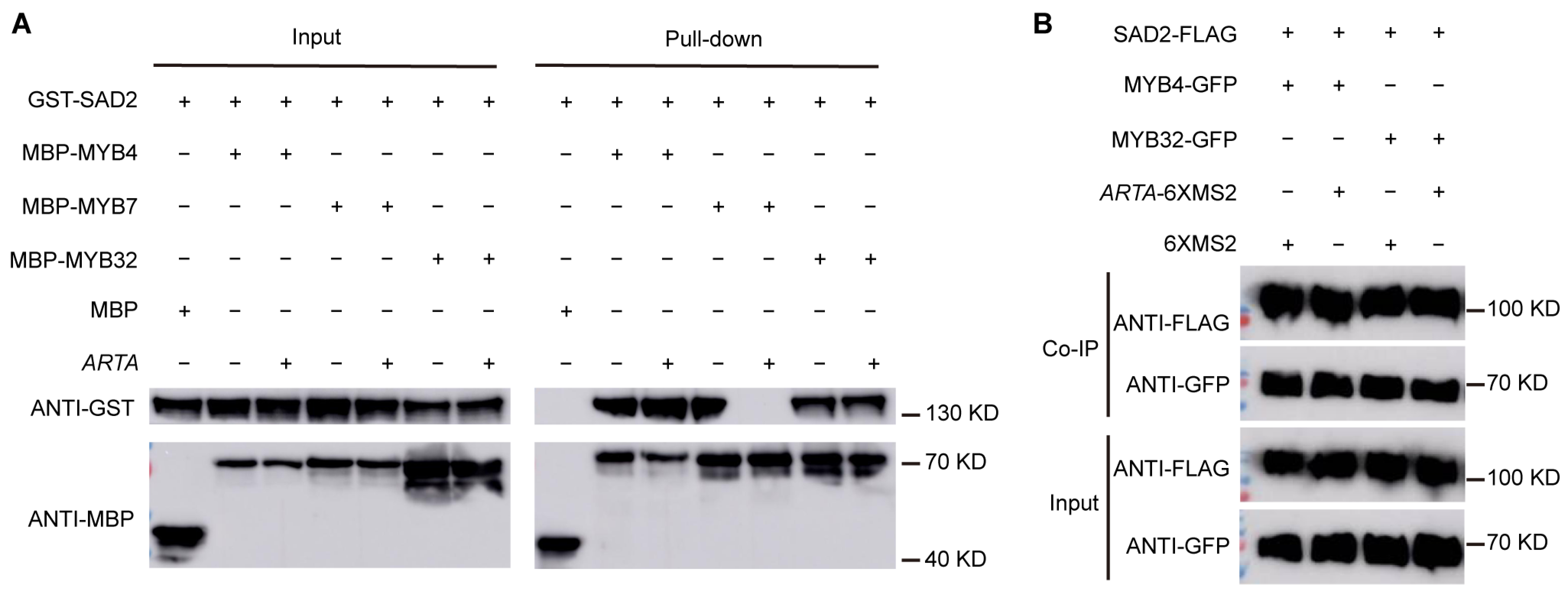
As reported, SAD2 influenced the nuclear transport of the R2R3-MYB subgroup 4 transcription factors MYB4, MYB7, and MYB32 [17]. Sequence alignment reveals that these three proteins share conserved R2R3 DNA-binding domains, the EAR motif, and a conserved SAD2-interacting SID motif at their C-termini, while notable sequence divergence exists outside these conserved regions [17]. Given their conserved SAD2-interacting motifs yet with regional sequence divergence, whether ARTA affects the SAD2-MYB4 or SAD2-MYB32 interaction remains unclear. To address this, we performed in vitro pull-down assays. These results showed that ARTA disrupted the SAD2-MYB7 interaction, consistent with the previous finding, but did not block the formation of either the SAD2-MYB4 or the SAD2-MYB32 complex under identical experimental conditions (Figure 1A).
To validate these in vitro findings in a cellular context, we performed co-immunoprecipitation (Co-IP) assays in Nicotiana benthamiana leaves transiently co-expressing the proteins. The Co-IP results clearly demonstrated that the existence of ARTA RNA did not influence the interaction of SAD2 with MYB4 or MYB32, respectively (Figure 1B). These findings further substantiated that ARTA does not impair the binding affinity between SAD2 and MYB4 or MYB32 in vivo.
Taken together, the above results prove that ARTA selectively disrupts the SAD2-MYB7 interaction, but does not affect the closely related SAD2-MYB4 and SAD2-MYB32 complexes. Therefore, we conclude that ARTA functions as a precise molecular disruptor specifically targeting the SAD2-MYB7 axis.

2.2. ARTA Did Not Alter the Nuclear Localizations of Both MYB4 and MYB32

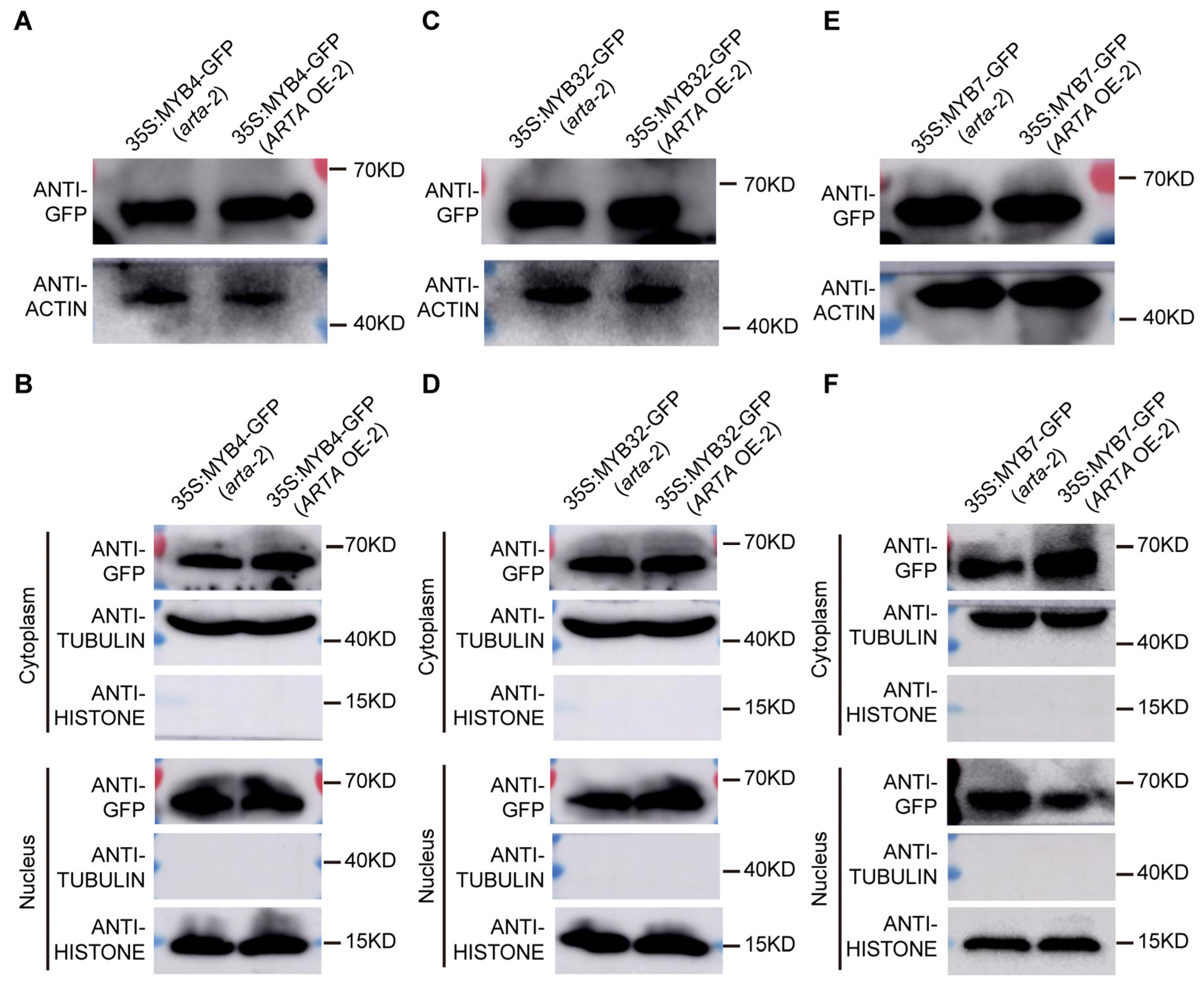
To investigate whether ARTA affected the nuclear translocation of MYB4 and MYB32, we performed transient expression in mesophyll protoplasts. Protoplasts isolated from both arta-2 and ARTA-overexpressing (ARTA OE) plants were transfected separately with constructs expressing MYB4-GFP, MYB7-GFP, or MYB32-GFP driven by the 35S promoter. First, we confirmed by Western blot analysis that no apparent differences in the protein levels of MYB4-GFP, MYB7-GFP, and MYB32-GFP were observed between arta-2 and ARTA OE plants (Figure 2A,C,E).
Subsequently, to determine whether ARTA influences the nucleocytoplasmic partitioning of MYB4 and MYB32, subcellular fractionation and immunoblotting experiments were performed to quantitatively assess their nuclear versus cytoplasmic distribution. Using histone and tubulin as rigorous indicators for the nuclear and cytoplasmic fractions, respectively, we observed that MYB7-GFP nuclear accumulation was markedly reduced in the ARTA OE plant compared with arta-2, consistent with our previous finding [4]. In contrast, no significant difference in the nuclear accumulation of either MYB4-GFP or MYB32-GFP was detected between the arta mutant and ARTA OE plants (Figure 2B,D,F). The results indicated that ARTA effectively regulates the nuclear import of MYB7 but exerts no detectable effect on the nuclear translocation of its paralogs, MYB4 and MYB32.

2.3. MYB7 Repressed ARTA Expression by Directly Binding to Its Promoter

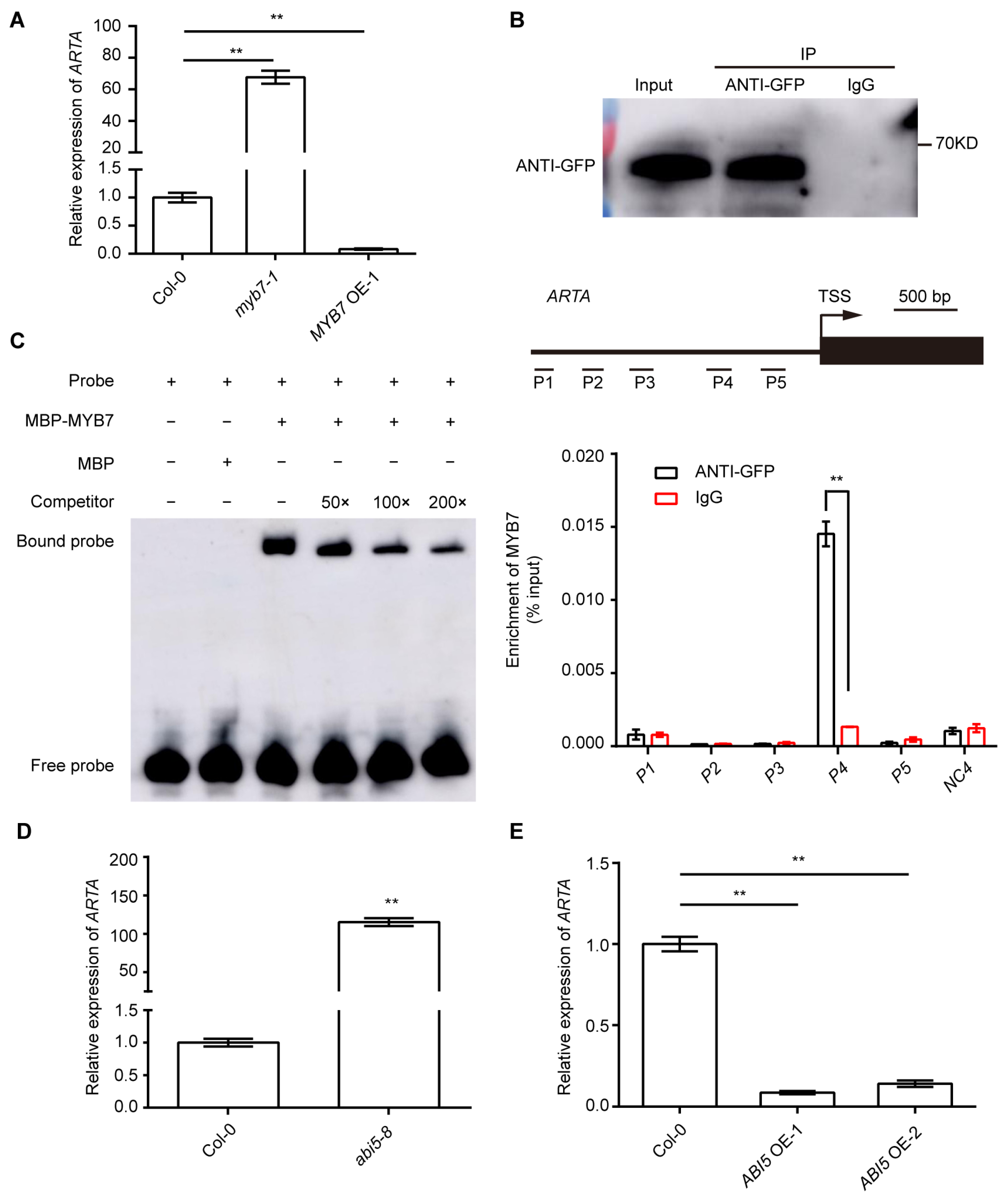
Given that ARTA specifically inhibited MYB7 nuclear import, we next asked whether MYB7 reciprocally regulates ARTA expression, thereby forming a feedback loop. The RT-qPCR results showed that ARTA transcript levels were significantly upregulated in the myb7 mutant and downregulated in MYB7 OE plants compared to the wild type, indicating that MYB7 acted as a transcriptional repressor of ARTA (Figure 3A). To determine whether MYB7 directly binds to the ARTA promoter, we performed a chromatin immunoprecipitation (ChIP)-qPCR assay using 35S:MYB7-GFP transgenic Arabidopsis seedlings. The results showed that MYB7 was significantly enriched at the P4 region of the ARTA promoter (Figure 3B). Next, an electrophoretic mobility shift assay (EMSA) was carried out, and the result further confirmed that MYB7 directly binds to the P4 region of the ARTA promoter in vitro (Figure 3C). These results indicate that MYB7 directly binds to the ARTA promoter to repress its transcription, thereby forming a dual-negative feedback loop with ARTA.
Given that MYB7 directly represses ABI5 transcription and ARTA relieves this repression by blocking MYB7 nuclear import [4], we next examined whether ABI5 in turn regulates ARTA. RT-qPCR analysis showed that ARTA transcript levels were significantly upregulated in the abi5-8 mutant and downregulated in ABI5-overexpressing (ABI5 OE) plants compared to Col-0 (Figure 3D,E), indicating that ABI5 also functions as a transcriptional repressor of ARTA.

3. Discussion

The precise spatial and temporal control of transcription factor activity is fundamental to eukaryotic gene regulation. In plants, this is often achieved by modulating the nucleocytoplasmic partitioning of key transcriptional regulators [15,27,28,29,30,31]. Previously, we found that lincRNA ARTA could regulate ABI5 expression during plant responses to ABA by regulating MYB7 nuclear trafficking [4]. MYB7 belongs to the R2R3-MYB subgroup 4, and SAD2 has been validated to be involved in the nuclear import of subgroup 4 R2R3-MYB TFs except for MYB3 [17]. However, the effects of ARTA on the nuclear translocation of MYB4 and MYB32 remain unclear. Here, our results showed that ARTA did not impair protein interactions among MYB4, MYB32, and SAD2 (Figure 1), and ARTA did not alter the nuclear localizations of either MYB4 or MYB32 as well (Figure 2).
The differential effects of ARTA on different SAD2 substrates prompted us to uncover the underlying molecular basis. Using structural bioinformatics analysis with PISA, we revealed significant differences in the thermodynamic properties of these complexes. The solvation free energy increment (ΔiG) upon formation of the SAD2-MYB7 complex interface was −9.6 kcal/mol, which is substantially higher than that of SAD2-MYB4 (−23.8 kcal/mol) and SAD2-MYB32 (−28.7 kcal/mol) (Figure S1). This indicated that the interaction between SAD2 and MYB7 is relatively weak and the interface is inherently unstable. Given this marked thermodynamic disparity, we propose that such weak binding renders the SAD2-MYB7 complex uniquely susceptible to disruption by ARTA. In contrast, the deeply favorable binding energies of MYB4 and MYB32 likely confer resistance to such interference. Even if ARTA binds to a fraction of SAD2, the high-affinity binding of MYB4 and MYB32 enables them to efficiently compete for the residual SAD2 pool, sustaining unperturbed nuclear import. Future structural studies will be essential to further elucidate the precise molecular mechanism by which ARTA distinguishes between different SAD2–substrate complexes.
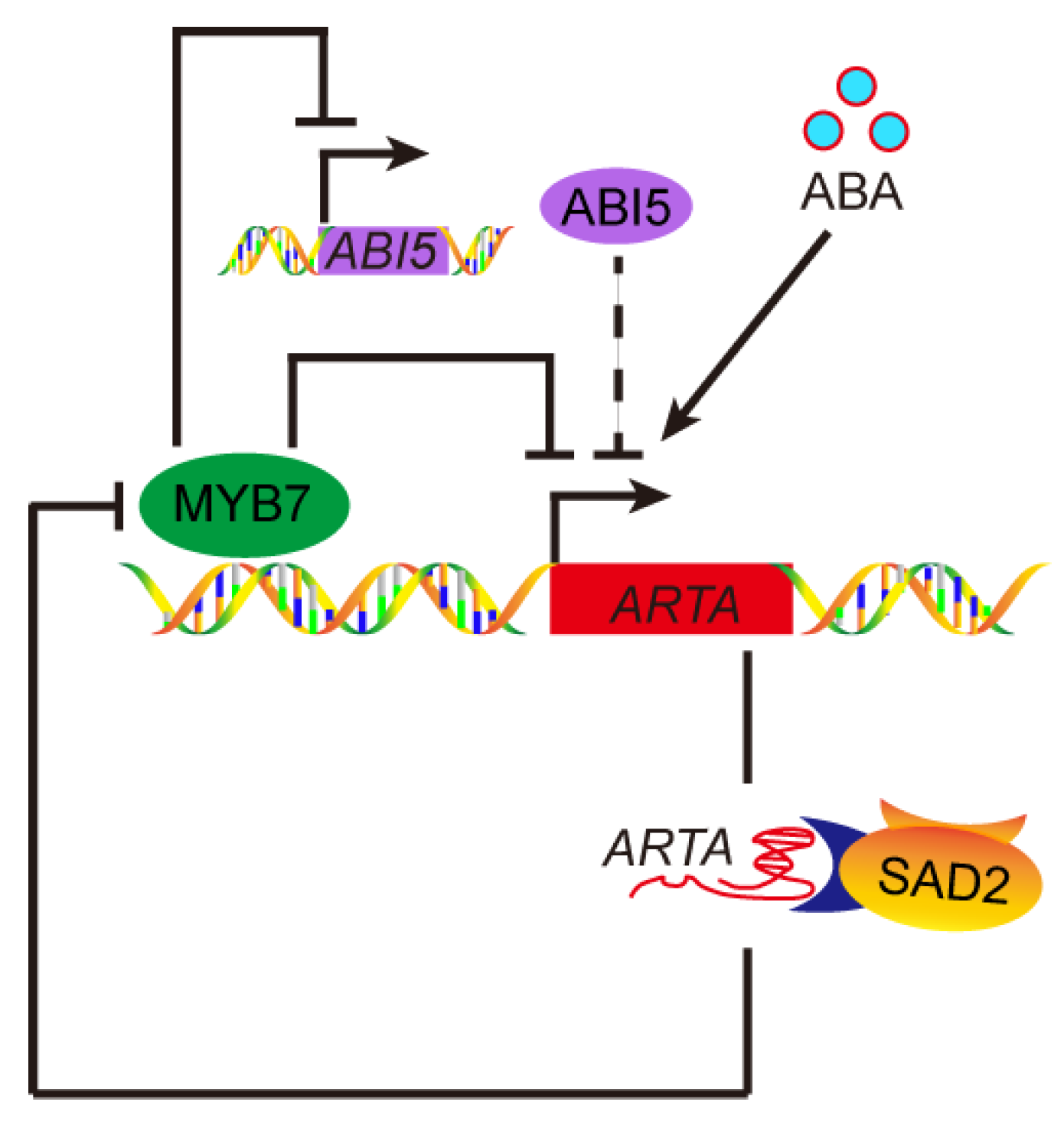
Feedback regulation is a key mechanism for balancing diverse physiological processes in organisms and enables rapid and reversible adaptive responses in plant growth, development, and environmental adaptation [24,25,26,32,33,34,35,36,37,38]. Our study revealed that the MYB7 protein binds to the promoter region of ARTA and represses its expression (Figure 3A). This establishes a critical self-reinforcing feedback loop: an initial ABA signal induces ARTA transcription [4]. Once ARTA accumulates and blocks MYB7 nuclear import [4], nuclear MYB7 levels decrease, which relieves the repression of the ARTA locus and further promotes ARTA transcription. Furthermore, we found that ABI5 represses ARTA transcription (Figure 3D,E). Based on these discoveries we propose a dynamic regulatory model (Figure 4). Under initial stress conditions, the ARTA-MYB7 double negative feedback loop is rapidly activated to amplify the ABA signal. As nuclear MYB7 is depleted by ARTA, its repression of ABI5 is relieved, allowing ABI5 to accumulate [4]. Subsequently, ABI5 accumulates and provides a braking effect by inhibiting ARTA transcription, thereby preventing overactivation and promoting the restoration of homeostasis. Through this ARTA-MYB7-ABI5 regulatory module, plants achieve efficient and reversible stress adaptation. This regulatory mechanism warrants further refinement with respect to its spatial, temporal, and signal intensity-dependent dynamics in future studies.
In the current study, we revealed a double negative feedback loop, in which the lincRNA ARTA specifically inhibits the nuclear transport of the MYB7 protein. This inhibition relieves the MYB7-mediated transcriptional repression of ARTA, thereby establishing a self-reinforcing cycle that enables a rapid and amplified response to ABA signals. However, this circuit is further modulated by an ABI5-mediated braking mechanism, ensuring that the ABA response remains controlled. Our findings extend the understanding of ARTA’s regulatory mechanism and further enrich the feedback regulation networks for ABA signaling in plants.

4. Materials and Methods

4.1. Plant Materials and Growth Conditions

All transgenic lines used in this study were in the Col-0 background. The mutants myb7-1 (SALK_020256) and abi5-8 (SALK_013163), obtained from the Arabidopsis Biological Resource Center (ABRC, Ohio State University, Columbus, OH, USA), have been described previously [4,39,40]. The MYB7 OE line was generated by expressing the complementary DNA encoding full-length MYB7 driven by the 35S promoter, fused with a GFP tag, as previously described [4]. The ABI5 OE line was generated by expressing the complementary DNA encoding full-length ABI5 driven by the 35S promoter, fused with an HA tag, as previously described [4]. Arabidopsis seeds were sterilized with 70% ethanol for 10 min, followed by six to seven rinses with sterile distilled water. Subsequently, the seeds were sown in 1/2 MS medium, layered for 3 days in the darkness of 4 °C, and grown under the illumination of 22 °C for 16 h light/8 h dark.

4.2. RT-qPCR and Western Blotting

Total RNA was extracted using the TRIzol reagent (Ambion, Austin, TX, USA, Cat# 15596018), and first-strand cDNA was synthesized with the TransScript One-Step gDNA Removal and cDNA Synthesis SuperMix (TransGen Biotech, Beijing, China, Cat# AT311-03). RT-qPCR was performed on a Bio-Rad CFX96 system using the SYBR qPCR Master Mix (Vazyme, Nanjing, China, Cat# Q711-02). UBQ3 was used as the reference gene for normalization. Three independent biological samples were considered. Student’s t test was performed considering two-tailed samples of different variance. Primer sequences are listed in Table S1.
Protein extracts were resolved on 12% SDS-PAGE gels (Thermo Fisher Scientific, Waltham, MA, USA, Cat# XP00120BOX) and transferred to nitrocellulose membranes (GE Healthcare, Chicago, IL, USA, Cat# 9004700100). For immunoblotting, the following primary antibodies were used: anti-MBP (Abmart, Shanghai, China, Cat# M20051), anti-GST (Abmart, Shanghai, China, Cat# M20007), anti-GFP (BBI Life Sciences, Shanghai, China, Cat# D110008-0200), anti-FLAG (Abmart, Shanghai, China, Cat# M20008), anti-ACTIN (Abmart, Shanghai, China, Cat# M20009), anti-Tubulin (Abmart, Shanghai, China, Cat# M20045F), and anti-Histone (Abmart, Shanghai, China, Cat# P30266F).

4.3. Recombinant Proteins and In Vitro Protein Pull-Down Assay

The full-length cDNAs of MYB4, MYB32, and MYB7 were introduced into the vector pMSCG7-MBP, respectively. The full-length cDNA of SAD2 was introduced into the vector pGEX-6P-3 (GST). After that the resultant MBP-MYB4, MBP-MYB32, MBP-MYB7, and GST-SAD2 were separately transformed into the Escherichia coli (BL21 (DE3)) cells. The pull-down assay was performed as previously described [4]. In brief, 500 μg of GST-SAD2 was mixed with 500 μg of MBP, MBP-MYB4, MBP-MYB32, or MBP-MYB7 and the volume was adjusted to 1 mL with TGH buffer (50 mM HEPES pH 7.5, 150 mM NaCl, 1.5 mM MgCl2, 1 mM EGTA pH 7.5, 1% Triton X-100, 5% glycerol, 1 mM PMSF, and complete protease inhibitor cocktail (Roche, Basel, Switzerland, Cat# 04693132001)). The mixture was incubated for 1 h at 4 °C. Subsequently, 65 µL of amylose resin (NEB, Ipswich, MA, USA, Cat# E8021S) was added and incubated for an additional 1 h, followed by four washes with TGH buffer. The bound proteins were analyzed on 10% SDS-PAGE gels, and then subjected to immunoblotting.

4.4. Chromatin Immunoprecipitation

ChIP was performed as described previously with minor modifications [4]. Approximately 3 g of 35S: MYB7-GFP seedlings were cross-linked in vivo, and cell nuclei were purified and extracted through sonication. The resulting supernatant was immunoprecipitated with mouse IgG1 (Cell Signaling Technology, Danvers, MA, USA, Cat# 5415S) or anti-GFP antibody (Roche, Basel, Switzerland, Cat# 11814460001) at 4 °C for 4h on a rotation mixer. After reverse cross-linking and proteinase K (Merck Millipore, Billerica, MA, USA, Cat# 539480) digestion, DNA was extracted with phenol–chloroform and precipitated with ethanol. The primer sequences used for ChIP-qPCR are listed in Table S1.

4.5. Electrophoretic Mobility Shift Assay

The EMSA was performed using the LightShift EMSA Optimization and Control Kit (Thermo Fisher Scientific, Waltham, MA, USA, Cat# 20148X) as described previously [4]. The biotin 5′-end-labeled DNA fragment (listed in Table S1) was synthesized, annealed, and used as the DNA probe, while the corresponding unlabeled DNA fragment served as the specific competitor. For the binding reaction, recombinant MBP-MYB7 proteins were incubated with 20 fmol of biotin-labeled probe in 20 μL of binding buffer (10 mM Tris-HCl pH 7.5, 50 mM KCl, 1 mM DTT, 2.5% glycerol, 5 mM MgCl2, 50 ng/μL poly (dI-dC)) at room temperature for 20 min. For competition assays, a 50-, 100-, or 200-fold molar excess of unlabeled probe was added to the reaction mixture prior to the addition of the labeled probe. The reaction products were separated on a native 6% polyacrylamide gel in 0.5× TBE buffer at 100 V for 60 min at 4 °C. Subsequently, the separated DNA–protein complexes were then transferred to a positively charged nylon membrane and cross-linked using a UV cross-linker. Biotin-labeled DNA was detected by chemiluminescence.

4.6. Co-IP Assay

Co-IP assays were performed as described previously with small modifications [41]. Briefly, Agrobacterium strains harboring 35S: MYB4-GFP, 35S: MYB32-GFP, 35S: SAD2-FLAG, and 35S: MS2 or 35S: MS2-ARTA constructs described above were transiently expressed in leaves of N. benthamiana. After 48 h of infiltration, leaf tissues were harvested and protein extracts were incubated with anti-GFP antibody (Roche, Basel, Switzerland, Cat# 11814460001) to pull down the target proteins. After washing the magnetic beads, the immunoprecipitated proteins were resolved by SDS-PAGE and subsequently probed using anti-GFP (BBI Life Sciences, Shanghai, China, Cat# D110008-0200) or anti-FLAG (Abmart, Shanghai, China, Cat# M20008) antibodies.

4.7. Nuclear–Cytoplasmic Fractionation

Nuclear–cytoplasmic fractionation was carried out using protoplasts isolated from 3-week-old Arabidopsis plants of the arta-2 and ARTA OE-2 lines, following a previous description [42]. The full-length MYB4 and MYB32 coding sequences were cloned into the vectors PA7-YFP, respectively. All constructs were transformed into Arabidopsis protoplasts by PEG-mediated transfection [4]. Subsequently, extracts were separated on 12% SDS-PAGE gels. After electrophoretic transfer to membranes, immunoblotting was performed using anti-GFP (BBI Life Sciences, Shanghai, China, Cat# D110008-0200), anti-Tubulin (Abmart, Shanghai, China, Cat# M20045F), and anti-Histone (Abmart, Shanghai, China, Cat# P30266F) antibodies.

Supplementary Materials

The following supporting information can be downloaded at: https://www.mdpi.com/article/10.3390/plants15111596/s1. Figure S1: PISA-calculated interaction parameters for SAD2-MYB complexes. Table S1: Primers and probes used in this study.

Author Contributions

Conceptualization, D.W., R.H. and Y.Z. (Youlin Zhu); methodology and formal analysis, Z.T., J.Y., J.C. and Y.C.; investigation and validation, Z.T., J.Y. and Y.Z. (Yongdi Zhang); visualization and writing—original draft preparation, Z.T. and R.H.; writing—review and editing, R.H., D.W., Z.T., J.Y., J.C., Y.C. and Y.Z. (Yongdi Zhang). All authors have read and agreed to the published version of the manuscript.

Funding

This study was supported by the Project of Fund for Stable Support to Agricultural Sci-Tech Renovation—Xinjiang Crop Biotechnology Key Laboratory open project (Grant No. xjnkywdzc-2023001-pt2-02 to R.H.) and the Jiangxi Provincial Natural Science Foundation (Grant No. 20242BAB23062 to D.W.).

Data Availability Statement

The original contributions presented in this study are included in the article/Supplementary Material. Further inquiries can be directed to the corresponding author.

Conflicts of Interest

The authors declare no conflicts of interest.

References

  1. Zeevaart, J.A.D. Changes in the Levels of Abscisic Acid and Its Metabolites in Excised Leaf Blades of Xanthium strumarium during and after Water Stress. Plant Physiol. 1980, 66, 672–678. [Google Scholar] [CrossRef]
  2. Kim, J.-S.; Kidokoro, S.; Yamaguchi-Shinozaki, K.; Shinozaki, K. Regulatory networks in plant responses to drought and cold stress. Plant Physiol. 2024, 195, 170–189. [Google Scholar] [CrossRef]
  3. Zhang, H.; Zhu, J.; Gong, Z.; Zhu, J.-K. Abiotic stress responses in plants. Nat. Rev. Genet. 2021, 23, 104–119. [Google Scholar] [CrossRef]
  4. Yang, J.; He, R.Q.; Qu, Z.P.; Gu, J.B.; Jiang, L.Y.; Zhan, X.Q.; Gao, Y.; Adelson, D.L.; Li, S.; Wang, Z.-Y.; et al. Long noncoding RNA ARTA controls ABA response through MYB7 nuclear trafficking in Arabidopsis. Dev. Cell 2023, 58, 1206–1217.E4. [Google Scholar] [CrossRef] [PubMed]
  5. Yuan, H.; Liu, S.; Yan, R.; Liu, Z.; Xu, K.; Huang, D.; Zhang, N.; Wu, Y.; Lan, X.; Yukawa, Y.; et al. AtR8 lncRNA integrates WRKY46 into ABA signaling to regulate seed and seeding growth in Arabidopsis. Plant Physiol. Biochem. 2025, 223, 109732. [Google Scholar] [CrossRef]
  6. Yang, L.; Cheng, Y.; Yuan, C.; Zhou, Y.-F.; Huang, Q.-J.; Zhao, W.-L.; He, R.-R.; Jiang, J.; Qin, Y.-C.; Chen, Z.-T.; et al. The long noncoding RNA VIVIpary promotes seed dormancy release and pre-harvest sprouting through chromatin remodeling in rice. Mol. Plant 2025, 18, 978–994. [Google Scholar] [CrossRef] [PubMed]
  7. Ariel, F.; Romero-Barrios, N.; Jégu, T.; Benhamed, M.; Crespi, M. Battles and hijacks: Noncoding transcription in plants. Trends Plant Sci. 2015, 20, 362–371. [Google Scholar] [CrossRef]
  8. Zhang, Y.-C.; He, R.-Q.; Cheng, Y.; Wang, D.; Ariel, F.; Chen, Y.-Q. Long noncoding RNAs as molecular architects: Shaping plant functions and physiological plasticity. Mol. Plant 2025, 18, 1643–1671. [Google Scholar] [CrossRef] [PubMed]
  9. Yang, J.; Ariel, F.; Wang, D. Plant long non-coding RNAs: Biologically relevant and mechanistically intriguing. J. Exp. Bot. 2023, 74, 2364–2373. [Google Scholar] [CrossRef]
  10. Zhang, P.X.; He, R.Q.; Yang, J.; Cai, J.J.; Qu, Z.P.; Yang, R.X.; Gu, J.B.; Wang, Z.-Y.; Adelson, D.L.; Zhu, Y.L.; et al. The long non-coding RNA DANA2 positively regulates drought tolerance by recruiting ERF84 to promote JMJ29-mediated histone demethylation. Mol. Plant 2023, 16, 1339–1353. [Google Scholar] [CrossRef]
  11. Cai, J.J.; Zhang, Y.D.; He, R.Q.; Jiang, L.Y.; Qu, Z.P.; Gu, J.B.; Yang, J.; Legascue, M.F.; Wang, Z.-Y.; Ariel, F.; et al. LncRNA DANA1 promotes drought tolerance and histone deacetylation of drought responsive genes in Arabidopsis. EMBO Rep. 2024, 25, 796–812. [Google Scholar] [CrossRef] [PubMed]
  12. Franco-Zorrilla, J.M.; Valli, A.; Todesco, M.; Mateos, I.; Puga, M.I.; Rubio-Somoza, I.; Leyva, A.; Weigel, D.; García, J.A.; Paz-Ares, J. Target mimicry provides a new mechanism for regulation of microRNA activity. Nat. Genet. 2007, 39, 1033–1037. [Google Scholar] [CrossRef]
  13. Ariel, F.; Lucero, L.; Christ, A.; Mammarella, M.F.; Jegu, T.; Veluchamy, A.; Mariappan, K.; Latrasse, D.; Blein, T.; Liu, C.; et al. R-Loop Mediated trans Action of the APOLO Long Noncoding RNA. Mol. Cell 2020, 77, 1055–1065.E4. [Google Scholar] [CrossRef]
  14. Campalans, A.; Kondorosi, A.; Crespi, M. Enod40, a Short Open Reading Frame–Containing mRNA, Induces Cytoplasmic Localization of a Nuclear RNA Binding Protein in Medicago truncatula. Plant Cell 2004, 16, 1047–1059. [Google Scholar] [CrossRef]
  15. Verslues, P.E.; Guo, Y.; Dong, C.H.; Ma, W.; Zhu, J.K. Mutation of SAD2, an importin β-domain protein in Arabidopsis, alters abscisic acid sensitivity. Plant J. 2006, 47, 776–787. [Google Scholar] [CrossRef]
  16. Zhao, J.; Zhang, W.; Zhao, Y.; Gong, X.; Guo, L.; Zhu, G.; Wang, X.; Gong, Z.; Schumaker, K.S.; Guo, Y. SAD2, an Importin β-Like Protein, Is Required for UV-B Response in Arabidopsis by Mediating MYB4 Nuclear Trafficking. Plant Cell 2007, 19, 3805–3818. [Google Scholar] [CrossRef]
  17. Zhou, M.; Sun, Z.; Wang, C.; Zhang, X.; Tang, Y.; Zhu, X.; Shao, J.; Wu, Y. Changing a conserved amino acid in R2R3-MYB transcription repressors results in cytoplasmic accumulation and abolishes their repressive activity in Arabidopsis. Plant J. 2015, 84, 395–403. [Google Scholar] [CrossRef] [PubMed]
  18. Chen, G.; Xu, D.; Liu, Q.; Yue, Z.; Dai, B.; Pan, S.; Chen, Y.; Feng, X.; Hu, H. Regulation of FLC nuclear import by coordinated action of the NUP62-subcomplex and importin β SAD2. J. Integr. Plant Biol. 2023, 65, 2086–2106. [Google Scholar] [CrossRef]
  19. Liu, L.; Liu, Y.; Ji, X.; Zhao, X.; Liu, J.; Xu, N. Coronatine orchestrates ABI1-mediated stomatal opening to facilitate bacterial pathogen infection through importin β protein SAD2. Plant J. 2024, 119, 676–688. [Google Scholar] [CrossRef]
  20. Wang, D.; Qu, Z.; Yang, L.; Zhang, Q.; Liu, Z.-H.; Do, T.; Adelson, D.L.; Wang, Z.-Y.; Searle, I.; Zhu, J.-K. Transposable elements (TEs) contribute to stress-related long intergenic noncoding RNAs in plants. Plant J. 2017, 90, 133–146. [Google Scholar] [CrossRef] [PubMed]
  21. Wang, Y.; Mao, Z.; Jiang, H.; Zhang, Z.; Chen, X. A feedback loop involving MdMYB108L and MdHY5 controls apple cold tolerance. Biochem. Biophys. Res. Commun. 2019, 512, 381–386. [Google Scholar] [CrossRef]
  22. Song, S.-K.; Jeong, D.W.; Kim, Y.J.; Schiefelbein, J.; Lee, M.M. Negative feedback regulation of GLABRA1 contributes to epidermal cell patterning in the Arabidopsis root. Biochem. Biophys. Res. Commun. 2024, 737, 150869. [Google Scholar] [CrossRef]
  23. Hu, D.-G.; Zhang, M.; Li, C.; Zhao, T.-T.; Du, L.-D.; Sun, Q.; Wang, C.-K.; Meng, D.; Sun, C.-H.; Fei, Z.; et al. A linker histone acts as a transcription factor to orchestrate malic acid accumulation in apple in response to sorbitol. Plant Cell 2025, 37, 328. [Google Scholar] [CrossRef] [PubMed]
  24. Xie, T.; Zan, X.; Chen, X.; Zhu, H.; Rong, H.; Wang, Y.; Jiang, J. An R3-MYB repressor, BnCPC forms a feedback regulation with MBW complex to modulate anthocyanin biosynthesis in Brassica napus. Biotechnol. Biofuels Bioprod. 2022, 15, 133. [Google Scholar] [CrossRef]
  25. Xing, M.; Xin, P.; Wang, Y.; Han, C.; Lei, C.; Huang, W.; Zhang, Y.; Zhang, X.; Cheng, K.; Zhang, X.; et al. A negative feedback regulatory module comprising R3-MYB repressor MYBL2 and R2R3-MYB activator PAP1 fine-tunes high light-induced anthocyanin biosynthesis in Arabidopsis. J. Exp. Bot. 2024, 75, 7381–7400. [Google Scholar] [CrossRef]
  26. Yu, S.; Li, P.; Liu, H.; Zhang, X.; Gao, Y.; Liu, J.; Yuan, C.; Liu, X.; Yao, Y.; Song, L.; et al. A CCA1-like MYB subfamily member CsMYB128 participates in chilling sensitivity and cold tolerance in tea plants (Camellia sinensis). Int. J. Biol. Macromol. 2025, 294, 139473. [Google Scholar] [CrossRef]
  27. Stacey, M.G.; Hicks, S.N.; Arnim, A.G.v. Discrete Domains Mediate the Light-Responsive Nuclear and Cytoplasmic Localization of Arabidopsis COP1. Plant Cell 1999, 11, 349–363. [Google Scholar] [CrossRef]
  28. Yang, H.-Q.; Wu, Y.-J.; Tang, R.-H.; Liu, D.; Liu, Y.; Cashmore, A.R. The C Termini of Arabidopsis Cryptochromes Mediate a Constitutive Light Response. Cell 2000, 103, 815–827. [Google Scholar] [CrossRef] [PubMed]
  29. Lee, H.; Xiong, L.; Gong, Z.; Ishitani, M.; Stevenson, B.; Zhu, J.-K. The Arabidopsis HOS1 gene negatively regulates cold signal transduction and encodes a RING finger protein that displays cold-regulated nucleo–cytoplasmic partitioning. Genes Dev. 2001, 15, 912–924. [Google Scholar] [CrossRef]
  30. Merkle, T. Nucleo-cytoplasmic partitioning of proteins in plants: Implications for the regulation of environmental and developmental signalling. Curr. Genet. 2003, 44, 231–260. [Google Scholar] [CrossRef] [PubMed]
  31. Powers, S.K.; Holehouse, A.S.; Korasick, D.A.; Schreiber, K.H.; Clark, N.M.; Jing, H.; Emenecker, R.; Han, S.; Tycksen, E.; Hwang, I.; et al. Nucleo-cytoplasmic Partitioning of ARF Proteins Controls Auxin Responses in Arabidopsis thaliana. Mol. Cell 2019, 76, 177–190.E5. [Google Scholar] [CrossRef] [PubMed]
  32. Zong, W.; Tang, N.; Yang, J.; Peng, L.; Ma, S.; Xu, Y.; Li, G.; Xiong, L. Feedback Regulation of ABA Signaling and Biosynthesis by a bZIP Transcription Factor Targets Drought-Resistance-Related Genes. Plant Physiol. 2016, 171, 2810–2825. [Google Scholar] [CrossRef]
  33. Ruan, Y.; Halat, L.S.; Khan, D.; Jancowski, S.; Ambrose, C.; Belmonte, M.F.; Wasteneys, G.O. The Microtubule-Associated Protein CLASP Sustains Cell Proliferation through a Brassinosteroid Signaling Negative Feedback Loop. Curr. Biol. 2018, 28, 2718–2729.E5. [Google Scholar] [CrossRef]
  34. Lin, W.; Zhang, H.; Huang, D.; Schenke, D.; Cai, D.; Wu, B.; Miao, Y. Dual-Localized WHIRLY1 Affects Salicylic Acid Biosynthesis via Coordination of ISOCHORISMATE SYNTHASE1, PHENYLALANINE AMMONIA LYASE1, and S-ADENOSYL-L-METHIONINE-DEPENDENT METHYLTRANSFERASE1. Plant Physiol. 2020, 184, 1884–1899. [Google Scholar] [CrossRef] [PubMed]
  35. Li, Z.; Wei, X.; Tong, X.; Zhao, J.; Liu, X.; Wang, H.; Tang, L.; Shu, Y.; Li, G.; Wang, Y.; et al. The OsNAC23-Tre6P-SnRK1a feed-forward loop regulates sugar homeostasis and grain yield in rice. Mol. Plant 2022, 15, 706–722. [Google Scholar] [CrossRef]
  36. Yu, J.; Wu, Z.; Liu, X.; Fang, Q.; Pan, X.; Xu, S.; He, M.; Lin, J.; Teng, N. LoBLH6 interacts with LoMYB65 to regulate anther development through feedback regulation of gibberellin synthesis in lily. Hortic. Res. 2025, 12, 339. [Google Scholar] [CrossRef]
  37. Wang, Y.; Wu, F.; Lin, Q.; Sheng, P.; Wu, Z.; Jin, X.; Chen, W.; Li, S.; Luo, S.; Duan, E.; et al. A regulatory loop establishes the link between the circadian clock and abscisic acid signaling in rice. Plant Physiol. 2023, 191, 1857–1870. [Google Scholar] [CrossRef]
  38. Wu, Z.; Li, T.; Cao, X.; Zhang, D.; Teng, N. Lily WRKY factor LlWRKY22 promotes thermotolerance through autoactivation and activation of LlDREB2B. Hortic. Res. 2022, 9, 186. [Google Scholar] [CrossRef]
  39. Kim, J.H.; Hyun, W.Y.; Nguyen, H.N.; Jeong, C.Y.; Xiong, L.; Hong, S.W.; Lee, H. AtMyb7, a subgroup 4 R2R3 Myb, negatively regulates ABA-induced inhibition of seed germination by blocking the expression of the bZIP transcription factor ABI5. Plant Cell Environ. 2014, 38, 559–571. [Google Scholar] [CrossRef]
  40. Zheng, Y.; Schumaker, K.S.; Guo, Y. Sumoylation of transcription factor MYB30 by the small ubiquitin-like modifier E3 ligase SIZ1 mediates abscisic acid response in Arabidopsis thaliana. Proc. Natl. Acad. Sci. USA 2012, 109, 12822–12827. [Google Scholar] [CrossRef] [PubMed]
  41. Zhang, S.; Zhou, B.; Kang, Y.; Cui, X.; Liu, A.; Deleris, A.; Greenberg, M.V.C.; Cui, X.; Qiu, Q.; Lu, F.; et al. C-terminal domains of histone demethylase JMJ14 interact with a pair of NAC transcription factors to mediate specific chromatin association. Cell Discov. 2015, 1, 15003. [Google Scholar] [CrossRef] [PubMed]
  42. Yoo, S.-D.; Cho, Y.-H.; Sheen, J. Arabidopsis mesophyll protoplasts: A versatile cell system for transient gene expression analysis. Nat. Protoc. 2007, 2, 1565–1572. [Google Scholar] [CrossRef] [PubMed]
Figure 1. Examining effects of ARTA on interaction between SAD2 and two subgroup 4 R2R3-MYB members. (A) In vitro pull-down assay. In vitro transcribed ARTA (80 pmol) was incubated with GST-SAD2 and MBP-MYB4 or MBP-MYB32, and pulled down with amylose resin. Bound proteins were detected by immunoblotting with anti-GST and anti-MBP antibodies. (B) Co-IP assay of MYB4 and MYB32 with SAD2. MYB4-GFP or MYB32-GFP was co-expressed with SAD2-FLAG and MS2 or MS2-ARTA in N. benthamiana leaves. Protein extracts were immunoprecipitated with anti-GFP antibody, followed by immunoblotting with anti-FLAG antibody.
Plants 15 01596 g001
Figure 2. Examining effects of ARTA on nuclear localization of MYB4, MYB7, and MYB32. (A) 35S:MYB4-GFP was transfected into arta-2 and ARTA OE-2 protoplasts and the total protein levels of MYB4-GFP were detected. ACTIN was used as a loading control. (B) Immunoblot analyses showing the nucleus and cytoplasmic distributions of MYB4 protein in arta-2 and ARTA OE-2. HISTONE and TUBULIN were used as a nuclear and cytoplasmic marker, respectively. (C) 35S:MYB32-GFP was transfected into arta-2 and ARTA OE-2 protoplasts and the total protein levels of MYB32-GFP were detected. ACTIN was used as a loading control. (D) Immunoblot analyses showing the nucleus and cytoplasmic distributions of MYB32 protein in arta-2 and ARTA OE-2. HISTONE and TUBULIN were used as a nuclear and cytoplasmic marker, respectively. (E) 35S:MYB7-GFP was transfected into arta-2 and ARTA OE-2 protoplasts and the total protein levels of MYB7-GFP were detected. ACTIN was used as a loading control. (F) Immunoblot analyses showing the nucleus and cytoplasmic distributions of MYB7 protein in arta-2 and ARTA OE-2. HISTONE and TUBULIN were used as a nuclear and cytoplasmic marker, respectively.
Plants 15 01596 g002
Figure 3. MYB7 regulated ARTA expression. (A) Analysis of ARTA transcript levels in 4-day-old Col-0, myb7-1 mutant, and MYB7-overexpressing plants. Data are shown as mean ± SD (n = 3). Asterisks indicate statistically significant differences as determined by Student’s t-test (** p < 0.01). (B) (Top) Western blot analysis of MYB7-GFP protein levels in input and immunoprecipitated (IP) fractions. (Middle) Schematic diagram of the ARTA promoter region. Positions of five primer pairs (P1–P5) used for ChIP-qPCR are indicated relative to the transcription start site (TSS). (Bottom) ChIP-qPCR analysis of MYB7 binding at the promoters of ARTA in MYB7 OE plants. NC4 served as the negative control. Data are shown as mean ± SD (n = 3). Asterisks indicate statistically significant differences as determined by Student’s t-test (** p < 0.01). (C) EMSA of MYB7 binding the ARTA promoter. Biotin-labeled 36-nucleotide DNA probe derived from the P4 region of the ARTA promoter was incubated with recombinant MBP-MYB7 protein. Unlabeled probe was used as a competitor. (D) Quantitative measurement of the transcript levels of ARTA in 4-day-old Col-0 and abi5-8 plants. Data are shown as mean ± SD (n = 3). Asterisks indicate statistically significant differences as determined by Student’s t-test (** p < 0.01). (E) Quantitative measurement of the transcript levels of ARTA in 4-day-old Col-0 and ABI5 OE plants. Data are shown as mean ± SD (n = 3). Asterisks indicate statistically significant differences as determined by Student’s t-test (** p < 0.01).
Plants 15 01596 g003
Figure 4. A model for ARTA-regulated ABA signaling. ABA-induced lincRNA ARTA binds to SAD2, disrupting the interaction between SAD2 and MYB7, thereby reducing nuclear-localized MYB7 protein levels [4]. This relieves MYB7-mediated repression of the ARTA promoter, thereby driving further ARTA synthesis. This establishes a self-reinforcing feedback loop between ARTA and MYB7. On the other hand, the reduction in nuclear MYB7 attenuates its repression of ABI5, promoting ABI5 transcription [4]. Subsequently, ABI5 suppresses ARTA expression through negative feedback, ultimately dampening the ARTA response and restores homeostasis. Blunt-ended arrows indicate an inhibitory effect, the two right-angled arrows indicate the direction of transcription of the ABI5 and ARTA genes, the dashed line indicates whether ABI5 directly inhibits ARTA remains unknown and the solid arrow indicates ABA induction.
Plants 15 01596 g004
Disclaimer/Publisher’s Note: The statements, opinions and data contained in all publications are solely those of the individual author(s) and contributor(s) and not of MDPI and/or the editor(s). MDPI and/or the editor(s) disclaim responsibility for any injury to people or property resulting from any ideas, methods, instructions or products referred to in the content.