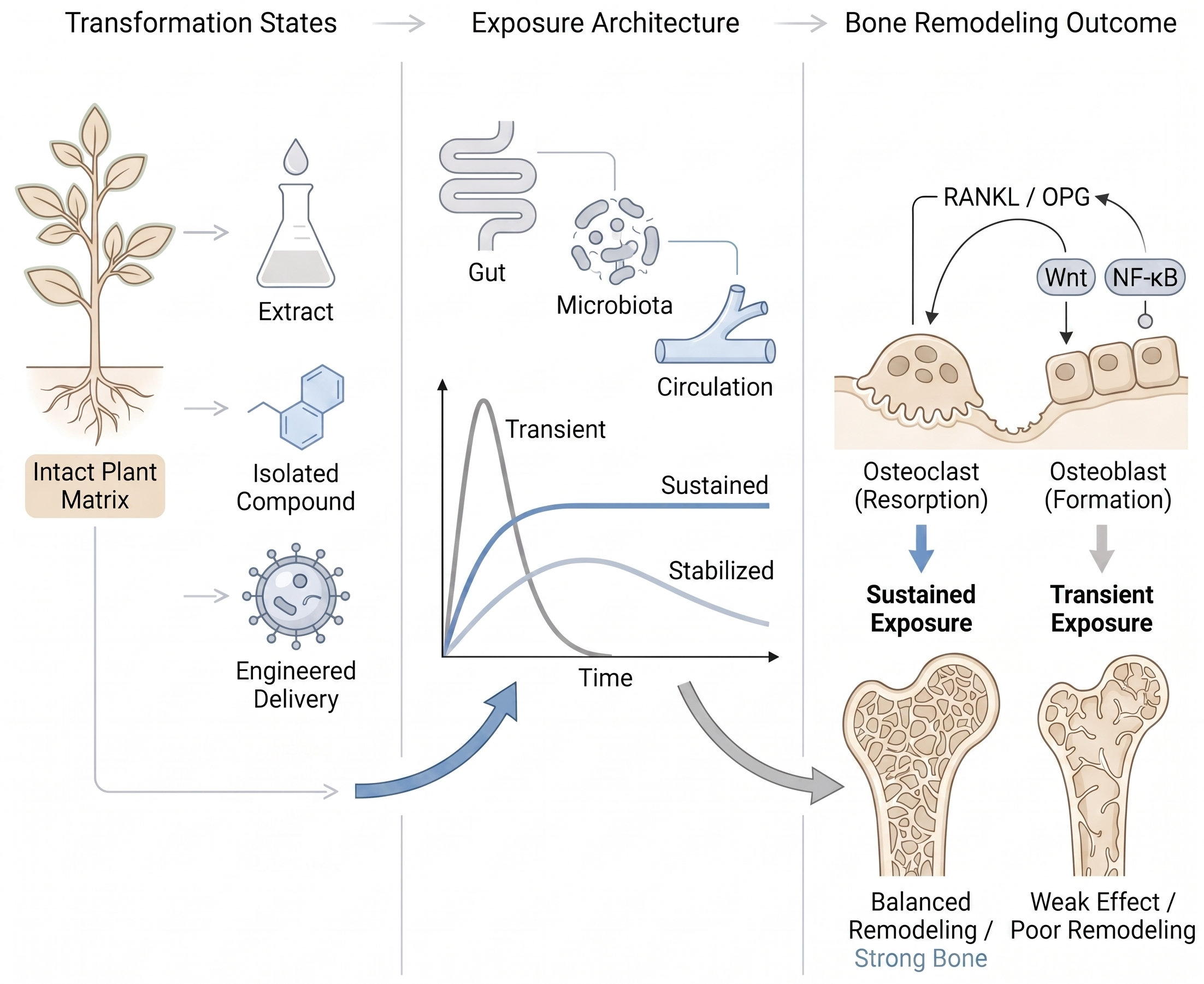
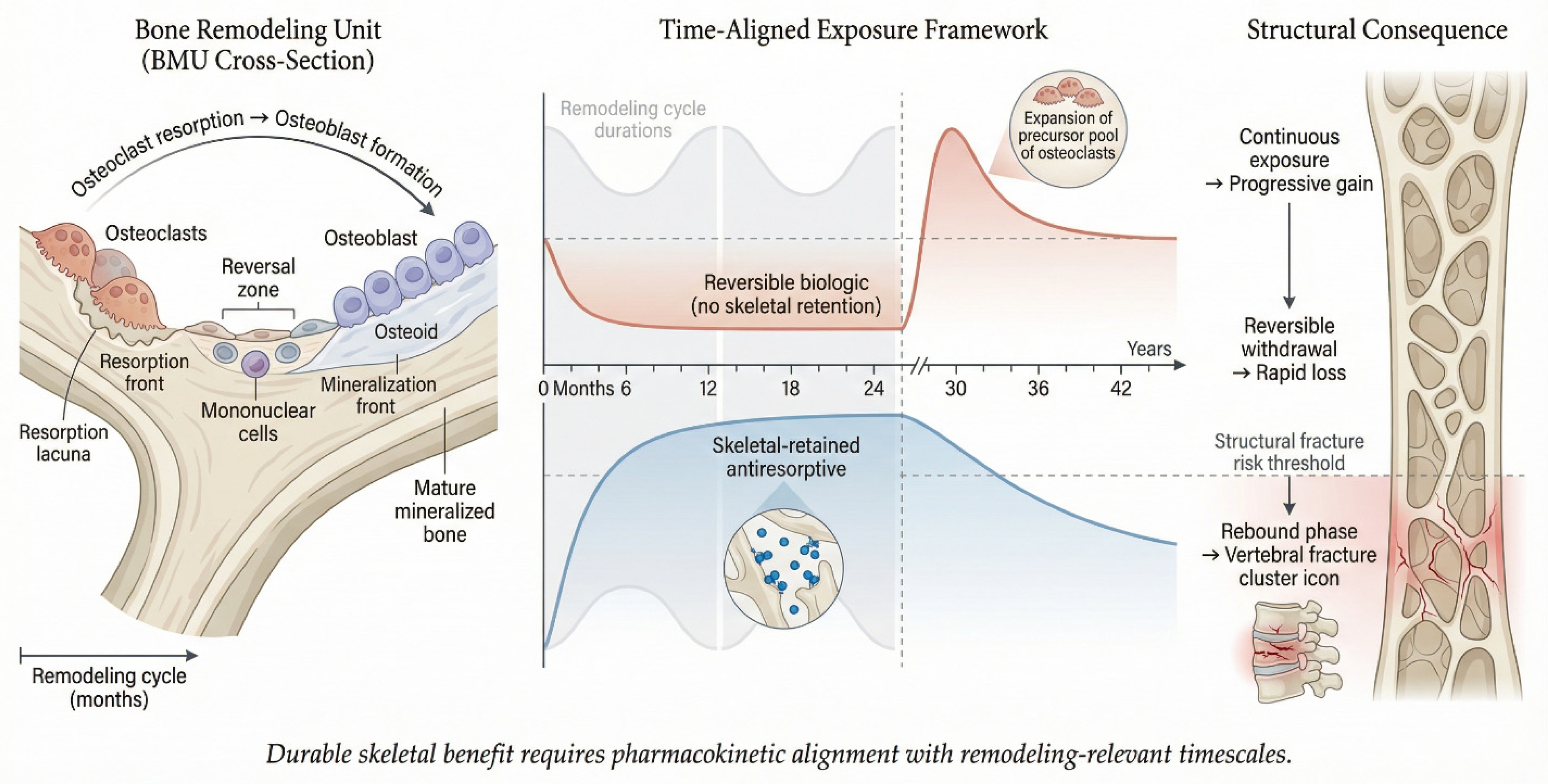
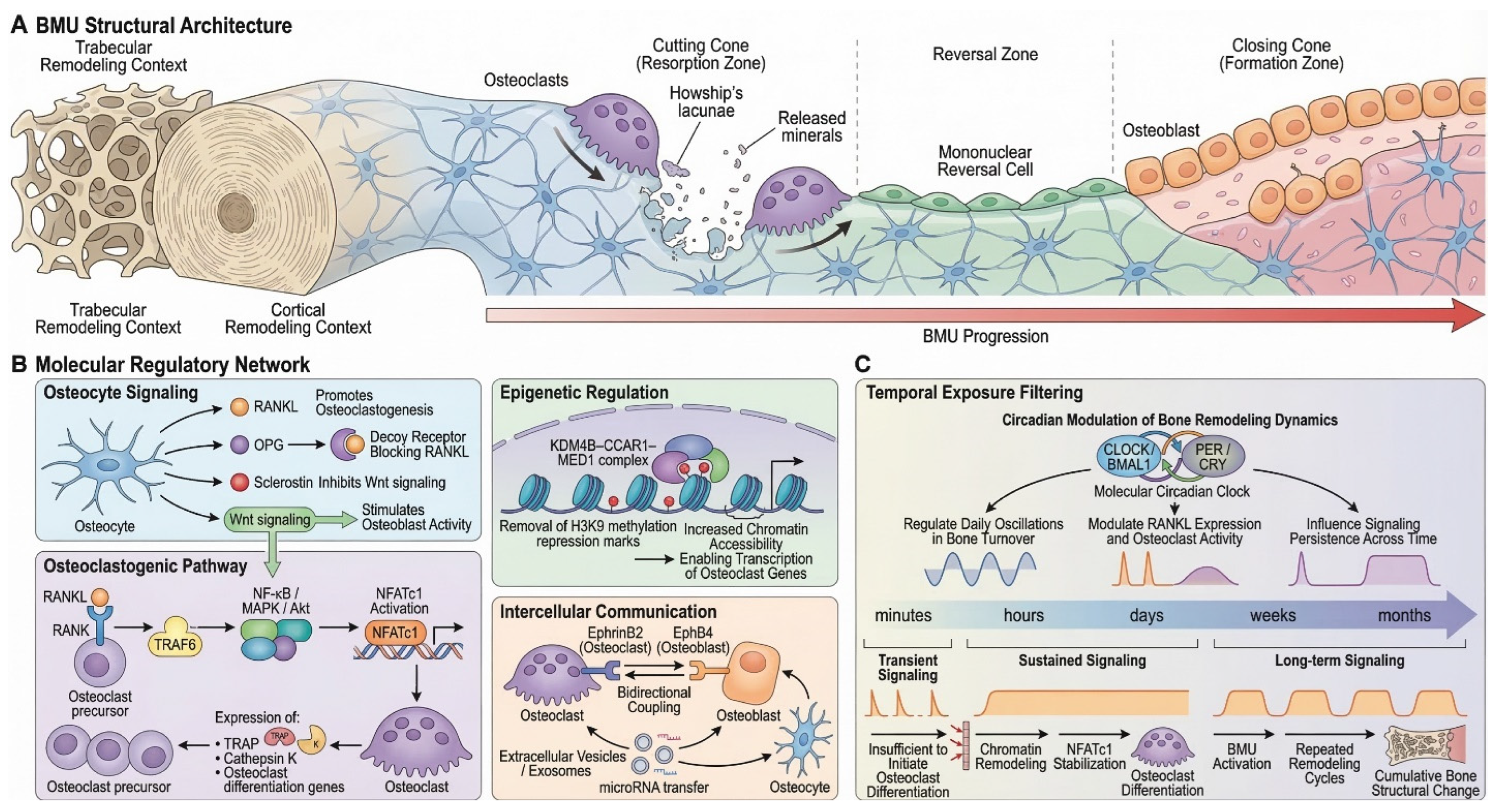
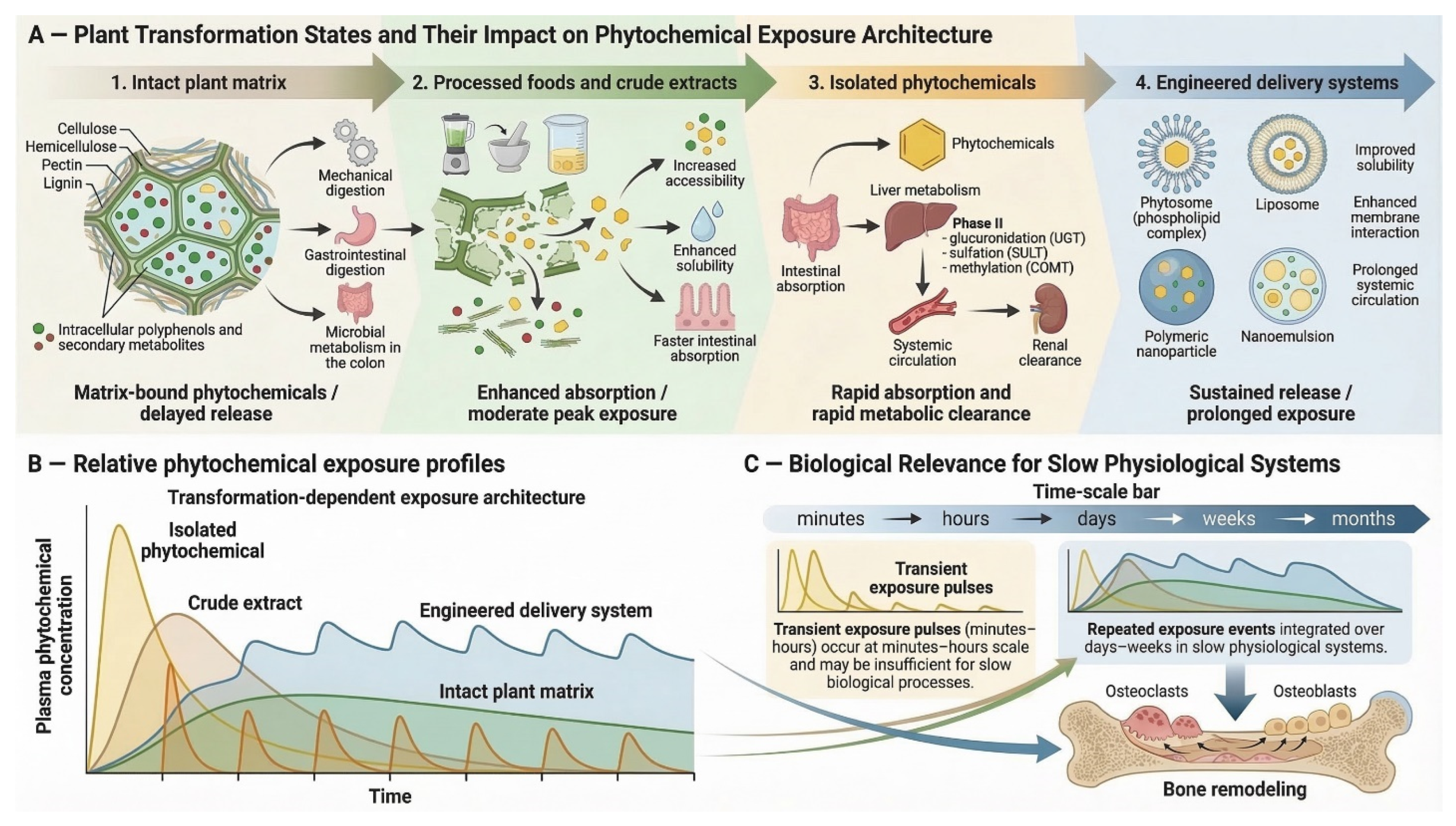
Plant Transformation States and Exposure Architecture: A Pharmacokinetic Framework for Plant-Derived Compounds in Bone Remodeling

 , , and
Abstract
1. Introduction
2. Literature Search Strategy and Review Methodology
3. Bone Remodeling as a Temporal and Exposure Filter
4. Plant Transformation States and Their Impact on Exposure Architecture
5. Natural Exposure Modulation by Plant Matrices and Extracts
5.1. Matrix-Constrained Delivery and Microbiota-Mediated Bone-Relevant Exposure
5.2. Extraction-Driven Reconfiguration of Exposure and Its Skeletal Implications
6. Exposure–Transformation Alignment and Implications for Skeletal Efficacy
7. Conclusions
Author Contributions
Funding
Data Availability Statement
Acknowledgments
Conflicts of Interest
Abbreviations
| Abbreviation | Full term |
| Akt | Protein kinase B |
| ALP | Alkaline phosphatase |
| AUC | Area under the curve |
| BMD | Bone mineral density |
| BMAL1 | Brain and muscle ARNT-like 1 |
| BMP | Bone morphogenetic protein |
| BMU | Basic multicellular unit |
| BMSC | Bone marrow stromal cell |
| CCAR1 | Cell cycle and apoptosis regulator 1 |
| CLOCK | Circadian locomotor output cycles kaput |
| COMT | Catechol-O-methyltransferase |
| COX-2 | Cyclooxygenase-2 |
| CRY | Cryptochrome |
| CTSK | Cathepsin K |
| CYP | Cytochrome P450 |
| DNA | Deoxyribonucleic acid |
| EphB4 | EPH receptor B4 |
| ER | Estrogen receptor |
| EVs | Extracellular vesicles |
| GPR41/43 | G protein-coupled receptors 41 and 43 |
| IL | Interleukin |
| Jmjd3 | Jumonji domain-containing protein 3 |
| KDM4B | Lysine demethylase 4B |
| MAPK | Mitogen-activated protein kinase |
| MED1 | Mediator complex subunit 1 |
| NFATc1 | Nuclear factor of activated T cells 1 |
| NF-κB | Nuclear factor kappa B |
| OA | Osteoarthritis |
| OPG | Osteoprotegerin |
| OVX | Ovariectomized |
| PANoptosis | Pyroptosis, apoptosis, and necroptosis |
| PDENs | Plant-derived exosome-like nanoparticles |
| PELNs | Plant exosome-like nanovesicles |
| PER | Period circadian regulator |
| PI3K | Phosphoinositide 3-kinase |
| PK | Pharmacokinetic |
| PK–PD | Pharmacokinetic–pharmacodynamic |
| PPARγ | Peroxisome proliferator-activated receptor gamma |
| RANK | Receptor activator of nuclear factor kappa B |
| RANKL | Receptor activator of nuclear factor kappa B ligand |
| RNA | Ribonucleic acid |
| ROS | Reactive oxygen species |
| SCFAs | Short-chain fatty acids |
| SEM | Standard error of the mean |
| Smad | Small mothers against decapentaplegic |
| SMI | Structure model index |
| SOST | Sclerostin |
| STAT6 | Signal transducer and activator of transcription 6 |
| SULT | Sulfotransferase |
| TGF-β | Transforming growth factor beta |
| TNF-α | Tumor necrosis factor alpha |
| TRAF6 | TNF receptor-associated factor 6 |
| TRAP | Tartrate-resistant acid phosphatase |
| UGT | UDP-glucuronosyltransferase |
| VEGF | Vascular endothelial growth factor |
| Wnt | Wingless/integrated |
References
- Adejuyigbe, B.; Kallini, J.; Chiou, D.; Kallini, J.R. Osteoporosis: Molecular pathology, diagnostics, and therapeutics. Int. J. Mol. Sci. 2023, 24, 14583. [Google Scholar] [CrossRef]
- Zhang, X.; Liang, Y.; Zhang, F.; Liu, X. Osteoporosis: Molecular pathogenesis and therapeutic interventions. Mol. Biomed. 2025, 6, 98. [Google Scholar] [CrossRef]
- Gregson, C.L.; Armstrong, D.J.; Bowden, J.; Cooper, C.; Edwards, J.; Gittoes, N.J.L.; Harvey, N.; Kanis, J.; Leyland, S.; Low, R.; et al. Correction: UK clinical guideline for the prevention and treatment of osteoporosis. Arch. Osteoporos. 2022, 17, 80. [Google Scholar] [CrossRef]
- Gregson, C.L.; Armstrong, D.J.; Avgerinou, C.; Bowden, J.; Cooper, C.; Douglas, L.; Edwards, J.; Gittoes, N.J.L.; Harvey, N.C.; Kanis, J.A.; et al. The 2024 UK clinical guideline for the prevention and treatment of osteoporosis. Arch. Osteoporos. 2025, 20, 119. [Google Scholar] [CrossRef] [PubMed]
- Kumar, S.; Wang, M.; Kim, A.S.; Center, J.R.; McDonald, M.M.; Girgis, C.M. Denosumab discontinuation in the clinic: Implications of rebound bone turnover and emerging strategies to prevent bone loss and fractures. J. Bone Miner. Res. 2025, 40, 1017–1034. [Google Scholar] [CrossRef]
- Ouyang, X.; Ma, Q.; Zhou, C.; Tang, J.; Li, M.; Qing, J.; Lei, X.; Huang, D.; Liu, H.; Zhang, G. Natural bioactive products in the regulation of bone metabolism and regeneration. Front. Pharmacol. 2025, 16, 1683279. [Google Scholar] [CrossRef] [PubMed]
- Perrone, P.; De Rosa, C.; D’Angelo, S. Polyphenols and bone health: A comprehensive review of their role in osteoporosis prevention and treatment. Molecules 2025, 30, 4154. [Google Scholar] [CrossRef]
- Kenkre, J.S.; Bassett, J.H. The bone remodelling cycle. Ann. Clin. Biochem. 2018, 55, 308–327. [Google Scholar] [CrossRef]
- Bolamperti, S.; Villa, I.; Rubinacci, A. Bone remodeling: An operational process ensuring survival and bone mechanical competence. Bone Res. 2022, 10, 48. [Google Scholar] [CrossRef] [PubMed]
- Zhu, S.; Yan, M.-Q.; Masson, A.; Chen, W.; Li, Y.-P. Cell signaling and transcriptional regulation of osteoclast lineage commitment, differentiation, bone resorption and diseases. Cell Discov. 2026, 12, 6. [Google Scholar] [CrossRef]
- Kurotaki, D.; Yoshida, H.; Tamura, T. Epigenetic and transcriptional regulation of osteoclast differentiation. Bone 2020, 138, 115471. [Google Scholar] [CrossRef]
- Appelman-Dijkstra, N.M.; Oei, H.L.D.; Vlug, A.G.; Winter, E.M. The effect of osteoporosis treatment on bone mass. Best Pract. Res. Clin. Endocrinol. Metab. 2022, 36, 101623. [Google Scholar] [CrossRef] [PubMed]
- Sahraeian, S.; Rashidinejad, A.; Golmakani, M.-T. Recent advances in the conjugation approaches for enhancing the bioavailability of polyphenols. Food Hydrocoll. 2024, 146, 109221. [Google Scholar] [CrossRef]
- Kroon, M.A.G.M.; van Laarhoven, H.W.M.; Swart, E.L.; van Tellingen, O.; Kemper, E.M. A pharmacokinetic study and critical reappraisal of curcumin formulations enhancing bioavailability. iScience 2025, 28, 112575. [Google Scholar] [CrossRef] [PubMed]
- Kapetanovic, I.M.; Muzzio, M.; Huang, Z.; Thompson, T.N.; McCormick, D.L. Pharmacokinetics, oral bioavailability, and metabolic profile of resveratrol and its dimethylether analog, pterostilbene, in rats. Cancer Chemother. Pharmacol. 2011, 68, 593–601. [Google Scholar] [CrossRef]
- Szabó, R.; Rácz, C.P.; Dulf, F.V. Bioavailability Improvement Strategies for Icariin and Its Derivates: A Review. Int. J. Mol. Sci. 2022, 23, 7519. [Google Scholar] [CrossRef] [PubMed]
- Hollands, W.J.; Hart, D.J.; Dainty, J.R.; Hasselwander, O.; Tiihonen, K.; Wood, R.; Kroon, P.A. Bioavailability of epicatechin and effects on nitric oxide metabolites of an apple flavanol-rich extract supplemented beverage compared to a whole apple puree: A randomized, placebo-controlled, crossover trial. Mol. Nutr. Food Res. 2013, 57, 1209–1217. [Google Scholar] [CrossRef]
- Hu, Y.; Lin, Q.; Zhao, H.; Li, X.; Sang, S.; McClements, D.J.; Long, J.; Jin, Z.; Wang, J.; Qiu, C. Bioaccessibility and bioavailability of phytochemicals: Influencing factors, improvements, and evaluations. Food Hydrocoll. 2023, 135, 108165. [Google Scholar] [CrossRef]
- Favari, C.; Rinaldi de Alvarenga, J.F.; Sánchez-Martínez, L.; Tosi, N.; Mignogna, C.; Cremonini, E.; Manach, C.; Bresciani, L.; Del Rio, D.; Mena, P. Factors driving the inter-individual variability in the metabolism and bioavailability of (poly)phenolic metabolites: A systematic review of human studies. Redox Biol. 2024, 71, 103095. [Google Scholar] [CrossRef]
- Morand, C. How to better consider and understand interindividual variability in response to polyphenols in clinical trials. Front. Nutr. 2024, 11, 1522516. [Google Scholar] [CrossRef]
- Hu, J.; Mesnage, R.; Tuohy, K.; Heiss, C.; Rodriguez-Mateos, A. (Poly) phenol-related gut metabotypes and human health: An update. Food Funct. 2024, 15, 2814–2835. [Google Scholar] [CrossRef]
- Hu, H.-T.; Zhang, Z.-Y.; Luo, Z.-X.; Ti, H.-B.; Wu, J.-J.; Nie, H.; Yuan, Z.-D.; Wu, X.; Zhang, K.-Y.; Shi, S.-W. Emerging regulated cell death mechanisms in bone remodeling: Decoding ferroptosis, cuproptosis, disulfidptosis, and PANoptosis as therapeutic targets for skeletal disorders. Cell Death Discov. 2025, 11, 335. [Google Scholar] [CrossRef] [PubMed]
- Daponte, V.; Henke, K.; Drissi, H. Current perspectives on the multiple roles of osteoclasts: Mechanisms of osteoclast–osteoblast communication and potential clinical implications. Elife 2024, 13, e95083. [Google Scholar] [CrossRef]
- Pajevic, P.D.; Krause, D.S. Osteocyte regulation of bone and blood. Bone 2019, 119, 13–18. [Google Scholar] [CrossRef] [PubMed]
- Anzai, M.; Watanabe-Takahashi, M.; Kawabata, H.; Masuda, Y.; Ikegami, A.; Okuda, Y.; Waku, T.; Sakurai, H.; Nishikawa, K.; Inoue, J.-i. Clustered peptide regulating the multivalent interaction between RANK and TRAF6 inhibits osteoclastogenesis by fine-tuning signals. Commun. Biol. 2025, 8, 643. [Google Scholar] [CrossRef]
- Ayyasamy, R.; Fan, S.; Czernik, P.; Lecka-Czernik, B.; Chattopadhyay, S.; Chakravarti, R. 14-3-3ζ suppresses RANKL signaling by destabilizing TRAF6. J. Biol. Chem. 2024, 300, 107487. [Google Scholar] [CrossRef]
- Yi, S.-J.; Jang, Y.-J.; Kim, H.-J.; Lee, K.; Lee, H.; Kim, Y.; Kim, J.; Hwang, S.Y.; Song, J.S.; Okada, H. The KDM4B–CCAR1–MED1 axis is a critical regulator of osteoclast differentiation and bone homeostasis. Bone Res. 2021, 9, 27. [Google Scholar] [CrossRef]
- Astleford, K.; Campbell, E.; Norton, A.; Mansky, K.C. Epigenetic regulators involved in osteoclast differentiation. Int. J. Mol. Sci. 2020, 21, 7080. [Google Scholar] [CrossRef]
- Wang, R.; Luo, H.; Yang, D.; Yu, B.; Guo, J.; Shao, L.; Okamura, H.; Qiu, L. Osteoblast Jmjd3 regulates osteoclastogenesis via EphB4 and RANKL signalling. Oral Dis. 2023, 29, 1613–1621. [Google Scholar] [CrossRef] [PubMed]
- Yuan, F.-L.; Wu, Q.-y.; Miao, Z.-N.; Xu, M.-H.; Xu, R.-S.; Jiang, D.-L.; Ye, J.-X.; Chen, F.-h.; Zhao, M.-D.; Wang, H.-j. Osteoclast-derived extracellular vesicles: Novel regulators of osteoclastogenesis and osteoclast–osteoblasts communication in bone remodeling. Front. Physiol. 2018, 9, 628. [Google Scholar] [CrossRef]
- Kikyo, N. Circadian regulation of bone remodeling. Int. J. Mol. Sci. 2024, 25, 4717. [Google Scholar] [CrossRef]
- Ayala Soto, F.E.; Serna Saldívar, S.O. Architecture, structure and chemistry of plant cell walls and their constituents. In Science and Technology of Fibers in Food Systems; Springer: Berlin/Heidelberg, Germany, 2020; pp. 3–14. [Google Scholar]
- Cosgrove, D.J. Structure and growth of plant cell walls. Nat. Rev. Mol. Cell Biol. 2024, 25, 340–358. [Google Scholar] [CrossRef]
- Le Bourvellec, C.; Renard, C.M. Interactions between polyphenols and macromolecules: Quantification methods and mechanisms. Crit. Rev. Food Sci. Nutr. 2012, 52, 213–248. [Google Scholar] [CrossRef]
- Pérez-Jiménez, J.; Díaz-Rubio, M.E.; Saura-Calixto, F. Non-extractable polyphenols, a major dietary antioxidant: Occurrence, metabolic fate and health effects. Nutr. Res. Rev. 2013, 26, 118–129. [Google Scholar] [CrossRef] [PubMed]
- Leonard, W.; Zhang, P.; Ying, D.; Fang, Z. Hydroxycinnamic acids on gut microbiota and health. Compr. Rev. Food Sci. Food Saf. 2021, 20, 710–737. [Google Scholar] [CrossRef] [PubMed]
- Mahdi, L.; Graziani, A.; Baffy, G.; Mitten, E.K.; Portincasa, P.; Khalil, M. Unlocking polyphenol efficacy: The role of gut microbiota in modulating bioavailability and health effects. Nutrients 2025, 17, 2793. [Google Scholar] [CrossRef] [PubMed]
- Tagliazucchi, D.; Verzelloni, E.; Conte, A. The first tract of alimentary canal as an extractor. Release of phytochemicals from solid food matrices during simulated digestion. J. Food Biochem. 2012, 36, 555–568. [Google Scholar] [CrossRef]
- Yuan, S.; Zhao, W.; Wang, Y.; Dong, H.; Song, K.; Shi, D. Mechanism-Driven Green Extraction of Plant Polyphenols: From Molecular Interactions to Process Integration and Intelligent Optimization. Plants 2026, 15, 596. [Google Scholar] [CrossRef]
- Cortés-Ferré, H.; Arredondo-Ochoa, T.; Gaytán-Martínez, M. Polysaccharides-polyphenolic interactions: Formation, functionality and applications. Trends Food Sci. Technol. 2025, 163, 105117. [Google Scholar] [CrossRef]
- Al-Kafaween, M.A.; Alwahsh, M.; Mohd Hilmi, A.B.; Abulebdah, D.H. Physicochemical characteristics and bioactive compounds of different types of honey and their biological and therapeutic properties: A comprehensive review. Antibiotics 2023, 12, 337. [Google Scholar] [CrossRef]
- Polia, F.; Pastor-Belda, M.; Martínez-Blázquez, A.; Horcajada, M.-N.; Tomás-Barberán, F.A.; García-Villalba, R. Technological and biotechnological processes to enhance the bioavailability of dietary (poly) phenols in humans. J. Agric. Food Chem. 2022, 70, 2092–2107. [Google Scholar] [CrossRef]
- Dai, J.; Mumper, R.J. Plant phenolics: Extraction, analysis and their antioxidant and anticancer properties. Molecules 2010, 15, 7313–7352. [Google Scholar] [CrossRef] [PubMed]
- Brodkorb, A.; Egger, L.; Alminger, M.; Alvito, P.; Assunção, R.; Ballance, S.; Bohn, T.; Bourlieu-Lacanal, C.; Boutrou, R.; Carrière, F. INFOGEST static in vitro simulation of gastrointestinal food digestion. Nat. Protoc. 2019, 14, 991–1014. [Google Scholar] [CrossRef]
- Xiao, J. Recent advances on the stability of dietary polyphenols. Efood 2022, 3, e21. [Google Scholar] [CrossRef]
- Monfoulet, L.-E.; Buffière, C.; Istas, G.; Dufour, C.; Le Bourvellec, C.; Mercier, S.; Bayle, D.; Boby, C.; Remond, D.; Borel, P. Effects of the apple matrix on the postprandial bioavailability of flavan-3-ols and nutrigenomic response of apple polyphenols in minipigs challenged with a high fat meal. Food Funct. 2020, 11, 5077–5090. [Google Scholar] [CrossRef]
- Hoda, M.; Hemaiswarya, S.; Doble, M. Pharmacokinetics and pharmacodynamics of polyphenols. In Role of Phenolic Phytochemicals in Diabetes Management: Phenolic Phytochemicals and Diabetes; Springer: Berlin/Heidelberg, Germany, 2019; pp. 159–173. [Google Scholar]
- Bohn, T.; McDougall, G.J.; Alegría, A.; Alminger, M.; Arrigoni, E.; Aura, A.M.; Brito, C.; Cilla, A.; El, S.N.; Karakaya, S. Mind the gap—Deficits in our knowledge of aspects impacting the bioavailability of phytochemicals and their metabolites—A position paper focusing on carotenoids and polyphenols. Mol. Nutr. Food Res. 2015, 59, 1307–1323. [Google Scholar] [CrossRef]
- Kanimozhi, N.; Sukumar, M. Harnessing probiotic fermentation to enhance the bioavailability and health impact of dietary phytochemicals. Food Wellness 2025, 1, 100018. [Google Scholar] [CrossRef]
- Burdușel, A.-C.; Andronescu, E. Lipid nanoparticles and liposomes for bone diseases treatment. Biomedicines 2022, 10, 3158. [Google Scholar] [CrossRef]
- Yang, B.; Dong, Y.; Wang, F.; Zhang, Y. Nanoformulations to enhance the bioavailability and physiological functions of polyphenols. Molecules 2020, 25, 4613. [Google Scholar] [CrossRef]
- Kumbhar, S.; Jagdale, V.; Bhatia, M. Phytosomes: A Cutting-Edge Platform for Phytochemicals Delivery by Enhancing Bioavailability. Jordan J. Pharm. Sci. 2024, 17, 794–810. [Google Scholar] [CrossRef]
- Belcaro, G.; Cesarone, M.R.; Dugall, M.; Pellegrini, L.; Ledda, A.; Grossi, M.G.; Togni, S.; Appendino, G. Efficacy and safety of Meriva®, a curcumin-phosphatidylcholine complex, during extended administration in osteoarthritis patients. Altern. Med. Rev. 2010, 15, 337–344. [Google Scholar]
- Shriram, R.G.; Moin, A.; Alotaibi, H.F.; Khafagy, E.-S.; Al Saqr, A.; Abu Lila, A.S.; Charyulu, R.N. Phytosomes as a plausible nano-delivery system for enhanced oral bioavailability and improved hepatoprotective activity of silymarin. Pharmaceuticals 2022, 15, 790. [Google Scholar] [CrossRef] [PubMed]
- Goktas, Z.; Zu, Y.; Abbasi, M.; Galyean, S.; Wu, D.; Fan, Z.; Wang, S. Recent advances in nanoencapsulation of phytochemicals to combat obesity and its comorbidities. J. Agric. Food Chem. 2020, 68, 8119–8131. [Google Scholar] [CrossRef] [PubMed]
- Kumar, A.; P, N.; Kumar, M.; Jose, A.; Tomer, V.; Oz, E.; Proestos, C.; Zeng, M.; Elobeid, T.; K, S. Major phytochemicals: Recent advances in health benefits and extraction method. Molecules 2023, 28, 887. [Google Scholar] [CrossRef]
- Sun, S.; Yu, Y.; Jo, Y.; Han, J.H.; Xue, Y.; Cho, M.; Bae, S.-J.; Ryu, D.; Park, W.; Ha, K.-T. Impact of extraction techniques on phytochemical composition and bioactivity of natural product mixtures. Front. Pharmacol. 2025, 16, 1615338. [Google Scholar] [CrossRef]
- Mungwari, C.P.; King’ondu, C.K.; Sigauke, P.; Obadele, B.A. Conventional and modern techniques for bioactive compounds recovery from plants. Sci. Afr. 2025, 27, e02509. [Google Scholar] [CrossRef]
- Takegahara, N.; Kim, H.; Choi, Y. Unraveling the intricacies of osteoclast differentiation and maturation: Insight into novel therapeutic strategies for bone-destructive diseases. Exp. Mol. Med. 2024, 56, 264–272. [Google Scholar] [CrossRef]
- Arranz, S.; Silván, J.M.; Saura-Calixto, F. Nonextractable polyphenols, usually ignored, are the major part of dietary polyphenols: A study on the Spanish diet. Mol. Nutr. Food Res. 2010, 54, 1646–1658. [Google Scholar] [CrossRef]
- Xu, X.; Jia, X.; Mo, L.; Liu, C.; Zheng, L.; Yuan, Q.; Zhou, X. Intestinal microbiota: A potential target for the treatment of postmenopausal osteoporosis. Bone Res. 2017, 5, 17046. [Google Scholar] [CrossRef]
- Scott, M.B.; Styring, A.K.; McCullagh, J.S.O. Polyphenols: Bioavailability, Microbiome Interactions and Cellular Effects on Health in Humans and Animals. Pathogens 2022, 11, 770. [Google Scholar] [CrossRef]
- Wang, K.; Hu, S. The synergistic effects of polyphenols and intestinal microbiota on osteoporosis. Front. Immunol. 2023, 14, 1285621. [Google Scholar] [CrossRef] [PubMed]
- Zaiss, M.M.; Jones, R.M.; Schett, G.; Pacifici, R. The gut-bone axis: How bacterial metabolites bridge the distance. J. Clin. Investig. 2019, 129, 3018–3028. [Google Scholar] [CrossRef] [PubMed]
- Yan, Q.; Cai, L.; Guo, W. New Advances in Improving Bone Health Based on Specific Gut Microbiota. Front. Cell. Infect. Microbiol. 2022, 12, 821429. [Google Scholar] [CrossRef]
- Adedigba, P.; Ice, J.A.; Alake, S.E.; Hatter, B.; Islam, P.; Ford Versypt, A.N.; Knotts, T.A.; Ritchey, J.; Lucas, E.A.; Smith, B.J. Dietary Tart Cherry and Fructooligosaccharides Promote Bone Health via the Gut Microbiota and Increased Bone Formation. Nutrients 2025, 17, 2829. [Google Scholar] [CrossRef]
- Russell, R.G.G. Bisphosphonates: The first 40years. Bone 2011, 49, 2–19. [Google Scholar] [CrossRef] [PubMed]
- Scarpa, E.-S.; Antonelli, A.; Balercia, G.; Sabatelli, S.; Maggi, F.; Caprioli, G.; Giacchetti, G.; Micucci, M. Antioxidant, Anti-Inflammatory, Anti-Diabetic, and Pro-Osteogenic Activities of Polyphenols for the Treatment of Two Different Chronic Diseases: Type 2 Diabetes Mellitus and Osteoporosis. Biomolecules 2024, 14, 836. [Google Scholar] [CrossRef]
- Hu, W.; Si, Y.; Xie, X.; Xu, J. Research Progress on Icariin Promoting Bone Injury Repair and Regeneration. Pharmaceuticals 2025, 18, 1174. [Google Scholar] [CrossRef]
- Khezri, K.; Saeedi, M.; Mohammadamini, H.; Zakaryaei, A.S. A comprehensive review of the therapeutic potential of curcumin nanoformulations. Phytother. Res. 2021, 35, 5527–5563. [Google Scholar] [CrossRef]
- Zhang, Z.; Sun, Z.; Jia, R.; Jiang, D.; Xu, Z.; Zhang, Y.; Wu, Y.-Q.; Wang, X. Protective effects of polydatin against bone and joint disorders: The in vitro and in vivo evidence so far. Nutr. Res. Rev. 2024, 37, 96–107. [Google Scholar] [CrossRef]
- Jawad, M.; Talcott, S.T.; Brannan, R.G.; Hillman, A.R. Metabolic fate of montmorency tart cherry (Prunus cerasus L.) polyphenols and their association with short-chain fatty acids in humans: A secondary analysis. Food Biosci. 2026, 79, 108738. [Google Scholar] [CrossRef]
- Tian, X.-Y.; Bai, J.-W.; Fang, Q.; Wang, M.; Wu, X.; Aheto, J.H. Polyphenols in Modern Nutrition: Green Extraction Technologies, Encapsulation, and Promissory Applications. Food Bioprocess Technol. 2025, 18, 6035–6065. [Google Scholar] [CrossRef]
- Austermann, K.; Baecker, N.; Stehle, P.; Heer, M. Putative Effects of Nutritive Polyphenols on Bone Metabolism In Vivo—Evidence from Human Studies. Nutrients 2019, 11, 871. [Google Scholar] [CrossRef] [PubMed]
- Smith, B.J.; Hatter, B.; Washburn, K.; Graef-Downard, J.; Ojo, B.A.; El-Rassi, G.D.; Cichewicz, R.H.; Payton, M.; Lucas, E.A. Dried Plum’s Polyphenolic Compounds and Carbohydrates Contribute to Its Osteoprotective Effects and Exhibit Prebiotic Activity in Estrogen Deficient C57BL/6 Mice. Nutrients 2022, 14, 1685. [Google Scholar] [CrossRef]
- Hodges, J.K.; Maiz, M.; Cao, S.; Lachcik, P.J.; Peacock, M.; McCabe, G.P.; McCabe, L.D.; Cladis, D.P.; Jackson, G.S.; Ferruzzi, M.G.; et al. Moderate consumption of freeze-dried blueberry powder increased net bone calcium retention compared with no treatment in healthy postmenopausal women: A randomized crossover trial. Am. J. Clin. Nutr. 2023, 118, 382–390. [Google Scholar] [CrossRef]
- Zhou, T.; Wang, M.; Ma, H.; Li, X.; Heianza, Y.; Qi, L. Dietary fiber, genetic variations of gut microbiota-derived short-chain fatty acids, and bone health in UK biobank. J. Clin. Endocrinol. Metab. 2021, 106, 201–210. [Google Scholar] [CrossRef]
- Kim, S.M.; Lee, H.S.; Jung, J.I.; Lim, S.-M.; Lim, J.H.; Ha, W.-H.; Jeon, C.L.; Lee, J.-Y.; Kim, E.J. Effect of isoflavone-enriched whole soy milk powder supplementation on bone metabolism in ovariectomized mice. Nutr. Res. Pract. 2018, 12, 275–282. [Google Scholar] [CrossRef]
- Wen, X.; Wu, P.; Li, F.; Pi, G. Study on the relationship between tea polyphenols alleviating osteoporosis and the changes of microorganism-metabolite-intestinal barrier. Microb. Pathog. 2024, 188, 106564. [Google Scholar] [CrossRef] [PubMed]
- Xue, L.; Li, J.; Sun, L.; Liu, T.; Lam, B.; Xing, K.; Liang, B.; Hu, J.; Zheng, Z.; Yang, Y.; et al. Mulberry polyphenols (ABRU) promote bone formation and alleviate bone loss via dual regulation of bone metabolism. J. Ethnopharmacol. 2026, 361, 121240. [Google Scholar] [CrossRef] [PubMed]
- Wang, F.; Tu, P.; Zeng, K.; Jiang, Y. Total glycosides and polysaccharides of Cistanche deserticola prevent osteoporosis by activating Wnt/β-catenin signaling pathway in SAMP6 mice. J. Ethnopharmacol. 2021, 271, 113899. [Google Scholar] [CrossRef]
- Zang, L.; Kagotani, K.; Nakayama, H.; Bhagat, J.; Fujimoto, Y.; Hayashi, A.; Sono, R.; Katsuzaki, H.; Nishimura, N.; Shimada, Y. 10-gingerol suppresses osteoclastogenesis in RAW264. 7 cells and zebrafish osteoporotic scales. Front. Cell Dev. Biol. 2021, 9, 588093. [Google Scholar] [CrossRef]
- Ji, B.; Zhang, Z.; Guo, W.; Ma, H.; Xu, B.; Mu, W.; Amat, A.; Cao, L. Isoliquiritigenin blunts osteoarthritis by inhibition of bone resorption and angiogenesis in subchondral bone. Sci. Rep. 2018, 8, 1721. [Google Scholar] [CrossRef]
- Zhang, R.; Zhang, Q.; Zou, Z.; Li, Z.; Jin, M.; An, J.; Li, H.; Ma, J. Curcumin supplementation enhances bone marrow mesenchymal stem cells to promote the anabolism of articular chondrocytes and cartilage repair. Cell Transplant. 2021, 30, 231935905. [Google Scholar] [CrossRef]
- Liu, J.; Li, T.; Chen, H.; Yu, Q.; Yan, C. Structural characterization and osteogenic activity in vitro of novel polysaccharides from the rhizome of Polygonatum sibiricum. Food Funct. 2021, 12, 6626–6636. [Google Scholar] [CrossRef]
- Klasik-Ciszewska, S.; Kaczmarczyk-Sedlak, I.; Wojnar, W. Effect of glabridin and glycyrrhizic acid on histomorphometric parameters of bones in ovariectomized rats. Acta Pol. Pharm. 2016, 73, 517–527. [Google Scholar]
- Hwang, Y.-H.; Ha, H.; Kim, R.; Cho, C.-W.; Song, Y.-R.; Hong, H.-D.; Kim, T. Protective effects of a polysaccharide BLE0 isolated from barley leaf on bone loss in ovariectomized mice. Int. J. Biol. Macromol. 2019, 123, 314–321. [Google Scholar] [CrossRef]
- Joseph, B.; Anil, S.; Suresh, N.; Waltimo, T. Phyto-Nanoparticles in Osteogenesis. In Innovation in Osteogenesis Research; Haidar, Z.S., Ed.; IntechOpen: London, UK, 2024. [Google Scholar]
- Yuan, S.; He, D.-W.; Zhou, X.-J.; Jiao, H.-T.; Gao, Y.; Li, C. Greening Bone Healing: The Emerging Role of Plant-Derived Exosome-Like Nanoparticles in Osteoporosis and Osteoarthritis Therapy. Int. J. Nanomed. 2026, 21, 569552. [Google Scholar] [CrossRef]
- Xia, X.; Zhu, J.; Xu, X.; Wang, W.; Zhao, R.; Wu, K.; Huang, H.; Qian, Y.; Luo, Z.; Xu, F. Current progress of plant-derived exosome-like nanovesicles on the regulation of osteoporosis and osteoarthritis. Ann. Med. 2025, 57, 2549524. [Google Scholar] [CrossRef] [PubMed]
- Suresh, N.; Thomas, N.G.; Mauramo, M.; Waltimo, T.; Sorsa, T.; Anil, S. Phytonanoparticles as novel drug carriers for enhanced osteogenesis and osseointegration. Discov. Nano 2025, 20, 11. [Google Scholar] [CrossRef] [PubMed]
- Dayanandan, A.P.; Cho, W.J.; Kang, H.; Bello, A.B.; Kim, B.J.; Arai, Y.; Lee, S.-H. Emerging nano-scale delivery systems for the treatment of osteoporosis. Biomater. Res. 2023, 27, 68. [Google Scholar] [CrossRef] [PubMed]
- Riva, A.; Franceschi, F.; Togni, S.; Eggenhoffner, R.; Giacomelli, L. Health benefits of curcumin and curcumin phytosome in bone density disorders. JSM Bone Marrow Res. 2017, 1, 1006–1009. [Google Scholar]
- Agarwal, A.; Dadge, S.D.; Garg, R.; Chauhan, D.; Katekar, R.; Maity, D.; Vishwakarma, S.K.; Rathaur, S.; Yadav, S.; Gayen, J.R. Formononetin–piperine–phospholipid complex: Enhancement of anti-osteoporotic activity and bioavailability in bone marrow in rats. Future J. Pharm. Sci. 2025, 11, 154. [Google Scholar] [CrossRef]
- Reddy, S.; Sharma, A. Characterization, properties and formulation of Phytosomes. Int. J. Multidiscip. Trends 2022, 4, 229–234. [Google Scholar]
- Amin, A.; Akhtar, M.S.; Khalil, A.A.K.; Ali, S.; Zaman, W. Natural products in medicinal chemistry: Targeting inflammatory pathways with plant-derived compounds. Med. Chem. Res. 2026, 35, 61–84. [Google Scholar] [CrossRef]
- Bitwell, C.; Indra, S.S.; Luke, C.; Kakoma, M.K. A review of modern and conventional extraction techniques and their applications for extracting phytochemicals from plants. Sci. Afr. 2023, 19, e01585. [Google Scholar] [CrossRef]
- Williamson, G.; Clifford, M.N. Role of the small intestine, colon and microbiota in determining the metabolic fate of polyphenols. Biochem. Pharmacol. 2017, 139, 24–39. [Google Scholar] [CrossRef] [PubMed]
- Holland, C.; Ryden, P.; Edwards, C.H.; Grundy, M.M.L. Plant Cell Walls: Impact on Nutrient Bioaccessibility and Digestibility. Foods 2020, 9, 201. [Google Scholar] [CrossRef]
- Ticinesi, A.; Siniscalchi, C.; Meschi, T.; Nouvenne, A. Gut microbiome and bone health: Update on mechanisms, clinical correlations, and possible treatment strategies. Osteoporos. Int. 2025, 36, 167–191. [Google Scholar] [CrossRef]
- Hwang, D.; Chong, E.; Li, Y.; Li, Y.; Roh, K. Deciphering the gut microbiome’s metabolic code: Pathways to bone health and novel therapeutic avenues. Front. Endocrinol. 2025, 16, 1553655. [Google Scholar] [CrossRef] [PubMed]
- Lucas, S.; Omata, Y.; Hofmann, J.; Böttcher, M.; Iljazovic, A.; Sarter, K.; Albrecht, O.; Schulz, O.; Krishnacoumar, B.; Krönke, G.; et al. Short-chain fatty acids regulate systemic bone mass and protect from pathological bone loss. Nat. Commun. 2018, 9, 55. [Google Scholar] [CrossRef]
- Aatif, M. Current Understanding of Polyphenols to Enhance Bioavailability for Better Therapies. Biomedicines 2023, 11, 2078. [Google Scholar] [CrossRef]
- Ortiz, A.D.; Fideles, S.O.; Reis, C.H.; Bellini, M.Z.; Pereira, E.D.; Pilon, J.P.; de Marchi, M.Â.; Detregiachi, C.R.; Flato, U.A.; Trazzi, B.F.; et al. Therapeutic Effects of Citrus Flavonoids Neohesperidin, Hesperidin and Its Aglycone, Hesperetin on Bone Health. Biomolecules 2022, 12, 626. [Google Scholar] [CrossRef]
- Perna, S.; Cornelli, N.; Acharya, A.; Patta, E.; Mazzola, G.; Rondanelli, M.; Riso, P. Citrus polyphenols for bone health: A systematic review of experimental and human studies. J. Funct. Foods 2026, 138, 107177. [Google Scholar] [CrossRef]
- Ávila-Gálvez, M.Á.; Giménez-Bastida, J.A.; González-Sarrías, A.; Espín, J.C. New Insights into the Metabolism of the Flavanones Eriocitrin and Hesperidin: A Comparative Human Pharmacokinetic Study. Antioxidants 2021, 10, 435. [Google Scholar] [CrossRef]
- Brown, J.P.; Don-Wauchope, A.; Douville, P.; Albert, C.; Vasikaran, S.D. Current use of bone turnover markers in the management of osteoporosis. Clin. Biochem. 2022, 109–110, 1–10. [Google Scholar] [CrossRef] [PubMed]
- Inpan, R.; Dukaew, N.; Na Takuathung, M.; Teekachunhatean, S.; Koonrungsesomboon, N. Effects of isoflavone interventions on bone turnover markers and factors regulating bone metabolism in postmenopausal women: A systematic review and meta-analysis of randomized controlled trials. Arch. Osteoporos. 2024, 20, 2. [Google Scholar] [CrossRef]
- Karimi, S.M.; Abbaspour, F.; Tabatabaei-Malazy, O.; Qolami, H.; Fayyaz, F.; Ebrahimi Fana, S.; Rahimi, R.; Salari, P.; Larijani, B. Impact of medicinal plants on bone health; a systematic review and meta-analysis of clinical studies. J. Agric. Food Res. 2025, 19, 101545. [Google Scholar] [CrossRef]
- Lyu, Z.; Hu, Y.; Guo, Y.; Liu, D. Modulation of bone remodeling by the gut microbiota: A new therapy for osteoporosis. Bone Res. 2023, 11, 31. [Google Scholar] [CrossRef] [PubMed]
- Saran, V.; Jeeva, A.; Syamala, G. Nanotechnology-enabled delivery systems to improve the bioavailability and efficacy of polyphenolic compounds. Pharmacol. Res.-Nat. Prod. 2026, 10, 100532. [Google Scholar] [CrossRef]
- Salvio, G.; Ciarloni, A.; Gianfelice, C.; Lacchè, F.; Sabatelli, S.; Giacchetti, G.; Balercia, G. The Effects of Polyphenols on Bone Metabolism in Postmenopausal Women: Systematic Review and Meta-Analysis of Randomized Control Trials. Antioxidants 2023, 12, 1830. [Google Scholar] [CrossRef]
- Patra, J.K.; Das, G.; Fraceto, L.F.; Campos, E.V.R.; Rodriguez-Torres, M.d.P.; Acosta-Torres, L.S.; Diaz-Torres, L.A.; Grillo, R.; Swamy, M.K.; Sharma, S. Nano based drug delivery systems: Recent developments and future prospects. J. Nanobiotechnology 2018, 16, 71. [Google Scholar] [CrossRef]
- Eastell, R.; Pigott, T.; Gossiel, F.; Naylor, K.E.; Walsh, J.S.; Peel, N.F.A. DIAGNOSIS OF ENDOCRINE DISEASE: Bone turnover markers: Are they clinically useful? Eur. J. Endocrinol. 2018, 178, R19–R31. [Google Scholar] [CrossRef] [PubMed]



| Plant/System | Form | Model | PK Insight (Remodeling-Relevant Exposure) | Skeletal Outcome | Mechanistic Basis | Ref |
|---|---|---|---|---|---|---|
| Whole Plant Matrices and Matrix-Dependent Systems | ||||||
| Tart cherry (Prunus cerasus) | Whole plant matrix | Female C57BL/6 mice | Microbiota-dependent, SCFA-mediated secondary exposure | ↑ Bone mineral density (BMD); improved trabecular and cortical bone; ↑ osteoblast activity | Gut–bone axis modulation via SCFAs | [66] |
| Dried plum (Prunus domestica) | Whole fruit, extract, fractions | Ovariectomized (OVX) mice | Matrix-dependent, microbiota-mediated exposure with SCFA contribution | ↑ BMD; restored bone structure; ↓ bone loss | SCFA-mediated signaling; anti-resorptive and anabolic effects | [75] |
| Blueberry (Vaccinium spp.) | Whole-fruit powder | OVX rats; postmenopausal women | Dose-dependent microbiota-derived metabolite exposure with hormetic profile | ↑ calcium retention; ↓ bone turnover markers | Phenolic metabolites regulate osteoclastogenesis and redox pathways | [76] |
| Dietary fiber | Whole plant matrix | Human cohort | Microbiota-dependent SCFA exposure with host variability | ↑ BMD; ↓ fracture risk | SCFA-mediated inhibition of osteoclastogenesis; enhanced calcium metabolism | [77] |
| Soybean (Glycine max) | Isoflavone-enriched matrix | OVX mice | Matrix-retained exposure with composition-dependent bioavailability | ↑ BMD; improved bone turnover markers | Estrogen receptor activation; modulation of osteoblast/osteoclast balance | [78] |
| Extracts and Partially Processed Plant Systems | ||||||
| Tea polyphenols (Camellia sinensis) | Extract | Osteoporosis mouse model | Microbiota-mediated exposure with barrier-dependent metabolite absorption | ↑ BMD; improved trabecular structure; ↓ osteoclast activity | Microbiota remodeling; intestinal barrier restoration; metabolite signaling | [79] |
| Mulberry polyphenols | Extract | In vitro + in vivo models | Direct exposure with sufficient bioavailability for sustained activity | ↑ BMD; ↑ osteoblast activity; ↓ osteoclastogenesis | Activation of Wnt/β-catenin; PPARG inhibition; ↓ sclerostin | [80] |
| Cistanche deserticola | Glycoside/polysaccharide extracts | Osteoporosis mouse model | Composition-dependent exposure determining efficacy | ↑ BMD; improved trabecular architecture | Activation of Wnt/β-catenin; ↑ BMP-2, OPG; ↓ RANKL | [81] |
| Ginger (Zingiber officinale)—10-gingerol | Extract-derived isolated phytochemical | In vitro + zebrafish | Rapid, formulation-assisted exposure with limited persistence | ↓ Osteoclastogenesis; restored mineralization | Inhibition of NFATc1 and NF-κB signaling; suppression of CTSK | [82] |
| Isolated Phytochemicals and Purified Fractions | ||||||
| Isoliquiritigenin (Glycyrrhiza spp.) | Isolated phytochemical | OA mouse model | Direct exposure with narrow therapeutic window and dose dependence | ↓ Osteoclastogenesis; improved subchondral remodeling | Inhibition of RANKL–TRAF6 signaling; anti-angiogenic effects | [83] |
| Curcumin (Curcuma longa) + Bone marrow stromal cells (BMSCs) | Isolated phytochemical (co-system) | In vitro + OA model | Context-dependent exposure requiring cellular interaction | Improved cartilage repair; reduced OA progression | Amplification of BMSC signaling; NF-κB inhibition | [84] |
| Polygonatum sibiricum polysaccharides | Purified fraction | In vitro osteoblasts | Direct, concentration-dependent exposure with narrow effective range | ↑ osteoblast differentiation; ↑ mineralization | Promotion of osteoblast maturation pathways | [85] |
| Licorice constituents | Isolated phytochemicals | OVX rats | Direct exposure with limited persistence | Modest improvement in bone structure | Phytoestrogenic signaling via ERα/ERβ | [86] |
| Barley leaf polysaccharide | Purified polysaccharide | OVX mice + in vitro | Direct exposure with sufficient systemic activity | ↑ BMD; ↓ osteoclast formation | Inhibition of ERK/p38/NF-κB; suppression of NFATc1 | [87] |
| Engineered Delivery and Exposure-Enhancing Systems | ||||||
| Plant-derived phyto-nanoparticles | Engineered nano-delivery | In vitro + in vivo | Controlled and sustained release with enhanced bioavailability | ↑ osteogenesis; improved bone regeneration | Activation of Wnt/BMP; modulation of RANKL/OPG | [88] |
| Plant-derived exosome-like nanoparticles (PDENs) | Natural nanovesicles | In vitro + in vivo | Vesicle-mediated delivery enabling protected and sustained signaling | ↑ osteoblast differentiation; ↓ osteoclast activity | miRNA-mediated gene regulation; activation of BMP/Wnt/PI3K pathways | [89] |
| Plant-derived nanovesicles (PELNs) | Natural vesicles | In vitro + in vivo | Encapsulated delivery enabling sustained intracellular signaling | ↑ osteogenesis; ↓ inflammation and osteoclast activity | Suppression of RANKL signaling; activation of osteogenic pathways | [90] |
| Plant-mediated phytonanoparticles | Engineered nanoparticles | In vitro + in vivo | Enhanced stability and localized retention with controlled release | ↑ osteoblast activity; improved bone regeneration | Activation of Runt-related transcription factor 2 (RUNX2)/BMP/Wnt; angiogenesis promotion | [91] |
| Phyto-nanoparticle delivery systems | Engineered nanosystems | In vitro + in vivo | Sustained release and improved retention overcoming rapid clearance | ↑ osteogenesis; ↓ osteoclast activity | Enhanced intracellular delivery; modulation of RANKL/NF-κB | [92] |
| Curcumin phytosome (Meriva®) | Phytosome formulation | Human + in vivo | Enhanced absorption and sustained exposure overcoming PK limitations | ↑ bone density; improved bone parameters | Suppression of NF-κB/RANKL; promotion of osteoblast activity | [93] |
| Formononetin–piperine complex | Bioenhanced phytochemical system | OVX rats | Metabolism-inhibited exposure with increased half-life and bone targeting | ↑ trabecular bone; improved strength | Activation of RUNX2/BMP; suppression of osteoclastogenesis | [94] |
| Phytosome complexes (general) | Phospholipid complexes | Human + preclinical | Improved membrane permeability and systemic exposure | ↑ bone density | Enhanced cellular uptake; modulation of osteogenic pathways | [95] |
Disclaimer/Publisher’s Note: The statements, opinions and data contained in all publications are solely those of the individual author(s) and contributor(s) and not of MDPI and/or the editor(s). MDPI and/or the editor(s) disclaim responsibility for any injury to people or property resulting from any ideas, methods, instructions or products referred to in the content. |
© 2026 by the authors. Licensee MDPI, Basel, Switzerland. This article is an open access article distributed under the terms and conditions of the Creative Commons Attribution (CC BY) license.
Share and Cite
Khaleel, S.; Al-Qirim, T.; Alhusban, A.A.; Aburjai, T.; El Khassawna, T. Plant Transformation States and Exposure Architecture: A Pharmacokinetic Framework for Plant-Derived Compounds in Bone Remodeling. Plants 2026, 15, 1541. https://doi.org/10.3390/plants15101541
Khaleel S, Al-Qirim T, Alhusban AA, Aburjai T, El Khassawna T. Plant Transformation States and Exposure Architecture: A Pharmacokinetic Framework for Plant-Derived Compounds in Bone Remodeling. Plants. 2026; 15(10):1541. https://doi.org/10.3390/plants15101541
Chicago/Turabian StyleKhaleel, Sara, Tariq Al-Qirim, Ala A. Alhusban, Talal Aburjai, and Thaqif El Khassawna. 2026. "Plant Transformation States and Exposure Architecture: A Pharmacokinetic Framework for Plant-Derived Compounds in Bone Remodeling" Plants 15, no. 10: 1541. https://doi.org/10.3390/plants15101541
APA StyleKhaleel, S., Al-Qirim, T., Alhusban, A. A., Aburjai, T., & El Khassawna, T. (2026). Plant Transformation States and Exposure Architecture: A Pharmacokinetic Framework for Plant-Derived Compounds in Bone Remodeling. Plants, 15(10), 1541. https://doi.org/10.3390/plants15101541