Assessing Genetic Divergence and Adaptive Potential of Aroeira (Myracrodruon urundeuva Allemão LC, Anacardiaceae) Across Brazilian Biomes

 , , , , ,
  ,
,  ,
,
Abstract
1. Introduction
2. Results
2.1. Genomic Library Construction and SNP Identification
2.2. Allele Richness, Private Alleles, and Heterozygosity
2.3. Population Structure and Genetic Diversity Across Biomes
2.4. Genetic Differentiation and Environmental Influence on Population Structure
3. Discussion
3.1. High-Resolution Population Genetics of M. Urundeuva: Insights into Genetic Structure and Diversity
3.2. Caatinga as a Genetically Divergent Biome
3.3. Climatic Drivers and Environmental Pressures on M. urundeuva Genetic Differentiation Within Biomes
3.4. Conservation in Light of Genetic Divergence and Implications for Non-Model Species
4. Materials and Methods
4.1. Materials
4.2. Methods
4.2.1. DNA Extraction and Library Preparation for Double Digest Restriction Associated DNA Sequencing (ddRADseq)
4.2.2. Data Analysis: Read Processing, SNP Identification, Genetic Diversity, and Climate Association
5. Conclusions
Supplementary Materials
Author Contributions
Funding
Data Availability Statement
Acknowledgments
Conflicts of Interest
Abbreviations
| AGB | Active Germplasm Bank |
| AFLP | Amplified Fragment Length Polymorphism |
| AMOVA | Analysis of Molecular Variance |
| BAG | Rosana |
| BU | Bauru |
| CB | Cuiabá |
| CO | Corumbá |
| CTAB | Cetyltrimethylammonium Bromide |
| DAPC | Discriminant Analysis of Principal Components |
| ddRADseq | Double Digest Restriction Associated DNA Sequencing |
| FEIS | Ilha Solteira School of Engineering |
| FEPE | Teaching, Research, and Extension Farm |
| FST | Wright’s Fixation Coefficient |
| He | Expected heterozygosity |
| Ho | Observed heterozygosity |
| IT | Itarumã |
| MI | Miranda |
| NGS | Next-Generation Sequencing |
| PCA | Principal Component Analysis |
| PCoA | Principal Coordinates Analysis |
| PE | Petrolina |
| PF | Paulo de Faria |
| RADseq | Restriction Digest Associated DNA Sequencing |
| RAPD | Random Amplified Polymorphic DNA |
| RDA | Redundancy Analysis |
| RP | Ribeirão Preto |
| SE | Seridó |
| SNPs | Single Nucleotide Polymorphisms |
| SV | Selvíria |
| TBE buffer | Tris/Borate/EDTA |
| UNESP | São Paulo State University |
References
- Da Costa, R.B.; Almeida, E.V.; Kaiser, P.; Azevedo, L.P.d.A.; Martinez, D.T.; Tsukamoto Filho, A.d.A. Avaliação genética em progênies de Myracrodruon urundeuva Fr. All. na região do Pantanal, estado do Mato Grosso. Rev. Bras. Ciências Agrárias 2011, 6, 685–693. [Google Scholar] [CrossRef][Green Version]
- Damasceno-Junior, G.A.; Pott, A.; Pott, V.J.; Silva, J.d.S.V.d. Florestas Estacionais no Pantanal: Considerações Florísticas e Subsídios para Conservação. Geogr. Rio Claro 2009, 34, 697–707. [Google Scholar]
- Pereira Júnior, L.R.; De Andrade, A.P.; Araújo, K.D.; Barbosa, A.S.; Barbosa, F.M. Espécies da Caatinga como Alternativa para o Desenvolvimento de Novos Fitofármacos. Floresta Ambiente 2014, 21, 509–520. [Google Scholar] [CrossRef]
- Pott, A.; Pott, V.J. The Brazilian Pantanal: Vegetation, physiognomy, and floristic considerations. In The Pantanal: Ecology, Biodiversity and Sustainable Management of a Large Neotropical Seasonal Wetland; Junk, W.J., da Silva, C.J., Eds.; Pensoft Publishers: Sofia, Bulgaria, 2004; pp. 223–274. [Google Scholar] [CrossRef]
- De Souza, A.P.; Mota, L.L.d.; Zamadei, T.; Martin, C.C.; Almeida, F.T.d.; Paulino, J. Classificação climática e balanço hídrico climatológico no estado de Mato Grosso. Nativa 2013, 1, 34–43. [Google Scholar] [CrossRef]
- Araújo Neto, J.B.; Costa, M.; Brandão de Souza, A. Estudo Etnobotânico de Plantas Medicinais em uma Comunidade Urbana de Juazeiro do Norte—CE. In Proceedings of the Anais do IV Simpósio Brasileiro de Recursos Naturais do Semiárido—SBRNS, Crato-Ceará, Brasil, 22–24 May 2019. [Google Scholar] [CrossRef]
- Campos, J.L.A.; Albuquerque, U.P. Indicators of conservation priorities for medicinal plants from seasonal dry forests of northeastern Brazil. Ecol. Indic. 2021, 121, 106993. [Google Scholar] [CrossRef]
- Duarte, M.R.; Schroder, L.M.; Toledo, M.G.; Yano, M.; Machado, A.A.; Modolo, A.K. Anatomia foliar comparada de espécies de aroeira: Myracrodruon urundeuva Allemão e Schinus terebinthifolius Raddi. Visão Acadêmica 2009, 10, 18–28. [Google Scholar] [CrossRef]
- Lucena, D.B.J.; Servain, J.; Gomes Filho, M.F.G. Rainfall Response in Northeast Brazil from Ocean Climate Variability during the Second Half of the Twentieth Century. J. Clim. 2011, 24, 6174–6184. [Google Scholar] [CrossRef]
- Machado, A.C.; Oliveira, R.C. Medicamentos Fitoterápicos na Odontologia: Evidências e Perspectivas sobre o Uso da Aroeira-do-Sertão (Myracrodruon urundeuva Allemão). Rev. Bras. Plantas Med. 2014, 16, 283–289. [Google Scholar] [CrossRef]
- Silva, L.L.H.; Oliveira, E.; Calegari, L.; Pimenta, M.C.; Dantas, M.K.L. Características Dendrométricas, Físicas e Químicas da Myracrodruon urundeuva e da Leucaena leucocephala. Floresta Ambiente 2017, 24, e20160022. [Google Scholar] [CrossRef][Green Version]
- Sousa, R.F.; Alves, C.A.B.; Lucena, R.F.P.; Araújo, J.A.S.; Santos, S.S.; Leite, A.P.; Gomes, D.S. Estudo etnobotânico de Myracrodruon urundeuva Allemão no Vale do Piancó (Paraíba, Nordeste, Brasil). Rev. Biol. Farmácia–Biofar 2012, 7, 72–83. [Google Scholar]
- Tung, E.S.C.; Moraes, M.L.T.; Freitas, M.L.M.; Florsheim, S.M.B.; Lima, I.L.; Longui, E.L.; Sebbenn, A.M.; Santos, F.W. Variação, divergência e correlações genéticas entre caracteres silviculturais e densidade básica da madeira em progênies de Myracrodruon urundeuva (Engler) Fr. Allem. Rev. Inst. Florest. 2011, 23, 1–12. [Google Scholar] [CrossRef]
- Werneck, F.P. The diversification of eastern South American open vegetation biomes: Historical biogeography and perspectives. Quat. Sci. Rev. 2011, 30, 1630–1648. [Google Scholar] [CrossRef]
- Lima, N.E.; Carvalho, A.A.; Lima-Ribeiro, M.S.; Manfrin, M.H. Characterization and biogeographic history of neotropical dry ecosystems. Rodriguésia 2018, 69, 2209–2222. [Google Scholar] [CrossRef]
- Pennington, R.T.; Prado, D.E.; Pendry, C.A. Neotropical seasonally dry forests and Quaternary vegetation changes. J. Biogeogr. 2000, 27, 261–273. [Google Scholar] [CrossRef]
- Collevatti, R.G.; Lima, N.E.; Vitorino, L.C. The Diversification of Extant Angiosperms in the South America Dry Diagonal. In Neotropical Diversification: Patterns and Processes; Rull, V., Carnaval, A., Eds.; Fascinating Life Sciences; Springer: Cham, Switzerland, 2020. [Google Scholar] [CrossRef]
- Xavier, M.S.A.; Nascimento, J.E.M.; Felix, J.A.; de S. Muniz, V.I.M.; Pereira, J.O.P.; Alves, J.E. The influence of collection methods and pluviometry on bee pollen productivity in the Caatinga. Rev. Ciências Agroveterinárias 2020, 19, 440–445. [Google Scholar] [CrossRef]
- Silva, P.I.T.; Silva-Junior, O.B.; Resende, L.V.; Sousa, V.A.; Aguiar, A.V.; Grattapaglia, D. A 3K Axiom SNP array from a transcriptome-wide SNP resource sheds new light on the genetic diversity and structure of the iconic subtropical conifer tree Araucaria angustifolia (Bert.) Kuntze. PLoS ONE 2020, 15, e0230404. [Google Scholar] [CrossRef]
- Dias, U.N.S.; Alves, L.C.; Sá Braga, M.F.N.; Souza, M.C.; Silva, L.F.F.; Sousa, W.S.; Carvalho, F.A.; Pifano, D.S. O componente arbustivo-arbóreo em área de Depressão Sertaneja Meridional em Petrolina, PE. Pesqui. Florest. Bras. 2018, 38. [Google Scholar] [CrossRef]
- Empresa Brasileira De Pesquisa Agropecuária—EMBRAPA. Sistema Brasileiro de Classificação de Solos (SiBCS); Brasil, Ministério da agricultura, Pecuaria e Abastecimento: Brasília, Brasil, 2007; 206p, Available online: https://livimagens.sct.embrapa.br/amostras/00053080.pdf (accessed on 2 April 2025).
- Do Nascimento, E.R.; Santos, J.L.; Gouveia, S.F. Configuração dos remanescentes florestais em uma área da Mata Atlântica do nordeste do Brasil: Orientando medidas de conservação em escala municipal. Sci. Plena 2016, 12, 10. [Google Scholar] [CrossRef]
- Santos, P.H.R.; Giordani, S.C.O.; Soares, B.C.; Silva, F.H.L.; Esteves, E.A.; Fernandes, J.S.C. Genetic divergence in populations of Caryocar brasiliense Camb. From the physical characteristics of the fruits. Rev. Árvore 2018, 42, e420116. [Google Scholar] [CrossRef]
- Hampe, A.; Petit, R.J. Conserving Biodiversity under Climate Change: The Importance of the Rear Edge Matters. Ecol. Lett. 2005, 8, 461–467. [Google Scholar] [CrossRef]
- Andrews, K.R.; Good, J.M.; Miller, M.R.; Luikart, G.; Hohenlohe, P.A. Harnessing the power of RADseq for ecological and evolutionary genomics. Nat. Rev. 2016, 17, 81–92. [Google Scholar] [CrossRef]
- Deschamps, S.; Llaca, V.; May, G.D. Genotyping-by-Sequencing in Plants. Biology 2012, 1, 460–483. [Google Scholar] [CrossRef] [PubMed]
- Peterson, B.K.; Weber, J.N.; Kay, E.H.; Fisher, H.S.; Hoekstra, H.E. Double digest RADseq: An inexpensive method for de novo SNP discovery and genotyping in model and non-model species. PLoS ONE 2012, 7, e37135. [Google Scholar] [CrossRef]
- Fouet, C.; Kamdem, C.; Gamez, S.; White, B.J. Extensive genetic diversity among populations of the malaria mosquito Anopheles moucheti revealed by population genomics. Infect. Genet. Evol. 2017, 48, 27–29. [Google Scholar] [CrossRef]
- Morin, P.A.; Martien, K.K.; Taylor, B.L. Assessing statistical power of SNPs for population structure and conservation studies. Mol. Ecol. Resour. 2009, 9, 66–73. [Google Scholar] [CrossRef]
- Thrasher, D.J.; Butcher, B.G.; Campagna, L.; Webster, M.S.; Lovette, I.J. Double-digest RAD sequencing outperforms microsatellite loci at assigning paternity and estimating relatedness: A proof of concept in a highly promiscuous bird. Mol. Ecol. Resour. 2018, 18, 953–965. [Google Scholar] [CrossRef]
- Vianna, L.S. Caracterização da diversidade genética de duas populações naturais de Vochysia bifalcata WARM no Parque Nacional Do Caparaó/ES. Nucleus 2015, 12. [Google Scholar] [CrossRef]
- Wright, S. Evolution in Mendelian Populations. Genetics 1931, 16, 97–159. [Google Scholar] [CrossRef]
- Honorio Coronado, E.N.; Blanc-Jolivet, C.; Mader, M.; García-Dávila, C.R.; Aldana Gomero, D.; Del Castillo Torres, D.; Flores Llampazo, G.; Hidalgo Pizango, G.; Sebbenn, A.M.; Meyer-Sand, B.R.V.; et al. SNP Markers as a Successful Molecular Tool for Assessing Species Identity and Geographic Origin of Trees in the Economically Important South American Legume Genus Dipteryx. J. Hered. 2020, 111, 346–356. [Google Scholar] [CrossRef] [PubMed]
- Chaves, C.L.; Degen, B.; Pakull, B.; Mader, M.; Honorio, E.; Ruas, P.; Tysklind, N.; Sebbenn, A.M. Assessing the Ability of Chloroplast and Nuclear DNA Gene Markers to Verify the Geographic Origin of Jatoba (Hymenaea courbaril L.) Timber. J. Hered. 2018, 109, 543–552. [Google Scholar] [CrossRef] [PubMed]
- Meyer-Sand, B.R.V.; Blanc-Jolivet, C.; Mader, M.; Paredes-Villanueva, K.; Tysklind, N.; Sebbenn, A.M.; Guichoux, E.; Degen, B. Development of a set of SNP markers for population genetics studies of Ipe (Handroanthus sp.), a valuable tree genus from Latin America. Conserv. Genet. Resour. 2018, 10, 779–781. [Google Scholar] [CrossRef]
- Silva-Junior, O.B.; Grattapaglia, D.; Novaes, E.; Collevatti, R.G. Genome assembly of the Pink Ipê (Handroanthus impetiginosus, Bignoniaceae), a highly valued, ecologically keystone Neotropical timber forest tree. Gigascience 2018, 7, gix125. [Google Scholar] [CrossRef]
- Parchman, T.L.; Gompert, Z.; Mudge, J.; Schilkey, F.D.; Benkman, C.W.; Buerkle, C.A. Genome-wide association genetics of an adaptive trait in lodgepole pine. Mol. Ecol. 2012, 21, 2991–3005. [Google Scholar] [CrossRef]
- Souza, D.C.L.; Rossini, B.C.; de Souza, F.B.; Sebbenn, A.M.; Marino, C.L.; Moraes, M.L.T. Development of microsatellite markers for Myracrodruon urundeuva (F.F. & M.F. Allemão), a highly endangered species from tropical forest based on next-generation sequencing. Mol. Biol. Rep. 2018, 45, 71–75. [Google Scholar] [CrossRef] [PubMed]
- Caetano, S.L.; Grattapaglia, D.; Shepherd, M.; Sederoff, R.R. Identification of microsatellite markers in a neotropical seasonally dry Forest tree, Astronium urundeuva (Anacardiaceae). Mol. Ecol. Notes 2005, 5, 21–23. [Google Scholar] [CrossRef]
- Gaino, C.L.; Moraes, M.L.T.; Moreira, J.P.; Cardin, L.T.; Moraes, M.A.; Silva, A.M.; Freitas, M.L.M.; Sebbenn, A.M. Mating system in Myracrodruon urundeuva (Anarcadiaceae): Implications for conservation genetics. Rev. Bras. Bot. 2011, 34, 545–551. [Google Scholar] [CrossRef]
- Freitas, M.L.M.; Faria, D.A.; Silva, A.M.; Sebbenn, A.M. Mating system of a population of Myracrodruon urundeuva F.F. & M.F. Allemão using the fAFLP molecular marker. Genet Mol. Biol. 2004, 27, 425–431. [Google Scholar] [CrossRef]
- Freitas, M.L.M.; De Andrade Aukar, A.P.; Sebbenn, A.M.; De Moraes, M.L.T.; Lemos, E.G.M. Variabilidade genética intrapopulacional em Myracrodruon urundeuva Fr. All. por marcador AFLP. Sci. For. 2005, 68, 21–28. [Google Scholar]
- Freitas, M.L.M.; de Moraes, M.L.T.; Aukar, A.P.D. Variação genética em progênies de Myracrodruon urundeuva F.F. & M.F. Allemão em três sistemas de cultivo. Arvore 2006, 30, 319–329. [Google Scholar] [CrossRef]
- Reis, A.M.M.; Grattapaglia, D. RAPD variation in a germplasm collection of Myracrodruon urundeuva (Anacardiaceae), an endangered tropical tree: Recommendations for conservation. Genet. Resour. Crop Evol. 2004, 51, 529–538. [Google Scholar] [CrossRef]
- Rossini, B.C.; de Moraes, M.L.T.; Marino, C.L. Complete chloroplast genome of Myracrodruon urundeuva and its phylogenetics relationships in Anacardiaceae family. Physiol. Mol. Biol. Plants 2021, 27, 801–814. [Google Scholar] [CrossRef]
- Fady, B.; Aravanopoulos, F.A.; Alizoti, P.; Mátyás, C.; von Wühlisch, G.; Westergren, M.; Belletti, P.; Cvjetkovic, B.; Ducci, F.; Huber, G.; et al. Evolution-based approach needed for the conservation and silviculture of peripheral forest tree populations. For. Ecol. Manag. 2016, 375, 66–75. [Google Scholar] [CrossRef]
- Kageyama, P.Y.; Gandara, F.B.; Souza, L.M.I. Consequências genéticas da fragmentação sobre populações de espécies arbóreas. Série Técnica IPEF 1998, 12, 65–70. [Google Scholar]
- Moraes, M.L.T.; Kageyama, P.Y.; Siqueira, A.C.M.F.; Kano, N.K.; Cambuim, J. Variação genética em duas populações de aroeira (Astronium urundeuva (Fr. All.) Engl.—Anacardiaceae). Rev. Inst. Florest. 1992, 4, 1241–1245. [Google Scholar] [CrossRef]
- Sebbenn, A.M.; Kageyama, P.Y.; Siqueira, A.C.M.F.; Zanatto, A.C.S. Sistema de cruzamento em populações de Cariniana legalis Mart. O. Ktze: Implicações para a conservação e o melhoramento genético. Sci. For. 2000, 58, 25–40. [Google Scholar]
- Sebbenn, A.M.; Carvalho, A.C.M.; Freitas, M.L.M.; Moraes, S.M.B.; Gaino, A.P.S.C.; da Silva, J.M.; Jolivet, C.; Moraes, M.L.T. Low levels of realized seed and pollen gene flow and strong spatial genetic structure in a small, isolated and fragmented population of the tropical tree Copaifera langsdorffii Desf. Heredity 2011, 106, 134–145. [Google Scholar] [CrossRef]
- Alberto, F.J.; Aitken, S.N.; Alía, R.; González-Martínez, S.C.; Hänninen, H.; Kremer, A.; Lefèvre, F.; Lenormand, T.; Yeaman, S.; Whetten, R.; et al. Potential for Evolutionary Responses to Climate Change—Evidence from Tree Populations. Glob. Change Biol. 2013, 19, 1645–1661. [Google Scholar] [CrossRef]
- Pfenninger, M.; Foucault, Q.; Waldvogel, A.-M.; Feldmeyer, B. Selective Effects of a Short Environmental Fluctuation in a Natural Population. Ecol. Mol. 2022, 32, 335–349. [Google Scholar] [CrossRef]
- Roque, R.H. Efeitos de Diferentes Intensidades de Corte Seletivo Sobre a Diversidade e Estrutura Genética de Uma População Natural de Araucaria Angustifolia (Bertol.) Kuntze (Araucariaceae) Acessada por Marcadores Microssatélites. Ph.D. Thesis, Programa de Pós-Graduação em Recursos Florestais, Universidade de São Paulo, Escola Superior de Agricultura “Luiz de Queiroz”, Piracicaba, Brasil, 2023; 71p. [Google Scholar] [CrossRef]
- Costa, L.S. Conservação da Biodiversidade Florestal: Uso de Simulações no Estudo de Diversidade Genética. Undergraduate Thesis, Universidade Federal do Pampa, São Gabriel, Brasil, 2011; 61p. Available online: https://repositorioslatinoamericanos.uchile.cl/handle/2250/9198809 (accessed on 10 January 2025).
- Bashalkhanov, S.; Pandey, M.; Rajora, O.P. A simple method for estimating genetic diversity in large populations from finite sample sizes. BMC Genet. 2009, 10, 84. [Google Scholar] [CrossRef] [PubMed]
- Viana, J.P.G.; Siqueira, M.V.B.M.; Araujo, F.L.; Grando, C.; Sujii, P.S.; Silvestre, E.A.; Novello, M.; Pinheiro, J.B.; Cavallari, M.M.; Brancalion, P.H.S.; et al. Genomic diversity is similar between Atlantic Forest restorations and natural remnants for the native tree Casearia sylvestris Sw. PLoS ONE 2018, 13, e0192165. [Google Scholar] [CrossRef]
- Vanhove, M.; Pina-Martins, F.; Coelho, A.C.; Branquinho, C.; Costa, A.; Batista, D.; Silva, A.; Sousa, P.; Henriques, A.; Marques, I.; et al. Using gradient Forest to predict climate response and adaptation in Cork oak. J. Evol. Biol. 2021, 34, 910–923. [Google Scholar] [CrossRef] [PubMed]
- Costa, M.F.; Morales-Marroquín, J.A.; de Araújo Batista, C.E.; Alves-Pereira, A.; de Almeida Vieira, F.; Zucchi, M.I. Population genomics of the neotropical palm Copernicia prunifera (Miller) H. E. Moore: Implications for conservation. PLoS ONE 2022, 17, e0276408. [Google Scholar] [CrossRef]
- Pereira, A.G.; da Silva Ferreira, M.F.; da Silveira, T.C.; Soler-Guilhen, J.H.; Canal, G.B.; Alves, L.B.; de Almeida, F.A.N.; Gaiotto, F.A.; Ferreira, A. Patterns of genetic diversity and structure of a threatened palm species (Euterpe edulis Arecaceae) from the Brazilian Atlantic Forest. Heredity 2022, 129, 161–168. [Google Scholar] [CrossRef] [PubMed]
- Barreto, M.A.; Gaiotto, F.A.; Mucherino-Muñoz, J.J.; Menezes, I.P.P.; Silva, J.G.; Corrêa, R.X.; Costa, M.F. Genetic Structure and Diversity of Dalbergia nigra from Brazilian Atlantic Forest Fragments. Forests 2023, 14, 2165. [Google Scholar] [CrossRef]
- Vieira, R.R.S.; Pressey, R.L.; Loyola, R. A natureza residual das áreas protegidas no Brasil. Conserv. Biológica 2019, 233, 152–161. [Google Scholar] [CrossRef]
- Rojas-Cortés, Á.P.; Gasca-Pineda, J.; González-Rodríguez, A.; Ibarra-Manríquez, G. Genomic diversity and structure of a Neotropical microendemic fig tree. Ecol. Evol. 2024, 14, e11178. [Google Scholar] [CrossRef]
- Reis, M.N.O. Influência da Paisagem e do Clima Sobre os Padrões de Diversidade Genética de Plantas do Cerrado. Undergraduate Thesis, Instituto Federal Goiano, Rio Verde, Brasil, 2019; 59p. Available online: https://repositorio.ifgoiano.edu.br/handle/prefix/563 (accessed on 6 June 2025).
- Stefenon, V.M.; Costa, L.S. A simulation study on the behavior of allelic richness and inbreeding coefficient over generations in fragmented populations of tree species. Ann. For. Res. 2012, 55, 3–10. [Google Scholar] [CrossRef]
- Araújo, V.K.R.; Santos, J.M.F.F.; Araújo, E.L.; Pimentel, R.M.M.; Silva, K.A. Influence of leaf morphometric variations on the growth of seedlings and juveniles of woody species in a semiarid environment. Braz. J. Bot. 2017, 40, 1019–1028. [Google Scholar] [CrossRef]
- Corrêa, A.J.M.; Alves, P.F.; Cambuim, J.; Moraes, M.L.T.; Freitas, M.L.M. Climate fluctuation impacts in Astronium urundeuva (M. allemão) Engl. silvicultural characters in the Brazilian Cerrado. Environ. Res. Clim. 2022, 1, 025007. [Google Scholar] [CrossRef]
- Viana, T.V.A.; Bastos, E.A.; Alves, D.R.B.; Folegatti, M.V. Algoritimo da classificação climática de Köppen. In Congresso Brasileiro de Agrometeorologia; Sociedade Brasileira de Agrometeorologia: Piracicaba, Brasil, 1997; Volume 10, p. 255. [Google Scholar]
- Alvares, C.A.; Stape, J.L.; Sentelhas, P.C.; Gonçalves, J.L.M.; Sparovek, G. Köppen’s climate classification map for Brazil. Meteorol. Z. 2013, 22, 711–728. [Google Scholar] [CrossRef]
- Maracajá, P.B.; Batista, C.H.F.; Sousa, A.H.; Vasconcelos, W.E. Levantamento florístico e fitossociológico do extrato arbustivo-arbóreo de dois ambientes na Vila Santa Catarina, Serra do Mel, RN. Rev. Biol. Ciências Terra 2003, 3, 20–33. [Google Scholar]
- Nunes, Y.R.F.; Fagundes, M.; Almeida, H.S.; Veloso, M.D.M. Aspectos Ecológicos da Aroeira (Myracrodruon urundeuva Allemão—Anacardiaceae): Fenologia e Germinação de Sementes. Rev. Árvore 2008, 32, 233–243. [Google Scholar] [CrossRef]
- Zagatto, L.F.G. O Feedback Planta-Solo e Suas Implicações na Restauração Ecológica na Transição Mata Atlântica-Cerrado. Master’s Thesis, Universidade de São Paulo, Piracicaba, Brasil, 2023; 64p. [Google Scholar] [CrossRef]
- Jesus, J.B.; Gama, D.C.; Nascimento Júnior, J.M.; de M. Fernandes, M.R.; Fernandes, M.M. Fragmentação florestal em região semiárida no Nordeste do Brasil. Pesqui. Florest. Bras. 2019, 39, e201801683. [Google Scholar] [CrossRef]
- D’Arrochella, M.L.G. Fragmentação Florestal da Mata Atlântica: Conectividade Potencial via Polinização por Mariposas e Modelagem Atmosférica. Rev. Geogr. Atos 2020, 3, 101–116. [Google Scholar] [CrossRef]
- Ribeiro, C.V.G.; Borges, L.A.C. Breve análise da evolução e status quo das unidades de conservação no cerrado brasileiro. Caminhos Geogr. 2021, 22, 133–143. [Google Scholar] [CrossRef]
- Santos, S.A.; Cherem, L.F.S. Spatial and temporal structure of Cerrado Conservation Units: Combined heterogeneity for conservation. Soc. Nat. 2023, 35, e65504. [Google Scholar] [CrossRef]
- Bussotti, F.; Pollastrini, M.; Holland, V.; Brüggemann, W. Functional traits and adaptive capacity of European forests to climate change. Environ. Exp. Bot. 2015, 111, 91–113. [Google Scholar] [CrossRef]
- Caetano, S.; Prado, D.; Pennington, R.T.; Beck, S.; Oliveira-Filho, A.; Spichiger, R.; Naciri, Y. The history of Seasonally Dry Tropical Forests in eastern South America: Infer-ences from the genetic structure of the tree Astronium urundeuva (Anacardiaceae). Mol. Ecol. 2008, 13, 3147–3159. [Google Scholar] [CrossRef]
- Figueirôa, J.M.; Barbosa, D.C.A.; Simabukuro, E.A. Crescimento de plantas jovens de Myracrodruon urundeuva Allemão (Anacardiaceae) sob diferentes regimes hídricos. Acta Bot. Bras. 2004, 18, 573–580. [Google Scholar] [CrossRef]
- Hatakeyama, S.; Yada, M.; Matsumoto, M.; Ishida, N.; Nakayama, K.I. U box proteins as a new family of ubiquitin-protein ligases. J. Biol. Chem. 2001, 276, 33111–33120. [Google Scholar] [CrossRef]
- Rehman, N.U.; Zeng, P.; Mo, Z.; Guo, S.; Liu, Y.; Huang, Y.; Xie, Q. Conserved and Diversified Mechanism of Autophagy between Plants and Animals upon Various Stresses. Antioxidants 2021, 10, 1736. [Google Scholar] [CrossRef]
- de Araújo, F.S.; Rodal, M.J.N.; Barbosa, M.R.d.V. Análise das Variações da Biodiversidade do Bioma Caatinga: Suporte a Estratégias Regionais de Conservação; Ministério do Meio Ambiente: Brasília, Brasil, 2005; 446p. [Google Scholar]
- Hoffmann, W.A.; Geiger, E.L.; Gotsch, S.G.; Rossatto, D.R.; Silva, L.C.R.; Lau, O.L.; Haridasan, M.; Franco, A.C. Ecological thresholds at the savanna-forest boundary: How plant traits, resources and fire govern the distribution of tropical biomes. Ecol. Lett. 2012, 15, 759–768. [Google Scholar] [CrossRef]
- Neves, D.M.; Dexter, K.G.; Pennington, R.T.; Bueno, M.L.; Oliveira Filho, A.T. Environmental and historical controls of floristic composition across the South American Dry Diagonal. J. Biogeogr. 2015, 42, 1566–1576. [Google Scholar] [CrossRef]
- Nascimento, A.V.S.; Mendonça, A.M.C.; Santos, P.A.A.; Santana, M.C. O que sabemos sobre as sementes de Astronium urundeuva (M. allemão) Engl. (Anacardiaceae)? Revisão sobre uma espécie ameaçada e com importância socioeconômica. Biodivers. Bras. 2022, 12, 1–13. [Google Scholar] [CrossRef]
- Ventura, J.J.D. Respostas Fisiológicas de Indivíduos de Myracrodruon Urundeuva Allemão (Anacardiaceae) Cultivados em Condições de Deficiência Hídrica. Undergraduate Thesis, Universidade Federal de Alagoas, Maceió, Brasil, 2022; 60p. Available online: http://www.repositorio.ufal.br/jspui/handle/123456789/10086 (accessed on 15 January 2025).
- Costa, A.S.; Freire, A.L.O.; Bakke, I.A.; Pereira, F.H.F. Respostas fisiológicas e bioquímicas de plantas de aroeira (Myracrodruon urundeuva Allemão) ao déficit hídrico e posterior recuperação. IRRIGA 2015, 20, 705–718. [Google Scholar] [CrossRef]
- Silva, G.Z. Estresse Hídrico na Fisiologia da Germinação e Morfoanatomia de Plântulas de Myracrodruon urundeuva Fr. All. (Anacardiaceae). Master’s Thesis, Universidade Federal da Paraíba, Areia, Brasil, 2014; 93p. Available online: https://repositorio.ufpb.br/jspui/handle/tede/8026 (accessed on 15 January 2025).
- Bergelson, J.; Roux, F. Towards Identifying Genes Underlying Ecologically Relevant Traits in Arabidopsis thaliana. Nat. Rev. Genet. 2019, 20, 510–526. [Google Scholar] [CrossRef]
- Bräutigam, K.; Vining, K.J.; Lafon-Placette, C.; Fossdal, C.G.; Mirouze, M.; Gutiérrez-Marcos, J.; Fluch, S.; Fernández-Fraga, M.; Guevara, M.Á.; Abarca, D.; et al. Epigenetic regulation of adaptive responses of forest tree species to the environment. Ecol. Evol. 2013, 3, 399–415. [Google Scholar] [CrossRef] [PubMed]
- González-Martínez, S.C.; Krutovsky, K.V.; Neale, D.B. Forest-tree population genomics and adaptive evolution. New Phytol. 2006, 170, 227–238. [Google Scholar] [CrossRef] [PubMed]
- Aitken, S.N.; Yeaman, S.; Holliday, J.A.; Wang, T.; Curtis-McLane, S. Adaptation, migration or extirpation: Climate change outcomes for tree populations. Evol. Appl. 2008, 1, 95–111. [Google Scholar] [CrossRef]
- Canuto, D.S.O.; da Silva, A.M.; Freitas, M.L.M.; Sebbenn, A.M.; de Moraes, M.L.T. Genetic variability in Myracrodruon urundeuva (Allemao) Engl. progeny tests. Open J. For. 2016, 7, 1–10. [Google Scholar] [CrossRef]
- Guerra, C.R.S.B.; Moraes, M.L.T.; Silva, C.L.S.P.; Canuto, D.S.O.; Andrade, J.A.C.; Freitas, M.L.M.; Sebbenn, A.M. Estratégia de seleção dentro de progênies em duas populações de Myracrodruon urundeuva Fr. All. em sistema silvopastoril. Sci. For. 2009, 37, 7–87. [Google Scholar]
- Kratka, P.C.; Correia, C.R.M.A. Crescimento inicial de aroeira do sertão (Myracrodruon urundeuva allemão) em diferentes substratos. Rev. Árvore 2015, 39, 551–559. [Google Scholar] [CrossRef]
- Moraes, M.L.T.; Kageyama, P.Y.; Sebbenn, A.M. Correlated mating in dioecious tropical tree species, Myracrodruon urundeuva Fr. All. For. Genet. 2004, 11, 53–59. [Google Scholar]
- De Moraes, M.L.T.; Kageyama, P.Y.; Sebbenn, A.M. Diversidade e estrutura espacial em duas populações de Myracrodruon urundeuva Fr. All. Sob diferentes condições antrópicas. Rev. Árvore 2005, 29, 281–289. [Google Scholar] [CrossRef]
- Pupin, S.; Freitas, M.L.M.; Canuto, D.S.O.; Silva, A.M.; Marin, A.L.A.; Moraes, M.L.T. Variabilidade genética e ganhos de seleção em progênies de Myracrodruon urundeuva Fr. All. Nativa 2017, 5, 59–65. [Google Scholar] [CrossRef]
- Riva, L.C.; de Moraes, M.A.; Cambuim, J.; Zulian, D.F.; Sato, L.M.; Caldeira, F.A.; Panosso, A.R.; de Moraes, M.L.T. Genetic control of wood quality of Myracrodruon urundeuva populations under anthropogenic disturbance. Crop Breed. Appl. Biotechnol. 2020, 20, e320920411. [Google Scholar] [CrossRef]
- Rodriguez, S.C.; Alvarado, J.C.; Espírito-Santo, M.M.; Nunes, Y.R.F. Myracrodruon urundeuva fr all. (aroeira tree) population dynamics, diameter growth rate and its potential for sustainable management in successional tropical dry forests of Brazil. Rev. Árvore 2017, 41, 8. [Google Scholar] [CrossRef]
- Tung, E.S.C.; Freitas, M.L.M.; Florsheim, S.M.B.; de Lima, I.L.; Longui, E.L.; Santos, F.W.; de Moraes, M.L.T.; Sebbenn, A.M. Variação genética para caracteres silviculturais e anatômicos da madeira em progênies de Myracrodruon urundeuva (Engler) Fr. Allem. Sci. For. 2010, 38, 499–508. [Google Scholar]
- Viegas, M.P.; Silva, C.L.S.P.; Moreira, J.P.; Cardin, L.T.; Azevedo, V.C.R.; Ciampi, A.Y.; Freitas, M.G.M.; de Moraes, M.L.T.; Sebbenn, A.M. Diversidade genética e tamanho efetivo de duas populações de Myracrodruon urundeuva FR. ALL. sob conservação genética ex situ. Rev. Árvore 2011, 35, 769–779. [Google Scholar] [CrossRef]
- Marques, D.A.; Meier, J.I.; Seehausen, O. A Combinatorial View on Speciation and Adaptive Radiation. Trends Ecol. Evol. 2019, 34, 531–544. [Google Scholar] [CrossRef]
- Lawri, D.S.; Petrov, D.A. Comparative population genomics: Power and principles for the inference of functionality. Trends Genet. 2014, 30, 133–139. [Google Scholar] [CrossRef]
- Santin, D.A. Revisão Taxomica do Genero Astronium Jacq. Revalidação do Genero Myracrodruon Fr. (Anacardiaceae). 187. Master’s Thesis, Universidade Estadual de Campinas, Instituto de Biologia, Campinas, Brasil, 1989. [Google Scholar] [CrossRef]
- Ribeiro, K.T.; Nascimento, J.S.; Madeira, J.A.; Ribeiro, L.C. Aferição dos limites da Mata Atlântica na Serra do Cipó, MG, Brasil, visando maior compreensão e proteção de um mosaico vegetacional fortemente ameaçado. Nat. Conserv. 2009, 7, 30–48. [Google Scholar]
- Coutinho, L.M. O bioma do cerrado. In Eugen Warming e o Cerrado Brasileiro: Um Século Depois; Editora Unesp: São Paulo, Brasil, 2002; ISBN 85-7139-354-0. [Google Scholar]
- Andrade-Lima, D. The caatinga dominium. Rev. Bras. Botânica 1981, 4, 149–163. [Google Scholar]
- Silva, J.M.C.; Bates, J.M. Biogeographic Patterns and Conservation in the South American Cerrado: A Tropical Savanna Hotspot: The Cerrado, which includes both forest and savanna habitats, is the second largest South American biome, and among the most threatened on the continent. BioScience 2002, 52, 225–234. [Google Scholar] [CrossRef]
- Alho, C. Biodiversity of the Pantanal: Response to seasonal flooding regime and to environmental degradation. Braz. J. Biol. 2008, 68, 957–966. [Google Scholar] [CrossRef] [PubMed]
- Alho, C.J.R.; Mamede, S.B.; Benites, M.; Andrade, B.S.; Sepúlveda, J.J.O. Threats to the biodiversity of the brazilian Pantanal due to land use and occupation. Ambiente Soc. 2019, 22. [Google Scholar] [CrossRef]
- Doyle, J.J.; Doyle, J.L. Isolation of plant DNA from fresh tissue. Focus Rockv. 1990, 12, 13–15. [Google Scholar]
- Campos, M.; Conn, J.E.; Alonso, D.P.; Vinetz, J.M.; Emerson, K.J.; Ribolla, P.E.M. Microgeographical structure in the major Neotropical malaria vector Anopheles darlingi using microsatellites and SNP markers. Parasites Vectors 2017, 10, 76. [Google Scholar] [CrossRef]
- Andrews, S. FastQC: A Quality Control Tool for High Throughput Sequence Data; Babraham Bioinformatics, Babraham Institute: Cambridge, UK, 2018. [Google Scholar]
- Catchen, J.; Hohenlohe, P.A.; Bassham, S.; Amores, A.; Cresko, W.A. Stacks: An analysis tool set for population genomics. Mol. Ecol. 2013, 22, 3124–3140. [Google Scholar] [CrossRef]
- Paris, J.R.; Stevens, J.R.; Catchen, J.M. Lost in parameter space: A road map for STACKS. Methods Ecol. Evol. 2017, 8, 1360–1373. [Google Scholar] [CrossRef]
- Rochette, N.C.; Catchen, J.M. Deriving genotypes from RAD-seq short-read data using Stacks. Nat. Protoc. 2017, 12, 2640–2659. [Google Scholar] [CrossRef]
- Purcell, S.; Neale, B.; Todd-Brown, K.; Thomas, L.; Ferreira, M.A.R.; Bender, D.; Maller, J.; Sklar, P.; de Bakker, P.I.W.; Daly, M.J.; et al. PLINK: A tool set for whole-genome association and population-based linkage analyses. Am. J. Hum. Genet. 2007, 81, 559–575. [Google Scholar] [CrossRef]
- Jombart, T.; Devillard, S.; Balloux, F. Discriminant analysis of principal components: A new method for the analysis of genetically structured populations. BMC Genet. 2010, 11, 94. [Google Scholar] [CrossRef]
- Caldeira, C.F., Jr.; Ramos, S.J.; Gastauer, M.; Monteiro, W.; Dalapicolla, J.; Jaffe, R.; Ferreira, G.; Nóbrega, J.; Coelho, R.; Carvalho, J.; et al. O uso sustentável do jaborandi na FLONA de Carajás é impulsionado pelo conhecimento científico aplicado à conservação e à geração de renda para a comunidade local. In Vale e Biodiversidade, Único; Instituto Tecnológico Vale: Belém, Brasil, 2021; 6p, Available online: https://www.researchgate.net/publication/353763363 (accessed on 10 January 2025).
- Wickham, H. ggplot2: Elegant Graphics for Data Analysis, 2nd ed; Springer: Cham, Switzerland, 2016. [Google Scholar] [CrossRef]
- Malinsky, M.; Trucchi, E.; Lawson, D.J.; Falush, D. RADpainter and fineRADstructure: Population Inference from RADseq Data. Mol. Biol. Evol. 2018, 35, 1284–1290. [Google Scholar] [CrossRef] [PubMed]
- Kamvar, Z.N.; Tabima, J.F.; Grünwald, N.J. Poppr: An R package for genetic analysis of populations with clonal, partially clonal, and/or sexual reproduction. PeerJ 2014, 2, e281. [Google Scholar] [CrossRef] [PubMed] [PubMed Central]
- Oksanen, J.; Simpson, G.L.; Blanchet, F.; Kindt, R.; Legendre, P.; Minchin, P.R.; O’Hara, R.B.; Solymos, P.; Stevens, M.H.; Szoecs, E.; et al. vegan: Community Ecology Package. 2011. Available online: https://vegandevs.github.io/vegan/ (accessed on 4 March 2025).
- Pembleton, L.W.; Cogan, N.O.I.; Forster, J.W. StAMPP: An R package for calculation of genetic differentiation and structure of mixed-ploidy level populations. Mol. Ecol. Resour. 2013, 13, 946–952. [Google Scholar] [CrossRef]
- Weir, B.S.; Cockerham, C.C. Estimating F-Statistics for the Analysis of Population Structure. Evolution 1984, 38, 1358–1370. [Google Scholar] [CrossRef] [PubMed]
- Goudet, J. Hierfstat, a package for R to compute and test variance components and F-statistics. Mol. Ecol. Notes 2005, 5, 184–186. [Google Scholar] [CrossRef]
- Privé, F.; Luu, K.; Vilhjálmsson, B.J.; Blum, M.G. Performing highly efficient genome scans for local adaptation with R package pcadapt version 4. Mol. Biol. Evol. 2020, 37, 2153–2154. [Google Scholar] [CrossRef]
- Revelle, W. psych: Procedures for Psychological, Psychometric, and Personality Research, R package version 2.4.12; Northwestern University: Evanston, IL, USA, 2024; Available online: https://CRAN.R-project.org/package=psych (accessed on 4 March 2025).
- Fick, S.E.; Hijmans, R.J. WorldClim 2: New 1km spatial resolution climate surfaces for global land areas. Int. J. Climatol. 2017, 37, 4302–4315. [Google Scholar] [CrossRef]



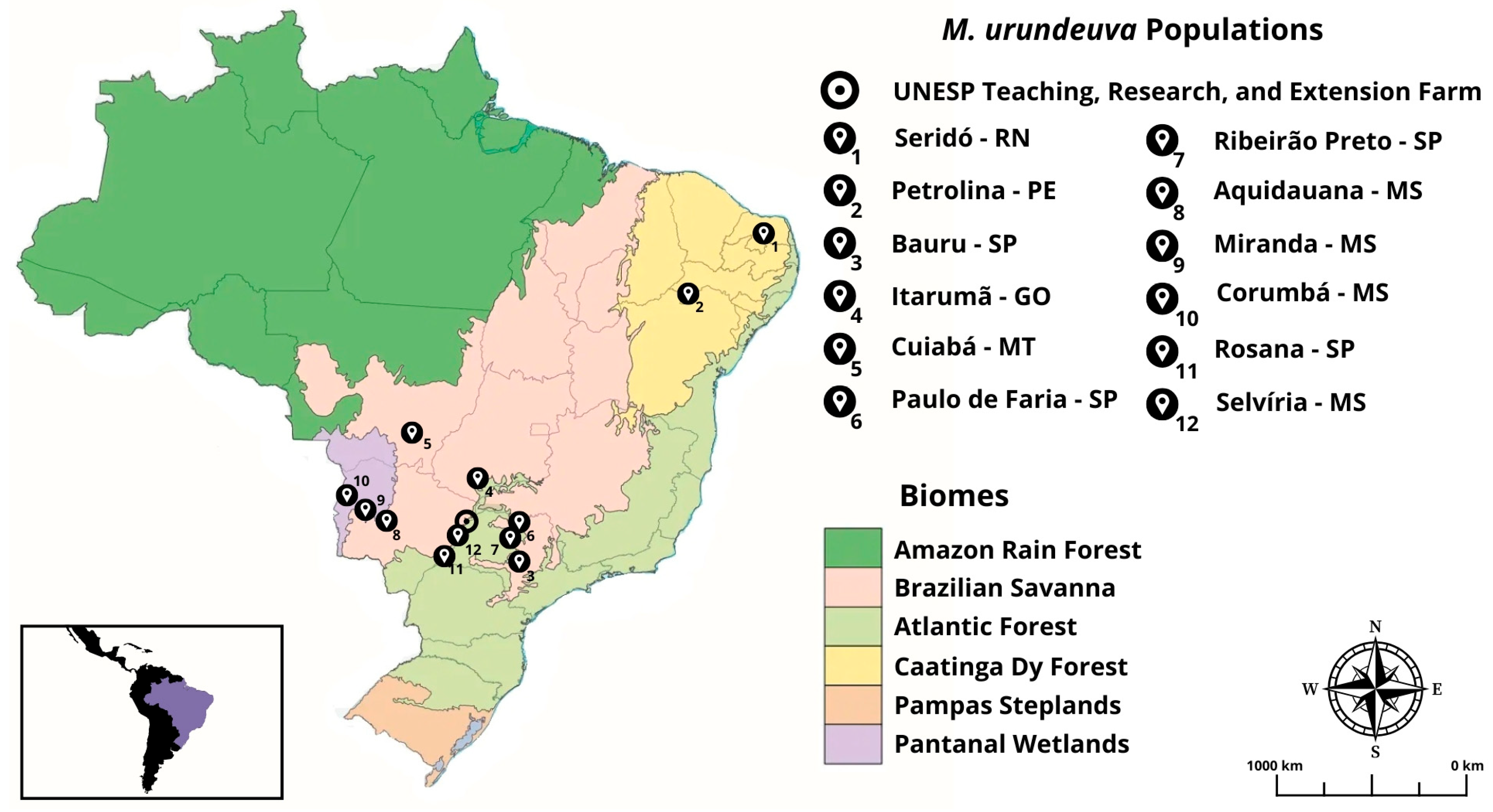
| Population | Code | Biome | Installation |
|---|---|---|---|
| Petrolina—PE | PE | Caatinga dry forest | 12/1992 |
| Seridó—RN | SE | Caatinga dry forest | 04/1997 |
| Bauru—SP | BU | Brazilian Savanna | 12/1987 |
| Cuiabá—MT | CB | Brazilian Savanna | 01/2010 |
| Itarumã—GO | IT | Brazilian Savanna | 06/2004 |
| Selvíria—MS | SV | Brazilian Savanna-Atlantic Forest Ecotone (BAE) | 12/1987 |
| Paulo de Faria—SP | PF | Atlantic Forest | 04/1997 |
| Ribeirão Preto—SP | RP | Atlantic Forest | 10/2006 |
| Aquidauana—MS | AQ | Pantanal Wetland | 12/2010 |
| Corumbá—MS | CO | Pantanal Wetland | 11/2023 |
| Miranda—MS | MI | Pantanal Wetland | 11/2023 |
| Biome | Average Temp. (°C) | Precipitation (mm) | Elevation (m) | Soil | Key Characteristics | References |
|---|---|---|---|---|---|---|
| Atlantic Forest | 20 to 26 | 1200 to 2200 | 0 to 2000 | Moist, shallow, not naturally fertile, but rich in humus | High biodiversity; dense perennial vegetation with the presence of epiphytes; humid climate with well-distributed rainfall throughout the year. | [105] |
| Brazilian Savanna | 22 to 33 | 1200 to 1800 | 300 to 1600 | Acidic, nutrient-poor, with high water infiltration capacity | Seasonal tropical climate with a well-defined dry season; vegetation composed of grasses, shrubs and small trees with deep roots; natural occurrence of fires. | [106] |
| Caatinga | 25 to 30 | 500 to 700 | 0 to 500 | Shallow, stony, with little organic matter; relatively fertile | Semi-arid climate with long periods of drought; drought-adapted vegetation, including cacti and small shrubs; fauna adapted to arid conditions. | [107] |
| Ecotone (BAE) | 20 to 24 | 1200 to 1800 | 300 to 800 | Mixed, varying between soil characteristics of the Cerrado and the Atlantic Forest | Transition area with a mosaic of vegetation from the Cerrado and the Atlantic Forest; high biodiversity due to the overlap of species from both biomes; sensitive to environmental changes due to its ecological complexity. | [108] |
| Pantanal | 22 to 32 | 800 to 1500 | 80 to 150 | Alluvial soils, rich in nutrients, subject to periodic flooding | Largest floodplain in the world; alternates between periods of flood and drought; high biodiversity with the presence of aquatic and terrestrial species adapted to seasonal floods. | [109,110] |
Disclaimer/Publisher’s Note: The statements, opinions and data contained in all publications are solely those of the individual author(s) and contributor(s) and not of MDPI and/or the editor(s). MDPI and/or the editor(s) disclaim responsibility for any injury to people or property resulting from any ideas, methods, instructions or products referred to in the content. |
© 2026 by the authors. Licensee MDPI, Basel, Switzerland. This article is an open access article distributed under the terms and conditions of the Creative Commons Attribution (CC BY) license.
Share and Cite
Alcantara, M.A.M.; Rossini, B.C.; Silvestre, M.A.d.M.; Guyot, R.; Garavito, A.; Alves, P.F.; Alonso, D.P.; Ribolla, P.E.M.; Moraes, M.L.T.d.; Marino, C.L. Assessing Genetic Divergence and Adaptive Potential of Aroeira (Myracrodruon urundeuva Allemão LC, Anacardiaceae) Across Brazilian Biomes. Plants 2026, 15, 1505. https://doi.org/10.3390/plants15101505
Alcantara MAM, Rossini BC, Silvestre MAdM, Guyot R, Garavito A, Alves PF, Alonso DP, Ribolla PEM, Moraes MLTd, Marino CL. Assessing Genetic Divergence and Adaptive Potential of Aroeira (Myracrodruon urundeuva Allemão LC, Anacardiaceae) Across Brazilian Biomes. Plants. 2026; 15(10):1505. https://doi.org/10.3390/plants15101505
Chicago/Turabian StyleAlcantara, Marcelo Augusto Mendes, Bruno Cesar Rossini, Marcela Aparecida de Moraes Silvestre, Romain Guyot, Andrea Garavito, Patricia Ferreira Alves, Diego Peres Alonso, Paulo Eduardo Martins Ribolla, Mario Luiz Teixeira de Moraes, and Celso Luis Marino. 2026. "Assessing Genetic Divergence and Adaptive Potential of Aroeira (Myracrodruon urundeuva Allemão LC, Anacardiaceae) Across Brazilian Biomes" Plants 15, no. 10: 1505. https://doi.org/10.3390/plants15101505
APA StyleAlcantara, M. A. M., Rossini, B. C., Silvestre, M. A. d. M., Guyot, R., Garavito, A., Alves, P. F., Alonso, D. P., Ribolla, P. E. M., Moraes, M. L. T. d., & Marino, C. L. (2026). Assessing Genetic Divergence and Adaptive Potential of Aroeira (Myracrodruon urundeuva Allemão LC, Anacardiaceae) Across Brazilian Biomes. Plants, 15(10), 1505. https://doi.org/10.3390/plants15101505