Flavonoids in Plant Salt Stress Responses: Biosynthesis, Regulation, Functions, and Signaling Networks

Abstract
1. Introduction
2. Flavonoid Biosynthesis and Regulation Under Salt Stress
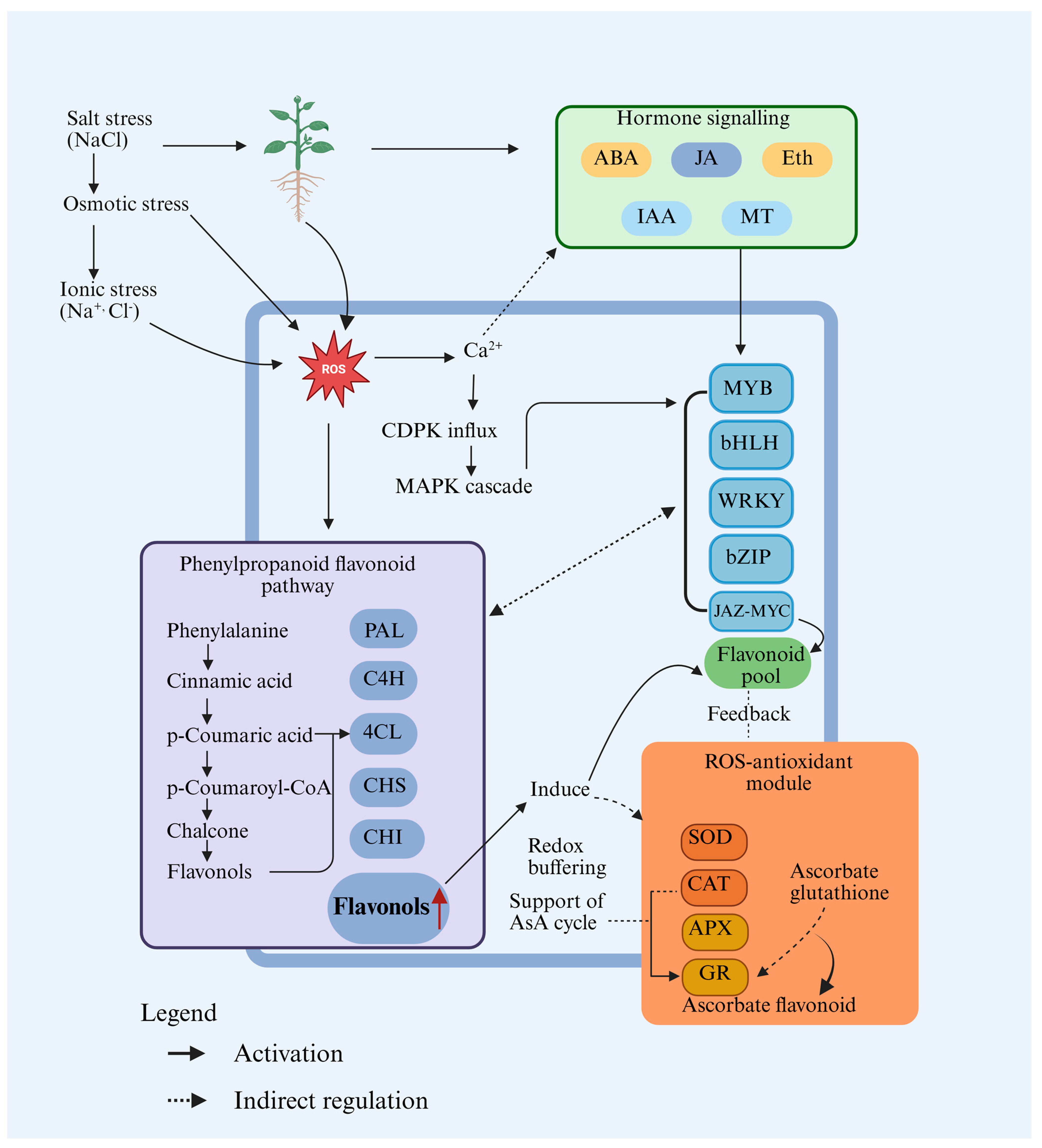
2.1. Biosynthetic Pathway Overview
2.2. Regulatory Control Under Salinity
2.2.1. Transcription Factors
2.2.2. Hormonal Integration (ABA, JA, Auxin, Ethylene)
2.3. Structural Diversification and Functional Relevance Under Salt Stress
2.3.1. Methylation
2.3.2. Glycosylation
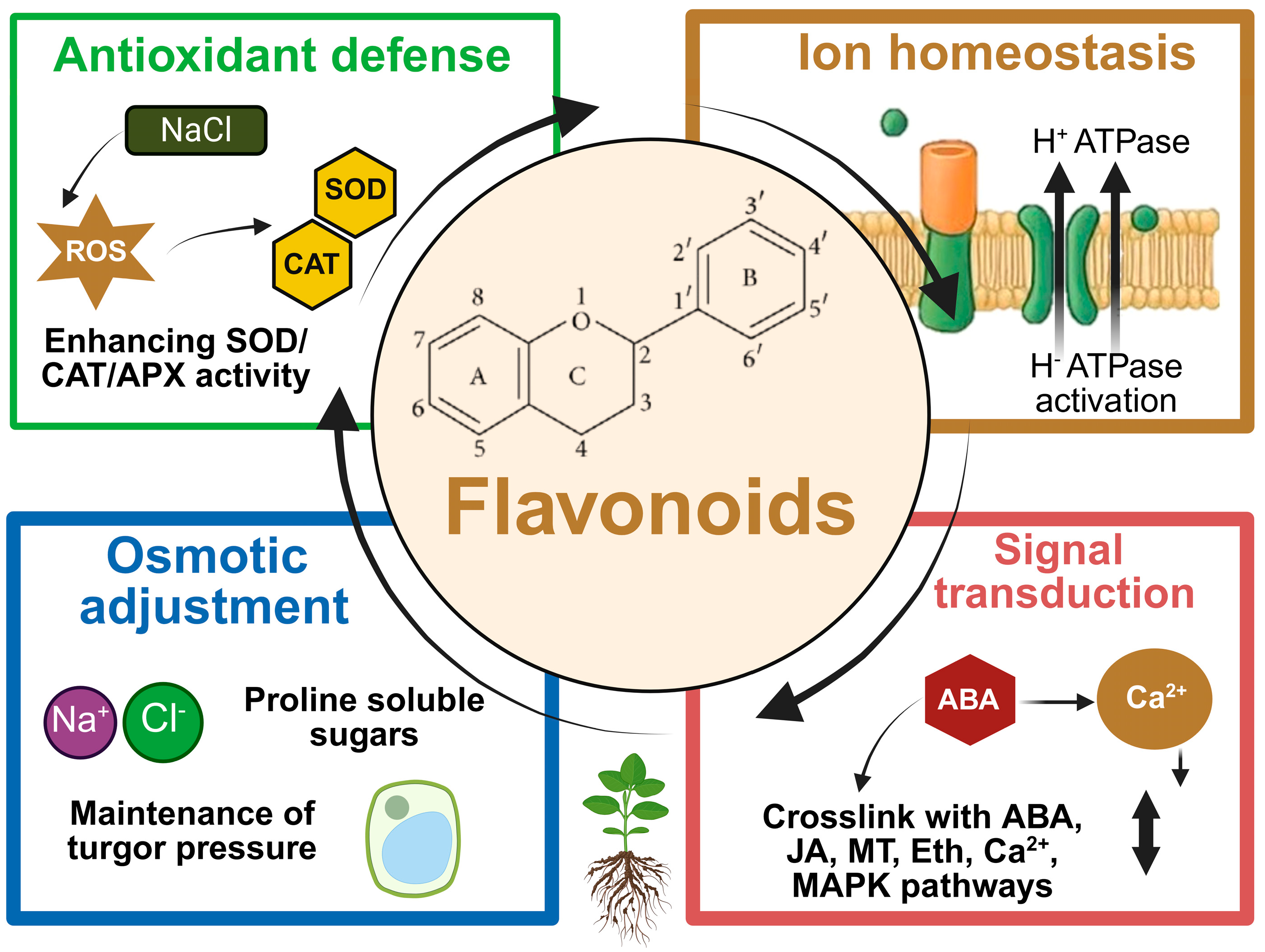
3. Functional Roles of Flavonoids in Salt Stress Tolerance
3.1. Antioxidant and Redox Buffering Systems
3.2. Ionic and Osmotic Homeostasis
3.3. Membrane Stabilization and Osmoprotection
3.4. Interaction with Stress Signaling Pathways
3.4.1. Flavonoid Integration into Ca2+, ABA, MAPK, and Melatonin Signaling Under Salt Stress
3.4.2. Epigenetic Influence and Noncoding RNAs
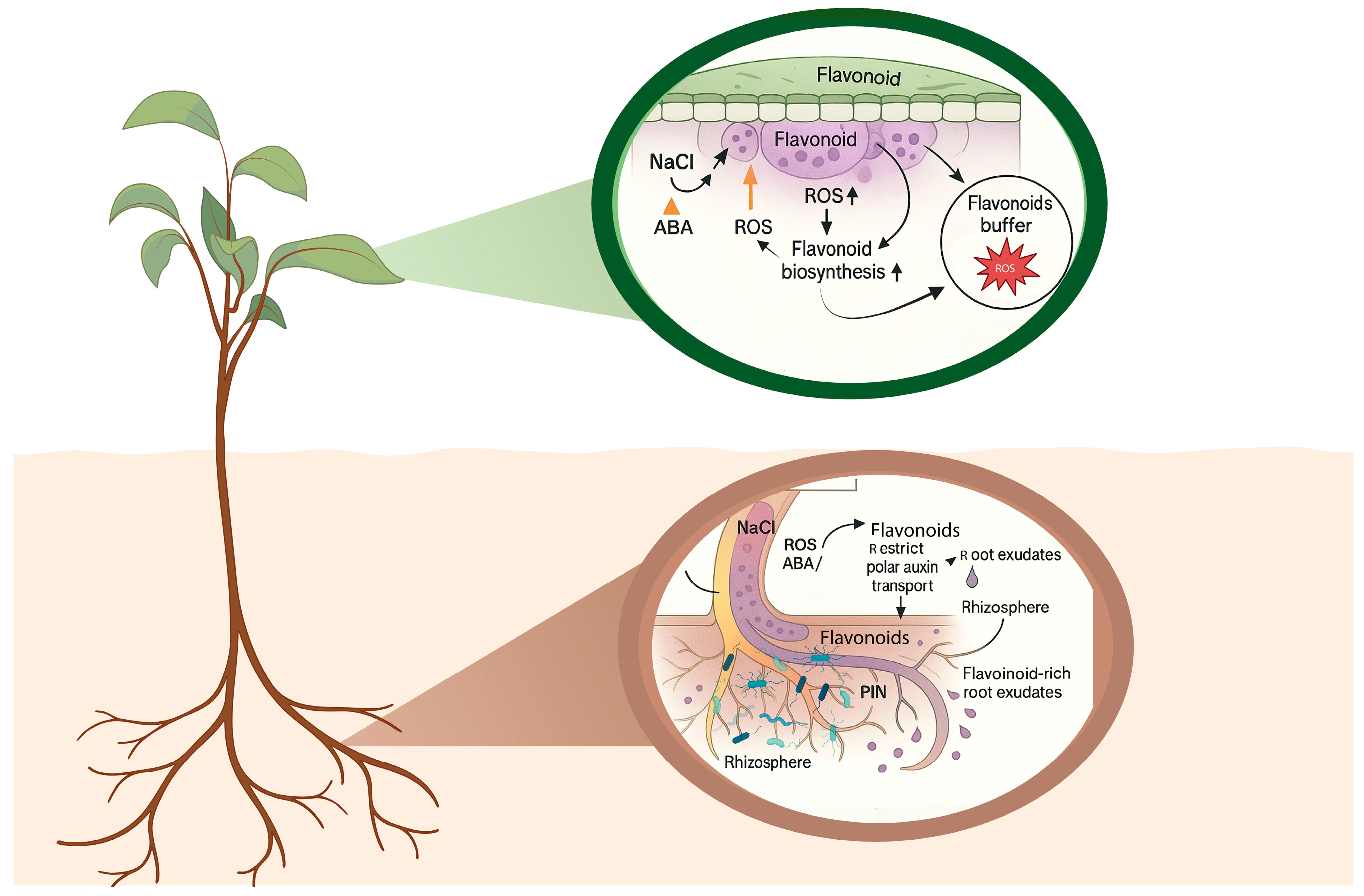
4. Spatial and Inter-Organ Roles of Flavonoids in Salt Stress
4.1. Root–Shoot Communication and Auxin-Mediated Morphogenesis Under Salt Stress
4.2. Apoplastic and Symplastic Distribution Under Stress Conditions
4.3. Flavonoids as Root Exudates and Rhizosphere Microbiota
4.4. Facilitation of Systemic Salt Tolerance

| Plant Species/System | Key Flavonoid Module (Genes/Metabolites) | Experimental Evidence Under Salt Stress | Proposed Mechanism of Action | Ref. No. |
|---|---|---|---|---|
| Arabidopsis thaliana | AtMYB12 overexpression upregulates the expression of CHS, CHI, F3H, FLS, DFR, and ANS | Transgenic AtMYB12-OE plants exposed to salinity show increased flavonoid accumulation and improved growth. | Enhanced flavonoid biosynthesis strengthens ROS scavenging and ABA-linked stress signaling, contributing to higher salt tolerance. | [23] |
| Ginkgo biloba | LncNAT11-MYB11-F3’H/FLS module flavonol biosynthesis | Salt-treated seedlings and transgenic analyses show that the lncNAT11-MYB11-F3’H/FLS module drives flavonol accumulation and improves NaCl tolerance. | Elevated flavonols strengthen ROS scavenging and membrane protection, reducing oxidative damage under salinity. | [24] |
| Glycine max | GmMYB173 phosphorylation and activation | Quantitative phosphoproteomics and metabolomics under NaCl reveal that phosphorylated GmMYB173 enhances CHS expression and dihydroxy B-ring flavonoid accumulation. | Optimized flavonoid metabolism reinforces ROS buffering and supports ion and osmotic adjustment during salt stress. | [26] |
| Arabidopsis thaliana | UGT79B2 / UGT79B3 (anthocyanin UGTs) | UGT79B2/B3-overexpressing lines exhibit increased anthocyanin accumulation and improved tolerance to salt. | Anthocyanin glycosides act as efficient ROS buffers and membrane protectants, enhancing multi-stress resilience. | [65] |
| Ginkgo biloba | GbTOE1a overexpression | GbTOE1a-OE plants accumulate more flavonoids and display higher antioxidant capacity and salt tolerance; silencing reduces both. | AP2/ERF TF GbTOE1a promotes flavonoid pathway activation, improving redox homeostasis and stress resilience. | [82] |
| Solanum nigrum | Quercetin-3-β-D-glucoside accumulation | NaCl treatment upregulates SnPAL, SnCHS and SnFLS and causes marked increases in quercetin-3-β-D-glucoside correlated with antioxidant capacity. | Flavonol glycosides contribute to ROS scavenging and protection of membranes and photosynthetic apparatus under salinity. | [89] |
| Abelmoschus esculentus | CHS overexpression | Overexpression of CHS genes increases flavonoid content in transgenic plants and improves salt tolerance with lower ROS levels. | Upregulated CHS diverts carbon into antioxidant flavonoids, enhancing ROS homeostasis and stress protection. | [90] |
| Nicotiana tabacum | NtCHS1 overexpression elevated rutin | NtCHS1-OE tobacco plants accumulate more rutin, show reduced H2O2 and , and survive better under saline conditions. | Rutin-rich tissues exhibit stronger redox buffering capacity, preserving membrane integrity and photosynthesis under salt stress. | [91] |
| Chenopodium quinoa | Induction of flavonol rutin under NaCl | Salinity strongly induces rutin, coinciding with improved K+ retention, Na+ efflux, and maintenance of photosynthetic performance. | Rutin supports tissue tolerance by protecting ion transport systems from ROS and sustaining favorable K+/Na+ balance. | [93] |
| Medicago sativa | MsEOBI-MsPAL1 module and flavonoids | Overexpression of MsPAL1 in alfalfa increases flavonoid and lignin levels and confers higher tolerance to salinity accompanied by reduced ROS. | Enhanced phenylpropanoid flux strengthens antioxidant capacity and cell wall reinforcement, improving salt stress tolerance. | [105] |
| Euphorbia kansui | EkFLS overexpression | EkFLS expression enhances flavonol accumulation and improves growth and survival of plants exposed to NaCl. | Flavonols act as ROS buffers and contribute to osmotic and membrane protection under saline conditions. | [144] |
| Medicago truncatula | MtBGLU17 (β-glucosidase) and antioxidant flavonoids | Loss- and gain-of-function analyses demonstrate that MtBGLU17 promotes accumulation of flavonoid derivatives and enhances salt tolerance. | Hydrolysis and remodeling of flavonoid conjugates fine-tune ROS detoxification and cellular protection under salinity. | [145] |
| Functional Category | Representative Flavonoid Module(s) | Experimental Systems/Conditions | Mechanistic Summary Under Salinity | Ref. No. |
|---|---|---|---|---|
| Antioxidant and redox buffering | AtMYB12, MYB112, and UGT76E11; LncNAT11-MYB11-F3’H/FLS; and CHS- and FLS-based modules | Arabidopsis TF and UGT over expressors; G. biloba seedlings and TF lines; tobacco CHS/FLS overexpression; and S. nigrum and quinoa under NaCl. | Flavonols and anthocyanins and their glycosides accumulate in chloroplasts and vacuoles, quenching ROS (H2O2, 1O2), lowering MDA, and sustaining photosynthetic activity and growth. | [23,24,86,87,89,90,91] |
| Na+/K+ and ionic/osmotic homeostasis | Rutin-enriched flavonol pools; F3H-dependent anthocyanin pathway; and SOS3-AIR1-anthocyanin module | Quinoa exposed to NaCl; F3H-OE rice lines; and mutants and over expressors affecting SOS3–AIR1 signaling and anthocyanin biosynthesis. | Flavonoids protect plasma membrane H+-ATPases and Na+/K+ transporters from oxidative damage and, in some cases, transcriptionally reprogram HKT, SOS, and NHX genes, supporting K+ retention, Na+ efflux, and vacuolar sequestration. | [93,94,96,97] |
| Membrane stabilization and osmoprotection | Highly O-methoxylated flavone-7-O-rutinosides; MsPAL1-driven phenylpropanoids; and flavonol glycosides | Halophyte Sesuvium portulacastrum under high salinity; alfalfa MsPAL1 overexpression lines; and diverse species with salt-induced flavonol glycosides. | Amphipathic flavonoids insert into lipid bilayers, limit peroxidation, adjust fluidity and leakiness, and act together with compatible solutes (proline, sugars) to maintain membrane integrity and cellular hydration. | [55,84,95,104,105] |
| Hormonal and Ca2+/MAPK signaling integration | Flavonoid-related MYB and bHLH TFs (GmMYB173, VvMYBF1); Ca2+-responsive phenylpropanoid enzymes; and melatonin flavonoid modules | Soybean under NaCl; grapevine and transgenic Arabidopsis; CaCl2 or CaP-NP treatments; and melatonin-treated grape, tomato, and Brassica under salinity. | Flavonoids act both downstream and upstream of ABA, JA, IAA, ethylene, and MT signaling, feeding back on hormone biosynthesis and Ca2+-dependent CDPK/MAPK cascades to coordinate antioxidant defense, ion homeostasis, and growth responses. | [25,26,110,115,116] |
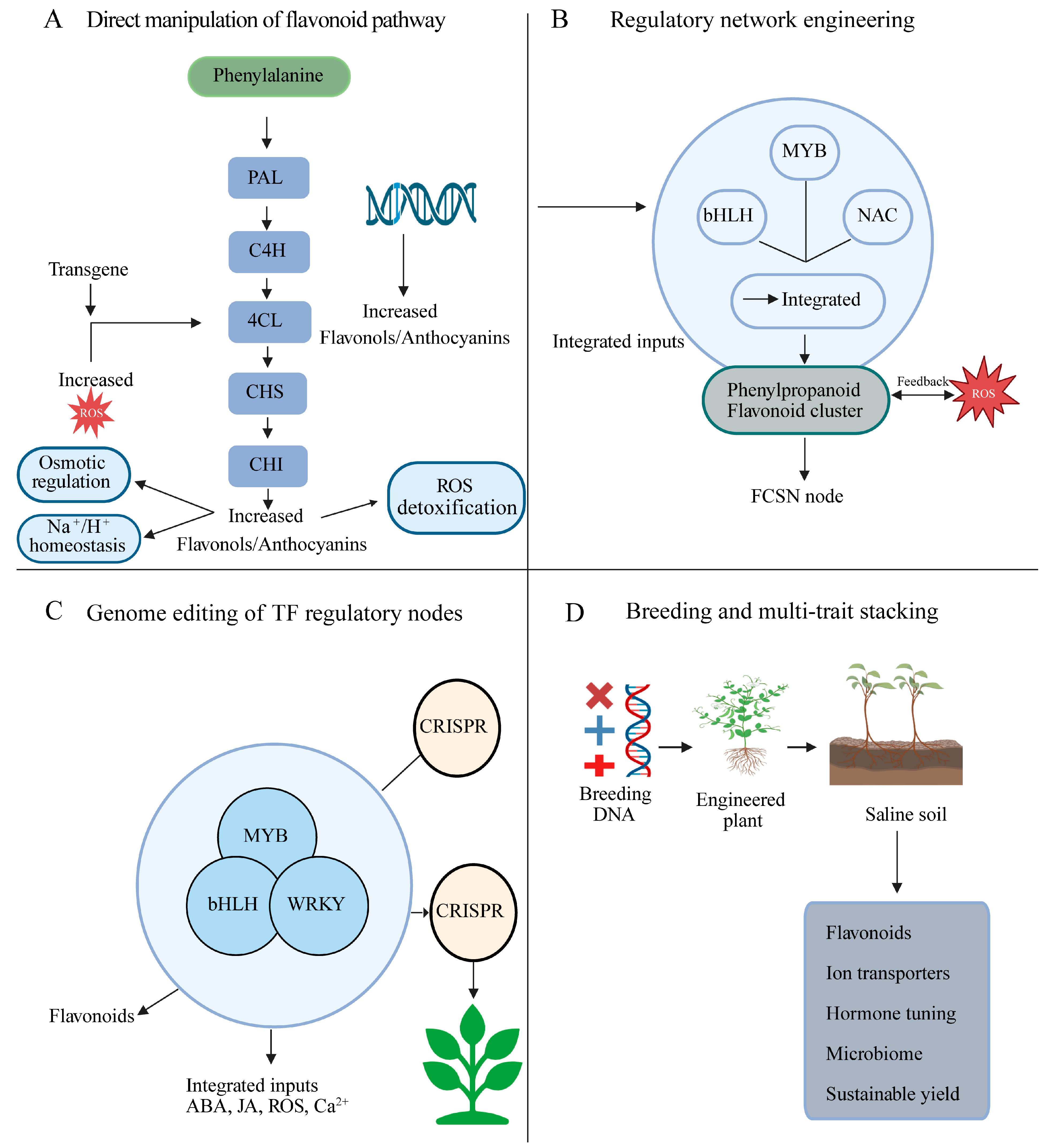
5. Genetic Engineering and Breeding Applications
5.1. Direct Manipulation of Flavonoid Biosynthetic Pathways
5.1.1. Transgenic Overexpression of Structural Genes
5.1.2. Precision Genome Editing for Pathway Engineering
5.2. Engineering Regulatory Networks and Transcription Factors
5.2.1. The “Master Switch” Strategy
5.2.2. Synthetic Biology and Customized Regulation
5.3. Integration with Breeding and Multi-Trait Stacking
5.3.1. Marker-Assisted and Genomic Selection
5.3.2. Rational Trait Stacking for Synergistic Resilience
5.4. Implications for Sustainable Agriculture and Crop Resilience
6. Flavonoid-Centered Integration of Redox, Hormonal, and Metabolic Networks Under Salt Stress
6.1. Coordination Between Redox and Hormonal Networks
6.2. Metabolic Reprogramming and Cellular Energy Balance
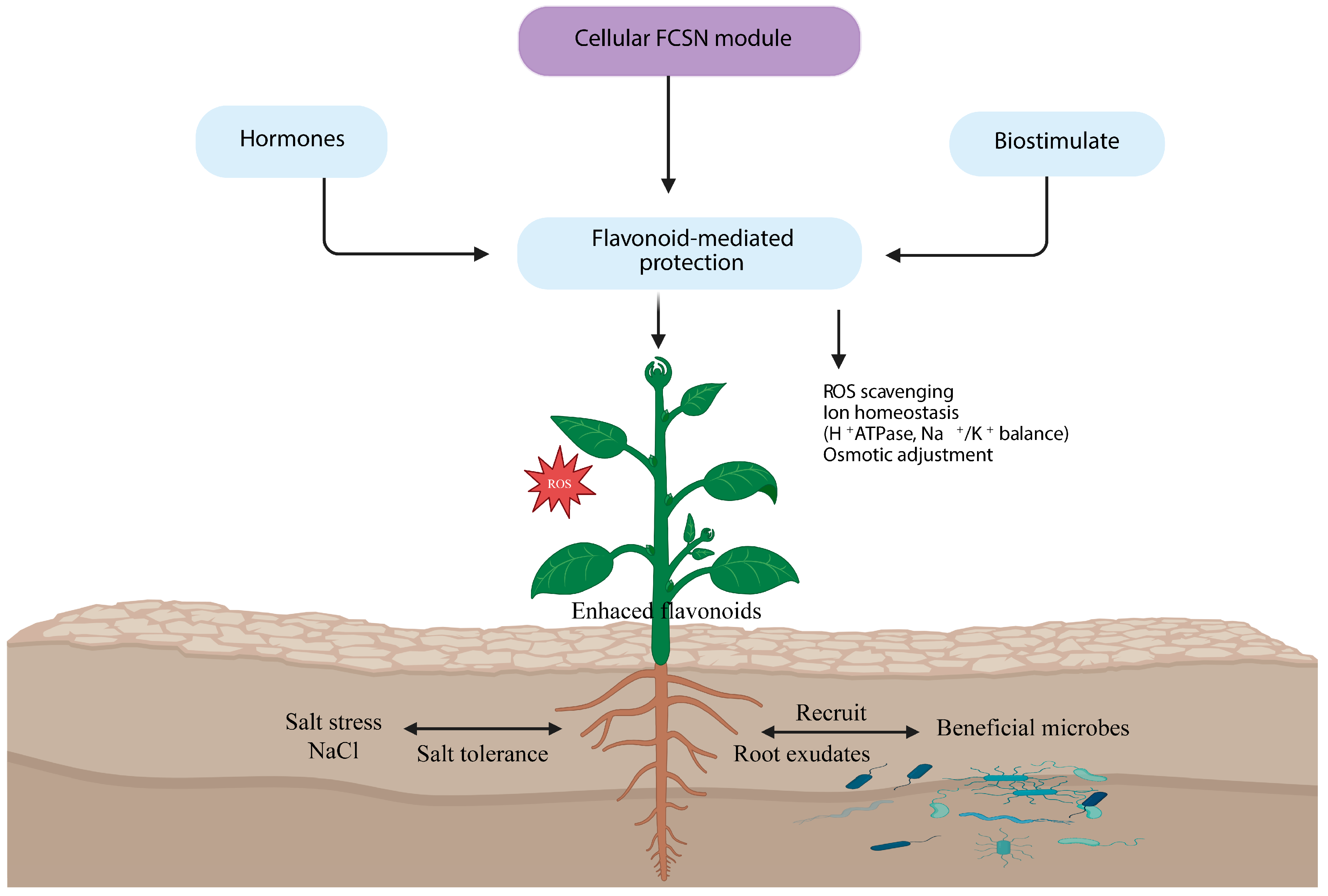
6.3. Flavonoid-Centered Stress Network (FCSN): A Conceptual Model
7. Conclusions and Future Perspectives
7.1. Conclusions
7.2. Challenges and Constraints in Exploiting Flavonoids for Salt Tolerance
- (i)
- Metabolic trade-offs:Flavonoid synthesis is carbon/energy costly; constitutive accumulation can reduce growth/yield.Stress-inducible, tissue-specific, or developmental control are preferable to minimize penalties.
- (ii)
- Specificity and context dependence:Effects depend on flavonoid class, localization, and dose; different branches can have opposing outcomes.Responses vary across species/genotypes and under combined stresses (salt + drought/heat).
- (iii)
- Pleiotropy from pathway crosstalk:Flavonoids intersect with lignin, auxin transport, hormone balance, and cell wall traits.Editing enzymes/TFs may alter architecture or mechanics; agronomic evaluation is essential.
- (iv)
- Regulatory uncertainty:Epigenetic regulation and ncRNAs influence both flavonoids and salt response pathways.These controls are dynamic and can vary across environments and generations.
- (v)
- Limited field validation:Many studies use seedlings and controlled NaCl regimes.Stability under fluctuating salinity, heterogeneous soils, and multi-stress field settings remain under-tested.
7.3. Future Research Directions
Author Contributions
Funding
Data Availability Statement
Acknowledgments
Conflicts of Interest
References
- Eckardt, N.A.; Ainsworth, E.A.; Bahuguna, R.N.; Broadley, M.R.; Busch, W.; Carpita, N.C.; Castrillo, G.; Chory, J.; DeHaan, L.R.; Duarte, C.M.; et al. Climate change challenges, plant science solutions. Plant Cell 2022, 35, 24–66. [Google Scholar] [CrossRef]
- Minhas, P.; Ramos, T.B.; Ben-Gal, A.; Pereira, L.S. Coping with salinity in irrigated agriculture: Crop evapotranspiration and water management issues. Agric. Water Manag. 2020, 227, 105832. [Google Scholar] [CrossRef]
- Afzal, M.; Hindawi, S.E.S.; Alghamdi, S.S.; Migdadi, H.H.; Khan, M.A.; Hasnain, M.U.; Arslan, M.; Habib ur Rahman, M.; Sohaib, M. Potential breeding strategies for improving salt tolerance in crop plants. J. Plant Growth Regul. 2023, 42, 3365–3387. [Google Scholar] [CrossRef]
- Butcher, K.; Wick, A.F.; DeSutter, T.; Chatterjee, A.; Harmon, J. Soil salinity: A threat to global food security. Agron. J. 2016, 108, 2189–2200. [Google Scholar] [CrossRef]
- Ullah, A.; Bano, A.; Khan, N. Climate change and salinity effects on crops and chemical communication between plants and plant growth-promoting microorganisms under stress. Front. Sustain. Food Syst. 2021, 5, 618092. [Google Scholar] [CrossRef]
- Hannachi, S.; Steppe, K.; Eloudi, M.; Mechi, L.; Bahrini, I.; Van Labeke, M.-C. Salt stress induced changes in photosynthesis and metabolic profiles of one tolerant (‘Bonica’) and one sensitive (‘Black beauty’) eggplant cultivars (Solanum melongena L.). Plants 2022, 11, 590. [Google Scholar] [CrossRef]
- Ji, X.; Tang, J.; Zhang, J. Effects of salt stress on the morphology, growth and physiological parameters of Juglans microcarpa L. Seedlings. Plants 2022, 11, 2381. [Google Scholar] [CrossRef]
- Balasubramaniam, T.; Shen, G.; Esmaeili, N.; Zhang, H. Plants’ response mechanisms to salinity stress. Plants 2023, 12, 2253. [Google Scholar] [CrossRef]
- D’Amelia, V.; Aversano, R.; Chiaiese, P.; Carputo, D. The antioxidant properties of plant flavonoids: Their exploitation by molecular plant breeding. Phytochem. Rev. 2018, 17, 611–625. [Google Scholar] [CrossRef]
- Shen, N.; Wang, T.; Gan, Q.; Liu, S.; Wang, L.; Jin, B. Plant flavonoids: Classification, distribution, biosynthesis, and antioxidant activity. Food Chem. 2022, 383, 132531. [Google Scholar] [CrossRef]
- Lopes, M.; Sanches-Silva, A.; Castilho, M.; Cavaleiro, C.; Ramos, F. Halophytes as source of bioactive phenolic compounds and their potential applications. Crit. Rev. Food Sci. Nutr. 2023, 63, 1078–1101. [Google Scholar] [CrossRef]
- Stanković, M.S.; Petrović, M.; Godjevac, D.; Stevanović, Z.D. Screening inland halophytes from the central Balkan for their antioxidant activity in relation to total phenolic compounds and flavonoids: Are there any prospective medicinal plants? J. Arid. Environ. 2015, 120, 26–32. [Google Scholar] [CrossRef]
- Dias, M.C.; Pinto, D.; Silva, A.M.S. Plant flavonoids: Chemical characteristics and biological activity. Molecules 2021, 26, 5377. [Google Scholar] [CrossRef]
- Mao, Y.; Luo, J.; Cai, Z. Biosynthesis and regulatory mechanisms of plant flavonoids: A review. Plants 2025, 14, 1847. [Google Scholar] [CrossRef] [PubMed]
- Jiang, L.; Gao, Y.; Han, L.; Zhang, W.; Fan, P. Designing plant flavonoids: Harnessing transcriptional regulation and enzyme variation to enhance yield and diversity. Front. Plant Sci. 2023, 14, 2023. [Google Scholar] [CrossRef]
- Tohge, T.; de Souza, L.P.; Fernie, A.R. Current understanding of the pathways of flavonoid biosynthesis in model and crop plants. J. Exp. Bot. 2017, 68, 4013–4028. [Google Scholar] [CrossRef]
- Liu, W.; Feng, Y.; Yu, S.; Fan, Z.; Li, X.; Li, J.; Yin, H. The flavonoid biosynthesis network in plants. Int. J. Mol. Sci. 2021, 22, 12824. [Google Scholar] [CrossRef]
- Yu, K.; Song, Y.; Lin, J.; Dixon, R.A. The complexities of proanthocyanidin biosynthesis and its regulation in plants. Plant Commun. 2023, 4, 100498. [Google Scholar] [CrossRef] [PubMed]
- Jun, J.H.; Lu, N.; Docampo-Palacios, M.; Wang, X.; Dixon, R.A. Dual activity of anthocyanidin reductase supports the dominant plant proanthocyanidin extension unit pathway. Sci. Adv. 2021, 7, eabg4682. [Google Scholar] [CrossRef]
- Yu, L.; He, K.; Wu, Y.; Hao, K.; Wang, Y.; Yao, J.; Zhao, Y.; Yu, Q.; Shen, Y.; Chen, M.; et al. UGT708S6 from Dendrobium catenatum, catalyzes the formation of flavonoid C-glycosides. BMC Biotechnol. 2024, 24, 94. [Google Scholar] [CrossRef]
- Feng, M.; Liu, Y.; He, B.; Zhong, H.; Qu-Bie, A.; Li, M.; Luo, M.; Bao, X.; Li, Y.; Yan, X.; et al. An efficient flavonoid glycosyltransferase NjUGT73B1 from Nardostachys jatamansi of alpine Himalayas discovered by structure-based protein clustering. Phytochemistry 2024, 227, 114228. [Google Scholar] [CrossRef] [PubMed]
- Wang, Y.; Jiang, W.; Li, C.; Wang, Z.; Lu, C.; Cheng, J.; Wei, S.; Yang, J.; Yang, Q. Integrated transcriptomic and metabolomic analyses elucidate the mechanism of flavonoid biosynthesis in the regulation of mulberry seed germination under salt stress. BMC Plant Biol. 2024, 24, 132. [Google Scholar] [CrossRef]
- Wang, F.; Kong, W.; Wong, G.; Fu, L.; Peng, R.; Li, Z.; Yao, Q. AtMYB12 regulates flavonoids accumulation and abiotic stress tolerance in transgenic Arabidopsis thaliana. Mol. Genet. Genom. 2016, 291, 1545–1559. [Google Scholar] [CrossRef]
- Liu, S.; Zhang, H.; Meng, Z.; Jia, Z.; Fu, F.; Jin, B.; Cao, F.; Wang, L. The LncNAT11–MYB11–F3’H/FLS module mediates flavonol biosynthesis to regulate salt stress tolerance in Ginkgo biloba. J. Exp. Bot. 2024, 76, 1179–1201. [Google Scholar] [CrossRef]
- Wang, J.; Wang, F.; Jin, C.; Tong, Y.; Wang, T. A R2R3-MYB transcription factor VvMYBF1 from grapevine (Vitis vinifera L.) regulates flavonoids accumulation and abiotic stress tolerance in transgenic Arabidopsis. J. Hortic. Sci. Biotechnol. 2020, 95, 147–161. [Google Scholar] [CrossRef]
- Pi, E.; Zhu, C.; Fan, W.; Huang, Y.; Qu, L.; Li, Y.; Zhao, Q.; Ding, F.; Qiu, L.; Wang, H. Quantitative phosphoproteomic and metabolomic analyses reveal GmMYB173 optimizes flavonoid metabolism in soybean under salt stress. Mol. Cell. Proteom. 2018, 17, 1209–1224. [Google Scholar] [CrossRef] [PubMed]
- Qi, L.; Yang, J.; Yuan, Y.; Huang, L.; Chen, P. Overexpression of two R2R3-MYB genes from Scutellaria baicalensis induces phenylpropanoid accumulation and enhances oxidative stress resistance in transgenic tobacco. Plant Physiol. Biochem. 2015, 94, 235–243. [Google Scholar] [CrossRef]
- Gao, Q.; Li, X.; Xiang, C.; Li, R.; Xie, H.; Liu, J.; Li, X.; Zhang, G.; Yang, S.; Liang, Y.; et al. EbbHLH80 enhances salt responses by up-regulating flavonoid accumulation and modulating ROS levels. Int. J. Mol. Sci. 2023, 24, 11080. [Google Scholar] [CrossRef]
- Zhang, X.; Cheng, Z.; Zhao, K.; Yao, W.; Sun, X.; Jiang, T.; Zhou, B. Functional characterization of poplar NAC13 gene in salt tolerance. Plant Sci. 2019, 281, 1–8. [Google Scholar] [CrossRef]
- Xu, N.; Liu, S.; Lu, Z.; Pang, S.; Wang, L.; Wang, L.; Li, W. Gene expression profiles and flavonoid accumulation during salt stress in Ginkgo biloba seedlings. Plants 2020, 9, 1162. [Google Scholar] [CrossRef] [PubMed]
- Song, J.; Liu, X.; Li, X.; Wang, H.; Chu, R.; Qu, F.; Zhang, S.; Li, Q. Transcriptome analysis reveals genes and pathways associated with salt tolerance during seed germination in Suaeda liaotungensis. Int. J. Mol. Sci. 2022, 23, 12229. [Google Scholar] [CrossRef]
- Riemann, M.; Dhakarey, R.; Hazman, M.; Miro, B.; Kohli, A.; Nick, P. Exploring jasmonates in the hormonal network of drought and salinity responses. Front. Plant Sci. 2015, 6, 1077. [Google Scholar] [CrossRef]
- Crizel, R.; Perin, E.; Siebeneichler, T.; Borowski, J.; Messias, R.; Rombaldi, C.; Galli, V. Abscisic acid and stress induced by salt: Effect on the phenylpropanoid, L-ascorbic acid and abscisic acid metabolism of strawberry fruits. Plant Physiol. Biochem. 2020, 152, 211–220. [Google Scholar] [CrossRef]
- Galli, V.; da Silva Messias, R.; Perin, E.C.; Borowski, J.M.; Bamberg, A.L.; Rombaldi, C.V. Mild salt stress improves strawberry fruit quality. LWT 2016, 73, 693–699. [Google Scholar] [CrossRef]
- Mahajan, M.; Yadav, S.K. Overexpression of a tea flavanone 3-hydroxylase gene confers tolerance to salt stress and Alternaria solani in transgenic tobacco. Plant Mol. Biol. 2014, 85, 551–573. [Google Scholar] [CrossRef] [PubMed]
- Wang, F.; Zhu, H.; Chen, D.; Li, Z.; Peng, R.; Yao, Q. A grape bHLH transcription factor gene, VvbHLH1, increases the accumulation of flavonoids and enhances salt and drought tolerance in transgenic Arabidopsis thaliana. Plant Cell Tissue Organ. Cult. 2016, 125, 387–398. [Google Scholar] [CrossRef]
- Han, C.; Chen, G.; Zheng, D.; Feng, N. Transcriptomic and metabolomic analyses reveal that ABA increases the salt tolerance of rice significantly correlated with jasmonic acid biosynthesis and flavonoid biosynthesis. Sci. Rep. 2023, 13, 20365. [Google Scholar] [CrossRef]
- Zhao, Y.; Wang, Q.; Zhang, Y.; Zhang, P.; Jiang, M. BIP130 enhances salt tolerance through modulation of ABA synthesis and scavenging ROS in rice (Oryza sativa L.). Plant Growth Regul. 2021, 93, 163–173. [Google Scholar] [CrossRef]
- Zhao, X.; He, Y.; Liu, Y.; Wang, Z.; Zhao, J. JAZ proteins: Key regulators of plant growth and stress response. Crop J. 2024, 12, 1505–1516. [Google Scholar] [CrossRef]
- Kim, Y.-H.; Park, C.-W.; Lee, K.M.; Hong, C.-O.; Son, H.-J.; Kim, K.K.; Park, H.C.; Kim, Y.-J. The Roles of MYC2 transcription factor in JA-signaling pathway in plants. J. Plant Biol. 2025, 68, 113–131. [Google Scholar] [CrossRef]
- Tang, G.; Ma, J.; Hause, B.; Nick, P.; Riemann, M. Jasmonate is required for the response to osmotic stress in rice. Environ. Exp. Bot. 2020, 175, 104047. [Google Scholar] [CrossRef]
- Delgado, C.; Mora-Poblete, F.; Ahmar, S.; Chen, J.-T.; Figueroa, C.R. Jasmonates and plant salt stress: Molecular players, physiological effects, and improving tolerance by using genome-associated tools. Int. J. Mol. Sci. 2021, 22, 3082. [Google Scholar] [CrossRef] [PubMed]
- Wang, X.; Yin, J.; Wang, J.; Li, J. Integrative analysis of transcriptome and metabolome revealed the mechanisms by which flavonoids and phytohormones regulated the adaptation of alfalfa roots to NaCl stress. Front. Plant Sci. 2023, 14, 1117868. [Google Scholar] [CrossRef]
- Hu, D.-d.; Dong, S.; Zhang, J.; Zhao, B.; Ren, B.; Liu, P. Endogenous hormones improve the salt tolerance of maize (Zea mays L.) by inducing root architecture and ion balance optimizations. J. Agron. Crop Sci. 2022, 208, 662–674. [Google Scholar] [CrossRef]
- Porwal, P.; Singh, R.; Husen, A. Role of Hormones in Crop Plants Root System Architecture Under Changing Environmental Conditions. In Augmenting Crop Productivity in Stress Environment; Ansari, S.A., Ansari, M.I., Husen, A., Eds.; Springer Nature: Singapore, 2022; pp. 145–159. [Google Scholar] [CrossRef]
- Korver, R.A.; Koevoets, I.T.; Testerink, C. Out of shape during stress: A key role for auxin. Trends Plant Sci. 2018, 23, 783–793. [Google Scholar] [CrossRef]
- Ng, J.L.P.; Hassan, S.; Truong, T.T.; Hocart, C.H.; Laffont, C.; Frugier, F.; Mathesius, U. Flavonoids and auxin transport inhibitors rescue symbiotic nodulation in the Medicago truncatula cytokinin perception mutant cre1. Plant Cell 2015, 27, 2210–2226. [Google Scholar] [CrossRef] [PubMed]
- Ghitti, E.; Rolli, E.; Crotti, E.; Borin, S. Flavonoids are intra-and inter-kingdom modulator signals. Microorganisms 2022, 10, 2479. [Google Scholar] [CrossRef]
- Zhang, M.; Lu, X.; Ren, T.; Marowa, P.; Meng, C.; Wang, J.; Yang, H.; Li, C.; Zhang, L.; Xu, Z. Heterologous overexpression of Apocynum venetum flavonoids synthetase genes improves Arabidopsis thaliana salt tolerance by activating the IAA and JA biosynthesis pathways. Front. Plant Sci. 2023, 14, 1123856. [Google Scholar] [CrossRef]
- Wang, Y.; Diao, P.; Kong, L.; Yu, R.; Zhang, M.; Zuo, T.; Fan, Y.; Niu, Y.; Yan, F.; Wuriyanghan, H. Ethylene enhances seed germination and seedling growth under salinity by reducing oxidative stress and promoting chlorophyll content via ETR2 pathway. Front. Plant Sci. 2020, 11, 1066. [Google Scholar] [CrossRef]
- Jiang, C.; Belfield, E.J.; Cao, Y.; Smith, J.A.C.; Harberd, N.P. An Arabidopsis soil-salinity–tolerance mutation confers ethylene-mediated enhancement of sodium/potassium homeostasis. Plant Cell 2013, 25, 3535–3552. [Google Scholar] [CrossRef]
- Ma, Q.; Zhou, H.; Sui, X.; Su, C.; Yu, Y.; Yang, H.; Dong, C.-H. Generation of new salt-tolerant wheat lines and transcriptomic exploration of the responsive genes to ethylene and salt stress. Plant Growth Regul. 2021, 94, 33–48. [Google Scholar] [CrossRef]
- Wang, S.; Lin, H.; Saito, T.; Ohkawa, K.; Ohara, H.; Jia, H.; Kondo, S. Abscisic acid affects ethylene metabolism and carotenoid biosynthesis in Japanese apricot (Prunus mume Sieb. et Zucc.). Agri Gene 2019, 12, 100083. [Google Scholar] [CrossRef]
- Ruan, N.; Xu, H.; Chen, K.; Tian, F.; Gao, D.; Wang, Z.; Yang, X.; Yan, X.; Wang, Y.; Wang, M.; et al. CYP75B4-mediated tricin and lignin accumulation improve salt tolerance in rice. Rice 2025, 18, 8. [Google Scholar] [CrossRef]
- Nikalje, G.C.; Variyar, P.S.; Joshi, M.V.; Nikam, T.D.; Suprasanna, P. Temporal and spatial changes in ion homeostasis, antioxidant defense and accumulation of flavonoids and glycolipid in a halophyte Sesuvium portulacastrum (L.) L. PLoS ONE 2018, 13, e0193394. [Google Scholar] [CrossRef]
- Duan, H.; Tiika, R.J.; Tian, F.; Lu, Y.; Zhang, Q.; Hu, Y.; Cui, G.; Yang, H. Metabolomics analysis unveils important changes involved in the salt tolerance of Salicornia europaea. Front. Plant Sci. 2023, 13, 1097076. [Google Scholar] [CrossRef]
- Zhao, K.; Lan, Y.; Shi, Y.; Duan, C.; Yu, K. Metabolite and transcriptome analyses reveal the effects of salinity stress on the biosynthesis of proanthocyanidins and anthocyanins in grape suspension cells. Front. Plant Sci. 2024, 15, 1351008. [Google Scholar] [CrossRef]
- Huang, A.H. Plant lipid droplets and their associated proteins: Potential for rapid advances. Plant Physiol. 2018, 176, 1894–1918. [Google Scholar] [CrossRef] [PubMed]
- Xiao, X.; Lu, Q.; Liu, R.; Gong, J.; Gong, W.; Liu, A.; Ge, Q.; Li, J.; Shang, H.; Li, P. Genome-wide characterization of the UDP-glycosyltransferase gene family in upland cotton. 3 Biotech 2019, 9, 453. [Google Scholar] [CrossRef]
- Li, Y.; Li, P.; Wang, Y.; Dong, R.; Yu, H.; Hou, B. Genome-wide identification and phylogenetic analysis of Family-1 UDP glycosyltransferases in maize (Zea mays). Planta 2014, 239, 1265–1279. [Google Scholar] [CrossRef]
- Rehman, H.M.; Nawaz, M.A.; Bao, L.; Shah, Z.H.; Lee, J.-M.; Ahmad, M.Q.; Chung, G.; Yang, S.H. Genome-wide analysis of family-1 UDP-glycosyltransferases in soybean confirms their abundance and varied expression during seed development. J. Plant Physiol. 2016, 206, 87–97. [Google Scholar] [CrossRef] [PubMed]
- Ao, B.; Han, Y.; Wang, S.; Wu, F.; Zhang, J. Genome-wide analysis and profile of UDP-glycosyltransferases family in alfalfa (Medicago sativa L.) under drought stress. Int. J. Mol. Sci. 2022, 23, 7243. [Google Scholar] [CrossRef] [PubMed]
- Wang, T.; Li, X.-k.; Liu, X.; Yang, X.-q.; Li, Y.-j.; Hou, B.-K. Rice glycosyltransferase gene UGT2 functions in salt stress tolerance under the regulation of bZIP23 transcription factor. Plant Cell Rep. 2023, 42, 17–28. [Google Scholar] [CrossRef]
- Dong, G.; Ma, Y.; Zhao, S.; Ma, X.; Liu, C.; Ding, Y.; Wu, J.; Hou, B. Rice glycosyltransferase DUGT2 enhances drought and salt tolerances through glycosylating a broad-spectrum of flavonoids under bZIP16 regulation. Plant Sci. 2025, 360, 112692. [Google Scholar] [CrossRef] [PubMed]
- Li, P.; Li, Y.J.; Zhang, F.J.; Zhang, G.Z.; Jiang, X.Y.; Yu, H.M.; Hou, B.K. The Arabidopsis UDP-glycosyltransferases UGT79B2 and UGT79B3, contribute to cold, salt and drought stress tolerance via modulating anthocyanin accumulation. Plant J. 2017, 89, 85–103. [Google Scholar] [CrossRef]
- Zhang, K.; Sun, Y.; Li, M.; Long, R. CrUGT87A1, a UDP-sugar glycosyltransferases (UGTs) gene from Carex rigescens, increases salt tolerance by accumulating flavonoids for antioxidation in Arabidopsis thaliana. Plant Physiol. Biochem. 2021, 159, 28–36. [Google Scholar] [CrossRef] [PubMed]
- Cao, Y.; Han, Z.; Zhang, Z.; He, L.; Huang, C.; Chen, J.; Dai, F.; Xuan, L.; Yan, S.; Si, Z.; et al. UDP-glucosyltransferase 71C4 controls the flux of phenylpropanoid metabolism to shape cotton seed development. Plant Commun. 2024, 5, 100938. [Google Scholar] [CrossRef]
- Sun, Y.-G.; Wang, B.; Jin, S.-H.; Qu, X.-X.; Li, Y.-J.; Hou, B.-K. Ectopic expression of Arabidopsis glycosyltransferase UGT85A5 enhances salt stress tolerance in tobacco. PLoS ONE 2013, 8, e59924. [Google Scholar] [CrossRef]
- Yang, T.; Echols, M.; Martin, A.; Bar-Peled, M. Identification and characterization of a strict and a promiscuous N-acetylglucosamine-1-P uridylyltransferase in Arabidopsis. Biochem. J. 2010, 430, 275–284. [Google Scholar] [CrossRef]
- Chen, Y.H.; Shen, H.L.; Chou, S.J.; Sato, Y.; Cheng, W.H. Interference of Arabidopsis N-Acetylglucosamine-1-P Uridylyltransferase expression impairs protein N-Glycosylation and induces ABA-mediated salt sensitivity during seed germination and early seedling development. Front. Plant Sci. 2022, 13, 903272. [Google Scholar] [CrossRef]
- Liu, C.; Niu, G.; Zhang, H.; Sun, Y.; Sun, S.; Yu, F.; Lu, S.; Yang, Y.; Li, J.; Hong, Z. Trimming of N-glycans by the Golgi-localized α-1, 2-mannosidases, MNS1 and MNS2, is crucial for maintaining RSW2 protein abundance during salt stress in Arabidopsis. Mol. Plant 2018, 11, 678–690. [Google Scholar] [CrossRef]
- Kang, J.S.; Frank, J.; Kang, C.H.; Kajiura, H.; Vikram, M.; Ueda, A.; Kim, S.; Bahk, J.D.; Triplett, B.; Fujiyama, K. Salt tolerance of Arabidopsis thaliana requires maturation of N-glycosylated proteins in the Golgi apparatus. Proc. Natl. Acad. Sci. USA 2008, 105, 5933–5938. [Google Scholar] [CrossRef]
- Zhang, X.; Tang, H.; Du, H.; Bao, Z.; Shi, Q. Sugar metabolic and N-glycosylated profiles unveil the regulatory mechanism of tomato quality under salt stress. Environ. Exp. Bot. 2020, 177, 104145. [Google Scholar] [CrossRef]
- Qin, S.; Zhang, Y.; Tian, Z. Quantitative N-glycoproteomics characterization of differential N-glycosylation in sorghum bicolor under salinity stress. Biochem. Biophys. Res. Commun. 2024, 737, 150509. [Google Scholar] [CrossRef] [PubMed]
- Demidchik, V. ROS-activated ion channels in plants: Biophysical characteristics, physiological functions and molecular nature. Int. J. Mol. Sci. 2018, 19, 1263. [Google Scholar] [CrossRef]
- Kesawat, M.S.; Satheesh, N.; Kherawat, B.S.; Kumar, A.; Kim, H.U.; Chung, S.M.; Kumar, M. Regulation of reactive oxygen species during salt stress in plants and their crosstalk with other signaling molecules-current perspectives and future directions. Plants 2023, 12, 864. [Google Scholar] [CrossRef]
- Agati, G.; Brunetti, C.; Fini, A.; Gori, A.; Guidi, L.; Landi, M.; Sebastiani, F.; Tattini, M. Are flavonoids effective antioxidants in plants? Twenty years of our investigation. Antioxidants 2020, 9, 1098. [Google Scholar] [CrossRef]
- Agati, G.; Azzarello, E.; Pollastri, S.; Tattini, M. Flavonoids as antioxidants in plants: Location and functional significance. Plant Sci. 2012, 196, 67–76. [Google Scholar] [CrossRef] [PubMed]
- Agati, G.; Matteini, P.; Goti, A.; Tattini, M. Chloroplast-located flavonoids can scavenge singlet oxygen. New Phytol. 2007, 174, 77–89. [Google Scholar] [CrossRef] [PubMed]
- Zhao, J. Flavonoid transport mechanisms: How to go, and with whom. Trends Plant Sci. 2015, 20, 576–585. [Google Scholar] [CrossRef]
- Behrens, C.E.; Smith, K.E.; Iancu, C.V.; Choe, J.-y.; Dean, J.V. Transport of anthocyanins and other flavonoids by the Arabidopsis ATP-binding cassette transporter AtABCC2. Sci. Rep. 2019, 9, 437. [Google Scholar] [CrossRef]
- Chang, B.; Qiu, X.; Yang, Y.; Zhou, W.; Jin, B.; Wang, L. Genome-wide analyses of the GbAP2 subfamily reveal the function of GbTOE1a in salt and drought stress tolerance in Ginkgo biloba. Plant Sci. 2024, 342, 112027. [Google Scholar] [CrossRef] [PubMed]
- Zhao, J.; Dixon, R.A. The ‘ins’ and ‘outs’ of flavonoid transport. Trends Plant Sci. 2010, 15, 72–80. [Google Scholar] [CrossRef]
- Tattini, M.; Remorini, D.; Pinelli, P.; Agati, G.; Saracini, E.; Traversi, M.L.; Massai, R. Morpho-anatomical, physiological and biochemical adjustments in response to root zone salinity stress and high solar radiation in two Mediterranean evergreen shrubs, Myrtus communis and Pistacia lentiscus. New Phytol. 2006, 170, 779–794. [Google Scholar] [CrossRef]
- Tattini, M.; Galardi, C.; Pinelli, P.; Massai, R.; Remorini, D.; Agati, G. Differential accumulation of flavonoids and hydroxycinnamates in leaves of Ligustrum vulgare under excess light and drought stress. New Phytol. 2004, 163, 547–561. [Google Scholar] [CrossRef]
- Li, Q.; Yu, H.M.; Meng, X.F.; Lin, J.S.; Li, Y.J.; Hou, B.K. Ectopic expression of glycosyltransferase UGT 76E11 increases flavonoid accumulation and enhances abiotic stress tolerance in Arabidopsis. Plant Biol. 2018, 20, 10–19. [Google Scholar] [CrossRef]
- Lotkowska, M.E.; Tohge, T.; Fernie, A.R.; Xue, G.P.; Balazadeh, S.; Mueller-Roeber, B. The Arabidopsis transcription factor MYB112 promotes anthocyanin formation during salinity and under high light stress. Plant Physiol. 2015, 169, 1862–1880. [Google Scholar] [CrossRef]
- Bharti, P.; Mahajan, M.; Vishwakarma, A.K.; Bhardwaj, J.; Yadav, S.K. AtROS1 overexpression provides evidence for epigenetic regulation of genes encoding enzymes of flavonoid biosynthesis and antioxidant pathways during salt stress in transgenic tobacco. J. Exp. Bot. 2015, 66, 5959–5969. [Google Scholar] [CrossRef]
- Ben Abdallah, S.; Aung, B.; Amyot, L.; Lalin, I.; Lachâal, M.; Karray-Bouraoui, N.; Hannoufa, A. Salt stress (NaCl) affects plant growth and branch pathways of carotenoid and flavonoid biosyntheses in Solanum nigrum. Acta Physiol. Plant. 2016, 38, 72. [Google Scholar] [CrossRef]
- Wang, F.; Ren, G.; Li, F.; Qi, S.; Xu, Y.; Wang, B.; Yang, Y.; Ye, Y.; Zhou, Q.; Chen, X. A chalcone synthase gene AeCHS from Abelmoschus esculentus regulates flavonoid accumulation and abiotic stress tolerance in transgenic Arabidopsis. Acta Physiol. Plant. 2018, 40, 97. [Google Scholar] [CrossRef]
- Chen, S.; Wu, F.; Li, Y.; Qian, Y.; Pan, X.; Li, F.; Wang, Y.; Wu, Z.; Fu, C.; Lin, H. NtMYB4 and NtCHS1 are critical factors in the regulation of flavonoid biosynthesis and are involved in salinity responsiveness. Front. Plant Sci. 2019, 10, 178. [Google Scholar] [CrossRef]
- Cannea, F.B.; Padiglia, A. Antioxidant defense systems in plants: Mechanisms, regulation, and biotechnological strategies for enhanced oxidative stress tolerance. Life 2025, 15, 1293. [Google Scholar] [CrossRef]
- Ismail, H.; Dragišic Maksimovic, J.; Maksimovic, V.; Shabala, L.; Živanovic, B.D.; Tian, Y.; Jacobsen, S.-E.; Shabala, S. Rutin, a flavonoid with antioxidant activity, improves plant salinity tolerance by regulating K+ retention and Na+ exclusion from leaf mesophyll in quinoa and broad beans. Funct. Plant Biol. 2015, 43, 75–86. [Google Scholar] [CrossRef]
- Tian, N.; Wang, J.; Xu, Z.Q. Overexpression of Na+/H+ antiporter gene AtNHX1 from Arabidopsis thaliana improves the salt tolerance of kiwifruit (Actinidia deliciosa). S. Afr. J. Bot. 2011, 77, 160–169. [Google Scholar] [CrossRef]
- Chen, T.; Shabala, S.; Niu, Y.; Chen, Z.-H.; Shabala, L.; Meinke, H.; Venkataraman, G.; Pareek, A.; Xu, J.; Zhou, M. Molecular mechanisms of salinity tolerance in rice. Crop J. 2021, 9, 506–520. [Google Scholar] [CrossRef]
- Jan, R.; Kim, N.; Lee, S.-H.; Khan, M.A.; Asaf, S.; Lubna; Park, J.-R.; Asif, S.; Lee, I.-J.; Kim, K.-M. Enhanced flavonoid accumulation reduces combined salt and heat stress through regulation of transcriptional and hormonal mechanisms. Front. Plant Sci. 2021, 12, 796956. [Google Scholar] [CrossRef]
- Van Oosten, M.J.; Sharkhuu, A.; Batelli, G.; Bressan, R.A.; Maggio, A. The Arabidopsis thaliana mutant air1 implicates SOS3 in the regulation of anthocyanins under salt stress. Plant Mol. Biol. 2013, 83, 405–415. [Google Scholar] [CrossRef] [PubMed]
- Saleem, M.; Fariduddin, Q.; Castroverde, C.D.M. Salicylic acid: A key regulator of redox signalling and plant immunity. Plant Physiol. Biochem. 2021, 168, 381–397. [Google Scholar] [CrossRef]
- Günther, C.S.; Plunkett, B.J.; Cooney, J.M.; Jensen, D.J.; Trower, T.M.; Elborough, C.; Nguyen, H.M.; Deng, C.H.; Lafferty, D.J.; Albert, N.W. Biotic stress-induced and ripening-related anthocyanin biosynthesis are regulated by alternate phytohormone signals in blueberries. Environ. Exp. Bot. 2022, 203, 105065. [Google Scholar] [CrossRef]
- Van Zelm, E.; Zhang, Y.; Testerink, C. Salt tolerance mechanisms of plants. Annu. Rev. Plant Biol. 2020, 71, 403–433. [Google Scholar] [CrossRef]
- Tsuchiya, H. Structure-dependent membrane interaction of flavonoids associated with their bioactivity. Food Chem. 2010, 120, 1089–1096. [Google Scholar] [CrossRef]
- Pahari, B.; Chakraborty, S.; Chaudhuri, S.; Sengupta, B.; Sengupta, P.K. Binding and antioxidant properties of therapeutically important plant flavonoids in biomembranes: Insights from spectroscopic and quantum chemical studies. Chem. Phys. Lipids 2012, 165, 488–496. [Google Scholar] [CrossRef] [PubMed]
- Pang, Q.; Yu, W.; Sadeghnezhad, E.; Chen, X.; Hong, P.; Pervaiz, T.; Ren, Y.; Zhang, Y.; Dong, T.; Jia, H. Omic analysis of anthocyanin synthesis in wine grape leaves under low-temperature. Sci. Hortic. 2023, 307, 111483. [Google Scholar] [CrossRef]
- Wang, D.; Yang, N.; Zhang, C.; He, W.; Ye, G.; Chen, J.; Wei, X. Transcriptome analysis reveals molecular mechanisms underlying salt tolerance in halophyte Sesuvium portulacastrum. Front. Plant Sci. 2022, 13, 973419. [Google Scholar] [CrossRef] [PubMed]
- Song, Y.; Tang, H.; Zhang, Z.; Sun, X.; Ding, X.; Guo, X.; Wang, Q.; Chen, J.; Dong, W. A novel MsEOBI-MsPAL1 module enhances salinity stress tolerance, floral scent emission and seed yield in alfalfa. Plant Cell Environ. 2025, 48, 907–922. [Google Scholar] [CrossRef] [PubMed]
- Zeng, H.; Xu, L.; Singh, A.; Wang, H.; Du, L.; Poovaiah, B. Involvement of calmodulin and calmodulin-like proteins in plant responses to abiotic stresses. Front. Plant Sci. 2015, 6, 600. [Google Scholar] [CrossRef] [PubMed]
- Zhu, X.; Wang, P.; Bai, Z.; Herde, M.; Ma, Y.; Li, N.; Liu, S.; Huang, C.F.; Cui, R.; Ma, H. Calmodulin-like protein CML24 interacts with CAMTA2 and WRKY46 to regulate ALMT1-dependent Al resistance in Arabidopsis thaliana. New Phytol. 2022, 233, 2471–2487. [Google Scholar] [CrossRef] [PubMed]
- You, W.; Zhang, J.; Ru, X.; Xu, F.; Wu, Z.; Jin, P.; Zheng, Y.; Cao, S. CaCl2 promoted phenolics accumulation via the CmCAMTA4-mediated transcriptional activation of phenylpropane pathway and energy metabolism in fresh-cut cantaloupe. Postharvest Biol. Technol. 2024, 207, 112599. [Google Scholar] [CrossRef]
- Nasrallah, A.K.; Kheder, A.A.; Kord, M.A.; Fouad, A.S.; El-Mogy, M.M.; Atia, M.A. Mitigation of salinity stress effects on broad bean productivity using calcium phosphate nanoparticles application. Horticulturae 2022, 8, 75. [Google Scholar] [CrossRef]
- Sim, U.; Sung, J.; Lee, H.; Heo, H.; Jeong, H.S.; Lee, J. Effect of calcium chloride and sucrose on the composition of bioactive compounds and antioxidant activities in buckwheat sprouts. Food Chem. 2020, 312, 126075. [Google Scholar] [CrossRef]
- Guo, Y.; Liu, Y.; Zhang, Y.; Liu, J.; Gul, Z.; Guo, X.-R.; Abozeid, A.; Tang, Z.-H. Effects of exogenous calcium on adaptive growth, photosynthesis, ion homeostasis and phenolics of Gleditsia sinensis Lam. plants under salt stress. Agriculture 2021, 11, 978. [Google Scholar] [CrossRef]
- Asano, T.; Hayashi, N.; Kikuchi, S.; Ohsugi, R. CDPK-mediated abiotic stress signaling. Plant Signal. Behav. 2012, 7, 817–821. [Google Scholar] [CrossRef]
- Khan, A.; Shah, S.T.; Basit, A.; Mohamed, H.I.; Li, Y. Mitogen-activated protein kinase: A potent signaling protein that combats biotic and abiotic stress in plants. J. Plant Growth Regul. 2024, 43, 1762–1786. [Google Scholar] [CrossRef]
- Im, J.H.; Lee, H.; Kim, J.; Kim, H.B.; Seyoung, K.; Kim, B.M.; An, C.S. A salt stress-activated mitogen-activated protein kinase in soybean is regulated by phosphatidic acid in early stages of the stress response. J. Plant Biol. 2012, 55, 303–309. [Google Scholar] [CrossRef]
- Xu, L.; Yue, Q.; Bian, F.e.; Sun, H.; Zhai, H.; Yao, Y. Melatonin enhances phenolics accumulation partially via ethylene signaling and resulted in high antioxidant capacity in grape berries. Front. Plant Sci. 2017, 8, 1426. [Google Scholar] [CrossRef]
- Jahan, M.S.; Guo, S.; Baloch, A.R.; Sun, J.; Shu, S.; Wang, Y.; Ahammed, G.J.; Kabir, K.; Roy, R. Melatonin alleviates nickel phytotoxicity by improving photosynthesis, secondary metabolism and oxidative stress tolerance in tomato seedlings. Ecotoxicol. Environ. Saf. 2020, 197, 110593. [Google Scholar] [CrossRef]
- Khan, V.; Umar, S.; Iqbal, N. Synergistic action of Pseudomonas fluorescens with melatonin attenuates salt toxicity in mustard by regulating antioxidant system and flavonoid profile. Physiol. Plant. 2023, 175, e14092. [Google Scholar] [CrossRef]
- Yung, W.S.; Wang, Q.; Huang, M.; Wong, F.L.; Liu, A.; Ng, M.S.; Li, K.P.; Sze, C.C.; Li, M.W.; Lam, H.M. Priming-induced alterations in histone modifications modulate transcriptional responses in soybean under salt stress. Plant J. 2022, 109, 1575–1590. [Google Scholar] [CrossRef]
- Xu, R.; Wang, Y.; Zheng, H.; Lu, W.; Wu, C.; Huang, J.; Yan, K.; Yang, G.; Zheng, C. Salt-induced transcription factor MYB74 is regulated by the RNA-directed DNA methylation pathway in Arabidopsis. J. Exp. Bot. 2015, 66, 5997–6008. [Google Scholar] [CrossRef] [PubMed]
- Wibowo, A.; Becker, C.; Marconi, G.; Durr, J.; Price, J.; Hagmann, J.; Papareddy, R.; Putra, H.; Kageyama, J.; Becker, J.; et al. Hyperosmotic stress memory in Arabidopsis is mediated by distinct epigenetically labile sites in the genome and is restricted in the male germline by DNA glycosylase activity. eLife 2016, 5, e13546. [Google Scholar] [CrossRef] [PubMed]
- Zhang, X.; Dong, J.; Deng, F.; Wang, W.; Cheng, Y.; Song, L.; Hu, M.; Shen, J.; Xu, Q.; Shen, F. The long non-coding RNA lncRNA973 is involved in cotton response to salt stress. BMC Plant Biol. 2019, 19, 459. [Google Scholar] [CrossRef]
- Sun, X.; Zheng, H.; Li, J.; Liu, L.; Zhang, X.; Sui, N. Comparative transcriptome analysis reveals new lncRNAs responding to salt stress in sweet sorghum. Front. Bioeng. Biotechnol. 2020, 8, 331. [Google Scholar] [CrossRef] [PubMed]
- Sun, X.; Tian, R.; Zhao, M.; Yan, J.; Chu, J.; Zhang, W.-H. MtCIR2 negatively regulates seed germination to salt stress by disrupting metabolisms and signaling of abscisic acid and gibberellins. Plant Physiol. Biochem. 2025, 220, 109493. [Google Scholar] [CrossRef] [PubMed]
- Li, H.; Testerink, C.; Zhang, Y. How roots and shoots communicate through stressful times. Trends Plant Sci. 2021, 26, 940–952. [Google Scholar] [CrossRef] [PubMed]
- Dardanelli, M.S.; de Córdoba, F.J.F.; Estévez, J.; Contreras, R.; Cubo, M.T.; Rodríguez-Carvajal, M.Á.; Gil-Serrano, A.M.; López-Baena, F.J.; Bellogín, R.; Manyani, H. Changes in flavonoids secreted by Phaseolus vulgaris roots in the presence of salt and the plant growth-promoting rhizobacterium Chryseobacterium balustinum. Appl. Soil. Ecol. 2012, 57, 31–38. [Google Scholar] [CrossRef]
- Liu, X.; Elzenga, J.T.M.; Venema, J.H.; Tiedge, K.J. Thriving in a salty future: Morpho-anatomical, physiological and molecular adaptations to salt stress in alfalfa (Medicago sativa L.) and other crops. Ann. Bot. 2024, 134, 1113–1130. [Google Scholar] [CrossRef]
- Zhou, H.; Tang, H.; Hu, B.; Zhang, J.; Qin, Y.; Zeng, F.; Chen, G.; Chen, Z.-H.; Deng, F. The vascular preferentially expressed OsCOPT7 mediates the long-distance transport of copper in rice. Plant Soil. 2025, 515, 717–734. [Google Scholar] [CrossRef]
- Xie, J.; Cao, X.; Pan, W.; Du, L. Advances in Plant Flavonoid Transport and Accumulation Mechanism. Chin. Bull. Bot. 2024, 59, 463–480. [Google Scholar] [CrossRef]
- Xiao, C.; Zhou, G.; He, T.; Li, C. Transport of secondary metabolites in plants: Mechanistic insights and transporter engineering for crop improvement. Plant Commun. 2025, 6, 101536. [Google Scholar] [CrossRef]
- Shah, A.; Subramanian, S.; Smith, D.L. Flavonoids and Devosia sp SL43 cell-free supernatant increase early plant growth under salt stress and optimal growth conditions. Front. Plant Sci. 2022, 13, 1030985. [Google Scholar] [CrossRef]
- Lu, Z.; Zou, H.; Cui, J.; Wang, T.; Ma, L.; Ren, S.; Cao, Y.; Zhang, X.; Chen, Z.; Bao, H.; et al. The Rhus chinensis genome provides insights into tannin, flavonoid biosynthesis, and glandular trichome development. Plant Biotechnol. J. 2025. [Google Scholar] [CrossRef]
- Wu, J.; Wang, X.; Xu, J.; Li, T.; Shan, G.; Zhang, L.; Yan, T.; Song, X.; Sun, Y.; Guo, H. Overexpression of soybean flavonoid 3′-hydroxylase enhances plant salt tolerance by promoting ascorbic acid biosynthesis. J. Adv. Res. 2025, in press. [Google Scholar] [CrossRef]
- Ahmadzai, A.S.; Hu, C.; Zhang, C.; Li, Y. Mechanisms of anthocyanin-mediated salt stress alleviation and cellular homeostasis in plants. Plant Growth Regul. 2025, 105, 655–673. [Google Scholar] [CrossRef]
- Stefanov, M.; Yotsova, E.; Gesheva, E.; Dimitrova, V.; Markovska, Y.; Doncheva, S.; Apostolova, E.L. Role of flavonoids and proline in the protection of photosynthetic apparatus in Paulownia under salt stress. S. Afr. J. Bot. 2021, 139, 246–253. [Google Scholar] [CrossRef]
- Yildiztugay, E.; Ozfidan-Konakci, C.; Kucukoduk, M.; Turkan, I. Flavonoid naringenin alleviates short-term osmotic and salinity stresses through regulating photosynthetic machinery and chloroplastic antioxidant metabolism in Phaseolus vulgaris. Front. Plant Sci. 2020, 11, 682. [Google Scholar] [CrossRef] [PubMed]
- Muslu, A.S. Improving salt stress tolerance in Zea mays L. by modulating osmolytes accumulation and antioxidant capacity with Rutin. Anatol. J. Bot. 2024, 8, 21–29. [Google Scholar] [CrossRef]
- Bag, S.; Mondal, A.; Majumder, A.; Mondal, S.K.; Banik, A. Flavonoid mediated selective cross-talk between plants and beneficial soil microbiome. Phytochem. Rev. 2022, 21, 1739–1760. [Google Scholar] [CrossRef]
- Tiwari, S.; Singh, P.; Tiwari, R.; Meena, K.K.; Yandigeri, M.; Singh, D.P.; Arora, D.K. Salt-tolerant rhizobacteria-mediated induced tolerance in wheat (Triticum aestivum) and chemical diversity in rhizosphere enhance plant growth. Biol. Fertil. Soils 2011, 47, 907–916. [Google Scholar] [CrossRef]
- Dandlen, S.A.; Da Silva, J.P.; Miguel, M.G.; Duarte, A.; Power, D.M.; Marques, N.T. Quick decline and stem pitting Citrus tristeza virus isolates induce a distinct metabolomic profile and antioxidant enzyme activity in the phloem sap of two Citrus Species. Plants 2023, 12, 1394. [Google Scholar] [CrossRef]
- Liu, T.; Liu, L.; Zhou, T.; Chen, Y.; Zhou, H.; Lyu, J.; Zhang, D.; Shi, X.; Yuan, D.; Ye, N. Chalcone isomerase gene (OsCHI3) increases rice drought tolerance by scavenging ROS via flavonoid and ABA metabolic pathways. Crop J. 2025, 13, 372–384. [Google Scholar] [CrossRef]
- Ikram, M.; Khalid, B.; Batool, M.; Ullah, M.; Zitong, J.; Rauf, A.; Rao, M.J.; Rehman, H.U.; Kuai, J.; Xu, Z. Secondary metabolites as biostimulants in salt stressed plants: Mechanisms of oxidative defense and signal transduction. Plant Stress. 2025, 16, 100891. [Google Scholar] [CrossRef]
- Negi, Y.; Kumar, K. OsWNK9 regulates the expression of key transcription factors, phytohormonal, and transporters genes to improve salinity stress tolerance in rice. Sci. Rep. 2025, 15, 30930. [Google Scholar] [CrossRef]
- Feng, K.; Chen, C.; Chen, Y.; Di, J.; Feng, T.; Zhuge, J. Targeted-metabolome and transcriptome analysis revealed the mechanisms by which jasmonate and flavonoids regulate Ginkgo biloba adaptation to high-dose NaCl stress. Ind. Crops Prod. 2025, 234, 121492. [Google Scholar] [CrossRef]
- Wang, M.; Zhang, Y.; Zhu, C.; Yao, X.; Zheng, Z.; Tian, Z.; Cai, X. EkFLS overexpression promotes flavonoid accumulation and abiotic stress tolerance in plant. Physiol. Plant. 2021, 172, 1966–1982. [Google Scholar] [CrossRef]
- Du, W.; Yang, J.; Li, Q.; Jiang, W.; Pang, Y. Medicago truncatula β-glucosidase 17 contributes to drought and salt tolerance through antioxidant flavonoid accumulation. Plant Cell Environ. 2024, 47, 3076–3089. [Google Scholar] [CrossRef] [PubMed]
- Dong, N.-Q.; Sun, Y.; Guo, T.; Shi, C.-L.; Zhang, Y.-M.; Kan, Y.; Xiang, Y.-H.; Zhang, H.; Yang, Y.-B.; Li, Y.-C.; et al. UDP-glucosyltransferase regulates grain size and abiotic stress tolerance associated with metabolic flux redirection in rice. Nat. Commun. 2020, 11, 2629. [Google Scholar] [CrossRef]
- Jung, Y.J.; Lee, H.J.; Kim, J.H.; Kim, D.H.; Kim, H.K.; Cho, Y.-G.; Bae, S.; Kang, K.K. CRISPR/Cas9-targeted mutagenesis of F3′ H, DFR and LDOX, genes related to anthocyanin biosynthesis in black rice (Oryza sativa L.). Plant Biotechnol. Rep. 2019, 13, 521–531. [Google Scholar] [CrossRef]
- Yang, T.; Ali, M.; Lin, L.; Li, P.; He, H.; Zhu, Q.; Sun, C.; Wu, N.; Zhang, X.; Huang, T. Recoloring tomato fruit by CRISPR/Cas9-mediated multiplex gene editing. Hortic. Res. 2023, 10, uhac214. [Google Scholar] [CrossRef]
- Tu, M.; Fang, J.; Zhao, R.; Liu, X.; Yin, W.; Wang, Y.; Wang, X.; Wang, X.; Fang, Y. CRISPR/Cas9-mediated mutagenesis of VvbZIP36 promotes anthocyanin accumulation in grapevine (Vitis vinifera). Hortic. Res. 2022, 9, uhac022. [Google Scholar] [CrossRef]
- Miranda, S.; Piazza, S.; Nuzzo, F.; Li, M.; Lagrèze, J.; Mithöfer, A.; Cestaro, A.; Tarkowska, D.; Espley, R.; Dare, A. CRISPR/Cas9 genome-editing applied to MdPGT1 in apple results in reduced foliar phloridzin without impacting plant growth. Plant J. 2023, 113, 92–105. [Google Scholar] [CrossRef]
- Wen, D.; Wu, L.; Wang, M.; Yang, W.; Wang, X.; Ma, W.; Sun, W.; Chen, S.; Xiang, L.; Shi, Y. CRISPR/Cas9-mediated targeted mutagenesis of FtMYB45 promotes flavonoid biosynthesis in tartary buckwheat (Fagopyrum tataricum). Front. Plant Sci. 2022, 13, 879390. [Google Scholar] [CrossRef]
- Zhang, A.; Liu, Y.; Wang, F.; Li, T.; Chen, Z.; Kong, D.; Bi, J.; Zhang, F.; Luo, X.; Wang, J.; et al. Enhanced rice salinity tolerance via CRISPR/Cas9-targeted mutagenesis of the OsRR22 gene. Mol. Breed. 2019, 39, 47. [Google Scholar] [CrossRef]
- Alam, M.S.; Kong, J.; Tao, R.; Ahmed, T.; Alamin, M.; Alotaibi, S.S.; Abdelsalam, N.R.; Xu, J.H. CRISPR/Cas9 mediated knockout of the OSBHLH024 transcription factor improves salt stress resistance in rice (Oryza sativa L.). Plants 2022, 11, 1184. [Google Scholar] [CrossRef] [PubMed]
- Wang, T.; Xun, H.; Wang, W.; Ding, X.; Tian, H.; Hussain, S.; Dong, Q.; Li, Y.; Cheng, Y.; Wang, C.; et al. Mutation of GmAITR genes by CRISPR/Cas9 genome editing results in enhanced salinity stress tolerance in soybean. Front. Plant Sci. 2021, 12, 779598. [Google Scholar] [CrossRef]
- Ma, Y.; Dong, G.; Zhao, S.; Zhang, F.; Ma, X.; Liu, C.; Ding, Y.; Hou, B. Arabidopsis glycosyltransferase UGT86A1 promotes plant adaptation to salt and drought stresses. Physiol. Plant 2025, 177, e70050. [Google Scholar] [CrossRef] [PubMed]
- Wu, Y.; Popovsky-Sarid, S.; Tikunov, Y.; Borovsky, Y.; Baruch, K.; Visser, R.G.F.; Paran, I.; Bovy, A. CaMYB12-like underlies a major QTL for flavonoid content in pepper (Capsicum annuum) fruit. New Phytol. 2023, 237, 2255–2267. [Google Scholar] [CrossRef]
- Yang, X.; Wang, J.; Xia, X.; Zhang, Z.; He, J.; Nong, B.; Luo, T.; Feng, R.; Wu, Y.; Pan, Y. OsTTG1, a WD40 repeat gene, regulates anthocyanin biosynthesis in rice. Plant J. 2021, 107, 198–214. [Google Scholar] [CrossRef]
- Zhang, P.; Du, H.; Wang, J.; Pu, Y.; Yang, C.; Yan, R.; Yang, H.; Cheng, H.; Yu, D. Multiplex CRISPR/Cas9-mediated metabolic engineering increases soya bean isoflavone content and resistance to soya bean mosaic virus. Plant Biotechnol. J. 2020, 18, 1384–1395. [Google Scholar] [CrossRef]
- Nitarska, D.; Boehm, R.; Debener, T.; Lucaciu, R.C.; Halbwirth, H. First genome edited poinsettias: Targeted mutagenesis of flavonoid 3′-hydroxylase using CRISPR/Cas9 results in a colour shift. Plant Cell Tissue Organ. Cult. 2021, 147, 49–60. [Google Scholar] [CrossRef]
- Wang, F.; Ren, X.; Zhang, F.; Qi, M.; Zhao, H.; Chen, X.; Ye, Y.; Yang, J.; Li, S.; Zhang, Y.; et al. A R2R3-type MYB transcription factor gene from soybean, GmMYB12, is involved in flavonoids accumulation and abiotic stress tolerance in transgenic Arabidopsis. Plant Biotechnol. Rep. 2019, 13, 219–233. [Google Scholar] [CrossRef]
- Wang, F.; Zhu, H.; Kong, W.; Peng, R.; Liu, Q.; Yao, Q. The antirrhinum AmDEL gene enhances flavonoids accumulation and salt and drought tolerance in transgenic Arabidopsis. Planta 2016, 244, 59–73. [Google Scholar] [CrossRef] [PubMed]
- Liu, W.; Stewart, C.N. Plant synthetic biology. Trends Plant Sci. 2015, 20, 309–317. [Google Scholar] [CrossRef] [PubMed]
- Bhadouriya, S.L.; Karamchandani, A.N.; Nayak, N.; Mehrotra, S.; Mehrotra, R. Artificially designed synthetic promoter for a high level of salt induction using a cis-engineering approach. Sci. Rep. 2024, 14, 13657. [Google Scholar] [CrossRef]
- Yasmeen, E.; Wang, J.; Riaz, M.; Zhang, L.; Zuo, K. Designing artificial synthetic promoters for accurate, smart, and versatile gene expression in plants. Plant Commun. 2023, 4, 100558. [Google Scholar] [CrossRef] [PubMed]
- Haque, M.A.; Rafii, M.Y.; Yusoff, M.M.; Ali, N.S.; Yusuff, O.; Datta, D.R.; Anisuzzaman, M.; Ikbal, M.F. Recent advances in rice varietal development for durable resistance to biotic and abiotic stresses through marker-assisted gene pyramiding. Sustainability 2021, 13, 10806. [Google Scholar] [CrossRef]
- Mipeshwaree Devi, A.; Khedashwori Devi, K.; Premi Devi, P.; Lakshmipriyari Devi, M.; Das, S. Metabolic engineering of plant secondary metabolites: Prospects and its technological challenges. Front. Plant Sci. 2023, 14, 1171154. [Google Scholar] [CrossRef] [PubMed]
- Aizaz, M.; Lubna; Jan, R.; Asaf, S.; Bilal, S.; Kim, K.-M.; AL-Harrasi, A. Regulatory dynamics of plant hormones and transcription factors under salt stress. Biology 2024, 13, 673. [Google Scholar] [CrossRef]
- Amin, I.; Rasool, S.; Mir, M.A.; Wani, W.; Masoodi, K.Z.; Ahmad, P. Ion homeostasis for salinity tolerance in plants: A molecular approach. Physiol. Plant. 2021, 171, 578–594. [Google Scholar] [CrossRef]
- Benderradji, L.; Saibi, W.; Brini, F. Role of ABA in overcoming environmental stress: Sensing, signaling and crosstalk. Ann. Agric. Crop Sci. 2021, 6, 1070. [Google Scholar] [CrossRef]
- Wu, F.; Chi, Y.; Jiang, Z.; Xu, Y.; Xie, L.; Huang, F.; Wan, D.; Ni, J.; Yuan, F.; Wu, X. Hydrogen peroxide sensor HPCA1 is an LRR receptor kinase in Arabidopsis. Nature 2020, 578, 577–581. [Google Scholar] [CrossRef]
- Qaim, M. Role of new plant breeding technologies for food security and sustainable agricultural development. Appl. Econ. Perspect. Policy 2020, 42, 129–150. [Google Scholar] [CrossRef]
- Aryal, S.; Baniya, M.K.; Danekhu, K.; Kunwar, P.; Gurung, R.; Koirala, N. Total phenolic content, flavonoid content and antioxidant potential of wild vegetables from Western Nepal. Plants 2019, 8, 96. [Google Scholar] [CrossRef]
- Zhuang, W.-B.; Li, Y.-H.; Shu, X.-C.; Pu, Y.-T.; Wang, X.-J.; Wang, T.; Wang, Z. The classification, molecular structure and biological biosynthesis of flavonoids, and their roles in biotic and abiotic stresses. Molecules 2023, 28, 3599. [Google Scholar] [CrossRef] [PubMed]
- Singh, P.; Choudhary, K.K.; Chaudhary, N.; Gupta, S.; Sahu, M.; Tejaswini, B.; Sarkar, S. Salt stress resilience in plants mediated through osmolyte accumulation and its crosstalk mechanism with phytohormones. Front. Plant Sci. 2022, 13, 1006617. [Google Scholar] [CrossRef]
- Jiang, L.; Xiao, M.; Huang, R.; Wang, J. The regulation of ROS and phytohormones in balancing crop yield and salt tolerance. Antioxidants 2025, 14, 63. [Google Scholar] [CrossRef]
- Karimi, S.M.; Freund, M.; Wager, B.M.; Knoblauch, M.; Fromm, J.; Mueller, H.M.; Ache, P.; Krischke, M.; Mueller, M.J.; Mueller, T. Under salt stress guard cells rewire ion transport and abscisic acid signaling. New Phytol. 2021, 231, 1040–1055. [Google Scholar] [CrossRef]
- Hussain, Q.; Asim, M.; Zhang, R.; Khan, R.; Farooq, S.; Wu, J. Transcription factors interact with aba through gene expression and signaling pathways to mitigate drought and salinity stress. Biomolecules 2021, 11, 1159. [Google Scholar] [CrossRef]
- Dar, N.A.; Amin, I.; Wani, W.; Wani, S.A.; Shikari, A.B.; Wani, S.H.; Masoodi, K.Z. Abscisic acid: A key regulator of abiotic stress tolerance in plants. Plant Gene 2017, 11, 106–111. [Google Scholar] [CrossRef]
- Li, Y.; Liu, Y.; Jin, L.; Peng, R. Crosstalk between Ca2+ and other regulators assists plants in responding to abiotic stress. Plants 2022, 11, 1351. [Google Scholar] [CrossRef] [PubMed]
- Fichman, Y.; Zandalinas, S.I.; Peck, S.; Luan, S.; Mittler, R. HPCA1 is required for systemic reactive oxygen species and calcium cell-to-cell signaling and plant acclimation to stress. Plant Cell 2022, 34, 4453–4471. [Google Scholar] [CrossRef]
- Waszczak, C.; Vahisalu, T.; Yarmolinsky, D.; Sierla, M.; Zamora, O.; Gavarrón, M.L.; Palorinne, J.; Carter, R.; Pandey, A.K.; Nuhkat, M. Synthesis and import of GDP-l-fucose into the Golgi affect plant-water relations. New Phytol. 2024, 241, 747–763. [Google Scholar] [CrossRef]
- Shomali, A.; Das, S.; Arif, N.; Sarraf, M.; Zahra, N.; Yadav, V.; Aliniaeifard, S.; Chauhan, D.K.; Hasanuzzaman, M. Diverse physiological roles of flavonoids in plant environmental stress responses and tolerance. Plants 2022, 11, 3158. [Google Scholar] [CrossRef] [PubMed]
- ElSayed, A.I.; Mohamed, A.H.; Rafudeen, M.S.; Omar, A.A.; Awad, M.F.; Mansour, E. Polyamines mitigate the destructive impacts of salinity stress by enhancing photosynthetic capacity, antioxidant defense system and upregulation of calvin cycle-related genes in rapeseed (Brassica napus L.). Saudi J. Biol. Sci. 2022, 29, 3675–3686. [Google Scholar] [CrossRef]
- Mandal, S.K.; Mukherjee, D.; Roy, S.; Banerjee, S.; Bose, S. Modulation of TCA Cycle and Enzymes During Different Environmental Stresses. In Photosynthesis and Respiratory Cycles during Environmental Stress Response in Plants; Apple Academic Press: Palm Bay, FL, USA, 2022; pp. 309–336. [Google Scholar] [CrossRef]
- Nadarajah, K.K. ROS homeostasis in abiotic stress tolerance in plants. Int. J. Mol. Sci. 2020, 21, 5208. [Google Scholar] [CrossRef] [PubMed]
- Skodra, C.; Michailidis, M.; Dasenaki, M.; Ganopoulos, I.; Thomaidis, N.S.; Tanou, G.; Molassiotis, A. Unraveling salt-responsive tissue-specific metabolic pathways in olive tree. Physiol. Plant. 2021, 173, 1643–1656. [Google Scholar] [CrossRef]
- Kumar, G.A.; Kumar, S.; Bhardwaj, R.; Swapnil, P.; Meena, M.; Seth, C.S.; Yadav, A. Recent advancements in multifaceted roles of flavonoids in plant–rhizomicrobiome interactions. Front. Plant Sci. 2024, 14, 1297706. [Google Scholar] [CrossRef] [PubMed]
- Camargo-Ramírez, R.; Val-Torregrosa, B.; San Segundo, B. MiR858-mediated regulation of flavonoid-specific MYB transcription factor genes controls resistance to pathogen infection in Arabidopsis. Plant Cell Physiol. 2018, 59, 190–204. [Google Scholar] [CrossRef]
- Qin, T.; Zhao, H.; Cui, P.; Albesher, N.; Xiong, L. A Nucleus-localized long non-coding RNA enhances drought and salt stress tolerance. Plant Physiol. 2017, 175, 1321–1336. [Google Scholar] [CrossRef]
- Zhang, Y.; Zhou, Y.; Zhu, W.; Liu, J.; Cheng, F. Non-coding RNAs fine-tune the balance between plant growth and abiotic stress tolerance. Front. Plant Sci. 2022, 13, 965745. [Google Scholar] [CrossRef]


Disclaimer/Publisher’s Note: The statements, opinions and data contained in all publications are solely those of the individual author(s) and contributor(s) and not of MDPI and/or the editor(s). MDPI and/or the editor(s) disclaim responsibility for any injury to people or property resulting from any ideas, methods, instructions or products referred to in the content. |
© 2026 by the authors. Licensee MDPI, Basel, Switzerland. This article is an open access article distributed under the terms and conditions of the Creative Commons Attribution (CC BY) license.
Share and Cite
Akhtar, M.T.; Noor, M.; Lin, X.; Lu, Z.; Jin, B. Flavonoids in Plant Salt Stress Responses: Biosynthesis, Regulation, Functions, and Signaling Networks. Plants 2026, 15, 171. https://doi.org/10.3390/plants15010171
Akhtar MT, Noor M, Lin X, Lu Z, Jin B. Flavonoids in Plant Salt Stress Responses: Biosynthesis, Regulation, Functions, and Signaling Networks. Plants. 2026; 15(1):171. https://doi.org/10.3390/plants15010171
Chicago/Turabian StyleAkhtar, Muhammad Tanveer, Maryam Noor, Xinyi Lin, Zhaogeng Lu, and Biao Jin. 2026. "Flavonoids in Plant Salt Stress Responses: Biosynthesis, Regulation, Functions, and Signaling Networks" Plants 15, no. 1: 171. https://doi.org/10.3390/plants15010171
APA StyleAkhtar, M. T., Noor, M., Lin, X., Lu, Z., & Jin, B. (2026). Flavonoids in Plant Salt Stress Responses: Biosynthesis, Regulation, Functions, and Signaling Networks. Plants, 15(1), 171. https://doi.org/10.3390/plants15010171