Next Article in Journal
Selenium Biofortification and an Ecklonia maxima-Based Seaweed Extract Jointly Compose Curly Endive Drought Stress Tolerance in a Soilless System
Previous Article in Journal
MeJA-Induced Plant Disease Resistance: A Review
Previous Article in Special Issue
The Transcription Factor CaNAC81 Is Involved in the Carotenoid Accumulation in Chili Pepper Fruits
error_outline You can access the new MDPI.com website here. Explore and share your feedback with us.
 
 
Review

MicroRNA-Mediated Hormonal Control of Fruit Morphology

Institute of Tropical Eco-Agriculture Science, Yunnan Academy of Agricultural Sciences, Chuxiong 651300, China
*
Authors to whom correspondence should be addressed.
These authors contributed equally to this work.
Plants 2026, 15(1), 167; https://doi.org/10.3390/plants15010167
Submission received: 23 October 2025 / Revised: 5 December 2025 / Accepted: 7 December 2025 / Published: 5 January 2026
(This article belongs to the Special Issue Omics in Horticultural Crops)

Abstract

Fruit morphogenesis represents a complex biological process resulting from the interactions among transcriptional regulation, hormone signaling, and environmental factors. MicroRNA (miRNAs) have been recognized recently as key genetic and epigenetic regulators in various plants, and they play critical roles in the regulation of diverse processes in response to endogenous developmental signals and external environmental cues, respectively. Recently, miRNA-mediated regulation mechanisms have also been extensively in horticulture plants, many novel mechanisms unveiled. Compared with model plants and field crops, miRNAs exhibit greater complexity and unique regulatory characteristics in governing fruit development in horticultural crops. Integrating the latest research, this review explores the roles of conserved miRNAs across multiple horticulture crops and synthesizes their regulatory networks in conjunction with phytohormones and transcription factors in governing fruit development, morphogenesis, and stress responses. It highlights the dual role of plant miRNAs under temperature stress, coordinating temperature adaptation, and fruit developmental plasticity through hormones and transcription factor networks. This review discusses the challenges and future prospects of utilizing this complex but promising epigenetic mechanism for crop improvement to cope with climate change.

1. Introduction

As a pivotal trait determining the commercial value of horticultural crops, fruit morphology serves as a critical interface between biological development and agricultural economics, where geometric precision directly translates to commercial competitiveness in the global supply chain [1]. From a consumer perspective, optimal morphological characteristics, including geometric symmetry, vibrant coloration, and surface glossiness, constitute fundamental visual parameters governing market acceptance. Standardization of fruit morphology significantly extends shelf life, and enhances efficiency in mechanical harvesting, packaging and transport logistics, whereas malformed fruits incur supply chain loss rates as high as 22% [2].
Fruit morphology is primarily governed by the coordination control of cell division and expansion that are fundamental cellular processes underlying development in all plant organs [3]. The genetic basis of fruit morphology is complex, reflecting its nature as a quantitative inherited trait governed by multiple genes. As established models for Solanaceae, Cucurbitaceae, and Rosaceae, tomato, cucumber, and peach have been widely studied to dissect fruit morphogenesis, respectively. FW, SUN, OVATE, IC/FAS, SF and HDC1, key loci regulating fruit morphogenesis, were identified through quantitative trait loci (QTLs) fine-mapping [4,5,6]. Understanding the genetic basis of fruit morphology is crucial for breeding cultivars adapted to diverse ecological niches. However, major obstacle in deciphering the genetic architecture of fruit morphology is the masking effect of major loci, which often conceals the action of minor-effect QTLs and impedes a fuller understanding of the regulatory network controlling fruit development [7]. To dissect the complex regulatory network governing fruit morphogenesis, multi-omics approaches, including transcriptomics and small RNA profiling, must be integrated with classical quantitative genetics.
On the other hand, genome-wide and transcriptomic analyses have revealed that over 50% of the genome is transcribed in recent years. However, only 1.5% of these transcripts are translated into proteins, while the majority comprise non-coding RNAs (ncRNAs) that lack protein-coding potential [3]. miRNAs are a type of non-coding small RNA, but much of our knowledge regarding miRNAs comes from model plants like Arabidopsis. Since the Nobel Prize-winning discovery of miRNA’s role in gene regulation, extensive identification of miRNAs across diverse fruit species has been achieved through integrated approaches encompassing bioinformation prediction, high-throughput sequencing and experimental validation [8,9,10,11,12]. Research on the role of miRNAs—which mediate posttranscriptional gene regulation in eukaryotes and modulate critical process including meristem function, organ morphogenesis and stress response—pioneered model plants. This foundation is now guiding a progressive expansion of inquiry non-model systems, including a group of horticultural plants [13,14]. It is precisely because of the function roles of miRNAs in fruits that crops exhibit notable mechanistic complexity and species-specific regulatory networks that differ from model plants and field crops that the role of miRNAs in fruit plants is worthy of our further research and exploration, expanding and deepening people’s understanding and thinking about this specific epigenetic mechanism.
This review examines the role of miRNAs in fruit morphogenesis, emphasizing miRNA-mediated hormone synthesis and signal transduction pathways that govern key agronomic traits such as fruit size, shape and parthenocarpy. This review also explores the roles of gene regulatory network comprising miRNAs, plant hormones, and transcription factors in fruit development under temperature stress. Based on recent research gaps and future directions to guide improved fruit quality and stress-resistant breeding.

2. MicroRNA-Mediated Regulation of Hormone Pathways in Fruit Development

2.1. Evolutionary Conservation and Functional Divergence of miRNAs in Fruit Development

To date, a large number of miRNAs have been identified and cataloged, highlighting their essential functions in numerous metabolic processes [15]. Many previous studies have shown that miRNAs are evolutionarily conserved across all significant plant lineages. These conserved miRNAs have similar effects on their target genes, and the synthetic pathway and target genes of the same miRNAs family are always the same in various plants [16,17,18]. In fruit plants, evolutionarily conserved miRNAs govern developmental patterning, including size and shape. In contrast, species-specific miRNAs tend to modulate secondary metabolic pathways that are often related to pigmentation, aroma production, sugar accumulation, and resistance [19]. However, current miRNAs research remains largely confined to a few model plants and economically important fruits crops, with limited functional characterization in non-model plants, such as cucumber, watermelon, lychee and longan, thereby constraining a comprehensive understanding of fruit morphogenesis. Therefore, this review aims to synthesize current knowledge on key fruit-related miRNAs and their functions, with a focus on the regulatory networks underlying fruit morphogenesis.
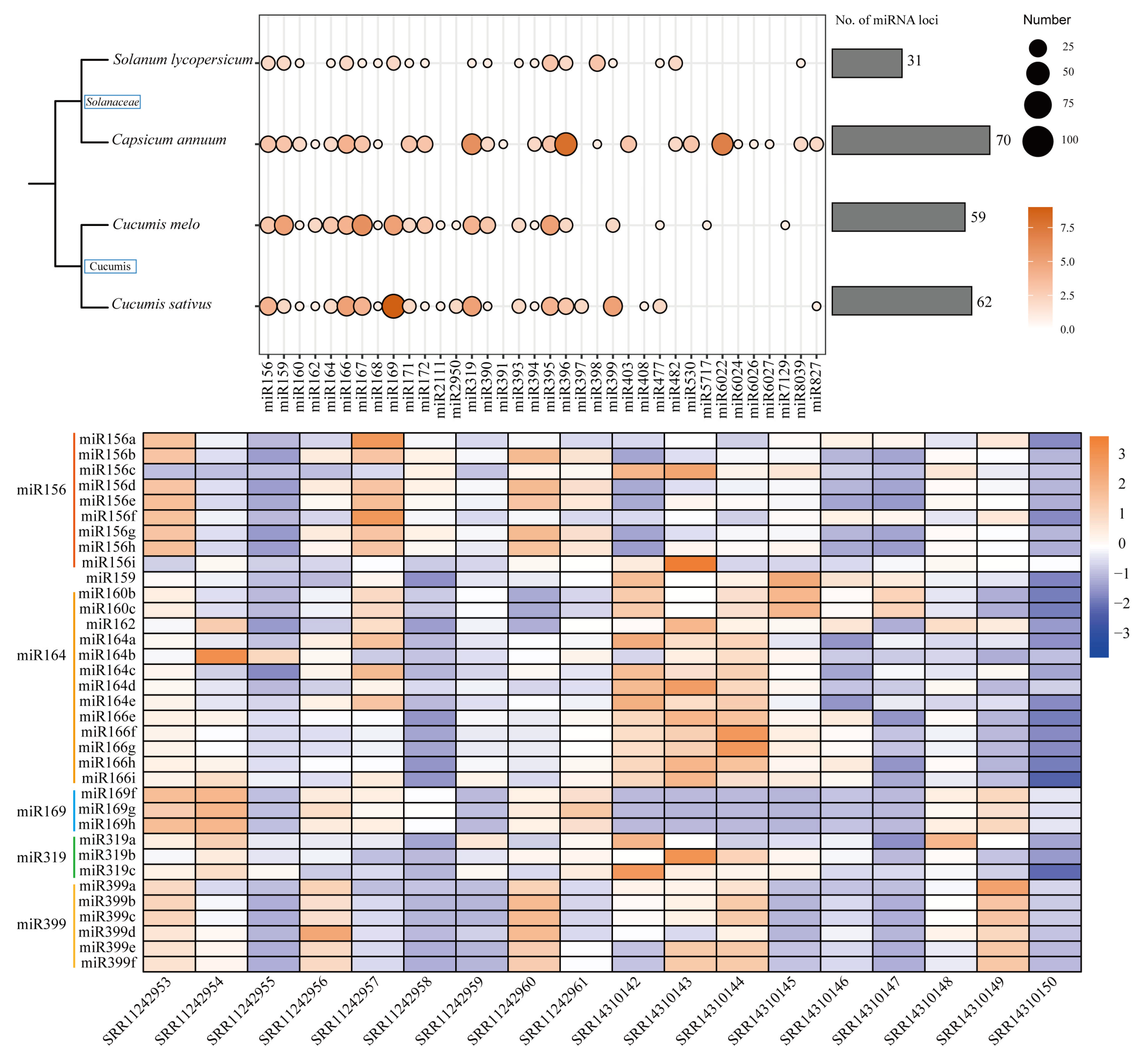
In this review, we used the ‘One step sRNAminer’ program in the sRNAminer software (v1.1.2) [20] to analyze the sRNA sequencing data of fruit from several fruit and vegetable crops such as tomato, cucumber, melon, and pepper based on NCBI public database. A total of 3950 miRNAs involved in fruit development. The target genes of the screened miRNAs were predicted, and the target genes were analyzed for GO/KEGG, focusing on the signaling pathways related to hormone synthesis and metabolic pathways by the ‘Target prediction’ program in the sRNAmiber software. Comparing the seed sequence of miRNAs, we found conserved miRNAs that belong to 5 miRNAs family, namely miR156, miR164, miR169, miR319 and miR399, which were involved in regulating hormone synthesis and metabolism (Figure 1).
In general, plant miRNAs are commonly classified into three categories: the highly conserved across angiosperms, moderately conserved within certain lineages or families, and those that are species-specific [21]. This review focuses on microRNAs associated with hormone signaling pathways in fruits of diverse horticultural crops. These miRNAs represent conserved regulators of fundamental processes, including plant growth and development, fruit ripening, and quality formation. Despite high sequence conservation, miRNAs families exhibit substantial interspecies divergence in copy number, spatiotemporal expression patterns, and regulatory networks, reflecting their adaptive evolution under natural selection.
The miR156, an abundant and highly conserved miRNA family member in plants, functions as a key regulator of fruit development by repressing SPL/SBP-box transcription factors. However, the miR156-SPL/SBP-box module exhibits substantial functional diversity across crop species. Despite its evolutionary conservation, the miR156-SPL/SBP module exhibits remarkable functional diversification across crop species. This is well illustrated in tomato, where it induces parthenocarpy through the GA pathway. Moreover, the same module regulates later processes, orchestrating fruit color change via ethylene signaling and maintains meristematic identity during early fruit development [22,23,24]. The conserved miR164 family governs fruit ripening by fine-tuning the expression of NAC transcription factors. Base changes in the non-cleavage sites of miR164 have occurred in crops such as wheat (Triticum aestivum L.), Gossypium hirsutum and Xanthoceras sorbifolium. Consequently, an expanded repertoire of transcription factors, including PSK, MAPK, CRKs, NEK, and HSF, became susceptible to miR164 targeting, among others, facilitating the emergence of novel regulatory architectures and functional diversification [25].
Current research has predominantly focused on linear regulatory relationships between conserved miRNAs and their target genes. In contrast, the crosstalk, feedback loops, and network-level interactions between miRNAs and hormone signaling pathways remain poorly understood.

2.2. miRNA–Hormone Interplay During Fruit Development: Crosstalk, Feedback Loops, and Regulatory Networks

Fruit development comprises overlapping phases of cell division, expansion and differentiation, culminating in maturation and ripening. Plant hormones, including auxin, gibberellin (GA), cytokinin (CK), ethylene, and abscisic acid (ABA), orchestrate fruit development through the regulation of cell division and expansion. Recent studies demonstrate that miRNAs fine-tune fruit development by modulating key regulators of hormone synthesis, metabolism, and signaling. For instance, miRNAs directly target hormone signaling components, including auxin response factors (ARFs), DELLA protein, cytokinin oxidases/dehydroxylases (CKXs), and ethylene biosynthetic (e.g., ACS and ACO), to fine-tune hormonal homeostasis and downstream responses (Table 1). In auxin signaling, miR160 and miR167 target ARF transcription factors to regulate fruit cell division and shape [26]. Silencing miR160 via short tandem target mimics (STTM) elevates ARF expression and promotes elongated pear-shaped fruit development in tomato [27]. Furthermore, miR393 targets the auxin receptor TIR1/AFB2, and miR319 represses TCP transcription factor, collectively maintaining auxin homeostasis and regulating cell proliferation and fruit enlargement [28]. MiR159 regulates fruit morphology by targeting the GAMYB2 transcription factor, which in turn controls expression of the GA biosynthesis gene GA3ox2. Overexpression miR159 impairs GAMYB function, reducing fruit size and promoting elongation, whereas its inhibition enhances fruit expansion [29], miR172 targets AP2 transcription factor to modulate GA biosynthesis and signaling, thereby regulating fruit cell division and expansion. Overexpression of miR172 promotes siliques enlargement in Arabidopsis thaliana but conversely reduces fruit size and weight in tomato and apple [30,31]. Furthermore, it is interesting to note that silencing miR172 precursors induces the formation of internal secondary fruits in tomato, revealing its key role in early morphological patterning [32]. Similarly, miR166 overexpression induces secondary fruits by suppressing HD-ZIPIII transcription factors [33]. These findings suggest that miR172 and miR166 coregulate fruit morphology through an interconnected signaling network. In summary, miRNAs form a multifaceted regulatory network that integrates hormonal signals and directs fruit development through targeted transcription factors.
Within regulatory network, miRNAs fine-tune the downstream gene expression by mediating the post-transcription silencing of transcription factors (TFs) through sequence-specific targeting and represents a central mechanism for precise spatiotemporal control of gene expression during plant development and stress responses [7]. Emerging evidence indicates that RNA degradation products can function as regulatory molecules to fine-tune miRNAs levels through multiple mechanisms. These include binding to cis elements within miRNAs precursors or cognate miRNAs genes, as well as modulating miRNAs biogenesis or turnover. Such interactions often give rise to intricate regulatory circuits, including feedback (FBLs) and feedforward loops (FFLs), which contribute to the dynamic precision of gene regulation [38,39].
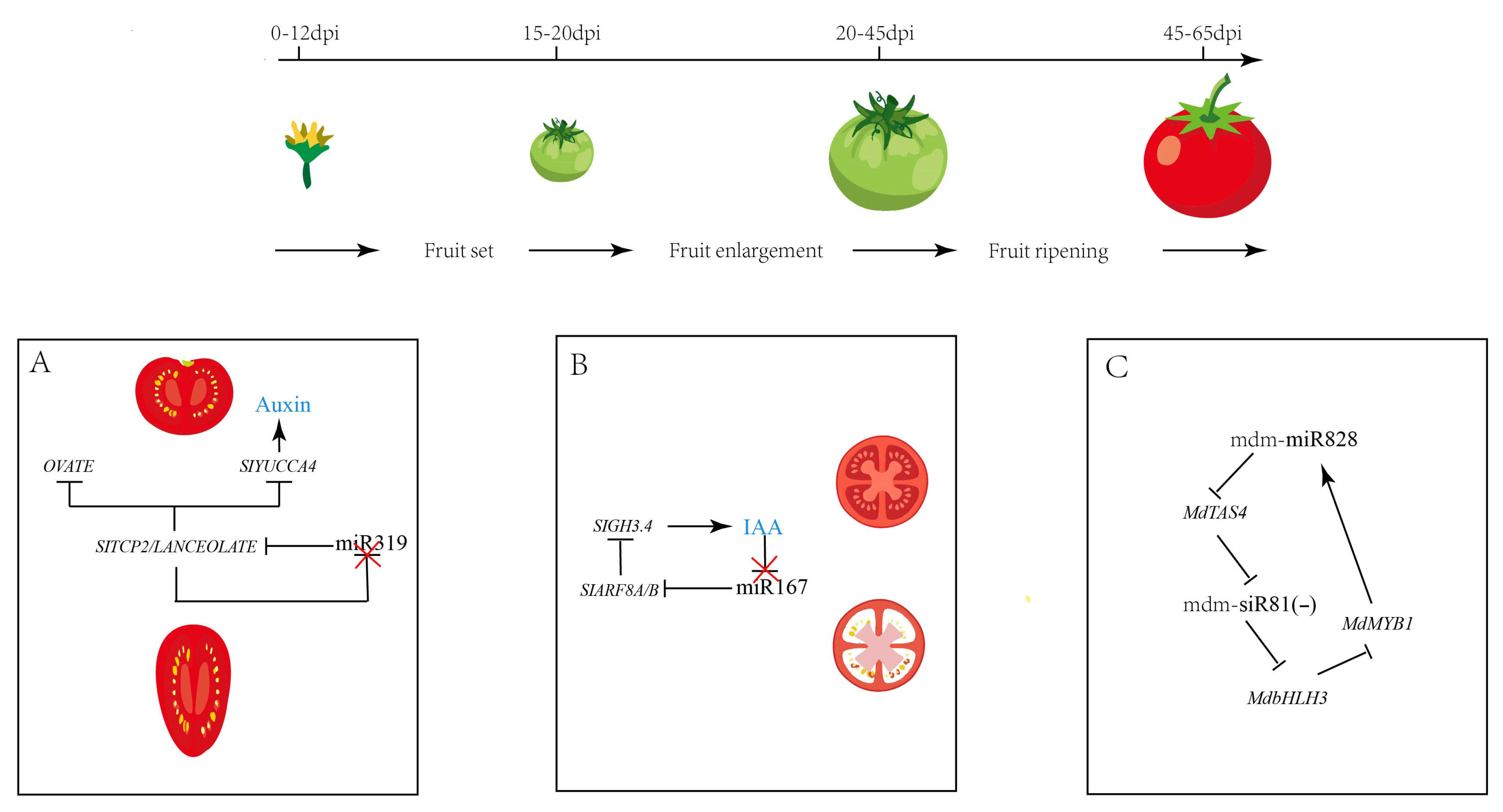
These regulatory circuits play essential roles in fruit development by orchestrating key biological processes, including hormone signaling, cell division and expansion, and metabolite accumulation, thereby ensuring precise control over fruit morphogenesis and quality traits. Carvalho A et al. showed that the regulation of SITCP2/LA by miR319 is crucial for tomato fruit morphology. The loss of miR319 led to a premature SITCP2/LA expression during gynoecium patterning and exhibited elongated ovary and fruit shape [40]. The transcriptional dynamics of miR319 during fruit development suggesting a possible negative feedback loop between miR319 and SlTCP2/LA [41]. Concurrently, a feedback module consisting of sly-miR167-SlARF8A/B-SlGH3.4 in tomato fruit. SlARF8A/B directly suppresses SlGH3.4 expression to modulate IAA amidation, while elevated auxin levels in-duce miR167 transcription, post-transcriptionally repressing SlARF8A/B translation and consequently reducing IAA accumulation. Ultimately, forming a feedback loop to maintain auxin homeostasis during the development of locular tissues [35]. Beyond their roles in fruit morphogenesis, regulatory circuits governing ripening and quality formation have been characterized in crop species, such as strawberries and apple [42,43]. The functional characterization of miRNA-mediated regulatory circuits in horticultural crops remains limited, primarily due to constraints in genetic transformation. This knowledge gap is particularly evident in networks involving conserved miRNAs, phytohormones, and transcription factors across diverse crop species.
These regulatory circuits ensure robust execution of the developmental program during fruit ontogeny (Figure 2), while simultaneously integrating internal and external cues, such as hormonal signals, light, and temperature, to facilitate faithful fruit development and ripening under fluctuating environmental conditions. So, elucidating these miRNA-mediated feedback (FBL) and feedforward (FFL) loops will provide crucial molecular insights and inform novel biotechnological strategies for precision breeding and fruit quality enhancement in crops.

3. MicroRNA-Mediated Regulation of Hormone Pathways in Fruit Development Under Temperature Stress

3.1. The Effects of Temperature Stress on Fruit

Temperature stress has become a common abiotic stress that has a negative impact on the growth, development and reproduction of plants and on crop production around the world. According to the IPPC, the global average annual temperature will increase at a rate of 1.5 to 5.8 °C, and on average, global yields will fall by 2.5~16% each degree-Celsius increase [44]. Reproductive organs are highly sensitive to environmental factors. In particular, temperature stress affects the biological process of another development, style elongation, pollen release, pollen germination, pollen tube growth, pollen-pistil interaction, fertilization and embryo development, with consequences on fruit set and development [45,46,47,48,49]. During reproductive development, fruit organs display greater susceptibility to temperature stress compared to vegetative tissues. Prolonged temperature stress impairs essential physiological functions, such as transpiration, respiration, and photo-assimilate allocation, thereby restricting both mitotic activity and cellular expansion during the cell expansion phase. These physiological disturbances manifest morphologically as reduced fruit elongation and increased incidence of malformed fruits [50,51]. Furthermore, prolonged heat stress detrimentally impacts fruit nutritional quality, manifesting as marked reductions in essential nutritional components including organic acids, vitamin C, soluble proteins, and soluble sugars [52]. Meanwhile, successive high-temperature stresses on young flower buds often cause multilocular fruits, secondary fruit at blossom end in tomato. In addition, the problem of poor pollination, inhibiting fruit development and significantly increasing the frozen fruit rate will also appear at cold stress [53].
The morphological imprint of temperature stress on fruit development is ultimately a consequence of its profound impact on cellular processes, namely the frequency and orientation of cell divisions. Acting as master signaling hubs, phytohormones not only regulate these cellular events but also mediate the plant’s response to thermal stress [54,55]. The integration of these signals is achieved through a complex regulatory symphony involving transcription factors and miRNAs. These players engage in extensive crosstalk, forming a robust network that is dynamically reprogrammed by temperature fluctuations [56]. Elucidating how this integrated network processes environmental information to guide developmental outcomes remains a central question in understanding fruit phenotypic plasticity.

3.2. Regulation of miRNAs During Fruit Development by Temperature Stress

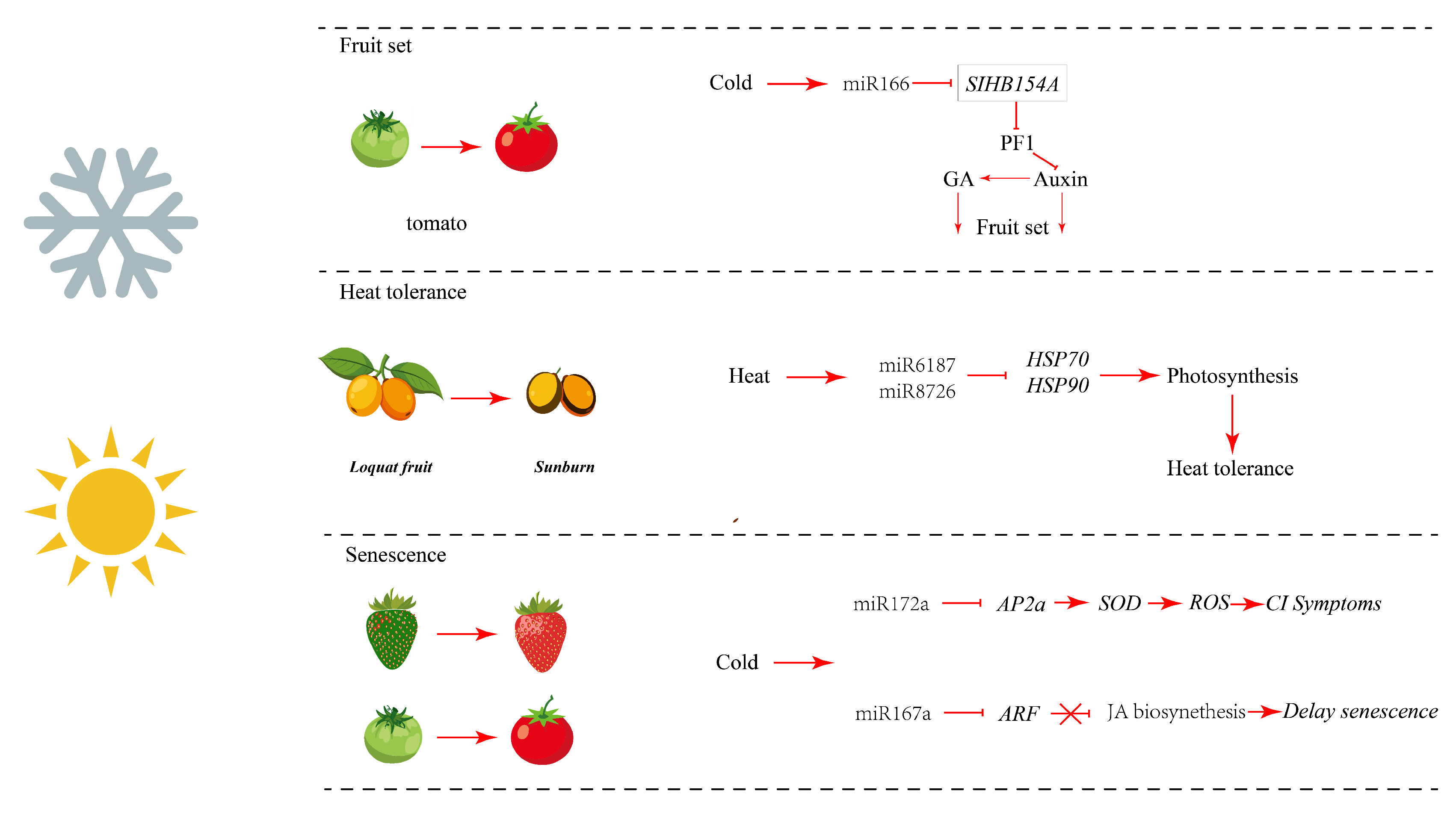
Far from being passive victims of temperature stress, plant fruits actively orchestrate their acclimation through multi-layered miRNAs networks that govern precise transcriptional and post-transcriptional reprogramming. Emerging research indicates that miRNAs function as a key post-transcriptional regulator in coordinating fruit response to temperature stress. By integrating oxidative signaling, protein homeostasis, and hormone pathways, they establish a sophisticated regulatory network that ensures normal fruit development under temperature stress (Figure 3). In response to temperature stress, plant cells initiate cell-autonomous protective mechanisms. In response to heat stress, the specific suppression of miR6187/8726 in loquat fruit enables an enhanced translation of heat shock protein genes. This drives robust HSPs accumulation, offering direct protection to essential organelles including Photosystem II [57]. Complementarily, the activated miR172a-SIAP2 module in tomato fruit orchestrates a dual-pronged strategy to maintain hardness under cold stress. It concurrently curbs reactive oxygen species (ROS) accumulation to minimize oxidative damage and reprograms cell wall metabolism to enhance mechanical strength, thereby collectively preserving the integrity of cellular components [58]. Beyond maintaining cellular homeostasis, developing fruit employs more sophisticated adaptation mechanisms, such as the miRNA-mediated remodeling of fruit morphology via hormone signaling pathways in response to environmental stress. Low temperature-induced miR166 overexpression in tomato downregulates SIHB15A, perturbing the auxin-ethylene crosstalk. This hormonal imbalance reprograms fruit cell proliferation and differentiation, providing a mechanistic basis for the resulting morphological defects [59,60]. In cucumber fruit, miRNAs also demonstrate how temperature signals are transformed into specific morphological changes. The miR156/157 module is used as an environmentally sensitive development regulatory factor. The changes in temperature will drive miR156/157 overexpression, which inversely regulates the expression of levels of the core development regulatory family, such as SBP-box transcription factors, which ultimately reprograms the development trajectory of cucumber fruit and influences fruit morphological formation under thermal variation [61,62].
However, it is well established that the integration of environmental stimuli and endogenous signals the orchestration of a broad spectrum of developmental processes, from embryogenesis and fruit set to morphogenesis and stress adaptation [63,64]. Meng et al. identified an auxin-ethylene antagonism governing cucumber parthenocarpy under low temperature, defined by the promotive role of auxin and the inhibitory function of ethylene in fruit development [55]. In tomato plants, prolonged high-temperature stress leads to the formation of malformed fruits by suppressing brassinosteroid biosynthesis, a process mediated by the overexpression of the SlELF3 gene [65]. These results suggest that plant responses to high temperatures are often tissue and organ specific and are regulated by multiple hormones, regulatory insight into their functions during early morphological development lags considerably behind. Collectively, these findings delineate a hierarchical, miRNA-mediated regulatory network that orchestrates the thermos-responsive development of fruits, spanning from cell-autonomous defenses to systemic hormone-driven remodeling. By precisely influencing the synthesis and signal transduction of hormones, it ultimately regulates fruit morphogenesis. This crucial regulatory chain has not yet been systematically analyzed. The core issue hinges on the multifaceted roles of hormone biosynthesis and signaling genes in linking temperature perception to specific morphological outcomes in developing fruits. The central mechanistic question is whether hormonal dysregulation under temperature stress serves as an upstream signal that triggers downstream miRNAs module dysfunction, leading to aberrant fruit morphogenesis. All these problems need further study.

3.3. Regulatory Roles of MicroRNAs in Grafting Systems Underlying Temperature Stress Responses

Grafting technology is one of the most economical and effective means by which to increase yield, improve quality, and enhance the stress resistance/tolerance of horticultural crop plants. It is commonly believed that granted rootstocks and scions maintain their genetic identity, but transcription factors, small interfering RNA (SiRNAs), miRNAs, mRNAs, peptides, and proteins are mobile in the plant vascular system, thereby moving between graft and scions [66,67,68,69]. In graft systems, these mobiles signaling molecules, notable miRNAs, function as long-distance epigenetic modifiers. By trafficking between scion and rootstock, they coordinate transmissible RNA silencing and antagonize DNA methylation, collectively regulating heritable phenotypic variation [70,71,72]. The epigenetic alterations were predominantly enriched in biological processes critical for fruit development, including photosynthesis, oxidative phosphorylation, photosynthetic proteins, and ubiquitin-mediated proteolysis, highlighting their central role in regulating fruit ripening and maturation [72,73].
Recent studies have shown that miRNAs can be mobile, acting as long-distance signaling in graft systems, whereby their translocation from rootstock to scion directly regulates the expression of genes governing critical agronomic traits, such as flowering and fruit morphology. In the context of developmental regulation, the conserved miRNA families miR166 and miR396, identified by their highly specific expression in apricot-peach graft chimeras, have been established as key mobile regulators that govern flowering. The functional analysis indicates that the complex regulatory network formed by the module of miR396-SFH12 and miR166-Bhlh74, jointly activates the expression of the FLOWERLOCUST (FT) gene, thereby synergistically promoting flowering. The results indicate that mobile miRNAs from the rootstock mediate the formation of a multi-layered regulatory network in the scion, enabling the coordinated reprogramming of its core developmental pathways [74]. In regulating fruit size, miRNAs exert more direct control. In the walnut grafting systems, the downregulation of miR396a derepresses its target, the JrGRE4b-JrGIF1a complex, thereby activating the downstream growth-promoting gene JrGATA4, driving scion cell proliferation and ultimately contribute to higher yield potential [75]. Correspondingly, significant alterations in fruit size within pumpkin-watermelon grafts are associated with the reduced expression of miR159, miR164, and miR171, suggesting that a network of interacting miRNAs coordinately regulate this key developmental trait [76]. Clear evidence indicates that graft systems improve scion performance through multiple mechanisms, including enhanced nutrient acquisition, a shifted balance from vegetative to reproductive growth, and the regulation of endogenous hormone levels, which collectively drive fruit enlargement and yield increase [77,78,79]. Unfortunately, the field remains largely descriptive. Most studies are confined to identifying differentially expressed miRNAs and making bioinformation predictions, lacking direct functional validation in specific grafting systems. Furthermore, it is unclear whether rootstock-derived miRNA signals exert stage-specific regulatory functions during fruit development. Consequently, without this spatiotemporal resolution, we cannot construct an accurate map of miRNAs movement and its regulatory logic.

4. Conclusions and Future Perspectives

Accumulating evidence has now firmly established that miRNAs play a central regulatory role in determining fruit morphology. Functioning as key post-transcriptional and epigenetic regulators, miRNAs act as a key that integrates hormonal signals and modulates the expression of hormone-related genes. Through this role, they orchestrate complex networks essential for fruit morphogenesis [80]. However, significant knowledge gaps remain. Unlike in module plant and major food crops, the role of miRNAs within the precise regulatory network governing fruit development, particularly their interplay with environmental stress signals, is still largely unexplored. This review synthesizes the morphological and molecular basis of fruit development, with a focus on the complex regulatory networks involving miRNAs, transcription factors, and hormone signals under temperature stress. We propose that hormone signaling acts as a central hub, integrating miRNA-mediated stress responses into developmental outcomes. This is exemplified by the miR166-SIH15A module, which disrupts auxin-ethylene homeostasis to induce fruit malformation under cold stress. A central question is how hormone signals molecularly integrate miRNA inputs with target gene expression to precisely control processes like fruit cell division, enlargement, and quality formation. Currently, there is a paucity of systematic functional studies to provide a definitive mapping of this regulatory circuitry. Therefore, a prioritized focus on critical phases like flowering and early fruit development is essential for future mechanistic research. Leveraging cutting-edge spatial omics and single-cell transcriptomics will allow for the concurrent capture of miRNAs and mRNA profiles. Generating such dynamic expression maps across tissues and stages is a prerequisite for systematically analyzing how miRNAs serve as core signaling hubs that integrate developmental, hormonal, and environmental cues [81,82].
As discussed in the preceding sections miRNAs have multiple characteristics that give them the potential to play prominent roles during plant growth, development and stress resistance. In this context, the royal road to decipher their roles is a functional approach analyzing the molecular mechanism of abnormal miRNAs function through genetics. Precise functional analysis of individual miRNAs in specific tissues remains challenging. Although CRISPR/Cas9 and RNAi are powerful, their utility in non-model vegetable crops is limited by inefficient transformation. Alternative approaches like STTM and VIGS often lack robustness and exhibit variable silencing efficiency across tissues, complicating phenotypic interpretation. It is equally important to acknowledge that, even with advances in mechanism understanding, pivotal bottlenecks, such as delivery efficiency, target specificity, and environmental stability, remain to be addressed. Consequently, advancing plant-adapted, spatiotemporally controllable miRNAs technologies, by leveraging intelligent delivery platforms such as nanocarriers, represents a critical frontier for realizing their full application potential.
Furthermore, grafting systems can serve as a powerful platform to overcome the bottleneck of recalcitrant transformation in vegetable crops. A practical strategy involves using easily transformable model plants (e.g., Nicotiana benthamiana) or amenable crops within the same family as rootstocks, grafted with the target vegetable scion. Integrating this classical approach with multi-omics analyses can clarify how rootstock-derived mobile miRNAs regulate fruit development under environmental stress. In summary, grafting systems constitute a powerful model system for dissecting the fundamental question of how mobile miRNAs systemically regulate fruit development under environmental stress.

Author Contributions

K.D. and D.Z.: Data curation, formal analysis, visualization, writing—original draft and writing—review and editing. W.L., G.C., L.B. and X.L.: Data curation and investigation and visualization. W.M.: Conceptualization and supervision and writing—review and editing. Z.D.: Conceptualization, data curation, funding acquisition, writing—original draft and writing—review and editing. All authors have read and agreed to the published version of the manuscript.

Funding

This work was supported by the National Natural Science Foundation of China (32460755) and Yunnan Provincial Department of Science, Technology Basic Research Program (202101AT070184) and Pre-research Foundation of Yunnan Academy of Agricultural Sciences (2025KYZX-05).

Data Availability Statement

The RNA-seq datasets used in this study were retrieved from the NCBI public database (SRA accession: PRJNA624184, PRJNA438371, PRJNA718887 and PRJNA624184).

Conflicts of Interest

The authors declare no conflicts of interest.

References

  1. Anne, N.; Magnus, R.; Karin, W. Sustainable Fruit Consumption: The Influence of Color, Shape and Damage on Consumer Sensory Perception and Liking of Different Apples. Sustainability 2019, 11, 4626. [Google Scholar] [CrossRef]
  2. Lin, M.; Fawole, O.A.; Saeys, W.; Wu, D.; Wang, J.; Opara, U.L.; Nicolai, B.; Chen, K. Mechanical damages and packaging methods along the fresh fruit supply chain: A review. Crit. Rev. Food Sci. Nutr. 2023, 63, 10283–10302. [Google Scholar] [CrossRef] [PubMed]
  3. Snouffer, A.; Kraus, C.; van der Knaap, E. The shape of things to come: Ovate family proteins regulate plant organ shape. Curr. Opin. Plant Biol. 2020, 53, 98–105. [Google Scholar] [CrossRef] [PubMed]
  4. Rodríguez, G.R.; Muños, S.; Anderson, C.; Sim, S.C.; Michel, A.; Causse, M.; Gardener, B.B.; Francis, D.; van der Knaap, E. Distribution of SUN, OVATE, LC, and FAS in the tomato germplasm and the relationship to fruit shape diversity. Plant Physiol. 2011, 156, 275–285. [Google Scholar] [CrossRef]
  5. Pan, Y.; Wang, Y.; McGregor, C.; Liu, S.; Luan, F.; Gao, M.; Weng, Y. Genetic architecture of fruit size and shape variation in cucurbits: A comparative perspective. Theor. Appl. Genet. 2020, 133, 1–21. [Google Scholar] [CrossRef]
  6. Cirilli, M.; Baccichet, I.; Chiozzotto, R.; Silvestri, C.; Rossini, L.; Bassi, D. Genetic and phenotypic analyses reveal major quantitative loci associated to fruit size and shape traits in a non-flat peach collection (P. persica L. Batsch). Hortic. Res. 2021, 8, 232. [Google Scholar] [CrossRef]
  7. Zhan, J.; Meyers, B.C. Plant Small RNAs: Their Biogenesis, Regulatory Roles, and Functions. Annu. Rev. Plant Biol. 2023, 74, 21–51. [Google Scholar] [CrossRef]
  8. Liu, Y.; Wang, L.; Chen, D.; Wu, X.; Huang, D.; Chen, L.; Li, L.; Deng, X.; Xu, Q. Genome-wide comparison of microRNAs and their targeted transcripts among leaf, flower and fruit of sweet orange. BMC Genom. 2014, 15, 695. [Google Scholar] [CrossRef]
  9. Ye, X.; Song, T.; Liu, C.; Feng, H.; Liu, Z. Identification of fruit related microRNAs in cucumber (Cucumis sativus L.) using high-throughput sequencing technology. Hereditas 2014, 151, 220–228. [Google Scholar] [CrossRef]
  10. Zuo, J.; Wang, Y.; Zhu, B.; Luo, Y.; Wang, Q.; Gao, L. Network analysis of noncoding RNAs in pepper provides insights into fruit ripening control. Sci. Rep. 2019, 9, 8734. [Google Scholar] [CrossRef]
  11. Wang, Y.; Li, W.; Chang, H.; Zhou, J.; Luo, Y.; Zhang, K.; Zuo, J.; Wang, B. SRNAome and transcriptome analysis provide insight into strawberry fruit ripening. Genomics 2020, 112, 2369–2378. [Google Scholar] [CrossRef] [PubMed]
  12. Kim, Y.K.; Han, J. Nobel-winning microRNA, the micromaestro of gene silencing. Mol. Cells 2024, 47, 100123. [Google Scholar] [CrossRef] [PubMed]
  13. Liu, H.; Yu, H.; Tang, G.; Huang, T. Small but powerful: Function of microRNAs in plant development. Plant Cell Rep. 2018, 37, 515–528. [Google Scholar] [CrossRef] [PubMed]
  14. Song, X.; Li, Y.; Cao, X.; Qi, Y. MicroRNAs and Their Regulatory Roles in Plant-Environment Interactions. Annu. Rev. Plant Biol. 2019, 70, 489–525. [Google Scholar] [CrossRef]
  15. Kong, X.; He, M.; Guo, Z.; Zhou, Y.; Chen, Z.; Qu, H.; Zhu, H. microRNA regulation of fruit development, quality formation and stress response. Fruit Res. 2021, 1, 5. [Google Scholar] [CrossRef]
  16. Varkonyi-Gasic, E.; Lough, R.H.; Moss, S.M.; Wu, R.; Hellens, R.P. Kiwifruit floral gene APETALA2 is alternatively spliced and accumulates in aberrant indeterminate flowers in the absence of miR172. Plant Mol. Biol. 2012, 78, 417–429. [Google Scholar] [CrossRef]
  17. Qin, Z.; Li, C.; Mao, L.; Wu, L. Novel insights from non-conserved microRNAs in plants. Front. Plant Sci. 2014, 5, 586. [Google Scholar] [CrossRef]
  18. Luo, Y.; Zhang, X.; Luo, Z.; Zhang, Q.; Liu, J. Identification and characterization of microRNAs from Chinese pollination constant non-astringent persimmon using high-throughput sequencing. BMC Plant Biol. 2015, 15, 11. [Google Scholar] [CrossRef]
  19. Liang, Y.; Guan, Y.; Wang, S.; Li, Y.; Zhang, Z.; Li, H. Identification and characterization of known and novel microRNAs in strawberry fruits induced by Botrytis cinerea. Sci. Rep. 2018, 8, 10921. [Google Scholar] [CrossRef]
  20. Li, G.; Chen, C.; Chen, P.; Meyers, B.C.; Xia, R. sRNAminer: A multifunctional toolkit for next-generation sequencing small RNA data mining in plants. Sci. Bull. 2024, 69, 784–791. [Google Scholar] [CrossRef]
  21. Cuperus, J.T.; Fahlgren, N.; Carrington, J.C. Evolution and functional diversification of MIRNA genes. Plant Cell 2011, 23, 431–442. [Google Scholar] [CrossRef] [PubMed]
  22. Ferreira e Silva, G.F.; Silva, E.M.; Azevedo Mda, S.; Guivin, M.A.; Ramiro, D.A.; Figueiredo, C.R.; Carrer, H.; Peres, L.E.; Nogueira, F.T. microRNA156-targeted SPL/SBP box transcription factors regulate tomato ovary and fruit development. Plant J. 2014, 78, 604–618. [Google Scholar] [CrossRef] [PubMed]
  23. Li, H.; Wang, S.; Zhai, L.; Cui, Y.; Tang, G.; Huo, J.; Li, X.; Bian, S. The miR156/SPL12 module orchestrates fruit colour change through directly regulating ethylene production pathway in blueberry. Plant Biotechnol. J. 2024, 22, 386–400. [Google Scholar] [CrossRef] [PubMed]
  24. Wang, D.R.; Zhang, C.L.; Wang, X.; Liu, D.D.; Liu, X.; Chen, G.L.; Wang, Q.; Qu, M.S.; Yang, K.; You, C.X.; et al. MicroRNA156-SPL13B Module Induces Parthenocarpy Through the Gibberellin Pathway. Plant Biotechnol. J. 2025, 23, 5536–5549. [Google Scholar] [CrossRef]
  25. Gao, J.; Chen, L.; Yuan, N.; Liu, Y.; Sun, Y.; Ke, L. Multifaceted Regulation and Functional Versatility of miR164 in Plant: From Molecular Mechanisms to Crop Improvement. Physiol. Plant. 2025, 177, e70548. [Google Scholar] [CrossRef]
  26. Liu, X.; Xu, T.; Dong, X.; Liu, Y.; Liu, Z.; Shi, Z.; Wang, Y.; Qi, M.; Li, T. The role of gibberellins and auxin on the tomato cell layers in pericarp via the expression of ARFs regulated by miRNAs in fruit set. Acta Physiol. Plant. 2016, 38, 77. [Google Scholar] [CrossRef]
  27. Damodharan, S.; Zhao, D.; Arazi, T. A common miRNA160-based mechanism regulates ovary patterning, floral organ abscission and lamina outgrowth in tomato. Plant J. 2016, 86, 458–471. [Google Scholar] [CrossRef]
  28. Zhang, Y.; Zhu, X.; Wang, C.; Ge, M. Characterisation of early fruit development-specific miRNAs and their targets in peach using small RNA and degradome sequencing. Fruit Res. 2025, 5, e021. [Google Scholar] [CrossRef]
  29. Zhao, P.; Wang, F.; Deng, Y.; Zhong, F.; Tian, P.; Lin, D.; Deng, J.; Zhang, Y.; Huang, T. Sly-miR159 regulates fruit morphology by modulating GA biosynthesis in tomato. Plant Biotechnol. J. 2022, 20, 833–845. [Google Scholar] [CrossRef]
  30. Yao, J.L.; Xu, J.; Cornille, A.; Tomes, S.; Karunairetnam, S.; Luo, Z.; Bassett, H.; Whitworth, C.; Rees-George, J.; Ranatunga, C.; et al. A microRNA allele that emerged prior to apple domestication may underlie fruit size evolution. Plant J. 2015, 84, 417–427. [Google Scholar] [CrossRef]
  31. Yao, J.L.; Tomes, S.; Xu, J.; Gleave, A.P. How microRNA172 affects fruit growth in different species is dependent on fruit type. Plant Signal. Behav. 2016, 11, e1156833. [Google Scholar] [CrossRef] [PubMed]
  32. Chung, M.Y.; Nath, U.K.; Vrebalov, J.; Gapper, N.; Lee, J.M.; Lee, D.J.; Kim, C.K.; Giovannoni, J. Ectopic expression of miRNA172 in tomato (Solanum lycopersicum) reveals novel function in fruit development through regulation of an AP2 transcription factor. BMC Plant Biol. 2020, 20, 283. [Google Scholar] [CrossRef] [PubMed]
  33. Zhang, Z.; Yang, T.; Li, N.; Tang, G.; Tang, J. MicroRNA166: Old Players and New Insights into Crop Agronomic Traits Improvement. Genes 2024, 15, 944. [Google Scholar] [CrossRef] [PubMed]
  34. Kong, X.; Zeng, J.; Yun, Z.; Hu, C.; Yang, B.; Qu, H.; Jiang, Y.; Zhu, H. Characterization of miRNA-mediated auxin signaling during banana (Musa spp.) fruit ripening. Postharvest Biol. Technol. 2022, 193, 112045. [Google Scholar] [CrossRef]
  35. Hua, B.; Wu, J.; Han, X.; Bian, X.; Xu, Z.; Sun, C.; Wang, R.; Zhang, W.; Liang, F.; Zhang, H.; et al. Auxin homeostasis is maintained by sly-miR167-SlARF8A/B-SlGH3.4 feedback module in the development of locular and placental tissues of tomato fruits. New Phytol. 2024, 241, 1177–1192. [Google Scholar] [CrossRef]
  36. Wang, C.; Jogaiah, S.; Zhang, W.; Abdelrahman, M.; Fang, J.G. Spatio-temporal expression of miRNA159 family members and their GAMYB target gene during the modulation of gibberellin-induced grapevine parthenocarpy. J. Exp. Bot. 2018, 69, 3639–3650. [Google Scholar] [CrossRef]
  37. Cao, D.; Wang, J.; Ju, Z.; Liu, Q.; Li, S.; Tian, H.; Fu, D.; Zhu, H.; Luo, Y.; Zhu, B. Regulations on growth and development in tomato cotyledon, flower and fruit via destruction of miR396 with short tandem target mimic. Genes 2016, 247, 1–12. [Google Scholar] [CrossRef]
  38. Cai, S.; Zhou, P.; Liu, Z. Functional characteristics of a double negative feedback loop mediated by microRNAs. Cogn. Neurodyn. 2013, 7, 417–429. [Google Scholar] [CrossRef]
  39. Megraw, M.; Cumbie, J.S.; Ivanchenko, M.G.; Filichkin, S.A. Small Genetic Circuits and MicroRNAs: Big Players in Polymerase II Transcriptional Control in Plants. Plant Cell 2016, 28, 286–303. [Google Scholar] [CrossRef]
  40. Carvalho, A., Jr.; Vicente, M.H.; Ferigolo, L.F.; Silva, E.M.; Lira, B.S.; Teboul, N.; Levy, M.; Serrano-Bueno, G.; Peres, L.E.P.; Sablowski, R.; et al. The miR319-based repression of SlTCP2/LANCEOLATE activity is required for regulating tomato fruit shape. Plant J. 2025, 121, e17174. [Google Scholar] [CrossRef]
  41. Li, X.; Bian, H.; Song, D.; Ma, S.; Han, N.; Wang, J.; Zhu, M. Flowering time control in ornamental gloxinia (Sinningia speciosa) by manipulation of miR159 expression. Ann. Bot. 2013, 111, 791–799. [Google Scholar] [CrossRef] [PubMed]
  42. Zhang, B.; Yang, H.J.; Yang, Y.Z.; Zhu, Z.Z.; Li, Y.N.; Qu, D.; Zhao, Z.Y. mdm-miR828 Participates in the Feedback Loop to Regulate Anthocyanin Accumulation in Apple Peel. Front. Plant Sci. 2020, 11, 608109. [Google Scholar] [CrossRef] [PubMed]
  43. Li, D.; Mou, W.; Xia, R.; Li, L.; Zawora, C.; Ying, T.; Mao, L.; Liu, Z.; Luo, Z. Integrated analysis of high-throughput sequencing data shows abscisic acid-responsive genes and miRNAs in strawberry receptacle fruit ripening. Hortic. Res. 2019, 6, 26. [Google Scholar] [CrossRef] [PubMed]
  44. Battisti, D.S.; Naylor, R.L. Historical warnings of future food insecurity with unprecedented seasonal heat. Science 2009, 323, 240–244. [Google Scholar] [CrossRef]
  45. Sato, S.; Peet, M.M.; Thomas, J.F. Physiological factors limit fruit set of tomato (Lycopersicon esculentum Mill.) under chronic, mild heat stress. Plant Cell Environ. 2000, 23, 719–726. [Google Scholar] [CrossRef]
  46. Erickson, A.N.; Markhart, A.H. Flower developmental stage and organ sensitivity of bell pepper (Capsicum annuum L.) to elevated temperature. Plant Cell Environ. 2002, 25, 123–130. [Google Scholar] [CrossRef]
  47. Firon, N.; Shaked, R.; Peet, M.M.; Pharr, D.M.; Zamski, E.; Rosenfeld, K.; Althan, L.; Pressman, E. Pollen grains of heat tolerant tomato cultivars retain higher carbohydrate concentration under heat stress conditions. Sci. Hortic. 2006, 109, 212–217. [Google Scholar] [CrossRef]
  48. Zinn, K.E.; Tunc-Ozdemir, M.; Harper, J.F. Temperature stress and plant sexual reproduction: Uncovering the weakest links. J. Exp. Bot. 2010, 61, 1959–1968. [Google Scholar] [CrossRef]
  49. Giorno, F.; Wolters-Arts, M.; Mariani, C.; Rieu, I. Ensuring reproduction at high temperatures: The heat stress response during anther and pollen development. Plants 2013, 2, 489–506. [Google Scholar] [CrossRef]
  50. Negi, S.; Kumar, P.; Kumar, A.; Kumar, V.; Irfan, M. Environmental variables affecting apple fruit development and bioactive compounds: Biochemical insights and biotechnological advances. J. Plant Growth Regul. 2025, 7, 1–12. [Google Scholar] [CrossRef]
  51. Christopher, M. A review of fruit development in strawberry: High temperatures accelerate flower development and decrease the size of the flowers and fruit. J. Hortic. Sci. Biotechnol. 2023, 98, 409–431. [Google Scholar] [CrossRef]
  52. Du, X.; Song, Y.; Pan, L.; Cui, S. Optimizing cucumber (Cucumis sativus L.) fruit metabolomics under elevated CO2 and high-temperature stress in the greenhouse. Horticulturae 2024, 11, 10. [Google Scholar] [CrossRef]
  53. Sharif, R.; Su, L.; Chen, X.; Qi, X. Hormonal interactions underlying parthenocarpic fruit formation in horticultural crops. Hortic. Res. 2022, 9, uhab024. [Google Scholar] [CrossRef] [PubMed]
  54. Wang, C.; Xin, M.; Zhou, X.; Liu, C.; Li, S.; Liu, D.; Xu, Y.; Qin, Z. The novel ethylene-responsive factor CsERF025 affects the development of fruit bending in cucumber. Plant Mol. Biol. 2017, 95, 519–531. [Google Scholar] [CrossRef]
  55. Meng, Y.; Zhu, P.; Gou, C.; Cheng, C.; Li, J.; Chen, J. Auxin and ethylene play important roles in parthenocarpy under low-temperature stress revealed by transcriptome analysis in cucumber (Cucumis sativus L.). J. Plant Growth Regul. 2024, 43, 1137–1152. [Google Scholar] [CrossRef]
  56. Correa, J.P.O.; Silva, E.M.; Nogueira, F.T.S. Molecular control by non-coding RNAs during fruit development: From gynoecium patterning to fruit ripening. Front. Plant Sci. 2018, 9, 1760. [Google Scholar] [CrossRef]
  57. Chen, Y.; Deng, C.; Xu, Q.; Chen, X.; Jiang, F.; Zhang, Y.; Hu, W.; Zheng, S.; Su, W.; Jiang, J. Integrated analysis of the metabolome, transcriptome and miRNome reveals crucial roles of auxin and heat shock proteins in the heat stress response of loquat fruit. Sci. Hortic. 2022, 294, 110764. [Google Scholar] [CrossRef]
  58. Zhao, K.; Chen, R.; Duan, W.; Meng, L.; Song, H.; Wang, Q.; Li, J.; Xu, X. Chilling injury of tomato fruit was alleviated under low-temperature storage by silencing Sly-miR171e with short tandem target mimic technology. Front. Nutr. 2022, 9, 906227. [Google Scholar] [CrossRef]
  59. Clepet, C.; Devani, R.S.; Boumlik, R.; Hao, Y.; Morin, H.; Marcel, F.; Verdenaud, M.; Mania, B.; Brisou, G.; Citerne, S.; et al. The miR166-SlHB15A regulatory module controls ovule development and parthenocarpic fruit set under adverse temperatures in tomato. Mol. Plant 2021, 14, 1185–1198. [Google Scholar] [CrossRef]
  60. da Silva, E.M.; Nogueira, F.T.S. Guarding tomato fruit setting in adverse temperatures through the miRNA166-SlHB15A regulatory module. Mol. Plant 2021, 14, 1046–1048. [Google Scholar] [CrossRef]
  61. Ma, Y.; Guo, J.W.; Bade, R.; Men, Z.H.; Hasi, A. Genome-wide identification and phylogenetic analysis of the SBP-box gene family in melons. Genet. Mol. Res. 2014, 13, 8794–8806. [Google Scholar] [CrossRef] [PubMed]
  62. Zhou, Q.; Zhang, S.; Chen, F.; Liu, B.; Wu, L.; Li, F.; Zhang, J.; Bao, M.; Liu, G. Genome-wide identification and characterization of the SBP-box gene family in Petunia. BMC Genom. 2018, 19, 193. [Google Scholar] [CrossRef] [PubMed]
  63. Sharif, R.; Su, L.; Chen, X.; Qi, X. Involvement of auxin in growth and stress response of cucumber. Veg. Res. 2022, 2, 13. [Google Scholar] [CrossRef]
  64. Li, N.; Euring, D.; Cha, J.Y.; Lin, Z.; Lu, M.; Huang, L.J.; Kim, W.Y. Plant Hormone-Mediated Regulation of Heat Tolerance in Response to Global Climate Change. Front. Plant Sci. 2020, 11, 627969. [Google Scholar] [CrossRef] [PubMed]
  65. Wu, J.; Li, P.; Li, M.; Zhu, D.; Ma, H.; Xu, H.; Li, S.; Wei, J.; Bian, X.; Wang, M.; et al. Heat stress impairs floral meristem termination and fruit development by affecting the BR-SlCRCa cascade in tomato. Plant Commun. 2024, 5, 100790. [Google Scholar] [CrossRef]
  66. Spiegelman, Z.; Golan, G.; Wolf, S. Don’t kill the messenger: Long-distance trafficking of mRNA molecules. Genes 2013, 213, 1–8. [Google Scholar] [CrossRef]
  67. Kalantidis, K.; Schumacher, H.T.; Alexiadis, T.; Helm, J.M. RNA silencing movement in plants. Biol. Cell 2008, 100, 13–26. [Google Scholar] [CrossRef]
  68. Haroldsen, V.M.; Szczerba, M.W.; Aktas, H.; Lopez-Baltazar, J.; Odias, M.J.; Chi-Ham, C.L.; Labavitch, J.M.; Bennett, A.B.; Powell, A.L. Mobility of transgenic nucleic acids and proteins within grafted rootstocks for agricultural improvement. Front. Plant Sci. 2012, 3, 39. [Google Scholar] [CrossRef]
  69. Melnyk, C.W.; Molnar, A.; Baulcombe, D.C. Intercellular and systemic movement of RNA silencing signals. EMBO J. 2011, 30, 3553–3563. [Google Scholar] [CrossRef]
  70. Molnar, A.; Melnyk, C.W.; Bassett, A.; Hardcastle, T.J.; Dunn, R.; Baulcombe, D.C. Small silencing RNAs in plants are mobile and direct epigenetic modification in recipient cells. Science 2010, 328, 872–875. [Google Scholar] [CrossRef]
  71. Li, W.; Chen, S.; Liu, Y.; Wang, L.; Jiang, J.; Zhao, S.; Fang, W.; Chen, F.; Guan, Z. Long-distance transport RNAs between rootstocks and scions and graft hybridization. Planta 2022, 255, 96. [Google Scholar] [CrossRef]
  72. Cheng, S.L.H.; Xu, H.; Ng, J.H.T.; Chua, N.H. Systemic movement of long non-coding RNA ELENA1 attenuates leaf senescence under nitrogen deficiency. Nat. Plants 2023, 9, 1598–1606. [Google Scholar] [CrossRef] [PubMed]
  73. Liu, W.; Wang, Q.; Zhang, R.; Liu, M.; Wang, C.; Liu, Z.; Xiang, C.; Lu, X.; Zhang, X.; Li, X.; et al. Rootstock-scion exchanging mRNAs participate in the pathways of amino acids and fatty acid metabolism in cucumber under early chilling stress. Hortic. Res. 2022, 9, uhac031. [Google Scholar] [CrossRef] [PubMed]
  74. Zhang, S.; Zhi, Z.; Tian, L.; Zhou, R.; Chen, H.; Yue, H.; Li, F.; Zhu, G.P.; Jia, W.; Zhang, M. Integrated multi-omics analyses reveal the roles of apricot miR166a and miR396c in the growth and development of apricot-peach grafted chimera. Int. J. Biol. Macromol. 2025, 318, 145121. [Google Scholar] [CrossRef] [PubMed]
  75. Li, B.; Liu, Y.; Zhang, P.; Song, X.; Wang, X.; Zheng, Z.; Pei, D. Rootstock of distant hybrid activates transcription factors of scion cultivar to promote growth and yield in walnut. Plant Biotechnol. J. 2025, 23, 4302–4317. [Google Scholar] [CrossRef]
  76. Xanthopoulou, A.; Tsaballa, A.; Ganopoulos, I.; Kapazoglou, A.; Avramidou, E.; Aravanopoulos, F.; Moysiadis, T.; Osathanunkul, M.; Tsaftaris, A.; Doulis, A. Ιntra-species grafting induces epigenetic and metabolic changes accompanied by alterations in fruit size and shape of Cucurbita pepo L. Plant Growth Regul. 2019, 87, 93–108. [Google Scholar] [CrossRef]
  77. Cui, Q.; Xie, L.; Dong, C.; Gao, L.; Shang, Q. Stage-specific events in tomato graft formation and the regulatory effects of auxin and cytokinin. Plant Sci. 2021, 304, 110803. [Google Scholar] [CrossRef]
  78. Shrestha, S.; Mattupalli, C.; Miles, C. Effect of grafting compatibility on fruit yield and quality of cantaloupe in a mediterranean-type climate. Horticulturae 2022, 8, 888. [Google Scholar] [CrossRef]
  79. Miao, L.; Li, Q.; Sun, T.S.; Chai, S.; Wang, C.; Bai, L.; Sun, M.; Li, Y.; Qin, X.; Zhang, Z.; et al. Sugars promote graft union development in the heterograft of cucumber onto pumpkin. Hortic. Res. 2021, 8, 146. [Google Scholar] [CrossRef]
  80. Shang, R.; Lee, S.; Senavirathne, G.; Lai, E.C. microRNAs in action: Biogenesis, function and regulation. Nat. Rev. Genet. 2023, 24, 816–833. [Google Scholar] [CrossRef]
  81. Bawa, G.; Liu, Z.; Yu, X.; Tran, L.P.; Sun, X. Introducing single cell stereo-sequencing technology to transform the plant transcriptome landscape. Trends Plant Sci. 2024, 29, 249–265. [Google Scholar] [CrossRef] [PubMed]
  82. Kreutz, J.; Mitić, T.; Caporali, A. Exploring microRNAs, One Cell at a Time. Noncoding RNA 2025, 11, 73. [Google Scholar] [CrossRef] [PubMed]
Figure 1. Conservation of miRNAs in fruit. miRNAs among four common fruit and vegetable species, which are derived from NCBI database. The scatter plot on the up shows the number of miRNAs loci in each species. The bar graph on the down shows five miRNAs families which involved in the signaling pathways related to hormone synthesis and metabolic pathways in fruit development. Lowercase letters represent a specific member of the conservation miRNA family.
Plants 15 00167 g001
Figure 2. Roles of miRNA–TF loops during fruit developmental. (A) A hypothetical model depicting how a regulatory module integrating miR319-targeted SlTCP2/LANCEOLATE, the OVATE protein, and auxin signaling coordinates gynoecium patterning to ultimately establish fruit shape. (B) A self-correcting feedback module, comprising sly-miR167, SlARF8A/B, and SlGH3.4, maintains auxin homeostasis during tomato locule development through a negative feedback loop to precisely control active auxin levels. (C) A model depicting a mdm-miR828-MYB transcription factor regulatory axis that forms a feedback circuit to maintain anthocyanin homeostasis and prevent over-accumulation in the apple fruit peel.
Plants 15 00167 g002
Figure 3. Schematic representation of the regulatory network integrating oxidative signaling, protein homeostasis, and hormone pathways by miRNAs in fruit development underlying temperature stress.
Plants 15 00167 g003
Table 1. Mechanisms of miRNA-target modules in regulating fruit development.
miRNA Direct Target GenesEvidence TypeDownstream Target GenesHormone CrosstalkPhenotypic EffectsSpeciesReference
miR156SPL 13BPredictedGA biosynthesis genes, MdKO, MdKAO2 and MdGA20oxRegulate GA accumulationInduced parthenocarpyTomato[24]
PredictedHistone modification gene, MdMSIPromote GA deactivation
miR393TIR1/AFB2PredictedUndetermined Maintain the dynamic balance of auxinRegulate cell proliferation and fruit enlargementPeach[28]
PredictedInduced ethylene biosynthesis through auxin signaling pathwayInduced fruit ripeningBanana[34]
miR160ARF10BValidatedUndeterminedInhibit auxin biosynthesisRegulate cell division and preserve the fruit morphologyTomato[27]
ARF8, ARF10, ARF16ValidatedUndeterminedAuxin signaling pathwayRegulate the formation of pericarp cell layersTomato[26]
miR167ARF8BValidatedAcyl acid amino synthetase gene, SlGH3.4Disruption of auxin balanceDefective locular and placental tissues in tomato fruitTomato[35]
miR172AP2ValidatedEthylene synthesis gene, ACS2, ACS4, ACO1Promote ethylene synthesis Regulates fruit ripeningTomato[32]
miR159GAMYBValidatedGA biosynthesis gene GA3ox2Regulate GA accumulationInfluencing fruit morphologyTomato[29]
PredictedUndeterminedGA signaling pathwayInduced parthenocarpyGrape[36]
miR396GRFsValidatedUndeterminedRegulate auxin biosynthesisInhibited fruit enlargementTomato[37]
Disclaimer/Publisher’s Note: The statements, opinions and data contained in all publications are solely those of the individual author(s) and contributor(s) and not of MDPI and/or the editor(s). MDPI and/or the editor(s) disclaim responsibility for any injury to people or property resulting from any ideas, methods, instructions or products referred to in the content.