Genetic and Epigenetic Mechanisms Underpinning Biotic Stress Resilience of Brassica Vegetables
 , ,
, ,  , and
, and 
Abstract
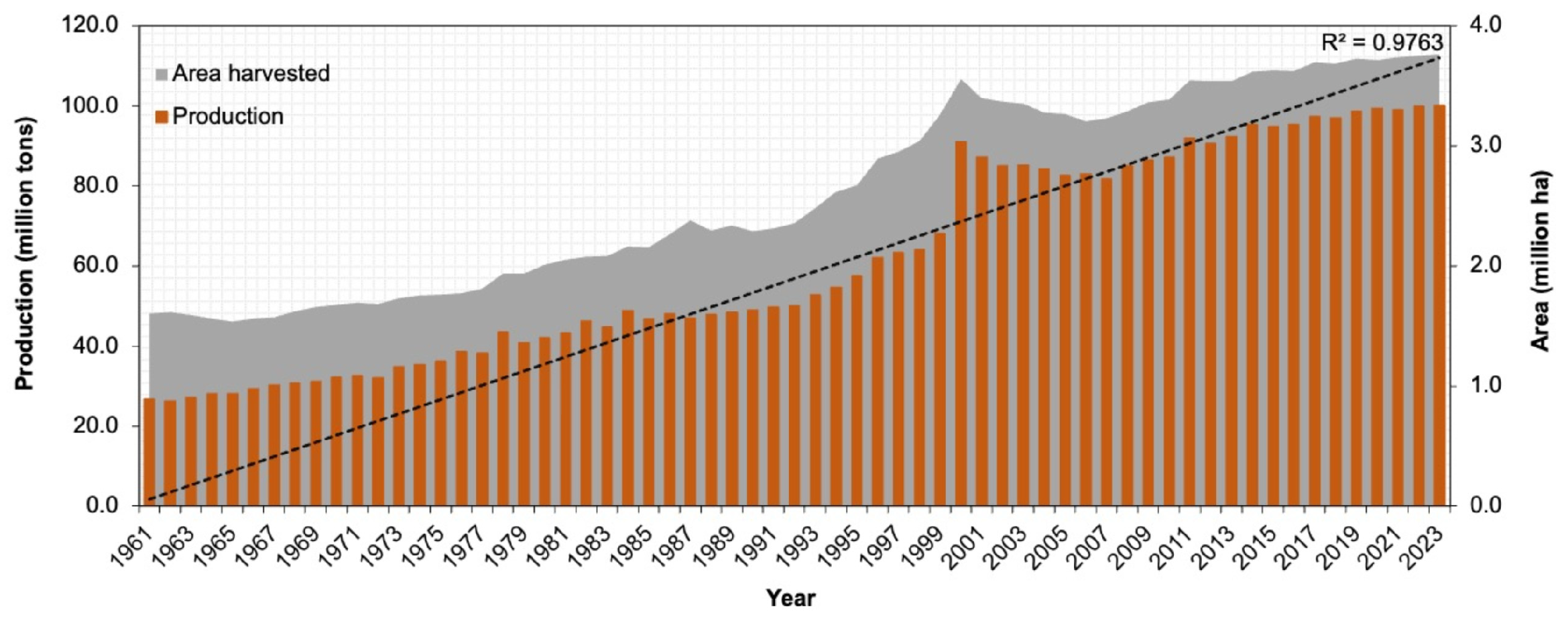
1. Introduction

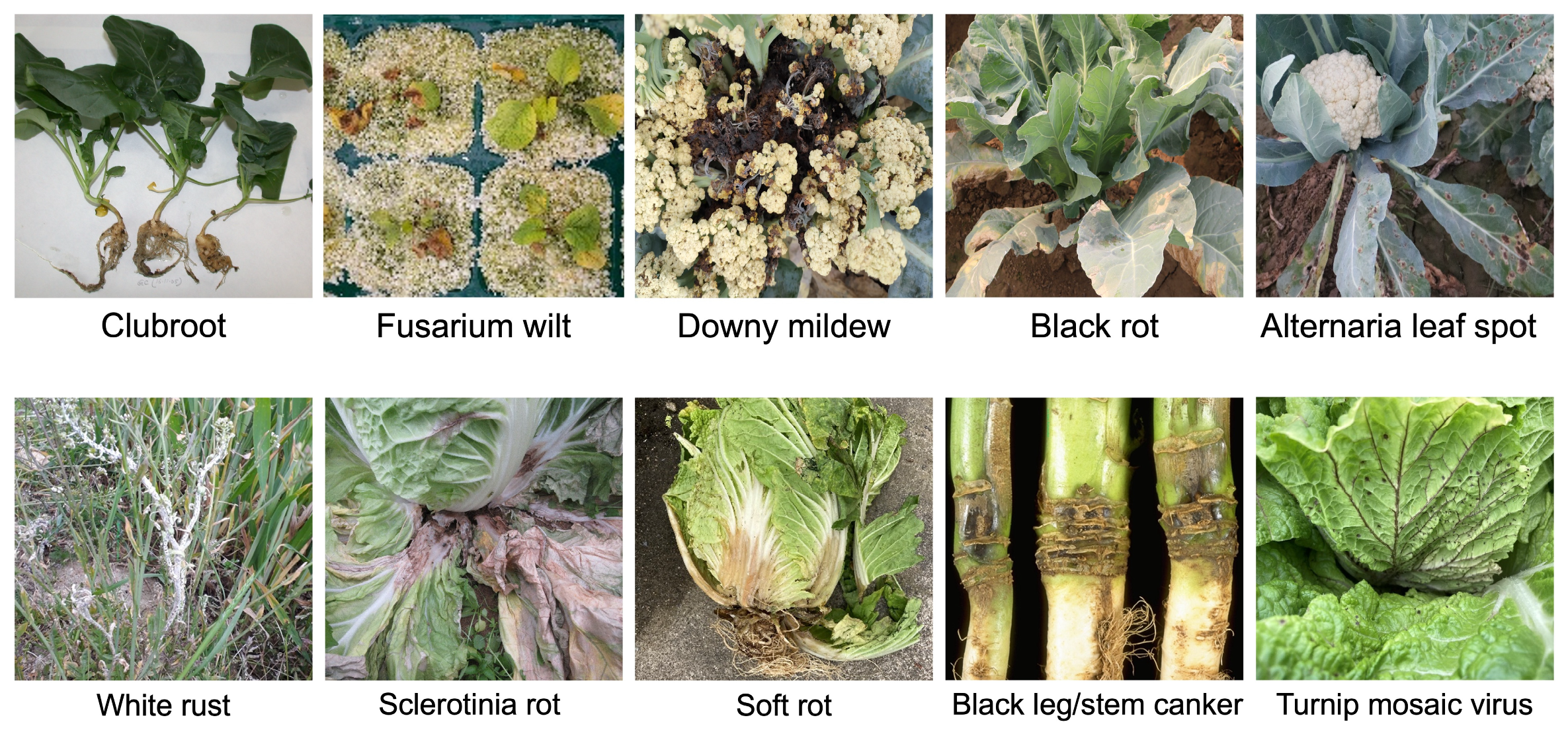
| Disease | Causative Agent | Brassica Species | Ideal Climatic Condition | Major Symptoms | Yield Losses | References |
|---|---|---|---|---|---|---|
| Fusarium wilt/yellow | Fusarium oxysporum f.sp. conglutinans (Foc) or rapae (For) | B. rapa; B. oleracea | 16–35 °C, high soil moisture | Leaf yellowing, wilting, brown necrosis of the lower levels, stunted growth, and defoliation | Severe | [6] |
| Clubroot | Plasmodiophora brassicae (Pb) | B. rapa; B. oleracea | Acidic soil (pH < 6.8), wet and warm (>15 °C), low Ca and B, high ammonia | Wilting, stunting, and yellowing of shoots, club-shaped galls in roots | 10–15%; 30–100% (severely infested fields) | [7,8,9] |
| Downy mildew | Hyaloperonospora parasitica (Hp) | B. rapa; B. oleracea | 10–16 °C (germination and penetration of conidia), 20–24 °C (haustoria formation), high RH (≥85%) | Angular-shaped pale green to yellowish spots bound by leaf veins | B. rapa: ~90% damage of outer leaves; B. oleracea: 10–34% in cauliflower (20–35% seed crop); 16–20% in cabbage (50–60% seed crop) | [8,10,11] |
| Black rot | Xanthomonas campestris var. campestris (Xcc) | B. oleracea | >20 °C, >60% RH | ‘V-shaped’ yellow-colored lesions with blackened veins, necrotic | 10–50%, 60% in susceptible variety | [8,11] |
| Sclerotinia rot or Stalk rot | Sclerotinia sclerotiorum | B. oleracea | 16–24 °C, >80% RH, cool and moist, >10 °C soil temp | Foliage Brassica: white fungal growth and small black sclerotia; Head: watery soft rot | 17% seeds in cauliflower | [8,12,13] |
| Soft rot | Pectobacterium carotovorum (Erwinia carotovorum) | B. rapa; B. oleracea | Prolonged moisture, high RH, mild temperatures (21–25 °C), low Ca | Yellow-brown leaves, rotted leaves | Severe losses (25–40%) | [14] |
| Alternaria leaf/blight or black spot | Alternaria brassicae and A. brassicicola | B. rapa; B. oleracea | 18–30 °C, ~90% RH | Pale to dark brown circular and zonate leaf spots | 20–80%, 59% in seed crop | [8,15,16] |
| Blackleg/stem cankers | Leptoshaeria maculans | B. rapa; B. oleracea | 5–20 °C (grows well up to 32 °C), low pH, wet climate | White to pale/dark brown spots on leaves, cankers in the stem | 30–50% | [8,17,18,19] |
| White rust/blister | Albugo candida | B. rapa; B. oleracea | 16–25 °C, additional moisture after rainfall at the dryland | Upper surface of leaves: Yellow spots Lower surface of leaves: small, white, blister-like pustules; necrosis, leaf curling, defoliation, and stunted growth | Up to 60% | [20,21,22] |
| Turnip mosaic | Turnip mosaic virus (TuMV) | B. rapa, B. oleracea | 22–30 °C | Mottling and necrotic spots, ring spots, leaf distortion, and leaf yellowing | As high as 65–70% | [11,23] |

2. Defense Mechanisms and Host–Pathogen Interaction in Plants
3. Host Resistance: Genomic Loci, Molecular Markers, Candidate Genes, and Transcription
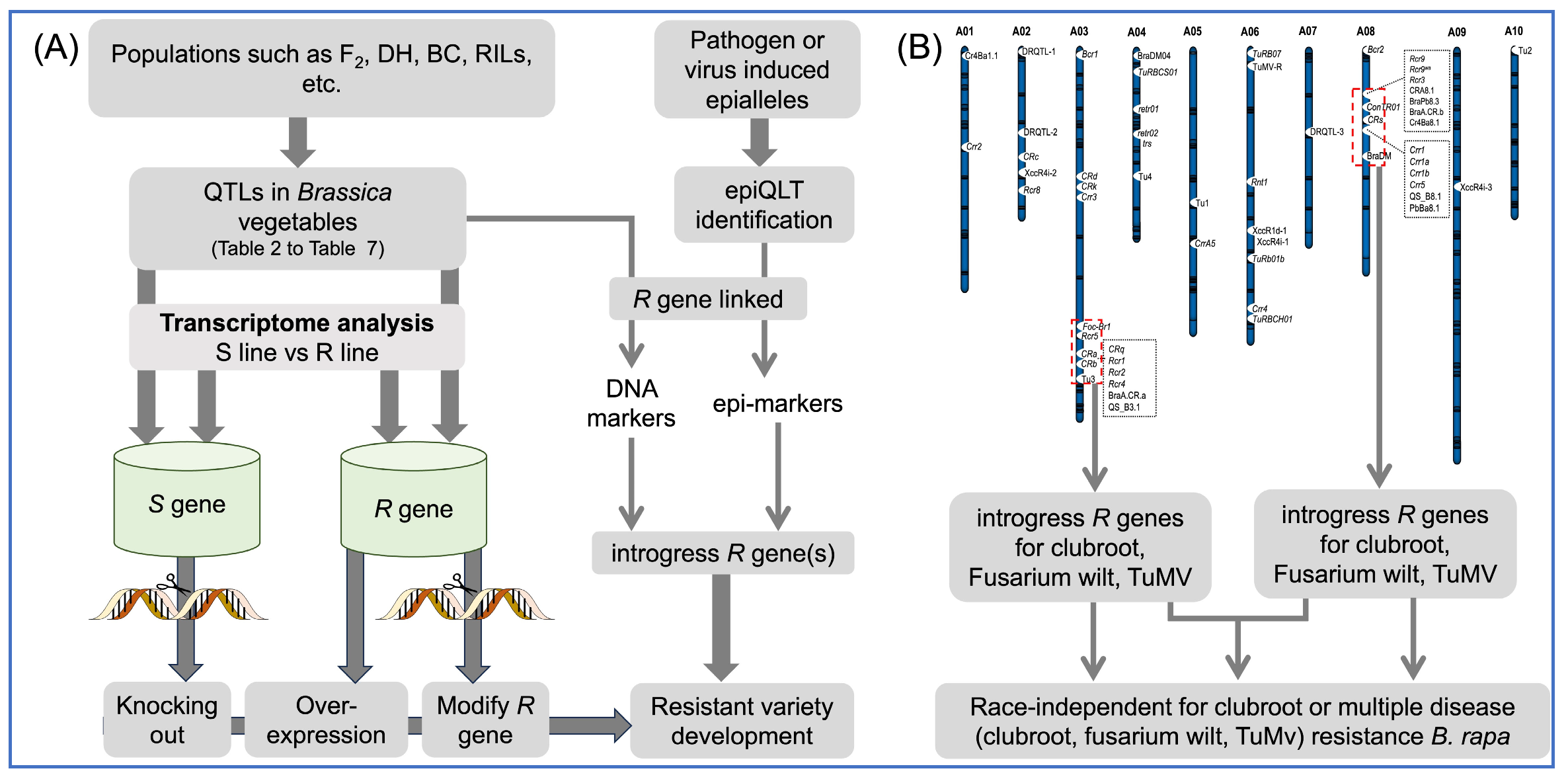
3.1. Clubroot
3.1.1. QTL Mapping in B. rapa

3.1.2. QTL Mapping in B. oleracea

3.1.3. Transcriptome Analysis for CR Gene
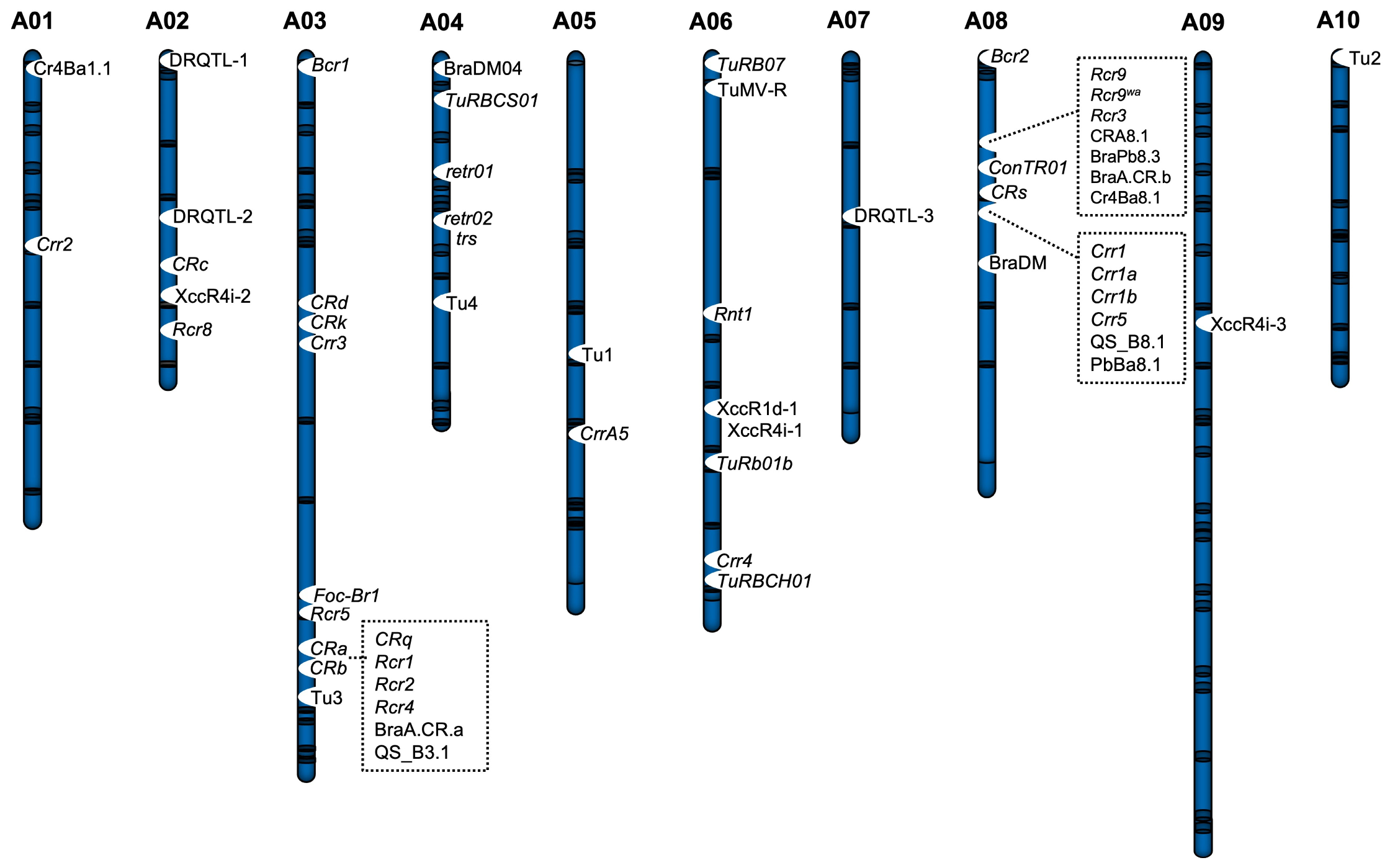
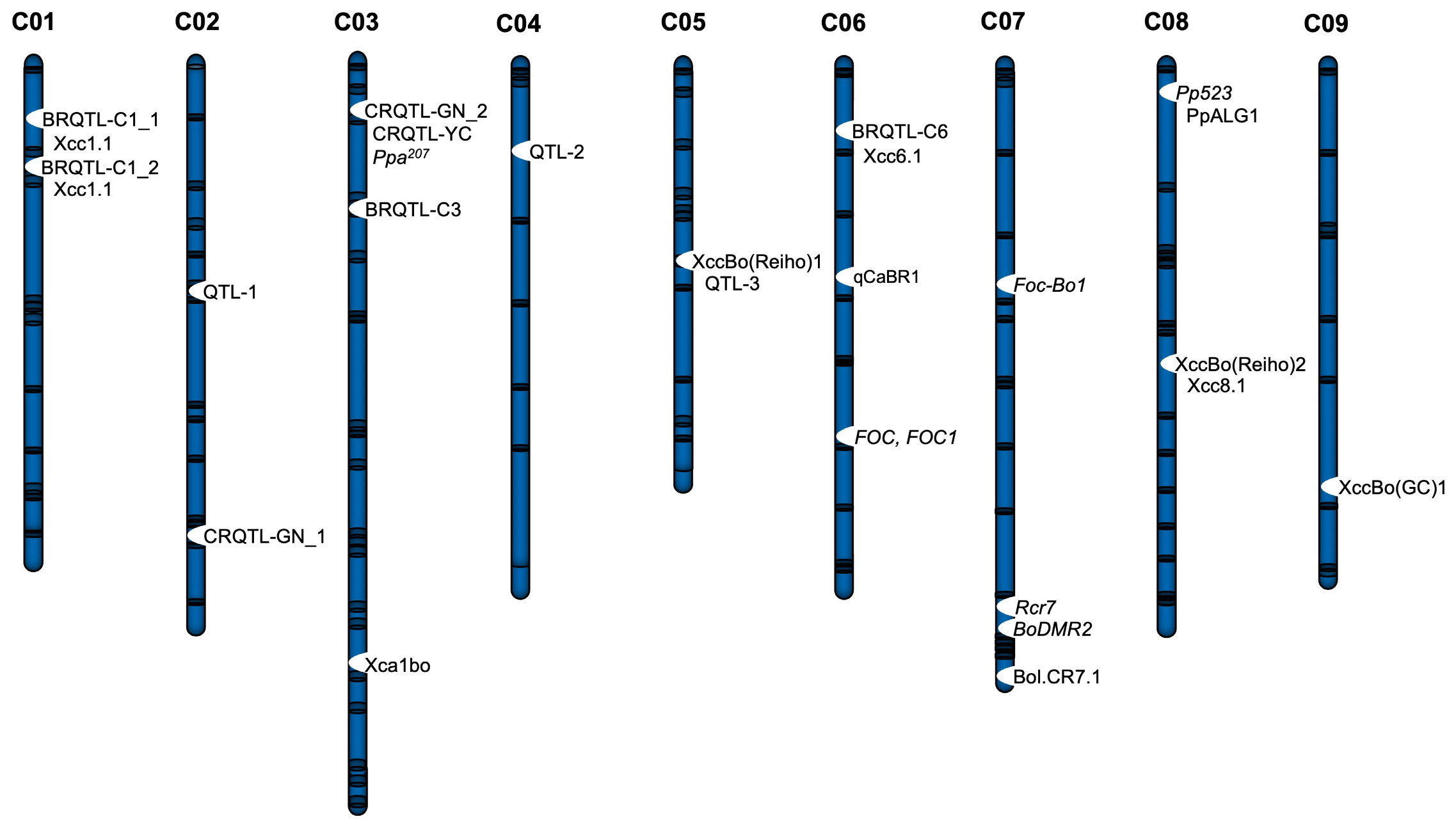
| Parents | Pop. | Race or Pathotype | System | Chr. | Resistance Gene/Loci | Flanking or Linked Markers | PL (Mb) | PV (%) | Candidate Gene IDs | Ref. |
|---|---|---|---|---|---|---|---|---|---|---|
| B. rapa | ||||||||||
| T136-8 (R), Q5 (S) | F2 | Pb2 | RFLP | A03 | CRa | HC352b~HC181 | - | - | - | [130] |
| SCAR | HC352b-SCAR | - | - | - | [131] | |||||
| SCAR | HC181-SCAR | - | - | - | [132] | |||||
| 94SK (S) and CR Shinki (R) (DH) | F2 | Pb4 | CAPS, SCAR | A03 | CRb(i) | TCR09~TCR05 | - | - | - | [133] |
| TCR079~TCR108 | - | - | - | [134] | ||||||
| T-line (R) and V-line (S) | F2 | Pb14 | SSR | A03 | CRb(i) | KBrH059N21F~KBrH129J18R | 21.16~24.76 | - | - | [135] |
| SSR, BAC, InDel | KB59N07~B1005 | 24.2~24.34 | - | Bra019410, Bra019413 a | [136,137] | |||||
| SG (R) and BJN3 (S) | F2, F3 | Pb4 | SSR, UGMS | A03 | QS_B3.1 (A) | sau_um028~At4g35530 | 22.28~29.98 | 70.55 | - | [138] |
| G004 (R) and A9709 (S), DH lines | F2 | Pb4 | SSR | A08 | Crr1 | BRMS-088 | - | - | - | [139] |
| W01 | RAPD, RFLP, SSR, InDel | BRMS-297~BRMS-088 | - | 26.8 | - | [140] | ||||
| Ano-01 | - | 71.7 | - | |||||||
| Pb5, Pb7, Pb9, Pb14 | SSR | Crr1a | BSA7 | - | - | - | [141] | |||
| BAC-clones | Crr1b | AT27 | - | - | - | |||||
| Five resistant hybrids | BC3F2 | CanFI | SNP, SSR, SCAR | A03 | CRa | M8~M10 | 24.26~24.45 | - | - | [142] |
| SCNU-T2016 (R), CC-F920 (S) | F2 | Pb4 | SNP | A08 | CRs (B) | A08:8577582~A08:11505101 | 7.86–11.86 | 96.87 | Bra020918, Bra020876 b | [143] |
| SG (R) and BJN3 (S) | F2, F3 | Pb4 | SSR, UGMS | A08 | QS_B8.1 (C) | BRPGM0920~BRPGM0173 | 6.15 | 7.28 | - | [138] |
| G004 (R) and A9709 (S), DH lines | F2 | Pb4 | SSR | A01 | Crr2 | BRMS-096 | - | - | - | [139] |
| W01 | RAPD, RFLP, SSR, InDel | BRMS-100~BRMS-096 | - | 18.3 | - | [140] | ||||
| N-WMR-3 (R) and A9709 | F2, F3 | Pb4 | STSs | A03 | Crr3 | OPC11-2S | - | - | - | [144] |
| STSs, CAPS | BrSTS-33~BrSTS-78 | - | - | - | [145] | |||||
| 20-2cc1 (R), EC-1 (S) | BC1 | - | RAPD, SSR, SCAR, InDel | A03 | BrID10041~BrID10031 | - | - | - | [146] | |
| G004 (R) and A9709 (S), DH lines | F2 | W01 | RAPD, RFLP, SSR, InDel | A06 | Crr4 | BN288D~WE24-1 | - | 10.5 | - | [140] |
| Ano-01 | - | 15.9 | - | |||||||
| DH40 (R, DH) and ECD01 | F2 | Pb4 | SNPs, InDel, KASP | A08 | Crr5(B) | Su1-seq1~ Crr5-K35 | 19.77~19.85 | DH40A08G013380 c | [86] | |
| 20-2cc1 (R), EC-1 (S) | BC1 | - | RAPD, SSR, SCAR, InDel | A05 | CrrA5 | tau_cBrCR404~BrID10131 | - | - | - | [146] |
| DingWen (R), HuangZiShaXun (S) | F1 | PbXm, PbCd, PbZj, PbTc, and PbLx | SNPs, InDel | A08 | CRA8.1a | A08-4346~A08-4624 | 10.7~11.5 | - | BraA08g039174E, BraA08g039175E, BraA08g039193E c | [82] |
| CRA8.1b | A08-4624~A08-4853 | 11.5~11.9 | - | BraA08g039211E, BraA08g039212E b | ||||||
| C9 (R) and 6R (S), DH lines | F2 | K04 | AFLP, RAPD, RFLP, STS, and SSR | A02 | CRc | E14M3-02~m6R | - | 68.5~72.1 | - | [147] |
| K10 (R) and Q5 (S), DH lines | F2 | M85, K04 | A03 | CRk(Up1) | HC688~OPC11-2S | - | 50.2~71.1 | - | ||
| 85-74 (R) and BJN3-1 (S) | F2, F3 | Pb4 | SNPs | A03 | CRd(Up1) | yau389~yau376 | 15.03~15.09 | - | Bra001160, Bra001161, Bra001162, Bra001175 b | [148] |
| Y635-10 (R) and Y177-47 (S), DH lines | F2 | Pb4 | SNPs, InDels, SSR | A03 | CRq(i) | GC30-FW/RV~BGA06 | 24.35~24.43 | - | Bra019409, Bra019410, Bra019412, Bra019413 b | [90] |
| ECD04 (R) and C59-1 (S) | BC1F1 | Pb2, and Pb7 | SSR | A01 | PbBa1.1 | cnu_m235a~hri_mBRMS056a | - | 13.2, 18.7 | - | [149] |
| Pb2 | A03 | PbBa3.1 | nia_m102a~sau_um034a | - | 12.2 | - | ||||
| Pb10 | PbBa3.2 | cnu_m098a~sau_um516a | - | 14 | - | |||||
| Pb7 | PbBa3.3 | cnu_m327a~cnu_m073a | - | 18.70 | - | |||||
| Pb4 | A08 | PbBa8.1 (C) | cnu_m490a~sau_um353a | - | 35.20 | - | ||||
| 377 (R) and 12A (S) | F2 | Pb4 | SNPs, InDel | A08 | BraPb8.3 (D) | srt8-65~srt8-25 | 10.70~10.86 | 7.39 | Bra020876, Bra020861 b | [84] |
| Pak choy cv. FN (R) and ACDC DH line (S) | F2, BC1F1 | Pb3 | SSR, CAPS | A03 | Rcr1(ii) | ms7-9~sN8591 | 24.26~24.50 | 96.50 | Bra019409, Bra019410, Bra019412, Bra019413 b | [150,151] |
| Chinese cabbage cv. Jazz (R) and ACDC (S) | F1 | Pb3 | SNPs, KASP | A03 | Rcr2(ii) | SNP_A03_32~SNP_A03_67 | 24.14~24.39 | - | Bra019409, Bra019410, Bra019412, Bra019413 b | [152] |
| 96-6990-2 (R) and ACDC (S) | Pb3H, Pb5x | SNPs, InDels, KASP | A08 | Rcr3 | A90_A08_SNP_M12 and M16 | 10.00 and 10.23 | Bra020951, Bra020974, Bra020979 b | [96] | ||
| T19 (R) and ACDC (S) | BC1S1 | Pb2, Pb3, Pb5, Pb6, and Pb8 | SNPs, InDels | A03 | Rcr4(ii) | - | 22.69~25.65 | 85~94 | Bra012541, Bra019413, Bra019412, Bra019410, Bra019409, Bra019273 b | [153] |
| PTWG (R) and ACDC (S) | BC1 | Pb3 | SNPs, InDels, KASP | A03 | Rcr5(Up2) | SNP_A03_100~SNP_A03_83 | 23.47~23.34 | - | - | [154] |
| T19 (R) and ACDC (S) | BC1S1 | Pb5x | SNPs, InDels | A02 | Rcr8 | - | 18.50~22.10 | 36.00 | Bra022069, Bra022071, Bra026556, Bra032996 b | [153] |
| Pb5x | A08 | Rcr9 | - | 7.11~13.59 | 39.00 | Bra020936, Bra020861 b | ||||
| 96-6990-2 (R) and ACDC (S) | BC1 | Pb3H, Pb5x | SNPs, InDels, KASP | A08 | Rcr9wa(E) | A90_A08_SNP_M28 and M79 | 10.85 and 11.17 | Bra020827, Bra020828, Bra020814 b | [96] | |
| ECD04 (R) and Yellow sarson (S) | BC1 | CanFI | SRAP, SSR | A03 | BraA.CR.a (ii) | FSASS45b~FSASS79b | 24.30~24.40 | - | - | [155] |
| A08 | BraA.CR.b (E) | S11R11~S08R08 | 10.78~10.93 | - | - | |||||
| 877 (R) and ‘255 (S) | F2, F3 | Pb4 | SNPs, KASP | A03 | Bcr1 | A03-1-192~A03-1-024 | 4.3~4.78 | 33.30 | Bra006630, Bra006631, Bra006632 b | [94] |
| A08 | Bcr2 | A08-1-06~A08-1-705 | 0.02~0.79 | 13.30 | Bra030815, Bra030846 b | |||||
| Bap246 (R), Bac1344 (S) | F2 | Pb4 | SNPs, InDels | A01 | Cr4Ba1.1 | SNP-4678697~SNP-5170126 | 4.68~5.17 | 30.97 | Bra013275, Bra013299, Bra013336, Bra013339, Bra013341, Bra013357 | [83] |
| A08 | Cr4Ba8.1 | A08-10700494~A08-10845219 | 10.70~10.85 | 8.65 | Bra020861 b | |||||
| B. oleracea | ||||||||||
| EW (S), OSU CR-7 (R) | F2 | Pb7 | RFLP | 1C | - | 14a | - | - | - | |
| C10 (R), 48.4.7 (S) | F2 | ECD | RAPD | - | 2 QTLs | OPL6-780~OPB11-740, OPA16-510 | - | - | - | [156] |
| Bi (R), Gr (S), DH lines | F2 | ECD | RFLP, AFLP | LG3 | Pb-3 | 4NE11a | - | - | - | [101] |
| LG1 | Pb-4 | 2NA8c | - | - | - | |||||
| Y2A, K269 | F2 | - | RAPD, RFLP | LG3 | 1 QTL | WG6A1~WG1G5 | - | - | - | [157] |
| Tekila (R), Kilaherb (R) T010000DH (S) | F1 | Pb3, Pb5x | KASP | C07 | Rcr7 | SNP_C7_44~SNP_C7_56 | 41~44 | 56–73 | Bo7g108760, Bo7g109000 b | |
| K269 (R), Y2A (S) | F2, F3 | Km, Anno, Yuki | RAPD, RFLP, SCAR, CAPS | LG1 | QTL1 | SCA02a2 | - | - | - | [158] |
| LG3 | QTL3 | SCB50b~SCB74c | - | - | - | |||||
| LG9 | QTL9 | SOPT15a~SCA25 | - | - | - | |||||
| C10 (R), HDEM DH line (S) | F3 | Pb1, Pb2, Pb4, Pb7 | RAPD, RFLP | LG1 | Pb-Bo1 | Ae05.8800~T2 | - | - | - | [102] |
| LG2 | Pb-Bo2 | PBB38a~r10.1200 | - | - | - | |||||
| LG3 | Pb-Bo3 | Ae15.100~RGA8.450 | - | - | - | |||||
| LG4 | Pb-Bo4 | ELI3.983~aa9.983 | - | - | - | |||||
| LG5 | Pb-Bo5a | PBB7b~ae05.135 | - | - | - | |||||
| LG5 | Pb-Bo5b | ELI3.115~a18.1400 | - | - | - | |||||
| LG8 | Pb-Bo8 | C01.980~t16.500 | - | - | - | |||||
| LG9 | Pb-Bo9a | Aj16.570~W22B.400 | - | - | - | |||||
| LG9 | Pb-Bo9b | A04.1900~ae03.136 | - | - | - | |||||
| Anju DH line (R), GC DH line (S) | F2, F3 | PR4 | SSR, CAPS | LG2 | Pb-Bo(Anju)1 | KBrH059L13 | - | 47.0 | - | [108,109] |
| LG2 | Pb-Bo(Anju)2 | CB10026 | - | 40.0 | - | |||||
| LG3 | Pb-Bo(Anju)3 | KBrB068C04 | - | 9.0 | - | |||||
| LG7 | Pb-Bo(Anju)4 | KBrB089H07 | - | 3.0 | - | |||||
| LG5 | Pb-Bo(GC)1 | CB10065 | - | 9.0 | - | |||||
| C1220 (R), C1176 (S) | F2, F3 | PR9 | SNPs (GBS) | C02 | CRQTL-GN_1 | C2d-1(2)~C2g-1(1) | - | 22.0~29.7 | - | [105] |
| C03 | CRQTL-GN_2 | C3a-1(11)~C3b-14(6) | - | 23.5~29.1 | - | |||||
| PR2 | SNPs (GBS) | C03 | CRQTL-YC | C3a-1(11)–C3b-153(3) | - | 47.1 | - | |||
| GZ87 (R), 263 (S) | F2 | PR4 | SNPs | - | 23 QTL | - | - | 6.1~17.8 | - | [103] |
| W12 (R), Z5 (S) | - | Pb4 | SNPs, InDels | C07 | Bol.CR7.1 | InDel_5177~InDel_519. R | 51.77~51.94 | - | BolC7t45647H (Bol.TNL.2) | [107] |
3.2. Fusarium Yellows
| Parents | Population | Race | System | Chr. | Major Loci | Linked/Flanking Markers (PL in Mb) 1 | Reference |
|---|---|---|---|---|---|---|---|
| B. rapa | |||||||
| Chinese cabbage: RJKB-T21 and T23 (R), RJKB-T22, and T24 (S) | F2 | Cong:1-1 | RNA-seq | A03 | Foc-Br1a | Bra012688m | [160] |
| Foc-Br1b | Bra012689m | ||||||
| B. oleracea | |||||||
| Broccoli cv GCPO4 (S), Cabbage cv Anju (R) | F2 | Cong:1-1 | SSR | C07 | QTL2 (Foc-Bo1) | KBrS003O1N10 | [162] |
| F2 | Cong: 1-1 | InDel | C07 | Foc-Bo1 | BoInd 2 and BoInd 11 | [163] | |
| Cabbage: 99–77 (R), 99–91 (S) | DH | FGL3-6 | InDel | C06 | FOC | M10 and A1 | [164] |
| DH, F2 | FGL3-7 | InDel | C06 | FOC1 | Bol037156 (38.8) and Bol037158 (38.8) | [166] | |
| Cabbage: 01–20 (S), 96–100 (R) | DH | FGL3-6 | InDel, SSR | C06 | FOC1 | Frg13 | [167] |
| Raddish; YR RK15-1 (R), AKM (S) | F2 | MAFF 731043 (For) | GBS, GRAS-Di | R07 | ForRs1 | AMP0000754~AMP0009342 | [172] |
| R02 | ForRs2 | AMP0010176~AMP0013639 | |||||
3.3. Downy Mildew
| Parents | Population | Marker System | Major Loci | Chr | Linked/Flanking Markers (PL in Mb) 1 | Reference |
|---|---|---|---|---|---|---|
| B. rapa | ||||||
| Chinese cabbage; RS1 (R), SS1 (S) | F2, F3, F4, BC1 | RAPD, SCAR | BrRHP1 | A01 | BrPERK15A | [173] |
| Chinese cabbage; 91–112 (S) and T12–19 (R) | DH, BC2 | SNP, SLAF | BraDM | A08 | PGM~K14-1030 | [174] |
| DH | RAPD | BraDM | A08 | K14-1030~KBrB058M10 | [175] | |
| DH | SSR | BraDM | A08 | K14-1030~kbrb006c05-2 | [176] | |
| DH, BC1, BC2, BC3 | SNP | BraDM | A08 | A08-17629022~SNP-428-2FF | [177] | |
| BY (B. rapa ssp. pekinensis) MM (B. rapa ssp. rapifera) | DH, F2 | SNP | Bra-DM04 | A04 | A04_5235282 and A04_5398232 | [178] |
| B. oleracea | ||||||
| Pusa Himjyoti (S) and BR-2 (R) | F2 | RAPD, ISSR, SSR | Ppa3 | - | OPC141186~OPE141881 | [190] |
| R pool, S pool | - | InDel | BoDMR2 | C07 | W8-3 (46.8)~W7-22 (47.2) | [179] |
| Broccoli; GK97362 (S), OL87125 (R) | F2 | RAPD, AFLP, SSR, ISSR | Pp523 | C08 | OPK17_980~AT.CTA_133/134 | [191] |
| F2 | RAPD, AFLP, SCAR, CAPS | Pp523 | C08 | SCR15~SCAFB1 | [180] | |
| Broccoli; OL 87098 (S), OL87125 (R) | F2 | RAPD, SSR, ISSR, AFLP, SCAR, BAC-end derived STS | Pp523 | C08 | AAG.CTA_113y~AAG.CTA_1200 | [192] |
| F2 | BAC-end derived STS | Pp523 | C08 | 67---167K22_F_cod~AAC.CAA_1200 | [181] | |
| B. oleracea var. tronchuda Bailey R and S lines | F2, F3 | RAPD, ISSR, SSR, BAC-end derived markers | PpALG1 | C08 | 31N6_Ry~CB10045A | [182] |
| Cauliflower; BR-2 (R), and Pusa Himjyoti (S) | F2 | RAPD, ISSR | Ppa3 | C02 | OPC141186~OPE141881 | [193] |
| Cauliflower; Pusa Sharad (S), DMR-2-0-7 (R) | RIL | SSR | Ppa207 | C03 | BoGMS0486 (2.9) and BoGMS0900 (23.2) | [194] |
3.4. Black Rot
| Parents | Population | Race | Marker System | Major Loci | Chr/LG | Linked/Flanking Markers | Reference |
|---|---|---|---|---|---|---|---|
| B. oleracea | |||||||
| Cabbage BI-16 (R), Broccoli OSU Cr-7 (S) | F3 | - | RFLP | QTL-LG1, QTL-LG9 | C01 (LG1), C09 (LG9) | wg6g5, wg8a9b | [199] |
| Cabbage: January King (R) × Golden Acre (S) | F2 | - | RAPD | Xcc R gene | - | C-111000 | [204] |
| Broccoli GC P09 (S), Cabbage Reiho P01 (R) | F3 | 1 | SRAP, CAPS | 2 loci | LG2 | CAM1~GSA1 | [205] |
| LG9 | F12-R12-e~BORED | ||||||
| Cabbage CY (R), Broccoli BB (S) | F3 | 1 | EST-SNP | QTL-1 * | C02 | BoCL5989s~BoCL5545s | [197] |
| QTL-2 | C04 | BoCL1384s~BoCL7837s | |||||
| QTL-3 | C05 | BoCL5860s~BoCL4231s | |||||
| Broccoli GC P09 (S), Cabbage Reiho P01 (R) | F2, F3 | 1 | CAPS, SSR, SNP | XccBo(Reiho)2 | C08 | BoGMS0971, OL12D05 | [198] |
| XccBo(Reiho)1 | C05 | BoGMS1330, | |||||
| XccBo(GC)1 | C09 | CB10509, CB10459, pW143 | |||||
| Cauliflower | F2 | 2 | RAPD, ISSR, SSR | Xca1bo | C03 | RAPD04833~ISSR11635 | [206] |
| Cabbage | - | SNP and EST based dCAPS, MIP, IBP, SSR, InDel | BRQTL-C1_1 * | C01 | BnGMS301, BoESSR726, BoESSR145 (14.8~16.5) | [200] | |
| BRQTL-C1_2 * | C01 | BoESSR089, BoEdcaps4, BnGMS299 (18.2~37.1) | |||||
| BRQTL-C3 | C03 | B041F06-2 (19.7~22.8) | |||||
| BRQTL-C6 | C06 | Ol10-G06 (7.4~10.4) | |||||
| Cauliflower | F3 | 1 | RAPD, ISSR, SCAR | Xca1bo | C03 | ScOPO-04833 and ScPKPS-11635 | [196] |
| Cabbage, inbreed lines | - | 1-7 | SSR, InDel | - | C01 | BnGMS301-BoESSR726 | [207] |
| C03 | BoESSR291 | ||||||
| C06 | OI10G06 | ||||||
| C08 | BoGMS0971 | ||||||
| Broccoli ‘Early Big’ (S), Chinese kale ‘TO1000DH3’ (R) | DH | 1 | Xcc1.1, Xcc6.1, Xcc8.1, Xcc9.1 | C01, C06, C08, C09 | C01: BRQTL-C1_1, BRQTL-C1_2 (1), C06: BRQTL-C6 (1), C08: XccBo(Reiho)2 (2) | [201] | |
| Cabbage | F2, F3 | 1 | GBS, SNP | qCaBR1 | C06 | -(29.8~34.3) | [202] |
| B. rapa | |||||||
| Turnip (S), Pak choi (R), | F2 | 4 | RAPD | - | - | WE22, WE49 | [208] |
| R-o-18 Yellow–Sarson (S), B162 (R), | F2 | 1 | AFLP | XccR1d-1 * | A06 | E11M50_280b | [195] |
| 4 | XccR1d-1 * | A06 | E12M61_215b | ||||
| 1 | XccR4i-1 * | A06 | E12M48_171r | ||||
| 4 | XccR4i-1 * | A06 | E12M61_215b | ||||
| 1, 4 | XccR4i-2 | A02 | E11M59_178r | ||||
| XccR4i-3 | A09 | E12M48_1>330b | |||||
| P115 × P143 | DH | 1, 3, 4, 6 | RAPD, RFLP, AFLP | 19 QTLs | A01-A07, A09 | Many | [209] |
| P175 × P143 | DH | 13 QTLs | A01-A06, A08, A10 | Many | |||
| Radish | F2, F3 | - | RAD-seq, SNP, InDel | qBRR2 | LG2 | - | [210] |
| qBRR7 | LG7 | ||||||
3.5. Turnip mosaic virus (TuMV)
| Parents/F1 | Population | Isolate/Race | Marker System | Major Loci/R-Gene (Chromosome) | Linked/Flanking Markers | Reference |
|---|---|---|---|---|---|---|
| Chinese cabbage; BP079 (R) and RLR22 (S) | BC1, BC1S1 | CDN1, CZE1 | RFLP | retr01 * (A04) | pN202e1 | [217] |
| ConTR01 * (A08) | pO85e1 | |||||
| Chinese cabbage; 91-112 (R) and T12-19 (S) | DH | C4 | AFLP, RAPD, SSR, SCAR | Tu1 (A05) | A04-850~CA_TG470 | [218] |
| Tu2 (A10) | X12-850 | |||||
| Tu3 (A03) | U10-1500~CA_TC157 | |||||
| Tu4 (A04) | CT_TC710 | |||||
| Chinese cabbage; A52-2 (R) and GCⅣ (S) | F2 | C3 | AFLP, EST-PCR-RFLP | TuR1 (A03) | E41M5808~E39/M5305 | [219] |
| TuR2 (A03) | E39/ M505~E42/M5710 | |||||
| TuR3 (A07) | E38/ M5401~E38/M5106 | |||||
| TuR4 (A07) | E38/M5106~HpaII650 | |||||
| Chinese cabbage; Y195-93 (R) and Y177-12 (S) | DH | C4 | - | Tu1 (A03) | E36M47-7 | [220] |
| Tu2 (A04) | E33M60-5 | |||||
| Tu3 (A06) | E36M59-5 | |||||
| Pak choi; Q048 (R) and A168-5D (S) | F2 | C5 | AFLP | TuRBCH01 * | EaccMctt3~EaccMctt1 | [221] |
| Pak choi | F2 | C5 | AFLP, SSR | TuRBCH01 * (A06) | E36M62-3~E44M48-1 | [222] |
| Chinese cabbage; 73 (R) and 71-36-2 (S) | F2 | C4 | EST-SSR | retr02 * | HCC259 | [223] |
| Chinese cabbage; AS9 (R) and SS11 (S) | F2 | 1 | InDel | Rnt1 * (A06) | BRMS-221~BRMS-223 | [224] |
| Chinese cabbage; BP8407 (S) and Ji Zao (R) | F2 | C4 | SSR, InDel | retr01 * (A04) | pN202e1 (retr01) | [213] |
| retr02 * (A04) | BrID10694~BrID101309, and Scaffold000060/Scaffold000104 | |||||
| Chinese cabbage; GJS2A (S) × SB18 (R) and SB22 (R) × SB24 (S) | F2 | C3 | SNPs, SCAR | trs *a (A04) | Scaffold000104~Scaffold040552 | [225] |
| B. rapa; VC1 (R) and SR5 (S) | DH, F2, BC1 | C4 | SSR | TuRB07 * (A06) | H132A24-s1~KS10960 | [215] |
| Chinese cabbage | BC1 | - | RFLP | TuRB01b * (A06) | pN101e1~pW137e1 | [226] |
| B. rapa; VC40 (R) and SR5 (S) | DH | C4 | SNPs, InDel, SSR | TuMV-R (A06) | No343~CUK_0040i | [227] |
| Chinese cabbage; 43 P1 (R), 88 P2 (S) | F2, BC1 | C4 | SSR, InDel, EST | TuRBCS01 * (A04) | BrID10723~SAAS_mBr4055_194 | [228] |
| Chinese cabbage | BC1 | - | SSR, SSP | TuRBCS01 * (A04) | SAAS_mBr4072_240~Bra025493-1 | [229] |
| B. rapa; B80124 (R), B80450 (S) | F2 | C4 | SNPs, KASP | qtl (A06) | A06S11–A06S14 | [216] |
| B. rapa ssp. rapa; BR05058 (R), S22561 (S) | BC1 | CDN1, GBR6 | SNP | QTL (A06) | A06-p49446208~A06-p50287184 | [230] |
3.6. Sclerotinia Rot, Soft Rot, Alternaria Leaf Spot, Blackleg, and White Rust Diseases in Brassica Vegetables
| Parents | Population | Race | Marker System | Major Loci | Chr | Linked/Flanking Markers (Physical Position in Mb) | Reference |
|---|---|---|---|---|---|---|---|
| Sclerotinia rot (Sclerotinia sclerotiorum) | |||||||
| B. incana ‘C01’ (R), B. oleracea var. alboglabra ‘C41’ (S) | F2 | - | SSR, AFLP, SRAP | qLR | C01 | SWUC59/170~Na12-C08 | [231] |
| qLR-5 | C09 | SWUC679~SWUC635 | |||||
| qLR-6 | C09 | SWUC700~SWUC711 | |||||
| qSR-1 | C09 | SWUC611~Ra2-F11 | |||||
| qSR-2 | C09 | SWUC700~SWUC711 | |||||
| B. villosa ‘BRA1896’ (R), B. oleracea ‘BRA1909’ (S) | F2 | - | SNP | pQTLa | C01 | Bn-scaff_15747_1-p105633~Bn-scaff_22790_1-p1026422 (14.2~17.4) | [248] |
| pQTLb1 | C03 | Bn-scaff_16614_1-p734250~Bn-scaff_16614_1-p174856 (2.0~3.1) | |||||
| pQTLb2 | C07 | Bn-scaff_16069_1-p2611780~Bn-scaff_16069_1-p4306874 (42.3~44.0) | |||||
| lQTLb | C07 | Bn-scaff_16110_1-p975852~Bn-scaff_16110_1-p426547 (47.3~47.9) | |||||
| Soft rot (Pectobacterium carotovorum or Erwinia carotovorum) | |||||||
| Chinese cabbage A03 (S), pakchoi ‘Huaguan’ (R) | F2 | - | SNP | DRQTL-1 | A02 | A02-668352~A02-761454 | [235] |
| DRQTL-2 | A02 | A02-4366585~A02-5305993 | |||||
| DRQTL-3 | A07 | A07-26520444~A07-26625030 | |||||
| White rust (Albugo candida) | |||||||
| B. rapa | F2, F3 | 2, 7 | RFLP | ACA1, PUB genes | A04 | ec2b3a~wg6c1a | [246] |
| B. rapa ssp. oleifera; Bor4206 (S), Bor4109 (R) | F2 | 7a, 7v | RAPD, AFLP | - | A02 | Z19a | [249] |
4. Hostplant Epigenetic Resistance Mechanisms
4.1. Epigenome Analysis and Epigenomic Defense Response in Brassica Vegetables
4.2. Lessons from Arabidopsis for Shaping the Epigenetic Landscape in Defense Response
4.3. Epigenomic Defense Response in Brassica Vegetables
5. Perspective
Author Contributions
Funding
Data Availability Statement
Acknowledgments
Conflicts of Interest
Abbreviations
| 4MI3G | 4-methoxyindole-3-ylmethyl glucosinolate |
| 4OH-I3M | 4-methoxy indole-3-ylmethyl glucosinolate or 4-methoxyglucobrassicin |
| 5mC | 5-methylcytosine |
| ac | Acetylation |
| ACA1 | ALPHA CARBONIC ANHYDRASE 1 |
| ACCox1 | 1-amino-cyclopropane-1-carboxylic acid oxidase |
| AFLP | Amplified fragment length polymorphisms |
| AS | Alternative splicing |
| BAC | Bacterial artificial chromosome |
| BC1 | Backcrossed first generation |
| BC1F1 | First filial generation of the first backcross |
| BC1F2 | Second filial generation of the first backcross (comes from selfing of BC1F1) |
| BC1S1 | Backcross segregating first generation |
| BC2 | Backcrossed second generation |
| BC3 | Backcrossed third generation |
| BC4F2 | Second filial generation of the fourth backcross |
| bp | Base pair |
| BSA-Seq | Bulked segregant analysis sequencing |
| BSR-seq | Bulked segregant RNA sequencing |
| CALM | CALMODULIN |
| CanF | Canadian field isolates |
| CAPS | Cleaved amplified polymorphic sequences |
| CC | Coiled-coil |
| CKX | Cytokinin dehydrogenase/oxidase |
| ConTR01 | Conditional TuMV resistance 01 |
| CR | Clubroot resistance |
| CYP81F2 | Cytochrome P450, family 81, subfamily F, polypeptide 2 |
| DAMP | Damage-associated molecular pattern |
| dCAPS | Derived cleaved amplified polymorphic sequences |
| DH | Double haploid |
| DM | Downy mildew |
| DMG | Differentially methylated gene |
| DMR | Differentially methylated region |
| DUS | Distinctness, uniformity, and stability |
| EFR | Elongation factor-Tu receptor |
| epiQTL | Epigenetic quantitative trait locus |
| epiQTLs | Epigenetic quantitative trait loci |
| ET | Ethylene |
| ETD | Effector-triggered defense |
| ETI | Effector-triggered immunity |
| F1 | First filial generations |
| F2 | Second filial generations |
| F3 | Third filial generations |
| F4 | Fourth filial generations |
| FLS | Flagellin-sensing receptor |
| Foc | Fusarium oxysporum f.sp. conglutinans |
| For | Fusarium oxysporum f.sp. rapae |
| FY | Fusarium wilt/yellows |
| GBS | Genotyping-by-sequencing |
| GRAS-Di | Genotyping by random amplicon sequencing–direct |
| H2Bub1 | Monoubiquitination of H2B |
| H3ac | Acetylation of histone H3 |
| H3K27me3 | Trimethylation of histone H3 at lysine 27 |
| H3K36me3 | Trimethylation of histone H3 at lysine 36 |
| H3K4me3 | Trimethylation of histone H3 at lysine 4 |
| H3K9me2 | Dimethylation of histone H3 at lysine 9 |
| H4ac | Acetylation of histone H4 |
| HDA19 | HISTONE DEACETYLASE 19 |
| Hp | Hyaloperonospora parasitica |
| hpi | Hours post-inoculation |
| HR | Hypersensitive responses |
| I3G | Indole-3-ylmethyl glucosinolate |
| IBP | Intron-based polymorphic |
| IGMT1 | Indole glucosinolate methyltransferase 1 |
| IGMT2 | Indole glucosinolate methyltransferase 2 |
| incRNAs | Intronic non-coding RNAs |
| InDel | Insertion–deletion |
| IRRs | Interspersed repeat regions |
| ISSR | Inter-simple sequence repeat |
| JA | Jasmonic acid |
| JAZ1 | JASMONATE-ZIM-DOMAIN PROTEIN 1 |
| KASP | Kompetitive Allele-Specific PCR |
| Kb | Kilobase |
| Km | Kamogawa |
| LF | Less fractioned |
| LG | Linkage group |
| LHP1 | LIKE HETEROCHROMATIN PROTEIN 1 |
| LIF2 | LHP1-Interacting Factor 2 |
| lincRNAs | Long intergenic non-coding RNAs |
| LRR | Leucine-rich repeat |
| MAMP | Microbe-associated molecular patterns |
| MAPK | Mitogen-activated protein kinase |
| MAS | Marker-assisted selection |
| Mb | Mega base |
| me | Methylation |
| MF | More fractioned |
| MIP | MITE insertion polymorphism |
| MKK3 | MITOGEN-ACTIVATED PROTEIN KINASE 3 |
| NAT | Natural antisense transcript |
| NB | Nucleotide-binding |
| NBS | nucleotide-binding site |
| NDR1 | NON RACE-SPECIFIC DISEASE RESISTANCE 1 |
| NGS | Next-generation sequencing |
| NLRs | NB-LRR receptors |
| PAL | PHENYLALANINE AMMONIALYASE |
| PAMPs | Pathogens/microbes via pathogen-associated molecular patterns |
| Pb | Plasmodiophora brassicae |
| Pcc | Pectobacterium carotovorum subsp. carotovorum |
| PCR | Polymerase chain reaction |
| PDF1.2b | plant defensin 1.2b |
| PGIP | A polygalacturonase inhibitor protein |
| ph | Phosphorylation |
| PR | Pathogenesis-related |
| PR | Physiological race |
| PR-3 | PATHOGENESIS-RELATED 3 |
| PRR | Pattern-recognition receptor |
| PTI | Pattern-triggered immunity |
| PTM | Post-transcriptional modification |
| PUB1 | Leaf pubescence loci |
| QTL | Quantitative trait locus |
| QTLs | Quantitative trait loci |
| R | Resistance |
| R | Resistant line |
| RAD-seq | Restriction-site Associated DNA Sequencing |
| RAPD | Random amplified polymorphic DNA |
| RBOHD | RESPIRATORY BURST OXIDASE HOMOLOGUE D |
| RBOHF | RESPIRATORY BURST OXIDASE PROTEIN F |
| RH | Relative humidity |
| RIL | Recombinant inbred line |
| RLKs | Receptor-like kinase |
| RLP | Receptor-like protein |
| RNAi | RNA interference |
| ROI | Reactive oxygen intermediate |
| RPS2 | RESISTANT TO P. SYRINGAE 2 |
| RPS4 | RESISTANT TO P. SYRINGAE 4 |
| RRBS | Reduced representation bisulfite sequencing |
| S | Susceptible line |
| SA | Salicylic acid |
| SAR | Systemic acquired resistance |
| SCAR | Sequence-characterized amplified region |
| SHPRH | SNF2—sucrose non-fermenting2, histone linker, PHD—plant homeodomain, RING—really interesting new gene, helicase |
| SLAF | Specific-locus amplified fragment |
| SNP | Single-nucleotide polymorphism |
| SR | Sclerotinia rot or stalk rot |
| SRAP | Sequence-related amplified polymorphism |
| SSR | Simple sequence repeats |
| STS | Sequence-tagged site |
| TDF | Transcript-derived fragment |
| TE | Transposable element |
| TF | Transcription factor |
| TIR | N-terminal Toll/Interleukin-1 receptor |
| TIR | Toll/Interleukin-1 Receptor |
| TuMV | Turnip mosaic virus |
| ub | Ubiquitination |
| UGMS | Unigene-derived reliable microsatellite |
| W01 | Wakayama-01 |
| WAK | Wall-associated kinase |
| WGBS | Whole genome bisulfite sequencing |
| Xcc | Xanthomonas campestris var. campestris |
| YCR | Fusarium yellows and clubroot resistance |
| YR | Fusarium yellows resistance |
References
- FAO, FAOSTAT—Worldwide Production Value of Cabbage, Cauliflower, Broccoli and Rape or Colza Seed 2023. Available online: https://www.fao.org/faostat/en/#data/QCL (accessed on 6 September 2025).
- Lv, H.; Miyaji, N.; Osabe, K.; Akter, A.; Mehraj, H.; Shea, D.J.; Fujimoto, R. The importance of genetic and epigenetic research in the Brassica vegetables in the face of climate change. In Genomic Designing of Climate-Smart Vegetable Crops; Kole, C., Ed.; Chapter 3; Springer: Cham, Switzerland, 2020; Volume 1, pp. 161–255. [Google Scholar] [CrossRef]
- Kim, C.; Cho, W.; Kim, H. Yield loss of spring Chinese cabbage as affected by infection time of clubroot disease in fields. Plant Dis. Res. 2000, 6, 23–26. [Google Scholar]
- Sotelo, T.; Lema, M.; Soengas, P.; Cartea, M.E.; Velasco, P. In vitro activity of glucosinolates and their degradation products against brassica-pathogenic bacteria and fungi. Appl. Environ. Microbiol. 2015, 81, 432–440. [Google Scholar] [CrossRef]
- Akter, M.A.; Mehraj, H.; Itabashi, T.; Shindo, T.; Osaka, M.; Akter, A.; Miyaji, N.; Chiba, N.; Miyazaki, J.; Fujimoto, R. Breeding for disease resistance in Brassica vegetables using DNA marker selection. In Brassica Breeding and Biotechnology; Islam, A.K.M.A., Hossain, M.A., Islam, A.K.M.M., Eds.; Chapter, 8; IntechOpen: London, UK, 2021; Volume 1, pp. 1–16. [Google Scholar] [CrossRef]
- Mehraj, H.; Akter, A.; Miyaji, N.; Miyazaki, J.; Shea, D.J.; Fujimoto, R.; Doullah, M.A.U. Genetics of clubroot and fusarium wilt disease resistance in Brassica vegetables: The application of marker assisted breeding for disease resistance. Plants 2020, 9, 726. [Google Scholar] [CrossRef]
- Dixon, G.R. The occurrence and economic impact of Plasmodiophora brassicae and clubroot disease. J. Plant Growth Regul. 2009, 28, 194–202. [Google Scholar] [CrossRef]
- AHDB—Brassica Diseases Guide 2020. Available online: https://horticulture.ahdb.org.uk/knowledge-library/brassica-diseases-guide (accessed on 6 September 2025).
- Javed, M.A.; Schwelm, A.; Zamani-Noor, N.; Salih, R.; Vañó, M.S.; Wu, J.; García, M.G.; Heick, T.M.; Luo, C.; Prakash, P.; et al. The clubroot pathogen Plasmodiophora brassicae: A profile update. Mol. Plant Pathol. 2023, 24, 89–106. [Google Scholar] [CrossRef] [PubMed]
- Yu, S.; Zhang, F.; Yu, R.; Zou, Y.; Qi, J.; Zhao, X.; Yu, Y.; Zhang, D.; Li, L. Genetic mapping and localization of a major QTL for seedling resistance to downy mildew in Chinese cabbage (Brassica rapa ssp. pekinensis). Mol. Breed. 2009, 23, 573–590. [Google Scholar] [CrossRef]
- Greer, S.F.; Surendran, A.; Grant, M.; Lillywhite, R. The current status, challenges, and future perspectives for managing diseases of brassicas. Front. Microbiol. 2023, 14, 1209258. [Google Scholar] [CrossRef]
- Duwadi, V.R.; Paneru, R.B.; Bhattarai, M.R. An estimate of yield loss of cauliflower (cv. Kibo Giant) seed caused by Sclerotinia sclerotiorum (Lib.) de Bary. In Pakhribas Agricultural Centre Working Paper; Pakhribas Agricultural Centre (PAC): Pakhribas, Nepal, 1993; Volume 4. [Google Scholar]
- Koch, S.; Dunker, S.; Kleinhenz, B.; Röhrig, M.; Tiedemann, A. A crop loss-related forecasting model for sclerotinia stem rot in winter oilseed rape. Phytopathology 2007, 97, 1186–1194. [Google Scholar] [CrossRef]
- Teoh, S.H.; Wong, G.R.; Teo, W.F.A.; Mazumdar, P. First report of Pectobacterium carotovorum and Pectobacterium aroidearum causing bacterial soft rot on curly dwarf pak choy (Brassica rapa var. chinensis) in Malaysia. Plant Dis. 2023, 107, 3631. [Google Scholar] [CrossRef]
- Bart, P.H.; Thomma, J. Alternaria spp.: From general saprophyte to specific parasite. Mol. Plant Pathol. 2003, 4, 225–236. [Google Scholar] [CrossRef]
- Nowicki, M.; Nowakowska, M.; Niezgoda, A.; Kozik, E. Alternaria black spot of crucifers: Symptoms, importance of disease, and perspectives of resistance breeding. Veg. Crops Res. Bull. 2012, 76, 5–19. [Google Scholar] [CrossRef]
- Toscano-Underwood, C.; Huang, Y.J.; Fitt, B.D.L.; Hall, A.M. Effects of temperature on maturation of pseduothecia of Leptosphaeria maculans and L. biglobosa on oilseed rape stem debris. Plant Pathol. 2003, 52, 726–736. [Google Scholar] [CrossRef]
- Sprague, S.J.; Marcroft, S.J.; Lindbeck, K.D.; Ware, A.H.; Khangura, R.K.; Van de Wouw, A.P. Detection, prevalence and severity of upper canopy infection on mature Brassica napus plants caused by Leptosphaeria maculans. Crop Pasture Sci. 2018, 69, 65–78. [Google Scholar] [CrossRef]
- Newbery, F.; Ritchie, F.; Gladders, P.; Fitt, B.D.L.; Shaw, M.W. Inter-individual genetic variation in the temperature response of Leptosphaeria species pathogenic on oilseed rape. Plant Pathol. 2020, 69, 1469–1481. [Google Scholar] [CrossRef]
- Patnude, E.; Nelson, S. White Rust of Cruciferous Begetables in Hawai‘i. Plant Disease Series of College of Tropical Agriculture and Human Resources (CTAHR) University of Hawai‘i, Honolulu Publications Database. 2013. PD-94. Available online: https://www.ctahr.hawaii.edu/oc/freepubs/pdf/pd-94.pdf (accessed on 9 September 2025).
- Damicone, J. Diseases of Leafy Crucifer Vegetables (Collards, Kale, Mustard, Turnips); EPP–7666; Oklahoma State University: Stillwater, OK, USA, 2017; pp. 1–7. Available online: https://extension.okstate.edu/fact-sheets/diseases-of-leafy-crucifer-vegetables.html (accessed on 9 September 2025).
- Nirwan, S.; Sharma, A.K.; Tripathi, R.M.; Pati, A.M.; Shrivastava, N. Resistance strategies for defense against Albugo candida causing white rust disease. Microbiol. Res. 2023, 270, 127317. [Google Scholar] [CrossRef]
- Li, G.; Lv, H.; Zhang, S.; Zhang, S.; Li, F.; Zhang, H.; Qian, W.; Fang, Z.; Sun, R. TuMV management for brassica crops through host resistance: Retrospect and prospects. Plant Pathol. 2019, 68, 1035–1044. [Google Scholar] [CrossRef]
- Okamoto, T.; Wei, X.; Mehraj, H.; Hossain, M.R.; Akter, A.; Miyaji, N.; Takada, Y.; Park, J.I.; Fujimoto, R.; Nou, I.S.; et al. Chinese cabbage (Brassica rapa L. var. pekinensis) Breeding: Application of Molecular Technology. In Advances in Plant Breeding Strategies: Vegetable Crops; Chapter, 2, Al-Khayri, J.M., Jain, S.M., Johnson, D.V., Eds.; Springer: Cham, Switzerland, 2021; Volume 10, pp. 59–94. [Google Scholar] [CrossRef]
- Fujimoto, R.; Sasaki, T.; Ishikawa, R.; Osabe, K.; Kawanabe, T.; Dennis, E.S. Molecular mechanisms of epigenetic variation in plants. Int. J. Mol. Sci. 2012, 13, 9900–9922. [Google Scholar] [CrossRef]
- Kamiya, Y.; Shiraki, S.; Fujiwara, K.; Akter, M.A.; Akter, A.; Fujimoto, R.; Mehraj, H. The role of epigenetic transcriptional regulation in Brassica vegetables: A potential resource for epigenetic breeding. In Smart Plant Breeding for Vegetable Crops in Post-Genomics Era; Chapter, 1, Singh, S., Sharma, D., Sharma, S.K., Singh, R., Eds.; Springer: Singapore, 2023; Volume 1, pp. 1–24. [Google Scholar] [CrossRef]
- Yuan, M.; Ngou, B.P.M.; Ding, P.; Xin, X.F. PTI-ETI crosstalk: An integrative view of plant immunity. Curr. Opin. Plant Biol. 2021, 62, 102030. [Google Scholar] [CrossRef]
- Thieffry, A.; López-Márquez, D.; Bornholdt, J.; Malekroudi, M.G.; Bressendorff, S.; Barghetti, A.; Sandelin, A.; Brodersen, P. PAMP-triggered genetic reprogramming involves widespread alternative transcription initiation and an immediate transcription factor wave. Plant Cell 2022, 34, 2615–2637. [Google Scholar] [CrossRef]
- Hudson, A.; Mullens, A.; Hind, S.; Jamann, T.; Balint-Kurti, P. Natural variation in the pattern-triggered immunity response in plants: Investigations, implications and applications. Mol. Plant Pathol. 2024, 25, e13445. [Google Scholar] [CrossRef] [PubMed]
- Zhang, C.; Xie, Y.; He, P.; Shan, L. Unlocking nature’s defense: Plant pattern recognition receptors as guardians against pathogenic threats. Mol. Plant Microbe Interact. 2024, 37, 73–83. [Google Scholar] [CrossRef] [PubMed]
- Jones, J.D.G.; Staskawicz, B.J.; Dangl, J.L. The plant immune system: From discovery to deployment. Cell 2024, 187, 2095–2116. [Google Scholar] [CrossRef]
- Li, T.; Moreno-Pérez, A.; Coaker, G. Plant Pattern recognition receptors: Exploring their evolution, diversification, and spatiotemporal regulation. Curr. Opin. Plant Biol. 2024, 82, 102631. [Google Scholar] [CrossRef]
- Nicaise, V.; Roux, M.; Zipfel, C. Recent advances in PAMP-triggered immunity against bacteria: Pattern recognition receptors watch over and raise the alarm. Plant Physiol. 2009, 150, 1638–1647. [Google Scholar] [CrossRef]
- Zipfel, C.; Robatzek, S.; Navarro, L.; Oakeley, E.J.; Jones, J.D.; Felix, G.; Boller, T. Bacterial disease resistance in Arabidopsis through flagellin perception. Nature 2004, 428, 764–767. [Google Scholar] [CrossRef]
- Maruta, N.; Burdett, H.; Lim, B.Y.J.; Hu, X.; Desa, S.; Manik, M.K.; Kobe, B. Structural basis of NLR activation and innate immune signalling in plants. Immunogenetics 2022, 74, 5–26. [Google Scholar] [CrossRef]
- Gong, Y.; Tian, L.; Kontos, I.; Li, J.; Li, X. Plant immune signaling network mediated by helper NLRs. Curr. Opin. Plant Biol. 2023, 73, 102354. [Google Scholar] [CrossRef] [PubMed]
- Stotz, H.U.; Mitrousia, G.K.; de Wit, P.J.; Fitt, B.D.L. Effector-triggered defence against apoplastic fungal pathogens. Trends Plant Sci. 2014, 19, 491–500. [Google Scholar] [CrossRef]
- Thomas, W.J.W.; Amas, J.C.; Dolatabadian, A.; Huang, S.; Zhang, F.; Zandberg, J.D.; Neik, T.X.; Edwards, D.; Batley, J. Recent advances in the improvement of genetic resistance against disease in vegetable crops. Plant Physiol. 2024, 196, 32–46. [Google Scholar] [CrossRef]
- Zhou, J.M.; Zhang, Y.L. Plant immunity: Danger perception and signaling. Cell 2020, 181, 978–989. [Google Scholar] [CrossRef]
- Kuźniak, E.; Gajewska, E. Lipids and lipid-mediated signaling in plant-pathogen interactions. Int. J. Mol. Sci. 2024, 25, 7255. [Google Scholar] [CrossRef] [PubMed]
- Yun, S.H.; Noh, B.; Noh, Y.S. Plant immunity: A plastic system operated through cell-fate transition. J. Plant Biol. 2023, 66, 193–206. [Google Scholar] [CrossRef]
- Kim, W.; Prokchorchik, M.; Tian, Y.; Kim, S.; Jeon, H.; Segonzac, C. Perception of unrelated microbe-associated molecular patterns triggers conserved yet variable physiological and transcriptional changes in Brassica rapa ssp. pekinensis. Hortic. Res. 2020, 7, 186. [Google Scholar] [CrossRef]
- Miyaji, N.; Shimizu, M.; Miyazaki, J.; Osabe, K.; Sato, M.; Ebe, Y.; Takada, S.; Kaji, M.; Dennis, E.S.; Fujimoto, R.; et al. Comparison of transcriptome profiles by Fusarium oxysporum inoculation between Fusarium yellows resistant and susceptible lines in Brassica rapa L. Plant Cell Rep. 2017, 36, 1841–1854. [Google Scholar] [CrossRef]
- Miyaji, N.; Shimizu, M.; Takasaki-Yasuda, T.; Dennis, E.S.; Fujimoto, R. The transcriptional response to salicylic acid plays a role in Fusarium yellows resistance in Brassica rapa L. Plant Cell Rep. 2021, 40, 605–619. [Google Scholar] [CrossRef] [PubMed]
- Miyaji, N.; Akter, M.A.; Shimizu, M.; Mehraj, H.; Doullah, M.A.U.; Dennis, E.S.; Chuma, I.; Fujimoto, R. Differences in the transcriptional immune response to Albugo candida between white rust resistant and susceptible cultivars in Brassica rapa L. Sci. Rep. 2023, 13, 8599. [Google Scholar] [CrossRef]
- Wang, H.; Zhang, J.; Wang, Y.; Fang, B.; Ge, W.; Wang, X.; Zou, J.; Ji, R. Transcriptome analysis of Chinese cabbage infected with Plasmodiophora Brassicae in the primary stage. Sci. Rep. 2024, 14, 26180. [Google Scholar] [CrossRef]
- Pathak, R.K.; Baunthiyal, M.; Pandey, N.; Pandey, D.; Kumar, A. Modeling of the jasmonate signaling pathway in Arabidopsis thaliana with respect to pathophysiology of Alternaria blight in Brassica. Sci. Rep. 2017, 7, 16790. [Google Scholar] [CrossRef]
- Berendsen, R.L.; Pieterse, C.M.; Bakker, P.A. The rhizosphere microbiome and plant health. Trends Plant Sci. 2012, 17, 478–486. [Google Scholar] [CrossRef]
- Yang, X.; Lu, Y.; Zhao, X.; Jiang, L.; Xu, S.; Peng, J.; Zheng, H.; Lin, L.; Wu, Y.; MacFarlane, S.; et al. Downregulation of nuclear protein H2B induces salicylic acid mediated defense against PVX infection in Nicotiana benthamiana. Front. Microbiol. 2019, 10, 1000. [Google Scholar] [CrossRef]
- Noman, A.; Aqeel, M.; Lou, Y. PRRs and NB-LRRs: From signal perception to activation of plant innate immunity. Int. J. Mol. Sci. 2019, 20, 1882. [Google Scholar] [CrossRef]
- Vlot, A.C.; Dempsey, D.A.; Klessig, D.F. Salicylic acid, a multifaceted hormone to combat disease. Annu. Rev. Phytopathol. 2009, 47, 177–206. [Google Scholar] [CrossRef] [PubMed]
- Glazebrook, J. Contrasting mechanisms of defense against biotrophic and necrotrophic pathogens. Annu. Rev. Phytopathol. 2005, 43, 205–227. [Google Scholar] [CrossRef] [PubMed]
- Beckers, G.J.M.; Spoel, S.H. Fine-tuning plant defence signalling: Salicylate versus jasmonate. Plant Biol. 2006, 8, 1–10. [Google Scholar] [CrossRef] [PubMed]
- Kandel, S.L.; Joubert, P.M.; Doty, S.L. Bacterial endophyte colonization and distribution within plants. Microorganisms 2017, 5, 77. [Google Scholar] [CrossRef]
- Neik, T.X.; Amas, J.; Barbetti, M.; Edwards, D.; Batley, J. Understanding host–pathogen interactions in Brassica napus in the omics era. Plants 2020, 9, 1336. [Google Scholar] [CrossRef]
- Shaw, R.K.; Shen, Y.; Wang, J.; Sheng, X.; Zhao, Z.; Yu, H.; Gu, H. Advances in multi-omics approaches for molecular breeding of black rot resistance in Brassica oleracea L. Front. Plant Sci. 2021, 12, 742553. [Google Scholar] [CrossRef]
- Amas, J.C.; Thomas, W.J.W.; Zhang, Y.; Edwards, D.; Batley, J. Key advances in the new era of genomics-assisted disease resistance improvement of Brassica species. Phytopathology 2023, 113, 771–785. [Google Scholar] [CrossRef]
- Lin, K.; Zhang, N.; Severing, E.I.; Nijveen, H.; Cheng, F.; Visser, R.G.; Wang, X.; de Ridder, D.; Bonnema, G. Beyond genomic variation-comparison and functional annotation of three Brassica rapa genomes: A turnip, a rapid cycling and a Chinese cabbage. BMC Genom. 2014, 15, 250. [Google Scholar] [CrossRef]
- Golicz, A.A.; Batley, J.; Edwards, D. Towards plant pangenomics. Plant Biotechnol. J. 2016, 14, 1099–1105. [Google Scholar] [CrossRef]
- Zheng, H.; Zhang, Y.; Li, J.; He, L.; Wang, F.; Bi, Y.; Gao, J. Comparative transcriptome analysis between a resistant and a susceptible Chinese cabbage in response to Hyaloperonospora brassicae. Plant Signal. Behav. 2020, 15, 1777373. [Google Scholar] [CrossRef]
- Ding, Y.; Mei, J.; Chai, Y.; Yu, Y.; Shao, C.; Wu, Q.; Disi, J.O.; Li, Y.; Wan, H.; Qian, W. Simultaneous transcriptome analysis of host and pathogen highlights the interaction between Brassica oleracea and Sclerotinia sclerotiorum. Phytopathology 2019, 109, 542–550. [Google Scholar] [CrossRef]
- Tortosa, M.; Cartea, M.E.; Rodríguez, V.M.; Velasco, P. Unraveling the metabolic response of Brassica oleracea exposed to Xanthomonas campestris pv. campestris. J. Sci. Food Agric. 2018, 98, 3675–3683. [Google Scholar] [CrossRef]
- Zhu, M.; Wang, Y.; Lu, S.; Yang, L.; Zhuang, M.; Zhang, Y.; Lv, H.; Fang, Z.; Hou, X. Genome-wide identification and analysis of cytokinin dehydrogenase/oxidase (CKX) family genes in Brassica oleracea L. reveals their involvement in response to Plasmodiophora brassicae infections. Hortic. Plant J. 2022, 8, 68–80. [Google Scholar] [CrossRef]
- Zhang, F.; Neik, T.X.; Wu, T.; Edwards, D.; Batley, J. Understanding R gene evolution in Brassica. Agronomy 2022, 12, 1591. [Google Scholar] [CrossRef]
- Jo, J.; Kang, M.Y.; Kim, K.S.; Youk, H.R.; Shim, E.J.; Kim, H.; Park, J.S.; Sim, S.C.; Yu, B.C.; Jung, J.K. Genome-wide analysis-based single nucleotide polymorphism marker sets to identify diverse genotypes in cabbage cultivars (Brassica oleracea var. capitata). Sci. Rep. 2022, 12, 20030. [Google Scholar] [CrossRef]
- Mohan, M.; Nair, S.; Bhagwat, A.; Krishna, T.G.; Yano, M.; Bhatia, C.R.; Sasaki, T. Genome mapping, molecular markers and mark- er-assisted selection in crop plants. Mol. Breed. 1997, 3, 87–103. [Google Scholar] [CrossRef]
- Liang, F.; Deng, Q.; Wang, Y.; Xiong, Y.; Jin, D.; Li, J.; Wang, B. Molecular marker-assisted selection for yield-enhancing genes in the progeny of “9311 ×O. rufipogon” using SSR. Euphytica 2004, 139, 159–165. [Google Scholar] [CrossRef]
- Hasan, M.; Seyis, F.; Badani, A.G.; Pons-Kühnemann, J.; Friedt, W.; Lühs, W.; Snowdon, R.J. Analysis of genetic diversity in the Brassica napus L. gene pool using SSR markers. Genet. Resour. Crop Evol. 2006, 53, 793–802. [Google Scholar] [CrossRef]
- Lan, Y.P.; Zhou, L.D.; Yao, Y.W.; Shang, D.W.; Liu, G.B. Analysis of Castanea mollissima germplasm resources by AFLP. Acta Hortic. Sinic. 2010, 37, 1499–1506. (In Chinese) [Google Scholar]
- Li, G.L.; Zhang, S.J.; Qian, W.; Li, F.; Zhang, S.F.; Zhang, H.; Fang, Z.Y.; Sun, R.F. Genetic analysis of dominant locus involved in resistance to turnip mosaic virus by QTL-seq in Chinese cabbage. Acta Hortic. Sinic. 2019, 46, 307–316. (In Chinese) [Google Scholar]
- Li, Q.; Hermanson, P.J.; Springer, N.M. Detection of DNA methylation by whole-genome bisulfite sequencing. In Maize: Methods and Protocols, Methods in Molecular Biology; Lagrimini, L., Ed.; Chapter, 1; Humana Press: New York, NY, USA, 2018; Volume 1676, pp. 97–108. [Google Scholar] [CrossRef]
- Shiraki, S.; Fujiwara, K.; Kamiya, Y.; Akter, M.A.; Dennis, E.S.; Fujimoto, R.; Mehraj, H. Studies on the molecular basis of heterosis in Arabidopsis thaliana and vegetable crops. Horticulturae 2023, 9, 366. [Google Scholar] [CrossRef]
- Li, F.; Kitashiba, H.; Inaba, K.; Nishio, T. A Brassica rapa linkage map of EST–based SNP markers for identification of candidate genes controlling flowering time and leaf morphological traits. DNA Res. 2009, 16, 311–323. [Google Scholar] [CrossRef] [PubMed]
- Atri, C.; Akhatar, J.; Gupta, M.; Gupta, N.; Goyal, A.; Rana, K.; Kaur, R.; Mittal, M.; Sharma, A.; Singh, M.P.; et al. Molecular and genetic analysis of defensive responses of Brassica juncea—B. fruticulosa introgression lines to Sclerotinia infection. Sci. Rep. 2019, 9, 17089. [Google Scholar] [CrossRef]
- Huang, S.M.; Deng, L.B.; Guan, M.; Li, J.N.; Lu, K.; Wang, H.Z.; Fu, D.H.; Mason, A.S.; Liu, S.Y. Identification of genome-wide single nucleotide polymorphisms in allopolyploid crop Brassica napus. BMC Genom. 2013, 14, 717. [Google Scholar] [CrossRef]
- Liu, Z.; Ding, Y.; Wang, F.; Ye, Y.; Zhu, C. Role of salicylic acid in resistance to cadmium stress in plants. Plant Cell Rep. 2016, 35, 719–731. [Google Scholar] [CrossRef] [PubMed]
- Su, T.; Li, P.; Yang, J.; Sui, G.; Yu, Y.; Zhang, D.; Zhao, X.; Wang, W.; Wen, C.; Yu, S.; et al. Development of cost-effective single nucleotide polymorphism marker assays for genetic diversity analysis in Brassica rapa. Mol. Breed. 2018, 38, 42. [Google Scholar] [CrossRef]
- Hayashi, K.; Yoshida, H.; Ashikawa, I. Development of PCR-based allele-specific and InDel marker sets for nine rice blast resistance genes. Theor. Appl. Genet. 2006, 113, 251–260. [Google Scholar] [CrossRef]
- Chen, R.; Chang, L.; Cai, X.; Wu, J.; Liang, J.; Lin, R.; Song, Y.; Wang, X. Development of InDel markers for Brassica rapa based on a high-resolution melting curve. Hortic. Plant J. 2021, 7, 31–37. [Google Scholar] [CrossRef]
- Zhao, J.; Jin, C.; Geng, R.; Xue, Y.; Tang, M.; Zhu, K.; Li, Y.; Wang, D.; Liu, S.; Tan, X. Development and application of molecular markers for TSW (thousand-seed weight) related gene BnaGRF7.C02 in Brassica napus. Oil Crop Sci. 2021, 6, 145–150. [Google Scholar] [CrossRef]
- Lai, S.; Huang, Y.; Liu, Y.; Han, F.; Zhuang, M.; Cui, X.; Li, Z. Clubroot resistant in cruciferous crops: Recent advances in genes and QTLs identification and utilization. Hortic. Res. 2025, 12, uhaf105. [Google Scholar] [CrossRef]
- Wang, Y.; Xiang, X.; Huang, F.; Yu, W.; Zhou, X.; Li, B.; Zhang, Y.; Chen, P.; Zhang, C. Fine mapping of clubroot resistance loci CRA8.1 and candidate gene analysis in Chinese cabbage (Brassica rapa L.). Front. Plant Sci. 2022, 13, 898108. [Google Scholar] [CrossRef] [PubMed]
- Zhang, H.; Liu, X.; Zhou, J.; Strelkov, S.E.; Fredua-Agyeman, R.; Zhang, S.; Li, F.; Li, G.; Wu, J.; Sun, R.; et al. Identification of clubroot (Plasmodiophora brassicae) resistance loci in Chinese cabbage (Brassica rapa ssp. pekinensis) with recessive character. Genes 2024, 15, 274. [Google Scholar] [CrossRef]
- Kong, L.; Yang, Y.; Zhang, Y.; Zhan, Z.; Piao, Z. Genetic mapping and characterization of the clubroot resistance gene BraPb8.3 in Brassica rapa. Int. J. Mol. Sci. 2024, 25, 10462. [Google Scholar] [CrossRef]
- Pang, W.; Zhang, X.; Ma, Y.; Wang, Y.; Zhan, Z.; Piao, Z. Fine mapping and candidate gene analysis of CRA3.7 conferring clubroot resistance in Brassica rapa. Theor. Appl. Genet. 2022, 135, 4541–4548. [Google Scholar] [CrossRef]
- Yang, S.; Wang, X.; Wang, Z.; Zhang, W.; Su, H.; Wei, X.; Zhao, Y.; Wang, Z.; Zhang, X.; Guo, L.; et al. A chromosome-level reference genome facilitates the discovery of clubroot resistant gene Crr5 in Chinese cabbage. Hortic. Res. 2024, 12, uhae338. [Google Scholar] [CrossRef] [PubMed]
- Hatakeyama, K.; Yuzawa, S.; Tonosaki, K.; Takahata, Y.; Matsumoto, S. Allelic variation of a clubroot resistance gene (Crr1a) in Japanese cultivars of Chinese cabbage (Brassica rapa L.). Breed. Sci. 2022, 72, 115–123. [Google Scholar] [CrossRef]
- Lei, T.; Li, N.; Ma, J.; Hui, M.; Zhao, L. Development of molecular markers based on CRa gene sequencing of different clubroot disease-resistant cultivars of Chinese cabbage. Mol. Biol. Rep. 2022, 49, 5953–5961. [Google Scholar] [CrossRef]
- Wei, X.; Xiao, S.; Zhao, Y.; Zhang, L.; Nath, U.K.; Yang, S.; Su, H.; Zhang, W.; Wang, Z.; Tian, B.; et al. Fine mapping and candidate gene analysis of CRA8.1.6, which confers clubroot resistance in turnip (Brassica rapa ssp. rapa). Front. Plant Sci. 2024, 15, 1355090. [Google Scholar] [CrossRef]
- Wei, X.; Li, J.; Zhang, X.; Zhao, Y.; Nath, U.K.; Mao, L.; Xie, Z.; Yang, S.; Shi, G.; Wang, Z.; et al. Fine mapping and functional analysis of major QTL, CRq for clubroot resistance in Chinese cabbage (Brassica rapa ssp. pekinensis). Agronomy 2022, 12, 1172. [Google Scholar] [CrossRef]
- Fredua-Agyeman, R.; Jiang, J.; Hwang, S.F.; Strelkov, S.E. QTL mapping and inheritance of clubroot resistance genes derived from Brassica rapa subsp. rapifera (ECD 02) reveals resistance loci and distorted segregation ratios in two F2 populations of different crosses. Front. Plant Sci. 2020, 11, 899. [Google Scholar] [CrossRef]
- Zhang, N.; Zhu, M.; Qiu, Y.; Fang, Z.; Zhuang, M.; Zhang, Y.; Lv, H.; Ji, J.; Hou, X.; Yang, L.; et al. Rapid introgression of the clubroot resistance gene CRa into cabbage skeleton inbred lines through marker assisted selection. Mol. Breed. 2025, 45, 19. [Google Scholar] [CrossRef]
- Rahaman, M.; Strelkov, S.E.; Hu, H.; Gossen, B.D.; Yu, F. Identification of a genomic region containing genes involved in resistance to four pathotypes of Plasmodiophora brassicae in Brassica rapa turnip ECD02. Plant Genome 2022, 15, e20245. [Google Scholar] [CrossRef]
- Zhang, H.; Ma, X.; Liu, X.; Zhang, S.; Li, F.; Li, G.; Sun, R.; Zhang, S. Identification and fine-mapping of clubroot (Plasmodiophora brassicae) resistant QTL in Brassica rapa. Horticulturae 2022, 8, 66. [Google Scholar] [CrossRef]
- Choi, S.R.; Oh, S.H.; Chhapekar, S.S.; Dhandapani, V.; Lee, C.Y.; Rameneni, J.J.; Ma, Y.; Choi, G.J.; Lee, S.-S.; Lim, Y.P. Quantitative trait locus mapping of clubroot resistance and Plasmodiophora brassicae pathotype Banglim-specific marker development in Brassica rapa. Int. J. Mol. Sci. 2020, 21, 4157. [Google Scholar] [CrossRef] [PubMed]
- Karim, M.M.; Dakouri, A.; Zhang, Y.; Chen, Q.; Peng, G.; Strelkov, S.E.; Gossen, B.D.; Yu, F. Two clubroot-resistance genes, Rcr3 and Rcr9wa, mapped in Brassica rapa using bulk segregant RNA sequencing. Int. J. Mol. Sci. 2020, 21, 5033. [Google Scholar] [CrossRef] [PubMed]
- Fredua-Agyeman, R.; Yu, Z.; Hwang, S.F.; Strelkov, S.E. Genome-wide mapping of loci associated with resistance to clubroot in Brassica napus ssp. napobrassica (Rutabaga) accessions from Nordic countries. Front. Plant Sci. 2020, 11, 742. [Google Scholar] [CrossRef]
- Yu, Z.; Fredua-Agyeman, R.; Strelkov, S.E.; Hwang, S.F. RNA-seq bulked segregant analysis of an exotic B. napus ssp. napobrassica (Rutabaga) F2 population reveals novel QTLs for breeding clubroot-resistant canola. Int. J. Mol. Sci. 2024, 25, 4596. [Google Scholar] [CrossRef]
- Figdore, S.S.; Ferreia, M.E.; Slocum, M.K.; Williams, P.H. Association of RFLP markers with trait loci affecting clubroot resistance and morphological characters in Brassica oleracea L. Euphytica 1993, 69, 33–44. [Google Scholar] [CrossRef]
- Grandclément, C.; Thomas, G. Detection and analysis of QTLs based on RAPD markers for polygenic resistance to Plasmodiophora brassicae Woron in Brassica oleracea L. Theor. Appl. Genet. 1996, 93, 86–90. [Google Scholar] [CrossRef]
- Voorrips, R.E.; Jongerius, M.C.; Kanne, H.J. Mapping of two genes for resistance to clubroot (Plasmodiophora brassicae) in a population of doubled haploid lines of Brassica oleracea by means of RFLP and AFLP markers. Theor. Appl. Genet. 1997, 94, 75–82. [Google Scholar] [CrossRef]
- Rocherieux, J.; Glory, P.; Giboulot, A.; Boury, S.; Barbeyron, G.; Thomas, G.; Manzanares-Dauleux, M.J. Isolate-specific and broad-spectrum QTLs are involved in the control of clubroot in Brassica oleracea. Theor. Appl. Genet. 2004, 108, 1555–1563. [Google Scholar] [CrossRef]
- Peng, L.; Zhou, L.; Li, Q.; Wei, D.; Ren, X.; Song, H.; Mei, J.; Si, J.; Qian, W. Identification of quantitative trait loci for clubroot resistance in Brassica oleracea with the use of Brassica SNP microarray. Front. Plant Sci. 2018, 9, 822. [Google Scholar] [CrossRef]
- Farid, M.; Yang, R.C.; Kebede, B.; Rahman, H. Evaluation of Brassica oleracea accessions for resistance to Plasmodiophora brassicae and identification of genomic regions associated with resistance. Genome 2020, 63, 91–101. [Google Scholar] [CrossRef] [PubMed]
- Lee, J.; Izzah, N.K.; Choi, B.S.; Joh, H.J.; Lee, S.C.; Perumal, S.; Seo, J.; Ahn, K.; Jo, E.J.; Choi, G.J.; et al. Genotyping-by-sequencing map permits identification of clubroot resistance QTLs and revision of the reference genome assembly in cabbage (Brassica oleracea L.). DNA Res. 2016, 23, 29–41. [Google Scholar] [CrossRef]
- Ce, F.; Mei, J.; He, H.; Zhao, Y.; Hu, W.; Yu, F.; Li, Q.; Ren, X.; Si, J.; Song, H.; et al. Identification of candidate genes for clubroot-resistance in Brassica oleracea using quantitative trait loci-sequencing. Front. Plant Sci. 2021, 12, 703520. [Google Scholar] [CrossRef]
- Shi, Y.; Xu, K.; Zhao, F.; Bao, S.; Wang, K.; Zheng, L.; Lu, M.; Sun, W.; Li, X.; Xu, A.; et al. Identification and characterization of Bol.TNL.2, a key clubroot resistance gene from cabbage, in Arabidopsis and Brassica napus L. Hortic. Res. 2025, 12, uhaf208. [Google Scholar] [CrossRef] [PubMed]
- Nagaoka, T.; Doullah, M.A.U.; Matsumoto, S.; Kawasaki, S.; Ishikawa, T.; Hori, H.; Okazaki, K. Identification of QTLs that control clubroot resistance in Brassica oleracea and comparative analysis of clubroot resistance genes between B. rapa and B. oleracea. Theor. Appl. Genet. 2010, 120, 1335–1346. [Google Scholar] [CrossRef] [PubMed]
- Tomita, H.; Shimizu, M.; Doullah, M.A.U.; Fujimoto, R.; Okazaki, K. Accumulation of quantitative trait loci conferring broad-spectrum clubroot resistance in Brassica oleracea. Mol. Breed. 2013, 32, 889–900. [Google Scholar] [CrossRef]
- Karim, M.M.; Yu, F. Identification of QTLs for resistance to 10 pathotypes of Plasmodiophora brassicae in Brassica oleracea cultivar ECD11 through genotyping-by-sequencing. Theor. Appl. Genet. 2023, 136, 249. [Google Scholar] [CrossRef]
- Perumal, S.; Koh, C.S.; Jin, L.; Buchwaldt, M.; Higgins, E.E.; Zheng, C.; Sankoff, D.; Robinson, S.J.; Kagale, S.; Navabi, Z.K. A high-contiguity Brassica nigra genome localizes active centromeres and defines the ancestral Brassica genome. Nat. Plants 2020, 6, 929–941. [Google Scholar] [CrossRef]
- Matsumoto, E.; Ueno, H.; Aruga, D.; Sakamoto, K.; Hayashida, N. Accumulation of three clubroot resistance genes through marker-assisted selection in Chinese cabbage (Brassica rapa ssp. pekinensis). J. Jpn. Soc. Hortic. Sci. 2012, 81, 184–190. [Google Scholar] [CrossRef]
- Zheng, J.; Zhao, H.; Ma, Y.; Jiang, M.; Zhan, Z.; Li, X.; Piao, Z. Marker-assisted pyramiding of genes for multilocular ovaries, self-compatibility, and clubroot resistance in Chinese cabbage (Brassica rapa L. ssp. pekinensis). Horticulturae 2022, 8, 139. [Google Scholar] [CrossRef]
- Li, X.; Wei, Y.; Ma, Y.; Cao, G.; Ma, S.; Zhang, T.; Zhan, Z.; Piao, Z. Marker-assisted pyramiding of CRa and CRd genes to improve the clubroot resistance of Brassica rapa. Genes 2022, 13, 2414. [Google Scholar] [CrossRef]
- Chen, L.; Zhang, X.; Xu, H.; Song, B.; Fan, X. Introgression of clubroot resistance into an elite pak choi inbred line through marker-assisted introgression breeding. Plant Breed. 2016, 135, 471–475. [Google Scholar] [CrossRef]
- Dakouri, A.; Zhang, X.; Peng, G.; Falk, K.C.; Gossen, B.D.; Strelkov, S.E.; Yu, F. Analysis of genome-wide variants through bulked segregant RNA sequencing reveals a major gene of resistance to Plasmodiophora brassicae in Brassica oleracea. Sci. Rep. 2018, 8, 17657. [Google Scholar] [CrossRef] [PubMed]
- Zhu, M.; Yang, L.; Zhang, Y.; Zhuang, M.; Ji, J.; Hou, X.; Li, Z.; Han, F.; Fang, Z.; Lv, H.; et al. Introgression of clubroot resistant gene into Brassica oleracea L. from Brassica rapa based on homoeologous exchange. Hortic. Res. 2022, 9, uhac195. [Google Scholar] [CrossRef] [PubMed]
- Song, S.; Hong, J.E.; Hossain, M.R.; Jung, H.J.; Nou, I.S. Development of clubroot resistant cabbage line through introgressing six CR loci from Chinese cabbage via interspecific hybridization and embryo rescue. Sci. Hortic. 2022, 300, 111036. [Google Scholar] [CrossRef]
- Wei, X.; Zhang, Y.; Zhao, Y.; Xie, Z.; Hossain, M.R.; Yang, S.; Shi, G.; Lv, Y.; Wang, Z.; Tian, B.; et al. Root transcriptome and metabolome profiling reveal key phytohormone-related genes and pathways involved clubroot resistance in Brassica rapa L. Front. Plant Sci. 2021, 12, 759623. [Google Scholar] [CrossRef]
- Yuan, Y.; Qin, L.; Su, H.; Yang, S.; Wei, X.; Wang, Z.; Zhao, Y.; Li, L.; Liu, H.; Tian, B.; et al. Transcriptome and coexpression network analyses reveal hub genes in Chinese cabbage (Brassica rapa L. ssp. pekinensis) during different stages of Plasmodiophora brassicae infection. Front. Plant Sci. 2021, 12, 650252. [Google Scholar] [CrossRef]
- Zhang, C.; Du, C.; Li, Y.; Wang, H.; Zhang, C.; Chen, P. Advances in biological control and resistance genes of Brassicaceae clubroot disease-the study case of China. Int. J. Mol. Sci. 2023, 24, 785. [Google Scholar] [CrossRef]
- Wei, X.; Liao, R.; Zhang, X.; Zhao, Y.; Xie, Z.; Yang, S.; Su, H.; Wang, Z.; Zhang, L.; Tian, B.; et al. Integrative transcriptome, miRNAs, degradome, and phytohormone analysis of Brassica rapa L. in response to Plasmodiophora brassicae. Int. J. Mol. Sci. 2023, 24, 2414. [Google Scholar] [CrossRef]
- Oh, E.S.; Park, H.; Lee, K.; Shim, D.; Oh, M.H. Comparison of root transcriptomes against clubroot disease pathogens in a resistant Chinese cabbage cultivar (Brassica rapa cv. ‘Akimeki’). Plants 2024, 13, 2167. [Google Scholar] [CrossRef]
- Qiu, Y.; Zhang, J.; Deng, C.; Yuan, J.; Wang, B.; Meng, H.; Mohany, M.; Zeng, L.; Wei, L.; Ahmed, W.; et al. Comparative transcriptome analysis reveals molecular mechanisms of resistance in Chinese cabbage to Plasmodiophora brassicae pathotype 11. Front. Microbiol. 2025, 16, 1495243. [Google Scholar] [CrossRef]
- Su, H.N.; Yuan, Y.X.; Yang, S.J.; Wei, X.C.; Zhao, Y.Y.; Wang, Z.Y.; Qin, L.Y.; Yang, Z.Y.; Niu, L.J.; Lin, L.I.; et al. Comprehensive analysis of the full-length transcripts and alternative splicing involved in clubroot resistance in Chinese cabbage. J. Integr. Agric. 2023, 22, 3284–3295. [Google Scholar] [CrossRef]
- Ce, F.; Mei, J.; Zhao, Y.; Li, Q.; Ren, X.; Song, H.; Qian, W.; Si, J. Comparative analysis of transcriptomes reveals pathways and verifies candidate genes for clubroot resistance in Brassica oleracea. Int. J. Mol. Sci. 2024, 25, 9189. [Google Scholar] [CrossRef]
- Ciaghi, S.; Schwelm, A.; Neuhauser, S. Transcriptomic response in symptomless roots of clubroot infected kohlrabi (Brassica oleracea var. gongylodes) mirrors resistant plants. BMC Plant Biol. 2019, 19, 288. [Google Scholar] [CrossRef] [PubMed]
- Wang, S.; Yu, F.; Zhang, W.; Tang, J.; Li, J.; Yu, L.; Wang, H.; Jiang, J. Comparative transcriptomic analysis reveals gene expression changes during early stages of Plasmodiophora brassicae infection in cabbage (Brassica oleracea var. capitata L.). Can. J. Plant Pathol. 2019, 41, 188–199. [Google Scholar] [CrossRef]
- Wang, M.; Zhu, X.; Tai, X.; Chen, J.; Bo, T. A Combined mRNA and microRNA transcriptome analysis of B. oleracea response to Plasmodiophora brassicae infection. Horticulturae 2024, 10, 1013. [Google Scholar] [CrossRef]
- Matsumoto, E.; Yasui, C.; Ohi, M.; Tsukada, M. Linkage analysis of RFLP markers for clubroot resistance and pigmentation in Chinese cabbage (Brassica rapa ssp. pekinensis). Euphytica 1998, 104, 79–86. [Google Scholar] [CrossRef]
- Hayashida, N.; Takabatake, Y.; Nakazawa, N.; Aruga, D.; Nakanishi, H.; Taguchi, G.; Sakamoto, K.; Matsumoto, E. Construction of a practical SCAR marker linked to clubroot resistance in Chinese cabbage, with intensive analysis of HC352b genes. J. Jpn. Soc. Hortic. Sci. 2008, 77, 150–154. [Google Scholar] [CrossRef][Green Version]
- Ueno, H.; Matsumoto, E.; Aruga, D.; Kitagawa, S.; Matsumura, H.; Hayashida, N. Molecular characterization of the CRa gene conferring clubroot resistance in Brassica rapa. Plant Mol. Biol. 2012, 80, 621–629. [Google Scholar] [CrossRef]
- Piao, Z.Y.; Deng, Y.Q.; Choi, S.R.; Park, Y.J.; Lim, Y.P. SCAR and CAPS mapping of CRb, a gene conferring resistance to Plasmodiophora brassicae in Chinese cabbage (Brassica rapa ssp. pekinensis). Theor. Appl. Genet. 2004, 108, 1458–1465. [Google Scholar] [CrossRef]
- Zhang, T.; Zhao, Z.; Zhang, C.; Pang, W.; Choi, S.R.; Lim, Y.P.; Piao, Z. Fine genetic and physical mapping of the CRb gene conferring resistance to clubroot disease in Brassica rapa. Mol. Breed. 2014, 34, 1173–1183. [Google Scholar] [CrossRef]
- Kato, T.; Hatakeyama, K.; Fukino, N.; Matsumoto, S. Identification of a clubroot resistance locus conferring resistance to a Plasmodiophora brassicae classified into pathotype group 3 in Chinese cabbage (Brassica rapa L.). Breed. Sci. 2012, 62, 282–287. [Google Scholar] [CrossRef] [PubMed]
- Kato, T.; Hatakeyama, K.; Fukino, N.; Matsumoto, S. Fine mapping of the clubroot resistance gene CRb and development of a useful selectable marker in Brassica rapa. Breed. Sci. 2013, 63, 116–124. [Google Scholar] [CrossRef]
- Hatakeyama, K.; Niwa, T.; Kato, T.; Ohara, T.; Kakizaki, T.; Matsumoto, S. The tandem repeated organization of NB-LRR genes in the clubroot-resistant CRb locus in Brassica rapa L. Mol. Genet. Genom. 2017, 292, 397–405. [Google Scholar] [CrossRef]
- Pang, W.; Liang, S.; Li, X.; Li, P.; Yu, S.; Lim, Y.P.; Piao, Z. Genetic detection of clubroot resistance loci in a new population of Brassica rapa. Hortic. Environ. Biotechnol. 2014, 55, 540–547. [Google Scholar] [CrossRef]
- Suwabe, K.; Tsukazaki, H.; Iketani, H.; Hatakeyama, K.; Fujimura, M.; Nunome, T.; Fukuoka, H.; Matsumoto, S.; Hirai, M. Identification of two loci for resistance to clubroot (Plasmodiophora brassicae Woronin) in Brassica rapa L. Theor. Appl. Genet. 2003, 107, 997–1002. [Google Scholar] [CrossRef]
- Suwabe, K.; Tsukazaki, H.; Iketani, H.; Hatakeyama, K.; Kondo, M.; Fujimura, M.; Nunome, T.; Fukuoka, H.; Hirai, M.; Matsumoto, S. Simple sequence repeat-based comparative genomics between Brassica rapa and Arabidopsis thaliana: The genetic origin of clubroot resistance. Genetics 2006, 173, 309–319. [Google Scholar] [CrossRef] [PubMed]
- Hatakeyama, K.; Suwabe, K.; Tomita, R.N.; Kato, T.; Nunome, T.; Fukuoka, H.; Matsumoto, S. Identification and characterization of Crr1a, a gene for resistance to clubroot disease (Plasmodiophora brassicae Woronin) in Brassica rapa L. PLoS ONE 2013, 8, e54745. [Google Scholar] [CrossRef]
- Gao, F.; Hirani, A.H.; Liu, J.; Liu, Z.; Fu, G.; Wu, C.; McVetty, P.B.; Li, G. Fine mapping a clubroot resistance locus in Chinese cabbage. J. Am. Soc. Hortic. Sci. 2014, 139, 247–252. [Google Scholar] [CrossRef]
- Laila, R.; Park, J.I.; Robin, A.H.K.; Natarajan, S.; Vijayakumar, H.; Shirasawa, K.; Isobe, S.; Kim, H.T.; Nou, I.S. Mapping of a novel clubroot resistance QTL using ddRAD-seq in Chinese cabbage (Brassica rapa L.). BMC Plant Biol. 2019, 19, 13. [Google Scholar] [CrossRef]
- Hirai, M.; Harada, T.; Kubo, N.; Tsukada, M.; Suwabe, K.; Matsumoto, S. A novel locus for clubroot resistance in Brassica rapa and its linkage markers. Theor. Appl. Genet. 2004, 108, 639–643. [Google Scholar] [CrossRef] [PubMed]
- Saito, M.; Kubo, N.; Matsumoto, S.; Suwabe, K.; Tsukada, M.; Hirai, M. Fine mapping of the clubroot resistance gene, Crr3, in Brassica rapa. Theor. Appl. Genet. 2006, 114, 81–91. [Google Scholar] [CrossRef]
- Nguyen, M.L.; Monakhos, G.F.; Komakhin, R.A.; Monakhos, S.G. The new clubroot resistance locus is located on chromosome A05 in Chinese cabbage (Brassica rapa L.). Russ. J. Genet. 2018, 54, 296–304. [Google Scholar] [CrossRef]
- Sakamoto, K.; Saito, A.; Hayashida, N.; Taguchi, G.; Matsumoto, E. Mapping of isolate-specific QTLs for clubroot resistance in Chinese cabbage (Brassica rapa L. ssp. pekinensis). Theor. Appl. Genet. 2008, 117, 759–767. [Google Scholar] [CrossRef]
- Pang, W.; Fu, P.; Li, X.; Zhan, Z.; Yu, S.; Piao, Z. Identification and mapping of the clubroot resistance gene CRd in Chinese Babbage (Brassica rapa ssp. pekinensis). Front. Plant Sci. 2018, 9, 653. [Google Scholar] [CrossRef]
- Chen, J.; Jing, J.; Zhan, Z.; Zhang, T.; Zhang, C.; Piao, Z. Identification of novel QTLs for isolate-specific partial resistance to Plasmodiophora brassicae in Brassica rapa. PLoS ONE 2013, 8, e85307. [Google Scholar] [CrossRef] [PubMed]
- Chu, M.; Song, T.; Falk, K.C.; Zhang, X.; Liu, X.; Chang, A.; Lahlali, R.; McGregor, L.; Gossen, B.D.; Peng, G.; et al. Fine mapping of Rcr1 and analyses of its effect on transcriptome patterns during infection by Plasmodiophora brassicae. BMC Genom. 2014, 15, 1166. [Google Scholar] [CrossRef]
- Yu, F.; Zhang, X.; Huang, Z.; Chu, M.; Song, T.; Falk, K.C.; Deora, A.; Chen, Q.; Zhang, Y.; McGregor, L.; et al. Identification of genome-wide variants and discovery of variants associated with Brassica rapa clubroot resistance gene Rcr1 through bulked segregant RNA sequencing. PLoS ONE 2016, 11, e0153218. [Google Scholar] [CrossRef]
- Huang, Z.; Peng, G.; Liu, X.; Deora, A.; Falk, K.C.; Gossen, B.D.; McDonald, M.R.; Yu, F. Fine mapping of a clubroot resistance gene in Chinese cabbage using SNP markers identified from bulked segregant RNA sequencing. Front. Plant Sci. 2017, 8, 1448. [Google Scholar] [CrossRef]
- Yu, F.; Zhang, X.; Peng, G.; Falk, K.C.; Strelkov, S.E.; Gossen, B.D. Genotyping-by-sequencing reveals three QTL for clubroot resistance to six pathotypes of Plasmodiophora brassicae in Brassica rapa. Sci. Rep. 2017, 7, 4516. [Google Scholar] [CrossRef]
- Huang, Z.; Peng, G.; Gossen, B.D.; Strelkov, S.E.; Falk, K.C.; Gossen, B.D. Fine mapping of a clubroot resistance gene from turnip using SNP markers identified from bulked segregant RNA-Seq. Mol. Breed. 2019, 39, 131. [Google Scholar] [CrossRef]
- Hirani, A.H.; Gao, F.; Liu, J.; Fu, G.; Wu, C.; McVetty, P.B.E.; Duncan, R.W.; Li, G. Combinations of independent dominant loci conferring clubroot resistance in all four turnip accessions (Brassica rapa) from the European clubroot differential set. Front. Plant Sci. 2018, 9, 1628. [Google Scholar] [CrossRef] [PubMed]
- Grandclemant, C.; Laurens, F.; Thomas, G. Genetic analysis of resistance to clubroot (Plasmodiophora brassicae Woron) in two Brassica oleracea groups (spp. acephala and spp. botrytis) through diallel analysis. Plant Breed. 1996, 115, 152–156. [Google Scholar] [CrossRef]
- Moriguchi, K.; Kimizuka-Takagi, C.; Ishii, K.; Nomura, K. A genetic map based on RAPD, RFLP, isozyme, morphological markers and QTL analysis for clubroot resistance in Brassica oleracea. Breed. Sci. 1999, 49, 257–265. [Google Scholar] [CrossRef]
- Nomura, K.; Minegishi, Y.; Kimizuka-Takagi, C.; Fujioka, T.; Moriguchi, K.; Shishido, R.; Ikehashi, H. Evaluation of F2 and F3 plants introgressed with QTLs for clubroot resistance in cabbage developed by using SCAR markers. Plant Breed. 2005, 124, 371–375. [Google Scholar] [CrossRef]
- Tong, L.; Zhao, C.; Liu, J.; Yang, L.; Zhuang, M.; Zhang, Y.; Wang, Y.; Ji, J.; Kuang, B.; Tang, K.; et al. Resource screening and inheritance analysis of Fusarium oxysporum sp. conglutinans race 2 resistance in cabbage (Brassica oleracea var. capitata). Genes 2022, 13, 1590. [Google Scholar] [CrossRef]
- Shimizu, M.; Fujimoto, R.; Ying, H.; Pu, Z.; Ebe, Y.; Kawanabe, T.; Saeki, N.; Taylor, J.M.; Kaji, M.; Dennis, E.S.; et al. Identification of candidate genes for fusarium yellows resistance in Chinese cabbage by differential expression analysis. Plant Mol. Biol. 2014, 85, 247–257. [Google Scholar] [CrossRef]
- Miyaji, N.; Akter, M.A.; Suzukamo, C.; Mehraj, H.; Shindo, T.; Itabashi, T.; Okazaki, K.; Shimizu, M.; Kaji, M.; Katsumata, M.; et al. Development of a new DNA marker for fusarium yellows resistance in Brassica rapa vegetables. Plants 2021, 10, 1082. [Google Scholar] [CrossRef]
- Pu, Z.J.; Shimizu, M.; Zhang, Y.J.; Nagaoka, T.; Hayashi, T.; Hori, H.; Matsumoto, S.; Fujimoto, R.; Okazaki, K. Genetic mapping of a fusarium wilt resistance gene in Brassica oleracea. Mol. Breed. 2012, 30, 809–818. [Google Scholar] [CrossRef]
- Shimizu, M.; Pu, Z.J.; Kawanabe, T.; Kitashiba, H.; Matsumoto, S.; Ebe, Y.; Sano, M.; Funaki, T.; Fukai, E.; Fujimoto, R.; et al. Map-based cloning of a candidate gene conferring Fusarium yellows resistance in Brassica oleracea. Theor. Appl. Genet. 2015, 128, 119–130. [Google Scholar] [CrossRef] [PubMed]
- Lv, H.; Yang, L.; Kang, J.; Wang, Q.; Wang, X.; Fang, Z.; Liu, Y.; Zhuang, M.; Zhang, Y.; Lin, Y.; et al. Development of InDel markers linked to Fusarium wilt resistance in cabbage. Mol. Breed. 2013, 32, 961–967. [Google Scholar] [CrossRef]
- Lv, H.; Wang, Q.; Yang, L.; Fang, Z.; Liu, Y.; Zhuang, M.; Zhang, Y.; Yang, Y.; Xie, B.; Wang, X. Breeding of cabbage (Brassica oleracea L. var. capitata) with fusarium wilt resistance based on microspore culture and marker-assisted selection. Euphytica 2014, 200, 465–473. [Google Scholar] [CrossRef]
- Lv, H.; Fang, Z.; Yang, L.; Zhang, Y.; Wang, Q.; Liu, Y.; Zhuang, M.; Yang, Y.; Xie, B.; Liu, B.; et al. Mapping and analysis of a novel candidate Fusarium wilt resistance gene FOC1 in Brassica oleracea. BMC Genom. 2014, 15, 1094. [Google Scholar] [CrossRef] [PubMed]
- Liu, X.; Han, F.; Kong, C.; Fang, Z.; Yang, L.; Zhang, Y.; Zhuang, M.; Liu, Y.; Li, Z.; Lv, H. Rapid introgression of the fusarium wilt resistance gene into an elite cabbage line through the combined application of a microspore culture, genome background analysis, and disease resistance-specific marker assisted foreground selection. Front. Plant Sci. 2017, 8, 11. [Google Scholar] [CrossRef]
- Dubina, E.V.; Makukha, Y.A.; Artem’eva, A.M.; Fateev, D.A.; Garkusha, S.V.; Gorun, O.L.; Lesnyak, S.A. Molecular marking in Brassica oleracea L. breeding for resistance to fusarium wilt. Russ. J. Genet. 2023, 59, 1004–1010. [Google Scholar] [CrossRef]
- Sato, M.; Shimizu, M.; Shea, D.J.; Hoque, M.; Kawanabe, T.; Miyaji, N.; Fujimoto, R.; Fukai, E.; Okazaki, K. Allele specific DNA marker for fusarium resistance gene FocBo1 in Brassica oleracea. Breed. Sci. 2019, 69, 308–315. [Google Scholar] [CrossRef]
- Xing, M.; Lv, H.; Ma, J.; Xu, D.; Li, H.; Yang, L.; Kang, J.; Wang, X.; Fang, Z. Transcriptome profiling of resistance to Fusarium oxysporum f. sp. conglutinans in cabbage (Brassica oleracea) roots. PLoS ONE 2016, 11, e0148048. [Google Scholar] [CrossRef]
- Liu, X.; Zhao, C.; Yang, L.; Zhuang, M.; Zhang, Y.; Wang, Y.; Fang, Z.; Lv, H. A time-resolved dual transcriptome analysis reveals the molecular regulating network underlying the compatible/incompatible interactions between cabbage (Brassica oleracea) and Fusarium oxysporum f. sp. conglutinans. Plant Soil 2020, 448, 455–478. [Google Scholar] [CrossRef]
- Ezeah, C.S.A.; Shimazu, J.; Kawanabe, T.; Shimizu, M.; Kawashima, S.; Kaji, M.; Ezinma, C.O.; Nuruzzaman, M.; Minato, N.; Fukai, E.; et al. Quantitative trait locus (QTL) analysis and fine-mapping for Fusarium oxysporum disease resistance in Raphanus sativus using GRAS-Di technology. Breed. Sci. 2023, 73, 421–434. [Google Scholar] [CrossRef] [PubMed]
- Kim, S.; Song, Y.H.; Lee, J.Y.; Choi, S.R.; Dhandapani, V.; Jang, C.S.; Lim, Y.P.; Han, T. Identification of the BrRHP1 locus that confers resistance to downy mildew in Chinese cabbage (Brassica rapa ssp. pekinensis) and development of linked molecular markers. Theor. Appl. Genet. 2011, 123, 1183. [Google Scholar] [CrossRef] [PubMed]
- Yu, S.; Su, T.; Zhi, S.; Zhang, F.; Wang, W.; Zhang, D.; Zhao, X.; Yu, Y. Construction of a sequence-based bin map and mapping of QTLs for downy mildew resistance at four developmental stages in Chinese cabbage (Brassica rapa L. ssp. pekinensis). Mol. Breed. 2016, 36, 44. [Google Scholar] [CrossRef]
- Li, H.; Yu, S.C.; Zhang, F.L.; Yu, Y.J.; Zhao, X.Y.; Zhang, D.S.; Zhao, X. Development of molecular markers linked to the resistant QTL for downy mildew in Brassica Rapa L. ssp. pekinensis. Hereditas 2011, 33, 1271–1278. [Google Scholar] [CrossRef]
- Yu, S.; Zhang, F.; Zhao, X.; Yu, Y.; Zhang, D. Sequence-characterized amplified region and simple sequence repeat markers for identifying the major quantitative trait locus responsible for seedling resistance to downy mildew in Chinese cabbage (Brassica rapa ssp. pekinensis). Plant Breed. 2011, 130, 580–583. [Google Scholar] [CrossRef]
- Zhang, B.; Su, T.; Xin, X.; Li, P.; Wang, J.; Wang, W.; Yu, Y.; Zhao, X.; Zhang, D.; Li, D.; et al. Wall-associated kinase BrWAK1 confers resistance to downy mildew in Brassica rapa. Plant Biotechnol. J. 2023, 21, 2125–2139. [Google Scholar] [CrossRef]
- Zhang, B.; Li, P.; Su, T.; Li, P.; Xin, X.; Wang, W.; Zhao, X.; Yu, Y.; Zhang, D.; Yu, S.; et al. BrRLP48, encoding a receptor-like protein, involved in downy mildew resistance in Brassica rapa. Front. Plant Sci. 2018, 9, 1708. [Google Scholar] [CrossRef] [PubMed]
- Wu, Y.; Zhang, B.; Yang, L.; Zhuang, M.; Lv, H.; Wang, Y.; Ji, J.; Hou, X.; Zhang, Y. Fine mapping and identification of the downy mildew resistance gene BoDMR2 in cabbage (Brassica oleracea L. var. capitata). BMC Plant Biol. 2024, 24, 987. [Google Scholar] [CrossRef]
- Farinhó, M.; Coelho, P.; Monteiro, A.; Leitão, J. SCAR and CAPS markers flanking the Brassica oleracea L. Pp523 downy mildew resistance locus demarcate a genomic region syntenic to the top arm end of Arabidopsis thaliana L. chromosome 1. Euphytica 2007, 157, 215–221. [Google Scholar] [CrossRef]
- Carlier, J.D.; Alabaça, C.S.; Sousa, N.H.; Coelho, P.S.; Monteiro, A.A.; Paterson, A.H.; Leitão, J.M. Physical mapping in a triplicated genome: Mapping the downy mildew resistance locus Pp523 in Brassica oleracea L. G3 2011, 1, 593–601. [Google Scholar] [CrossRef]
- Coelho, P.S.; Carlier, J.D.; Monteiro, A.A.; Leitão, J.M. A major QTL conferring downy mildew resistance in ‘Couve Algarvia’ (Brassica oleracea var. tronchuda) is located on chromosome 8. Acta Hortic. 2023, 1362, 289–296. [Google Scholar] [CrossRef]
- Saha, P.; Ghoshal, C.; Saha, N.D.; Verma, A.; Srivastava, M.; Kalia, P.; Tomar, B.S. Marker-assisted pyramiding of downy mildew-resistant gene Ppa3 and black rot-resistant gene Xca1bo in popular early cauliflower variety Pusa Meghna. Front. Plant Sci. 2021, 12, 603600. [Google Scholar] [CrossRef] [PubMed]
- Gao, T.; Yu, S.; Zhang, F.; Chen, X.; Yu, Y.; Zhang, D.; Zhao, X.; Wang, W. Expression analysis of major genes involved in signaling pathways during infection of Chinese cabbage with Hyaloperonospora brassicae. Sci. Hortic. 2014, 167, 27–35. [Google Scholar] [CrossRef]
- Chen, Y.; Miao, L.; Li, X.; Liu, Y.; Xi, D.; Zhang, D.; Gao, L.; Zhu, Y.; Dai, S.; Zhu, H. Comparative transcriptome analysis between resistant and susceptible pakchoi cultivars in response to downy mildew. Int. J. Mol. Sci. 2023, 24, 15710. [Google Scholar] [CrossRef]
- Li, J.; Ding, Q.; Wang, F.; Li, H.; Zhang, Y.; Liu, L.; Jiao, Z.; Gao, J. Genome-wide gene expression profiles in response to downy mildew in Chinese cabbage (Brassica rapa L. ssp. pekinensis). Eur. J. Plant Pathol. 2018, 151, 861–873. [Google Scholar] [CrossRef]
- Chen, X.F.; Hou, X.L.; Zhang, J.Y.; Zheng, J.Q. Molecular characterization of two important antifungal proteins isolated by downy mildew infection in non-heading Chinese cabbage. Mol. Biol. Rep. 2008, 35, 621–629. [Google Scholar] [CrossRef]
- Xiao, D.; Liu, S.T.; Wei, Y.P.; Zhou, D.Y.; Hou, X.L.; Li, Y.; Hu, C.M. cDNA-AFLP analysis reveals differential gene expression in incompatible interaction between infected non-heading Chinese cabbage and Hyaloperonospora parasitica. Hortic. Res. 2016, 3, 16034. [Google Scholar] [CrossRef]
- Zhang, B.; Su, T.; Li, P.; Xin, X.; Cao, Y.; Wang, W.; Zhao, X.; Zhang, D.; Yu, Y.; Li, D.; et al. Identification of long noncoding RNAs involved in resistance to downy mildew in Chinese cabbage. Hortic. Res. 2021, 8, 44. [Google Scholar] [CrossRef]
- Singh, K.P.; Kumari, P.; Rai, P.K. Current status of the disease-resistant gene(s)/QTLs, and strategies for improvement in Brassica juncea. Front. Plant Sci. 2021, 12, 617405. [Google Scholar] [CrossRef]
- Farinhó, M.; Coelho, P.; Carlier, J.; Svetleva, D.; Monteiro, A.; Leitao, J. Mapping of a locus for adult plant resistance to downy mildew in broccoli (Brassica oleracea convar. italica). Theor. Appl. Genet. 2004, 109, 1392–1398. [Google Scholar] [CrossRef] [PubMed]
- Carlier, J.D.; Alabaça, C.A.; Coelho, P.S.; Monteiro, A.A.; Leitão, J.M. The downy mildew resistance locus Pp523 is located on chromosome C8 of Brassica oleracea L. Plant Breed. 2011, 131, 170–175. [Google Scholar] [CrossRef]
- Singh, S.; Sharma, S.R.; Kalia, P.; Deshmukh, R.; Kumar, V.; Sharma, P.; Sharma, T.R. Molecular mapping of the downy mildew resistance gene Ppa3 in cauliflower (Brassica oleracea var. botrytis L.). J. Hortic. Sci. Biotechnol. 2012, 87, 137–143. [Google Scholar] [CrossRef]
- Saha, P.; Ghoshal, C.; Ray, S.; Saha, N.D.; Srivastava, M.; Kalia, P.; Tomar, B.S. Genetic analysis of downy mildew resistance and identification of molecular markers linked to resistance gene Ppa207 on chromosome 2 in cauliflower. Euphytica 2020, 216, 183. [Google Scholar] [CrossRef]
- Soengas, P.; Hand, P.; Vicente, J.G.; Pole, J.M.; Pink, D.A. Identification of quantitative trait loci for resistance to Xanthomonas campestris pv. campestris in Brassica rapa. Theor. Appl. Genet. 2007, 114, 637–645. [Google Scholar] [CrossRef] [PubMed]
- Kalia, P.; Saha, P.; Ray, S. Development of RAPD and ISSR derived SCAR markers linked to Xca1Bo gene conferring resistance to black rot disease in cauliflower (Brassica oleracea var. botrytis L.). Euphytica 2017, 213, 232. [Google Scholar] [CrossRef]
- Kifuji, Y.; Hanzawa, H.; Terasawa, Y.; Ashutosh; Nishio, T. QTL analysis of black rot resistance in cabbage using newly developed EST-SNP markers. Euphytica 2013, 190, 289–295. [Google Scholar] [CrossRef]
- Tonu, N.N.; Doullah, M.A.U.; Shimizu, M.; Karim, M.M.; Kawanabe, T.; Fujimoto, R.; Okazaki, K. Comparison of positions of QTLs conferring resistance to Xanthomonas campestris pv. campestris in Brassica oleracea. Am. J. Plant Sci. 2013, 4, 11–20. [Google Scholar] [CrossRef]
- Camargo, L.E.A.; Williams, P.H.; Osborn, T.C. Mapping of quantitative trait loci controlling resistance of Brassica oleracea to Xanthomonas campestris pv. campestris in the field and greenhouse. Phytopathology 1995, 85, 1296–1300. [Google Scholar] [CrossRef]
- Lee, J.; Izzah, N.K.; Jayakodi, M.; Perumal, S.; Joh, H.J.; Lee, H.J.; Lee, S.C.; Park, J.Y.; Yang, K.W.; Nou, I.S.; et al. Genome-wide SNP identification and QTL mapping for black rot resistance in cabbage. BMC Plant Boil. 2015, 15, 32. [Google Scholar] [CrossRef]
- Iglesias-Bernabé, L.; Madloo, P.; Rodríguez, V.M.; Francisco, M.; Soengas, P. Dissecting quantitative resistance to Xanthomonas campestris pv. campestris in leaves of Brassica oleracea by QTL analysis. Sci. Rep. 2019, 9, 2015. [Google Scholar] [CrossRef]
- Lu, L.; Choi, S.R.; Lim, Y.P.; Kang, S.Y.; Yi, S.Y. A GBS-based genetic linkage map and quantitative trait loci (QTL) associated with resistance to Xanthomonas campestris pv. campestris race 1 identified in Brassica oleracea. Front. Plant Sci. 2023, 14, 1205681. [Google Scholar] [CrossRef] [PubMed]
- Hong, J.E.; Afrin, K.S.; Rahim, M.A.; Jung, H.J.; Nou, I.S. Inheritance of black rot resistance and development of molecular marker linked to Xcc races 6 and 7 resistance in cabbage. Plants 2021, 10, 1940. [Google Scholar] [CrossRef]
- Kaur, R.; Shivani, S.B.; Kanwar, H.S.; Dohroo, N.P.; Majeed, S.; Sharma, D.R. Detecting RAPD markers associated with black rot resistance in cabbage (Brassica oleracea var. capitata). Fruit Veg. Cereal Sci. Biotechnol. 2009, 3, 12–15. [Google Scholar]
- Doullah, M.A.U.; Mohsin, G.M.; Ishikawa, K.; Hori, H.; Okazaki, K. Construction of a linkage map and QTL analysis for black rot resistance in Brassica oleracea L. Int. J. Nat. Sci. 2011, 1, 1–6. [Google Scholar] [CrossRef]
- Saha, P.; Kalia, P.; Sonah, H.; Sharma, T.R.; Chevre, A.M. Molecular mapping of black rot resistance locus Xca1bo on chromosome 3 in Indian cauliflower (Brassica oleracea var. botrytis L.). Plant Breed. 2014, 133, 268–274. [Google Scholar] [CrossRef]
- Afrin, K.S.; Rahim, M.A.; Park, J.I.; Natarajan, S.; Rubel, M.H.; Kim, H.T. Screening of cabbage (Brassica oleracea L.) germplasm for resistance to black rot. Plant Breed. Biotechnol. 2018, 6, 30–43. [Google Scholar] [CrossRef]
- Ignatov, A.N.; Kuginuki, Y.; Suprunova, T.P.; Pozmogova, G.E.; Seitova, A.M.; Dorokhov, D.B.; Hirai, M. RAPD-markery, stseplennye s lokusom ustoĭchivosti k race 4 vozbuditelia sosudistogo bakterioza Xanthomonas campestris pv. campestris (Pamm.) Dow., u Brassica rapa L. Genetika Russ. J. Genet. 2000, 36, 357–360. (In Russian) [Google Scholar]
- Artemyeva, A.M.; Ignatov, A.N.; Volkova, A.I.; Kocherina, M.N.; Konopleva, N.V.; Chesnokov, Y.V. Physiological and genetic components of black rot resistance in double haploid lines of Brassica rapa L. Agri. Biol. 2018, 53, 157–169. [Google Scholar] [CrossRef]
- Wu, C.; Qiu, Y.; Duan, Y.; Guo, Y.; Wang, H.; Zhang, X.; Song, J.; Li, X. 2020. Construction of high-density linkage map and identification of QTLs associated with resistance to black rot in radish (Raphanus sativus) by RAD sequencing. Plant Breed. 2020, 139, 660–671. [Google Scholar] [CrossRef]
- Palukaitis, P.; Kim, S. Resistance to turnip mosaic virus in the family Brassicaceae. Plant Pathol. J. 2021, 37, 1–23. [Google Scholar] [CrossRef]
- Nellist, C.F.; Qian, W.; Jenner, C.E.; Moore, J.D.; Zhang, S.; Wang, X.; Briggs, W.H.; Barker, G.C.; Sun, R.; Walsh, J.A. Multiple copies of eukaryotic translation initiation factors in Brassica rapa facilitate redundancy, enabling diversification through variation in splicing and broad-spectrum resistance. Plant J. 2014, 77, 261–268. [Google Scholar] [CrossRef]
- Qian, W.; Zhang, S.; Zhang, S.; Li, F.; Zhang, H.; Wu, J.; Wang, X.; Walsh, J.A.; Sun, R. Mapping and candidate-gene screening of the novel Turnip mosaic virus resistance gene retr02 in Chinese cabbage (Brassica rapa L.). Theor. Appl. Genet. 2013, 126, 179–188. [Google Scholar] [CrossRef] [PubMed]
- Lee, Y.R.; Siddique, M.I.; Kim, D.S.; Lee, E.S.; Han, K.; Kim, S.G.; Lee, H.E. CRISPR/Cas9-mediated gene editing to confer turnip mosaic virus (TuMV) resistance in Chinese cabbage (Brassica rapa). Hortic. Res. 2023, 10, uhad078. [Google Scholar] [CrossRef] [PubMed]
- Jin, M.; Lee, S.S.; Ke, L.; Kim, J.S.; Seo, M.S.; Sohn, S.H.; Park, B.S.; Bonnema, G. Identification and mapping of a novel dominant resistance gene, TuRB07 to turnip mosaic virus in Brassica rapa. Theor. Appl. Genet. 2014, 127, 509–519. [Google Scholar] [CrossRef]
- Lu, X.; Li, Z.; Huang, W.; Wang, S.; Zhang, S.; Li, F.; Zhang, H.; Sun, R.; Li, G.; Zhang, S. Mapping and identification of a new potential dominant resistance gene to turnip mosaic virus in Brassica rapa. Planta 2022, 256, 66. [Google Scholar] [CrossRef]
- Rusholme, R.L.; Higgins, E.E.; Walsh, J.A.; Lydiate, D.J. Genetic control of broad-spectrum resistance to turnip mosaic virus in Brassica rapa (Chinese cabbage). J. Gen. Virol. 2007, 88, 3177–3186. [Google Scholar] [CrossRef] [PubMed]
- Zhang, F.L.; Wang, M.; Liu, X.C.; Zhao, X.Y.; Yang, J.P. Quantitative trait loci analysis for resistance against Turnip mosaic virus based on a doubled-haploid population in Chinese cabbage. Plant Breed. 2008, 127, 82–86. [Google Scholar] [CrossRef]
- Zhang, J.H.; Qu, S.P.; Cui, C.S. Analysis of QTL for turnip mosaic virus resistance in Chinese cabbage. Acta Phytopathol. Sin. 2008, 38, 178–184. (In Chinese) [Google Scholar]
- Zhang, X.W.; Yuan, Y.X.; Wang, X.W.; Sun, R.F.; Wu, J.; Xie, C.H.; Jang, W.S.; Yao, Q.J. QTL mapping for TuMV resistance in Chinese cabbage [Brassica campestris L. ssp. pekinensis (Lour.) Olssom]. Acta Hortic. Sin. 2009, 36, 731736. (In Chinese) [Google Scholar]
- Xinhua, W.; Huoying, C.; Yuying, Z.; Ruixian, H. An AFLP marker linked to turnip mosaic virus resistance gene in pak-choi. Afr. J. Biotechnol. 2009, 8, 2508–2512. [Google Scholar]
- Xinhua, W.; Yang, L.; Huoying, C. A linkage map of pak-choi (Brassica rapa ssp. chinensis) based on AFLP and SSR markers and identification of AFLP markers for resistance to TuMV. Plant Breed. 2011, 130, 275–277. [Google Scholar] [CrossRef]
- Li, Q.; Tong, H.; Zhang, Z.; Zhao, Z.; Song, X. Inheritance and development of EST-SSR marker associated with turnip mosaic virus resistance in Chinese cabbage. Can. J. Plant Sci. 2011, 91, 707–715. [Google Scholar] [CrossRef]
- Fujiwara, A.; Inukai, T.; Kim, B.M.; Masuta, C. Combinations of a host resistance gene and the CI gene of turnip mosaic virus differentially regulate symptom expression in Brassica rapa cultivars. Arch. Virol. 2011, 156, 575–1581. [Google Scholar] [CrossRef]
- Kim, J.; Kang, W.H.; Yang, H.B.; Park, S.; Jang, C.S.; Yu, H.J.; Kang, B.C. Identification of a broad-spectrum recessive gene in Brassica rapa and molecular analysis of the eIF4E gene family to develop molecular markers. Mol. Breed. 2013, 32, 385–398. [Google Scholar] [CrossRef]
- Lydiate, D.J.; Pilcher, R.L.; Higgins, E.E.; Walsh, J.A. Genetic control of immunity to turnip mosaic virus (TuMV) pathotype 1 in Brassica rapa (Chinese cabbage). Genome 2014, 57, 419–425. [Google Scholar] [CrossRef]
- Chung, H.; Jeong, Y.M.; Mun, J.H.; Lee, S.S.; Chung, W.H.; Yu, H.J. Construction of a genetic map based on high-throughput SNP genotyping and genetic mapping of a TuMV resistance locus in Brassica rapa. Mol. Genet. Genomics 2014, 289, 149–160. [Google Scholar] [CrossRef]
- Li, Q.; Zhang, X.; Zeng, Q.; Zhang, Z.; Liu, S.; Pei, Y.; Wang, S.; Liu, X.; Xu, W.; Fu, W.; et al. Identification and mapping of a novel turnip mosaic virus resistance gene Tu RBCS 01 in Chinese cabbage (Brassica rapa L.). Plant Breed. 2015, 134, 221–225. [Google Scholar] [CrossRef]
- Gao, H.C.; Zeng, Q.; Zhang, Z.; Zhao, Z.; Pei, Y.; Liu, S.; Li, Y.; Liu, Y.; Liu, X.; Song, X.; et al. The development of molecular markers closely linked to TuMV resistance gene TURBCS01 in Chinese cabbage (Brassica campestris ssp. pekinensis). J. Agric. Biotechnol. 2016, 24, 196–205. (In Chinese) [Google Scholar]
- Bramham, L.; Barker, G.; Walsh, J. Mapping broad-spectrum virus resistance in Brassica rapa using an advantageous tandem genotyping by sequencing approach. Research Square 2024, preprint. [Google Scholar] [CrossRef]
- Mei, J.; Ding, Y.; Lu, K.; Wei, D.; Liu, Y.; Disi, J.O.; Li, J.; Liu, L.; Liu, S.; McKay, J.; et al. Identification of genomic regions involved in resistance against Sclerotinia sclerotiorum from wild Brassica oleracea. Theor. Appl. Genet. 2013, 126, 549–556. [Google Scholar] [CrossRef]
- Bayer, P.E.; Golicz, A.A.; Tirnaz, S.; Chan, C.K.K.; Edwards, D.; Batley, J. Variation in abundance of predicted resistance genes in the Brassica oleracea pangenome. Plant Biotechnol. J. 2019, 17, 789–800. [Google Scholar] [CrossRef]
- Ding, Y.; Mei, J.; Liu, Y.; Wang, L.; Li, Y.; Wan, H.; Li, J.; Qian, W. Transfer of sclerotinia stem rot resistance from wild Brassica oleracea into B. rapa. Mol. Breed. 2015, 35, 225. [Google Scholar] [CrossRef]
- Jung, Y.J.; Kyoung, J.H.; Nou, I.S.; Cho, Y.G.; Kang, K.K. Molecular characterization of the UDP-glucose 4-epimerase (BrUGE) gene family in response to biotic and abiotic stress in Chinese cabbage (Brassica rapa). Plant Biotechnol. Rep. 2015, 9, 339–350. [Google Scholar] [CrossRef]
- Liu, M.Y.; Fang, W.U.; Ge, Y.J.; Yin, L.U.; Zhang, X.M.; Wang, Y.H.; Wang, Y.; Yan, J.H.; Shen, S.X.; Wei, M.A. Identification of soft rot resistance loci in Brassica rapa with SNP markers. J. Integr. Agric. 2022, 21, 2253–2263. [Google Scholar] [CrossRef]
- Rajarammohan, S.; Kumar, A.; Gupta, V.; Pental, D.; Pradhan, A.K.; Kaur, J. Genetic architecture of resistance to Alternaria brassicae in Arabidopsis thaliana: QTL mapping reveals two major resistance-conferring loci. Front. Plant Sci. 2017, 8, 260. [Google Scholar] [CrossRef]
- Rajarammohan, S.; Pradhan, A.K.; Pental, D.; Kaur, J. Genome-wide association mapping in Arabidopsis identifies novel genes underlying quantitative disease resistance to Alternaria brassicae. Mol. Plant Pathol. 2018, 19, 1719–1732. [Google Scholar] [CrossRef]
- Cramer, R.A.; La Rota, C.M.; Cho, Y.; Thon, M.; Craven, K.D.; Knudson, D.L.; Mitchell, T.K.; Lawrence, C.B. Bioinformatic analysis of expressed sequence tags derived from a compatible Alternaria brassicicola-Brassica oleracea interaction. Mol. Plant Pathol. 2006, 7, 113–124. [Google Scholar] [CrossRef]
- Tao, H.; Miao, H.; Chen, L.; Wang, M.; Xia, C.; Zeng, W.; Sun, B.; Zhang, F.; Zhang, S.; Li, C.; et al. WRKY33-mediated indolic glucosinolate metabolic pathway confers resistance against Alternaria brassicicola in Arabidopsis and Brassica crops. J. Integr. Plant Biol. 2022, 64, 1007–1019. [Google Scholar] [CrossRef] [PubMed]
- Tian, M.; Zhang, L.; Li, R.; Zhang, H. Mapping-based localization of blackleg-resistant candidate genes of Chinese cabbage (Brassica rapa). Plant Dis. 2024, 108, 3063–3071. [Google Scholar] [CrossRef] [PubMed]
- Yu, F.; Gugel, R.K.; Kutcher, H.R.; Peng, G.; Rimmer, S.R. Identification and mapping of a novel blackleg resistance locus LepR4 in the progenies from Brassica napus × B. rapa subsp. sylvestris. Theor. Appl. Genet. 2013, 126, 307–315. [Google Scholar] [CrossRef]
- Ferdous, M.J.; Hossain, M.R.; Park, J.I.; Robin, A.H.K.; Jesse, D.M.I.; Jung, H.J.; Kim, H.T.; Nou, I.S. Inheritance pattern and molecular markers for resistance to blackleg disease in cabbage. Plants 2019, 8, 583. [Google Scholar] [CrossRef]
- Ferdous, M.J.; Hossain, M.R.; Park, J.I.; Kim, H.T.; Robin, A.H.K.; Natarajan, S.; Biswas, M.K.; Jung, H.J.; Nou, I.S. In silico characterization and expression of disease-resistance-related genes within the collinear region of Brassica napus blackleg resistant locus LepR1′ in B. oleracea. J. Gen. Plant Pathol. 2020, 86, 442–456. [Google Scholar] [CrossRef]
- Robin, A.H.K.; Laila, R.; Abuyusuf, M.; Park, J.I.; Nou, I.S. Leptosphaeria maculans alters glucosinolate accumulation and expression of aliphatic and indolic glucosinolate biosynthesis genes in blackleg disease-resistant and -susceptible cabbage lines at the seedling stage. Front. Plant Sci. 2020, 11, 1134. [Google Scholar] [CrossRef] [PubMed]
- Robin, A.H.K.; Saha, G.; Park, J.I.; Laila, R.; Rahim, M.A.; Bagchi, M.; Kim, H.T.; Jung, H.J.; Nou, I.S. In silico analysis and expression profiling revealed Rlm1′ blackleg disease-resistant genes in Chromosome 6 of Brassica oleracea. Hortic. Environ. Biotechnol. 2021, 62, 969–983. [Google Scholar] [CrossRef]
- Kole, C.; Teutonico, R.; Mengistu, A.; Williams, P.H.; Osborn, T.C. Molecular mapping of a locus controlling resistance to Albugo candida in Brassica rapa. Phytopathology 1996, 86, 367–369. [Google Scholar] [CrossRef]
- Akter, M.A.; Miyaji, N.; Shimizu, M.; Mehraj, H.; Doullah, M.A.U.; Chuma, I.; Fujimoto, R. Identification of candidate genes associated with the defense response following Albugo candida inoculation in Brassica rapa L. Acta Hortic. 2024, 1404, 469–476. [Google Scholar] [CrossRef]
- Bergmann, T.; Menkhaus, J.; Ye, W.; Schemmel, M.; Hasler, M.; Rietz, S.; Leckband, G.; Cai, D. QTL mapping and transcriptome analysis identify novel QTLs and candidate genes in Brassica villosa for quantitative resistance against Sclerotinia sclerotiorum. Theor. Appl. Genet. 2023, 136, 86. [Google Scholar] [CrossRef] [PubMed]
- Tanhuanpää, P. Identification and mapping of resistance gene analogs and a white rust resistance locus in Brassica rapa ssp. oleifera. Theor. Appl. Genet. 2004, 108, 1039–1046. [Google Scholar] [CrossRef]
- Hemenway, E.A.; Gehring, M. Epigenetic regulation during plant development and the capacity for epigenetic memory. Annu. Rev. Plant Biol. 2023, 74, 87–109. [Google Scholar] [CrossRef] [PubMed]
- Zhang, H.; Zhu, J.K. Epigenetic gene regulation in plants and its potential applications in crop improvement. Nat. Rev. Mol. Cell Biol. 2024, 26, 51–57. [Google Scholar] [CrossRef]
- Kang, H.; Fan, T.; Wu, J.; Zhu, Y.; Shen, W.H. Histone modification and chromatin remodeling in plant response to pathogens. Front. Plant Sci. 2022, 13, 986940. [Google Scholar] [CrossRef] [PubMed]
- Takahashi, S.; Osabe, K.; Fukushima, N.; Takuno, S.; Miyaji, N.; Shimizu, M.; Takasaki-Yasuda, T.; Suzuki, Y.; Dennis, E.S.; Seki, M.; et al. Genome-wide characterization of DNA methylation, small RNA expression, and histone H3 lysine nine di-methylation in Brassica rapa L. DNA Res. 2018, 25, 511–520. [Google Scholar] [CrossRef]
- Chen, X.; Ge, X.; Wang, J.; Tan, C.; King, G.J.; Liu, K. Genome-wide DNA methylation profiling by modified reduced representation bisulfite sequencing in Brassica rapa suggests that epigenetic modifications play a key role in polyploid genome evolution. Front. Plant Sci. 2015, 6, 836. [Google Scholar] [CrossRef]
- Feng, A.N.; Kang, Z.H.A.N.G.; Ling-Kui, Z.; Xing, L.I.; Shu-Min, C.; Hua-Sen, W.; Feng, C.H.E.N.G. Genome-wide identification, evolutionary selection, and genetic variation of DNA methylation-related genes in Brassica rapa and Brassica oleracea. J. Integr. Agric. 2022, 21, 1620–1632. [Google Scholar] [CrossRef]
- Parkin, I.A.; Koh, C.; Tang, H.; Robinson, S.J.; Kagale, S.; Clarke, W.E.; Town, C.D.; Nixon, J.; Krishnakumar, V.; Bidwell, S.L.; et al. Transcriptome and methylome profiling reveals relics of genome dominance in the mesopolyploid Brassica oleracea. Genome Biol. 2014, 15, R77. [Google Scholar] [CrossRef]
- Takahashi, S.; Fukushima, N.; Osabe, K.; Itabashi, E.; Shimizu, M.; Miyaji, N.; Takasaki-Yasuda, T.; Suzuki, Y.; Seki, M.; Fujimoto, R. Identification of DNA methylated regions by using methylated DNA immunoprecipitation sequencing in Brassica rapa. Crop Pasture Sci. 2018, 69, 107–120. [Google Scholar] [CrossRef]
- Liu, L.J.; Pu, Y.Y.; Fang, Y.; Ma, L.; Yang, G.; Niu, Z.X.; Wang, W.T.; Yue, J.L.; Bian, L.; Liu, M.M.; et al. Genome-wide analysis of DNA methylation and transcriptional changes associated with overwintering memory in Brassica rapa L. grown in the field. Chem. Biol. Technol. Agric. 2024, 11, 132. [Google Scholar] [CrossRef]
- Han, F.; Zhang, X.; Liu, X.; Su, H.; Kong, C.; Fang, Z.; Yang, L.; Zhuang, M.; Zhang, Y.; Liu, Y.; et al. Comparative analysis of genome wide DNA methylation profiles for the genic male sterile cabbage line 01-20S and its maintainer line. Genes 2017, 8, 159. [Google Scholar] [CrossRef] [PubMed]
- Zhang, J.; Wu, D.; Zhang, Y.; Feng, X.; Gao, H. DNA methylation dynamics in male germline development in Brassica rapa. Mol. Hortic. 2025, 5, 16. [Google Scholar] [CrossRef] [PubMed]
- Liu, Y.; Xu, C.; Tang, X.; Pei, S.; Jin, D.; Guo, M.; Yang, M.; Zhang, Y. Genomic methylation and transcriptomic profiling provides insights into heading depression in inbred Brassica rapa L. ssp. pekinensis. Gene 2018, 665, 119–126. [Google Scholar] [CrossRef]
- Li, H.; Yuan, J.; Wu, M.; Han, Z.; Li, L.; Jiang, H.; Jia, Y.; Han, X.; Liu, M.; Sun, D.; et al. Transcriptome and DNA methylome reveal insights into yield heterosis in the curds of broccoli (Brassica oleracea L var. italic). BMC Plant Biol. 2018, 18, 168. [Google Scholar] [CrossRef] [PubMed]
- Liu, G.; Xia, Y.; Liu, T.; Dai, S.; Hou, X. The DNA methylome and association of differentially methylated regions with differential gene expression during heat stress in Brassica rapa. Int. J. Mol. Sci. 2018, 19, 1414. [Google Scholar] [CrossRef]
- Tirnaz, S.; Batley, J. DNA methylation: Toward crop disease resistance improvement. Trends Plant Sci. 2019, 24, 1137–1150. [Google Scholar] [CrossRef]
- Zhu, W.; Xie, Z.; Chu, Z.; Ding, Y.; Shi, G.; Chen, W.; Wei, X.; Yuan, Y.; Wei, F.; Tian, B. The chromatin remodeling factor BrCHR39 targets DNA methylation to positively regulate apical dominance in Brassica rapa. Plants 2023, 12, 1384. [Google Scholar] [CrossRef]
- Payá-Milans, M.; Poza-Viejo, L.; Martín-Uriz, P.S.; Lara-Astiaso, D.; Wilkinson, M.D.; Crevillén, P. Genome-wide analysis of the H3K27me3 epigenome and transcriptome in Brassica rapa. Gigascience 2019, 8, giz147. [Google Scholar] [CrossRef]
- Akter, A.; Takahashi, S.; Deng, W.; Shea, D.J.; Itabashi, E.; Shimizu, M.; Miyaji, N.; Osabe, K.; Nishida, N.; Suzuki, Y.; et al. The histone modification H3 lysine 27 tri-methylation has conserved gene regulatory roles in the triplicated genome of Brassica rapa L. DNA Res. 2019, 26, 433–443. [Google Scholar] [CrossRef]
- Mehraj, H.; Takahashi, S.; Miyaji, N.; Akter, A.; Suzuki, Y.; Seki, M.; Dennis, E.S.; Fujimoto, R. Characterization of histone H3 lysine 4 and 36 tri-methylation in Brassica rapa L. Front. Plant Sci. 2021, 12, 659634. [Google Scholar] [CrossRef]
- Shiraki, S.; Kamiya, Y.; Mehraj, H.; Takahashi, S.; Seki, M.; Dennis, E.S.; Fujimoto, R. The role of histone modification in gene expression in Brassica rapa vegetables. Acta Hortic. 2023, 1362, 107–112. [Google Scholar] [CrossRef]
- Mehraj, H.; Shea, D.J.; Takahashi, S.; Miyaji, N.; Akter, A.; Seki, M.; Dennis, E.S.; Fujimoto, R.; Osabe, K. Genome-wide analysis of long noncoding RNAs, 24-nt siRNAs, DNA methylation and H3K27me3 marks in Brassica rapa. PLoS ONE 2021, 16, e0242530. [Google Scholar] [CrossRef]
- Akter, M.A.; Mehraj, H.; Miyaji, N.; Takahashi, S.; Takasaki-Yasuda, T.; Seki, M.; Dennis, E.S.; Fujimoto, R.; Osabe, K. Transcriptional association between mRNAs and their paired natural antisense transcripts following Fusarium oxysporum inoculation in Brassica rapa L. Horticulturae 2022, 8, 17. [Google Scholar] [CrossRef]
- Kamiya, Y.; Shiraki, S.; Mehraj, H.; Akter, M.A.; Takahashi, S.; Seki, M.; Dennis, E.S.; Osabe, K.; Fujimoto, R. The role of epigenetic modifications in the transcriptional regulation of long noncoding RNAs in Brassica rapa vegetables. Acta Hortic. 2023, 1362, 65–70. [Google Scholar] [CrossRef]
- Niederhuth, C.E.; Schmitz, R.J. Covering your bases: Inheritance of DNA methylation in plant genomes. Mol. Plant. 2014, 7, 472–480. [Google Scholar] [CrossRef] [PubMed]
- Hofmeister, B.T.; Lee, K.; Rohr, N.A.; Hall, D.W.; Schmitz, R.J. Stable inheritance of DNA methylation allows creation of epigenotype maps and the study of epiallele inheritance patterns in the absence of genetic variation. Genome Biol. 2017, 18, 155. [Google Scholar] [CrossRef] [PubMed]
- Catoni, M.; Cortijo, S. EpiRILs: Lessons from Arabidopsis. In Advances in Botanical Research: Plant Epigenetics Coming of Age for Breeding Applications; Mirouze, M., Bucher, E., Gallusci, P., Eds.; Chapter, 4; Elsevier: Amsterdam, The Netherlands, 2018; Volume 88, pp. 87–116. [Google Scholar] [CrossRef]
- Cortijo, S.; Wardenaar, R.; Colomé-Tatché, M.; Gilly, A.; Etcheverry, M.; Labadie, K.; Caillieux, E.; Hospital, F.; Aury, J.M.; Wincker, P.; et al. Mapping the epigenetic basis of complex traits. Science 2014, 343, 1145–1148. [Google Scholar] [CrossRef]
- Kooke, R.; Johannes, F.; Wardenaar, R.; Becker, F.; Etcheverry, M.; Colot, V.; Vreugdenhil, D.; Keurentjes, J.J.B. Epigenetic basis of morphological variation and phenotypic plasticity in Arabidopsis thaliana. Plant Cell 2015, 27, 337–348. [Google Scholar] [CrossRef]
- Lauss, K.; Keurentjes, J.J.B. QTLepi Mapping in Arabidopsis thaliana. In Methods in Molecular Biology: Plant Chromatin Dynamics, Part II, Chromatin Dynamics and Gene Regulation; Bemer, M., Baroux, C., Eds.; Humana Press: New York, NY, USA, 2018; Volume 1675, pp. 373–396. [Google Scholar] [CrossRef]
- Liégard, B.; Baillet, V.; Etcheverry, M.; Joseph, E.; Lariagon, C.; Lemoine, J.; Evrard, A.; Colot, V.; Gravot, A.; Manzanares-Dauleux, M.J.; et al. Quantitative resistance to clubroot infection mediated by transgenerational epigenetic variation in Arabidopsis. New Phytol. 2019, 222, 468–479. [Google Scholar] [CrossRef]
- Petitpas, M.; Lapous, R.; Le Duc, M.; Lariagon, C.; Lemoine, J.; Langrume, C.; Manzanares-Dauleux, M.J.; Jubault, M. Environmental conditions modulate the effect of epigenetic factors controlling the response of Arabidopsis thaliana to Plasmodiophora brassicae. Front. Plant Sci. 2024, 15, 1245545. [Google Scholar] [CrossRef] [PubMed]
- López Sánchez, A.; Stassen, J.H.; Furci, L.; Smith, L.M.; Ton, J. The role of DNA (de)methylation in immune responsiveness of Arabidopsis. Plant J. 2016, 88, 361–374. [Google Scholar] [CrossRef] [PubMed]
- Furci, L.; Jain, R.; Stassen, J.; Berkowitz, O.; Whelan, J.; Roquis, D.; Baillet, V.; Colot, V.; Johannes, F.; Ton, J. Identification and characterisation of hypomethylated DNA loci controlling quantitative resistance in Arabidopsis. eLife 2019, 8, e40655. [Google Scholar] [CrossRef]
- Le, T.N.; Schumann, U.; Smith, N.A.; Tiwari, S.; Au, P.C.; Zhu, Q.H.; Taylor, J.M.; Kazan, K.; Llewellyn, D.J.; Zhang, R.; et al. DNA demethylases target promoter transposable elements to positively regulate stress responsive genes in Arabidopsis. Genome Biol. 2014, 15, 458. [Google Scholar] [CrossRef]
- Berr, A.; McCallum, E.J.; Alioua, A.; Heintz, D.; Heitz, T.; Shen, W.H. Arabidopsis histone methyltransferase SET DOMAIN GROUP8 mediates induction of the jasmonate/ethylene pathway genes in plant defense response to necrotrophic fungi. Plant Physiol. 2010, 154, 1403–1414. [Google Scholar] [CrossRef]
- Liu, Y.; Xin, J.; Liu, L.; Song, A.; Liao, Y.; Guan, Z.; Fang, W.; Chen, F. Ubiquitin E3 ligase AaBre1 responsible for H2B monoubiquitination is involved in hyphal growth, conidiation and pathogenicity in Alternaria alternata. Genes 2020, 11, 229. [Google Scholar] [CrossRef]
- Dhawan, R.; Luo, H.; Foerster, A.M.; Abuqamar, S.; Du, H.N.; Briggs, S.D.; Scheid, O.M.; Mengiste, T. HISTONE MONOUBIQUITINATION1 interacts with a subunit of the mediator complex and regulates defense against necrotrophic fungal pathogens in Arabidopsis. Plant Cell 2009, 21, 1000–1019. [Google Scholar] [CrossRef]
- Ménard, R.; Verdier, G.; Ors, M.; Erhardt, M.; Beisson, F.; Shen, W.H. Histone H2B monoubiquitination is involved in the regulation of cutin and wax composition in Arabidopsis thaliana. Plant Cell Physiol. 2014, 55, 455–466. [Google Scholar] [CrossRef]
- Zhou, C.; Zhang, L.; Duan, J.; Miki, B.; Wu, K. HISTONE DEACETYLASE19 is involved in jasmonic acid and ethylene signaling of pathogen response in Arabidopsis. Plant Cell 2005, 17, 1196–1204. [Google Scholar] [CrossRef]
- Choi, S.M.; Song, H.R.; Han, S.K.; Han, M.; Kim, C.Y.; Park, J.; Lee, Y.H.; Jeon, J.S.; Noh, Y.S.; Noh, B. HDA19 is required for the repression of salicylic acid biosynthesis and salicylic acid-mediated defense responses in Arabidopsis. Plant J. 2012, 71, 135–146. [Google Scholar] [CrossRef] [PubMed]
- Le Roux, C.; Del Prete, S.; Boutet-Mercey, S.; Perreau, F.; Balagué, C.; Roby, D.; Fagard, M.; Gaudin, V. The hnRNP-Q protein LIF2 participates in the plant immune response. PLoS ONE 2014, 9, e99343. [Google Scholar] [CrossRef] [PubMed]
- Veluchamy, A.; Jégu, T.; Ariel, F.; Latrasse, D.; Mariappan, K.G.; Kim, S.K.; Crespi, M.; Hirt, H.; Bergounioux, C.; Raynaud, C.; et al. LHP1 regulates H3K27me3 spreading and shapes the three-dimensional conformation of the Arabidopsis genome. PLoS ONE 2016, 11, e0158936. [Google Scholar] [CrossRef] [PubMed]
- Latrasse, D.; Germann, S.; Houba-Hérin, N.; Dubois, E.; Bui-Prodhomme, D.; Hourcade, D.; Juul-Jensen, T.; Le Roux, C.; Majira, A.; Simoncello, N.; et al. Control of flowering and cell fate by LIF2, an RNA binding partner of the polycomb complex component LHP1. PLoS ONE 2011, 6, e16592. [Google Scholar] [CrossRef]
- Tirnaz, S.; Miyaji, N.; Takuno, S.; Bayer, P.E.; Shimizu, M.; Akter, M.A.; Edwards, D.; Batley, J.; Fujimoto, R. Whole-Genome DNA methylation analysis in Brassica rapa subsp. perviridis in response to Albugo candida Infection. Front. Plant Sci. 2022, 13, 849358. [Google Scholar] [CrossRef]
- Yu, J.; Gao, L.W.; Yang, Y.; Liu, C.; Zhang, R.J.; Sun, F.F.; Song, L.X.; Xiao, D.; Liu, T.K.; Hou, X.L.; et al. The methylation pattern of DNA and complex correlations with gene expressions during TuMV infection in Chinese cabbage. Biol. Plant. 2019, 63, 671–680. [Google Scholar] [CrossRef]
- Nugroho, A.B.D.; Kim, S.; Lee, S.W.; Kim, D.H. Transcriptomic and epigenomic analyses revealed that polycomb repressive complex 2 regulates not only developmental but also stress responsive metabolism in Brassica rapa. Front. Plant Sci. 2023, 14, 1079218. [Google Scholar] [CrossRef]
- Peng, H.; Zhang, J. Plant genomic DNA methylation in response to stresses: Potential applications and challenges in plant breeding. Progr. Nat. Sci. 2009, 19, 1037–1045. [Google Scholar] [CrossRef]
- Mehraj, H.; Maruyama, T.; Tsuruta, M.; Ueno, S. Developmental regulatory genes: Key switches in the developmental events of plant tissue culture. Curr. Plant Biol. 2025, 44, 100550. [Google Scholar] [CrossRef]


Disclaimer/Publisher’s Note: The statements, opinions and data contained in all publications are solely those of the individual author(s) and contributor(s) and not of MDPI and/or the editor(s). MDPI and/or the editor(s) disclaim responsibility for any injury to people or property resulting from any ideas, methods, instructions or products referred to in the content. |
© 2025 by the authors. Licensee MDPI, Basel, Switzerland. This article is an open access article distributed under the terms and conditions of the Creative Commons Attribution (CC BY) license (https://creativecommons.org/licenses/by/4.0/).
Share and Cite
Akter, M.A.; Iwamura, M.; Singh, S.; Doullah, M.A.-U.; Fujimoto, R.; Stotz, H.U.; Mehraj, H. Genetic and Epigenetic Mechanisms Underpinning Biotic Stress Resilience of Brassica Vegetables. Plants 2025, 14, 3765. https://doi.org/10.3390/plants14243765
Akter MA, Iwamura M, Singh S, Doullah MA-U, Fujimoto R, Stotz HU, Mehraj H. Genetic and Epigenetic Mechanisms Underpinning Biotic Stress Resilience of Brassica Vegetables. Plants. 2025; 14(24):3765. https://doi.org/10.3390/plants14243765
Chicago/Turabian StyleAkter, Mst. Arjina, Mei Iwamura, Shrawan Singh, Md Asad-Ud Doullah, Ryo Fujimoto, Henrik U. Stotz, and Hasan Mehraj. 2025. "Genetic and Epigenetic Mechanisms Underpinning Biotic Stress Resilience of Brassica Vegetables" Plants 14, no. 24: 3765. https://doi.org/10.3390/plants14243765
APA StyleAkter, M. A., Iwamura, M., Singh, S., Doullah, M. A.-U., Fujimoto, R., Stotz, H. U., & Mehraj, H. (2025). Genetic and Epigenetic Mechanisms Underpinning Biotic Stress Resilience of Brassica Vegetables. Plants, 14(24), 3765. https://doi.org/10.3390/plants14243765