Article

Morphological Characteristics of Floral Organs and Their Taxonomic Significance in 23 Species of Bamboo from Southwest China


1
Biological Research and Utilization Innovation Team in Bamboo Resources of Yunnan Province, Southwest Forestry University, Kunming 650224, China
2
Science and Technology Innovation Team of National Forestry and Grassland Administration, Southwest Forestry University, Kunming 650224, China
3
Faculty of Bamboo and Rattan, Southwest Forestry University, Kunming 650031, China
*
Author to whom correspondence should be addressed.
Plants 2025, 14(24), 3751; https://doi.org/10.3390/plants14243751
Submission received: 6 October 2025 / Revised: 28 November 2025 / Accepted: 29 November 2025 / Published: 9 December 2025
(This article belongs to the Section Plant Systematics, Taxonomy, Nomenclature and Classification)

Abstract

This study conducted a systematic morphological comparative analysis of reproductive organ structures in 23 bamboo species from Southwest China, focusing on key morphological characteristics including spikelets, florets, lemma, palea, lodicules, pistils, and stamens. Principal component analysis (PCA) and linear discriminant analysis (LDA) were employed for multidimensional variable interpretation. The experimental results demonstrated significant interspecific differences in floral organ morphology among bamboo species; these differences not only aided in species identification but also provided morphological support for clarifying the ambiguous taxonomic boundaries within the Bambusa–Dendrocalamus–Gigantochloa (BDG) complex. Spikelet morphology, palea length, and stamen number were identified as core diagnostic indicators for the classification among different bamboo genera. The 11 core traits identified by PCA collectively explained 84.6% of the variation. The LDA further validated the taxonomic reliability of these traits, achieving an overall genus-level classification accuracy of 95.7%. Through quantitative analysis, this research confirmed the critical role of floral morphological characteristics in bamboo classification systems, offering novel morphometric evidence to enhance traditional taxonomic criteria.

1. Introduction

Bamboo is a group of plants under the Poaceae family, comprising approximately 120 genera and 1702 species. [1]. It is widely distributed across tropical, subtropical, and temperate regions of all continents except Europe and Antarctica, ranging from lowlands to elevations of approximately 4000 m, playing significant economic and ecological roles in many countries. China serves as a center of bamboo distribution, hosting 34 genera and over 534 species [2].
In fact, the earliest classification of bamboo originated with Rumpf (1750), who categorized bamboo into eight classes, all named under Arundo. In 1753, Linnaeus adopted this nomenclature, collectively referring to all bamboos as Arundo bambos. Later, the genus name Bambusa Schreb. was adopted [3]. In 1788, Retzius first established the sympodial bamboo genus under the name Bambusa [4]. In 1803, the first monopodial bamboo genus, Arundinaria Michx, was established [5]. Munro (1868) classified global bamboos into three categories based on floral structure and fruit type [6]. Bentham (1881) divided them into four subtribes (Arundinariinae, Sasainae, Dendrocalaminae, and Melocanninae) [7]. Camus (1913) and Camus (1935) expanded the system to five tribes/four subtribes and seven tribes/four subtribes, respectively [8]. Holttum (1956) proposed four functional types based on ovary morphology: Bambusa-type, Oxyten stamena-type, Dendrocalamus-type, and Arundinaria-type [3]. Geng (1957) pioneered a system centered on spikelets (Arundinaria series) and true inflorescences (Bambusa series), with further subdivisions based on spikelet characteristics [9]. Subsequently, Geng revised this into two supertribes and refined tribal classifications [10], while Clayton and Renvoize (1986) proposed a three-subtribe system based on inflorescence type and ovarian appendages [11]. Since the 21st century, molecular phylogenetics had revolutionized bamboo classification, resolving long-standing controversies over generic delimitation and evolutionary relationships. Li suggested that RAPD clustering aligned more closely with traditional classification, according to the cluster analysis of genetic distance among 32 bamboo species in the Sasainae subtribe using RAPD, SSR, and ISSR markers [8].
In plant taxonomy, despite advances in molecular techniques, morphological characteristics remained indispensable for species identification. Peng revealed through nuclear DNA sequence analysis that most genera of temperate bamboos were non-monophyletic, morphological subdivisions at the subtribal level lack support, and molecular results for Neomicrocalamus prainii (Gamble) Keng f. exhibited significant inconsistencies with morphologically similar temperate taxa [12]. Zhang et al. reconstructed the molecular phylogeny of 146 representative species in the Arundinarieae tribe using eight chloroplast DNA fragments, finding substantial discrepancies with classical classifications [13]. Subsequently, by sampling 108 species from 25 genera within this tribe and utilizing single-copy nuclear gene GBSSI sequences, their research demonstrated conflicts between gene trees and morphological classifications, necessitating a re-evaluation of the taxonomic significance of certain key morphological traits [13]. These findings indicated that molecular classification methods for bamboos did not fully align with morphological classification results. However, the prolonged and unpredictable flowering cycles of bamboos (from decades to a century) result in scarce floral specimens, forcing traditional classifications to rely heavily on vegetative characteristics, which were subject to considerable debate [14]. For instance, Dendrocalamus giganteus Wall. ex Munro was once classified under Bambusa, but molecular evidence later confirmed its genetic independence [15,16,17].
In the classification research of bamboo plants, the taxonomic status of Neosinocalamus Keng f. and Dendrocalamopsis (Chia et Fang) Keng f. had long been subjected to numerous controversies and difficulties. McClure established the genera Lingnania and Sinocalamus in 1940, and Chia adjusted this classification, assigning some species of Sinocalamus to Dendrocalamus and placing the remaining species in Bambusa in 1980. However, Keng reorganized them, establishing the genera Dendrocalamopsis and Neosinocalamus in 1983 [18]. This process clearly illustrated the complexity and variability of classification, jointly revealing the difficulty and intricacy of taxonomic work, as well as their shifting classifications between Dendrocalamus and Bambusa. Both Flora Reipublicae Popularis Sinicae [19] and Flora of China [2] also documented in detail the complex changes in the taxonomic status of Neosinocalamus and Dendrocalamopsis. For example, Bambusa emeiensis L. C. Chia & H. L. Fung (formerly Neosinocalamus affinis (Rendle) P. C. Keng) was once classified under Dendrocalamus, and Dendrocalamopsis had also undergone taxonomic changes, such as being classified as a subgenus under Bambusa [19].
Since the 20th century, molecular systematics techniques have provided new tools for resolving such controversies. Kelchner and Clark, through chloroplast rpl16 intron sequence analysis, revealed evolutionary branching within the Bambusoideae subfamily, confirming the critical role of floral characteristics in generic differentiation [20]. Vorontsova et al. integrated morphological and molecular data to divide the Bambusoideae into 3 tribes and 18 subtribes, offering a framework reference for global bamboo classification [21]. Nevertheless, molecular approaches had also exposed widespread genetic introgression and polyphyletic or paraphyletic patterns in bamboo taxonomy, as well as resolution difficulties caused by convergent gene sequences. These issues were particularly pronounced in the Bambusa–Dendrocalamus–Gigantochloa (BDG) complex [12].
In recent years, with increasing reports of flowering bamboo species in China, research on floral morphology structures has expanded, focusing on floral organ development and gametogenesis in species such as Phyllostachys violascens (Carrière) Riviere & C. Rivière [22], Dendrocalamus sinicus L. C. Chia & J. L. Sun [23], Shibataea chinensis Nakai [24], Bambusa multiplex (Lour.) Raeusch. ex Schult. & Schult. f. [25], Bambusa eutuldoides var. viridivittata (W. T. Lin) L. C. Chia [26], Bambusa intermedia Hsueh & T.P. Yi [27], Neomicrocalamus prainii (Gamble) Keng f [28], Bambusa oldhamii Munro [29], and Bambusa rigida Keng & Keng f [30]. However, systematic comparisons of floral traits across genera remained scarce. Du et al. [31] systematically documented the flowering and fruiting patterns of 61 bamboo species in Yunnan province, providing a valuable foundation for regional research. Nevertheless, existing studies predominantly focused on single or few bamboo species, leaving a scarcity of systematic comparative research on floral characteristics across genera. Floral morphology for some significant bamboo species even remained undocumented in the literature [19]. Furthermore, floral traits, owing to their evolutionary conservatism, had been demonstrated to align closely with molecular phylogenies, holding unique value in resolving taxonomic disputes and identifying hybrids [32].
This study selected 23 representative bamboo species from Southwest China, focusing on seven genera: Bambusa, Dendrocalamus, Fargesia, Gigantochloa, Phyllostachys, Pleioblastus, and Schizostachyum. The Bambusa–Dendrocalamus–Gigantochloa (BDG) complex within this group is taxonomically contentious due to morphological overlap and conflicting molecular signals. The aim of this study was to systematically compare floral morphological characteristics across species, thereby addressing data gaps for under-described species like Pleioblastus fortunei, Gigantochloa sp. 1, Gigantochloa sp. 2, Phyllostachys sulphurea, and Fargesia yuanjiangensis. Multidimensional floral trait data were integrated and analyzed using principal component analysis (PCA) to identify key diagnostic indicators. A linear discriminant analysis (LDA) model was then constructed to provide morphological support for genus-level classification, especially within the BDG complex. Through integrated morphological and numerical analyses, this research investigates the structural characteristics of bamboo floral organs and explores the use of multivariate statistical methods to provide quantitative morphological criteria for bamboo taxonomy.

2. Results

Bamboo flowers, a unique morphological stage in the bamboo life cycle, hold significant value for species classification and botanical research. The spikelet serves as a fundamental composite unit of bamboo inflorescence, comprising multiple florets and glumes(Figure 1). The spikelet of bamboo consists of a rachilla (a branch of the inflorescence axis) and florets borne on the axis. The rachilla belongs to the inflorescence system, while the florets include floral organs such as the palea, lemma, stamens, pistil, and lodicules. Notably, these protective structures exhibit interspecific variation in shape among different bamboo species. Furthermore, quantitative and morphological differences in reproductive organs (androecium, lodicules, and gynoecium) serve as critical taxonomic identifiers across bamboo varieties.

2.1. Morphological Structure and Characteristics of Bamboo Flowers

From 2010 to 2024, detailed observations and records were conducted on the flowering phenomena of 23 bamboo species in Yunnan, Guizhou, and other regions of China. The floral organs were morphologically examined and their characteristic features documented (Table 1), including ten species from Bambusa, two from Gigantochloa, one from Pleioblastus, four from Dendrocalamus, three from Phyllostachys, one from Schizostachyum, and two from Fargesia. Among the 23 bamboo species whose flowers were dissected, a small number exhibited morphological differences from the descriptions provided in Flora of China and other literature. Additionally, detailed floral morphological records for several species were not available in previous studies. Notably, two Gigantochloa specimens, representing new varieties awaiting formal publication, were included in this analysis. These specimens, temporarily designated as Gigantochloa sp. 1 and Gigantochloa sp. 2, provide the first comparative floral morphological data for the genus in this region. They have been deposited in the Herbarium of Southwest Forestry University (SWFC), Kunming, China, under voucher numbers SWFC0072425 and SWFC0072426, respectively, and are publicly accessible for verification and future reference. All collected bamboo species were artificially cultivated, with most specimens rarely producing seeds during the collection period.
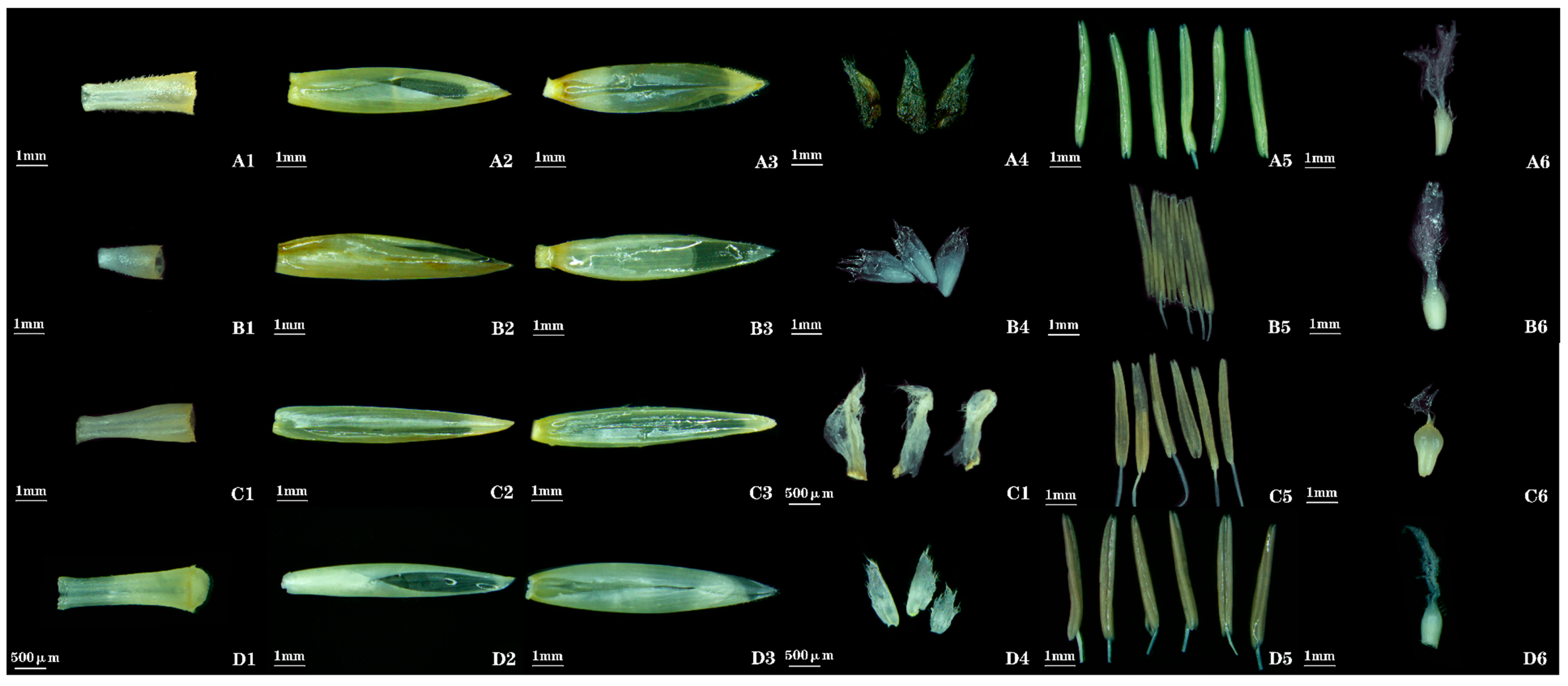
Bambusa sinospinosa McClure: The floral morphology is basically consistent with the description in Flora of China, but there are differences in the length of the lemma/palea, the shape of the lemma, and the shape of the ovary compared with the records in Flora of China (see Table 1 for complete data). In this study, the lemma length was measured to be 7.3–8.2 mm, and the palea length was 7.1–9.0 mm; the palea is slightly longer than or equal in length to the lemma, the lemma is ovate-lanceolate (Figure 2 (A2)), and the ovary is obovate (Figure 2 (A6)). However, Flora of China records that the lemma is longer than the palea, the lemma is ovate-oblong, and the ovary is narrowly elongated.
Bambusa ventricosa McClure: Its floral morphology is basically consistent with the records in Flora of China, but there are differences in the lengths of the lemma/palea, the shape of the lemma, and the shape of ovary compared with the descriptions in Flora of China (see Table 1 for complete data). In this study, the measured lemma length ranges from 9.2–10.5 mm, and the palea length ranges from 9.7–11.3 mm; the palea is slightly longer than the lemma, the lemma is ovate-lanceolate (Figure 2 (B2)), and the ovary is obovate (Figure 2 (B6)). However, Flora of China records that the lemma is equal in length to the palea, the lemma is ovate-elliptic, and the ovary is narrowly elongated.
Bambusa eutuldoides var. viridivittata (W. T. Lin) L. C. Chia: Its floral morphology is basically consistent with the literature records, but there are differences in the lengths of the lemma/palea, the shape of the lodicules, and the shape of the ovary compared with the descriptions by Tang et al. [5] (see Table 2 for complete data). In this study, the measured lemma length ranges from 9.4–11.0 mm, and the palea length ranges from 9.7–11.1 mm; the palea is slightly longer than the lemma, the lodicules are ovate-lanceolate (Figure 2 (C4)), and the ovary is obovate (Figure 2 (C6)). However, Tang et al. [5] described that the lemma is equal in length to the palea, the lodicules are obovate, and the ovary is ovoid.
Bambusa tuldoides Munro: Its floral morphology is basically consistent with the records in Flora of China, but there is a difference in the shape of the lemma compared with the description in Flora of China (see Table 1 for complete data). In this study, the lemma was observed to be ovate-lanceolate (Figure 2 (D2)); however, Flora of China records that the lemma is ovate-oblong.
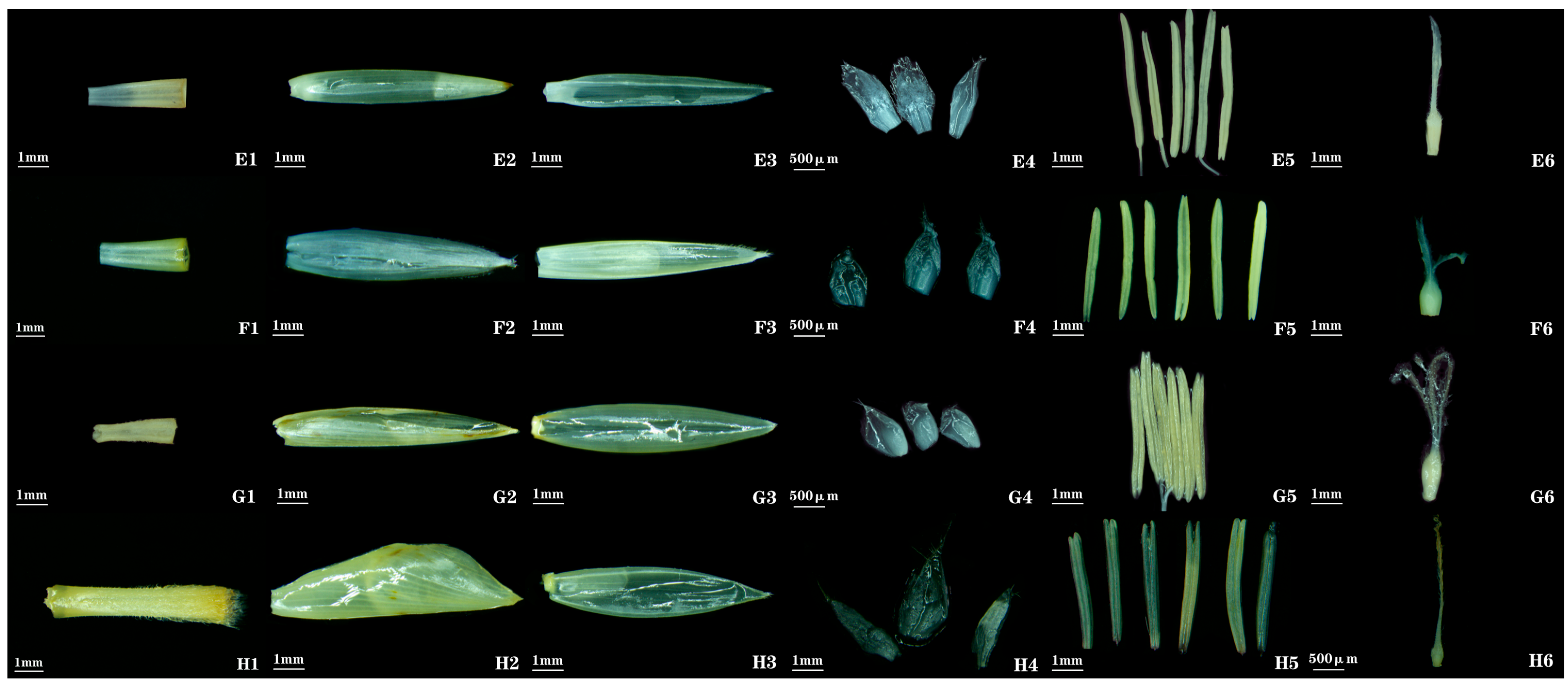
Bambusa textilis McClure: Its floral morphology is basically consistent with the records in Flora of China, but there are differences in the lengths of the lemma/palea, the shape of the lemma, and the shape of the ovary compared with the descriptions in Flora of China (see Table 1 for complete data). In this study, the measured lemma length ranges from 12.3–14.5 mm, and the palea length ranges from 12.3–13.7 mm; the palea is slightly shorter than or equal in length to the lemma, the lemma is ovate-lanceolate (Figure 3 (E2)), and the ovary is obovate (Figure 3 (E6)). However, Flora of China records that the lemma is slightly shorter than the palea, the lemma is elliptic, and the ovary is broadly ovoid.
Bambusa rigida Keng & P. C. Keng: Its floral morphology is basically consistent with the records in Flora of China, but there is a difference in the shape of the ovary compared with the description in Flora of China (see Table 1 for complete data). In this study, the ovary was observed to be obovate (Figure 3 (F6)); however, Flora of China records that the ovary is ovoid.
Bambusa rutila McClure: Floral morphology of Bambusa rutila agrees with Flora of China; no additional traits were observed (Figure 3 (G)).
Bambusa emeiensis L. C. Chia & H. L. Fung: Morphological features such as the spikelet shape, and ovary shape of this bamboo species have been described less frequently in previous studies. Spikelets are long-ovate (Figure 1 (8)). Ovary is broadly obovate, sparsely pubescent; stigmas 3, plumose, exhibiting a long-style/long-stigma type (Figure 3 (H6)).
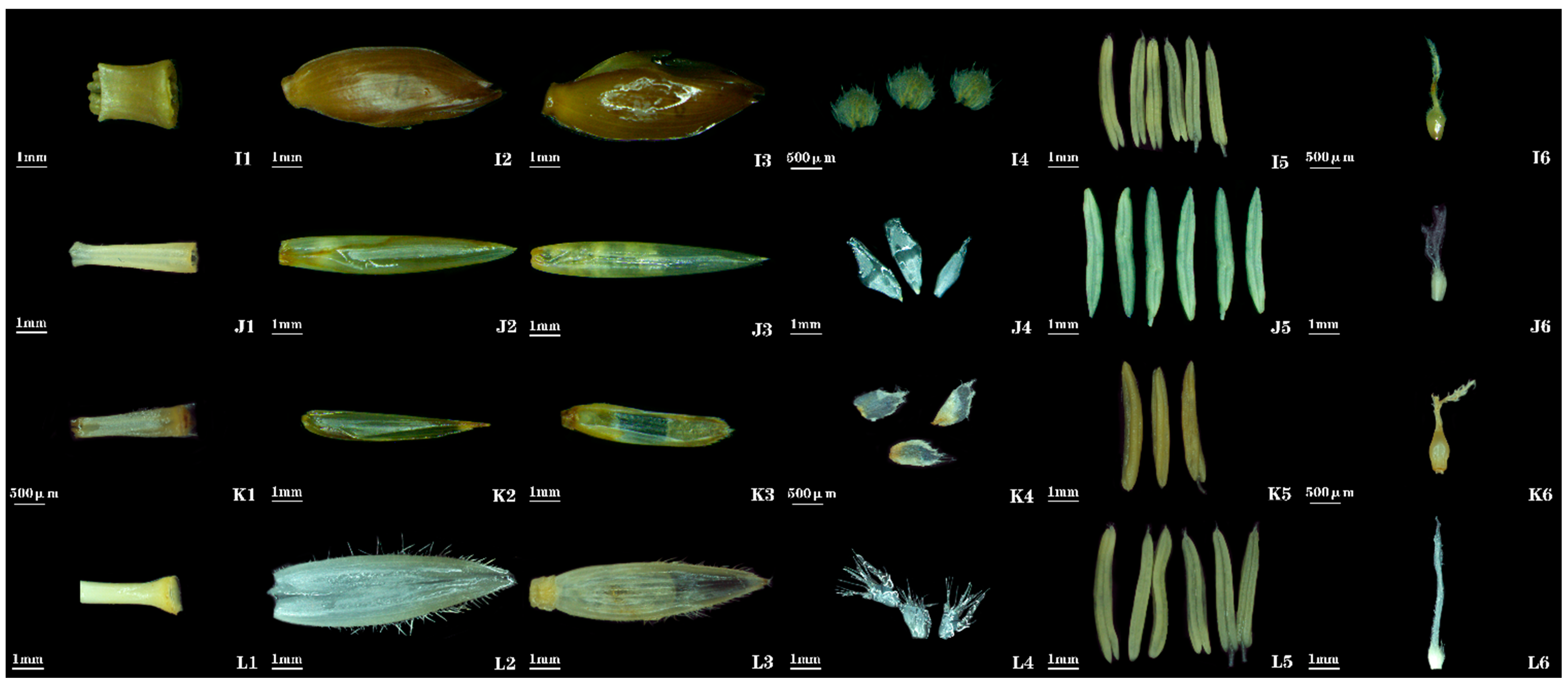
Bambusa cerosissima McClure: Floral morphology of Bambusa cerosissima agrees with Flora of China; no additional traits were observed (Figure 4 (I)).
Bambusa intermedia J. R. Xue & T. P. Yi: Morphological features such as spikelet shape, lemma shape, ovary shape, and lodicule characteristics of this bamboo species have been described less frequently in previous studies. Spikelets are linear-lanceolate, (Figure 1 (10)), and the Lemma is ovate-oblong (Figure 4 (J2)). Lodicules 3, slender-lanceolate (Figure 4 (J4)). Ovary is obovoid, pubescent on the upper part; stigmas 3, plumose, exhibiting a short-style/short-stigma type (Figure 4 (J6)).
Gigantochloa sp. 1: This bamboo species has not been formally published. Spikelets are oblong-lanceolate, slightly flattened, 2.83 cm long, 2.1 mm wide, and clustered at each node of flowering branches. Bud bracts 2–3, narrowly ovate, apex abruptly acute. Spikelets contain 5–7 florets (Figure 1 (11)). Rachilla is nearly solid (Figure 4 (K1)). Lemma is oblong-lanceolate, 7.58 mm long, glabrous, and apex abruptly acute (Figure 4 (K2)). Palea is linear, slightly shorter than lemma (5.75 mm long), bearing short cilia along keel, and apex truncate with ciliate margins (Figure 4 (K3)). Lodicules 3, ovate-lanceolate (Figure 4 (K4)). Stamens 3; filaments slender; stamens tipped with white brush-like hairs (Figure 4 (K5)). Ovary is obovate; stigmas 3, plumose, exhibiting a short-style/long-stigma type (Figure 4 (K6)).
Gigantochloa sp. 2: This bamboo species has not yet been formally published. Spikelets are oblong, slightly flattened, 2.25 cm long, 6.11 mm wide, and densely clustered or forming spherical clusters at nodes of flowering branches. Bud bracts 1–2, ovate, apex blunt with a mucronate tip. Spikelets contain 4–5 florets (Figure 1 (12)). Rachilla is nearly solid (Figure 4 (L1)). Lemma is broadly ovate, 9.39 mm long, margins ciliate, and apex abruptly acute (Figure 4 (L2)). Palea is slightly shorter than lemma, 7.82 mm long, with short cilia along keels (Figure 4 (L3)). Lodicules 3, ovate-lanceolate (Figure 4 (L4)). Stamens 6; filaments slender (Figure 4 (L5)). Ovary is obovate, apex thickened, and covered with short stiff hairs; stigmas 3, feathery, exhibiting a short-style/long-stigma type (Figure 4 (L6)).
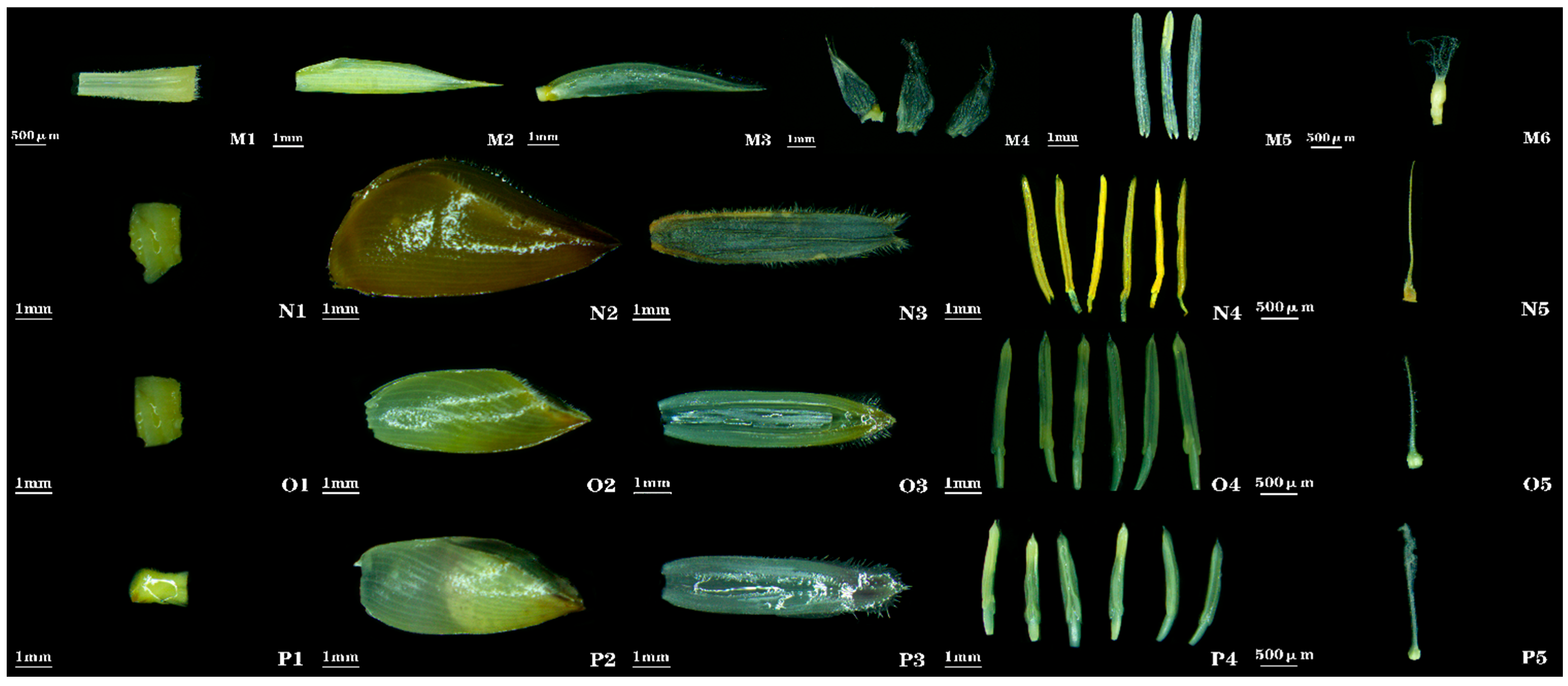
Pleioblastus fortunei (Van Houtte ex Munro) Nakai: Spikelets are linear-lanceolate, slightly flattened, 7.03 cm long, 2.44 mm wide, and clustered at nodes of flowering branches. Bud bracts 1–2, narrowly ovate, apex sharply pointed. Spikelets contain 4–9 florets (Figure 1 (13)). Rachilla is nearly solid (Figure 5 (M1)). Lemma is lanceolate, 13.63 mm long, and apex sharply pointed (Figure 5 (M2)). Palea is slightly shorter than lemma (12.63 mm long), with short cilia near apical margins (Figure 5 (M3)). Lodicules 3, oblong-lanceolate, and margins ciliate (Figure 5 (M4)). Stamens 3; filaments slender (Figure 5 (M5)). Ovary iselliptical; style short; stigmas 3, feathery, exhibiting a short-style/long-stigma type (Figure 5 (M6)). Floral characteristics of this species were not documented in Flora of China.
Dendrocalamus sinicus L. C. Chia & J. L. Sun: Previous studies have provided limited descriptions concerning the spikelet morphology, lemma shape, and ovary shape of this bamboo species. Spikelets are ovoid with tapering apices (Figure 1 (14)). Rachilla is nearly solid (Figure 5 (N1)). Lemma is broadly ovate (Figure 5 (N2)). Ovary is globular, with apical pubescence extending to the stigma; stigma is solitary, feathery, exhibiting a long-style/long-stigma type (Figure 5 (N5)).
Dendrocalamus giganteus Wall. ex Munro: Floral morphology of Dendrocalamus giganteus agrees with Flora of China; no additional traits were observed (Figure 5 (O)).
Dendrocalamus fugongensis J. R. Xue & D. Z. Li: Floral morphology of Dendrocalamus fugongensis agrees with Flora of China; no additional traits were observed (Figure 5 (P)).
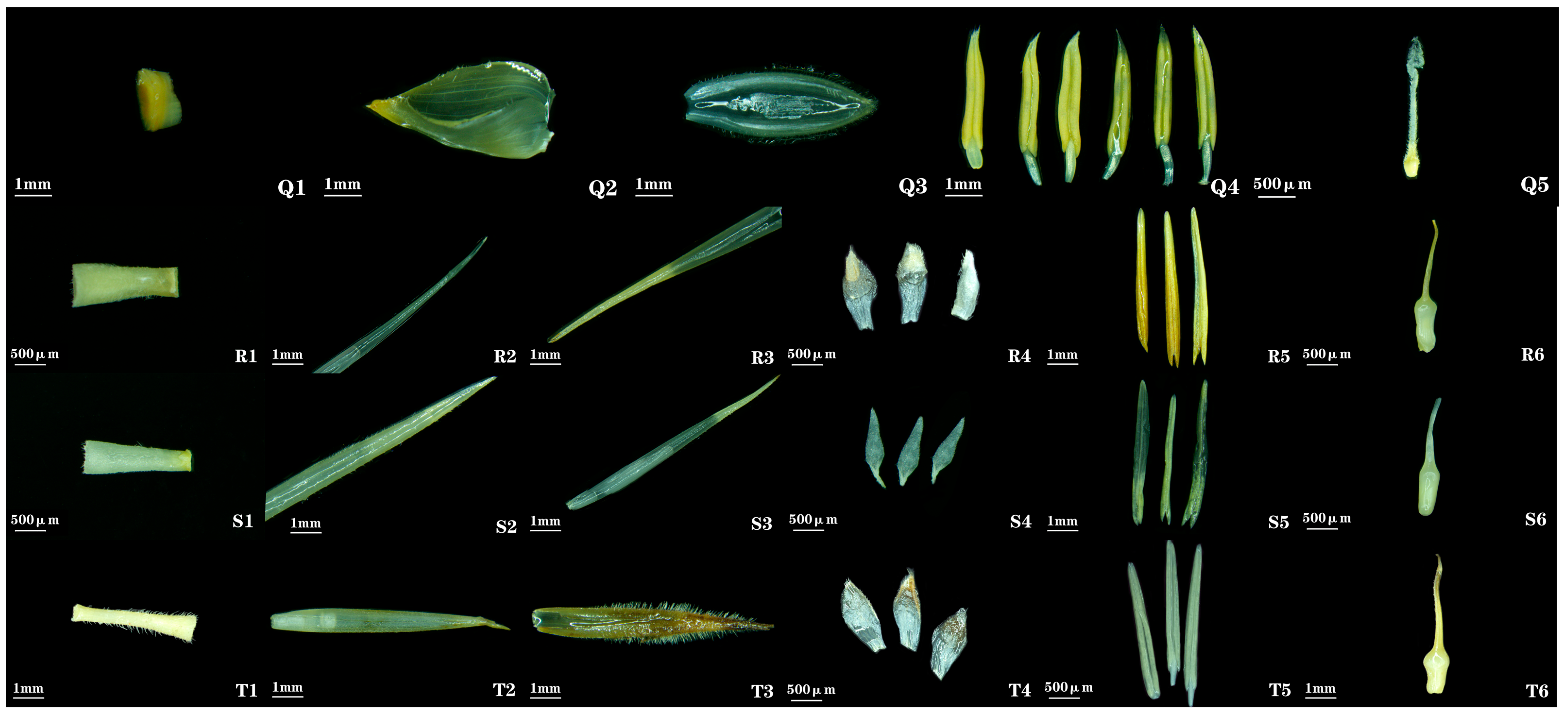
Dendrocalamus hamiltonii Nees & Arn. ex Munro: The spikelet shape, lemma shape, and ovary morphology of this bamboo species lacked detailed descriptions in previous research reports. Spikelets are ovate with obtuse apex, slightly flattened (Figure 1 (17)). Rachis is nearly solid (Figure 6 (Q1)). Lemma is broadly ovate (Figure 6 (Q2)). Ovary is globular; style is exceptionally long; stigma is solitary, feathery, exhibiting a long-style/long-stigma type (Figure 6 (Q5)).
Phyllostachys sulphurea (Carrière) Riviere & C. Rivière: Floral characteristics were not documented in Flora of China. This species was commonly found in southwestern China. Spikelets are narrowly lanceolate, 2.75 cm long, 1.50 mm wide, borne at the apex of branches, and enclosed by a spathe formed from a single leaf sheath. Bud bracts 3–5, lanceolate, with pubescent apices. Spikelets contain 3–5 florets (Figure 1 (18)). Rachis is nearly solid (Figure 6 (R1)). Lemma is lanceolate, 19.25 mm long, apex sharply pointed, sparsely pubescent abaxially, glabrous adaxially (Figure 6 (R2)). Palea is nearly equal to or slightly longer than lemma, 20.51 mm long, apex acute, and densely pubescent along keels (Figure 6 (R3)). Lodicules 3, subequal, lanceolate, ciliate at apex (Figure 6 (R4)). Stamens 3; filaments slender (Figure 6 (R5)). Ovary is obovate; stigma solitary, sparsely plumose, exhibiting a long-style/short-stigma type (Figure 6 (R6)).
Phyllostachys glauca McClure: The shapes of the lemma, ovary, and lodicules of this bamboo species lacked detailed descriptions in previous studies. Lemma is lanceolate, (Figure 6 (S2)). Lodicules 3, lanceolate, ciliate at apex (Figure 6 (S4)). Ovary is obovate; stigma solitary, plumose, exhibiting a long-style/short-stigma type (Figure 6 (S6)).
Phyllostachys nigra (Lodd. ex Lindl.) Munro: The shape of the lemma, ovary, and lodicules in this bamboo species lacked detailed descriptions in previous studies. Lemma is lanceolate, (Figure 6 (T2)). Lodicules 3, subequal, obovate, ciliate at apex (Figure 6 (T4)). Ovary is obovate; stigma solitary, plumose, exhibiting a long-style/short-stigma type (Figure 6 (T6)).
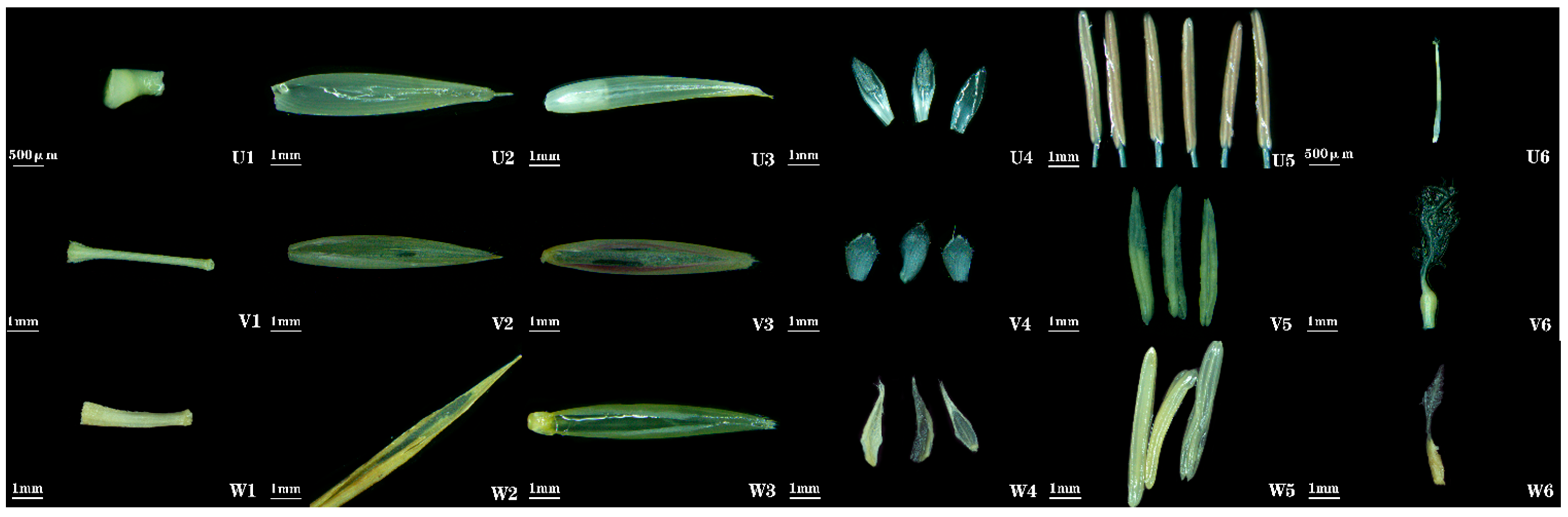
Schizostachyum brachycladum (Kurz ex Munro) Kurz: Floral characteristics were not documented in Flora of China. Spikelets are lanceolate, 2.75 cm long, 3.32 mm wide, clustered at nodes on flowering branches. Bud bracts 1–2, broadly ovate, apex shortly pointed. Spikelets contain 2–3 florets (Figure 1 (21)). Rachis is nearly solid (Figure 7 (U1)). Lemma is ovoid-caudate, 11.33 mm long, apex abruptly mucronate, glabrous externally (Figure 7 (U2)). Palea is slightly shorter than lemma, 7.56 mm long, apex similarly acute, nearly glabrous along keel (Figure 7 (U3)). Lodicules 3, subequal, oblong-lanceolate, ciliate at apex (Figure 7 (U4)). Stamens 6; filaments slender (Figure 7 (U5)). Ovary is broadly ovate; stigma solitary, sparsely feathery, exhibiting a long-style/short-stigma type (Figure 7 (U6)).
Fargesia yuanjiangensis J. R. Xue & T. P. Yi: Floral characteristics were not documented in Flora of China. Spikelets are linear-lanceolate, 3.98 cm long, 2.52 mm wide, clustered at nodes on flowering branches. Bud bracts 2, lanceolate, apex acute. Spikelets contain 4–6 florets (Figure 1 (22)). Rachilla are nearly solid (Figure 7 (V1)). Lemma is lanceolate, 9.42 mm long, apex gradually acuminate, margins ciliate (Figure 7 (V2)). Palea is nearly equal to lemma, 8.67 mm long, keels ciliate, apex truncate (Figure 7 (V3)). Lodicules 3, ovate, apical margins ciliate (Figure 7 (V4)). Stamens 3 (Figure 7 (V5)). Ovary is nearly obovate; stigmas 3, feathery, exhibiting a short-style/long-stigma type (Figure 7 (V6)).
Fargesia fungosa T. P. Yi: Floral morphology of Fargesia fungosa agrees with Flora of China; no additional traits were observed (Figure 7 (W)).
Through morphology observations of the floral organs from 23 bamboo species across 7 genera in southwestern China, significant morphological differences were identified among genera. The Bambusa genus exhibited linear-lanceolate spikelets with three distinct lodicules (obovate or lanceolate), six stamens, nearly hollow rachises, and predominantly short-styled pistils with long stigmas (e.g., Bambusa sinospinosa, Bambusa pervariabilis). The Dendrocalamus genus was characterized by ovate spikelets, complete absence of lodicules, six stamens, nearly solid rachises, and long-styled pistils with elongated stigmas. Phyllostachys displayed narrow-lanceolate spikelets enclosed by spathes, three lanceolate lodicules, three stamens, nearly solid rachises, and long-styled pistils with short stigmas. Fargesia species showed linear-lanceolate spikelets with three ovate lodicules, three stamens, nearly solid rachises, and short-styled pistils with long stigmas. The Gigantochloa genus exhibited significant interspecific variation in stamen number (3 or 6), lanceolate spikelets, three lodicules, and nearly solid rachises. Among these bamboos, the Bambusa species represented the most extensively collected specimens, followed by Dendrocalamus and Phyllostachys, which correlated with the quantitative distribution of bamboo species in the southwestern region. Notably, the floral morphological characteristics of species including Pleioblastus fortunei, Gigantochloa sp., Gigantochloa sp., Phyllostachys sulphurea, and Fargesia yuanjiangensis were not documented in the Flora of China, Illustrated Monograph of Chinese Bamboos, or other existing literature. This study provided critical evidence for future taxonomic identification and classification of bamboos.

2.2. Principal Component Analysis of Phenotypic Traits in Bamboo Flowers

Based on the observation and analysis of bamboo flower morphological structures, 16 floral organ phenotypic traits (eight qualitative traits and eight quantitative traits) were selected for principal component analysis. Using an eigenvalue λ > 1 as the extraction threshold, five principal components were extracted, primarily composed of 11 correlated floral traits, with a cumulative variance contribution rate of 84.6%, reflecting the majority of information from the original floral dataset (Table 2).
The first principal component (PC1) explained 35.4% of the variance. PC1 integrated traits primarily reflected spikelet shape and lodicule number. PC2 explained 23.5% of the variance and was significantly influenced by spikelet width, stamen number, and lodicule shape. PC3 contributed 11.2% of the variance mainly through spikelet length, lemma length, palea length, and the presence or absence of pubescence on the palea margin. PC4 contributed 8.1% of the variance and partially influenced the presence or absence of pubescence on the lemma margin and palea margin. PC5 primarily explained 6.4% of the variance in spikelet length, spikelet width, and ovary shape. In summary, spikelet morphology, palea length, and stamen number were the most significant traits influencing the morphological variation in bamboo flowers.

2.3. Linear Discriminant Analysis of Bamboo Floral Phenotypic Traits

Based on the principal component analysis (PCA) results (Table 2), 11 core traits with absolute loadings ≥ 0.35 were selected: spikelet morphology, spikelet length, spikelet width, lemma length, lemma margin pubescence presence, palea length, palea margin pubescence presence, ovary shape, stamen number, lodicule number, and lodicule shape. Using these 11 high-loading traits as input variables and “genus” as the grouping factor, a linear discriminant analysis (LDA) classification model was constructed. Model efficacy was evaluated via original classification accuracy and leave-one-out cross-validation accuracy. LDA extracted six discriminant functions, with the first two cumulatively explaining 89.7% of the total variance, indicating strong discriminative power (Table 3). Results demonstrated that the 11 high-loading traits significantly distinguished bamboo genera. Among these, spikelet morphology, palea length, and stamen number were core traits distinguishing generic-level taxa (Table 4). The cross-validation accuracy reached 95.7% (Table 5), confirming that the LDA model based on PCA high-loading traits effectively classifies bamboo at the genus level, providing morphological evidence for bamboo systematic taxonomy.

3. Discussion

The evolutionary trajectory of the classification system for Bambusoideae reveals that early taxonomic practices predominantly relied on vegetative organ characteristics, such as rhizome types and branching patterns. Modern molecular phylogenetic studies, however, have confirmed the irreplaceable role of floral characteristics in elucidating intergeneric relationships [32]. The florets of bamboo typically comprise five components: lemma, palea, lodicules, stamens, and pistil, which exhibit interspecific variations in morphology, number, and coloration [33]. Through morphological investigations of floral organs across 23 bamboo species in southwestern China, this study unveils the diversity and complexity of floral structures among different species.
Prior research has documented the floral morphology of species such as Dendrocalamus sinicus [23], Bambusa eutuldoides [24], Bambusa intermedia [27], and Bambusa rigida [30], with observations in this study aligning consistently with earlier descriptions. Comparative analyses demonstrated significant morphological and structural divergence in floral organs across species. These distinctions not only facilitate species identification but also provide critical insights for systematic taxonomy, enabling comprehensive descriptions of bamboo classification and offering an intuitive understanding of floral morphology across diverse species.
Through systematic morphological observations of floral organs in 23 bamboo species from Southwest China, combined with multivariate statistical methods including principal component analysis (PCA) and linear discriminant analysis (LDA), the research revealed that key traits identified by PCA—such as spikelet morphology, palea length, and stamen number—collectively explained 84.6% of the observed variations. LDA further validated the taxonomic reliability of these traits, achieving an overall genus-level classification accuracy of 95.7%. Specifically, the discrimination accuracy reached 100% for Bambusa (10 species) and 75% for Dendrocalamus (4 species). These results not only confirm the stability of floral characteristics as critical markers for defining bamboo genera but also provide practical quantitative indicators for rapid field identification. This offers new morphological support for resolving long-debated taxonomic boundaries within the BDG complex group. The findings demonstrated that comparative morphological analysis of floral organs across genera, integrated with multivariate statistical methods like PCA and LDA, effectively addressed the limitations of traditional bamboo classification reliant on vegetative traits. Nevertheless, it must be emphasized that the long and highly unpredictable flowering cycles of bamboos severely restrict the routine application of floral characters in everyday identification. During our 14-year sampling period in south-west China, only a small fraction of bamboo taxa produced inflorescences; the vast majority still lack any floral material. Consequently, this study does not advocate replacing traditional vegetative keys with reproductive traits; rather, we offer a quantitative, repeatable ancillary tool that can be employed whenever flowering material becomes available. Future taxonomic work should continue to rely primarily on vegetative characteristics, while integrating floral data and molecular evidence for critical or problematic taxa in order to enhance accuracy and stability.
D. giganteus was previously misclassified into the genus Bambusa due to similarities in culm morphology and branching characteristics [2]. However, this study unequivocally demonstrated through the analysis of LDA that significant, non-negligible differences existed between them in lodicule characteristics (D. giganteus lacked lodicules, while Bambusa possessed three obovate lodicules) and spikelet length-to-width ratio (approximately 0.5 for D. giganteus vs. about 10 for Bambusa). These morphological evidences corroborated the molecular phylogenetic findings of Kelchner et al. [20], providing further support for the taxonomic placement of D. giganteus within Dendrocalamus.
Particular attention was warranted regarding the taxonomic placement of B. emeiensis. Significant divergence had long persisted concerning its systematic position, with the core controversy centering on the uniqueness of its vegetative organ characteristics and its relationship to closely related taxa. Scholars represented by Bojie Geng argued that B. emeiensis exhibited distinct differences from typical sympodial caespitose Bambusa species and was insufficiently similar to justify its inclusion within that genus, primarily based on vegetative traits such as its sympodial leptomorph rhizomes (with well-developed pseudorhizomes), relatively slender and drooping culm apices, and branching habits. Consequently, they established the separate genus Neosinocalamus Keng f. to emphasize its morphological distinctiveness [34]. Conversely, another school of thought maintained that B. emeiensis’s caespitose growth habit, inflorescence, and fundamental spikelet structure aligned more closely with Bambusa. They contended that B. emeiensis should be treated as a distinctive member of Bambusa, with its unique slender culm morphology representing an evolutionary adaptation to specific habitats rather than a characteristic sufficiently distinct to warrant generic separation [35,36]. Subsequent molecular phylogenetic studies consistently revealed that molecular markers from B. emeiensis were nested within the core clade of Bambusa, providing robust evidence for its inclusion in that genus [37].
Morphological observations of floral organs in this study clearly demonstrated that B. emeiensis possessed the typical floral character combination of Bambusa: six stamens, three prominent obovate lodicules, and a pistil with a short style and long stigmas. These characteristics stood in stark contrast to the vegetative traits emphasized by the proposal for its recognition as a separate genus. LDA results further confirmed that the floral morphology data of B. emeiensis fell entirely within the discriminant space of Bambusa, with high classification confidence. Therefore, the detailed morphological description of B. emeiensis flowers in this study supported its inclusion within Bambusa. This finding was highly congruent with molecular phylogenetic evidence [18], collectively confirming the systematic position of B. emeiensis within Bambusa. This study also demonstrated the utility of PCA and LDA in bamboo taxonomy.
Bamboo has a long flowering cycle and rarely blooms. Many bamboo species rely solely on vegetative characteristics for identification at the time of publication, lacking descriptions of floral organs. This paper described the floral organ characteristics of 23 bamboo species, among which five species—Pleioblastus fortunei, Gigantochloa sp., Gigantochloa sp., Phyllostachys sulphurea, and Fargesia yuanjiangensis—exhibited floral morphological features not previously recorded in Flora of China, Illustrated Flora of Bambusoideae in China, or other literature. Morphological descriptions of these bamboo floral organs provided critical evidence for future classification and identification. Additionally, these new descriptions offered essential morphological evidence for revising bamboo taxonomic systems. For example, the stamen number in Gigantochloa (three to six) formed a distinct contrast with that of Bambusa and other genera (typically six), potentially suggesting divergence in their evolutionary pathways [38].
In the BDG complex group, where controversy over genetic introgression existed in molecular systematics, floral traits demonstrated stronger taxonomic stability. Species of Bambusa consistently possess six stamens and pistils with short styles/long stigmas, while Dendrocalamus exhibits pistils with long styles/long stigmas and completely lacks lodicules. The uniqueness of Gigantochloa was reflected in the plasticity of stamen number (three to six) and ovate-lanceolate lodicules, even among taxa exhibiting molecular marker overlap [15]. These morphological characteristics reliably distinguished Gigantochloa from Bambusa and Dendrocalamus.
In this study, stamen number was found to be a stable diagnostic trait at the generic level. All Bambusa, Dendrocalamus, and Schizostachyum species consistently exhibited six stamens, whereas Phyllostachys, Pleioblastus, and Fargesia species possessed three (Table 2). This pattern aligns with previous reports for the genera examined [15,39,40], reinforcing the reliability of stamen count as a morphological marker in bamboo taxonomy. Notably, Gigantochloa showed intrageneric variation (three or six stamens). The underlying mechanism for this evolutionary reduction in number remains unreported and requires further investigation.
In summary, this study, through a comparative morphological investigation of bamboo floral organs in the southwestern region, not only revealed the diversity and taxonomic significance of floral structures across different bamboo species but also provided novel morphological evidence for establishing intergeneric classification systems. Future research could expand the sample size to include more bamboo species and broader geographical distributions, thereby offering a more comprehensive understanding of floral diversity and taxonomic implications.

4. Materials and Methods

4.1. Plant Materials

The bamboo flower materials analyzed in this study were all obtained through field collection. They were primarily gathered from the Yunnan and Guizhou provinces in Southwest China from 2010 to 2024, encompassing 23 distinct bamboo species (seven genera) with their floral organ specimens (Table 6).
Two Gigantochloa specimens whose floral morphology has never previously been documented were included and are temporarily designated as Gigantochloa sp. 1 and Gigantochloa sp. 2. Voucher specimens have been deposited in the Herbarium of Southwest Forestry University (SWFC), Kunming, China, under voucher numbers SWFC0072425 and SWFC0072426, respectively. Each voucher contains detailed locality, collection date, collector information, and high-resolution photographs and is publicly available for examination.

4.2. Methods

Freshly bloomed mature florets were selected and collected. The spikelets and floral branches were excised and immediately immersed in FAA fixative solution (50% ethanol: formaldehyde: glacial acetic acid = 18:1:1) and then transported to the laboratory for vacuum degassing and preservation. The fixed spikelets and florets were dissected under a stereomicroscope (Olympus HO11, Evident Scientific Tokyo, Tokyo, Japan).
Florets were sequentially detached from the spikelets, and each floral organ was observed under an optical microscope. Photographic documentation and morphometric analysis of individual floral structures were performed using the 2D measurement software DS-3000. Morphological data from all organs were analyzed in IBM SPSS Statistics 21 to calculate means, standard deviations, and Z-score normalization, with the 20 flowers used for each indicator sampled from three clumps (nine individual bamboos in total). Subsequently, principal component analysis (PCA) was performed using Origin 2024, followed by linear discriminant analysis (LDA) using IBM SPSS Statistics 21. Descriptive traits (e.g., spikelet shape, ovary shape) were quantified through coding, while numerical traits (e.g., spikelet dimensions, lemma/palea lengths) retained original measurements. A total of 20 spikelets from each bamboo species were selected for measurements of morphological indicators.

5. Conclusions

This study systematically investigated the morphological diversity and taxonomic significance of floral organs in 23 bamboo species from Southwest China through systematic morphological observation and multivariate statistical analyses, including principal component analysis and linear discriminant analysis. The results confirmed the importance of floral characteristics as stable taxonomic markers. Core traits screened by PCA—spikelet morphology, palea length, and stamen number—collectively accounted for 84.6% of the observed variance. LDA further validated the reliability of these traits, achieving an overall genus-level classification accuracy of 95.7%. This demonstrated the value of multivariate statistical methods like PCA and LDA for bamboo classification and provided objective, quantifiable morphological criteria for genus delimitation, greatly enhancing the practicality of field identification.

Author Contributions

X.W. and S.W. wrote the main manuscript text. J.L. and C.Z. performed the sampling. All authors have read and agreed to the published version of the manuscript.

Funding

This paper was funded by the National Key R and D Program of China (2021YFD2200503-4), Natural Science Foundation of Yunnan Province (202201AS070018), and National Natural Science Fund of China (32460376). We also appreciate all the authors for their valuable works.

Data Availability Statement

The datasets generated during and/or analyzed during the study are available from the corresponding author upon reasonable request.

Acknowledgments

We are very grateful to every scientific researcher who supports and helps us in our work.

Conflicts of Interest

The authors declare no conflicts of interest.

References

  1. Ma, P.F.; Liu, Y.L.; Guo, C.; Jin, G.; Guo, Z.-H.; Mao, L.; Yang, Y.-Z.; Niu, L.-Z.; Wang, Y.-J.; Clark, L.G.; et al. Genome assemblies of 11 bamboo species highlight diversification induced by dynamic subgenome dominance. Nat. Genet. 2024, 56, 710–720. [Google Scholar] [CrossRef]
  2. Flora of China; (Poaceae); Wu, Z.-Y., Raven, P.H., Hong, D.-Y., Eds.; Science Press: Beijing, China; Missouri Botanical Garden Press: St. Louis, MO, USA, 2006; Volume 22, ISBN 978-1-930723-50-8. [Google Scholar]
  3. Janzen, D.H. Why bamboos wait so long to flower. Annu. Rev. Ecol. Syst. 1976, 7, 347–391. [Google Scholar] [CrossRef]
  4. Holttum, R.E. The typification of the generic name Bambusa and the status of the name Arundo bambos L. Taxon 1956, 5, 26–28. [Google Scholar] [CrossRef]
  5. Jiang, Z. Bamboos and Rattans in the World; China Forestry Publishing House: Beijing, China, 2007. [Google Scholar]
  6. Chao, C.; Tang, G. The present status and problems of bamboo classification in China. J. Nanjing For. Univ. 1993, 36, 1. [Google Scholar]
  7. Li, L. Systematic Taxonomy of the Subtribe Sasinae; Nanjing Forestry University: Nanjing, China, 2009. [Google Scholar]
  8. Geng, Y. Key to the Genera and Species of Gramineae in China: With Systematic List; Science Press: Beijing, China, 1957. [Google Scholar]
  9. Geng, B. A Revision of the Genera of Bambusoideae in the World. J. Bamboo Res. 1982, 1, 1–19. [Google Scholar]
  10. Clayton, W.D.; Renvoize, S.A. Genera Graminum: Grasses of the World; HMSO: London, UK, 1986. [Google Scholar]
  11. Li, D.; Xue, J. Studies on the Genus Dendrocalamus in China (I). J. Bamboo Res. 1988, 7, 1–19. [Google Scholar]
  12. Peng, S.; Yang, H.-Q.; Li, D.-Z. Highly heterogeneous generic delimitation within the temperate bamboo clade (Poaceae: Bambusoideae): Evidence from GBSSI and ITS sequences. Taxon 2008, 57, 799–810. [Google Scholar] [CrossRef]
  13. Zhang, Y.X.; Zeng, C.X.; Li, D.Z. Complex evolution in Arundinarieae (Poaceae: Bambusoideae): Incongruence between plastid and nuclear GBSSI gene phylogenies. Mol. Phylogenet. Evol. 2012, 63, 777–797. [Google Scholar] [CrossRef]
  14. Yi, T.; Shi, J.; Ma, L.; Wang, H.; Ma, N.; Yang, H.; Zhou, D.; Lu, X. Atlas of Chinese Bamboos; Science Press: Beijing, China, 2008. [Google Scholar]
  15. Zheng, C. Speciation of the Bambusa–Dendrocalamus–Gigantochloa Complex: Molecular Evidence of Hybridization. Ph.D. Thesis, University of Chinese Academy of Sciences, Beijing, China, 2014. [Google Scholar]
  16. Ma, X. Preliminary Study on the Molecular Systematics of the Bambusa Group in Bambusoideae. Ph.D. Dissertation, Southwest Forestry University, Kunming, China, 2009. [Google Scholar]
  17. Yi, T.; Shi, J.; Ma, L.; Wang, H.; Yang, L. A New Species of Yushania Keng f. and Supplement of Flower of Fargesia lincangensis Yi from West Yunnan, China. Bull. Bot. Res. 2008, 28, 129–132. [Google Scholar] [CrossRef]
  18. Lin, W. Discussion on Dendrocalamus in China. J. Bamboo Res. 1989, 8, 30–36. [Google Scholar]
  19. Editorial Committee of Flora Reipublicae Popularis Sinicae. Flora Reipublicae Popularis Sinicae; Science Press: Beijing, China, 1996; Volume 9. [Google Scholar]
  20. Kelchner, S.A.; Clark, L.G. Molecular evolution and phylogenetic utility of the chloroplast rpl16 intron in Chusquea and the Bambusoideae (Poaceae). Mol. Phylogenet. Evol. 1997, 8, 385–397. [Google Scholar] [CrossRef]
  21. Vorontsova, M.S.; Clark, L.G.; Dransfield, J.; Soreng, R.J.; Fisher, A.E.; Kelchner, S.A.; Paula, D.S.; Welker, C.A.D.; Barberá, P.; Cano, Á.A.; et al. World Checklist of Bamboos and Rattans; Science Press: Beijing, China, 2016. [Google Scholar]
  22. Huang, J.; Huang, H.; He, F.; Zhang, W. Microsporogenesis and Formation of Male Gametophyte of Phyllostachys violascens. J. Bamboo Res. 1999, 18, 55–58. [Google Scholar]
  23. Wang, S.; Pu, X.; Ding, Y.; Yang, Y.; Zhang, Y.; Zhou, S.; Li, L. Morphological Structure of the Reproductive Organs and Development of Female and Male Gametophytes of Dendrocalamus sinicus. Bull. Bot. Res. 2006, 26, 270–274. [Google Scholar] [CrossRef]
  24. Lin, S.; Ding, Y. Development of the Male and Female Gametophytes in Shibataea chinensis (Bambusoideae). Acta Bot. Boreal.-Occid. Sin. 2012, 32, 907–914. [Google Scholar]
  25. Lin, S.; Li, J.; Zhao, R.; Dong, X.; Ding, Y. The development of flowering bud differentiation and male gametophyte of Bambusa multiplex. J. Nanjing For. Univ. (Nat. Sci. Ed.) 2015, 39, 51–56. [Google Scholar] [CrossRef]
  26. Tang, G.; Yang, J.; Ding, Y.; Liu, Y.; Zhang, Y.; Zhang, H. Studies on the flower morphology and structure in Bambusa eutuldoides McClure var. viridi-vittata(W.T.Lin)Chia J. Nanjing For. Univ. (Nat. Sci. Ed.) 2016, 40, 71–75. [Google Scholar] [CrossRef]
  27. Wang, Y.; Luo, J.; Chen, N.; Tong, Y.; Ye, H.; Zhang, Y.; Zhang, H. Floral Morphology and Development of Female and Male Gametophyte of Bambusa intermedia Hsueh et Yi. Bull. Bot. Res. 2017, 37, 492–498. [Google Scholar] [CrossRef]
  28. Chu, C.; Huang, L.; Wang, S. Floral Morphology and Development of Female and Male Gametophytes of Neomicrocalamus prainii. Acta Bot. Boreal.-Occid. Sin. 2019, 39, 763–769. [Google Scholar] [CrossRef]
  29. Lin, S.; Fu, H.; Wan, Y.; Zhang, Y.; Ding, Y.; Zhao, R.; Dong, X. Anther development and floral morphology characteristics of Bambusa oldhami ‘Xia Zao’ ZSX. J. Nanjing For. Univ. (Nat. Sci. Ed.) 2019, 43, 7–13. [Google Scholar] [CrossRef]
  30. Li, J.; Wang, Y.; Chu, C.; Zhang, Y.; Ding, Y.; Dong, X.; Qu, Z. Study on the Morphology and Structure of Bambusa rigida Flowers. For. Res. 2020, 33, 28–34. [Google Scholar] [CrossRef]
  31. Du, F.; Xue, J.; Yang, Y.; Hui, C.; Wang, J. Study on Flowering Phenomenon and its Type of Bamboo in Yunnan in Past Fifteen Years. Sci. Silvae Sin. 2000, 36, 57–68. [Google Scholar] [CrossRef]
  32. Cai, L. A Preliminary Discussion on the Taxonomic Values of The Main Characters of Reproductive Organ of Poaceae and their Ranks Suitable for Differentiating Taxa. Bull. Bot. Res 2002, 22, 278–284. [Google Scholar]
  33. Lin, S.; Shi, W.; Miao, B.; Zhang, Y.; Ding, Y. Research Advances in Reproduction Biology of Bamboos. World Bamboo Rep. 2010, 8, 1–6. [Google Scholar]
  34. Geng, B. A Revision of the Genera of Bambusoideae in the World (IV). J. Bamboo Res. 1983, 2, 1–17. [Google Scholar]
  35. Ohrnberger, D. The Bamboos of the World: Annotated Nomenclature and Literature of the Species and the Higher and Lower Taxa; Elsevier: Amsterdam, The Netherlands, 1999. [Google Scholar]
  36. Yang, H.Q.; Yang, J.B.; Peng, Z.H.; Gao, J.; Yang, Y.M.; Peng, S.; Li, D.Z. A molecular phylogenetic and fruit evolutionary analysis of the major groups of the paleotropical woody bamboos (Gramineae: Bambusoideae) based on nuclear ITS, GBSSI gene and plastid trnL-F DNA sequences. Mol. Phylogenet. Evol. 2008, 48, 809–824. [Google Scholar] [CrossRef] [PubMed]
  37. Wang, A.K.; Lu, Q.F.; Zhu, Z.X.; Liu, S.H.; Zhong, H.; Xiao, Z.Z.; Zou, Y.G.; Gu, L.J.; Du, X.H.; Cai, H.J.; et al. Exploring phylogenetic relationships within the subgenera of Bambusa based on DNA barcodes and morphological characteristics. Sci. Rep. 2022, 12, 8018. [Google Scholar] [CrossRef]
  38. Chitchak, N.; Traiperm, P.; Staples, G.; Pornpongrungrueng, P. Species delimitation of some Argyreia (Convolvulaceae) using phenetic analyses: Insights from leaf anatomical data reveal a new species. Botany 2018, 96, 217–233. [Google Scholar] [CrossRef]
  39. Huang, L.; Deng, L.; Chu, C.; Zhan, H.; Wang, S. Morphological and Anatomical Observations of Floral Organs and Sterility Analysis of Fargesia yuanjiangensis. Sci. Silvae Sin. 2020, 56, 64–73. [Google Scholar] [CrossRef]
  40. Lin, S.; Ding, Y.; Zhang, H. Pollen Germination Percentage and the Floral Character of Five Bamboo Species. Sci. Silvae Sin. 2008, 44, 159–163. [Google Scholar] [CrossRef]
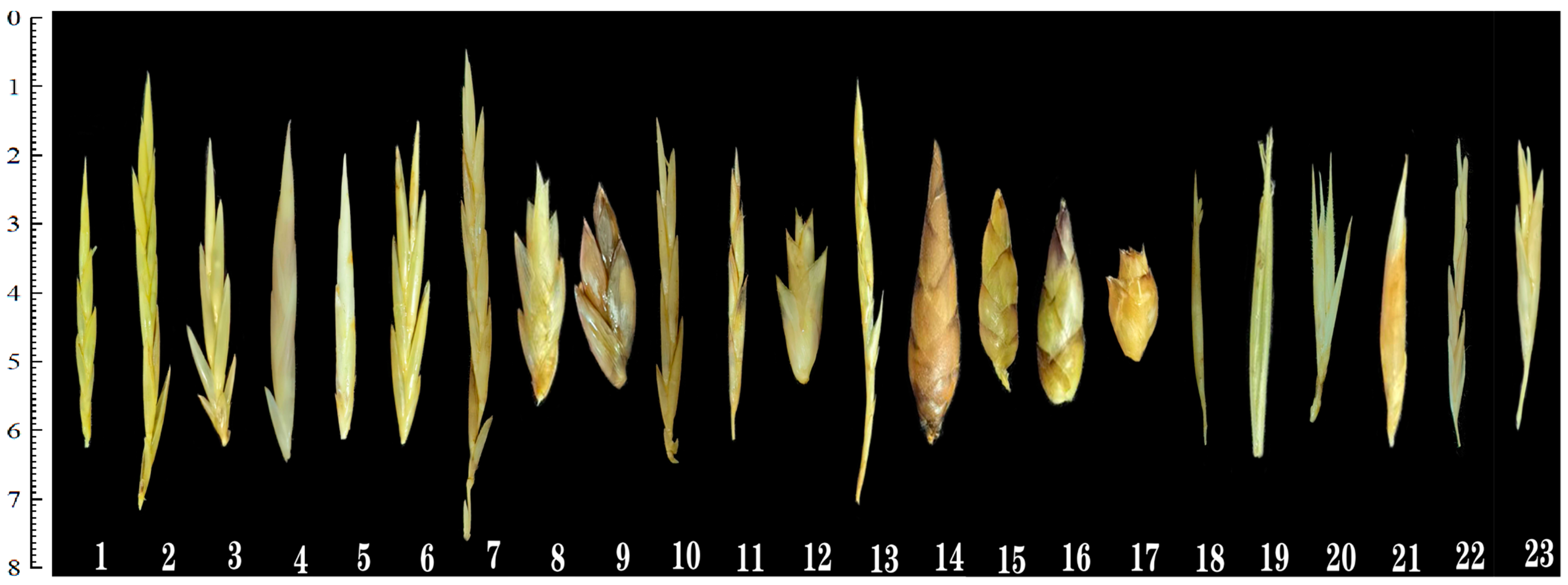
Figure 1. Morphology of the spikelet of different bamboo species. 1. Bambusa sinospinosa. 2. Bambusa ventricosa. 3. Bambusa eutuldoides var. viridivittata. 4. Bambusa tuldoides. 5. Bambusa textilis. 6. Bambusa rigida. 7. Bambusa rutila. 8. Bambusa emeiensis. 9. Bambusa cerosissima. 10. Bambusa intermedia. 11. Gigantochloa sp. 12. Gigantochloa sp. 13. Pleioblastus fortunei. 14. Dendrocalamus sinicus. 15. Dendrocalamus giganteus. 16. Dendrocalamus fugongensis. 17. Dendrocalamus hamiltonii. 18. Phyllostachys sulphurea. 19. Phyllostachys glauca. 20. Phyllostachys nigra. 21. Schizostachyum brachycladum. 22. Fargesia yuanjiangensis. 23. Fargesia fungosa.
Plants 14 03751 g001
Figure 2. Morphology of floral organs in Bambusa bamboos. A1, B1, C1, D1: rachilla. A2, B2, C2, D2: lemma. A3, B3, C3, D3: palea. A4, B4, C4, D4: lodicules. A5, B5, C5, D5: stamens. A6, B6, C6, D6: gynoecium. A1A6: B. sinospinosa. B1B6: B. ventricosa. C1C6: B. eutuldoides. D1D6: B. tuldoides.
Plants 14 03751 g002
Figure 3. Morphology of floral organs in Bambusa bamboos. E1, F1, G1, H1: rachilla. E2, F2, G2, H2: lemma. E3, F3, G3, H3: palea. E4, F4, G4, H4: lodicules. E5, F5, G5, H5: stamens. E6, F6, G6, H6: gynoecium. E1E6: B. textilis. F1F6: B. rigida. G1G6: B. rutila. H1H6: B. emeiensis.
Plants 14 03751 g003
Figure 4. Floral organ morphology of Bambusa and Gigantochloa bamboos. I1, J1, K1, L1: rachilla. I2, J2, K2, L2: lemma. I3, J3, K3, L3: palea. I4, J4, K4, L4: lodicules. I5, J5, K5, L5: stamens. I6, J6, K6, L6: gynoecium. I1I6: B. cerosissima. J1J6: B. intermedia. K1K6: Gigantochloa sp. L1L6: Gigantochloa sp.
Plants 14 03751 g004
Figure 5. Floral organ morphology of Pleioblastus and Dendrocalamus bamboos. M1, N1, O1, P1: rachilla. M2, N2, O2, P2: lemma. M3, N3, O3, P3: palea. M4: lodicules. M5, N4, O4, P4: stamens. M6, N5, O5, P5: gynoecium. M1M6: P. pygmaeus. N1N5: D. sinicus. O1O5: D. giganteus. P1P5: D. fugongensis.
Plants 14 03751 g005
Figure 6. Floral organ morphology of Dendrocalamus and Phyllostachys bamboos. Q1, R1, S1, T1: rachilla. Q2, R2, S2, T2: lemma. Q3, R3, S3, T3: palea. R4, S4, T4: lodicules. Q4, R5, S5, T5: stamens. Q5, R6, S6, T6: gynoecium. Q1Q5: D. hamiltonii. R1R6: P. sulphurea. S1S6: P. glauca. T1T6: P nigra.
Plants 14 03751 g006
Figure 7. Floral organ morphology of Schizostachyum and Fargesia bamboos. U1, V1, W1: rachilla. U2, V2, W2: lemma. U3, V3, W3: palea. U4, V4, W4: lodicules. U5, V5, W5: stamens. U6, V6, W6: gynoecium. U1U6: S. brachycladum. V1V6: F. yuanjiangensis. W1W6: F. fungosa.
Plants 14 03751 g007
Table 1. Characteristics of florets across diverse bamboo species.
GenusSpeciesSpikelet ShapeSpikelet Length (cm)Spikelet Width (mm)Rachilla TypeRachilla Length (mm)Lemma ShapePubescence on Lemma MarginsLemma Length (mm)Pubescence on Palea MarginsPalea Length (mm)Pistil TypeOvary ShapeStigmas NumberStamen NumberLodicule NumberLodicule Shape
BambusaBambusa sinospinosaLinear lanceolate2.7–3.82.7–4.1Nearly hollow3.8–4.8Ovate-lanceolateNo7.3–8.2Yes7.1–9.0Long style and short stigmaObovate363Obovate
Bambusa ventricosaLinear lanceolate4.9–5.93.0–4.5Nearly hollow1.9–3.1Ovate-lanceolateNo9.2–10.5Yes9.7–11.3Short style and long stigmaObovate363Obovate
Bambusa eutuldoides var. vviridivittataLinear lanceolate2.8–3.84.7–7.5Nearly hollow2.7–3.7Ovate-lanceolateNo9.4–11.0Yes9.7–11.1Short style and long stigmaObovate263Irregular
Bambusa tuldoidesLinear lanceolate3.4–4.62.4–4.0Near-solid2.8–4.2Ovate-lanceolateNo11.5–13.5Yes10.7–12.9Short style and long stigmaObovate363Obovate
Bambusa textilisLinear lanceolate2.9–4.12.9–5.3Nearly hollow3.2–4.8Ovate-lanceolateNo12.3–14.5Yes12.3–13.7Short style and long stigmaObovate363Spoon-shaped, obovate
Bambusa rigidaLinear lanceolate2.1–4.34.8–7.2Nearly hollow2.7–3.7Ovate-lanceolateNo11.7–13.3Yes9.7–10.9Long style and short stigmaObovate363Semi-spoon-shaped, Oblanceolate
Bambusa rutilaLinear lanceolate6.2–7.72.4–3.9Nearly hollow2.3–3.1Ovate-lanceolateNo9.2–11.1Yes11.0–12.6Short style and long stigmaObovate363Ovate
Bambusa cerosissimaLong-ovate1.8–3.26.6–8.0Nearly hollow3.5–5.0Broadly ovateNo9.3–9.9No9.0–10.2Short style and short stigmaObovate363Ovate
Bambusa intermediaLinear lanceolate4.3–5.12.0–3.2Nearly hollow1.8–2.8Ovate-lanceolateNo11–12.2Yes12.2–14.4Short style and short stigmaObovate163Elongated-lanceolate
Bambusa emeiensisLong oval shape1.9–3.55.1–8.1Near-solid1.5–2.9Broadly ovateYes8.2–9.8Yes7.8–9.4Long style and long stigmaObovate363Oblong-lanceolate
GigantochloaGigantochloa sp.Lanceolate2.5–2.91.4–2.9Near-solid3.1–4.3Oblong-lanceolateNo6.7–8.5Yes5.2–6.2Short style and long stigmaObovate333Ovo-lanceolate
GigantochloaGigantochloaOblong1.9–2.65.4–6.8Near-solid4.56 ± 0.541Broadly ovateYes8.4–10.3Yes7.0–8.6Short style and long stigmaObovate363Ovo-lanceolate
PleioblastusPleioblastus fortuneiLinear lanceolate6.7–7.11.4–3.5Near-solid7.11 ± 0.352LanceolateNo12.8–14.4Yes11.9–13.3Short style and long stigmaElliptical333Oblong-lanceolate
DendrocalamusDendrocalamus sinicusOvate3.0–3.56.2–8.1Near-solid2.67 ± 0.086Broadly ovateYes24.3–25.7Yes24.7–26.3Long style and long stigmaGlobular160/
Dendrocalamus giganteusOvate2.5–2.84.5–6.1Near-solid0.59 ± 0.017Broadly ovateYes9.3–11.1Yes9.1–10.9Long style and long stigmaGlobular160/
Dendrocalamus fugongensisOvate2.5–3.25.7–8.1Near-solid1.03 ± 0.210Broadly ovateYes11.5–12.9Yes11.5–12.9Long style and long stigmaGlobular160/
Dendrocalamus hamiltoniiOvate0.5–1.24.9–7.0Near-solid1.2 ± 0.073Broadly ovateYes7.7–10.3Yes8.4–10.0Long style and long stigmaGlobular160/
PhyllostachysPhyllostachys sulphureaNarrowly lanceolate2.3–3.20.6–2.5Near-solid5.31 ± 0.351LanceolateYes18.6–20.0Yes19.7–21.3Long style and short stigmaObovate133Lanceolate
Phyllostachys glaucaNarrowly lanceolate3.1–3.61.5–3.1Near-solid2.53 ± 0.0231LanceolateYes19.1–21.3Yes15.5–17.5Long style and short stigmaObovate133Lanceolate
Phyllostachys nigraLanceolate2.2–3.43.8–5.2Near-solid3.29 ± 0.294LanceolateYes15.4–16.6Yes14.1–15.3Long style and short stigmaObovate133Obovate
SchizostachyumSchizostachyum brachycladumLanceolate2.3–3.12.5–4.0Near-solid2.25 ± 0.0621Ovoid-caudal pointedNo10.2–12.4No6.6–8.6Long style and short stigmaBroadly ovate163Oblong-lanceolate
FargesiaFargesia yuanjiangensisLinear lanceolate3.1–4.21.8–3.1Near-solid5.15 ± 0.754LanceolateYes8.8–10.0Yes7.8–9.6Short style and long stigmaObovate233Ovate
Fargesia fungosaLanceolate3.4–4.11.9–3.3Near-solid4.46 ± 0.544LanceolateYes16.4–17.8Yes11.1–13.3Short style and long stigmaElliptical233Lanceolate
Notes: All quantitative traits are presented directly as the 95% measurement interval, obtained by ranking the 20 spikelet observations and taking the 1st–19th values, thereby reflecting the range most relevant for taxonomy and identification.
Table 2. Eigenvalues, contribution rates, and cumulative contribution rates of each principal.
Principal ComponentPC1PC2PC3PC4PC5
Load factor
Spikelet morphology0.3564−0.17380.1103−0.0120.1417
Spikelet length−0.2452−0.0605−0.3522−0.1068−0.5006
Spikelet width0.14780.3505−0.01260.04120.4417
Lemma length0.1787−0.2805−0.4223−0.27990.2219
Lemma shape0.347−0.11470.1759−0.0825−0.2498
Pubescence on lemma margins 0.3177−0.15930.01180.37030.2023
Palea length0.1643−0.2022−0.5546−0.23950.1897
Pubescence on palea margins 0.0047−0.084−0.41630.6505−0.1439
Ovary shape0.30480.11160.12−0.3274−0.4039
Stigma number−0.33130.10950.05320.21750.0282
Pistil type0.23150.2922−0.09170.2311−0.0764
Stamen number−0.00420.4673−0.0841−0.15310.1395
Rachis type0.2758−0.2420.21750.2157−0.2017
Rachis length−0.218−0.2950.01310.0033−0.0512
Lodicule number−0.3512−0.20940.1482−0.07520.2034
Lodicule shape−0.0871−0.40060.2668−0.02110.2261
Eigenvalue5.667713.76061.792971.299361.02581
Contribution Rate %35.4%23.50%11.2%8.1%6.4%
Cumulative Contribution Rate %35.4%58.9%70.1%78.2%84.6%
Note: The cumulative contribution rate represented the representativeness of the extracted factors for all variables. Generally, 80% was taken as the critical value. The larger the value, the stronger the representativeness. The significance of each principal component was determined by the absolute value of the loading coefficient. When studying the potential significance of the floral organs of new bamboo species in taxonomy, the absolute value of 0.35 was used as the threshold to preliminarily screen out more variables that were likely to be related to the principal components, providing a basis for more in-depth analysis in the future.
Table 3. Eigenvalues and variance contribution of discriminant functions.
Discriminant FunctionEigenvalueVariance Contribution (%)Cumulative Contribution (%)Canonical Correlation
13.42169.569.50.891
20.99620.289.70.709
30.3627.397.00.534
40.1282.699.60.347
50.0180.4100.00.133
60.0000.0100.00.000
Note: LDA extracted six discriminant functions (equal to the number of genera minus one). The first two functions accounted for 89.7% of the total variance, indicating strong discriminative power.
Table 4. Coefficients of discriminant functions.
TraitDiscriminant Function 1Discriminant Function 2
Spikelet morphology0.502−0.179
Spikelet length−0.3650.221
Spikelet width0.3940.087
Lemma length−0.4280.193
Pubescence on lemma margins0.376−0.152
Palea length−0.5190.205
Pubescence on palea margins0.473−0.251
Ovary shape−0.3980.324
Number of stamen0.4790.163
Number of lodicules−0.358−0.210
Lodicule shape−0.4120.285
Note: The coefficients reflect the relative importance of each core trait in genus discrimination. Traits with absolute coefficients > 0.45 are critical for classification.
Table 5. LDA classification matrix of discriminant results.
Actual GenusSample SizeCorrectly ClassifiedAccuracy (%)
Bambusa1010100.0
Gigantochloa22100.0
Pleioblastus11100.0
Dendrocalamus4375.0
Phyllostachys33100.0
Schizostachyum11100.0
Fargesia22100.0
Total232295.7
The overall classification accuracy of 23 bamboo species was 95.7%. All genera except Dendrocalamus achieved 100% accuracy.
Table 6. Collection of spikelets of different bamboo species.
GenusSpeciesFlowering TimeFlowering Site
BambusaBambusa sinospinosa McClure2010.4Bamboo Garden, Kunming Expo Park, Yunnan Province
Bambusa ventricosa McClure2012.4Bamboo Garden, Kunming Expo Park, Yunnan Province
Bambusa eutuldoides var. Viridivittata (W. T. Lin) L. C. Chia2013.8Mengla County, Xishuangbanna Dai Autonomous Prefecture, Yunnan Province
Bambusa textilis McClure2013.8Mengla County, Xishuangbanna Dai Autonomous Prefecture, Yunnan Province
Bambusa tuldoides Munro2023.7Rare Bamboo Garden at Southwest Forestry University in Kunming City, Yunnan Province
Bambusa rigida Keng & P. C. Keng2017.4Rare Bamboo Garden at Southwest Forestry University in Kunming City, Yunnan Province
Bambusa rutila McClure2017.5Rare Bamboo Garden at Southwest Forestry University in Kunming City, Yunnan Province
Bambusa emeiensis L. C. Chia & H. L. Fung2012.9Rare Bamboo Garden at Southwest Forestry University in Kunming City, Yunnan Province
Bambusa cerosissima McClure2022.10Chishui County Bamboo Sea National Forest Park, Guizhou Province
Bambusa intermedia J. R. Xue & T. P. Yi2014.5Yunnan Kunming World Horticultural Expo Bamboo Garden
GigantochloaGigantochloa sp. 1 (SWFC0072425)2020.5Mangshi, Dehong Prefecture, Yunnan Province
Gigantochloa sp. 2 (SWFC0072426)2020.5Mangshi, Dehong Prefecture, Yunnan Province
PleioblastusPleioblastus fortunei (Van Houtte ex Munro) Nakai2015.7Simao District, Pu’er City, Yunnan Province
DendrocalamusDendrocalamus sinicus L. C. Chia & J. L. Sun2014.7Cangyuan Wa Autonomous County, Yunnan Province
Dendrocalamus giganteus Wall. ex Munro2012.10Mojiang County, Pu’er City, Yunnan Province
Dendrocalamus fugongensis J. R. Xue & D. Z. Li2023.1Fugong County, Nujiang Lisu Autonomous Prefecture, Yunnan Province
Dendrocalamus hamiltonii
Nees & Arn. ex Munro
2015.7Mengla County, Xishuangbanna Dai Autonomous Prefecture, Yunnan Province
PhyllostachysPhyllostachys sulphurea
(Carrière) Riviere & C. Rivière
2013.5Panlong District, Kunming City, Yunnan Province
Phyllostachys glauca McClure2018.7Panlong District, Kunming City, Yunnan Province
Phyllostachys nigra (Lodd. ex Lindl.) Munro2021.8Southwest Forestry University in Kunming City, Yunnan Province
SchizostachyumSchizostachyum brachycladum (Kurz) Kurz2017.10Simao District, Pu’er City, Yunnan Province
FargesiaFargesia yuanjiangensis J. R. Xue & T. P. Yi2018.7Rare Bamboo Garden at Southwest Forestry University in Kunming City, Yunnan Province
Fargesia fungosa T. P. Yi2014.4Yunnan Kunming World Horticultural Expo Bamboo Garden
Disclaimer/Publisher’s Note: The statements, opinions and data contained in all publications are solely those of the individual author(s) and contributor(s) and not of MDPI and/or the editor(s). MDPI and/or the editor(s) disclaim responsibility for any injury to people or property resulting from any ideas, methods, instructions or products referred to in the content.