Article

Organic Amendments and Trichoderma Change the Rhizosphere Microbiome and Improve Cucumber Yield and Fusarium Suppression


1
Jiangsu Provincial Key Lab of Solid Organic Waste Utilization, Jiangsu Collaborative Innovation Center of Solid Organic Wastes, Educational Ministry Engineering Center of Resource-Saving Fertilizers, Nanjing Agricultural University, Nanjing 210095, China
2
College of Resources and Environmental Sciences, Nanjing Agricultural University, Nanjing 210095, China
3
The Sanya Institute of Nanjing Agricultural University, Sanya 572025, China
*
Author to whom correspondence should be addressed.
Plants 2025, 14(23), 3660; https://doi.org/10.3390/plants14233660 (registering DOI)
Submission received: 3 November 2025 / Revised: 20 November 2025 / Accepted: 27 November 2025 / Published: 1 December 2025
(This article belongs to the Section Plant Protection and Biotic Interactions)

Abstract

Conventional chemical-based control methods for soil-borne diseases often degrade soil quality. The recycling of organic wastes offers a promising solution to simultaneously alleviate environmental pollution and restore soil health. As a beneficial fungus, Trichoderma plays a crucial role in enhancing plant performance. However, knowledge of the mechanisms through which organic wastes and Trichoderma interact to influence plant performance remains limited. We investigated how the combined application of organic wastes (chitin and straw) and a biocontrol fungus (Trichoderma) influenced the rhizosphere microbiome to improve plant performance. Compared with the control, organic waste alone, and Trichoderma alone treatments, the combined application of organic wastes and Trichoderma significantly (p < 0.05) increased cucumber yield and reduced pathogen density. Increased yield and reduced pathogen density were associated with changes in bacterial and fungal communities induced by this combined application treatment. Indeed, this combined application treatment enabled plants to recruit certain potentially beneficial core bacterial (e.g., Streptomyces and Flavisolibacter) and fungal taxa (e.g., Trichoderma), increasing their positive interactions in the rhizosphere. We demonstrate that the combined application of organic wastes and Trichoderma can shape distinct rhizosphere bacterial and fungal communities, promoting an increase in beneficial microorganisms and their positive interactions, which contribute to enhanced plant performance.

1. Introduction

Cucumber (Cucumis sativus L.) is a globally important vegetable crop, and its yield and quality directly influence agricultural productivity and food supply stability [1]. However, Fusarium wilt, caused by Fusarium oxysporum f. sp. cucumerinum, is among the most destructive soil-borne diseases that threaten cucumber cultivation [2]. Pathogens invade the vascular system, leading to vascular occlusion, wilting, and ultimately plant death, frequently causing yield losses of 30–70% in heavily infested fields and, in severe cases, resulting in complete crop failure [3,4]. Conventional control methods, such as the prolonged use of chemical fungicides and fertilizers, can offer short-term benefits but often lead to soil degradation, reduced microbial diversity, and the development of pathogen resistance [5,6]. Given the growing demand for ecological sustainability and food safety, the development of environmentally friendly and efficient strategies to control Fusarium wilt and simultaneously improve cucumber productivity is urgently needed [7].
Recycling of organic wastes provides a promising approach to simultaneously mitigate environmental pollution and restore soil health [8]. China, as one of the world’s largest agricultural producers, generates approximately 1.04 × 10⁹ tons of crop straw annually [9,10], accounting for a large proportion of global agricultural waste. Traditional disposal methods, such as open burning, not only result in resource waste but also significantly contribute to air pollution [11]. Moreover, the seafood processing industry generates significant amounts of shrimp and crab shell waste, which is rich in chitin—a natural polysaccharide known for its biocompatibility and antimicrobial properties [12]. Owing to its resistance to degradation, the accumulation of chitin can pose significant environmental challenges if it is left untreated [13]. Transforming these wastes into soil amendments can therefore serve two purposes: mitigating environmental burdens and suppressing soil-borne pathogens [14].
Trichoderma, a widely recognized biocontrol fungus, is extensively utilized in agriculture because of its diverse roles in disease suppression and plant growth promotion [15,16]. This biocontrol fungus provides superior disease suppression and yield improvement by stimulating beneficial soil microbes and strengthening microbial interactions [17]. Trichoderma effectively controls disease and improves plant growth through multiple coordinated mechanisms, such as direct mycoparasitism by recognizing, attaching to, and penetrating pathogenic hyphae to degrade their cellular contents; competition for nutrients, space, and root colonization sites via rapid growth; secretion of hydrolytic enzymes that break down fungal cell walls; and induction of systemic resistance (ISR) in host plants through root colonization, priming the plant’s immune system for enhanced defense and long-term, broad-spectrum protection [17]. Rhizosphere microbial communities play a central role in regulating plant health, and accumulating evidence indicates that the suppression of soil-borne diseases and the promotion of plant growth are strongly associated with shifts in microbial community composition [18,19]. The enrichment of specific rhizosphere bacterial genera and fungal taxa has been linked to a reduced abundance of pathogens and increased crop yields [19]. Chitin acts as a carbon and nitrogen source for Trichoderma, which effectively breaks it down through chitinase enzymes to fuel targeted growth [20,21]. Straw provides a sustained supply of organic carbon and serves as a microbial habitat, supporting the rapid proliferation of soil fungal communities [22]. Therefore, chitin and straw may establish a favorable microenvironment, enhancing root colonization and the biocontrol efficacy of the biocontrol fungus Trichoderma. However, knowledge of the specific mechanisms through which organic wastes and Trichoderma interact to influence plant health remains limited.
To investigate the assembly of rhizosphere microorganisms in plants under the combined application of organic waste and Trichoderma and its association with improved plant performance, we conducted a field experiment with the following treatments: control, chitin alone, straw alone, Trichoderma alone, and the combined application of chitin, straw, and Trichoderma. We examined rhizosphere bacterial and fungal communities across different treatments using Illumina amplicon sequencing. We hypothesized that (1) the increased cucumber yield and reduced pathogen density were associated with changes in bacterial and fungal communities induced by the combined application of chitin, straw, and Trichoderma and that (2) core rhizosphere bacteria and fungi recruited by plant roots through the combined application of chitin, straw, and Trichoderma would enhance plant performance.

2. Results

2.1. Sequencing Data

After the removal of ambiguous, short, and low quality reads and singleton OTUs, a total of 5,329,523 bacterial 16S rRNA genes and 5,111,804 ITS high-quality sequences remained for community analyses from rhizosphere soil samples. The number of passing sequences per sample varied from 78,007 to 172,059, with an average of 118,434 for bacteria and from 65,302 to 257,054, and with an average of 150,347 for fungi.

2.2. Effects of the Combined Application of Chitin, Straw, and Trichoderma on Crop Yield and Pathogen Density

Before applying different treatments, we quantified the pathogen (F. oxysporum) density of the original soils in each treatment, and the results showed that no statistically significant differences in pathogen density were observed among the treatments (Duncan test, p > 0.05; Figure S1).
After applying different treatments, the combined application of chitin, straw, and Trichoderma (CST) achieved significantly higher cucumber yield and lower pathogen density compared to the control treatment (CK, yield: 16.91%, pathogen density: 11.95%) and the individual applications of straw (S, yield: 12.12%, pathogen density: 11.34%), chitin (C, yield: 15.11%, pathogen density: 9.16%), and Trichoderma (T, yield: 15.40%, pathogen density: 8.13%) (Duncan test, p < 0.05), while no statistically significant differences in yield or pathogen density were observed among S, C, T, and CK (Duncan test, p > 0.05; Figure 1A,B). Moreover, cucumber yield was negatively correlated with F. oxysporum density (Spearman correlation: r = −0.72; p < 0.05; Figure 1C).

2.3. Effects of the Combined Application of Chitin, Straw, and Trichoderma on Rhizosphere Microbial α Diversity and Community Composition

No statistically significant differences in bacterial or fungal diversity (Shannon index) or evenness (Shannoneven index) were observed among the CK, S, C, T and CST treatments (Duncan test, p < 0.05; Figure S2). No significant correlations were detected between cucumber yield and rhizosphere microbial diversity (Shannon index) or evenness (Shannoneven index) (Spearman correlation, p > 0.05; Tables S1 and S2). No significant correlations were detected between pathogen density and rhizosphere microbial diversity (Shannon index) or evenness (Shannoneven index) (Spearman correlation, p > 0.05; Tables S1 and S2).
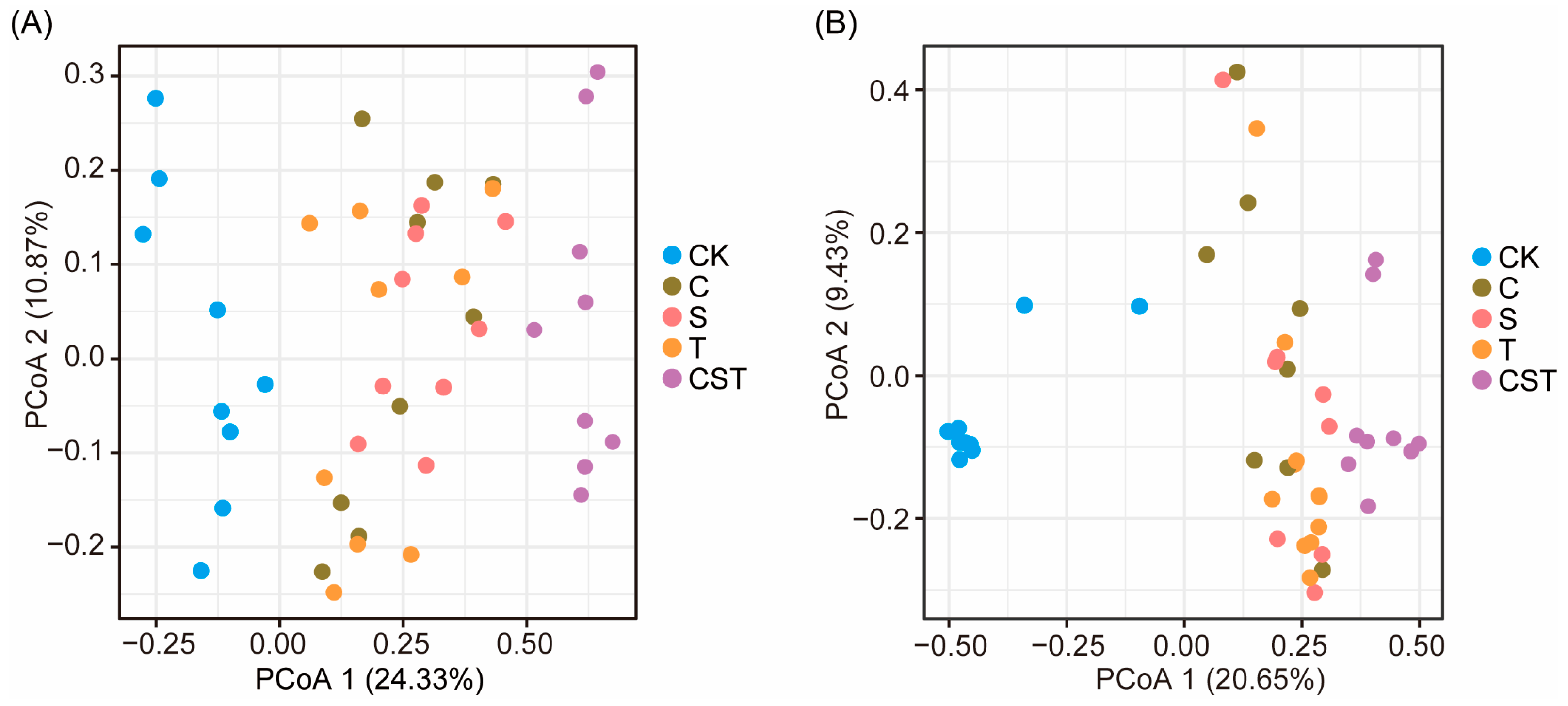
Microbial α-diversity (richness/evenness) did not change, whereas β-diversity (community composition) differed significantly, especially for CST. The results showed that the C, S, T, and CST treatments significantly altered the composition of the rhizosphere bacterial and fungal communities compared to the CK treatment (ANOSIM, p < 0.05; Figure 2; Tables S3 and S4). Moreover, compared with the C, S, and T treatments, CST treatment induced additional modifications to the rhizosphere bacterial and fungal community composition (ANOSIM, p < 0.05; Figure 2 and Tables S3 and S4). Moreover, the rhizosphere bacterial and fungal community compositions were positively correlated with cucumber yield and negatively correlated with F. oxysporum density (Spearman correlation, p < 0.05; Tables S5 and S6).

2.4. Effects of the Combined Application of Chitin, Straw, and Trichoderma on the Rhizosphere Microbial Taxonomic Composition and Its Relationships with Crop Yield and Pathogen Density

Based on the OTU level, the relative abundances of 37 bacterial OTUs, including Niabella, Streptacidiphilus, Parasegetibacter, Rathayibacter, Amnibacterium, Tepidibacillus, Pedobacter, Nakamurella, Lysinibacillus, Phenylobacterium, Sphaerobacter, Tumebacillus, Streptomyces, Propionicicella, Nocardia, Nakamurella, Ornithinibacillus, Fulvimonas, Pallidibacillus, Cohnella, Candidimonas, Gp3, Sphingomonas, Bacillus, Camellibacillus, and Flavisolibacter, were positively correlated with cucumber yield (Spearman correlation, p < 0.05; Table S7). Based on the corrections, these bacteria were identified as potentially growth-promoting bacteria. The relative abundances of 21 bacterial OTUs, including Bacillus, Altererythrobacter, Streptacidiphilus, Halobacillus, Falsiroseomonas, Rhodanobacter, Niabella, Streptomyces, Acidovorax, Amnibacterium, Cerasibacillus, Dyella, Chitinophaga, Rathayibacter, Actinocatenispora, Nocardia, Pseudalkalibacillus and Symbioplanes, were negatively correlated with F. oxysporum density (Spearman correlation, p < 0.05; Table S8). Based on the corrections, these bacteria were identified as potentially pathogen-suppressing bacteria.
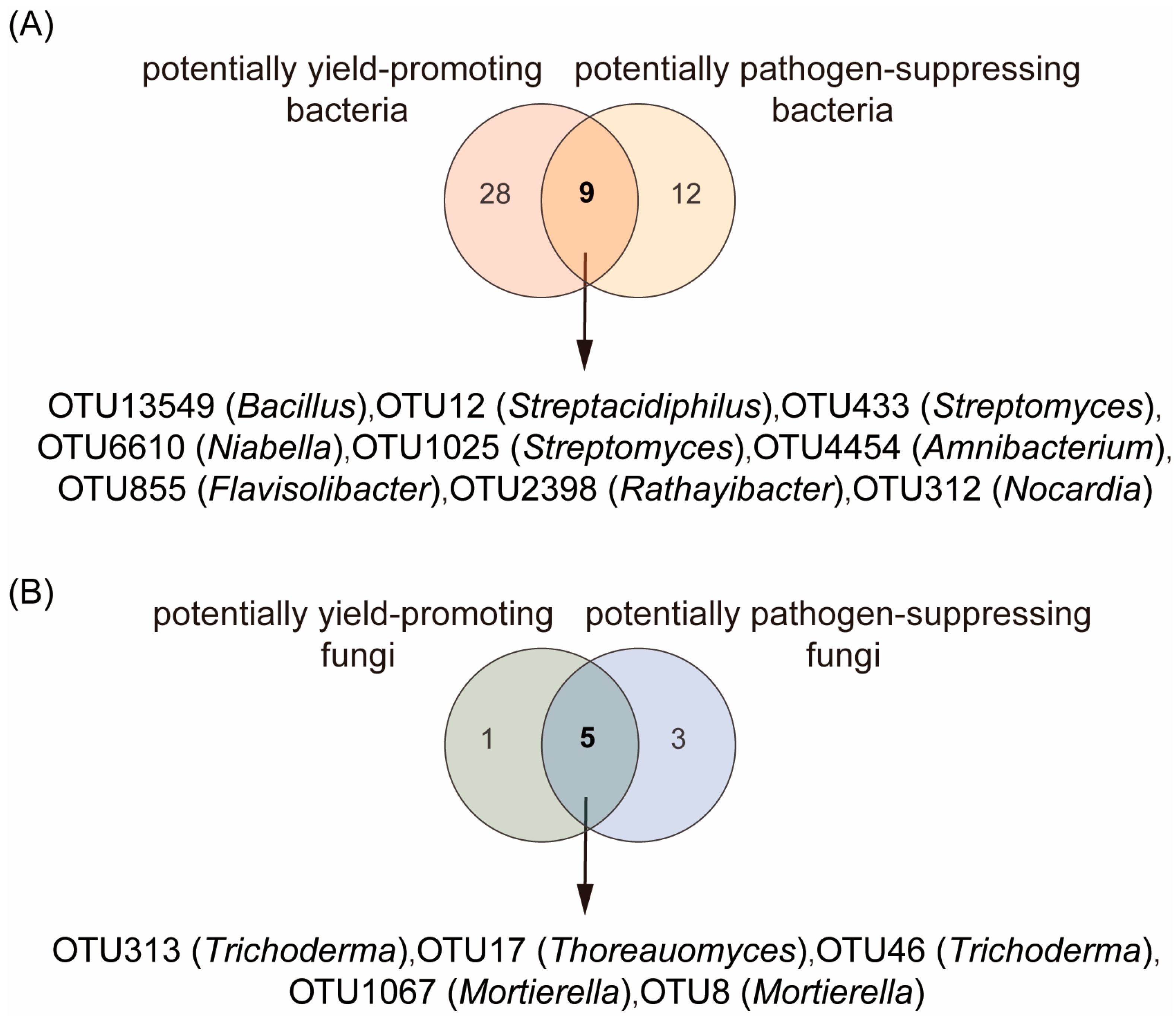
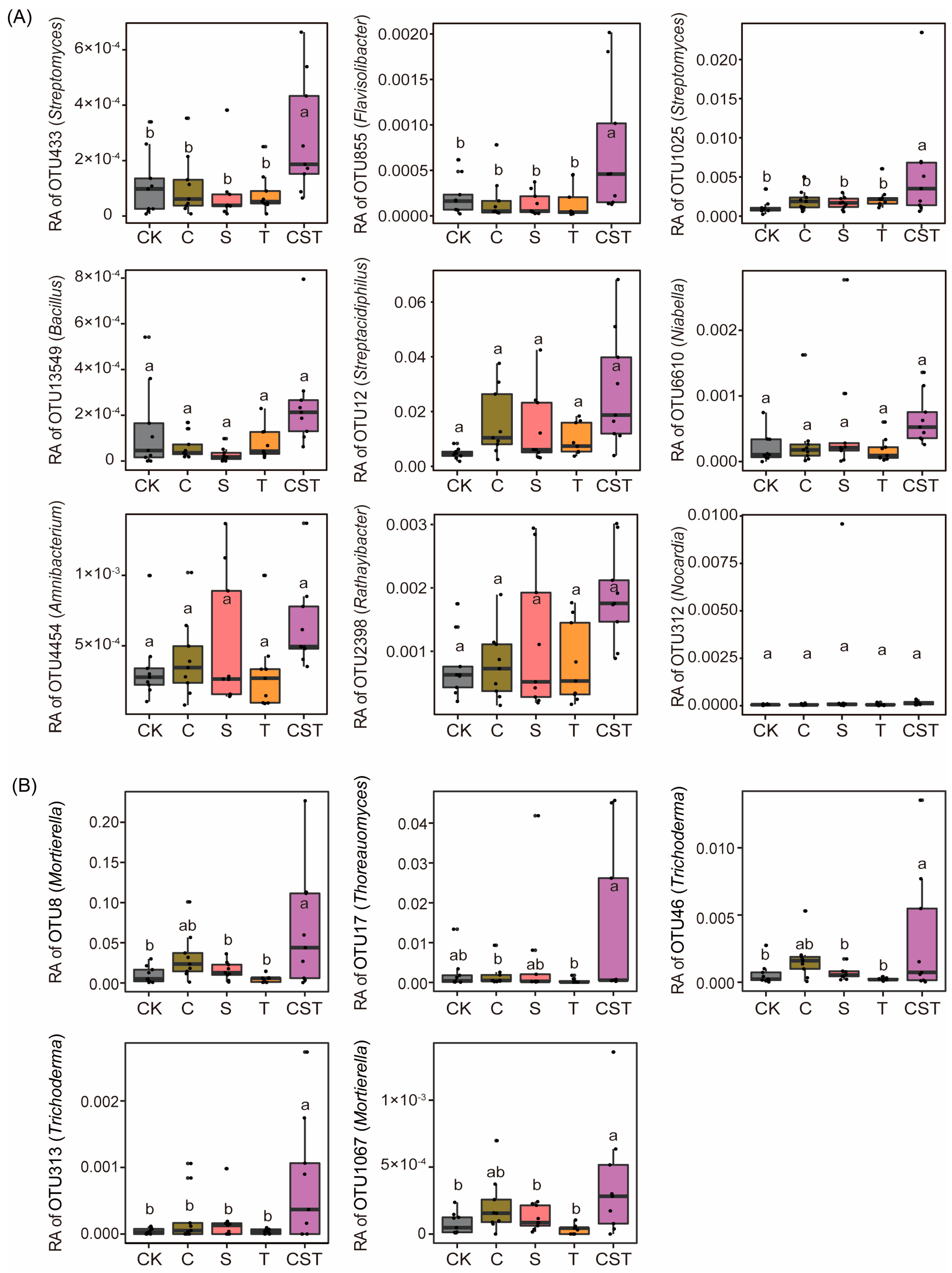
Further Venn diagram analysis was performed on bacterial taxa associated with plant growth promotion and pathogen suppression (Figure 3A). Nine bacterial OTUs were consistently identified as overlapping key taxa that contribute to both potentially growth-promoting and pathogen-suppressive functions in plants, including OTU13549 (Bacillus), OTU12 (Streptacidiphilus), OTU433 (Falsiroseomonas), OTU6610 (Niabella), OTU1025 (Streptomyces), OTU4454 (Amnibacterium), OTU855 (Flavisolibacter), OTU2398 (Rathayibacter), and OTU312 (Nocardia). Among the 9 bacterial OTUs, CST treatment significantly increased the relative abundances of bacterial OTU433 (Streptomyces), OTU855 (Flavisolibacter), and OTU1025 (Streptomyces) compared with those in the CK, C, S, and T treatments (Duncan test, p < 0.05; Figure 4A). These bacterial taxa were further designated in this study as core bacteria (which play dual functional roles in potentially promoting plant growth and suppressing pathogens and are induced by the combined application of chitin, straw, and Trichoderma).
Based on the OTU level, the relative abundances of 6 fungal OTUs, including Trichoderma, Mortierella, Thoreauomyces, and Penicillium, were positively correlated with cucumber yield (Spearman correlation, p < 0.05; Table S9). Based on the corrections, these fungi were identified as potentially growth-promoting fungi. The relative abundances of 8 fungal OTUs, including Mortierella, Trichoderma, Corynespora, Kochiomyces, Thoreauomyces, and Rhizophlyctis, were negatively correlated with F. oxysporum density (Spearman correlation, p < 0.05; Table S10). Based on the corrections, these fungi were identified as potentially pathogen-suppressing fungi.
Further Venn diagram analysis was performed on fungal taxa associated with plant growth promotion and pathogen suppression (Figure 3B). Five fungal OTUs were consistently identified as overlapping key taxa that contribute to both potentially growth-promoting and pathogen-suppressive functions in plants: OTU313 (Trichoderma), OTU17 (Thoreauomyces), OTU46 (Trichoderma), OTU1067 (Mortierella), and OTU8 (Mortierella). Among the 5 fungal OTUs, CST treatment significantly increased the relative abundance of fungal OTU313 (Trichoderma) compared with those in the CK, C, S, and T treatments (Duncan test, p < 0.05; Figure 4B). This fungal taxon was designated in this study as core fungi (which play dual functional roles in potentially promoting plant growth and suppressing pathogens and are induced by the combined application of chitin, straw, and Trichoderma).
Given these results, we used subsequent network analyses to explore associations among the previously defined core taxa.

2.5. Relationships Between Core Rhizosphere Bacteria and Fungi with Combined Potentially Growth-Promoting and Pathogen-Suppressive Functions in Plants

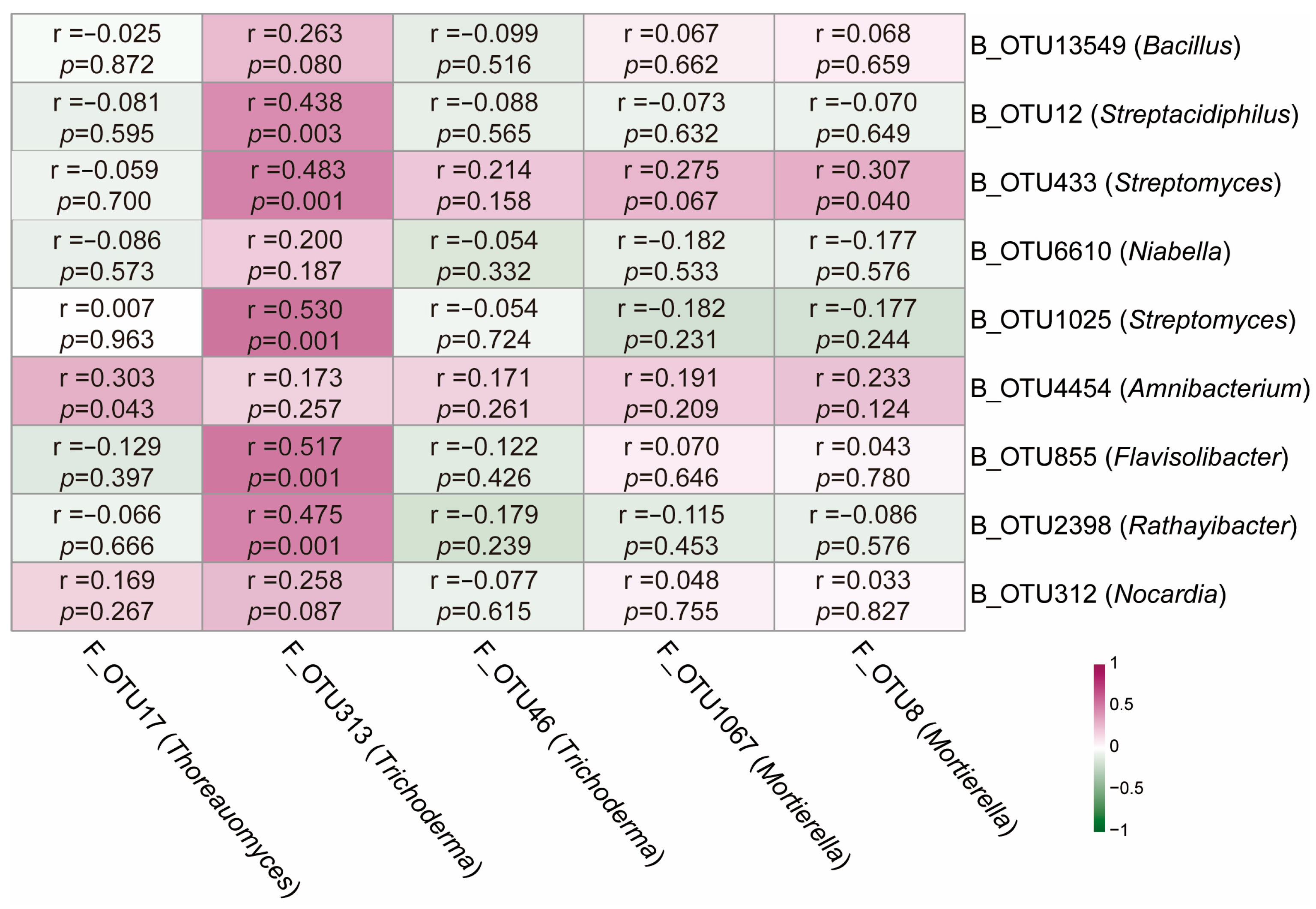
Network analyses showed that the relative abundances of the core rhizosphere bacteria OTU433 (Streptomyces) (Spearman correlation, r = 0.483, p = 0.001), OTU855 (Flavisolibacter) (Spearman correlation, r = 0.517, p = 0.001), and OTU1025 (Streptomyces) (Spearman correlation, r = 0.530, p = 0.001) were positively correlated with the relative abundance of the core rhizosphere fungus OTU313 (Trichoderma) (Spearman correlation, p < 0.05; Figure 5).

3. Discussion

We demonstrate here that the combined application of organic wastes and the Trichoderma strain (T. guizhouense NJAU4742) can shape distinct rhizosphere bacterial and fungal communities, promoting an increase in beneficial microorganisms and their positive interactions, which contribute to enhanced plant growth and pathogen suppression.
Our findings indicate that the combined application of chitin, straw, and the Trichoderma strain (T. guizhouense NJAU4742) under field conditions effectively promotes plant growth and suppresses pathogens. These results align with previous research, which has shown that the decomposition of organic wastes such as straw and chitin releases nutrients that benefit beneficial soil microorganisms and plant growth [23]. Additionally, previous studies have demonstrated that Trichoderma not only promotes growth and controls disease but also strongly degrades organic wastes such as straw by producing various enzymes that facilitate waste decomposition in soil environments [15,24]. Moreover, principal coordinate analysis (PCoA) and ANOSIM revealed that the combined application significantly altered the composition of the bacterial and fungal communities in the rhizosphere soil, driving functional shifts in the rhizosphere microbiome. Furthermore, the modified rhizosphere microbial communities resulting from the combined application were correlated with both the yield of cucumbers and the density of F. oxysporum, demonstrating that the combined of the Trichoderma strain (T. guizhouense NJAU4742) with chitin and straw under field conditions increases plant growth and suppresses soil-borne diseases [25,26]. These findings underscore that the combined application may exert co-occurring growth-promoting and disease-suppressing effects by modulating the rhizosphere microbial community. However, because our experimental design lacked two-factor combination treatments (e.g., C+S, C+T, S+T), it may not be able to distinguish additive from synergistic interactions among treatments.
We further validate the microecological mechanism of co-occurring growth promotion and disease suppression—the specific bacterial and fungal taxa stimulated by the combined application under field conditions, as well as their coupled relationships with cucumber yield and the abundance of F. oxysporum. Our results showed that the combined application of chitin, straw, and the Trichoderma strain (T. guizhouense NJAU4742) effectively increased the abundance of bacterial taxa such as Flavisolibacter and Streptomyces and the fungal genus Trichoderma. These microorganisms exhibited positive correlations with cucumber yield and negative correlations with the abundance of F. oxysporum, as well as evidence of positive interactions among these bacterial and fungal taxa [27]. These findings showed that the combination of chitin, straw, and the Trichoderma strain (T. guizhouense NJAU4742) was associated with higher relative abundance of key microbial taxa—Flavisolibacter, Streptomyces, and Trichoderma previously reported as beneficial and their positive interactions coinciding with improved plant growth and disease suppression [16,28,29]. Previous research indicates that TgSWO from T. guizhouense NJAU4742 can expand root cell walls, thereby enhancing root colonization [30]. In addition, T. guizhouense NJAU4742 also can stimulate the beneficial indigenous bacteria and fungi, such as Massilia and Aspergillus [31,32]. Chitin and straw can serve as carbon and nitrogen sources, improving Trichoderma populations and selectively enriching beneficial indigenous bacteria and fungi in soils [33,34,35]. In addition, chitin may activate chitinolytic taxa, fostering dynamic interactions with Trichoderma through intricate biochemical signaling [36,37,38]. Thus, the combined application of organic wastes and the Trichoderma strain (T. guizhouense NJAU4742) may further stimulate the population of Trichoderma and other beneficial microorganisms that have a positive interaction with it in the soil, increasing crop yields and reducing the number of pathogenic bacteria. Our study confirms the microecological mechanism underlying the co-occurring promotion of plant growth and suppression of diseases by the combined application of chitin, straw, and the Trichoderma strain (T. guizhouense NJAU4742). This combination (chitin + straw + T. guizhouense NJAU4742) can be considered an integrated organic–biocontrol approach with synergistic potential in future agriculture.
Overall, we demonstrate that the combined application of chitin, straw, and the Trichoderma strain (T. guizhouense NJAU4742) can shape distinct rhizosphere bacterial and fungal communities in plants, promoting an increase in beneficial microorganisms and their positive interactions, which contribute to increased crop growth and reduced pathogen density. Our research hopefully provides valuable insights into the substantial potential of integrating organic waste with biocontrol microbes to improve plant performance in future sustainable agricultural systems. However, our findings were conducted in a greenhouse facility under field conditions for one season and were based on correlative analyses. Subsequently, large-scale field trials can be carried out and experiments over multiple seasons can be conducted to verify the universality of our conclusions. Microorganisms with potential disease-suppressing and growth-promoting functions should also be isolated to verify their disease-suppressing and growth-promoting capabilities.

4. Materials and Methods

4.1. Site Description and Experimental Design

The field experiment was carried out in August 2020 in a greenhouse located at the Nanjing Institute of Vegetable and Flower Science, Hengxi Town, Jiangning District, Nanjing, Jiangsu Province, China (31°43′ N, 118°46′ E). The study area is characterized by a subtropical monsoon climate, featuring an annual mean temperature of 15.4 °C and an average annual precipitation of 1106 mm [39]. The soil was classified as yellow loam and exhibited the following initial physicochemical properties: a pH of 7.08, an organic matter content of 28.4 g·kg−1, a total nitrogen content of 2.04 g·kg−1, an ammonium nitrogen concentration of 52.7 mg·kg−1, a nitrate nitrogen concentration of 544 mg·kg−1, an available phosphorus (as P2O5) concentration of 242 mg·kg−1, and an available potassium (as K2O) concentration of 332 mg·kg−1 [40].
A randomized complete block design consisting of five treatments and nine replicates per treatment was employed. Each plot measured 8 m2 (4 m × 2 m) and was separated by 50 cm-wide cement barriers to prevent cross-contamination. The treatments consisted of (1) control (CK); (2) chitin (C), applied at 2 g·kg−1 dry soil; (3) straw (S), applied at 2 g·kg−1 dry soil; (4) the Trichoderma strain (T. guizhouense NJAU4742) (T), inoculated at 1 × 10³ spores·g−1 dry soil; and (5) combined treatment (CST), incorporating chitin and straw each at 2 g·kg−1 dry soil and the Trichoderma strain (T. guizhouense NJAU4742) at 1 × 10³ spores·g−1 dry soil. All amendments were uniformly incorporated into the top 20 cm of soil prior to transplanting. Cucumber seedlings are cultivated in seedling trays filled with nutrient-rich seedling substrate at the greenhouses (daytime: 28 °C, night: 25 °C, all-day average humidity of 50%). Cucumber seedlings at the three-leaf, one-heart stage were transplanted at a spacing of 40 cm × 50 cm, with 40 plants per plot. Standard agronomic practices, such as irrigation and weeding, were consistently implemented throughout the growing season, and chemical fungicides were excluded from the management protocol.
The cucumber cultivar Ningfeng Chunqiu, which is widely cultivated in protected cultivation systems and exhibits moderate resistance to Fusarium wilt, was provided by the Nanjing Vegetable and Flower Science Research Institute. Chitin (purity ≥ 95%) was purchased from Shandong Zhongsheng Marine Technology Co., Ltd. (Weihai, Shandong, China), and sieved through a 20-mesh screen prior to application. Rice straw was collected from Lianyungang, Jiangsu Province, air-dried, pulverized, and similarly sieved to a 20-mesh particle size. The biocontrol strain Trichoderma guizhouense NJAU4742, known for its dual ability to promote plant growth and suppress disease [31,41,42], was isolated and maintained at the Jiangsu Key Laboratory of Solid Organic Waste Resource Utilization (College of Resources and Environmental Sciences, Nanjing Agricultural University). The strain was cultured in potato dextrose broth (PDB) at 28 °C under shaking conditions (180 rpm) for 72 h, and the concentrations of the spore suspensions were adjusted to 1 × 10⁸ spores·mL−1 before application. Basal fertilization was carried out using agricultural-grade urea (N ≥ 46%), superphosphate (P2O5 ≥ 12%,), and potassium sulfate (K2O ≥ 50%). We applied 260 kg of agricultural-grade urea, 1625 kg of superphosphate, and 240 kg of potassium sulfate per hectare as basal fertilizer before transplanting seedlings. The base fertilizers are produced and packaged by Kingenta Chemical Fertilizer Co., Ltd. (Shenzhen, Guangdong, China).

4.2. Cucumber Yield Measurement and Rhizosphere Soil Sample Collection

Since the fruiting period (cucumber plants entered the fruiting stage 55 days after transplantation) best represents the final growth outcome of the plants, we recorded cucumber yield and collected rhizosphere soil samples during this period. At this period, we collected all plants (twenty plants) in each plot (a replicate of a treatment), weighed the cucumber fruits from the plants, and recorded the weights as the yield of each plot. And then, the cumulative yield per plot was converted to yield per hectare.
Meanwhile, ten plant samples of each plot were collected using an “S-shaped” sampling method. A S-shaped sampling method systematically collects samples across large areas by following an S-shaped trajectory, ensuring comprehensive spatial coverage. Widely used in agricultural surveys, this approach provides a more representative and efficient alternative to random or other conventional sampling methods. Ten plant roots of each plot were vigorously shaken to remove loosely bound soil, retaining only a thin layer of approximately 1 mm of soil closely associated with the root surface. These roots, along with the adhering soil, were transferred into a sterile flask containing sterile phosphate-buffered saline (PBS). Using sterile forceps, the roots were thoroughly agitated to dislodge all remaining soil particles from the root surfaces. The resulting soil suspension was then centrifuged at 8000 rpm for 20 min, and the resulting pellet was collected as rhizosphere soil of a replicate of a treatment. 45 rhizosphere soil samples (9 replicates × 5 treatments) were stored at −80 °C for DNA extraction, microbial community analysis, and quantification of the pathogen F. oxysporum.

4.3. Soil Genomic DNA Extraction, Real-Time PCR, Illumina NovaSeq Sequencing and Bioinformatic Analyses

Genomic DNA was isolated from 0.5 g of frozen soil samples using the DNeasy® PowerMax® Soil Kit (Qiagen, Hilden, Germany) following the manufacturer’s protocol. The concentration and purity of the extracted DNA were assessed using a NanoDrop 2000 spectrophotometer (Thermo Fisher Scientific, Waltham, MA, USA), and only those samples with OD260/OD280 ratios within the range of 1.8–2.0 were selected for further analysis. Quantification of F. oxysporum abundance was carried out via real-time quantitative PCR (qPCR) on a Step One Plus Real-Time PCR System (Applied Biosystems, Foster City, CA, USA). The assay employed the specific primers FocF3 (5′-AAACGAGCCCGCTATTTGAG-3′) and FocR7 (5′-TATTTCCTCCACATTGCCATG-3′) [20]. Each 20 μL sample for qPCR analysis consisted of 10 μL of SYBR Premix Ex Taq II (Takara, Kyoto, Japan), 0.4 μL of each primer (10 μmol·L−1), 2 μL of DNA template (10 ng·μL−1), and 7.2 μL of sterile distilled water. The amplification program included initial denaturation at 95 °C for 30 s, followed by 40 cycles of 95 °C for 5 s and 60 °C for 30 s, with a subsequent melting curve analysis ranging from 60 to 95 °C. Copy numbers of F. oxysporum per gram of dry soil were estimated using a standard curve generated from plasmid DNA containing the target gene sequence. All the samples were run in triplicate to ensure reproducibility.
The V4 region of the bacterial 16S rRNA gene was amplified using the primer pair 515F (5′-GTGCCAGCMGCCGCGGTAA-3′) and 806R (5′-GGACTACHVGGGTWTCTAAT-3′) [43], whereas the fungal ITS1 region was amplified with the primers ITS1F (5′-CTTGGTCATTTAGAGGAAGTAA-3′) and ITS2 (5′-GCTGCGTTCTTCATCGATGC-3′) [44]. Each 25 μL PCR mixture sample consisted of 12.5 μL of 2 × Taq Plus Master Mix (Vazyme, Nanjing, China), 1 μL of each forward and reverse primer (10 μmol·L−1), 2 μL of DNA template (10 ng·μL−1), and 8.5 μL of sterile distilled water. Amplification was carried out under the following thermal cycling conditions: initial denaturation at 95 °C for 5 min, followed by 30 cycles of 95 °C for 30 s, annealing at 55 °C for 30 s, extension at 72 °C for 45 s, and a final extension at 72 °C for 10 min. Amplified products were examined via 1.5% agarose gel electrophoresis, purified using the AxyPrep DNA Gel Extraction Kit (Axygen, San Jose, CA, USA), and quantified with a Qubit 3.0 fluorometer (Thermo Fisher Scientific, Waltham, MA, USA). Purified amplicons from all the samples were normalized to equal concentrations and pooled together to prepare sequencing libraries, which were subsequently sequenced on an Illumina MiSeq platform with paired-end 250 bp reads (PE250) by Guangzhou Magigene Biotechnology Co., Ltd. (Guangzhou, China).
Raw reads were filtered with Trimmomatic to remove low-quality reads (Q value < 20) and adapter sequences. Paired-end reads were merged using FLASH, and operational taxonomic units (OTUs) were clustered at 97% similarity with USEARCH v11.0 after chimeric removal [45]. Taxonomic annotation was performed with the RDP Naive Bayesian Classifier against the RDP 16S rRNA database [46] for bacteria and the UNITE ITS database for fungi [47].

4.4. Network Analyses

Network analyses were used to show the relationships between core rhizosphere bacteria and fungi with combined potentially growth-promoting and pathogen-suppressive functions in plants. Network Analyses was calculated by pairwise Spearman correlations. A pairwise Spearman correlation matrix was calculated with the “corr.test” function in the package “psych” [48] in R and p-values were adjusted with the false discovery rate method [49].

4.5. Statistical Analyses

The data for alpha and beta diversity was rarefied using the “subsample” command in MOTHUR (v 1.48.0. https://mothur.org/). Alpha diversity indices (Shannon and Shannon evenness) were calculated using MOTHUR (v 1.48.0. https://mothur.org/) [50], whereas beta diversity was evaluated through principal coordinate analysis (PCoA) based on Bray–Curtis dissimilarity distances. The significance of differences among treatments was assessed using ANOSIM [50]. One-way analysis of variance (ANOVA) was conducted in SPSS 26.0, and treatment means were compared using Duncan’s multiple range test at p < 0.05. The ANOVA data were assessed for normality and homogeneity of variance, and satisfied the assumptions of normal distribution and homoscedasticity. Spearman correlation analysis was performed using R to examine the relationships between cucumber yield, F. oxysporum density, and microbial indices (including microbial alpha and beta diversity and the relative abundances of microbial OTUs). Spearman correlation was calculated with the “corr.test” function in the package “psych” [48] in R and p-values were adjusted with the false discovery rate method [49].

Supplementary Materials

The following supporting information can be downloaded at: https://www.mdpi.com/article/10.3390/plants14233660/s1, Figure S1: The pathogen density in the field experiment before applying different treatments; Figure S2: Effects of the addition of different materials on the rhizosphere microbial diversity and evenness; Table S1: Relationship between microbial α-diversity and cucumber yield; Table S2: Relationship between microbal α-diversity and Fusarium oxysporum density; Table S3: Treatment effects on bacterial community composition based on ANOSIM; Table S4: Treatment effects on fungal community composition based on ANOSIM; Table S5: Relationship between microbial community composition and cucumber yield; Table S6: Relationship between microbial community composition and Fusarium oxysporum density; Table S7: Bacterial OTUs that have positive correlations with cucumber yield; Table S8: Bacterial OTUs that have negative correlations with Fusarium oxysporum density; Table S9: Fungal OTUs that have positive correlations with cucumber yield; Table S10: Fungal OTUs that have negative correlations with Fusarium oxysporum density.

Author Contributions

Y.W., X.H., C.S. and Z.Z. performed all experiments; Y.W., S.G., R.L. and Q.S. designed the study and wrote the majority of the manuscript; Y.W. and S.G. analyzed the data; R.L. and Q.S. participated in the design of the study, provided comments, and edited the manuscript. All authors have read and agreed to the published version of the manuscript.

Funding

This study was funded by the Young Elite Scientists Sponsorship Program by CAST (ZZFH2024-2026QNRC001), the National Natural Science Foundation of China (42307171), the Postdoctoral Science Foundation of China (2023M731724) and the key project at central government level: the ability establishment of sustainable use for valuable Chinese medicine resources (2060302).

Data Availability Statement

All raw 16S rRNA and ITS gene sequences are available at the CNCB (China National Center of Bioinformation) under the accession number BioProject PRJCA050036.

Conflicts of Interest

The authors declare that they have no competing interests.

References

  1. Kaur, M.; Sharma, P. Recent Advances in Cucumber (Cucumis sativus L.). J. Hortic. Sci. Biotechnol. 2022, 97, 3–23. [Google Scholar] [CrossRef]
  2. Dong, J.; Wang, Y.; Xian, Q.; Chen, X.; Xu, J. Transcriptome Analysis Reveals Ethylene-Mediated Defense Responses to Fusarium oxysporum f. sp. Cucumerinum Infection in Cucumis sativus L. BMC Plant Biol. 2020, 20, 334. [Google Scholar] [CrossRef]
  3. Vakalounakis, D.J.; Chalkias, J. Survival of Fusarium oxysporum f. sp. radicis-cucumerinum in Soil. Crop Prot. 2004, 23, 871–873. [Google Scholar] [CrossRef]
  4. Scarlett, K.; Tesoriero, L.; Daniel, R.; Guest, D. Sciarid and Shore Flies as Aerial Vectors of Fusarium oxysporum f. sp. cucumerinum in Greenhouse Cucumbers. J. Appl. Entomol. 2014, 138, 368–377. [Google Scholar] [CrossRef]
  5. Priyadarshini, C.; Lal, R.; Yuan, P.; Liu, W.; Adhikari, A.; Bhandari, S.; Xia, Y. Plant Disease Suppressiveness Enhancement via Soil Health Management. Biology 2025, 14, 924. [Google Scholar] [CrossRef] [PubMed]
  6. Yasir, M.; Hossain, A.; Pratap-Singh, A. Pesticide Degradation: Impacts on Soil Fertility and Nutrient Cycling. Environments 2025, 12, 272. [Google Scholar] [CrossRef]
  7. Varzakas, T.; Smaoui, S. Global Food Security and Sustainability Issues: The Road to 2030 from Nutrition and Sustainable Healthy Diets to Food Systems Change. Foods 2024, 13, 306. [Google Scholar] [CrossRef]
  8. Xia, L.; Wang, S.; Yan, X. Effects of Long-Term Straw Incorporation on the Net Global Warming Potential and the Net Economic Benefit in a Rice–Wheat Cropping System in China. Agric. Ecosyst. Environ. 2014, 197, 118–127. [Google Scholar] [CrossRef]
  9. Sheng, Y.; Tian, X.; Qiao, W.; Peng, C. Measuring Agricultural Total Factor Productivity in China: Pattern and Drivers over the Period of 1978–2016. Aust. J. Agric. Resour. Econ. 2020, 64, 82–103. [Google Scholar] [CrossRef]
  10. Zhao, X.; Li, R.-C.; Liu, W.-X.; Liu, W.-S.; Xue, Y.-H.; Sun, R.-H.; Wei, Y.-X.; Chen, Z.; Lal, R.; Dang, Y.P.; et al. Estimation of Crop Residue Production and Its Contribution to Carbon Neutrality in China. Resour. Conserv. Recycl. 2024, 203, 107450. [Google Scholar] [CrossRef]
  11. Gómez-Sanabria, A.; Kiesewetter, G.; Klimont, Z.; Schoepp, W.; Haberl, H. Potential for Future Reductions of Global GHG and Air Pollutants from Circular Waste Management Systems. Nat. Commun. 2022, 13, 106. [Google Scholar] [CrossRef]
  12. Akhila, D.S.; Ashwath, P.; Manjunatha, K.G.; Akshay, S.D.; Reddy Surasani, V.K.; Sofi, F.R.; Saba, K.; Dara, P.K.; Ozogul, Y.; Ozogul, F. Seafood Processing Waste as a Source of Functional Components: Extraction and Applications for Various Food and Non-Food Systems. Trends Food Sci. Technol. 2024, 145, 104348. [Google Scholar] [CrossRef]
  13. Grifoll, V.; Bravo, P.; Pérez, M.N.; Pérez-Clavijo, M.; García-Castrillo, M.; Larrañaga, A.; Lizundia, E. Environmental Sustainability and Physicochemical Property Screening of Chitin and Chitin-Glucan from 22 Fungal Species. ACS Sustain. Chem. Eng. 2024, 12, 7869–7881. [Google Scholar] [CrossRef] [PubMed]
  14. Glendining, M.; Powlson, D.S. The Effect of Long-Term Applications of Inorganic Nitrogen Fertilizer on Soil Organic Nitrogen. In Advances in Soil Organic Matter Research; Woodhead Publishing: Cambridge, UK, 2003; pp. 329–338. [Google Scholar]
  15. Woo, S.L.; Hermosa, R.; Lorito, M.; Monte, E. Trichoderma: A Multipurpose, Plant-Beneficial Microorganism for Eco-Sustainable Agriculture. Nat. Rev. Microbiol. 2023, 21, 312–326. [Google Scholar] [CrossRef] [PubMed]
  16. Yao, X.; Guo, H.; Zhang, K.; Zhao, M.; Ruan, J.; Chen, J. Trichoderma and Its Role in Biological Control of Plant Fungal and Nematode Disease. Front. Microbiol. 2023, 14, 1160551. [Google Scholar] [CrossRef]
  17. Guzmán-Guzmán, P.; Etesami, H.; Santoyo, G. Trichoderma: A Multifunctional Agent in Plant Health and Microbiome Interactions. BMC Microbiol. 2025, 25, 434. [Google Scholar] [CrossRef]
  18. Chen, Q.; Song, Y.; An, Y.; Lu, Y.; Zhong, G. Soil Microorganisms: Their Role in Enhancing Crop Nutrition and Health. Diversity 2024, 16, 734. [Google Scholar] [CrossRef]
  19. Musini, A.; Deepu, P.G.; Harikrishna, K.; Kumar, P.P.; Navyatha, S.; Harihara, J. Soil Microbial Community Dynamics and Plant Proliferation. In Soil Microbiome in Green Technology Sustainability; Aransiola, S.A., Atta, H.I., Maddela, N.R., Eds.; Springer Nature: Cham, Switzerland, 2024; pp. 133–157. ISBN 978-3-031-71844-1. [Google Scholar]
  20. Walia, A.; Sharma, S.K.; Gupta, B.K.; Rana, N.; Sharma, A.; Verma, P. Biocontrol Potential of Trichoderma-Derived Chitinase: Optimization, Purification, and Antifungal Activity against Soilborne Pathogens of Apple. Front. Fungal Biol. 2025, 6, 1618728. [Google Scholar] [CrossRef] [PubMed]
  21. Kappel, L.; Münsterkötter, M.; Sipos, G.; Escobar Rodriguez, C.; Gruber, S. Chitin and Chitosan Remodeling Defines Vegetative Development and Trichoderma Biocontrol. PLoS Pathog. 2020, 16, e1008320. [Google Scholar] [CrossRef]
  22. Zhang, C.; Lin, Z.; Que, Y.; Fallah, N.; Tayyab, M.; Li, S.; Luo, J.; Zhang, Z.; Abubakar, A.Y.; Zhang, H. Straw Retention Efficiently Improves Fungal Communities and Functions in the Fallow Ecosystem. BMC Microbiol. 2021, 21, 52. [Google Scholar] [CrossRef]
  23. Lin, C.; Cheruiyot, N.K.; Bui, X.-T.; Ngo, H.H. Composting and Its Application in Bioremediation of Organic Contaminants. Bioengineered 2022, 13, 1073–1089. [Google Scholar] [CrossRef] [PubMed]
  24. Song, H.; Chang, Z.; Hu, X.; Li, Y.; Duan, C.; Yang, L.; Wang, H.; Li, T. Combined Application of Chemical and Organic Fertilizers Promoted Soil Carbon Sequestration and Bacterial Community Diversity in Dryland Wheat Fields. Land 2024, 13, 1296. [Google Scholar] [CrossRef]
  25. Iqbal, S.; Begum, F.; Nguchu, B.A.; Claver, U.P.; Shaw, P. The Invisible Architects: Microbial Communities and Their Transformative Role in Soil Health and Global Climate Changes. Environ. Microbiome 2025, 20, 36. [Google Scholar] [CrossRef]
  26. Jin, N.; Jin, L.; Wang, S.; Li, J.; Liu, F.; Liu, Z.; Luo, S.; Wu, Y.; Lyu, J.; Yu, J. Reduced Chemical Fertilizer Combined with Bio-Organic Fertilizer Affects the Soil Microbial Community and Yield and Quality of Lettuce. Front. Microbiol. 2022, 13, 863325. [Google Scholar] [CrossRef] [PubMed]
  27. Wang, Q.; Zhou, X.; Liu, Y.; Han, Y.; Zuo, J.; Deng, J.; Yuan, L.; Gao, L.; Bai, W. Mixed Oligosaccharides-Induced Changes in Bacterial Assembly during Cucumber (Cucumis sativus L.) Growth. Front. Microbiol. 2023, 14, 1195096. [Google Scholar] [CrossRef] [PubMed]
  28. Rathor, P.; De Silva, C.; Lumactud, R.A.; Gorim, L.Y.; Quideau, S.A.; Thilakarathna, M.S. Humalite Shapes the Wheat Rhizosphere Soil Microbiome by Altering Microbial Community Structure, Diversity, and Network Stability. Appl. Soil Ecol. 2025, 215, 106414. [Google Scholar] [CrossRef]
  29. Yang, K.; Wang, H.; Zhao, Z.; Li, H.; Wei, Y.; Wang, Y.; Hu, J.; Wu, Y.; Li, J. Effects of Trichoderma Harzianum and Arthrobacter Ureafaciens on Control of Fusarium Crown Rot and Microbial Communities in Wheat Root-Zone Soil. Phytopathol. Res. 2025, 7, 47. [Google Scholar] [CrossRef]
  30. Meng, X.; Miao, Y.; Liu, Q.; Ma, L.; Guo, K.; Liu, D.; Ran, W.; Shen, Q. TgSWO from Trichoderma Guizhouense NJAU4742 Promotes Growth in Cucumber Plants by Modifying the Root Morphology and the Cell Wall Architecture. Microb. Cell Factories 2019, 18, 148. [Google Scholar] [CrossRef]
  31. Hang, X.; Meng, L.; Ou, Y.; Shao, C.; Xiong, W.; Zhang, N.; Liu, H.; Li, R.; Shen, Q.; Kowalchuk, G.A. Trichoderma-Amended Biofertilizer Stimulates Soil Resident Aspergillus Population for Joint Plant Growth Promotion. npj Biofilms Microbiomes 2022, 8, 57. [Google Scholar] [CrossRef]
  32. Qiao, C.; Penton, C.R.; Xiong, W.; Liu, C.; Wang, R.; Liu, Z.; Xu, X.; Li, R.; Shen, Q. Reshaping the Rhizosphere Microbiome by Bio-Organic Amendment to Enhance Crop Yield in a Maize-Cabbage Rotation System. Appl. Soil Ecol. 2019, 142, 136–146. [Google Scholar] [CrossRef]
  33. Wieczorek, A. Trophic Interactions of a Chitin-Degrading Microbiome of an Aerated Agricultural Soil. Ph.D. Thesis, University of Bayreuth, Bayreuth, Germany, 2019. [Google Scholar]
  34. Izadi, H.; Asadi, H.; Bemani, M. Chitin: A Comparison between Its Main Sources. Front. Mater. 2025, 12, 1537067. [Google Scholar] [CrossRef]
  35. Liu, B.; Dai, Y.; Cheng, X.; He, X.; Bei, Q.; Wang, Y.; Zhou, Y.; Zhu, B.; Zhang, K.; Tian, X.; et al. Straw Mulch Improves Soil Carbon and Nitrogen Cycle by Mediating Microbial Community Structure and Function in the Maize Field. Front. Microbiol. 2023, 14, 1217966. [Google Scholar] [CrossRef]
  36. Veliz, E.A.; Martínez-Hidalgo, P.; Hirsch, A.M.; Veliz, E.A.; Martínez-Hidalgo, P.; Hirsch, A.M. Chitinase-Producing Bacteria and Their Role in Biocontrol. AIMS Microbiol. 2017, 3, 689–705. [Google Scholar] [CrossRef]
  37. Shao, Y.; Gu, S.; Peng, H.; Zhang, L.; Li, S.; Berendsen, R.L.; Yang, T.; Dong, C.; Wei, Z.; Xu, Y.; et al. Synergic Interactions between Trichoderma and the Soil Microbiomes Improve Plant Iron Availability and Growth. npj Biofilms Microbiomes 2025, 11, 56. [Google Scholar] [CrossRef]
  38. Kielak, A.M.; Cretoiu, M.S.; Semenov, A.V.; Sørensen, S.J.; van Elsas, J.D. Bacterial Chitinolytic Communities Respond to Chitin and pH Alteration in Soil. Appl. Environ. Microbiol. 2013, 79, 263–272. [Google Scholar] [CrossRef] [PubMed]
  39. Guo, S.; Xiong, W.; Hang, X.; Gao, Z.; Jiao, Z.; Liu, H.; Mo, Y.; Zhang, N.; Kowalchuk, G.A.; Li, R.; et al. Protists as Main Indicators and Determinants of Plant Performance. Microbiome 2021, 9, 64. [Google Scholar] [CrossRef] [PubMed]
  40. Hang, X. Formation Mechanism of High Yield Soil Microflora of Cucumber Based on Continous Application of Trichoderma Bio-Organic Fertilizer. Ph.D. Thesis, Nanjing Agricultural University, Nanjing, China, 2022. [Google Scholar]
  41. Wang, Q.; Garrity, G.M.; Tiedje, J.M.; Cole, J.R. Naïve Bayesian Classifier for Rapid Assignment of rRNA Se-quences into the New Bacterial Taxonomy. Appl. Environ. Microbiol. 2007, 73, 5261–5267. [Google Scholar] [CrossRef] [PubMed]
  42. Lu, H.; Zhou, P.; Li, F.; Wang, Y.; Gu, J.; Wang, Y.; Sun, S.; Zhang, M.; Wang, X. Trichoderma Guizhouense NJAU4742 Augments Morphophysiological Responses, Nutrient Availability and Photosynthetic Efficacy of Ornamental Ilex Verticillata. Tree Physiol. 2024, 44, tpae033. [Google Scholar] [CrossRef]
  43. Mei, H.; Li, T.; Wu, H.; Xia, Y.; Huang, Q.; Liu, D.; Shen, Q. Transcriptomic Profiling Reveals Key Gene in Trichoderma Guizhouense NJAU4742 Enhancing Tomato Tolerance Under Saline Conditions. Agriculture 2025, 15, 610. [Google Scholar] [CrossRef]
  44. Walters, W.; Hyde, E.R.; Berg-Lyons, D.; Ackermann, G.; Humphrey, G.; Parada, A.; Gilbert, J.A.; Jansson, J.K.; Caporaso, J.G.; Fuhrman, J.A.; et al. Improved Bacterial 16S rRNA Gene (V4 and V4-5) and Fungal Internal Transcribed Spacer Marker Gene Primers for Microbial Community Surveys. mSystems 2015. [Google Scholar] [CrossRef]
  45. Caporaso, J.G.; Lauber, C.L.; Walters, W.A.; Berg-Lyons, D.; Huntley, J.; Fierer, N.; Owens, S.M.; Betley, J.; Fraser, L.; Bauer, M.; et al. Ultra-High-Throughput Microbial Community Analysis on the Illumina HiSeq and MiSeq Platforms. ISME J. 2012, 6, 1621–1624. [Google Scholar] [CrossRef]
  46. Zhou, Y.; Liu, Y.-X.; Li, X. USEARCH 12: Open-Source Software for Sequencing Analysis in Bioinformatics and Microbiome. iMeta 2024, 3, e236. [Google Scholar] [CrossRef] [PubMed]
  47. Xiong, W.; Guo, S.; Jousset, A.; Zhao, Q.; Wu, H.; Li, R.; Kowalchuk, G.A.; Shen, Q. Bio-Fertilizer Application Induces Soil Suppressiveness against Fusarium Wilt Disease by Reshaping the Soil Microbiome. Soil Biol. Biochem. 2017, 114, 238–247. [Google Scholar] [CrossRef]
  48. Revelle, W.; Revelle, M.W. Package ‘Psych’. Compr. R Arch. Netw. 2015, 337, 161–165. [Google Scholar]
  49. Benjamini, Y.; Hochberg, Y. Controlling the False Discovery Rate: A Practical and Powerful Approach to Multiple Testing. J. R. Stat. Soc. Ser. B Methodol. 1995, 57, 289–300. [Google Scholar] [CrossRef]
  50. Schloss, P.D.; Westcott, S.L.; Ryabin, T.; Hall, J.R.; Hartmann, M.; Hollister, E.B.; Lesniewski, R.A.; Oakley, B.B.; Parks, D.H.; Robinson, C.J.; et al. Introducing Mothur: Open-Source, Platform-Independent, Community-Supported Software for Describing and Comparing Microbial Communities. Appl. Environ. Microbiol. 2009, 75, 7537–7541. [Google Scholar] [CrossRef]
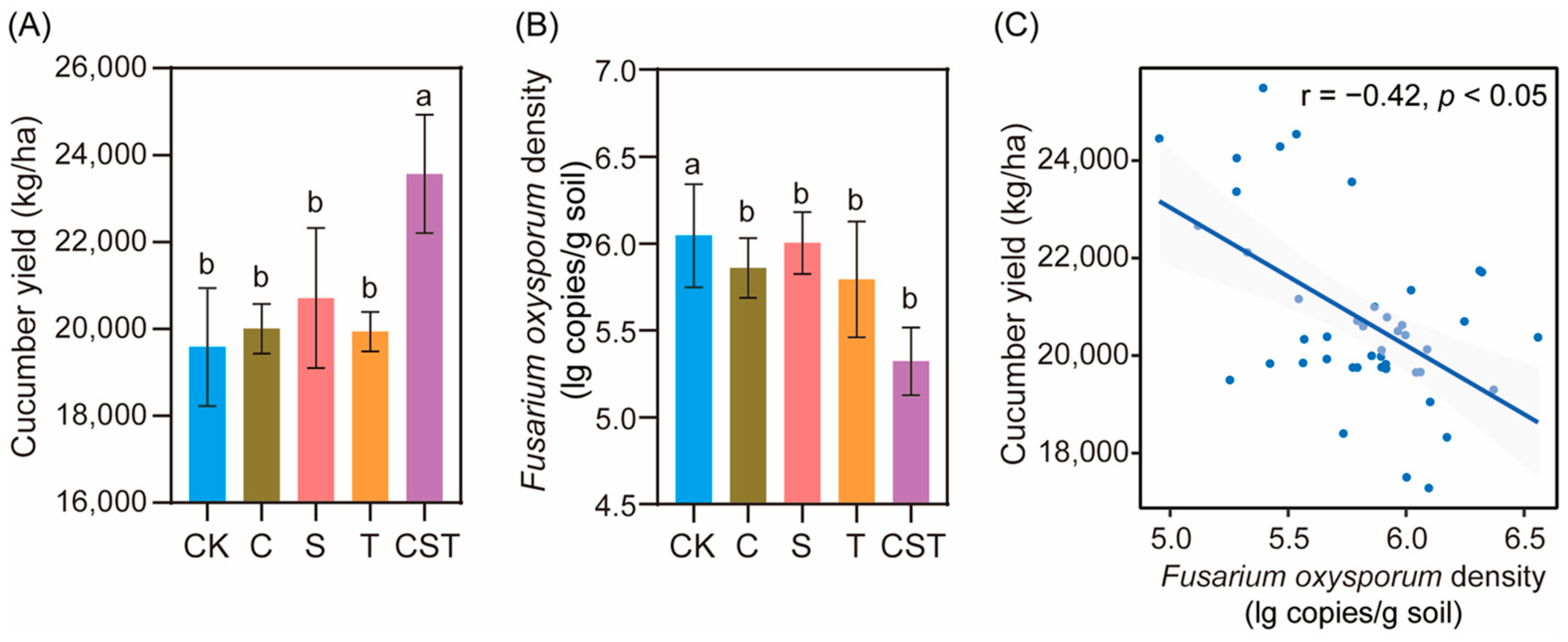
Figure 1. Effects of the addition of different materials on cucumber yield (A) and pathogen density (B) in the field experiment and the relationship between cucumber yield and pathogen density (C). In (A,B), CK denotes control treatment; C denotes chitin addition treatment; S denotes straw addition treatment; T denotes the Trichoderma strain (T. guizhouense NJAU4742) addition treatment; CST denotes treatment with a mixture of straw, chitin and the Trichoderma strain (T. guizhouense NJAU4742). Units for yield are kg/ha; units for F. oxysporum density are lg copies/g soil. n = 9 and data are presented as mean ± SD. Statistical significance was calculated by Duncan’s test. Different letters represent a significant difference at p < 0.05 according to Duncan’s test. In (C), statistical significance was calculated by Spearman correlation.
Plants 14 03660 g001
Figure 2. Effects of the addition of different materials on the rhizosphere bacterial (A) and fungal (B) community composition. CK denotes control treatment; C denotes chitin addition treatment; S denotes straw addition treatment; T denotes the Trichoderma strain (T. guizhouense NJAU4742) addition treatment; CST denotes treatment with a mixture of straw, chitin and the Trichoderma strain (T. guizhouense NJAU4742). n = 9 and statistical significance was calculated by ANOSIM.
Plants 14 03660 g002
Figure 3. Rhizosphere bacterial (A) and fungal (B) taxa with both potentially yield-promoting and pathogen-suppressing functions.
Plants 14 03660 g003
Figure 4. Effects of the addition of different materials on rhizosphere bacterial (A) and fungal (B) taxa with both potentially growth-promoting and disease-suppressing functions in plants. In (A,B), CK denotes control treatment; C denotes chitin addition treatment; S denotes straw addition treatment; T denotes Trichoderma addition treatment; CST denotes treatment with a mixture of straw, chitin and the Trichoderma strain (T. guizhouense NJAU4742). n = 9 and data are presented as mean ± SD. Statistical significance was calculated by Duncan’s test. Different letters represent a significant difference at p < 0.05 according to Duncan’s test.
Plants 14 03660 g004
Figure 5. Relationships between core bacterial and fungal groups and both potentially growth-promoting and disease-suppressing functions in plants. B, bacteria; F, fungi. Relationships were calculated by Spearman correlation and p-values were adjusted with the false discovery rate method.
Plants 14 03660 g005
Disclaimer/Publisher’s Note: The statements, opinions and data contained in all publications are solely those of the individual author(s) and contributor(s) and not of MDPI and/or the editor(s). MDPI and/or the editor(s) disclaim responsibility for any injury to people or property resulting from any ideas, methods, instructions or products referred to in the content.