Article

The Distribution Characteristics of Vegetation in the Subrange of the Altai Mountains, Xinjiang

1
Grassland College, Xinjiang Agricultural University, Urumqi 830011, China
2
CAS Key Laboratory of Biogeography and Bioresource in Arid Land, Xinjiang Institute of Ecology and Geography, Urumqi 830011, China
3
The Specimen Museum of Xinjiang Institute of Ecology and Geography, Chinese Academy of Sciences, Urumqi 830011, China
4
Institute of Botany, Academy Science Republic of Uzbekistan, Tashkent 100126, Uzbekistan
*
Author to whom correspondence should be addressed.
Plants 2023, 12(22), 3915; https://doi.org/10.3390/plants12223915

Submission received: 13 September 2023 / Revised: 7 November 2023 / Accepted: 15 November 2023 / Published: 20 November 2023
(This article belongs to the Special Issue Mapping Asia Plants)

Abstract

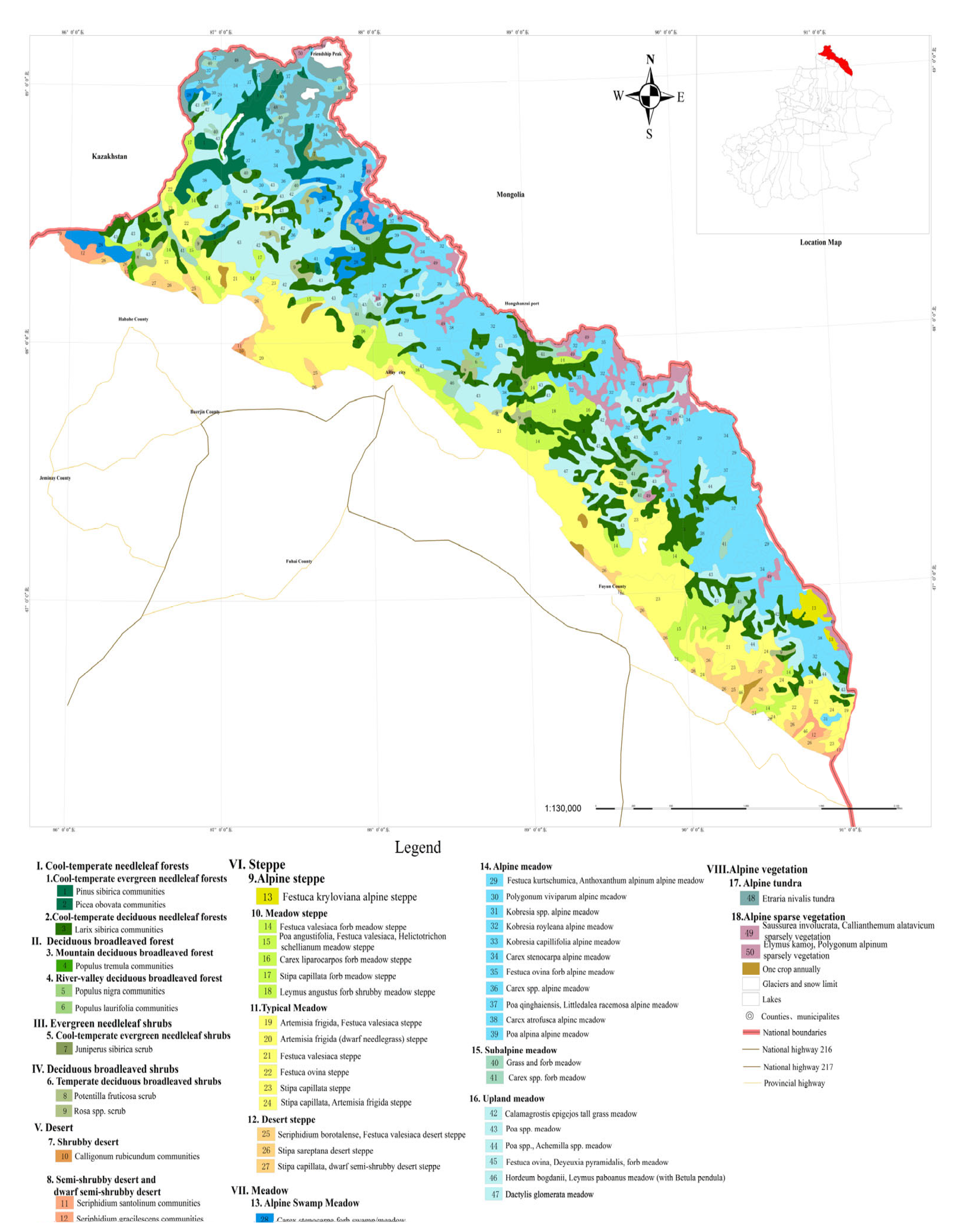
The Altai Mountains are an important center of biodiversity and are a major habitat for threatened and endemic species in Asia. Moreover, the Altai Mountains are a valuable site for the study of the evolution of central Asian vegetation. The Xinjiang Altai subrange represents the largest part of the southern Altai Mountains and has many unique plant communities. After conducting a thorough literature review and field investigation, we utilized the Chinese vegetation categorization system to identify the dominant plant communities in the Xinjiang Altai subrange and report their composition and distribution characteristics. Our results show that (1) the natural plant communities present in the Xinjiang Altai subrange can be divided into eight vegetation types, eighteen vegetation subtypes, and 50 communities. Among these, two communities—Form. Calligonum rubicundum and Form. Seriphidium borotalense-Festuca valesiaca—are present only in the Xinjiang Altai subrange. (2) The Xinjiang Altai subrange is located at the junction of three major biomes containing unique vegetation types (coniferous forest, temperate broadleaf forest, and desert). Thus, the Xinjiang Altai subrange is distinct in its staggered transition from mountainous boreal taiga to temperate desert. This research provides textual data to contextualize the cultural heritage of the Xinjiang Altai subrange and also provides a scientific basis for the protection and sustainable management of natural resources found in the Xinjiang Altai.
Keywords: Xinjiang Altai subrange; vegetation type; composition and distribution characteristics Xinjiang Altai subrange; vegetation type; composition and distribution characteristics