Article

In-Field Rainwater Harvesting Tillage in Semi-Arid Ecosystems: I Maize–Bean Intercrop Performance and Productivity


by
Weldemichael Tesfuhuney
1,*,
Muthianzhele Ravuluma
2,
Admire Rukudzo Dzvene
1,3,
Zaid Bello
4,5,
Fourie Andries
6,
Sue Walker
1,2 and
Davide Cammarano
7
1
Department of Soil, Crop, and Climate Sciences, University of the Free State, Bloemfontein 9301, South Africa
2
Agricultural Research Council (ARC), Soil Climate and Water (SWC), Pretoria 0083, South Africa
3
Risk and Vulnerability Science Centre, Faculty of Science and Agriculture, University of Fort Hare, Alice 5700, South Africa
4
Agricultural Research Council (ARC), Grains Crops, Potchefstroom 2520, South Africa
5
Risk and Vulnerability Science Centre, University of Limpopo, Polokwane 0727, South Africa
6
Department of Agriculture and Rural Development (DARD), Glen, Bloemfontein 9360, South Africa
7
Department of Agroecology, Aarhus University, 8000 Aarhus, Denmark
*
Author to whom correspondence should be addressed.
Plants 2023, 12(17), 3027; https://doi.org/10.3390/plants12173027

Submission received: 5 July 2023 / Revised: 2 August 2023 / Accepted: 9 August 2023 / Published: 23 August 2023
(This article belongs to the Section Crop Physiology and Crop Production)

Abstract

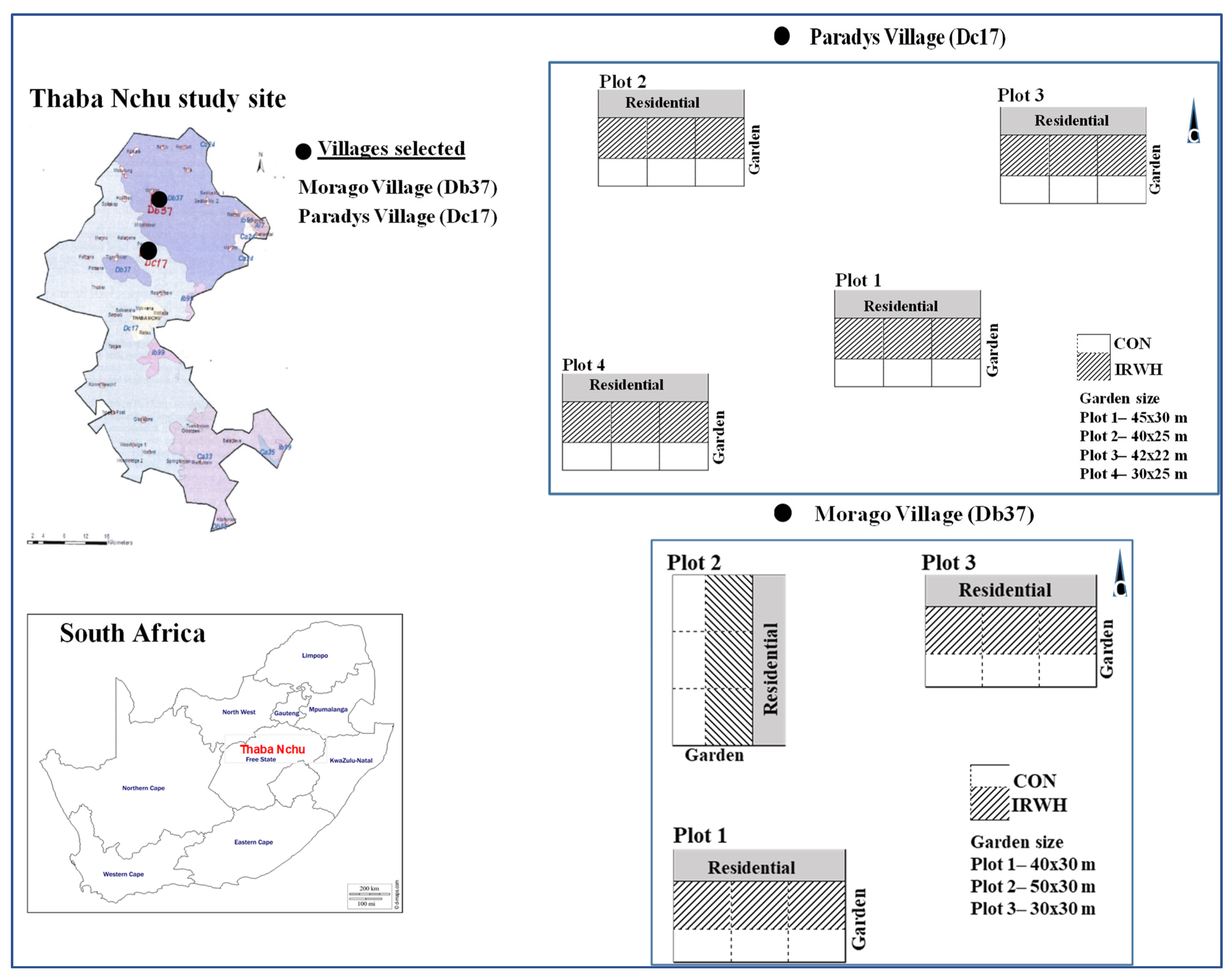
The purpose of this study was to monitor and compare the growth and productivity of maize/beans sole and inter-cropping systems under conventional (CON) and in-field rainwater harvesting (IRWH) tillage practices. During the typical drought conditions of the 2018/19 growing season, seven homestead gardens of smallholder farmers (four in Paradys and three in Morago villages) in the Thaba Nchu rural communities of South Africa were selected for on-farm demonstration trials. Two tillage systems CON and IRWH as the main plot and three cropping systems as sub-treatment (sole maize and beans and intercropping) were used to measure crop growth and productivity parameters. The results showed that IRWH tillage had significantly higher above-ground dry matter for both sole maize (29%) and intercropped maize (27%) compared to CON treatments. The grain yield under both tillage systems showed that IRWH-Sole >> IRWH-Ic >> CON-Sole >> CON-Ic, with values ranging from 878.2 kg ha−1 to 618 kg ha−1 (p ≤ 0.05). The low harvest index values (0.21–0.38) could have been due to the effect of the drought during the growing season. The results of precipitation use efficiency (PUE) showed that the IRWH tillage was more effective at converting rainwater into maize biomass and grain yield compared to CON tillage. However, the different cropping systems did not show a consistent trend in PUE. During the growing season, the PUE for AGDM varied for different tillage and cropping system treatments in Morago and Paradys. For maize, it ranged between 10.01–6.07 and 9.93–7.67 kg ha−1, while for beans, it ranged between 7.36–3.95 and 7.07–3.89 kg ha−1 mm−1. The PUE for grain yield showed similar trends with the significantly highest values of PUE under IRWH tillage systems for the Morago sites, but there were no significant differences at the Paradys site in both tillage and cropping systems. There is a critical need, therefore, to devise alternative techniques to promote an increase in smallholders’ productivity based on an improved ability to capture and use resources more efficiently.
Keywords: above-ground dry matter; growth and yield; intercropping; precipitation use efficiency; semi-arid above-ground dry matter; growth and yield; intercropping; precipitation use efficiency; semi-arid