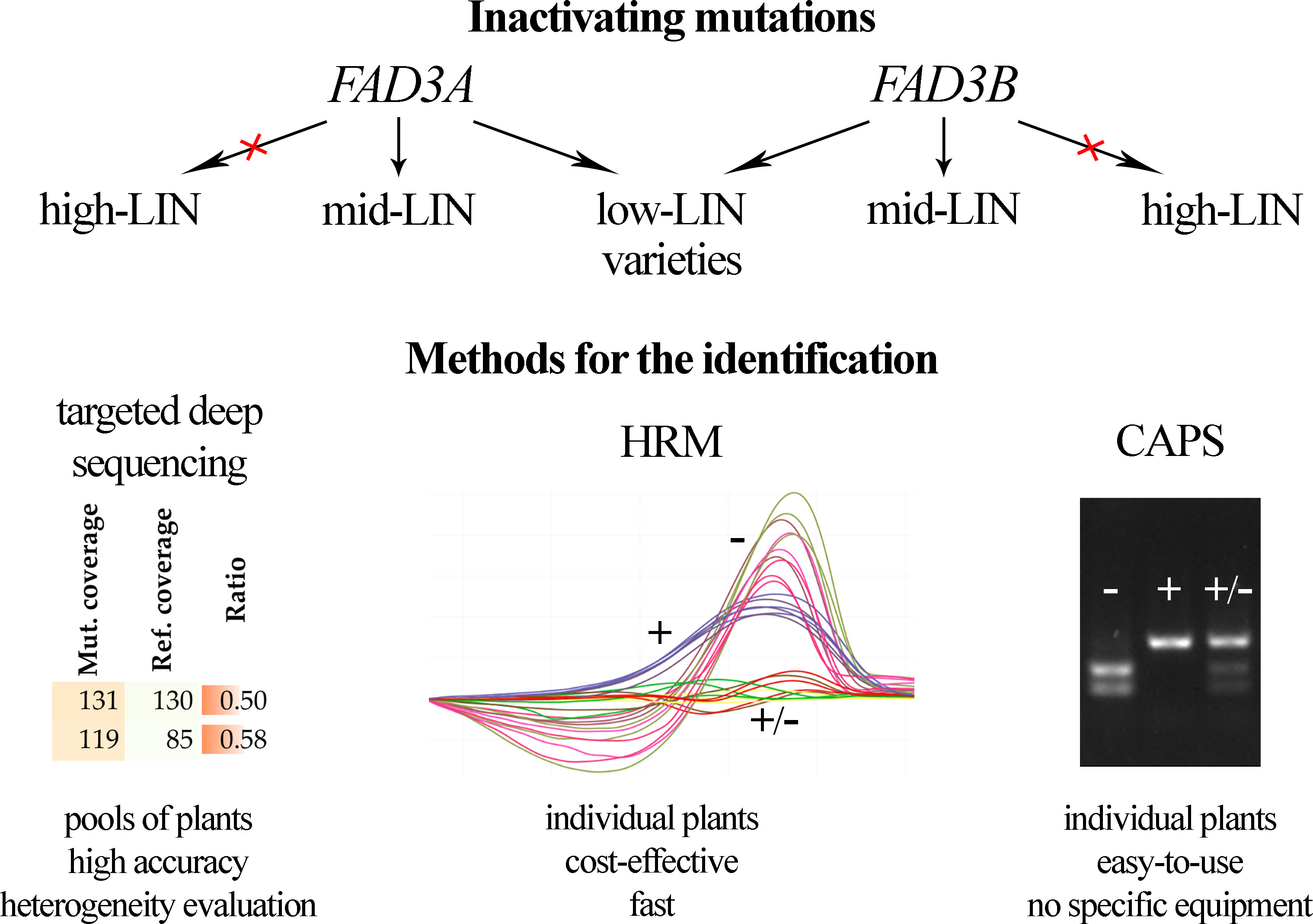
Development and Complex Application of Methods for the Identification of Mutations in the FAD3A and FAD3B Genes Resulting in the Reduced Content of Linolenic Acid in Flax Oil
 , ,
, ,  , , ,
, , ,  and
and 
Abstract
Share and Cite
Povkhova, L.V.; Pushkova, E.N.; Rozhmina, T.A.; Zhuchenko, A.A.; Frykin, R.I.; Novakovskiy, R.O.; Dvorianinova, E.M.; Gryzunov, A.A.; Borkhert, E.V.; Sigova, E.A.; et al. Development and Complex Application of Methods for the Identification of Mutations in the FAD3A and FAD3B Genes Resulting in the Reduced Content of Linolenic Acid in Flax Oil. Plants 2023, 12, 95. https://doi.org/10.3390/plants12010095
Povkhova LV, Pushkova EN, Rozhmina TA, Zhuchenko AA, Frykin RI, Novakovskiy RO, Dvorianinova EM, Gryzunov AA, Borkhert EV, Sigova EA, et al. Development and Complex Application of Methods for the Identification of Mutations in the FAD3A and FAD3B Genes Resulting in the Reduced Content of Linolenic Acid in Flax Oil. Plants. 2023; 12(1):95. https://doi.org/10.3390/plants12010095
Chicago/Turabian StylePovkhova, Liubov V., Elena N. Pushkova, Tatiana A. Rozhmina, Alexander A. Zhuchenko, Roman I. Frykin, Roman O. Novakovskiy, Ekaterina M. Dvorianinova, Aleksey A. Gryzunov, Elena V. Borkhert, Elizaveta A. Sigova, and et al. 2023. "Development and Complex Application of Methods for the Identification of Mutations in the FAD3A and FAD3B Genes Resulting in the Reduced Content of Linolenic Acid in Flax Oil" Plants 12, no. 1: 95. https://doi.org/10.3390/plants12010095
APA StylePovkhova, L. V., Pushkova, E. N., Rozhmina, T. A., Zhuchenko, A. A., Frykin, R. I., Novakovskiy, R. O., Dvorianinova, E. M., Gryzunov, A. A., Borkhert, E. V., Sigova, E. A., Vladimirov, G. N., Snezhkina, A. V., Kudryavtseva, A. V., Krasnov, G. S., Dmitriev, A. A., & Melnikova, N. V. (2023). Development and Complex Application of Methods for the Identification of Mutations in the FAD3A and FAD3B Genes Resulting in the Reduced Content of Linolenic Acid in Flax Oil. Plants, 12(1), 95. https://doi.org/10.3390/plants12010095