Article

Is Plant Life-History of Biseasonal Germination Consistent in Response to Extreme Precipitation?

1
State Key Laboratory of Desert and Oasis Ecology, Xinjiang Institute of Ecology and Geography, Chinese Academy of Sciences, Urumqi 830011, China
2
Department of Tourism Management, School of Geography and Tourism, Qufu Normal University, Rizhao 276826, China
3
Department of Information Engineering, Shandong Water Polytechnic, Rizhao 276826, China
4
Xinjiang Key Laboratory of Soil and Plant Ecological Processes, College of Grassland and Environment Sciences, Xinjiang Agricultural University, Urumqi 830052, China
5
College of Resources and Environment, University of Chinese Academy of Sciences, Beijing 100049, China
6
Yili Botanical Garden, Xinjiang Institute of Ecology and Geography, Xinyuan 835800, China
7
Turpan Eremophytes Botanical Garden, Chinese Academy of Sciences, Turpan 838008, China
*
Author to whom correspondence should be addressed.
Plants 2021, 10(8), 1642; https://doi.org/10.3390/plants10081642

Submission received: 15 June 2021 / Revised: 8 August 2021 / Accepted: 9 August 2021 / Published: 10 August 2021
(This article belongs to the Special Issue Plant Reproductive Development and Ecology)

Abstract

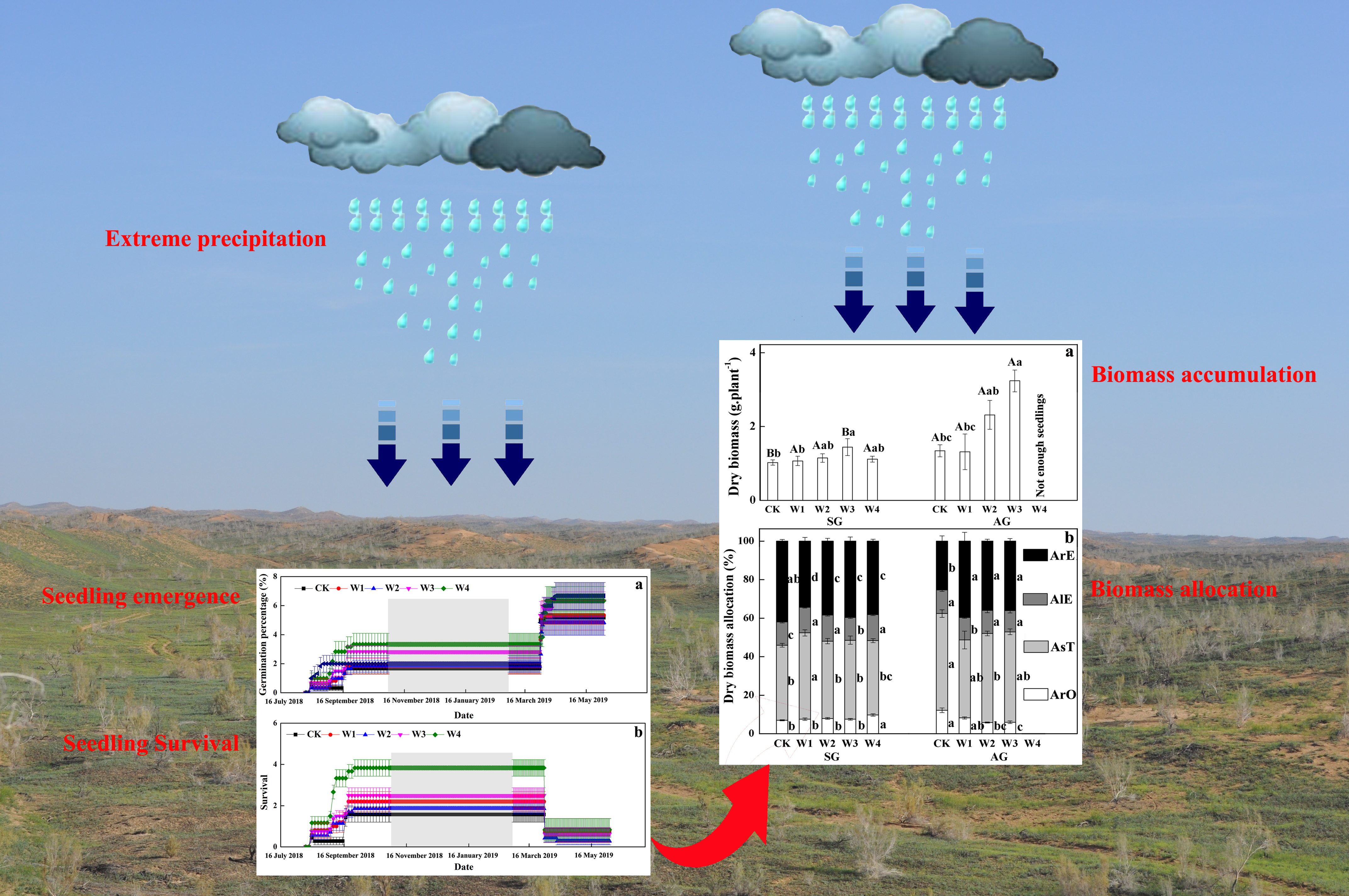
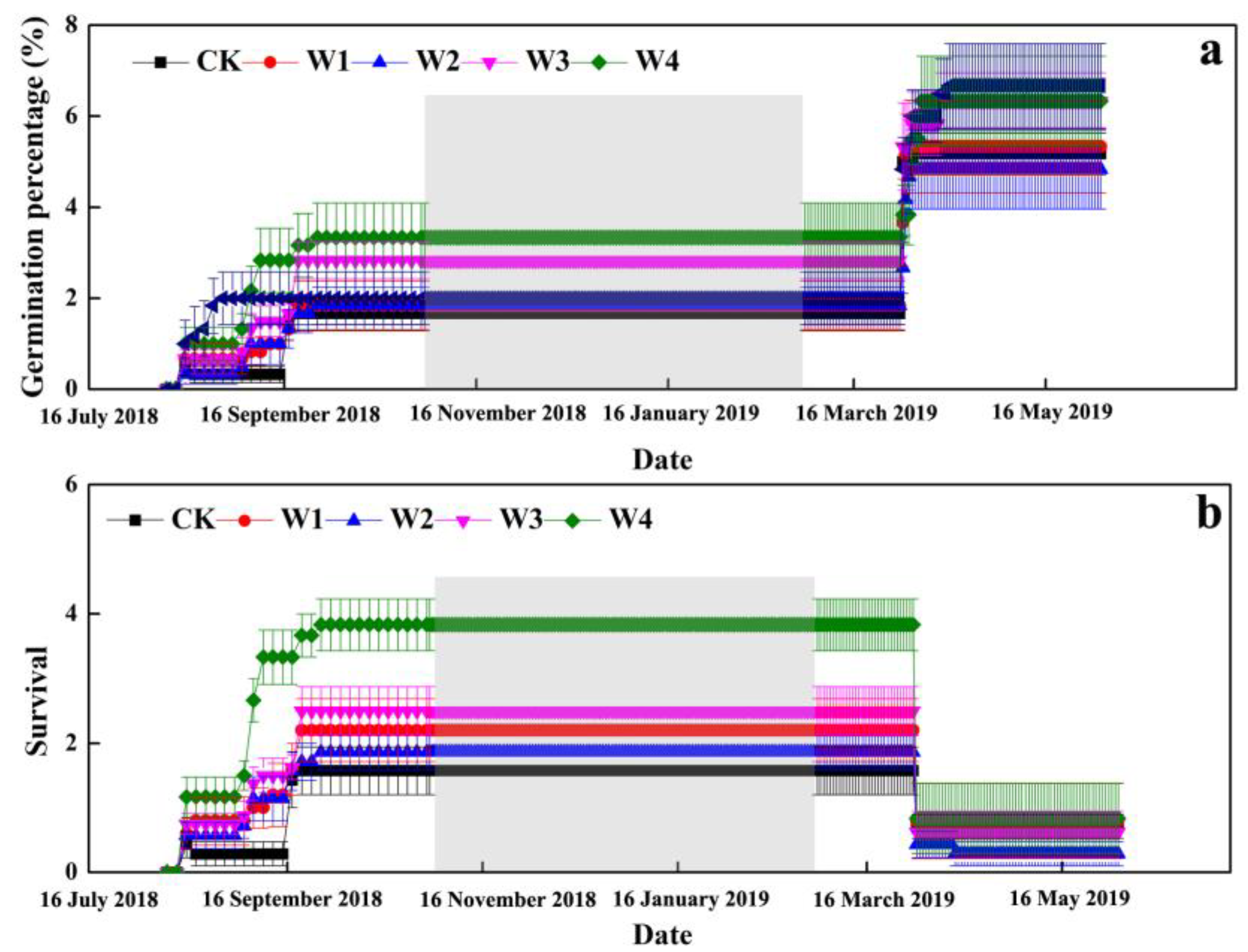
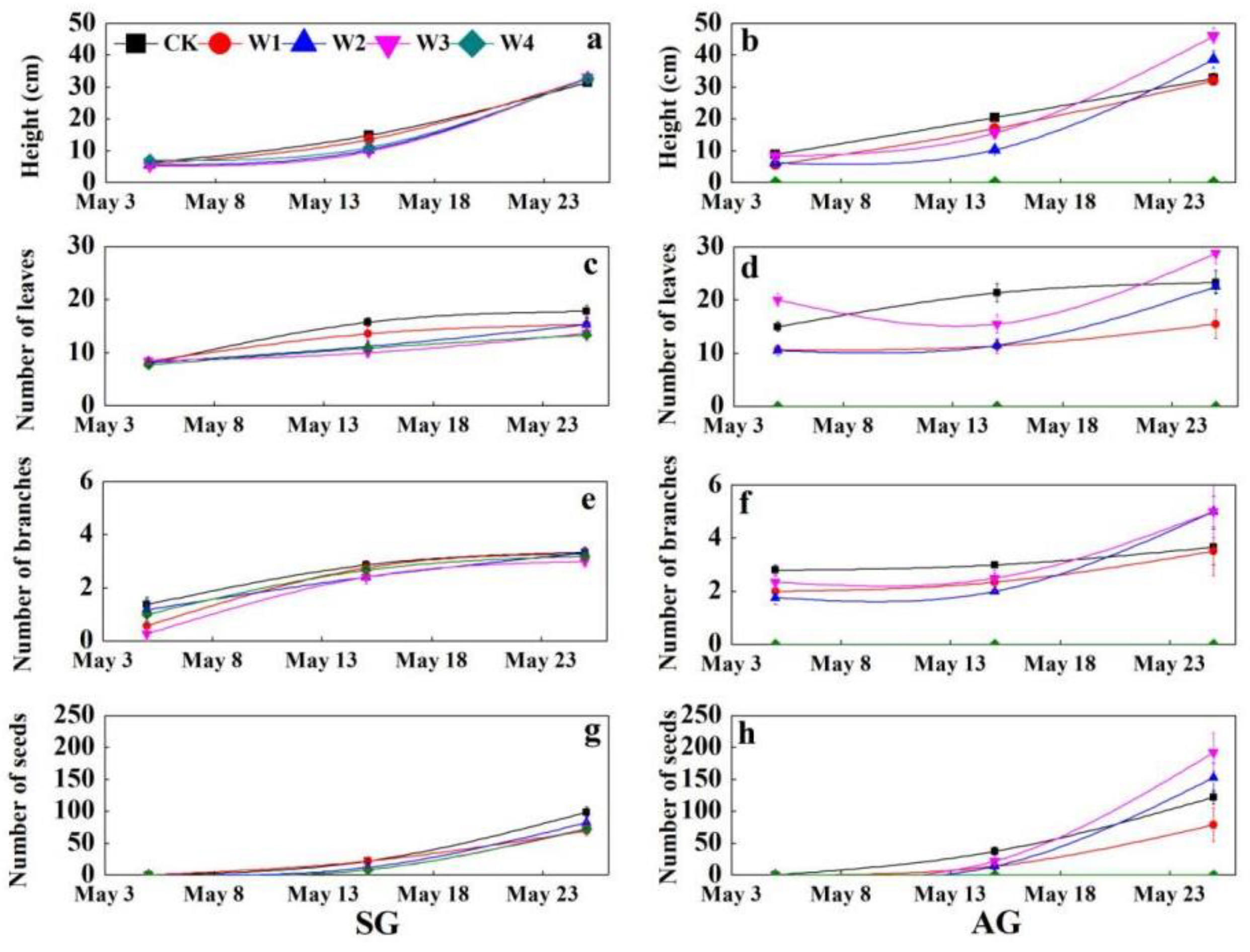
Future climate is projected to increase in the intensity and frequency of extreme precipitation events, and the resulting ecological consequences are often more serious than those of normal precipitation events. In particular, in desert ecosystems, due to the low frequency and strong fluctuation of extreme precipitation, the destructive consequences for desert plants caused by extreme precipitation have not received enough attention for some time. Based on statistics of extreme precipitation events (1965–2018) in the Gurbantunggut Desert, we investigated the effects of extreme precipitation (+0%, CK; +50%, W1; +100%, W2; +200%, W3; maintenance of field capacity, W4) on the plant life-history of the spring-germinated (SG) and autumn-germinated (AG) ephemeral plant Erodium oxyrhynchum by monitoring seedling emergence, survival, phenology, organ size, biomass accumulation, and allocation. The results showed that extreme precipitation caused about 2.5% seedling emergence of E. oxyrhynchum in autumn 2018 and 3.0% seedling emergence in early spring 2019, which means that most seeds may be stored in the soil or have died. Meanwhile, extreme precipitation significantly improved the survival, organ size, and biomass accumulation of SG and AG plants, and W3 was close to the precipitation threshold of SG (326.70 mm) and AG (560.10 mm) plants corresponding to the maximum individual biomass; thus, AG plants with a longer life cycle need more water for growth. Conversely, W4 caused AG plants to enter the leaf stage in advance and led to death in winter, which indicates that extreme precipitation may not be good for AG plants. Root and reproduction biomass allocation of SG and AG plants showed a significantly opposite trend under extreme precipitation treatments, which might be related to their different life-history strategies. Therefore, when only taking into account the changing trend of extreme precipitation from the Coupled Model Intercomparison Project 6 (CMIP6) climate projections data, we speculate that extreme precipitation may promote the growth of SG and AG plants from the beginning to the middle of this century, but extreme precipitation in autumn exceeding a certain threshold may adversely affect the survival of AG plants at the end of the century.
Keywords: climate change; ephemeral plant; Erodium oxyrhynchum; extreme precipitation; plant growth climate change; ephemeral plant; Erodium oxyrhynchum; extreme precipitation; plant growth
Graphical Abstract