Article

Uptake Dynamics of Ionic and Elemental Selenium Forms and Their Metabolism in Multiple-Harvested Alfalfa (Medicago sativa L.)

1
Agricultural Botany, Plant Physiology and Biotechnology Department, University of Debrecen, Böszörményi Str. 138, 4032 Debrecen, Hungary
2
Institute of Food Science, University of Debrecen, Böszörményi Str. 138, 4032 Debrecen, Hungary
3
Department of Biological and Environmental Sciences, Faculty of Home Economic, Al-Azhar University, Tanta 31732, Egypt
4
Institute of Animal Science, Biotechnology and Nature Conservation, University of Debrecen, Böszörményi Str. 138, 4032 Debrecen, Hungary
5
Soil and Water Science Department, Faculty of Agriculture, Kafrelsheikh University, Kafr El-Sheikh 33516, Egypt
*
Author to whom correspondence should be addressed.
Plants 2021, 10(7), 1277; https://doi.org/10.3390/plants10071277

Submission received: 1 June 2021 / Revised: 11 June 2021 / Accepted: 17 June 2021 / Published: 23 June 2021
(This article belongs to the Special Issue Natural and Anthropogenic Origin Selenium in the Context of Plants)

Abstract

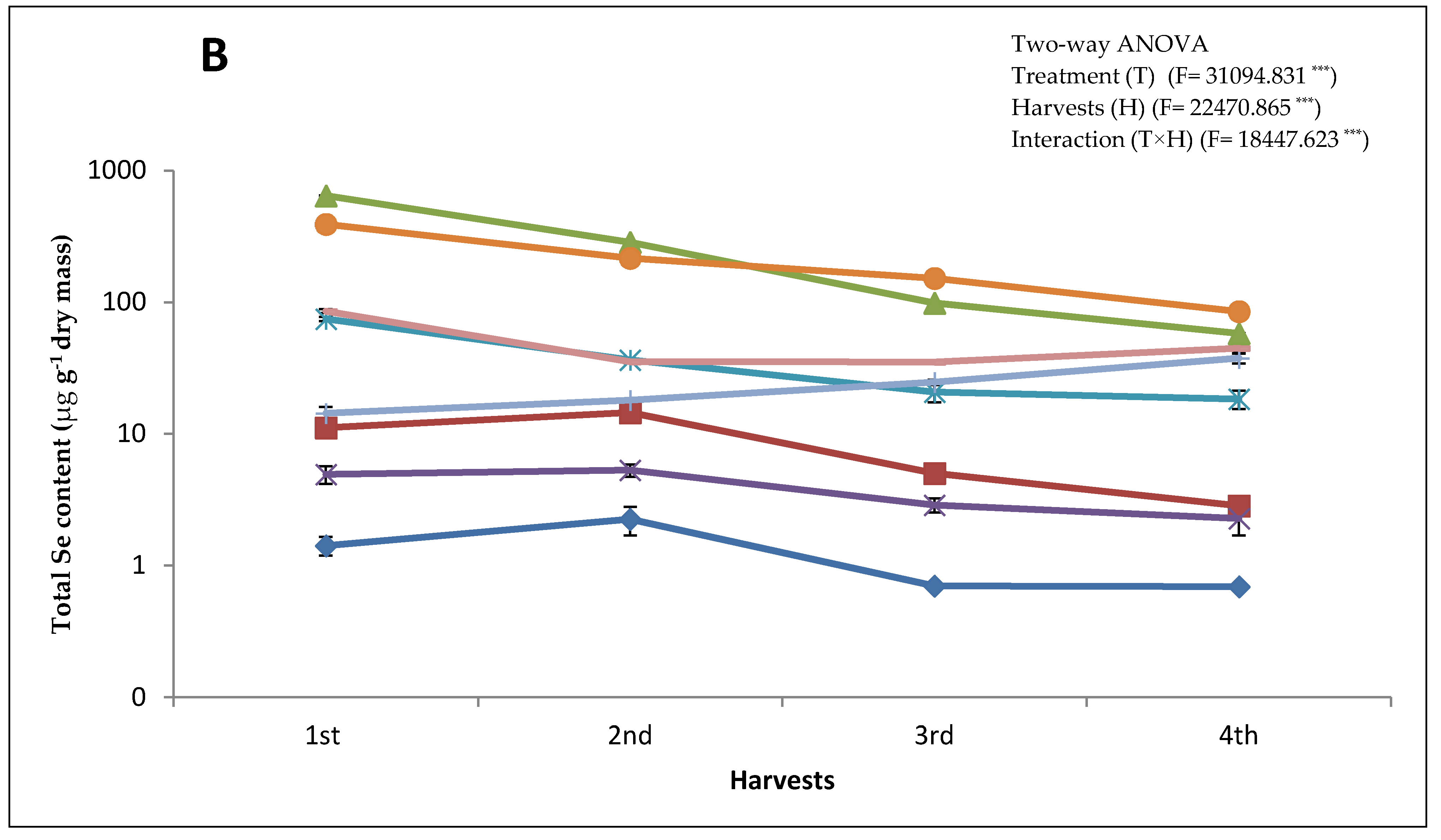
A pot experiment, under greenhouse conditions, was carried out aiming at investigating the agronomic biofortification of alfalfa (Medicago sativa L.) with Se and monitoring the Se uptake and accumulation dynamics within four consecutive harvests within the same growing season. Two ionic Se forms, i.e., sodium selenate (Se (VI)) and sodium selenite (Se (IV)), were applied once at a rate of 1, 10, and 50 mg kg−1 (added on Se basis), while 10 and 50 mg L−1 of a red elemental Se (red Se0) were used; all Se treatments were added as soil application. Application of Se (VI) at the rate of 50 mg kg−1 was toxic to alfalfa plants. The effect of Se forms on Se accumulation in alfalfa tissues, regardless of the applied Se concentration, follows: Se (VI) > Se (IV) > red Se0. The leaf, in general, possessed higher total Se content than the stem in all the treatments. The accumulation of Se in stem and leaf tissues showed a gradual decline between the harvests, especially for plants treated with either Se (VI) or Se (IV); however, the chemically synthesized red Se0 showed different results. The treatment of 10 mg kg−1 Se (VI) resulted in the highest total Se content in stem (202.5 and 98.0 µg g−1) and leaf (643.4 and 284.5 µg g−1) in the 1st and 2nd harvests, respectively. Similar tendency is reported for the Se (IV)-treated plants. Otherwise, the application of red Se0 resulted in a lower Se uptake; however, less fluctuation in total Se content between the four harvests was noticed compared to the ionic Se forms. The Se forms in stem and leaf of alfalfa extracted by water and subsequently by protease XIV enzyme were measured by strong anion exchange (SAX) HPLC-ICP-MS. The major Se forms in our samples were selenomethionine (SeMet) and Se (VI), while neither selenocysteine (SeCys) nor Se (IV) was detected. In water extract, however, Se (VI) was the major Se form, while SeMet was the predominant form in the enzyme extract. Yet, Se (VI) and SeMet contents declined within the harvests, except in stem of plants treated with 50 mg L−1 red Se0. The highest stem or leaf SeMet yield %, in all harvests, corresponded to the treatment of 50 mg L−1 red Se0. For instance, 63.6% (in stem) and 38.0% (in leaf) were calculated for SeMet yield % in the 4th harvest of plants treated with 50 mg L−1 red Se0. Our results provide information about uptake and accumulation dynamics of different ionic Se forms in case of multiple-harvested alfalfa, which, besides being a good model plant, is an important target plant species in green biorefining.
Keywords: agronomic biofortification; alfalfa; red elemental Se; selenomethionine; uptake dynamics agronomic biofortification; alfalfa; red elemental Se; selenomethionine; uptake dynamics