Review

Culturable Yeasts as Biofertilizers and Biopesticides for a Sustainable Agriculture: A Comprehensive Review

by
María Hernández-Fernández
,
Gustavo Cordero-Bueso
*,
Marina Ruiz-Muñoz
and
Jesús M. Cantoral
Laboratory of Microbiology, Department Biomedicine, Biotechnology and Public Health, University of Cádiz, Puerto Real, 11510 Cádiz, Spain
*
Author to whom correspondence should be addressed.
Plants 2021, 10(5), 822; https://doi.org/10.3390/plants10050822

Submission received: 24 February 2021 / Revised: 7 April 2021 / Accepted: 19 April 2021 / Published: 21 April 2021
(This article belongs to the Special Issue Biostimulants as Growth Promoting and Stress Protecting Compounds)

Abstract

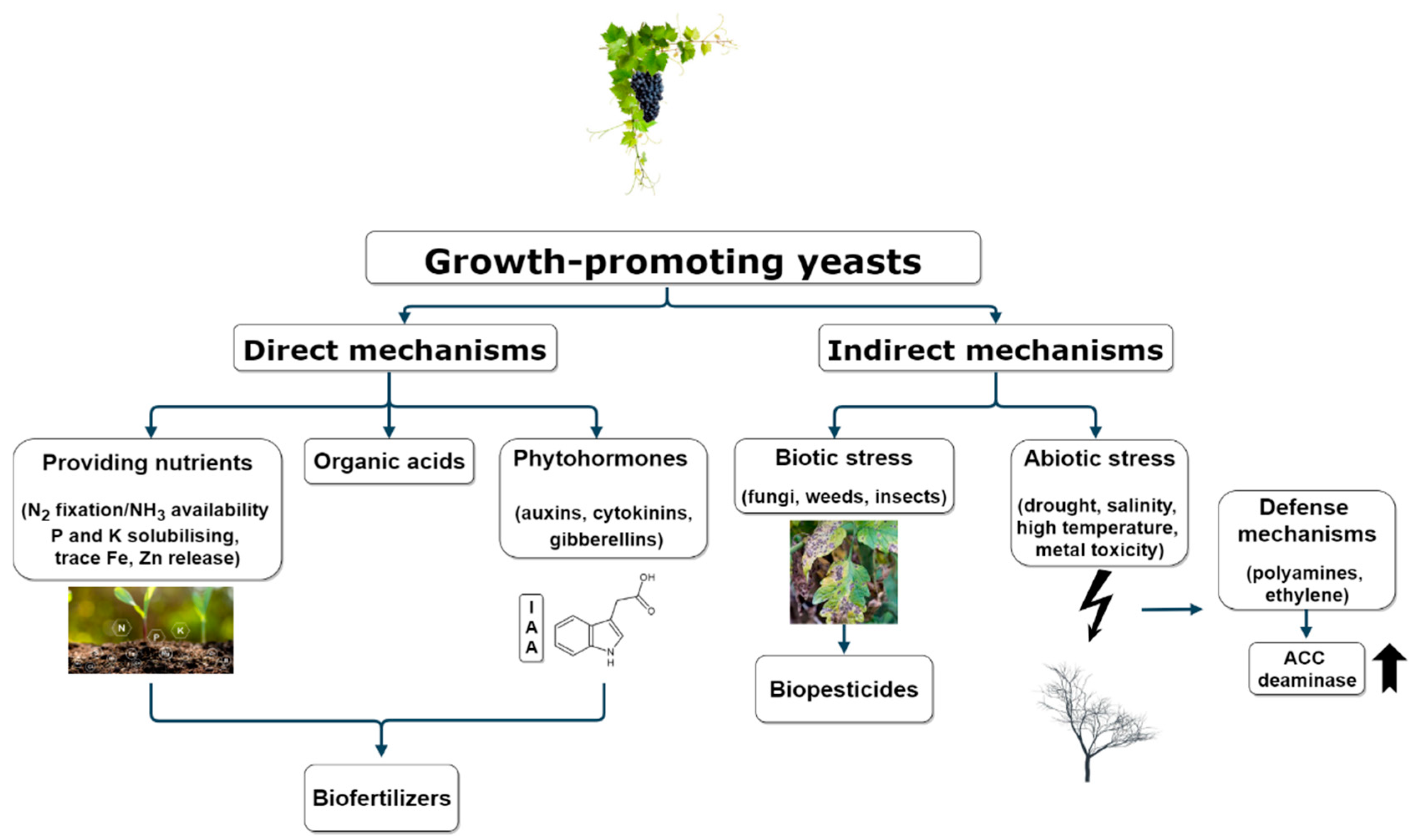
The extensive use of synthetic fertilizers and pesticides has negative consequences in terms of soil microbial biodiversity and environmental contamination. Faced with this growing concern, a proposed alternative agricultural method is the use of microorganisms as biofertilizers. Many works have been focused on bacteria, but the limited literature on yeasts and their potential ability to safely promote plant growth is gaining particular attention in recent years. Thus, the objective of this review is to highlight the application of yeasts as biological agents in different sectors of sustainable agricultural practices through direct or indirect mechanisms of action. Direct mechanisms include the ability of yeasts to provide soluble nutrients to plants, produce organic acids and phytohormones (indole-3-acetic acid). Indirect mechanisms involve the ability for yeasts to act as biocontrol agents through their high antifungal activity and lower insecticidal and herbicidal activity, and as soil bioremediating agents. They also act as protective agents against extreme environmental factors by activating defense mechanisms. It is evident that all the aspects that yeasts offer could be useful in the creation of quality biofertilizers and biopesticides. Hence, extensive research on yeasts could be promising and potentially provide an environmentally friendly solution to the increased crop production that will be required with a growing population.
Keywords: yeasts; sustainability; biocontrol; growth promoters; bioinsecticides; antifungals; biostimulants yeasts; sustainability; biocontrol; growth promoters; bioinsecticides; antifungals; biostimulants