


Three-Dimensional Reconstruction of Indoor Building Components Based on Multi-Dimensional Primitive Modeling Method
Abstract
1. Introduction
1.1. Background
1.2. Related Works
1.3. Problem Statement and Research Objective
2. Methodology
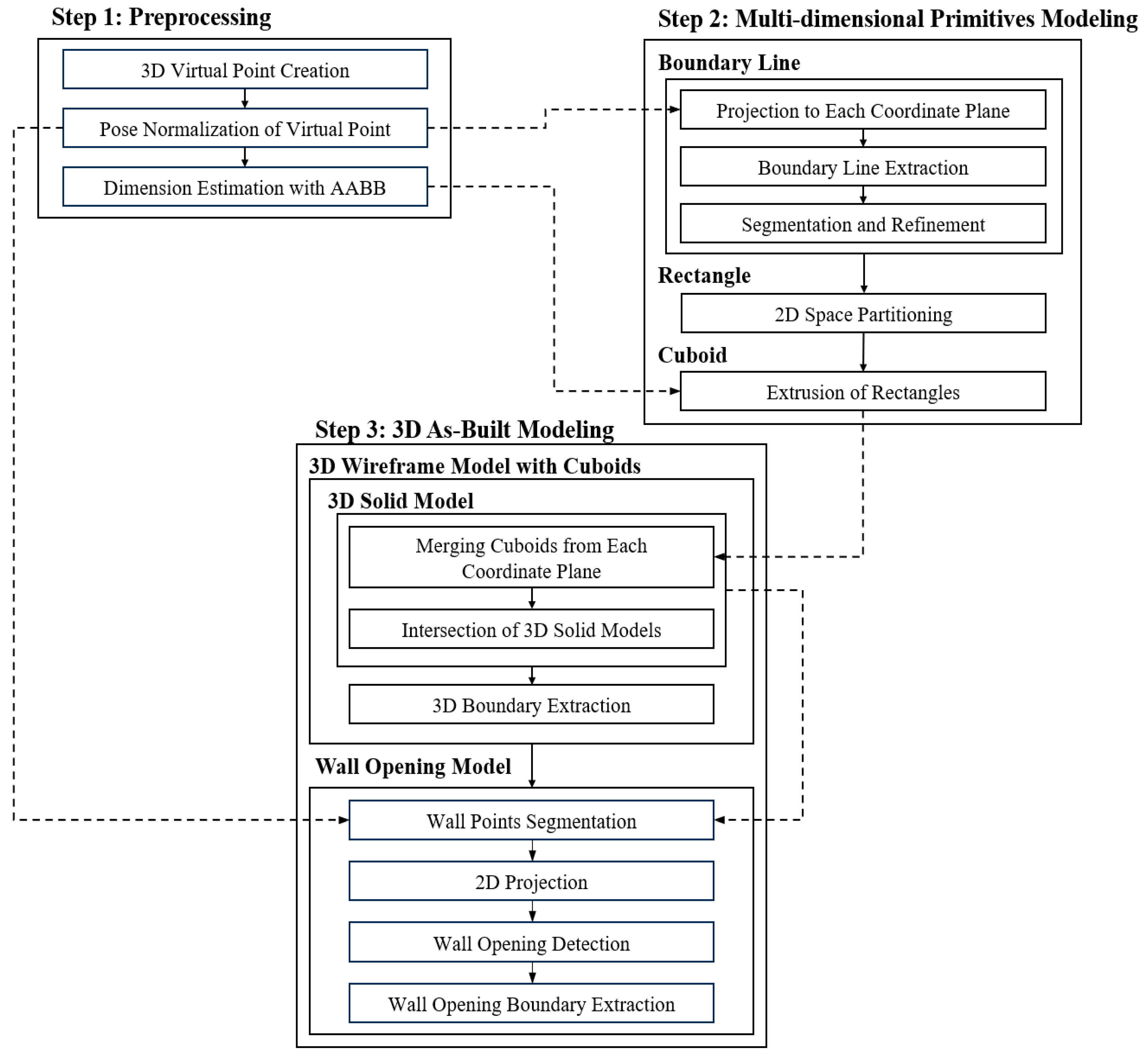
2.1. Overview
2.2. Preprocessing
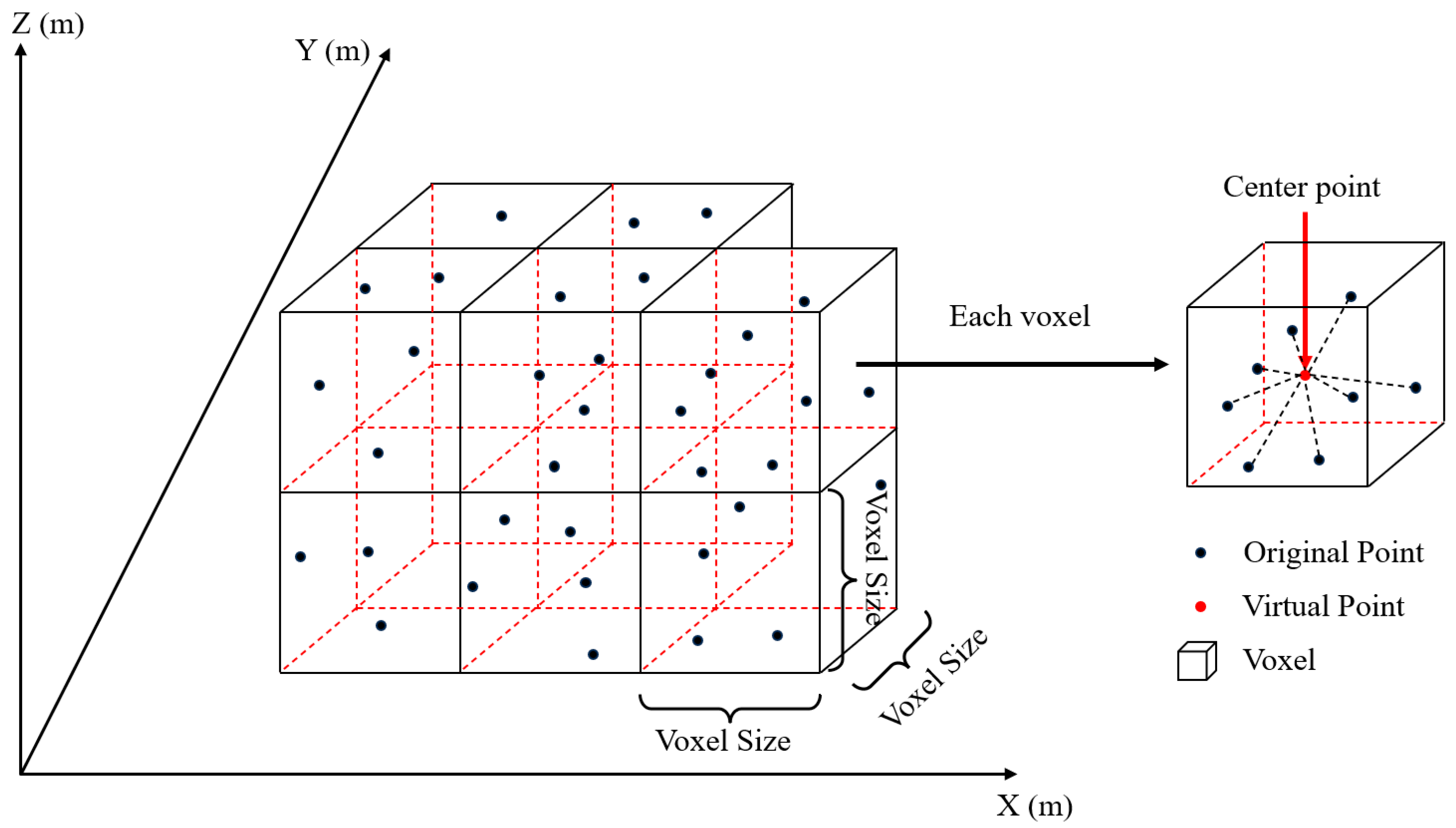
2.2.1. Three-Dimensional Virtual Point Creation
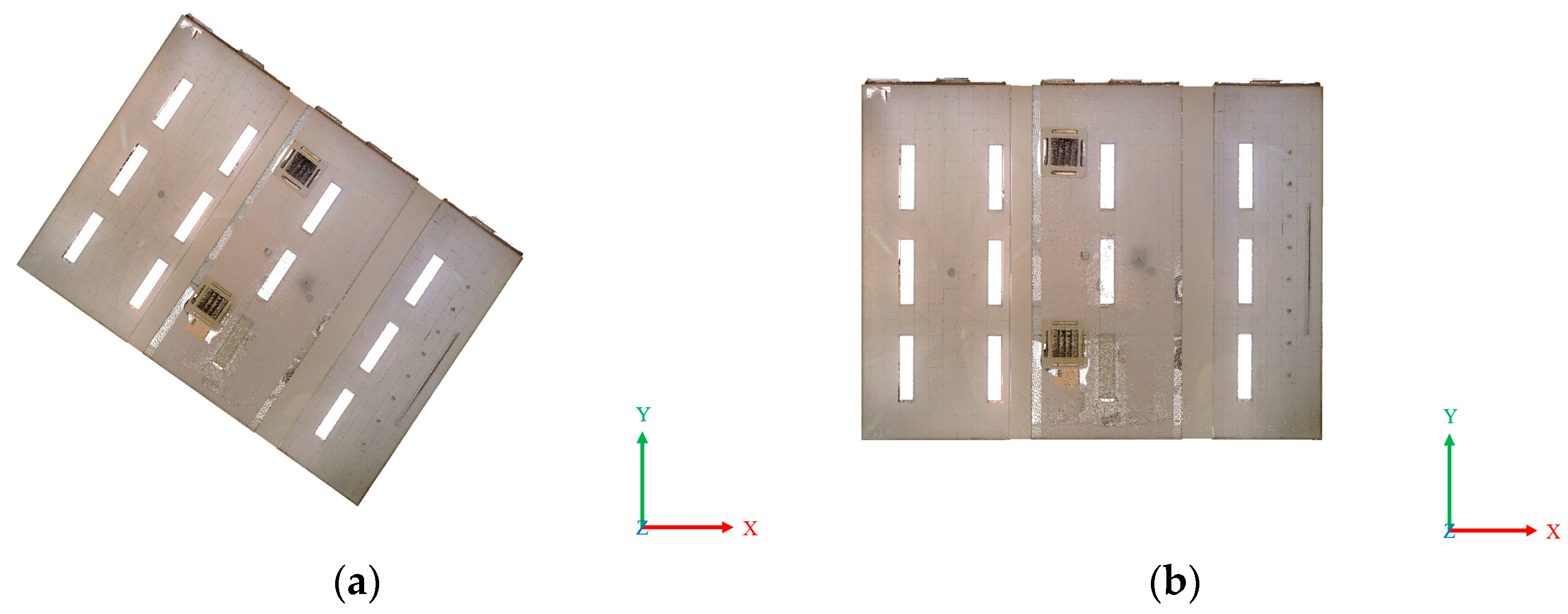
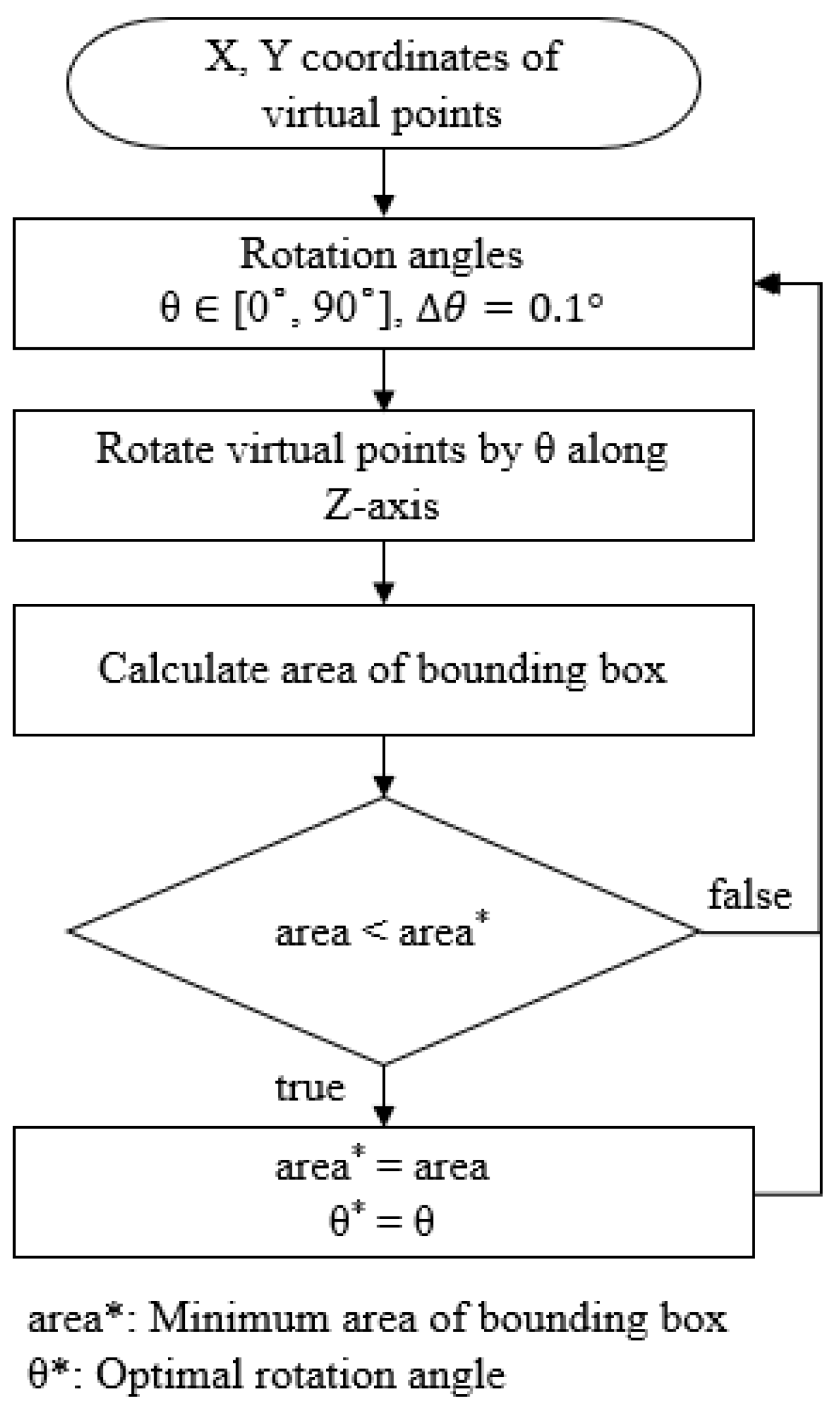
2.2.2. Pose Normalization and Dimension Estimation
2.3. Multi-Dimensional Primitive Modeling
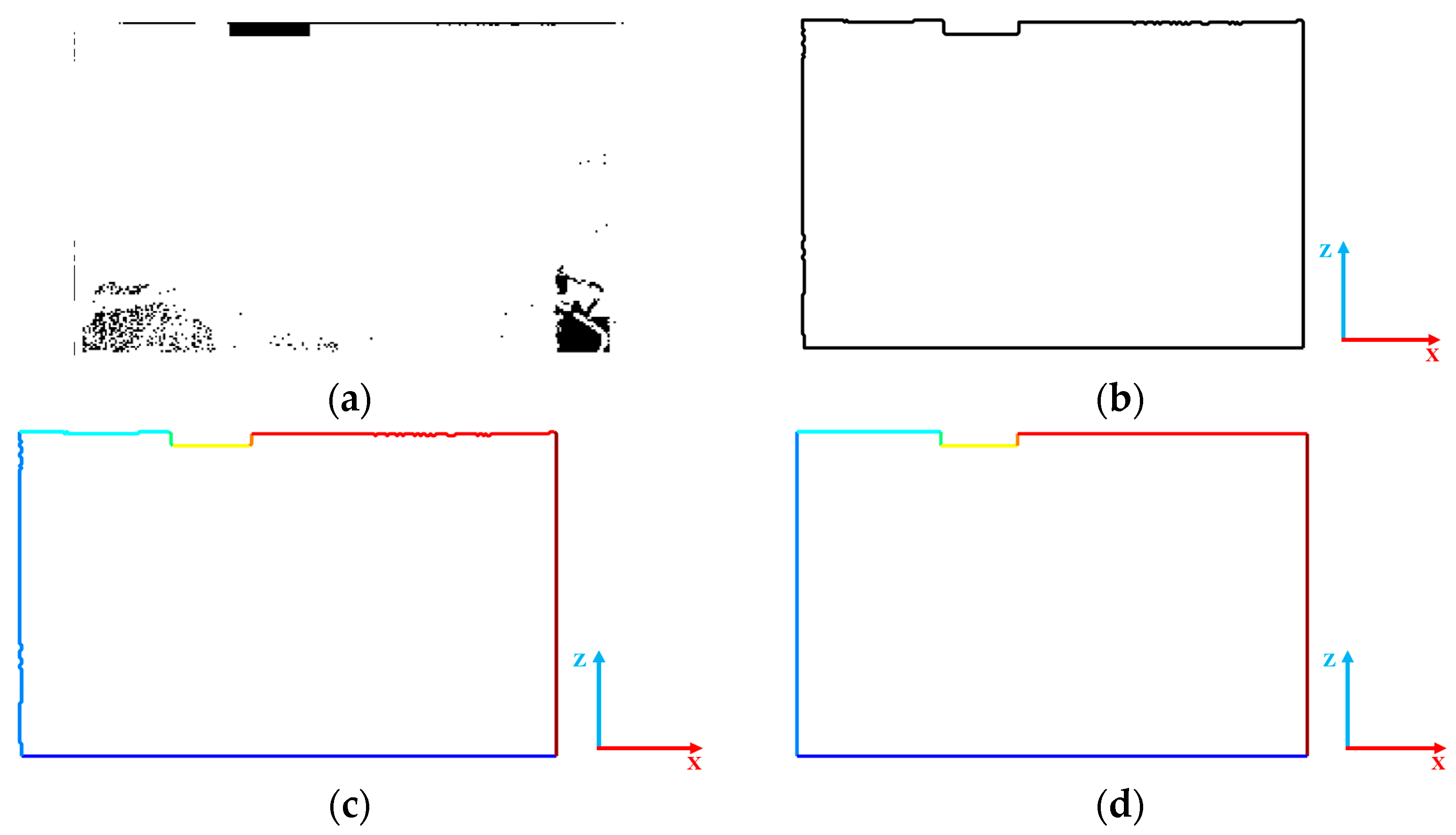
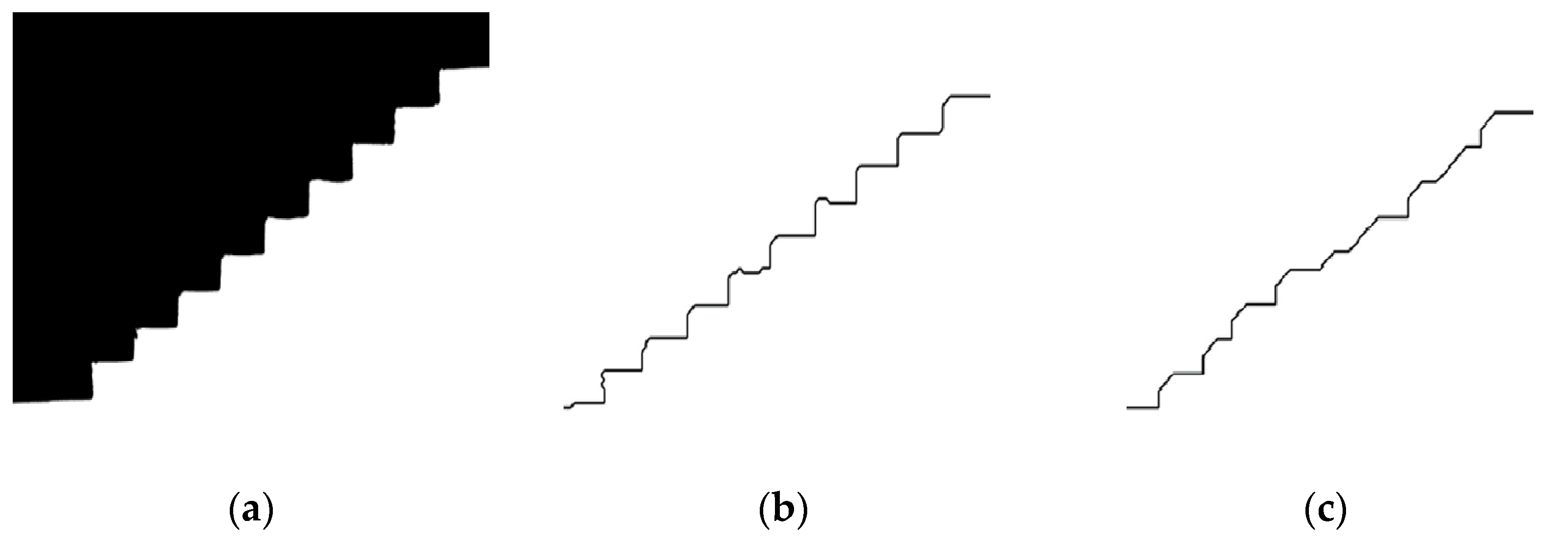
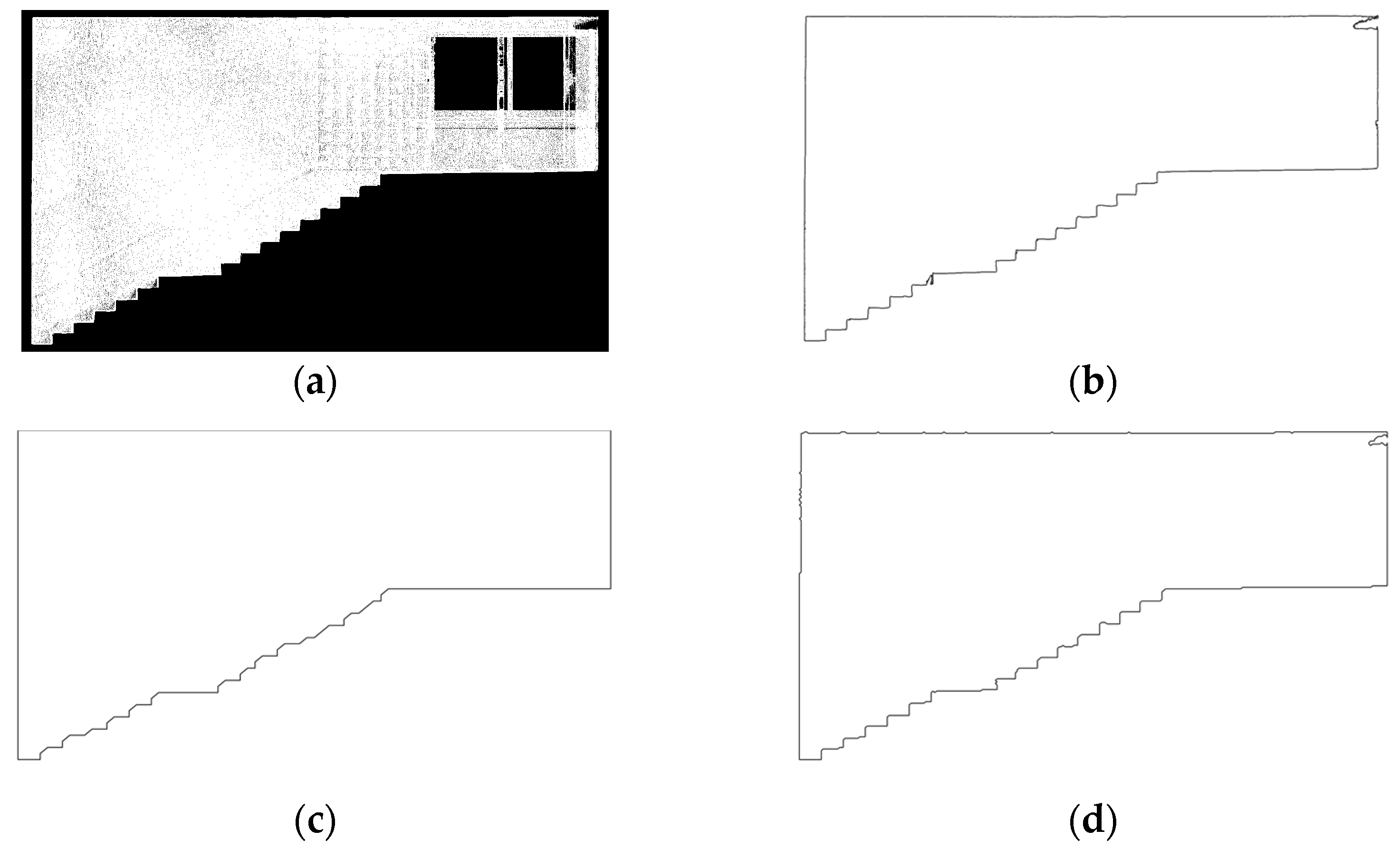
2.3.1. Boundary Line Modeling
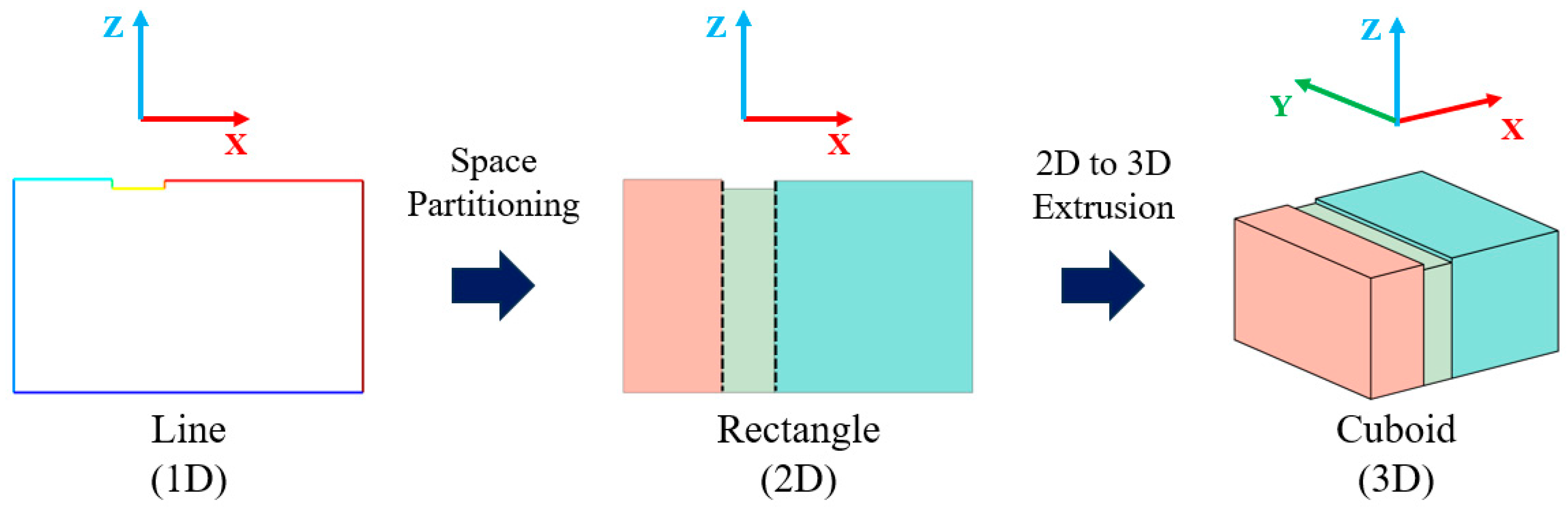
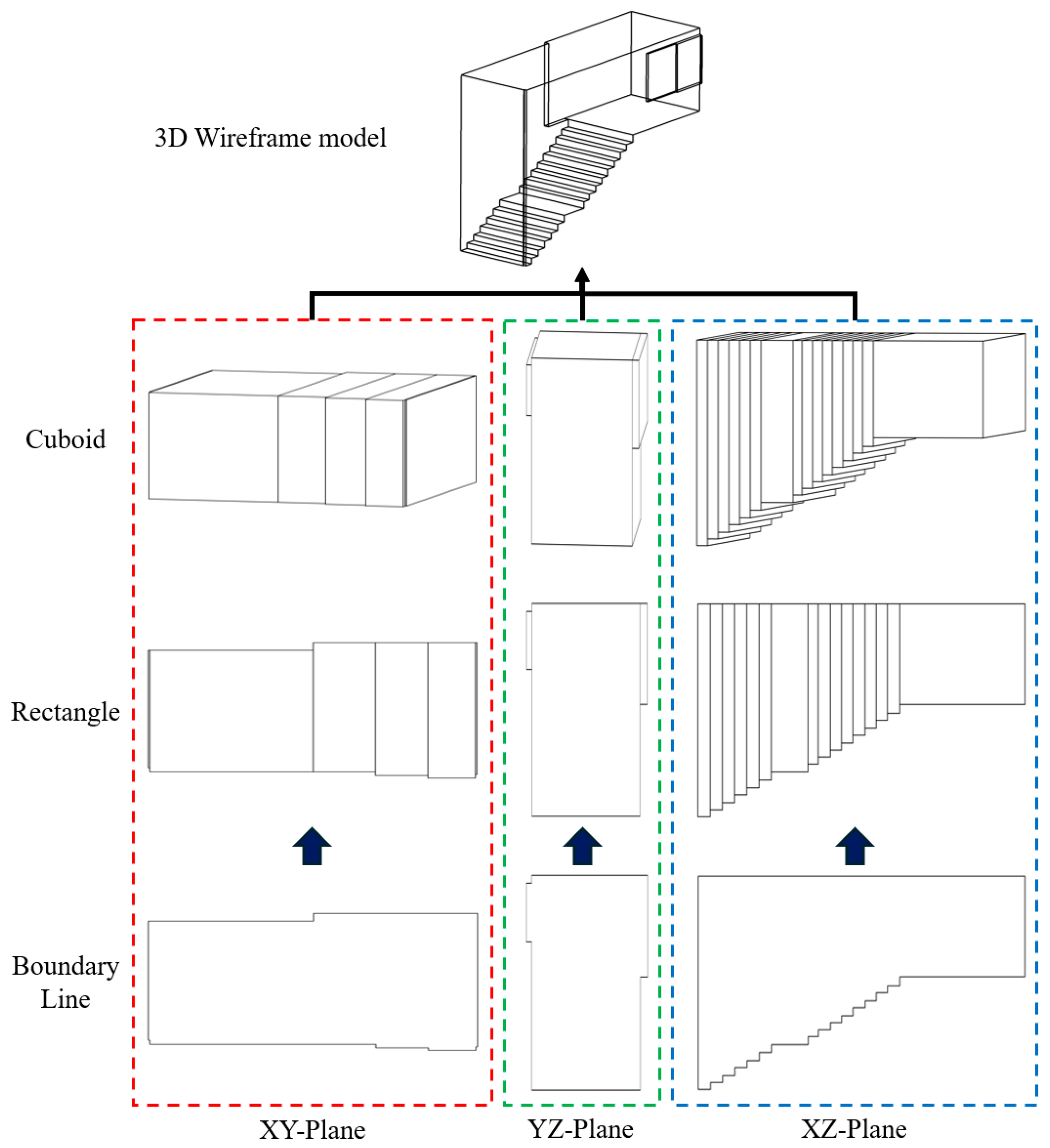
2.3.2. Rectangle and Cuboid Modeling
2.4. Three-Dimensional As-Built Modeling
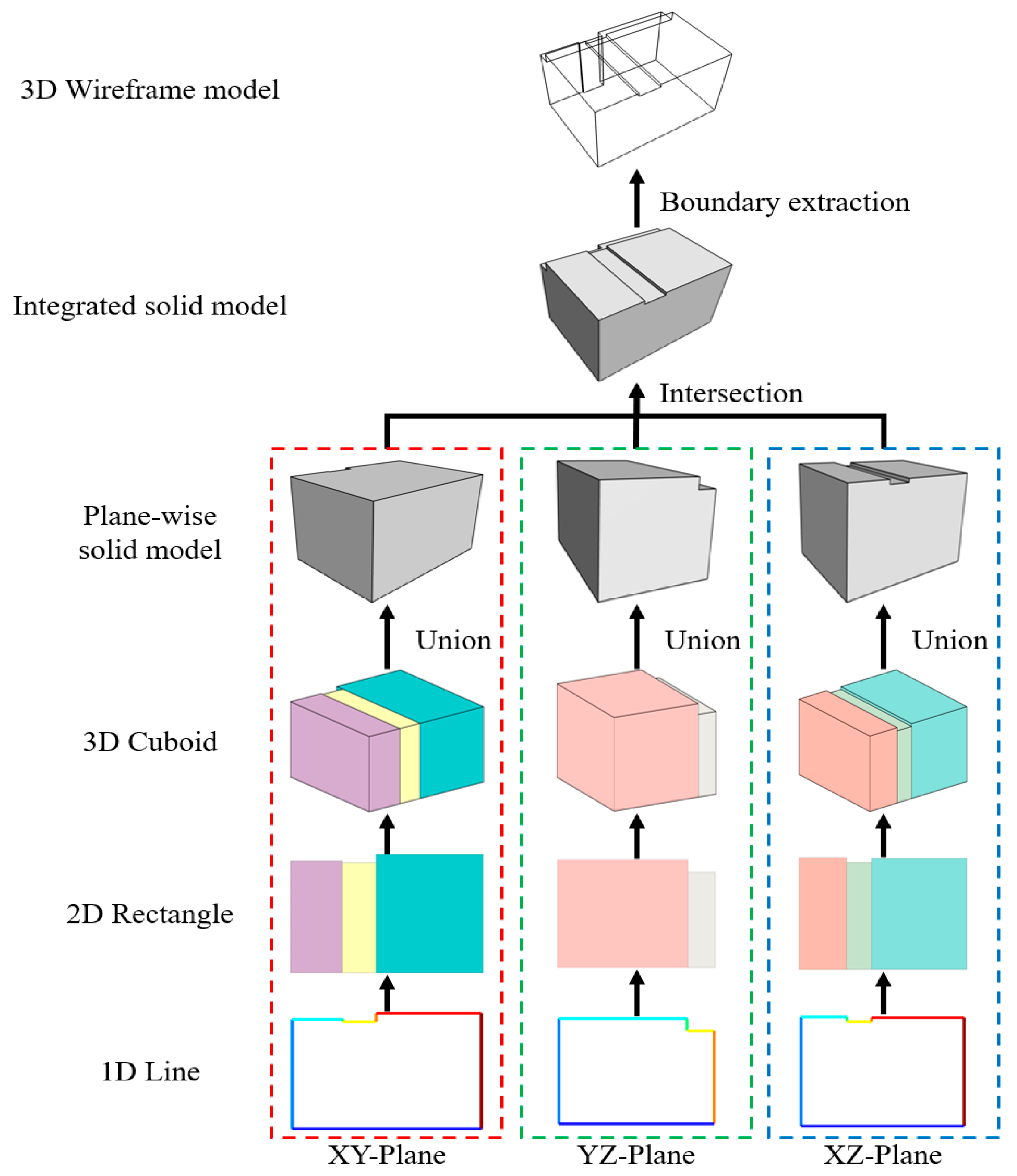
2.4.1. Three-Dimensional Wireframe Modeling
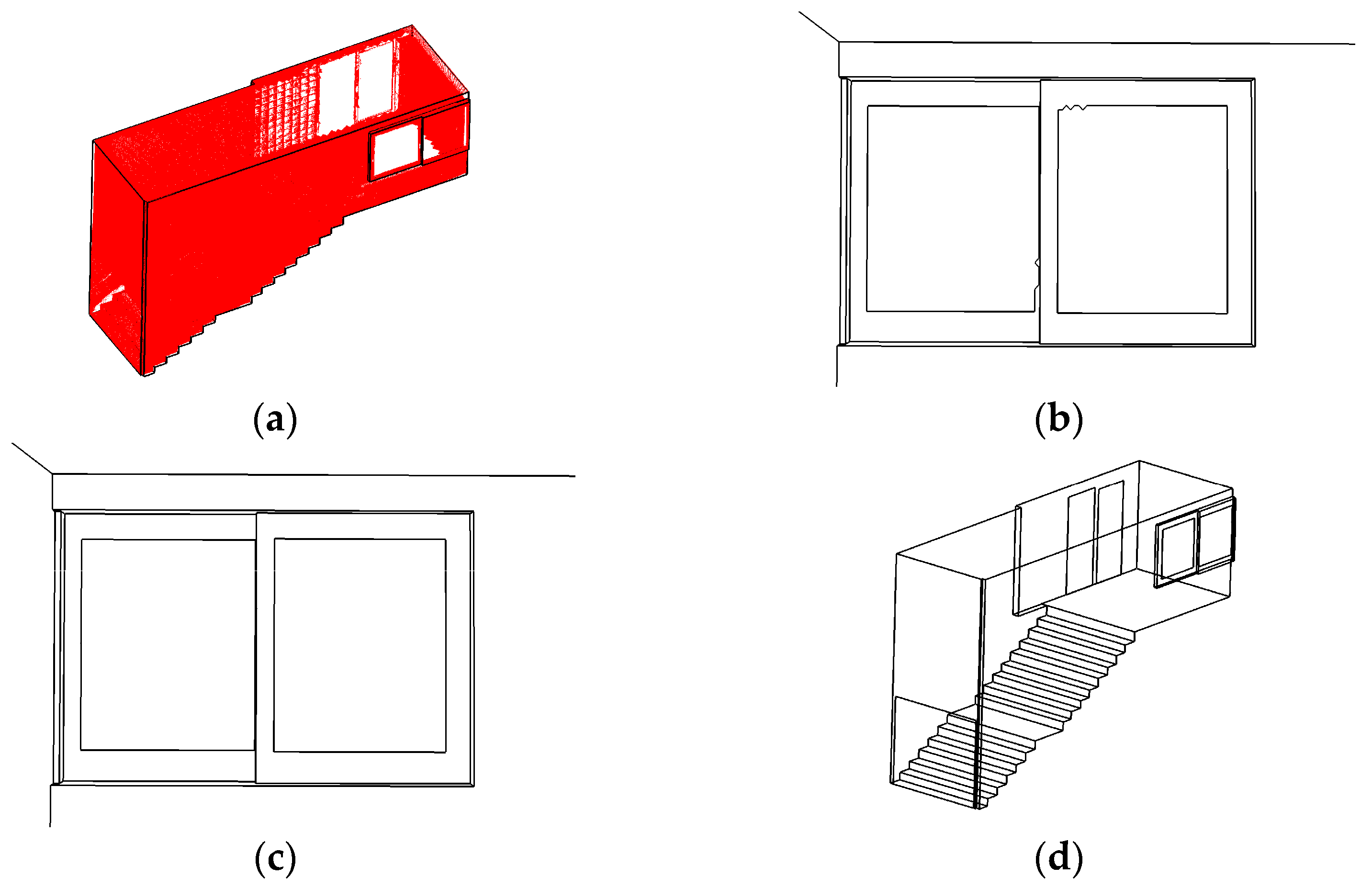
2.4.2. Wall Opening Modeling
3. Test Site and Application
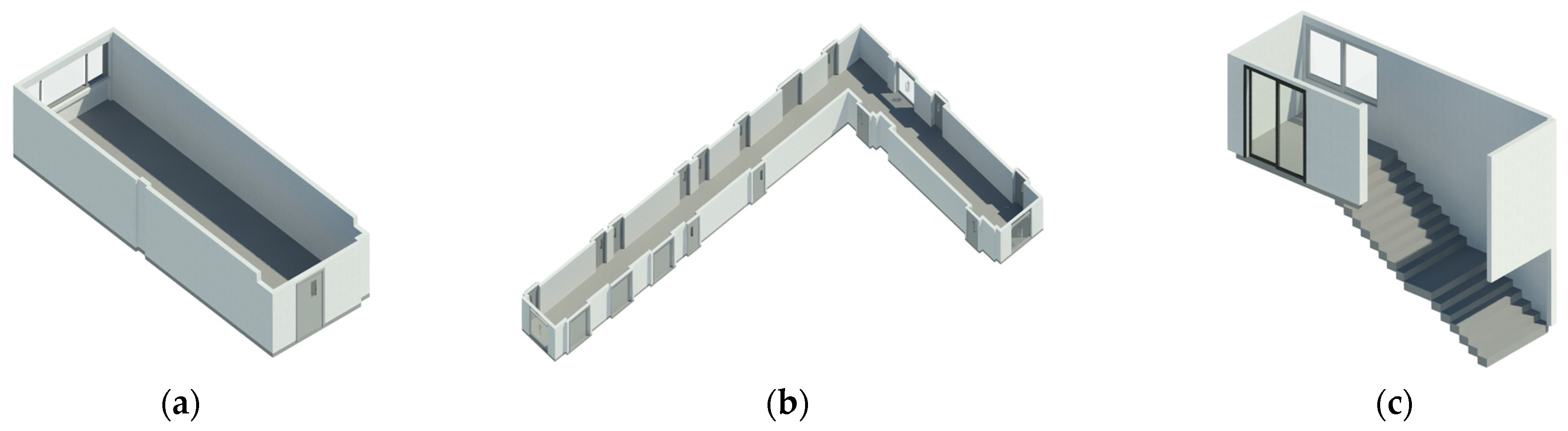
3.1. Overview
3.2. Three-Dimensional Virtual Point Creation and Pose Normalization
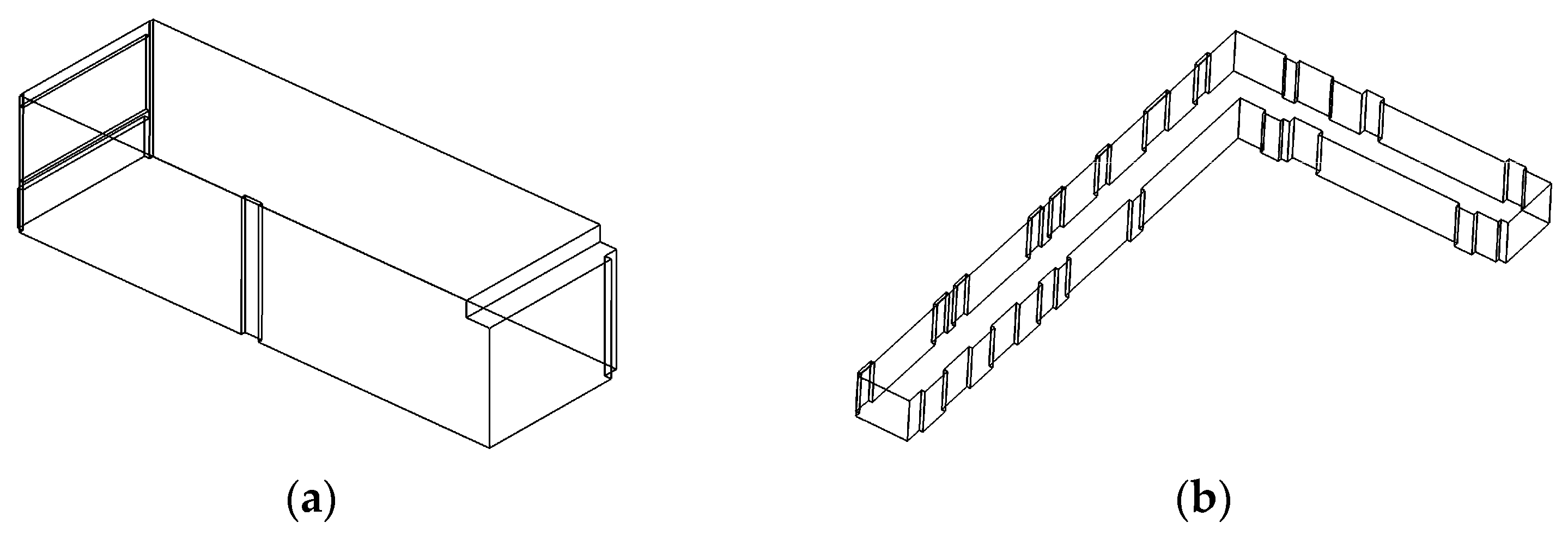
3.3. Three-Dimensional Wireframe Model Reconstruction
3.4. Wall Opening Model Reconstruction
3.5. Accuracy Assessment
3.6. Three-Dimensional As-Built BIM Creation
4. Discussion and Conclusions
Author Contributions
Funding
Data Availability Statement
Acknowledgments
Conflicts of Interest
References
- Deng, M.; Menassa, C.C.; Kamat, V.R. From BIM to digital twins: A systematic review of the evolution of intelligent building representations in the AEC-FM industry. J. Inf. Technol. Constr. 2021, 26, 58. [Google Scholar] [CrossRef]
- Nguyen, T.D.; Adhikari, S. The role of bim in integrating digital twin in building construction: A literature review. Sustainability 2023, 15, 10462. [Google Scholar] [CrossRef]
- Eneyew, D.D.; Capretz, M.A.; Bitsuamlak, G.T. Toward smart-building digital twins: BIM and IoT data integration. IEEE Access 2022, 10, 130487–130506. [Google Scholar] [CrossRef]
- Sacks, R.; Eastman, C.; Lee, G.; Teicholz, P. BIM Handbook: A Guide to Building Information Modeling for Owners, Designers, Engineers, Contractors, and Facility Managers; John Wiley & Sons: Hoboken, NJ, USA, 2018. [Google Scholar]
- Jo, C.; Choi, J. Bim information standard framework for model integration and utilization based on openbim. Appl. Sci. 2021, 11, 9926. [Google Scholar] [CrossRef]
- Omrany, H.; Ghaffarianhoseini, A.; Chang, R.; Ghaffarianhoseini, A.; Rahimian, F.P. Applications of Building information modelling in the early design stage of high-rise buildings. Autom. Constr. 2023, 152, 104934. [Google Scholar] [CrossRef]
- Lee, J.H.; Ostwald, M.J.; Arasteh, S.; Oldfield, P. BIM-enabled design collaboration processes in remote architectural practice and education in Australia. J. Archit. Eng. 2023, 29, 05022012. [Google Scholar] [CrossRef]
- Martins, S.S.; Evangelista, A.C.J.; Hammad, A.W.; Tam, V.W.; Haddad, A. Evaluation of 4D BIM tools applicability in construction planning efficiency. Int. J. Constr. Manag. 2022, 22, 2987–3000. [Google Scholar] [CrossRef]
- Wang, W.-C.; Weng, S.-W.; Wang, S.-H.; Chen, C.-Y. Integrating building information models with construction process simulations for project scheduling support. Autom. Constr. 2014, 37, 68–80. [Google Scholar] [CrossRef]
- Boton, C. Supporting constructability analysis meetings with Immersive Virtual Reality-based collaborative BIM 4D simulation. Autom. Constr. 2018, 96, 1–15. [Google Scholar] [CrossRef]
- Chen, W.; Chen, K.; Cheng, J.C.; Wang, Q.; Gan, V.J. BIM-based framework for automatic scheduling of facility maintenance work orders. Autom. Constr. 2018, 91, 15–30. [Google Scholar] [CrossRef]
- Gao, X.; Pishdad-Bozorgi, P. BIM-enabled facilities operation and maintenance: A review. Adv. Eng. Inform. 2019, 39, 227–247. [Google Scholar] [CrossRef]
- Tang, S.; Shelden, D.R.; Eastman, C.M.; Pishdad-Bozorgi, P.; Gao, X. A review of building information modeling (BIM) and the internet of things (IoT) devices integration: Present status and future trends. Autom. Constr. 2019, 101, 127–139. [Google Scholar] [CrossRef]
- Huang, X.; Liu, Y.; Huang, L.; Onstein, E.; Merschbrock, C. BIM and IoT data fusion: The data process model perspective. Autom. Constr. 2023, 149, 104792. [Google Scholar] [CrossRef]
- Ali, F.H.; Bandi, S. Correlation between BIM data creation and big data attributes in construction. Int. J. Constr. Manag. 2024, 24, 1295–1304. [Google Scholar]
- Qian, Y.; Leng, J.; Zhou, K.; Liu, Y. How to measure and control indoor air quality based on intelligent digital twin platforms: A case study in China. Build. Environ. 2024, 253, 111349. [Google Scholar] [CrossRef]
- Desogus, G.; Quaquero, E.; Rubiu, G.; Gatto, G.; Perra, C. Bim and iot sensors integration: A framework for consumption and indoor conditions data monitoring of existing buildings. Sustainability 2021, 13, 4496. [Google Scholar] [CrossRef]
- Hu, X.; Assaad, R.H. A BIM-enabled digital twin framework for real-time indoor environment monitoring and visualization by integrating autonomous robotics, LiDAR-based 3D mobile mapping, IoT sensing, and indoor positioning technologies. J. Build. Eng. 2024, 86, 108901. [Google Scholar] [CrossRef]
- Xu, J.; Shu, X.; Qiao, P.; Li, S.; Xu, J. Developing a digital twin model for monitoring building structural health by combining a building information model and a real-scene 3D model. Measurement 2023, 217, 112955. [Google Scholar] [CrossRef]
- Hu, X.; Olgun, G.; Assaad, R.H. An intelligent BIM-enabled digital twin framework for real-time structural health monitoring using wireless IoT sensing, digital signal processing, and structural analysis. Expert Syst. Appl. 2024, 252, 124204. [Google Scholar] [CrossRef]
- Peng, Y.; Zhang, M.; Yu, F.; Xu, J.; Gao, S. Digital twin hospital buildings: An exemplary case study through continuous lifecycle integration. Adv. Civ. Eng. 2020, 2020, 8846667. [Google Scholar] [CrossRef]
- Francisco, A.; Mohammadi, N.; Taylor, J.E. Smart city digital twin–enabled energy management: Toward real-time urban building energy benchmarking. J. Manag. Eng. 2020, 36, 04019045. [Google Scholar] [CrossRef]
- Jung, J.; Hong, S.; Yoon, S.; Kim, J.; Heo, J. Automated 3D wireframe modeling of indoor structures from point clouds using constrained least-squares adjustment for as-built BIM. J. Comput. Civ. Eng. 2016, 30, 04015074. [Google Scholar] [CrossRef]
- Wang, Q.; Guo, J.; Kim, M.-K. An application oriented scan-to-BIM framework. Remote Sens. 2019, 11, 365. [Google Scholar] [CrossRef]
- Qiu, Q.; Wang, M.; Tang, X.; Wang, Q. Scan planning for existing buildings without BIM based on user-defined data quality requirements and genetic algorithm. Autom. Constr. 2021, 130, 103841. [Google Scholar] [CrossRef]
- Hong, S.; Jung, J.; Kim, S.; Cho, H.; Lee, J.; Heo, J. Semi-automated approach to indoor mapping for 3D as-built building information modeling. Comput. Environ. Urban Syst. 2015, 51, 34–46. [Google Scholar] [CrossRef]
- Xiong, X.; Adan, A.; Akinci, B.; Huber, D. Automatic creation of semantically rich 3D building models from laser scanner data. Autom. Constr. 2013, 31, 325–337. [Google Scholar] [CrossRef]
- Tang, P.; Huber, D.; Akinci, B.; Lipman, R.; Lytle, A. Automatic reconstruction of as-built building information models from laser-scanned point clouds: A review of related techniques. Autom. Constr. 2010, 19, 829–843. [Google Scholar] [CrossRef]
- Dore, C.; Murphy, M. Semi-automatic generation of as-built BIM façade geometry from laser and image data. J. Inf. Technol. Constr. (ITcon) 2014, 19, 20–46. [Google Scholar]
- Bosché, F.; Ahmed, M.; Turkan, Y.; Haas, C.T.; Haas, R. The value of integrating Scan-to-BIM and Scan-vs-BIM techniques for construction monitoring using laser scanning and BIM: The case of cylindrical MEP components. Autom. Constr. 2015, 49, 201–213. [Google Scholar] [CrossRef]
- Sanhudo, L.; Ramos, N.M.; Martins, J.P.; Almeida, R.M.; Barreira, E.; Simões, M.L.; Cardoso, V. A framework for in-situ geometric data acquisition using laser scanning for BIM modelling. J. Build. Eng. 2020, 28, 101073. [Google Scholar] [CrossRef]
- Valero, E.; Mohanty, D.D.; Bosché, F. Development of an Open-source Scan BIM Platform. In Proceedings of the International Symposium on Automation and Robotics in Construction (ISARC), Kitakyushu, Japan, 27–28 October 2020; pp. 223–232. [Google Scholar]
- Suprun, E.; Mostafa, S.; Stewart, R.A.; Villamor, H.; Sturm, K.; Mijares, A. Digitisation of existing water facilities: A framework for realising the value of scan-to-BIM. Sustainability 2022, 14, 6142. [Google Scholar] [CrossRef]
- Rocha, G.; Mateus, L. A survey of scan-to-BIM practices in the AEC industry—A quantitative analysis. ISPRS Int. J. Geo-Inf. 2021, 10, 564. [Google Scholar]
- Khoshelham, K.; Díaz-Vilariño, L. 3D modelling of interior spaces: Learning the language of indoor architecture. Int. Arch. Photogramm. Remote Sens. Spat. Inf. Sci. 2014, 40, 321–326. [Google Scholar] [CrossRef]
- Heo, J.; Jeong, S.; Park, H.-K.; Jung, J.; Han, S.; Hong, S.; Sohn, H.-G. Productive high-complexity 3D city modeling with point clouds collected from terrestrial LiDAR. Comput. Environ. Urban Syst. 2013, 41, 26–38. [Google Scholar] [CrossRef]
- Jung, J.; Hong, S.; Jeong, S.; Kim, S.; Cho, H.; Hong, S.; Heo, J. Productive modeling for development of as-built BIM of existing indoor structures. Autom. Constr. 2014, 42, 68–77. [Google Scholar] [CrossRef]
- Qiu, Q.; Wang, M.; Guo, J.; Liu, Z.; Wang, Q. An adaptive down-sampling method of laser scan data for scan-to-BIM. Autom. Constr. 2022, 135, 104135. [Google Scholar] [CrossRef]
- Mehranfar, M.; Braun, A.; Borrmann, A. From dense point clouds to semantic digital models: End-to-end AI-based automation procedure for Manhattan-world structures. Autom. Constr. 2024, 162, 105392. [Google Scholar] [CrossRef]
- Pătrăucean, V.; Armeni, I.; Nahangi, M.; Yeung, J.; Brilakis, I.; Haas, C. State of research in automatic as-built modelling. Adv. Eng. Inform. 2015, 29, 162–171. [Google Scholar] [CrossRef]
- Kang, Z.; Yang, J.; Yang, Z.; Cheng, S. A review of techniques for 3d reconstruction of indoor environments. ISPRS Int. J. Geo-Inf. 2020, 9, 330. [Google Scholar]
- Pintore, G.; Mura, C.; Ganovelli, F.; Fuentes-Perez, L.; Pajarola, R.; Gobbetti, E. State-of-the-art in automatic 3D reconstruction of structured indoor environments. Comput. Graph. Forum 2020, 39, 667–699. [Google Scholar]
- Mura, C.; Mattausch, O.; Villanueva, A.J.; Gobbetti, E.; Pajarola, R. Automatic room detection and reconstruction in cluttered indoor environments with complex room layouts. Comput. Graph. 2014, 44, 20–32. [Google Scholar] [CrossRef]
- Ochmann, S.; Vock, R.; Wessel, R.; Klein, R. Automatic reconstruction of parametric building models from indoor point clouds. Comput. Graph. 2016, 54, 94–103. [Google Scholar] [CrossRef]
- Ochmann, S.; Vock, R.; Klein, R. Automatic reconstruction of fully volumetric 3D building models from oriented point clouds. ISPRS J. Photogramm. Remote Sens. 2019, 151, 251–262. [Google Scholar] [CrossRef]
- Becker, S.; Peter, M.; Fritsch, D. Grammar-supported 3d indoor reconstruction from point clouds for “as-built” BIM. ISPRS Ann. Photogramm. Remote Sens. Spat. Inf. Sci. 2015, 2, 17–24. [Google Scholar] [CrossRef]
- Tran, H.; Khoshelham, K.; Kealy, A.; Díaz-Vilariño, L. Shape grammar approach to 3D modeling of indoor environments using point clouds. J. Comput. Civ. Eng. 2019, 33, 04018055. [Google Scholar] [CrossRef]
- Abdollahi, A.; Arefi, H.; Malihi, S.; Maboudi, M. Progressive model-driven approach for 3D modeling of indoor spaces. Sensors 2023, 23, 5934. [Google Scholar] [CrossRef] [PubMed]
- Xiao, J.; Furukawa, Y. Reconstructing the world’s museums. Int. J. Comput. Vis. 2014, 110, 243–258. [Google Scholar] [CrossRef]
- Mahmoud, M.; Chen, W.; Yang, Y.; Li, Y. Automated BIM generation for large-scale indoor complex environments based on deep learning. Autom. Constr. 2024, 162, 105376. [Google Scholar] [CrossRef]
- Martens, J.; Blankenbach, J. An evaluation of pose-normalization algorithms for point clouds introducing a novel histogram-based approach. Adv. Eng. Inform. 2020, 46, 101132. [Google Scholar] [CrossRef]
- Chan, C.; Tan, S. Determination of the minimum bounding box of an arbitrary solid: An iterative approach. Comput. Struct. 2001, 79, 1433–1449. [Google Scholar] [CrossRef]
- US General Services Administration. GSA Building Information Modeling Guide Series: 03; US General Services Administration: Washington, DC, USA, 2009.







| Approach | Type | Highlight and Detail | Limitation |
|---|---|---|---|
| Hong et al. [26] | 2.5D Approach |
|
|
| Jung et al. [23] | 2.5D Approach |
|
|
| Abdollahi et al. [48] | 2.5D Approach |
|
|
| Mahmoud et al. [50] | 2.5D Approach |
|
|
| Xiong et al. [27] | 3D Approach |
|
|
| Xiao and Furukawa [49] | 3D Approach |
|
|
| Jung et al. [37] | 3D Approach |
|
|
| Office | Hallway | Stairway | |
|---|---|---|---|
| Number of scans | 3 | 17 | 7 |
| Number of points | 3,567,835 | 13,052,382 | 3,835,159 |
| Data size(.xyz) | 160 mb | 637 mb | 168 mb |
| Voxel Size | Office | Hallway | Stairway | ||||||
|---|---|---|---|---|---|---|---|---|---|
| Rotation Angle (°) | Time (s) | Unique Virtual Points (Number) | Rotation Angle (°) | Time (s) | Unique Virtual Points (Number) | Rotation Angle (°) | Time (s) | Unique Virtual Points (Number) | |
| Original | 27.6 | 48.9 | 29.7 | 185.4 | 32.5 | 66.7 | |||
| 1 cm | 27.6 | 19.8 | 373,186 | 29.7 | 63.4 | 1,300,555 | 32.5 | 18.2 | 201,797 |
| 2 cm | 27.6 | 6.4 | 93,906 | 29.7 | 19.5 | 326,919 | 32.5 | 4.8 | 50,882 |
| 3 cm | 27.6 | 2.9 | 41,950 | 29.7 | 10.5 | 146,021 | 32.5 | 2.6 | 22,777 |
| 4 cm | 27.6 | 2.0 | 23,731 | 29.7 | 6.8 | 82,554 | 32.5 | 1.6 | 12,904 |
| 5 cm | 27.6 | 1.4 | 15,256 | 29.7 | 4.7 | 53,112 | 32.5 | 1.2 | 8322 |
| 6 cm | 27.6 | 1.1 | 10,648 | 29.7 | 3.9 | 37,061 | 32.5 | 0.9 | 5817 |
| 7 cm | 27.6 | 0.9 | 7862 | 29.7 | 3.4 | 27,369 | 32.5 | 0.8 | 4302 |
| 8 cm | 27.6 | 0.8 | 6051 | 29.7 | 3.0 | 21,057 | 32.2 | 0.7 | 3318 |
| 9 cm | 27.6 | 0.7 | 4805 | 29.7 | 2.6 | 16,715 | 32.5 | 0.6 | 2639 |
| 10 cm | 27.6 | 0.7 | 3913 | 29.7 | 2.4 | 13,609 | 32.5 | 0.6 | 2153 |
| 11 cm | 27.5 | 0.7 | 3251 | 29.7 | 2.2 | 11,299 | 32.1 | 0.6 | 1790 |
| 12 cm | 27.6 | 0.7 | 2746 | 29.6 | 1.9 | 9537 | 33.4 | 0.5 | 1516 |
| 13 cm | 27.6 | 0.6 | 2348 | 29.7 | 1.7 | 8171 | 33.3 | 0.5 | 1298 |
| Plane | Office | Hallway | Stairway | |||
|---|---|---|---|---|---|---|
| Grid Size (cm) | Threshold (cm) | Grid Size (cm) | Threshold (cm) | Grid Size (cm) | Threshold (cm) | |
| XY | 3 | 3 | 1 | 7 | 1 | 1 |
| YZ | 1.5 | 1.5 | 2 | 4 | 2 | 2 |
| XZ | 0.5 | 1.5 | 0.5 | 2.5 | 2.5 | 5 |
| Process | Office | Hallway | Stairway |
|---|---|---|---|
| Pre-processing (s) | 0.855 | 2.531 | 0.724 |
| Multi-dimensional primitive modeling (s) | 1.833 | 7.014 | 1.867 |
| 3D wireframe modeling (s) | 0.054 | 0.969 | 0.156 |
| Wall opening modeling (s) | 0.812 | 9.471 | 0.985 |
| Total (s) | 3.554 | 19.985 | 3.732 |
| Reference Point | X (m) | Y (m) | Z (m) | Error (m) |
|---|---|---|---|---|
| 1 | 0.002 | −0.018 | −0.002 | 0.018 |
| 2 | −0.008 | −0.018 | −0.006 | 0.020 |
| 3 | −0.010 | −0.026 | 0.022 | 0.035 |
| 4 | −0.005 | −0.022 | 0.006 | 0.023 |
| 5 | −0.026 | −0.002 | 0 | 0.026 |
| 6 | −0.037 | −0.013 | −0.010 | 0.040 |
| 7 | −0.008 | 0 | −0.010 | 0.013 |
| 8 | −0.026 | −0.002 | −0.007 | 0.027 |
| 9 | 0.011 | 0.005 | −0.006 | 0.014 |
| 10 | 0.016 | 0.005 | 0.015 | 0.023 |
| 11 | −0.002 | 0.003 | 0.021 | 0.021 |
| 12 | 0.012 | 0.011 | 0.002 | 0.016 |
| 13 | 0.042 | 0.028 | −0.042 | 0.066 |
| 14 | 0.050 | 0.025 | 0.023 | 0.061 |
| 15 | −0.012 | 0.024 | −0.006 | 0.028 |
| Average | 0.018 | 0.013 | 0.012 | 0.029 |
| RMSE | 0.023 | 0.017 | 0.016 | 0.033 |
| Reference Point | X (m) | Y (m) | Z (m) | Error (m) |
|---|---|---|---|---|
| 1 | −0.040 | 0.010 | 0.015 | 0.044 |
| 2 | −0.001 | −0.017 | 0.021 | 0.027 |
| 3 | −0.008 | 0.018 | −0.037 | 0.042 |
| 4 | −0.002 | −0.004 | −0.032 | 0.033 |
| 5 | 0.008 | −0.010 | 0.016 | 0.021 |
| 6 | 0.004 | −0.002 | −0.036 | 0.037 |
| 7 | 0.010 | −0.018 | 0.031 | 0.038 |
| 8 | −0.002 | 0.003 | 0.021 | 0.021 |
| 9 | 0.009 | −0.004 | 0.021 | 0.023 |
| 10 | 0.020 | −0.009 | −0.033 | 0.040 |
| 11 | 0.007 | −0.010 | 0.019 | 0.023 |
| 12 | 0.019 | −0.027 | 0.007 | 0.033 |
| 13 | 0.025 | 0 | 0.005 | 0.026 |
| 14 | 0.019 | −0.005 | −0.017 | 0.026 |
| 15 | 0.028 | 0.005 | −0.031 | 0.042 |
| 16 | 0.030 | 0.028 | 0.013 | 0.043 |
| 17 | −0.015 | 0.015 | −0.014 | 0.025 |
| 18 | −0.004 | −0.015 | 0.022 | 0.027 |
| 19 | −0.022 | −0.007 | 0.027 | 0.036 |
| 20 | −0.008 | −0.014 | −0.015 | 0.022 |
| 21 | −0.032 | −0.006 | 0 | 0.032 |
| 22 | −0.003 | 0.047 | 0.008 | 0.048 |
| 23 | −0.042 | 0.024 | −0.010 | 0.049 |
| Average | 0.016 | 0.013 | 0.020 | 0.033 |
| RMSE | 0.020 | 0.017 | 0.022 | 0.034 |
| Reference Point | X (m) | Y (m) | Z (m) | Error (m) |
|---|---|---|---|---|
| 1 | 0.001 | 0.026 | 0.035 | 0.043 |
| 2 | −0.004 | −0.017 | −0.043 | 0.046 |
| 3 | 0.005 | −0.015 | 0.018 | 0.024 |
| 4 | −0.018 | 0.013 | 0.018 | 0.028 |
| 5 | 0.024 | −0.022 | 0.014 | 0.035 |
| 6 | 0.003 | 0 | −0.014 | 0.014 |
| 7 | −0.010 | −0.030 | −0.021 | 0.038 |
| 8 | −0.025 | 0.016 | −0.015 | 0.034 |
| 9 | 0.026 | −0.008 | 0.010 | 0.028 |
| 10 | −0.002 | 0.013 | −0.018 | 0.022 |
| 11 | 0.031 | 0 | −0.003 | 0.031 |
| 12 | −0.023 | 0.002 | 0.007 | 0.024 |
| 13 | 0.013 | −0.010 | −0.008 | 0.019 |
| 14 | −0.026 | 0.006 | −0.002 | 0.027 |
| 15 | 0.012 | 0.003 | 0.010 | 0.016 |
| 16 | −0.032 | 0.009 | 0.009 | 0.035 |
| 17 | 0.026 | 0.015 | 0.004 | 0.031 |
| Average | 0.017 | 0.012 | 0.015 | 0.029 |
| RMSE | 0.020 | 0.015 | 0.018 | 0.030 |
Disclaimer/Publisher’s Note: The statements, opinions and data contained in all publications are solely those of the individual author(s) and contributor(s) and not of MDPI and/or the editor(s). MDPI and/or the editor(s) disclaim responsibility for any injury to people or property resulting from any ideas, methods, instructions or products referred to in the content. |
© 2025 by the authors. Published by MDPI on behalf of the International Society for Photogrammetry and Remote Sensing. Licensee MDPI, Basel, Switzerland. This article is an open access article distributed under the terms and conditions of the Creative Commons Attribution (CC BY) license.
Share and Cite
Lee, J.; Kim, S.; Hong, S. Three-Dimensional Reconstruction of Indoor Building Components Based on Multi-Dimensional Primitive Modeling Method. ISPRS Int. J. Geo-Inf. 2026, 15, 10. https://doi.org/10.3390/ijgi15010010
Lee J, Kim S, Hong S. Three-Dimensional Reconstruction of Indoor Building Components Based on Multi-Dimensional Primitive Modeling Method. ISPRS International Journal of Geo-Information. 2026; 15(1):10. https://doi.org/10.3390/ijgi15010010
Chicago/Turabian StyleLee, Jaeyoung, Soomin Kim, and Sungchul Hong. 2026. "Three-Dimensional Reconstruction of Indoor Building Components Based on Multi-Dimensional Primitive Modeling Method" ISPRS International Journal of Geo-Information 15, no. 1: 10. https://doi.org/10.3390/ijgi15010010
APA StyleLee, J., Kim, S., & Hong, S. (2026). Three-Dimensional Reconstruction of Indoor Building Components Based on Multi-Dimensional Primitive Modeling Method. ISPRS International Journal of Geo-Information, 15(1), 10. https://doi.org/10.3390/ijgi15010010