
From Cooperative Dual-Arm Manipulators to Cooperative Multi-Arm Manipulators—Where Are We Standing Today?


Abstract
1. Introduction
2. Hierarchical Divisions
2.1. Task Divisions
- Simultaneous coordinated: different manipulators are performing the same task on the same object. For example two or more manipulators are transporting an object from position A to position B;
- Task coordinated: different manipulators are performing a different task on the same object within the same time slot. For example, one manipulator holds a cup while another fills the cup with tea [8].
- Additionally, mobile robotics are not considered to contribute to the number of manipulators. Two examples provide more explanation:
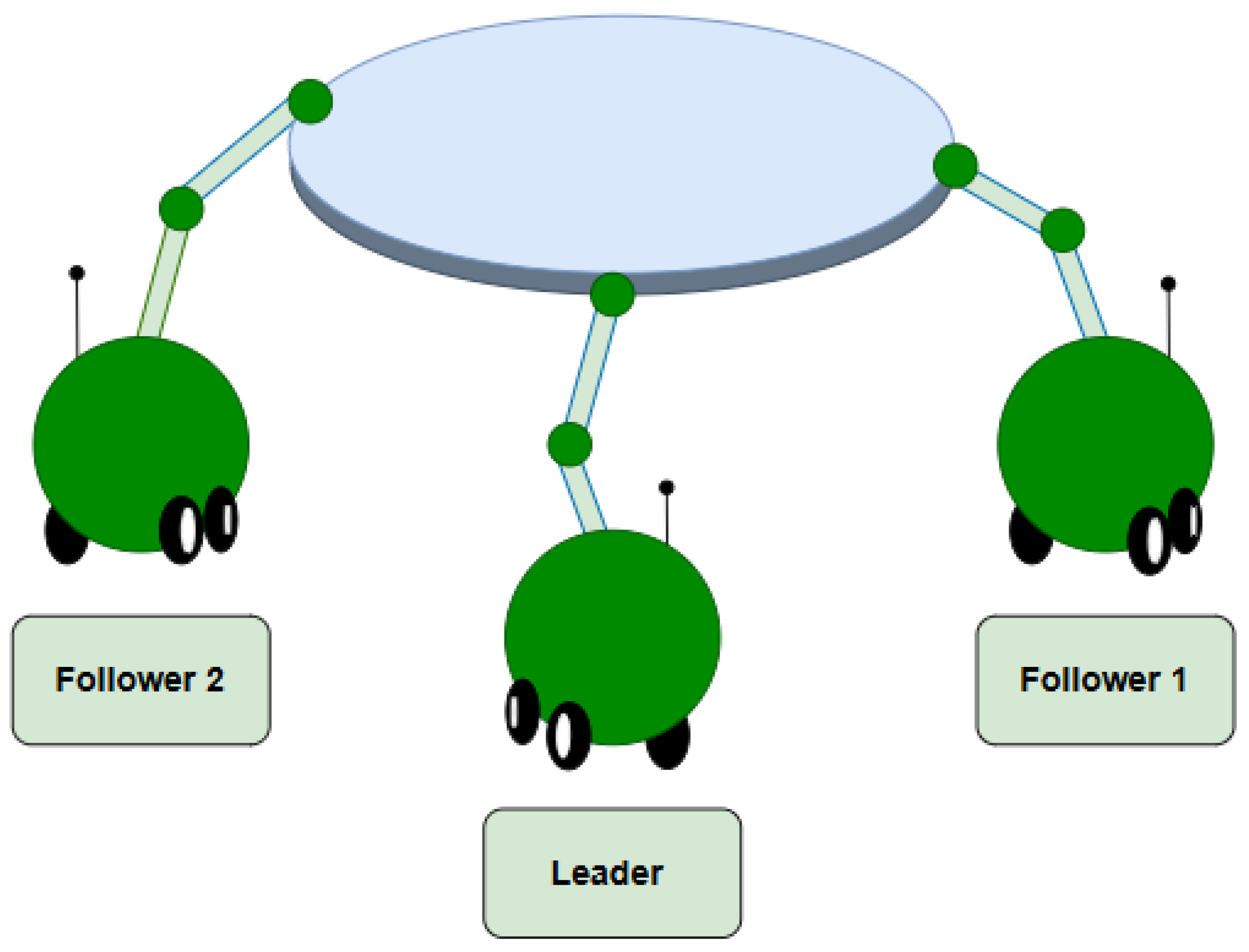
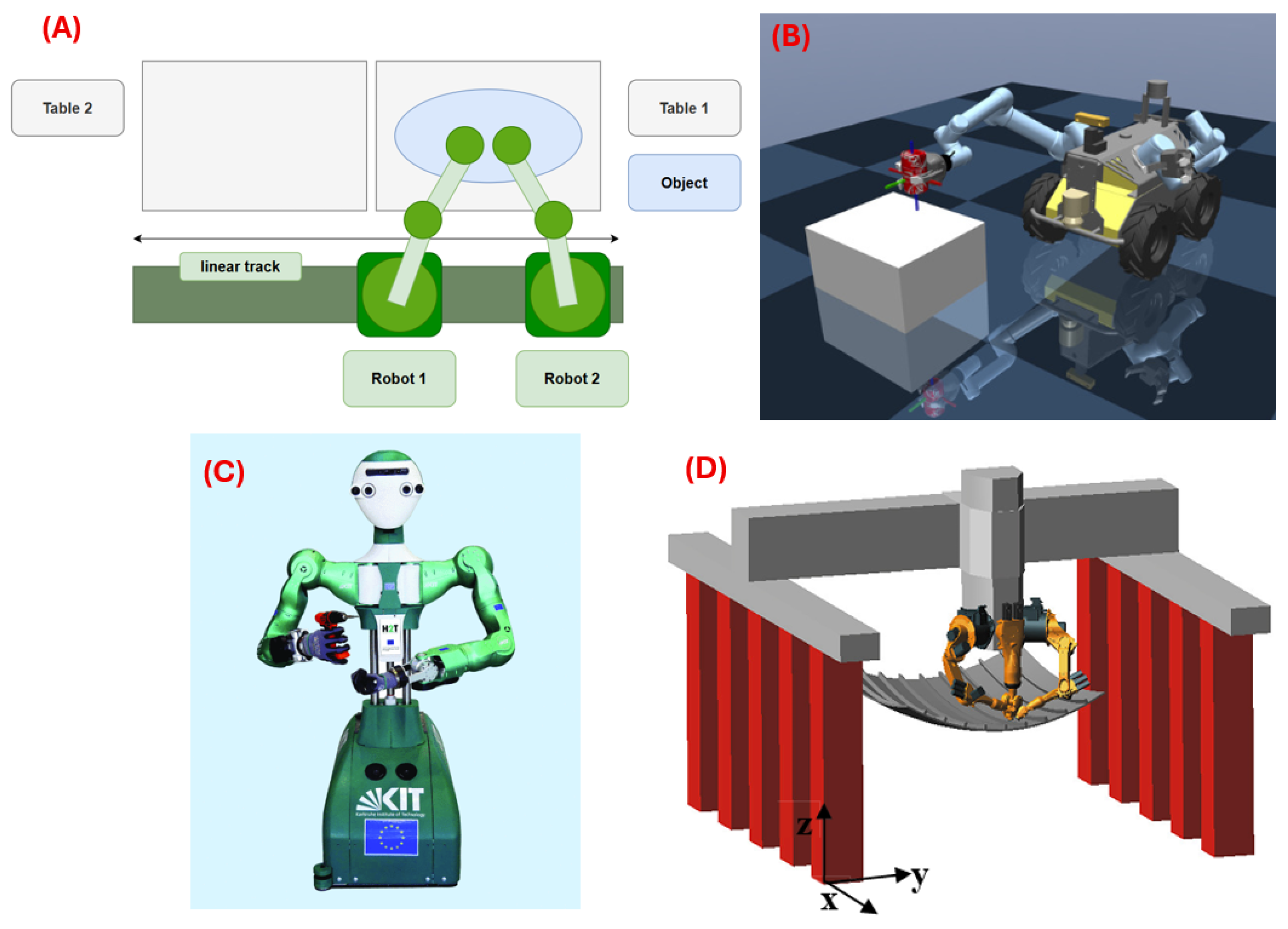
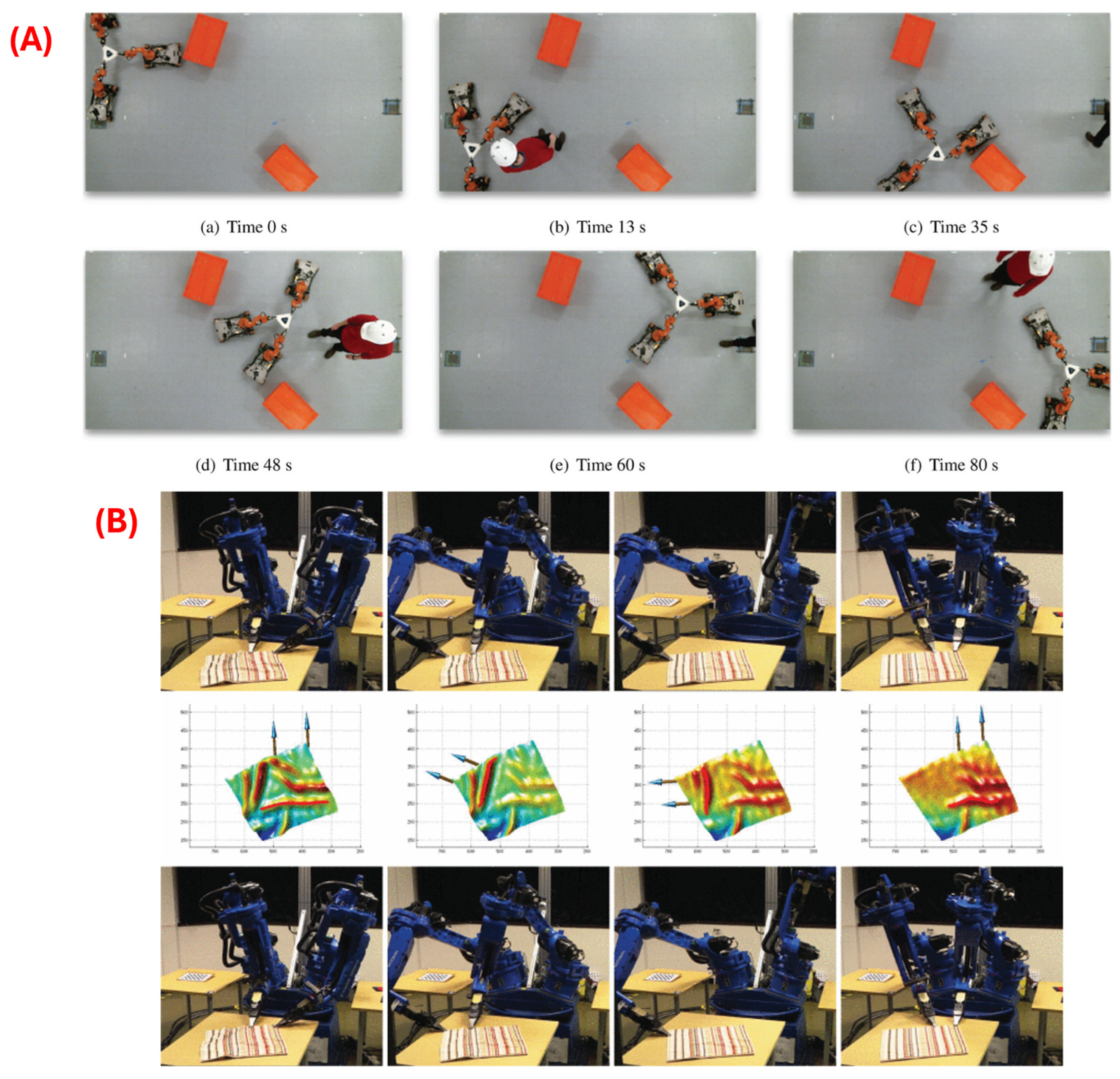
- In some applications, manipulators are placed on a mobile system, giving them more freedom to operate in large areas. As shown in Figure 2, three manipulators are placed on their mobile platform to transport an object from position A to position B. This is referred to as CMM because three manipulators are simultaneously transporting the object. The mobile platforms, supporting the manipulators, are not considered in the number of manipulators. It is a cooperative multi-manipulator system with three manipulators [20];
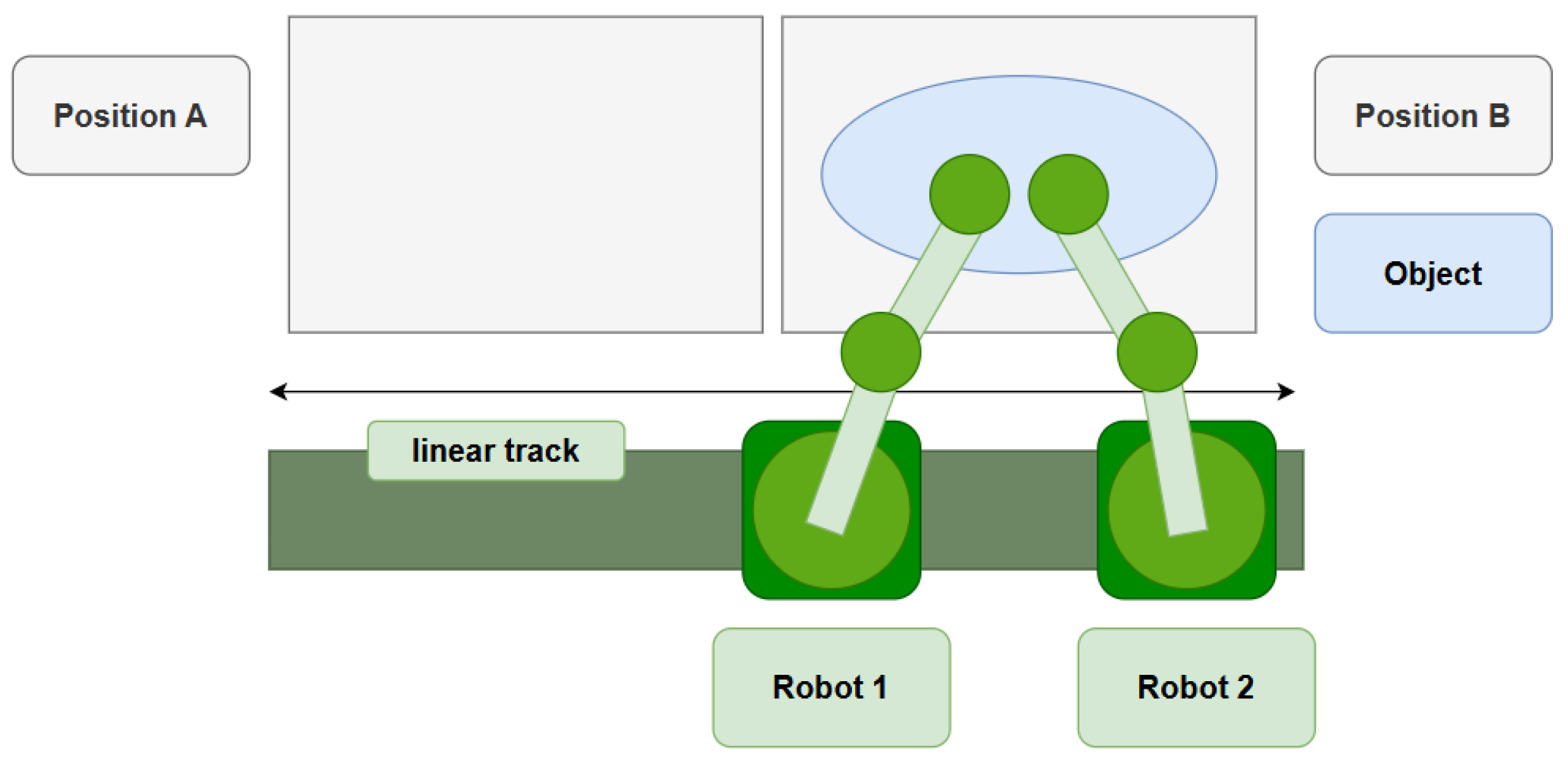
- The second example involves an application where the manipulators are positioned on the same linear track. The two manipulators can move along the track to take the product and transport it from point A to point B. In this case, the linear track causes the movement of the manipulators but does not support the object. This system is called a CDM system with transportation on a linear axis (shown in Figure 3) [21,22].
2.2. Types of Cooperation
- Fixation-fixation: several examples of this are:
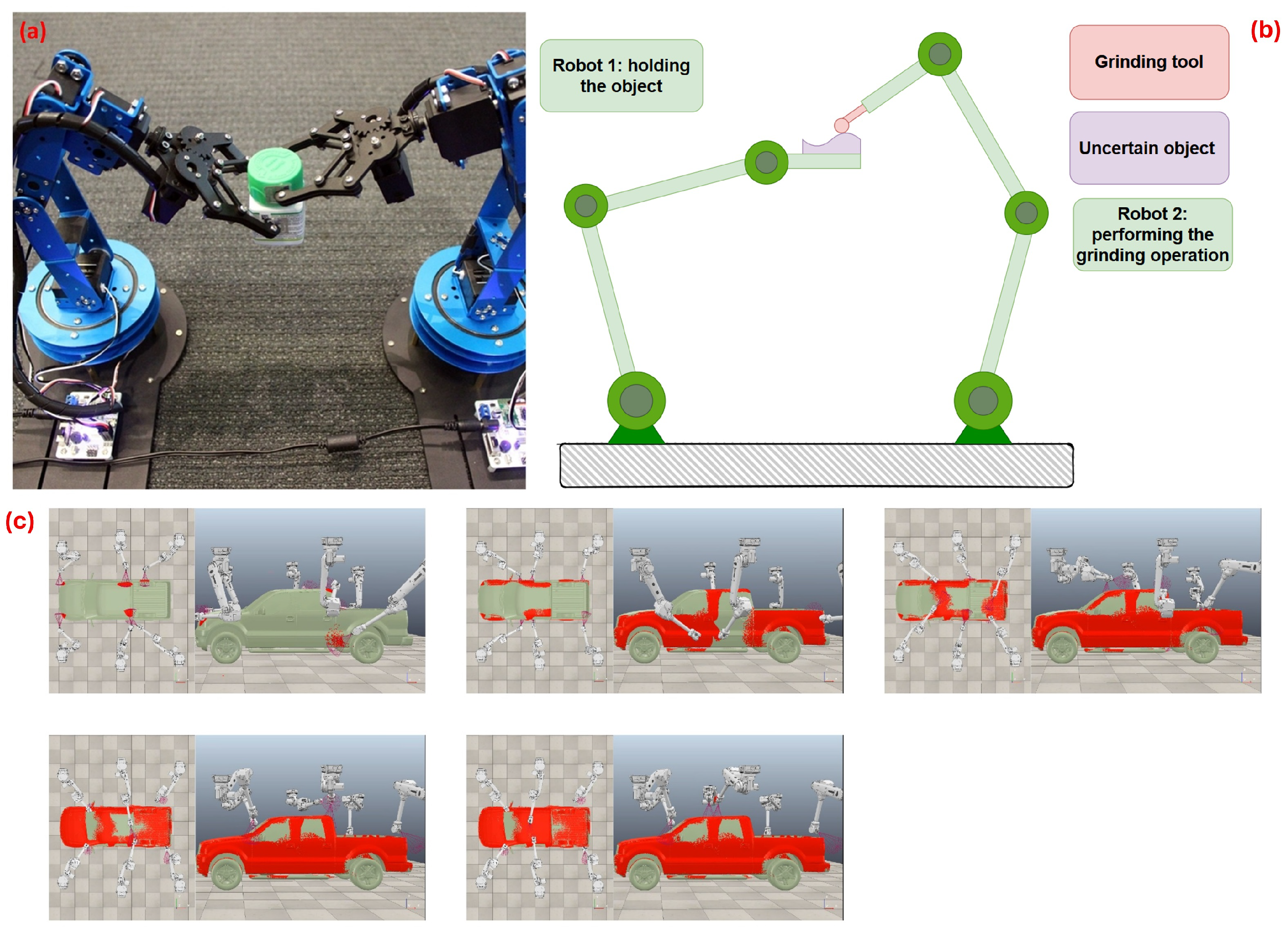
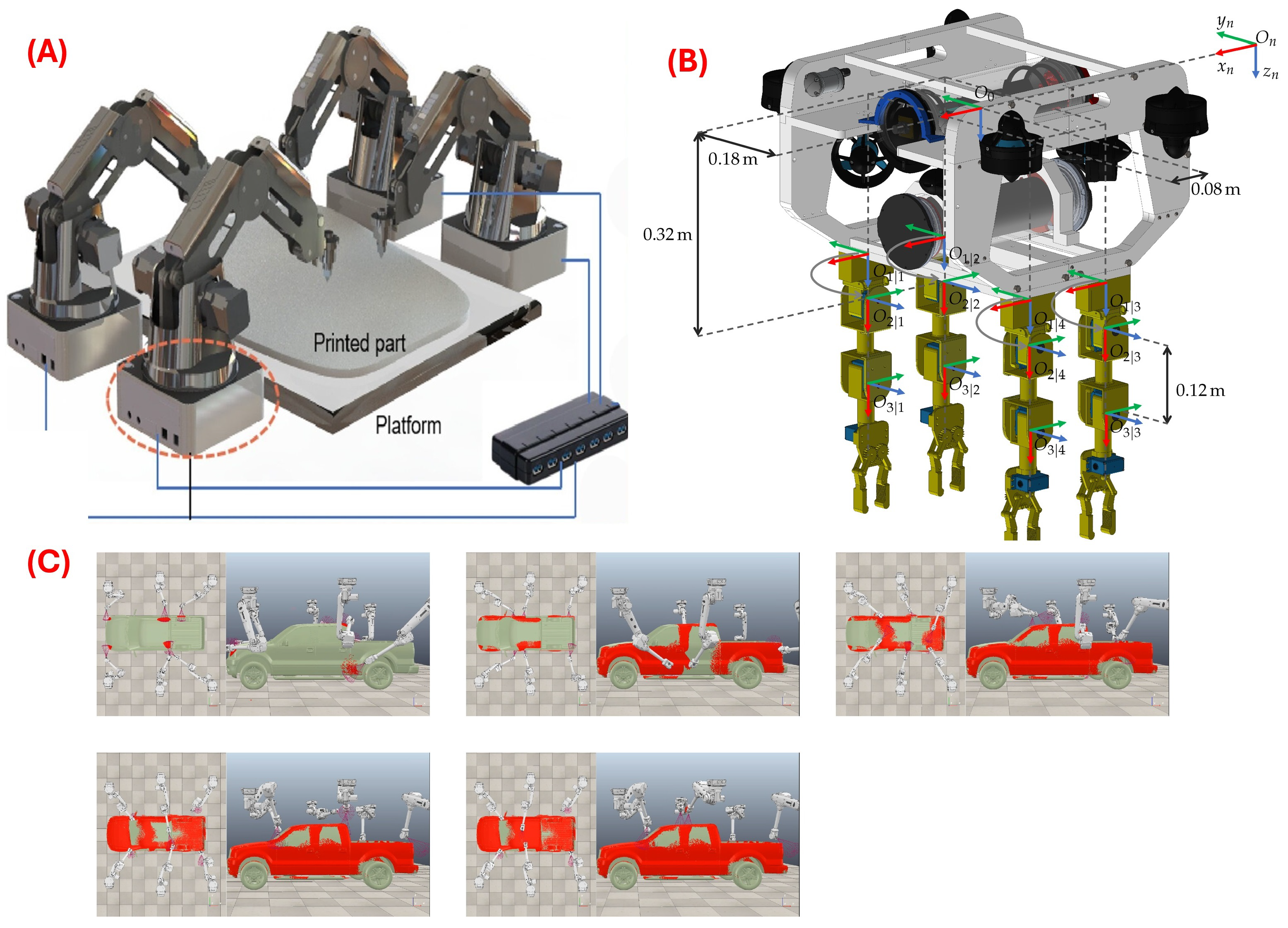
- In this context, fixation means that the manipulator is handling an object, while tooling means that the manipulator is performing operations with its tool on the object.Figure 4. Different types of cooperation: (a) is the fixation-fixation cooperation type where two manipulators are holding an object simultaneously, reprinted from Ref. [26], (b) is the fixation-tooling cooperation type where one manipulator is holding the object and the other one is doing an grinding operation on the object, adapted from [24], (c) is the tooling-tooling cooperation type different manipulators are spray painting a car. None of the manipulators are holding the car, reprinted from Ref. [25].Figure 4. Different types of cooperation: (a) is the fixation-fixation cooperation type where two manipulators are holding an object simultaneously, reprinted from Ref. [26], (b) is the fixation-tooling cooperation type where one manipulator is holding the object and the other one is doing an grinding operation on the object, adapted from [24], (c) is the tooling-tooling cooperation type different manipulators are spray painting a car. None of the manipulators are holding the car, reprinted from Ref. [25].


3. State of the Art
3.1. Historical Timeline
3.2. Modeling
3.3. Control Methods and Architectures
3.3.1. CDM Control Architectures
- Function approximation technique-based control combined with linear observer-based control [161];
- Adaptive proportional derivative control [104];
- Adaptive backstepping control [101];
- Adaptive fuzzy control combined with backstepping control [120];
- Fuzzy neural network control [143];
- Kalman filter combined with iterative learning control [106];
- Radial basis function neural network control combined with model-based control architecture [134];
- Synchronous sliding mode control combined with radial basis function neural network [160];
- Passivity-based hybrid force/position control [35];
- Vibration suspension control [50];
- Leader-follower force control [185].
- For impedance control, a wide variety of architectures can be found in the literature. These include:
- Adaptive impedance combined with a leader-follower control method [108];
- Proportional derivative control combined with gravity compensation [115];
- Adaptive variable impedance control combined with sliding mode control [165];
- Sliding mode control combined with adaptive radial basis function neural network [24];
- Adaptive hybrid impedance control [207];
- Impedance control combined with trajectory coordination [182];
- Impedance control to achieve compliant control [184].
- Adaptive proportional derivative architecture [102];
- Fuzzy sliding mode control [208];
- Adaptive radial basis function neural network combined with sliding mode control [99];
- Adaptive radial basis function neural network combined with backstepping control and sliding mode control [100];
- Dynamic surface control combined with radial basis function neural network [158].
- The fourth control method in adaptive control systems is admittance control. In admittance control methods, three different control architectures exist:
- Adaptive backstepping [187];
- The last main control structure in adaptive control systems is the vision-based control method. Further information about vision is mentioned in the Section 3.8. In [8], a brief overview of flexible manipulators’ control methods and architectures is given. The reason these architectures are not mentioned is that they are less relevant for CMM research. Flexible manipulators, such as product manipulation with dexterous fingers, are topics on their own.
3.3.2. CMM Control Architectures
- Several publications have introduced control architectures specifically for CMM. Many of these approaches overlap with those used in CDM, although some techniques are more prominent in CMM. Adaptive control clearly dominates in CMM applications. An observer-based adaptive sliding mode control combined with proportional derivative, to grab an object with three manipulators, is discussed in [140]. An adaptive fuzzy hybrid intelligent position/force controller is proposed in [75]. Adaptive synchronized control is used in [76] to guide an object synchronously during assembly tasks, while an admittance-based adaptive cooperative control scheme is presented in [142]. Another adaptive method is adaptive consensus control [77], a multi-agent technique that does not appear in the CDM literature. Sliding mode control is another commonly used architecture in both manipulation systems. For welding applications, sliding mode control is applied to cooperative multi-manipulators in [149]. Incremental motion control is used for the simultaneous transport of large objects in [41]. In human-robot interaction, a CMM system is developed to transport large objects together with human operators. Therefore, impedance control combined with leader-follower control is proposed in [155]. Another leader-follower application is proposed in [186] where multiple mobile manipulators transport a rigid object simultaneously. As mentioned in CDM, CM is also performed in underwater environments [131]. The control architectures used there can be extended to CMM systems. In multi-manipulator assembly systems, an agent-based control method is used to coordinate three manipulators operating in the same workspace [42]. A distributed neural network for solving the motion generation problem in multi-manipulator systems is presented in [198]. In telemanipulation, neural network-based control [132] and fuzzy control [152] are proposed for cooperative object transport with multiple manipulators. Motion control approaches using the Open Motion Planning Library and networked mobile platforms are discussed in [153,192]. As mentioned in CDM, formation control and observer-based control are also relevant and can be extended to CMM. Solutions are provided in [133,154]. Table 3 provides a comparison between CDM and CMM control architectures.
3.4. Planning Strategies
3.4.1. CDM Planning Strategies
3.4.2. CMM Planning Strategies
3.5. Manipulator Setup
3.6. Division in Types of Cooperation
3.7. Sensor Systems
3.8. Vision Systems
3.9. End-Effector and in Hand Manipulation
3.10. Application Domains
4. Challenges and Future Work
5. Conclusions
Author Contributions
Funding
Informed Consent Statement
Data Availability Statement
Acknowledgments
Conflicts of Interest
References
- Ulewicz, R.; Mazur, M. Economic Aspects of Robotization of Production Processes by Example of a Car Semi-trailers Manufacturer. Manuf. Technol. 2019, 19, 1054–1059. [Google Scholar] [CrossRef]
- IFR International Federation of Robotics. International Federation of Robotics. Available online: https://ifr.org/about-world-robotics (accessed on 21 October 2025).
- Cyberne1. 1954—Programmed Article Transfer Patent—George C. Devol Jr. (American). 2013. Available online: https://cyberneticzoo.com/early-industrial-robots/1954-programmed-article-transfer-patent-george-c-devol-jr-american/ (accessed on 21 October 2025).
- Gasparetto, A.; Scalera, L. A Brief History of Industrial Robotics in the 20th Century. Adv. Hist. Stud. 2019, 8, 24–35. [Google Scholar] [CrossRef]
- Hayakawa, S.; Wan, W.; Koyama, K.; Harada, K. A Dual-Arm Robot That Manipulates Heavy Plates With the Support of a Vacuum Lifter. IEEE Trans. Autom. Sci. Eng. 2023, 20, 2808–2821. [Google Scholar] [CrossRef]
- Lee, D.H.; Choi, M.S.; Park, H.; Jang, G.R.; Park, J.H.; Bae, J.H. Peg-in-Hole Assembly With Dual-Arm Robot and Dexterous Robot Hands. IEEE Robot. Autom. Lett. 2022, 7, 8566–8573. [Google Scholar] [CrossRef]
- Caccavale, F. Cooperative Manipulators. In Encyclopedia of Systems and Control; Baillieul, J., Samad, T., Eds.; Springer International Publishing: Cham, Swizerland, 2021; pp. 450–455. [Google Scholar] [CrossRef]
- Abbas, M.; Narayan, J.; Dwivedy, S.K. A systematic review on cooperative dual-arm manipulators: Modeling, planning, control, and vision strategies. Int. J. Intell. Robot. Appl. 2023, 7, 683–707. [Google Scholar] [CrossRef]
- Uchiyama, M.; Iwasawa, N.; Hakomori, K. Hybrid position/Force control for coordination of a two-arm robot. In Proceedings of the 1987 IEEE International Conference on Robotics and Automation, Raleigh, NC, USA, 31 March–3 April 1987; Volume 4, pp. 1242–1247. [Google Scholar] [CrossRef]
- Wen, J.T.; Kreutz-Delgado, K. Motion and force control of multiple robotic manipulators. Automatica 1992, 28, 729–743. [Google Scholar] [CrossRef]
- Schneider, S.; Cannon, R. Object impedance control for cooperative manipulation: Theory and experimental results. IEEE Trans. Robot. Autom. 1992, 8, 383–394. [Google Scholar] [CrossRef]
- Hsu, P. Coordinated control of multiple manipulator systems. IEEE Trans. Robot. Autom. 1993, 9, 400–410. [Google Scholar] [CrossRef]
- Hu, Y.-R.; Goldenberg, A.A.; Zhou, C. Motion and Force Control of Coordinated Robots During Constrained Motion Tasks. Int. J. Robot. Res. 1995, 14, 351–365. [Google Scholar] [CrossRef]
- Chiacchio, P.; Chiaverini, S.; Siciliano, B. Direct and Inverse Kinematics for Coordinated Motion Tasks of a Two-Manipulator System. J. Dyn. Syst. Meas. Control 1996, 118, 691–697. [Google Scholar] [CrossRef]
- Caccavale, F.; Chiacchio, P.; Chiaverini, S. Task-space regulation of cooperative manipulators. Automatica 2000, 36, 879–887. [Google Scholar] [CrossRef]
- Darmanin, R.N.; Bugeja, M.K. A review on multi-robot systems categorised by application domain. In Proceedings of the 2017 25th Mediterranean Conference on Control and Automation (MED), Valletta, Malta, 3–6 July 2017; pp. 701–706. [Google Scholar] [CrossRef]
- Smith, C.; Karayiannidis, Y.; Nalpantidis, L.; Gratal, X.; Qi, P.; Dimarogonas, D.V.; Kragic, D. Dual arm manipulation—A survey. Robot. Auton. Syst. 2012, 60, 1340–1353. [Google Scholar] [CrossRef]
- Yoshikawa, T. Multifingered robot hands: Control for grasping and manipulation. Annu. Rev. Control 2010, 34, 199–208. [Google Scholar] [CrossRef]
- Elsevier. Manipulator—An Overview|ScienceDirect Topics. 2025. Available online: https://www.sciencedirect.com/topics/computer-science/manipulator (accessed on 21 October 2025).
- Kume, Y.; Hirata, Y.; Kosuge, K. Coordinated motion control of multiple mobile manipulators handling a single object without using force/torque sensors. In Proceedings of the 2007 IEEE/RSJ International Conference on Intelligent Robots and Systems, San Diego, CA, USA, 29 October–2 November 2007; pp. 4077–4082. [Google Scholar] [CrossRef]
- Larsen, L.; Pham, V.L.; Kim, J.; Kupke, M. Collision-free path planning of industrial cooperating robots for aircraft fuselage production. In Proceedings of the 2015 IEEE International Conference on Robotics and Automation (ICRA), Seattle, WA, USA, 26–30 May 2015; pp. 2042–2047. [Google Scholar] [CrossRef]
- Larsen, L.; Kim, J. Path planning of cooperating industrial robots using evolutionary algorithms. Robot. Comput.-Integr. Manuf. 2021, 67, 102053. [Google Scholar] [CrossRef]
- Matheson, R. Robots Track Moving Objects with Unprecedented Precision. 2019. Available online: https://news.mit.edu/2019/robots-track-moving-objects-unprecedented-precision-0219 (accessed on 21 October 2025).
- Zhai, A.; Zhang, H.; Wang, J.; Lu, G.; Li, J.; Chen, S. Adaptive neural synchronized impedance control for cooperative manipulators processing under uncertain environments. Robot. Comput.-Integr. Manuf. 2022, 75, 102291. [Google Scholar] [CrossRef]
- Zbiss, K.; Kacem, A.; Santillo, M.; Mohammadi, A. Automatic Optimal Robotic Base Placement for Collaborative Industrial Robotic Car Painting. Appl. Sci. 2024, 14, 8614. [Google Scholar] [CrossRef]
- Ghorbanpour, A. Cooperative Robot Manipulators Dynamical Modeling and Control: An Overview. Dynamics 2023, 3, 820–854. [Google Scholar] [CrossRef]
- Yun, X.; Kumar, V.R. An Approach to Simultaneous Control of Trajectory and Interaction Forces in Dual Arm Configurations. In Advanced Robotics: 1989, Proceedings of the 4th International Conference on Advanced Robotics Columbus, Columbus, OH, USA, 13–15 June 1989; Waldron, K.J., Ed.; Springer: Berlin/Heidelberg, Germany, 1989; pp. 278–298. [Google Scholar] [CrossRef]
- Sarkar, N.; Yun, X.; Kumar, V. Dynamic Control of 3-D Rolling Contacts in Two-Arm Manipulation. IEEE Trans. Robot. Autom. 1997, 13, 364–376. [Google Scholar] [CrossRef]
- Bicchi, A.; Melchiorri, C.; Balluchi, D. On the mobility and manipulability of general multiple limb robots. IEEE Trans. Robot. Autom. 1995, 11, 215–228. [Google Scholar] [CrossRef]
- Wakamatsu, H.; Hirai, S.; Iwata, K. Static analysis of deformable object grasping based on bounded force closure. In Proceedings of the IEEE International Conference on Robotics and Automation, Minneapolis, MN, USA, 22–28 April 1996; Volume 4, pp. 3324–3329. [Google Scholar] [CrossRef]
- Xi, N.; Tarn, T.J.; Bejczy, A. Intelligent planning and control for multirobot coordination: An event-based approach. IEEE Trans. Robot. Autom. 1996, 12, 439–452. [Google Scholar] [CrossRef]
- Bonitz, R.; Hsia, T. Robust dual-arm manipulation of rigid objects via palm grasping-theory and experiments. In Proceedings of the IEEE International Conference on Robotics and Automation, Minneapolis, MN, USA, 22–28 April 1996; Volume 4, pp. 3047–3054. [Google Scholar] [CrossRef]
- Zheng, Y.F.; Chen, M.Z. Trajectory planning for two manipulators to deform flexible beams. Robot. Auton. Syst. 1994, 12, 55–67. [Google Scholar] [CrossRef]
- Buckingham, R. Multi-arm robots. Ind. Robot Int. J. 1996, 23, 16–20. [Google Scholar] [CrossRef]
- Liu, Y.H.; Arimoto, S.; Parra-Vega, V.; Kitagaki, K. Adaptive distributed cooperation controller for multiple manipulators. In Proceedings of the 1995 IEEE/RSJ International Conference on Intelligent Robots and Systems. Human Robot Interaction and Cooperative Robots, Pittsburgh, PA, USA, 5–9 August 1995; Volume 1, pp. 489–494. [Google Scholar] [CrossRef]
- Yun, X.; Kumar, V. An approach to simultaneous control of trajectory and interaction forces in dual-arm configurations. IEEE Trans. Robot. Autom. 1991, 7, 618–625. [Google Scholar] [CrossRef]
- Yamada, Y.; Nagamatsu, S.; Sato, Y. Development of multi-arm robots for automobile assembly. In Proceedings of the 1995 IEEE International Conference on Robotics and Automation, Nagoya, Japan, 21–27 May 1995; Volume 3, pp. 2224–2229. [Google Scholar] [CrossRef]
- Tanner, H.G.; Kyriakopoulos, K.J.; Krikelis, N.J. Modeling of multiple mobile manipulators handling a common deformable object. J. Robot. Syst. 1998, 15, 599–623. [Google Scholar] [CrossRef]
- Chiacchio, P.; Chiaverini, S.; Sciavicco, L.; Siciliano, B. Global Task Space Manipulability Ellipsoids for Multiple-Arm Systems. IEEE Trans. Robot. Autom. 1991, 7, 678–685. [Google Scholar] [CrossRef]
- Williams, D.; Khatib, O. The virtual linkage: A model for internal forces in multi-grasp manipulation. In Proceedings of the [1993] Proceedings IEEE International Conference on Robotics and Automation, Atlanta, GA, USA, 2–6 May 1993; Volume 1, pp. 1025–1030. [Google Scholar] [CrossRef]
- Tzafestas, C.S.; Prokopiou, P.A.; Tzafestas, S.G. Path Planning and Control of a Cooperative Three-Robot System Manipulating Large Objects. J. Intell. Robot. Syst. 1998, 22, 99–116. [Google Scholar] [CrossRef]
- Fraile, J.C.; Paredis, C.; Wang, C.H.; Khosla, P. Agent-based planning and control of a multi-manipulator assembly system. In Proceedings of the 1999 IEEE International Conference on Robotics and Automation (Cat. No.99CH36288C), Detroit, MI, USA, 10–15 May 1999; Volume 2, pp. 1219–1225. [Google Scholar] [CrossRef]
- Moon, S.; Ahmad, S. Time-optimal trajectories for cooperative multi-manipulator systems. IEEE Trans. Syst. Man Cybern. Part B (Cybern.) 1997, 27, 343–353. [Google Scholar] [CrossRef][Green Version]
- Khatib, O.; Yokoi, K.; Chang, K.; Ruspini, D.; Holmberg, R.; Casal, A. Coordination and decentralized cooperation of multiple mobile manipulators. J. Robot. Syst. 1996, 13, 755–764. [Google Scholar] [CrossRef]
- Cox, D. Mock-up of hazardous material handling tasks using a dual-arm robotic system. In Proceedings of the 5th Biannual World Automation Congress, Orlando, FL, USA, 9–13 June 2002; Volume 14, pp. 527–532. [Google Scholar] [CrossRef]
- Caccavale, F.; Chiacchio, P.; Marino, A.; Luigi, V. Six-DOF Impedance Control of Dual-Arm Cooperative Manipulators. IEEE/ASME Trans. Mechatron. 2008, 13, 576–586. [Google Scholar] [CrossRef]
- Gudino-Lau, J.; Arteaga, M.; Munoz, L.; Parra-Vega, V. On the control of cooperative robots without velocity measurements. IEEE Trans. Control Syst. Technol. 2004, 12, 600–608. [Google Scholar] [CrossRef]
- Gudiño-Lau, J.; Arteaga, M.A. Dynamic model and simulation of cooperative robots: A case study. Robotica 2005, 23, 615–624. [Google Scholar] [CrossRef]
- Navarro-Alarcon, D.; Parra-Vega, V.; Vite-Medecigo, S.; Olguin-Diaz, E. Dexterous Cooperative Manipulation with Redundant Robot Arms. In Progress in Pattern Recognition, Image Analysis, Computer Vision, and Applications, Proceedings of the 14th Iberoamerican Conference on Pattern Recognition, CIARP 2009, Guadalajara, Mexico, 15–18 November 2009; Bayro-Corrochano, E., Eklundh, J.O., Eds.; Springer: Berlin/Heidelberg, Germany, 2009; pp. 910–917. [Google Scholar] [CrossRef]
- Yamano, M.; Kim, J.S.; Konno, A.; Uchiyama, M. Cooperative Control of a 3D Dual-Flexible-Arm Robot. J. Intell. Robot. Syst. 2004, 39, 1–15. [Google Scholar] [CrossRef]
- Tinos, R.; Terra, M.; Ishihara, J. Motion and force control of cooperative robotic manipulators with passive joints. IEEE Trans. Control Syst. Technol. 2006, 14, 725–734. [Google Scholar] [CrossRef]
- Lian, K.Y.; Chiu, C.S.; Liu, P. Semi-decentralized adaptive fuzzy control for cooperative multirobot systems with H/sup /spl infin// motion/internal force tracking performance. IEEE Trans. Syst. Man Cybern. Part B (Cybern.) 2002, 32, 269–280. [Google Scholar] [CrossRef]
- Tanner, H.; Loizou, S.; Kyriakopoulos, K. Nonholonomic navigation and control of cooperating mobile manipulators. IEEE Trans. Robot. Autom. 2003, 19, 53–64. [Google Scholar] [CrossRef]
- Dauchez, P.; Fraisse, P.; Pierrot, F. A vision/position/force control approach for performing assembly tasks with a humanoid robot. In Proceedings of the 5th IEEE-RAS International Conference on Humanoid Robots, Tsukuba, Japan, 5 December 2005; pp. 277–282. [Google Scholar] [CrossRef]
- Vahrenkamp, N.; Böge, C.; Welke, K.; Asfour, T.; Walter, J.; Dillmann, R. Visual servoing for dual arm motions on a humanoid robot. In Proceedings of the 2009 9th IEEE-RAS International Conference on Humanoid Robots, Paris, France, 7–10 December 2009; pp. 208–214. [Google Scholar] [CrossRef]
- Platt, R.; Burridge, R.; Diftler, M.; Graf, J.; Goza, M.; Huber, E.; Brock, O. Humanoid Mobile Manipulation Using Controller Refinement. In Proceedings of the 2006 6th IEEE-RAS International Conference on Humanoid Robots, Genova, Italy, 4–6 December 2006; pp. 94–101. [Google Scholar] [CrossRef]
- Schaal, S.; Kotosaka, S.; Sternad, D. Nonlinear Dynamical Systems as Movement Primitives; CD-Proceedings: Cambridge, MA, USA, 2000. [Google Scholar]
- Gribovskaya, E.; Billard, A. Combining Dynamical Systems Control and Programming by Demonstration for Teaching Discrete Bimanual Coordination Tasks to a Humanoid Robot. In Proceedings of the 3rd ACM/IEEE International Conference on Human-Robot Interaction (HRI 2008), Amsterdam, The Netherlands, 12–15 March 2008; pp. 33–40. [Google Scholar] [CrossRef]
- Albers, A.; Brudniok, S.; Ottnad, J.; Sauter, C.; Sedchaicharn, K. Upper Body of a new Humanoid Robot—The Design of ARMAR III. In Proceedings of the 2006 6th IEEE-RAS International Conference on Humanoid Robots, Genova, Italy, 4–6 December 2006; pp. 308–313. [Google Scholar] [CrossRef]
- Salleh, K.; Seki, H.; Kamiya, Y.; Hikizu, M. Inchworm robot grippers in clothes manipulation—Optimizing the tracing algorithm. In Proceedings of the 2007 International Conference on Intelligent and Advanced Systems, Kuala Lumpur, Malaysia, 25–28 November 2007; pp. 1051–1055. [Google Scholar] [CrossRef]
- Asfour, T.; Regenstein, K.; Azad, P.; Schroder, J.; Bierbaum, A.; Vahrenkamp, N.; Dillmann, R. ARMAR-III: An Integrated Humanoid Platform for Sensory-Motor Control. In Proceedings of the 2006 6th IEEE-RAS International Conference on Humanoid Robots, Genova, Italy, 4–6 December 2006; pp. 169–175. [Google Scholar] [CrossRef]
- Iwata, H.; Sugano, S. Design of human symbiotic robot TWENDY-ONE. In Proceedings of the 2009 IEEE International Conference on Robotics and Automation, Kobe, Japan, 12–17 May 2009; pp. 580–586. [Google Scholar] [CrossRef]
- Hamajima, K.; Kakikura, M. Planning strategy for task of unfolding clothes. Robot. Auton. Syst. 2000, 32, 145–152. [Google Scholar] [CrossRef]
- Park, C.; Park, K.; Park, D.I.; Kyung, J.H. Dual arm robot manipulator and its easy teaching system. In Proceedings of the 2009 IEEE International Symposium on Assembly and Manufacturing, Seoul, Republic of Korea, 17–20 November 2009; pp. 242–247. [Google Scholar] [CrossRef]
- Takamatsu, J.; Ogawara, K.; Kimura, H.; Ikeuchi, K. Recognizing Assembly Tasks Through Human Demonstration. Int. J. Robot. Res. 2007, 26, 641–659. [Google Scholar] [CrossRef]
- Liu, H.; Dai, J. An approach to carton-folding trajectory planning using dual robotic fingers. Robot. Auton. Syst. 2003, 42, 47–63. [Google Scholar] [CrossRef]
- Suda, R.; Kosuge, K.; Kakuya, H. Object-impedance-based cooperative handling of object by mobile robot helper and human using visual and force information. In Proceedings of the 2003 IEEE/ASME International Conference on Advanced Intelligent Mechatronics (AIM 2003), Kobe, Japan, 20–24 July 2003; Volume 1, pp. 592–597. [Google Scholar] [CrossRef]
- Fuchs, M.; Borst, C.; Robuffo Giordano, P.; Baumann, A.; Kraemer, E.; Langwald, J.; Gruber, R.; Seitz, N.; Plank, G.; Kunze, K.; et al. Rollin’ Justin—Design considerations and realization of a mobile platform for a humanoid upper body. In Proceedings of the 2009 IEEE International Conference on Robotics and Automation, Kobe, Japan, 12–17 May 2009; pp. 4131–4137. [Google Scholar] [CrossRef]
- Ott, C.; Eiberger, O.; Friedl, W.; Bauml, B.; Hillenbrand, U.; Borst, C.; Albu-Schaffer, A.; Brunner, B.; Hirschmuller, H.; Kielhofer, S.; et al. A Humanoid Two-Arm System for Dexterous Manipulation. In Proceedings of the 2006 6th IEEE-RAS International Conference on Humanoid Robots, Genova, Italy, 4–6 December 2006; pp. 276–283. [Google Scholar] [CrossRef]
- Sugar, T.; Kumar, V. Control of cooperating mobile manipulators. IEEE Trans. Robot. Autom. 2002, 18, 94–103. [Google Scholar] [CrossRef]
- Li, Z.; Ge, S.S.; Adams, M.; Wijesoma, W.S. Robust Adaptive Control of Cooperating Mobile Manipulators with Relative Motion. In Proceedings of the 2007 IEEE 22nd International Symposium on Intelligent Control, Singapore, 1–3 October 2007; pp. 351–356. [Google Scholar] [CrossRef]
- Kawasaki, H.; Ueki, S.; Ito, S. Decentralized Adaptive Coordinated Control of Multiple Robot Arms Without Using a Force Sensor. Automatica 2006, 42, 437–448. [Google Scholar] [CrossRef]
- Lippiello, V.; Siciliano, B.; Villani, L. An experimental setup for visual servoing applications on an industrial robotic cell. In Proceedings of the 2005 IEEE/ASME International Conference on Advanced Intelligent Mechatronics, Monterey, CA, USA, 24–28 July 2005; pp. 1431–1436. [Google Scholar] [CrossRef]
- Swain, A.K.; Morris, A.S. Dynamic control of multi-arm co-operating manipulator systems. Robotica 2004, 22, 271–283. [Google Scholar] [CrossRef]
- Gueaieb, W.; Karray, F.; Al-Sharhan, S. A Robust Hybrid Intelligent Position/Force Control Scheme for Cooperative Manipulators. IEEE/ASME Trans. Mechatron. 2007, 12, 109–125. [Google Scholar] [CrossRef]
- Sun, D.; Mills, J. Adaptive synchronized control for coordination of multirobot assembly tasks. IEEE Trans. Robot. Autom. 2002, 18, 498–510. [Google Scholar] [CrossRef]
- Cheng, L.; Hou, Z.G.; Tan, M.; Liu, D.; Zou, A.M. Multi-Agent Based Adaptive Consensus Control for Multiple Manipulators with Kinematic Uncertainties. In Proceedings of the 2008 IEEE International Symposium on Intelligent Control, San Antonio, TX, USA, 3–5 September 2008; pp. 189–194. [Google Scholar] [CrossRef]
- Huang, X.; Lv, X.; Wang, M. Development of A Robotic Microassembly System with Multi-Manipulator Cooperation. In Proceedings of the 2006 International Conference on Mechatronics and Automation, Luoyang, China, 25–28 June 2006; pp. 1197–1201. [Google Scholar] [CrossRef]
- Fraile, J.C.; Perez-Turiel, J.; Gonzalez-Sanchez, J.L.; Baeyens, E.; Perez, R. Comparative analysis of collision-free path-planning methods for multi-manipulator systems. Robotica 2006, 24, 711–726. [Google Scholar] [CrossRef]
- Moosavian, S.A.A.; Ashtiani, H.R. Cooperation of robotic manipulators using non-model-based multiple impedance control. Ind. Robot Int. J. 2008, 35, 549–558. [Google Scholar] [CrossRef]
- Liza Ahmad Shauri, R.; Nonami, K. Assembly manipulation of small objects by dual-arm manipulator. Assem. Autom. 2011, 31, 263–274. [Google Scholar] [CrossRef]
- Zhu, J.; Navarro, B.; Fraisse, P.; Crosnier, A.; Cherubini, A. Dual-arm robotic manipulation of flexible cables. In Proceedings of the 2018 IEEE/RSJ International Conference on Intelligent Robots and Systems (IROS), Madrid, Spain, 1–5 October 2018; pp. 479–484. [Google Scholar] [CrossRef]
- Bell, M. Flexible Object Manipulation. Ph.D. Thesis, Dartmouth College, Hanover, NH, USA, 2010. [Google Scholar] [CrossRef]
- Shin, S.Y.; Kim, C. Human-Like Motion Generation and Control for Humanoid’s Dual Arm Object Manipulation. IEEE Trans. Ind. Electron. 2015, 62, 2265–2276. [Google Scholar] [CrossRef]
- Adorno, B.V.; Fraisse, P.; Druon, S. Dual position control strategies using the cooperative dual task-space framework. In Proceedings of the 2010 IEEE/RSJ International Conference on Intelligent Robots and Systems, Taipei, Taiwan, 18–22 October 2010; pp. 3955–3960. [Google Scholar] [CrossRef]
- Maitin-Shepard, J.; Cusumano-Towner, M.; Lei, J.; Abbeel, P. Cloth grasp point detection based on multiple-view geometric cues with application to robotic towel folding. In Proceedings of the 2010 IEEE International Conference on Robotics and Automation, Anchorage, AK, USA, 3–7 May 2010; pp. 2308–2315. [Google Scholar] [CrossRef]
- Zhou, J.; Yu, Y. Coordination control of dual-arm modular robot based on position feedback using Optotrak3020. Ind. Robot Int. J. 2011, 38, 172–185. [Google Scholar] [CrossRef]
- Masatoshi, H.; Hiroaki, S.; Yoshitsugu, K.; Sahari, K.S.M. Edge Tracing Manipulation of Clothes Based on Different Gripper Types. J. Comput. Sci. 2010, 6, 872–879. [Google Scholar] [CrossRef]
- Vahrenkamp, N.; Do, M.; Asfour, T.; Dillmann, R. Integrated Grasp and motion planning. In Proceedings of the 2010 IEEE International Conference on Robotics and Automation, Anchorage, AK, USA, 3–7 May 2010; pp. 2883–2888. [Google Scholar] [CrossRef]
- van den Berg, J.; Miller, S.; Goldberg, K.; Abbeel, P. Gravity-Based Robotic Cloth Folding. In Algorithmic Foundations of Robotics IX: Selected Contributions of the Ninth International Workshop on the Algorithmic Foundations of Robotics; Hsu, D., Isler, V., Latombe, J.C., Lin, M.C., Eds.; Springer: Berlin/Heidelberg, Germany, 2011; pp. 409–424. [Google Scholar] [CrossRef]
- Stückler, J.; Behnke, S. Following human guidance to cooperatively carry a large object. In Proceedings of the 2011 11th IEEE-RAS International Conference on Humanoid Robots, Bled, Slovenia, 26–28 October 2011; pp. 218–223. [Google Scholar] [CrossRef]
- Li, H.; Huang, Q.; Dong, Q.; Li, C.; He, Y.; Jiang, Z.; Li, Y.; Lv, P.; Xie, L.; Chen, X.; et al. Design for a Dual-Arm Space Robot. In Proceedings of the ROMANSY 18 Robot Design, Dynamics and Control; Parenti Castelli, V., Schiehlen, W., Eds.; Springer: Vienna, Austria, 2010; pp. 191–198. [Google Scholar] [CrossRef]
- Krüger, J.; Schreck, G.; Surdilovic, D. Dual arm robot for flexible and cooperative assembly. CIRP Ann. 2011, 60, 5–8. [Google Scholar] [CrossRef]
- Mukai, T.; Hirano, S.; Nakashima, H.; Kato, Y.; Sakaida, Y.; Guo, S.; Hosoe, S. Development of a nursing-care assistant robot RIBA that can lift a human in its arms. In Proceedings of the 2010 IEEE/RSJ International Conference on Intelligent Robots and Systems, Taipei, Taiwan, 18–22 October 2010; pp. 5996–6001. [Google Scholar] [CrossRef]
- Kojima, K.; Karasawa, T.; Kozuki, T.; Kuroiwa, E.; Yukizaki, S.; Iwaishi, S.; Ishikawa, T.; Koyama, R.; Noda, S.; Ueda, R.; et al. Development of High-Speed and High-Power Humanoid Research Platform JAXON. J. Robot. Soc. Jpn. 2016, 34, 458–467. [Google Scholar] [CrossRef]
- Lemburg, J.; de Gea Fernández, J.; Eich, M.; Mronga, D.; Kampmann, P.; Vogt, A.; Aggarwal, A.; Shi, Y.; Kirchner, F. AILA—Design of an autonomous mobile dual-arm robot. In Proceedings of the 2011 IEEE International Conference on Robotics and Automation, Shanghai, China, 9–13 May 2011; pp. 5147–5153. [Google Scholar] [CrossRef]
- Sun, L.; Aragon-Camarasa, G.; Rogers, S.; Siebert, J.P. Autonomous Clothes Manipulation Using a Hierarchical Vision Architecture. IEEE Access 2018, 6, 76646–76662. [Google Scholar] [CrossRef]
- Li, Z.; Yang, C.; Su, C.Y.; Deng, S.; Sun, F.; Zhang, W. Decentralized Fuzzy Control of Multiple Cooperating Robotic Manipulators With Impedance Interaction. IEEE Trans. Fuzzy Syst. 2015, 23, 1044–1056. [Google Scholar] [CrossRef]
- Tuan, L.A.; Joo, Y.H.; Tien, L.Q.; Duong, P.X. Adaptive neural network second-order sliding mode control of dual arm robots. Int. J. Control Autom. Syst. 2017, 15, 2883–2891. [Google Scholar] [CrossRef]
- Nguyen, T.V.; Thai, N.H.; Pham, H.T.; Phan, T.A.; Nguyen, L.; Le, H.X.; Nguyen, H.D. Adaptive Neural Network-Based Backstepping Sliding Mode Control Approach for Dual-Arm Robots. J. Control Autom. Electr. Syst. 2019, 30, 512–521. [Google Scholar] [CrossRef]
- Ahmad, U.; Pan, Y.J.; Shen, H.; Liu, S. Cooperative Control of Mobile Manipulators Transporting an Object based on an Adaptive Backstepping Approach. In Proceedings of the 2018 IEEE 14th International Conference on Control and Automation (ICCA), Anchorage, AK, USA, 12–15 June 2018; pp. 198–203. [Google Scholar] [CrossRef]
- Gaytán, A.; Sanchez-Magos, M.; Cruz-Ortiz, D.; Ballesteros-Escamilla, M.; Salgado, I.; Chairez, I. Adaptive Proportional Derivative Controller of Cooperative Manipulators. IFAC-PapersOnLine 2018, 51, 232–237. [Google Scholar] [CrossRef]
- Erhart, S.; Hirche, S. Adaptive force/velocity control for multi-robot cooperative manipulation under uncertain kinematic parameters. In Proceedings of the 2013 IEEE/RSJ International Conference on Intelligent Robots and Systems, Tokyo, Japan, 3–7 November 2013; pp. 307–314. [Google Scholar] [CrossRef]
- Pliego-Jimenez, J.; Arteaga-Perez, M. On the adaptive control of cooperative robots with time-variant holonomic constraints. Int. J. Adapt. Control Signal Process. 2017, 31, 1217–1231. [Google Scholar] [CrossRef]
- Cai, C.; Wang, B.; Li, Y. Research on Cooperative Work Path Planning Method Based on Double 6—DOF Manipulators. In Proceedings of the 2018 IEEE International Conference on Mechatronics and Automation (ICMA), Changchun, China, 5–8 August 2018; pp. 12–17. [Google Scholar] [CrossRef]
- Chen, B.H.; Wang, Y.H.; Lin, P.C. A Hybrid Control Strategy for Dual-arm Object Manipulation Using Fused Force/Position Errors and Iterative Learning. In Proceedings of the 2018 IEEE/ASME International Conference on Advanced Intelligent Mechatronics (AIM), Auckland, New Zealand, 9–12 July 2018; pp. 39–44. [Google Scholar] [CrossRef]
- Bjerkeng, M.; Schrimpf, J.; Myhre, T.; Pettersen, K.Y. Fast dual-arm manipulation using variable admittance control: Implementation and experimental results. In Proceedings of the 2014 IEEE/RSJ International Conference on Intelligent Robots and Systems, Chicago, IL, USA, 14–18 September 2014; pp. 4728–4734. [Google Scholar] [CrossRef]
- Liu, X.; Zhang, P.; Du, G. Hybrid adaptive impedance-leader-follower control for multi-arm coordination manipulators. Ind. Robot Int. J. 2016, 43, 112–120. [Google Scholar] [CrossRef]
- Jinjun, D.; Yahui, G.; Ming, C.; Xianzhong, D. Symmetrical adaptive variable admittance control for position/force tracking of dual-arm cooperative manipulators with unknown trajectory deviations. Robot. Comput.-Integr. Manuf. 2019, 57, 357–369. [Google Scholar] [CrossRef]
- Lin, L.; Yang, Y.; Song, Y.; Nemec, B.; Ude, A.; Rytz, J.; Buch, A.; Krüger, N.; Savarimuthu, T. Peg-in-Hole assembly under uncertain pose estimation. In Proceedings of the 11th World Congress on Intelligent Control and Automation, Shenyang, China, 29 June–4 July 2014; pp. 2842–2847. [Google Scholar] [CrossRef]
- Qu, J.; Zhang, F.; Fu, Y.; Guo, S. Multi-cameras visual servoing for dual-arm coordinated manipulation. Robotica 2017, 35, 2218–2237. [Google Scholar] [CrossRef]
- Parigi Polverini, M.; Zanchettin, A.M.; Rocco, P. A constraint-based programming approach for robotic assembly skills implementation. Robot. Comput.-Integr. Manuf. 2019, 59, 69–81. [Google Scholar] [CrossRef]
- Choi, T.Y.; Do, H.; Park, D.; Kyungk, J. Control of an Industrial Dual-arm Robot in a Narrow Space where Human Workers are Familiar with. In Proceedings of the 16th International Conference on Informatics in Control, Automation and Robotics, Prague, Czech Republic, 29–31 July 2019; Volume 2: ICINCO, pp. 339–344. [Google Scholar] [CrossRef]
- Völz, A.; Graichen, K. An Optimization-Based Approach to Dual-Arm Motion Planning with Closed Kinematics. In Proceedings of the 2018 IEEE/RSJ International Conference on Intelligent Robots and Systems (IROS), Madrid, Spain, 1–5 October 2018; pp. 8346–8351. [Google Scholar] [CrossRef]
- Ren, Y.; Liu, Y.; Jin, M.; Liu, H. Biomimetic object impedance control for dual-arm cooperative 7-DOF manipulators. Robot. Auton. Syst. 2016, 75, 273–287. [Google Scholar] [CrossRef]
- Huang, Y.; Zhang, X.; Chen, X.; Ota, J. Vision-guided peg-in-hole assembly by Baxter robot. Adv. Mech. Eng. 2017, 9, 1687814017748078. [Google Scholar] [CrossRef]
- Stolfi, A.; Gasbarri, P.; Sabatini, M. A combined impedance-PD approach for controlling a dual-arm space manipulator in the capture of a non-cooperative target. Acta Astronaut. 2017, 139, 243–253. [Google Scholar] [CrossRef]
- Choi, Y.; Kim, D.; Hwang, S.; Kim, H.; Kim, N.; Han, C. Dual-arm robot motion planning for collision avoidance using B-spline curve. Int. J. Precis. Eng. Manuf. 2017, 18, 835–843. [Google Scholar] [CrossRef]
- Ren, Y.; Chen, Z.; Liu, Y.; Gu, Y.; Jin, M.; Liu, H. Adaptive hybrid position/force control of dual-arm cooperative manipulators with uncertain dynamics and closed-chain kinematics. J. Frankl. Inst. 2017, 354, 7767–7793. [Google Scholar] [CrossRef]
- Jiang, Y.; Liu, Z.; Chen, C.; Zhang, Y. Adaptive robust fuzzy control for dual arm robot with unknown input deadzone nonlinearity. Nonlinear Dyn. 2015, 81, 1301–1314. [Google Scholar] [CrossRef]
- Kurosu, J.; Yorozu, A.; Takahashi, M. Simultaneous Dual-Arm Motion Planning for Minimizing Operation Time. Appl. Sci. 2017, 7, 1210. [Google Scholar] [CrossRef]
- Benali, K.; Brethé, J.F.; Guérin, F.; Gorka, M. Dual arm robot manipulator for grasping boxes of different dimensions in a logistics warehouse. In Proceedings of the 2018 IEEE International Conference on Industrial Technology (ICIT), Lyon, France, 20–22 February 2018; pp. 147–152. [Google Scholar] [CrossRef]
- He, J.; Luo, M.; Zhang, Q. Dual impedance control with variable object stiffness for the dual-arm cooperative manipulators. In Proceedings of the 2016 Asia-Pacific Conference on Intelligent Robot Systems (ACIRS), Tokyo, Japan, 20–22 July 2016; pp. 102–108. [Google Scholar] [CrossRef]
- Sarabu, H.; Ahlin, K.; Hu, A.P. Graph-Based Cooperative Robot Path Planning in Agricultural Environments. In Proceedings of the 2019 IEEE/ASME International Conference on Advanced Intelligent Mechatronics (AIM), Hong Kong, China, 8–12 July 2019; pp. 519–525. [Google Scholar] [CrossRef]
- Ling, X.; Zhao, Y.; Gong, L.; Liu, C.; Wang, T. Dual-arm cooperation and implementing for robotic harvesting tomato using binocular vision. Robot. Auton. Syst. 2019, 114, 134–143. [Google Scholar] [CrossRef]
- Zhang, T.; Ouyang, F. Offline motion planning and simulation of two-robot welding coordination. Front. Mech. Eng. 2012, 7, 81–92. [Google Scholar] [CrossRef]
- Bai, H.; Wen, J.T. Cooperative Load Transport: A Formation-Control Perspective. IEEE Trans. Robot. 2010, 26, 742–750. [Google Scholar] [CrossRef]
- Li, Z.; Li, J.; Kang, Y. Adaptive robust coordinated control of multiple mobile manipulators interacting with rigid environments. Automatica 2010, 46, 2028–2034. [Google Scholar] [CrossRef]
- Knepper, R.A.; Layton, T.; Romanishin, J.; Rus, D. IkeaBot: An autonomous multi-robot coordinated furniture assembly system. In Proceedings of the 2013 IEEE International Conference on Robotics and Automation, Karlsruhe, Germany, 6–10 May 2013; pp. 855–862. [Google Scholar] [CrossRef]
- Lee, H.; Kim, H.J. Constraint-Based Cooperative Control of Multiple Aerial Manipulators for Handling an Unknown Payload. IEEE Trans. Ind. Inform. 2017, 13, 2780–2790. [Google Scholar] [CrossRef]
- Simetti, E.; Casalino, G. Manipulation and Transportation With Cooperative Underwater Vehicle Manipulator Systems. IEEE J. Ocean. Eng. 2017, 42, 782–799. [Google Scholar] [CrossRef]
- Li, Z.; Su, C.Y. Neural-Adaptive Control of Single-Master–Multiple-Slaves Teleoperation for Coordinated Multiple Mobile Manipulators With Time-Varying Communication Delays and Input Uncertainties. IEEE Trans. Neural Netw. Learn. Syst. 2013, 24, 1400–1413. [Google Scholar] [CrossRef] [PubMed]
- Ferrante, E.; Tuci, M.E.; Huepe, C.; Dorigo, M. Multi-robot formation control and object transport in dynamic environments via constrained optimization. Int. J. Robot. Res. 2017, 36, 1000–1021. [Google Scholar] [CrossRef]
- Rani, M.; Kumar, N. A New Hybrid Position/Force Control Scheme for Coordinated Multiple Mobile Manipulators. Arab. J. Sci. Eng. 2019, 44, 2399–2411. [Google Scholar] [CrossRef]
- Dong, Y.; He, W.; Kong, L.; Hua, X. Impedance Control for Coordinated Robots by State and Output Feedback. IEEE Trans. Syst. Man Cybern. Syst. 2019, 51, 5056–5066. [Google Scholar] [CrossRef]
- Wang, J.; Liu, S.; Zhang, B.; Yu, C. Inverse kinematics-based motion planning for dual-arm robot with orientation constraints. Int. J. Adv. Robot. Syst. 2019, 16, 1729881419836858. [Google Scholar] [CrossRef]
- Cao, P.; Gan, Y.; Duan, J.; Dai, X. Time-optimal path tracking for coordinated dual-robot system using sequential convex programming. In Proceedings of the 2016 12th World Congress on Intelligent Control and Automation (WCICA), Guilin, China, 12–15 June 2016; pp. 1520–1525. [Google Scholar] [CrossRef]
- Asfour, T.; Waechter, M.; Kaul, L.; Rader, S.; Weiner, P.; Ottenhaus, S.; Grimm, R.; Zhou, Y.; Grotz, M.; Paus, F. ARMAR-6: A High-Performance Humanoid for Human-Robot Collaboration in Real-World Scenarios. IEEE Robot. Autom. Mag. 2019, 26, 108–121. [Google Scholar] [CrossRef]
- Chen, K.; Kamezaki, M.; Katano, T.; Kaneko, T.; Azuma, K.; Uehara, Y.; Ishida, T.; Seki, M.; Ichiryu, K.; Sugano, S. Compound manipulation mode for improving task-ability of multi-arm multi-flipper crawler robot. In Proceedings of the 2017 IEEE/SICE International Symposium on System Integration (SII), Taipei, Taiwan, 11–14 December 2017; pp. 463–468. [Google Scholar] [CrossRef]
- Monfaredi, R.; Rezaei, S.M.; Talebi, A. A new observer-based adaptive controller for cooperative handling of an unknown object. Robotica 2016, 34, 1437–1463. [Google Scholar] [CrossRef]
- Yong-de, Z.; Jin-gang, J.; Pei-jun, L.; Yong, W. Study on the multi-manipulator tooth-arrangement robot for complete denture manufacturing. Ind. Robot Int. J. 2011, 38, 20–26. [Google Scholar] [CrossRef]
- Li, Y.; Yang, C.; Yan, W.; Cui, R.; Annamalai, A. Admittance-Based Adaptive Cooperative Control for Multiple Manipulators With Output Constraints. IEEE Trans. Neural Netw. Learn. Syst. 2019, 30, 3621–3632. [Google Scholar] [CrossRef] [PubMed]
- Xu, Z.; Zhou, X.; Cheng, T.; Sun, K.; Huang, D. Fuzzy-neural-network based position/force hybrid control for multiple robot manipulators. In Proceedings of the 2017 IEEE International Conference on Cybernetics and Intelligent Systems (CIS) and IEEE Conference on Robotics, Automation and Mechatronics (RAM), Ningbo, China, 19–21 November 2017; pp. 94–99. [Google Scholar] [CrossRef]
- Zhang, Y.d.; Jiang, J.g.; Liang, T.; Hu, W.p. Kinematics Modeling and Experimentation of the Multi-manipulator Tooth-Arrangement Robot for Full Denture Manufacturing. J. Med. Syst. 2011, 35, 1421–1429. [Google Scholar] [CrossRef]
- Beetz, M.; Klank, U.; Maldonado, A.; Pangercic, D.; Rühr, T.; Kresse, I.; Mösenlechner, L.; Tenorth, M. Robotic Roommates Making Pancakes—Look Into Perception–Manipulation Loop. In Proceedings of the 2011 11th IEEE-RAS International Conference on Humanoid Robots (Humanoids), Bled, Slovenia, 26–28 October 2011; pp. 529–536. [Google Scholar] [CrossRef]
- Baigzadehnoe, B.; Rahmani, Z.; Khosravi, A.; Rezaie, B. On position/force tracking control problem of cooperative robot manipulators using adaptive fuzzy backstepping approach. ISA Trans. 2017, 70, 432–446. [Google Scholar] [CrossRef] [PubMed]
- Marino, A.; Pierri, F. A two stage approach for distributed cooperative manipulation of an unknown object without explicit communication and unknown number of robots. Robot. Auton. Syst. 2018, 103, 122–133. [Google Scholar] [CrossRef]
- Shen, H.; Pan, L.; Qian, J. Research on large-scale additive manufacturing based on multi-robot collaboration technology. Addit. Manuf. 2019, 30, 100906. [Google Scholar] [CrossRef]
- Zi, B.; Sun, H.; Zhu, Z.; Qian, S. The Dynamics and Sliding Mode Control of Multiple Cooperative Welding Robot Manipulators. Int. J. Adv. Robot. Syst. 2012, 9, 53. [Google Scholar] [CrossRef]
- Wang, K.; Lu, Q.; Chen, B.; Shen, Y.; Li, H.; Liu, M.; Xu, Z. Endovascular intervention robot with multi-manipulators for surgical procedures: Dexterity, adaptability, and practicability. Robot. Comput.-Integr. Manuf. 2019, 56, 75–84. [Google Scholar] [CrossRef]
- Liu, X.; Qiu, C.; Zeng, Q.; Li, A. Kinematics Analysis and Trajectory Planning of collaborative welding robot with multiple manipulators. Procedia CIRP 2019, 81, 1034–1039. [Google Scholar] [CrossRef]
- Zhai, D.H.; Xia, Y. Adaptive Fuzzy Control of Multilateral Asymmetric Teleoperation for Coordinated Multiple Mobile Manipulators. IEEE Trans. Fuzzy Syst. 2016, 24, 57–70. [Google Scholar] [CrossRef]
- Petitti, A.; Franchi, A.; Di Paola, D.; Rizzo, A. Decentralized motion control for cooperative manipulation with a team of networked mobile manipulators. In Proceedings of the 2016 IEEE International Conference on Robotics and Automation (ICRA), Stockholm, Sweden, 16–21 May 2016; pp. 441–446. [Google Scholar] [CrossRef]
- Marino, A. Distributed Adaptive Control of Networked Cooperative Mobile Manipulators. IEEE Trans. Control Syst. Technol. 2018, 26, 1646–1660. [Google Scholar] [CrossRef]
- Sieber, D.; Hirche, S. Human-Guided Multirobot Cooperative Manipulation. IEEE Trans. Control Syst. Technol. 2019, 27, 1492–1509. [Google Scholar] [CrossRef]
- Bai, W.; Zhang, N.; Huang, B.; Wang, Z.; Cursi, F.; Tsai, Y.Y.; Xiao, B.; Yeatman, E.M. Dual-arm Coordinated Manipulation for Object Twisting with Human Intelligence. In Proceedings of the 2021 IEEE International Conference on Systems, Man, and Cybernetics (SMC), Melbourne, Australia, 17–20 October 2021; pp. 902–908. [Google Scholar] [CrossRef]
- Garate, V.R.; Gholami, S.; Ajoudani, A. A Scalable Framework for Multi-Robot Tele-Impedance Control. IEEE Trans. Robot. 2021, 37, 2052–2066. [Google Scholar] [CrossRef]
- Pham, D.T.; Nguyen, T.V.; Le, H.X.; Nguyen, L.; Thai, N.H.; Phan, T.A.; Pham, H.T.; Duong, A.H.; Bui, L.T. Adaptive neural network based dynamic surface control for uncertain dual arm robots. Int. J. Dyn. Control 2020, 8, 824–834. [Google Scholar] [CrossRef]
- Fan, Y.; Zhu, Z.; Li, Z.; Yang, C. Neural adaptive with impedance learning control for uncertain cooperative multiple robot manipulators. Eur. J. Control 2023, 70, 100769. [Google Scholar] [CrossRef]
- Wang, C.; Zhang, Q.; Tian, Q.; Li, S.; Wang, X.; Lane, D.; Petillot, Y.; Wang, S. Learning Mobile Manipulation through Deep Reinforcement Learning. Sensors 2020, 20, 939. [Google Scholar] [CrossRef]
- Deylami, A.; Izadbakhsh, A. FAT-based robust adaptive control of cooperative multiple manipulators without velocity measurement. Robotica 2022, 40, 1732–1762. [Google Scholar] [CrossRef]
- Jing, X.; Gao, H.; Chen, Z.; Wang, Y. A Recursive Dynamic Modeling and Control for Dual-arm Manipulator With Elastic Joints. IEEE Access 2020, 8, 155093–155102. [Google Scholar] [CrossRef]
- Jing, X.; Gao, H.; Wang, Y.; Chen, Z. Cooperative compliance control of the dual-arm manipulators with elastic joints. J. Mech. Sci. Technol. 2021, 35, 5689–5697. [Google Scholar] [CrossRef]
- Liu, X.; Xu, X.; Zhu, Z.; Jiang, Y. Dual-Arm Coordinated Control Strategy Based on Modified Sliding Mode Impedance Controller. Sensors 2021, 21, 4653. [Google Scholar] [CrossRef]
- Hu, H.; Cao, J. Adaptive variable impedance control of dual-arm robots for slabstone installation. ISA Trans. 2022, 128, 397–408. [Google Scholar] [CrossRef] [PubMed]
- Peng, J.; Xu, W.; Liang, B.; Wu, A.G. Virtual Stereovision Pose Measurement of Noncooperative Space Targets for a Dual-Arm Space Robot. IEEE Trans. Instrum. Meas. 2020, 69, 76–88. [Google Scholar] [CrossRef]
- Chen, X.; You, X.; Jiang, J.; Ye, J.; Wu, H. Trajectory Planning of Dual-Robot Cooperative Assembly. Machines 2022, 10, 689. [Google Scholar] [CrossRef]
- Motoda, T.; Petit, D.; Nishi, T.; Nagata, K.; Wan, W.; Harada, K. Shelf Replenishment Based on Object Arrangement Detection and Collapse Prediction for Bimanual Manipulation. Robotics 2022, 11, 104. [Google Scholar] [CrossRef]
- SepúLveda, D.; Fernández, R.; Navas, E.; Armada, M.; González-De-Santos, P. Robotic Aubergine Harvesting Using Dual-Arm Manipulation. IEEE Access 2020, 8, 121889–121904. [Google Scholar] [CrossRef]
- Stolfi, A.; Gasbarri, P.; Misra, A.K. A two-arm flexible space manipulator system for post-grasping manipulation operations of a passive target object. Acta Astronaut. 2020, 175, 66–78. [Google Scholar] [CrossRef]
- Yang, M.; Yu, L.; Wong, C.; Mineo, C.; Yang, E.; Bomphray, I.; Huang, R.; Brady, S. Comprehensive Simulation of Cooperative Robotic System for Advanced Composite Manufacturing: A Case Study. In Advances in Manufacturing Technology XXXIV; Shafik, M., Case, K., Eds.; Advances in Transdisciplinary Engineering; IOS Press: Amsterdam, The Netherlands, 2021; Volume 15, pp. 105–110. [Google Scholar] [CrossRef]
- Wang, X.; Shi, L.; Katupitiya, J. A strategy to decelerate and capture a spinning object by a dual-arm space robot. Aerosp. Sci. Technol. 2021, 113, 106682. [Google Scholar] [CrossRef]
- Xu, R.; Luo, J.; Wang, M. Optimal grasping pose for dual-arm space robot cooperative manipulation based on global manipulability. Acta Astronaut. 2021, 183, 300–309. [Google Scholar] [CrossRef]
- Feng, Z.; Hu, G.; Sun, Y.; Soon, J. An overview of collaborative robotic manipulation in multi-robot systems. Annu. Rev. Control 2020, 49, 113–127. [Google Scholar] [CrossRef]
- Chen, J.; Li, J.; Huang, Y.; Garrett, C.; Sun, D.; Fan, C.; Hofmann, A.; Mueller, C.; Koenig, S.; Williams, B.C. Cooperative Task and Motion Planning for Multi-Arm Assembly Systems. arXiv 2022, arXiv:2203.02475. [Google Scholar] [CrossRef]
- Zhao, T.; Deng, M.; Li, Z.; Hu, Y. Cooperative Manipulation for a Mobile Dual-Arm Robot Using Sequences of Dynamic Movement Primitives. IEEE Trans. Cogn. Dev. Syst. 2020, 12, 18–29. [Google Scholar] [CrossRef]
- Verginis, C.K.; Mastellaro, M.; Dimarogonas, D.V. Robust Cooperative Manipulation Without Force/Torque Measurements: Control Design and Experiments. IEEE Trans. Control Syst. Technol. 2020, 28, 713–729. [Google Scholar] [CrossRef]
- PERI. PERI at Bauma 2025: Innovation, Sustainability and Digital Solutions. 2025. Available online: https://www.peri.com/en/company/press-releases/peri-at-bauma-april-2025.html (accessed on 21 October 2025).
- Gentile, C.; Lunghi, G.; Buonocore, L.R.; Cordella, F.; Di Castro, M.; Masi, A.; Zollo, L. Manipulation Tasks in Hazardous Environments Using a Teleoperated Robot: A Case Study at CERN. Sensors 2023, 23, 1979. [Google Scholar] [CrossRef] [PubMed]
- Kim, H.; Ohmura, Y.; Kuniyoshi, Y. Goal-Conditioned Dual-Action Imitation Learning for Dexterous Dual-Arm Robot Manipulation. IEEE Trans. Robot. 2024, 40, 2287–2305. [Google Scholar] [CrossRef]
- Kong, D.; Shi, L.; Jiang, H. Design and Implementation of a Dual Arm Imitation Learning System for Fine Manipulation Tasks. In Proceedings of the 2026 6th International Conference on Neural Networks, Information and Communication Engineering (NNICE), Hefei, China, 23–25 January 2026; pp. 1513–1517. [Google Scholar] [CrossRef]
- Ibarguren, A.; Daelman, P.; Prada, M. Control Strategies for Dual Arm Co-Manipulation of Flexible Objects in Industrial Environments. In Proceedings of the 2020 IEEE Conference on Industrial Cyberphysical Systems (ICPS), Tampere, Finland, 10–12 June 2020; Volume 1, pp. 514–519. [Google Scholar] [CrossRef]
- Zhu, Z.; Guo, Z.; Hu, Q.; Zhou, Y.; He, B. Dual-Arm Fabric Manipulation Learning With Grasp Pose Constraints. IEEE Robot. Autom. Lett. 2025, 10, 3494–3501. [Google Scholar] [CrossRef]
- Wang, D.; Qiu, C.; Lian, J.; Wan, W.; Pan, Q.; Dong, Y. Cooperative Control for Dual-Arm Robots Based on Improved Dynamic Movement Primitives. IEEE Trans. Ind. Electron. 2024, 1–11. [Google Scholar] [CrossRef]
- Gkountas, K.; Tzes, A. Leader/Follower Force Control of Aerial Manipulators. IEEE Access 2021, 9, 17584–17595. [Google Scholar] [CrossRef]
- Sewlia, M.; Verginis, C.K.; Dimarogonas, D.V. Leader-Follower Cooperative Manipulation Under Spatio-Temporal Constraints. In Proceedings of the 2024 IEEE/RSJ International Conference on Intelligent Robots and Systems (IROS), Abu Dhabi, United Arab Emirates, 14–18 October 2024; pp. 10312–10317. [Google Scholar] [CrossRef]
- Abbas, M.; Dwivedy, S.K. Event-triggered adaptive backstepping admittance control for cooperative manipulation. Trans. Inst. Meas. Control 2022, 44, 2675–2692. [Google Scholar] [CrossRef]
- Liu, Q.; Wang, C.; Shang, C.; Li, J. Design of a multi-manipulator robot for relieving welding residual stress. Ind. Robot Int. J. Robot. Res. Appl. 2024, 52, 183–194. [Google Scholar] [CrossRef]
- Tao, H.; Wang, H.; Hou, Y.; Guo, S.; Lin, K.; Wang, M.; Huang, Q.; Fukuda, T. Rail-Guided Multi-Robot System for the Cooperative Manipulation of Cross-Scale Targets. In Proceedings of the 2022 IEEE International Conference on Cyborg and Bionic Systems (CBS), Wuhan, China, 24–26 March 2023; pp. 128–133. [Google Scholar] [CrossRef]
- Abbas, M.; Dwivedy, S.K. Adaptive control for networked uncertain cooperative dual-arm manipulators: An event-triggered approach. Robotica 2022, 40, 1951–1978. [Google Scholar] [CrossRef]
- Alhijaily, A.; Kilic, Z.M.; Bartolo, A.N.P. Teams of robots in additive manufacturing: A review. Virtual Phys. Prototyp. 2023, 18, e2162929. [Google Scholar] [CrossRef]
- Li, T.; Xie, F.; Zhao, Z.; Zhao, H.; Guo, X.; Feng, Q. A multi-arm robot system for efficient apple harvesting: Perception, task plan and control. Comput. Electron. Agric. 2023, 211, 107979. [Google Scholar] [CrossRef]
- Su, C.; Xu, J. A novel non-collision path planning strategy for multi-manipulator cooperative manufacturing systems. Int. J. Adv. Manuf. Technol. 2022, 120, 3299–3324. [Google Scholar] [CrossRef]
- Qin, X.; Liao, Z.; Liu, C.; Xiong, Z. Online task allocation and scheduling in multi-manipulator system considering collision constraints and unknown tasks. Robot. Comput.-Integr. Manuf. 2024, 90, 102808. [Google Scholar] [CrossRef]
- Wang, W.; Liu, S.; Wang, J.; Lu, G. A calibration-based method for interval reliability analysis of the multi-manipulator system. Eksploat. Niezawodn.—Maint. Reliab. 2022, 24, 42–52. [Google Scholar] [CrossRef]
- León-González, G.; Núñez-Cruz, R.S.; Antonio-Yañez, E.D.; Herrera-Vidal, J.; Canales-Gómez, G.; Rueda-Germán, C. A Unified Approach to Modeling and Simulation of Underwater Vehicle Multi-Manipulator Systems. Machines 2024, 12, 94. [Google Scholar] [CrossRef]
- TAMS: Development of a Multipurpose Three-Arm Aerial Manipulator System. Available online: https://www.tandfonline.com/doi/epdf/10.1080/01691864.2020.1845237?needAccess=true (accessed on 21 October 2025).
- Ren, X.; Guo, J.; Chen, S.; Zhang, M.; Zhang, Z. A Distributed Varying-Parameter Recurrent Neural Network for Solving the Motion Generation Problem of a Multimanipulator Collaborative System. IEEE Trans. Syst. Man Cybern. Syst. 2024, 54, 4918–4928. [Google Scholar] [CrossRef]
- Xiong, J.; Fu, Z.; Chen, H.; Pan, J.; Gao, X.; Chen, X. Simulation and trajectory generation of dual-robot collaborative welding for intersecting pipes. Int. J. Adv. Manuf. Technol. 2020, 111, 2231–2241. [Google Scholar] [CrossRef]
- Haghshenas, H.; Hansson, A.; Norrlöf, M. Time-Optimal Path Tracking for Cooperative Manipulators: A Convex Optimization Approach. arXiv 2023, arXiv:2303.07039. [Google Scholar] [CrossRef]
- Billard, A.; Kragic, D. Trends and challenges in robot manipulation. Science 2019, 364, eaat8414. [Google Scholar] [CrossRef]
- Murray, R.M.; Li, Z.; Sastry, S.S. A Mathematical Introduction to Robotic Manipulation; CRC Press: Boca Raton, FL, USA, 2017. [Google Scholar] [CrossRef]
- Bicchi, A. Hands for dexterous manipulation and robust grasping: A difficult road toward simplicity. IEEE Trans. Robot. Autom. 2000, 16, 652–662. [Google Scholar] [CrossRef]
- Hu, Z.; Wan, W.; Harada, K. Designing a Mechanical Tool for Robots with 2-Finger Parallel Grippers. IEEE Robot. Autom. Lett. 2019, 4, 2981–2988. [Google Scholar] [CrossRef]
- Ozawa, R.; Arimoto, S.; Nakamura, S.; Bae, J.-H. Control of an object with parallel surfaces by a pair of finger robots without object sensing. IEEE Trans. Robot. 2005, 21, 965–976. [Google Scholar] [CrossRef]
- Zhao, Y.; Cheah, C.C. Neural network control of multifingered robot hands using visual feedback. Trans. Neur. Netw. 2009, 20, 758–767. [Google Scholar] [CrossRef]
- Jiao, C.; Yu, L.; Su, X.; Wen, Y.; Dai, X. Adaptive hybrid impedance control for dual-arm cooperative manipulation with object uncertainties. Automatica 2022, 140, 110232. [Google Scholar] [CrossRef]
- Farahmandrad, M.; Ganjefar, S.; Talebi, H.A.; Bayati, M. Fuzzy Sliding Mode Controller Design for a Cooperative Robotic System With Uncertainty for Handling an Object. J. Dyn. Syst. Meas. Control 2019, 141, 061010. [Google Scholar] [CrossRef]
- Peng, G.; Yang, C.; He, W.; Chen, C.L.P. Force Sensorless Admittance Control With Neural Learning for Robots With Actuator Saturation. IEEE Trans. Ind. Electron. 2020, 67, 3138–3148. [Google Scholar] [CrossRef]
- LaValle, S.M. Planning Algorithms; Cambridge University Press: Cambridge, UK, 2006. [Google Scholar]
- Zhang, H.; Zhu, Y.; Liu, X.; Xu, X. Analysis of Obstacle Avoidance Strategy for Dual-Arm Robot Based on Speed Field with Improved Artificial Potential Field Algorithm. Electronics 2021, 10, 1850. [Google Scholar] [CrossRef]
- Byrne, S.; Naeem, W.; Ferguson, S. Improved APF strategies for dual-arm local motion planning. Trans. Inst. Meas. Control 2015, 37, 73–90. [Google Scholar] [CrossRef]
- Kim, D.E.; Park, D.J.; Park, J.H.; Lee, J.M. Collision and Singularity Avoidance Path Planning of 6-DOF Dual-Arm Manipulator. In Proceedings of the Intelligent Robotics and Applications, Newcastle, NSW, Australia, 9–11 August 2018; Chen, Z., Mendes, A., Yan, Y., Chen, S., Eds.; Springer: Cham, Swizerland, 2018; pp. 195–207. [Google Scholar] [CrossRef]
- Prianto, E.; Kim, M.; Park, J.H.; Bae, J.H.; Kim, J.S. Path Planning for Multi-Arm Manipulators Using Deep Reinforcement Learning: Soft Actor-Critic with Hindsight Experience Replay. Sensors 2020, 20, 5911. [Google Scholar] [CrossRef] [PubMed]
- Ghorbanpour, A.; Richter, H. Energy-Optimal Impedance Control of Cooperative Robot Manipulators. J. Dyn. Syst. Meas. Control 2022, 144, 121002. [Google Scholar] [CrossRef]
- Shin, K.; Zheng, Q. Minimum-time collision-free trajectory planning for dual-robot systems. IEEE Trans. Robot. Autom. 1992, 8, 641–644. [Google Scholar] [CrossRef]
- Bien, Z.; Lee, J. A minimum-time trajectory planning method for two robots. IEEE Trans. Robot. Autom. 1992, 8, 414–418. [Google Scholar] [CrossRef]
- Han, S.; Choi, J.; Son, K.; Lee, M.; Lee, J.; Lee, M. A study on feature-based visual servoing control of eight axes-dual arm robot by utilizing redundant feature. In Proceedings of the IEEE International Conference on Robotics and Automation (Cat. No.01CH37164), Seoul, Republic of Korea, 21–26 May 2001; Volume 3, pp. 2622–2627. [Google Scholar] [CrossRef]
- Kazhoyan, G.; Stelter, S.; Kenfack, F.K.; Koralewski, S.; Beetz, M. The Robot Household Marathon Experiment. arXiv 2020, arXiv:2011.09792. [Google Scholar] [CrossRef]
- Doulgeri, Z.; Fasoulas, J. Grasping control of rolling manipulations with deformable fingertips. IEEE/ASME Trans. Mechatron. 2003, 8, 283–286. [Google Scholar] [CrossRef]
- Han, L.; Trinkle, J.; Li, Z. Grasp analysis as linear matrix inequality problems. IEEE Trans. Robot. Autom. 2000, 16, 663–674. [Google Scholar] [CrossRef]
- Kelly, R.; Carelli, R.; Nasisi, O.; Kuchen, B.; Reyes, F. Stable visual servoing of camera-in-hand robotic systems. IEEE/ASME Trans. Mechatron. 2000, 5, 39–48. [Google Scholar] [CrossRef]
- Claudio, G.; Spindler, F.; Chaumette, F. Vision-based manipulation with the humanoid robot Romeo. In Proceedings of the 2016 IEEE-RAS 16th International Conference on Humanoid Robots (Humanoids), Cancun, Mexico, 15–17 November 2016; pp. 286–293. [Google Scholar] [CrossRef]
- Kim, Y.; Fan, S.; Han, S.; Go, H. Image-based visual feedback control of a dual-arm robot. In Proceedings of the 2001 IEEE International Symposium on Industrial Electronics Proceedings (Cat. No.01TH8570), Pusan, Republic of Korea, 12–16 June 2001; Volume 3, pp. 1603–1608. [Google Scholar] [CrossRef]
- Abdul Hafez, A.H.; Mithun, P.; Anurag, V.V.; Shah, S.V.; Krishna, K.M. Reactionless visual servoing of a multi-arm space robot combined with other manipulation tasks. Robot. Auton. Syst. 2017, 91, 1–10. [Google Scholar] [CrossRef]
- Hughes, J.; Culha, U.; Giardina, F.; Guenther, F.; Rosendo, A.; Iida, F. Soft Manipulators and Grippers: A Review. Front. Robot. AI 2016, 3, 69. [Google Scholar] [CrossRef]
- Monkman, G.; Hesse, S.; Steinmann, R.; Schunk, H. Robot Grippers, 1st ed.; John Wiley & Sons, Ltd.: Hoboken, NJ, USA, 2006. [Google Scholar] [CrossRef]
- Makris, S.; Dietrich, F.; Kellens, K.; Hu, S. Automated assembly of non-rigid objects. CIRP Ann. 2023, 72, 513–539. [Google Scholar] [CrossRef]
- Shintake, J.; Schubert, B.; Rosset, S.; Shea, H.; Floreano, D. Variable stiffness actuator for soft robotics using dielectric elastomer and low-melting-point alloy. In Proceedings of the 2015 IEEE/RSJ International Conference on Intelligent Robots and Systems (IROS), Hamburg, Germany, 28 September–2 October 2015; pp. 1097–1102. [Google Scholar] [CrossRef]
- Hirai, S.; Niiyama, R.; Nakamura, T.; Umedachi, T.; Nakata, T.; Tanaka, H. Soft Manipulation and Locomotion. In The Science of Soft Robots: Design, Materials and Information Processing; Suzumori, K., Fukuda, K., Niiyama, R., Nakajima, K., Eds.; Natural Computing Series; Springer Nature: Singapore, 2023; pp. 59–106. [Google Scholar] [CrossRef]
- Xavier, M.S.; Tawk, C.D.; Zolfagharian, A.; Pinskier, J.; Howard, D.; Young, T.; Lai, J.; Harrison, S.M.; Yong, Y.K.; Bodaghi, M.; et al. Soft Pneumatic Actuators: A Review of Design, Fabrication, Modeling, Sensing, Control and Applications. IEEE Access 2022, 10, 59442–59485. [Google Scholar] [CrossRef]
- Rus, D.; Tolley, M.T. Design, fabrication and control of soft robots. Nature 2015, 521, 467–475. [Google Scholar] [CrossRef]
- Bandala, M.; West, C.; Monk, S.; Montazeri, A.; Taylor, C.J. Vision-Based Assisted Tele-Operation of a Dual-Arm Hydraulically Actuated Robot for Pipe Cutting and Grasping in Nuclear Environments. Robotics 2019, 8, 42. [Google Scholar] [CrossRef]
- Zereik, E.; Sorbara, A.; Casalino, G.; Didot, F. Autonomous dual-arm mobile manipulator crew assistant for surface operations: Force/vision-guided grasping. In Proceedings of the 2009 4th International Conference on Recent Advances in Space Technologies, Istanbul, Turkey, 11–13 June 2009; pp. 710–715. [Google Scholar] [CrossRef]
- Su, C.; Zhang, M.; Zhang, S.; Guo, S.; Wang, R.; Zhang, G.; Yao, Y.; Zhang, Q. Adaptive coordinated motion constraint control for cooperative multi-manipulator systems. Int. J. Adv. Manuf. Technol. 2022, 119, 4203–4218. [Google Scholar] [CrossRef]



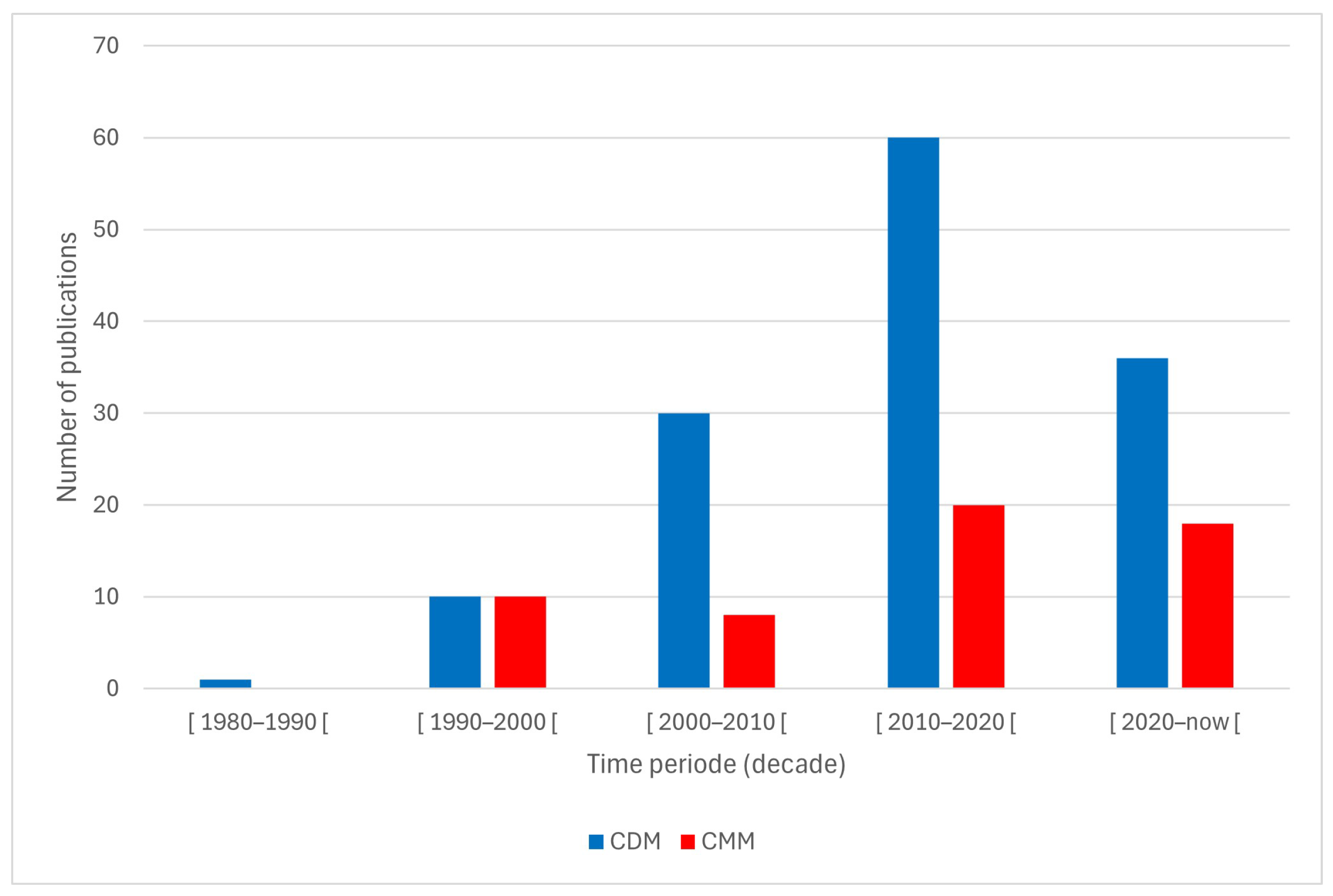
| Period | CDM | CMM |
|---|---|---|
| [1980–1990[ | [27] | |
| [1990–2000[ | [4,28,29,30,31,32,33,34,35,36] | [12,15,34,37,38,39,40,41,42,43,44] |
| [2000–2010[ | [20,45,46,47,48,49,50,51,52,53,54,55,56,57,58,59,60,61,62,63,64,65,66,67,68,69,70,71,72,73] | [70,74,75,76,77,78,79,80] |
| [2010–2020[ | [21,81,82,83,84,85,86,87,88,89,90,91,92,93,94,95,96,97,98,99,100,101,102,103,104,105,106,107,108,109,110,111,112,113,114,115,116,117,118,119,120,121,122,123,124,125,126,127,128,129,130,131,132,133,134,135,136,137,138,139] | [127,131,132,133,140,141,142,143,144,145,146,147,148,149,150,151,152,153,154,155] |
| [2020–now[ | [5,6,7,22,24,156,157,158,159,160,161,162,163,164,165,166,167,168,169,170,171,172,173,174,175,176,177,178,179,180,181,182,183,184,185,186] | [25,174,175,186,187,188,189,190,191,192,193,194,195,196,197,198,199,200] |
| Control Method | Non-Adaptive | Adaptive |
|---|---|---|
| Hybrid force/position control | x | x |
| Impedance control | x | x |
| Position-based control | x | |
| Admittance control | x | |
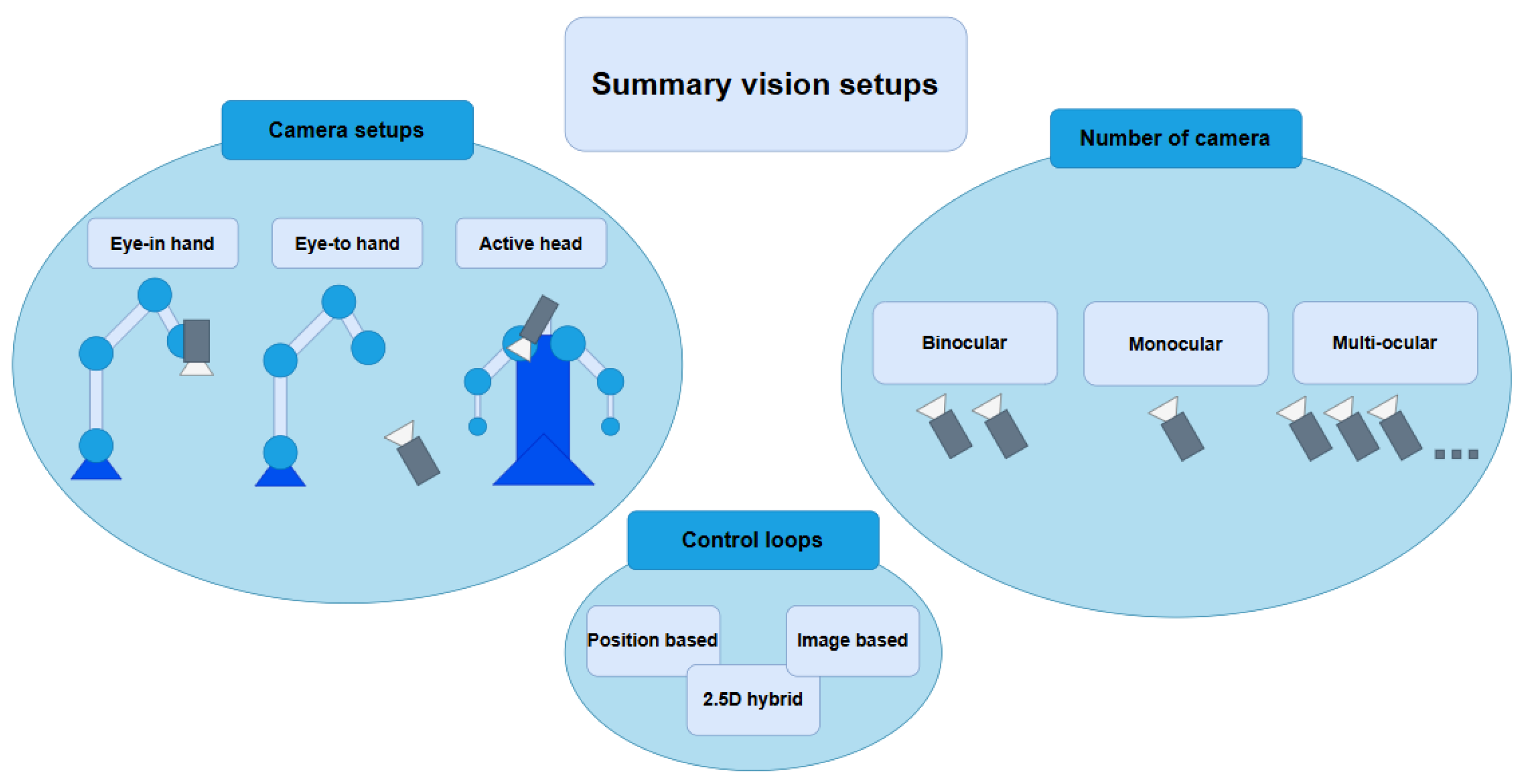
| Vision-based control | x |
| Control Architecture | CDM | CMM |
|---|---|---|
| Non-adaptive | ||
| Computed torque | [11,12] | [12] |
| Feedback linearization | [31] | |
| PID control | [46] | |
| PD control | [117], | |
| Sliding mode control | [24,164] | |
| Adaptive | ||
| PD control | [102,104,115] | [140] |
| KF control | [106] | |
| Sliding mode control | [99,100,160,208] | [140,149] |
| Function approximation technique based control | [161] | |
| Admittance control | [107,109,187] | [142,187] |
| Impedance control | [108,165,182,184,207] | [155] |
| Radial basis function neural network | [24,99,100,134,158,160] | |
| Model-base control | [134,165] | |
| Iterative learning control | [106] | |
| Neural network | [132,143,159] | [132,143,198] |
| Dynamic surface control | [142,158,209] | [74] |
| Backstepping | [100,101,120,187] | [146,187] |
| Passivity based control | [35] | |
| Vibration suspension control | [50] | |
| Fuzzy control | [98,120,135,143,208] | [75,143,146,152] |
| Leader-follower control | [108,185,186] | [155,186] |
| Compound manipulation control mode | [139] | |
| Gravity compensation | [115] | |
| Observer-based control | [161] | [140,154] |
| Coordinated control | [71,72,127,128] | [127] |
| Formation control | [133] | [133] |
| Prescribed performance control | [177] | |
| Constraint-based control | [130] | |
| Task priority control | [131] | [131] |
| Distributed dynamic control | [131] | [131] |
| Synchronized control | [76] | |
| Consensus control | [77] | |
| Motion control | [41,153,192] | |
| Agent-based control | [42] | |
| Planning Strategies | CDM | CMM |
|---|---|---|
| APF planning | [105,211,212,213] | [79] |
| Sampling-based planning | [89,136,167,210] | [175] |
| Optimization planning | [22,114,137] | |
| Neural network and reinforcement learning-based planning | [214] | [192] |
| Time optimal planning | [137] | [200] |
| Optimal energy consumption planning | [213,215] | |
| Welding trajectory planning | [126] | [151] |
| Incremental displacement planning | [41] | |
| Agent-based planning | [42] | |
| Elastic-strip planning | [79] | |
| Strategy-based planning | [79] |
| Type of Cooperation | CDM | CMM |
|---|---|---|
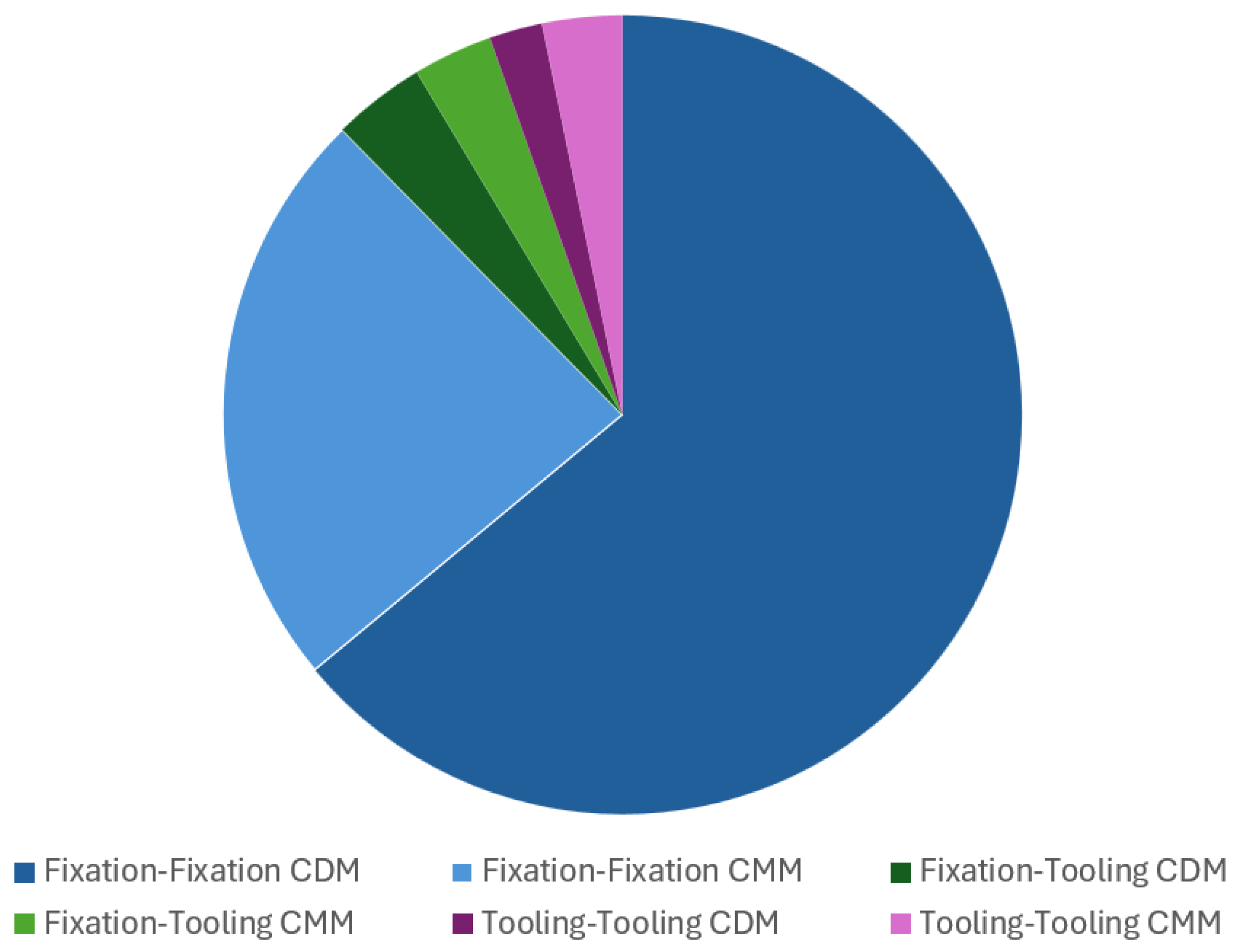
| Fixation-fixation | [5,6,7,15,20,21,22,28,29,30,31,32,33,34,36,46,47,48,49,50,51,52,53,54,55,56,58,59,60,61,62,63,64,65,66,67,68,69,70,71,81,82,83,84,85,86,87,88,89,90,91,92,93,94,95,96,97,98,99,100,101,103,104,105,106,107,108,109,110,111,112,113,114,115,116,117,118,119,120,121,122,123,125,127,128,129,130,131,132,133,139,156,157,158,159,160,161,162,163,164,165,167,168,170,171,172,173,174,175,176,177,180,181,182,183,184,185,186,218] | |
| Fixation-tooling | [24,55,58,85,124,126,199] | [76,78,145,149,151,191] |
| Tooling-tooling | [57,166,169,174] | [25,76,148,174,191,194] |
| Type of Object | CDM | CMM |
|---|---|---|
| Rigid/non-deformable | [5,6,7,15,20,28,29,31,32,34,36,47,48,49,50,51,55,56,58,62,64,65,68,69,70,85,87,89,91,92,93,94,95,96,99,100,101,103,104,105,106,107,108,109,110,111,112,115,116,117,118,119,120,122,123,124,125,127,128,129,130,131,132,133,139,157,158,159,160,161,162,163,164,165,167,169,170,172,173,174,175,176,177,184,185,186,218] | [12,31,34,37,39,40,41,43,44,74,75,76,78,80,131,132,133,141,142,143,144,145,146,147,151,152,153,154,155,174,175,186,187,188,189,190,192,195,196,197,198] |
| Flexible/deformable | [21,22,30,33,46,53,55,60,62,63,66,82,83,84,86,88,90,97,121,167,168,171,180,182,183] | [38,70,127,145,150,189] |
| Application Domain | CDM | CMM |
|---|---|---|
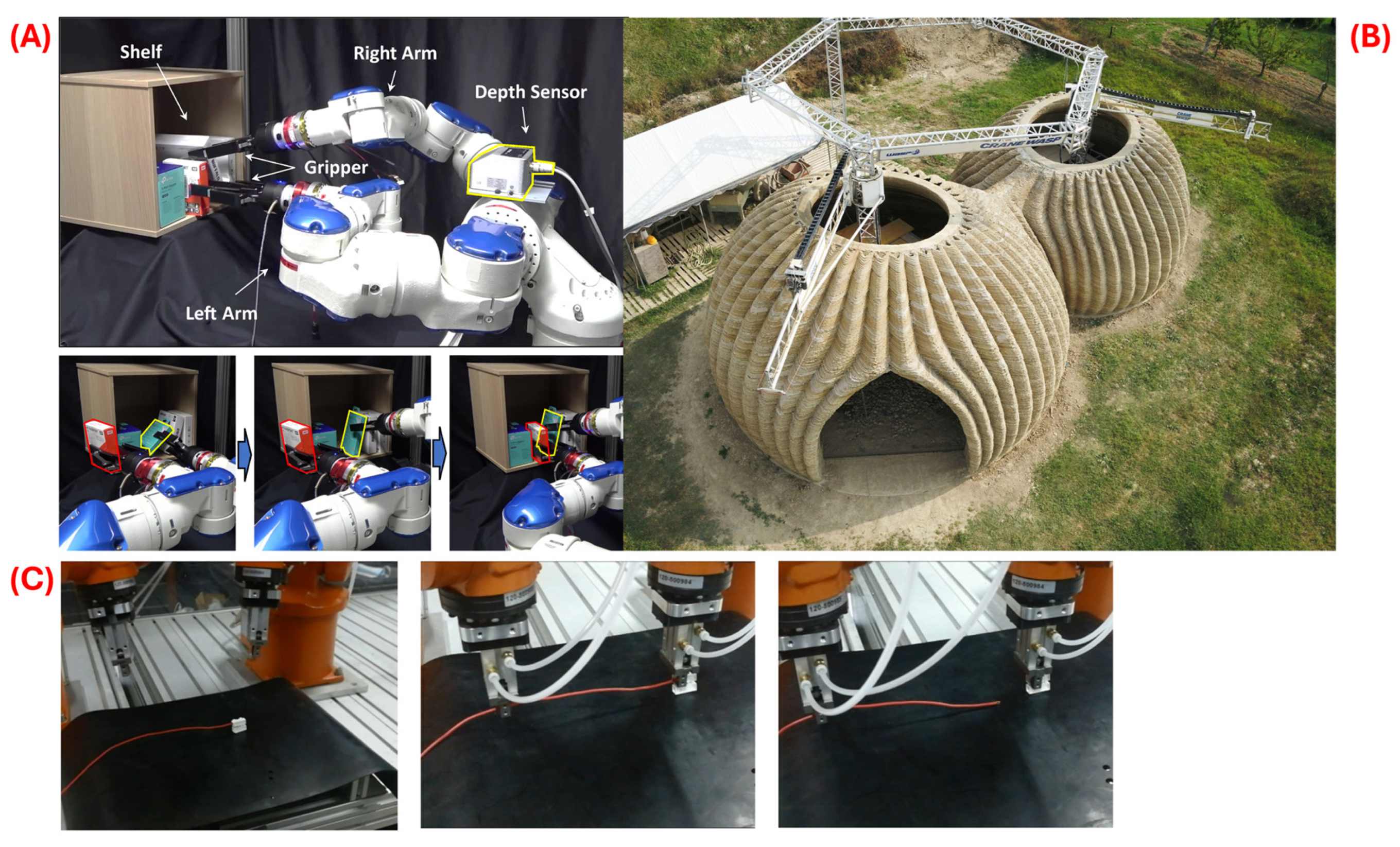
| Assembly | [6,64,81,175] | [37,42,76,78,141,144,175,189] |
| Disassembly | [167] | |
| 3D-printing | [174] | [148,191] |
| Spraying processes | [174] | [25,76] |
| Welding | [126,174,199] | [149,151,188] |
| Grinding | [24] | |
| Polishing | [194] | |
| Construction | [178,191] | [191] |
| Cleaning | [168] | |
| Cooking | [145] | |
| Folding | [60,63,86,88,90,97,183] | [38] |
| Playing music | [57] | |
| Health care | [141,144,150,189] | |
| Agriculture | [8] | |
| Space | [50,166,234] | |
| Aerial | [130,185] | [197] |
| Hazardous environment | [139,179] | |
| Underwater | [131] | [131,196] |
Disclaimer/Publisher’s Note: The statements, opinions and data contained in all publications are solely those of the individual author(s) and contributor(s) and not of MDPI and/or the editor(s). MDPI and/or the editor(s) disclaim responsibility for any injury to people or property resulting from any ideas, methods, instructions or products referred to in the content. |
© 2026 by the authors. Licensee MDPI, Basel, Switzerland. This article is an open access article distributed under the terms and conditions of the Creative Commons Attribution (CC BY) license.
Share and Cite
Ketelbuters, L.; Engelen, B.; Dekker, I.; Kellens, K. From Cooperative Dual-Arm Manipulators to Cooperative Multi-Arm Manipulators—Where Are We Standing Today? Robotics 2026, 15, 97. https://doi.org/10.3390/robotics15050097
Ketelbuters L, Engelen B, Dekker I, Kellens K. From Cooperative Dual-Arm Manipulators to Cooperative Multi-Arm Manipulators—Where Are We Standing Today? Robotics. 2026; 15(5):97. https://doi.org/10.3390/robotics15050097
Chicago/Turabian StyleKetelbuters, Lander, Bart Engelen, Ivo Dekker, and Karel Kellens. 2026. "From Cooperative Dual-Arm Manipulators to Cooperative Multi-Arm Manipulators—Where Are We Standing Today?" Robotics 15, no. 5: 97. https://doi.org/10.3390/robotics15050097
APA StyleKetelbuters, L., Engelen, B., Dekker, I., & Kellens, K. (2026). From Cooperative Dual-Arm Manipulators to Cooperative Multi-Arm Manipulators—Where Are We Standing Today? Robotics, 15(5), 97. https://doi.org/10.3390/robotics15050097