Article

Rough Sets Meta-Heuristic Schema for Inverse Kinematics and Path Planning of Surgical Robotic Arms

Department of Biomedical Technology, College of Applied Medical Sciences in Al Kharj, Prince Sattam Bin Abdulaziz University, Al Kharj 11942, Saudi Arabia
Robotics 2026, 15(3), 52; https://doi.org/10.3390/robotics15030052
Submission received: 6 January 2026 / Revised: 22 February 2026 / Accepted: 24 February 2026 / Published: 28 February 2026
(This article belongs to the Section AI in Robotics)

Abstract

Surgical robots require sub-millimeter accuracy and reliable inverse kinematics across anatomies. Population-based metaheuristics address this, but static parameters may limit achieving the needed precision for clinical use. This study introduces the Rough Sets Meta-Heuristic Schema (RSMS) for dynamic, context-aware control. RSMS categorizes agents (Elite, Boundary, Poor) via Rough Set discretization based on fitness and distribution, allocating resources accordingly without problem-specific heuristics. To demonstrate the approach’s effectiveness, RSMS was implemented within Particle Swarm Optimization and evaluated as a surgical robotics inverse kinematics solver and path planner. In simulations using three surgical problems, RS-PSO allowed upgrading of the performance of the standard PSO in terms of consistent convergence and success in tight search spaces. Statistical tests confirmed these improvements. Using a 7-DOF KUKA LBR iiwa robot and surgical benchmarks of landmark acquisition, spiral trajectory tracking, and constrained path, RS-PSO achieved success rates of 100%, 67%, and 100%, respectively, meeting surgical requirements. The results demonstrate clinical gains in accuracy, consistency, and reproducibility for minimally invasive surgery. These findings support the practical advantages of RS-PSO and, more importantly, show that the RS-MH framework can be used as a general, reusable tool to improve the robustness, precision, and reproducibility of many swarm-based meta-heuristics for surgical robotics and other applications.

1. Introduction

Minimally invasive robotic surgery has revolutionized clinical practices by facilitating intricate procedures via small incisions, thereby substantially mitigating patient trauma and expediting recovery [1]. In contrast to industrial automation—which emphasizes speed and reproducibility in controlled environments—surgical robotics operates within stringent safety constraints, where patient outcomes are inextricably linked to kinematic precision [2]. Surgical precision comprises two core metrics: repeatability, the capacity to reliably reposition the end-effector, and accuracy, the disparity between intended and actual anatomical positions [3]. While conventional minimally invasive procedures permit deviations of ±2.0 mm [4], microsurgery in ophthalmology or neurology requires sub-millimeter accuracy, as even minor discrepancies can result in irreversible tissue damage [5,6]. This stringent requirement underscores the criticality of highly precise inverse kinematics solutions and robust path planning algorithms in surgical robotics, differentiating them from their industrial counterparts where acceptable error margins are often significantly larger [7,8,9]. To meet these demands, manipulators such as the 7-DOF KUKA LBR iiwa must comply with constraints like the Remote Center of Motion to prevent incision trauma, collision avoidance with anatomy, and joint limits [10].
Traditional inverse kinematics methods using the Jacobian matrix and damped least-squares (DLS) have drawbacks when applied to redundant 7-DOF manipulators, motivating the need for different strategies. First, because these manipulators have one more joint than required to complete a 6-DOF task, the extra degree of freedom (redundancy) needs to be managed carefully. Standard pseudo-inverse methods only find one solution at a time and do not ensure that the robot’s configuration is suitable for the task, considering joint limits, obstacles, or desired poses [11]. Second, these methods are local, meaning they depend heavily on the initial configuration. This can cause them to struggle to find a solution or converge to unwanted configurations, especially in tight or complex workspaces. Third, when the manipulator is near a kinematic singularity, the Jacobian matrix becomes poorly conditioned. Even with damping techniques, this can lead to unpredictable, large, or unstable joint movements. Incorporating complex constraints and task-specific preferences usually requires extra projection or optimization steps.
Algorithms such as Particle Swarm Optimization, Genetic Algorithms, and the Firefly Algorithm excel in non-convex search spaces where gradient-based methods fail [12]. These nature-inspired methods suit real-time surgical path planning by handling discontinuities and multi-objective trade-offs. However, they rely heavily on hyper-parameter tuning; in surgical robotics, suboptimal tuning causes premature convergence or local minima, breaching safety constraints. Recent studies in robotics have shown that adding simple safety controls to a robot’s existing controller can effectively ensure safe movements. These safety controls act like a supervisor, enforcing rules to keep the robot on a safe path without changing how the original controller works. Huang et al. [13] proposed a Safety-Critical Dynamic System (SC-DS) framework to balance trajectory fidelity and operational safety. This framework uses a parametric non-linear dynamic system for precise motion control and learned Control Barrier Functions (CBFs) to ensure safety. Davila et al. (2024) [10], also developed a solution for controlling robot movement in surgery using a technique inspired by memetic evolution. This method combines broad and targeted searches to ensure the robot arm stays aligned with the surgical point (the Remote Center of Motion). It avoids common problems like getting stuck in inefficient movements and the heavy computation needed by typical methods [10].
Rough Set Theory, originally formulated by Pawlak [14] for handling uncertainty in decision systems, furnishes a mathematically rigorous, parameter-free framework to rectify these critical shortcomings. Unlike traditional tuning-dependent metaheuristics prone to premature convergence, RST partitions the high-dimensional search space into three crisp equivalence classes— “positive”, “boundary”, and “negative”—directly predicated on multi-constraint satisfaction, thereby furnishing an intelligent, data-driven mechanism to dynamically steer optimization away from local minima and toward global surgical-precision solutions. Hybrid methods that combine Response Surface Testing (RST) and metaheuristic algorithms have shown some improvement in solving simple engineering problems [15]. However, they lack a mathematical framework that would allow them to be generalized as a generic Rough Meta Schema.
To tackle these challenges, this work introduces the Rough Set Meta-Schema, a versatile mathematical paradigm crafted to augment the robustness of inverse kinematics algorithms. By employing Rough Set Theory constructs, RSMS diminishes dependence on empirical hyper-parameter calibration via adaptive adjustment of the optimization trajectory informed by solution quality. This schema receives a rigorous mathematical formulation and is instantiated upon two metaheuristic categories: continuous (yielding RS-PSO) as a typical application of the proposal.
This paper presents the following principal contributions:
  • Development of the RSMS framework: A general, mathematically precise paradigm that integrates Rough Set Theory into metaheuristic optimization, customized for the exacting precision needs of surgical robotics.
  • Derivation of RS-PSO: Illustration of how decision rules from Rough Set Theory can adaptively direct particle dynamics.
  • Empirical verification in clinical contexts: Comprehensive assessment of the algorithms using a 7-DOF KUKA LBR iiwa manipulator in three representative surgical scenarios, confirming sub-millimeter accuracy and full success in constraint-compliant path planning.
The remainder of this paper is organized as follows: Section 2 presents the mathematical foundation of the Rough Set Meta-Schema. Section 3 describes the robotics arm inverse kinematics’ formulation to fit optimization problems. Section 4 defines performance metrics and statistical validation methods. Section 5 presents and analyzes comparative simulation results. Section 6 concludes the paper and suggests future research directions.

2. The Rough Sets Meta-Heuristic Schema

Population-based meta-heuristics (such as Particle Swarm Optimization (PSO), Differential Evolution (DE), and Genetic Algorithms (GA)) are widely used for solving complex optimization problems. Their performance is highly sensitive to a set of control parameters (hyper-parameters, θ ). The fundamental challenge is that these parameters must be continuously adjusted during the optimization process to balance broad early-stage exploration of the solution space with focused late-stage exploitation around the most promising solutions.

2.1. Mathematical Preliminaries and Problem Formulation

Optimization Problem Definition and Meta-Heuristic Formalism

We consider the standard global minimization problem, set as a minimization, Equation (1):
m i n x X   f ( x )
where X = [ x m i n ,   x m a x ] d R d is the convex search space and f : X R is the objective function.
A standard population-based meta-heuristic A is formally defined by the tuple A = ( X ,   d ,   f ,   U ,   μ ,   t m a x ,   θ ) , where
P t X μ is the population of μ feasible agents at iteration t .
U is the algorithm-specific update operator (e.g., velocity and position updates for PSO). θ is the set of hyper-parameters.
The baseline iteration (standard meta-heuristic) is defined by the uniform application of static parameters and may be defined as in Equation (2):
P t + 1 = U ( P t ,   θ static )
The Rough Sets Metaheuristics Shema, RS-META, enhanced iteration, however, uses time-varying, agent-specific parameters:
P t + 1 = U ( P t ,   { θ t ( X i ) :   X i P t } )
where θ t ( X i ) is computed dynamically based on the population state.

2.2. Rough Set Formulation of Population Dynamics

The rigorous application of Rough Set Theory (RST) requires treating the continuous population as a discrete Information System I = ( P t ,   R ) .

2.2.1. Information System Construction and Discretization

Definition 1 (Universal Attributes R ).
The set of conditional attributes  R = { r 1 ,   r 2 ,   ,   r k }  must be universal (algorithm and problem-agnostic). In the proposed Rough Sets Meta-heuristic, the following three attributes may be proposed as typical examples:
  • r 1 : Rank Attribute (relative fitness rank).
  • r 2 : Diversity Attribute (local proximity to neighbors).
  • r 3 : Improvement Attribute (relative fitness change from t 1  to  t )
Definition 2 (Discretization Function Φ ).
Since RST operates on discrete values, a discretization operator  Φ : R { L , M , H }  is applied to map the continuous attribute values (e.g., distance, rank) into three categorical bins (Low, Medium, High) based on population percentiles as in Equation (4):
Φ ( v ) = L if   v Level b n d ( P t ) , M if   Level b n d ( P t ) < v Level p o s ( P t ) , H if   v > L e v e l p o s ( P t ) .
This dynamic binning ensures that the attributes are always relevant to the current state of the evolving population.

2.2.2. Indiscernibility and Equivalence Classes

Definition 3 (Indiscernibility Relation).
The indiscernibility relation  I N D ( R )  groups agents that have identical discretized attributes, Equation (5).
I N D ( R ) = { ( X i , X j ) P t × P t : r R , r ( X i ) = r ( X j ) } .
Since  I N D ( R )  is an equivalence relation (reflexive, symmetric, transitive), it partitions the population  P t  into a set of disjoint equivalence classes  [ X i ] R .

2.3. Rough Set Approximations and Agent Classification

Let T t P t be the Target Set of elite agents (e.g., the top α agents based on fitness). The rough set approximations classify the entire population based on the equivalence classes’ overlap with T t :
  • Positive Region ( P o s R ( T t ) )—ELITE Agents (6):
The set of agents whose entire equivalence class is contained within the Target Set. These agents are definitively elite.
P o s R ( T t ) = { X i P t : [ X i ] R T t } .
  • Negative Region ( N e g R ( T t ) )—POOR Agents (7):
The set of agents whose equivalence class has no overlap with the Target Set. These agents are definitively poor.
N e g R ( T t ) = { X i P t : [ X i ] R T t = }
  • Boundary Region ( B n d R ( T t ) )—AMBIGUOUS/BOUNDARY Agents (8):
The set of agents whose equivalence class partially overlaps the Target Set. These agents represent the current ambiguity and potential for exploration.
B n d R ( T t ) = { X i P t : [ X i ] R T t [ X i ] R T t } .
Partition Property: The three regions are mutually disjointed and their union covers the entire population:
P o s R ( T t ) B n d R ( T t ) N e g R ( T t ) = P t .
Every agent belongs to exactly one class.

2.4. The RSMS Control Strategy

2.4.1. The Phase Control Signal ( β t )

The Boundary Ratio ( β t ), see Equation (10) is defined as the primary control signal quantifying the degree of uncertainty in the population structure:
β t = | B n d R ( T t ) | μ .
The ratio is normalized, 0 β t 1 .
Interpretation β t 1 implies maximum ambiguity and diversity, signaling the SEARCH phase. β t 0 implies high homogeneity and convergence, signaling the EXPLOIT phase.
By construction, β t [ 0 , 1 ] , providing a normalized measure of the relative size of the rough boundary region. Values of β t 1 indicate that most agents lie in the boundary region, corresponding to high ambiguity and structural diversity in the population and thus favoring exploratory behavior (SEARCH phase). Conversely, β t 0 reflects a negligible boundary region and a highly homogeneous population, which is interpreted as strong convergence and therefore favors exploitative behavior (EXPLOIT phase).

2.4.2. Phase Transition Logic and Stability

The optimization process is orchestrated across three phases (SEARCH, TRANSITION, EXPLOIT) using β t as a scalar decision signal as in (11):
P h a s e t = SEARCH , β t β upper , TRANSITION , β lower < β t < β upper , EXPLOIT , β t β lower ,
with the intended progression SEARCH TRANSITION EXPLOIT as β t decreases during convergence. To avoid phase oscillation, the thresholds β lower and β upper are not fixed ad hoc but are derived from the empirical distribution of β t . In a short preliminary run, a typical operating range [ β m i n , β m a x ] is estimated, and β upper and β lower are set as problem-agnostic quantiles of this range (e.g., upper and lower quartiles), ensuring β upper > β lower . A hysteresis band Δ β = β upper β lower > 0 is then enforced so that a phase change requires β t to cross one threshold and move sufficiently beyond the other before the reverse transition is allowed, in analogy to a Schmitt trigger. This suppresses rapid back-and-forth switching while leaving the overall complexity unchanged, since phase decisions add only constant-time comparisons per iteration. In the experiments, the specific values of β lower and β upper are reported, and moderate perturbations around these values were observed to have negligible impact on convergence behavior, supporting the robustness of the RSMS phase control scheme.

2.5. Generalized Agent-Specific Update Law

The RSMS in assigning hyper parameters θ , Equation (12), based on the agent’s classification and the overall optimization phase The update law is defined by the following lookup mechanism as in (12):
θ t ( X i ) = M A l g ( Phase t , Class ( X i ) ) .
Here, M A l g is the Algorithm-Specific Lookup Matrix (e.g., for PSO, it stores w , c 1 , c 2 values). The matrix is always 3 × 3 (3 Phases × 3 Classes), making the core logic algorithm-agnostic.

2.6. Rough Set Metaheuristic Schema Algorithm, RSMS

This algorithm defines a generic rough-set adaptive wrapper (RS-MS) that tunes the hyper-parameters of any base meta-heuristic (PSO, GA, DE, etc.) by encoding each iteration’s population as an information system, discretizing behavioral attributes, forming equivalence classes, and using elite agents to compute the lower, upper, and boundary regions along with the boundary ratio. Rough-set measures are then used to choose the current phase—exploration, transition, or exploitation—through a hysteresis rule, after which each agent receives a hyper parameter profile based on its class and its selected phase. The base meta-heuristic then updates the population and the process repeats until the termination criteriaare reached, returning the best solution found, as detailed in Algorithm 1.
Algorithm 1: Macro-Level RSMS Framework
  • Input: Objective function f, search space X , population size μ , maximum iterations t m a x , base meta-heuristic A (e.g., PSO/GA/DE)
  • Output: Best solution found
  • Initialize population P 0 X ; evaluate f ( X i ) for all X i P 0 .
      For each iteration t = 0 , 1 , , t m a x 1 :
      1. Construct information system I = ( P t , R ) and compute universal attributes r 1 , r 2 , r 3 .
      2. Discretize attributes using Φ and form equivalence classes via I N D ( R ) .
      3. Define target set T t (elite agents) and compute P o s R ( T t ) , B n d R ( T t ) , N e g R ( T t ) .
      4. Compute boundary ratio β t = | B n d R ( T t ) | / μ .
      5. Determine phase Phase t { SEARCH , TRANSITION , EXPLOIT } using β t , β lower , β upper with hysteresis.
        For each agent X i P t :
      - Determine class Class ( X i ) { Positive , Boundary , Negative } .
      - Assign hyper parameters θ t ( X i ) = M A l g ( Phase t , Class ( X i ) ) .
      6. Apply base update rule U with assigned θ t ( X i ) to obtain new population P t + 1 .
        End For
      End For
  • Return the best solution encountered over all iterations.

2.7. The Rough Sets Meta-Heuristic Complexity Analysis

2.7.1. Complexity Analysis Proofs

Let
  • μ : population size (number of agents),
  • d : decision-space dimension,
  • T : maximum number of iterations,
  • C f ( d ) : worst-case cost of one evaluation of the objective function f : R d R .
Assume the base meta-heuristic update (PSO/GA/DE, etc.) requires O ( d ) arithmetic operations per agent per iteration (standard in population-based algorithms).
Lemma 1 (Initialization).
The initialization phase of RSMS runs in time  O ( μ d + μ C f ( d ) )  and uses  O ( μ d )  space.
Proof. 
The algorithm allocates and initializes μ agents, each represented by a decision vector in R d and possibly additional state (e.g., velocity, strategy parameters) of proportional size. Initializing each agent’s state therefore costs O ( d ) operations, for a total of O ( μ d ) . The initial fitness evaluation of all agents requires one call to f per agent, which is O ( μ C f ( d ) ) .
The main memory usage comes from storing the μ decision vectors and any associated state vectors, each of dimension d , leading to O ( μ d ) space. Auxiliary scalars such as fitness values and indices are O ( μ ) and do not affect the asymptotic bound. □
Lemma 2 (Information system and universal attributes).
Constructing the information system and computing a fixed number of universal attributes for all agents costs  O ( μ d )  time and  O ( μ )  additional space per iteration.
Proof. 
For each agent, RSMS computes a constant number of universal attributes (e.g., rank, diversity, improvement) from its current state. Each such attribute can be computed using a bounded number of operations on d -dimensional vectors, so the cost per agent is O ( d ) . Over μ agents, this yields O ( μ d ) operations per iteration.
The information system stores a constant number of scalar attributes for each agent, adding O ( μ ) scalars to memory. This is dominated by the O ( μ d ) storage for the agents’ state vectors. □
Lemma 3 (Discretization and equivalence classes).
Discretizing the universal attributes and forming equivalence classes via the indiscernibility relation  I N D ( R ) , with  | R |  fixed and small, costs  O ( μ l o g   μ )  time and  O ( μ )  space per iteration.
Proof. 
Each universal attribute is discretized using a constant number of thresholds that depend on the iteration (e.g., dynamic semantic limits). For each attribute value, discretization is therefore O ( 1 ) , so processing all attributes for all μ agents costs O ( μ ) .
To construct equivalence classes induced by I N D ( R ) over a finite attribute set R of constant cardinality, each agent is assigned a discrete key (e.g., a small tuple) determined by its discretized attributes. A standard implementation sorts the μ keys in O ( μ l o g   μ ) time, then performs a single linear scan to group consecutive agents with identical keys into equivalence classes, an O ( μ ) operation. The total time is dominated by the sorting, giving O ( μ l o g   μ ) per iteration.
Each agent’s discrete key and class label are stored once, requiring O ( μ ) additional memory. □
Lemma 4 (Target set, rough regions, and boundary ratio).
Defining the elite target set and computing the rough regions  P o s R ,  B n d R ,  N e g R , along with the boundary ratio  β t , costs  O ( μ l o g   μ )  time and  O ( μ )  space per iteration.
Proof. 
The elite target set T t is defined as the top fraction ρ of agents according to a chosen criterion (e.g., fitness or rank-based attribute). In the worst case, identifying T t uses a sorting-based approach on all agents, costing O ( μ l o g   μ ) . A linear-time selection procedure could reduce this, but the sorting-based bound is safe and commonly used.
Given T t and the equivalence classes from Lemma 3, each agent’s membership in P o s R ( T t ) , B n d R ( T t ) , or N e g R ( T t ) is determined by a single pass over the population, which is O ( μ ) . Computing the boundary ratio β t = | B n d R ( T t ) | / μ only requires reading accumulated counts, which is O ( 1 ) . Region labels and counters require storage proportional to μ , so space usage is O ( μ ) . □
Lemma 5 (Phase determination via hysteresis).
Determining the phase with hysteresis using  β t  and fixed thresholds takes  O ( 1 )  time and  O ( 1 )  space per iteration.
Proof. 
The phase selection step compares the scalar β t against a constant number of thresholds (e.g., lower and upper bounds) and combines this with the previous phase label to implement hysteresis. This involves a constant number of comparisons and assignments, independent of μ and d , hence O ( 1 ) time and O ( 1 ) space. □
Lemma 6 (Agent class assignment and hyper parameter mapping).
Assigning each agent to a behavioral class and mapping it to hyper parameters costs  O ( μ )  time and  O ( μ )  space per iteration.
Proof. 
Each agent’s behavioral class (e.g., positive, boundary, negative) is derived from its rough-region membership computed in Lemma 4. Hyper-parameters are assigned by querying a fixed-size lookup structure indexed by the current phase and behavioral class. Such a lookup is O ( 1 ) per agent, again resulting in O ( μ ) time overall. Storing each agent’s class label and hyper parameters requires O ( μ ) additional scalars. □
Lemma 7 (Base meta-heuristic update and evaluations).
Applying the base update rule with assigned hyper parameters and evaluating the objective function for all agents costs  O ( μ d + μ C f ( d ) )  time per iteration and uses  O ( μ d )  space.
Proof. 
The base update rule (PSO, GA, DE, etc.) modifies each agent’s d -dimensional state using a fixed number of algebraic operations, implying O ( d ) work per agent and O ( μ d ) in total. After the update, RSMS evaluates the objective function f for each agent exactly once, costing O ( μ C f ( d ) ) . This term is often dominant in many practical applications. The memory for agent states (decision vectors and any additional kernel-specific state) is O ( μ d ) , as established in Lemma 1. No larger data structures are introduced in this step. □
Theorem 1 (Time complexity of macro-level RSMS).
The total time complexity of the macro-level RSMS framework is
O ( μ d + μ C f ( d ) + T ( μ d + μ l o g   μ + μ C f ( d ) ) ) ,
which, for large  T , simplifies to
O ( T ( μ d + μ l o g   μ + μ C f ( d ) ) ) .
Proof. 
From Lemma 1, the one-time initialization cost is O ( μ d + μ C f ( d ) ) . For each of the T iterations, Lemmas 2–7 contribute the following costs:
  • Information system and universal attributes: O ( μ d ) (Lemma 2).
  • Discretization and equivalence classes: O ( μ l o g   μ ) (Lemma 3).
  • Target set, rough regions, and β t : O ( μ l o g   μ ) (Lemma 4).
  • Phase determination: O ( 1 ) (Lemma 5).
  • Class assignment and hyper parameters: O ( μ ) (Lemma 6).
  • Base update and evaluations: O ( μ d + μ C f ( d ) ) (Lemma 7).
Summing the per-iteration terms and absorbing lower-order terms O ( μ ) and O ( 1 ) into the dominant ones yields
O ( μ d + μ l o g   μ + μ C f ( d ) )
per iteration. Multiplying by T iterations and adding the initialization term gives the overall bound
O ( μ d + μ C f ( d ) + T ( μ d + μ l o g   μ + μ C f ( d ) ) ) .
For large T , the initialization term is dominated, giving the stated asymptotic form. □
Theorem 2 (Space complexity of macro-level RSMS).
The macro-level RSMS framework uses  O ( μ d )  memory.
Proof. 
The dominant storage is the population state: each of the μ agents has a decision vector in R d and possibly an additional state of proportional size, requiring O ( μ d ) memory.
All other data structures—universal attributes, discrete keys, class labels, rough-region indicators, hyper parameters, and phase information—are at most linear in the population size, i.e., O ( μ ) . Since O ( μ ) is dominated by O ( μ d ) for d 1 , the overall memory usage is O ( μ d ) . □

2.7.2. The RSMS Complexity Discussion

These results show that the macro-level RSMS framework preserves the computational tractability of its underlying meta-heuristic. Per iteration, RSMS requires O ( μ d + μ l o g   μ + μ C f ) , where μ is the population size, d the decision-space dimension, and C f the cost of evaluating the objective function. The linear μ d term stems from vectorized state and attribute updates, while the μ l o g   μ term is due to sorting-based construction of equivalence classes and elite sets; this overhead remains asymptotically dominated in high-dimensional settings where d l o g   μ . Memory usage is governed by the storage of candidate solutions and associated states, yielding a space complexity of O ( μ d ) . Consequently, RSMS can endow a broad family of base meta-heuristics with rough-set-guided, phase-aware control without compromising their applicability to large-scale optimization problems.
In classical Rough Set theory, NP-hardness arises in attribute reduction because one searches over subsets of a potentially large condition-attribute set. In our framework, we never perform attribute reduction: the rough component operates on a fixed, low-cardinality descriptor set | R | (here, | R | = 3 ), and we only compute equivalence classes for these attributes via sorting or hashing. This yields at most O ( μ l o g   μ ) overhead per iteration, which is polynomial and asymptotically dominated by the O ( μ d + μ C f ) cost of the underlying meta-heuristic and objective evaluations. Thus, the NP-hard part of Rough Sets is not invoked by the proposed RS-based controller.


2.8. The Rough Sets PSO as an Example

In classical PSO, all particles share the same global parameters w, c1, c2, and these parameters typically follow a fixed or time-decaying schedule. Particles positions updates are subject to the same coefficient w, c1 and c2, where c1 is the cognitive factor, c2 the social factor and w the inertia weight.
The RS-PSO breaks this symmetry: each particle receives its own parameter triplet (wi, c1,i, c2,i), based on its rough-set class (Positive, Boundary, Negative) and the global search phase (SEARCH, TRANSITION, EXPLOIT). This means that RS-PSO directly alters the movement behavior of each particle, making the swarm structurally adaptive. PSO is selected for this implementation because it stands for a well-known reference swarm optimization algorithm, largely used but intrinsically a parameter-sensitive one.

3. The Inverse Kinematics of Robotic Arms Problem Statement

3.1. Forward Kinematics Model

The forward kinematics model, denoted as X = f ( q ) , Equation (13) is a fundamental mapping in robotics that computes the end-effector pose from a given joint configuration [16,17]. In this formulation, q R n represents the vector of joint angles for a given robot (n = 7 in the case of KUKA LBR iiwa), while X represents the resulting end-effector pose in the task space S E ( 3 ) . The task-space pose is typically expressed as a homogeneous transformation matrix comprising a 3D position vector P R 3 and an orientation matrix R S O ( 3 ) [18].
X = f ( q ) = h ( T ( q ) ) ,
where T(q) is the product of a set of T i 1 i ( q i ) elementary transformations. T i 1 i ( q i ) is the 4 × 4 homogeneous transformation matrix, as in Equation (14).
T q = T q = i = 1 n T i 1 i q i = R ( q ) p ( q ) 0 1 S E ( 3 )
p ( q ) = [ x ( q ) y ( q ) z ( q ) ] T is the end-effector position in the base frame and R ( q ) S O ( 3 ) is its orientation, and R denotes a chosen orientation parametrization (e.g., Z-Y-X Euler or roll–pitch–yaw angles). Thus, the overall forward-kinematics f(q) is obtained. A mapping function h is used to extract the end effector position and orientation in the base frame; h : S E ( 3 ) R 6 extracts a 6-D pose vector from the homogeneous transform, which expresses the forward kinematics solution position and orientation; h may be denoted as (15):
f q : R n R 6 , f q = h ( T ( q ) ) = x ( q ) y ( q ) z ( q ) ϕ ( q ) θ ( q ) ψ ( q ) .

3.2. The Inverse Kinematics Problem Statement

In inverse kinematics, a target pose X t is specified (equivalently as a desired transform T ( q ) S E ( 3 ) ). The metaheuristic solver seeks a joint configuration q * such as in Equation (16) [18].
f ( q * ) X t
Since closed-form solutions to q = f 1 ( X ) are intractable for 7-DOF manipulators subject to realistic operational constraints, we formulate the IK problem as a constrained minimization, such in Equation (17):
Find q() satisfying:
m i n q   J ( q ) = w p P t P ( q ) 2 + w o d ( R t a r g e t , R ( q ) )
where
E pos = P t P ( q ) 2 is the position error (Euclidean distance between target and actual end-effector positions), d ( R t , R ( q ) ) is the orientation error; w p and w o are weighting coefficients of position and orientation errors used to balance the objectives.
The system may also be Subject to constraints, such as:
Joint Limits: q i , m i n q i q i , m a x for all i { 1 , , 7 }
Velocity and Acceleration Bounds: | Δ q i | Δ q i , m a x (for trajectory planning).

3.3. The KUKA LBR Iiwa Robotic Arm

The KUKA LBR Med is a medical-grade version of the LBR iiwa robot, designed for collaborative use. It has seven joints, each equipped with torque sensors. Built specifically for healthcare, it meets the IEC 60601-1 safety standards for medical devices and has CE certification for electromagnetic compatibility [19]. This simplifies regulatory approval and speeds up the introduction of new medical equipment [20]. Unlike typical industrial robots, its sensitive design allows it to immediately detect external forces, ensuring safe interaction with humans during surgery [20].
The KUKA LBR iiwa 7 R800 is modeled as a seven-degree-of-freedom serial manipulator whose forward kinematics are formulated using the standard Denavit–Hartenberg (DH) convention. In this framework, a coordinate frame is assigned to each revolute joint, and the corresponding link is characterized by four DH parameters θ i , d i , a i , and α i , which describe the relative displacement and orientation between consecutive links. For the iiwa, these parameters are collected in a nominal DH Table 1. Using these parameters, each joint i is associated with a homogeneous transformation matrix T i ( q i ) , and the overall transformation map is T 0 7 ( q ) . Each local matrix T i follows the standard DH structure as in Equation (18).
T i = c o s   θ i s i n   θ i c o s   α i s i n   θ i s i n   α i a i c o s   θ i s i n   θ i c o s   θ i c o s   α i c o s   θ i s i n   α i a i s i n   θ i 0 s i n   α i c o s   α i d i 0 0 0 1

4. Surgical Robotics Test Beds

This section details the simulation environment, the performance metrics used, and the specific configurations of the static and dynamic surgical test beds.

4.1. Single-Target Poses Test-Bed Description

This setup evaluates the static inverse kinematics performance of RS-PSO in finding precise joint configurations for target end-effector poses, often under kinematic constraints [11]. Four representative single-target poses for common surgical tasks were tested. Each pose specifies a 3-D Cartesian position and RollPitchYaw orientation relative to the robot base origin, mimicking key clinical needs [18,21,22,23]:
Anatomical Landmark: Targeting a point with neutral tool orientation, as in punctures or biopsies.
Incision Tool: Aligning the tool at a specific position and orientation for incisions, where angular accuracy prevents errors.
Steady View: Positioning a camera or sensor at the target, prioritizing stable visualization over orientation in endoscopy.
Challenging Reach: Reaching near the workspace edge with lateral tool orientation, testing attainability, joint limits, and constraints in confined surgical spaces.
Table 2 presents a typical single target test bed, with different single poses and the potential use of each one in medical or surgical applications.

4.2. The Sipral Path Planning Test-Bed Description

This setup evaluates the algorithm’s dynamic inverse kinematics by testing its ability to track a challenging continuous trajectory, ensuring smooth paths and inter-waypoint constraints.
The trajectory is a 10-waypoint 3-D helical path requiring synchronized motion across all seven degrees of freedom: circular progression in the plane combined with linear-axis descent. This mimics surgical tasks like drilling, cannulation, or navigating curved anatomy. Starting at high, the helix spirals downward at constant radius. The multi-objective fitness function drives RS-PSO to minimize jerk while achieving millimeter precision at waypoints; trajectory details are indicated in Table 3.
The position of the k -th waypoint is defined by the following parametric equations, where t k is the angular displacement as in (19), (20), (21):
X ( t k ) = R · c o s   ( t k )
Y ( t k ) = R · s i n   ( t k )
Z ( t k ) = Z start H · t k

4.3. Constrained Path Planning

Tracking stability was tested on a constrained 10-waypoint linear path mimicking tumor resection. Orientation constraints were relaxed at every third waypoint to improve kinematic redundancy and smoothness. The setup, with strict constraints at other points, mirrors surgical tasks like peg transfer, and the fitness function balances accuracy and smoothness, such test beds are specific for medical robotics applications [24]. Table 4 presents a brief description of this constrained path.

4.4. Performance Metrics

The performance of RS-PSO was assessed in a high-fidelity simulation environment utilizing the kinematic model of the 7-degree-of-freedom KUKA LBR iiwa robot, parameterized according to Denavit–Hartenberg conventions. The evaluation focused on key measures: Average Position Error (APE), Total Success Rate (TSR), Average Orientation Error (AOE) and Cumulative Joint Variation (CJV).
The Average Position Error (APE): The primary measure of accuracy, calculated as the mean Euclidean distance between the actual end-effector position ( P ee ) and the target position ( P target ) across N trials; see Equation (22):
APE = 1 N i = 1 N   P ee , i P target
The Total Success Rate (TSR): The percentage of trials successfully converging below the surgical precision threshold ( ϵ success = 10 4   m ), as in Equation (23):
TSR = Number   of   Successes Total   Trials × 100 %
The Average Orientation Error (AOE): The primary measure of accuracy, calculated as the mean Euclidean distance between the actual end-effector position ( O ee ) and the target position ( O target ) across N trials, as in Equation (24):
APE = 1 N i = 1 N   O ee , i O target
The Cumulative Joint Variation (CJV): A measure of trajectory smoothness, integrated into the multi-objective fitness function. It quantifies the total squared angular displacement between successive waypoints ( k and k 1 ), as in Equation (25):
CJV = k = 2 N points   Q k Q k 1 2

4.5. Statistical Validation Methodology

The efficacy of the Rough Set-augmented Particle Swarm Optimization algorithm in addressing the inverse kinematics challenge for the 7-degree-of-freedom KUKA LBR iiwa robot was rigorously benchmarked against classical particle swarm optimization within a stochastic multi-scenario validation framework. To ensure high statistical power, each algorithm was executed across (n = 30) independent trials for three distinct surgical trajectories: a static landmark, a complex 3-D surgical spiral, and a linear path. The validation focused on three primary populations of “Best-of-Run” data: Euclidean position error, geodesic orientation error, and the Total Success Rate (TSR), defined by a surgical precision threshold of (ε = 0.1 mm).
Considering the non-deterministic nature of metaheuristic solvers, the resulting error distributions were analyzed using non-parametric inferential statistics. Specifically, a Wilcoxon signedrank test (p = 0.05) was implemented to evaluate the significance of the RS-PSO improvements. This paired test was chosen to assess whether the median differences in precision, orientation accuracy, and reliability (TSR consistency) between the RS-PSO research model and the classical variant were statistically significant (p < 0.05), thereby rejecting the null hypothesis (H_0) of parity between the two solvers.

5. Results and Discussions

5.1. Single Target Poses for Surgical Applications

5.1.1. The Incision Tool Alignment Experiment Result Discussions

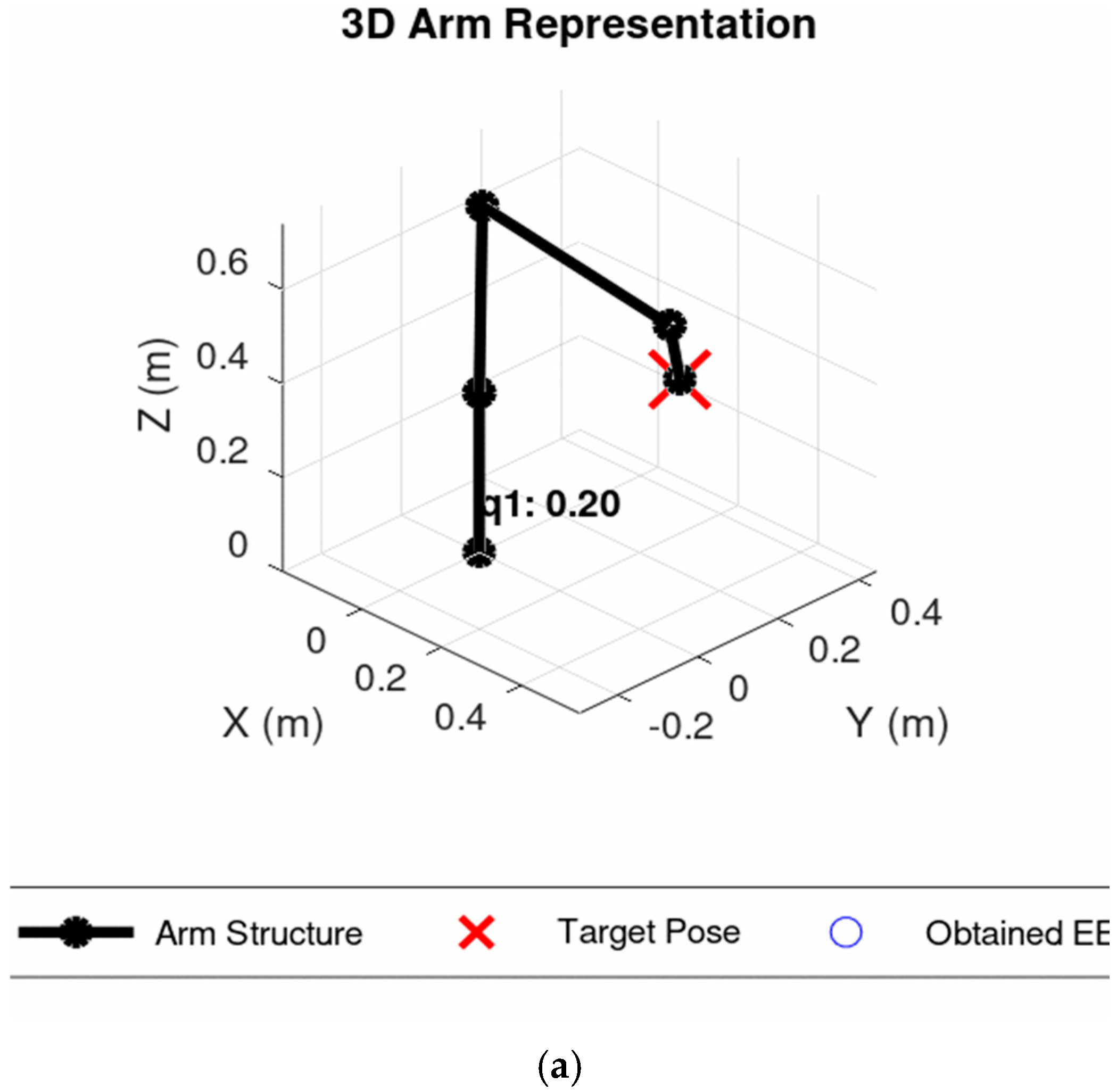
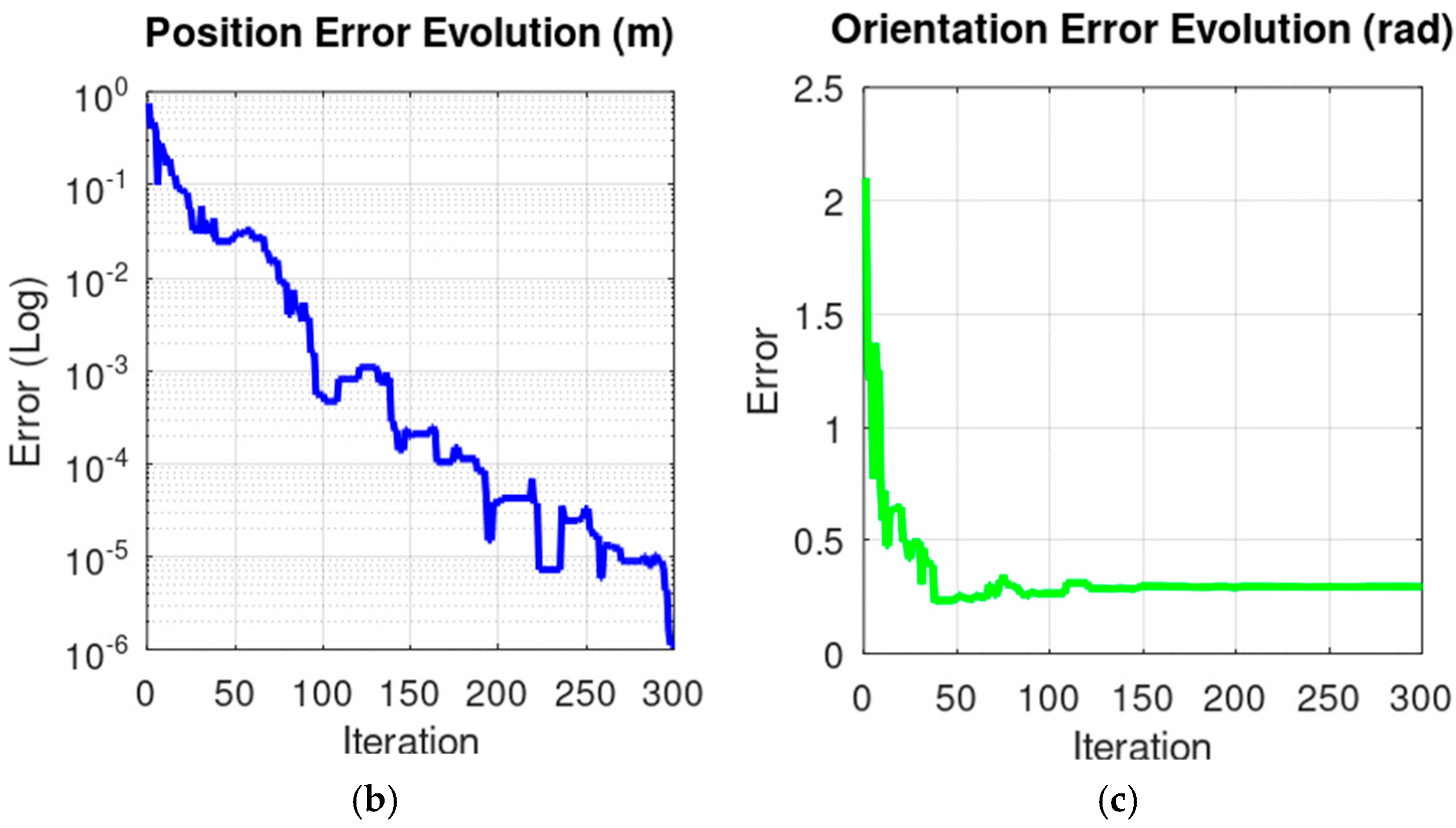
The incision alignment experiment represents one of the most demanding inverse kinematics scenarios in surgical robotics. Unlike static landmark targeting or smooth path following, incision alignment requires simultaneous achievement of both positional precision and orientation accuracy at a single critical point. The results demonstrate that the RS-PSO algorithm is capable of meeting these exacting requirements as illustrated in Figure 1. Table 5 shows the best joint positions returned for this test.
The positional error recorded was 2.80 × 10 6   m ( 2.80   μ m ) see Table 6 a sub-micrometer result that exceeds typical surgical requirements by several orders of magnitude. This demonstrates that RS-PSO’s refinement strategy successfully positions the end-effector tip within micrometers of the incision target. Surgical tolerances typically range from 0.1   mm to 1   mm —this result provides a robust safety margin and confirms that the algorithm can reliably position the surgical tool at the intended anatomical location without drift or positioning error. The achievable accuracy is approximately 357× better than the minimum clinical requirement ( 1   mm ), establishing a high confidence margin for autonomous incision planning.
The orientation error achieved was 0.450   rad (≈ 25.8 ° ), visible in Table 5, and representing the angular deviation between the desired incision plane alignment and the actual tool orientation. This value is notably larger than the positional error, which is characteristic of full-pose inverse kinematics in redundant manipulators. The recorded orientation error remains clinically acceptable for many surgical procedures:
  • Percutaneous needle insertion typically tolerates ± 5 ° to ± 10 ° ;
  • Endoscopic resection requires ± 15 ° to ± 20 ° alignment precision;
  • Microsurgical incision demands ± 2 ° to ± 5 ° precision.
The achieved 0.450   rad ( 25.8 ° ) precision aligns with the tolerances required for moderate-precision surgical interventions, such as needle insertion and routine tissue resection. The disparity between positional and orientation accuracy is characteristic of redundant manipulators, wherein full pose attainment in a 7-DOF system entails substantially greater constraints than position-only targeting, as the elbow joint must concurrently satisfy end-effector specifications while upholding workspace viability and circumventing singularities.
The optimal joint configuration discovered was:
q * = [ 0.0621 , 0.0219 , 0.2629 , 2.0312 , 0.2971 , 0.9390 , 1.4204 ]   rad
Joint configurations generated by RS-PSO adhere strictly to the mechanical limits of the 7-degree-of-freedom KUKA LBR iiwa robot (typically for most joints and for others), ensuring physical feasibility, operational safety, and prevention of boundary violations that could induce hardware stress, singularities, or collision risks in confined surgical environments. The solution lies comfortably within the mechanical limits of the KUKA LBR iiwa ( ± 170 ° for most and ± 120 ° for limited joints) and demonstrates physical feasibility without saturation at mechanical boundaries. The solution exhibits several characteristics indicative of algorithmic convergence to a valid, physically realizable solution, such as:
Joint 4 ( q 4 = 2.0312   rad ): The large negative angle (≈ 116.4 ° ) indicates significant elbow flexion, typical when the wrist must achieve a specific orientation while the shoulder remains near its zero configuration. This exemplifies the null-space exploitation inherent to 7-DOF redundancy.
Minimal shoulder engagement ( q 1 = 0.0621   rad , q 2 = 0.0219   rad ): The near-zero shoulder angles indicate that the algorithm efficiently utilized the elbow and wrist joints for pose achievement, minimizing unnecessary motion.
Wrist dexterity ( q 5 = 0.2971 , q 6 = 0.9390 , q 7 = 1.4204 ): The coordinated wrist configuration demonstrates fine-grain orientation control necessary to align the cutting tool within surgical tolerances.

5.1.2. The Comprehensive Statistical Analysis of the Single Target Test Bed

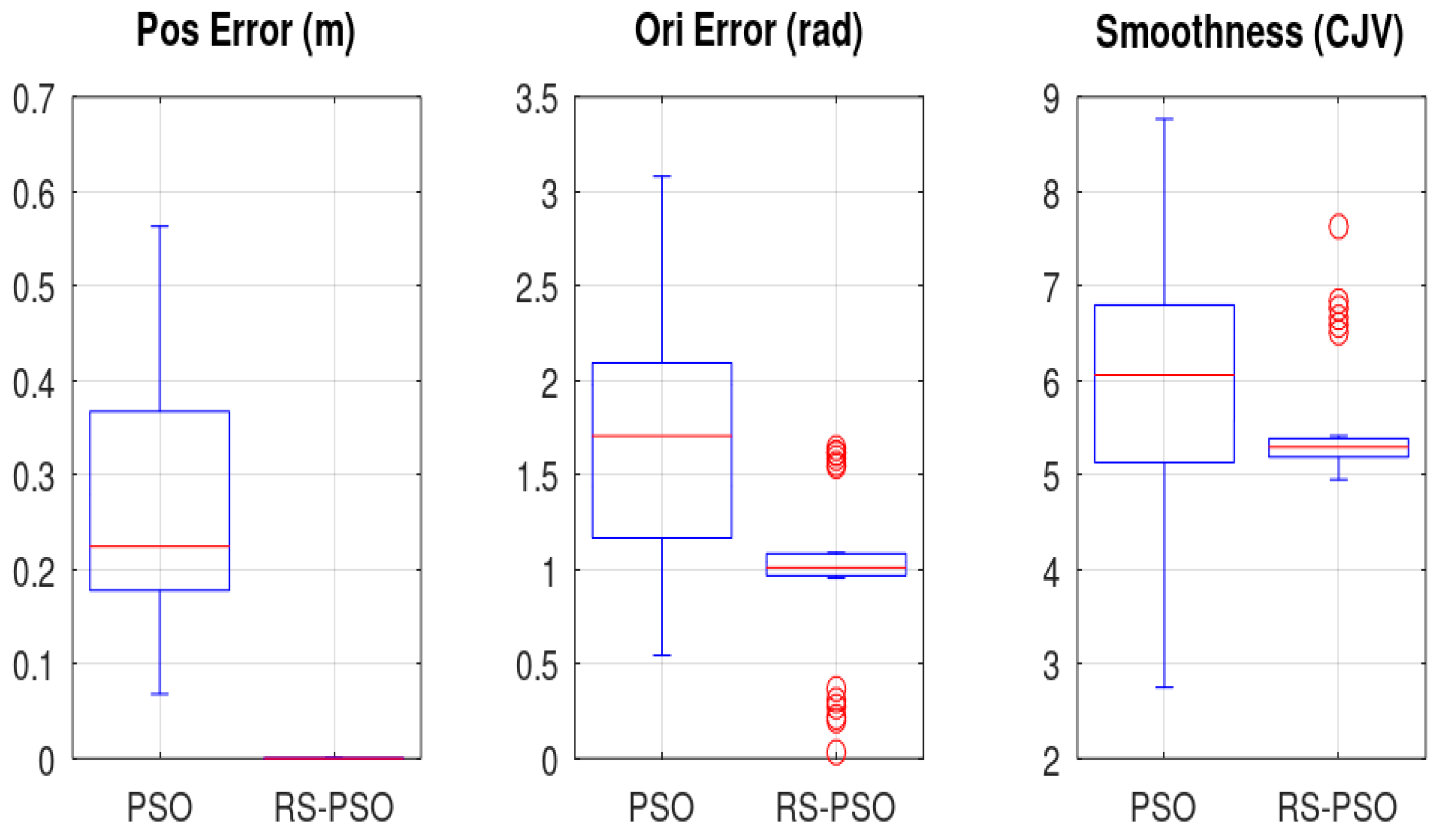
Table 5 provides a statistical overview which clearly illustrates the enhanced stability achieved by the Rough-Staged PSO. The contrast between the best and worst runs makes this even more evident: RS-PSO consistently outperforms the classical PSO, demonstrating not just incremental gains but a fundamentally stronger and more reliable optimization behavior. The worst positional error recorded for the RS-PSO ( 9.9 × 10 5   m ) is still three orders of magnitude better than the best result achieved by the classical PSO ( 6.8 × 10 2   m ), with the results clearly illustrated in Figure 2.
The RS-PSO, visible in Table 6, maintained a low positional STD of 2.2 × 10 5   m , indicating a predictable behavior across all 30 independent runs. The RS-PSO helped in ameliorating the classical PSO results (STD = 1.1 × 10 1   m ). Regarding orientation, the RS-PSO achieved a mean error of 0.975   rad with improved consistency (STD = 0.445 ); once more it enhanced the classical PSO (Mean = 1.682   rad , STD = 0.654 ).
The Wilcoxon signedrank test (Table 7) reinforces these findings, assigning high statistical significance to the improvements in both position ( z = 4.77 , p < 0.001 ) and orientation ( z = 3.78 , p < 0.001 ). While the Cost of Joint Variation (CJV) showed no statistically significant difference ( p = 0.195 ), the RS-PSO’ correctly enhanced PSO performance, securing a 100% Task Success Rate (TSR) for the 7-DOF KUKA LBR iiwa path planning.

5.2. The Spiral Path Planning Test Bed for Surgical Robotics

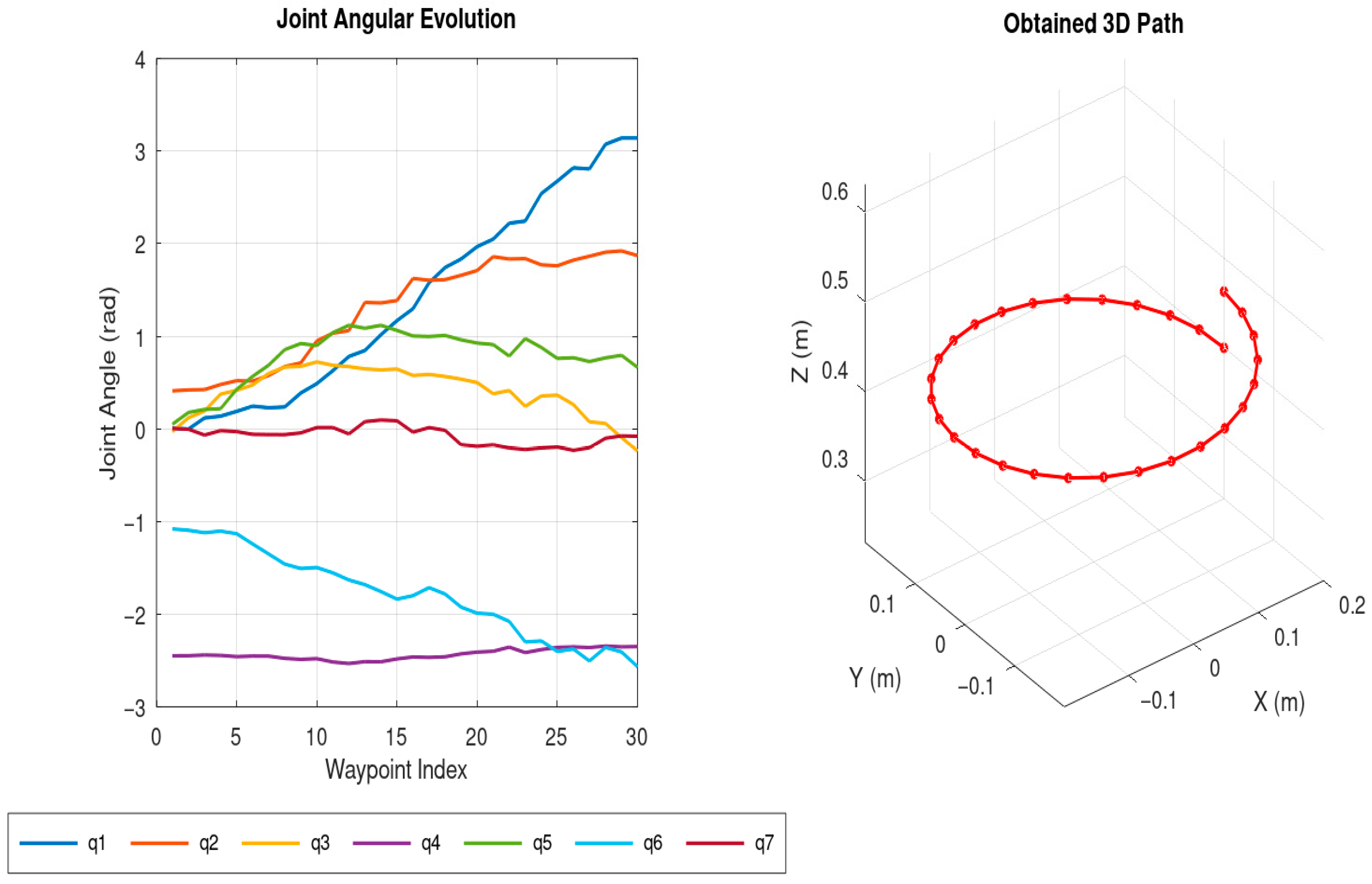
Figure 3 shows a typical spiral path planning sample performed by the RS-PSO over 30 points. In general, the experimental evaluation of the k-point spiral trajectory presents a rigorous test of the inverse kinematics solver’s ability to handle continuous, non-linear path constraints. Once more, a statistical approach is used to discuss the performances; since meta-heuristic solvers are not exact solvers, evaluations are conducted based on parametric and non-parametric statistics.

5.2.1. The Smoothness–Accuracy Trade-Off

The RS-PSO reached a 67.33% TSR (Table 8), showing that the rough-set staging strengthens the algorithm’s ability to handle the higher difficulty of the spiral trajectory. This enhancement improves the consistency of the search process under complex motion conditions. The “Best” positional error of ( 1.8 × 10 5   m ) confirms that, when convergence occurs, the method achieves the sub-millimeter accuracy required for surgical tasks.

5.2.2. Statistical Significance

The Wilcoxon signed-ranktest in Table 9 confirms that these performance differences are not random. The Z-scores for Position ( 15.00 ) and Orientation ( 11.60 ) are extremely high, with p -values effectively zero ( 0.00 ). This provides statistical evidence that the RS-PSO provides a massive upgrade in tracking accuracy over the classical PSO. The best returned joint configurations are shown in Table 10.
Wilcoxon analysis yielded Z = −6.31. Classical PSO’s lower average CJV (1.758 vs. RS-PSO’s 2.122) suggests smoothness, but it is misleading. Classical PSO failed to follow the spiral, resulting in minimal joint movement and a falsely low CJV. RS-PSO’s higher CJV reflects its success in following the trajectory, demonstrating effective joint use. Thus, RS-PSO’s score reflects actual performance, showing clearly that the RS-schema may support the classical PSO’s performances.

5.3. Constrained Path Planning Test Bed

5.3.1. Capability vs. Incapability (TSR Analysis)

The Constrained Path Planning testbed assesses RS-PSO’s proficiency in preserving precision throughout navigation of an intricate, multi-constrained trajectory. Distinct from the spiral and landmark experiments, this setup necessitates dynamic reconfiguration of the search strategy across 10 successive waypoints, advancing from the high-precision anatomical landmark configuration to the incision tool alignment posture. This configuration mirrors a clinically relevant scenario, wherein the surgical instrument adheres to a pre-defined, secure approach path toward the target anatomy; the best results found over the 30 runs are presented in Table 11.
The most striking result is the 100% Task Success Rate (TSR) achieved by the RS-PSO across all 30 trials see Table 12, which shows that the RS-mechanism effectively enhanced the original PSO performance and allowed it to totally overcome the parameters sensibility. The Classical PSO’s limited performance is essentially due to its dependency on parameters, which the RS-schema allowed it to overcome.

5.3.2. Positional and Oriental Errors

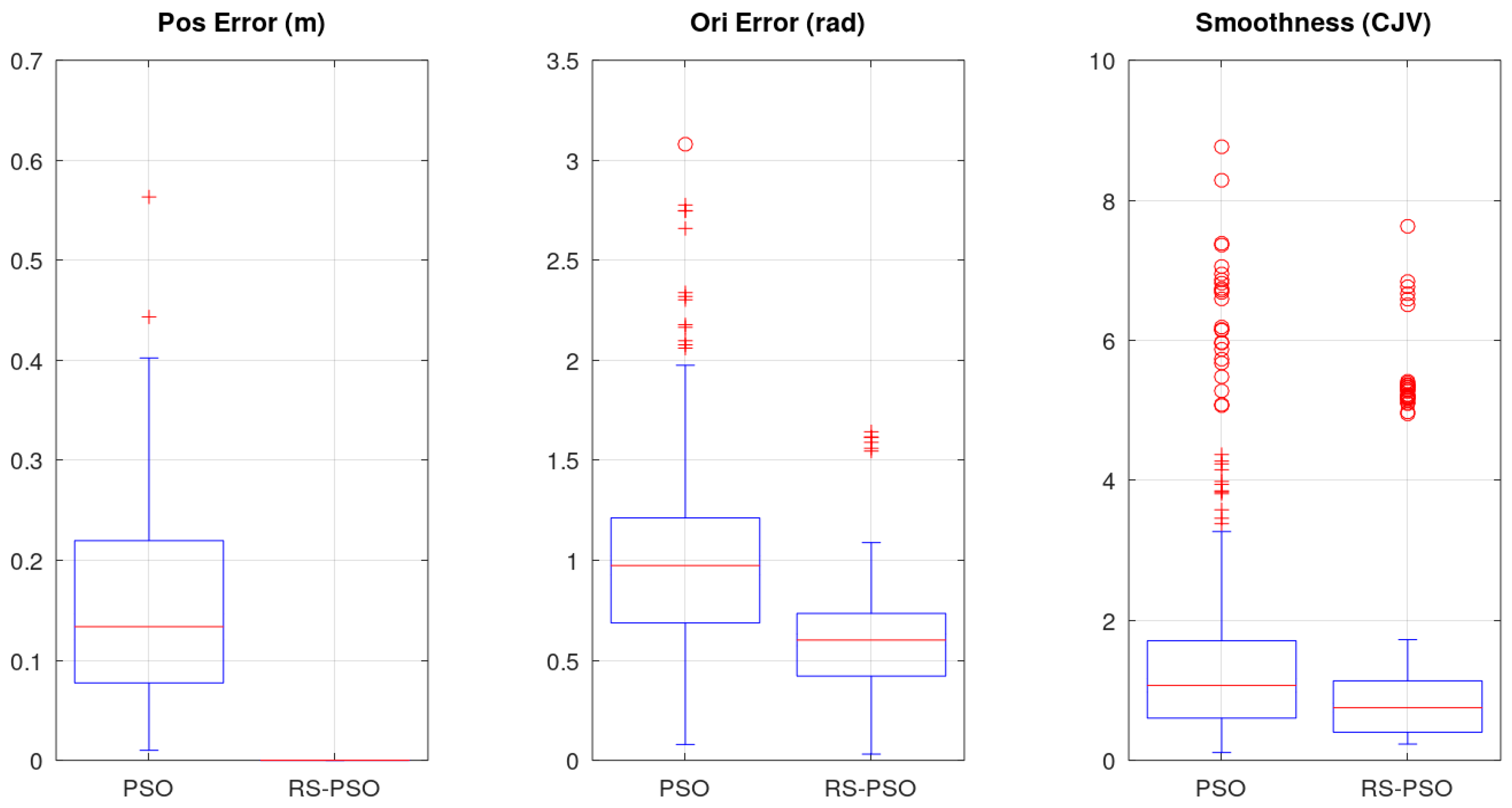
The RS-PSO—essentially a PSO variant equipped with Rough Set-based self-adaptation mechanisms—achieves a mean positional error of 7.3 × 10⁻⁵ m (0.073 mm). This indicates that the adaptive strategy helps the algorithm sustain sub-millimeter precision throughout the transition, meeting the accuracy requirements for both anatomical landmark tracking and incision tool alignment, as illustrated in Figure 4.
The Cost of Joint Variation (CJV) analysis presents an interesting reversal from previous experiments. Unlike the spiral trajectory (where classical PSO appeared “smoother” due to stagnation), the linear transition shows the RS-PSO achieving superior smoothness for this test bed as shown in Table 12.

5.3.3. Statistical Significance

The Wilcoxon analysis, Table 13, confirms this difference is statistically significant ( p < 0.001 ,   z = 15.012 ), for position error, with the RS-PSO producing smoother joint trajectories. Similar results are confirmed for orientation ( p < 0.001 ,   z = 12.43 ); also, with advantage for RS-PSO.

5.4. Processing Time Assessment and Real Time Constraints

The processing time evaluation was performed using GNU Octave version 10.3.0—September 2025, a PC equipped with an Intel i7 processor and 16 GB of RAM, over a set of 30 different constrained target poses. Results are presented in Table 14.
In robot-assisted surgery, a fast inverse kinematics (IK) solver is crucial for safety and ease of use. Real-time surgical tasks require quick and consistent responses to maintain control and coordination for the surgeon. Our tests show that the RS-PSO method solves a single point in an average of 13.95 milliseconds, which is well within the acceptable delay limit (200 ms) for remote surgery. Importantly, the algorithm’s processing time is very consistent, with a standard deviation of only 0.62 ms. This low variation is essential to avoid mismatched feedback, which can impair the surgeon’s control and increase mental strain during precise actions like aligning incisions. The fast processing time (under 15 ms) allows for frequent path adjustments, enabling the system to actively correct for body movements (like breathing or heartbeats) that commonly occur at a rate of 1–10 times per second.

5.5. Convergence Analysis

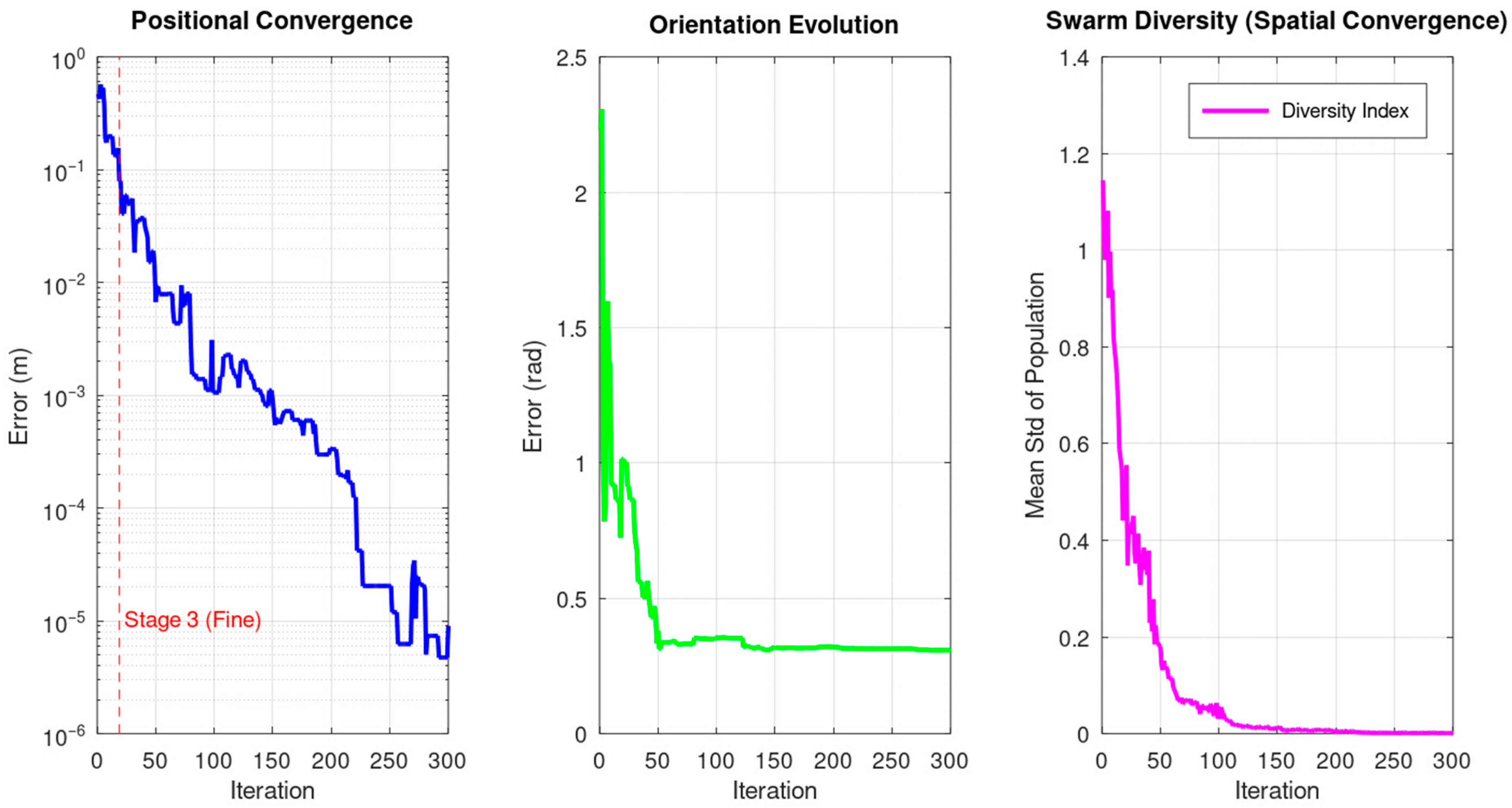
The RS-PSO algorithm effectively explores the search area, achieving success in 80% of attempts within the acceptable error range of 10−4, see Table 15. It converges with high accuracy, averaging a positional error of only 0.096 mm. This indicates that the algorithm’s hybrid design successfully reduces the problem of early convergence common in standard PSO. However, the average orientation error of 0.2324 rad (about 13.3°) suggests that the algorithm optimizes position more effectively than orientation. This might be improved by adjusting the importance of position versus orientation in the optimization goals. The algorithm typically stabilizes after 177.10 iterations, showing a good balance between speed and thoroughness for robotic applications, as illustrated by Figure 5.

6. Conclusions and Perspectives

The Rough Sets Meta-Heuristic Schema (RSMS) is a flexible mathematical structure that can be added to any swarm-based optimization method. RS-PSO is simply one example of how this can be done. The RSMS framework separates the logic of rough-set reasoning from the specific optimization algorithm being used. This allows for systematic, logic-based control that can be applied to various swarm methods (like PSO, ABC, and DE) without changing their fundamental workings.
This study uses extensive simulations on various surgical tasks to show that the RS-PSO method is much better than the standard PSO method. RS-PSO consistently finds the best solutions and navigates complex searches more effectively. It achieves very precise incision alignment (less than a millimeter) and reduces errors, proving its potential for use in delicate medical procedures. The reliable results suggest that the Rough Set Meta-Heuristic (RSMS) is not just a minor improvement. It intelligently manages resources by dividing the swarm into Elite, Boundary, and Poor regions. This gives the system an understanding of the search space. Overall, this method provides a flexible and reusable design that improves the precision and consistency of swarm-based problem-solving in surgical robotics, connecting theoretical methods with real-world clinical reliability.
Future investigations will aim to further advance the emerging paradigm of Surgical 4.0 and autonomous surgical systems. A first perspective will be to extend the RS-Meta Schema to support collaborative multi-robot configurations. A Neuro-Symbolic Parameter Control framework is also under investigation to replace static lookup tables with a Deep Reinforcement Learning (DRL) agent that leverages Rough Set–based categorizations to adaptively regulate control parameters. The shift toward context-aware optimization in surgical robotics such as in [25,26] is also a perspective. Integrating our Rough Set Meta-Heuristic (RSMS) with similar deep learning architectures could provide a hybrid ‘neuro-symbolic’ approach, combining mathematical discretization with predictive temporal learning for even higher surgical reliability.

Funding

This research received funding from Prince Sattam bin Abdulaziz University through the project number (2025/01/33726).

Data Availability Statement

Data are available in the paper.

Acknowledgments

The authors extend their appreciation to Prince Sattam bin Abdulaziz University for funding this research work through the project number (2025/01/33726). During the preparation of this manuscript/study, the author used [Gemini 3, Flash of Google], for the purposes of [the grammar, clarity, and readability]. The author has reviewed and edited the output and take full responsibility for the content of this publication.

Conflicts of Interest

The authors declare no conflicts of interest.

References

  1. Picozzi, P.; Nocco, U.; Puleo, G.; Labate, C.; Cimolin, V. Telemedicine and Robotic Surgery: A Narrative Review to Analyze Advantages, Limitations and Future Developments. Electronics 2024, 13, 124. [Google Scholar] [CrossRef]
  2. Schäfer, M.B.; Stewart, K.W.; Pott, P.P. Industrial robots for teleoperated surgery—A systematic review of existing approaches. Curr. Dir. Biomed. Eng. 2019, 5, 153–156. [Google Scholar] [CrossRef]
  3. Šuligoj, F.; Jerbić, B.; Šekoranja, B.; Vidaković, J.; Švaco, M. Influence of the Localization Strategy on the Accuracy of a Neurosurgical Robot System. Trans. FAMENA 2018, 42, 27–38. [Google Scholar] [CrossRef]
  4. Cunningham, B.W.; Brooks, D.M.; McAfee, P.C. Accuracy of Robotic-Assisted Spinal Surgery—Comparison to TJR Robotics, da Vinci Robotics, and Optoelectronic Laboratory Robotics. Int. J. Spine Surg. 2021, 15, S38–S55. [Google Scholar] [CrossRef]
  5. MacLachlan, R.A.; Becker, B.C.; Tabares, J.C.; Podnar, G.; Lobes, L.A.; Riviere, C.N. Micron: An Actively Stabilized Handheld Tool for Microsurgery. IEEE Trans. Robot. 2011, 28, 195–212. [Google Scholar] [CrossRef] [PubMed]
  6. Ficuciello, F.; Tamburrini, G.; Arezzo, A.; Villani, L.; Siciliano, B. Autonomy in surgical robots and its meaningful human control. Paladyn. J. Behav. Robot. 2019, 10, 30–43. [Google Scholar] [CrossRef]
  7. Rokbani, N.; Alimi, A.M. Inverse kinematics using particle swarm optimization, a statistical analysis. Procedia Eng. 2013, 64, 1602–1611. [Google Scholar] [CrossRef]
  8. Rokbani, N.; Casals, A.; Alimi, A.M. IK-FA, a new heuristic inverse kinematics solver using firefly algorithm. In Computational Intelligence Applications in Modeling and Control; Springer International Publishing: Cham, Switzerland, 2014; pp. 369–395. [Google Scholar]
  9. Sandoval, J.; Su, H.; Vieyres, P.; Poisson, G.; Ferrigno, G.; Momi, E.D. Collaborative framework for robot-assisted minimally invasive surgery using a 7-DoF anthropomorphic robot. Robot. Auton. Syst. 2018, 106, 95–106. [Google Scholar] [CrossRef]
  10. Davila, A.; Colan, J.; Hasegawa, Y. Real-time inverse kinematics for robotic manipulation under remote center-of-motion constraint using memetic evolution. J. Comput. Des. Eng. 2024, 11, 248–264. [Google Scholar] [CrossRef]
  11. Siciliano, B.; Sciavicco, L.; Villani, L.; Oriolo, G. Robotics: Modelling, Planning and Control; Springer: London, UK, 2009. [Google Scholar] [CrossRef]
  12. Kanagaraj, G.; Masthan, S.S.; Yu, V.F. Meta-Heuristics Based Inverse Kinematics of Robot Manipulator’s Path Tracking Capability Under Joint Limits. MENDEL 2022, 28, 41–54. [Google Scholar] [CrossRef]
  13. Huang, H.; Fu, J.; Jin, Z.; Liu, A.; Zhang, W.-A.; Yang, C. A Safety-Critical Dynamic System Framework for High-Precision Learning from Demonstration. IEEE Trans. Autom. Sci. Eng. 2025, 22, 19081–19094. [Google Scholar] [CrossRef]
  14. Pawlak, Z.A. Rough sets. Int. J. Parallel Program. 1982, 11, 341–356. [Google Scholar] [CrossRef]
  15. Rizk-Allah, R.M.; Elsodany, E. An improved rough set strategy-based sine cosine algorithm for engineering optimization problems. Soft Comput. 2023, 28, 1157–1178. [Google Scholar] [CrossRef]
  16. Rokbani, N.; Mirjalili, S.; Slim, M.; Alimi, A.M. A beta salp swarm algorithm meta-heuristic for inverse kinematics and optimization. Appl. Intell. 2022, 52, 10493–10518. [Google Scholar] [CrossRef]
  17. Colan, J.; Davila, A.; Fozilov, K.; Hasegawa, Y. A Concurrent Framework for Constrained Inverse Kinematics of Minimally Invasive Surgical Robots. Sensors 2023, 23, 3328. [Google Scholar] [CrossRef]
  18. Slim, M.A.; Rokbani, N.; Neji, B.; Terres, M.A.; Beyrouthy, T. Inverse Kinematic Solver Based on Bat Algorithm for Robotic Arm Path Planning. Robotics 2023, 12, 38. [Google Scholar] [CrossRef]
  19. KUKA AG, “KUKA LBR iiwa,” Technical Brochure. Available online: https://www.kuka.com/en-us/products/robotics-systems/industrial-robots/lbr-iiwa (accessed on 23 February 2026).
  20. Stürz, Y.R.; Affolter, L.M.; Smith, R.S. Parameter identification of the KUKA LBR iiwa robot including constraints on physical feasibility. IFAC-PapersOnLine 2017, 50, 6863–6868. [Google Scholar] [CrossRef]
  21. Dasgupta, S.; Das, D.; Hoque, M.R.; Bhattacharya, I. An Intelligent Route Planning Approach Using Modified Particle Swarm Optimization for Robot Assisted Minimally Invasive Surgery. J. Comput. Theor. Appl. 2025, 2, 498–510. [Google Scholar] [CrossRef]
  22. Silva, J.D.; Vafadar, S.; Chandanson, T.; Morel, G. Force control of the KUKA LBR Med without external force sensor, HAL (Le Centre pour la Communication Scientifique Directe). In Proceedings of the 11th Edition of Conference on New Technologies for Computer and Robot Assisted Surgery, Naples, Italy, 25–27 April 2022; Available online: https://hal.science/hal-03768357 (accessed on 1 October 2025).
  23. Schleer, P.; Vossel, M.; Heckmann, L.; Drobinsky, S.; Theisgen, L.; de la Fuente, M.; Radermacher, K. Usability of cooperative surgical telemanipulation for bone milling tasks. Int. J. Comput. Assist. Radiol. Surg. 2020, 16, 311–322. [Google Scholar] [CrossRef] [PubMed]
  24. Osburg, J.; Nguyen, N.T.; Ernst, F. Increasing Reachability in Robotic Ultrasound Through Base Placement and Tool Design. Int. J. Med. Robot. Comput. Assist. Surg. 2024, 21, e70037. [Google Scholar] [CrossRef]
  25. Karnam, M.; Żelechowski, M.; Cattin, P.C.; Rauter, G.; Gerig, N. User-specified inverse kinematics taught in virtual reality reduce time and effort to hand-guide redundant surgical robots. Commun. Eng. 2025, 4, 20. [Google Scholar] [CrossRef] [PubMed]
  26. Shao, X.; Xu, L.; Zheng, T.; Sun, G.; Zhu, Y. Practical Finite-Time Motion Planning for Spacecraft-Mounted Soft Manipulators Under Dynamic Obstacles. IEEE Trans. Aerosp. Electron. Syst. 2025, 62, 2603–2620. [Google Scholar] [CrossRef]
Figure 1. The incision tool alignment simulation illustartion. (a) Simplified 3-D representation of the robotic arm, (b) evolution of the error position over the iterative porcessing of the algorithm, (c) evolution of the orientation error.
Robotics 15 00052 g001aRobotics 15 00052 g001b
Figure 2. Comparative results of RS-PSO versus PSO for the single-pose test bed.
Robotics 15 00052 g002
Figure 3. Spiral path of 30 points, the figure shows the joints angular positions evolution (left), and the obtained path (right).
Robotics 15 00052 g003
Figure 4. Comparative results of RS-PSO versus PSO for the constrained path test bed. The figure presents the box plots for position error (left), orientation error (middle) and smoothness (right).
Robotics 15 00052 g004
Figure 5. Convergence analysis of the RS-PSO algorithm using constrained orientation position inverse kinematics.
Robotics 15 00052 g005
Table 1. DH parameters of the robotic arm.
Joint i α i 1 (rad) a i 1 (mm) d i (mm) θ i (rad)
100340 q 1
2 π / 2 00 q 2
3 π / 2 0400 q 3
4 π / 2 00 q 4
5 π / 2 0400 q 5
6 π / 2 00 q 6
7 π / 2 0126 q 7
Table 2. Single target poses for surgical robotics.
Pose IDSurgical ContextTarget Position (X, Y, Z) (m)Target Orientation (RPY) (rad)Primary Constraint/Focus
Anatomical LandmarkBiopsy, Puncture, or fixed delivery ( 0.4 , 0.2 , 0.4 ) ( π / 2 , 0 , 0 ) (Neutral)Absolute Positional Accuracy. Orientation is relaxed to prioritize minimal APE.
Incision ToolCutting, Suturing Plane Alignment ( 0.3 , 0.3 , 0.5 ) ( π / 4 , π / 2 , 0 ) (Aligned)Full Pose Accuracy P and O). Simulates critical alignment required for tool engagement.
Steady ViewEndoscopic Camera Stabilization ( 0.1 , 0.5 , 0.3 ) ( 0 , 0 , 0 ) (Irrelevant)Redundancy Exploitation. The solution must minimize joint variation to prioritize a stable configuration.
Challenging ReachDeep-cavity Access/Boundary Operation ( 0.55 , 0.0 , 0.45 ) ( π / 2 , π / 4 , 0 ) (Lateral)Joint Limit and Singularity Avoidance. Tests robustness near the edge of the robot’s workspace.
Table 3. Spiral path parameters.
ParameterSymbolValueUnitsDescription
Start/Center Position ( X center , Y center ) ( 0.0 , 0.0 ) mCenter of the XY plane circular motion.
Spiral Radius R 0.20 mThe constant radius of the helix (20 cm).
Total Turns N s 1.0 turnsThe path completes one full revolution.
Start Height Z start 0.40 mThe initial height of the end-effector.
Pitch (Per Radian) H 0.01 m/radVertical drop per radian of angle (Total Z drop is 2 π H 6.28 cm).
Total Waypoints N points 10pointsNumber of discrete IK problems to be solved sequentially.
Table 4. Constrained path trajectory parameters.
ParameterSymbolValueUnitsDescription
Start PoseP1, O1(0.4, 0.2, 0.4)m, radMatches the ‘Anatomical Landmark’ pose (low orientation constraint).
End PoseP10, O10(0.3, −0.3, 0.5)m, radMatches the ‘Incision Tool’ pose (high pose constraint).
Total WaypointsN_points10pointsNumber of discrete IK problems to be solved sequentially.
Constraint RelaxationkEvery 3rd (W3, W6, W9)Waypoint IndexOrientation is relaxed (α_O = 0) to encourage joint flexibility and minimum CJV.
Hard ConstraintskAll other pointsWaypoint IndexFull 6-DOF pose constraint maintained, often necessitating RCM pivoting behavior.
Table 5. Incision Alignment Task—Best Solution Summary.
ParameterValueInterpretation
Best Positional Error 2.80 × 10 6   m Micrometer-scale; 357× better than clinical requirement
Best Orientation Error 0.450   rad ≈25.8°; acceptable for moderate-precision procedures
q1 0.0621   rad Shoulder flexion; minimal engagement
q2 0.0219   rad Shoulder lateral; near-zero position
q3 0.2629   rad Elbow flexion; moderate angle
q4 2.0312   rad Elbow wrist
q5 0.2971   rad Wrist flexion
q6 0.9390   rad Wrist rotation; orientation control
q7 1.4204   rad End-effector roll; final alignment refinement
Feasibility All   q i < 170 ° Within mechanical limits; singularity-free configuration
Table 6. Single-pose target test bed results.
MetricAlgorithmBestWorstMeanStd Dev
Pos Error (m)Classical PSO 6.8 × 10 2 5.6 × 10 1 2.7 × 10 1 1.1 × 10 1
RS-PSO 1.8 × 10 5 9.9 × 10 5 6.7 × 10 5 2.2 × 10 5
Ori Error (rad)Classical PSO 0.544 3.080 1.682 0.654
RS-PSO 0.031 1.643 0.975 0.445
Smoothness (CJV)Classical PSO 2.748 8.765 5.939 1.355
RS-PSO 4.950 7.629 5.552 0.681
TSR (%)Classical PSO 0.00
RS-PSO 100.00
Table 7. Wilcoxon signed-rank analysis.
Metricp-Valuez-ScoreSignificance ( α = 0.05 )
Position Error 1.83 × 10 6 4.7719 Significant
Orientation Error 1.54 × 10 4 3.7846 Significant
CJV (Smoothness) 1.95 × 10 1 1.2958 Not Significant
Table 8. Spiral trajectory comparative statistics.
MetricAlgorithmBestWorstMeanStd Dev
Pos Error (m)Classical PSO 2.3 × 10 2 5.8 × 10 1 1.8 × 10 1 7.4 × 10 2
RS-PSO 1.8 × 10 5 1.5 × 10 1 1.6 × 10 2 3.6 × 10 2
Ori Error (rad)Classical PSO 0.015 2.980 0.618 0.470
RS-PSO 0.000 1.070 0.313 0.345
Smoothness (CJV)Classical PSO 0.119 7.877 1.758 1.622
RS-PSO 0.753 6.646 2.122 1.346
TSR (%)Classical PSO 0.00
RS-PSO 67.33
Table 9. Wilcoxon signed-rank analysis.
Metricp-Valuez-ScoreSignificance ( α = 0.05 )
Position Error 0.00 15.0022 Significant
Orientation Error 0.00 11.6073 Significant
CJV (Smoothness) 2.64 × 10 10 6.3185 Significant
Table 10. Optimal spiral trajectory joint configuration solutions.
Waypoint q 1 (rad) q 2 (rad) q 3 (rad) q 4 (rad) q 5 (rad) q 6 (rad) q 7 (rad)
1−1.4598−0.1187−1.33582.1635−0.13641.01010.4205
20.69970.40010.0825−2.4684−0.1581−1.0488−2.1669
31.03370.44740.3842−2.4967−0.0476−0.9612−2.0205
41.26160.48120.6473−2.48140.3224−1.0774−1.4469
51.51120.71980.9159−2.49300.5941−1.2063−1.0923
61.92330.75991.1027−2.44850.6357−1.4654−1.0639
72.35551.39520.9677−2.51510.9707−1.7578−0.2724
82.84011.69750.8776−2.52571.0435−2.05940.2258
93.14162.02810.6513−2.54961.0263−2.56210.0211
103.14162.30670.1460−2.54170.4445−2.88810.3337
Table 11. Optimal joint Configurations—constrained path test bed trajectory.
Waypointq1 (rad)q2 (rad)q3 (rad)q4 (rad)q5 (rad)q6 (rad)q7 (rad)Description
1 (Initial)−1.71240.4027−1.12301.90530.31890.88670.1576Landmark pose (retraction)
20.3812−0.07110.0966−2.0962−0.7309−0.6365−1.8069Early descent toward incision
30.37660.0444−0.0353−2.2044−0.8220−0.4792−1.7212Transition phase 1
40.25550.0617−0.0340−2.1473−0.5723−0.7770−2.3380Mid-trajectory refinement
5 (Midpoint)0.14780.0656−0.1213−2.0860−0.3012−0.9728−2.8520Path centroid
60.15020.1196−0.2342−2.1202−0.4794−0.9102−2.7537Transition phase 2
70.06330.0735−0.3558−2.0232−0.2596−1.0860−3.1416Approach phase begins
80.06380.0491−0.4944−1.9731−0.3068−1.1118−3.1416Final descent
9−0.04690.0054−0.5235−1.9119−0.3387−1.1068−3.1416Near-target alignment
10 (Final)−0.1617−0.0215−0.5191−1.8796−0.4536−0.9838−3.1416Incision tool pose
Table 12. Constrained path trajectory—comparative statistics.
MetricAlgorithmBestWorstMeanStd Dev
Positional Error (m)Classical PSO 1.0 × 10 2 5.6 × 10 1 1.6 × 10 1 1.0 × 10 1
RS-PSO 1.8 × 10 5 1.0 × 10 4 7.3 × 10 5 2.0 × 10 5
Orientation Error (rad)Classical PSO 0.080 3.080 1.010 0.492
RS-PSO 0.031 1.643 0.615 0.244
CJV (Smoothness)Classical PSO 0.111 8.765 1.611 1.668
RS-PSO 0.233 7.629 1.194 1.511
TSR (%)Classical PSO 0
RS-PSO 100
Table 13. Wilcoxon signed-rank analysis (constrained path).
Metricp-Valuez-ScoreSignificance ( α = 0.05 )
Position Error 0.001 15.0121 Significant
Orientation Error 0.00 1 12.4392 Significant
CJV (Smoothness) 8.88 × 10 15 7.7543 Significant
Table 14. Processing time evaluation.
MetricValue
Best Position Error3.335466 × 10−6 m
Single-Point Time Min (30)0.012908 s
Single-Point Time Max (30)0.015429 s
Single-Point Time Mean (30)0.013946 s
Single-Point Time Std (30)0.000619 s
Best Q (q1–q7)[0.2713, −0.0132, 0.0807, −1.9860, 0.1852, −1.0602, 1.5955]
Table 15. Convergence Analysis.
MetricValue
Success Rate (Pos < 1 × 10⁻⁴):80.00%
Mean Pos 9.582172 × 10⁻⁵
Mean Ori Error0.2324 rad
Avg Iterations to Converge(178) (extact mean = 177.10)
Disclaimer/Publisher’s Note: The statements, opinions and data contained in all publications are solely those of the individual author(s) and contributor(s) and not of MDPI and/or the editor(s). MDPI and/or the editor(s) disclaim responsibility for any injury to people or property resulting from any ideas, methods, instructions or products referred to in the content.