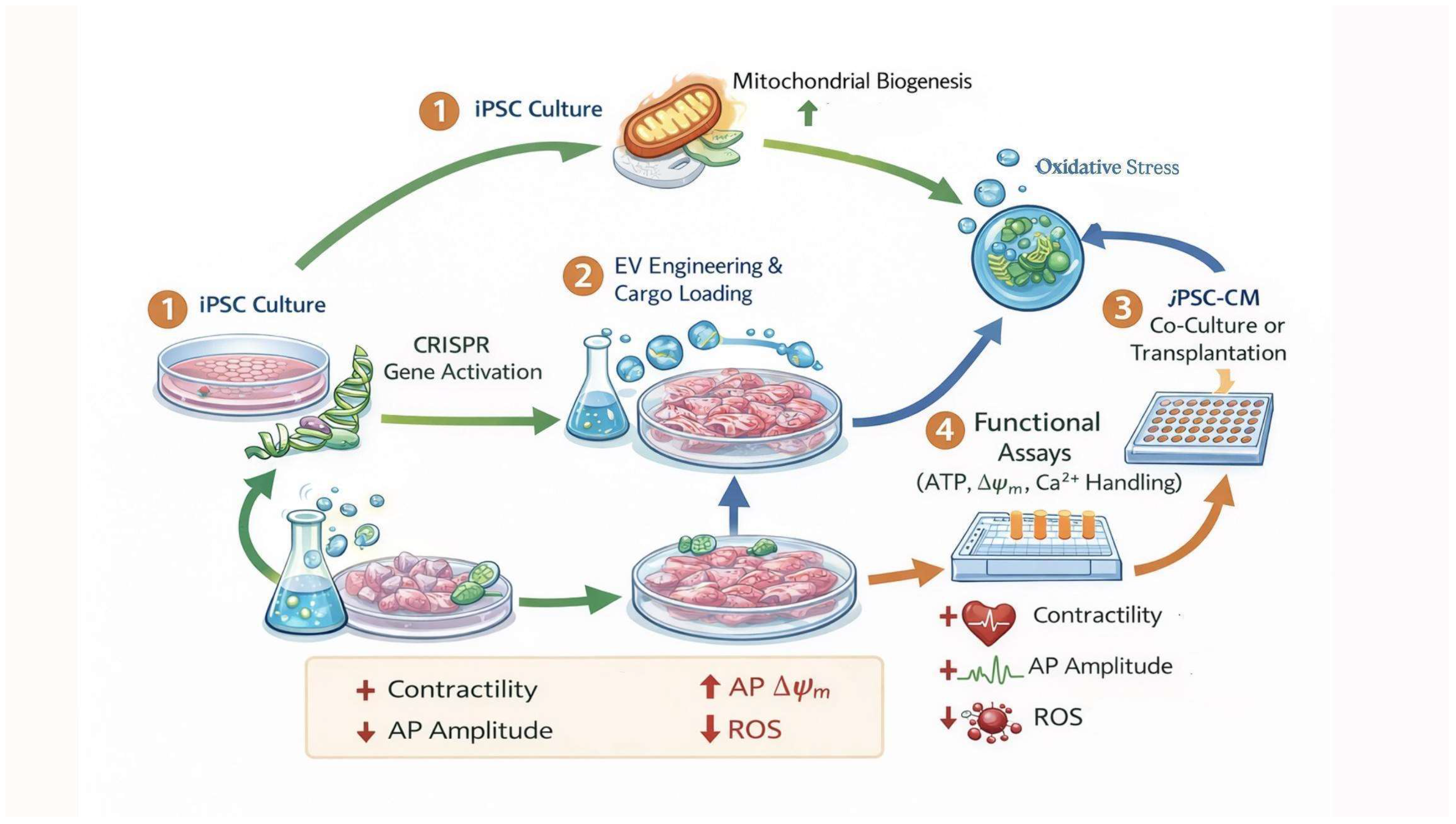
Next-Generation Metabolic Reprogramming in iPSC-Derived Cardiomyocytes: CRISPR-EV Synergy for Precision Cardiac Regeneration



Abstract
1. Introduction
2. Metabolic Landscape of iPSC-CMs
2.1. Glycolytic Bias vs. Adult Cardiomyocyte Oxidative Phosphorylation
2.2. Mitochondrial Architecture and Dynamics
2.3. Biomolecular Signatures: Δψm, NAD+/NADH, and ROS
2.4. Synthesis: A Metabolic Framework for iPSC-CM Maturation
3. CRISPR-Guided Metabolic Engineering
3.1. Target Selection: PGC-1α, TFAM, ERRα/β, and PPAR Pathways
3.2. CRISPRa/i Strategies and Base Editing
3.3. Quantitative Outcomes: Respiration and ATP Kinetics
3.4. Safety and Off-Target Considerations
3.5. Synthesis and Prospects
4. Extracellular Vesicle Metabolic Modulators
4.1. EV Biogenesis and Metabolic Cargo
4.2. Engineered EVs: miRNAs, Metabolic Enzymes, and Lipid Modulators
4.3. Functional Effects in Recipient Cells
- Bioenergetic restoration: EV-encoded mitochondrial proteins and metabolic enzymes enhance oxidative phosphorylation efficiency, increase ATP output, and improve mitochondrial dynamics through regulation of fusion (MFN1/2) and fission (DRP1) pathways.
- Redox modulation: miRNAs and enzymes carried by EVs regulate NAD+/NADH balance and ROS production, crucial determinants of metabolic flux and oxidative stress resilience.
- Stress adaptation: Cardioprotective miRNAs delivered by EVs can suppress pro-apoptotic signaling and subclinical metabolic dysregulation in hypoxic or post-ischemic environments.
- Substrate flexibility: EV cargo may influence glycolytic and fatty acid oxidation pathways, shifting metabolic preference toward adult-like OXPHOS patterns in immature cardiomyocytes.
4.4. Dose and Delivery Optimization
- Particle quantification versus cargo functionality: Measuring both particle number and biologically active cargo (e.g., miRNA copies, enzyme activity) ensures consistent metabolic impact.
- Targeted delivery: Surface modification of EVs (e.g., integrin peptides, antibodies) improves tissue specificity and uptake efficiency. Engineering EV membranes can enhance biodistribution and reduce off-target uptake.
- Route of administration: Intramyocardial, intracoronary, or systemic delivery modalities affect EV retention, half-life, and metabolic impact, necessitating comparative optimization studies.
4.5. Synthesis
5. CRISPR-EV Synergy: Mechanisms and Data
5.1. Complementary Actions: Gene vs. Extracellular Modulation
5.2. Enhanced Mitochondrial Fusion/Fission Balance
5.3. Calcium Handling and Electrophysiologic Improvements
5.4. Quantitative Metrics Across Studies
- ATP Production: EV transfers of mitochondrial cargo enhance ATP synthesis, while CRISPR-mediated upregulation of ETC and biogenesis genes increases ATP output synergistically in recipient cardiomyocytes [45]. In mitochondrial-rich EV (M-EV) studies, treatment restored intracellular ATP levels to near-physiological levels within hours after administration [11].
5.5. Synthesis and Future Perspectives
6. Biomolecular Biomarkers and Quantitative Platforms
6.1. NAD+/NADH Ratio, ATP Turnover, and Metabolomics
6.2. Seahorse XF, High-Resolution Respirometry
6.3. Bioinformatic Integration and Predictive Modeling
7. Translational Framework
7.1. Preclinical Efficacy and Safety Data
7.2. Cell Therapy Manufacturing Scalability
7.3. Regulatory Landscape
7.4. Summary of Translational Imperatives
8. Future Directions and Challenges
8.1. In Vivo Maturation and Engraftment Hurdles
8.2. Immune Modulation via EVs
8.3. Personalized Metabolic Editing Strategies
8.4. Outlook
9. Conclusions
Author Contributions
Funding
Institutional Review Board Statement
Informed Consent Statement
Data Availability Statement
Conflicts of Interest
References
- Sugiura, T.; Shahannaz, D.C.; Ferrell, B.E. Current status of cardiac regenerative therapy using induced pluripotent stem cells. Int. J. Mol. Sci. 2024, 25, 5772. [Google Scholar] [CrossRef] [PubMed]
- Sugiura, T.; Shahannaz, D.C.; Ferrell, B.E.; Yoshida, T. Advancements in cardiac regenerative therapy: Scalable human iPSC-derived cardiomyocyte differentiation and maturation. Glob. Transl. Med. 2025, 4, 1–15. [Google Scholar] [CrossRef]
- Zhao, J.; Hao, R. Recent Advances in Maturation of Induced pluripotent Stem Cells-derived Cardiomyocytes. Am. J. Stud. 2024, 2, 115–122. [Google Scholar] [CrossRef]
- Major, R.J.; Poss, K.D. Zebrafish Heart Regeneration as a Model for Cardiac Tissue Repair. Drug Discov. Today Dis. Models 2007, 4, 219–225. [Google Scholar] [CrossRef] [PubMed] [PubMed Central]
- Goliusova, D.V.; Bogomolova, A.P.; Davidenko, A.V.; Lavrenteva, K.A.; Sharikova, M.Y.; Zerkalenkova, E.A.; Vassina, E.M.; Bogomazova, A.N.; Lagarkova, M.A.; Katrukha, I.A.; et al. Metabolic Culture Medium Enhances Maturation of Human iPSC-Derived Cardiomyocytes via Cardiac Troponin I Isoform Induction. Int. J. Mol. Sci. 2025, 26, 7248. [Google Scholar] [CrossRef] [PubMed] [PubMed Central]
- Shahannaz, D.C.; Sugiura, T.; Ferrell, B.E. Enhancing mitochondrial maturation in IPSC-DerivedCardiomyocytes: Strategies for Metabolic Optimization. BioChem 2025, 5, 23. [Google Scholar] [CrossRef]
- Fernández-Ruiz, I. Metabolic reprogramming unlocks the regenerative potential of the heart. Nat. Rev. Cardiol. 2023, 20, 795. [Google Scholar] [CrossRef] [PubMed]
- Sugiura, T.; Nawaz, S.; Shahannaz, D.C.; Ferrell, B.E.; Yoshida, T. From injury to repair: The therapeutic potential of induced pluripotent stem cells in heart failure. Regen. Med. Rep. 2025, 2, 22–30. [Google Scholar] [CrossRef]
- Shahannaz, D.C.; Sugiura, T.; Ferrell, B.E. The role of large language models in induced pluripotent stem cell-derived cardiomyocytes research and clinical translation. J. Clin. Transl. Res. 2025, 11, 4. [Google Scholar] [CrossRef]
- Shahannaz, D.C.; Sugiura, T.; Ferrell, B.E.; Yoshida, T. Arrhythmogenic Risk in IPSC-Derived Cardiomyocytes: Current limitations and therapeutic Perspectives. Medicina 2025, 61, 2056. [Google Scholar] [CrossRef] [PubMed]
- Shahannaz, D.C.; Sugiura, T.; Ferrell, B.E.; Yoshida, T. Engineering Mitochondrial Biogenesis in iPSC-CMs: CRISPR-Guided Approaches for Advanced Cardiomyocyte Development. J. Cardiovasc. Dev. Dis. 2026, 13, 77. [Google Scholar] [CrossRef]
- Shahannaz, D.C.; Sugiura, T.; Ferrell, B.E.; Yoshida, T. Targeting Mitochondrial Dynamics via EV Delivery in Regenerative Cardiology: Mechanistic and Therapeutic Perspectives. Cells 2025, 14, 1738. [Google Scholar] [CrossRef] [PubMed] [PubMed Central]
- Shahannaz, D.C.; Sugiura, T.; Yoshida, T. Mitochondria-Enriched Extracellular Vesicles (EVs) for Cardiac Bioenergetics Restoration: A Scoping Review of Preclinical Mechanisms and Source-Specific Strategies. Int. J. Mol. Sci. 2025, 26, 11052. [Google Scholar] [CrossRef] [PubMed] [PubMed Central]
- Shahannaz, D.C.; Sugiura, T. EV-Encapsulated Mitochondrial miRNAs: Enhancing Cardiomyocyte Bioenergetics. Int. J. Mol. Sci. 2026, 27, 2224. [Google Scholar] [CrossRef]
- Chen, X.; Wu, H.; Liu, Y.; Liu, L.; Houser, S.R.; Wang, W.E. Metabolic reprogramming: A byproduct or a driver of cardiomyocyte proliferation? Circulation 2024, 149, 1598–1610. [Google Scholar] [CrossRef]
- Purnama, U.; Castro-Guarda, M.; Sahoo, O.S.; Carr, C.A. Modelling diabetic cardiomyopathy: Using human stem Cell-Derived cardiomyocytes to complement animal models. Metabolites 2022, 12, 832. [Google Scholar] [CrossRef]
- Feyen, D.A.M.; McKeithan, W.L.; Bruyneel, A.A.N.; Spiering, S.; Hörmann, L.; Ulmer, B.; Zhang, H.; Briganti, F.; Schweizer, M.; Hegyi, B.; et al. Metabolic Maturation Media Improve Physiological Function of Human iPSC-Derived Cardiomyocytes. Cell Rep. 2020, 32, 107925. [Google Scholar] [CrossRef] [PubMed] [PubMed Central]
- Zheng, Y.; Mayourian, J.; King, J.S.; Li, Y.; Bezzerides, V.J.; Pu, W.T.; VanDusen, N.J. Cardiac Applications of CRISPR/AAV-Mediated Precise Genome Editing. bioRxiv 2024. [Google Scholar] [CrossRef]
- Galdos, F.X.; Darsha, A.K.; Paige, S.L.; Wu, S.M. Purification of Pluripotent Stem Cell-Derived Cardiomyocytes Using CRISPR/Cas9-Mediated Integration of Fluorescent Reporters. In Cardiac Regeneration: Methods and Protocols; Canonical CRISPR Reporter Strategy Enabling Chamber-Specific CM Purification; Humana: New York, NY, USA, 2021; Volume 2158, pp. 223–240. [Google Scholar] [CrossRef]
- Femminò, S.; Bonelli, F.; Brizzi, M.F. Extracellular vesicles in cardiac repair and regeneration: Beyond stem-cell-based approaches. Front. Cell Dev. Biol. 2022, 10, 996887. [Google Scholar] [CrossRef]
- Bitirim, C.V. Role of Extracellular Vesicles in Cardiac Regeneration. In Extracellular Vesicles-Applications and Therapeutic Potential; Comprehensive Synthesis of EVs from CPCs, MSCs, and iPSC-Derived Cells; IntechOpen: Rijeka, Croatia, 2024. [Google Scholar] [CrossRef]
- Reznik, E.; Miller, M.L.; Şenbabaoğlu, Y.; Riaz, N.; Sarungbam, J.; Tickoo, S.K.; A Al-Ahmadie, H.; Lee, W.; E Seshan, V.; Hakimi, A.A.; et al. Mitochondrial DNA copy number variation across human cancers. eLife 2016, 5, e10769. [Google Scholar] [CrossRef]
- Correa, B.L.; El Harane, N.; Desgres, M.; Perotto, M.; Alayrac, P.; Guillas, C.; Pidial, L.; Bellamy, V.; Baron, E.; Autret, G.; et al. Extracellular vesicles fail to trigger the generation of new cardiomyocytes in chronically infarcted hearts. Theranostics 2021, 11, 10114–10124. [Google Scholar] [CrossRef]
- Zwi-Dantsis, L.; Winter, C.W.; Kauscher, U.; Ferrini, A.; Wang, B.; Whittaker, T.E.; Hood, S.R.; Terracciano, C.M.; Stevens, M.M. Highly purified extracellular vesicles from human cardiomyocytes demonstrate preferential uptake by human endothelial cells. Nanoscale 2020, 12, 19844–19854. [Google Scholar] [CrossRef] [PubMed] [PubMed Central]
- Kojic, A.; Moslehi, J.; Ky, B.; Wu, J.C. Cardiometabolic disease and cardio-oncology: Insights from iPSC models and tissue engineering. Cell Rep. Med. 2025, 6, 102261. [Google Scholar] [CrossRef]
- Malan, D.; Gallo, M.P.; Geddo, F.; Levi, R.; Querio, G. Metabolic Maturation in HIPSC-Derived Cardiomyocytes: Emerging Strategies for Inducing the adult cardiac phenotype. Pharmaceuticals 2025, 18, 1133. [Google Scholar] [CrossRef]
- Yoshida, S.; Miyagawa, S.; Fukushima, S.; Kawamura, T.; Kashiyama, N.; Ohashi, F.; Toyofuku, T.; Toda, K.; Sawa, Y. Maturation of Human Induced Pluripotent Stem Cell-Derived Cardiomyocytes by Soluble Factors from Human Mesenchymal Stem Cells. Mol. Ther. 2018, 26, 2681–2695. [Google Scholar] [CrossRef] [PubMed] [PubMed Central]
- Pervaiz, I.; Mehta, Y.; Al-Ahmad, A.J. Glucose transporter 1 deficiency impairs glucose metabolism and barrier induction in human induced pluripotent stem Cell-Derived astrocytes. J. Cell. Physiol. 2025, 240, e31523. [Google Scholar] [CrossRef]
- Guan, G.; Huo, D.; Li, Y.; Zhao, X.; Li, Y.; Qin, Z.; Sun, D.; Yang, G.; Yang, M.; Tan, J.; et al. Engineering hiPSC-CM and hiPSC-EC laden 3D nanofibrous splenic hydrogel for improving cardiac function through revascularization and remuscularization in infarcted heart. Bioact. Mater. 2021, 6, 4415–4429. [Google Scholar] [CrossRef] [PubMed] [PubMed Central]
- Chowdhury, A.; Boshnakovska, A.; Aich, A.; Methi, A.; Vergel Leon, A.M.; Silbern, I.; Lüchtenborg, C.; Cyganek, L.; Prochazka, J.; Sedlacek, R.; et al. Metabolic switch from fatty acid oxidation to glycolysis in knock-in mouse model of Barth syndrome. EMBO Mol. Med. 2023, 15, e17399. [Google Scholar] [CrossRef] [PubMed] [PubMed Central]
- Mattam, U.; Talari, N.K.; Sathyanarayana, A.R.; Mia, S.; Frazier, J.; Alagarsamy, J.; Slone, S.; Drosatos, K.; Krishnan, K.C. Isolated mouse adult cardiomyocytes display minimal mitochondrial ATP demand and maximal reliance on glycolysis. J. Mol. Cell. Cardiol. 2025, 204, 1–4. [Google Scholar] [CrossRef] [PubMed]
- Li, S.; Pan, H.; Tan, C.; Sun, Y.; Song, Y.; Zhang, X.; Yang, W.; Wang, X.; Li, D.; Dai, Y.; et al. Mitochondrial Dysfunctions Contribute to Hypertrophic Cardiomyopathy in Patient iPSC-Derived Cardiomyocytes with MT-RNR2 Mutation. Stem Cell Rep. 2018, 10, 808–821. [Google Scholar] [CrossRef] [PubMed]
- Folmes, C.D.; Ma, H.; Mitalipov, S.; Terzic, A. Mitochondria in pluripotent stem cells: Stemness regulators and disease targets. Curr. Opin. Genet. Dev. 2016, 38, 1–7. [Google Scholar] [CrossRef] [PubMed] [PubMed Central]
- Rebs, S.; Streckfuss-Bömeke, K. How can we use stem cell-derived cardiomyocytes to understand the involvement of energetic metabolism in alterations of cardiac function? Front. Mol. Med. 2023, 3, 1222986. [Google Scholar] [CrossRef]
- Dai, D.F.; Danoviz, M.E.; Wiczer, B.; Laflamme, M.A.; Tian, R. Mitochondrial maturation in human pluripotent stem cell derived cardiomyocytes. Stem Cells Int. 2017, 2017, 5153625. [Google Scholar] [CrossRef]
- Zheng, X.; Boyer, L.; Jin, M.; Mertens, J.; Kim, Y.; Ma, L.; Hamm, M.; Gage, F.H.; Hunter, T. Metabolic reprogramming during neuronal differentiation from aerobic glycolysis to neuronal oxidative phosphorylation. eLife 2016, 5, e13374. [Google Scholar] [CrossRef]
- Li, A.; Shami, G.J.; Griffiths, L.; Lal, S.; Irving, H.; Braet, F. Giant mitochondria in cardiomyocytes: Cellular architecture in health and disease. Basic Res. Cardiol. 2023, 118, 39. [Google Scholar] [CrossRef] [PubMed]
- Hinton, A.; Claypool, S.M.; Neikirk, K.; Senoo, N.; Wanjalla, C.N.; Kirabo, A.; Williams, C.R. Mitochondrial structure and function in human heart failure. Circ. Res. 2024, 135, 372–396. [Google Scholar] [CrossRef] [PubMed]
- Huang, Y.; Zhou, B. Mitochondrial dysfunction in cardiac diseases and therapeutic strategies. Biomedicines 2023, 11, 1500. [Google Scholar] [CrossRef]
- Piquereau, J.; Caffin, F.; Novotova, M.; Lemaire, C.; Veksler, V.; Garnier, A.; Ventura-Clapier, R.; Joubert, F. Mitochondrial dynamics in the adult cardiomyocytes: Which roles for a highly specialized cell? Front. Physiol. 2013, 4, 102. [Google Scholar] [CrossRef]
- Yang, H.M. Mitochondrial Dysfunction in Cardiovascular Diseases. Int. J. Mol. Sci. 2025, 26, 1917. [Google Scholar] [CrossRef] [PubMed] [PubMed Central]
- Sulaiman, A.A.; Katanaev, V.L. Beyond antioxidants: How redox pathways shape cellular signaling and disease outcomes. Antioxidants 2025, 14, 1142. [Google Scholar] [CrossRef]
- Li, T.; Wang, N.; Yi, D.; Xiao, Y.; Li, X.; Shao, B.; Wu, Z.; Bai, J.; Shi, X.; Wu, C.; et al. ROS-mediated ferroptosis and pyroptosis in cardiomyocytes: An update. Life Sci. 2025, 370, 123565. [Google Scholar] [CrossRef] [PubMed]
- Lu, S.; Baier, M.J.; Polonen, R.; Liao, Z.; Martin, J.L.; Ginsburg, K.S.; Mustroph, J.; Bers, D.M. Hyperglycaemia-induced reactive oxygen species production in cardiac ventricular myocytes differs among mammals. J. Physiol. 2025, 1–25. [Google Scholar] [CrossRef]
- Fusaki, N.; Ban, H.; Nishiyama, A.; Saeki, K.; Hasegawa, M. Efficient induction of transgene-free human pluripotent stem cells using a vector based on Sendai virus, an RNA virus that does not integrate into the host genome. Proc. Jpn. Acad. Ser. B Phys. Biol. Sci. 2009, 85, 348–362. [Google Scholar] [CrossRef] [PubMed] [PubMed Central]
- Yu, J.; Hu, K.; Smuga-Otto, K.; Tian, S.; Stewart, R.; Slukvin, I.I.; Thomson, J.A. Human induced pluripotent stem cells free of vector and transgene sequences. Science 2009, 324, 797–801. [Google Scholar] [CrossRef] [PubMed]
- Ikeda, G.; Santoso, M.R.; Tada, Y.; Li, A.M.; Vaskova, E.; Jung, J.-H.; O’bRien, C.; Egan, E.; Ye, J.; Yang, P.C. Mitochondria-Rich extracellular vesicles from autologous stem Cell–Derived cardiomyocytes restore energetics of ischemic myocardium. J. Am. Coll. Cardiol. 2021, 77, 1073–1088. [Google Scholar] [CrossRef]
- Chew, K.; Zhao, L. Interactions of Mitochondrial Transcription Factor A with DNA Damage: Mechanistic Insights and Functional Implications. Genes 2021, 12, 1246. [Google Scholar] [CrossRef] [PubMed] [PubMed Central]
- Kang, D.; Kim, S.H.; Hamasaki, N. Mitochondrial transcription factor A (TFAM): Roles in maintenance of mtDNA and cellular functions. Mitochondrion 2006, 7, 39–44. [Google Scholar] [CrossRef]
- Kukat, C.; Davies, K.M.; Wurm, C.A.; Spåhr, H.; Bonekamp, N.A.; Kühl, I.; Joos, F.; Polosa, P.L.; Park, C.B.; Posse, V.; et al. Cross-strand binding of TFAM to a single mtDNA molecule forms the mitochondrial nucleoid. Proc. Natl. Acad. Sci. USA 2015, 112, 11288–11293. [Google Scholar] [CrossRef]
- Farge, G.; Mehmedovic, M.; Baclayon, M.; Wildenberg, S.M.v.D.; Roos, W.H.; Gustafsson, C.M.; Wuite, G.J.; Falkenberg, M. In Vitro-Reconstituted nucleoids can block mitochondrial DNA replication and transcription. Cell Rep. 2014, 8, 66–74. [Google Scholar] [CrossRef]
- Lee, E.J.; Kang, Y.C.; Park, W.H.; Jeong, J.H.; Pak, Y.K. Negative transcriptional regulation of mitochondrial transcription factor A (TFAM) by nuclear TFAM. Biochem. Biophys. Res. Commun. 2014, 450, 166–171. [Google Scholar] [CrossRef] [PubMed]
- Kunkel, G.H.; Chaturvedi, P.; Tyagi, S.C. Mitochondrial pathways to cardiac recovery: TFAM. Heart Fail. Rev. 2016, 21, 499–517. [Google Scholar] [CrossRef] [PubMed] [PubMed Central]
- Ji, K.; Zhou, L.; Zhang, T.; Fan, H.; Xie, G.; Man, W.; Wang, C.; Tian, Y.; Chen, L.; Wang, G.; et al. hnRNP A1 inhibits colorectal cancer tumorigenesis and progression by regulating fatty acid metabolism and RNA stability. Cell Death Discov. 2025, 11, 542. [Google Scholar] [CrossRef]
- Wang, J.; Jia, D.; Zhang, Z.; Wang, D. Exerkines and Sarcopenia: Unveiling the Mechanism Behind Exercise-Induced Mitochondrial Homeostasis. Metabolites 2025, 15, 59. [Google Scholar] [CrossRef]
- Namgaladze, D.; Brüne, B.; Weigert, A. Metabolic Implications of Efferocytosis During Inflammation. In Apoptosis and Other Forms of Cell Death in the Regulation of Inflammation in Health and Disease; Advances in Experimental Medicine and Biology; Gregory, C.D., Wood, W., Ravichandran, K., Eds.; Springer: Cham, Switzerland, 2025; Volume 1481. [Google Scholar] [CrossRef]
- Chien, C.H.; Hu, Y.C. Engineered miniature CRISPR activation system promotes dodecanedioic acid production in Candida viswanathii. J. Taiwan Inst. Chem. Eng. 2025, 181, 106548. [Google Scholar] [CrossRef]
- Renzi, G.; Higos, R.; Vlassakev, I.; Bello, A.A.; Omar-Hmeadi, M.; Hansen, M.; Merabtene, F.; Rouault, C.; Hodek, O.; Massier, L.; et al. Creatine kinase B regulates glycolysis and de novo lipogenesis pathways to control lipid accumulation during adipogenesis. Cell Rep. 2025, 44, 116489. [Google Scholar] [CrossRef] [PubMed]
- Khetarpal, S.A.; Li, H.; Lerchenmüller, C.; Rhee, J.; Rosenzweig, A. Molecular mediators of the cardiac benefits of exercise. Circ. Res. 2025, 137, 163–183. [Google Scholar] [CrossRef] [PubMed]
- Perdigão, P.R.L.; Sacristan-Reviriego, A.; Cheetham, M.E.; Van Der Spuy, J. Adenine base editor correction of pathogenic variations associated with inherited retinal dystrophy in patient iPSC and retinal organoids. Mol. Ther. Nucleic Acids 2025, 36, 102777. [Google Scholar] [CrossRef]
- Nemoto, A.; Imaizumi, K.; Miya, F.; Hiroi, Y.; Yamada, M.; Ideno, H.; Saitoh, S.; Kosaki, K.; Okuno, H.; Okano, H. Rescue of imprinted genes by epigenome editing in human cellular models of Prader-Willi syndrome. Nat. Commun. 2025, 16, 9442. [Google Scholar] [CrossRef]
- Quaid, K.; Xing, X.; Chen, Y.H.; Miao, Y.; Neilson, A.; Selvamani, V.; Tran, A.; Cui, X.; Hu, M.; Wang, T. iPSCs and iPSC-derived cells as a model of human genetic and epigenetic variation. Nat. Commun. 2025, 16, 1750. [Google Scholar] [CrossRef]
- Aussel, C.; Cathomen, T.; Fuster-García, C. The hidden risks of CRISPR/Cas: Structural variations and genome integrity. Nat. Commun. 2025, 16, 7208. [Google Scholar] [CrossRef]
- Kalter, N.; Fuster-García, C.; Silva, A.; Ronco-Díaz, V.; Roncelli, S.; Turchiano, G.; Gorodkin, J.; Cathomen, T.; Benabdellah, K.; Lee, C.; et al. Off-target effects in CRISPR-Cas genome editing for human therapeutics: Progress and challenges. Mol. Ther. Nucleic Acids 2025, 36, 102636. [Google Scholar] [CrossRef]
- Lee, J.; Kweon, J.; Kim, Y. Emerging trends in prime editing for precision genome editing. Exp. Mol. Med. 2025, 57, 1381–1391. [Google Scholar] [CrossRef] [PubMed]
- Lotfi, M.; Yazdi, Z.F.; Hashemi, M.R.; Abbaszadegan, M.R.; Sharif, S. Guarding the genome: Strategies for off-target detection and minimization in CRISPR/Cas9 system. Expert Rev. Mol. Diagn. 2025, 25, 883–902. [Google Scholar] [CrossRef]
- Pramanik, B.; Nayak, A.A.; Debnath, S. Emerging plant CRISPR technologies for improved efficiency and reduced off-target effects. In CRISPR Technology for Combating Plant Pests and Pathogens; Academic Press: Cambridge, MA, USA, 2025; pp. 259–279. [Google Scholar] [CrossRef]
- Abbaszadeh, A.; Shahlai, A. Artificial intelligence for CRISPR Guide RNA design: Explainable models and Off-Target safety. arXiv 2025. [Google Scholar] [CrossRef]
- Basit, M.A.; Hasan, M.M.; Mariam, M.; Rehman, M.A.U.; Ali, S.; Hasnain, M.; Ali, I.; Kareem, S.; Ali, D. Mechanistic insights, technical innovations and emerging applications of CRISPR-CAS systems in biotechnology and biochemistry for genome editing. Sch. Acad. J. Biosci. 2025, 13, 887–897. [Google Scholar] [CrossRef]
- Ruden, D.M. TIGR-TAS and the expanding universe of RNA-Guided Genome Editing Systems: A new era Beyond CRISPR-CAS. Genes 2025, 16, 896. [Google Scholar] [CrossRef] [PubMed]
- Pradhan, K.; Anoop, S. CRISPR 2.0: Expanding the genome engineering Toolbox for epigenetics, RNA editing, and molecular diagnostics. Gene 2025, 979, 149938. [Google Scholar] [CrossRef]
- Patel, J.; Patel, D.; Raval, A. Artificial Intelligence for Predictive Modeling in CRISPR/Cas9 Gene Editing: A Survey of Methods and Design Strategies. J. Gene Med. 2025, 27, e70061. [Google Scholar] [CrossRef]
- Karp, H.; Zoltek, M.; Wasko, K.; Vazquez, A.L.; Brim, J.; Ngo, W.; Schepartz, A.; Doudna, J.A. Packaged delivery of CRISPR–Cas9 ribonucleoproteins accelerates genome editing. Nucleic Acids Res. 2025, 53, gkaf105. [Google Scholar] [CrossRef]
- Zeng, J.; Nguyen, M.A.; Liu, P.; da Silva, L.F.; Lin, L.Y.; Justus, D.G.; Petri, K.; Clement, K.; Porter, S.N.; Verma, A.; et al. Gene editing withoutex vivoculture evades genotoxicity in human hematopoietic stem cells. bioRxiv 2023. [Google Scholar] [CrossRef]
- Sharma, A.; Khan, S.; Pooja, N.; Ansari, L.; Asija, D.; Nain, N.; Singh, A. Mechanistic Insight into Genotoxicity Mediated DNA damage: Fate of DNA. J. Biochem. Mol. Toxicol. 2025, 39, e70429. [Google Scholar] [CrossRef]
- Dhaiban, S.; Chandran, S.; Noshi, M.; Sajini, A.A. Clinical translation of human iPSC technologies: Advances, safety concerns, and future directions. Front. Cell Dev. Biol. 2025, 13, 1627149. [Google Scholar] [CrossRef]
- Dou, D.; Lu, J.; Dou, J.; Huo, Y.; Gong, X.; Zhang, X.; Chen, X. Global regulatory considerations and practices for tumorigenicity evaluation of cell-based therapy. Regul. Toxicol. Pharmacol. 2024, 156, 105769. [Google Scholar] [CrossRef] [PubMed]
- Paul, D.; Das KKr Ghosh, A.; Chandra, S.; Das, S. Clinical Significance and Regulatory Aspects of Stem Cell Therapy. In Stem Cell Therapy in Dermatological Disorders; Wiley-Scrivener: Hoboken, NJ, USA, 2025; pp. 271–299. [Google Scholar] [CrossRef]
- Ezzati, M.; Izadpanah, M. Extracellular vesicles in monitoring and modulation of oocyte competence: Focus on exosomes. J. Ovarian Res. 2025, 18, 281. [Google Scholar] [CrossRef]
- D’Souza-Schorey, C.; Stahl, P.D. Resolving the two-body problem: A postulated role for the V0 sector of the V0V1-ATPase in exosome biogenesis and multivesicular body fate. Mol. Biol. Cell 2024, 36, pe1. [Google Scholar] [CrossRef] [PubMed]
- Pevzner, I.B.; Andrianova, N.V.; Lomakina, A.K.; Cherkesova, K.S.; Semenchenko, E.D.; Plotnikov, E.Y. Organ-Specific extracellular vesicles in the treatment of ischemic acute organ injury: Mechanisms, successes, and Prospects. Int. J. Mol. Sci. 2025, 26, 9709. [Google Scholar] [CrossRef]
- Aquino, A.; Rubinstein, A.; Kudryavtsev, I.; Yakovlev, A.; Golovkin, A. Extracellular vesicles as the drug delivery vehicle for gene-based therapy. Appl. Phys. Rev. 2025, 12, 041301. [Google Scholar] [CrossRef]
- Fazio, M.; Stagno, F.; Penna, G.; Mirabile, G.; Allegra, A. Navigating the landscape of exosomal microRNAs: Charting their pivotal role as biomarkers in hematological malignancies. Non-Coding RNA 2025, 11, 64. [Google Scholar] [CrossRef]
- Chitkara, S.; Atilla-Gokcumen, G.E. Decoding ceramide function: How localization shapes cellular fate and how to study it. Trends Biochem. Sci. 2025, 50, 356–367. [Google Scholar] [CrossRef]
- Zhang, J.; Li, J.; Zheng, Y.; Zhu, C.; Wu, Z.; Wang, T.; Li, Y.; Zhu, J.; Wei, S.; Qian, H.; et al. Lipid metabolism and lipid signaling in extracellular vesicles ontogeny: From biogenesis to functional execution. J. Nanobiotechnol. 2025, 23, 672. [Google Scholar] [CrossRef] [PubMed]
- Li, S.; Zhang, C.; Liu, Y.; Meng, C.; Xie, Y.; Li, S. miR-199a-5p inhibited HIF-1α to suppress the proliferation, migration, and differentiation of cardiac stem cells. Eur. J. Histochem. 2025, 69, 4239. [Google Scholar] [CrossRef] [PubMed] [PubMed Central]
- Niu, X.L.; Liang, G.Q.; Chen, S.B.; Li, Y.; Wang, T.; Wang, X.; Guo, Q.; Gu, D.; Kang, L.; Liu, C.; et al. MicroRNA profiling reveals novel biomarkers for cardiovascular and psychological health in plateau psycho CVD. Sci. Rep. 2025, 15, 12488. [Google Scholar] [CrossRef] [PubMed]
- Qu, Y.; Wang, H.; Liu, H.; Yin, Z.; Yang, X. Smart wearable devices for exhaled breath condensate harvesting and health monitoring. FASEB J. 2025, 39, e71102. [Google Scholar] [CrossRef]
- Parvini, M.; Ghasemian, F. Sphingolipids and Male Reproductive Health: A Narrative Review of Their Roles in Spermatogenesis, Fertility, and Dysfunction. Reprod. Sci. 2025, 32, 2121–2136. [Google Scholar] [CrossRef]
- Egea, V. HypoxamiRs: The hidden architects of tissue adaptation in hypoxia. Cell Death Dis. 2025, 16, 732. [Google Scholar] [CrossRef]
- Shen, N.N.; Qian, H.; Zhu, Y.F. The expression profiles and roles of microRNAs in cardiac glucose metabolism. Front. Endocrinol. 2025, 16, 1565385. [Google Scholar] [CrossRef]
- Yoo, Y.; Yeon, M.; Yoon, M.S.; Seo, Y.-K. Role of cardiolipin in skeletal muscle function and its therapeutic implications. Cell Commun. Signal. 2025, 23, 36. [Google Scholar] [CrossRef]
- Shen, P.; Huang, K.; Zhang, X.; Yin, G.; Qin, M.; Ma, H.; Fan, Z.; Liao, Y. Genetically engineered MSC-derived hybrid cellular vesicles for ROS-scavenging and mitochondrial homeostasis in hepatic ischemia-reperfusion injury. Mater. Today Bio 2025, 34, 102215. [Google Scholar] [CrossRef]
- Yu, F.; Duan, J.; Lou, Z.; Shi, G.-P.; Gong, F.; Zhong, L.; Chen, D.; Xu, L.; Hong, T.; Hu, X.; et al. Cardiomyocyte lncRNA Cpat maintains cardiac homeostasis and mitochondria function by targeting citrate synthase acetylation. Nat. Commun. 2025, 16, 9022. [Google Scholar] [CrossRef] [PubMed]
- Vo, Q.D.; Saito, Y.; Nakamura, K.; Iida, T.; Yuasa, S. Induced Pluripotent Stem Cell-Derived Cardiomyocytes Therapy for Ischemic heart Disease in Animal Model: A Meta-Analysis. Int. J. Mol. Sci. 2024, 25, 987. [Google Scholar] [CrossRef]
- Shahannaz, D.C.; Sugiura, T. Engineering Smart Biomaterial Interfaces for iPSC-CM Maturation: A Biophysical and Metabolic Reprogramming Approach to Regenerative Cardiac Medicine. Int. J. Mol. Sci. 2026, 27, 2637. [Google Scholar] [CrossRef]
- Mason, J.; Kraft, M.; Hueckels, J.; Wei, H.; Spetsieris, K. Advancing cell therapy manufacturing: An image-based solution for accurate confluency estimation. Front. Bioeng. Biotechnol. 2025, 13, 1651144. [Google Scholar] [CrossRef]
- Martins, F.; Ribeiro, M.H.L. Quality and Regulatory Requirements for the Manufacture of Master Cell Banks of Clinical Grade iPSCs: The EU and USA Perspectives. Stem Cell Rev. Rep. 2025, 21, 645–679. [Google Scholar] [CrossRef]
- European Medicines Agency (EMA). New Guidelines on Good Manufacturing Practices for Advanced Therapies; European Medicines Agency (EMA): Amsterdam, The Netherlands, 2017. Available online: https://www.ema.europa.eu/en/news/new-guidelines-good-manufacturing-practices-advanced-therapies?utm_source=chatgpt.com (accessed on 9 March 2026).
- Ko, C.; Lee, J.I. Studies on the Comparison of the Expedited Programs for Regenerative Medicine Therapies among the United States, the European Union and the Republic of Korea. Korean J. Clin. Pharm. 2025, 35, 45–64. [Google Scholar] [CrossRef]
- Hara, A.; Sato, D.; Sahara, Y. New governmental regulatory system for stem Cell—Based therapies in Japan. Ther. Innov. Regul. Sci. 2014, 48, 681–688. [Google Scholar] [CrossRef]
- Regulatory Considerations for Human Cells, Tissues, and Cellular and Tissue-Based Products: Minimal Manipulation and Homologous Use. 2020. Available online: https://www.fda.gov/media/109176/download (accessed on 30 December 2025).
- Gretseva, T.A.; Enikeyev, D.A.; Shaidullina, E.A.; Djanbekova, L.M.; Karpelevich, V.S.; Kuzhina, A.R.; Magomedova, A.I.; Valeev, I.R.; Gimranova, G.S.; Sayarova, L.M.; et al. Genetic modifications in cardiology: The role of CRISPR-Cas9 in the treatment of cardiovascular diseases. Clin. Rev. Gen. Pract. 2025, 6, 29–40. [Google Scholar] [CrossRef]
- Liu, M.; Peng, T.; Yu, R.; Wang, K.; Wang, D.; Jia, X.; Zhang, Y.; Hu, J.; Qi, B.; Li, Y. Heart Regeneration and Repair: Molecular mechanism and therapeutic targets. MedComm 2025, 6, e70407. [Google Scholar] [CrossRef]
- Hong, S.B.; Jeong, J.O.; Choi, H. Hydrogels in cardiac Surgery: Versatile platforms for tissue repair, adhesion prevention, and localized therapeutics. Gels 2025, 11, 564. [Google Scholar] [CrossRef]
- Erbasan, E.; Aliciaslan, M.; Erendor, F.; Sanlioglu, A.D.; Sanlioglu, S. Therapeutic precision gene editing of cholesterol pathways as a gene therapy strategy for cardiovascular disease. Gene Ther. 2025, 32, 1–20. [Google Scholar] [CrossRef]
- Tian, S.; Yao, L.; Zhang, Y.; Rao, X.; Zhu, H. Prime Editing for Crop Improvement: A Systematic review of optimization Strategies and advanced applications. Genes 2025, 16, 965. [Google Scholar] [CrossRef] [PubMed]


| Feature | iPSC-CMs | Adult CM | % Relative Deviation from Adult CM | Therapeutic Target |
|---|---|---|---|---|
| ATP production (pmol/cell/min) | 45 ± 5 [25] | 120 ± 10 [17,26] | −62% | PGC-1α, TFAM |
| Oxidative Phosphorylation contribution (%) | 35 ± 7 [6] | 80 ± 5 [6] | −56% | PPARδ, ERRα |
| Glycolytic reliance (%) | 65 ± 6 [6,17,28,29,30] | 20 ± 4 [6,30] | +225% (Pathological excess) | Metabolic shift via EV miRs |
| Mitochondrial DNA (mtDNA) density (#/cell) | 1000–4000 [22,31,32,33,34] | 4000–6000 [31,32,33,34,35] | −50% | CRISPR-mediated biogenesis |
| ROS burden (fold vs. adult) | 3.0-fold ↑ [6] | 1.0-fold ↑ [6] | +200% (Pathological Excess) | EV antioxidant cargo |
| EV Cargo | Molecular Function | Target | Functional Outcome | % Change (Preclinical) |
|---|---|---|---|---|
| miR-210 [91] | Hypoxia adaptation | HIF1α pathway | ↑ OXPHOS | +35–45% |
| miR-199a [92] | Energy metabolism | PGC-1α | ↑ ATP production | +28–40% |
| CRLS1 [93] | Cardiolipin synthesis | Mitochondrial inner membrane | ↑ Δψm | +30–50% |
| SOD2 protein (#/cell) [94] | ROS scavenging | Mitochondria | ↓ ROS | −45% |
| Citrate synthase mRNA [95] | TCA flux | Krebs cycle | ↑ basal respiration | EV + 20–35% |
| Functional Parameter | Baseline iPSC-CMs | CRISPR Only | EV Only | CRISPR + EV | % Improvement vs. Baseline |
|---|---|---|---|---|---|
| ATP (pmol/cell/min) | 45 ± 5 | 85 ± 7 | 70 ± 6 | 105 ± 8 | +133% |
| Maximal respiration (OCR, pmol/min) | 30 ± 3 | 60 ± 5 | 50 ± 4 | 75 ± 6 | +150% |
| Calcium transient amplitude (ΔF/F0) | 0.8 ± 0.1 | 1.0 ± 0.1 | 0.95 ± 0.1 | 1.1 ± 0.1 | +37.5% |
| ROS (µM) | 15 ± 2 | 12 ± 1 | 10 ± 1 | 8 ± 0.8 | −46% |
| Mitochondrial density (#/cell) | 200 ± 30 | 500 ± 40 | 400 ± 35 | 700 ± 50 | +250% |
Disclaimer/Publisher’s Note: The statements, opinions and data contained in all publications are solely those of the individual author(s) and contributor(s) and not of MDPI and/or the editor(s). MDPI and/or the editor(s) disclaim responsibility for any injury to people or property resulting from any ideas, methods, instructions or products referred to in the content. |
© 2026 by the authors. Licensee MDPI, Basel, Switzerland. This article is an open access article distributed under the terms and conditions of the Creative Commons Attribution (CC BY) license.
Share and Cite
Shahannaz, D.C.; Sugiura, T. Next-Generation Metabolic Reprogramming in iPSC-Derived Cardiomyocytes: CRISPR-EV Synergy for Precision Cardiac Regeneration. Biomolecules 2026, 16, 467. https://doi.org/10.3390/biom16030467
Shahannaz DC, Sugiura T. Next-Generation Metabolic Reprogramming in iPSC-Derived Cardiomyocytes: CRISPR-EV Synergy for Precision Cardiac Regeneration. Biomolecules. 2026; 16(3):467. https://doi.org/10.3390/biom16030467
Chicago/Turabian StyleShahannaz, Dhienda C., and Tadahisa Sugiura. 2026. "Next-Generation Metabolic Reprogramming in iPSC-Derived Cardiomyocytes: CRISPR-EV Synergy for Precision Cardiac Regeneration" Biomolecules 16, no. 3: 467. https://doi.org/10.3390/biom16030467
APA StyleShahannaz, D. C., & Sugiura, T. (2026). Next-Generation Metabolic Reprogramming in iPSC-Derived Cardiomyocytes: CRISPR-EV Synergy for Precision Cardiac Regeneration. Biomolecules, 16(3), 467. https://doi.org/10.3390/biom16030467