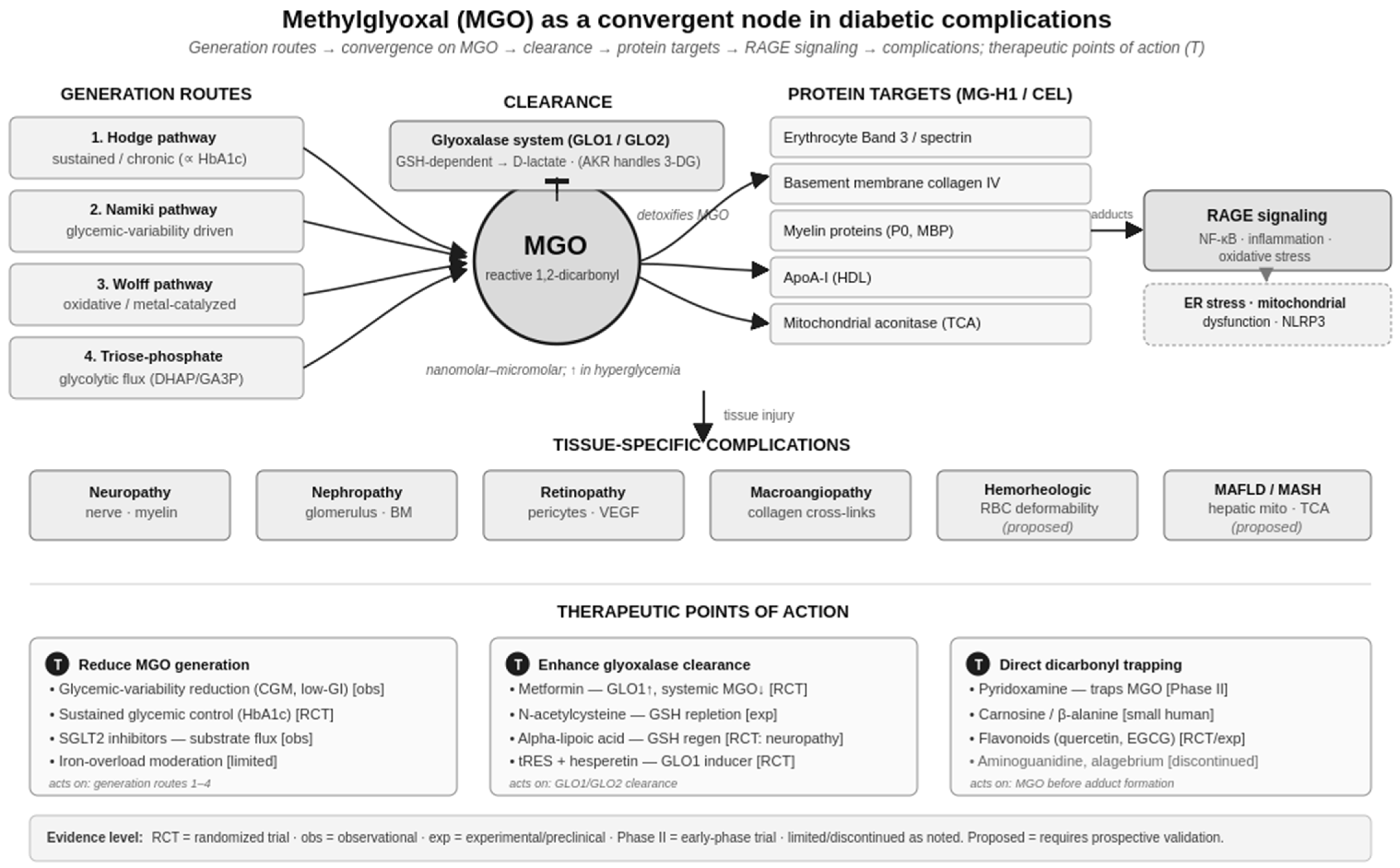
Methylglyoxal as a Convergent Mediator of Diabetic Complications: Generation, Protein Targets, Tissue Distribution, and Therapeutic Reduction—A Clinically Oriented Mechanistic Synthesis

Abstract
1. Introduction
2. Methylglyoxal Generation: Four Convergent Input Routes
2.1. The Three AGE Synthesis Routes as MGO Sources
2.2. Glycolytic Triose Phosphate Degradation—The Metabolic Flux Source
2.3. Quantitative Considerations
3. Methylglyoxal Protein Modification Targets
3.1. Reaction Chemistry—Arginine and Lysine Preferences
3.2. Principal Protein Modification Targets Across Tissues
3.3. Downstream Cellular Consequences Beyond Direct Adduct Formation
4. Tissue Mgo Accumulation and Complication Distribution
- Tissue glucose accessibility. Cells expressing insulin-independent glucose transporters (GLUT1, GLUT3)—including the capillary endothelium, mesangial cells, retinal pericytes, and the peripheral nerve—accumulate intracellular glucose proportional to plasma glucose, providing a substrate for both AGE synthesis pathways and glycolytic triose phosphate flux.
- Long protein half-lives. Tissues with long-lived structural proteins—collagen IV in basement membranes (half-life measured in years), myelin proteins, and vascular elastin—accumulate AGE modifications over time, producing cumulative damage even at modest instantaneous MGO concentrations.
5. Methylglyoxal Clearance: The Glyoxalase System
5.1. GLO1/GLO2 Architecture
5.2. GLO1 Regulation and Clinical Correlates
5.3. GSH Dependence and Systemic Implications
6. Therapeutic Reduction in Methylglyoxal Burden
6.1. Reducing MGO Generation
- Glycemic variability reduction. [Evidence: observational/mechanistic.] Interventions that reduce postprandial glycemic excursions—including time-in-range optimization with continuous glucose monitoring, low-glycemic-index dietary patterns, and GLP-1 receptor agonists with gastric-emptying effects—should reduce Namiki pathway substrate availability for MGO generation [36].
- Sustained glycemic control. [Evidence: RCT—landmark glycemic control trials.] A reduction in mean glucose exposure (reflected in HbA1c) reduces Amadori product accumulation and proportionally reduces Hodge pathway MGO generation, consistent with the long-term complication–reduction benefit demonstrated in landmark glycemic intervention trials [37,38].
- SGLT2 inhibitors. [Evidence: observational/mechanistic for the MGO attribution.] By promoting renal glucose excretion and reducing intrahepatic glucose flux, SGLT2 inhibitors reduce substrate availability across multiple MGO-generating routes. Hepatic GGT reduction observed with these agents is consistent with a reduction in glyoxalase system load, though the mechanistic attribution remains hypothesis-generating [39].
- Iron metabolism moderation. [Evidence: limited; indirect.] Avoiding excess heme iron intake, and treating iron overload where present, limits Wolff pathway Fenton chemistry and the associated oxidative dicarbonyl generation. The clinical evidence for iron moderation-specific outcomes in T2DM is limited [40].
6.2. Enhancing Glyoxalase-Mediated Clearance
- Metformin. [Evidence: human—reduces systemic MGO in T2DM; RCT-supported glucose lowering.] Beyond its primary glucose-lowering effect via AMPK activation, metformin has been demonstrated to upregulate GLO1 expression and to reduce systemic methylglyoxal levels in patients with T2DM, providing a pleiotropic anti-MGO mechanism additive to glucose lowering [41,42].
- N-acetylcysteine (NAC). [Evidence: experimental; limited human data for AGE endpoints.] NAC provides cysteine as a rate-limiting substrate for de novo GSH synthesis, replenishing the GLO1 cofactor pool. NAC has reduced plasma MGO in experimental models; clinical efficacy data for AGE-related endpoints in T2DM are limited [43].
- Alpha-lipoic acid. [Evidence: RCT for neuropathy symptoms; MGO biomarker effect in humans less documented.] It acts both as a direct antioxidant and as a GSH regenerator (reducing GSSG to GSH via thioredoxin reductase coupling). It has demonstrated symptomatic improvement in diabetic peripheral neuropathy in randomized trials; its effects on MGO biomarkers in humans are less directly documented [44].
6.3. Direct Dicarbonyl Trapping
- Pyridoxamine. [Evidence: Phase II—reduced urinary MG-H1; renal endpoints mixed.] This is a vitamin B6 analog that directly traps reactive 1,2-dicarbonyls including MGO and GO. Phase II clinical trials in early diabetic nephropathy demonstrated reductions in urinary MG-H1 and improvements in some renal function endpoints [45].
- Carnosine and β-alanine. [Evidence: small human studies; at the surrogate level.] Carnosine (β-alanyl-L-histidine) reacts with MGO at its imidazole group. β-alanine is the rate-limiting precursor for tissue carnosine synthesis and dietary carnosine is present in red meat and poultry. Modest reductions in plasma MGO have been reported in small human studies [46].
- Bioflavonoids (quercetin, hesperidin, EGCG). [Evidence: RCT/experimental; at the surrogate level.] Quercetin has reduced plasma methylglyoxal in randomized placebo-controlled trials in healthy adults; hesperidin and related flavonoids show similar in vitro and clinical trial activity. The mechanism involves both direct dicarbonyl trapping and polyphenol-mediated transition metal chelation [47,48,49,50,51].
6.4. A Note on AGE-Targeting Agents with Complex Translational Histories
- Aminoguanidine (pimagedine). [Evidence: discontinued—efficacy in animals; human development halted for toxicity.] This is a hydrazine compound that traps reactive dicarbonyls. It has demonstrated efficacy in animal models of diabetic nephropathy and retinopathy. Clinical development was discontinued following the ACTION-1 trial due to adverse effects including anti-glomerular basement membrane antibody formation and vasculitis. Aminoguanidine remains a research tool and is not in current clinical use [52].
- Alagebrium (ALT-711). [Evidence: discontinued—Phase II compliance signal; development ended.] This is an AGE cross-link breaker designed to cleave established collagen cross-links. Phase II trials demonstrated improvements in arterial compliance in older adults, but clinical development was discontinued for commercial reasons [53].
7. Clinical Monitoring Approaches—A Hypothesis-Generating Schema
7.1. Purpose and Explicit Caveats
- This schema is hypothesis-generating, not validated. The proposed mappings between routine biomarkers and MGO-specific biology have a mechanistic rationale developed below but have not been prospectively validated in clinical cohorts. They are presented as testable hypotheses, not as clinical scoring instruments.
- Each proposed mapping has alternative explanations. Elevated GGT and elevated RDW each have multiple potential interpretations beyond the MGO-related mechanisms proposed here. The schema should not be applied clinically without acknowledgement of these alternatives.
- Validation will require prospective biomarker studies. The validation work needed to convert these proposed mappings into clinically actionable markers is outlined in Section 9.

| Proposed Proxy | MGO-Related Component | Mechanistic Rationale | Caveats/Alternatives |
|---|---|---|---|
| Plasma MGO (LC-MS/MS) | Direct measurement of circulating MGO | Direct biomarker; integrates generation from all four routes | Not available in routine clinical care; requires specialized laboratory |
| Urinary MG-H1 (ELISA) | Integrated whole-body MG-H1 generation | Stable end product of MGO–arginine reaction; renal excretion correlates with systemic generation | Interlaboratory variability; not standardized; affected by renal function |
| Skin autofluorescence | Tissue-accumulated AGEs (pentosidine, CML, MG-H1) | Non-invasive measure of long-term tissue AGE burden | Integrates multiple AGE pathways, not MGO-specific; assay standardization developing |
| GGT (proposed proxy; not validated) | Putative marker of glyoxalase system load | GGT catalyzes extracellular GSH recycling; hepatic GSH turnover under MGO load mechanistically plausible | Multiple confounders (hepatic disease, alcohol, medications); not MGO-specific; mechanistic attribution requires validation |
| RDW (proposed proxy; not validated) | Putative marker of erythrocyte membrane MGO modification | Band 3/spectrin MG-H1 modification may alter erythrocyte deformability and volume distribution | Multiple confounders (nutritional deficiency, inflammation, ineffective erythropoiesis); not MGO-specific; mechanistic attribution requires validation |
| HbA1c | Integrated Hodge pathway activity | Amadori product on hemoglobin; reflects sustained glycemic exposure | Reflects only Hodge pathway component; does not capture Namiki/Wolff/triose phosphate contributions to MGO |
| CGM-derived variability indices | Proxy for Namiki pathway substrate availability | Postprandial excursions drive Schiff base turnover and retroaldol cleavage | Requires CGM availability; variability metrics not yet standardized for clinical decisions |
7.2. Proposed Clinical Proxies for MGO Biology
7.3. Distinction from a Validated Clinical Scoring Instrument
8. Comparison with Existing Diagnostic and Biomarker Strategies
8.1. Glycemic Monitoring (HbA1c, Fasting Glucose, CGM)
8.2. Direct AGE Measurements
8.3. GLO1 Activity Assays
8.4. Insulin Resistance Indices
9. Limitations and Prospective Validation
9.1. Mechanistic Claims Rest Predominantly on In Vitro and Animal Model Evidence
9.2. The Biomarker Mappings in Section 7 Require Prospective Validation
9.3. The Convergent Mediator Framing Is a Hypothesis-Generating Organizing Schema
9.4. Therapeutic Claims Are Limited by Absence of Direct Comparative Trials
9.5. Priorities for Prospective Validation
- MGO-specific biomarker cohorts: prospective longitudinal measurement of plasma MGO, urinary MG-H1, GGT, RDW, HbA1c, and CGM-derived variability in defined T2DM populations stratified by disease duration, with correlation to clinical complication endpoints.
- Pharmacodynamic studies: evaluation of biomarker responses (plasma MGO, urinary MG-H1, GGT, RDW) to interventions with established or hypothesized glyoxalase-targeting effects (metformin, NAC, pyridoxamine, β-alanine) to establish target engagement readouts.
- Comparative therapeutic trials: head-to-head evaluation of MGO-targeting versus individual pathway interventions, with hard clinical endpoints (eGFR, monofilament, retinopathy progression).
- Assay standardization: interlaboratory standardization of plasma MGO and urinary MG-H1 measurement to support multicenter validation studies.
10. Conclusions
Funding
Institutional Review Board Statement
Informed Consent Statement
Data Availability Statement
Acknowledgments
Conflicts of Interest
Abbreviations
References
- Brownlee, M. The pathobiology of diabetic complications: A unifying mechanism. Diabetes 2005, 54, 1615–1625. [Google Scholar] [CrossRef] [Scilit] [PubMed]
- Vlassara, H.; Uribarri, J. Advanced glycation end products (AGE) and diabetes: Cause, effect, or both? Curr. Diabetes Rep. 2014, 14, 453. [Google Scholar]
- Schalkwijk, C.G.; Stehouwer, C.D.A. Methylglyoxal, a highly reactive dicarbonyl compound, in diabetes, its vascular complications, and other age-related diseases. Physiol. Rev. 2020, 100, 407–461. [Google Scholar] [CrossRef] [Scilit] [PubMed]
- Fernandez, E.C. The three pathways of advanced glycation end product synthesis: Hodge, Namiki, and Wolff—A clinically oriented mechanistic synthesis with network-based implications. Front. Endocrinol. 2026, 17, 1856036. [Google Scholar] [CrossRef] [Scilit] [PubMed]
- Namiki, M.; Hayashi, T. A new mechanism of the Maillard reaction involving sugar fragmentation and free radical formation. ACS Symp. Ser. 1983, 215, 21–46. [Google Scholar] [CrossRef] [Scilit]
- Hayashi, T.; Namiki, M. Role of sugar fragmentation in the Maillard reaction. Dev. Food Sci. 1986, 13, 29–38. [Google Scholar]
- Monnier, L.; Mas, E.; Ginet, C.; Michel, F.; Villon, L.; Cristol, J.P.; Colette, C. Activation of oxidative stress by acute glucose fluctuations compared with sustained chronic hyperglycemia in patients with type 2 diabetes. JAMA 2006, 295, 1681–1687. [Google Scholar] [CrossRef] [Scilit] [PubMed]
- Hodge, J.E. Dehydrated foods: Chemistry of browning reactions in model systems. J. Agric. Food Chem. 1953, 1, 928–943. [Google Scholar] [CrossRef] [Scilit]
- Thornalley, P.J.; Langborg, A.; Minhas, H.S. Formation of glyoxal, methylglyoxal and 3-deoxyglucosone in the glycation of proteins by glucose. Biochem. J. 1999, 344, 109–116. [Google Scholar] [CrossRef] [PubMed]
- Goldstein, D.E.; Little, R.R.; Lorenz, R.A.; Malone, J.I.; Nathan, D.; Peterson, C.M.; Sacks, D.B. Tests of glycemia in diabetes. Diabetes Care 2004, 27, 1761–1773. [Google Scholar] [CrossRef] [Scilit] [PubMed]
- Wolff, S.P.; Dean, R.T. Glucose autoxidation and protein modification. The potential role of ‘autoxidative glycosylation’ in diabetes. Biochem. J. 1987, 245, 243–250. [Google Scholar] [CrossRef] [Scilit] [PubMed]
- Hunt, J.V.; Smith, C.C.T.; Wolff, S.P. Autoxidative glycosylation and possible involvement of peroxides and free radicals in LDL modification by glucose. Diabetes 1990, 39, 1420–1424. [Google Scholar] [CrossRef] [Scilit] [PubMed]
- Jiang, Z.Y.; Woollard, A.C.; Wolff, S.P. Hydrogen peroxide production during experimental protein glycation. FEBS Lett. 1990, 268, 69–71. [Google Scholar] [CrossRef] [Scilit] [PubMed]
- Fernández-Real, J.M.; Manco, M. Effects of iron overload on chronic metabolic diseases. Lancet Diabetes Endocrinol. 2014, 2, 513–526. [Google Scholar] [CrossRef] [Scilit] [PubMed]
- Phillips, S.A.; Thornalley, P.J. The formation of methylglyoxal from triose phosphates. Investigation using a specific assay for methylglyoxal. Eur. J. Biochem. 1993, 212, 101–105. [Google Scholar] [CrossRef] [Scilit] [PubMed]
- Allaman, I.; Bélanger, M.; Magistretti, P.J. Methylglyoxal, the dark side of glycolysis. Front. Neurosci. 2015, 9, 23. [Google Scholar] [CrossRef] [Scilit] [PubMed] [PubMed Central]
- Rabbani, N.; Xue, M.; Thornalley, P.J. Dicarbonyls and glyoxalase in disease mechanisms and clinical therapeutics. Glycoconj. J. 2016, 33, 513–525. [Google Scholar] [CrossRef] [Scilit] [PubMed]
- Vašková, J.; Kováčová, G.; Pudelský, J.; Palenčár, D.; Mičková, H. Methylglyoxal formation—Metabolic routes and consequences. Antioxidants 2025, 14, 212. [Google Scholar] [CrossRef] [Scilit] [PubMed]
- Rabbani, N.; Thornalley, P.J. Unraveling the impaired incretin effect in obesity and type 2 diabetes: Key role of hyperglycemia-induced unscheduled glycolysis and glycolytic overload. Diabetes Res. Clin. Pract. 2024, 217, 111905. [Google Scholar] [CrossRef] [Scilit] [PubMed]
- Rabbani, N.; Thornalley, P.J. Methylglyoxal, glyoxalase 1 and the dicarbonyl proteome. Amino Acids 2012, 42, 1133–1142. [Google Scholar] [PubMed]
- Ahmed, M.U.; Brinkmann Frye, E.; Degenhardt, T.P.; Thorpe, S.R.; Baynes, J.W. N-epsilon-(carboxyethyl)lysine, a product of the chemical modification of proteins by methylglyoxal, increases with age in human lens proteins. Biochem. J. 1997, 324, 565–570. [Google Scholar] [CrossRef] [Scilit] [PubMed]
- Rabbani, N.; Xue, M.; Thornalley, P.J. Dicarbonyl stress, protein glycation and the unfolded protein response. Glycoconj. J. 2021, 38, 331–340. [Google Scholar] [CrossRef] [Scilit] [PubMed]
- Xue, M.; Irshad, Z.; Rabbani, N.; Thornalley, P.J. Increased cellular protein modification by methylglyoxal activates endoplasmic reticulum-based sensors of the unfolded protein response. Redox Biol. 2024, 69, 103025. [Google Scholar] [CrossRef] [Scilit] [PubMed]
- Oliveira, A.L.; de Oliveira, M.G.; Mónica, F.Z.; Antunes, E. Methylglyoxal and advanced glycation end products (AGEs): Targets for the prevention and treatment of diabetes-associated bladder dysfunction? Biomedicines 2024, 12, 939. [Google Scholar] [CrossRef] [Scilit] [PubMed]
- Brings, S.; Fleming, T.; Fischler, M.; Nawroth, P.P.; Sacks, D.B. Dicarbonyls and advanced glycation end products in the development of diabetic complications and targets for intervention. Int. J. Mol. Sci. 2017, 18, 984. [Google Scholar] [CrossRef] [Scilit] [PubMed]
- Schalkwijk, C.G.; Micali, L.R.; Wouters, K. Advanced glycation endproducts in diabetes-related macrovascular complications: Focus on methylglyoxal. Trends Endocrinol. Metab. 2023, 34, 49–60. [Google Scholar] [CrossRef] [Scilit] [PubMed]
- Peculis, R.; Konrade, I.; Skapare, E.; Fridmanis, D.; Nikitina-Zake, L.; Lejnieks, A.; Pirags, V.; Dambrova, M.; Klovins, J. Identification of glyoxalase 1 polymorphisms associated with enzyme activity. Gene 2013, 515, 140–143. [Google Scholar] [CrossRef] [Scilit] [PubMed]
- Miranda, E.R.; Varshney, P.; Mazo, C.E.; Shadiow, J.; Ludlow, A.T.; Haus, J.M. Loss of NAMPT and SIRT2 but not SIRT1 attenuate GLO1 expression and activity in human skeletal muscle. Redox Biol. 2024, 75, 103300. [Google Scholar] [CrossRef] [Scilit] [PubMed]
- Thornalley, P.J. The glyoxalase system in health and disease. Mol. Asp. Med. 1993, 14, 287–371. [Google Scholar] [CrossRef] [Scilit] [PubMed]
- Vander Jagt, D.L.; Hunsaker, L.A. Methylglyoxal metabolism and diabetic complications: Roles of aldose reductase, glyoxalase-I, betaine aldehyde dehydrogenase and 2-oxoaldehyde dehydrogenase. Chem. Biol. Interact. 2003, 143-144, 341–351. [Google Scholar] [CrossRef] [Scilit] [PubMed]
- Rabbani, N.; Thornalley, P.J. Quantitation of markers of protein damage by glycation, oxidation, and nitration in peritoneal dialysis. Perit. Dial. Int. 2009, 29, S51–S56. [Google Scholar] [CrossRef] [Scilit] [PubMed]
- Xue, M.; Rabbani, N.; Momiji, H.; Imbasi, P.; Anwar, M.M.; Kitteringham, N.; Park, B.K.; Souma, T.; Moriguchi, T.; Yamamoto, M.; et al. Transcriptional control of glyoxalase 1 by Nrf2 provides a stress-responsive defence against dicarbonyl glycation. Biochem. J. 2012, 443, 213–222. [Google Scholar] [CrossRef] [Scilit] [PubMed]
- Hanigan, M.H. Gamma-glutamyl transpeptidase: Redox regulation and drug resistance. Adv. Cancer Res. 2014, 122, 103–141. [Google Scholar] [PubMed]
- Azarova, I.; Klyosova, E.; Polonikov, A. The link between type 2 diabetes mellitus and the polymorphisms of glutathione-metabolizing genes suggests a new hypothesis explaining disease initiation and progression. Life 2021, 11, 886. [Google Scholar] [CrossRef] [Scilit] [PubMed]
- Gong, S.; Gan, S.; Zhang, Y.; Zhou, H.; Zhou, Q. Gamma-glutamyl transferase to high-density lipoprotein cholesterol ratio is a more powerful marker than the TyG index for predicting metabolic syndrome in patients with type 2 diabetes mellitus. Front. Endocrinol. 2023, 14, 1248614. [Google Scholar] [CrossRef] [Scilit] [PubMed]
- Ceriello, A.; Hanefeld, M.; Leiter, L.; Monnier, L.; Moses, A.; Owens, D.; Tajima, N.; Tuomilehto, J. Postprandial glucose regulation and diabetic complications. Arch. Intern. Med. 2004, 164, 2090–2095. [Google Scholar] [CrossRef] [Scilit] [PubMed]
- DCCT Research Group. The effect of intensive treatment of diabetes on the development and progression of long-term complications in insulin-dependent diabetes mellitus. N. Engl. J. Med. 1993, 329, 977–986. [Google Scholar] [CrossRef] [Scilit] [PubMed]
- UK Prospective Diabetes Study (UKPDS) Group. Intensive blood-glucose control with sulphonylureas or insulin compared with conventional treatment and risk of complications in patients with type 2 diabetes (UKPDS 33). Lancet 1998, 352, 837–853. [Google Scholar] [CrossRef] [Scilit] [PubMed]
- Solini, A.; Giannini, L.; Seghieri, M.; Vitolo, E.; Taddei, S.; Ghiadoni, L.; Bruno, R.M. Dapagliflozin acutely improves endothelial dysfunction, reduces aortic stiffness and renal resistive index in type 2 diabetic patients: A pilot study. Cardiovasc. Diabetol. 2017, 16, 138. [Google Scholar] [CrossRef] [Scilit] [PubMed]
- Simcox, J.A.; McClain, D.A. Iron and diabetes risk. Cell Metab. 2013, 17, 329–341. [Google Scholar] [CrossRef] [Scilit] [PubMed] [PubMed Central]
- Beisswenger, P.J.; Howell, S.K.; Touchette, A.D.; Lal, S.; Szwergold, B.S. Metformin reduces systemic methylglyoxal levels in type 2 diabetes. Diabetes 1999, 48, 198–202. [Google Scholar] [CrossRef] [Scilit] [PubMed]
- Kender, Z.; Fleming, T.; Kopf, S.; Torzsa, P.; Grolmusz, V.; Herzig, S.; Schleicher, E.; Rácz, K.; Reismann, P.; Nawroth, P.P. Effect of metformin on methylglyoxal metabolism in patients with type 2 diabetes. Exp. Clin. Endocrinol. Diabetes 2014, 122, 316–319. [Google Scholar] [CrossRef] [Scilit] [PubMed]
- Atkuri, K.R.; Mantovani, J.J.; Herzenberg, L.A.; Herzenberg, L.A. N-Acetylcysteine—A safe antidote for cysteine/glutathione deficiency. Curr. Opin. Pharmacol. 2007, 7, 355–359. [Google Scholar] [CrossRef] [Scilit] [PubMed] [PubMed Central]
- Ziegler, D.; Low, P.A.; Litchy, W.J.; Boulton, A.J.; Vinik, A.I.; Freeman, R.; Samigullin, R.; Tritschler, H.; Munzel, U.; Maus, J.; et al. Efficacy and safety of antioxidant treatment with α-lipoic acid over 4 years in diabetic polyneuropathy: The NATHAN 1 trial. Diabetes Care 2011, 34, 2054–2060. [Google Scholar] [CrossRef] [Scilit] [PubMed] [PubMed Central]
- Williams, M.E.; Bolton, W.K.; Khalifah, R.G.; Degenhardt, T.P.; Schotzinger, R.J.; McGill, J.B. Effects of pyridoxamine in combined Phase 2 studies of patients with type 1 and type 2 diabetes and overt nephropathy. Am. J. Nephrol. 2007, 27, 605–614. [Google Scholar] [CrossRef] [Scilit] [PubMed]
- Aldini, G.; Orioli, M.; Rossoni, G.; Ferrali, M.; Carini, M. The carbonyl scavenger carnosine ameliorates dyslipidaemia and renal function in Zucker obese rats. J. Cell. Mol. Med. 2011, 15, 1339–1354. [Google Scholar] [CrossRef] [Scilit] [PubMed]
- Van den Eynde, M.D.G.; Geleijnse, J.M.; Scheijen, J.L.J.M.; Hanssen, N.M.J.; Dower, J.I.; Afman, L.A.; Stehouwer, C.D.A.; Hollman, P.C.H.; Schalkwijk, C.G. Quercetin, but not epicatechin, decreases plasma concentrations of methylglyoxal in adults in a randomized, double-blind, placebo-controlled, crossover trial with pure flavonoids. J. Nutr. 2018, 148, 1911–1916. [Google Scholar] [CrossRef] [Scilit] [PubMed]
- Van den Eynde, M.D.G.; Houben, A.J.H.M.; Scheijen, J.L.J.M.; Linkens, A.M.A.; Niessen, P.M.; Simons, N.; Hanssen, N.M.J.; Kusters, Y.H.A.M.; Eussen, S.J.M.P.; Miyata, T.; et al. Pyridoxamine reduces methylglyoxal and markers of glycation and endothelial dysfunction, but does not improve insulin sensitivity or vascular function in abdominally obese individuals: A randomized double-blind placebo-controlled trial. Diabetes Obes. Metab. 2023, 25, 1280–1291. [Google Scholar] [CrossRef] [Scilit] [PubMed]
- Xue, M.; Rabbani, N.; Thornalley, P.J. Glyoxalase 1 inducer, trans-resveratrol and hesperetin—Dietary supplement with multi-modal health benefits. Antioxidants 2025, 14, 956. [Google Scholar] [CrossRef] [Scilit] [PubMed]
- Rabbani, N.; Thornalley, P.J. Emerging glycation-based therapeutics—Glyoxalase 1 inducers and glyoxalase 1 inhibitors. Int. J. Mol. Sci. 2022, 23, 2453. [Google Scholar] [CrossRef] [Scilit] [PubMed]
- Rabbani, N.; Xue, M.; Weickert, M.O.; Thornalley, P.J. Reversal of insulin resistance in overweight and obese subjects by trans-resveratrol and hesperetin combination—Link to dysglycemia, blood pressure, dyslipidemia, and low-grade inflammation. Nutrients 2021, 13, 2374. [Google Scholar] [CrossRef] [Scilit] [PubMed]
- Bolton, W.K.; Cattran, D.C.; Williams, M.E.; Adler, S.G.; Appel, G.B.; Cartwright, K.; Foiles, P.G.; Freedman, B.I.; Raskin, P.; Ratner, R.E.; et al. Randomized trial of an inhibitor of formation of advanced glycation end products in diabetic nephropathy. Am. J. Nephrol. 2004, 24, 32–40. [Google Scholar] [CrossRef] [Scilit] [PubMed]
- Kass, D.A.; Shapiro, E.P.; Kawaguchi, M.; Capriotti, A.R.; Scuteri, A.; deGroof, R.C.; Lakatta, E.G. Improved arterial compliance by a novel advanced glycation end-product crosslink breaker. Circulation 2001, 104, 1464–1470. [Google Scholar] [CrossRef] [Scilit] [PubMed]
- Tsilingiris, D.; Makrilakis, K.; Barmpagianni, A.; Dalamaga, M.; Tentolouris, A.; Kosta, O.; Eleftheriadou, I.; Liatis, S. The glycemic status determines the direction of the relationship between red cell distribution width and HbA1c. J. Diabetes Complicat. 2021, 35, 108012. [Google Scholar] [CrossRef] [Scilit] [PubMed]
- Koenig, G.; Seneff, S. Gamma-glutamyltransferase: A predictive biomarker of cellular antioxidant inadequacy and disease risk. Dis. Markers 2015, 2015, 818570. [Google Scholar] [CrossRef] [Scilit] [PubMed] [PubMed Central]
- Bao, X.; Wan, M.; Gu, Y.; Zhang, Q.; Meng, G.; Liu, L.; Wu, H.; Xia, Y.; Shi, H.; Wang, X.; et al. Red cell distribution width is associated with hemoglobin A1C elevation, but not glucose elevation. J. Diabetes Complicat. 2017, 31, 1544–1548. [Google Scholar] [CrossRef] [Scilit] [PubMed]
- Dev, A.; Nanda Kumar, R.; Arun, K.; Sivan, G.; Lenin, R.R.; Kumar, J.S. Correlation of mean platelet volume and red cell distribution width with HbA1c and its association with microvascular complications in type 2 diabetes mellitus: A cross-sectional study at a tertiary hospital in India. Cureus 2024, 16, e66139. [Google Scholar] [CrossRef] [Scilit] [PubMed]
- Liu, J.; Wang, X.; Gao, T.Y.; Zhang, Q.; Zhang, S.N.; Xu, Y.Y.; Yao, W.Q.; Yang, Z.H.; Yan, H.J. Red blood cell distribution width to albumin ratio associates with prevalence and long-term diabetes mellitus prognosis: An overview of NHANES 1999-2020 data. Front. Endocrinol. 2024, 15, 1362077. [Google Scholar] [CrossRef] [Scilit] [PubMed]
- Rehill, G.; Panchonia, A.P.; Manzoor, M.W. Red cell distribution width as a surrogate biomarker for diabetic nephropathy, retinopathy, and vascular dysfunction. Eur. J. Cardiovasc. Med. 2025, 15, 163–172. [Google Scholar]
- Miyataka, K.; Kaneko, Y.; Hori, T.; Yamaguchi, Y.; Tsuji, S.; Hara, T.; Yamagami, H.; Yoshida, S.; Otoda, T.; Yuasa, T.; et al. Red blood cell distribution width is associated with renal tubular injury in individuals with type 2 diabetes. J. Diabetes Investig. 2025, 16, 2191–2200. [Google Scholar] [CrossRef] [Scilit] [PubMed]
- Allahyani, M. Association of the red cell distribution width with the glycemic index and lipid profile in patients with type 2 diabetes mellitus. Cureus 2023, 15, e42800. [Google Scholar] [CrossRef] [Scilit] [PubMed]
- Ma, L.; Yan, C.; Lu, S.; Xing, Y. Association between red cell distribution width and its ratio with albumin and diabetic nephropathy/retinopathy: A systematic review and meta-analysis. Pak. J. Med. Sci. 2025, 41, 2979–2989. [Google Scholar] [CrossRef] [Scilit] [PubMed]
- Meerwaldt, R.; Graaff, R.; Oomen, P.H.N.; Links, T.P.; Jager, J.J.; Alderson, N.L.; Thorpe, S.R.; Baynes, J.W.; Gans, R.O.B.; Smit, A.J. Simple non-invasive assessment of advanced glycation endproduct accumulation. Diabetologia 2004, 47, 1324–1330. [Google Scholar] [CrossRef] [Scilit] [PubMed]
- Matthews, D.R.; Hosker, J.P.; Rudenski, A.S.; Naylor, B.A.; Treacher, D.F.; Turner, R.C. Homeostasis model assessment: Insulin resistance and beta-cell function from fasting plasma glucose and insulin concentrations in man. Diabetologia 1985, 28, 412–419. [Google Scholar] [CrossRef] [Scilit] [PubMed]
- Matsuda, M.; DeFronzo, R.A. Insulin sensitivity indices obtained from oral glucose tolerance testing: Comparison with the euglycemic insulin clamp. Diabetes Care 1999, 22, 1462–1470. [Google Scholar] [CrossRef] [Scilit] [PubMed]

| Protein Target | Tissue Compartment | Modification Type | Documented Functional Consequence |
|---|---|---|---|
| Band 3/spectrin | Erythrocyte membrane | MG-H1 on multiple Arg residues | Altered cell deformability; impaired capillary transit |
| ApoA-I (HDL) | Plasma/vascular wall | MG-H1 on Arg173, Arg149 | Reduced ABCA1-mediated cholesterol efflux; impaired HDL function |
| Collagen IV/laminin | Glomerular and vascular basement membrane | MG-H1 + MOLD cross-links | Basement membrane thickening; altered charge selectivity |
| Myelin proteins (P0, MBP) | Peripheral nerve | MG-H1 on multiple Arg residues | Myelin structural disruption; slowed conduction velocity |
| Mitochondrial aconitase | All tissues with active TCA | MG-H1 at Arg active site | Reduced enzymatic activity; citrate accumulation |
| VEGF receptor (extracellular domain) | Retinal endothelium/pericytes | MG-H1 modification of extracellular Arg sites | Modified VEGF signaling response |
| Complication | Tissue Compartment | Proposed Primary MGO Mechanism | Established Clinical Readout | Proposed Accessible Biomarker |
|---|---|---|---|---|
| Peripheral neuropathy | Peripheral nerve | MG-H1 disruption of myelin proteins and tubulin | Monofilament exam | Plasma MGO; urinary MG-H1 |
| Nephropathy | Glomerulus | Basement membrane MG-H1 cross-links; podocyte MGO accumulation | ACR; eGFR | Urinary MG-H1 |
| Retinopathy | Retinal endothelium/pericytes | Pericyte loss; modified VEGF signaling | Fundoscopy | Plasma MGO |
| Macroangiopathy | Vascular wall | MOLD cross-links in collagen/elastin; ApoA-I modification | Pulse wave velocity; TG/HDL | Skin autofluorescence |
| Hemorheological impairment (proposed) | Erythrocyte membrane | Band 3/spectrin MG-H1 modification (proposed mechanism) | Not routinely measured | RDW (proposed marker; requires validation) |
| MAFLD/MASH progression (proposed) | Hepatocyte mitochondria | Aconitase MG-H1; TCA cycle impairment (proposed mechanism) | ALT; ultrasound; FIB-4 | GGT (proposed marker; requires validation) |
Disclaimer/Publisher’s Note: The statements, opinions and data contained in all publications are solely those of the individual author(s) and contributor(s) and not of MDPI and/or the editor(s). MDPI and/or the editor(s) disclaim responsibility for any injury to people or property resulting from any ideas, methods, instructions or products referred to in the content. |
© 2026 by the author. Licensee MDPI, Basel, Switzerland. This article is an open access article distributed under the terms and conditions of the Creative Commons Attribution (CC BY) license.
Share and Cite
Fernandez, E.C. Methylglyoxal as a Convergent Mediator of Diabetic Complications: Generation, Protein Targets, Tissue Distribution, and Therapeutic Reduction—A Clinically Oriented Mechanistic Synthesis. Biomolecules 2026, 16, 1104. https://doi.org/10.3390/biom16081104
Fernandez EC. Methylglyoxal as a Convergent Mediator of Diabetic Complications: Generation, Protein Targets, Tissue Distribution, and Therapeutic Reduction—A Clinically Oriented Mechanistic Synthesis. Biomolecules. 2026; 16(8):1104. https://doi.org/10.3390/biom16081104
Chicago/Turabian StyleFernandez, Enrique C. 2026. "Methylglyoxal as a Convergent Mediator of Diabetic Complications: Generation, Protein Targets, Tissue Distribution, and Therapeutic Reduction—A Clinically Oriented Mechanistic Synthesis" Biomolecules 16, no. 8: 1104. https://doi.org/10.3390/biom16081104
APA StyleFernandez, E. C. (2026). Methylglyoxal as a Convergent Mediator of Diabetic Complications: Generation, Protein Targets, Tissue Distribution, and Therapeutic Reduction—A Clinically Oriented Mechanistic Synthesis. Biomolecules, 16(8), 1104. https://doi.org/10.3390/biom16081104