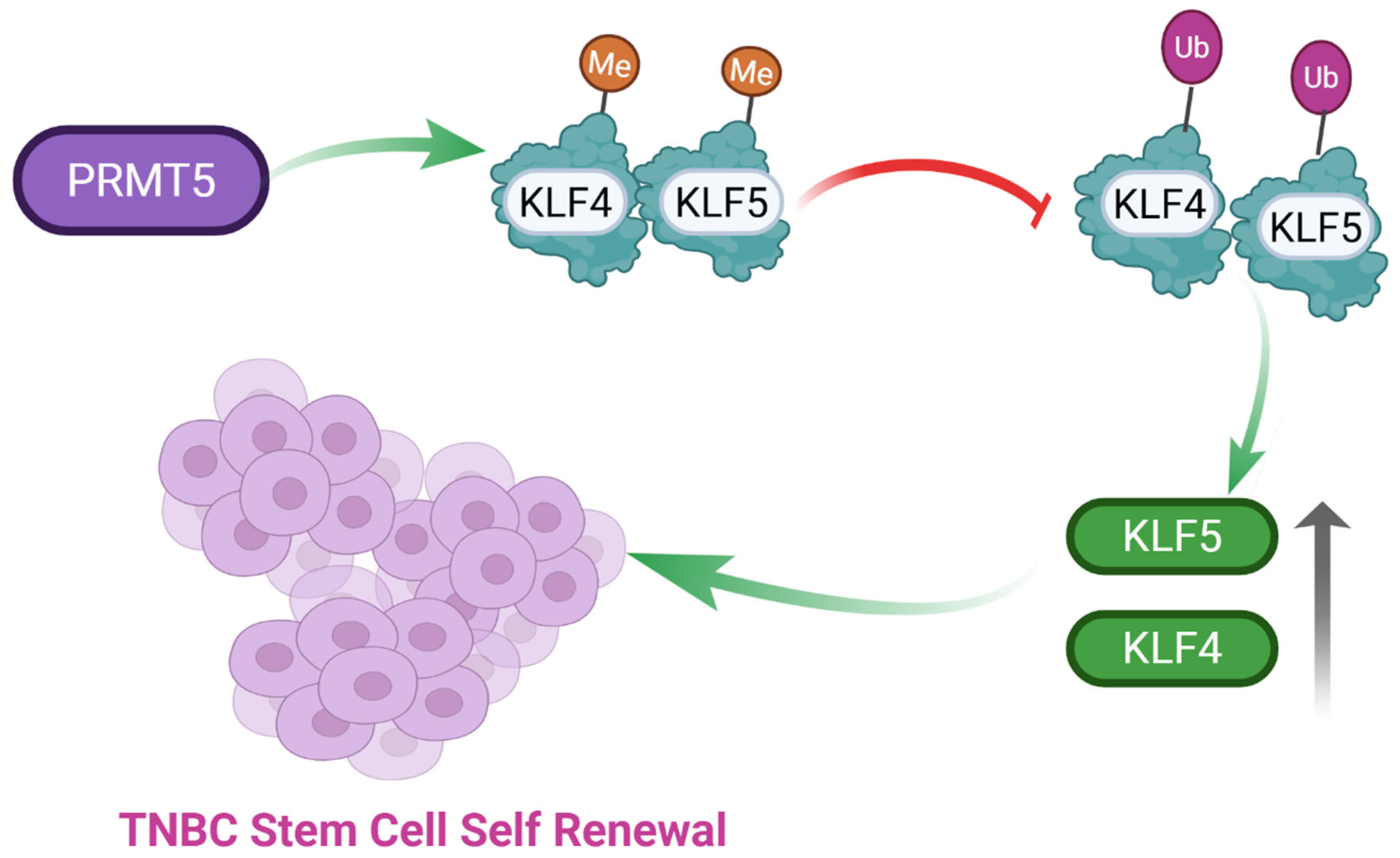
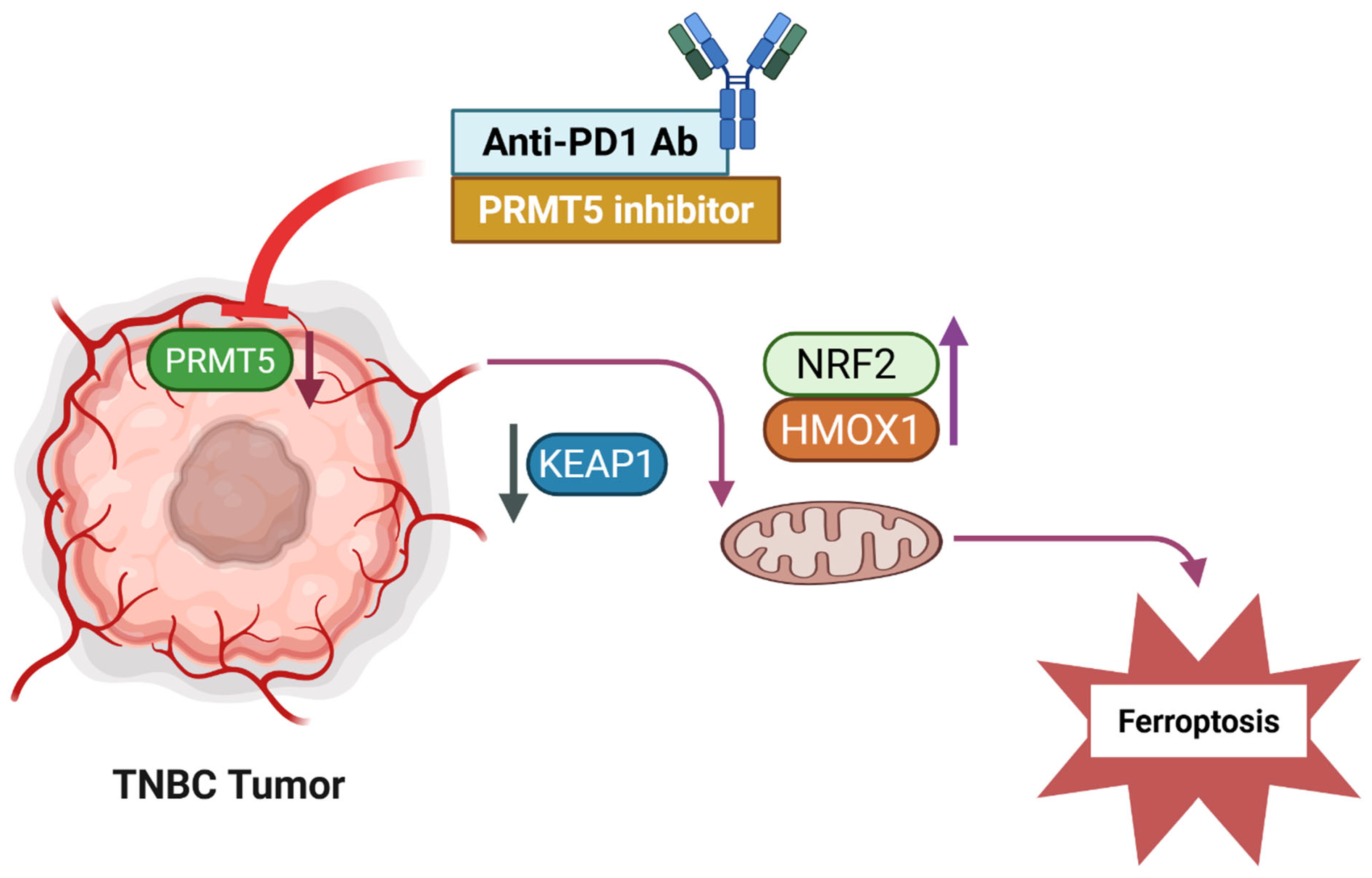
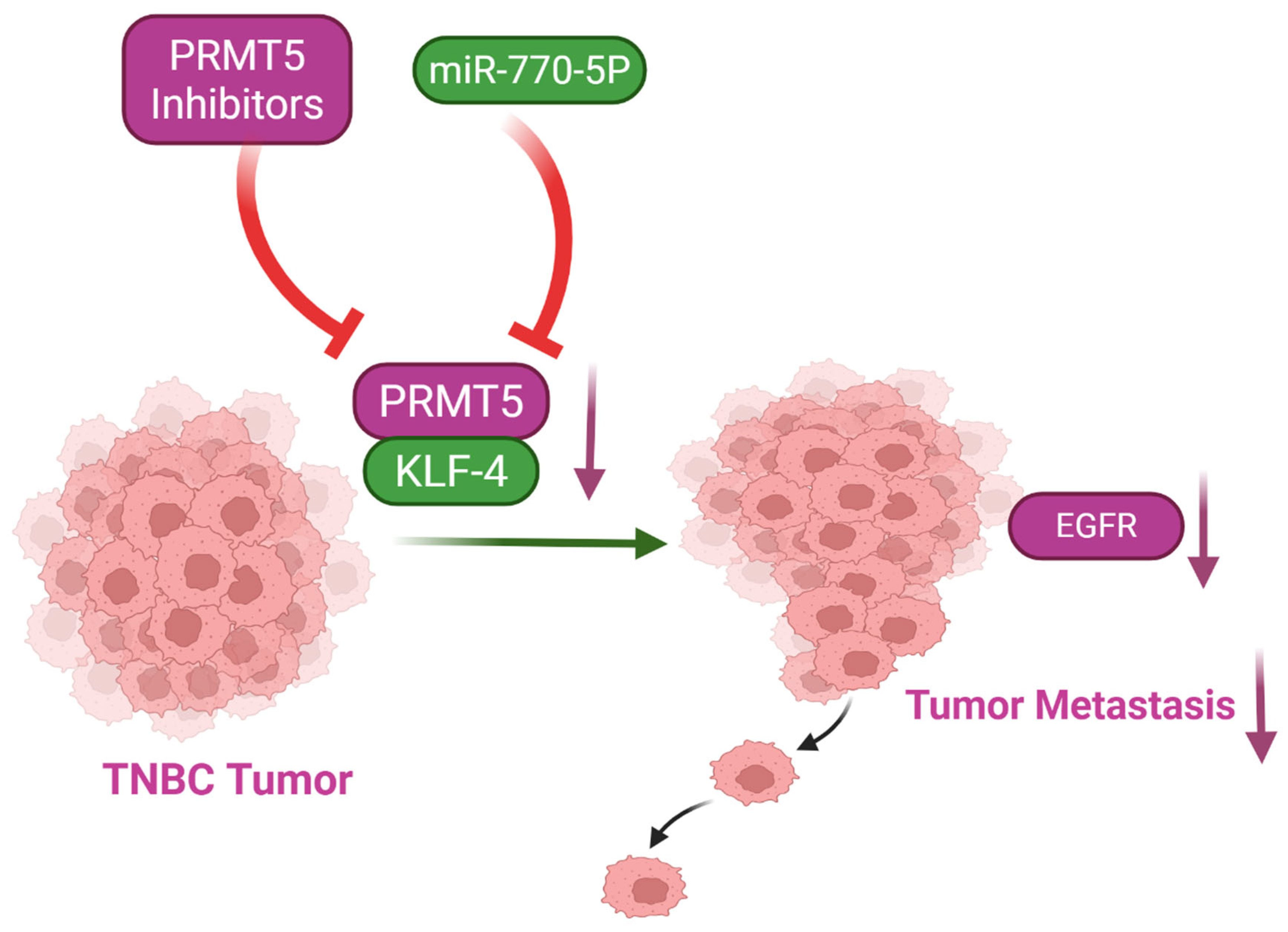
PRMT5 as a Key Driver of Stemness and Metastatic Potential in Triple-Negative Breast Cancer



Abstract
1. Introduction
2. Protein Arginine Methyltransferase (PRMT)
2.1. PRMT5
2.2. Expression of PRMT5 in Diverse Cancers
3. PRMT5 Expression in Breast Cancer
3.1. PRMT5 Involvement in Breast Cancer Chemoresistance
3.2. PRMT5 and Triple-Negative Breast Cancer (TNBC)
3.3. PRMT5 Enhances Stemness and Tumor Growth in TNBC
3.4. PRMT5 Inhibitors Induces Apoptosis in TNBC
4. Combination of PRMT5 Inhibitors and Anti-Cancer Agents Against TNBC
4.1. Effect of PRMT5 Inhibitors for Diverse Cancers
4.2. PRMT5 Inhibitors in Clinical Trial
5. Future Perspectives
6. Conclusions
Author Contributions
Funding
Institutional Review Board Statement
Informed Consent Statement
Data Availability Statement
Conflicts of Interest
References
- Millán-Zambrano, G.; Burton, A.; Bannister, A.J.; Schneider, R. Histone post-translational modifications—Cause and consequence of genome function. Nat. Rev. Genet. 2022, 23, 563–580. [Google Scholar] [CrossRef] [PubMed]
- Lennartsson, A.; Ekwall, K. Histone modification patterns and epigenetic codes. Biochim. Biophys. Acta 2009, 1790, 863–868. [Google Scholar] [CrossRef] [PubMed]
- Fischle, W.; Wang, Y.; Allis, C.D. Histone and chromatin cross-talk. Curr. Opin. Cell Biol. 2003, 15, 172–183. [Google Scholar] [CrossRef] [PubMed]
- Bannister, A.J.; Kouzarides, T. Regulation of chromatin by histone modifications. Cell Res. 2011, 21, 381–395. [Google Scholar] [CrossRef] [PubMed]
- Klose, R.J.; Zhang, Y. Regulation of histone methylation by demethylimination and demethylation. Nat. Rev. Mol. Cell Biol. 2007, 8, 307–318. [Google Scholar] [CrossRef] [PubMed]
- Wolf, S.S. The protein arginine methyltransferase family: An update about function, new perspectives and the physiological role in humans. Cell. Mol. Life Sci. 2009, 66, 2109–2121. [Google Scholar] [CrossRef] [PubMed]
- Tewary, S.K.; Zheng, Y.G.; Ho, M.C. Protein arginine methyltransferases: Insights into the enzyme structure and mechanism at the atomic level. Cell. Mol. Life Sci. 2019, 76, 2917–2932. [Google Scholar] [CrossRef] [PubMed]
- Lee, J.; Kim, J.; Hwang, I. Targeting PRMT5 in cancer: Mechanistic insights and clinical progress. Biomed. Pharmacother. 2025, 193, 118754. [Google Scholar] [CrossRef] [PubMed]
- Hussain, T.; Awasthi, S.; Shahid, F.; Yi, S.S.; Sahni, N.; Aldaz, C.M. Therapeutic potential of PRMT1 as a critical survival dependency target in multiple myeloma. BMC Cancer 2025, 25, 1704. [Google Scholar] [CrossRef] [PubMed]
- Motolani, A.; Martin, M.; Sun, M.; Lu, T. The Structure and Functions of PRMT5 in Human Diseases. Life 2021, 11, 1074. [Google Scholar] [CrossRef] [PubMed]
- Xu, Y.; Wu, Q.; Zhang, Y.; Gu, Y.; Zhu, H.; Fu, X.; Li, A.; Li, Y. Arginine methylation in cancer: Mechanisms and therapeutic implications. Biomark. Res. 2025, 13, 143. [Google Scholar] [CrossRef]
- Carter, J.; Hulse, M.; Sivakumar, M.; Burtell, J.; Thodima, V.; Wang, M.; Agarwal, A.; Vykuntam, K.; Spruance, J.; Bhagwat, N.; et al. PRMT5 Inhibitors Regulate DNA Damage Repair Pathways in Cancer Cells and Improve Response to PARP Inhibition and Chemotherapies. Cancer Res. Commun. 2023, 3, 2233–2243. [Google Scholar] [CrossRef] [PubMed]
- Stopa, N.; Krebs, J.E.; Shechter, D. The PRMT5 arginine methyltransferase: Many roles in development, cancer and beyond. Cell. Mol. Life Sci. 2015, 72, 2041–2059. [Google Scholar] [CrossRef] [PubMed]
- Chen, H.; Lorton, B.; Gupta, V.; Shechter, D. A TGFβ-PRMT5-MEP50 axis regulates cancer cell invasion through histone H3 and H4 arginine methylation coupled transcriptional activation and repression. Oncogene 2017, 36, 373–386. [Google Scholar] [CrossRef] [PubMed]
- Liang, Z.; Wen, C.; Jiang, H.; Ma, S.; Liu, X. Protein Arginine Methyltransferase 5 Functions via Interacting Proteins. Front. Cell Dev. Biol. 2021, 9, 725301. [Google Scholar] [CrossRef] [PubMed]
- Chiang, K.; Davies, C.C. Linking PRMT5 to breast cancer stem cells: New therapeutic opportunities? Mol. Cell. Oncol. 2018, 5, e1441628. [Google Scholar] [CrossRef] [PubMed]
- Tee, W.W.; Pardo, M.; Theunissen, T.W.; Yu, L.; Choudhary, J.S.; Hajkova, P.; Surani, M.A. Prmt5 is essential for early mouse development and acts in the cytoplasm to maintain ES cell pluripotency. Genes Dev. 2010, 24, 2772–2777. [Google Scholar] [CrossRef] [PubMed]
- DeSisto, J.; Balakrishnan, I.; Knox, A.J.; Link, G.; Venkataraman, S.; Vibhakar, R.; Green, A.L. PRMT5 Maintains Tumor Stem Cells to Promote Pediatric High-Grade Glioma Tumorigenesis. Mol. Cancer Res. 2025, 23, 107–118. [Google Scholar] [CrossRef] [PubMed]
- Greenblatt, S.M.; Liu, F.; Nimer, S.D. Arginine methyltransferases in normal and malignant hematopoiesis. Exp. Hematol. 2016, 44, 435–441. [Google Scholar] [CrossRef] [PubMed]
- Liang, Z.; Liu, L.; Wen, C.; Jiang, H.; Ye, T.; Ma, S.; Liu, X. Clinicopathological and Prognostic Significance of PRMT5 in Cancers: A System Review and Meta-Analysis. Cancer Control. 2021, 28, 10732748211050583. [Google Scholar] [CrossRef] [PubMed]
- Zhang, Y.; Xu, M.; Yuan, J.; Hu, Z.; Jiang, J.; Sun, Y.; Huang, J.; Wang, Y.; Wang, B.; Shen, J.; et al. Repression of PRMT activities sensitize human homologous recombination-proficient ovarian and breast cancer cells to PARP inhibitor treatment. eLife 2026, 13, RP99225. [Google Scholar] [CrossRef] [PubMed]
- Song, P.; Yang, F. Protein arginine methyltransferase 5 as a novel therapeutic target in solid tumors. Genes Dis. 2025, 13, 101796. [Google Scholar] [CrossRef] [PubMed]
- Gu, Z.; Gao, S.; Zhang, F.; Wang, Z.; Ma, W.; Davis, R.E.; Wang, Z. Protein arginine methyltransferase 5 is essential for growth of lung cancer cells. Biochem. J. 2012, 446, 235–241. [Google Scholar] [CrossRef] [PubMed]
- Shilo, K.; Wu, X.; Sharma, S.; Welliver, M.; Duan, W.; Villalona-Calero, M.; Fukuoka, J.; Sif, S.; Baiocchi, R.; Hitchcock, C.L.; et al. Cellular localization of protein arginine methyltransferase-5 correlates with grade of lung tumors. Diagn. Pathol. 2013, 8, 201. [Google Scholar] [CrossRef] [PubMed]
- Abe, Y.; Sano, T.; Otsuka, N.; Ogawa, M.; Tanaka, N. PRMT5-mediated methylation of STAT3 is required for lung cancer stem cell maintenance and tumour growth. Commun. Biol. 2024, 7, 593. [Google Scholar] [CrossRef] [PubMed]
- Zheng, Y.; Ji, H.; Yi, W.; Chen, Z.; Hu, X.; Zhou, J.; Wang, Y.; Zheng, X. PRMT5 facilitates angiogenesis and EMT via HIF-1α/VEGFR/Akt signaling axis in lung cancer. Aging 2023, 15, 6163–6178. [Google Scholar] [CrossRef] [PubMed]
- Jeon, J.; Lee, J.S.; Park, E.; Shen, Y.N.; Kim, M.; Shin, H.; Joo, H.; Cho, E.; Moon, S.M.; Shin, U.S.; et al. Protein arginine methyltransferase 5 is implicated in the aggressiveness of human hepatocellular carcinoma and controls the invasive activity of cancer cells. Oncol. Rep. 2018, 40, 536–544. [Google Scholar] [CrossRef] [PubMed]
- Li, X.; Wang, X.; Zhao, J.; Wang, J.; Wu, J. PRMT5 promotes colorectal cancer growth by interaction with MCM7. J. Cell. Mol. Med. 2021, 25, 3537–3547. [Google Scholar] [CrossRef] [PubMed]
- Yan, F.; Alinari, L.; Lustberg, M.E.; Martin, L.K.; Cordero-Nieves, H.M.; Banasavadi-Siddegowda, Y.; Virk, S.; Barnholtz-Sloan, J.; Bell, E.H.; Wojton, J.; et al. Genetic validation of the protein arginine methyltransferase PRMT5 as a candidate therapeutic target in glioblastoma. Cancer Res. 2014, 74, 1752–1765. [Google Scholar] [CrossRef] [PubMed]
- Han, X.; Li, R.; Zhang, W.; Yang, X.; Wheeler, C.G.; Friedman, G.K.; Province, P.; Ding, Q.; You, Z.; Fathallah-Shaykh, H.; et al. Expression of PRMT5 correlates with malignant grade in gliomas and plays a pivotal role in tumor growth in vitro. J. Neurooncol. 2014, 118, 61–72. [Google Scholar] [CrossRef] [PubMed]
- Banasavadi-Siddegowda, Y.K.; Russell, L.; Frair, E.; Karkhanis, V.A.; Relation, T.; Yoo, J.Y.; Zhang, J.; Sif, S.; Imitola, J.; Baiocchi, R.; et al. PRMT5-PTEN molecular pathway regulates senescence and self-renewal of primary glioblastoma neurosphere cells. Oncogene 2017, 36, 263–274. [Google Scholar] [CrossRef] [PubMed]
- Banasavadi-Siddegowda, Y.K.; Welker, A.M.; An, M.; Yang, X.; Zhou, W.; Shi, G.; Imitola, J.; Li, C.; Hsu, S.; Wang, J.; et al. PRMT5 as a druggable target for glioblastoma therapy. Neuro Oncol. 2018, 20, 753–763. [Google Scholar] [CrossRef] [PubMed]
- Martinez, S.; Sentis, S.; Poulard, C.; Trédan, O.; Le Romancer, M. Role of PRMT1 and PRMT5 in Breast Cancer. Int. J. Mol. Sci. 2024, 25, 8854. [Google Scholar] [CrossRef] [PubMed]
- Wang, Z.; Kong, J.; Wu, Y.; Zhang, J.; Wang, T.; Li, N.; Fan, J.; Wang, H.; Zhang, J.; Ling, R. PRMT5 determines the sensitivity to chemotherapeutics by governing stemness in breast cancer. Breast Cancer Res. Treat. 2018, 168, 531–542. [Google Scholar] [CrossRef] [PubMed]
- Han, X.; Wei, L.; Wu, B. PRMT5 Promotes Aerobic Glycolysis and Invasion of Breast Cancer Cells by Regulating the LXRα/NF-κBp65 Pathway. Onco Targets Ther. 2020, 13, 3347–3357. [Google Scholar] [CrossRef] [PubMed]
- Shailesh, H.; Siveen, K.S.; Sif, S. Protein arginine methyltransferase 5 (PRMT5) activates WNT/β-catenin signalling in breast cancer cells via epigenetic silencing of DKK1 and DKK3. J. Cell. Mol. Med. 2021, 25, 1583–1600. [Google Scholar] [CrossRef] [PubMed]
- Wu, Y.; Wang, Z.; Zhang, J.; Ling, R. Elevated expression of protein arginine methyltransferase 5 predicts the poor prognosis of breast cancer. Tumour Biol. 2017, 39, 1010428317695917. [Google Scholar] [CrossRef] [PubMed]
- Davey, M.G.; Hynes, S.O.; Kerin, M.J.; Miller, N.; Lowery, A.J. Ki-67 as a Prognostic Biomarker in Invasive Breast Cancer. Cancers 2021, 13, 4455. [Google Scholar] [CrossRef] [PubMed]
- Yang, D.Q.; Freund, D.M.; Harris, B.R.E.; Wang, D.; Cleary, M.P.; Hegeman, A.D. Measuring relative utilization of aerobic glycolysis in breast cancer cells by positional isotopic discrimination. FEBS Lett. 2016, 590, 3179–3187. [Google Scholar] [CrossRef] [PubMed]
- Hu, D.; Gur, M.; Zhou, Z.; Gamper, A.; Hung, M.C.; Fujita, N.; Lan, L.; Bahar, I.; Wan, Y. Interplay between arginine methylation and ubiquitylation regulates KLF4-mediated genome stability and carcinogenesis. Nat. Commun. 2015, 6, 8419. [Google Scholar] [CrossRef] [PubMed]
- He, Z.; He, J.; Xie, K. KLF4 transcription factor in tumorigenesis. Cell Death Discov. 2023, 9, 118. [Google Scholar] [CrossRef] [PubMed]
- Zhang, J.; Fan, X.; Zhou, Y.; Chen, L.; Rao, H. The PRMT5-LSD1 axis confers Slug dual transcriptional activities and promotes breast cancer progression. J. Exp. Clin. Cancer Res. 2022, 41, 191. [Google Scholar] [CrossRef] [PubMed]
- Lin, C.C.; Chang, T.C.; Wang, Y.; Guo, L.; Gao, Y.; Bikorimana, E.; Lemoff, A.; Fang, Y.V.; Zhang, H.; Zhang, Y.; et al. PRMT5 is an actionable therapeutic target in CDK4/6 inhibitor-resistant ER+/RB-deficient breast cancer. Nat. Commun. 2024, 15, 2287. [Google Scholar] [CrossRef] [PubMed]
- Powers, M.A.; Fay, M.M.; Factor, R.E.; Welm, A.L.; Ullman, K.S. Protein arginine methyltransferase 5 accelerates tumor growth by arginine methylation of the tumor suppressor programmed cell death 4. Cancer Res. 2011, 71, 5579–5587. [Google Scholar] [CrossRef] [PubMed]
- Chiang, K.; Zielinska, A.E.; Shaaban, A.M.; Sanchez-Bailon, M.P.; Jarrold, J.; Clarke, T.L.; Zhang, J.; Francis, A.; Jones, L.J.; Smith, S.; et al. PRMT5 Is a Critical Regulator of Breast Cancer Stem Cell Function via Histone Methylation and FOXP1 Expression. Cell Rep. 2017, 21, 3498–3513. [Google Scholar] [CrossRef] [PubMed]
- Gillespie, M.S.; Chiang, K.; Regan-Mochrie, G.L.; Choi, S.Y.; Ward, C.M.; Sahay, D.; Garcia, P.; Arnold, R.; Davies, C.C. PRMT5-regulated splicing of DNA repair genes drives chemoresistance in breast cancer stem cells. Oncogene 2025, 44, 862–876. [Google Scholar] [CrossRef]
- Vinet, M.; Suresh, S.; Maire, V.; Monchecourt, C.; Némati, F.; Lesage, L.; Pierre, F.; Ye, M.; Lescure, A.; Brisson, A.; et al. Protein arginine methyltransferase 5, A novel therapeutic target for triple-negative breast cancers. Cancer Med. 2019, 8, 2414–2428. [Google Scholar] [CrossRef] [PubMed]
- Zhou, Z.; Feng, Z.; Hu, D.; Yang, P.; Gur, M.; Bahar, I.; Cristofanilli, M.; Gradishar, W.J.; Xie, X.Q.; Wan, Y. A novel small-molecule antagonizes PRMT5-mediated KLF4 methylation for targeted therapy. EBioMedicine 2019, 44, 98–111. [Google Scholar] [CrossRef] [PubMed]
- Kong, J.; Dong, Y.; Li, M.; Fan, J.; Wang, T. Protein arginine methyltransferase 5 confers the resistance of triple-negative breast cancer to nanoparticle albumin-bound paclitaxel by enhancing autophagy through the dimethylation of ULK1. Toxicol. Appl. Pharmacol. 2024, 493, 117145. [Google Scholar] [CrossRef] [PubMed]
- Poulard, C.; Jacquemetton, J.; Pham, T.H.; Le Romancer, M. Using proximity ligation assay to detect protein arginine methylation. Methods 2020, 175, 66–71. [Google Scholar] [CrossRef] [PubMed]
- Noureddine, L.M.; Ablain, J.; Surmieliova-Garnès, A.; Jacquemetton, J.; Pham, T.H.; Marangoni, E.; Schnitzler, A.; Bieche, I.; Badran, B.; Trédan, O.; et al. PRMT5 triggers glucocorticoid-induced cell migration in triple-negative breast cancer. Life Sci. Alliance. 2023, 6, e202302009. [Google Scholar] [CrossRef] [PubMed]
- Cheng, X.; Hu, Z.; Mao, H.; Li, Z.; Wang, Z.; Tang, Y.; Huang, S.; Huang, Y.; Yin, C.; Xing, H.; et al. Discovery of Oxime Ether Derivatives as Second-Generation PRMT5 Inhibitors for the Treatment of Triple Negative Breast Cancer. J. Med. Chem. 2026, 69, 2647–2665. [Google Scholar] [CrossRef] [PubMed]
- Wang, X.; Qiu, T.; Wu, Y.; Yang, C.; Li, Y.; Du, G.; He, Y.; Liu, W.; Liu, R.; Chen, C.H.; et al. Arginine methyltransferase PRMT5 methylates and stabilizes KLF5 via decreasing its phosphorylation and ubiquitination to promote basal-like breast cancer. Cell Death Differ. 2021, 28, 2931–2945. [Google Scholar] [CrossRef] [PubMed]
- Noyan, S.; Gur Dedeoglu, B.; Can, A.; Alikasifoglu, M. miR-770-5p: A novel molecular target regulating KLF4/EGFR signaling through PRMT5 interaction. Med. Oncol. 2025, 42, 545. [Google Scholar] [CrossRef]
- Roberts, M.S.; Anstine, L.J.; Finke, V.S.; Bryson, B.L.; Webb, B.M.; Weber-Bonk, K.L.; Seachrist, D.D.; Majmudar, P.R.; Keri, R.A. KLF4 defines the efficacy of the epidermal growth factor receptor inhibitor, erlotinib, in triple-negative breast cancer cells by repressing the EGFR gene. Breast Cancer Res. 2020, 22, 66. [Google Scholar] [CrossRef] [PubMed]
- Zhang, K.; Wei, J.; Zhang, S.; Fei, L.; Guo, L.; Liu, X.; Ji, Y.; Chen, W.; Ciamponi, F.E.; Chen, W.C.; et al. A chemical screen identifies PRMT5 as a therapeutic vulnerability for paclitaxel-resistant triple-negative breast cancer. Cell Chem. Biol. 2024, 31, 1942–1957.e6. [Google Scholar] [CrossRef] [PubMed]
- Wang, Z.; Li, R.; Hou, N.; Zhang, J.; Wang, T.; Fan, P.; Ji, C.; Zhang, B.; Liu, L.; Wang, Y.; et al. PRMT5 reduces immunotherapy efficacy in triple-negative breast cancer by methylating KEAP1 and inhibiting ferroptosis. J. Immunother. Cancer. 2023, 11, e006890. [Google Scholar] [CrossRef] [PubMed]
- Guo, Y.; Li, Y.; Zhou, Z.; Hou, L.; Liu, W.; Ren, W.; Mi, D.; Sun, J.; Dai, X.; Wu, Y.; et al. Targeting PRMT5 through PROTAC for the treatment of triple-negative breast cancer. J. Exp. Clin. Cancer Res. 2024, 43, 314. [Google Scholar] [CrossRef] [PubMed]
- Suresh, S.; McPherson, L.; Ford, J.M. PARP inhibitor and PRMT5 inhibitor synergy is independent of BRCA1/2 and MTAP status in breast cancer cells. Sci. Rep. 2025, 15, 36766. [Google Scholar] [CrossRef] [PubMed]
- Li, Y.; Dobrolecki, L.E.; Sallas, C.; Zhang, X.; Kerr, T.D.; Bisht, D.; Wang, Y.; Awasthi, S.; Kaundal, B.; Wu, S.; et al. PRMT blockade induces defective DNA replication stress response and synergizes with PARP inhibition. Cell Rep. Med. 2023, 4, 101326. [Google Scholar] [CrossRef] [PubMed]
- Zhang, Z.; Zhang, S.; Guo, L.; Pan, Y.; Huang, J.; Ji, Y.; Tao, J.; Wei, Y.; Wang, X.; Wu, Q. Interferon-Driven Biomarkers and Synergistic Therapy for PRMT5 Inhibition in Triple-Negative Breast Cancer. Adv. Sci. 2026, 13, e05787. [Google Scholar] [CrossRef] [PubMed]
- Oshi, M.; Gandhi, S.; Tokumaru, Y.; Yan, L.; Yamada, A.; Matsuyama, R.; Ishikawa, T.; Endo, I.; Takabe, K. Conflicting roles of EGFR expression by subtypes in breast cancer. Am. J. Cancer Res. 2021, 11, 5094–5110. [Google Scholar] [PubMed]
- Dakroub, R.; Huard, S.; Hajj-Younes, Y.; Suresh, S.; Badran, B.; Fayyad-Kazan, H.; Dubois, T. Therapeutic Advantage of Targeting PRMT5 in Combination with Chemotherapies or EGFR/HER2 Inhibitors in Triple-Negative Breast Cancers. Breast Cancer 2023, 15, 785–799. [Google Scholar] [CrossRef] [PubMed]
- Klinger, J.R. Tadalafil for the treatment of pulmonary arterial hypertension. Expert Rev. Respir. Med. 2011, 5, 315–328. [Google Scholar] [CrossRef] [PubMed]
- Wu, Y.; Wang, Z.; Han, L.; Guo, Z.; Yan, B.; Guo, L.; Zhao, H.; Wei, M.; Hou, N.; Ye, J.; et al. PRMT5 regulates RNA m6A demethylation for doxorubicin sensitivity in breast cancer. Mol. Ther. 2022, 30, 2603–2617. [Google Scholar] [CrossRef] [PubMed]
- Yin, S.; Liu, L.; Brobbey, C.; Palanisamy, V.; Ball, L.E.; Olsen, S.K.; Ostrowski, M.C.; Gan, W. PRMT5-mediated arginine methylation activates AKT kinase to govern tumorigenesis. Nat. Commun. 2021, 12, 3444. [Google Scholar] [CrossRef] [PubMed]
- Thiebaut, C.; Martinez, S.; Pruvost, L.; Eve, L.; El-Botty, R.; Sourd, L.; Montaudon, E.; Dahmani, A.; Derrien, H.; Sentis, S.; et al. Targeting PRMTs Creates Vulnerability of DNA Double-Stand Break Repair Pathways and Potentiates Chemotherapy Efficacy in TNBC. Cancer Sci. 2026, 117, 1273–1285. [Google Scholar] [CrossRef] [PubMed]
- Sloan, S.; Brown, F.; Chung, J.H.; Prouty, A.; Wheeler, E.; Harrington, B.K.; Brooks, E.; Yilmaz, A.S.; Ozer, H.G.; Byrd, J.C.; et al. Targeting PRMT5 to Circumvent Acquired Ibrutinib Resistance in Mantle Cell Lymphoma. Blood 2019, 134, 4065. [Google Scholar] [CrossRef]
- Brown-Burke, F.; Hwang, I.; Sloan, S.; Hinterschied, C.; Helmig-Mason, J.; Long, M.; Chan, W.K.; Prouty, A.; Chung, J.H.; Zhang, Y.; et al. PRMT5 inhibition drives therapeutic vulnerability to combination treatment with BCL-2 inhibition in mantle cell lymphoma. Blood Adv. 2023, 7, 6211–6224. [Google Scholar] [CrossRef] [PubMed]
- Bonday, Z.Q.; Cortez, G.S.; Grogan, M.J.; Antonysamy, S.; Weichert, K.; Bocchinfuso, W.P.; Li, F.; Kennedy, S.; Li, B.; Mader, M.M.; et al. LLY-283, a Potent and Selective Inhibitor of Arginine Methyltransferase 5, PRMT5, with Antitumor Activity. ACS Med. Chem. Lett. 2018, 9, 612–617. [Google Scholar] [CrossRef] [PubMed]
- Sachamitr, P.; Ho, J.C.; Ciamponi, F.E.; Ba-Alawi, W.; Coutinho, F.J.; Guilhamon, P.; Kushida, M.M.; Cavalli, F.M.G.; Lee, L.; Rastegar, N.; et al. PRMT5 inhibition disrupts splicing and stemness in glioblastoma. Nat. Commun. 2021, 12, 979. [Google Scholar] [CrossRef] [PubMed]
- Gerhart, S.V.; Kellner, W.A.; Thompson, C.; Pappalardi, M.B.; Zhang, X.P.; Montes de Oca, R.; Penebre, E.; Duncan, K.; Boriack-Sjodin, A.; Le, B.; et al. Activation of the p53-MDM4 regulatory axis defines the anti-tumour response to PRMT5 inhibition through its role in regulating cellular splicing. Sci. Rep. 2018, 8, 9711. [Google Scholar] [CrossRef] [PubMed]
- Brehmer, D.; Beke, L.; Wu, T.; Millar, H.J.; Moy, C.; Sun, W.; Mannens, G.; Pande, V.; Boeckx, A.; van Heerde, E.; et al. Discovery and Pharmacological Characterization of JNJ-64619178, a Novel Small-Molecule Inhibitor of PRMT5 with Potent Antitumor Activity. Mol. Cancer Ther. 2021, 20, 2317–2328. [Google Scholar] [CrossRef] [PubMed]
- Chan-Penebre, E.; Kuplast, K.G.; Majer, C.R.; Boriack-Sjodin, P.A.; Wigle, T.J.; Johnston, L.D.; Rioux, N.; Munchhof, M.J.; Jin, L.; Jacques, S.L.; et al. A selective inhibitor of PRMT5 with in vivo and in vitro potency in MCL models. Nat. Chem. Biol. 2015, 11, 432–437. [Google Scholar] [CrossRef] [PubMed]
- Liu, X.; He, J.; Mao, L.; Zhang, Y.; Cui, W.; Duan, S.; Jiang, A.; Gao, Y.; Sang, Y.; Huang, G. EPZ015666, a selective protein arginine methyltransferase 5 (PRMT5) inhibitor with an antitumour effect in retinoblastoma. Exp. Eye Res. 2021, 202, 108286. [Google Scholar] [CrossRef] [PubMed]
- Holmes, B.; Benavides-Serrato, A.; Saunders, J.T.; Landon, K.A.; Schreck, A.J.; Nishimura, R.N.; Gera, J. The protein arginine methyltransferase PRMT5 confers therapeutic resistance to mTOR inhibition in glioblastoma. J. Neurooncol. 2019, 145, 11–22. [Google Scholar] [CrossRef] [PubMed]
- Shen, Q.; Liu, Y.; Deng, X.; Hu, C.D. PRMT5 promotes chemotherapy-induced neuroendocrine differentiation in NSCLC. Thorac. Cancer. 2023, 14, 1764–1773. [Google Scholar] [CrossRef] [PubMed]
- Jiang, Y.; Yuan, Y.; Chen, M.; Li, S.; Bai, J.; Zhang, Y.; Sun, Y.; Wang, G.; Xu, H.; Wang, Z.; et al. PRMT5 disruption drives antitumor immunity in cervical cancer by reprogramming T cell-mediated response and regulating PD-L1 expression. Theranostics 2021, 11, 9162–9176. [Google Scholar] [CrossRef] [PubMed]
- Kim, H.; Kim, H.; Feng, Y.; Li, Y.; Tamiya, H.; Tocci, S.; Ronai, Z.A. PRMT5 control of cGAS/STING and NLRC5 pathways defines melanoma response to antitumor immunity. Sci. Transl. Med. 2020, 12, eaaz5683. [Google Scholar] [CrossRef] [PubMed]
- Hu, R.; Zhou, B.; Chen, Z.; Li, S.; Bai, J.; Zhang, Y.; Sun, Y.; Wang, G.; Xu, H.; Wang, Z.; et al. PRMT5 Inhibition Promotes PD-L1 Expression and Immuno-Resistance in Lung Cancer. Front. Immunol. 2022, 12, 722188. [Google Scholar] [CrossRef] [PubMed]
- Feustel, K.; Falchook, G.S. Protein Arginine Methyltransferase 5 (PRMT5) Inhibitors in Oncology Clinical Trials: A review. J. Immunother. Precis. Oncol. 2022, 5, 58–67. [Google Scholar] [CrossRef] [PubMed]
- Watts, J.; Minden, M.D.; Bachiashvili, K.; Brunner, A.M.; Abedin, S.; Crossman, T.; Zajac, M.; Moroz, V.; Egger, J.L.; Tarkar, A.; et al. Phase I/II study of the clinical activity and safety of GSK3326595 in patients with myeloid neoplasms. Ther. Adv. Hematol. 2024, 15, 20406207241275376. [Google Scholar] [CrossRef] [PubMed]
- Gounder, M.M.; Martin-Romano, P.; Italiano, A.; Siu, L.L.; Cassier, P.A.; Falchook, G.S.; Lossos, I.S.; Rasco, D.W.; Hilton, J.F.; McKean, M.A.; et al. Phase Ib and dose-expansion study of GSK3326595, a PRMT5 inhibitor as monotherapy and in combination with pembrolizumab in patients with advanced cancers. Ann. Oncol. 2025, 36, 1480–1491. [Google Scholar] [CrossRef] [PubMed]
- Guo, C.; Liao, K.H.; Li, M.; Wang, I.M.; Shaik, N.; Yin, D. PK/PD model-informed dose selection for oncology phase I expansion: Case study based on PF-06939999, a PRMT5 inhibitor. CPT Pharmacomet. Syst. Pharmacol. 2023, 12, 1619–1625. [Google Scholar] [CrossRef]
- Rodon, J.; Rodriguez, E.; Maitland, M.L.; Tsai, F.Y.; Socinski, M.A.; Berlin, J.D.; Thomas, J.S.; Al Baghdadi, T.; Wang, I.M.; Guo; et al. A phase I study to evaluate the safety, pharmacokinetics, and pharmacodynamics of PF-06939999 (PRMT5 inhibitor) in patients with selected advanced or metastatic tumors with high incidence of splicing factor gene mutations. ESMO Open 2024, 9, 102961. [Google Scholar] [CrossRef] [PubMed]
- Vieito, M.; Moreno, V.; Spreafico, A.; Brana, I.; Wang, J.S.; Preis, M.; Hernández, T.; Genta, S.; Hansen, A.R.; Doger, B.; et al. Phase 1 Study of JNJ-64619178, a Protein Arginine Methyltransferase 5 Inhibitor, in Advanced Solid Tumors. Clin. Cancer Res. 2023, 29, 3592–3602. [Google Scholar] [CrossRef] [PubMed]
- Haque, T.; Cadenas, F.L.; Xicoy, B.; Alfonso-Pierola, A.; Platzbecker, U.; Avivi, I.; Brunner, A.M.; Chromik, J.; Morillo, D.; Patel, M.R.; et al. Phase 1 study of JNJ-64619178, a protein arginine methyltransferase 5 inhibitor, in patients with lower-risk myelodysplastic syndromes. Leuk. Res. 2023, 134, 107390. [Google Scholar] [CrossRef] [PubMed]
- Bewersdorf, J.P.; Mi, X.; Lu, B.; Kuykendall, A.; Sallman, D.; Patel, M.; Stevens, D.; Philipovskiy, A.; Sutamtewagul, G.; Masarova, L.; et al. Phase Ib study of PRT543, an oral protein arginine methyltransferase 5 (PRMT5) inhibitor, in patients with advanced splicing factor-mutant myeloid malignancies. Leukemia 2025, 39, 765–769. [Google Scholar] [CrossRef] [PubMed]



| PRMT5 Inhibition | TNBC Model | Signaling Molecule | Effect | Reference |
|---|---|---|---|---|
| Inhibitors-GSK595/LLY283 | Paclitaxel-resistant MDA-MB-436/MDA-MB-231 | ↓ AURKB | ↑ Apoptosis | [56] |
| PRMT5 shRNA | Nanoparticle albumin-bound paclitaxel resistant MDA-MB-231/MDA-MB-468 | ↓ ULK-1 | ↑ Apoptosis | [49] |
| GSK3326595 & Anti-PD-1 antibody | TNBC mouse model | ↓ KEAP1 ↑ NRF2, HMOX1 | ↓ Tumor growth | [57] |
| YZ-836P | TNBC patient-derived organoids and HCC1806 Xenografts mice model | ↓ KLF5 | ↓ Organoid formation & Tumor growth | [58] |
| PRMT5 Inhibitors | Anti-Cancer Agents | TNBC Model | TNBC Signaling Molecule | Reference |
|---|---|---|---|---|
| WX2-43 | Doxorubicin & Cisplatin | MDA-MB-231 xenograft model | ↓ KLF4 | [48] |
| GSK3326595 | Talazoparib (PARP inhibitor) | MDA-MB-468 & MDA-MB-231 | ↑ BRCA1, BRCA2 RAD50 | [59] |
| TNG908 | Talazoparib | MDA-MB-468 (MTAP WT) & MDA-MB-231 (MTAPnull) | [59] | |
| EPZ015666 | Olaparib (PARP inhibitor) | BT549 & BRCA-mutant PDX model | ↓ ATR & ATR pS428 | [60] |
| LLY-283 | Olaparib | Patient-derived organoid and PDX models | ↑ Interferon | [61] |
| GSK3368715, GSK3235025 | Olaparib | MDA-MB-231 & MDA-MB-468 | ↓ ERCC1 | [21] |
| EPZ015938 | Cisplatin, Doxorubicin Camptothecin | BT20, MDA-MB-453 and MDA-MB-468 | [62] | |
| EPZ015938 | Erlotinib, Neratinib | BT20 and MDA-MB-468 | [62] | |
| EPZ015666 | SP2509 (LSD1 inhibitor) | MDA-MB-231 Xenograft model | ↑ E-cadherin ↓ Vimentin | [42] |
| Tadalafil | Doxorubicin | MDA-MB-231 Xenografts & Wild-type BRCA1 PDX mouse models | ALKBH5 nuclear localization | [65] |
| GSK3326595 | MK2206 (AKT inhibitor) | MDA-MB-231, MDA-MB-468, and BT-549, | [66] | |
| GSK3326595 | Doxorubicin, Carboplatin | MDA-MB-231 | [67] |
| PRMT5 Inhibitor | Clinical Trial/ Phase | Tumor Type/ Population | Treatment | Efficacy | Toxicities | Reference |
|---|---|---|---|---|---|---|
| GSK3326595 | NCT04676516; phase II window-of-opportunity trial | Early-stage HR+ breast cancer; n = 60 | Pre-surgical monotherapy | Results not publicly reported | Results not publicly reported | |
| GSK3326595 | NCT03614728; phase I/II | R/R MDS, CMML, AML; n = 30 | Oral monotherapy; 300–400 mg/daily | Limited activity; Clinical benefit rate (17% of patients had response) | Cytopenias, dysgeusia, fatigue, nausea | [82] |
| GSK3326595 | NCT02783300; phase Ib/dose expansion | Solid tumors and Non-Hodgkin lymphoma NHL) n = 288 | Monotherapy and combination with pembrolizumab also tested | Modest monotherapy activity; responses in NHL, and solid tumors. No responses with pembrolizumab | Fatigue, nausea, anemia, dysgeusia, thrombocytopenia | [83] |
| PF-06939999 | NCT03854227 Phase I (first-in-patient study) | Solid tumor n = 28 | Dose escalation (part 1) and dose expansion (part 2). recommended dose for expansion (RDE) 6 mg QD | 78% reduction in plasma SDMA | Thrombocytopenia | [84] |
| PF-06939999 | NCT03854227; phase I dose escalation/expansion | Advanced/metastatic solid tumors | Oral monotherapy; 6 mg QD selected as RP2D | SDMA reduced 58–88%; 3 confirmed PRs | Anemia28%, thrombocytopenia (22%), fatigue, neutropenia | [85] |
| JNJ-64619178 | NCT03573310; phase I | Advanced solid tumors; n = 90 | Recommended phase 2 doses—1.5 mg intermittently (2 weeks on/1 week off) and 1.0-mg once daily | ORR 5.6%; ACC ORR 11.5%; median PFS 19.1 months in ACC. Plasma SDMA reduced | Anemia, thrombocytopenia, fatigue, and nausea | [86] |
| JNJ-64619178 | lower-risk, transfusion-dependent MDS harboring SF3B1 mutations | Dose identified- 0.5 mg QD | 70–80% reduction in plasma SDMA- no clinical benefit | Neutropenia, thrombocytopenia, and anemia | [87] | |
| PRT543 | NCT03886831; phase Ib | MDS, AML, MDS/MPN overlap n = 40 | Oral monotherapy; RP2D 35 mg daily, 5 days/week | Modest activity; HI/mCR in MDS/MDS-MPN and CRi in 1 AML patient; SDMA reduced 41.9% | Thrombocytopenia, nausea, fatigue, neutropenia | [88] |
Disclaimer/Publisher’s Note: The statements, opinions and data contained in all publications are solely those of the individual author(s) and contributor(s) and not of MDPI and/or the editor(s). MDPI and/or the editor(s) disclaim responsibility for any injury to people or property resulting from any ideas, methods, instructions or products referred to in the content. |
© 2026 by the authors. Licensee MDPI, Basel, Switzerland. This article is an open access article distributed under the terms and conditions of the Creative Commons Attribution (CC BY) license.
Share and Cite
Jeong, J.J.; Maniar, M.; Ghane, S.; Deshpande, S.; Ellis, C.; Lakshmikuttyamma, A. PRMT5 as a Key Driver of Stemness and Metastatic Potential in Triple-Negative Breast Cancer. Biomolecules 2026, 16, 916. https://doi.org/10.3390/biom16060916
Jeong JJ, Maniar M, Ghane S, Deshpande S, Ellis C, Lakshmikuttyamma A. PRMT5 as a Key Driver of Stemness and Metastatic Potential in Triple-Negative Breast Cancer. Biomolecules. 2026; 16(6):916. https://doi.org/10.3390/biom16060916
Chicago/Turabian StyleJeong, Jae Jin, Mauli Maniar, Shahrzad Ghane, Sakshi Deshpande, Claire Ellis, and Ashakumary Lakshmikuttyamma. 2026. "PRMT5 as a Key Driver of Stemness and Metastatic Potential in Triple-Negative Breast Cancer" Biomolecules 16, no. 6: 916. https://doi.org/10.3390/biom16060916
APA StyleJeong, J. J., Maniar, M., Ghane, S., Deshpande, S., Ellis, C., & Lakshmikuttyamma, A. (2026). PRMT5 as a Key Driver of Stemness and Metastatic Potential in Triple-Negative Breast Cancer. Biomolecules, 16(6), 916. https://doi.org/10.3390/biom16060916