Oxidative Stress and Necrotizing Enterocolitis in Preterm Newborns: The Role of GSTM1 and GSTT1 Null Genotypes
 , and
, and
Abstract
1. Introduction
2. Materials and Methods
2.1. Study Design
2.2. Clinical and Anthropometric Assessment
2.3. Molecular Analysis
2.3.1. Multiplex PCR Conditions
2.3.2. Combined Genotype Analysis
2.4. Ethical Considerations
2.5. Statistical Analysis
3. Results
3.1. Clinical and Demographic Characteristics of the Study Population
3.2. Result of Molecular Analysis
4. Discussion
5. Conclusions
Supplementary Materials
Author Contributions
Funding
Institutional Review Board Statement
Informed Consent Statement
Data Availability Statement
Acknowledgments
Conflicts of Interest
Abbreviations
| aOR | Adjusted Odds Ratio |
| aORs | Adjusted Odds Ratios |
| NEC | Necrotizing Enterocolitis |
| ROS | Reactive Oxygen Species |
| GSTs | Glutathione S-transferases |
| GSTM1 | Glutathione S-transferase Mu 1 |
| GSTM4 | Glutathione S-transferase Mu 4 |
| GSTT1 | Glutathione S-transferase Theta 1 |
| OR | Odds Ratio |
| CI | Confidence Interval |
| PCR | Polymerase Chain Reaction |
| DNA | Deoxyribonucleic acid |
References
- Flahive, C.; Schlegel, A.; Mezoff, E.A. Necrotizing Enterocolitis: Updates on Morbidity and Mortality Outcomes. J. Pediatr. 2020, 220, 7–9. [Google Scholar] [CrossRef]
- Sha, C.; Jin, Z.; Ku, S.Y.; Kogosov, A.S.; Yu, S.; Bergese, S.D.; Hsieh, H. Necrotizing Enterocolitis and Neurodevelopmental Impairments: Microbiome, Gut, and Brain Entanglements. Biomolecules 2024, 14, 1254. [Google Scholar] [CrossRef] [PubMed]
- Demers-Mathieu, V. The immature intestinal epithelial cells in preterm infants play a role in the necrotizing enterocolitis pathogenesis: A review. Health Sci. Rev. 2022, 4, 100033. [Google Scholar] [CrossRef]
- Duess, J.W.; Sampah, M.E.; Lopez, C.M.; Tsuboi, K.; Scheese, D.J.; Sodhi, C.P.; Hackam, D.J. Necrotizing enterocolitis, gut microbes, and sepsis. Gut Microbes 2023, 15, 2221470. [Google Scholar] [CrossRef] [PubMed]
- Kaplina, A.; Kononova, S.; Zaikova, E.; Pervunina, T.; Petrova, N.; Sitkin, S. Necrotizing Enterocolitis: The Role of Hypoxia, Gut Microbiome, and Microbial Metabolites. Int. J. Mol. Sci. 2023, 24, 2471. [Google Scholar] [CrossRef] [PubMed]
- Zaric, B.L.; Macvanin, M.T.; Isenovic, E.R. Free radicals: Relationship to Human Diseases and Potential Therapeutic applications. Int. J. Biochem. Cell Biol. 2023, 154, 106346. [Google Scholar] [CrossRef] [PubMed]
- Perrone, S.; Laschi, E.; Buonocore, G. Oxidative stress biomarkers in the perinatal period: Diagnostic and prognostic value. Semin. Fetal Neonatal Med. 2020, 25, 101087. [Google Scholar] [CrossRef] [PubMed]
- Lembo, C.; Buonocor, G.; Perrone, S. Oxidative Stress in Preterm Newborns. Antioxidants 2021, 10, 1672. [Google Scholar] [CrossRef] [PubMed]
- Martini, S.; Aceti, A.; Della Gatta, A.N.; Beghetti, I.; Marsico, C.; Pilu, G.; Corvaglia, L. Antenatal and Postnatal Sequelae of Oxidative Stress in Preterm Infants: A Narrative Review Targeting Pathophysiological Mechanisms. Antioxidants 2023, 12, 422. [Google Scholar] [CrossRef] [PubMed]
- Gershner, G.H.; Hunter, C.J. Redox Chemistry: Implications for Necrotizing Enterocolitis. Int. J. Mol. Sci. 2024, 25, 8416. [Google Scholar] [CrossRef] [PubMed]
- Perrone, S.; Tataranno, M.L.; Beretta, V.; Buonocore, G.; Gitto, E. Oxidative Stress in Fetuses and Newborns. Antioxidants 2024, 13, 1157. [Google Scholar] [CrossRef] [PubMed]
- Morgenstern, R. Kinetic Behavior of Glutathione Transferases: Understanding Cellular Protection from Reactive Intermediates. Biomolecules 2024, 14, 641. [Google Scholar] [CrossRef] [PubMed]
- Mazari, A.M.A.; Zhang, L.; Ye, Z.W.; Zhang, J.; Tew, K.D.; Townsend, D.M. The Multifaceted Role of Glutathione S-Transferases in Health and Disease. Biomolecules 2023, 13, 688. [Google Scholar] [CrossRef] [PubMed]
- Kim, J.H.; Ahn, J.B.; Kim, D.H.; Kim, S.; Ma, H.W.; Che, X.; Seo, D.H.; Kim, T.I.; Kim, W.H.; Cheon, J.H.; et al. Glutathione S-transferase theta 1 protects against colitis through goblet cell differentiation via interleukin-22. FASEB J. 2020, 34, 3289–3304. [Google Scholar] [CrossRef] [PubMed]
- Donda, K.T.; Torres, B.A.; Khashu, M.; Maheshwari, A. Single Nucleotide Polymorphisms in Neonatal Necrotizing Enterocolitis. Curr. Pediatr. Rev. 2022, 18, 197–209. [Google Scholar] [CrossRef] [PubMed]
- Nuevo, L.V.C.; Piatto, V.B.; Spessoto, L.C.F. Association of the Glutathione S-Transferase M1-Null Genotype with Bronchopulmonary Dysplasia in Preterm Infants: A Brazilian Study. Med. Princ. Pract. 2026, 35, 62–70. [Google Scholar] [CrossRef] [PubMed]
- Gephart, S.M.; Gordon, P.V.; Penn, A.H.; Gregory, K.E.; Swanson, J.R.; Maheshwari, A.; Sylvester, K. Changing the paradigm of defining, detecting, and diagnosing NEC: Perspectives on Bell’s stages and biomarkers for NEC. Semin. Pediatr. Surg. 2018, 27, 3–10. [Google Scholar] [CrossRef] [PubMed]
- Juhl, S.M.; Hansen, M.L.; Gormsen, M.; Skov, T.; Greisen, G. Staging of necrotising enterocolitis by Bell’s criteria is supported by a statistical pattern analysis of clinical and radiological variables. Acta Paediatr. 2019, 108, 842–848. [Google Scholar] [CrossRef] [PubMed]
- American College of Obstetricians and Gynecologists. ACOG Committee Opinion No 579: Definition of term pregnancy. Obstet. Gynecol. 2013, 122, 1139–1140. [Google Scholar]
- World Health Organization. WHO Media Centre. Preterm Birth. 2014. Available online: http://www.who.int/mediacentre/factsheets/fs363/en/ (accessed on 13 October 2024).
- United Nations Children’s Fund and World Health Organization. Low Birthweight: Country, Regional and Global Estimates; UNICEF: New York, NY, USA, 2004. [Google Scholar]
- Maniglia, M.P.; Ribeiro, M.E.B.; Costa, N.M.D.; Jacomini, M.L.G.; Carvalho, T.B.O.D.; Molina, F.D.; Piatto, V.B.; Maniglia, J.V. Molecular pathogenesis of juvenile nasopharyngeal angiofibroma in Brazilian patients. Pediatr. Hematol. Oncol. 2013, 30, 616–622. [Google Scholar] [CrossRef] [PubMed]
- Maheshwari, A.; Traub, T.M.; Garg, P.M.; Ethawi, Y.; Buonocore, G. Necrotizing Enterocolitis: Clinical Features, Histopathological Characteristics, and Genetic Associations. Curr. Pediatr. Rev. 2022, 18, 210–225. [Google Scholar] [CrossRef] [PubMed]
- Zhao, S.; Jiang, H.; Miao, Y.; Liu, W.; Li, Y.; Liu, H.; Wang, A.; Cui, X.; Zhang, Y. Factors influencing necrotizing enterocolitis in premature infants in China: A systematic review and meta-analysis. BMC Pediatr. 2024, 24, 148. [Google Scholar] [CrossRef] [PubMed]
- Perez, M.; Robbins, M.E.; Revhaug, C.; Saugstad, O.D. Oxygen radical disease in the newborn, revisited: Oxidative stress and disease in the newborn period. Free Radic. Biol. Med. 2019, 142, 61–72. [Google Scholar] [CrossRef] [PubMed]
- Simon-Szabo, Z.; Fogarasi, E.; Nemes-Nagy, E.; Denes, L.; Croitoru, M.; Szabo, B. Oxidative stress and peripartum outcomes (Review). Exp. Ther. Med. 2021, 22, 771. [Google Scholar] [CrossRef] [PubMed]
- Xiong, X.; Wu, L.; Liu, X.; Wang, J.; Xiao, J.; Chen, K.; Zhuansun, D.; Meng, X.; Feng, J.; Chen, X. Comprehensive Characterization of the Oxidative Stress Profiles in Neonatal Necrotizing Enterocolitis. Int. J. Med. Sci. 2025, 22, 2139–2154. [Google Scholar] [CrossRef] [PubMed]
- Cuna, A.; George, L.; Sampath, V. Genetic predisposition to necrotizing enterocolitis in premature infants: Current knowledge, challenges, and future directions. Semin. Fetal Neonatal Med. 2018, 23, 387–393. [Google Scholar] [CrossRef] [PubMed]
- Bai, R.; Chen, X.; Jiang, S.; Mo, Y.; Qian, A.; Cao, Y.; Du, L.; Lee, S.K.; Hu, L.; Yang, J.; et al. Genetic susceptibility to necrotizing enterocolitis in very preterm infants: Evidence from twin data. Pediatr. Res. 2025. Epub ahead of print. [Google Scholar] [CrossRef] [PubMed]
- Sampah, M.E.S.; Hackam, D.J. Prenatal Immunity and Influences on Necrotizing Enterocolitis and Associated Neonatal Disorders. Front. Immunol. 2021, 12, 650709. [Google Scholar] [CrossRef] [PubMed]
- Kelly, N.; Friend, K.; Boyle, P.; Zhang, X.R.; Wong, C.; Hackam, D.J.; Zamora, R.; Ford, H.R.; Upperman, J.S. The role of the glutathione antioxidant system in gut barrier failure in a rodent model of experimental necrotizing enterocolitis. Surgery 2004, 136, 557–666. [Google Scholar] [CrossRef] [PubMed]
- Bautista, G.M.; Cera, A.J.; Chaaban, H.; McElroy, S.J. State-of-the-art review and update of in vivo models of necrotizing enterocolitis. Front. Pediatr. 2023, 11, 1161342. [Google Scholar] [CrossRef] [PubMed]
- Arbour, N.C.; Lorenz, E.; Schutte, B.C.; Zabner, J.; Kline, J.N.; Jones, M.; Frees, K.; Watt, J.L.; Schwartz, D.A. TLR4 mutations are associated with endotoxin hyporesponsiveness in humans. Nat. Genet. 2000, 25, 187–191. [Google Scholar] [CrossRef] [PubMed]
- Szebeni, B.; Szekeres, R.; Rusai, K.; Vannay, Á.; Veres, G.; Treszl, A.; Arató, A.; Tulassay, T.; Vásárhelyi, B. Genetic polymorphisms of CD14, toll-like receptor 4, and caspase-recruitment domain 15 are not associated with necrotizing enterocolitis in very low birth weight infants. J. Pediatr. Gastroenterol. Nutr. 2006, 42, 27–31. [Google Scholar] [CrossRef] [PubMed]
- Afrazi, A.; Sodhi, C.P.; Richardson, W.; Neal, M.; Good, M.; Siggers, R.; Hackam, D.J. New insights into the pathogenesis and treatment of necrotizing enterocolitis: Toll-like receptors and beyond. Pediatr. Res. 2011, 69, 183–188. [Google Scholar] [CrossRef] [PubMed]
- Noreen, M.; Shah, M.A.A.; Mall, S.M.; Choudhary, S.; Hussain, T.; Ahmed, I.; Jalil, S.F.; Raza, M.I. TLR4 polymorphisms and disease susceptibility. Inflamm. Res. 2012, 61, 177–188. [Google Scholar] [CrossRef] [PubMed]
- Gomart, A.; Vallée, A.; Lecarpentier, Y. Necrotizing Enterocolitis: LPS/TLR4-Induced Crosstalk Between Canonical TGF-β/Wnt/β-Catenin Pathways and PPARγ. Front. Pediatr. 2021, 9, 713344. [Google Scholar] [CrossRef] [PubMed]
- Wu, H.; Eckhardt, C.M.; Baccarelli, A.A. Molecular mechanisms of environmental exposures and human disease. Nat. Rev. Genet. 2023, 24, 332–344. [Google Scholar] [CrossRef] [PubMed]
- Lennicke, C.; Cochemé, H.M. Redox metabolism: ROS as specific molecular regulators of cell signaling and function. Mol. Cell 2021, 81, 3691–3707. [Google Scholar] [CrossRef] [PubMed]
- Sies, H.; Belousov, V.V.; Chandel, N.S.; Davies, M.J.; Jones, D.P.; Mann, G.E.; Murphy, M.P.; Yamamoto, M.; Winterbourn, C. Defining roles of specific reactive oxygen species (ROS) in cell biology and physiology. Nat. Rev. Mol. Cell Biol. 2022, 23, 499–515. [Google Scholar] [CrossRef] [PubMed]
- Sies, H. Oxidative eustress: The physiological role of oxidants. Sci. China Life Sci. 2023, 66, 1947–1948. [Google Scholar] [CrossRef] [PubMed]
- Halliwell, B. Understanding mechanisms of antioxidant action in health and disease. Nat. Rev. Mol. Cell Biol. 2024, 25, 13–33. [Google Scholar] [CrossRef] [PubMed]

| Variable | Case (n = 50) | Control (n = 50) | p-Value |
|---|---|---|---|
| Gestational age, weeks median (min–max) | 29 (24–37) | 29 (23–36) | 0.353 * |
| Birth weight, g median (min–max) | 1267.5 (600–3700) | 1050 (500–3725) | 0.095 * |
| Apgar score (1 min) median (min–max) | 7 (2–9) | 6 (4–9) | 0.176 * |
| Apgar score (5 min) median (min–max) | 9 (7–10) | 9 (7–10) | 0.059 * |
| Male sex, n (%) | 27 (54) | 28 (56) | 1.000 † |
| Extremely low birth weight (<1000 g), n (%) | 15 (30) | 20 (40) | 0.172 † |
| Cesarean delivery, n (%) | 38 (76) | 37 (74) | 1.000 † |
| Genotype | Case (n = 50) | Control (n = 50) | OR (95% CI) | p-Value |
|---|---|---|---|---|
| GSTM1 | ||||
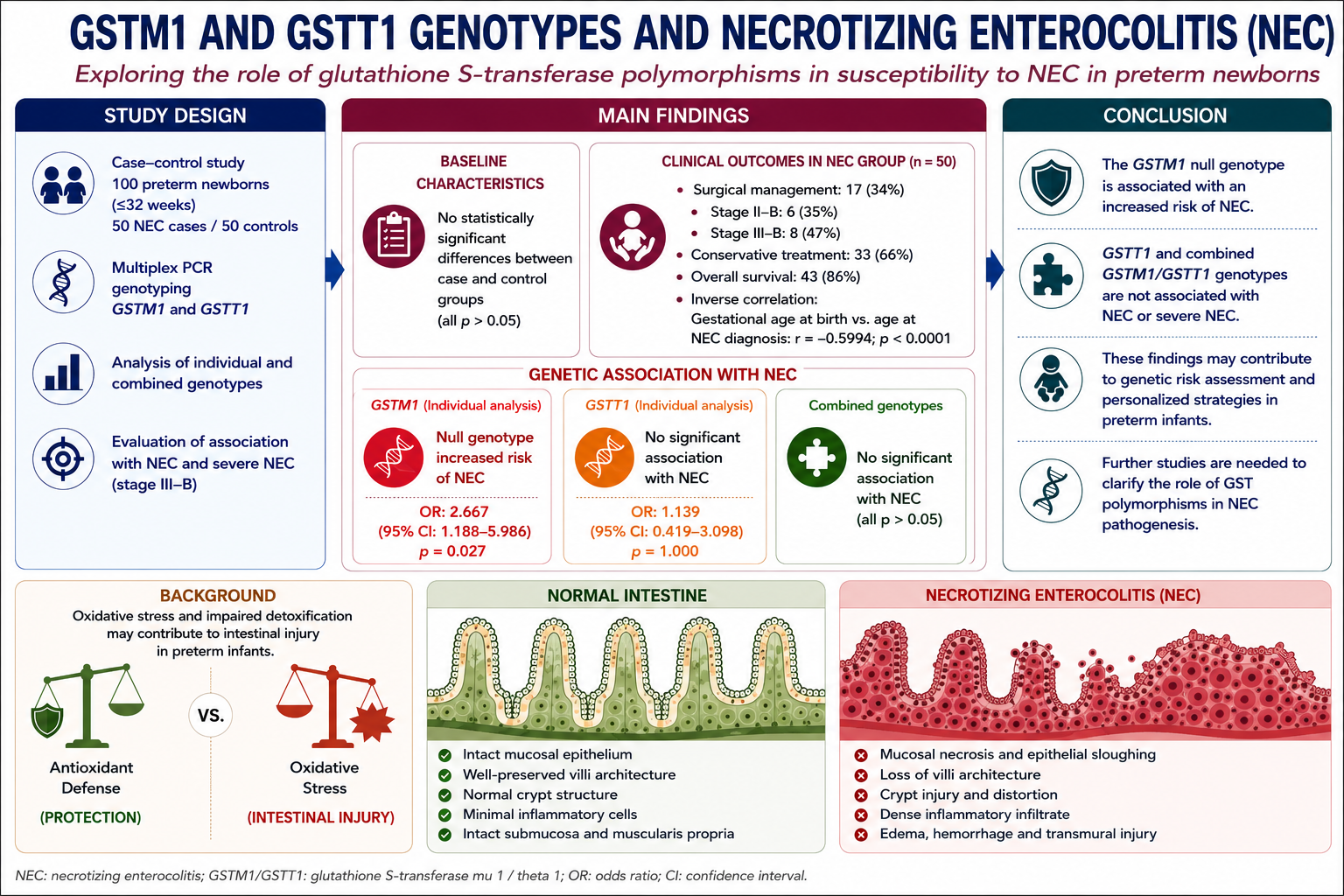
| Null | 30 (60) | 18 (36) | 2.667 (1.188–5.986) | 0.027 |
| Positive | 20 (40) | 32 (64) | Reference | |
| GSTT1 | ||||
| Null | 10 (20) | 9 (18) | 1.139 (0.419–3.098) | 1.000 |
| Positive | 40 (80) | 41 (82) | Reference | |
| Combined genotypes | ||||
| GSTM1 [−]/GSTT1 [−] | 9 (18) | 5 (10) | 1.976 (0.612–6.382) | 0.388 |
| GSTM1 [−]/GSTT1 [+] | 21 (42) | 13 (26) | 2.061 (0.885–4.801) | 0.139 |
| GSTM1 [+]/GSTT1 [+] | 19 (38) | 28 (56) | Reference | |
| GSTM1 [+]/GSTT1 [−] | 1 (2) | 4 (8) | 0.235 (0.025–2.179) | 0.362 |
Disclaimer/Publisher’s Note: The statements, opinions and data contained in all publications are solely those of the individual author(s) and contributor(s) and not of MDPI and/or the editor(s). MDPI and/or the editor(s) disclaim responsibility for any injury to people or property resulting from any ideas, methods, instructions or products referred to in the content. |
© 2026 by the authors. Licensee MDPI, Basel, Switzerland. This article is an open access article distributed under the terms and conditions of the Creative Commons Attribution (CC BY) license.
Share and Cite
Duarte, A.A.B.; Ferdinando, D.L.T.; Piatto, V.B.; Caldas, H.C. Oxidative Stress and Necrotizing Enterocolitis in Preterm Newborns: The Role of GSTM1 and GSTT1 Null Genotypes. Biomolecules 2026, 16, 900. https://doi.org/10.3390/biom16060900
Duarte AAB, Ferdinando DLT, Piatto VB, Caldas HC. Oxidative Stress and Necrotizing Enterocolitis in Preterm Newborns: The Role of GSTM1 and GSTT1 Null Genotypes. Biomolecules. 2026; 16(6):900. https://doi.org/10.3390/biom16060900
Chicago/Turabian StyleDuarte, Alexandre Alberto Barros, Danielle Lopes Teixeira Ferdinando, Vânia Belintani Piatto, and Heloísa Cristina Caldas. 2026. "Oxidative Stress and Necrotizing Enterocolitis in Preterm Newborns: The Role of GSTM1 and GSTT1 Null Genotypes" Biomolecules 16, no. 6: 900. https://doi.org/10.3390/biom16060900
APA StyleDuarte, A. A. B., Ferdinando, D. L. T., Piatto, V. B., & Caldas, H. C. (2026). Oxidative Stress and Necrotizing Enterocolitis in Preterm Newborns: The Role of GSTM1 and GSTT1 Null Genotypes. Biomolecules, 16(6), 900. https://doi.org/10.3390/biom16060900