Unfolding Behavior and Conformational Changes Under Different Denaturing Conditions of MAPK 1 (MEK1)

 , , ,
, , ,  and
and
Abstract
1. Introduction
2. Materials and Methods
2.1. Materials
2.2. Protein Expression and Purification
2.3. Fluorescence
2.3.1. Steady-State Intrinsic Fluorescence Measurements
2.3.2. ANS Binding
2.3.3. Thermal Denaturations
2.4. Far-UV Circular Dichroism Measurements (Far-UV CD)
2.4.1. Steady-State Spectra
2.4.2. Thermal Denaturations
2.5. Analysis of the pH, Thermal, and Chemical Denaturation Curves, and Stability Gibbs Energy Determination
2.6. Dynamic Light Scattering (DLS)
2.7. Differential Scanning Calorimetry (DSC)
2.8. Isothermal Titration Calorimetry (ITC)
2.9. Simulated Thermal Unfolding
3. Results
3.1. MEK1 Acquired a Native-like Conformation in a Narrow pH Range
3.1.1. Intrinsic Steady-State Fluorescence and Thermal Denaturations Followed by Intrinsic Fluorescence
3.1.2. ANS-Binding Fluorescence
3.1.3. Far UV CD
3.1.4. DLS
3.2. Conformational Stability of MEK1 at pH 8.1
3.2.1. Chemical (Urea and GdmCl) Denaturations of MEK1
- (a)
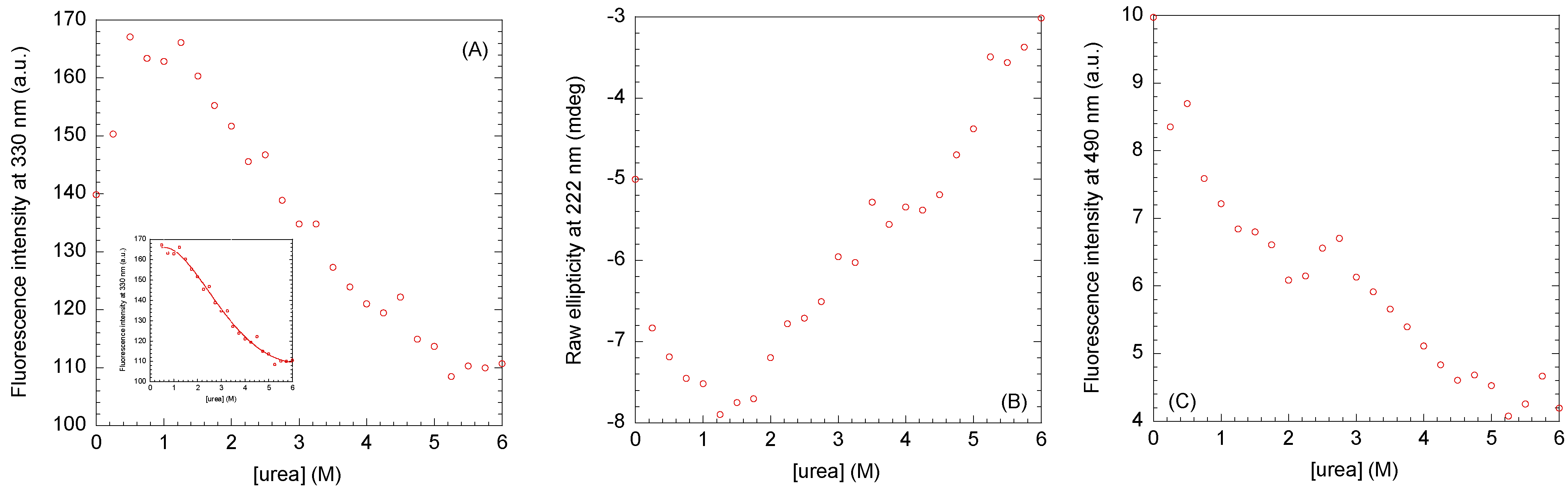
- Conformational changes in MEK1 at pH 8.1 with urea: We carried out chemical denaturation experiments in the presence of urea by using (intrinsic and ANS) fluorescence and CD. At room temperature, and at 4 μM (in protomer units) of MEK1, the intrinsic fluorescence intensity, either by excitation at 280 or 295 nm, showed two transitions at any wavelength: (i) one occurring between 0 and 0.75 M urea; and (ii) the second one at higher urea concentration (Figure 3A). Due to the absence of a baseline in the first one, we could not obtain an apparent midpoint for the transition, [urea]1/2; however, for the second one (Figure 3A, inset), we obtained [urea]1/2 = 1.8 ± 1.0 M and m = 660 ± 136 cal mol−1 M−1. On the other hand, the variation of <λ> (either after excitation at 280 or 295 nm) yielded a single transition with [urea]1/2 = 3 ± 1 M and m = 390 ± 230 cal mol−1 M−1 (Figure S3A).Furthermore, the results from the CD data indicated, as well, a first transition between 0 and 1 M urea and a second one between 1 and 6 M urea (Figure 3B). We could not fit any of the transitions because of the lack of a native baseline for the first transition and of an unfolding baseline for the second. Moreover, the urea-denaturation followed by ANS also showed two transitions (Figure 3C): (i) the first one occurring between 0 and 2 M urea; and (ii) the second one occurring between 2 and 6 M urea. Unfortunately, attempts to fit this second transition yielded unreliable results.We suspected that the transition observed at low urea concentrations was probably due to dimer dissociation, or alternatively, unfolding of one of the two lobes of the protein. To test that hypothesis, and since we could acquire experiments below room temperature only in the spectropolarimeter, we designed a urea denaturation experiment at low concentration (5 μM) and high (10 μM) protomer concentration at low temperature (5 °C). We did not use GdmCl as a denaturing agent because of the absence of the first transition in the far-UV CD experiments (see below in this same section). If that first transition was due to dimer dissociation, we should see at low concentration and low temperature the same transition observed at high temperature (Figure 3B), but such a transition should move towards higher concentrations of denaturant due to Le Châtelier principle, i.e., a concentration-dependent midpoint transition, [D]1/2 [32,33,34,35]. When we carried out the experiments, the first transition occurring at low urea concentrations was clearly observed in the diluted sample (Figure S4) together with the transition observed at the highest urea concentrations; however, at the high protein concentration, we only observed a single transition occurring at high urea concentrations, probably due to the concomitant occurrence of dimer dissociation and unfolding of the monomer.Then, taken together, and due to the variety of behaviors observed among the different probes during the denaturation, our findings suggest that unfolding of MEK1 caused by the presence of urea: (i) was irreversible; and (ii) it was not a two-state transition, involving conformational intermediate states, pointing to a low (un)folding cooperativity [43]; Unfortunately, the irreversibility of the denaturation process precluded to determine a thermodynamic free energy of unfolding.
- (b)
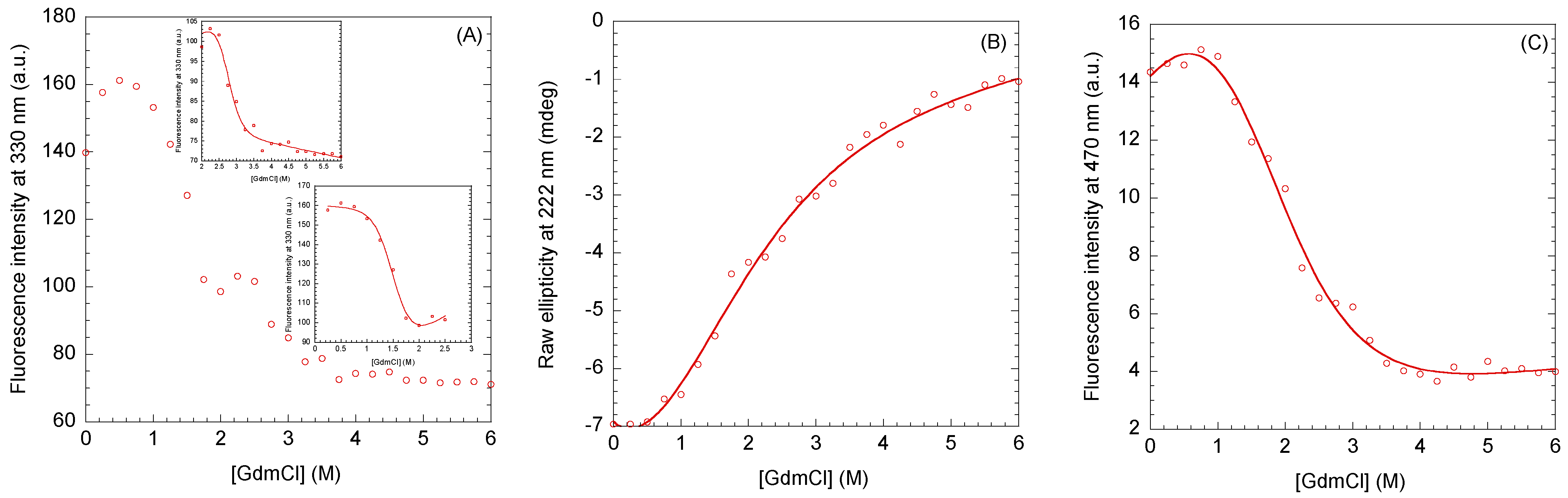
- Conformational changes in MEK1 at pH 8.1 with GdmCl: Experiments with GdmCl by monitoring the intrinsic fluorescence intensity showed three transitions: (i) one at the same range of concentrations observed with urea (i.e., between 0 and 0.75 M of GdmCl); (ii) another one between 0.75 and 2 M of GdmCl; and (iii) the final one between 2 and 6 M of GdmCl (Figure 4A). In this case, we could fit the second and last transitions to consecutive sigmoidal curves. In the second transition, we obtained [GdmCl]1/2 = 1.52 ± 0.08 M and m = 3 ± 1 kcal mol−1 M−1; and the third one yielded: [GdmCl]1/2 = 2.4 ± 0.2 M and m = 2.4 ± 0.4 kcal mol−1 M−1 (Figure 4A inset). On the other hand, the variation of <λ> (either after excitation at 280 or 295 nm) yielded a single transition with [GdmCl]1/2 = 1.9 ± 0.3 M and m = 760 ± 112 cal mol−1 M−1 (Figure S3B).Furthermore, the denaturation followed by far-UV CD also yielded a single, low-cooperative (i.e., small m-value) transition, with [GdmCl]1/2 = 2.8 ± 0.2 M and m = 626 ± 245 cal mol−1 M−1 (Figure 4B). Attempts to fit the far-UV CD data to a curve with more than one transition did not lead to reliable results (as judged from the F-test and the χ2 values of the fittings). The chemical denaturation in the presence of ANS also yielded a single transition with [GdmCl]1/2 = 1.6 ± 0.3 M and m = 930 ± 160 cal mol−1 M−1 (Figure 4C).To sum up, these results indicated that the unfolding of MEK1 in the presence of GdmCl: (i) was irreversible; and (ii) was not a two-state transition, as concluded from the different m- and [GdmCl]1/2—values obtained by using distinct probes and biophysical techniques [43] but rather it involved several intermediates (as concluded from the distinct [GdmCl]1/2 and m-values obtained by the different techniques).
3.2.2. Heat Denaturation of MEK1 in the Absence and in the Presence of ATP Followed by DSC at pH 8.1
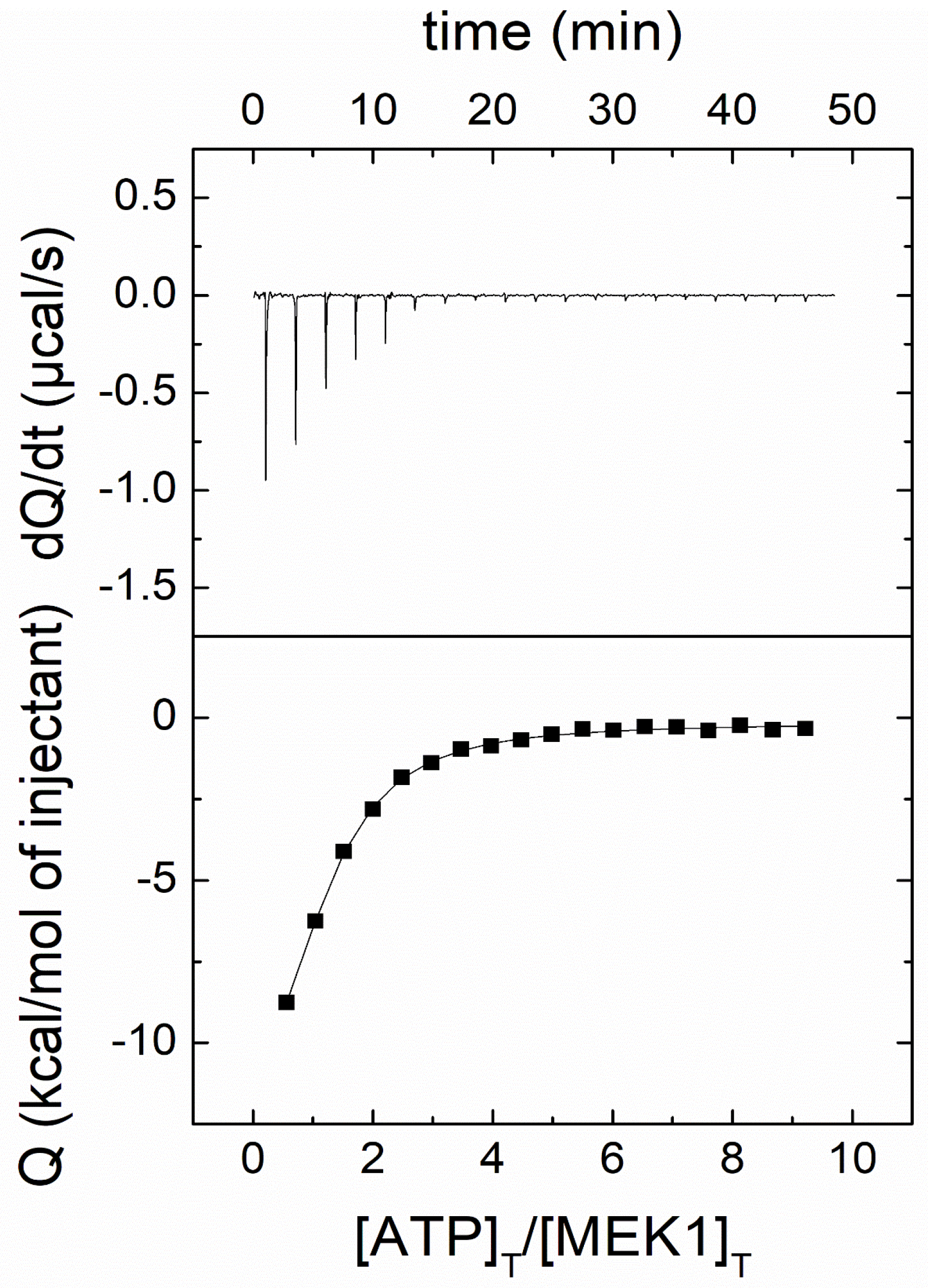
3.2.3. Interaction of MEK1 with ATP Monitored by ITC at pH 8.1
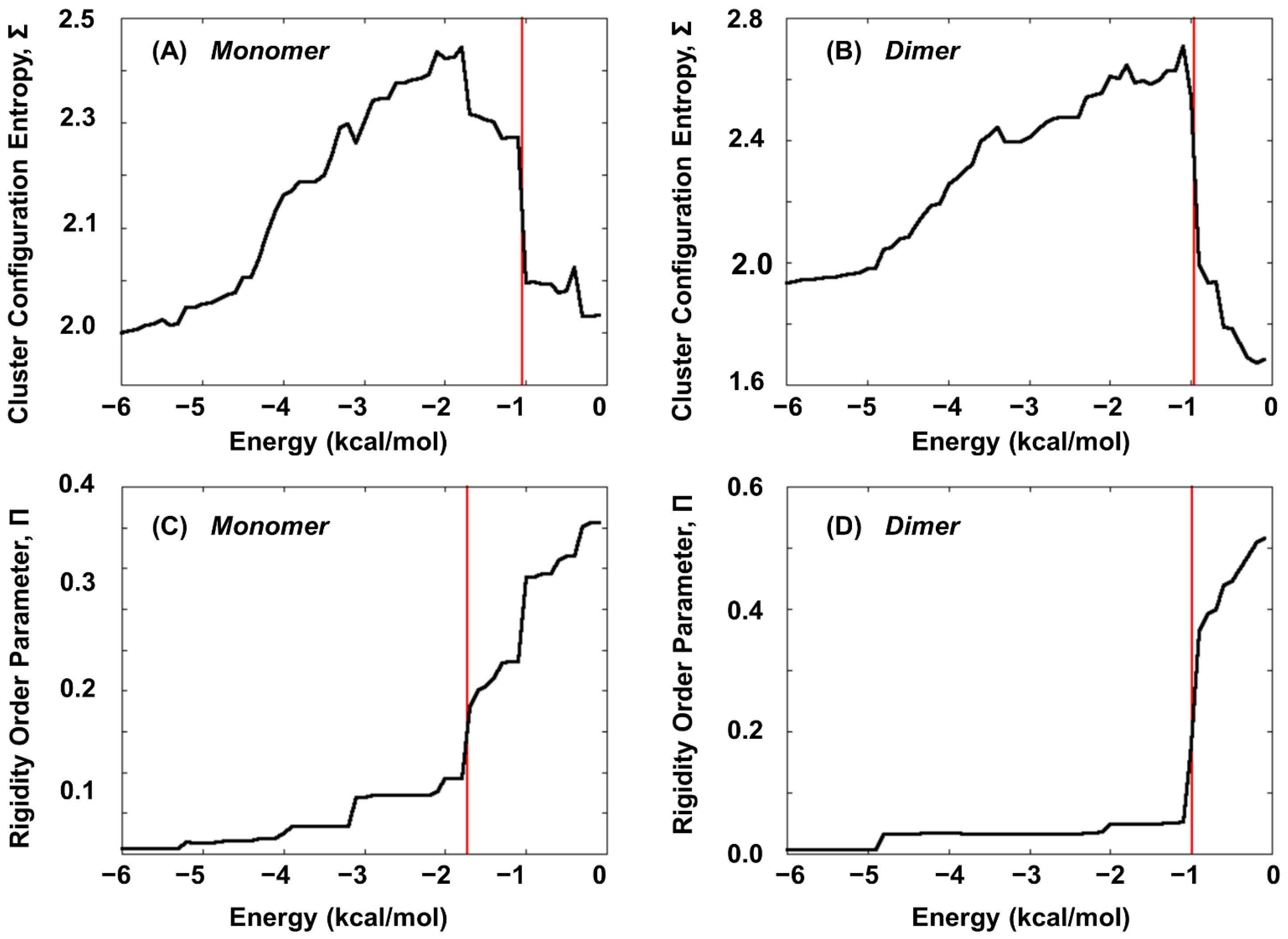
3.3. In Silico MEK1 Denaturations
4. Discussion
5. Conclusions
Supplementary Materials
Author Contributions
Funding
Institutional Review Board Statement
Informed Consent Statement
Data Availability Statement
Acknowledgments
Conflicts of Interest
Abbreviations
| ANS | 8-anilinonapthalene-1-sulfonic acid |
| ATP | adenosine triphosphate |
| CD | circular dichroism |
| CNA | constraint network analysis |
| DLS | dynamic light scattering |
| DSC | differential scanning calorimetry |
| ERK | extracellular signal-regulated kinase |
| GdmCl | guanidinium hydrochloride |
| ITC | isothermal titration calorimetry |
| MAPK | mitogen-activated protein kinase |
| PDB | protein data bank |
| PTM | post-translational modification |
| UV | ultraviolet |
References
- Ardito, F.; Giuliani, M.; Perrone, D.; Troiano, G.; Muzio, L. Lo The Crucial Role of Protein Phosphorylation in Cell Signaling and Its Use as Targeted Therapy (Review). Int. J. Mol. Med. 2017, 40, 271–280. [Google Scholar] [CrossRef]
- Bononi, A.; Agnoletto, C.; De Marchi, E.; Marchi, S.; Patergnani, S.; Bonora, M.; Giorgi, C.; Missiroli, S.; Poletti, F.; Rimessi, A.; et al. Protein Kinases and Phosphatases in the Control of Cell Fate. Enzym. Res. 2011, 2011, 329098. [Google Scholar] [CrossRef] [PubMed]
- Wilhelm, M.; Schlegl, J.; Hahne, H.; Gholami, A.M.; Lieberenz, M.; Savitski, M.M.; Ziegler, E.; Butzmann, L.; Gessulat, S.; Marx, H.; et al. Mass-Spectrometry-Based Draft of the Human Proteome. Nature 2014, 509, 582–587. [Google Scholar] [CrossRef]
- Yue, J.; López, J.M. Understanding MAPK Signaling Pathways in Apoptosis. Int. J. Mol. Sci. 2020, 21, 2346. [Google Scholar] [CrossRef] [PubMed]
- Burotto, M.; Chiou, V.L.; Lee, J.M.; Kohn, E.C. The MAPK Pathway across Different Malignancies: A New Perspective. Cancer 2014, 120, 3446–3456. [Google Scholar] [CrossRef]
- Guo, Y.; Pan, W.; Liu, S.; Shen, Z.; Xu, Y.; Hu, L. ERK/MAPK Signalling Pathway and Tumorigenesis. Exp. Ther. Med. 2020, 19, 1997–2007. [Google Scholar] [CrossRef]
- Corre, I.; Paris, F.; Huot, J. The P38 Pathway, a Major Pleiotropic Cascade That Transduces Stress and Metastatic Signals in Endothelial Cells. Oncotarget 2017, 8, 55684–55714. [Google Scholar] [CrossRef] [PubMed]
- Papa, S.; Choy, P.M.; Bubici, C. The ERK and JNK Pathways in the Regulation of Metabolic Reprogramming. Oncogene 2019, 38, 2223–2240. [Google Scholar] [CrossRef]
- Wei, Z.; Liu, H.T. MAPK Signal Pathways in the Regulation of Cell Proliferation in Mammalian Cells. Cell Res. 2002, 12, 9–18. [Google Scholar] [CrossRef]
- Martin-Vega, A.; Cobb, M.H. Navigating the ERK1/2 MAPK Cascade. Biomolecules 2023, 13, 1555. [Google Scholar] [CrossRef]
- Braicu, C.; Buse, M.; Busuioc, C.; Drula, R.; Gulei, D.; Raduly, L.; Rusu, A.; Irimie, A.; Atanasov, A.G.; Slaby, O.; et al. A Comprehensive Review on MAPK: A Promising Therapeutic Target in Cancer. Cancers 2019, 11, 1618. [Google Scholar] [CrossRef]
- Zheng, C.F.; Guan, K.L. Activation of MEK Family Kinases Requires Phosphorylation of Two Conserved Ser/Thr Residues. EMBO J. 1994, 13, 1123–1131. [Google Scholar] [CrossRef]
- Bahar, M.E.; Kim, H.J.; Kim, D.R. Targeting the RAS/RAF/MAPK Pathway for Cancer Therapy: From Mechanism to Clinical Studies. Signal Transduct. Target. Ther. 2023, 8, 455. [Google Scholar] [CrossRef]
- Knighton, D.R.; Zheng, J.; Ten Eyck, L.F.; Ashford, V.A.; Xuong, N.H.; Taylor, S.S.; Sowadski, J.M. Crystal Structure of the Catalytic Subunit of Cyclic Adenosine Monophosphate-Dependent Protein Kinase. Science 1991, 253, 407–414. [Google Scholar] [CrossRef]
- Nakae, S.; Kitamura, M.; Fujiwara, D.; Sawa, M.; Shirai, T.; Fujii, I.; Tada, T. Structure of Mitogen-Activated Protein Kinase Kinase 1 in the DFG-out Conformation. Acta Cryst. F Struct. Biol. Commun. 2021, 77, 459–464. [Google Scholar] [CrossRef] [PubMed]
- Dang, A.; Frost, J.A.; Cobb, M.H. The MEK1 Proline-Rich Insert Is Required for Efficient Activation of the Mitogen-Activated Protein Kinases ERK1 and ERK2 in Mammalian Cells. J. Biol. Chem. 1998, 273, 19909–19913. [Google Scholar] [CrossRef]
- Ohren, J.F.; Chen, H.; Pavlovsky, A.; Whitehead, C.; Zhang, E.; Kuffa, P.; Yan, C.; McConnell, P.; Spessard, C.; Banotai, C.; et al. Structures of Human MAP Kinase Kinase 1 (MEK1) and MEK2 Describe Novel Noncompetitive Kinase Inhibition. Nat. Struct. Mol. Biol. 2004, 11, 1192–1197. [Google Scholar] [CrossRef] [PubMed]
- Kadasah, S.F. Targeting the MAPK Pathway in Cancer. Int. J. Mol. Sci. 2025, 27, 214. [Google Scholar] [CrossRef] [PubMed]
- Ram, T.; Singh, A.K.; Kumar, A.; Singh, H.; Pathak, P.; Grishina, M.; Khalilullah, H.; Jaremko, M.; Emwas, A.H.; Verma, A.; et al. MEK Inhibitors in Cancer Treatment: Structural Insights, Regulation, Recent Advances and Future Perspectives. RSC Med. Chem. 2023, 14, 1837–1857. [Google Scholar] [CrossRef]
- Pfleger, C.; Rathi, P.C.; Klein, D.L.; Radestock, S.; Gohlke, H. Constraint Network Analysis (CNA): A Python Software Package for Efficiently Linking Biomacromolecular Structure, Flexibility, (Thermo-)Stability, and Function. J. Chem. Inf. Model. 2013, 53, 1007–1015. [Google Scholar] [CrossRef]
- Pace, C.N. Determination and Analysis of Urea and Guanidine Hydrochloride Denaturation Curves. Methods Enzymol. 1986, 131, 266–280. [Google Scholar] [CrossRef]
- Spicer, J.A.; Rewcastle, G.W.; Kaufman, M.D.; Black, S.L.; Plummer, M.S.; Denny, W.A.; Quin, J.; Shahripour, A.B.; Barrett, S.D.; Whitehead, C.E.; et al. 4-Anilino-5-Carboxamido-2-Pyridone Derivatives as Noncompetitive Inhibitors of Mitogen-Activated Protein Kinase Kinase. J. Med. Chem. 2007, 50, 5090–5102. [Google Scholar] [CrossRef] [PubMed]
- Tecle, H.; Shao, J.; Li, Y.; Kothe, M.; Kazmirski, S.; Penzotti, J.; Ding, Y.H.; Ohren, J.; Moshinsky, D.; Coli, R.; et al. Beyond the MEK-Pocket: Can Current MEK Kinase Inhibitors Be Utilized to Synthesize Novel Type III NCKIs? Does the MEK-Pocket Exist in Kinases Other than MEK? Bioorg. Med. Chem. Lett. 2009, 19, 226–229. [Google Scholar] [CrossRef]
- Pace, C.N.; Schmid, F.X. How to Determine the Molar Absorbance Coefficient of a Protein. In Protein Structure: A Practical Approach; Oxford Academic: Oxford, UK, 1997; pp. 253–260. [Google Scholar] [CrossRef]
- Gill, S.C.; von Hippel, P.H. Calculation of Protein Extinction Coefficients from Amino Acid Sequence Data. Anal. Biochem. 1989, 182, 319–326. [Google Scholar] [CrossRef]
- Schmid, F.X. Optical Spectroscopy to Characterize Protein Conformation and Conformational Changes. In Protein Structure: A Practical Approach; Creighton, T.E., Ed.; Oxford University Press: Oxford, UK, 1997; pp. 261–297. [Google Scholar]
- Neira, J.L.; Cámara-Artigas, A.; Hernández-Cifre, J.G.; Ortore, M.G. The Histidine Phosphocarrier Kinase/Phosphorylase from Bacillus Subtilis Is an Oligomer in Solution with a High Thermal Stability. Int. J. Mol. Sci. 2021, 22, 3231. [Google Scholar] [CrossRef]
- Neira, J.L.; Araujo-Abad, S.; Cámara-Artigas, A.; Rizzuti, B.; Abian, O.; Giudici, A.M.; Velazquez-Campoy, A.; de Juan Romero, C. Biochemical and Biophysical Characterization of PADI4 Supports Its Involvement in Cancer. Arch. Biochem. Biophys. 2022, 717, 109125. [Google Scholar] [CrossRef]
- Benjwal, S.; Verma, S.; Röhm, K.H.; Gursky, O. Monitoring Protein Aggregation during Thermal Unfolding in Circular Dichroism Experiments. Protein Sci. 2006, 15, 635–639. [Google Scholar] [CrossRef] [PubMed]
- Royer, C.A. Fluorescence Spectroscopy. Methods Mol. Biol. 1995, 40, 65–89. [Google Scholar] [CrossRef]
- Pace, C.N.; Hermans, J. The Stability of Globular Proteins. CRC Crit. Rev. Biochem. 1975, 3, 1–43. [Google Scholar] [CrossRef]
- Mateu, M.G. Conformational Stability of Dimeric and Monomeric Forms of the C-Terminal Domain of Human Immunodeficiency Virus-1 Capsid Protein. J. Mol. Biol. 2002, 318, 519–531. [Google Scholar] [CrossRef] [PubMed]
- Rumfeldt, J.A.O.; Galvagnion, C.; Vassall, K.A.; Meiering, E.M. Conformational Stability and Folding Mechanisms of Dimeric Proteins. Prog. Biophys. Mol. Biol. 2008, 98, 61–84. [Google Scholar] [CrossRef]
- Backmann, J.; Schäfer, G.; Wyns, L.; Bönisch, H. Thermodynamics and Kinetics of Unfolding of the Thermostable Trimeric Adenylate Kinase from the Archaeon Sulfolobus Acidocaldarius. J. Mol. Biol. 1998, 284, 817–833. [Google Scholar] [CrossRef]
- Bedouelle, H. Principles and Equations for Measuring and Interpreting Protein Stability: From Monomer to Tetramer. Biochimie 2016, 121, 29–37. [Google Scholar] [CrossRef]
- Varadi, M.; Anyango, S.; Deshpande, M.; Nair, S.; Natassia, C.; Yordanova, G.; Yuan, D.; Stroe, O.; Wood, G.; Laydon, A.; et al. AlphaFold Protein Structure Database: Massively Expanding the Structural Coverage of Protein-Sequence Space with High-Accuracy Models. Nucleic Acids Res. 2022, 50, D439–D444. [Google Scholar] [CrossRef]
- Mirdita, M.; Schütze, K.; Moriwaki, Y.; Heo, L.; Ovchinnikov, S.; Steinegger, M. ColabFold: Making Protein Folding Accessible to All. Nat. Methods 2022, 19, 679–682. [Google Scholar] [CrossRef] [PubMed]
- Pettersen, E.F.; Goddard, T.D.; Huang, C.C.; Couch, G.S.; Greenblatt, D.M.; Meng, E.C.; Ferrin, T.E. UCSF Chimera—A Visualization System for Exploratory Research and Analysis. J. Comput. Chem. 2004, 25, 1605–1612. [Google Scholar] [CrossRef] [PubMed]
- Krüger, D.M.; Rathi, P.C.; Pfleger, C.; Gohlke, H. CNA Web Server: Rigidity Theory-Based Thermal Unfolding Simulations of Proteins for Linking Structure, (Thermo-)Stability, and Function. Nucleic Acids Res. 2013, 41, W340–W348. [Google Scholar] [CrossRef]
- Pfleger, C.; Gohlke, H. Efficient and Robust Analysis of Biomacromolecular Flexibility Using Ensembles of Network Topologies Based on Fuzzy Noncovalent Constraints. Structure 2013, 21, 1725–1734. [Google Scholar] [CrossRef] [PubMed]
- Ptitsyn, O.B. Molten Globule and Protein Folding. Adv. Protein Chem. 1995, 47, 83–229. [Google Scholar] [CrossRef]
- Wilkins, D.K.; Grimshaw, S.B.; Receveur, V.; Dobson, C.M.; Jones, J.A.; Smith, L.J. Hydrodynamic Radii of Native and Denatured Proteins Measured by Pulse Field Gradient NMR Techniques. Biochemistry 1999, 38, 16424–16431. [Google Scholar] [CrossRef]
- Jackson, S.E. How Do Small Single-Domain Proteins Fold? Fold. Des. 1998, 3, R81–R91. [Google Scholar] [CrossRef]
- Rizzuti, B.; Abian, O.; Velazquez-Campoy, A.; Neira, J.L. Conformational Stability of the N-Terminal Region of MDM2. Molecules 2023, 28, 7578. [Google Scholar] [CrossRef] [PubMed]
- Radestock, S.; Gohlke, H. Exploiting the Link between Protein Rigidity and Thermostability for Data-Driven Protein Engineering. Eng. Life Sci. 2008, 8, 507–522. [Google Scholar] [CrossRef]
- Thurlkill, R.L.; Grimsley, G.R.; Scholtz, J.M.; Pace, C.N. PK Values of the Ionizable Groups of Proteins. Protein Sci. 2006, 15, 1214–1218. [Google Scholar] [CrossRef]
- Thurlkill, R.L.; Grimsley, G.R.; Scholtz, J.M.; Pace, C.N. Hydrogen Bonding Markedly Reduces the PK of Buried Carboxyl Groups in Proteins. J. Mol. Biol. 2006, 362, 594–604. [Google Scholar] [CrossRef]
- Pace, C.N.; Grimsley, G.R.; Scholtz, J.M. Protein Ionizable Groups: PK Values and Their Contribution to Protein Stability and Solubility. J. Biol. Chem. 2009, 284, 13285–13289. [Google Scholar] [CrossRef]
- Smith, C.K.; Windsor, W.T. Thermodynamics of Nucleotide and Non-ATP-Competitive Inhibitor Binding to MEK1 by Circular Dichroism and Isothermal Titration Calorimetry. Biochemistry 2007, 46, 1358–1367. [Google Scholar] [CrossRef]
- VanScyoc, W.S.; Holdgate, G.A.; Sullivan, J.E.; Ward, W.H.J. Enzyme Kinetics and Binding Studies on Inhibitors of MEK Protein Kinase. Biochemistry 2008, 47, 5017–5027. [Google Scholar] [CrossRef] [PubMed]




Disclaimer/Publisher’s Note: The statements, opinions and data contained in all publications are solely those of the individual author(s) and contributor(s) and not of MDPI and/or the editor(s). MDPI and/or the editor(s) disclaim responsibility for any injury to people or property resulting from any ideas, methods, instructions or products referred to in the content. |
© 2026 by the authors. Licensee MDPI, Basel, Switzerland. This article is an open access article distributed under the terms and conditions of the Creative Commons Attribution (CC BY) license.
Share and Cite
Álvarez-Rodríguez, M.G.; Vega, S.; Hornos, F.; Velazquez-Campoy, A.; Rizzuti, B.; Neira, J.L. Unfolding Behavior and Conformational Changes Under Different Denaturing Conditions of MAPK 1 (MEK1). Biomolecules 2026, 16, 845. https://doi.org/10.3390/biom16060845
Álvarez-Rodríguez MG, Vega S, Hornos F, Velazquez-Campoy A, Rizzuti B, Neira JL. Unfolding Behavior and Conformational Changes Under Different Denaturing Conditions of MAPK 1 (MEK1). Biomolecules. 2026; 16(6):845. https://doi.org/10.3390/biom16060845
Chicago/Turabian StyleÁlvarez-Rodríguez, Maria Gabriela, Sonia Vega, Felipe Hornos, Adrian Velazquez-Campoy, Bruno Rizzuti, and José L. Neira. 2026. "Unfolding Behavior and Conformational Changes Under Different Denaturing Conditions of MAPK 1 (MEK1)" Biomolecules 16, no. 6: 845. https://doi.org/10.3390/biom16060845
APA StyleÁlvarez-Rodríguez, M. G., Vega, S., Hornos, F., Velazquez-Campoy, A., Rizzuti, B., & Neira, J. L. (2026). Unfolding Behavior and Conformational Changes Under Different Denaturing Conditions of MAPK 1 (MEK1). Biomolecules, 16(6), 845. https://doi.org/10.3390/biom16060845