


Material Properties of Composite Resins Used for Orthodontic Attachments in Clear Aligner Therapy: A Systematic Review
 , , and
Abstract
1. Introduction
2. Materials and Methods
2.1. Search Strategy
- Accuracy of shape and fit reproduction;
- Shear strength;
- Wear over time;
- Durability and dimensional stability;
- Color stability;
- Influence on treatment efficiency and duration.
- Clinical trials.
- In vitro studies.
- Published between 2015 and 2025.
- Studies addressing the comparison of different types of composite resins in the fabrication of attachments.
- Full-text availability.
- Systematic reviews.
- Critical or narrative reviews.
- Letters to the editor, editorials, or clinical guidelines.
2.2. Study Selection and Data Extraction
- -
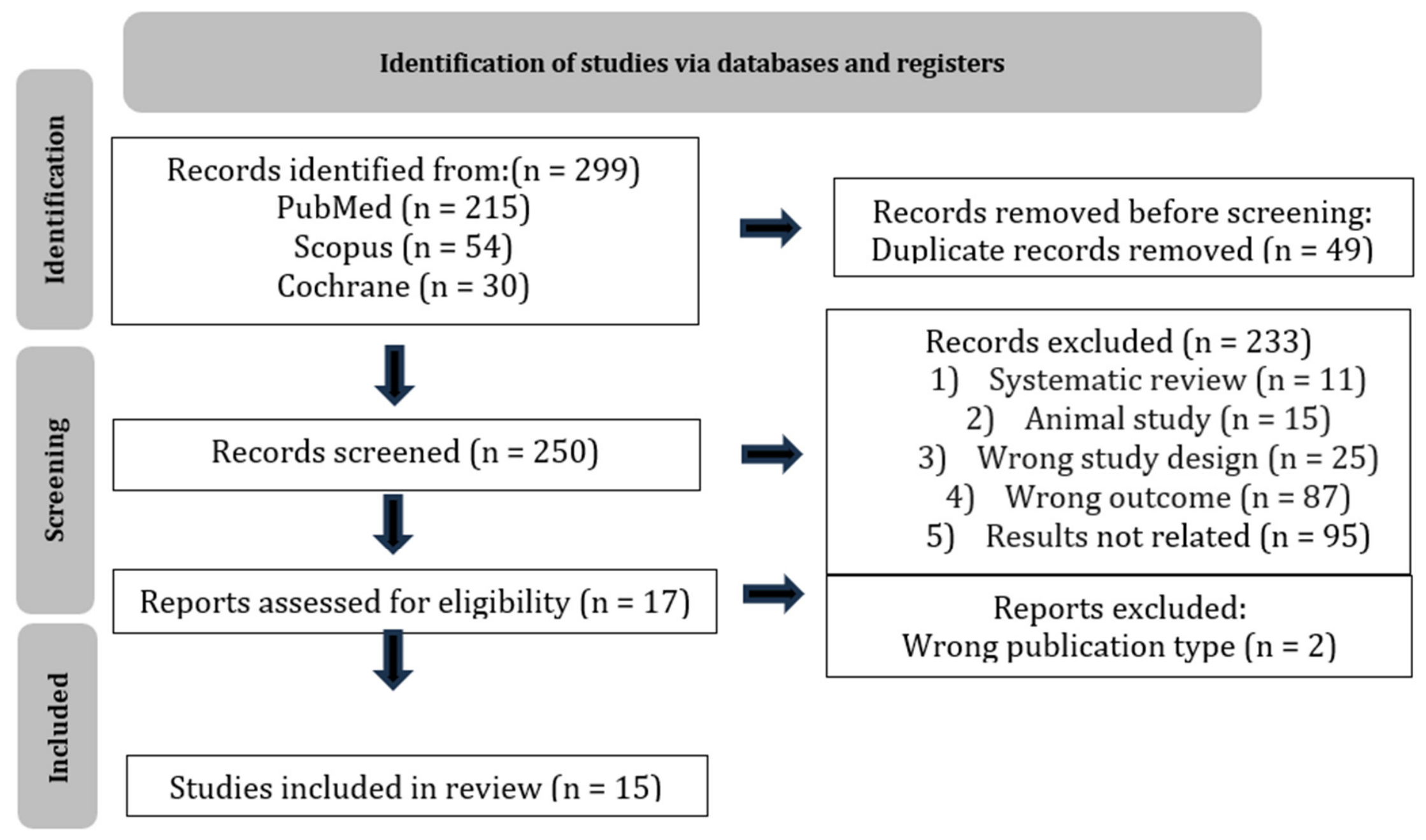
- Initial screening: Two independent reviewers (P.L. and L.F.) examined the titles and abstracts of the identified articles, applying the predefined eligibility criteria. Any discrepancies between the reviewers were resolved through discussion with a third author (R.F.-P.). Cohen’s Kappa test was performed to assess the inter-reviewer agreement. The Rayyan Intelligent Systematic Review Platform was used to assist in the systematic review process [18].
- -
- Abstract reading: Non-excluded articles were evaluated based on their abstracts to confirm compliance with the inclusion criteria before full-text assessment.
- -
- Full evaluation: Potentially eligible articles were read in full and analyzed for their relevance to the review objective.
2.3. Methodological Quality Assessment
3. Results
3.1. Study Selection
3.2. Risk-of-Bias Analysis
4. Discussion
5. Conclusions
Author Contributions
Funding
Institutional Review Board Statement
Informed Consent Statement
Data Availability Statement
Conflicts of Interest
Abbreviations
| 3D | Three-Dimensional |
| BPA | Bisphenol A |
| Bis-EMA | Bisphenol A Ethoxylated Dimethacrylate |
| Bis-GMA | Bisphenol A Glycidyl Methacrylate |
| CAD | Computer-Aided Design |
| CAM | Computer-Aided Manufacturing |
| CI | Confidence Interval |
| ΔE | Color Difference |
| ΔE00 | CIEDE2000 Color Difference |
| GC | GC Corporation (Dental Materials Manufacturer) |
| LED | Light-Emitting Diode |
| PET-G | Glycol-Modified Polyethylene Terephthalate |
| PICO | Population, Intervention, Comparison, Outcome |
| PRISMA | Preferred Reporting Items for Systematic Reviews and Meta-Analyses |
| Ra | Surface Roughness Average |
| RMS | Root Mean Square |
| RoB | Risk of Bias |
| RoB 2.0 | Revised Cochrane Risk-of-Bias Tool for Randomized Trials |
| SD | Standard Deviation |
| SEM | Scanning Electron Microscopy |
| SBS | Shear Bond Strength |
| TEGDMA | Triethylene Glycol Dimethacrylate |
| UDMA | Urethane Dimethacrylate |
| VHN | Vickers Hardness Number |
References
- Sousa, H.A.F.; Nascimento, J.J.P.N.F.; Sousa, M.A.F.; Gerani, B.; Souza, A.O.; Degrazia, F.W. Invisible orthodontic aligners: A review. Res. Soc. Dev. 2021, 10, e5510111259. [Google Scholar] [CrossRef]
- Naqbi, S.R.A.; Pratsinis, H.; Kletsas, D.; Eliades, T.; Athanasiou, A.E. In vitro assessment of cytotoxicity and estrogenicity of Vivera® retainers. J. Contemp. Dent. Pract. 2018, 19, 1163–1168. [Google Scholar] [CrossRef] [PubMed]
- Vlaskalic, V.; Boyd, R. Orthodontic treatment of a mildly crowded malocclusion using the Invisalign system. Aust. Orthod. J. 2001, 17, 41–46. [Google Scholar] [CrossRef] [PubMed]
- Dinu, S. In vitro biocompatibility and in ovo irritant potential screening of two clear aligners with orthodontic applications. Farmacia 2024, 72, 513–520. [Google Scholar] [CrossRef]
- Boyd, R.L. Esthetic orthodontic treatment using the Invisalign appliance for moderate to complex malocclusions. J. Dent. Educ. 2008, 72, 948–967. [Google Scholar] [CrossRef]
- Milovanović, A.; Sedmak, A.; Golubović, Z.; Mihajlović, K.Z.; Žurkić, A.; Trajković, I.; Milošević, M. The effect of time on mechanical properties of biocompatible photopolymer resins used for fabrication of clear dental aligners. J. Mech. Behav. Biomed. Mater. 2021, 119, 104494. [Google Scholar] [CrossRef]
- Ziuchkovski, J.P.; Fields, H.W.; Johnston, W.M.; Lindsey, D.T. Assessment of perceived orthodontic appliance attractiveness. Am. J. Orthod. Dentofac. Orthop. 2008, 133, S68–S78. [Google Scholar] [CrossRef]
- Yan, C.; Kleiner, C.; Tabigue, A.; Shah, V.; Sacks, G.; Shah, D.; DeStefano, V. PETG: Applications in modern medicine. Eng. Regen. 2024, 5, 45–55. [Google Scholar] [CrossRef]
- Iliadi, A.; Koletsi, D.; Papageorgiou, S.N.; Eliades, T. Safety considerations for thermoplastic-type appliances used as orthodontic aligners or retainers: A systematic review and meta-analysis. Materials 2020, 13, 1843. [Google Scholar] [CrossRef]
- Campobasso, A.; Lo Muzio, E.; Battista, G.; Ciavarella, D.; Crincoli, V.; Lo Muzio, L. Taxonomic analysis of oral microbiome during orthodontic treatment. Int. J. Dent. 2021, 2021, 8275181. [Google Scholar] [CrossRef]
- Papadimitriou, A.; Mousoulea, S.; Gkantidis, N.; Kloukos, D. Clinical effectiveness of Invisalign orthodontic treatment: A systematic review. Prog. Orthod. 2018, 19, 37. [Google Scholar] [CrossRef] [PubMed]
- Gomes, D.C. Descrição dos Attachments Utilizados no Tratamento com Alinhadores Ortodônticos. Master’s Thesis, Universidade Federal de Minas Gerais, Belo Horizonte, Brazil, 2022. [Google Scholar]
- Eliades, T.; Papageorgiou, S.N.; Ireland, A.J. The use of attachments in aligner treatment. Am. J. Orthod. Dentofac. Orthop. 2020, 158, 166–174. [Google Scholar] [CrossRef]
- Chen, W.; Qian, L.; Qian, Y.; Zhang, Z.; Wen, X. Comparative study of three composite materials in bonding attachments for clear aligners. Orthod. Craniofac. Res. 2021, 24, 250–257. [Google Scholar] [CrossRef]
- D’Antò, V.; Muraglie, S.; Candida, E.; Martina, R.; Valletta, R. Shear bond strength of different composites for orthodontic attachments: An in vitro study. Prog. Orthod. 2016, 17, 35. [Google Scholar]
- Erbaş, S.; Atik, E. A comparative in vitro study of different composite materials in terms of aligner attachment accuracy and surface roughness using different curing irradiances. Int. Orthod. 2024, 23, 100961. [Google Scholar] [CrossRef] [PubMed]
- Yaosen, C.; Mohamed, A.M.; Jinbo, W.; Ziwei, Z.; Al-Balaa, M.; Yan, Y. Risk factors of composite attachment loss in orthodontic patients during clear aligner therapy. Biomed. Res. Int. 2021, 2021, 6620377. [Google Scholar] [CrossRef]
- Ouzzani, M.; Hammady, H.; Fedorowicz, Z.; Elmagarmid, A. Rayyan—A web and mobile app for systematic reviews. Syst. Rev. 2016, 5, 210. [Google Scholar] [CrossRef] [PubMed]
- Guan, Y.; Xu, J.; Qiu, J.; Cai, H.; Xia, W.; Ye, Z.; Sang, T. Multiparametric performance comparison of dental composites for clear aligner attachments. BMC Oral Health 2025, 25, 1206. [Google Scholar] [CrossRef]
- Erbas, S.; Atik, E. In vitro comparison of different composite resins for aligner attachment production: Amount of adhesive flash, flash removal time, and shear bond strength. J. Orofac. Orthop. 2025. [Google Scholar] [CrossRef]
- Bellocchio, A.M.; Portelli, M.; Ciraolo, L.; Ciancio, E.; Militi, A.; Peditto, M.; Barbera, S.; Nucera, R. Evaluation of the clinical variables affecting attachment reproduction accuracy during clear aligner therapy. Materials 2023, 16, 6811. [Google Scholar] [CrossRef]
- Alshammari, R.R.; Alshihah, N.; Aldweesh, A. Quantitative evaluation of surface roughness and mass loss for different types of composite resins used for clear aligner attachments: An in vitro study. Front. Mater. 2025, 12, 1614811. [Google Scholar] [CrossRef]
- Ocak, I.; Gorucu-Coskuner, H.; Aksu, M. Wear resistance of orthodontic attachments: A comparative analysis of different composite resins in clear aligner therapy. Clin. Oral Investig. 2025, 29, 242. [Google Scholar] [CrossRef]
- Roatkanjanaporn, N.; Chavanavesh, J.; Teekavanich, C. Wear volumes of flowable and sculptable resin composite attachments and their correlation with retentive force of clear aligners: A laboratory study. BMC Oral Health 2025, 25, 483. [Google Scholar] [CrossRef]
- Hancıoğlu Kircelli, B.; Kilinc, D.D.; Karaman, A.; Sadry, S.; Gonul, E.Y.; Gögen, H. Comparison of the bond strength of five different composites used in the production of clear aligner attachments. J. Stomatol. Oral Maxillofac. Surg. 2023, 124, 101481. [Google Scholar] [CrossRef]
- Sirichamratsakul, T.; Khemaleelakul, W.; Sirabanchongkran, S. Shear bond strength and enamel effects of bioactive composite attachments for clear aligners. J. Clin. Exp. Dent. 2025, 17, e1305–e1313. [Google Scholar] [CrossRef]
- Barreda, G.J.; Dzierewianko, E.A.; Muñoz, K.A.; Piccoli, G.I. Surface wear of resin composites used for Invisalign® attachments. Acta Odontol. Latinoam. 2017, 30, 90–95. [Google Scholar] [PubMed]
- Yildiz, H.; Dedeoglu, M.; Aydemir, M.; Oktay, H. Evaluation of long-term colour resistance of composite materials used in aligner treatments: A comparative study. Orthod. Craniofac. Res. 2024, 27, 758–766. [Google Scholar] [CrossRef]
- Jardim, A.; da Veiga, F.; Curado de Freitas, J.; Estrela, C. Surface wear and adhesive failure of resin attachments used in clear aligner orthodontic treatment. J. Orofac. Orthop. 2023. [Google Scholar] [CrossRef]
- Hassanaly, T.; Rabal-Solans, A.; Mediero-Pérez, M.C.; Nieto-Sánchez, I. A comparison of the upper anterior teeth movements with optimized and conventional attachment. J. Clin. Exp. Dent. 2024, 16, e480–e484. [Google Scholar] [CrossRef]
- Faggion, C.M., Jr. Guidelines for reporting pre-clinical in vitro studies on dental materials. J. Evid. Based Dent. Pract. 2012, 12, 182–189. [Google Scholar] [CrossRef] [PubMed]

| Author (Year) | Composite Resins (Chemical Composition) | Fillers | Evaluated Parameters | Conclusions |
|---|---|---|---|---|
| [14] | Z350XT, 3M: Bis-GMA, UDMA, Bis-EMA Z350 Flow, 3M: Bis-GMA, UDMA, TEGDMA, Bis-EMA SonicFill, Kerr: Bis-GMA, Bis-EMA, EBPADMA, TEGDMA | Z350XT, 3M: silica, zirconia nanoparticles (20 μm) (72.5 wt%) Z350 Flow, 3M: ytterbium trifluoride, silica, zirconium oxide (65 wt%) SonicFill, Kerr: silicon dioxide-modified dimethacrylate aminoformate (81.3 wt%) | SBS, wear | SonicFill: best |
| [16] | Aligner Connect, GC: Octahydro-4,7-methano-1H-(indenediyl) bis(methylene) bismethacrylate, 1,3,5-triazine-2,4,6-triamine, polymer with formaldehyde, 2,2′-ethylene- dioxydiethyl dimethacrylate, 2-(H-benzotriazol-2-yl)-p-cresol, UDMA Ortho Connect: N.D. Z350 Flowable. 3M: Bis-GMA, TEGDMA, procrylat resin Z350 XT Universal, 3M: Bis-GMA, UDMA, Bis-EMA | GC Aligner Connect: N.D. Z350 Flowable: ytterbium trifluoride, silica, zirconium oxide (65 wt%) Z350 XT Universal, 3M: silica, zirconia nanoparticles (20 μm) (72.5 wt%) Ortho Connect: N.D. | Accuracy, roughness | Z350: smoother |
| [19] | Z250 XT, 3M: Bis-GMA, BIS-EMA, UDMA, TEGDMA Z350 XT, 3M: Bis-GMA, BIS-EMA, UDMA, PEGDMA, TEGDMA P60: Bis-GMA, UDMA, Bis-EMA | Z250 XT, 3M: 0.01–3.5 μm zirconia/silica (82 wt%) Z350 XT, 3M: 5–20 nm silica nanofillers and 0.6–1.4 μm zirconia/silica nanoclusters (78.5 wt%) P60: 0.01–3.5 μm zirconia/silica (83 wt%) | Color stability, SBS, wear | P60: best balance |
| [20] | GC Aligner, GC: Octahydro-4,7-methano-1H-(indenediyl) bis(methylene) bismethacrylate, 1,3,5-triazine-2,4,6-triamine, polymer with formaldehyde, 2,2′-ethylene- dioxydiethyl dimethacrylate, 2-(H-benzotriazol-2-yl)-p-cresol, UDMA Ortho Connect: N.D. Z350XT Flowable, 3M: Bis-GMA, TEGDMA, procrylat resin Z350XT Universal, 3M: Bis-GMA, UDMA, Bis-EMA | GC Aligner, GC: N.D. Ortho Connect: N.D. Z350XT Flowable, 3M: ytterbium trifluoride, silica, zirconium oxide (65 wt%) Z350XT Universal: silica, zirconia nanoparticles (20 μm) (72.5 wt%) | Adhesion, SBS | Z350 Universal: best SBS |
| [21] | Enaflow, Micerium: UDMA, HEMA Enamel Plus HRI, Micerium: tetramethylene dimethacrylate | Enaflow, Micerium: silicon dioxide Enamel Plus HRI, Micerium: 0.7–0.04 μm glass filler, silicone dioxide (77 wt%) | Accuracy | High viscosity, more stable |
| [22] | Tetric PowerFlow, Ivoclar: Bis-GMA, Bis-EMA, UDMA, DCP Tetric PowerFill, Ivoclar: Bis-GMA; Bis-EMA, UDMA, PBPA, DCP, β-allyl sulfone Filtek™ Supreme Flowable Restorative, 3M: procrylat, BisGMA, and TEG- DMA resins Filtek™ Supreme XTE Universal, 3M: Bis-GMA (5–10 wt%), UDMA, TEGDMA, Bis-EMA6, PEGDMA Clearfil Majesty Flow, Kuraray: TEGDMA, hydrophobic aromatic dimeth- acrylate dl-Camphorquinone · accelera- tors · pigments · others Estelite Sigma Quick, Tokuyama: Bis-GMA, TEGDMA | Tetric PowerFlow, Ivoclar: barium aluminum silicate glass, iso-filler copolymer mix, ytterbium fluoride (71 wt %) Tetric PowerFill, Ivoclar: barium aluminum silicate glass, iso-filler copolymer mix, ytterbium fluoride and spherical mixed oxides (79 wt%) Filtek™ Supreme Flowable Restorative, 3M: Non-agglomerated/non-aggregated surface-modified 20 nm silica filler; non-agglomer- ated/non-aggregated surface -modified 75 nm silica filler; surface-modified aggregated zirconia/silica cluster filler (comprising 20 nm silica and 4 to 11 nm zirconia particles); and ytterbium trifluoride filler with a range of particle sizes from 0.1 to 5.0 μm. The aggregate has an average cluster particle size of 0.6 to 10 μm (78.5 wt%). Clearfil Majesty Flow, Kuraray: silanated barium glass filler (average: 3 µm), silanated colloidal silica (average: 20 nm) (81 wt%) Estelite Sigma Quick, Tokuyama: SiO2, ZrO2, PFSC (200 nm) (82 wt%) | Microhardness, SBS | Clearfil Majesty Flow, Kuraray: best hardness |
| [23] | Flow Tain, Reliance: Bis-GMA, TEGDMA Transbond XT Light Cure Adhesive, 3M: Bis-GMA, TEGDMA G-aenial Universal Flo, GC: DMA, Bis-MPEPP Filtek Z350 XT Flowable Restorative, 3M: Bis-GMA, UDMA, TEGDMA, Bis-EMA | Flow Tain, Reliance: silica, barium glass, fumed silica (60 wt%) Transbond XT Light Cure Adhesive, 3M: silica, quartz (70 wt%) G-aenial Universal Flo: silica, strontium glass, fluoroaluminosilicate glass (69 wt%) Filtek Z350 XT Flowable Restorative, 3M: zirconia/silica (65 wt%) | Wear | G-aenial Universal Flo: best |
| [24] | Tetric N-Flow, Ivoclar: Bis-GMA, Bis-EMA, UDMA, Bis-PMA, DCP, D3MA Beautifil, Shofu: Bis-GMA, TEGDMA Z350XT, 3M: Bis-GMA, UDMA, Bis-EMA | Tetric N-Flow, Ivoclar: barium glass, ytterbium, trifuoride, copolymer, mixed oxides (SiO2/ZrO2) (79 wt%) Beautifil, Shofu: multifunctional glass filler, surface prereacted glass-ionomer filler based on aluminofluoro-borosilicate glass (83.3 wt%) Z350XT, 3M: silica, zirconia nanoparticles (20 μm) (72.5 wt%) | Wear | Z350: highest wear |
| [25] | Tetric Evoceram, Ivoclar: dimethacrylates Tetric N-Ceram, Ivoclar: dimethacrylates Tetric N-Flow, Ivoclar: Bis-GMA, Bis-EMA, UDMA, Bis-PMA, DCP, D3MA G-aenial Universal Injectable, GC: Bis-EMA, UDMA Aligner Connect, GC: Octahydro-4,7-methano-1H-(indenediyl) bis (methylene) bismethacrylate, 1,3,5-triazine-2,4,6- triamine, polymer with formaldehyde, 2,2′- ethylenedioxydiethyl dimethacrylate, 2-(2H- benzotriazol-2-yl)-p-cresol, UDMA… (not all content is shared) | Tetric Evoceram, Ivoclar: barium glass, ytterbium trifluoride, mixed oxides and copolymers (82 wt%) Tetric N-Ceram, Ivoclar: barium glass, ytterbium trifluoride, mixed oxides and copolymers (80–81 wt%) Tetric N-Flow, Ivoclar: Ba–Al–silicate glass, copolymer, mixed oxides, ytterbium trifluoride, silicone dioxide (40 wt%) G-aenial Universal Injectable, GC: silica, barium glass, Ultra Fine (150 nm) (69 wt% Aligner Connect, GC: N.D. | SBS | All acceptable |
| [26] | Enamel Hri, Micerium: Tricyclodecane dimethanol dimethacrylate, UDMA Bracepaste, American Orthodontics: methacrylic acid ester, activator, ethoxylated Bisphenol A, Dimethacrylate, Tetramethylene Dimethacrylate, Diphenyl (2,4,6-trimethylbenzoyl) phosphine oxide | Enamel Hri, Micerium: (0.005 μm–0.05 μm silicon dioxide fillers), (0.2–3.0 μm glass fillers) (74 wt%) Bracepaste, American Orthodontics: N.D. | Shape | Similar fidelity |
| Study | Tested Composite Resin (Chemical Composition) | Sample Size (n) | Follow-Up Period | Fillers | Evaluated Parameters | Criteria Evaluation | Conclusions |
|---|---|---|---|---|---|---|---|
| [27] | Z350 XT, 3M: Bis-GMA, UDMA, Bis-EMA Amelogen Plus, Ultradent: Bis-GMA | Not reported | Not reported | Z350 XT universal, 3M: silica, zirconia nanoparticles (20 μm) (72.5 wt%) Amelogen Plus, Ultradent: 76 wt% | Wear | Clinical comparison of surface degradation of attachments over time; method not standardized/reported | Amelogen: higher wear |
| [28] | G-aenial Universal Injectable, GC: Bis EMA, UDMA Tetric EvoFlow, Ivoclar: Bis GMA, UDMA, D3MA GC Aligner Connect, GC: Tetric Prime, Ivoclar: Bis GMA, UDMA, Bis-EMA | Not reported | Not reported | G-aenial Universal Injectable, GC: silica, barium glass, Ultra Fine (150 nm) (69 wt%) Tetric EvoFlow, Ivoclar: Ba–Al–silicate glass, copolymer, mixed oxides, ytterbium trifluoride, silicone dioxide (40 wt%) Tetric Prime, Ivoclar: Ba–Al–silicate glass, copolymer, mixed oxides, ytterbium trifluoride | Color | G-aenial: silica, barium glass (69 wt%); Tetric EvoFlow: Ba–Al–silicate glass + fillers (40 wt%) | G-aenial: best |
| [29] | Not specified | Not reported | Not reported | Not specified | Wear/failure | Not specified | More failures |
| [30] | Transbond XT, 3M: Bis-GMA, TEGDMA Tetric EvoCeram, Ivoclar: dimethacrylates | Not reported | Not reported | Transbond XT, 3M: silica, quartz (70 wt%) Tetric Evoceram, Ivoclar: barium glass, ytterbium trifluoride, mixed oxides and copolymers (82 wt%) | Esthetics | Transbond XT: silica, quartz (70 wt%); Tetric EvoCeram: barium glass, ytterbium trifluoride (82 wt%) | Transbond: worse |
| Outcome | Best-Performing Materials | Lower-Performing Materials | Main Findings/Trends |
|---|---|---|---|
| Shear Bond Strength (SBS) | Composite resins with high filler loads and increased viscosity, e.g., Filtek Z350 XT, 3M: Bis-GMA, UDMA, Bis-EMA, silica, zirconia nanoparticles (20 μm) (72.5 wt%) | Filtek Z350 XT Flowable Restorative, 3M: Bis-GMA, UDMA, TEGDMA, Bis-EMA zirconia/silica (65 wt%) Aligner Connect, GC: Octahydro-4,7-methano-1H-(indenediyl) bis(methylene) bismethacrylate,1,3,5-triazine-2,4,6-triamine, polymer with formaldehyde, 2,2′-ethylene- dioxydiethyl dimethacrylate, 2-(H-benzotriazol-2-yl)-p-cresol, UDMA. Inorganic filler content not disclosed. | All materials showed clinically acceptable SBSs (≈6–14 MPa). Higher filler content was frequently associated with improved mechanical stability; however, SBS values should be interpreted in context of complete bonding protocol. |
| Wear Resistance | Composite resins with high filler loads and increased viscosity, e.g., Filtek P60: Bis-GMA, UDMA, Bis-EMA, 0.01–3.5 μm zirconia/silica (83 wt%) | Flow Tain, Reliace: Bis-GMA, TEGDMA, silica, barium glass, fumed silica (60 wt%) | Higher inorganic filler reduces volumetric loss and improves long-term stability. |
| Surface Roughness | Composite resins with high filler loads and increased viscosity: 3M: Bis-GMA, UDMA, Bis-EMA, silica, zirconia nanoparticles (20 μm) (72.5 wt%) | Flowable composite resins (e.g., Aligner Connect under high irradiance) Aligner Connect, GC: Octahydro-4,7-methano-1H-(indenediyl) bis(methylene) bismethacrylate,1,3,5-triazine-2,4,6-triamine, polymer with formaldehyde, 2,2′-ethylene- dioxydiethyl dimethacrylate, 2-(H-benzotriazol-2-yl)-p-cresol, UDMA. Inorganic filler content not disclosed. | Higher-viscosity materials show smoother surfaces; flowable composite resins may increase roughness. |
| Microhardness (VHN) | Optimized flowables (e.g., Clearfil Majesty Flow) and composite resins with high inorganic filler contents and increased viscosity. Clear fill Majesty Flow: TEGDMA, hydrophobic aromatic dimeth- Acrylate, dl-Camphorquinone · accelera- tors · | Variable depending on composition | Depends on filler type and polymerization; no consistent superiority. |
| Color Stability | Nanohybrid/high-filler composite resins (e.g., Omnichroma, G-ænial Universal Injectable) | Flowable composite resins, e.g., Tetric PowerFlow: Bis-GMA, Bis-EMA, UDMA, DCP, barium aluminum silicate glass, iso-filler copolymer mix, ytterbium fluoride (71 wt%) | Coffee and wine cause highest discoloration; higher filler improves stability. |
| Accuracy of Attachment Reproduction | High-viscosity composite resins with PET-G molds | Flowable composite resins | High-viscosity resins show better shape fidelity; flowable composites may cause excess. |
| Handling/Adaptation | Flowable composite resins. G-aenial Universal Injectable, GC: Bis EMA, UDMA, silica, barium glass, Ultra Fine (150 nm) (69 wt%) | Conventional nanohybrid composite resins | Flowable composite resins provide better adaptation and easier handling. |
| Overall Clinical Recommendation | Posterior: nanohybrid/high-viscosity composite resins | Anterior: selected flowable composite resins with high filler loads | Material choice should balance mechanical load and esthetic needs. |
| Authors (Year) | D1 | D2 | D3 | D4 | D5 |
|---|---|---|---|---|---|
| [14] | Low | Moderate | Low | Low | Low |
| [16] | Low | Low | Low | Low | Low |
| [19] | Low | Moderate | Low | Moderate | Low |
| [20] | Low | Low | Low | Low | Low |
| [21] | Low | Low | Low | Low | Low |
| [22] | Moderate | Low | Low | Low | Low |
| [23] | Low | Low | Low | Low | Low |
| [24] | Low | Low | Low | Low | Low |
| [25] | Low | Low | Low | Low | Low |
| [26] | Moderate | Low | Low | Low | Low |
| [27] | Low | Low | Low | Low | Low |
| [28] | Low | Low | Low | Low | Low |
| [29] | Low | Moderate | Moderate | Low | Low |
| [30] | Low | Low | Low | Moderate | Low |
Disclaimer/Publisher’s Note: The statements, opinions and data contained in all publications are solely those of the individual author(s) and contributor(s) and not of MDPI and/or the editor(s). MDPI and/or the editor(s) disclaim responsibility for any injury to people or property resulting from any ideas, methods, instructions or products referred to in the content. |
© 2026 by the authors. Licensee MDPI, Basel, Switzerland. This article is an open access article distributed under the terms and conditions of the Creative Commons Attribution (CC BY) license.
Share and Cite
Frias, L.; Fidalgo-Pereira, R.; Noites, R.; Correia, M.J.; Gomes, A.T.P.C.; Lopes, P.C. Material Properties of Composite Resins Used for Orthodontic Attachments in Clear Aligner Therapy: A Systematic Review. Biomolecules 2026, 16, 822. https://doi.org/10.3390/biom16060822
Frias L, Fidalgo-Pereira R, Noites R, Correia MJ, Gomes ATPC, Lopes PC. Material Properties of Composite Resins Used for Orthodontic Attachments in Clear Aligner Therapy: A Systematic Review. Biomolecules. 2026; 16(6):822. https://doi.org/10.3390/biom16060822
Chicago/Turabian StyleFrias, Lara, Rita Fidalgo-Pereira, Rita Noites, Maria J. Correia, Ana T. P. C. Gomes, and Pedro C. Lopes. 2026. "Material Properties of Composite Resins Used for Orthodontic Attachments in Clear Aligner Therapy: A Systematic Review" Biomolecules 16, no. 6: 822. https://doi.org/10.3390/biom16060822
APA StyleFrias, L., Fidalgo-Pereira, R., Noites, R., Correia, M. J., Gomes, A. T. P. C., & Lopes, P. C. (2026). Material Properties of Composite Resins Used for Orthodontic Attachments in Clear Aligner Therapy: A Systematic Review. Biomolecules, 16(6), 822. https://doi.org/10.3390/biom16060822

