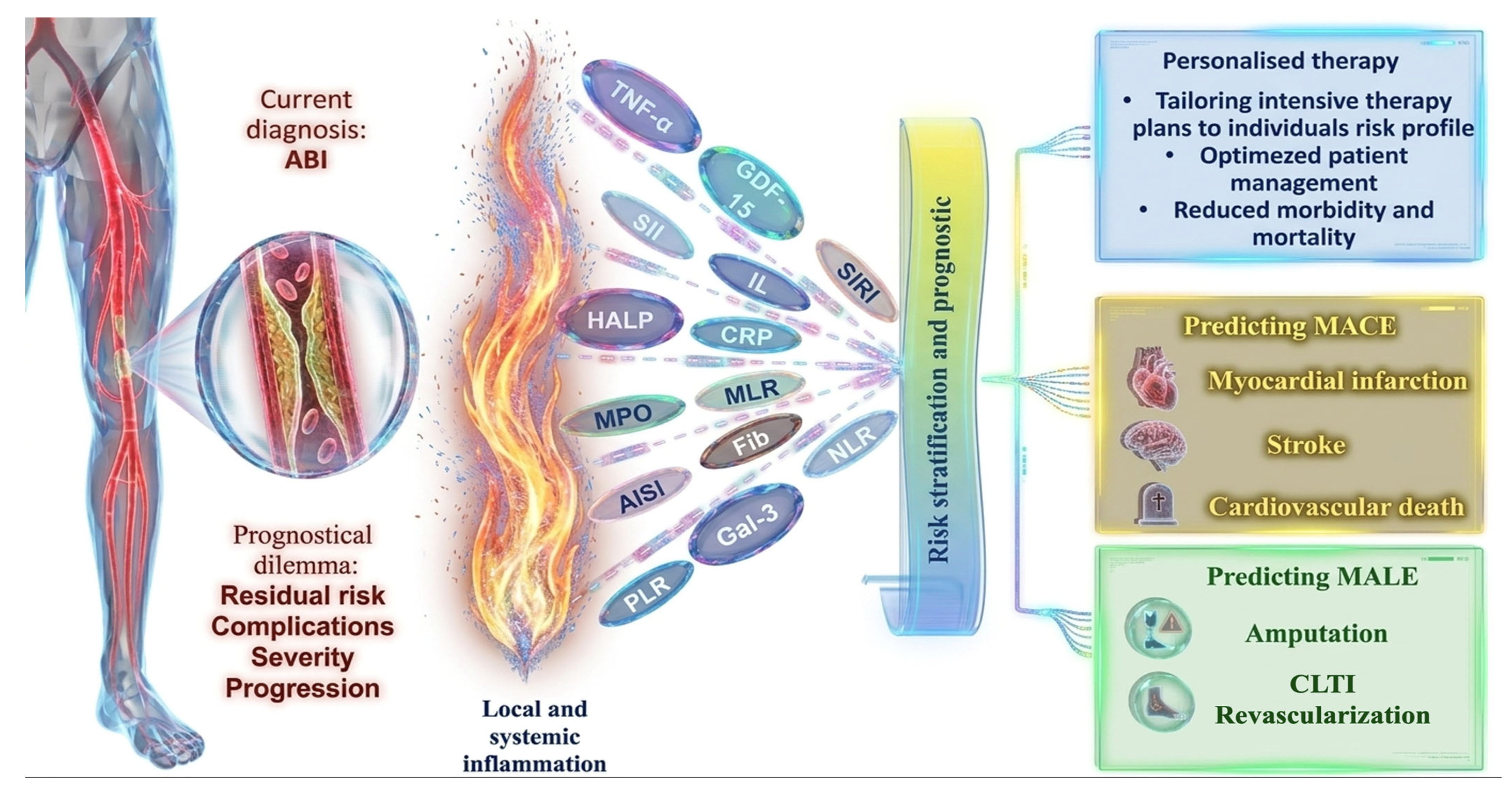
Role of Inflammatory Biomarkers in Peripheral Arterial Disease: A Comprehensive Review of Prognostic and Therapeutic Implications

 ,
,  ,
,  ,
, 
Abstract
1. Introduction
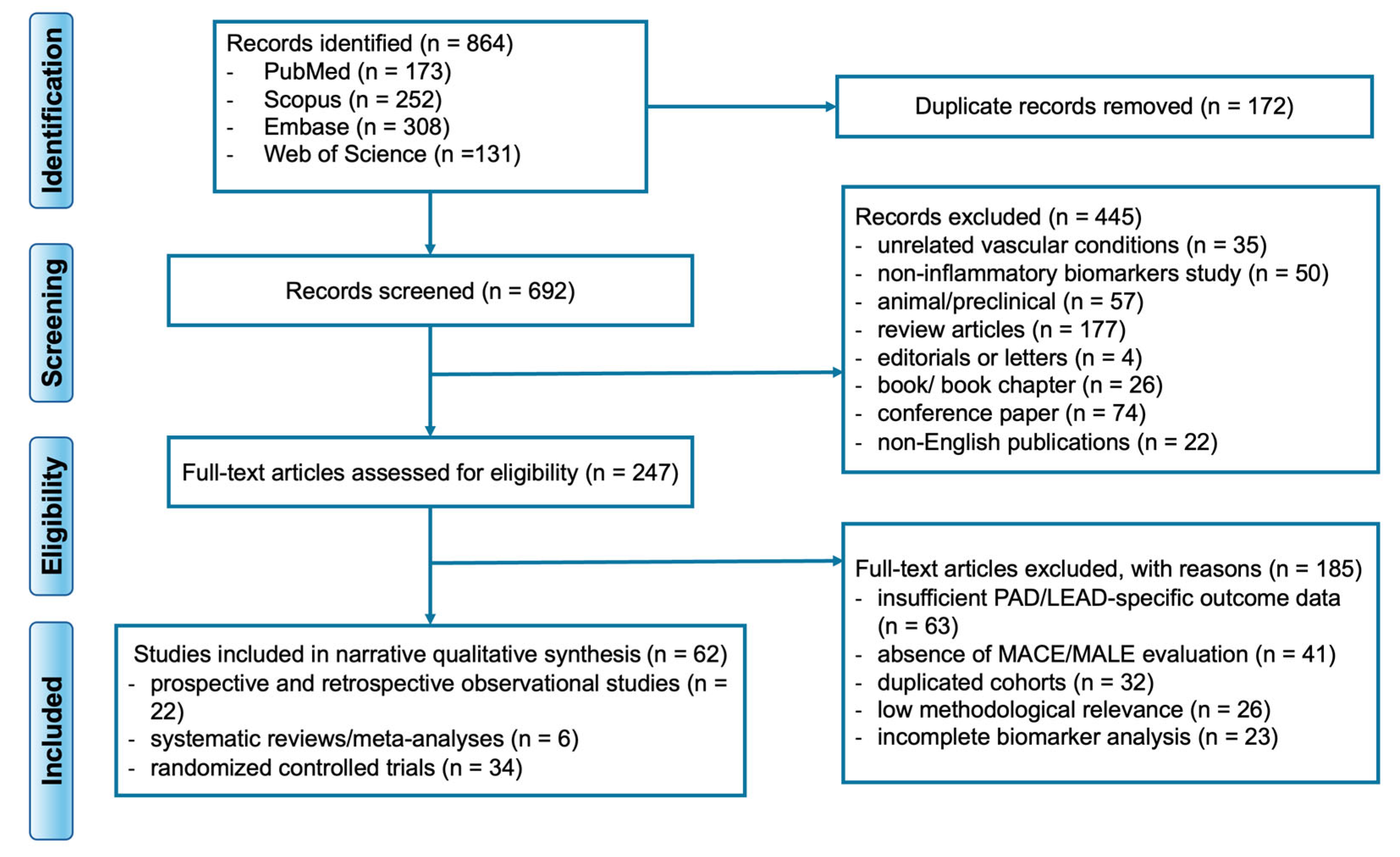
2. Materials and Methods
3. Classical Inflammatory Biomarkers
3.1. C-Reactive Protein (CRP)
3.2. Fibrinogen (Fib)
3.3. Interleukins
3.4. Tumor Necrosis Factor-α
3.5. Myeloperoxidase (MPO)
3.6. Galectin-3 (Gal-3)
3.7. Growth Differentiation Factor 15 (GDF-15)
3.8. Fatty Acid-Binding Proteins (FABPs)
3.9. High-Mobility Group Box-1 (HMGB-1)
3.10. Osteoprotegerin (OPG)

| Marker(s) | Study Design | Population | Sample Size (N) | Objective | Outcomes |
|---|---|---|---|---|---|
| CRP [22] | A systematic review and meta-analysis | PAD patients undergoing lower limb revascularization | 1460 | The association between the baseline CRP levels and postprocedural ALE | High baseline levels are predictive of ALE (target vessel revascularization, amputation, restenosis, disease progression, composite endpoint of any of these ALE) (HR, 1.09; 95% confidence interval, 1.00–1.18; p = 0.04) |
| hs-CRP [23] | Cohort retrospective, single center | PAD patients undergoing EVT for femoropopliteal occlusive disease | 71 | The association between preprocedural hs-CRP and MACEs and MALEs | Elevated hs-CRP values were associated with increased MALEs (HR, 4.015; 95% CI, 1.628–10.551; p = 0.003) |
| IL-1, IL-6, CRP, TNF-alpha, HMGB-1, OPG [24] | Cohort prospective, single center | Diabetic CLTI patients undergoing LER | 264 | The association between a panel of biomarkers and MACEs and MALEs | The biomarker panel significantly improved the prediction of incident events for MACEs (AUC = 0.98; 0.95, 0.99, p < 0.01) and MALEs (AUC = 0.94; 0.91, 0.98, p < 0.01). |
| hs-CRP, fibrinogen [27] | A systematic review and meta-analysis | PAD patients | 21,473 | The association between plasma biomarkers and cardiovascular events and mortality | Increased hs-CRP levels had a relative risk of 1.86 (1.48–2.33) for major adverse cardiovascular events and a relative risk of 3.49 (2.35–5.19) for mortality Increased fibrinogen was associated with an increased relative risk of mortality of 2.08 (1.46–2.97) |
| TNF-α, IL-1, IL-6, hs-CRP [26] | A systematic review and meta-analysis | PAD patients | 4673 | The association of specific inflammatory biomarkers with morbidity and mortality | Elevated levels are consistently linked to major risks—including loss of vascular patency, MACEs/MALEs and all-cause mortality |
| hs-CRP [29] | Cohort prospective, single center | PAD patients with IC | 335 | The associations between hs-CRP and clinical outcomes | Elevated levels were significantly associated with cardiovascular-related and malignancy-related deaths even after adjusting for other risk factors (hazard ratio 2.79; 95% confidence interval 1.66–7.17, p = 0.024) |
| IL-27 [35] | Cohort prospective, single center | PAD patients undergoing EVT | 489 | The association between preprocedural IL-27 and MACEs and MALEs | Elevated levels were an independent predictor of MACEs (HR 2.95; p = 0.039), but not MALEs |
| NLR and TNF-α [37] | A phase III RCT (GHAS trial) | CTLI patients | 35 | An investigation of gene expression and plasma biomarkers CLTI | Markers of mortality in CLTI |
| MPO [38] | Cohort prospective, single center | PAD patients with IC | 110 | A measure of biomarkers of neutrophil activation | High levels are a predictor of 6-month MACEs and/or MALEs (AUC = 0.74, 0.56–0.91, and a sensitivity and specificity of 0.80 and 0.65) for a cut-off of 108.37 ng/mL |
| MPO [39] | Cohort prospective, single center | PAD patients undergoing femoral artery endarterectomy | 37 | The histology of atheromatous plaques in the femoral artery and their association with subsequent cardiovascular events | A higher immunologic score has a significantly higher cumulative risk of MACEs (p = 0.014) |
| Gal-3 [41] | Cohort prospective, single center | PAD patients without CTLI and mild to moderate CKD | 577 | The association between serum and urinary Gal-3 and long-term survival | Elevated urinary Gal-3 is associated with increased mortality (HR 1.60; 1.31–1.95) |
| GDF-15 [42] | Cohort prospective, single center | PAD patients | 454 | To use explainable statistical and machine learning methods to assess the prognostic value of GDF15 for limb outcomes | Plasma GDF15 levels have important prognostic value for 2-year MALEs (AUC = 0.84, accuracy 83.5%, sensitivity 83.6%, specificity 83.7%, PPV 87.3%, and NPV 86.2%) |
| GDF-15 [43] | Cohort prospective, single center | PAD patients before initial EVT | 200 | The association between GDF-15 levels and all-cause mortality rate | In multivariate Cox proportional-hazards regression analysis, serum levels are associated with all-cause mortality and thrombotic and bleeding events (HR, 2.50; 1.67–3.73; p < 0.0001; HR, 2.30; 1.43–6.17; p < 0.0037) |
| FABP4 [44] | Cohort prospective case–control | PAD patients/without PAD patients | 568 with PAD 279 without PAD | The prognostic ability of FABP4 in predicting PAD-related adverse limb events | Higher levels were significantly associated with 3-year MALEs (composite of vascular intervention or major amputation) (unadjusted HR, 1.19; 1.04–1.27; adjusted HR, 1.18; 1.03–1.27; p = 0.022) and worsening PAD status (unadjusted HR, 1.18; 1.13–1.31; adjusted HR, 1.17; 1.12–1.28; p < 0.001). |
| HMGB-1 [45] | Cohort prospective case–control | PAD patients and CLTI after LER | 201 | The association between serum HMGB-1 levels and MACEs and MALEs | Increased serum levels are associated with the incidence of MACEs (AUC = 0.78) and MALEs (AUC = 0.75) |
4. Modern Inflammatory Biomarkers
4.1. The Neutrophil-to-Lymphocyte Ratio (NLR)
4.2. The Platelet-to-Lymphocyte Ratio (PLR)
4.3. Lymphocyte-to-Monocyte Ratio (LMR)
4.4. The Systemic Immune-Inflammation Index (SII)
4.5. The Systemic Inflammatory Response Index (SIRI)
4.6. The Aggregate Index of Systemic Inflammation (AISI)
4.7. C-Reactive Protein-to-Albumin Ratio (CAR)
4.8. Hemoglobin, Albumin, Lymphocyte, and Platelet (HALP) Score
5. Current Anti-Inflammatory Therapy in PAD
5.1. Canakinumab
5.2. Colchicine
5.3. Ziltivekimab
5.4. Statins
5.5. Proprotein Convertase Subtilisin/Kexin Type 9 Inhibitors (PCSK9i)
5.6. Inclisiran
5.7. Ezetimibe
5.8. Icosapent Ethyl (IPE)
5.9. Bempedoic Acid
5.10. Cilostazol
5.11. Antiplatelet Therapy
5.12. Sodium-Glucose Co-Transporter 2 Inhibitors (SGLT2Is)
5.13. Glucagon-like Peptide-1 (GLP-1) Receptor Agonists
5.14. Dipeptidyl Peptidase-4 Inhibitors (DPP4Is)
| Therapeutic Agent | Primary Trial Design and Population | Level of Evidence for PAD | Major Safety Concerns | Cost and Accessibility Considerations | Clinical Readiness |
|---|---|---|---|---|---|
| Canakinumab (IL-1β Inhibitor) | CANTOS trial: Post-MI patients with high CRP [77] | ASCVD RCT with PAD subgroup | Increased rates of neutropenia Higher risk of fatal infections or sepsis [78] | Extremely High Cost: ~$457,982 lifetime cost/patient 0% probability of cost-effectiveness unless costs are cut by 91% [130] | Low/Investigational: Not validated or established as a standard routine therapy for PAD |
| Pilot study: 38 PAD patients [77] | Small exploratory PAD study (terminated prematurely) | ||||
| Colchicine | COLCOT and LoDoCo2 trials: ASCVD patients [79,131] | ASCVD RCT with PAD subgroup | Gastrointestinal side effects Potential uncertainty highlighted by neutral data in other vascular trials (CONVINCE, CHANCE3 and CLEAR-SYNERGY) [84,86,88] | Low cost and high accessibility: widely available as a cheap generic medication [81] | Moderate / Investigational: Lacks current guideline support or definitive clinical validation for PAD Pending the results of the LEADER-PAD trial |
| LEADER-PAD trial (Ongoing): Dedicated high-risk PAD cohort [87] | High-risk PAD patients | ||||
| Ziltivekimab (IL-6 Inhibitor) | ZEUS trial (Ongoing) Established ASCVD and PAD [132] | ASCVD RCT with PAD subgroup (Ongoing large-scale evaluation) | Mild injection site reactions Potential minor lipid changes Notable, beneficial increase in hemoglobin levels [90] | No commercial costs and strictly limited access to clinical trial participants: not yet approved by the FDA or EMA | Low/ Investigational Awaiting outcomes in PAD patients from the large-scale ZEUS trial |
| RESCUE trial: High atherosclerotic risk [90] | CKD RCT on high-atherosclerotic-risk patients | ||||
| Statins | Multiple landmark cardiovascular prevention trials and large observational databases [5,93] | PAD-specific Meta-analyses and Large Observational Cohorts (Strong indirect/subgroup RCT evidence) | Myalgia/Myopathy Elevated liver enzymes (rare) [133] | Very low cost and ubiquitous accessibility: universally available generic drug [134] | Very high: first-line guideline-directed medical therapy for all PAD patients [5,93] |
| PCSK9 Inhibitors (Evolocumab /Alirocumab) | FOURIER (Evolocumab): Established ASCVD/PAD subgroup [97] | ASCVD RCT with prespecified PAD subgroups | Injection site reactions Nasopharyngitis [135] | High cost: represents a significant economic barrier compared to standard statins [136] | High: guideline-directed medical therapy for high-risk vascular patients, statin intolerance, or uncontrolled lipids [5,93] |
| ODYSSEY OUTCOMES (Alirocumab): Post-ACS with PAD subgroup [137] | |||||
| Inclisiran (siRNA) | ORION trials [102] | Familial hyperlipidemia/ASCVD | Injection site reactions Preclinical/In silico modeling for PAD [102] | High cost: requires professional administration via a twice-yearly injection schedule [138] | Moderate: Approved for general lipid-lowering in ASCVD, but its specific readiness for PAD outcomes awaits clinical RCT evidence [5,93] |
| ORION 4 trial (Ongoing) | ASCVD RCT and PAD patients | ||||
| Ezetimibe | IMPROVE-IT trial [139] | ASCVD RCT with PAD Subgroup | Generally well tolerated Rare mild gastrointestinal disturbances or myalgias (usually when combined with statins) [5,93] | Low cost and high accessibility: widely available as an affordable generic drug globally [140] | Very high: highly established second-line lipid-lowering therapy recommended by guidelines when statin targets are not met [5,93] |
| Multiple observational cohorts and lipid guidelines [5,93] | Strong clinical database evidence | ||||
| Bempedoic Acid | CLEAR Outcomes trial; statin-intolerant patients with high cardiovascular risk or established ASCVD [106] | ASCVD RCT with PAD Subgroup | Hyperuricemia (increased risk of gout) Small risk of tendon rupture Elevated liver enzymes [5] | Moderate cost: more expensive than generic statins/ezetimibe [141] | High: guideline-recommended medical therapy as a potent alternative/adjunct for high-risk PAD patients with statin intolerance [5] |
| Icosapent Ethyl (IPE) | REDUCE-IT: Patients with established ASCVD or diabetes, plus elevated triglycerides despite statin therapy [105] | ASCVD RCT with prespecified PAD subgroup | Increased risk of atrial fibrillation/flutter Slight increase in minor bleeding risks [105] | Moderate-to-high cost: Subject to regional availability and specific prior-authorization policies based on triglyceride levels [142] | High: strongly endorsed by international guidelines for high-risk vascular patients with persistent hypertriglyceridemia [5,93] |
| Cilostazol (PDE3 Inhibitor) focusing on IC and post-EVT patency | Multiple dedicated PAD trials [5,93] | PAD-Specific RCTs | Headache, diarrhea, palpitations. Contraindicated in patients with heart failure. | Low-to-moderate cost: readily accessible and affordable [143] | Very low: current clinical 2024 ESC Guidelines do not recommend cilostazol for the explicit purpose of MACE reduction or in the context of LEAD management [5,93] Very High: Approved and universally designated as a first-line medical treatment for severe IC according to 2024 ACC/AHA Guidelines [93] |
| Dual Pathway Inhibition (Aspirin + Rivaroxaban) | COMPASS and VOYAGER PAD: Stable vascular disease and post-revascularization PAD patients [5,93] | PAD-Specific RCTs (Large-scale dedicated multi-center trials) | Significantly increased risk of major bleeding (though fatal/intracranial bleeding is not significantly increased) [5,93] | Moderate cost: Rivaroxaban (2.5 mg bid) requires specific healthcare insurance/prescription authorization depending on regional rules [144] | Moderate: should be considered for patients with PAD and non-high bleeding risk at high ischemic risk or following lower-limb revascularization [5] High: in symptomatic PAD patients with no recent revascularization/recent revascularization (endovascular or surgical) [93] |
| SGLT2 Inhibitors (Dapagliflozin/Empagliflozin) | EMPA-REG, DECLARE-TIMI 58: Type 2 Diabetes and ASCVD cohorts with PAD subgroups [125,127] | ASCVD RCT with PAD subgroup | Genital mycotic infections [5,93] | Moderate-to-high cost: highly accessible for metabolic/diabetic indications [145] | High: fully ready and increasingly used for diabetic patients with concurrent PAD due to established systemic cardioprotective benefits [5,93] |
| GLP-1 Receptor Agonists (Liraglutide/Semaglutide) | LEADER and SUSTAIN: Type 2 diabetes and high cardiovascular risk cohorts [128,146] STRIDE (Ongoing): Dedicated symptomatic PAD and type 2 diabetes trial [128] | ASCVD RCT with PAD Subgroup | Gastrointestinal side effects (nausea, vomiting) Risk of dehydration [147] | High cost: substantial economic consideration, although widely covered for diabetic indications [148] | High: fully ready and increasingly used for diabetic patients with concurrent PAD due to established systemic cardioprotective benefits [5,93] |
| DPP-4 Inhibitors (DPP4Is) | Multiple large cardiovascular safety trials in type 2 diabetes populations [89,123] | ASCVD RCT with PAD Subgroup | Generally safe and well tolerated Minimal gastrointestinal side effects [149] | Moderate cost: widely available and accessible for diabetic patients [150] | Low: Highly ready as safe antidiabetic drugs, but show a neutral effect on ischemic outcomes and fail to slow PAD progression They lack current guideline support for PAD management. |
6. Strengths, Limitations, and Confounding Factors in Current Evidence
7. Future Direction
8. Conclusions
Author Contributions
Funding
Institutional Review Board Statement
Informed Consent Statement
Data Availability Statement
Acknowledgments
Conflicts of Interest
Abbreviations
| ABI | Ankle-Brachial Index |
| AFS | Amputation-free survival |
| AISI | The Aggregate Index of Systemic Inflammation |
| ALE | Acute limb event |
| ALI | Acute limb ischemia |
| AMI | Acute myocardial infarction |
| ASCVD | atherosclerotic cardiovascular disease |
| ASO | Arteriosclerosis obliterans |
| AUC | Area under the curve |
| CAD | Coronary artery disease |
| CAR | C-reactive protein-to-albumin ratio |
| CLTI | Chronic limb-threatening ischemia |
| CRP | C-reactive protein |
| CVD | Cardiovascular disease |
| DAPT | Dual antiplatelet therapy |
| DCB | Drug-coated balloon |
| DPP4Is | Dipeptidyl Peptidase-4 Inhibitors |
| EVT | Endovascular therapy |
| FABPs | Fatty acid-binding proteins |
| Fib | Fibrinogen |
| FMD | Flow-mediated dilation |
| GAL-3 | Galectine-3 |
| GDF-15 | Growth Differentiation Factor 15 |
| GLP-1 | Glucagon-like peptide-1 |
| HALP score | Hemoglobin, Albumin, Lymphocyte, and Platelet score |
| HGMB-1 | High-Mobility Group Box-1 |
| hs-CRP | High-sensitivity C-reactive protein |
| IC | Intermittent claudication |
| IL | Interleukins |
| IL-10 | Interleukin-10 |
| IL-1β | Interleukin-1β |
| IL-27 | Interleukin-27 |
| IL-6 | Interleukin-6 |
| IL-8 | Interleukin-8 |
| IMT | Intima-media thickness |
| IPE | Icosapent ethyl |
| IPH | Intraplaque hemorrhage |
| LCN-2 | Lipocalin-2 |
| LDL | Low-density lipoproteins |
| LDL-C | Low-density lipoprotein cholesterol |
| LMR | Lymphocyte-to-Monocyte Ratio |
| Lp(a) | Lipoprotein(a) |
| MAC | Medial arterial calcification |
| MACEs | Major adverse cardiovascular events |
| MALEs | Major adverse limb events |
| MI | Myocardial infarction |
| MLR | Monocytes/Lymphocytes ratio |
| MPO | Myeloperoxidase |
| MPV | Mean platelet volume |
| NAFLD | Non-alcoholic fatty liver disease |
| NLR | Neutrophils/Lymphocytes ratio |
| OPG | Osteoprotegerin |
| PAD | Peripheral arterial disease |
| PCI | Percutaneous coronary intervention |
| PIV | Pan-Immune Inflammation Value |
| PLR | Platelets/Lymphocytes ratio |
| PTA | Percutaneous transluminal angioplasty |
| SFA | Superficial femoral artery |
| SGLT2Is | Sodium-glucose co-transporter 2 inhibitors |
| SII | Systemic immune-inflammation index |
| SIRI | The Systemic Inflammatory Response Index |
| siRNA | Small interfering RNA |
| sST2 | Soluble Suppression of Tumorigenicity 2 |
| TCFAs | Thin-Cap Fibroatheromas |
| TNF-α | Tumor necrosis factor-α |
References
- Reitz, K.M.; Althouse, A.D.; Forman, D.E.; Zuckerbraun, B.S.; Vodovotz, Y.; Zamora, R.; Raffai, R.L.; Hall, D.E.; Tzeng, E. MetfOrmin BenefIts Lower Extremities with Intermittent Claudication (MOBILE IC): Randomized clinical trial protocol. BMC Cardiovasc. Disord. 2023, 23, 38. [Google Scholar] [CrossRef]
- Kurniawan, R.B.; Siahaan, P.P.; Saputra, P.B.; Arnindita, J.N.; Savitri, C.G.; Faizah, N.N.; Andira, L.H.; D’Oria, M.; Eko Putranto, J.N.; Alkaff, F.F. Neutrophil-to-lymphocyte ratio as a prognostic biomarker in patients with peripheral artery disease: A systematic review and meta-analysis. Vasc. Med. 2024, 29, 687–699. [Google Scholar] [CrossRef] [PubMed]
- Abbas, A.E.; Goodman, L.M.; Timmis, R.; Boura, J. Predictors of poor outcome in female patients undergoing endovascular intervention. J. Interv. Cardiol. 2010, 23, 401–410. [Google Scholar] [CrossRef] [PubMed]
- Mastracci, T.M.; Anand, S.S.; Aday, A.W. Peripheral Artery Disease: A High-Risk Yet Understudied, Underdiagnosed, and Undertreated Condition-A Call to Action. Can. J. Cardiol. 2022, 38, 553–554. [Google Scholar] [CrossRef]
- Mazzolai, L.; Teixido-Tura, G.; Lanzi, S.; Boc, V.; Bossone, E.; Brodmann, M.; Bura-Riviere, A.; De Backer, J.; Deglise, S.; Della Corte, A.; et al. 2024 ESC Guidelines for the management of peripheral arterial and aortic diseases. Eur. Heart J. 2024, 45, 3538–3700. [Google Scholar] [CrossRef] [PubMed]
- Yu, Z.; Lu, B.; Han, R.; Tu, C. Exploring the hemoglobin-to-red blood cell distribution width ratio (HRR) to peripheral arterial disease nexus: A comprehensive analysis of NHANES data from 1999 to 2004. Front. Pharmacol. 2025, 16, 1529155. [Google Scholar] [CrossRef]
- Zierfuss, B.; Feldscher, A.; Hobaus, C.; Hannes, A.; Koppensteiner, R.; Schernthaner, G.H. NT-proBNP as a surrogate for unknown heart failure and its predictive power for peripheral artery disease outcome and phenotype. Sci. Rep. 2023, 13, 8029. [Google Scholar] [CrossRef]
- Achim, A.; Peter, O.A.; Cocoi, M.; Serban, A.; Mot, S.; Dadarlat-Pop, A.; Nemes, A.; Ruzsa, Z. Correlation between Coronary Artery Disease with Other Arterial Systems: Similar, Albeit Separate, Underlying Pathophysiologic Mechanisms. J. Cardiovasc. Dev. Dis. 2023, 10, 210. [Google Scholar] [CrossRef]
- Kawai, K.; Kawakami, R.; Finn, A.V.; Virmani, R. Differences in Stable and Unstable Atherosclerotic Plaque. Arterioscler. Thromb. Vasc. Biol. 2024, 44, 1474–1484. [Google Scholar] [CrossRef]
- Narula, N.; Olin, J.W.; Narula, N. Pathologic Disparities Between Peripheral Artery Disease and Coronary Artery Disease. Arterioscler. Thromb. Vasc. Biol. 2020, 40, 1982–1989. [Google Scholar] [CrossRef]
- Wentzel, J.J.; Bos, D.; White, S.J.; van der Heiden, K.; Kavousi, M.; Evans, P.C. Sex-related differences in coronary and carotid vessel geometry, plaque composition and shear stress obtained from imaging. Atherosclerosis 2024, 395, 117616. [Google Scholar] [CrossRef] [PubMed]
- Russo, M.; Gurgoglione, F.L.; Russo, A.; Rinaldi, R.; Torlai Triglia, L.; Foschi, M.; Vigna, C.; Vergallo, R.; Montone, R.A.; Benedetto, U.; et al. Coronary Artery Disease and Atherosclerosis in Other Vascular Districts: Epidemiology, Risk Factors and Atherosclerotic Plaque Features. Life 2025, 15, 1226. [Google Scholar] [CrossRef]
- Stenmark, K.R.; Yeager, M.E.; El Kasmi, K.C.; Nozik-Grayck, E.; Gerasimovskaya, E.V.; Li, M.; Riddle, S.R.; Frid, M.G. The adventitia: Essential regulator of vascular wall structure and function. Annu. Rev. Physiol. 2013, 75, 23–47. [Google Scholar] [CrossRef]
- Zhao, X.; Underhill, H.R.; Zhao, Q.; Cai, J.; Li, F.; Oikawa, M.; Dong, L.; Ota, H.; Hatsukami, T.S.; Chu, B.; et al. Discriminating carotid atherosclerotic lesion severity by luminal stenosis and plaque burden: A comparison utilizing high-resolution magnetic resonance imaging at 3.0 Tesla. Stroke 2011, 42, 347–353. [Google Scholar] [CrossRef]
- Thakur, M.; Quillard, T.; Angliker, N.; Siegrist, M.; Jansen, Y.; Yan, Y.; Wollenhaupt, J.; Goettsch, C.; Maegdefessel, L.; Sachs, N.; et al. DDR1 Regulates Femoral Arterial Calcification in Lower-Extremity Artery Disease Through NF-Kappa B Activation. Acta Physiol. 2026, 242, e70146. [Google Scholar] [CrossRef]
- Mackey, R.H.; Venkitachalam, L.; Sutton-Tyrrell, K. Calcifications, arterial stiffness and atherosclerosis. Adv. Cardiol. 2007, 44, 234–244. [Google Scholar] [CrossRef]
- Ring, A.; Ismaeel, A.; Wechsler, M.; Fletcher, E.; Papoutsi, E.; Miserlis, D.; Koutakis, P. MicroRNAs in peripheral artery disease: Potential biomarkers and pathophysiological mechanisms. Ther. Adv. Cardiovasc. Dis. 2022, 16, 17539447221096940. [Google Scholar] [CrossRef]
- Schnidrig, K.; Thakur, M.; Tuleja, A.; Bernhard, S.M.; Noels, H.; Kotelis, D.; Schindewolf, M.; Doring, Y. Implications of inflammation and sex in lower extremity arterial disease. Eur. J. Clin. Investig. 2026, 56, e70144. [Google Scholar] [CrossRef] [PubMed]
- Cosarca, M.C.; Halmaciu, I.; Muresan, A.V.; Suciu, B.A.; Molnar, C.; Russu, E.; Horvath, E.; Niculescu, R.; Puscasiu, L.; Bacalbasa, N.; et al. Neutrophil-to-lymphocyte, platelet-to-lymphocyte and lymphocyte-to-monocyte ratios are associated with amputation rates in patients with peripheral arterial disease and diabetes mellitus who underwent revascularization: A Romanian regional center study. Exp. Ther. Med. 2022, 24, 703. [Google Scholar] [CrossRef] [PubMed]
- Bonaca, M.P.; Hamburg, N.M.; Creager, M.A. Contemporary Medical Management of Peripheral Artery Disease. Circ. Res. 2021, 128, 1868–1884. [Google Scholar] [CrossRef]
- Hobaus, C.; Herz, C.T.; Wrba, T.; Koppensteiner, R.; Schernthaner, G.H. Peripheral arterial disease and type 2 diabetes: Older patients still exhibit a survival benefit from glucose control. Diab Vasc. Dis. Res. 2020, 17, 1479164120914845. [Google Scholar] [CrossRef] [PubMed]
- Di, X.; Han, W.; Liu, C.W.; Ni, L.; Zhang, R. A systematic review and meta-analysis on the association between C-reactive protein levels and adverse limb events after revascularization in patients with peripheral arterial disease. J. Vasc. Surg. 2021, 74, 317–326. [Google Scholar] [CrossRef]
- Di, X.; Han, W.; Zhang, R.; Liu, C.; Zheng, Y. C-reactive Protein, Free Fatty Acid, and Uric Acid as Predictors of Adverse Events after Endovascular Revascularization of Arterial Femoropopliteal Occlusion Lesions. Ann. Vasc. Surg. 2022, 81, 333–342. [Google Scholar] [CrossRef]
- Nardella, E.; Biscetti, F.; Rando, M.M.; Cecchini, A.L.; Nicolazzi, M.A.; Rossini, E.; Angelini, F.; Iezzi, R.; Eraso, L.H.; Dimuzio, P.J.; et al. Development of a biomarker panel for assessing cardiovascular risk in diabetic patients with chronic limb-threatening ischemia (CLTI): A prospective study. Cardiovasc. Diabetol. 2023, 22, 136. [Google Scholar] [CrossRef]
- Popescu, A.I.; Rata, A.L.; Barac, S.; Popescu, R.; Onofrei, R.R.; Vlad, C.; Vlad, D. Narrative Review of Biological Markers in Chronic Limb-Threatening Ischemia. Biomedicines 2024, 12, 798. [Google Scholar] [CrossRef]
- Fragao-Marques, M.; Francisca-Marques, M.; Rocha Neves, J.; Ozben, T. Association of inflammatory biomarkers with morbidity and mortality risk in patients with peripheral artery disease: A systematic review and -meta-analysis. Crit. Rev. Clin. Lab. Sci. 2025, 62, 548–567. [Google Scholar] [CrossRef]
- Kremers, B.; Wubbeke, L.; Mees, B.; Ten Cate, H.; Spronk, H.; Ten Cate-Hoek, A. Plasma Biomarkers to Predict Cardiovascular Outcome in Patients With Peripheral Artery Disease: A Systematic Review and Meta-Analysis. Arterioscler. Thromb. Vasc. Biol. 2020, 40, 2018–2032. [Google Scholar] [CrossRef]
- Song, P.; Xiong, H.; Quan, X.; Chen, Q.; Wang, D.; Liu, X.; Shi, M. Predictive factors and models for major adverse cardiovascular and limb events in patients with peripheral arterial disease. Vasa 2025. [Google Scholar] [CrossRef]
- Fukase, T.; Dohi, T.; Kato, Y.; Chikata, Y.; Takahashi, N.; Endo, H.; Doi, S.; Nishiyama, H.; Okai, I.; Iwata, H.; et al. Long-term impact of high-sensitivity C-reactive protein in patients with intermittent claudication due to peripheral artery disease following endovascular treatment. Heart Vessel. 2021, 36, 1670–1678. [Google Scholar] [CrossRef] [PubMed]
- Saenz-Pipaon, G.; Martinez-Aguilar, E.; Orbe, J.; Gonzalez Miqueo, A.; Fernandez-Alonso, L.; Paramo, J.A.; Roncal, C. The Role of Circulating Biomarkers in Peripheral Arterial Disease. Int. J. Mol. Sci. 2021, 22, 3601. [Google Scholar] [CrossRef] [PubMed]
- Ferreira, J.; Carneiro, A.; Vila, I.; Silva, C.; Cunha, C.; Longatto-Filho, A.; Mesquita, A.; Cotter, J.; Mansilha, A.; Correia-Neves, M.; et al. Inflammation and Loss of Skeletal Muscle Mass in Chronic Limb Threatening Ischemia. Ann. Vasc. Surg. 2023, 88, 164–173. [Google Scholar] [CrossRef]
- Wang, J.; Tan, G.J.; Han, L.N.; Bai, Y.Y.; He, M.; Liu, H.B. Novel biomarkers for cardiovascular risk prediction. J. Geriatr. Cardiol. 2017, 14, 135–150. [Google Scholar] [CrossRef]
- Ferreira, J.; Roque, S.; Lima Carneiro, A.; Longatto-Filho, A.; Vila, I.N.; Cunha, C.; Silva, C.; Mesquita, A.; Cotter, J.; Correia-Neves, M.; et al. Reversion of the Inflammatory Markers in Patients With Chronic Limb-Threatening Ischemia. J. Am. Heart Assoc. 2024, 13, e031922. [Google Scholar] [CrossRef]
- Vieceli Dalla Sega, F.; Cimaglia, P.; Manfrini, M.; Fortini, F.; Marracino, L.; Bernucci, D.; Pompei, G.; Scala, A.; Trichilo, M.; De Carolis, B.; et al. Circulating Biomarkers of Endothelial Dysfunction and Inflammation in Predicting Clinical Outcomes in Diabetic Patients with Critical Limb Ischemia. Int. J. Mol. Sci. 2022, 23, 10641. [Google Scholar] [CrossRef]
- Kokalj, N.; Jug, B. Prognostic Impact of Interleukin-27 in Peripheral Artery Disease. Life 2025, 15, 1768. [Google Scholar] [CrossRef]
- Biscetti, F.; Ferraro, P.M.; Hiatt, W.R.; Angelini, F.; Nardella, E.; Cecchini, A.L.; Santoliquido, A.; Pitocco, D.; Landolfi, R.; Flex, A. Inflammatory Cytokines Associated With Failure of Lower-Extremity Endovascular Revascularization (LER): A Prospective Study of a Population With Diabetes. Diabetes Care 2019, 42, 1939–1945. [Google Scholar] [CrossRef]
- Caicedo, D.; Alvarez, C.V.; Perez-Romero, S.; Devesa, J. The Inflammatory Pattern of Chronic Limb-Threatening Ischemia in Muscles: The TNF-alpha Hypothesis. Biomedicines 2022, 10, 489. [Google Scholar] [CrossRef]
- Buso, G.; Faggin, E.; Bressan, A.; Galliazzo, S.; Cinetto, F.; Felice, C.; Fusaro, M.; Erdmann, A.; Pauletto, P.; Rattazzi, M.; et al. Biomarkers of Neutrophil Activation in Patients with Symptomatic Chronic Peripheral Artery Disease Predict Worse Cardiovascular Outcome. Biomedicines 2023, 11, 866. [Google Scholar] [CrossRef]
- Kim, S.M.; Hong, S.A.; Kim, J.M. Association of immunologic findings of atheromatous plaques with subsequent cardiovascular events in patients with peripheral artery disease. Sci. Rep. 2024, 14, 469. [Google Scholar] [CrossRef]
- Chiu, L.T.; Hsu, B.G.; Lai, Y.H.; Wang, C.H.; Tsai, J.P. High Serum Galectin-3 Level as a Potential Biomarker of Peripheral Artery Disease in Patients Undergoing Hemodialysis. Rev. Cardiovasc. Med. 2024, 25, 124. [Google Scholar] [CrossRef]
- Ursli, M.; Zierfuss, B.; Grigassy, T.; Pesau, G.; Koppensteiner, R.; Schernthaner, G.H.; Hobaus, C. Galectin-3 is linked to peripheral artery disease severity, and urinary excretion is associated with long-term mortality. Atherosclerosis 2022, 341, 7–12. [Google Scholar] [CrossRef]
- Li, B.; Shaikh, F.; Younes, H.; Abuhalimeh, B.; Zamzam, A.; Abdin, R.; Qadura, M. Investigation of Growth Differentiation Factor 15 as a Prognostic Biomarker for Major Adverse Limb Events in Peripheral Artery Disease. J. Clin. Med. 2025, 14, 5239. [Google Scholar] [CrossRef]
- Shikama, T.; Otaki, Y.; Watanabe, T.; Tamura, H.; Kato, S.; Nishiyama, S.; Takahashi, H.; Arimoto, T.; Watanabe, M. Growth Differentiation Factor-15 and Clinical Outcomes in Lower Extremity Artery Disease. J. Atheroscler. Thromb. 2024, 31, 964–978. [Google Scholar] [CrossRef]
- Li, B.; Zamzam, A.; Syed, M.H.; Djahanpour, N.; Jain, S.; Abdin, R.; Qadura, M. Fatty acid binding protein 4 has prognostic value in peripheral artery disease. J. Vasc. Surg. 2023, 78, 719–726. [Google Scholar] [CrossRef]
- Rando, M.M.; Biscetti, F.; Cecchini, A.L.; Nardella, E.; Nicolazzi, M.A.; Angelini, F.; Iezzi, R.; Eraso, L.H.; Dimuzio, P.J.; Pitocco, D.; et al. Serum high mobility group box-1 levels associated with cardiovascular events after lower extremity revascularization: A prospective study of a diabetic population. Cardiovasc. Diabetol. 2022, 21, 214. [Google Scholar] [CrossRef]
- Kadoglou, N.P.E.; Kapetanios, D.; Korakas, E.; Valsami, G.; Tentolouris, N.; Papanas, N.; Lambadiari, V.; Karkos, C. Association of serum levels of osteopontin and osteoprotegerin with adverse outcomes after endovascular revascularisation in peripheral artery disease. Cardiovasc. Diabetol. 2022, 21, 171. [Google Scholar] [CrossRef]
- Poredos, P.; Sabovic, M.; Bozic Mijovski, M.; Nikolajevic, J.; Antignani, P.L.; Paraskevas, K.I.; Mikhailidis, D.P.; Blinc, A. Inflammatory and Prothrombotic Biomarkers, DNA Polymorphisms, MicroRNAs and Personalized Medicine for Patients with Peripheral Arterial Disease. Int. J. Mol. Sci. 2022, 23, 12054. [Google Scholar] [CrossRef]
- Baytugan, N.Z.; Kandemir, H.C.; Dagli, M.; Bezgin, T.; Celik, A.I.; Zengin, A.; Cagdas, M. Inflammatory-Related Biomarkers in Patients Undergoing Percutaneous Transluminal Angioplasty for Femoropopliteal Artery Lesions. Acta Cardiol. Sin. 2025, 41, 138–147. [Google Scholar] [CrossRef]
- Onofrei, V.; Crisan, A.; Adam, C.A.; Marcu, D.T.M.; Haba, M.S.C.; Tribus, L.C.; Ceasovschih, A.; Esanu, I.M.; Petroaie, A.D.; Crisan-Dabija, R.; et al. The Role Played by Novel Inflammatory Markers in Assessment of Peripheral Artery Disease. Medicina 2023, 59, 1557. [Google Scholar] [CrossRef]
- Adler, L.S.F.; Rabie, E.M.; Shave, S.M.; Alla, A.; Rahimi, S.A.; Beckerman, W.E. Neutrophil-To-Lymphocyte Ratio as a Predictive Tool for Post-Operative Outcomes in Patients Undergoing Open Lower Extremity Revascularization Procedures. Ann. Vasc. Surg. 2022, 87, 155–163. [Google Scholar] [CrossRef]
- Russu, E.; Muresan, A.V.; Arbanasi, E.M.; Kaller, R.; Hosu, I.; Voidazan, S.; Arbanasi, E.M.; Cosarca, C.M. The Predictive Role of NLR and PLR in Outcome and Patency of Lower Limb Revascularization in Patients with Femoropopliteal Disease. J. Clin. Med. 2022, 11, 2620. [Google Scholar] [CrossRef]
- Yamamoto, Y.; Kazama, A.; Kikuchi, T.; Kudo, T. Preoperative Neutrophil-to-Lymphocyte Ratio as a Predictor of Clinical Outcomes in Patients Undergoing Femoral Endarterectomy. J. Clin. Med. 2025, 14, 211. [Google Scholar] [CrossRef]
- Huang, Z.; Ni, X.; Dai, Q. Predictive Value of Lymphocyte-Based Inflammation Index for Clinical Outcome in Patients With Lower Extremity Arteriosclerosis Obliterans: A Systematic Review and Meta-Analysis. Angiology 2025, 33197251399864. [Google Scholar] [CrossRef]
- Pan, T.; Tian, S.Y.; Liu, Z.; Zhang, T.; Li, C.; Ji, D.H.; Wang, F. Relationship Between Neutrophil-Lymphocyte Ratio and Drug-Coated Balloon Restenosis in Patients With Femoropopliteal Arterial Disease. Angiology 2023, 74, 252–258. [Google Scholar] [CrossRef]
- Toz, H.; Kuserli, Y.; Turkyilmaz, G.; Satilmis, O.E.; Kavala, A.A.; Turkyilmaz, S. The Relationship Between Neutrophil-to-Lymphocyte Ratio and Restenosis in Patients With Femoropopliteal Chronic Total Occlusion Treated With Drug-Coated Balloon Alone Versus Combined Atherectomy and Drug-Coated Balloon. Vasc. Endovasc. Surg. 2026, 60, 125–134. [Google Scholar] [CrossRef] [PubMed]
- Wang, Z.; Sheng, L.; Gu, H.; Yang, F.; Xie, H.; Li, M. Neutrophil-to-Lymphocyte Ratio Predicts Restenosis After Drug-Coated Balloon Therapy for Femoropopliteal Artery Lesions: A Retrospective Study. Front. Cardiovasc. Med. 2022, 9, 868656. [Google Scholar] [CrossRef] [PubMed]
- Erdogan, S.B.; Selcuk, U.N.; Bastopcu, M.; Arslanhan, G.; Cakmak, A.Y.; Kuplay, H.; Mete, E.M.; Aka, S.A. Critical limb ischemia patients clinically improving with medical treatment have lower neutrophil-to-lymphocyte and platelet-to-lymphocyte ratios. Vascular 2021, 29, 920–926. [Google Scholar] [CrossRef]
- Garcia-Rivera, E.; San Norberto, E.M.; Fidalgo-Domingos, L.; Revilla-Calavia, A.; Estevez-Fernandez, I.; Cenizo-Revuelta, N.; Martin-Pedrosa, M.; Vaquero-Puerta, C. Impact of nutritional and inflammatory status in patients with critical limb-threatening ischemia. Int. Angiol. 2021, 40, 504–511. [Google Scholar] [CrossRef]
- GonzAlez-Hernandez, J.; Varela, C.; Michel, I.; Laime, I.V.; Uyaguari, J.; March, J.R. Neutrophil-lymphocyte ratio as a link between complex pedal ulcers and poor clinical results after infrainguinal surgical revascularization. Int. Angiol. 2021, 40, 112–124. [Google Scholar] [CrossRef]
- King, A.H.; Kwan, S.; Schmaier, A.H.; Kumins, N.H.; Harth, K.C.; Colvard, B.D.; Wong, V.L.; Kashyap, V.S.; Cho, J.S. Elevated neutrophil to lymphocyte ratio is associated with decreased amputation-free survival after femoropopliteal percutaneous revascularization. Int. Angiol. 2021, 40, 442–449. [Google Scholar] [CrossRef] [PubMed]
- Su, M.I.; Liu, C.W. Neutrophil-to-lymphocyte ratio associated with an increased risk of mortality in patients with critical limb ischemia. PLoS ONE 2021, 16, e0252030. [Google Scholar] [CrossRef]
- Arbanasi, E.M.; Muresan, A.V.; Cosarca, C.M.; Kaller, R.; Bud, T.I.; Hosu, I.; Voidazan, S.T.; Arbanasi, E.M.; Russu, E. Neutrophil-to-Lymphocyte Ratio and Platelet-to-Lymphocyte Ratio Impact on Predicting Outcomes in Patients with Acute Limb Ischemia. Life 2022, 12, 822. [Google Scholar] [CrossRef]
- Coelho, N.H.; Coelho, A.; Augusto, R.; Semiao, C.; Peixoto, J.; Fernandes, L.; Martins, V.; Canedo, A.; Gregorio, T. Pre-operative Neutrophil to Lymphocyte Ratio is Associated With 30 Day Death or Amputation After Revascularisation for Acute Limb Ischaemia. Eur. J. Vasc. Endovasc. Surg. 2021, 62, 74–80. [Google Scholar] [CrossRef]
- Del Rio-Sola, M.A.L.; Asensio-Rodriguez, S.; Perez-Fernandez, S.; Roedan-Oliver, J. Inflammatory Biomarkers and Outcomes in Acute Lower Limb Ischemia: A Systematic Review and Meta-Analysis. Ann. Vasc. Surg. 2026, 123, 560–571. [Google Scholar] [CrossRef]
- Babes, E.E.; Radu, A.F.; Cretu, N.A.; Bungau, G.; Diaconu, C.C.; Tit, D.M.; Babes, V.V. Risk Stratification in Acute Coronary Syndromes: The Systemic Immune-Inflammation Index as Prognostic Marker. Med. Sci. 2025, 13, 116. [Google Scholar] [CrossRef]
- Tian, S.Y. Systemic Immune-Inflammation Index Predicts Restenosis after Interventions for Lower Extremity Arteriosclerosis Obliterans. Heart Surg. Forum 2023, 26, E225–E233. [Google Scholar] [CrossRef]
- Murat, B.; Aydin, F.; Sener, E.; Ozden, B.; Kaya, I.C.; Heval, A.; Murat, S. Impact of the Pre-Procedural Pan-Immune Inflammation Value on Long-Term Mortality in Patients With Peripheral Artery Disease Following Endovascular Treatment: A Comparative Study. Angiology 2025, 33197251383344. [Google Scholar] [CrossRef] [PubMed]
- Dragan, A.; Dragan, A.S.; Stiru, O. The Predictive Value of Perioperative Inflammatory Indexes in Major Arterial Surgical Revascularization from Leriche Syndrome. J. Clin. Med. 2024, 13, 6338. [Google Scholar] [CrossRef] [PubMed]
- Guler, Y.; Genc, O.; Akbas, F.; Yildirim, A.; Cetin, I.; Erdogan, A.; Halil, U.S.; Akgun, H.; Erdem, B.; Guler, A.; et al. Predictive value of the inflammatory indices on wound healing in patients with chronic limb-threatening ischemia revascularized via percutaneous intervention. Vasc. Med. 2025, 30, 186–196. [Google Scholar] [CrossRef]
- Erdogan, O.; Erdogan, T.; Panc, C.; Tasbulak, O.; Yalcin, A.A.; Erturk, M. The Aggregate Index of Systemic Inflammation: A Novel Inflammatory Marker for Predicting Restenosis Risk in Superficial Femoral Artery Lesions after Endovascular Treatment. Ann. Vasc. Surg. 2025, 120, 260–269. [Google Scholar] [CrossRef] [PubMed]
- Panc, C.; Guler, A.; Gurbak, I.; Tasbulak, O.; Guner, A.; Kalkan, A.K.; Yalcin, A.A.; Erturk, M. Association Between CRP/Albumin Ratio and Long-Term Mortality in Patients With cHronIc Limb-Threatening Ischemia Undergoing EndovaScular Therapy Below The Knee: The ACHILES-BTK Registry. Ann. Vasc. Surg. 2022, 82, 172–180. [Google Scholar] [CrossRef]
- Saputra, P.B.T.; Purwati, D.D.; Oktafia, P.; Kurniawan, R.B.; Savitri, C.G.; Putranto, J.N.E.; Multazam, C.; D’Oria, M.; Alkaff, F.F. C-reactive protein-to-albumin ratio in peripheral artery disease. Open Med. 2025, 20, 20251280. [Google Scholar] [CrossRef]
- Wang, Y.M.; Zhang, M.Q.; Chen, Z.P.; Ji, R.; Cai, J.; Qiao, T. Correlation between C-reactive protein to albumin ratio and restenosis after femoral popliteal stenting in patients with lower extremity arteriosclerotic obliterans. Zhonghua Wai Ke Za Zhi 2023, 61, 1058–1064. [Google Scholar] [CrossRef]
- Kim, B.G.; Seo, J.; Kim, G.S.; Jin, M.N.; Lee, H.Y.; Byun, Y.S.; Kim, B.O. Elevated C-Reactive Protein/Albumin Ratio Is Associated With Lesion Complexity, Multilevel Involvement, and Adverse Outcomes in Patients With Peripheral Artery Disease. Angiology 2022, 73, 843–851. [Google Scholar] [CrossRef]
- Evsen, A.; Aktan, A.; Kilic, R.; Yalcin, A.; Ozbek, M. Assessing the prognostic value of HALP score in peripheral artery disease: Correlation with lesion severity and long-term mortality. Vascular 2025, 34, 223–231. [Google Scholar] [CrossRef]
- Tunca, C.; Tas, A.; Demirtas Inci, S. The role of the HALP score in determining the severity of lower extremity peripheral arterial disease. Vascular 2025, 34, 240–247. [Google Scholar] [CrossRef]
- Russell, K.S.; Yates, D.P.; Kramer, C.M.; Feller, A.; Mahling, P.; Colin, L.; Clough, T.; Wang, T.; LaPerna, L.; Patel, A.; et al. A randomized, placebo-controlled trial of canakinumab in patients with peripheral artery disease. Vasc. Med. 2019, 24, 414–421. [Google Scholar] [CrossRef]
- Ridker, P.M.; Everett, B.M.; Thuren, T.; MacFadyen, J.G.; Chang, W.H.; Ballantyne, C.; Fonseca, F.; Nicolau, J.; Koenig, W.; Anker, S.D.; et al. Antiinflammatory Therapy with Canakinumab for Atherosclerotic Disease. N. Engl. J. Med. 2017, 377, 1119–1131. [Google Scholar] [CrossRef]
- Nidorf, S.M.; Fiolet, A.T.L.; Mosterd, A.; Eikelboom, J.W.; Schut, A.; Opstal, T.S.J.; The, S.H.K.; Xu, X.F.; Ireland, M.A.; Lenderink, T.; et al. Colchicine in Patients with Chronic Coronary Disease. N. Engl. J. Med. 2020, 383, 1838–1847. [Google Scholar] [CrossRef]
- Nidorf, S.M.; Eikelboom, J.W.; Budgeon, C.A.; Thompson, P.L. Low-dose colchicine for secondary prevention of cardiovascular disease. J. Am. Coll. Cardiol. 2013, 61, 404–410. [Google Scholar] [CrossRef]
- Fiolet, A.T.L.; Opstal, T.S.J.; Mosterd, A.; Eikelboom, J.W.; Jolly, S.S.; Keech, A.C.; Kelly, P.; Tong, D.C.; Layland, J.; Nidorf, S.M.; et al. Efficacy and safety of low-dose colchicine in patients with coronary disease: A systematic review and meta-analysis of randomized trials. Eur. Heart J. 2021, 42, 2765–2775. [Google Scholar] [CrossRef]
- Gaur, A.; Dike, P.; Mayowa, T.; Mekowulu, F.C.; Abdulkader, A.; Rao, M.S.; Shola, A.; Ajala, P.; Oluwatobi, O.; Abraham, I.C.; et al. Inflammation-modulating agents in chronic limb-threatening ischemia: A narrative review of therapeutic potential and future directions. Ann. Med. Surg. 2026, 88, 2298–2311. [Google Scholar] [CrossRef]
- Grajek, S.; Michalak, M.; Urbanowicz, T.; Olasinska-Wisniewska, A. A Meta-Analysis Evaluating the Colchicine Therapy in Patients With Coronary Artery Disease. Front. Cardiovasc. Med. 2021, 8, 740896. [Google Scholar] [CrossRef]
- Lin, D.S.; Huang, K.C.; Lin, T.T.; Lee, J.K.; Lin, L.Y. Effects of Colchicine on Major Adverse Limb and Cardiovascular Events in Patients With Peripheral Artery Disease. Mayo Clin. Proc. 2024, 99, 1374–1387. [Google Scholar] [CrossRef]
- Heindel, P.; Fitzgibbon, J.J.; Secemsky, E.; Bhatt, D.L.; Al-Omran, M.; Verma, S.; Almaghlouth, I.A.; Madenci, A.; Hussain, M.A. Colchicine for cardiovascular and limb risk reduction in Medicare beneficiaries with peripheral artery disease: Emulation of target trials. Eur. Heart J. Open 2024, 4, oeae062. [Google Scholar] [CrossRef]
- D’Entremont, M.A.; Poorthuis, M.H.F.; Fiolet, A.T.L.; Amarenco, P.; Boczar, K.E.; Buysschaert, I.; Chan, N.C.; Cornel, J.H.; Jannink, J.; Jansen, S.; et al. Colchicine for secondary prevention of vascular events: A meta-analysis of trials. Eur. Heart J. 2025, 46, 2564–2575. [Google Scholar] [CrossRef]
- Jansen, S.; Chan, N.; de Borst, G.J.; Hinchliffe, R.; Vemulapalli, S.; Teraa, M.; Group, L.-P.S. Low Dose Colchicine in Patients with Peripheral Artery Disease to Address Residual Vascular Risk (LEADER-PAD) Trial: Relevance and Importance of a Global Initiative. Eur. J. Vasc. Endovasc. Surg. 2025, 70, 401–402. [Google Scholar] [CrossRef]
- Tramujas, L.; Nogueira, A.; Felix, N.; de Barros, E.S.P.G.M.; Abizaid, A.; Cavalcanti, A.B. Association of colchicine use with cardiovascular and limb events in peripheral artery disease: Insights from a retrospective cohort study. Atherosclerosis 2024, 398, 118563. [Google Scholar] [CrossRef]
- Kong, P.; Cui, Z.Y.; Huang, X.F.; Zhang, D.D.; Guo, R.J.; Han, M. Inflammation and atherosclerosis: Signaling pathways and therapeutic intervention. Signal Transduct. Target. Ther. 2022, 7, 131. [Google Scholar] [CrossRef]
- Ridker, P.M.; Devalaraja, M.; Baeres, F.M.M.; Engelmann, M.D.M.; Hovingh, G.K.; Ivkovic, M.; Lo, L.; Kling, D.; Pergola, P.; Raj, D.; et al. IL-6 inhibition with ziltivekimab in patients at high atherosclerotic risk (RESCUE): A double-blind, randomised, placebo-controlled, phase 2 trial. Lancet 2021, 397, 2060–2069. [Google Scholar] [CrossRef]
- Jujo, K.; Ueshima, D.; Abe, T.; Shimazaki, K.; Fujimoto, Y.; Tanaka, T.; Murata, T.; Miyazaki, T.; Matsumoto, M.; Tokuyama, H.; et al. Baseline inflammatory status affects the prognostic impact of statins in patients with peripheral arterial disease. Am. Heart J. Plus 2024, 47, 100481. [Google Scholar] [CrossRef]
- Shibahashi, E.; Jujo, K.; Mizobuchi, K.; Nakao, M.; Uchigata, Y.; Yamaguchi, J. Prognostic Impact of Statins on Patients With Peripheral Artery Disease With Elevated C-Reactive Protein Levels. Am. J. Cardiol. 2023, 186, 142–149. [Google Scholar] [CrossRef]
- Gornik, H.L.; Aronow, H.D.; Goodney, P.P.; Arya, S.; Brewster, L.P.; Byrd, L.; Chandra, V.; Drachman, D.E.; Eaves, J.M.; Ehrman, J.K.; et al. ACC/AHA/AACVPR/APMA/ABC/SCAI/SVM/SVN/SVS/SIR/VESS Guideline for the Management of Lower Extremity Peripheral Artery Disease: A Report of the American College of Cardiology/American Heart Association Joint Committee on Clinical Practice Guidelines. Circulation 2024, 149, e1313–e1410. [Google Scholar] [CrossRef]
- Cecchini, A.L.; Biscetti, F.; Manzato, M.; Lo Sasso, L.; Rando, M.M.; Nicolazzi, M.A.; Rossini, E.; Eraso, L.H.; Dimuzio, P.J.; Massetti, M.; et al. Current Medical Therapy and Revascularization in Peripheral Artery Disease of the Lower Limbs: Impacts on Subclinical Chronic Inflammation. Int. J. Mol. Sci. 2023, 24, 16099. [Google Scholar] [CrossRef]
- Dhillon, A.S.; Caro, J.; Choi, J.; Caro, J.A.; Rowe, V.; Kumar, S.R.; Shavelle, D.M.; Matthews, R.V.; Clavijo, L.C. Effect of evolocumab in patients with chronic limb threatening ischemia (Evol-CLI study). Cardiovasc. Revascularization Med. 2025, 76, 91–97. [Google Scholar] [CrossRef]
- Bonaca, M.P.; Scirica, B.M.; Creager, M.A.; Olin, J.; Bounameaux, H.; Dellborg, M.; Lamp, J.M.; Murphy, S.A.; Braunwald, E.; Morrow, D.A. Vorapaxar in patients with peripheral artery disease: Results from TRA2degreesP-TIMI 50. Circulation 2013, 127, 1522–1529, 1529e1521-1526. [Google Scholar] [CrossRef]
- Oyama, K.; Giugliano, R.P.; Tang, M.; Bonaca, M.P.; Saver, J.L.; Murphy, S.A.; Ruzza, A.; Keech, A.C.; Sever, P.S.; Sabatine, M.S.; et al. Effect of evolocumab on acute arterial events across all vascular territories: Results from the FOURIER trial. Eur. Heart J. 2021, 42, 4821–4829. [Google Scholar] [CrossRef]
- Shah, A.J.; Pavlatos, N.; Kalra, D.K. Preventive Therapies in Peripheral Arterial Disease. Biomedicines 2023, 11, 3157. [Google Scholar] [CrossRef]
- Hamzah, K.A.; Kurmasha, Y.H.; Abdrabo, M.F.; Srour, M.F.; Al-Shammari, A.S.; Badi, M.H.I.; Shweliya, M.A.; Jena, N.; Sattar, Y. Effects of PCSK9 inhibitors on vascular function, lipid profile, and cardiovascular outcomes in patients with peripheral artery disease: A systematic review and meta-analysis. Int. J. Cardiol. Cardiovasc. Risk Prev. 2026, 29, 200590. [Google Scholar] [CrossRef]
- Clavijo, L.C.; Caro, J.; Choi, J.; Caro, J.A.; Tun, H.; Rowe, V.; Kumar, S.R.; Shavelle, D.M.; Matthews, R.V. The addition of evolocumab to maximal tolerated statin therapy improves walking performance in patients with peripheral arterial disease and intermittent claudication (Evol-PAD study). Cardiovasc. Revascularization Med. 2023, 55, 1–5. [Google Scholar] [CrossRef]
- Sato, Y.; Uzui, H.; Morishita, T.; Fukuoka, Y.; Hasegawa, K.; Ikeda, H.; Tama, N.; Ishida, K.; Miyazaki, S.; Tada, H. Effects of PCSK9 Inhibitor on Favorable Limb Outcomes in Patients with Chronic Limb-Threatening Ischemia. J. Atheroscler. Thromb. 2021, 28, 754–765. [Google Scholar] [CrossRef]
- Wright, R.S.; Ray, K.K.; Raal, F.J.; Kallend, D.G.; Jaros, M.; Koenig, W.; Leiter, L.A.; Landmesser, U.; Schwartz, G.G.; Friedman, A.; et al. Pooled Patient-Level Analysis of Inclisiran Trials in Patients With Familial Hypercholesterolemia or Atherosclerosis. J. Am. Coll. Cardiol. 2021, 77, 1182–1193. [Google Scholar] [CrossRef]
- Angoulvant, D.; Peyronnet, E.; Cariou, B.; Amarenco, P.; Boccara, F.; Boissel, J.P.; Bastien, A.; Courcelles, E.; Diatchenko, A.; Filipovics, A.; et al. Prediction of inclisiran efficacy in patients with established atherosclerotic cardiovascular disease: The SIRIUS In-Silico modelling of cardiovascular outcomes. Eur. J. Prev. Cardiol. 2025. [Google Scholar] [CrossRef]
- Belur, A.D.; Shah, A.J.; Virani, S.S.; Vorla, M.; Kalra, D.K. Role of Lipid-Lowering Therapy in Peripheral Artery Disease. J. Clin. Med. 2022, 11, 4872. [Google Scholar] [CrossRef]
- Bhatt, D.L.; Steg, P.G.; Miller, M.; Brinton, E.A.; Jacobson, T.A.; Ketchum, S.B.; Doyle, R.T., Jr.; Juliano, R.A.; Jiao, L.; Granowitz, C.; et al. Effects of Icosapent Ethyl on Total Ischemic Events: From REDUCE-IT. J. Am. Coll. Cardiol. 2019, 73, 2791–2802. [Google Scholar] [CrossRef]
- Nissen, S.E.; Lincoff, A.M.; Brennan, D.; Ray, K.K.; Mason, D.; Kastelein, J.J.P.; Thompson, P.D.; Libby, P.; Cho, L.; Plutzky, J.; et al. Bempedoic Acid and Cardiovascular Outcomes in Statin-Intolerant Patients. N. Engl. J. Med. 2023, 388, 1353–1364. [Google Scholar] [CrossRef] [PubMed]
- Colivicchi, F.; Arca, M.; Di Fusco, S.A.; Pirillo, A.; Alonzo, A.; Nardi, F.; Catapano, A.L. Efficacy and safety of bempedoic acid in the prevention of cardiovascular events: Results of the CLEAR Outcomes study and subgroup analyses. G. Ital. Cardiol. 2025, 26, 747–756. [Google Scholar] [CrossRef]
- Horie, K.; Takahara, M.; Nakama, T.; Tanaka, A.; Tobita, K.; Hayakawa, N.; Mori, S.; Iwata, Y.; Suzuki, K. Retrospective multicenter registry for endovascular treatment with newer devices in over 25-cm femoropopliteal artery disease: A retrospective observational study. Health Sci. Rep. 2023, 6, e1003. [Google Scholar] [CrossRef] [PubMed]
- Tan, Q.; Chen, Z.; Wu, H.; Wang, H.; Chen, J.; Lai, K.; Zhang, F.; Kang, T.; Zheng, J. A Systematic Review and Meta-Analysis of Efficacy and Safety of Cilostazol Prescription in Patients With Femoropopliteal Peripheral Artery Disease After Endovascular Therapy. J. Endovasc. Ther. 2025, 32, 1872–1888. [Google Scholar] [CrossRef]
- Martini, R.; Ageno, W.; Amato, C.; Favaretto, E.; Porfidia, A.; Visona, A. Cilostazol for peripheral arterial disease—A position paper from the Italian Society for Angiology and Vascular Medicine. Vasa 2024, 53, 109–119. [Google Scholar] [CrossRef]
- Shi, M.; Jian, L.; Liu, X.; Liu, F.; Liu, Y.; Yang, X.; Liu, X.; Xiong, H.; Wang, D.; Song, P.; et al. Development and Validation of Overall Survival and Amputation-Free Survival Prediction Models for Patients with Peripheral Arterial Disease Who underwent Endovascular Therapy. J. Endovasc. Ther. 2025, 15266028251328474. [Google Scholar] [CrossRef]
- Alameddine, D.; Damara, F.A.; Pinto Rodriguez, P.; Huttler, J.; Slade, M.D.; Arhuidese, I.; Aboian, E.; Ochoa Chaar, C.I. The Use and Impact of Cilostazol on Patients Undergoing Endovascular Peripheral Interventions. Ann. Vasc. Surg. 2024, 103, 47–57. [Google Scholar] [CrossRef]
- Cerecedo, C.D.; Silva, A.; Alia, V.S.; Vargas, A.; Garza, A.; El Shazly, O.; Candil, A.J. Cilostazol after endovascular therapy for femoropopliteal peripheral arterial disease: A systematic review and meta-analysis. J. Vasc. Surg. 2025, 81, 767–774 e767. [Google Scholar] [CrossRef] [PubMed]
- Kalantzi, K.; Tentolouris, N.; Melidonis, A.J.; Papadaki, S.; Peroulis, M.; Amantos, K.A.; Andreopoulos, G.; Bellos, G.I.; Boutel, D.; Bristianou, M.; et al. Efficacy and Safety of Adjunctive Cilostazol to Clopidogrel-Treated Diabetic Patients With Symptomatic Lower Extremity Artery Disease in the Prevention of Ischemic Vascular Events. J. Am. Heart Assoc. 2021, 10, e018184. [Google Scholar] [CrossRef]
- Jayalal, J.A.; Kumar, S.; Mohan, A. Effects of Cilostazol and Aspirin on Diabetic Foot Ulcer and Peripheral Artery Disease: A Retrospective Study. Cureus 2025, 17, e80929. [Google Scholar] [CrossRef]
- Moon, S.; Hong, S.; Han, K.; Park, C.Y. Effects of cilostazol on the prognosis of lower extremity peripheral arterial disease in patients with diabetes mellitus in Korea: A nationwide population-based study. Atherosclerosis 2026, 413, 120634. [Google Scholar] [CrossRef]
- Yasu, T. Comprehensive cardiac rehabilitation program for peripheral arterial diseases. J. Cardiol. 2022, 80, 303–305. [Google Scholar] [CrossRef] [PubMed]
- Bonaca, M.P.; Bhatt, D.L.; Storey, R.F.; Steg, P.G.; Cohen, M.; Kuder, J.; Goodrich, E.; Nicolau, J.C.; Parkhomenko, A.; Lopez-Sendon, J.; et al. Ticagrelor for Prevention of Ischemic Events After Myocardial Infarction in Patients With Peripheral Artery Disease. J. Am. Coll. Cardiol. 2016, 67, 2719–2728. [Google Scholar] [CrossRef] [PubMed]
- Cacoub, P.P.; Bhatt, D.L.; Steg, P.G.; Topol, E.J.; Creager, M.A.; Investigators, C. Patients with peripheral arterial disease in the CHARISMA trial. Eur. Heart J. 2009, 30, 192–201. [Google Scholar] [CrossRef]
- Steffel, J.; Eikelboom, J.W.; Anand, S.S.; Shestakovska, O.; Yusuf, S.; Fox, K.A.A. The COMPASS Trial: Net Clinical Benefit of Low-Dose Rivaroxaban Plus Aspirin as Compared With Aspirin in Patients With Chronic Vascular Disease. Circulation 2020, 142, 40–48. [Google Scholar] [CrossRef]
- Eikelboom, J.W.; Connolly, S.J.; Bosch, J.; Dagenais, G.R.; Hart, R.G.; Shestakovska, O.; Diaz, R.; Alings, M.; Lonn, E.M.; Anand, S.S.; et al. Rivaroxaban with or without Aspirin in Stable Cardiovascular Disease. N. Engl. J. Med. 2017, 377, 1319–1330. [Google Scholar] [CrossRef]
- Warfarin Antiplatelet Vascular Evaluation Trial, I.; Anand, S.; Yusuf, S.; Xie, C.; Pogue, J.; Eikelboom, J.; Budaj, A.; Sussex, B.; Liu, L.; Guzman, R.; et al. Oral anticoagulant and antiplatelet therapy and peripheral arterial disease. N. Engl. J. Med. 2007, 357, 217–227. [Google Scholar] [CrossRef]
- Chou, O.H.; Luo, Z.; Chung, C.T.S.; Chan, J.; Li, H.; Lakhani, I.; Lee, S.; Lau, D.H.H.; Zhang, Q.; Liu, T.; et al. Comparison of New-Onset Peripheral Artery Disease in Patients With Type 2 Diabetes Exposed to Sodium-Glucose Cotransporter-2 Inhibitors, Dipeptidyl Peptidase-4 Inhibitors, or Glucagon-Like Peptide-1 Agonists: A Population-Based Cohort Study. J. Am. Heart Assoc. 2025, 14, e034175. [Google Scholar] [CrossRef] [PubMed]
- Griffin, K.E.; Snyder, K.; Javid, A.H.; Hackstadt, A.; Greevy, R.; Grijalva, C.G.; Roumie, C.L. Use of SGLT2i Versus DPP-4i as an Add-on Therapy and the Risk of PAD-Related Surgical Events (Amputation, Stent Placement, or Vascular Surgery): A Cohort Study in Veterans With Diabetes. Diabetes Care 2025, 48, 361–370. [Google Scholar] [CrossRef]
- Wiviott, S.D.; Raz, I.; Bonaca, M.P.; Mosenzon, O.; Kato, E.T.; Cahn, A.; Silverman, M.G.; Zelniker, T.A.; Kuder, J.F.; Murphy, S.A.; et al. Dapagliflozin and Cardiovascular Outcomes in Type 2 Diabetes. N. Engl. J. Med. 2019, 380, 347–357. [Google Scholar] [CrossRef] [PubMed]
- Neal, B.; Perkovic, V.; Mahaffey, K.W.; de Zeeuw, D.; Fulcher, G.; Erondu, N.; Shaw, W.; Law, G.; Desai, M.; Matthews, D.R.; et al. Canagliflozin and Cardiovascular and Renal Events in Type 2 Diabetes. N. Engl. J. Med. 2017, 377, 644–657. [Google Scholar] [CrossRef]
- Zinman, B.; Wanner, C.; Lachin, J.M.; Fitchett, D.; Bluhmki, E.; Hantel, S.; Mattheus, M.; Devins, T.; Johansen, O.E.; Woerle, H.J.; et al. Empagliflozin, Cardiovascular Outcomes, and Mortality in Type 2 Diabetes. N. Engl. J. Med. 2015, 373, 2117–2128. [Google Scholar] [CrossRef] [PubMed]
- Bonaca, M.P.; Catarig, A.M.; Houlind, K.; Ludvik, B.; Nordanstig, J.; Ramesh, C.K.; Rasouli, N.; Sourij, H.; Videmark, A.; Verma, S.; et al. Semaglutide and walking capacity in people with symptomatic peripheral artery disease and type 2 diabetes (STRIDE): A phase 3b, double-blind, randomised, placebo-controlled trial. Lancet 2025, 405, 1580–1593. [Google Scholar] [CrossRef]
- Rodionov, R.N.; Peters, F.; Marschall, U.; L’Hoest, H.; Jarzebska, N.; Behrendt, C.A. Initiation of SGLT2 Inhibitors and the Risk of Lower Extremity Minor and Major Amputation in Patients with Type 2 Diabetes and Peripheral Arterial Disease: A Health Claims Data Analysis. Eur. J. Vasc. Endovasc. Surg. 2021, 62, 981–990. [Google Scholar] [CrossRef]
- Boczar, K.E.; Beanlands, R.; Wells, G.; Coyle, D. Cost-Effectiveness of Canakinumab From a Canadian Perspective for Recurrent Cardiovascular Events. CJC Open 2022, 4, 441–448. [Google Scholar] [CrossRef]
- Tardif, J.C.; Cuthill, S. Colchicine improves clinical outcomes in patients with coronary disease, will it result in similar benefits in peripheral artery disease? Eur. Heart J. Open 2024, 4, oeae063. [Google Scholar] [CrossRef]
- Ridker, P.M.; Baeres, F.M.M.; Hveplund, A.; Engelmann, M.M.D.; Hovingh, G.K.; Lincoff, A.M.; Marx, N.; Navar, A.M.; Sattar, N.; Tuttle, K.; et al. Rationale, Design, and Baseline Clinical Characteristics of the Ziltivekimab Cardiovascular Outcomes Trial: Interleukin-6 Inhibition and Atherosclerotic Event Rate Reduction. JAMA Cardiol. 2026, 11, 89–97. [Google Scholar] [CrossRef]
- Newman, C.B.; Preiss, D.; Tobert, J.A.; Jacobson, T.A.; Page, R.L., II; Goldstein, L.B.; Chin, C.; Tannock, L.R.; Miller, M.; Raghuveer, G.; et al. Statin Safety and Associated Adverse Events: A Scientific Statement From the American Heart Association. Arterioscler. Thromb. Vasc. Biol. 2019, 39, e38–e81. [Google Scholar] [CrossRef] [PubMed]
- Eisavi, M.; Mazaheri, E.; Rezapour, A.; Vahedi, S.; Hadian, M.; Jafari, A. The Cost-Effectiveness and Cost-Utility of Statin Drug for the Treatment of Patients with Cardiovascular Disease, A Systematic Review. Int. J. Prev. Med. 2021, 12, 39. [Google Scholar] [CrossRef] [PubMed]
- Gurgoze, M.T.; Muller-Hansma, A.H.G.; Schreuder, M.M.; Galema-Boers, A.M.H.; Boersma, E.; Roeters van Lennep, J.E. Adverse Events Associated With PCSK9 Inhibitors: A Real-World Experience. Clin. Pharmacol. Ther. 2019, 105, 496–504. [Google Scholar] [CrossRef]
- Mercep, I.; Strikic, D.; Hrabac, P.; Pecin, I.; Reiner, Z. PCSK9 inhibition: From effectiveness to cost-effectiveness. Front. Cardiovasc. Med. 2024, 11, 1339487. [Google Scholar] [CrossRef]
- Schwartz, G.G.; Steg, P.G.; Szarek, M.; Bhatt, D.L.; Bittner, V.A.; Diaz, R.; Edelberg, J.M.; Goodman, S.G.; Hanotin, C.; Harrington, R.A.; et al. Alirocumab and Cardiovascular Outcomes after Acute Coronary Syndrome. N. Engl. J. Med. 2018, 379, 2097–2107. [Google Scholar] [CrossRef] [PubMed]
- Desai, N.R.; Campbell, C.; Electricwala, B.; Petrou, M.; Trueman, D.; Woodcock, F.; Cristino, J. Cost Effectiveness of Inclisiran in Atherosclerotic Cardiovascular Patients with Elevated Low-Density Lipoprotein Cholesterol Despite Statin Use: A Threshold Analysis. Am. J. Cardiovasc. Drugs 2022, 22, 545–556. [Google Scholar] [CrossRef]
- Cannon, C.P.; Blazing, M.A.; Giugliano, R.P.; McCagg, A.; White, J.A.; Theroux, P.; Darius, H.; Lewis, B.S.; Ophuis, T.O.; Jukema, J.W.; et al. Ezetimibe Added to Statin Therapy after Acute Coronary Syndromes. N. Engl. J. Med. 2015, 372, 2387–2397. [Google Scholar] [CrossRef]
- Sasidharan, A.; Bagepally, B.S.; Kumar, S.S.; Jagadeesh, K.V.; Natarajan, M. Cost-effectiveness of Ezetimibe plus statin lipid-lowering therapy: A systematic review and meta-analysis of cost-utility studies. PLoS ONE 2022, 17, e0264563. [Google Scholar] [CrossRef]
- Nicholls, S.J.; Ray, K.K.; Lincoff, A.M.; Sarnes, E.; Gillard, K.K.; Bloedon, L.; Migliaccio-Walle, K.; Elsea, D.; Nissen, S.E. Cost-Effectiveness of Bempedoic Acid in High Cardiovascular Risk Patients with Statin Intolerance: An Analysis of the CLEAR Outcomes Trial. Am. J. Cardiovasc. Drugs 2026, 26, 59–70. [Google Scholar] [CrossRef]
- Toth, P.P.; Ferrieres, J.; Waters, M.; Mortensen, M.B.; Lan, N.S.R.; Wong, N.D. Global eligibility and cost effectiveness of icosapent ethyl in primary and secondary cardiovascular prevention. Front. Cardiovasc. Med. 2023, 10, 1220017. [Google Scholar] [CrossRef] [PubMed]
- Zhou, L.W.; Kraler, L.; de Havenon, A.; Lansberg, M.G. Cost-Effectiveness of Cilostazol Added to Aspirin or Clopidogrel for Secondary Prevention After Noncardioembolic Stroke. J. Am. Heart Assoc. 2022, 11, e024992. [Google Scholar] [CrossRef]
- Goudarzi, Z.; Najafpour, Z.; Gholami, A.; Keshavarz, K.; Mojahedian, M.M.; Babayi, M.M. Cost-effectiveness and budget impact analysis of rivaroxaban with or without aspirin compared to aspirin alone in patients with coronary and peripheral artery diseases in Iran. BMC Health Serv. Res. 2025, 25, 326. [Google Scholar] [CrossRef]
- Cohen, L.P.; Isaza, N.; Hernandez, I.; Lewis, G.D.; Ho, J.E.; Fonarow, G.C.; Kazi, D.S.; Bellows, B.K. Cost-effectiveness of Sodium-Glucose Cotransporter-2 Inhibitors for the Treatment of Heart Failure With Preserved Ejection Fraction. JAMA Cardiol. 2023, 8, 419–428. [Google Scholar] [CrossRef] [PubMed]
- Marso, S.P.; Bain, S.C.; Consoli, A.; Eliaschewitz, F.G.; Jodar, E.; Leiter, L.A.; Lingvay, I.; Rosenstock, J.; Seufert, J.; Warren, M.L.; et al. Semaglutide and Cardiovascular Outcomes in Patients with Type 2 Diabetes. N. Engl. J. Med. 2016, 375, 1834–1844. [Google Scholar] [CrossRef]
- Filippatos, T.D.; Panagiotopoulou, T.V.; Elisaf, M.S. Adverse Effects of GLP-1 Receptor Agonists. Rev. Diabet. Stud. 2014, 11, 202–230. [Google Scholar] [CrossRef]
- Huh, Y.J. Cost-Effectiveness of Obesity Treatments: Glucagon-Like Peptide-1 Receptor Agonists, Endoscopic Sleeve Gastroplasty, and Metabolic/Bariatric Surgery. J. Metab. Bariatr. Surg. 2025, 14, 97–105. [Google Scholar] [CrossRef] [PubMed]
- Wu, S.; Chai, S.; Yang, J.; Cai, T.; Xu, Y.; Yang, Z.; Zhang, Y.; Ji, L.; Sun, F.; Zhan, S. Gastrointestinal Adverse Events of Dipeptidyl Peptidase 4 Inhibitors in Type 2 Diabetes: A Systematic Review and Network Meta-analysis. Clin. Ther. 2017, 39, 1780–1789 e1733. [Google Scholar] [CrossRef]
- Lin, W.Q.; Cai, Z.J.; Chen, T.; Liu, M.B.; Li, N.; Zheng, B. Cost-Effectiveness of Dipeptidylpeptidase-4 Inhibitors Added to Metformin in Patients With Type 2 Diabetes in China. Front. Endocrinol. 2021, 12, 684960. [Google Scholar] [CrossRef]
- Khan, H.; Girdharry, N.R.; Massin, S.Z.; Abu-Raisi, M.; Saposnik, G.; Mamdani, M.; Qadura, M. Current Prognostic Biomarkers for Peripheral Arterial Disease: A Comprehensive Systematic Review of the Literature. Metabolites 2025, 15, 224. [Google Scholar] [CrossRef] [PubMed]
- Bradley, N.A.; Roxburgh, C.S.D.; McMillan, D.C.; Guthrie, G.J.K. A systematic review of the neutrophil to lymphocyte and platelet to lymphocyte ratios in patients with lower extremity arterial disease. Vasa 2024, 53, 155–171. [Google Scholar] [CrossRef] [PubMed]


| Marker(s) | Study Design | Population | Sample Size (N) | Objective | Cut-off Value (ng/L) | AUC | Sensitivity (%) | Specificity (%) | Outcomes |
|---|---|---|---|---|---|---|---|---|---|
| NLR [48] | Cohort retrospective, single center | PAD patients undergoing PTA for FPA disease | 418 | The association between preoperative inflammation-related biomarkers and mid-term restenosis and mortality | >4.64 | 0.842 | 69.23 | 88.95 | NLR was independently associated with mortality (HR: 6.91; 3.18–14.99, p = 0.001) |
| NLR PLR [49] | Cohort retrospective, single center | PAD patients | 652 | The diagnostic and prognostic role of inflammatory markers | - | 0.682 0.692 | - | - | High levels of NLR (CI: 0.419–0.664) and PLR (CI: 0.556–0.829) were predictors associated with a high risk of amputation in patients with an ABI < 0.5 |
| NLR [50] | Cohort prospective, single center | PAD patients undergoing open lower extremity revascularizations | 535 | The association between NLR and mortality | >4.6 | - | 0.61 | 0.74 | Preoperative NLR as both a dichotomous (NLR </> 4.6) variable(HR 2.78; 1.75–4.35, p < 0.0001) andas a continuous variable (HR 1.04; 1.02–1.06, p < 0.0004) was found to be an independentpredictor of mortality |
| NLR PLR [51] | Cohort retrospective, single center | PAD patients with femoropopliteal disease | 224 | The role of NLR and PLR in the medium-term outcome of patients surgically revascularized | >3.95 >142.13 | - | 82.6 79.1 | 89.9 82.6 | High values of preoperative NLR and PLR are strongly predictive of primary patency failure (12 months after revascularization) |
| NLR [52] | Cohort retrospective, single center | PAD patients undergoing femoral endarterectomy | 200 | The association between preoperative NLR and 5-year mortality | >4 | 0.698 | 64.0 | 75.7 | A high ratio was an independent factor associated with 5-year mortality |
| NLR [54] | Cohort prospective, single center | Patients with femoropopliteal arterial disease following DCB angioplasty | 120 | The relationship between postoperative NLR and restenosis in patients with femoropopliteal arterial disease following DCB angioplasty | >2.78 | 0.666 | 80.8 | 52.3 | Postoperative NLR is independently associated with late restenosis |
| NLR [56] | Cohort retrospective, single center | PAD patients with femoropopliteal artery disease treated with DCBs | 117 | The relationship between preoperative NLR and 1-year restenosis after DCB for femoropopliteal artery disease | - | - | - | - | Baseline ratio before DCB can predict the risk of restenosis after surgery (OR = 1.47; 1.13–2.48) |
| NLR [60] | Cohort retrospective, single center | PAD patients undergoing PVI of femoropopliteal arteries | 488 | The association between preoperative NLR and clinical outcomes | >3 | - | - | - | Elevated NLR is an independent predictor of decreased AFS (HR = 1.08; 1.05–1.11; p < 0.0001), decreased survival (HR = 1.09; 1.06–1.13; p < 0.0001) and freedom from major amputation survival through 4 years (HR = 1.06; 1.01–1.12; p = 0.01) Baseline NLR > 3 may be predictive of all-cause mortality and major amputation |
| NLR [61] | Cohort prospective, single center | CTLI patients | 195 | The association between the NLR and clinical outcomes in CTLI | ≥8 ≥6 | - | - | - | NLR has been associated with higher incidences of all-cause (p < 0.001) and cardiac-related mortality (adjusted HR: 5.286; 2.075–13.47, p < 0.001) MALEs (adjusted HR: 2.804; 1.292–6.088, p = 0.009) |
| NLR [62] | Cohort retrospective, single center | ALI patients with RC grade > I | 210 | The relationship between preoperative NLR and 30-day outcomes | >4.33 | 0.858 | 84.8 | 79.7 | Baseline high NLR value was an independent predictor of amputation (OR: 11.09; 5.48–22.42; p < 0.0001), mortality (OR: 22.24; 9.61–51.47; p < 0.0001) |
| NLR [63] | Cohort retrospective, single center | PAD patients with Rutherford IIa or IIb ALI undergoing lower limb revascularization | 345 | The association between preoperative NLR and clinical outcomes | ≥5.4 | - | 90.5 | 73.6 | A higher pre-operative ratio is associated with 30-day death or amputation |
| PLR [62] | Cohort retrospective, single center | ALI patients with RC grade > I | 210 | The relationship between preoperative PLR and 30-day outcomes | >143.34 | 0.759 | 81.8 | 68.9 | Baseline high PLR value was an independent predictor of amputation (OR: 8.97; 4.44–18.16; p < 0.0001), mortality (OR: 8.32; 3.90–17.73; p < 0.0001) |
| AISI [70] | Cohort retrospective, single center | Symptomatic PAD patients undergoing endovascular interventions | 632 | The relationship between preoperative AISI and the restenosis risk in SFA lesions | >489.64 | 0.623 | 57 | 56 | High AISI is a biomarker for predicting the risk of restenosis (HR: 2.133; 1.508–3.017, p < 0.001) |
| SII [66] | Cohort retrospective, single center | PAD patients with lower extremity ASO | 309 | The associations between pretreatment SII and restenosis | ≥357 | 0.715 | - | - | SII is an independent predictor of restenosis |
| SIRI [69] | Cohort retrospective, single center | CLTI patients with Fontaine stage 4 undergoing successful EVT | 168 | The associations between SIRI and wound healing | - | 0.840 | - | - | SIRI predicts the potential for wound healing during in-hospital follow-up (aOR = 0.443; 0.313–0.625, p < 0.001) |
| CAR [71] | Cohort retrospective, single center | CLTI patientsundergoing EVT for BTK lesions | 172 | The association betweenpreprocedural CAR and long-term mortality in patients with CLTI | >4.33 | 0.771 | 80 | 66.7 | The CAR is an independent predictor of all-cause mortality |
| HALP score [75] | Cohort retrospective, single center | Symptomatic PAD patients EVT | The HALP score’s relation to lesion severity and long-term mortality in PAD patients | - | 0.736 | - | - | The HALP score (HR, 0.087; 0.025–1.300; p < 0.001) independently predicted mortality |
Disclaimer/Publisher’s Note: The statements, opinions and data contained in all publications are solely those of the individual author(s) and contributor(s) and not of MDPI and/or the editor(s). MDPI and/or the editor(s) disclaim responsibility for any injury to people or property resulting from any ideas, methods, instructions or products referred to in the content. |
© 2026 by the authors. Licensee MDPI, Basel, Switzerland. This article is an open access article distributed under the terms and conditions of the Creative Commons Attribution (CC BY) license.
Share and Cite
Tudurachi, A.; Tudurachi, B.-S.; Anghel, L.; Sascău, R.A.; Balasanian, M.O.; Prisacariu, C.; Bazyani, A.; Stătescu, C. Role of Inflammatory Biomarkers in Peripheral Arterial Disease: A Comprehensive Review of Prognostic and Therapeutic Implications. Biomolecules 2026, 16, 789. https://doi.org/10.3390/biom16060789
Tudurachi A, Tudurachi B-S, Anghel L, Sascău RA, Balasanian MO, Prisacariu C, Bazyani A, Stătescu C. Role of Inflammatory Biomarkers in Peripheral Arterial Disease: A Comprehensive Review of Prognostic and Therapeutic Implications. Biomolecules. 2026; 16(6):789. https://doi.org/10.3390/biom16060789
Chicago/Turabian StyleTudurachi, Andreea, Bogdan-Sorin Tudurachi, Larisa Anghel, Radu Andy Sascău, Mircea Ovanez Balasanian, Cristina Prisacariu, Amin Bazyani, and Cristian Stătescu. 2026. "Role of Inflammatory Biomarkers in Peripheral Arterial Disease: A Comprehensive Review of Prognostic and Therapeutic Implications" Biomolecules 16, no. 6: 789. https://doi.org/10.3390/biom16060789
APA StyleTudurachi, A., Tudurachi, B.-S., Anghel, L., Sascău, R. A., Balasanian, M. O., Prisacariu, C., Bazyani, A., & Stătescu, C. (2026). Role of Inflammatory Biomarkers in Peripheral Arterial Disease: A Comprehensive Review of Prognostic and Therapeutic Implications. Biomolecules, 16(6), 789. https://doi.org/10.3390/biom16060789