Current Progress and Future Outlook for Synthetic Gene Circuits in Cardiovascular Therapy

Abstract
1. Introduction
2. Landscape of Cardiovascular Circuit Applications
2.1. Circuits for Direct Cardiac Engineering
2.2. Circuits for Indirect Cardiac Engineering
2.3. Circuit Architectures with Emerging Cardiac Relevance
3. Clinical Translation Using a Data-Driven DBTL
3.1. Data-Driven Design and Learning
3.2. Build and Delivery
3.3. Test and Validation
4. Conclusions and Outlook
Author Contributions
Funding
Institutional Review Board Statement
Informed Consent Statement
Data Availability Statement
Acknowledgments
Conflicts of Interest
References
- Gonzalez-Teran, B.; Pittman, M.; Felix, F.; Thomas, R.; Richmond-Buccola, D.; Hüttenhain, R.; Choudhary, K.; Moroni, E.; Costa, M.W.; Huang, Y.; et al. Transcription Factor Protein Interactomes Reveal Genetic Determinants in Heart Disease. Cell 2022, 185, 794–814.e30. [Google Scholar] [CrossRef]
- Cucu, I. Signaling Pathways in Inflammation and Cardiovascular Diseases: An Update of Therapeutic Strategies. Immuno 2022, 2, 630–650. [Google Scholar] [CrossRef]
- Chae, C.-W.; Kwon, Y.-W. Cell Signaling and Biological Pathway in Cardiovascular Diseases. Arch. Pharmacal Res. 2019, 42, 195–205. [Google Scholar] [CrossRef] [PubMed]
- Akazawa, H.; Komuro, I. Roles of Cardiac Transcription Factors in Cardiac Hypertrophy. Circ. Res. 2003, 92, 1079–1088. [Google Scholar] [CrossRef]
- Gheorghiade, M.; Pang, P.S. Acute Heart Failure Syndromes. J. Am. Coll. Cardiol. 2009, 53, 557–573. [Google Scholar] [CrossRef] [PubMed]
- Heidenreich, P.A.; Bozkurt, B.; Aguilar, D.; Allen, L.A.; Byun, J.J.; Colvin, M.M.; Deswal, A.; Drazner, M.H.; Dunlay, S.M.; Evers, L.R.; et al. 2022 AHA/ACC/HFSA Guideline for the Management of Heart Failure: Executive Summary. J. Am. Coll. Cardiol. 2022, 79, 1757–1780. [Google Scholar] [CrossRef] [PubMed]
- Martin, S.S.; Aday, A.W.; Allen, N.B.; Almarzooq, Z.I.; Anderson, C.A.M.; Arora, P.; Avery, C.L.; Baker-Smith, C.M.; Bansal, N.; Beaton, A.Z.; et al. 2025 Heart Disease and Stroke Statistics: A Report of US and Global Data from the American Heart Association. Circulation 2025, 151, 8. [Google Scholar] [CrossRef]
- Hajjar, R.J. The Past, Present, and Future of Cardiac Gene Therapy. Can. J. Cardiol. 2026, 42, 905–916. [Google Scholar] [CrossRef]
- Eriksson, R.A.E.; Nieminen, T.; Galibert, L.; Peltola, S.K.; Tikkanen, P.; Käyhty, P.; Leinonen, H.M.; Oruetxebarria, I.; Lepola, S.; Valkama, A.J.; et al. Optimized Riboswitch-Regulated AAV Vector for VEGF-B Gene Therapy. Front. Med. 2022, 9, 1052318. [Google Scholar] [CrossRef]
- Strobel, B.; Düchs, M.J.; Blazevic, D.; Rechtsteiner, P.; Braun, C.; Baum-Kroker, K.S.; Schmid, B.; Ciossek, T.; Gottschling, D.; Hartig, J.S.; et al. A Small-Molecule-Responsive Riboswitch Enables Conditional Induction of Viral Vector-Mediated Gene Expression in Mice. ACS Synth. Biol. 2020, 9, 1292–1305. [Google Scholar] [CrossRef]
- Lee, R.J.; Springer, M.L.; Blanco-Bose, W.E.; Shaw, R.; Ursell, P.C.; Blau, H.M. VEGF Gene Delivery to Myocardium. Circulation 2000, 102, 898–901. [Google Scholar] [CrossRef]
- Müller, K.; Engesser, R.; Metzger, S.; Schulz, S.; Kämpf, M.M.; Busacker, M.; Steinberg, T.; Tomakidi, P.; Ehrbar, M.; Nagy, F.; et al. A Red/Far-Red Light-Responsive Bi-Stable Toggle Switch to Control Gene Expression in Mammalian Cells. Nucleic Acids Res. 2013, 41, e77. [Google Scholar] [CrossRef]
- Miyazaki, Y.; Ikeda, Y.; Shiraishi, K.; Fujimoto, S.N.; Aoyama, H.; Yoshimura, K.; Inui, M.; Hoshijima, M.; Kasahara, H.; Aoki, H.; et al. Heart Failure-Inducible Gene Therapy Targeting Protein Phosphatase 1 Prevents Progressive Left Ventricular Remodeling. PLoS ONE 2012, 7, e35875. [Google Scholar] [CrossRef]
- Magadum, A.; Singh, N.; Kurian, A.A.; Munir, I.; Mehmood, T.; Brown, K.; Sharkar, M.T.K.; Chepurko, E.; Sassi, Y.; Oh, J.G.; et al. Pkm2 Regulates Cardiomyocyte Cell Cycle and Promotes Cardiac Regeneration. Circulation 2020, 141, 1249–1265. [Google Scholar] [CrossRef] [PubMed]
- Wagner, T.E.; Becraft, J.R.; Bodner, K.; Teague, B.; Zhang, X.; Woo, A.; Porter, E.; Alburquerque, B.; Dobosh, B.; Andries, O.; et al. Small-Molecule-Based Regulation of RNA-Delivered Circuits in Mammalian Cells. Nat. Chem. Biol. 2018, 14, 1043–1050. [Google Scholar] [CrossRef] [PubMed]
- Wroblewska, L.; Kitada, T.; Endo, K.; Siciliano, V.; Stillo, B.; Saito, H.; Weiss, R. Mammalian Synthetic Circuits with RNA Binding Proteins for RNA-Only Delivery. Nat. Biotechnol. 2015, 33, 839–841. [Google Scholar] [CrossRef]
- Montgomery, R.L.; Hullinger, T.G.; Semus, H.M.; Dickinson, B.A.; Seto, A.G.; Lynch, J.M.; Stack, C.; Latimer, P.A.; Olson, E.N.; van Rooij, E. Therapeutic Inhibition of miR-208a Improves Cardiac Function and Survival During Heart Failure. Circulation 2011, 124, 1537–1547. [Google Scholar] [CrossRef]
- Aghajanian, H.; Kimura, T.; Rurik, J.G.; Hancock, A.S.; Leibowitz, M.S.; Li, L.; Scholler, J.; Monslow, J.; Lo, A.; Han, W.; et al. Targeting Cardiac Fibrosis with Engineered T Cells. Nature 2019, 573, 430–433. [Google Scholar] [CrossRef] [PubMed]
- Rurik, J.G.; Tombácz, I.; Yadegari, A.; Méndez Fernández, P.O.; Shewale, S.V.; Li, L.; Kimura, T.; Soliman, O.Y.; Papp, T.E.; Tam, Y.K.; et al. CAR T Cells Produced in Vivo to Treat Cardiac Injury. Science 2022, 375, 91–96. [Google Scholar] [CrossRef]
- Unal, G.; Xie, Y.-Q.; Fussenegger, M. A Closed-Loop Cholesterol Shunt Controlling Experimental Dyslipidemia. Cell Metab. 2025, 37, 2066–2075.e3. [Google Scholar] [CrossRef]
- Brown, M.S.; Goldstein, J.L. The SREBP Pathway: Regulation of Cholesterol Metabolism by Proteolysis of a Membrane-Bound Transcription Factor. Cell 1997, 89, 331–340. [Google Scholar] [CrossRef] [PubMed]
- Newman, C.B.; Tobert, J.A. Targeting PCSK9 with Antibodies and Gene Silencing to Reduce LDL Cholesterol. J. Clin. Endocrinol. Metab. 2022, 108, 784–790. [Google Scholar] [CrossRef]
- Rössger, K.; Charpin-El-Hamri, G.; Fussenegger, M. A Closed-Loop Synthetic Gene Circuit for the Treatment of Diet-Induced Obesity in Mice. Nat. Commun. 2013, 4, 2825. [Google Scholar] [CrossRef]
- Okoh, P.; Olusanya, D.A.; Erinne, O.C.; Achara, K.E.; Aboaba, A.O.; Abiodun, R.; Gbigbi-Jackson, G.A.; Abiodun, R.F.; Oredugba, A.; Dieba, R.; et al. An Integrated Pathophysiological and Clinical Perspective of the Synergistic Effects of Obesity, Hypertension, and Hyperlipidemia on Cardiovascular Health: A Systematic Review. Cureus 2024, 16, e72443. [Google Scholar] [CrossRef]
- Shah, S.R.; Abbasi, Z.; Fatima, M.; Ochani, R.K.; Shahnawaz, W.; Asim Khan, M.; Shah, S.A. Canakinumab and Cardiovascular Outcomes: Results of the CANTOS Trial. J. Community Hosp. Intern. Med. Perspect. 2018, 8, 21–22. [Google Scholar] [CrossRef]
- Smole, A.; Lainšček, D.; Bezeljak, U.; Horvat, S.; Jerala, R. A Synthetic Mammalian Therapeutic Gene Circuit for Sensing and Suppressing Inflammation. Mol. Ther. 2017, 25, 102–119. [Google Scholar] [CrossRef]
- Krum, H. Tumor Necrosis Factor-α Blockade as a Therapeutic Strategy in Heart Failure (RENEWAL and ATTACH): Unsuccessful, to Be Specific. J. Card. Fail. 2002, 8, 365–368. [Google Scholar] [CrossRef] [PubMed]
- Cimino, A.; Pat, F.; Oyebamiji, O.; Pham, C.T.N.; Herzog, E.D.; Guilak, F. Dual-Responsive Synthetic Gene Circuit for Dynamic Biologic Drug Delivery via Inflammatory and Circadian Signaling Pathways. J. Biol. Eng. 2025, 19, 47. [Google Scholar] [CrossRef]
- Van Tassell, B.W.; Lipinski, M.J.; Appleton, D.; Roberts, C.S.; Kontos, M.C.; Abouzaki, N.; Melchior, R.; Mueller, G.; Garnett, J.; Canada, J.; et al. Rationale and Design of the Virginia Commonwealth University–Anakinra Remodeling Trial-3 (VCU-ART3): A Randomized, Placebo-controlled, Double-blinded, Multicenter Study. Clin. Cardiol. 2018, 41, 1004–1008. [Google Scholar] [CrossRef]
- Kiowski, W.; Osswald, S. Circadian Variation of Ischemic Cardiac Events. J. Cardiovasc. Pharmacol. 1993, 21, S45–S48. [Google Scholar] [CrossRef] [PubMed]
- Nissim, L.; Bar-Ziv, R.H. A Tunable Dual-promoter Integrator for Targeting of Cancer Cells. Mol. Syst. Biol. 2010, 6, MSB201099. [Google Scholar] [CrossRef] [PubMed]
- Liu, Y.; Huang, W.; Cai, Z. Synthesizing AND Gate Minigene Circuits Based on CRISPReader for Identification of Bladder Cancer Cells. Nat. Commun. 2020, 11, 5486. [Google Scholar] [CrossRef]
- Angelici, B.; Shen, L.; Schreiber, J.; Abraham, A.; Benenson, Y. An AAV Gene Therapy Computes over Multiple Cellular Inputs to Enable Precise Targeting of Multifocal Hepatocellular Carcinoma in Mice. Sci. Transl. Med. 2021, 13, eabh4456. [Google Scholar] [CrossRef]
- Doshi, J.; Willis, K.; Madurga, A.; Stelzer, C.; Benenson, Y. Multiple Alternative Promoters and Alternative Splicing Enable Universal Transcription-Based Logic Computation in Mammalian Cells. Cell Rep. 2020, 33, 108437. [Google Scholar] [CrossRef]
- Morsut, L.; Roybal, K.T.; Xiong, X.; Gordley, R.M.; Coyle, S.M.; Thomson, M.; Lim, W.A. Engineering Customized Cell Sensing and Response Behaviors Using Synthetic Notch Receptors. Cell 2016, 164, 780–791. [Google Scholar] [CrossRef]
- Roybal, K.T.; Williams, J.Z.; Morsut, L.; Rupp, L.J.; Kolinko, I.; Choe, J.H.; Walker, W.J.; McNally, K.A.; Lim, W.A. Engineering T Cells with Customized Therapeutic Response Programs Using Synthetic Notch Receptors. Cell 2016, 167, 419–432.e16. [Google Scholar] [CrossRef]
- Richards, M.; Troughton, R.W. NT-proBNP in Heart Failure: Therapy Decisions and Monitoring. Eur. J. Heart Fail. 2004, 6, 351–354. [Google Scholar] [CrossRef]
- Garg, P.; Morris, P.; Fazlanie, A.L.; Vijayan, S.; Dancso, B.; Dastidar, A.G.; Plein, S.; Mueller, C.; Haaf, P. Cardiac Biomarkers of Acute Coronary Syndrome: From History to High-Sensitivity Cardiac Troponin. Intern. Emerg. Med. 2017, 12, 147–155. [Google Scholar] [CrossRef] [PubMed]
- Moorman, A.; Samaniego, C.C.; Maley, C.; Weiss, R. A Dynamical Biomolecular Neural Network. In Proceedings of the 2019 IEEE 58th Conference on Decision and Control (CDC); IEEE: Nice, France, 2019; pp. 1797–1802. [Google Scholar]
- Yin, J.; Ma, X.; Hu, L.; Ye, H. Translating Synthetic Gene Circuits into the Clinic: Challenges, Opportunities, and Future Directions. Cell Syst. 2025, 16, 101425. [Google Scholar] [CrossRef] [PubMed]
- Greenberg, B.; Butler, J.; Felker, G.M.; Ponikowski, P.; Voors, A.A.; Desai, A.S.; Barnard, D.; Bouchard, A.; Jaski, B.; Lyon, A.R.; et al. Calcium Upregulation by Percutaneous Administration of Gene Therapy in Patients with Cardiac Disease (CUPID 2): A Randomised, Multinational, Double-Blind, Placebo-Controlled, Phase 2b Trial. Lancet 2016, 387, 1178–1186. [Google Scholar] [CrossRef]
- Matzko, R.; Konur, S. Technologies for Design-Build-Test-Learn Automation and Computational Modelling across the Synthetic Biology Workflow: A Review. Netw. Model. Anal. Health Inform. Bioinform. 2024, 13, 22. [Google Scholar] [CrossRef]
- Nattel, S.; Maguy, A.; Le Bouter, S.; Yeh, Y.-H. Arrhythmogenic Ion-Channel Remodeling in the Heart: Heart Failure, Myocardial Infarction, and Atrial Fibrillation. Physiol. Rev. 2007, 87, 425–456. [Google Scholar] [CrossRef]
- Kathiresan, S.; Srivastava, D. Genetics of Human Cardiovascular Disease. Cell 2012, 148, 1242–1257. [Google Scholar] [CrossRef] [PubMed]
- Badia-i-Mompel, P.; Wessels, L.; Müller-Dott, S.; Trimbour, R.; Ramirez Flores, R.O.; Argelaguet, R.; Saez-Rodriguez, J. Gene Regulatory Network Inference in the Era of Single-Cell Multi-Omics. Nat. Rev. Genet. 2023, 24, 739–754. [Google Scholar] [CrossRef]
- Theodoris, C.V.; Xiao, L.; Chopra, A.; Chaffin, M.D.; Al Sayed, Z.R.; Hill, M.C.; Mantineo, H.; Brydon, E.M.; Zeng, Z.; Liu, X.S.; et al. Transfer Learning Enables Predictions in Network Biology. Nature 2023, 618, 616–624. [Google Scholar] [CrossRef]
- Kamimoto, K.; Stringa, B.; Hoffmann, C.M.; Jindal, K.; Solnica-Krezel, L.; Morris, S.A. Dissecting Cell Identity via Network Inference and in Silico Gene Perturbation. Nature 2023, 614, 742–751. [Google Scholar] [CrossRef]
- Aibar, S.; González-Blas, C.B.; Moerman, T.; Huynh-Thu, V.A.; Imrichova, H.; Hulselmans, G.; Rambow, F.; Marine, J.-C.; Geurts, P.; Aerts, J.; et al. SCENIC: Single-Cell Regulatory Network Inference and Clustering. Nat. Methods 2017, 14, 1083–1086. [Google Scholar] [CrossRef]
- Morin, A.; Chu, C.P.; Pavlidis, P. Identifying Reproducible Transcription Regulator Coexpression Patterns with Single Cell Transcriptomics. PLoS Comput. Biol. 2025, 21, e1012962. [Google Scholar] [CrossRef]
- Li, L.; Li, D.; Wang, J.; Dai, Y. Single-Cell RNA Sequencing Reveals Key Regulators and Differentiation Trajectory of iPSC-Derived Cardiomyocytes. Sci. Rep. 2024, 14, 29268. [Google Scholar] [CrossRef]
- Kedzierska, K.Z.; Crawford, L.; Amini, A.P.; Lu, A.X. Zero-Shot Evaluation Reveals Limitations of Single-Cell Foundation Models. Genome Biol. 2025, 26, 101. [Google Scholar] [CrossRef] [PubMed]
- De Carluccio, G.; Fusco, V.; di Bernardo, D. Engineering a Synthetic Gene Circuit for High-Performance Inducible Expression in Mammalian Systems. Nat. Commun. 2024, 15, 3311. [Google Scholar] [CrossRef]
- Raj, A.; Oudenaarden, A. van Nature, Nurture, or Chance: Stochastic Gene Expression and Its Consequences. Cell 2008, 135, 216–226. [Google Scholar] [CrossRef]
- Chen, T.; He, H.L.; Church, G.M. Modeling Gene Expression with Differential Equations. In Biocomputing ’99; World Scientific: Singapore, 1998; pp. 29–40. [Google Scholar]
- Kang, X.; Hajek, B.; Hanzawa, Y. From Graph Topology to ODE Models for Gene Regulatory Networks. PLoS ONE 2020, 15, e0235070. [Google Scholar] [CrossRef]
- Gorochowski, T.E. Agent-Based Modelling in Synthetic Biology. Essays Biochem. 2016, 60, 325–336. [Google Scholar] [CrossRef]
- Rai, K.; O’Connell, R.W.; Piepergerdes, T.C.; Wang, Y.; Brown, L.B.C.; Samra, K.D.; Wilson, J.A.; Lin, S.; Zhang, T.H.; Ramos, E.M.; et al. Ultra-High-Throughput Mapping of Genetic Design Space. Nature 2026, 650, 1035–1044. [Google Scholar] [CrossRef]
- Marrone, L.; Marchi, P.M.; Azzouz, M. Circumventing the Packaging Limit of AAV-Mediated Gene Replacement Therapy for Neurological Disorders. Expert Opin. Biol. Ther. 2022, 22, 1163–1176. [Google Scholar] [CrossRef]
- Pulicherla, N.; Shen, S.; Yadav, S.; Debbink, K.; Govindasamy, L.; Agbandje-McKenna, M.; Asokan, A. Engineering Liver-Detargeted AAV9 Vectors for Cardiac and Musculoskeletal Gene Transfer. Mol. Ther. 2011, 19, 1070–1078. [Google Scholar] [CrossRef]
- Chen, T.; Ghosh, P.; Misquitta, C.M.; Govindan, A.; Grover, A.K. Characterization of SERCA2b Ca2+–Mg2+ ATPase mRNA Decay by Nuclear Proteins. Cell Calcium 2007, 41, 581–592. [Google Scholar] [CrossRef]
- Greer-Short, A.; Greenwood, A.; Leon, E.C.; Qureshi, T.N.; von Kraut, K.; Wong, J.; Tsui, J.H.; Reid, C.A.; Cheng, Z.; Easter, E.; et al. AAV9-Mediated MYBPC3 Gene Therapy with Optimized Expression Cassette Enhances Cardiac Function and Survival in MYBPC3 Cardiomyopathy Models. Nat. Commun. 2025, 16, 2196. [Google Scholar] [CrossRef]
- Frey, F.; Ziebert, F.; Schwarz, U.S. Stochastic Dynamics of Nanoparticle and Virus Uptake. Phys. Rev. Lett. 2019, 122, 088102. [Google Scholar] [CrossRef]
- Peng, W.; Song, R.; Acar, M. Noise Reduction Facilitated by Dosage Compensation in Gene Networks. Nat. Commun. 2016, 7, 12959. [Google Scholar] [CrossRef]
- Mehta, A.; Merkel, O.M. Immunogenicity of Cas9 Protein. J. Pharm. Sci. 2020, 109, 62–67. [Google Scholar] [CrossRef] [PubMed]
- Doshi, A.; Sadeghi, F.; Varadarajan, N.; Cirino, P.C. Small-Molecule Inducible Transcriptional Control in Mammalian Cells. Crit. Rev. Biotechnol. 2020, 40, 1131–1150. [Google Scholar] [CrossRef]
- Duan, D. Lethal Immunotoxicity in High-Dose Systemic AAV Therapy. Mol. Ther. 2023, 31, 3123–3126. [Google Scholar] [CrossRef] [PubMed]
- Mittas, D.M.; Riedmayr, L.M.; Gavrilov, Z.; Weber, V.J.; Otify, D.Y.; Mehlfeld, V.; Szalontai, B.; Ucambarlic, E.; Gandor, C.; Heigl, T.; et al. Dual AAV Vectors for Efficient Delivery of Large Transgenes. Nat. Protoc. 2025, 21, 1466–1522. [Google Scholar] [CrossRef] [PubMed]
- McClements, M.E.; MacLaren, R.E. Adeno-Associated Virus (AAV) Dual Vector Strategies for Gene Therapy Encoding Large Transgenes. Yale J. Biol. Med. 2017, 90, 611–623. [Google Scholar]
- Li, Y. Split-Inteins and Their Bioapplications. Biotechnol. Lett. 2015, 37, 2121–2137. [Google Scholar] [CrossRef]
- Ertl, H.C.J. Immunogenicity and Toxicity of AAV Gene Therapy. Front. Immunol. 2022, 13, 975803. [Google Scholar] [CrossRef]
- Cullis, P.R.; Hope, M.J. Lipid Nanoparticle Systems for Enabling Gene Therapies. Mol. Ther. 2017, 25, 1467–1475. [Google Scholar] [CrossRef]
- Fan, J.; Liu, Y.; Liu, L.; Huang, Y.; Li, X.; Huang, W. A Multifunction Lipid-Based CRISPR-Cas13a Genetic Circuit Delivery System for Bladder Cancer Gene Therapy. ACS Synth. Biol. 2020, 9, 343–355. [Google Scholar] [CrossRef]
- Hou, X.; Zaks, T.; Langer, R.; Dong, Y. Lipid Nanoparticles for mRNA Delivery. Nat. Rev. Mater. 2021, 6, 1078–1094. [Google Scholar] [CrossRef]
- Love, K.S.; Johnstone, C.P.; Peterman, E.L.; Gaglione, S.; Birnbaum, M.E.; Galloway, K.E. Model-Guided Design of microRNA-Based Gene Circuits Supports Precise Dosage of Transgenic Cargoes into Diverse Primary Cells. Cell Syst. 2025, 16, 101269. [Google Scholar] [CrossRef] [PubMed]
- Yang, J.; Lee, J.; Land, M.A.; Lai, S.; Igoshin, O.A.; St-Pierre, F. A Synthetic Circuit for Buffering Gene Dosage Variation between Individual Mammalian Cells. Nat. Commun. 2021, 12, 4132. [Google Scholar] [CrossRef]
- Du, R.; Flynn, M.J.; Mahe, K.; Honsa, M.; Gu, B.; Li, D.; McGeary, S.E.; Gradinaru, V.; Jungmann, R.; Elowitz, M.B. miRNA Modules for Precise, Tunable Control of Gene Expression. Mol. Cell 2026, 86, 194–212.e7. [Google Scholar] [CrossRef]
- Clauss, S.; Bleyer, C.; Schüttler, D.; Tomsits, P.; Renner, S.; Klymiuk, N.; Wakili, R.; Massberg, S.; Wolf, E.; Kääb, S. Animal Models of Arrhythmia: Classic Electrophysiology to Genetically Modified Large Animals. Nat. Rev. Cardiol. 2019, 16, 457–475. [Google Scholar] [CrossRef]
- Grisorio, L.; Bongianino, R.; Gianeselli, M.; Priori, S.G. Gene Therapy for Cardiac Diseases: Methods, Challenges, and Future Directions. Cardiovasc. Res. 2024, 120, 1664–1682. [Google Scholar] [CrossRef]
- Sedlmayer, F.; Aubel, D.; Fussenegger, M. Synthetic Gene Circuits for the Detection, Elimination and Prevention of Disease. Nat. Biomed. Eng. 2018, 2, 399–415. [Google Scholar] [CrossRef]
- Prondzynski, M.; Berkson, P.; Trembley, M.A.; Tharani, Y.; Shani, K.; Bortolin, R.H.; Sweat, M.E.; Mayourian, J.; Yucel, D.; Cordoves, A.M.; et al. Efficient and Reproducible Generation of Human iPSC-Derived Cardiomyocytes and Cardiac Organoids in Stirred Suspension Systems. Nat. Commun. 2024, 15, 5929. [Google Scholar] [CrossRef] [PubMed]
- Liu, Y.; Lin, L.; Qiao, L. Recent Developments in Organ-on-a-Chip Technology for Cardiovascular Disease Research. Anal. Bioanal. Chem. 2023, 415, 3911–3925. [Google Scholar] [CrossRef] [PubMed]
- Karbassi, E.; Fenix, A.; Marchiano, S.; Muraoka, N.; Nakamura, K.; Yang, X.; Murry, C.E. Cardiomyocyte Maturation: Advances in Knowledge and Implications for Regenerative Medicine. Nat. Rev. Cardiol. 2020, 17, 341–359. [Google Scholar] [CrossRef]
- Ronaldson-Bouchard, K.; Ma, S.P.; Yeager, K.; Chen, T.; Song, L.; Sirabella, D.; Morikawa, K.; Teles, D.; Yazawa, M.; Vunjak-Novakovic, G. Advanced Maturation of Human Cardiac Tissue Grown from Pluripotent Stem Cells. Nature 2018, 556, 239–243. [Google Scholar] [CrossRef]
- Porta-Sánchez, A.; Mazzanti, A.; Tarifa, C.; Kukavica, D.; Trancuccio, A.; Mohsin, M.; Zanfrini, E.; Perota, A.; Duchi, R.; Hernandez-Lopez, K.; et al. Unexpected Impairment of INa Underpins Reentrant Arrhythmias in a Knock-in Swine Model of Timothy Syndrome. Nat. Cardiovasc. Res. 2023, 2, 1291–1309. [Google Scholar] [CrossRef]
- Perleberg, C.; Kind, A.; Schnieke, A. Genetically Engineered Pigs as Models for Human Disease. Dis. Model. Mech. 2018, 11, dmm030783. [Google Scholar] [CrossRef]


| Term | Definition |
|---|---|
| Genetic circuit | an engineered biological network constructed from modular components that can sense inputs, generate outputs, or process signals to perform dynamic functions in varying contexts |
| Open-loop circuit | a circuit that executes a pre-programmed output in response to an exogenous inducer or spatial cue, without autonomous feedback from either the disease state or the circuit itself |
| Closed-loop circuit | a circuit that autonomously senses endogenous disease proxies and dynamically adjusts its therapeutic output, whether the feedback path runs through host physiology (implicitly closed-loop) or through an engineered circuit component (explicitly closed-loop) |
| Multi-input circuit | a circuit that integrates two or more independent signals through Boolean logic or analog computation; multi-input architectures can be either open-loop or closed-loop |
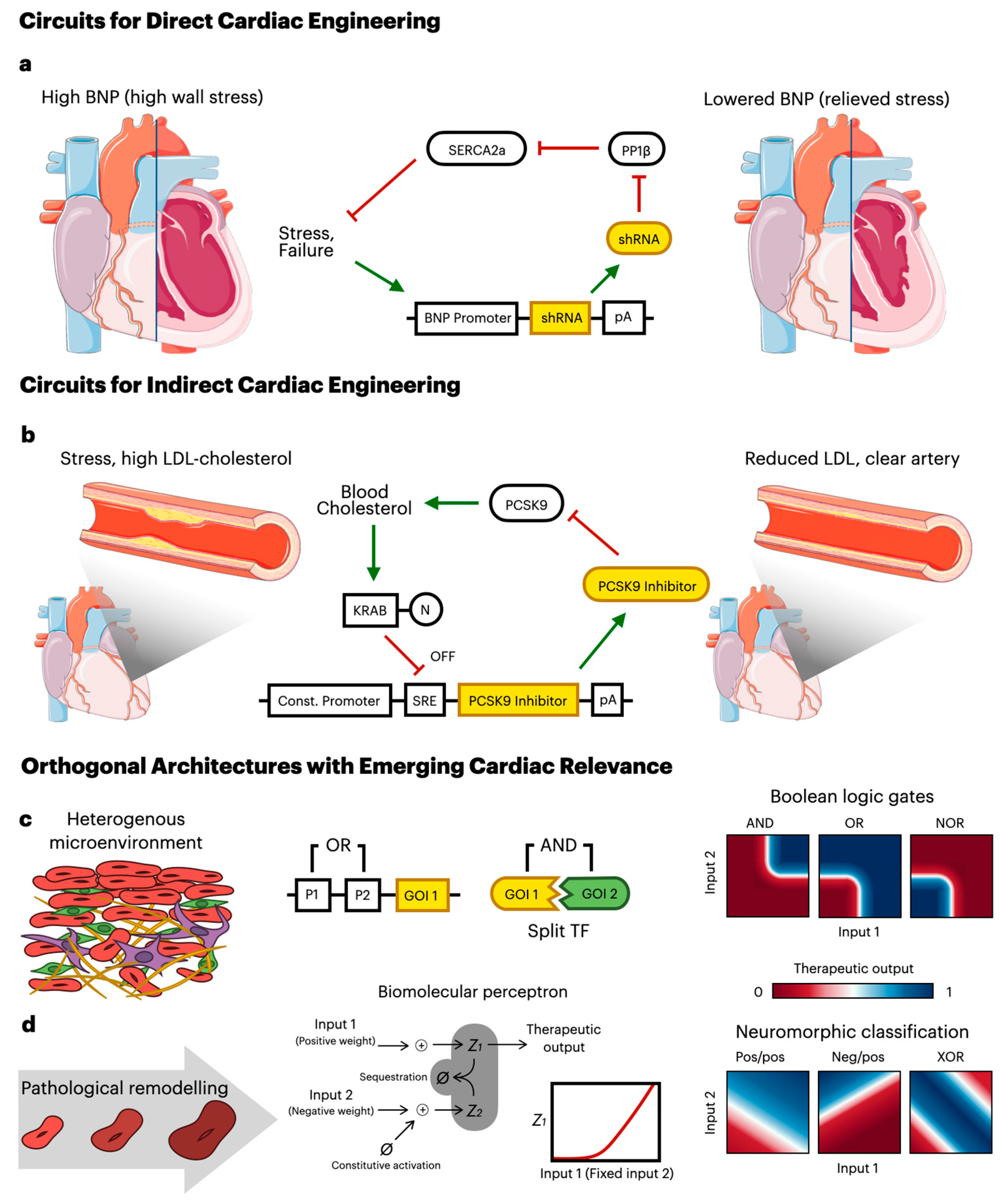
| AND gate | a logic architecture requiring the simultaneous detection of two distinct condition-specific promoters (e.g., a fibroblast-specific promoter combined with a pathological activation marker). |
| OR gate | a logic architecture that allows circuits to sense mutually redundant disease pathways, enabling therapeutic actuation across heterogeneous pathogenic cell populations |
| NOT gate | a logic architecture that suppresses expression in the presence of a specific input; often used as a safety mechanism to spare healthy, non-target cells by silencing output when healthy markers are detected |
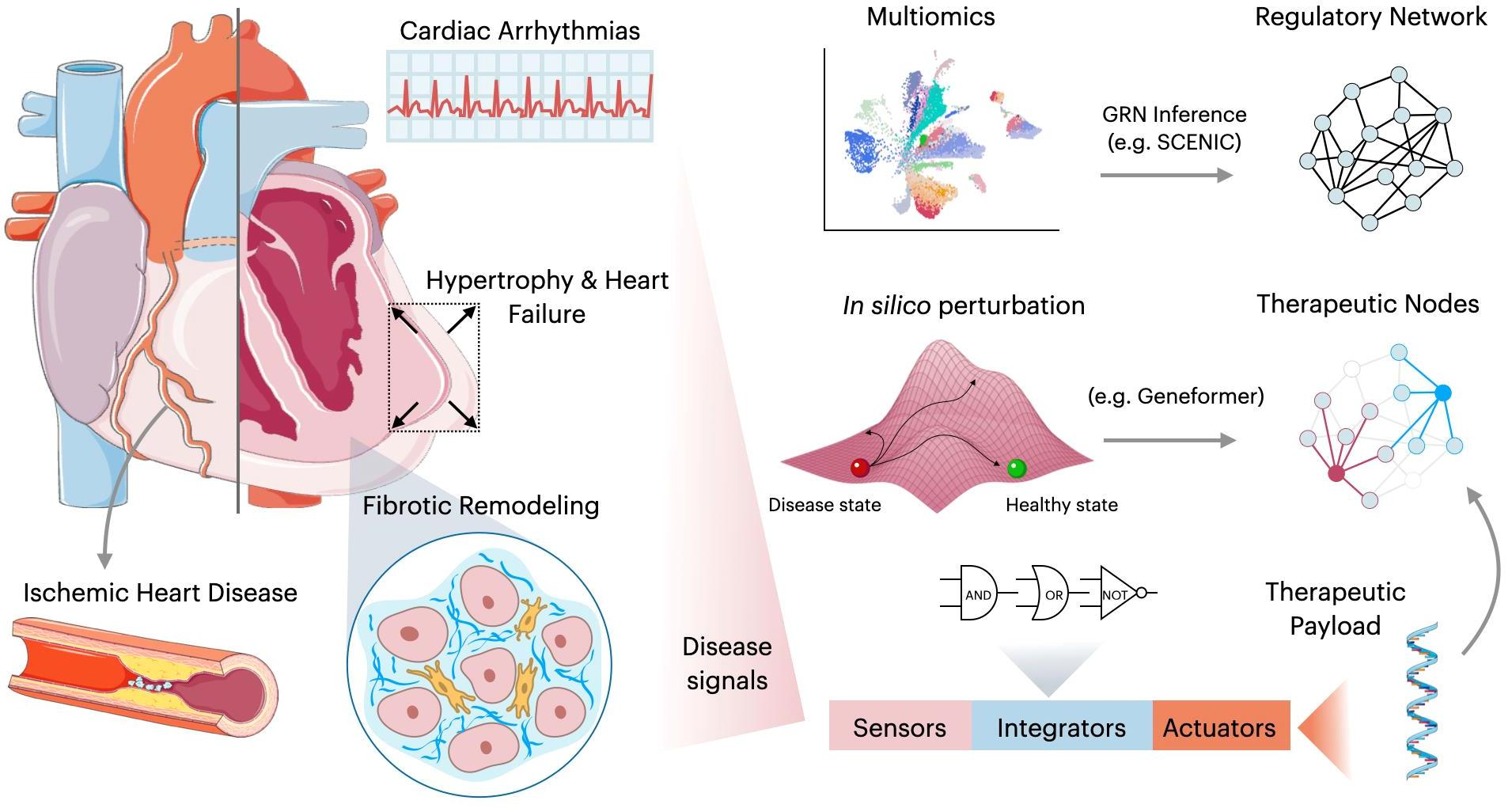
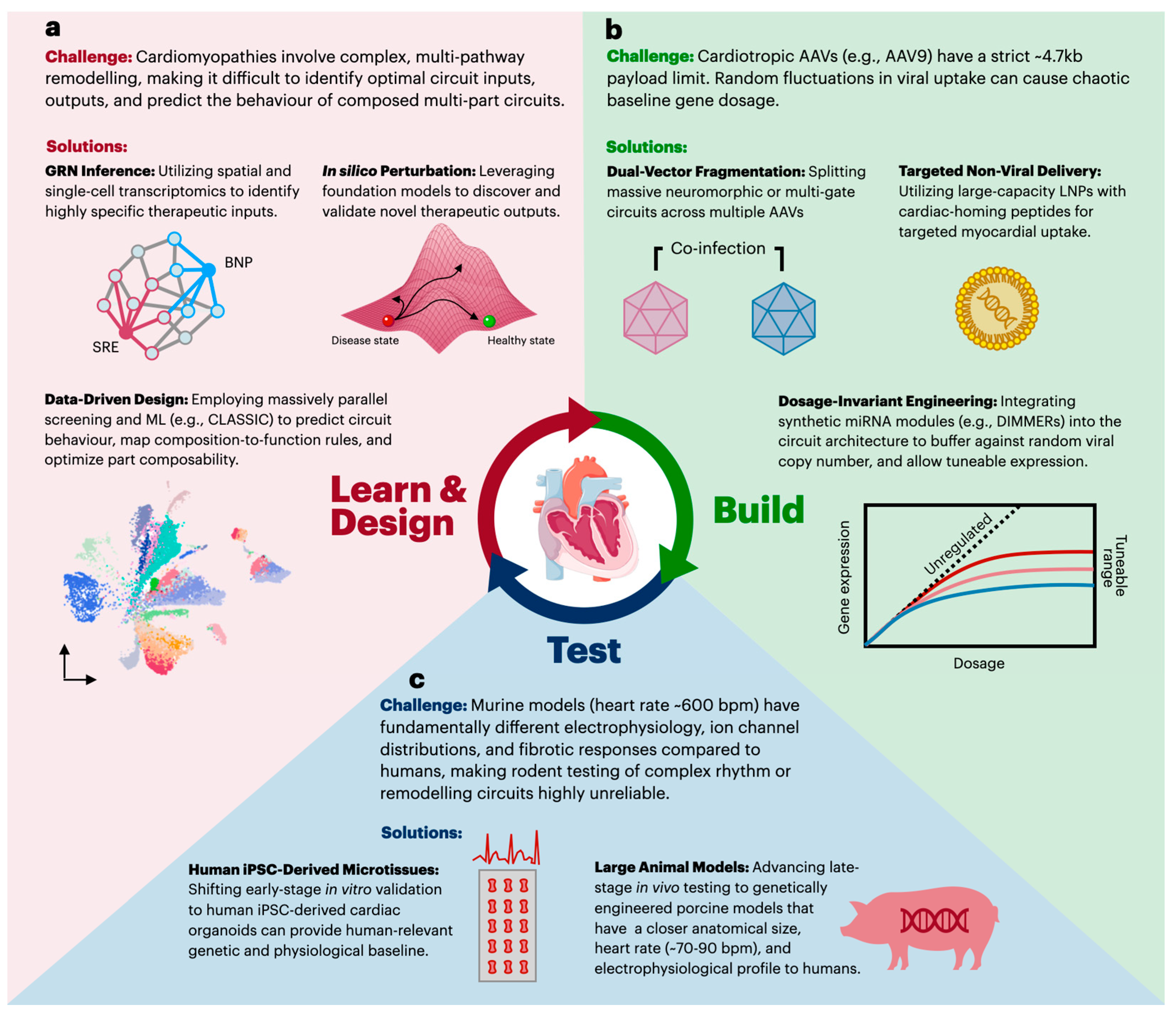
| Gene regulatory network (GRN) | a network of regulatory interactions between transcription factors and their target genes; GRNs can be inferred from high-throughput data (e.g., single-cell transcriptomics) to identify critical transcription factors, cis-regulatory elements, and specific promoter activity |
| Transformer-based foundation model (e.g., Geneformer) | a predictive large-scale AI model pre-trained on vast, diverse, and often unlabeled datasets (biological in our case) that can be used to discover therapeutic targets through in silico perturbation, among other uses |
| Ordinary differential equation (ODE) | a type of mathematical equation describing the rate of change in a variable over time; systems of ODEs are used to model the kinetics and nonlinear dynamics (e.g., oscillations, bistability) of genetic circuits, assuming a well-mixed environment |
Disclaimer/Publisher’s Note: The statements, opinions and data contained in all publications are solely those of the individual author(s) and contributor(s) and not of MDPI and/or the editor(s). MDPI and/or the editor(s) disclaim responsibility for any injury to people or property resulting from any ideas, methods, instructions or products referred to in the content. |
© 2026 by the authors. Licensee MDPI, Basel, Switzerland. This article is an open access article distributed under the terms and conditions of the Creative Commons Attribution (CC BY) license.
Share and Cite
Khalilitousi, M.; Dhingra, A.; Rohani, L.; Weiss, R. Current Progress and Future Outlook for Synthetic Gene Circuits in Cardiovascular Therapy. Biomolecules 2026, 16, 754. https://doi.org/10.3390/biom16050754
Khalilitousi M, Dhingra A, Rohani L, Weiss R. Current Progress and Future Outlook for Synthetic Gene Circuits in Cardiovascular Therapy. Biomolecules. 2026; 16(5):754. https://doi.org/10.3390/biom16050754
Chicago/Turabian StyleKhalilitousi, Mohammadali, Arshaan Dhingra, Leili Rohani, and Ron Weiss. 2026. "Current Progress and Future Outlook for Synthetic Gene Circuits in Cardiovascular Therapy" Biomolecules 16, no. 5: 754. https://doi.org/10.3390/biom16050754
APA StyleKhalilitousi, M., Dhingra, A., Rohani, L., & Weiss, R. (2026). Current Progress and Future Outlook for Synthetic Gene Circuits in Cardiovascular Therapy. Biomolecules, 16(5), 754. https://doi.org/10.3390/biom16050754