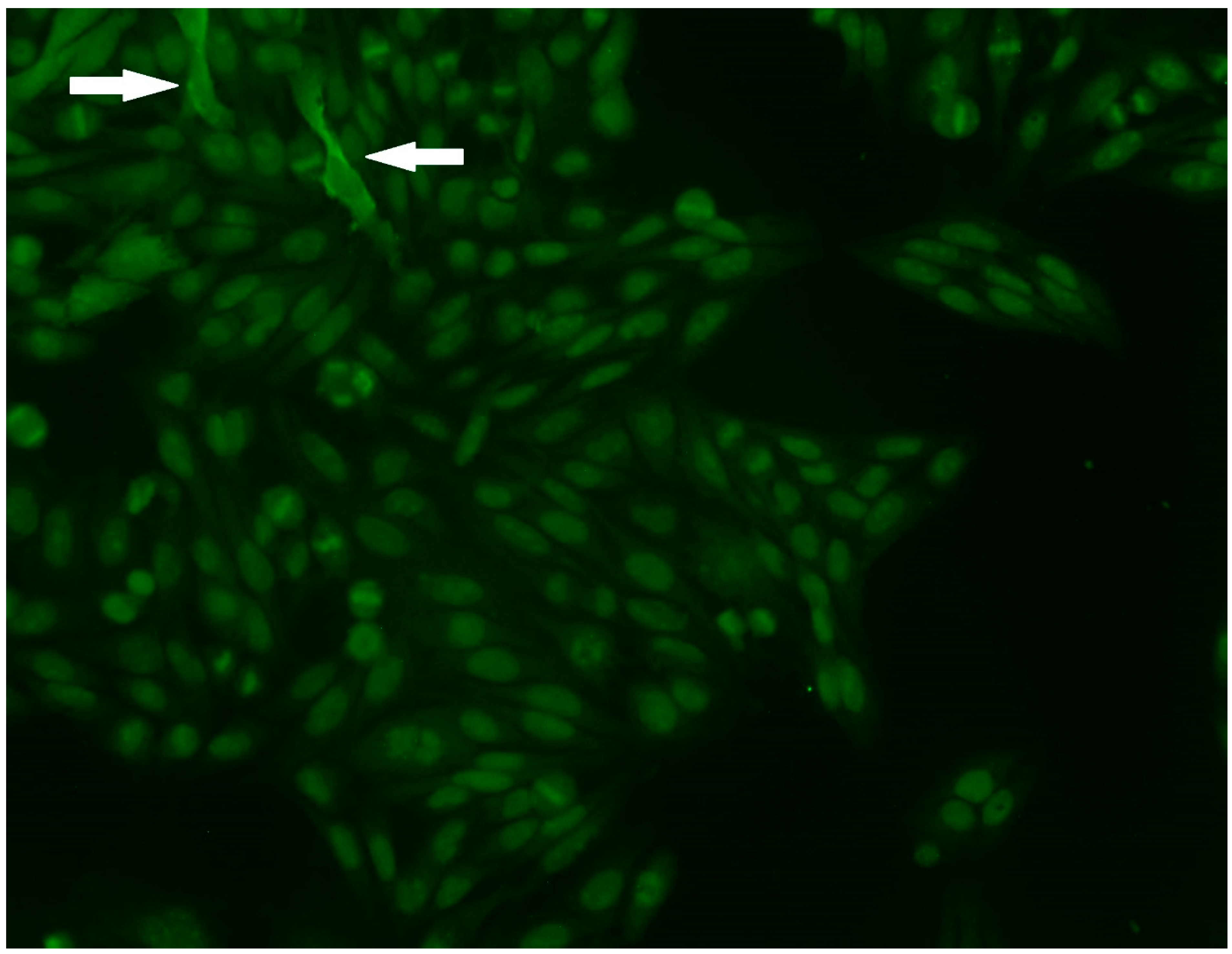
Clinical Relevance and Methodological Comparison of Anti-MDA5 Antibody Detection: A Five-Year Retrospective and Exploratory Pilot Study

 , , , ,
  ,
, 
 , ,
, ,
Abstract
1. Introduction
2. Materials and Methods
2.1. Study Design and Patient Selection
2.2. Sample Collection and Local Immunoblot Testing
2.3. Immunoprecipitation and Confirmatory Assays
2.4. Indirect Immunofluorescence
2.5. Statistical Analysis
2.6. Ethical Approval
3. Results
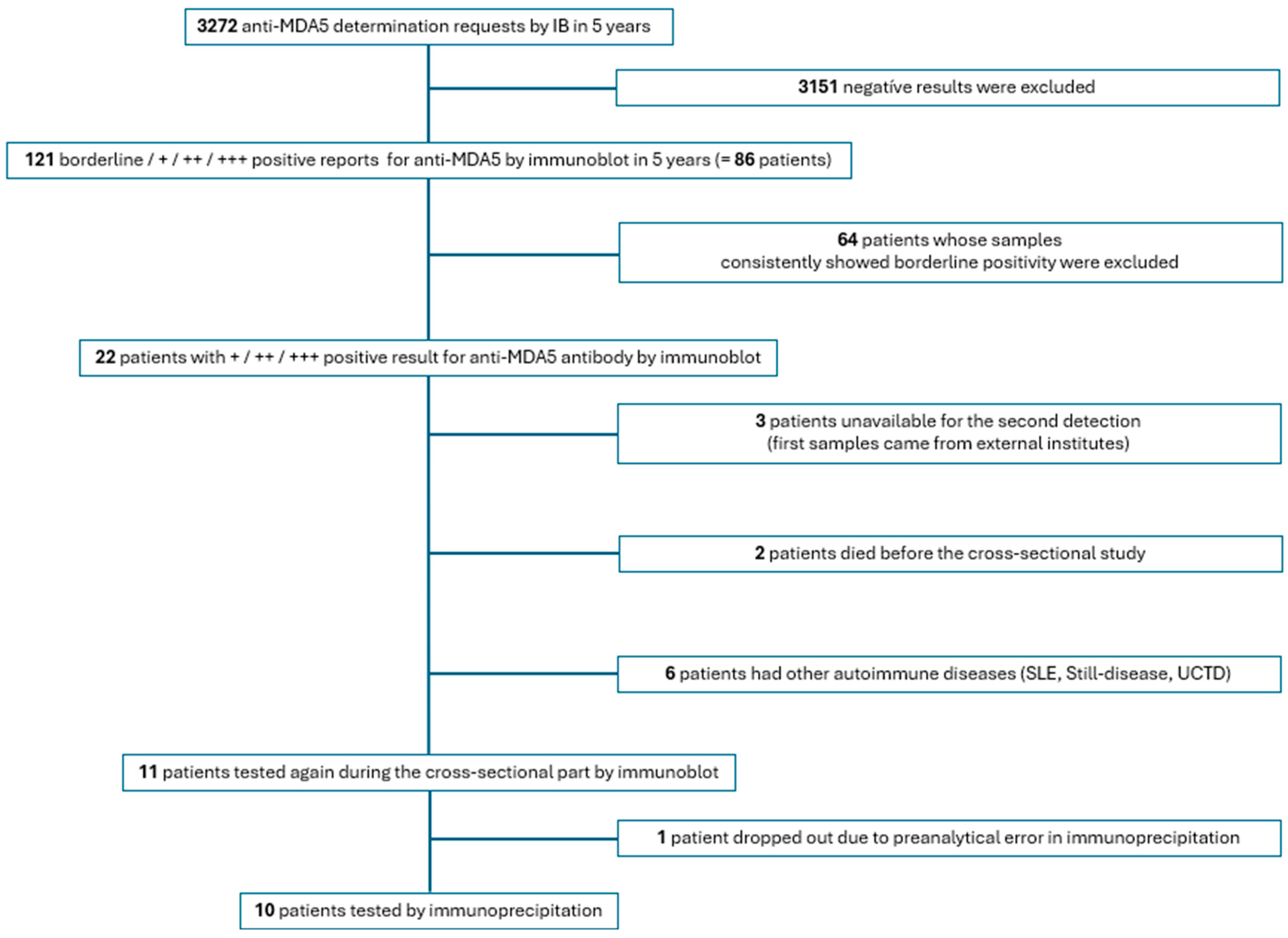
3.1. Retrospective Analysis of Anti-MDA5 Positivity Rate and Clinical Correlation
3.2. Pilot Cross-Sectional Comparison: Immunoblot vs. Immunoprecipitation
3.3. ANA Pattern Analysis
4. Discussion
5. Conclusions
Author Contributions
Funding
Institutional Review Board Statement
Informed Consent Statement
Data Availability Statement
Conflicts of Interest
Abbreviations
| ACR | American College of Rheumatology |
| ADM | Amyopathic dermatomyositis |
| AMA | American Medical Association |
| ANA | Antinuclear antibody |
| Anti-MDA5 | Anti-melanoma differentiation-associated gene 5 |
| CADM | Clinically amyopathic dermatomyositis |
| DM | Dermatomyositis |
| ELISA | Enzyme-linked immunosorbent assay |
| EULAR | European Alliance of Associations for Rheumatology |
| HEp-2 | Human epithelioma type 2 (cells) |
| IB | Immunoblot |
| IFIH1 | Interferon induced with helicase C domain 1 |
| IIF | Indirect immunofluorescence |
| IIM | Idiopathic inflammatory myopathy |
| IP | Immunoprecipitation |
| MAAs | Myositis-associated antibodies |
| MSAs | Myositis-specific antibodies |
| NPV | Negative predictive value |
| PM | Polymyositis |
| PPV | Positive predictive value |
| RP-ILD | Rapidly progressive interstitial lung disease |
| UCTD | Undifferentiated connective tissue disease |
References
- Yoshida, A.; Nagata, S.; Okazaki, Y.; Hanaoka, H.; Gono, T.; Kuwana, M. Dissociating autoantibody responses against Ro52 antigen in patients with anti-synthetase or anti-MDA5 antibodies. Diagnostics 2023, 13, 3621. [Google Scholar] [CrossRef]
- Fujimoto, N.; Honda, S.; Wakabayashi, M.; Hamaguchi, Y.; Fujimoto, M.; Tanaka, T. Anti-MDA-5 antibody-positive bullous dermatomyositis with palmar papules complicating rapidly progressive interstitial lung disease. Mod. Rheumatol. 2016, 26, 614–616. [Google Scholar] [CrossRef]
- Sato, S.; Murakami, A.; Kuwajima, A.; Takehara, K.; Mimori, T.; Kawakami, A.; Mishima, M.; Suda, T.; Seishima, M.; Fujimoto, M.; et al. Clinical utility of an enzyme-linked immunosorbent assay for detecting anti-melanoma differentiation-associated gene 5 autoantibodies. PLoS ONE 2016, 11, e0154285. [Google Scholar] [CrossRef]
- Hosono, Y.; Nakashima, R.; Serada, S.; Murakami, K.; Imura, Y.; Yoshifuji, H.; Ohmura, K.; Naka, T.; Mimori, T. Splicing factor proline/glutamine-rich is a novel autoantigen of dermatomyositis and associated with anti-melanoma differentiation-associated gene 5 antibody. J. Autoimmun. 2017, 77, 116–122. [Google Scholar] [CrossRef] [PubMed]
- Hoshino, K.; Muro, Y.; Sugiura, K.; Tomita, Y.; Nakashima, R.; Mimori, T. Anti-MDA5 and anti-TIF1-γ antibodies have clinical significance for patients with dermatomyositis. Rheumatology 2010, 49, 1726–1733. [Google Scholar] [CrossRef]
- Chen, Z.; Hu, W.; Wang, Y.; Guo, Z.; Sun, L.; Kuwana, M. Distinct profiles of myositis-specific autoantibodies in Chinese and Japanese patients with polymyositis/dermatomyositis. Clin. Rheumatol. 2015, 34, 1627–1631. [Google Scholar] [CrossRef] [PubMed]
- Labrador-Horrillo, M.; Martinez, M.A.; Selva-O’Callaghan, A.; Trallero-Araguas, E.; Balada, E.; Vilardell-Tarres, M.; Juárez, C. Anti-MDA5 antibodies in a large Mediterranean population of adults with dermatomyositis. J. Immunol. Res. 2014, 2014, 290797. [Google Scholar] [CrossRef] [PubMed]
- Sato, S.; Hirakata, M.; Kuwana, M.; Suwa, A.; Inada, S.; Mimori, T.; Nishikawa, T.; Oddis, C.V.; Ikeda, Y. Autoantibodies to a 140-kd polypeptide, CADM-140, in Japanese patients with clinically amyopathic dermatomyositis. Arthritis Rheum. 2005, 52, 1571–1576. [Google Scholar] [CrossRef] [PubMed]
- Gangadharan, H.; Seetha, A.P.; Musthafa, S.; Shenoy, P.; Francis, M.; Krishna, A.; Kamath, V.; Kp, V.; Kumar, R. Clinical characteristics and outcomes of patients with anti-MDA5 antibody associated rapidly progressive interstitial lung disease (RP-ILD): A case series. Mediterr. J. Rheumatol. 2024, 35, 668–679. [Google Scholar] [CrossRef]
- Fujisawa, T. Management of myositis-associated interstitial lung disease. Medicina 2021, 57, 347. [Google Scholar] [CrossRef] [PubMed]
- Okamoto, M.; Zaizen, Y.; Kaieda, S.; Nouno, T.; Koga, T.; Matama, G.; Mitsuoka, M.; Akiba, J.; Yamada, S.; Kato, H.; et al. Soluble form of the MDA5 protein in human sera. Heliyon 2024, 10, e31727. [Google Scholar] [CrossRef]
- Lu, X.; Peng, Q.; Wang, G. Anti-MDA5 antibody-positive dermatomyositis: Pathogenesis and clinical progress. Nat. Rev. Rheumatol. 2024, 20, 48–62. [Google Scholar] [CrossRef]
- Jayaraman, S.; Tiniakou, E.; Morgenlander, W.R.; Na, M.; Christopher-Stine, L.; Larman, H.B. Comprehensive enteroviral serology links infection and anti-melanoma differentiation-associated protein 5 dermatomyositis. ACR Open Rheumatol. 2025, 7, e11752. [Google Scholar] [CrossRef]
- Betteridge, Z.; Tansley, S.; Shaddick, G.; Chinoy, H.; Cooper, R.G.; New, R.P.; Lilleker, J.B.; Vencovsky, J.; Chazarain, L.; Dankó, K.; et al. Frequency, mutual exclusivity and clinical associations of myositis autoantibodies in a combined European cohort of idiopathic inflammatory myopathy patients. J. Autoimmun. 2019, 101, 48–55. [Google Scholar] [CrossRef] [PubMed]
- Gómez, G.N.; Pérez, N.; Poccard, A.B.; Gómez, R.A.; Costi, A.C.; García, M.A.; Viola, M.; Benitez, A.; Aciar, M.M.; Espíndola, M.C.; et al. Myositis-specific antibodies and clinical characteristics in patients with autoimmune inflammatory myopathies: Reported by the Argentine Registry of Inflammatory Myopathies of the Argentine Society of Rheumatology. Clin. Rheumatol. 2021, 40, 4473–4483. [Google Scholar] [CrossRef]
- Damoiseaux, J.; Mammen, A.L.; Piette, Y.; Benveniste, O.; Allenbach, Y. 256th ENMC international workshop: Myositis specific and associated autoantibodies (MSA-ab): Amsterdam, The Netherlands, 8–10 October 2021. Neuromuscul. Disord. 2022, 32, 594–608. [Google Scholar] [CrossRef] [PubMed]
- Loganathan, A.; McMorrow, F.; Lu, H.; Li, D.; Mulhearn, B.; McHugh, N.J.; Tansley, S.L. The use of ELISA is comparable to immunoprecipitation in the detection of selected myositis-specific autoantibodies in a European population. Front. Immunol. 2022, 13, 975939. [Google Scholar] [CrossRef]
- Griger, Z.; Nagy-Vincze, M.; Dankó, K. Pharmacological management of dermatomyositis. Expert Rev. Clin. Pharmacol. 2017, 10, 1109–1118. [Google Scholar] [CrossRef]
- Sato, S.; Kuwana, M.; Fujita, T.; Suzuki, Y. Anti-CADM-140/MDA5 autoantibody titer correlates with disease activity and predicts disease outcome in patients with dermatomyositis and rapidly progressive interstitial lung disease. Mod. Rheumatol. 2013, 23, 496–502. [Google Scholar] [CrossRef]
- Kang, E.H.; Kuwana, M.; Okazaki, Y.; Lee, E.Y.; Lee, Y.J.; Lee, E.B.; Song, Y.W. Comparison of radioimmunoprecipitation versus antigen-specific assays for identification of myositis-specific autoantibodies in dermatomyositis patients. Mod. Rheumatol. 2014, 24, 945–948. [Google Scholar] [CrossRef] [PubMed]
- Liu, Y.; Zheng, Y.; Hao, H.; Yuan, Y. Narrative review of autoantibodies in idiopathic inflammatory myopathies. Ann. Transl. Med. 2023, 11, 291. [Google Scholar] [CrossRef] [PubMed]
- Burbelo, P.D.; Huapaya, J.A.; Khavandgar, Z.; Beach, M.; Pinal-Fernandez, I.; Mammen, A.L.; Chiorini, J.A.; Farhadi, P.N.; Miller, F.W.; Schiffenbauer, A.; et al. Quantification of autoantibodies using a luminescent profiling method in autoimmune interstitial lung disease. Front. Immunol. 2024, 15, 1462242. [Google Scholar] [CrossRef]
- Angeli, F.; Pedretti, E.; Garrafa, E.; Fredi, M.; Ceribelli, A.; Franceschini, F.; Cavazzana, I. Comparison of lineblot and immunoprecipitation methods in the detection of myositis-specific and myositis-associated antibodies in patients with idiopathic inflammatory myopathies: Consistency with clinical diagnoses. Diagnostics 2024, 14, 2192. [Google Scholar] [CrossRef] [PubMed]
- Nombel, A.; Fabien, N.; Coutant, F. Dermatomyositis with anti-MDA5 antibodies: Bioclinical features, pathogenesis and emerging therapies. Front. Immunol. 2021, 12, 773352. [Google Scholar] [CrossRef]
- Xu, A.; Ye, Y.; Fu, Q.; Lian, X.; Chen, S.; Guo, Q.; Lu, L.-J.; Dai, M.; Lv, X.; Bao, C. Prognostic values of anti-Ro52 antibodies in anti-MDA5-positive clinically amyopathic dermatomyositis associated with interstitial lung disease. Rheumatology 2021, 60, 3343–3351. [Google Scholar] [CrossRef] [PubMed]
- Gono, T.; Gil-Vila, A.; Selva-O’Callaghan, A.; van Royen-Kerkhof, A.; Vincze, A.; Mecoli, C.; Gómez-Martín, D.; Hamann, D.; Conticini, E.; Griger, Z.; et al. Analytical performance of commercial myositis-specific autoantibody tests evaluated against immunoprecipitation assays as a reference standard: A systematic review and meta-analysis. Semin. Arthritis Rheum. 2025, 75, 152858. [Google Scholar] [CrossRef]
- Chung, S.W.; Yoo, I.S.; Kim, J.; Kang, S.W.; Kwon, M.; Juong, C.I.; Choi, I.A.; Chang, S.H.; Kang, M.I.; Hong, S.J.; et al. Comparison of the 2017 EULAR/ACR criteria with clinicoserologic criteria for the classification of idiopathic inflammatory myopathies in Korean patients. Yonsei Med. J. 2021, 62, 424–430. [Google Scholar] [CrossRef]
- Li, L.; Wang, H.; Wang, Q.; Wu, C.; Liu, C.; Zhang, Y.; Cheng, L.; Zeng, X.; Zhang, F.; Li, Y. Myositis-specific autoantibodies in dermatomyositis/polymyositis with interstitial lung disease. J. Neurol. Sci. 2019, 397, 123–128. [Google Scholar] [CrossRef]
- Wong, V.T.L.; So, H.; Lam, T.T.O.; Yip, R.M.L. Myositis-specific autoantibodies and their clinical associations in idiopathic inflammatory myopathies. Acta Neurol. Scand. 2021, 143, 131–139. [Google Scholar] [CrossRef]
- Li, Y.; Li, Y.; Wu, J.; Miao, M.; Gao, X.; Cai, W.; Shao, M.; Zhang, X.; Xu, Y.; Cong, L.; et al. Predictors of poor outcome of anti-MDA5-associated rapidly progressive interstitial lung disease in a Chinese cohort with dermatomyositis. J. Immunol. Res. 2020, 2020, 2024869. [Google Scholar] [CrossRef] [PubMed]
- Hormaza-Jaramillo, A.; Bedoya-Joaqui, V.; Puerta-Sarmiento, G.; Bautista, M.; Rios-Serna, L.J.; Delgado-Mora, T.; Nieto-Aristizábal, I.; Ruiz-Ordoñez, I. Profile of specific and associated autoantibodies in patients with idiopathic inflammatory myopathies in a Colombian population. Front. Med. 2022, 9, 954937. [Google Scholar] [CrossRef] [PubMed]
- Rams, A.; Kosałka-Węgiel, J.; Kuszmiersz, P.; Matyja-Bednarczyk, A.; Polański, S.; Zaręba, L.; Bazan-Socha, S. Characteristics of idiopathic inflammatory myopathies with novel myositis-specific autoantibodies. Adv. Clin. Exp. Med. 2021, 30, 1239–1248. [Google Scholar] [CrossRef]
- Horn, S.; Minden, K.; Speth, F.; Schwarz, T.; Dressler, F.; Grösch, N.; Haas, J.-P.; Hinze, C.; Horneff, G.; Hospach, A.; et al. Myositis-specific autoantibodies and their associated phenotypes in juvenile dermatomyositis: Data from a German cohort. Clin. Exp. Rheumatol. 2022, 40, 433–442. [Google Scholar] [CrossRef]
- Ceribelli, A.; Isailovic, N.; De Santis, M.; Generali, E.; Fredi, M.; Cavazzana, I.; Franceschini, F.; Cantarini, L.; Satoh, M.; Selmi, C. Myositis-specific autoantibodies and their association with malignancy in Italian patients with polymyositis and dermatomyositis. Clin. Rheumatol. 2017, 36, 469–475. [Google Scholar] [CrossRef] [PubMed]
- Tansley, S.L.; Betteridge, Z.E.; Gunawardena, H.; Jacques, T.S.; Owens, C.M.; Pilkington, C.; Arnold, K.; Yasin, S.; Moraitis, E.; Wedderburn, L.R.; et al. Anti-MDA5 autoantibodies in juvenile dermatomyositis identify a distinct clinical phenotype: A prospective cohort study. Arthritis Res. Ther. 2014, 16, R138. [Google Scholar] [CrossRef]
- Sasaki, N.; Nakagome, Y.; Kojima, A.; Shimura, K.; Ishii, A.; Sugiyama, M.; Izumi, Y.; Hirano, K.; Kurabayasi, T.; Hosono, Y.; et al. Early Initiation of Plasma Exchange Therapy for Anti-MDA5+Dermatomyositis with Refractory Rapidly Progressive Interstitial Lung Disease. Intern. Med. 2024, 63, 213–219. [Google Scholar] [CrossRef]
- Teo, K.F.; Chen, D.Y.; Hsu, J.T.; Lai, Y.H.; Chang, C.K.; Hsueh, P.R.; Lan, J.L.; Hsu, J.L. Screening and characterization of myositis-related autoantibodies in COVID-19 patients. Clin. Transl. Sci. 2023, 16, 140–150. [Google Scholar] [CrossRef]
- Kuwana, M.; Okazaki, Y. A multianalyte assay for the detection of dermatomyositis-related autoantibodies based on immunoprecipitation combined with immunoblotting. Mod. Rheumatol. 2023, 33, 543–548. [Google Scholar] [CrossRef]
- Bodoki, L.; Nagy-Vincze, M.; Griger, Z.; Betteridge, Z.; Szöllösi, L.; Dankó, K. Four dermatomyositis-specific autoantibodies-anti-TIF1γ, anti-NXP2, anti-SAE and anti-MDA5-in adult and juvenile patients with idiopathic inflammatory myopathies in a Hungarian cohort. Autoimmun. Rev. 2014, 13, 1211–1219. [Google Scholar] [CrossRef]
- Cavazzana, I.; Fredi, M.; Ceribelli, A.; Mordenti, C.; Ferrari, F.; Carabellese, N. Testing for myositis specific autoantibodies: Comparison between line blot and immunoprecipitation assays in 57 myositis sera. J. Immunol. Methods 2016, 433, 1–5. [Google Scholar] [CrossRef] [PubMed]
- Damoiseaux, J.; von Mühlen, C.A.; Garcia-De La Torre, I.; Carballo, O.G.; de Melo Cruvinel, W.; Carvalho Francescantonio, P.L.; Fritzler, M.J.; Herold, M.; Mimori, T.; Satoh, M.; et al. International consensus on ANA patterns (ICAP): The bumpy road towards a consensus on reporting ANA results. Autoimmun. Highlights 2016, 7, 1. [Google Scholar] [CrossRef] [PubMed]


| Patient No. | Age at 2nd Sample/Sex | Diagnosis (Year) | ILD/ RP-ILD | Skin Symptoms | Muscle Involvement | Therapy at 2nd Sample |
|---|---|---|---|---|---|---|
| 1 | 48/M | DM (2019) | Alveolitis, Fibrosis | Gottron’s papule, Heliotrop rash, Mechanic’s hand | Hypomyopathic | None (Remission) |
| 2 | 58/F | DM (2020) | None | Periorbital edema | Mild weakness | None |
| 3 | 67/M | DM (2008) | None | Heliotrop rash, Gottron’s sign, V-sign | Weakness, Myalgia | Glucocorticoid |
| 4 | 57/F | PM (2005) | Fibrosis | None | Weakness, Myalgia | Glucocorticoid |
| 5 | 48/F | DM (2022) | None | Heliotrop rash, Gottron’s sign, Subcutaneous calcinosis | Weakness | GC + Methotrexate |
| 6 | 66/F | DM (2013) | Alveolitis | Periorbital edema | Weakness | None |
| 7 | 55/F | DM (2020) | Alveolitis, Fibrosis | Mechanic’s hand, Gottron’s sign | Weakness | GC + Cyclosporin A |
| 8 | 63/F | PM (1998) | None | None | Weakness, Myalgia | Glucocorticoid |
| 9 | 61/F | DM (2020) | Alveolitis, Fibrosis | Erythema, Mechanic’s hand | Weakness, Atrophy | Mycophenolate mofetil |
| 10 | 47/F | DM (2020) | Alveolitis, Fibrosis | Gottron’s papule, Edema, V-sign | Weakness | GC + Methotrexate |
| Patient | First Detection (at the Diagnosis of the Myositis) | Second Detection (During the Study) |
|---|---|---|
| 1 | + | − |
| 2 | +++ | +++ |
| 3 | +/− | − |
| 4 | + | + |
| 5 | +++ | +++ |
| 6 | ++ | ++ |
| 7 | +++ | +++ |
| 8 | + | − |
| 9 | +++ | +/− |
| 10 | +++ | − |
| Patient | IB Anti-MDA5 Category | IB Anti-MDA5 Color Intensity (Ref.: <5) | IP Anti-MDA5 | Concordance | Time Interval Between Samples (Years) |
|---|---|---|---|---|---|
| 1 | Negative | 2 | Negative | Yes | 4 |
| 2 | +++ | 57 | Positive | Yes | 3 |
| 3 | Negative | 5 | Negative | Yes | 4 |
| 4 | + | 16 | Negative | No | 4 |
| 5 | +++ | 92 | Positive | Yes | 1 |
| 6 | ++ | 26 | Negative | No | 4 |
| 7 | +++ | 67 | Positive | Yes | 1 |
| 8 | Negative | 3 | Negative | Yes | 4 |
| 9 | +/− | 7 | Negative | No | 3 |
| 10 | Negative | 4 | Negative | Yes | 4 |
| IP Positive | IP Negative | Total | |
|---|---|---|---|
| IB Positive * | 3 | 3 | 6 |
| IB Negative | 0 | 4 | 4 |
| Total | 3 | 7 | 10 |
| Patient | IB Other Antibodies | IP Other Antibodies | HEp-2 IIF Nuclear Pattern/Titer | HEp-2 IIF Cytoplasmic Pattern Corresponding to Anti-MDA5 |
|---|---|---|---|---|
| 1 | all negative | nucleolar 1:80 titer | negative | |
| 2 | Ro-52 +++, NXP2 +/− | unknown 32 kDa and 34 kDa bands * | negative | negative |
| 3 | all negative | nuclear homogeneous 1:320 and nucleolar 1:320 titer | negative | |
| 4 | PM/Scl-75 + | anti-RuvBL1/2 | nuclear speckled 1:640 titer | negative |
| 5 | PL-7 +/−, PM/Scl-100 +/− | unknown 24 kDa, 23 kDa and 21 kDa bands * | negative | positive |
| 6 | Ku +/− | unknown 54 kDa band * | nuclear homogeneous 1:80 and nuclear speckled 1:80 titer | positive |
| 7 | Ro-52 +++ | unknown 56 kDa band * | nuclear speckled 1:640 and nuclear homogeneous 1:320 titer | negative |
| 8 | all negative | negative | negative | |
| 9 | Ro-52 +++ | anti-U1 and unknown 139 kDa and 160 kDa bands * | negative | negative |
| 10 | Ro-52 +++ | unknown 63 kDa band * | nuclear homogeneous 1:160 titer | negative |
Disclaimer/Publisher’s Note: The statements, opinions and data contained in all publications are solely those of the individual author(s) and contributor(s) and not of MDPI and/or the editor(s). MDPI and/or the editor(s) disclaim responsibility for any injury to people or property resulting from any ideas, methods, instructions or products referred to in the content. |
© 2026 by the authors. Licensee MDPI, Basel, Switzerland. This article is an open access article distributed under the terms and conditions of the Creative Commons Attribution (CC BY) license.
Share and Cite
Mogyoróssy, S.; Nagy, G.; Griger, Z.; Nagy-Vincze, M.; Bodoki, M.; Csige, D.; Tarr, T.; Zöld, É.; Pfliegler, G.; Brúgós, B.C.; et al. Clinical Relevance and Methodological Comparison of Anti-MDA5 Antibody Detection: A Five-Year Retrospective and Exploratory Pilot Study. Biomolecules 2026, 16, 698. https://doi.org/10.3390/biom16050698
Mogyoróssy S, Nagy G, Griger Z, Nagy-Vincze M, Bodoki M, Csige D, Tarr T, Zöld É, Pfliegler G, Brúgós BC, et al. Clinical Relevance and Methodological Comparison of Anti-MDA5 Antibody Detection: A Five-Year Retrospective and Exploratory Pilot Study. Biomolecules. 2026; 16(5):698. https://doi.org/10.3390/biom16050698
Chicago/Turabian StyleMogyoróssy, Sándor, Gábor Nagy, Zoltán Griger, Melinda Nagy-Vincze, Monika Bodoki, Dóra Csige, Tünde Tarr, Éva Zöld, György Pfliegler, Boglárka Csilla Brúgós, and et al. 2026. "Clinical Relevance and Methodological Comparison of Anti-MDA5 Antibody Detection: A Five-Year Retrospective and Exploratory Pilot Study" Biomolecules 16, no. 5: 698. https://doi.org/10.3390/biom16050698
APA StyleMogyoróssy, S., Nagy, G., Griger, Z., Nagy-Vincze, M., Bodoki, M., Csige, D., Tarr, T., Zöld, É., Pfliegler, G., Brúgós, B. C., Lu, H., Tansley, S., Antal-Szalmás, P., Domján, A., Szamosi, S., Szűcs, G., Szekanecz, Z., Horváth, Á., & Bodoki, L. (2026). Clinical Relevance and Methodological Comparison of Anti-MDA5 Antibody Detection: A Five-Year Retrospective and Exploratory Pilot Study. Biomolecules, 16(5), 698. https://doi.org/10.3390/biom16050698