This is an early access version, the complete PDF, HTML, and XML versions will be available soon.
Review

Unravelling Multilayered RNA Modification Networks in Female Reproduction and Obstetric/Gynaecologic Disorders


1
The Main Campus, Chengdu University of Traditional Chinese Medicine, Chengdu 611137, China
2
School of Medical and Life Sciences, Chengdu University of Traditional Chinese Medicine, Chengdu 611137, China
3
School of Clinical Medicine, Chengdu University of Traditional Chinese Medicine, Chengdu 611137, China
*
Authors to whom correspondence should be addressed.
These authors contributed equally to this work.
Biomolecules 2026, 16(4), 571; https://doi.org/10.3390/biom16040571
Submission received: 17 March 2026 / Revised: 9 April 2026 / Accepted: 10 April 2026 / Published: 13 April 2026
(This article belongs to the Section Molecular Reproduction)

Abstract

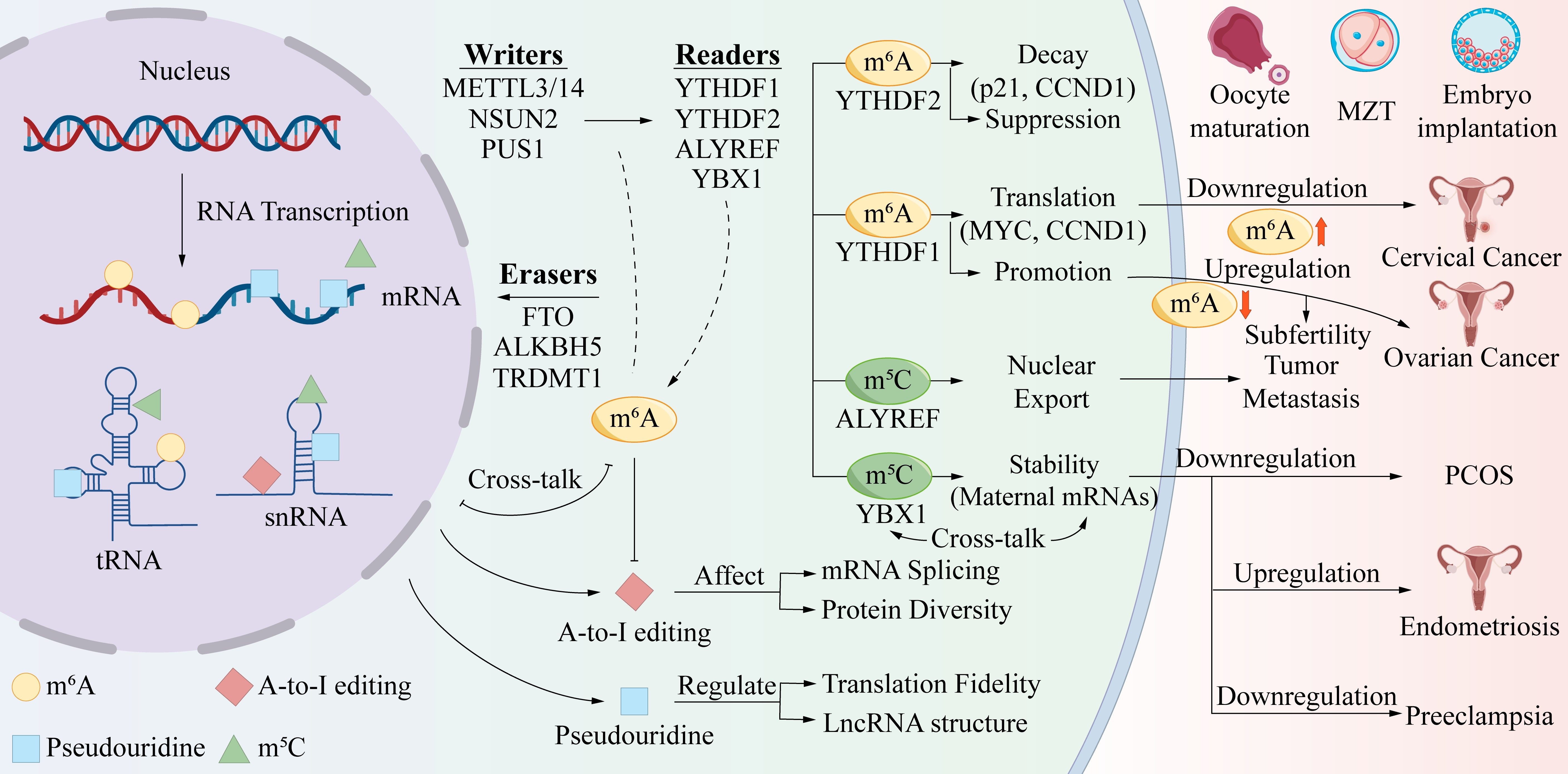
Background/Objective: RNA modifications, including N6-methyladenosine (m6A), 5-methylcytosine (m5C), 7-methylguanosine (m7G), N1-methyladenosine (m1A), pseudouridine (Ψ), N4-acetylcytidine (ac4C), 5-methoxycarbonylmethyl-2-thiouridine (mcm5s2U) and adenosine-to-inosine (A-to-I) editing, constitute a critical layer of post-transcriptional regulation that influences RNA stability, splicing, translation and degradation. This review aims to systematically summarise the current understanding of the molecular mechanisms and regulatory networks of RNA modifications in the female reproductive physiology and to evaluate their pathological implications in obstetric and gynaecologic disorders. Methods: We conducted a comprehensive literature review, synthesising findings from high-throughput sequencing studies, functional experiments and clinical investigations. The review integrates evidence across multiple RNA modification types, their regulatory enzymes (writers, erasers and readers) and their roles in physiological processes (germ cell development, oocyte maturation, embryogenesis and endometrial function) and pathological conditions (gynaecologic cancers, preeclampsia, endometriosis, polycystic ovary syndrome and premature ovarian insufficiency). Results: RNA modifications function as dynamic and reversible regulators that orchestrate key reproductive events, including primordial germ cell differentiation, oocyte meiosis, the maternal-to-zygotic transition, the establishment of uterine receptivity, and placental development. These modifications operate through coordinated writer–eraser–reader networks that fine tune transcripts’ stability, translation efficiency and RNA decay. The dysregulation of these epitranscriptomic networks is strongly implicated in the pathogenesis of gynaecologic malignancies (cervical, ovarian, endometrial cancers and choriocarcinoma), pregnancy-related disorders (preeclampsia, gestational diabetes mellitus and recurrent miscarriage), reproductive endocrine disorders (polycystic ovary syndrome and premature ovarian insufficiency) and benign gynaecological conditions (endometriosis and adenomyosis). Emerging evidence also reveals complex crosstalk among RNA modifications, such as cooperative interactions between m6A and m5C in translation regulation and antagonistic relationships between m6A and A-to-I editing. Conclusions: RNA modifications represent an essential and multifaceted regulatory layer in female reproduction, with broad implications for disease pathogenesis. Their unique reversibility and context-dependent functions offer promising opportunities for the development of diagnostic biomarkers and targeted therapeutic interventions. Future researchers should prioritise integrated multi-omics approaches, enhanced human-relevant models and clinical translation to fully realise the potential of epitranscriptomic medicine in reproductive health.
Keywords: RNA modification; female reproduction; obstetrical; gynaecological disease; reproductive physiology; gynaecological oncology; pregnancy-related diseases; reproductive endocrine diseases RNA modification; female reproduction; obstetrical; gynaecological disease; reproductive physiology; gynaecological oncology; pregnancy-related diseases; reproductive endocrine diseases
Graphical Abstract