Translational Barriers and Optimization Strategies for Remote Ischemic Conditioning to Enhance Stroke Cerebroprotection

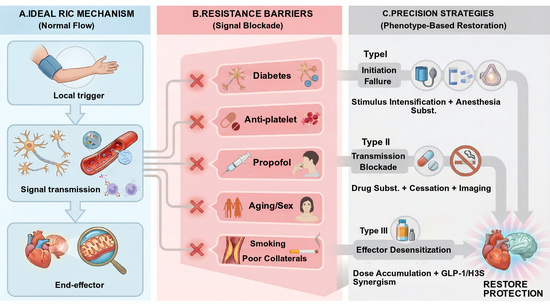
Abstract
Share and Cite
Zhang, X.; An, J.; Guo, X.; Li, J.; Wang, R. Translational Barriers and Optimization Strategies for Remote Ischemic Conditioning to Enhance Stroke Cerebroprotection. Biomolecules 2026, 16, 568. https://doi.org/10.3390/biom16040568
Zhang X, An J, Guo X, Li J, Wang R. Translational Barriers and Optimization Strategies for Remote Ischemic Conditioning to Enhance Stroke Cerebroprotection. Biomolecules. 2026; 16(4):568. https://doi.org/10.3390/biom16040568
Chicago/Turabian StyleZhang, Xin, Jiaxin An, Xiaofeng Guo, Jiayu Li, and Ruimin Wang. 2026. "Translational Barriers and Optimization Strategies for Remote Ischemic Conditioning to Enhance Stroke Cerebroprotection" Biomolecules 16, no. 4: 568. https://doi.org/10.3390/biom16040568
APA StyleZhang, X., An, J., Guo, X., Li, J., & Wang, R. (2026). Translational Barriers and Optimization Strategies for Remote Ischemic Conditioning to Enhance Stroke Cerebroprotection. Biomolecules, 16(4), 568. https://doi.org/10.3390/biom16040568