Cognitive-Enhancing Effects of Bioactive Compounds and Traditional Herbal Medicines in Elderly Patients with Metabolic Syndrome

Abstract
1. Introduction
2. The Complex Interplay Between the Individual Components of the MetS
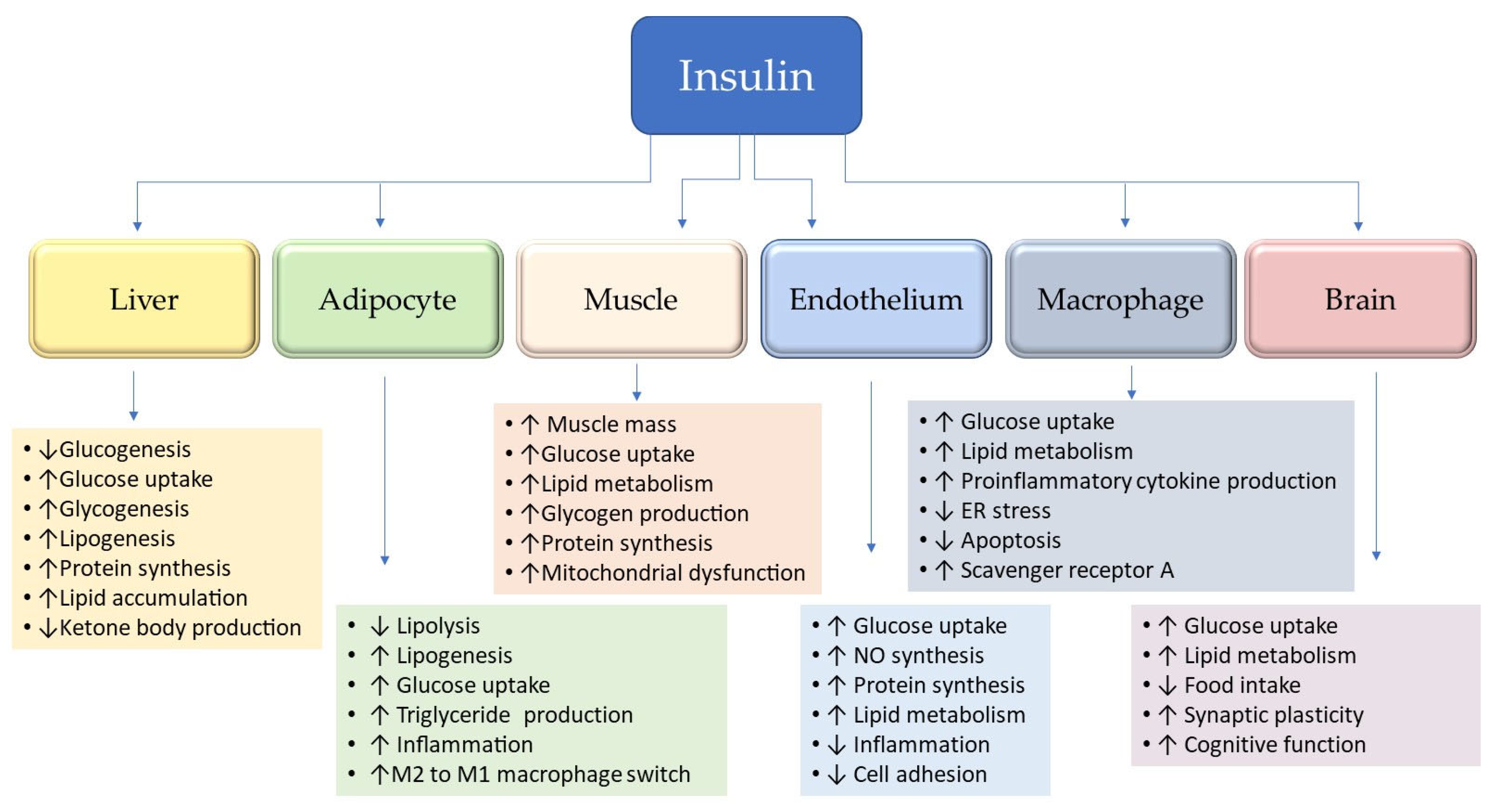
2.1. Insulin Is a Major Metabolic Hormone
2.2. Key Insulin-Target Tissues
2.2.1. Hepatic Tissue InsR
2.2.2. Adipose Tissue InsR
2.2.3. Skeletal Muscle InsR
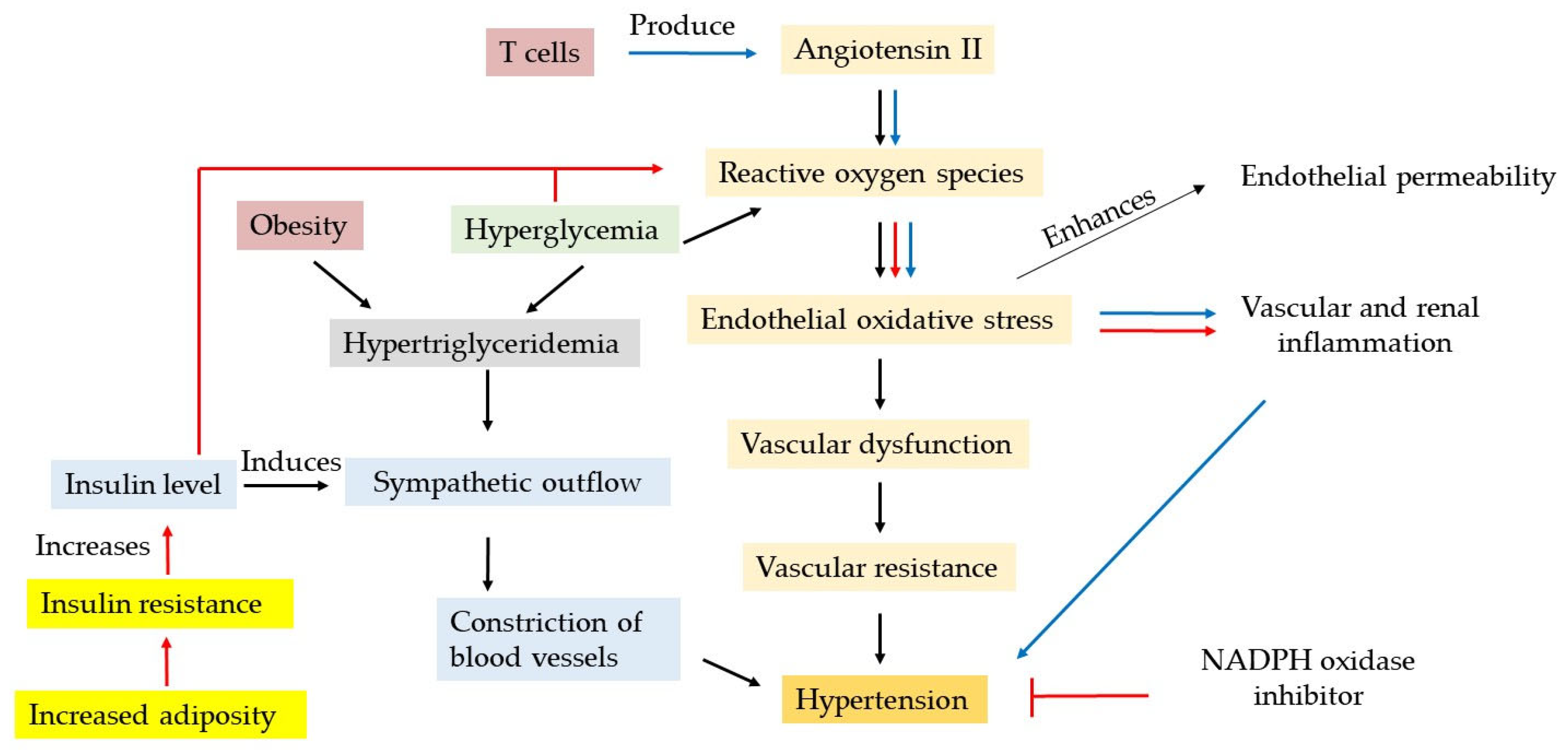
2.3. Hypertension and T2DM Coexist as Part of MetS
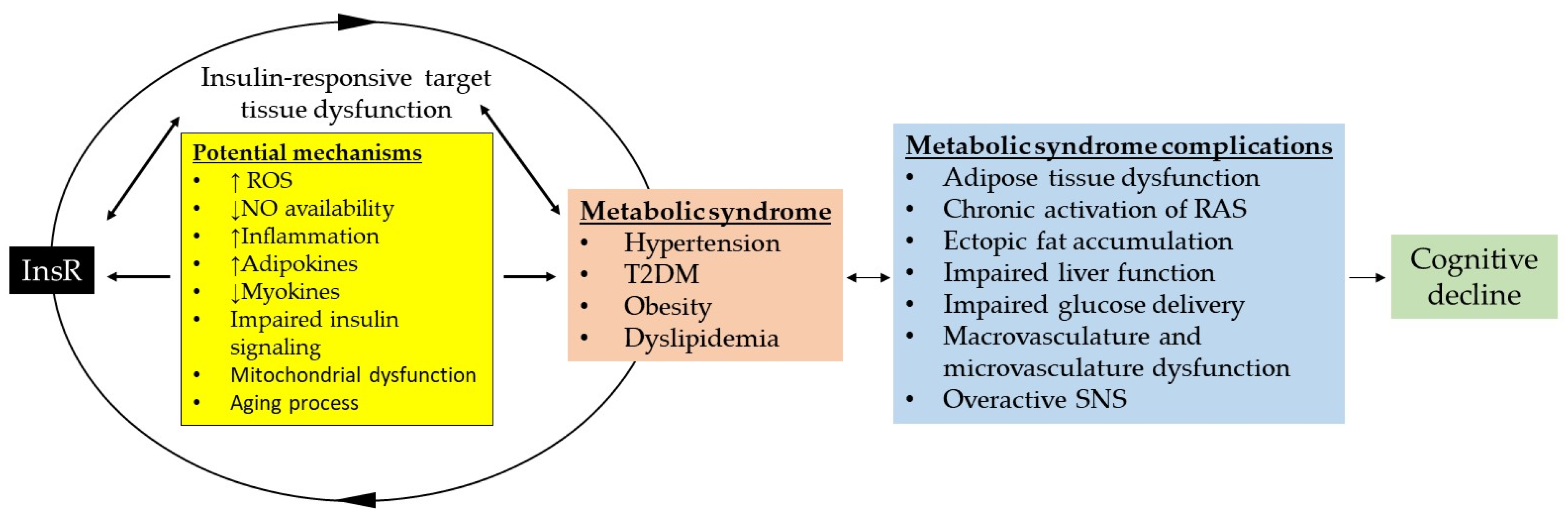
2.4. Several Competing Theories Have Been Proposed to Explain the Underlying Mechanisms of MetS
- InsR contributes to metabolic dysfunction-associated alterations in adipose tissue size and function. Reduced insulin action limits fatty acid uptake in adipose tissue, leading to tissue remodeling characterized by immune cell infiltration, chronic low-grade inflammation, and altered secretion of adipokines. These changes have led to the hypothesis that they promote the development and progression of metabolic disorders, including T2DM, hypertension, and ectopic fat accumulation, conditions that commonly coexist and synergistically drive the progression of MetS.
- Chronic activation of RAS promotes vascular endothelial dysfunction, resulting in fibrosis, increased ROS production, reduced NO availability, increased inflammatory response, and elevated sympathetic nervous system (SNS) activity. These alterations are proposed to contribute to the development of not only T2DM but also MetS.
- Loss of buffering capacity and increased stiffness of the macrovasculature reduce the delivery of steady blood flow to the microvasculature, impairing insulin-mediated glucose disposal and promoting dysregulated inflammatory and oxidative responses. Recent intensive investigations into macrovascular atherosclerosis and microvascular endothelial dysfunction across tissues have advanced understanding of T2DM and hypertension pathogenesis, and they propose that these processes contribute to the development of MetS.
- Overaction of SNS, driven by metabolic abnormalities such as obesity, impaired baroreflex sensitivity, hyperinsulinemia, and elevated adipokine levels, promotes a decline in insulin sensitivity and can accelerate the development of central obesity, InsR, and cardiovascular risk. These changes are also proposed to contribute to the development of MetS.
- Emerging research has revealed a complex interplay between genetic predisposition and environmental factors, particularly in the context of metabolic diseases. Obesity, T2DM, hypertension, and InsR are widely recognized as heritable, indicating a genetic predisposition, and several candidate genes have been postulated in the etiology of these conditions. It has been proposed that lifestyle choices and environmental exposures may play a pivotal role in mitigating obesity, T2DM, hypertension, and InsR through a healthy diet, reduced sedentary behavior, and avoidance of harmful habits.
2.5. Vascular Cognitive Impairment and Vascular Dementia
3. Cognitive Deterioration in the Context of Metabolic Diseases
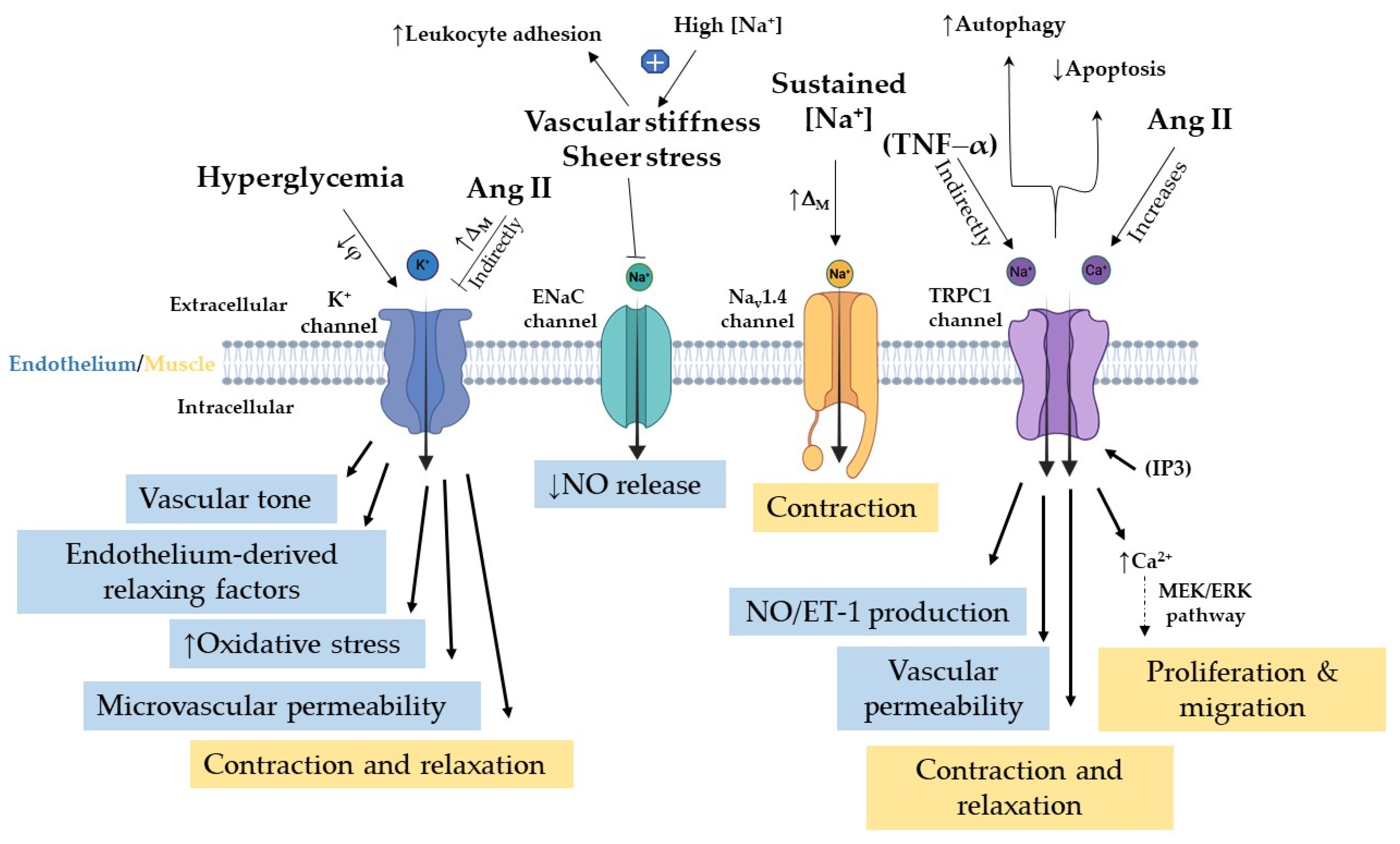
4. Ion Channels Play an Important Role in the Development and Progression of MetS
4.1. Potassium Channels
4.2. Sodium Channels
4.3. Transient Receptor Potential (TRP) Isoforms in MetS
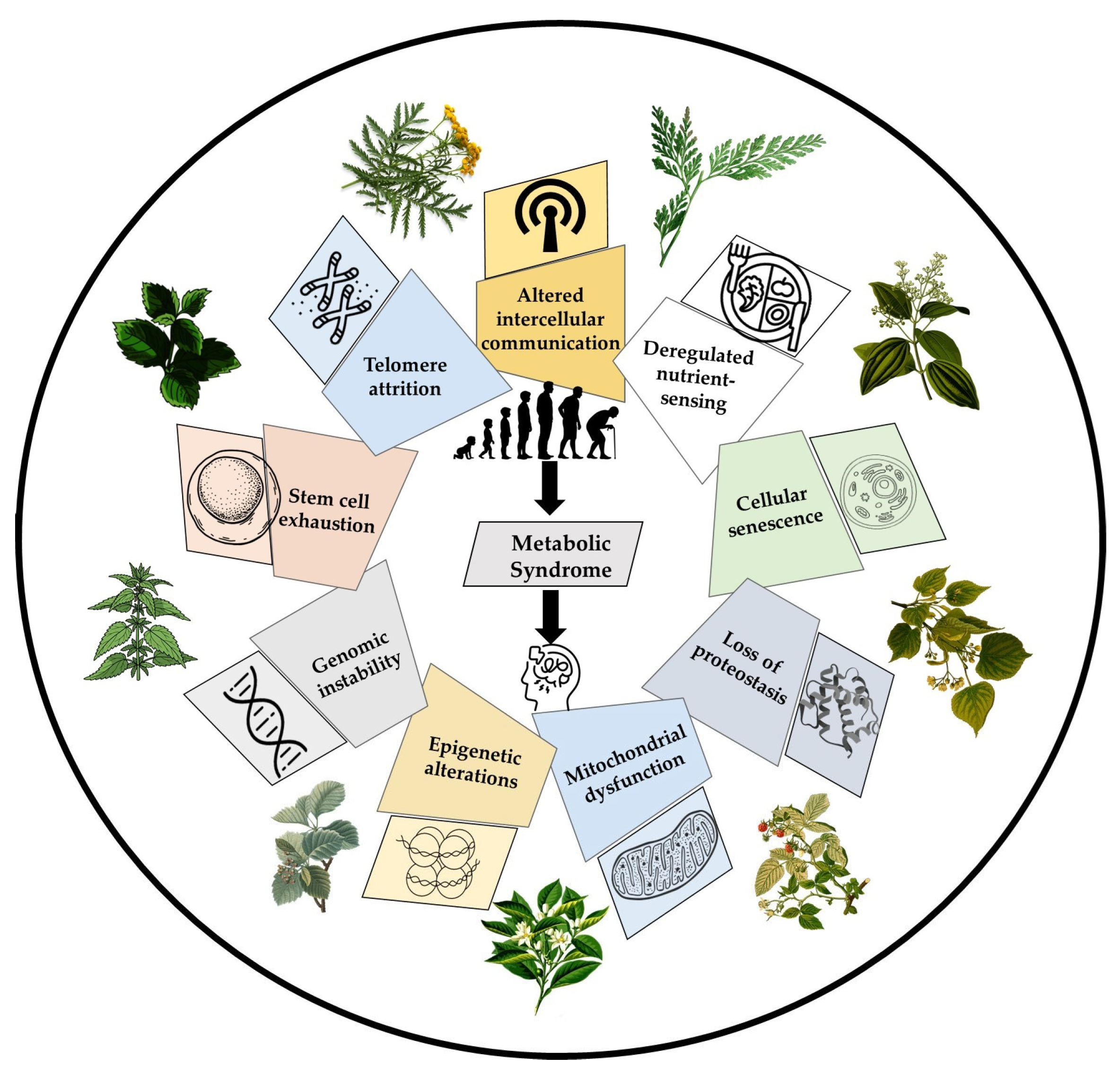
5. Age-Dependent Changes in Cell Remodeling and Herbs That Influence These Changes at the Molecular Level
5.1. Genomic Instability
5.2. Telomere Attrition
5.3. Epigenetic Alterations
5.4. Loss of Proteostasis
5.5. Mitochondrial Dysfunction
5.6. Cellular Senescence
5.7. Deregulated Nutrient Sensing
5.8. Stem Cell Exhaustion
5.9. Altered Intercellular Communication
6. Traditional Anti-Aging Medicines with the Potential to Be Translated into Effective Treatments for MetS-Induced Cognitive Decline
- Alpinia oxyphylla Miq., a medicinal plant, has been reported to improve cognitive impairment in post-ischemic stroke models by inducing the BDNF (brain-derived neurotropic factor)/TrkB (tropomycin receptor kinase B)/AKT signaling pathway [190]. p-Coumaric acid (also known as 4-hydroxycinnamic acid), a bioactive compound derived from Alpinia oxyphylla Miq., promotes hippocampal neurogenesis, enhances spatial learning, and improves both short- and long-term memory. These effects are mediated through the AKT pathway and are dependent on BDNF/TrkB signaling.
- Astragali radix is a widely used herb that exerts immunomodulatory [241], anti-hyperglycemic, anti-oxidant [242], anti-aging, anti-inflammatory [191], cardioprotective [243], and anti-aging effects [244], with minimum side effects [242,245]. Astragali radix contains diverse chemical constituents [246].
- Astragaloside IV exhibits a promising capacity to attenuate mitochondrial dysfunction in podocytes through the SIRT1/PGC1α/Nrf1 pathway, and it diminishes oxidative stress [192].
- Astragalus, a plant commonly utilized in traditional Chinese medicine, was shown to exhibit anti-aging effects through activating telomerase and inducing telomere length extension [234]. In an RCT on 40 middle-aged healthy individuals, the use of an astragalus-based supplement for 6 months significantly demonstrated longer median and shorter telomere length compared to the control group, where no changes in telomere length were exhibited [234].
- Atractylodis macrocephalae rhizoma (Atractylodes macrocephala Koidz.), a herb approved for use as a supplement in China, has demonstrated notable neuroprotective potential in preclinical studies. Evidence indicates that its medicinal properties include gastrointestinal support, anti-aging and antioxidant effects, and promotion of blood circulation [193]. A study indicates that Atractylodis macrocephalae rhizome alleviates neuroinflammation in AD through enhancing the cAMP signaling pathway [194]. It counteracts cyclophosphamide-induced immunosuppression in mice and restores normal immune function [195]. Evidence also indicates that Atractylodis macrocephalae rhizoma may enhance lymphocyte proliferation by inhibiting the PI3K/Akt/NF-κB signaling pathway; reducing IL-6, IFN-γ, and TNF-α levels; correcting immune cell imbalances; attenuating inflammatory responses; and improving immune function in aging rats. This herb may potentially delay aging due to its ability to reduce inflammation and enhance immune function [193].
- An 8-week RCT on 91 healthy subjects revealed the beneficial effects of Aronia melanocarpa supplementation on attenuating H2O2-induced DNA strand breaks ex vivo [235].
- Baicalin is an active ingredient predominantly found in Scutellaria baicalensis, a Chinese herbal medicine, and it exhibits anticancer, antifibrotic, anti-inflammatory, antioxidant, and anti-microbial properties [199,247,248,249]. In Parkinson’s disease rat models, baicalein exhibited neuroprotective effects by ameliorating mitochondrial dysfunction and activating mitochondrial autophagy through the SIRT1/AMPK/mTOR and miR-30b-5p pathways [196]. Baicalin also delineated protective effects against heart failure via improving mitochondrial dysfunction, as evidenced by reduced ROS production, apoptosis, and cardiac fibrosis in both in vivo and in vitro models [197]. Furthermore, baicalin has been shown to inhibit hypoxia-inducible factor-1α, thus reversing mitochondrial dysfunction and improving aerobic glycolysis [198]. It has been shown that baicalin is capable of preventing atherosclerosis via regulating the SIRT1/NF-κB signaling pathway mediated by exosomes stemming from the treatment of mesenchymal stem cells by baicalin [199].
- Bazi Bushen, a traditional Chinese medicine, has been shown to activate SASP, leading to significant alterations that impede inflammation-related pathways, including arachidonic linoleic acid metabolism and TNF- and IL-17-induced inflammatory pathways [200].
- Centella asiatica (L.) Urban, also known as gotu kola, a herb belonging to the Apiaceae family and widely grown in tropical and subtropical regions [205,250,251], has also been shown to have anti-aging effects via upregulating the activity of telomerase in human peripheral blood mononuclear cells (PBMCs) [252].
- Curcuma longa plant. It should be noted that not all natural products have promising effects on telomere maintenance. One of these natural products is curcumin, which is a polyphenolic compound derived from the Curcuma longa plant [253]. Curcumin, found primarily in the turmeric root [254], has been found to promote telomere attrition via inhibiting telomerase activity in tumor cells [255]. In addition, epigallocatechin gallate (EGCG), a catechin derived from green tea [256], promotes telomere shortening via genotoxicity [257]. Curcumin has been shown to affect DNA methylation by inhibiting DNA methyltransferase 1 (DNMT1) to modulate histone modification via inhibition of histone acetyltransferases [150]. On the other hand, in a study conducted in human leukemia cells, the authors found that curcumin and its derivatives can alter histone methylation and the activity of histone methylation/demethylation enzymes, and this is highly dependent on context and cell types [202].
- 11.
- Mylife/Mylife100® dietary supplement. In an 8-week RCT on 32 middle-aged Thai adults, Mylife/Mylife100® dietary supplement significantly increased the average telomere length between the baseline and the 8-week time point, possibly through the antioxidant properties of its ingredients [236]. This dietary supplement consists of soy protein, guava fruit, mangosteen aril, black sesame seed, and pennywort leaves. In another study, fortified mangosteen extract exhibited anti-aging properties via slowing telomere shortening [261].
- 12.
- Flavonoids, common constituents of fruits and Chinese herbal medicines, have been shown to protect vascular homeostasis through their antioxidant, anti-inflammatory, and antiaging effects in both in vitro and in vivo studies [250]. One study demonstrated that luteolin, a flavonoid, activates eNOS and increases NO production, resulting in concentration-dependent relaxation of vascular tension in rat aortic rings. Another study reported that luteolin-7-O-glucoside exerts antiproliferative and significant antioxidant effects by inhibiting signal transduction and the activator of the transcription 3 (STAT3) pathway [205].
- 13.
- Fangji Huangqi Decoction, a traditional Chinese medicine, demonstrated a significant elevation in mitophagy in podocytes in rat models via increasing BNIP3 expression [203].
- 14.
- Fisetin is a naturally occurring flavone with senolytic activity via upregulating anti-apoptotic pathways [205]. Fisetin has been shown to target various canonical indicators of cellular senescence in adipose-derived stem cells, including ROS, senescence-associated β–galactosidase, and senescence-associated heterochromatin foci [204].
- 15.
- Ginseng (Panax ginseng C.A. Meyer), a long-lived perennial herb belonging to the family of Panax (Araliaceae), is one of the most commonly used herbal nutritional products, known to promote vitality and longevity, reduce stress, fatigue, and weakness, and support both mental and physical health [251]. Recent evidence demonstrated that ginseng callus cells subcultured for 12 consecutive years retained chromosomal stability and totipotency, with minimal decline over time [252].
- 16.
- Grape Seed Extract: In contrast to Bazi Bushen, procyanidin C1, a polyphenolic component of grape seed extract, can inhibit SASP at lower concentrations and selectively eliminate senescent cells at higher concentrations [178].
- 17.
- Jiang Gui Fang increases the core temperature of mice by activating interscapular brown adipose tissue (iBAT) and inducing the browning of epididymal WAT (eWAT). This effect appears to be mediated through the peroxisome proliferator-activated receptor gamma (PPARγ)/SIRT1–PPARγ coactivator-1α (PGC-1α) signaling pathway [206].
- 18.
- Jingfang Granule, a traditional Chinese medicine, is often used for the treatment of infectious diseases. Jingfang Granule is a blend of 11 herbs. A recent study shows that Jingfang Granule not only significantly increases the median lifespan of C. elegans by 31.2% at a dosage of 10 mg/mL but also enhances oxidative stress resistance by reducing ROS levels [209]. Jingfang Granule also delays reproductive senescence in C. elegans. The authors propose that Jingfang Granule protects C. elegans from oxidative stress, thereby extending its lifespan. Jingfang Granule effectively promotes wound healing in diabetic rats [208]. It exerts anti-inflammatory and proangiogenic effects in vitro. American ginseng (Panax quinquefolius) maintained proteostasis through enhancing the activity of cathepsin B, a lysosomal protease in the autophagy–lysosomal pathway, leading to the removal of damaged proteins, as well as enhanced autophagic flux [262].
- 19.
- Lycium barbarum L. (L. barbarum), commonly known as wolfberry or goji berry, is widely used in traditional Chinese medicine. Among the multitude of its therapeutic effects, various strains of L. barbarum contain bioactive compounds that target 90 aging-related genes, providing evidence that they may represent a molecular source for anti-aging and age-delaying properties [193]. Evidence indicates that this herb possesses antioxidant, immunomodulatory, and glycemic-regulating properties, making it a promising candidate for addressing metabolic and obesity-related health challenges [263].
- 20.
- Scarlet beebalm (Monarda didyma L.), a perennial plant predominantly grown in Canada and the US and belonging to the Lamiaceae family, is rich in essential oil and phenolic compounds [264]. M. didyma L. contains didymin, a flavonoid glycoside that contributes to its anti-aging, antioxidant, and anti-inflammatory properties [265]. An RCT found that daily supplementation with M. didyma meaningfully stabilized DNA methylation age and improved telomere length [213].
- 21.
- Monochoria angustifolia, or Siam violet pearl, is the newest species of the genus Monochoria C. Presl, found in Thailand, and has long been consumed as food and in herbal medicine. It has been shown to produce apigenin-7-O-glucoside, an abundant antioxidant phytochemical [215], and may also have anti-inflammatory effects. Recent in silico and in vitro studies indicate that apigenin-7-O-glucoside is a potential anti-aging agent due to its ability to inhibit collagenase and elastase [216]. Since these enzymes contribute to tissue damage in diabetes, their inhibition by apigenin-7-O-glucoside may help reduce tissue damage in diabetic patients. The authors also provide evidence suggesting that the compound is safe based on its pharmacokinetic properties. However, further studies are needed to fully understand its therapeutic potential in the management of MetS.
- 22.
- Nicandra physalodes extract prolongs both lifespan and health span in C. elegans and ameliorates cellular senescence in human fetal lung fibroblasts (MRC-5 cells) [217]. It also counteracts premature aging in doxorubicin-treated aging mice. Treatment with Nicandra physalodes extract reverses liver function damage and reduces senescence marker levels, including ALT, SA-β-Gal, and γH2AX. The protective and antioxidative effects of this herb are mediated through insulin signaling pathways, involving DAF-16 and HSF-1. Naringenin, a flavanone predominantly found in citrus fruits, has been shown to exhibit promising effects on epigenetic alterations [266].
- 23.
- Nicotinamide Riboside: In a study on older adults with mild cognitive impairment, nicotinamide riboside, a vitamin B3 derivative, significantly increased blood levels of NAD+, indicating the potential role of this product in nutrient-sensing networks [237].
- 24.
- p-Coumaric acid is a 4-hydroxycinnamic acid derivative that is abundant in Chinese herbal medicines. It plays a role in oxidative stress-related diseases [267], including inflammation [218], CVDs [268], diabetes, MASLD [269], and nervous system disorders, according to recent reviews [244,270]. One study further indicates that the combination of metformin and p-coumaric acid improves MASLD by decreasing lipid accumulation and inhibiting inflammation [271]. p-Coumaric acid also increases outer and plasma membrane permeability in bacteria [272], which may potentially affect endothelial structure and function.
- 25.
- Pomegranate Extract: In a 12-week RCT on older adults, pomegranate extracts demonstrated beneficial effects on circulating levels of IGF-1, with no changes in telomere length [238]. IGF-1 has been shown to have potentially protective effects on vascular aging by mitigating oxidative stress and inhibiting signaling pathways associated with inflammation and apoptosis [273,274,275].
- 26.
- Quercetin: An RCT of quercetin, a natural flavonoid, in male patients with coronary artery disease found a significant decrease in vascular senescence and inflammaging signatures, indicating potential sex-specific effects of quercetin on regulating senescence-associated biology in humans [239].
- 27.
- Resveratrol, a polyphenol found primarily in certain berries, grains, roots, seeds, tea [276], Japanese knotweed, grapes, and red wine, has been shown to demonstrate anti-aging effects via telomere maintenance [254]. Resveratrol is capable of upregulating telomerase reverse transcriptase (hTERT) and stimulating silent information regulator proteins (SIRs) and their homologs, known as sirtuin (SIRT), along with the Nrf2 (nuclear factor erythroid 2-related factor 2) signaling pathway in human HepG2 hepatocellular carcinoma cells [220].
- 28.
- Salidroside, a phenylpropanoid glycoside derived from the plant Rhodiola rosea L., is capable of increasing the expression of SIRT1 and inducing autophagy via the AMPK-SIRT1 pathway [222] and mTOR [223]. It also reduces the expression levels of IGF-1 and regulates the insulin/IGF-1 signaling pathway [224]. Thus, salidroside may mitigate MetS and improve InsR via attenuating deregulated nutrient sensing. Moreover, salidroside has been shown to exert protective effects against liver fibrosis via upregulating miR-146a-5p, a major component of human liver stem cell exosomes [277], which ultimately inhibits hepatic stellate cell activation [278].
- 29.
- Si Jun Zi Tang (SJZT) is composed of four herbal medicines: Ginseng Radix et Rhizoma, Atractylodis macrocephalae Rhizoma, Poria, and Glycyrrhizae Radix et Rhizoma. SJZT is a classic traditional Chinese medicine prescription used to treat aging-related diseases, including skin disease. One study identified 131 bioactive compounds that met absorption, distribution, metabolism, and excretion (ADME) parameters, along with 235 target genes associated with aging [226]. According to the Kyoto Encyclopedia of Genes and Genomes (KEGG), the anti-aging mechanism of SJZT appears to be mediated through inhibition of the PI3K-AKT and p38 MAPK signaling pathways [226]. Thus, SJZT is a potential anti-aging herbal medicine. Sulforaphane, an isothiocyanate abundantly found in broccoli and other cruciferous vegetables, has been shown to affect DNA methylation [273].
- 30.
- Spermine and spermidine, which are polyamines, have been shown to have neuroprotective effects via stimulating autophagy [283], which subsequently results in reducing the aggregation of Tau and αS in neurons and microglia [284]. A cross-sectional study of 2674 older adults demonstrated a significant association between dietary intake of spermine and improved cognitive function [285]. Spermidine has been shown to effectively protect mesenchymal stromal cells against oxidative stress and exhibit antisenescence effects, at least in part, through SIRT3 [228].
- 31.
- Syringin, a phenylpropanoid glucoside found predominantly in the medicinal plant Acanthopanax senticosus, exerts antioxidant and anti-inflammatory activities [229]. Syringin has been demonstrated to stimulate autophagy, at least in part, by modulating the miR-34a/SIRT1/Beclin-1 axis, and to inhibit apoptosis induced by 6-hydroxydopamine in Caenorhabditis elegans models [230]. SIRT1 plays a crucial role in mitophagy and mitochondrial biogenesis [286,287].
- 32.
- Theaflavins, functional phytochemicals found primarily in black and dark tea, have beneficial effects on MetS [288]. Theaflavins act on multiple signaling pathways targeting dyslipidemia, obesity, and hyperglycemia. For instance, theaflavin TF3 activates the AMPK signaling pathway, leading to a reduction in hepatocyte lipid deposition [231].
- 33.
- Thymoquinone is an active ingredient primarily found in Nigella sativa seeds [289], and it exhibits protective effects against neuro-related disorders by ameliorating Aβ-induced neurotoxicity and mitochondrial membrane depolarization. These effects are mediated through inhibition of ROS formation and reduction in oxidative stress, as well as prevention of apoptosis via modulation of mitochondrial function and a decrease in levels of cytochrome-C and caspase-3 [289]. Similarly, in a study on rats, thymoquinone ameliorated inflammation, apoptosis, and oxidative stress, and it preserved mitochondrial DNA contents in cardiomyocytes [232].
- 34.
- Wuzi Yanzong Pill (WYP) is a traditional herbal prescription widely used in the treatment of male infertility. It consists of several herbs, including Gouqizi (Fructus Lycii), Tusizi (Semen Cuscutae), Wuweizi (Fructus Schisandrae Chinensis), Fupenzi (Fructus Rubi Chingii), and Cheqianzi (Semen Plantaginis). WYP exhibits neuroprotective and anti-inflammatory properties [290]. Although its precise molecular mechanisms remain unclear, evidence suggests that WYP exerts protective effects on nerve cells. Studies indicate that WYP appears to inhibit apoptosis and enhance the secretion of neurotrophic factors through activation of the PI3K/AKT signaling pathway [233].
7. Conclusions
Author Contributions
Funding
Institutional Review Board Statement
Informed Consent Statement
Data Availability Statement
Conflicts of Interest
Abbreviations
| AD | Alzheimer’s disease; |
| AMPK | AMP-activated protein kinase; |
| Ang II | Angiotensin II; |
| AT1R | Angiotensin II type 1 receptor; |
| CVD | Cardiovascular disease; |
| CNS | Central nervous system; |
| DAG | Diacylglycerol; |
| DFI | DNA fragmentation index; |
| DNMT | DNA methyltransferase; |
| EGCG | Epigallocatechin gallate; |
| ER | Extracellular vesicle; |
| Foxo | Forkhead box O; |
| GPCRs | G protein-coupled receptors; |
| GSK3β | Glycogen synthase kinase 3 beta; |
| HDAC | Histone deacetylase; |
| HDL | High-density lipoprotein; |
| IGF-1 | Insulin-like growth factor 1; |
| IGF-2 | Insulin-like growth factor 2; |
| IP3 | Inositol trisphosphate; |
| IRS-1 | Insulin receptor substrate 1; |
| IRS-2 | Insulin receptor substrate 2; |
| InsR | Insulin resistance; |
| IRs | Insulin receptors; |
| MAPK | Mitogen-activated protein kinase; |
| MASH | Metabolic dysfunction-associated steatohepatitis; |
| MASLD | Metabolic dysfunction-associated steatotic liver disease; |
| MetS | Metabolic syndrome; |
| MMPs | Matrix metalloproteinases; |
| mTOR | Mammalian target of rapamycin; |
| NO | Nitic oxide; |
| PBMCs | Peripheral blood mononuclear cells; |
| PLC | Phospholipase C; |
| PI3K | Phosphatidylinositol 3-kinase; |
| RAS | Renin–angiotensin system; |
| RCT | Randomized controlled trial; |
| ROS | Reactive oxygen species; |
| SASP | Senescence-associated secretory phenotype; |
| SIRT | Sirtuin; |
| SOD | Superoxide dismutase; |
| TBC1D4 | TBC1 domain family member 4; |
| NF-κB | Transcription factor nuclear factor-κB; |
| TRP | Transient receptor potential; |
| TSC1 | Tuberous sclerosis complex 1; |
| TSC2 | Tuberous sclerosis complex 2; |
| T2DM | Type 2 diabetes mellitus; |
| TNF-α | Tumor necrosis factor–α; |
| UKPDS | United Kingdom Prospective Diabetes Study; |
| UN | United Nations. |
References
- World Population Prospects, United Nations (UN). Population Ages 65 and Above (% of Total Population). Available online: https://data.worldbank.org/indicator/SP.POP.65UP.TO.ZS (accessed on 7 January 2026).
- Roberts, A.W.; Ogunwole, S.U.; Blakeslee, L.; Rabe, M.A. The Population 65 Years and Older in the United States: 2016; United States Census Bureau: Suitland, MD, USA, 2018. Available online: https://www.govinfo.gov/content/pkg/GOVPUB-C3-PURL-gpo112762/pdf/GOVPUB-C3-PURL-gpo112762.pdf (accessed on 1 January 2026).
- Ortman, J.; Velkoff, V.; Hogan, H. An aging nation: The older population in the United States. In Current Population Reports 2014; US Census Bureau: Suitland, MD, USA, 2014. [Google Scholar]
- Yaffe, K. Metabolic syndrome and cognitive decline. Curr. Alzheimer Res. 2007, 4, 123–126. [Google Scholar] [CrossRef] [PubMed]
- Jenkins, T.A. Metabolic Syndrome and Vascular-Associated Cognitive Impairment: A Focus on Preclinical Investigations. Curr. Diabetes Rep. 2022, 22, 333–340. [Google Scholar] [CrossRef]
- Mok, V.C.T.; Cai, Y.; Markus, H.S. Vascular cognitive impairment and dementia: Mechanisms, treatment, and future directions. Int. J. Stroke 2024, 19, 838–856. [Google Scholar] [CrossRef]
- Jang, K.W.; Hur, J.; Lee, D.W.; Kim, S.R. Metabolic Syndrome, Kidney-Related Adiposity, and Kidney Microcirculation: Unraveling the Damage. Biomedicines 2024, 12, 2706. [Google Scholar] [CrossRef]
- Gosalia, J.; Delgado Spicuzza, J.M.; Bowlus, C.K.; Gardner, A.W.; Dennis, N.A.; Pawelczyk, J.A.; Proctor, D.N. Impaired neurovascular coupling in metabolic syndrome: An fNIRS study. J. Appl. Physiol. 2025, 138, 1651–1663. [Google Scholar] [CrossRef] [PubMed]
- Shi, F.-D.; Yong, V.W. Neuroinflammation across neurological diseases. Science 2025, 388, eadx0043. [Google Scholar] [CrossRef]
- Brouwers, B.; Schrauwen-Hinderling, V.B.; Jelenik, T.; Gemmink, A.; Havekes, B.; Bruls, Y.; Dahlmans, D.; Roden, M.; Hesselink, M.K.C.; Schrauwen, P. Metabolic disturbances of non-alcoholic fatty liver resemble the alterations typical for type 2 diabetes. Clin. Sci. 2017, 131, 1905–1917. [Google Scholar] [CrossRef]
- Kolterman, O.G.; Gray, R.S.; Griffin, J.; Burstein, P.; Insel, J.; Scarlett, J.A.; Olefsky, J.M. Receptor and postreceptor defects contribute to the insulin resistance in noninsulin-dependent diabetes mellitus. J. Clin. Investig. 1981, 68, 957–969. [Google Scholar] [CrossRef]
- Prasad, A.; Quyyumi, A.A. Renin-Angiotensin System and Angiotensin Receptor Blockers in the Metabolic Syndrome. Circulation 2004, 110, 1507–1512. [Google Scholar] [CrossRef]
- Haeusler, R.A.; McGraw, T.E.; Accili, D. Biochemical and cellular properties of insulin receptor signalling. Nat. Rev. Mol. Cell Biol. 2018, 19, 31–44. [Google Scholar] [CrossRef] [PubMed]
- Batista, T.M.; Cederquist, C.T.; Kahn, C.R. The insulin receptor goes nuclear. Cell Res. 2019, 29, 509–511. [Google Scholar] [CrossRef] [PubMed]
- Frasca, F.; Pandini, G.; Scalia, P.; Sciacca, L.; Mineo, R.; Costantino, A.; Goldfine, I.D.; Belfiore, A.; Vigneri, R. Insulin Receptor Isoform A, a Newly Recognized, High-Affinity Insulin-Like Growth Factor II Receptor in Fetal and Cancer Cells. Mol. Cell. Biol. 1999, 19, 3278–3288. [Google Scholar] [CrossRef] [PubMed]
- Choi, E.; Bai, X.-C. The Activation Mechanism of the Insulin Receptor: A Structural Perspective. Annu. Rev. Biochem. 2023, 92, 247–272. [Google Scholar] [CrossRef]
- Martínez Báez, A.; Ayala, G.; Pedroza-Saavedra, A.; González-Sánchez, H.M.; Chihu Amparan, L. Phosphorylation Codes in IRS-1 and IRS-2 Are Associated with the Activation/Inhibition of Insulin Canonical Signaling Pathways. Curr. Issues Mol. Biol. 2024, 46, 634–649. [Google Scholar] [CrossRef]
- Yanai, H.; Adachi, H.; Hakoshima, M.; Iida, S.; Katsuyama, H. Metabolic-Dysfunction-Associated Steatotic Liver Disease-Its Pathophysiology, Association with Atherosclerosis and Cardiovascular Disease, and Treatments. Int. J. Mol. Sci. 2023, 24, 15473. [Google Scholar] [CrossRef]
- Vesković, M.; Šutulović, N.; Hrnčić, D.; Stanojlović, O.; Macut, D.; Mladenović, D. The Interconnection between Hepatic Insulin Resistance and Metabolic Dysfunction-Associated Steatotic Liver Disease—The Transition from an Adipocentric to Liver-Centric Approach. Curr. Issues Mol. Biol. 2023, 45, 9084–9102. [Google Scholar] [PubMed]
- Le, M.H.; Yeo, Y.H.; Zou, B.; Barnet, S.; Henry, L.; Cheung, R.; Nguyen, M.H. Forecasted 2040 global prevalence of nonalcoholic fatty liver disease using hierarchical bayesian approach. Clin. Mol. Hepatol. 2022, 28, 841–850. [Google Scholar] [CrossRef]
- Chen, Y.; Bian, S.; Le, J. Molecular Landscape and Diagnostic Model of MASH: Transcriptomic, Proteomic, Metabolomic, and Lipidomic Perspectives. Genes 2025, 16, 399. [Google Scholar] [CrossRef]
- Wang, Z.; Cao, Z.; Dong, Y.; Hong, Y.; Zuo, L.; Wang, H. Hepatocyte-hepatic stellate cell interactions in liver fibrosis: Mechanisms and therapeutic implications. Hepatol. Commun. 2026, 10, e0893. [Google Scholar] [CrossRef]
- Tantu, M.T.; Farhana, F.Z.; Haque, F.; Koo, K.M.; Qiao, L.; Ross, A.G.; Shiddiky, M.J.A. Pathophysiology, noninvasive diagnostics and emerging personalized treatments for metabolic associated liver diseases. npj Gut Liver 2025, 2, 18. [Google Scholar] [CrossRef]
- Santoro, A.; McGraw, T.E.; Kahn, B.B. Insulin action in adipocytes, adipose remodeling, and systemic effects. Cell Metab. 2021, 33, 748–757. [Google Scholar] [CrossRef] [PubMed]
- Cignarelli, A.; Genchi, V.A.; Perrini, S.; Natalicchio, A.; Laviola, L.; Giorgino, F. Insulin and Insulin Receptors in Adipose Tissue Development. Int. J. Mol. Sci. 2019, 20, 759. [Google Scholar] [CrossRef] [PubMed]
- Merz, K.E.; Thurmond, D.C. Role of Skeletal Muscle in Insulin Resistance and Glucose Uptake. Compr. Physiol. 2020, 10, 785–809. [Google Scholar] [CrossRef]
- DeFronzo, R.A.; Jacot, E.; Jequier, E.; Maeder, E.; Wahren, J.; Felber, J.P. The Effect of Insulin on the Disposal of Intravenous Glucose: Results from Indirect Calorimetry and Hepatic and Femoral Venous Catheterization. Diabetes 1981, 30, 1000–1007. [Google Scholar] [CrossRef]
- Parikh, H.M.; Elgzyri, T.; Alibegovic, A.; Hiscock, N.; Ekström, O.; Eriksson, K.-F.; Vaag, A.; Groop, L.C.; Ström, K.; Hansson, O. Relationship between insulin sensitivity and gene expression in human skeletal muscle. BMC Endocr. Disord. 2021, 21, 32. [Google Scholar] [CrossRef]
- Castillo, Í.M.P.; Argilés, J.M.; Rueda, R.; Ramírez, M.; Pedrosa, J.M.L. Skeletal muscle atrophy and dysfunction in obesity and type-2 diabetes mellitus: Myocellular mechanisms involved. Rev. Endocr. Metab. Disord. 2025, 26, 815–836. [Google Scholar] [CrossRef]
- DeFronzo, R.A.; Tripathy, D. Skeletal Muscle Insulin Resistance Is the Primary Defect in Type 2 Diabetes. Diabetes Care 2009, 32, S157–S163. [Google Scholar] [CrossRef]
- Kjærgaard, J.; Stocks, B.; Henderson, J.; Freemantle, J.B.; Rizo-Roca, D.; Puglia, M.; Madrazo Montoya, M.; Andersson, D.; Bäckdahl, J.; Eriksson-Hogling, D.; et al. Personalized molecular signatures of insulin resistance and type 2 diabetes. Cell 2025, 188, 4106–4122.e16. [Google Scholar] [CrossRef] [PubMed]
- Levate, G.; Stimson, R.H. Molecular signatures of skeletal muscle insulin resistance: Bringing personalised diabetes treatment a step closer. Signal Transduct. Target. Ther. 2025, 10, 320. [Google Scholar] [CrossRef]
- Seko, T.; Himuro, N.; Koyama, M.; Nakata, K.; Akasaka, H.; Mori, M.; Ogawa, S.; Miura, S.; Ohnishi, H. Low skeletal muscle mass independently predicts the progression of insulin resistance in non-obese older adults: A six-year cohort study. Diabetol. Int. 2025, 16, 726–734. [Google Scholar] [CrossRef]
- Nehme, A.; Zouein, F.A.; Zayeri, Z.D.; Zibara, K. An Update on the Tissue Renin Angiotensin System and Its Role in Physiology and Pathology. J. Cardiovasc. Dev. Dis. 2019, 6, 14. [Google Scholar] [CrossRef] [PubMed]
- Dandona, P.; Dhindsa, S.; Ghanim, H.; Chaudhuri, A. Angiotensin II and inflammation: The effect of angiotensin-converting enzyme inhibition and angiotensin II receptor blockade. J. Hum. Hypertens. 2007, 21, 20–27. [Google Scholar] [CrossRef]
- Hu, Y.; Zhao, D.; Zhong, L.; Zheng, J.; Zhang, D.; Wu, E.; Shi, Q.; Qiao, L.; Lin, L. Integrated multi-omics analysis reveals metabolic reprogramming as a key driver of angiotensin II-induced vascular remodeling. VIEW 2026, 7, 20250146. [Google Scholar] [CrossRef]
- da Silva, A.A.; do Carmo, J.M.; Li, X.; Wang, Z.; Mouton, A.J.; Hall, J.E. Role of Hyperinsulinemia and Insulin Resistance in Hypertension: Metabolic Syndrome Revisited. Can. J. Cardiol. 2020, 36, 671–682. [Google Scholar] [CrossRef]
- Kim, N.; Jung, Y.; Nam, M.; Sun Kang, M.; Lee, M.K.; Cho, Y.; Choi, E.-K.; Hwang, G.-S.; Soo Kim, H. Angiotensin II affects inflammation mechanisms via AMPK-related signalling pathways in HL-1 atrial myocytes. Sci. Rep. 2017, 7, 10328. [Google Scholar] [CrossRef]
- Koumallos, N.; Sigala, E.; Milas, T.; Baikoussis, N.G.; Aragiannis, D.; Sideris, S.; Tsioufis, K. Angiotensin Regulation of Vascular Homeostasis: Exploring the Role of ROS and RAS Blockers. Int. J. Mol. Sci. 2023, 24, 12111. [Google Scholar] [CrossRef]
- Bo, L.; Wei, L.; Shi, L.; Luo, C.; Gao, S.; Zhou, A.; Mao, C. Altered local RAS in the liver increased the risk of NAFLD in male mouse offspring produced by in vitro fertilization. BMC Pregnancy Childbirth 2023, 23, 345. [Google Scholar] [CrossRef]
- Chaimati, S.; Shantavasinkul, P.C.; Sritara, P.; Sirivarasai, J. Effects of AGT and AGTR1 Genetic Polymorphisms and Changes in Blood Pressure over a Five-Year Follow-Up. Risk Manag. Healthc. Policy 2023, 16, 2931–2942. [Google Scholar] [CrossRef]
- Ketkar, H.; Alqahtani, M.; Tang, S.; Parambath, S.P.; Bakshi, C.S.; Jain, S. Chronically hypertensive transgenic mice expressing human AT1R haplotype-I exhibit increased susceptibility to Francisella tularensis. Front. Microbiol. 2023, 14, 1173577. [Google Scholar] [CrossRef]
- Mekala, A.; Qiu, H. Interplay Between Vascular Dysfunction and Neurodegenerative Pathology: New Insights into Molecular Mechanisms and Management. Biomolecules 2025, 15, 712. [Google Scholar] [CrossRef] [PubMed]
- Shariat-Madar, Z.; Mahdi, F. Potential Molecular Biomarkers for Predicting and Monitoring Complications in Type 2 Diabetes Mellitus. Molecules 2025, 30, 4448. [Google Scholar] [CrossRef] [PubMed]
- Orieux, A.; Boulestreau, R.; Bats, M.L.; Vaurs, J.; Michot, M.; Peghaire, C.; Duplaa, C.; Couffinhal, T.; Rubin, S. Mechanisms of hypertension: Microvascular lesions and role of inflammation. Arch. Cardiovasc. Dis. 2025, 118, S183–S184. [Google Scholar] [CrossRef]
- Yannoutsos, A.; Levy, B.I.; Safar, M.E.; Slama, G.; Blacher, J. Pathophysiology of hypertension: Interactions between macro and microvascular alterations through endothelial dysfunction. J. Hypertens. 2014, 32, 216–224. [Google Scholar]
- The Metascreen Writing Committee. The Metabolic Syndrome Is a Risk Indicator of Microvascular and Macrovascular Complications in Diabetes: Results from Metascreen, a multicenter diabetes clinic–based survey. Diabetes Care 2006, 29, 2701–2707. [Google Scholar] [CrossRef]
- Tomiyama, H.; Shiina, K. The Relationships between Micro- and Macrovascular Damages: Their Functional and Morphological Aspects. J. Atheroscler. Thromb. 2022, 29, 1–2. [Google Scholar] [CrossRef]
- Noubiap, J.J.; Nansseu, J.R.; Nyaga, U.F.; Ndoadoumgue, A.L.; Ngouo, A.T.; Tounouga, D.N.; Tianyi, F.-L.; Foka, A.J.; Lontchi-Yimagou, E.; Nkeck, J.R.; et al. Worldwide trends in metabolic syndrome from 2000 to 2023: A systematic review and modelling analysis. Nat. Commun. 2025, 17, 573. [Google Scholar] [CrossRef]
- Lal, R.M.; Golubic, R.; Ray, S. 18 The heterogeneity of obesity: A cross-sectional analysis of the UK biobank cohort. BMJ Nutr. Prev. Health 2025, 8, A8. [Google Scholar] [CrossRef]
- Coral, D.E.; Franks, P.W. Clinically useful obesity subtypes revealed by harnessing deviations from population-average risk. Nat. Med. 2025, 31, 392–393. [Google Scholar] [CrossRef] [PubMed]
- Horwitz, A.; Birk, R. Adipose Tissue Hyperplasia and Hypertrophy in Common and Syndromic Obesity—The Case of BBS Obesity. Nutrients 2023, 15, 3445. [Google Scholar] [CrossRef]
- Balakrishnan, R.; Thurmond, D.C. Mechanisms by Which Skeletal Muscle Myokines Ameliorate Insulin Resistance. Int. J. Mol. Sci. 2022, 23, 4636. [Google Scholar] [CrossRef]
- Xue, M.; Xu, W.; Ou, Y.-N.; Cao, X.-P.; Tan, M.-S.; Tan, L.; Yu, J.-T. Diabetes mellitus and risks of cognitive impairment and dementia: A systematic review and meta-analysis of 144 prospective studies. Ageing Res. Rev. 2019, 55, 100944. [Google Scholar] [CrossRef]
- Uedono, H.; Mori, K.; Ochi, A.; Nakatani, S.; Miki, Y.; Tsuda, A.; Morioka, T.; Nagata, Y.; Imanishi, Y.; Shoji, T.; et al. Effects of fetuin-A-containing calciprotein particles on posttranslational modifications of fetuin-A in HepG2 cells. Sci. Rep. 2021, 11, 7486. [Google Scholar] [CrossRef]
- Li, Y.; Liu, Y.; Liu, S.; Gao, M.; Wang, W.; Chen, K.; Huang, L.; Liu, Y. Diabetic vascular diseases: Molecular mechanisms and therapeutic strategies. Signal Transduct. Target. Ther. 2023, 8, 152. [Google Scholar] [CrossRef] [PubMed]
- Chang, D.; Liu, J.; Bilinski, K.; Xu, L.; Steiner, G.Z.; Seto, S.W.; Bensoussan, A. Herbal Medicine for the Treatment of Vascular Dementia: An Overview of Scientific Evidence. Evid.-Based Complement. Altern. Med. 2016, 2016, 7293626. [Google Scholar] [CrossRef]
- Chen, C.; Rahman, N. Efficacy of Sailuotong in vascular dementia: An exploratory analysis of possible disease modifying activity. Alzheimer’s Dement. 2023, 19, e071506. [Google Scholar] [CrossRef]
- Lazdunski, M. Potassium channels: Structure-function relationships, diversity, and pharmacology. Cardiovasc. Drugs Ther. 1992, 6, 313–319. [Google Scholar] [CrossRef]
- Jackson, W.F. Chapter Three—Potassium Channels in Regulation of Vascular Smooth Muscle Contraction and Growth. In Advances in Pharmacology; Khalil, R.A., Ed.; Academic Press: Cambridge, MA, USA, 2017; Volume 78, pp. 89–144. [Google Scholar]
- Beverley, K.M.; Ahn, S.J.; Levitan, I. Flow-sensitive ion channels in vascular endothelial cells: Mechanisms of activation and roles in mechanotransduction. Biophys. J. 2025, 124, 4395–4406. [Google Scholar] [CrossRef]
- Nádasy, G.L.; Balla, A.; Dörnyei, G.; Hunyady, L.; Szekeres, M. Direct Vascular Effects of Angiotensin II (A Systematic Short Review). Int. J. Mol. Sci. 2025, 26, 113. [Google Scholar]
- Hayabuchi, Y.; Standen, N.B.; Davies, N.W. Angiotensin II inhibits and alters kinetics of voltage-gated K+ channels of rat arterial smooth muscle. Am. J. Physiol.-Heart Circ. Physiol. 2001, 281, H2480–H2489. [Google Scholar] [CrossRef]
- Nieves-Cintrón, M.; Flores-Tamez, V.A.; Le, T.; Baudel, M.M.-A.; Navedo, M.F. Cellular and molecular effects of hyperglycemia on ion channels in vascular smooth muscle. Cell. Mol. Life Sci. 2021, 78, 31–61. [Google Scholar] [CrossRef] [PubMed]
- Liu, Y.; Gutterman, D.D. The coronary circulation in diabetes:: Influence of reactive oxygen species on K+ channel-mediated vasodilation. Vasc. Pharmacol. 2002, 38, 43–49. [Google Scholar]
- Durante, A.; Mazzapicchi, A.; Baiardo Redaelli, M. Systemic and Cardiac Microvascular Dysfunction in Hypertension. Int. J. Mol. Sci. 2024, 25, 13294. [Google Scholar] [CrossRef] [PubMed]
- Alistair, D.G. Hypertensive Cerebral Small Vessel Disease and Stroke. Brain Pathol. 2002, 12, 358–370. [Google Scholar] [CrossRef] [PubMed]
- Werner, M.E.; Ledoux, J. K+ channels in biological processes: Vascular K+ channels in the regulation of blood pressure. J. Recept. Ligand Channel Res. 2014, 7, 51–60. [Google Scholar] [CrossRef]
- Yang, X.; Yang, Y. The crucial role of potassium ion channels in diabetes mellitus and its complications: A review. Channels 2025, 19, 2531949. [Google Scholar] [CrossRef]
- Jernigan, N.L.; Drummond, H.A. Myogenic vasoconstriction in mouse renal interlobar arteries: Role of endogenous β and γENaC. Am. J. Physiol.-Ren. Physiol. 2006, 291, F1184–F1191. [Google Scholar] [CrossRef]
- Oberleithner, H.; Ludwig, T.; Riethmüller, C.; Hillebrand, U.; Albermann, L.; Schäfer, C.; Shahin, V.; Schillers, H. Human Endothelium: Target for Aldosterone. Hypertension 2004, 43, 952–956. [Google Scholar] [CrossRef]
- Mantegazza, M.; Cestèle, S.; Catterall, W.A. Sodium channelopathies of skeletal muscle and brain. Physiol. Rev. 2021, 101, 1633–1689. [Google Scholar] [CrossRef]
- Cannon, S.C. Sodium Channelopathies of Skeletal Muscle. In Voltage-Gated Sodium Channels: Structure, Function and Channelopathies; Chahine, M., Ed.; Springer International Publishing: Cham, Switzerland, 2018; pp. 309–330. [Google Scholar]
- Pérez, F.R.; Venegas, F.; González, M.; Andrés, S.; Vallejos, C.; Riquelme, G.; Sierralta, J.; Michea, L. Endothelial Epithelial Sodium Channel Inhibition Activates Endothelial Nitric Oxide Synthase via Phosphoinositide 3-Kinase/Akt in Small-Diameter Mesenteric Arteries. Hypertension 2009, 53, 1000–1007. [Google Scholar] [CrossRef]
- Jeggle, P.; Callies, C.; Tarjus, A.; Fassot, C.; Fels, J.; Oberleithner, H.; Jaisser, F.; Kusche-Vihrog, K. Epithelial Sodium Channel Stiffens the Vascular Endothelium In Vitro and in Liddle Mice. Hypertension 2013, 61, 1053–1059. [Google Scholar] [CrossRef] [PubMed]
- Sternak, M.; Bar, A.; Adamski, M.G.; Mohaissen, T.; Marczyk, B.; Kieronska, A.; Stojak, M.; Kus, K.; Tarjus, A.; Jaisser, F.; et al. The Deletion of Endothelial Sodium Channel α (αENaC) Impairs Endothelium-Dependent Vasodilation and Endothelial Barrier Integrity in Endotoxemia In Vivo. Front. Pharmacol. 2018, 9, 178. [Google Scholar] [CrossRef]
- Herzog, M.J.; Müller, P.; Lechner, K.; Stiebler, M.; Arndt, P.; Kunz, M.; Ahrens, D.; Schmeißer, A.; Schreiber, S.; Braun-Dullaeus, R.C. Arterial stiffness and vascular aging: Mechanisms, prevention, and therapy. Signal Transduct. Target. Ther. 2025, 10, 282. [Google Scholar] [CrossRef]
- Vlahu, C.A.; Lemkes, B.A.; Struijk, D.G.; Koopman, M.G.; Krediet, R.T.; Vink, H. Damage of the Endothelial Glycocalyx in Dialysis Patients. J. Am. Soc. Nephrol. 2012, 23, 1900–1908. [Google Scholar] [CrossRef]
- Oberleithner, H.; Wilhelmi, M. Vascular Glycocalyx Sodium Store—Determinant of Salt Sensitivity? Blood Purif. 2015, 39, 7–10. [Google Scholar] [CrossRef] [PubMed]
- Broekhuizen, L.N.; Lemkes, B.A.; Mooij, H.L.; Meuwese, M.C.; Verberne, H.; Holleman, F.; Schlingemann, R.O.; Nieuwdorp, M.; Stroes, E.S.G.; Vink, H. Effect of sulodexide on endothelial glycocalyx and vascular permeability in patients with type 2 diabetes mellitus. Diabetologia 2010, 53, 2646–2655. [Google Scholar] [CrossRef]
- Strojek, K.; Grzeszczak, W.; Lacka, B.; Gorska, J.; Keller, C.K.; Ritz, E. Increased prevalence of salt sensitivity of blood pressure in IDDM with and without microalbuminuria. Diabetologia 1995, 38, 1443–1448. [Google Scholar] [CrossRef] [PubMed]
- Hill, M.A.; Jaisser, F.; Sowers, J.R. Role of the vascular endothelial sodium channel activation in the genesis of pathologically increased cardiovascular stiffness. Cardiovasc. Res. 2020, 118, 130–140. [Google Scholar] [CrossRef] [PubMed]
- Oberleithner, H.; Peters, W.; Kusche-Vihrog, K.; Korte, S.; Schillers, H.; Kliche, K.; Oberleithner, K. Salt overload damages the glycocalyx sodium barrier of vascular endothelium. Pflüg. Arch.—Eur. J. Physiol. 2011, 462, 519–528. [Google Scholar] [CrossRef]
- Flores, J.; Nugent, K. Sodium, the Vascular Endothelium, and Hypertension: A Narrative Review of Literature. Cardiol. Rev. 2025; Online ahead of print. [CrossRef]
- Korte, S.; Wiesinger, A.; Straeter, A.S.; Peters, W.; Oberleithner, H.; Kusche-Vihrog, K. Firewall function of the endothelial glycocalyx in the regulation of sodium homeostasis. Pflüg. Arch.—Eur. J. Physiol. 2012, 463, 269–278. [Google Scholar] [CrossRef]
- McDonald, K.K.; Cooper, S.; Danielzak, L.; Leask, R.L. Glycocalyx Degradation Induces a Proinflammatory Phenotype and Increased Leukocyte Adhesion in Cultured Endothelial Cells under Flow. PLoS ONE 2016, 11, e0167576. [Google Scholar] [CrossRef]
- Zaib, S.; Ahmad, S.; Khan, I.; Bin Jardan, Y.A.; Fentahun Wondmie, G. An evaluation of inflammatory and endothelial dysfunction markers as determinants of peripheral arterial disease in those with diabetes mellitus. Sci. Rep. 2024, 14, 15348. [Google Scholar] [CrossRef] [PubMed]
- Lang, P.-P.; Bai, J.; Zhang, Y.-L.; Yang, X.-L.; Xia, Y.-L.; Lin, Q.-Y.; Li, H.-H. Blockade of intercellular adhesion molecule-1 prevents angiotensin II-induced hypertension and vascular dysfunction. Lab. Investig. 2020, 100, 378–386. [Google Scholar] [CrossRef] [PubMed]
- Guan, X.; Zhu, X.; Zha, L.; Yu, W.; Rao, X.; Xiong, Y.; Jin, Y.; Zhang, M.; Luo, T.; Huang, X.; et al. VCAM-1 in Cognitive Impairment: Mechanisms, Biomarker Potential, and Therapeutic Targeting. Aging Dis. 2025; Online ahead of print. [CrossRef]
- Oberleithner, H.; Riethmüller, C.; Schillers, H.; MacGregor, G.A.; de Wardener, H.E.; Hausberg, M. Plasma sodium stiffens vascular endothelium and reduces nitric oxide release. Proc. Natl. Acad. Sci. USA 2007, 104, 16281–16286. [Google Scholar] [CrossRef]
- Oberleithner, H. Two barriers for sodium in vascular endothelium? Ann. Med. 2012, 44, S143–S148. [Google Scholar] [CrossRef] [PubMed]
- Monteil, A.; Guérineau, N.C.; Gil-Nagel, A.; Parra-Diaz, P.; Lory, P.; Senatore, A. New insights into the physiology and pathophysiology of the atypical sodium leak channel NALCN. Physiol. Rev. 2024, 104, 399–472. [Google Scholar] [CrossRef]
- Cochet-Bissuel, M.; Lory, P.; Monteil, A. The sodium leak channel, NALCN, in health and disease. Front. Cell. Neurosci. 2014, 8, 132. [Google Scholar] [CrossRef] [PubMed]
- Kschonsak, M.; Chua, H.C.; Noland, C.L.; Weidling, C.; Clairfeuille, T.; Bahlke, O.Ø.; Ameen, A.O.; Li, Z.R.; Arthur, C.P.; Ciferri, C.; et al. Structure of the human sodium leak channel NALCN. Nature 2020, 587, 313–318. [Google Scholar] [CrossRef]
- Li, P.; Halabi, C.M.; Stewart, R.; Butler, A.; Brown, B.; Xia, X.; Santi, C.; England, S.; Ferreira, J.; Mecham, R.P.; et al. Sodium-activated potassium channels moderate excitability in vascular smooth muscle. J. Physiol. 2019, 597, 5093–5108. [Google Scholar] [CrossRef]
- Sakitani, N. The sympathetic nervous system in the pathophysiology of hypertension: Mechanistic insights and therapeutic implications. Hypertens. Res. 2026, 49, 1324–1328. [Google Scholar] [CrossRef]
- Wong, C.-O.; Yao, X. TRP Channels in Vascular Endothelial Cells. In Transient Receptor Potential Channels; Islam, M.S., Ed.; Springer: Dordrecht, The Netherlands, 2011; pp. 759–780. [Google Scholar]
- Zhang, M.; Ma, Y.; Ye, X.; Zhang, N.; Pan, L.; Wang, B. TRP (transient receptor potential) ion channel family: Structures, biological functions and therapeutic interventions for diseases. Signal Transduct. Target. Ther. 2023, 8, 261. [Google Scholar] [CrossRef] [PubMed]
- Smani, T.; Gómez, L.J.; Regodon, S.; Woodard, G.E.; Siegfried, G.; Khatib, A.M.; Rosado, J.A. TRP Channels in Angiogenesis and Other Endothelial Functions. Front. Physiol. 2018, 9, 1731. [Google Scholar] [CrossRef]
- Greenberg, H.Z.E.; Carlton-Carew, S.R.E.; Khan, D.M.; Zargaran, A.K.; Jahan, K.S.; Vanessa Ho, W.S.; Albert, A.P. Heteromeric TRPV4/TRPC1 channels mediate calcium-sensing receptor-induced nitric oxide production and vasorelaxation in rabbit mesenteric arteries. Vasc. Pharmacol. 2017, 96–98, 53–62. [Google Scholar] [CrossRef]
- Feng, S. TRPC Channel Structure and Properties. Adv. Exp. Med. Biol. 2017, 976, 9–23. [Google Scholar] [CrossRef]
- Kim, J.; Ko, J.; Myeong, J.; Kwak, M.; Hong, C.; So, I. TRPC1 as a negative regulator for TRPC4 and TRPC5 channels. Pflüg. Arch.—Eur. J. Physiol. 2019, 471, 1045–1053. [Google Scholar] [CrossRef]
- Xu, S.-Z.; Beech, D.J. TrpC1 Is a Membrane-Spanning Subunit of Store-Operated Ca2+ Channels in Native Vascular Smooth Muscle Cells. Circ. Res. 2001, 88, 84–87. [Google Scholar] [CrossRef] [PubMed]
- Krout, D.; Schaar, A.; Sun, Y.; Sukumaran, P.; Roemmich, J.N.; Singh, B.B.; Claycombe-Larson, K.J. The TRPC1 Ca2+-permeable channel inhibits exercise-induced protection against high-fat diet-induced obesity and type II diabetes. J. Biol. Chem. 2017, 292, 20799–20807. [Google Scholar] [CrossRef]
- Chen, X.; Sooch, G.; Demaree, I.S.; White, F.A.; Obukhov, A.G. Transient Receptor Potential Canonical (TRPC) Channels: Then and Now. Cells 2020, 9, 1983. [Google Scholar] [CrossRef]
- Kuang, C.Y.; Yu, Y.; Wang, K.; Qian, D.H.; Den, M.Y.; Huang, L. Knockdown of transient receptor potential canonical-1 reduces the proliferation and migration of endothelial progenitor cells. Stem Cells Dev. 2012, 21, 487–496. [Google Scholar] [CrossRef]
- Bishara, N.B.; Ding, H. Glucose enhances expression of TRPC1 and calcium entry in endothelial cells. Am. J. Physiol. Heart Circ. Physiol. 2010, 298, H171–H178. [Google Scholar] [CrossRef] [PubMed]
- van Breemen, C.; Poburko, D.; Okon, E.B. TRP proteins: A new dimension in the treatment of occlusive vascular disease. Circ. Res. 2006, 98, 446–447. [Google Scholar] [CrossRef] [PubMed]
- Tang, L.; Yao, F.; Wang, H.; Wang, X.; Shen, J.; Dai, B.; Wu, H.; Zhou, D.; Guo, F.; Wang, J.; et al. Inhibition of TRPC1 prevents cardiac hypertrophy via NF-κB signaling pathway in human pluripotent stem cell-derived cardiomyocytes. J. Mol. Cell. Cardiol. 2019, 126, 143–154. [Google Scholar] [CrossRef] [PubMed]
- Chen, K.; Jin, X.; Li, Q.; Wang, W.; Wang, Y.; Zhang, J. Association of TRPC1 Gene Polymorphisms with Type 2 Diabetes and Diabetic Nephropathy in Han Chinese Population. Endocr. Res. 2013, 38, 59–68. [Google Scholar] [CrossRef]
- Zhu, Y.; Chu, Y.; Lan, Y.; Wang, S.; Zhang, Y.; Liu, Y.; Wang, X.; Yu, F.; Ma, X. Loss of Endothelial TRPC1 Induces Aortic Hypercontractility and Hypertension. Circ. Res. 2025, 136, 508–523. [Google Scholar] [CrossRef]
- Takahashi, Y.; Watanabe, H.; Murakami, M.; Ohba, T.; Radovanovic, M.; Ono, K.; Iijima, T.; Ito, H. Involvement of transient receptor potential canonical 1 (TRPC1) in angiotensin II-induced vascular smooth muscle cell hypertrophy. Atherosclerosis 2007, 195, 287–296. [Google Scholar] [CrossRef]
- Wen, X.; Peng, Y.; Yang, W.; Zhu, Y.; Yu, F.; Geng, L.; Wang, X.; Wang, X.; Zhang, X.; Tang, Y.; et al. VSMC-specific TRPC1 deletion attenuates angiotensin II-induced hypertension and cardiovascular remodeling. J. Mol. Med. 2025, 103, 205–218. [Google Scholar] [CrossRef]
- Paria, B.C.; Malik, A.B.; Kwiatek, A.M.; Rahman, A.; May, M.J.; Ghosh, S.; Tiruppathi, C. Tumor necrosis factor-alpha induces nuclear factor-kappaB-dependent TRPC1 expression in endothelial cells. J. Biol. Chem. 2003, 278, 37195–37203. [Google Scholar] [CrossRef]
- Alvarez, D.F.; King, J.A.; Weber, D.; Addison, E.; Liedtke, W.; Townsley, M.I. Transient receptor potential vanilloid 4-mediated disruption of the alveolar septal barrier: A novel mechanism of acute lung injury. Circ. Res. 2006, 99, 988–995. [Google Scholar] [CrossRef]
- Loot, A.E.; Popp, R.; Fisslthaler, B.; Vriens, J.; Nilius, B.; Fleming, I. Role of cytochrome P450-dependent transient receptor potential V4 activation in flow-induced vasodilatation. Cardiovasc. Res. 2008, 80, 445–452. [Google Scholar] [CrossRef]
- Yeon, S.-I.; Kim, J.Y.; Yeon, D.-S.; Abramowitz, J.; Birnbaumer, L.; Muallem, S.; Lee, Y.-H. Transient Receptor Potential Canonical Type 3 Channels Control the Vascular Contractility of Mouse Mesenteric Arteries. PLoS ONE 2014, 9, e110413. [Google Scholar] [CrossRef]
- Du, J.; Ma, X.; Shen, B.; Huang, Y.; Birnbaumer, L.; Yao, X. TRPV4, TRPC1, and TRPP2 assemble to form a flow-sensitive heteromeric channel. FASEB J. 2014, 28, 4677–4685. [Google Scholar] [CrossRef] [PubMed]
- Earley, S. TRPA1 channels in the vasculature. Br. J. Pharmacol. 2012, 167, 13–22. [Google Scholar] [CrossRef]
- Palmer, A.K.; Jensen, M.D. Metabolic changes in aging humans: Current evidence and therapeutic strategies. J. Clin. Investig. 2022, 132, e158451. [Google Scholar] [CrossRef]
- McCarthy, K.; Laird, E.; O’Halloran, A.M.; Fallon, P.; O’Connor, D.; Ortuño, R.R.; Kenny, R.A. An examination of the prevalence of metabolic syndrome in older adults in Ireland: Findings from The Irish Longitudinal Study on Ageing (TILDA). PLoS ONE 2022, 17, e0273948. [Google Scholar] [CrossRef]
- McCarthy, K.; O’Halloran, A.M.; Fallon, P.; Kenny, R.A.; McCrory, C. Metabolic syndrome accelerates epigenetic ageing in older adults: Findings from The Irish Longitudinal Study on Ageing (TILDA). Exp. Gerontol. 2023, 183, 112314. [Google Scholar] [CrossRef]
- Caso, G.; McNurlan, M.A.; Mileva, I.; Zemlyak, A.; Mynarcik, D.C.; Gelato, M.C. Peripheral fat loss and decline in adipogenesis in older humans. Metabolism 2013, 62, 337–340. [Google Scholar] [CrossRef]
- Kornicka, K.; Marycz, K.; Tomaszewski, K.A.; Marędziak, M.; Śmieszek, A. The Effect of Age on Osteogenic and Adipogenic Differentiation Potential of Human Adipose Derived Stromal Stem Cells (hASCs) and the Impact of Stress Factors in the Course of the Differentiation Process. Oxidative Med. Cell. Longev. 2015, 2015, 309169. [Google Scholar] [CrossRef] [PubMed]
- López-Otín, C.; Blasco, M.A.; Partridge, L.; Serrano, M.; Kroemer, G. Hallmarks of aging: An expanding universe. Cell 2023, 186, 243–278. [Google Scholar] [CrossRef]
- Lindahl, T. Instability and decay of the primary structure of DNA. Nature 1993, 362, 709–715. [Google Scholar] [CrossRef] [PubMed]
- Kallai, A.; Ungvari, Z.; Fekete, M.; Maier, A.B.; Mikala, G.; Andrikovics, H.; Lehoczki, A. Genomic instability and genetic heterogeneity in aging: Insights from clonal hematopoiesis (CHIP), monoclonal gammopathy (MGUS), and monoclonal B-cell lymphocytosis (MBL). Geroscience 2025, 47, 703–720. [Google Scholar] [CrossRef] [PubMed]
- Milić, M.; Kazensky, L.; Matovinović, M. The Impact of the Metabolic Syndrome Severity on the Appearance of Primary and Permanent DNA Damage. Medicina 2024, 61, 21. [Google Scholar] [CrossRef]
- Szewczuk, M.; Boguszewska, K.; Kaźmierczak-Barańska, J.; Karwowski, B.T. The role of AMPK in metabolism and its influence on DNA damage repair. Mol. Biol. Rep. 2020, 47, 9075–9086. [Google Scholar] [CrossRef]
- Meramat, A.; Rajab, N.; Shahar, S.; Sharif, R. Cognitive impairment, genomic instability and trace elements. J. Nutr. Health Aging 2015, 19, 48–57. [Google Scholar] [CrossRef]
- Blackburn, E.H.; Szostak, J.W. The molecular structure of centromeres and telomeres. Annu. Rev. Biochem. 1984, 53, 163–194. [Google Scholar] [CrossRef] [PubMed]
- Blackburn, E.H. Telomere states and cell fates. Nature 2000, 408, 53–56. [Google Scholar] [CrossRef]
- Casagrande, S.; Hau, M. Telomere attrition: Metabolic regulation and signalling function? Biol. Lett. 2019, 15, 20180885. [Google Scholar] [CrossRef]
- von Zglinicki, T. Oxidative stress shortens telomeres. Trends Biochem. Sci. 2002, 27, 339–344. [Google Scholar] [CrossRef]
- Haycock, P.C.; Heydon, E.E.; Kaptoge, S.; Butterworth, A.S.; Thompson, A.; Willeit, P. Leucocyte telomere length and risk of cardiovascular disease: Systematic review and meta-analysis. BMJ 2014, 349, g4227. [Google Scholar] [CrossRef]
- Weischer, M.; Bojesen, S.E.; Cawthon, R.M.; Freiberg, J.J.; Tybjærg-Hansen, A.; Nordestgaard, B.G. Short telomere length, myocardial infarction, ischemic heart disease, and early death. Arterioscler. Thromb. Vasc. Biol. 2012, 32, 822–829. [Google Scholar] [CrossRef]
- Willeit, P.; Raschenberger, J.; Heydon, E.E.; Tsimikas, S.; Haun, M.; Mayr, A.; Weger, S.; Witztum, J.L.; Butterworth, A.S.; Willeit, J.; et al. Leucocyte Telomere Length and Risk of Type 2 Diabetes Mellitus: New Prospective Cohort Study and Literature-Based Meta-Analysis. PLoS ONE 2014, 9, e112483. [Google Scholar] [CrossRef]
- Sun, C.; Qiu, P.; Huang, S.; Luo, Q.; Ma, Q.; Hu, P.; Chen, F.; Wu, H.; Chen, C. Telomere length and metabolic dysfunction-associated steatotic liver disease risk and progression: A systematic review and meta-analysis. Exp. Gerontol. 2026, 214, 113036. [Google Scholar] [CrossRef] [PubMed]
- Barros, A.G.A.; Soares, T.O.; Lage, A.F.A.; Cintra, M.T.G.; de Paula, J.J.; Malheiro, O.B.; Falcão, A.E.; Nogueira, C.A.C.; de Carvalho, L.B.; Romano Silva, M.A.; et al. Leukocyte telomere attrition in cognitive decline: Associations with APOE genotype and cardiovascular risk factors. Front. Aging Neurosci. 2025, 17, 1557016. [Google Scholar] [CrossRef] [PubMed]
- Cohen-Manheim, I.; Doniger, G.M.; Sinnreich, R.; Simon, E.S.; Pinchas, R.; Aviv, A.; Kark, J.D. Increased attrition of leukocyte telomere length in young adults is associated with poorer cognitive function in midlife. Eur. J. Epidemiol. 2016, 31, 147–157. [Google Scholar] [CrossRef]
- Koh, S.H.; Choi, S.H.; Jeong, J.H.; Jang, J.W.; Park, K.W.; Kim, E.J.; Kim, H.J.; Hong, J.Y.; Yoon, S.J.; Yoon, B.; et al. Telomere shortening reflecting physical aging is associated with cognitive decline and dementia conversion in mild cognitive impairment due to Alzheimer’s disease. Aging 2020, 12, 4407–4423. [Google Scholar] [CrossRef]
- Martin-Ruiz, C.; Dickinson, H.O.; Keys, B.; Rowan, E.; Kenny, R.A.; Von Zglinicki, T. Telomere length predicts poststroke mortality, dementia, and cognitive decline. Ann. Neurol. 2006, 60, 174–180. [Google Scholar] [CrossRef] [PubMed]
- Cai, Z.; Yan, L.J.; Ratka, A. Telomere shortening and Alzheimer’s disease. Neuromol. Med. 2013, 15, 25–48. [Google Scholar] [CrossRef] [PubMed]
- Pudas, S.; Josefsson, M.; Nordin Adolfsson, A.; Landfors, M.; Kauppi, K.; Veng-Taasti, L.M.; Hultdin, M.; Adolfsson, R.; Degerman, S. Short Leukocyte Telomeres, But Not Telomere Attrition Rates, Predict Memory Decline in the 20-Year Longitudinal Betula Study. J. Gerontol. Ser. A Biol. Sci. Med. Sci. 2021, 76, 955–963. [Google Scholar] [CrossRef]
- Beyne-Rauzy, O.; Prade-Houdellier, N.; Demur, C.; Recher, C.; Ayel, J.; Laurent, G.; Mansat-De Mas, V. Tumor necrosis factor-α inhibits hTERT gene expression in human myeloid normal and leukemic cells. Blood 2005, 106, 3200–3205. [Google Scholar]
- Blackburn, E.H. Switching and signaling at the telomere. Cell 2001, 106, 661–673. [Google Scholar] [CrossRef] [PubMed]
- Berger, S.L.; Kouzarides, T.; Shiekhattar, R.; Shilatifard, A. An operational definition of epigenetics. Genes Dev. 2009, 23, 781–783. [Google Scholar] [CrossRef] [PubMed]
- Gonzalo, S. Epigenetic alterations in aging. J. Appl. Physiol. 2010, 109, 586–597. [Google Scholar] [CrossRef] [PubMed]
- López-Otín, C.; Blasco, M.A.; Partridge, L.; Serrano, M.; Kroemer, G. The Hallmarks of Aging. Cell 2013, 153, 1194–1217. [Google Scholar] [CrossRef] [PubMed]
- Abbas, M.N.; Kausar, S.; Cui, H. Therapeutic potential of natural products in glioblastoma treatment: Targeting key glioblastoma signaling pathways and epigenetic alterations. Clin. Transl. Oncol. 2020, 22, 963–977. [Google Scholar] [CrossRef]
- Ramzan, F.; Vickers, M.H.; Mithen, R.F. Epigenetics, microRNA and Metabolic Syndrome: A Comprehensive Review. Int. J. Mol. Sci. 2021, 22, 5047. [Google Scholar] [CrossRef]
- Sanada, F.; Hayashi, S.; Morishita, R. Targeting the hallmarks of aging: Mechanisms and therapeutic opportunities. Front. Cardiovasc. Med. 2025, 12, 1631578. [Google Scholar] [CrossRef]
- Shukla, M.; Narayan, M. Proteostasis and Its Role in Disease Development. Cell Biochem. Biophys. 2025, 83, 1725–1741. [Google Scholar] [CrossRef]
- Labbadia, J.; Morimoto, R.I. The biology of proteostasis in aging and disease. Annu. Rev. Biochem. 2015, 84, 435–464. [Google Scholar] [CrossRef]
- Lemmer, I.L.; Willemsen, N.; Hilal, N.; Bartelt, A. A guide to understanding endoplasmic reticulum stress in metabolic disorders. Mol. Metab. 2021, 47, 101169. [Google Scholar] [CrossRef]
- Green, D.R.; Galluzzi, L.; Kroemer, G. Mitochondria and the autophagy-inflammation-cell death axis in organismal aging. Science 2011, 333, 1109–1112. [Google Scholar] [CrossRef] [PubMed]
- Liu, F.; Wu, X.; Wang, Z.; Li, A.; Luo, Y.; Cao, J. Mitochondrial dysfunction in postoperative cognitive dysfunction: From preclinical mechanisms to multimodal diagnostics and precision intervention. Ageing Res. Rev. 2025, 111, 102845. [Google Scholar] [CrossRef] [PubMed]
- Di Micco, R.; Krizhanovsky, V.; Baker, D.; d’Adda di Fagagna, F. Cellular senescence in ageing: From mechanisms to therapeutic opportunities. Nat. Rev. Mol. Cell Biol. 2021, 22, 75–95. [Google Scholar] [CrossRef]
- Gorgoulis, V.; Adams, P.D.; Alimonti, A.; Bennett, D.C.; Bischof, O.; Bishop, C.; Campisi, J.; Collado, M.; Evangelou, K.; Ferbeyre, G.; et al. Cellular Senescence: Defining a Path Forward. Cell 2019, 179, 813–827. [Google Scholar] [CrossRef]
- Muñoz-Espín, D.; Serrano, M. Cellular senescence: From physiology to pathology. Nat. Rev. Mol. Cell Biol. 2014, 15, 482–496. [Google Scholar] [CrossRef] [PubMed]
- Wiley, C.D.; Campisi, J. The metabolic roots of senescence: Mechanisms and opportunities for intervention. Nat. Metab. 2021, 3, 1290–1301. [Google Scholar] [CrossRef]
- Zhang, H.; Zhou, H.; Shen, X.; Lin, X.; Zhang, Y.; Sun, Y.; Zhou, Y.; Zhang, L.; Zhang, D. The role of cellular senescence in metabolic diseases and the potential for senotherapeutic interventions. Front. Cell Dev. Biol. 2023, 11, 1276707. [Google Scholar] [CrossRef] [PubMed]
- Fouqueray, P.; Bolze, S.; Dubourg, J.; Hallakou-Bozec, S.; Theurey, P.; Grouin, J.-M.; Chevalier, C.; Gluais-Dagorn, P.; Moller, D.E.; Cusi, K. Pharmacodynamic effects of direct AMP kinase activation in humans with insulin resistance and non-alcoholic fatty liver disease: A phase 1b study. Cell Rep. Med. 2021, 2, 100474. [Google Scholar] [CrossRef]
- Ruderman, N.B.; Carling, D.; Prentki, M.; Cacicedo, J.M. AMPK, insulin resistance, and the metabolic syndrome. J. Clin. Investig. 2013, 123, 2764–2772. [Google Scholar] [CrossRef]
- Hotamisligil, G.S.; Erbay, E. Nutrient sensing and inflammation in metabolic diseases. Nat. Rev. Immunol. 2008, 8, 923–934. [Google Scholar] [CrossRef]
- Micó, V.; Berninches, L.; Tapia, J.; Daimiel, L. NutrimiRAging: Micromanaging nutrient sensing pathways through nutrition to promote healthy aging. Int. J. Mol. Sci. 2017, 18, 915. [Google Scholar] [CrossRef]
- Guth, M. Stem cell exhaustion as a hallmark of aging. J. Cell Sci. Regen. Med. 2025, 1, 20–26. [Google Scholar]
- Guerville, F.; Barreto, P.D.S.; Ader, I.; Andrieu, S.; Casteilla, L.; Dray, C.; Fazilleau, N.; Guyonnet, S.; Langin, D.; Liblau, R.; et al. Revisiting the hallmarks of aging to identify markers of biological age. J. Prev. Alzheimer’s Dis. 2020, 7, 56–64. [Google Scholar] [CrossRef] [PubMed]
- Gunawardene, P.; Bermeo, S.; Vidal, C.; Al-Saedi, A.; Chung, P.; Boersma, D.; Phu, S.; Pokorski, I.; Suriyaarachchi, P.; Demontiero, O.; et al. Association between circulating osteogenic progenitor cells and disability and frailty in older persons: The Nepean Osteoporosis and Frailty Study. J. Gerontol. Ser. A Biomed. Sci. Med. Sci. 2016, 71, 1124–1130. [Google Scholar] [CrossRef]
- Qi, Y.; Liu, W.; Wang, X.; Lu, N.; Yang, M.; Liu, W.; Ma, J.; Liu, W.; Zhang, W.; Li, S. Adipose-derived mesenchymal stem cells from obese mice prevent body weight gain and hyperglycemia. Stem Cell Res. Ther. 2021, 12, 277. [Google Scholar] [CrossRef] [PubMed]
- Kotikalapudi, N.; Sampath, S.J.P.; Sinha, S.N.; Bhonde, R.; Mungamuri, S.K.; Venkatesan, V. Human placental mesenchymal stromal cell therapy restores the cytokine efflux and insulin signaling in the skeletal muscle of obesity-induced type 2 diabetes rat model. Hum. Cell 2022, 35, 557–571. [Google Scholar] [CrossRef] [PubMed]
- Kotikalapudi, N.; Sampath, S.J.P.; Sinha, S.N.; Bhonde, R.; Mungamuri, S.K.; Venkatesan, V. Placental mesenchymal stem cells restore glucose and energy homeostasis in obesogenic adipocytes. Cell Tissue Res. 2023, 391, 127–144. [Google Scholar] [CrossRef] [PubMed]
- Zarei, M. Mesenchymal stem cell therapy for type 2 diabetes: Mechanisms, clinical evidence, and future directions. Mol. Biol. Rep. 2025, 52, 1046. [Google Scholar] [CrossRef]
- Wu, Z.; Huang, S.; Li, S.; Cai, J.; Huang, L.; Wu, W.; Chen, J.; Tan, J. Bone marrow mesenchymal stem cell and mononuclear cell combination therapy in patients with type 2 diabetes mellitus: A randomized controlled study with 8-year follow-up. Stem Cell Res. Ther. 2024, 15, 339. [Google Scholar] [CrossRef]
- Ivan, A.; Lukinich-Gruia, A.T.; Cristea, I.-M.; Pricop, M.-A.; Calma, C.L.; Simina, A.-G.; Tatu, C.A.; Galuscan, A.; Păunescu, V. Quercetin and Mesenchymal Stem Cell Metabolism: A Comparative Analysis of Young and Senescent States. Molecules 2024, 29, 5755. [Google Scholar] [CrossRef]
- Fafián-Labora, J.A.; O’Loghlen, A. Classical and nonclassical intercellular communication in senescence and ageing. Trends Cell Biol. 2020, 30, 628–639. [Google Scholar] [CrossRef]
- van Niel, G.; Carter, D.R.; Clayton, A.; Lambert, D.W.; Raposo, G.; Vader, P. Challenges and directions in studying cell–cell communication by extracellular vesicles. Nat. Rev. Mol. Cell Biol. 2022, 23, 369–382. [Google Scholar] [CrossRef]
- Xu, Q.; Fu, Q.; Li, Z.; Liu, H.; Wang, Y.; Lin, X.; He, R.; Zhang, X.; Ju, Z.; Campisi, J.; et al. The flavonoid procyanidin C1 has senotherapeutic activity and increases lifespan in mice. Nat. Metab. 2021, 3, 1706–1726. [Google Scholar] [CrossRef]
- Isaac, R.; Reis, F.C.G.; Ying, W.; Olefsky, J.M. Exosomes as mediators of intercellular crosstalk in metabolism. Cell Metab. 2021, 33, 1744–1762. [Google Scholar] [CrossRef]
- Zhang, M.; Wei, J.; He, C.; Sui, L.; Jiao, C.; Zhu, X.; Pan, X. Inter-and intracellular mitochondrial communication: Signaling hubs in aging and age-related diseases. Cell. Mol. Biol. Lett. 2024, 29, 153. [Google Scholar] [CrossRef]
- Jia, H.; Liu, D. Integrative single-cell analysis of metabolic syndrome reveals novel cellular heterogeneity and differentiation dynamics in adipose tissue. Diabetol. Metab. Syndr. 2025, 17, 403. [Google Scholar] [CrossRef]
- Sheng, Q.; Wu, Z.; Li, W.; Wang, L.; Xu, H.; Wang, W.; Yan, Z.; Ge, G.; Xu, Y.; Geng, D. Extracellular vesicles in metabolic perspective: Mechanism and targeted therapy. J. Nanobiotechnol. 2025, 23, 676. [Google Scholar] [CrossRef]
- Zisser, L.; Binder, C.J. Extracellular Vesicles as Mediators in Atherosclerotic Cardiovascular Disease. J. Lipid Atheroscler. 2024, 13, 232–261. [Google Scholar] [CrossRef]
- Sandoval-Bórquez, A.; Carrión, P.; Hernández, M.P.; Pérez, J.A.; Tapia-Castillo, A.; Vecchiola, A.; Fardella, C.E.; Carvajal, C.A. Adipose Tissue Dysfunction and the Role of Adipocyte-Derived Extracellular Vesicles in Obesity and Metabolic Syndrome. J. Endocr. Soc. 2024, 8, bvae126. [Google Scholar] [CrossRef]
- Matilainen, J.; Berg, V.; Vaittinen, M.; Impola, U.; Mustonen, A.-M.; Männistö, V.; Malinen, M.; Luukkonen, V.; Rosso, N.; Turunen, T.; et al. Increased secretion of adipocyte-derived extracellular vesicles is associated with adipose tissue inflammation and the mobilization of excess lipid in human obesity. J. Transl. Med. 2024, 22, 623. [Google Scholar] [CrossRef]
- Heiston, E.M.; Ballantyne, A.; Stewart, N.R.; La Salvia, S.; Musante, L.; Lanningan, J.; Erdbrügger, U.; Malin, S.K. Insulin infusion decreases medium-sized extracellular vesicles in adults with metabolic syndrome. Am. J. Physiol.-Endocrinol. Metab. 2022, 323, E378–E388. [Google Scholar] [CrossRef] [PubMed]
- Li, Y.; Meng, Y.; Zhu, X.; Van Wijnen, A.; Eirin, A.; Lerman, L.O. Metabolic syndrome is associated with altered mRNA and miRNA content in human circulating extracellular vesicles. Front. Endocrinol. 2021, 12, 687586. [Google Scholar]
- Mode, N.; Chaitanya, B. Senescence-Associated Secretory Phenotype (SASP) in Diabetes. J. Pharma Insights Res. 2025, 3, 205–211. [Google Scholar] [CrossRef]
- Xu, J.; Wang, F.; Guo, J.; Xu, C.; Cao, Y.; Fang, Z.; Wang, Q. Pharmacological Mechanisms Underlying the Neuroprotective Effects of Alpinia oxyphylla Miq. on Alzheimer’s Disease. Int. J. Mol. Sci. 2020, 21, 2071. [Google Scholar] [CrossRef]
- He, Y.; Chen, S.; Tsoi, B.; Qi, S.; Gu, B.; Wang, Z.; Peng, C.; Shen, J. Alpinia oxyphylla Miq. and Its Active Compound P-Coumaric Acid Promote Brain-Derived Neurotrophic Factor Signaling for Inducing Hippocampal Neurogenesis and Improving Post-cerebral Ischemic Spatial Cognitive Functions. Front. Cell Dev. Biol. 2021, 8, 577790. [Google Scholar] [CrossRef]
- Dong, N.; Li, X.; Xue, C.; Zhang, L.; Wang, C.; Xu, X.; Shan, A. Astragalus polysaccharides alleviates LPS-induced inflammation via the NF-κB/MAPK signaling pathway. J. Cell. Physiol. 2020, 235, 5525–5540. [Google Scholar]
- Li, L.; Zou, J.; Zhou, M.; Li, H.; Zhou, T.; Liu, X.; Huang, Q.; Yang, S.; Xiang, Q.; Yu, R. Phenylsulfate-induced oxidative stress and mitochondrial dysfunction in podocytes are ameliorated by Astragaloside IV activation of the SIRT1/PGC1α/Nrf1 signaling pathway. Biomed. Pharmacother. 2024, 177, 117008. [Google Scholar] [CrossRef]
- Wang, Y.; Su, J.; Gao, S.; Niu, Z.; Zhou, Y.; Chen, S.; Lv, G. The ultrafine powder of atractylodis macrocephalae rhizoma improves immune function in naturally aging rats by regulating the PI3K/Akt/NF-κB signaling pathway. Front. Pharmacol. 2025, 16, 1550357. [Google Scholar]
- Xu, X.; Zhao, Y.; Ma, H.; Hu, Y.; Yu, L.; Su, Y.; Song, J.; Xie, Z.; Zhang, Z.; Wang, P. Mechanism of Atractylodis Rhizoma in improving cognitive dysfunction in Alzheimer’s disease by regulating the cAMP/CREB/BDNF pathway. Int. Immunopharmacol. 2026, 168, 115923. [Google Scholar] [CrossRef] [PubMed]
- Xiang, X.; Cao, N.; Chen, F.; Qian, L.; Wang, Y.; Huang, Y.; Tian, Y.; Xu, D.; Li, W. Polysaccharide of atractylodes macrocephala koidz (Pamk) alleviates cyclophosphamide-induced immunosuppression in mice by upregulating Cd28/Ip3r/Plcγ-1/Ap-1/Nfat signal pathway. Front. Pharmacol. 2020, 11, 529657. [Google Scholar] [CrossRef] [PubMed]
- Chen, M.; Peng, L.; Gong, P.; Zheng, X.; Sun, T.; Zhang, X.; Huo, J. Baicalein Induces Mitochondrial Autophagy to Prevent Parkinson’s Disease in Rats via miR-30b and the SIRT1/AMPK/mTOR Pathway. Front. Neurol. 2021, 12, 646817. [Google Scholar] [CrossRef]
- Zhang, Z.; Zhang, X.; Yang, Y.; Wang, H.; Yang, X.; Xuan, L.; Yang, D.; Zhang, G.; Wang, Y. Baicalein protects against heart failure by improving mitochondrial dysfunction and regulating endoplasmic reticulum stress to reduce apoptosis in vitro and in vivo. Int. J. Immunopathol. Pharmacol. 2025, 39, 03946320251315800. [Google Scholar] [CrossRef] [PubMed]
- Chen, Y.; Zhang, J.; Zhang, M.; Song, Y.; Zhang, Y.; Fan, S.; Ren, S.; Fu, L.; Zhang, N.; Hui, H.; et al. Baicalein resensitizes tamoxifen-resistant breast cancer cells by reducing aerobic glycolysis and reversing mitochondrial dysfunction via inhibition of hypoxia-inducible factor-1α. Clin. Transl. Med. 2021, 11, e577. [Google Scholar] [CrossRef]
- Yang, X.; Wu, W.; Huang, W.; Fang, J.; Chen, Y.; Chen, X.; Lin, X.; He, Y. Exosomes derived from baicalin-pretreated mesenchymal stem cells mitigate atherosclerosis by regulating the SIRT1/NF-κB signaling pathway. Mol. Med. Rep. 2025, 31, 126. [Google Scholar] [CrossRef]
- Shen, X.; Li, M.; Li, Y.; Jiang, Y.; Niu, K.; Zhang, S.; Lu, X.; Zhang, R.; Zhao, Z.; Zhou, L.; et al. Bazi Bushen ameliorates age-related energy metabolism dysregulation by targeting the IL-17/TNF inflammatory pathway associated with SASP. Chin. Med. 2024, 19, 61. [Google Scholar] [CrossRef]
- Zweig, J.A.; Brandes, M.S.; Brumbach, B.H.; Caruso, M.; Wright, K.M.; Quinn, J.F.; Soumyanath, A.; Gray, N.E. Prolonged Treatment with Centella asiatica Improves Memory, Reduces Amyloid-β Pathology, and Activates NRF2-Regulated Antioxidant Response Pathway in 5xFAD Mice. J. Alzheimer’s Dis. 2021, 81, 1453–1468. [Google Scholar] [CrossRef]
- Sawesi, S.; Malkaram, S.A.; Abd Elmageed, Z.Y.; Fandy, T.E. Modulation of the activity of histone lysine methyltransferases and demethylases by curcumin analog in leukaemia cells. J. Cell. Mol. Med. 2022, 26, 5624–5633. [Google Scholar] [CrossRef]
- Wang, Y.; Ma, Y.; Ke, Y.; Jiang, X.; Liu, J.; Xiao, Y.; Zheng, H.; Wang, C.; Chen, X.; Shi, M. Fangji Huangqi decoction ameliorates membranous nephropathy through the upregulation of BNIP3-mediated mitophagy. J. Ethnopharmacol. 2024, 324, 117734. [Google Scholar] [CrossRef]
- Mullen, M.; Nelson, A.L.; Goff, A.; Billings, J.; Kloser, H.; Huard, C.; Mitchell, J.; Hambright, W.S.; Ravuri, S.; Huard, J. Fisetin Attenuates Cellular Senescence Accumulation During Culture Expansion of Human Adipose-Derived Stem Cells. Stem Cells 2023, 41, 698–710. [Google Scholar] [CrossRef]
- De Stefano, A.; Caporali, S.; Di Daniele, N.; Rovella, V.; Cardillo, C.; Schinzari, F.; Minieri, M.; Pieri, M.; Candi, E.; Bernardini, S.; et al. Anti-inflammatory and proliferative properties of luteolin-7-O-glucoside. Int. J. Mol. Sci. 2021, 22, 1321. [Google Scholar] [CrossRef]
- Zu, Y.X.; Lu, H.Y.; Liu, W.W.; Jiang, X.W.; Huang, Y.; Li, X.; Zhao, Q.C.; Xu, Z.H. Jiang Gui Fang activated interscapular brown adipose tissue and induced epididymal white adipose tissue browning through the PPARgamma/SIRT1-PGC1alpha pathway. J. Ethnopharmacol. 2020, 248, 112271. [Google Scholar] [CrossRef] [PubMed]
- Zhao, T.; Hou, Y.; Feng, C.; Zhao, R.; Li, H.; Zhao, P.; Wang, M.; Ren, J.; Meng, Y.; Xu, K.; et al. Jingfang granule extends lifespan and healthspan in Caenorhabditis elegans: Insights from RNA-seq analysis of genetic mechanisms. Biogerontology 2025, 26, 168. [Google Scholar] [CrossRef] [PubMed]
- Wang, R.; Wang, Q.; Liu, M.; Xiao, H.; Zhang, G.; Yao, J.; Liu, M. Jingfang granules for diabetic wound healing: Insights from network pharmacology and experimental validation. Drug Des. Dev. Ther. 2025, 19, 4835–4860. [Google Scholar] [CrossRef] [PubMed]
- Yin, X.; Meng, Y.; Sun, C.; Zhao, Y.; Wang, W.; Zhao, P.; Wang, M.; Ren, J.; Yao, J.; Zhang, L.; et al. Investigation of anti-aging and anti-infection properties of Jingfang Granules using the Caenorhabditis elegans model. Biogerontology 2024, 25, 433–445. [Google Scholar] [PubMed]
- Wu, H.; Liu, Y.; Hao, Y.; Hou, D.; Yang, R. Lycium barbarum polysaccharide protects cardiomyocytes from hypoxia/reoxygenation injury via activation of SIRT3/CypD signaling. Ann. Transl. Med. 2023, 11, 72. [Google Scholar] [CrossRef]
- Xue, S.; Hu, X.; Zhu, L.; Nie, L.; Li, G. Protective functions of Lycium barbarum polysaccharides in H2O2-injured vascular endothelial cells through anti-oxidation and anti-apoptosis effects. Biomed. Rep. 2019, 11, 207–214. [Google Scholar] [CrossRef]
- Zhang, X.; Yang, X.; Lin, Y.; Suo, M.; Gong, L.; Chen, J.; Hui, R. Anti-hypertensive effect of Lycium barbarum L. with down-regulated expression of renal endothelial lncRNA sONE in a rat model of salt-sensitive hypertension. Int. J. Clin. Exp. Pathol. 2015, 8, 6981–6987. [Google Scholar] [PubMed]
- Campisi, M.; Cannella, L.; Paccagnella, O.; Brazzale, A.R.; Agnolin, A.; Grothe, T.; Baumann, J.; Pavanello, S. Unveiling the geroprotective potential of Monarda didyma L.: Insights from in vitro studies and a randomized clinical trial on slowing biological aging and improving quality of life. Geroscience 2025, 47, 4253–4290. [Google Scholar] [CrossRef]
- Makgato, K.; Gololo, S.; Mncube, S.; Motlhatlego, K.; Thibane, V. Effect of varying exposure to abiotic stress on the metabolic profile of Monsonia angustifolia Sond. which has potential to treat Alzheimer’s disease through reduction of oxidative stress. S. Afr. J. Bot. 2025, 180, 74–82. [Google Scholar] [CrossRef]
- Tungmunnithum, D.; Drouet, S.; Garros, L.; Lorenzo, J.M.; Hano, C. Flavonoid profiles and antioxidant potential of Monochoria angustifolia (GX Wang) Boonkerd & Tungmunnithum, a new species from the genus Monochoria C. Presl. Antioxidants 2022, 11, 952. [Google Scholar]
- Aonsri, C.; Kuljarusnont, S.; Tungmunnithum, D. Discovering Skin Anti-Aging Potentials of the Most Abundant Flavone Phytochemical Compound Reported in Siam Violet Pearl, a Medicinal Plant from Thailand by In Silico and In Vitro Assessments. Antioxidants 2025, 14, 272. [Google Scholar] [CrossRef] [PubMed]
- Wang, J.; Huang, Y.; Shi, K.; Bao, L.; Xiao, C.; Sun, T.; Mao, Z.; Feng, J.; Hu, Z.; Guo, Z.; et al. Nicandra physalodes Extract Exerts Antiaging Effects in Multiple Models and Extends the Lifespan of Caenorhabditis elegans via DAF-16 and HSF-1. Oxidative Med. Cell. Longev. 2022, 2022, 3151071. [Google Scholar] [CrossRef]
- Pragasam, S.J.; Venkatesan, V.; Rasool, M. Immunomodulatory and anti-inflammatory effect of p-coumaric acid, a common dietary polyphenol on experimental inflammation in rats. Inflammation 2013, 36, 169–176. [Google Scholar]
- An, Y.; Zhang, L.; Li, S.; Fan, X.; Tian, J.; Zhang, J.; Li, Z. p-Coumaric acid alleviates non-alcoholic fatty liver disease by promoting GLP-1 secretion via the GRP78-Ca2+ signaling axis. Food Biosci. 2025, 63, 105571. [Google Scholar] [CrossRef]
- Moghadam, D.; Zarei, R.; Vakili, S.; Ghojoghi, R.; Zarezade, V.; Veisi, A.; Sabaghan, M.; Azadbakht, O.; Behrouj, H. The effect of natural polyphenols Resveratrol, Gallic acid, and Kuromanin chloride on human telomerase reverse transcriptase (hTERT) expression in HepG2 hepatocellular carcinoma: Role of SIRT1/Nrf2 signaling pathway and oxidative stress. Mol. Biol. Rep. 2023, 50, 77–84. [Google Scholar] [CrossRef]
- Zheng, M.; Bai, Y.; Sun, X.; Fu, R.; Liu, L.; Liu, M.; Li, Z.; Huang, X. Resveratrol Reestablishes Mitochondrial Quality Control in Myocardial Ischemia/Reperfusion Injury through Sirt1/Sirt3-Mfn2-Parkin-PGC-1α Pathway. Molecules 2022, 27, 5545. [Google Scholar] [CrossRef] [PubMed]
- Gao, Z.; Zhan, H.; Zong, W.; Sun, M.; Linghu, L.; Wang, G.; Meng, F.; Chen, M. Salidroside alleviates acetaminophen-induced hepatotoxicity via Sirt1-mediated activation of Akt/Nrf2 pathway and suppression of NF-κB/NLRP3 inflammasome axis. Life Sci. 2023, 327, 121793. [Google Scholar] [CrossRef] [PubMed]
- Rong, L.; Li, Z.; Leng, X.; Li, H.; Ma, Y.; Chen, Y.; Song, F. Salidroside induces apoptosis and protective autophagy in human gastric cancer AGS cells through the PI3K/Akt/mTOR pathway. Biomed. Pharmacother. 2020, 122, 109726. [Google Scholar] [CrossRef] [PubMed]
- Wang, X.; Ren, Y.; Du, X.; Song, L.; Chen, F.; Su, F. Effects of late-onset dietary intake of salidroside on insulin/insulin-like growth factor-1 (IGF-1) signaling pathway of the annual fish Nothobranchius guentheri. Arch. Gerontol. Geriatr. 2020, 91, 104233. [Google Scholar] [CrossRef]
- Gao, B.; Wang, R.; Peng, Y.; Li, X. Effects of a homogeneous polysaccharide from Sijunzi decoction on human intestinal microbes and short chain fatty acids in vitro. J. Ethnopharmacol. 2018, 224, 465–473. [Google Scholar] [CrossRef]
- Yuan, Y.; Zhang, Y.; Zheng, R.; Yuan, H.; Zhou, R.; Jia, S.; Liu, J. Elucidating the anti-aging mechanism of Si Jun Zi Tang by integrating network pharmacology and experimental validation in vivo. Aging 2022, 14, 3941–3955. [Google Scholar] [CrossRef] [PubMed]
- Ke, H.; Zhang, X.; Liang, S.; Zhou, C.; Hu, Y.; Huang, Q.; Wu, J. Study on the anti-skin aging effect and mechanism of Sijunzi Tang based on network pharmacology and experimental validation. J. Ethnopharmacol. 2024, 333, 118421. [Google Scholar] [CrossRef]
- Huang, H.; Zhang, W.; Su, J.; Zhou, B.; Han, Q. Spermidine Retarded the Senescence of Multipotent Mesenchymal Stromal Cells In Vitro and In Vivo through SIRT3-Mediated Antioxidation. Stem Cells Int. 2023, 2023, 9672658. [Google Scholar] [CrossRef]
- Zhao, D.; Liu, K.; Wang, J.; Shao, H. Syringin exerts anti-inflammatory and antioxidant effects by regulating SIRT1 signaling in rat and cell models of acute myocardial infarction. Immun. Inflamm. Dis. 2023, 11, e775. [Google Scholar] [CrossRef]
- Fu, R.-H.; Hong, S.-Y.; Chen, H.-J. Syringin Prevents 6-Hydroxydopamine Neurotoxicity by Mediating the MiR-34a/SIRT1/Beclin-1 Pathway and Activating Autophagy in SH-SY5Y Cells and the Caenorhabditis elegans Model. Cells 2023, 12, 2310. [Google Scholar] [CrossRef]
- Zhang, W.; An, R.; Li, Q.; Sun, L.; Lai, X.; Chen, R.; Li, D.; Sun, S. Theaflavin TF3 relieves hepatocyte lipid deposition through activating an AMPK signaling pathway by targeting plasma kallikrein. J. Agric. Food Chem. 2020, 68, 2673–2683. [Google Scholar] [CrossRef]
- Khalifa, A.A.; Rashad, R.M.; El-Hadidy, W.F. Thymoquinone protects against cardiac mitochondrial DNA loss, oxidative stress, inflammation and apoptosis in isoproterenol-induced myocardial infarction in rats. Heliyon 2021, 7, e07561. [Google Scholar] [CrossRef]
- Hang, W.; Fan, H.-J.; Li, Y.-R.; Xiao, Q.; Jia, L.; Song, L.-J.; Gao, Y.; Jin, X.-M.; Xiao, B.-G.; Yu, J.-Z.; et al. Wuzi Yanzong pill attenuates MPTP-induced Parkinson’s Disease via PI3K/Akt signaling pathway. Metab. Brain Dis. 2022, 37, 1435–1450. [Google Scholar] [CrossRef] [PubMed]
- de Jaeger, C.; Kruiskamp, S.; Voronska, E.; Lamberti, C.; Baramki, H.; Beaudeux, J.L.; Cherin, P. A Natural Astragalus-Based Nutritional Supplement Lengthens Telomeres in a Middle-Aged Population: A Randomized, Double-Blind, Placebo-Controlled Study. Nutrients 2024, 16, 2963. [Google Scholar] [CrossRef] [PubMed]
- Bakuradze, T.; Meiser, P.; Galan, J.; Richling, E. DNA Protection by an Aronia Juice-Based Food Supplement. Antioxidants 2021, 10, 857. [Google Scholar] [CrossRef]
- Praengam, K.; Tuntipopipat, S.; Muangnoi, C.; Jangwangkorn, C.; Piamkulvanich, O. Efficacy of a dietary supplement derived from five edible plants on telomere length in Thai adults: A randomized, double-blind, placebo-controlled trial. Food Sci. Nutr. 2024, 12, 1592–1604. [Google Scholar] [CrossRef]
- Orr, M.E.; Kotkowski, E.; Ramirez, P.; Bair-Kelps, D.; Liu, Q.; Brenner, C.; Schmidt, M.S.; Fox, P.T.; Larbi, A.; Tan, C.; et al. A randomized placebo-controlled trial of nicotinamide riboside in older adults with mild cognitive impairment. Geroscience 2024, 46, 665–682. [Google Scholar] [CrossRef] [PubMed]
- Farhat, G.; Malla, J.; Hanson, L.; Vadher, J.; Al-Dujaili, E.A.S. Effects of Pomegranate Extract on IGF-1 Levels and Telomere Length in Older Adults (55–70 Years): Findings from a Randomised Double-Blinded Controlled Trial. Nutrients 2025, 17, 2974. [Google Scholar] [CrossRef]
- Mury, P.; Dagher, O.; Fortier, A.; Diaz, A.; Lamarche, Y.; Noly, P.E.; Ibrahim, M.; Pagé, P.; Demers, P.; Bouchard, D.; et al. Quercetin Reduces Vascular Senescence and Inflammation in Symptomatic Male but Not Female Coronary Artery Disease Patients. Aging Cell 2025, 24, e70108. [Google Scholar] [CrossRef] [PubMed]
- García-Martínez, B.I.; Ruiz-Ramos, M.; Pedraza-Chaverri, J.; Santiago-Osorio, E.; Mendoza-Núñez, V.M. Effect of Resveratrol on Markers of Oxidative Stress and Sirtuin 1 in Elderly Adults with Type 2 Diabetes. Int. J. Mol. Sci. 2023, 24, 7422. [Google Scholar] [CrossRef] [PubMed]
- Zhang, J.; Feng, Q. Pharmacological Effects and Molecular Protective Mechanisms of Astragalus Polysaccharides on Nonalcoholic Fatty Liver Disease. Front. Pharmacol. 2022, 13, 854674. [Google Scholar] [CrossRef] [PubMed]
- Yao, J.; Peng, T.; Shao, C.; Liu, Y.; Lin, H.; Liu, Y. The Antioxidant Action of Astragali radix: Its Active Components and Molecular Basis. Molecules 2024, 29, 1691. [Google Scholar] [CrossRef]
- Yin, B.; Hou, X.W.; Lu, M.L. Astragaloside IV attenuates myocardial ischemia/reperfusion injury in rats via inhibition of calcium-sensing receptor-mediated apoptotic signaling pathways. Acta Pharmacol. Sin. 2019, 40, 599–607. [Google Scholar] [CrossRef]
- Zhang, Z.; Fang, J.; Sun, D.; Zheng, Y.; Liu, X.; Li, H.; Hu, Y.; Liu, Y.; Zhang, M.; Liu, W.; et al. Study on the Mechanism of Radix Astragali against Renal Aging Based on Network Pharmacology. Evid.-Based Complement. Altern. Med. 2022, 2022, 6987677. [Google Scholar] [CrossRef]
- Zhang, Y.; Chen, Z.; Chen, L.; Dong, Q.; Yang, D.-H.; Zhang, Q.; Zeng, J.; Wang, Y.; Liu, X.; Cui, Y.; et al. Astragali radix (Huangqi): A time-honored nourishing herbal medicine. Chin. Med. 2024, 19, 119. [Google Scholar] [CrossRef]
- Chang, X.; Chen, X.; Guo, Y.; Gong, P.; Pei, S.; Wang, D.; Wang, P.; Wang, M.; Chen, F. Advances in Chemical Composition, Extraction Techniques, Analytical Methods, and Biological Activity of Astragali Radix. Molecules 2022, 27, 1058. [Google Scholar] [CrossRef]
- Motoo, Y.; Sawabu, N. Antitumor effects of saikosaponins, baicalin and baicalein on human hepatoma cell lines. Cancer Lett. 1994, 86, 91–95. [Google Scholar] [CrossRef]
- Yu, H.; Chen, B.; Ren, Q. Baicalin relieves hypoxia-aroused H9c2 cell apoptosis by activating Nrf2/HO-1-mediated HIF1α/BNIP3 pathway. Artif. Cells Nanomed. Biotechnol. 2019, 47, 3657–3663. [Google Scholar] [CrossRef]
- Zhu, J.; Wang, J.; Sheng, Y.; Zou, Y.; Bo, L.; Wang, F.; Lou, J.; Fan, X.; Bao, R.; Wu, Y.; et al. Baicalin improves survival in a murine model of polymicrobial sepsis via suppressing inflammatory response and lymphocyte apoptosis. PLoS ONE 2012, 7, e35523. [Google Scholar] [CrossRef]
- Li, H.; Zhang, Q. Research Progress of Flavonoids Regulating Endothelial Function. Pharmaceuticals 2023, 16, 1201. [Google Scholar] [CrossRef]
- Choi, H.-J.; Han, H.-S.; Park, J.-H.; Son, J.-H.; Bae, J.-H.; Seung, T.-S.; Choi, C. Antioxidantive, Phospholipase A2 Inhibiting, and Anticancer Effect of Polyphenol Rich Fractions from Panax ginseng CA Meyer. Appl. Biol. Chem. 2003, 46, 251–256. [Google Scholar]
- Liu, S.; Zhao, J.; Liu, Y.; Li, N.; Wang, Z.; Wang, X.; Liu, X.; Jiang, L.; Liu, B.; Fu, X.; et al. High chromosomal stability and immortalized totipotency characterize long-term tissue cultures of Chinese Ginseng (Panax ginseng). Genes 2021, 12, 514. [Google Scholar] [CrossRef] [PubMed]
- Dorna, D.; Grabowska, A.; Paluszczak, J. Natural products modulating epigenetic mechanisms by affecting histone methylation/demethylation: Targeting cancer cells. Br. J. Pharmacol. 2025, 182, 2137–2158. [Google Scholar] [CrossRef] [PubMed]
- Ahmed, M. Targeting aging pathways with natural compounds: A review of curcumin, epigallocatechin gallate, thymoquinone, and resveratrol. Immun. Ageing I&A 2025, 22, 28. [Google Scholar]
- Forouzanfar, F.; Majeed, M.; Jamialahmadi, T.; Sahebkar, A. Telomerase: A Target for Therapeutic Effects of Curcumin in Cancer. Adv. Exp. Med. Biol. 2021, 1286, 135–143. [Google Scholar] [PubMed]
- Capasso, L.; De Masi, L.; Sirignano, C.; Maresca, V.; Basile, A.; Nebbioso, A.; Rigano, D.; Bontempo, P. Epigallocatechin Gallate (EGCG): Pharmacological Properties, Biological Activities and Therapeutic Potential. Molecules 2025, 30, 654. [Google Scholar] [CrossRef]
- Udroiu, I.; Marinaccio, J.; Sgura, A. Epigallocatechin-3-gallate induces telomere shortening and clastogenic damage in glioblastoma cells. Environ. Mol. Mutagen. 2019, 60, 683–692. [Google Scholar] [CrossRef]
- Liu, H.-l.; Chen, Y.; Cui, G.-h.; Zhou, J.-f. Curcumin, a potent anti-tumor reagent, is a novel histone deacetylase inhibitor regulating B-NHL cell line Raji proliferation. Acta Pharmacol. Sin. 2005, 26, 603–609. [Google Scholar]
- Chang, X.; Rong, C.; Chen, Y.; Yang, C.; Hu, Q.; Mo, Y.; Zhang, C.; Gu, X.; Zhang, L.; He, W.; et al. (−)-Epigallocatechin-3-gallate attenuates cognitive deterioration in Alzheimer׳ s disease model mice by upregulating neprilysin expression. Exp. Cell Res. 2015, 334, 136–145. [Google Scholar] [CrossRef]
- Evans, L.W.; Stratton, M.S.; Ferguson, B.S. Dietary natural products as epigenetic modifiers in aging-associated inflammation and disease. Nat. Prod. Rep. 2020, 37, 653–676. [Google Scholar] [CrossRef]
- Wiriyachitra, P.; Leelahagul, P.; Watanapokasin, R.; Wiriyachitra, S.; Janprasert, J.; Sreesangkom, S. Regenerative Innovation from Fortified Mangosteen Extract. Clin. Immunol. Res. 2025, 9, 1–6. [Google Scholar] [CrossRef]
- Almeida, M.F.; Strangman, W.; Bahr, B.A. Distinct ginseng extracts produce disparate effects on proteostatic support through the autophagy-lysosomal pathway that is linked to synaptic resilience and cognitive health. FASEB J. 2022, 36. [Google Scholar] [CrossRef]
- Zhang, T.; Alexa, E.-A.; Liu, G.; Berisha, A.; Walsh, R.; Kelleher, R. Lycium barbarum for Health and Longevity: A Review of Its Biological Significance. Obesities 2025, 5, 35. [Google Scholar] [CrossRef]
- Gontar, Ł.; Geszprych, A.; Drutowska, A.; Osińska, E. Essential oil and phenolic compounds in different organs and developmental stages of Monarda didyma L., and their biological activity. Planta 2025, 261, 37. [Google Scholar] [CrossRef] [PubMed]
- Yao, Q.; Lin, M.T.; Zhu, Y.D.; Xu, H.L.; Zhao, Y.Z. Recent Trends in Potential Therapeutic Applications of the Dietary Flavonoid Didymin. Molecules 2018, 23, 2547. [Google Scholar] [CrossRef]
- Lai, Z.; Ke, L.; Zhao, W. Naringenin as a neurotherapeutic agent in Alzheimer’s disease: Epigenetic signatures, gut microbiota alterations, and molecular neuroprotection. Front. Aging Neurosci. 2025, 17, 1647967. [Google Scholar] [CrossRef]
- Ekinci Akdemir, F.N.; Albayrak, M.; Çalik, M.; Bayir, Y.; Gülçin, İ. The Protective Effects of p-Coumaric Acid on Acute Liver and Kidney Damages Induced by Cisplatin. Biomedicines 2017, 5, 18. [Google Scholar] [CrossRef]
- Nevin, K.G.; Chacko, S.M.; Radhakrishnan, D.; Hariharan, S.; Gangadharan, A. p-Coumaric acid modulates PGC1-α and TFAM expression to protect cardiomyocytes from doxorubicin toxicity via mitochondrial biogenesis. Adv. Tradit. Med. 2025, 25, 653–663. [Google Scholar] [CrossRef]
- Cui, K.; Zhang, L.; La, X.; Wu, H.; Yang, R.; Li, H.; Li, Z. Ferulic Acid and P-Coumaric Acid Synergistically Attenuate Non-Alcoholic Fatty Liver Disease through HDAC1/PPARG-Mediated Free Fatty Acid Uptake. Int. J. Mol. Sci. 2022, 23, 15297. [Google Scholar] [CrossRef]
- Yoon, H.J.; Jung, U.J. p-Coumaric acid alleviates metabolic dysregulation in high-fructose diet-fed hamsters. Nutr. Res. Pract. 2025, 19, 200–214. [Google Scholar] [CrossRef]
- Goodarzi, G.; Tehrani, S.S.; Panahi, G.; Bahramzadeh, A.; Meshkani, R. Combination therapy of metformin and p-coumaric acid mitigates metabolic dysfunction associated with obesity and nonalcoholic fatty liver disease in high-fat diet obese C57BL/6 mice. J. Nutr. Biochem. 2023, 118, 109369. [Google Scholar] [CrossRef]
- Lou, Z.; Wang, H.; Rao, S.; Sun, J.; Ma, C.; Li, J. p-Coumaric acid kills bacteria through dual damage mechanisms. Food Control 2012, 25, 550–554. [Google Scholar] [CrossRef]
- Higashi, Y.; Sukhanov, S.; Anwar, A.; Shai, S.-Y.; Delafontaine, P. IGF-1, oxidative stress and atheroprotection. Trends Endocrinol. Metab. 2010, 21, 245–254. [Google Scholar] [CrossRef] [PubMed]
- Serri, O.; Li, L.; Maingrette, F.; Jaffry, N.; Renier, G.v. Enhanced lipoprotein lipase secretion and foam cell formation by macrophages of patients with growth hormone deficiency: Possible contribution to increased risk of atherogenesis? J. Clin. Endocrinol. Metab. 2004, 89, 979–985. [Google Scholar] [CrossRef] [PubMed][Green Version]
- Sukhanov, S.; Higashi, Y.; Shai, S.-Y.; Vaughn, C.; Mohler, J.; Li, Y.; Song, Y.-H.; Titterington, J.; Delafontaine, P. IGF-1 reduces inflammatory responses, suppresses oxidative stress, and decreases atherosclerosis progression in ApoE-deficient mice. Arterioscler. Thromb. Vasc. Biol. 2007, 27, 2684–2690. [Google Scholar] [CrossRef]
- Martínez-Iglesias, O.; Naidoo, V.; Carrera, I.; Corzo, L.; Cacabelos, R. Natural bioactive products as epigenetic modulators for treating neurodegenerative disorders. Pharmaceuticals 2023, 16, 216. [Google Scholar] [CrossRef]
- Chiabotto, G.; Ceccotti, E.; Tapparo, M.; Camussi, G.; Bruno, S. Human liver stem cell-derived extracellular vesicles target hepatic stellate cells and attenuate their pro-fibrotic phenotype. Front. Cell Dev. Biol. 2021, 9, 777462. [Google Scholar] [CrossRef] [PubMed]
- Lang, Z.; Li, Y.; Lin, L.; Li, X.; Tao, Q.; Hu, Y.; Bao, M.; Zheng, L.; Yu, Z.; Zheng, J. Hepatocyte-derived exosomal miR-146a-5p inhibits hepatic stellate cell EMT process: A crosstalk between hepatocytes and hepatic stellate cells. Cell Death Discov. 2023, 9, 304. [Google Scholar] [CrossRef] [PubMed]
- Bendell, J.C.; Rodon, J.; Burris, H.A.; Jonge, M.d.; Verweij, J.; Birle, D.; Demanse, D.; Buck, S.S.D.; Ru, Q.C.; Peters, M.; et al. Phase I, Dose-Escalation Study of BKM120, an Oral Pan-Class I PI3K Inhibitor, in Patients with Advanced Solid Tumors. J. Clin. Oncol. 2012, 30, 282–290. [Google Scholar] [CrossRef] [PubMed]
- Maffei, A.; Lembo, G.; Carnevale, D. PI3Kinases in Diabetes Mellitus and Its Related Complications. Int. J. Mol. Sci. 2018, 19, 4098. [Google Scholar] [CrossRef]
- Gu, D.-y.; Zhang, M.-m.; Li, J.; Zhou, Y.-b.; Sheng, R. Development of PI3Kγ selective inhibitors: The strategies and application. Acta Pharmacol. Sin. 2024, 45, 238–247. [Google Scholar] [CrossRef]
- Takeda, A.J.; Maher, T.J.; Zhang, Y.; Lanahan, S.M.; Bucklin, M.L.; Compton, S.R.; Tyler, P.M.; Comrie, W.A.; Matsuda, M.; Olivier, K.N.; et al. Human PI3Kγ deficiency and its microbiota-dependent mouse model reveal immunodeficiency and tissue immunopathology. Nat. Commun. 2019, 10, 4364. [Google Scholar] [CrossRef]
- Hofer, S.J.; Simon, A.K.; Bergmann, M.; Eisenberg, T.; Kroemer, G.; Madeo, F. Mechanisms of spermidine-induced autophagy and geroprotection. Nat. Aging 2022, 2, 1112–1129. [Google Scholar] [CrossRef] [PubMed]
- Scrivo, A.; Bourdenx, M.; Pampliega, O.; Cuervo, A.M. Selective autophagy as a potential therapeutic target for neurodegenerative disorders. Lancet Neurol. 2018, 17, 802–815. [Google Scholar] [CrossRef] [PubMed]
- Ma, Y.; Qi, L.; Zhu, F.; Xiao, M.; Li, M.; Zhang, X.; Yuan, X.; Wang, Y.; Sun, C.; Wu, H. Association between dietary spermidine intake and cognitive performance in older adults: The U.S. National Health and Nutrition Examination Survey, 2011–2014. J. Affect. Disord. 2025, 381, 174–182. [Google Scholar] [CrossRef]
- Liang, D.; Zhuo, Y.; Guo, Z.; He, L.; Wang, X.; He, Y.; Li, L.; Dai, H. SIRT1/PGC-1 pathway activation triggers autophagy/mitophagy and attenuates oxidative damage in intestinal epithelial cells. Biochimie 2020, 170, 10–20. [Google Scholar] [CrossRef] [PubMed]
- Majeed, Y.; Halabi, N.; Madani, A.Y.; Engelke, R.; Bhagwat, A.M.; Abdesselem, H.; Agha, M.V.; Vakayil, M.; Courjaret, R.; Goswami, N.; et al. SIRT1 promotes lipid metabolism and mitochondrial biogenesis in adipocytes and coordinates adipogenesis by targeting key enzymatic pathways. Sci. Rep. 2021, 11, 8177. [Google Scholar] [CrossRef]
- Shi, M.; Lu, Y.; Wu, J.; Zheng, Z.; Lv, C.; Ye, J.; Qin, S.; Zeng, C. Beneficial Effects of Theaflavins on Metabolic Syndrome: From Molecular Evidence to Gut Microbiome. Int. J. Mol. Sci. 2022, 23, 7595. [Google Scholar] [CrossRef]
- Pottoo, F.H.; Ibrahim, A.M.; Alammar, A.; Alsinan, R.; Aleid, M.; Alshehhi, A.; Alshehri, M.; Mishra, S.; Alhajri, N. Thymoquinone: Review of Its Potential in the Treatment of Neurological Diseases. Pharmaceuticals 2022, 15, 408. [Google Scholar] [CrossRef] [PubMed]
- Yu, Q.; Song, F.J.; Chen, J.F.; Dong, X.; Jiang, Y.; Zeng, K.W.; Tu, P.F.; Wang, X.M. Antineuroinflammatory Effects of Modified Wu-Zi-Yan-Zong Prescription in β-Amyloid-Stimulated BV2 Microglia via the NF-κB and ERK/p38 MAPK Signaling Pathways. Evid.-Based Complement. Altern. Med. 2017, 2017, 8470381. [Google Scholar] [CrossRef] [PubMed]
- Chen, Z.; Ao, M.; Liao, Y.; Yu, L.; Yang, Z.; Hu, L.; Li, W.; Hu, C.; Gao, Y. Wuzi Yanzong prescription from Traditional Chinese Medicine for male infertility: A narrative review. J. Tradit. Chin. Med. 2023, 43, 416–428. [Google Scholar] [CrossRef]
- United State Department of Health & Human Services, Guidance Portal. Complementary and Alternative Medicine Products and Their Regulation by the Food and Drug Administration: Draft Guidance for Industry. Available online: https://www.hhs.gov/guidance/document/complementary-and-alternative-medicine-products-and-their-regulation-food-and-drug (accessed on 21 January 2026).


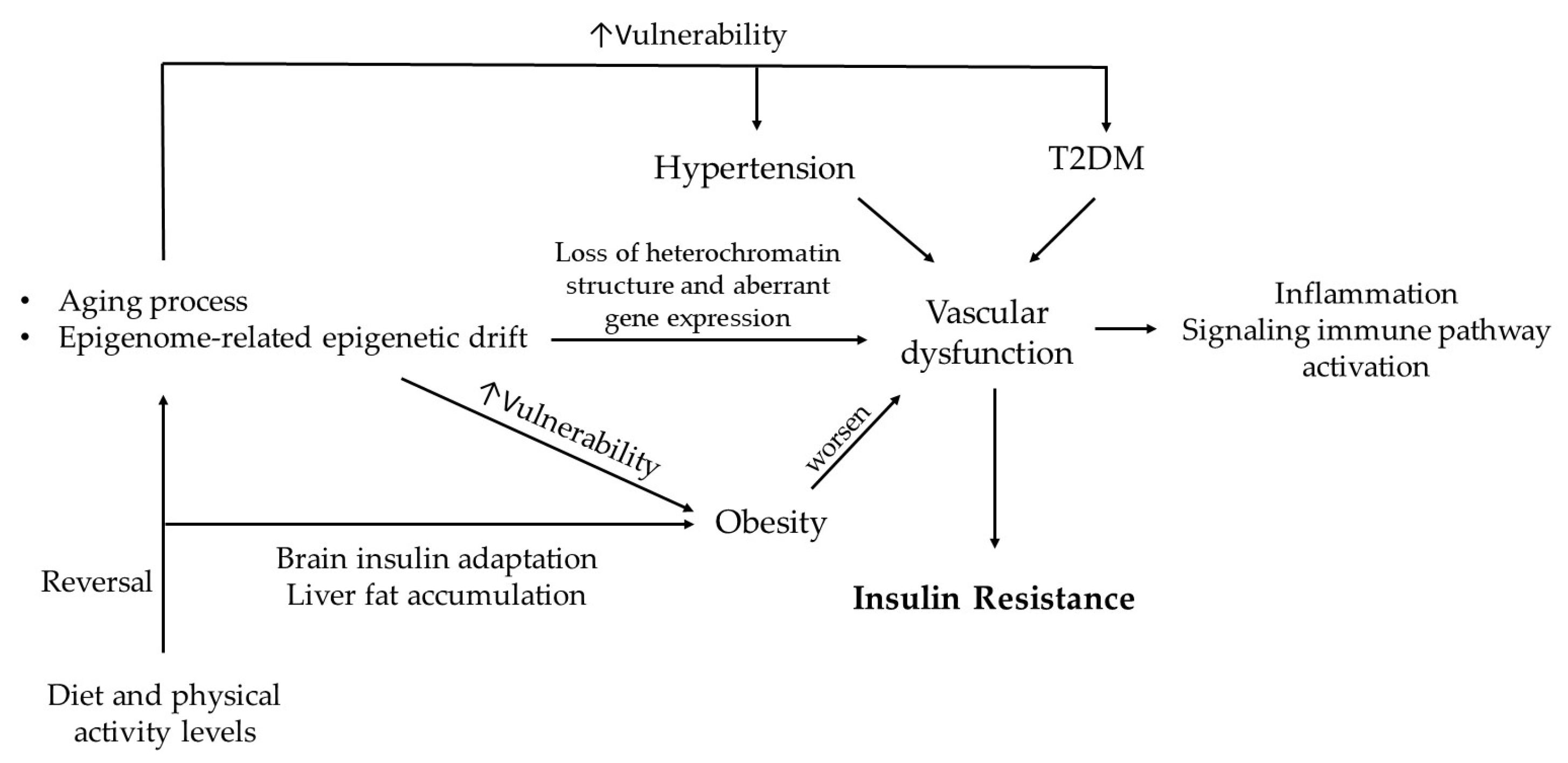
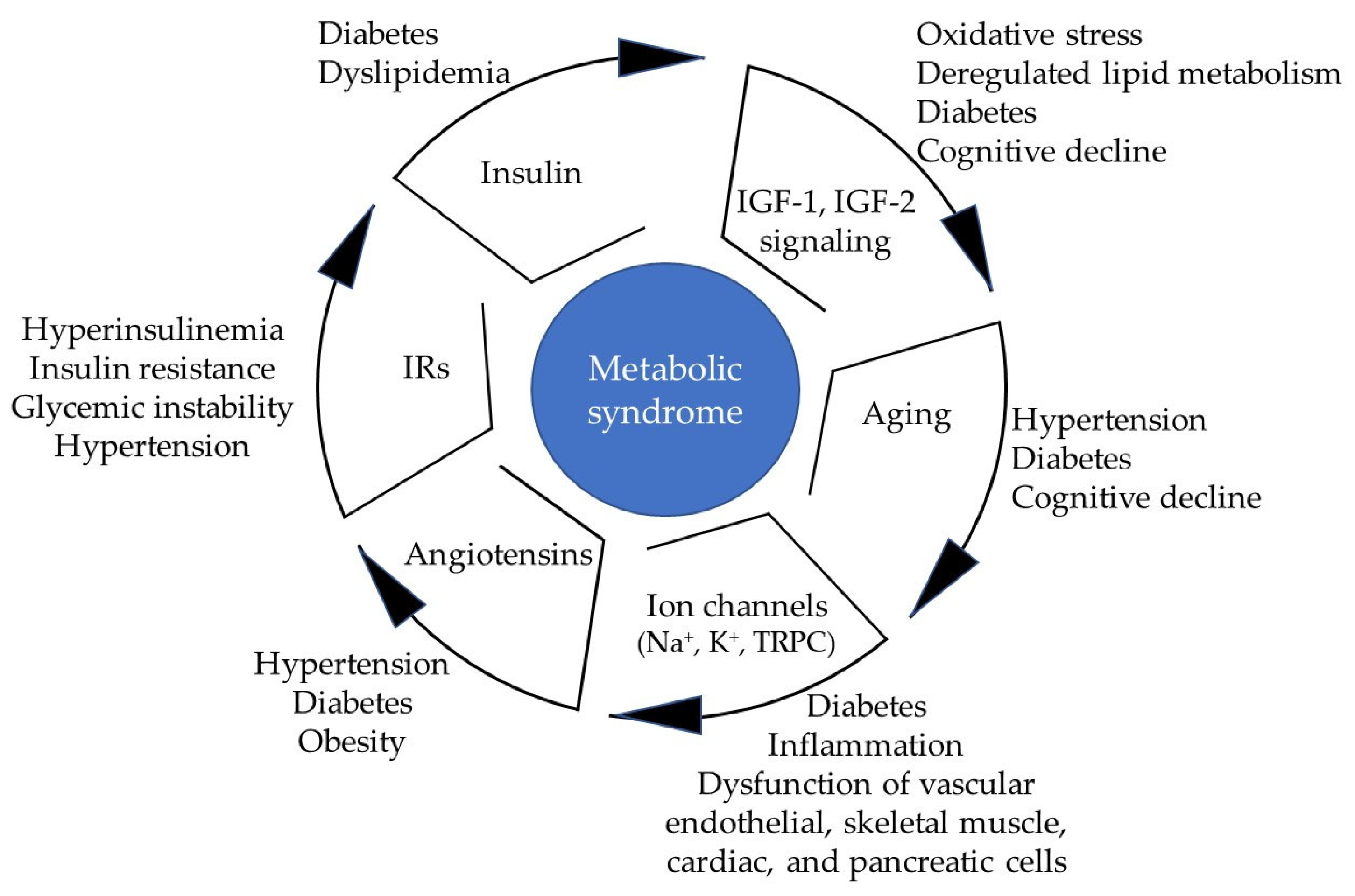

| Herb/Bioactive | Main Bioactive Compound | Study Subjects | Experimental Setting/Model | Study Design | Mechanism of Action | Pharmacological Effects | Ref. |
|---|---|---|---|---|---|---|---|
| Alpinia oxyphylla Miq | Diverse chemical constituents | Not applicable (in silico study) | Preclinical–in silico | Compound–target–pathway–disease/protein–protein interaction network constructions | Regulating the synthesis, release and transmission of neurotransmitters | Ameliorated mild cognitive impairment | [189] |
| Neural stem cells; MCAOrats | Preclinical–mixed in vitro/in vivo | In vitro neural stem cell (NSC) experiments and post-middle cerebral artery occlusion ischemic rats | Activated BDNF/TrkB/AKT signaling pathway, promoted NSC proliferation | Promoted hippocampal neurogenesis, improved cognitive functions | [190] | ||
| Astragali radix | Diverse chemical constituents | LPS-stimulated IPEC-J2 cells; BALB/c mice | Preclinical–mixed in vitro/in vivo | In vitro and in vivo experimental study | Anti-inflammatory effects via inhibition of NF-κB and MAPK signaling | Reduced IL-6, IL-1β, and TNF-α; improved jejunal morphology | [191] |
| Astragaloside IV | db/db mice; phenyl sulfate-treated podocytes | Preclinical–mixed in vitro/in vivo | In vivo and in vitro experimental study | Attenuated oxidative stress and mitochondrial dysfunction via activation of the SIRT1/PGC1α/Nrf1 signaling pathway | Reduced proteinuria and kidney damage, lowered ROS, increased antioxidant enzymes, and improved mitochondrial biogenesis/function | [192] | |
| Atractylodis Rhizoma | Diverse chemical constituents | Naturally aging rats | Preclinical–in vivo | In vivo experimental study | Anti-immunosenescence and immunomodulatory effects via inhibition of the PI3K/Akt/NF-κB signaling pathway | Improved lymphocyte proliferation, cytokine balance, immune function, and aging-related indicators | [193] |
| AD rats; HT22 cells | Preclinical–mixed in vitro/in vivo | In vivo animal study with in vitro validation | Activation of cAMP/CREB/BDNF signaling and inhibition of neuroinflammation | Improved cognition, reduced neuronal damage, lower IL-6, IL-1β, and TNF-α | [194] | ||
| BALB/c female mice | Preclinical–in vivo | In vivo experimental animal study | Upregulation of CD28/IP3R/PLCγ-1/AP-1/NFAT signaling; immunomodulatory effects | Alleviated cyclophosphamide-induced immunosuppression, improved spleen index, reduced splenocyte damage, and restored cytokine balance | [195] | ||
| Baicalein | 6-OHDA-induced Parkinson’s disease rats | Preclinical–in vivo | In vivo experimental animal study | Activated mitochondrial autophagy via miR-30b-5p and the SIRT1/AMPK/mTOR pathway | Improved neuronal injury, restored dopamine-related changes, reduced apoptosis, and alleviated mitochondrial dysfunction | [196] | |
| ISO-induced heart failure BALB/c mice; HL-1 cardiomyocytes | Preclinical–mixed in vitro/in vivo | In vivo and in vitro experimental study | Improved mitochondrial fusion/fission balance and inhibited the GRP78/CHOP pathway, thereby reducing oxidative stress and apoptosis | Reduced ROS, apoptosis, and cardiac fibrosis; improved cardiac function in heart failure | [197] | ||
| Tamoxifen-resistant breast cancer cells | Preclinical–in vitro | In vitro experimental cell study | Inhibited HIF-1α-mediated aerobic glycolysis and reversed mitochondrial dysfunction | Resensitized resistant cells to tamoxifen and reduced stem cell-like characteristics | [198] | ||
| High-fat-diet-induced atherosclerosis model; ox-LDL-induced VSMCs; mesenchymal stem cell-derived exosomes | Preclinical–mixed in vitro/in vivo | In vivo and in vitro experimental study | Exosome-mediated anti-atherosclerotic effects via regulation of the SIRT1/NF-κB signaling pathway | Reduced plaque formation/progression and suppressed inflammatory responses associated with atherosclerosis | [199] | ||
| Bazi Bushen | Multi-component traditional Chinese medicine formula | Naturally aged mice | Preclinical–in vivo | In vivo experimental animal study | Improved age-related energy metabolism by modulating SASP-associated IL-17/TNF inflammatory pathways and arachidonic acid–linoleic acid metabolism | Reduced inflammation in metabolic organs and improved metabolic homeostasis in aged mice | [200] |
| Centella asiatica | Diverse chemical constituents | Mouse models of aging | Preclinical–in vivo | In vivo experimental animal study | Antioxidant regulatory transcription factor NRF2 | Enhanced plasticity and improved cognitive function | [201] |
| Curcumin analog | Dimethoxycurcumin (DMC); curcumin comparator | HL60, U937, and Kasumi-1 leukemia cells | Preclinical–in vitro | In vitro experimental cell study | Inhibited histone lysine methyltransferases targeting H3K4, H3K9, and H3K27 and increased histone lysine demethylase activity (LSD1, JARID1, JMJD2), thereby modulating histone methylation marks | Altered histone methylation/acetylation landscape and supported epigenetic anticancer activity in leukemia cells | [202] |
| Fangji Huangqi decoction | Podocytes in rat models | Preclinical–mixed in vitro/in vivo | In vitro experimental cell study | Elevation in mitophagy, increased BNIP3 expression | Increased degradation of damaged mitochondria may provide potential therapeutic strategy for aging-related conditions | [203] | |
| Fisetin | Flavone with senolytic activity | Preclinical–in vitro | In vitro experimental cell study | Upregulated anti-apoptotic pathways | May provide potential therapeutic strategies to reduce vascular senescence and inflammation | [204] | |
| Flavonoids | Diverse chemical constituents | HUVEC cells | Preclinical–in vitro | In vitro experimental cell study | Anti-inflammatory and antioxidant effects via inhibition of STAT3 signaling and reduced ROS generation | Reduced STAT3 activation, proliferation, ROS, and inflammatory/oxysterol-related mediators | [205] |
| Grape seed extract | Procyanidin C1 | Senescent human stromal cells; treatment-damaged tumor microenvironment; aged mice | Preclinical–mixed in vitro/in vivo | In vitro and in vivo experimental study | Dose-dependent senotherapeutic activity: inhibited SASP at low concentrations and selectively eliminated senescent cells at higher concentrations, partly through ROS and mitochondrial dysfunction | Reduced senescent cell burden, improved physical function, and increased lifespan in mice | [178] |
| Jiang Gui Fang | Diverse compounds | Mice, tissues | Preclinical–in vivo | In vitro and in vivo experimental study | The increase in core temperature through the activation of iBAT and the browning of eWAT appears to be mediated by the PPARγ/SIRT1–PGC-1α signaling pathway | Protected liver, and reduced glucose and lipids, reduced the content of lipid droplets and ATP in brown fat cells, elevated PPARγ and lipolytic protein hormone-sensitive triglyceride lipase | [206] |
| Jingfang granule | Diverse compounds | Adult Caenorhabditis elegans | Preclinical–in vivo | In vivo experimental study | Increases extracellular transcription of extracellular matrix, stress-activated transcription factor 1 | Extend lifespan, slows down the functional degradation of mitochondria, enhances innate immunity | [207] |
| Streptozotocin-induced diabetic rats; HaCaT cells; HUVECs | Preclinical–mixed in vitro/in vivo | In vivo and in vitro experimental study with network pharmacology validation | Anti-oxidative, anti-inflammatory, and pro-angiogenic effects via PI3K-AKT and MAPK signaling | Promoted wound healing, improved metabolic parameters, reduced inflammation/oxidative stress, and increased angiogenesis | [208] | ||
| Caenorhabditis elegans N2 | Preclinical–in vivo | In vivo experimental animal study | Anti-aging and anti-infective effects associated with reduced oxidative stress and improved stress resistance | Extended lifespan, lowered ROS, and improved survival after bacterial infection | [209] | ||
| Lycium barbarum L. | Diverse compounds | Rat, aortic endothelial cells | Preclinical–in vivo | In vitro experimental study | SIRT3/CypD pathway | Protect mitochondrial function | [210] |
| Lycium barbarum polysaccharides | Rat aortic endothelial cells | Preclinical–in vitro | In vitro experimental study | Anti-oxidative and anti-apoptotic effects via increased SOD and NO, reduced MDA, upregulation of Bcl-2, and downregulation of Bax | Endothelial protection against oxidative injury | [211] | |
| Diverse compounds | Borderline hypertensive rats | Preclinical–in vivo | In vivo experimental animal study | Downregulation of renal endothelial lncRNA sONE and increased eNOS expression | Reduced blood pressure in salt-sensitive hypertensive rats | [212] | |
| Monarda didyma L. extract | Monarda didyma L. extract (botanical extract; specific single active compound not isolated) | Human fibroblasts, keratinocytes, HUVECs, dermal microvascular endothelial cells; middle-aged adults in intervention group (n = 40) and placebo group (n = 41) | Preclinical–in vitro plus clinical trial | In vitro studies plus RCT | Antioxidant, DNA-protective, anti-senescence, and endothelial-protective effects; reduced telomere shortening and supported maintenance of DNAmAge | Reduced DNA damage and cellular senescence in vitro; improved endothelial function; increased leukocyte telomere length, stabilized DNAmAge, and improved quality of life in the clinical trial | [213] |
| Monochoria angustifolia | Diverse compounds | Monsonia angustifolia plant samples from Gauteng and Limpopo provinces | Preclinical–in vitro | Phytochemical/metabolomic profiling study with in vitro antioxidant assays | Antioxidant activity and presence of metabolites with potential anti-amyloid-beta relevance | Increased phytochemical content and antioxidant activity under higher abiotic stress conditions | [214] |
| Plant samples from 25 natural populations in Thailand | Preclinical–in vitro | Phytochemical profiling study with in vitro and cellular antioxidant assays | Antioxidant activity mainly via hydrogen atom transfer; combined action of multiple flavonoids/phytochemicals | Higher flavonoid content and antioxidant potential | [215] | ||
| Plant-derived flavone compound; non-human enzyme assays | Preclinical–in silico/in vitro | In silico and in vitro experimental study | Anti-aging activity through inhibition of collagenase and elastase, with weaker tyrosinase inhibition | Anti-collagenase and anti-elastase effects; potential anti-aging phytochemical | [216] | ||
| Nicandra physalodes | Extract | Caenorhabditis elegans Human fibroblasts (MRC-5 cells), mouse | Preclinical–mixed in vitro/in vivo | In vivo and in vitro experimental study | Longevity effect mediated through DAF-16 (regulates oxidative stress tolerance, an insulin signaling pathway) and HSF-1 (an insulin signaling pathway) Reversed liver function damage and reduced senescence marker levels (ALT, SA-β-Gal, and γH2AX) | Improved health span, enhanced stress resistance, and delayed the progression of neurodegenerative diseases. Ameliorated senescence | [217] |
| P-coumaric acid | Rats; adjuvant-induced arthritic rat model | Preclinical–in vivo | In vivo experimental animal study | Anti-inflammatory and immunomodulatory effects via reduction of TNF-α and circulating immune complexes | Decreased synovial TNF-α, reduced immune complexes, and modulated immune responses | [218] | |
| High-fat-diet-fed C57BL/6J mice; NCI-H716 and STC-1 intestinal L cells | Preclinical–mixed in vitro/in vivo | In vivo and in vitro experimental study | Promoted GLP-1 secretion via the NPM1/GRP78/Ca2+ signaling axis | Improved glucose–lipid metabolism, reduced weight gain, and alleviated NAFLD | [219] | ||
| Resveratrol | HepG2 human hepatocellular carcinoma cells | Preclinical–in vitro | In vitro experimental cell study | Upregulated hTERT expression, possibly via SIRT1/Nrf2 signaling | Increased hTERT expression and antioxidant signaling | [220] | |
| Myocardial ischemia/reperfusion injury model; H/R-induced neonatal rat cardiomyocytes | Preclinical–mixed in vitro/in vivo | In vivo and in vitro experimental study | Reestablished mitochondrial quality control via the Sirt1/Sirt3-Mfn2-Parkin-PGC-1α pathway, with effects on mitochondrial dynamics, mitophagy, bioenergetics, and oxidative stress | Reduced myocardial ischemia/reperfusion injury, improved mitochondrial function and mitophagy, and decreased oxidative damage | [221] | ||
| Salidroside | C57BL/6 mice with APAP-induced liver injury; APAP-treated L02 hepatocytes | Preclinical–mixed in vitro/in vivo | In vivo and in vitro experimental study | Activated Sirt1/Akt/Nrf2 signaling and suppressed the NF-κB/NLRP3 inflammasome axis | Alleviated acetaminophen-induced hepatotoxicity, reduced oxidative stress and apoptosis, and improved liver injury markers | [222] | |
| AGS human gastric cancer cells; gastric cancer xenograft model | Preclinical–mixed in vitro/in vivo | In vitro and in vivo experimental study | Induced apoptosis and protective autophagy through inhibition of the PI3K/Akt/mTOR pathway | Inhibited gastric cancer cell growth, promoted apoptosis, and triggered protective autophagy | [223] | ||
| Nothobranchius guentheri (annual fish) | Preclinical–in vivo | In vivo experimental animal study | Modulated the insulin/IGF-1 signaling pathway in late-onset dietary intervention | Improved aging-related parameters and supported anti-aging effects in the annual fish model | [224] | ||
| Si Jun Zi Tang | Diverse compounds | Human fecal microbiota samples | Preclinical–in vitro | In vitro experimental fermentation study | Immunomodulatory effects via modulation of gut microbiota and short-chain fatty acid production | Altered intestinal bacterial composition and increased acetic acid/total SCFAs after incubation | [225] |
| Naturally aging mice | Preclinical network pharmacology plus in vivo | Network pharmacology study with in vivo validation | Anti-aging effects via inhibition of PI3K-AKT and P38 MAPK signaling pathways | Improved aging-related signs, including osteoporosis and hair loss | [226] | ||
| UVB-induced skin-aging model | Preclinical network pharmacology plus in vivo | Network pharmacology study with experimental validation | Anti-skin-aging effects via p38/p53 signaling | Reduced UVB-induced skin-aging changes; potential cosmeceutical application | [227] | ||
| Spermidine | Multipotent mesenchymal stromal cells; aging mouse model | Preclinical–mixed in vitro/in vivo | In vitro and in vivo experimental study | Delayed cellular senescence through SIRT3-mediated antioxidation | Reduced senescence, decreased oxidative stress, and improved stem-cell function | [228] | |
| Syringin | Rat myocardial ischemia/reperfusion model; H9c2 cardiomyocytes | Preclinical–mixed in vitro/in vivo | In vivo and in vitro experimental study | Anti-inflammatory and antioxidant effects via regulation of SIRT1 signaling and activation of the NRF2/HO-1 pathway | Improved cardiac function, reduced infarct size and cardiac injury, decreased inflammatory cytokines and ROS, and increased antioxidant enzyme expression | [229] | |
| SH-SY5Y cells; Caenorhabditis elegans Parkinson’s disease model | Preclinical–mixed in vitro/in vivo | In vitro and in vivo experimental study | Protected against neurotoxicity via the miR-34a/SIRT1/Beclin-1 pathway and activation of autophagy | Reduced 6-OHDA-induced neurotoxicity, enhanced autophagy, and improved neuronal survival | [230] | ||
| Theaflavin TF3 | Theaflavin-3,3-digallate (TF3) | Hepatocytes | Preclinical–in vitro | In vitro experimental cell study | Reduced lipid deposition via inhibition of plasma kallikrein and activation of the AMPK signaling pathway | Decreased hepatocyte lipid droplet accumulation; proposed benefit for NAFLD-related lipid dysregulation | [231] |
| Thymoquinone | Isoproterenol-induced myocardial infarction rat model | Preclinical–in vivo | In vivo experimental animal study | Preserved cardiac mitochondrial DNA and exerted antioxidant, anti-inflammatory, and anti-apoptotic effects | Reduced serum cardiac injury markers, oxidative stress, inflammatory cytokines, apoptosis, fibrosis, and histopathologic damage; preserved cardiac mtDNA content | [232] | |
| Wuzi Yanzong Pill | Diverse compounds | CPZ-induced demyelination animal model | Preclinical–in vivo | In vivo experimental animal study | Improved central nervous system (CNS) microenvironment by reducing neuroinflammation, modulating microglial phenotype, and increasing neurotrophic factors | Alleviated demyelination, improved mood-related behavior, and promoted remyelination | [233] |
| Mouse model of Parkinson’s disease | Preclinical–in vivo pharmacology plus in vivo | In vitro and in vivo experimental study | Inhibits apoptosis and increases the secretion of neurotrophic factor via PI3K/AKT signaling pathway | Anti-apoptotic effect and modulation of neuronal survival | [233] | ||
| Herb/Bioactive | Main Bioactive Compound | Study Subjects/Sample Size | Experimental Setting/Model | Study Design | Mechanism of Action | Pharmacological Effects | Ref. |
|---|---|---|---|---|---|---|---|
| Astragalus-based nutritional supplement | Cycloastragenol-rich Astragalus-based supplement | Middle-aged adults (n = 96) | Clinical trial | RCT (double-blind) placebo-controlled (6-month intervention) | Telomere-supporting effects, likely through telomerase activation/telomere maintenance | Increased telomere length compared with placebo after supplementation | [234] |
| Aronia melanocarpa supplement | Anthocyanin-rich aronia juice-based food supplement | 91 healthy volunteers; ex vivo peripheral blood lymphocytes from a male subgroup | Clinical trial | RCT (8-week intervention) | DNA-protective antioxidant effects; reduced susceptibility of lymphocytes to oxidative DNA damage ex vivo | Reduced H2O2-induced DNA strand breaks ex vivo; decreased background DNA strand breaks compared with baseline | [235] |
| Five-edible-plant dietary supplement (Mylife/Mylife100®) | Multi-component edible plant extract blend from black sesame seed, guava fruit, mangosteen aril, pennywort leaves, and soy protein | Thai adults aged 50–65 years (n = 32) | Clinical trial | RCT (8-week intervention) | Telomere-supporting effects, likely related to antioxidant activity | Increased leukocyte telomere length and improved plasma total antioxidant capacity compared with placebo | [236] |
| Nicotinamide riboside | Older adults with mild cognitive impairment (n = 20) | Clinical trial | RCT (10-week intervention) | NAD+ precursor; supports cellular energetics and neuroprotective/geroscience-related pathways | Evaluated cognitive and aging-related outcomes in older adults with MCI | [237] | |
| Pomegranate extract | Pomegranate polyphenol-rich extract | Older adults aged 55–70 years (n = 72 completers) | Clinical trial | RCT (12-week intervention) | Likely antioxidant and vascular-aging-related effects associated with modulation of IGF-1 | Increased serum IGF-1 at week 12; no significant effect on telomere length | [238] |
| Quercetin | Symptomatic coronary artery disease patients undergoing coronary artery bypass graft surgery (n = 97) | Clinical trial | RCT (2 days pre-surgery) | Senolytic/anti-inflammaging effects; reversed vascular senescence and inflammatory signaling in male vascular cells and improved endothelial function ex vivo | Reduced vascular senescence and inflammation in symptomatic male but not female CAD patients; improved acetylcholine-induced endothelial relaxation in men; lowered postoperative atrial fibrillation incidence | [239] | |
| Resveratrol | Older adults with type 2 diabetes (97 participants; 1000 mg/day group n = 37, 500 mg/day group n = 32, placebo n = 28) | Clinical trial | RCT (6-month intervention) | Antioxidant effects with modulation of oxidative-stress markers and SIRT1 | Decreased lipoperoxides and carbonyl stress markers, increased total antioxidant capacity and SIRT1, but no significant change in glucose or HbA1c | [240] | |
Disclaimer/Publisher’s Note: The statements, opinions and data contained in all publications are solely those of the individual author(s) and contributor(s) and not of MDPI and/or the editor(s). MDPI and/or the editor(s) disclaim responsibility for any injury to people or property resulting from any ideas, methods, instructions or products referred to in the content. |
© 2026 by the authors. Licensee MDPI, Basel, Switzerland. This article is an open access article distributed under the terms and conditions of the Creative Commons Attribution (CC BY) license.
Share and Cite
Sefidmooye Azar, P.; Akhlaghi, S.; Shariat-Madar, Z.; Mahdi, F. Cognitive-Enhancing Effects of Bioactive Compounds and Traditional Herbal Medicines in Elderly Patients with Metabolic Syndrome. Biomolecules 2026, 16, 535. https://doi.org/10.3390/biom16040535
Sefidmooye Azar P, Akhlaghi S, Shariat-Madar Z, Mahdi F. Cognitive-Enhancing Effects of Bioactive Compounds and Traditional Herbal Medicines in Elderly Patients with Metabolic Syndrome. Biomolecules. 2026; 16(4):535. https://doi.org/10.3390/biom16040535
Chicago/Turabian StyleSefidmooye Azar, Pouria, Shiva Akhlaghi, Zia Shariat-Madar, and Fakhri Mahdi. 2026. "Cognitive-Enhancing Effects of Bioactive Compounds and Traditional Herbal Medicines in Elderly Patients with Metabolic Syndrome" Biomolecules 16, no. 4: 535. https://doi.org/10.3390/biom16040535
APA StyleSefidmooye Azar, P., Akhlaghi, S., Shariat-Madar, Z., & Mahdi, F. (2026). Cognitive-Enhancing Effects of Bioactive Compounds and Traditional Herbal Medicines in Elderly Patients with Metabolic Syndrome. Biomolecules, 16(4), 535. https://doi.org/10.3390/biom16040535