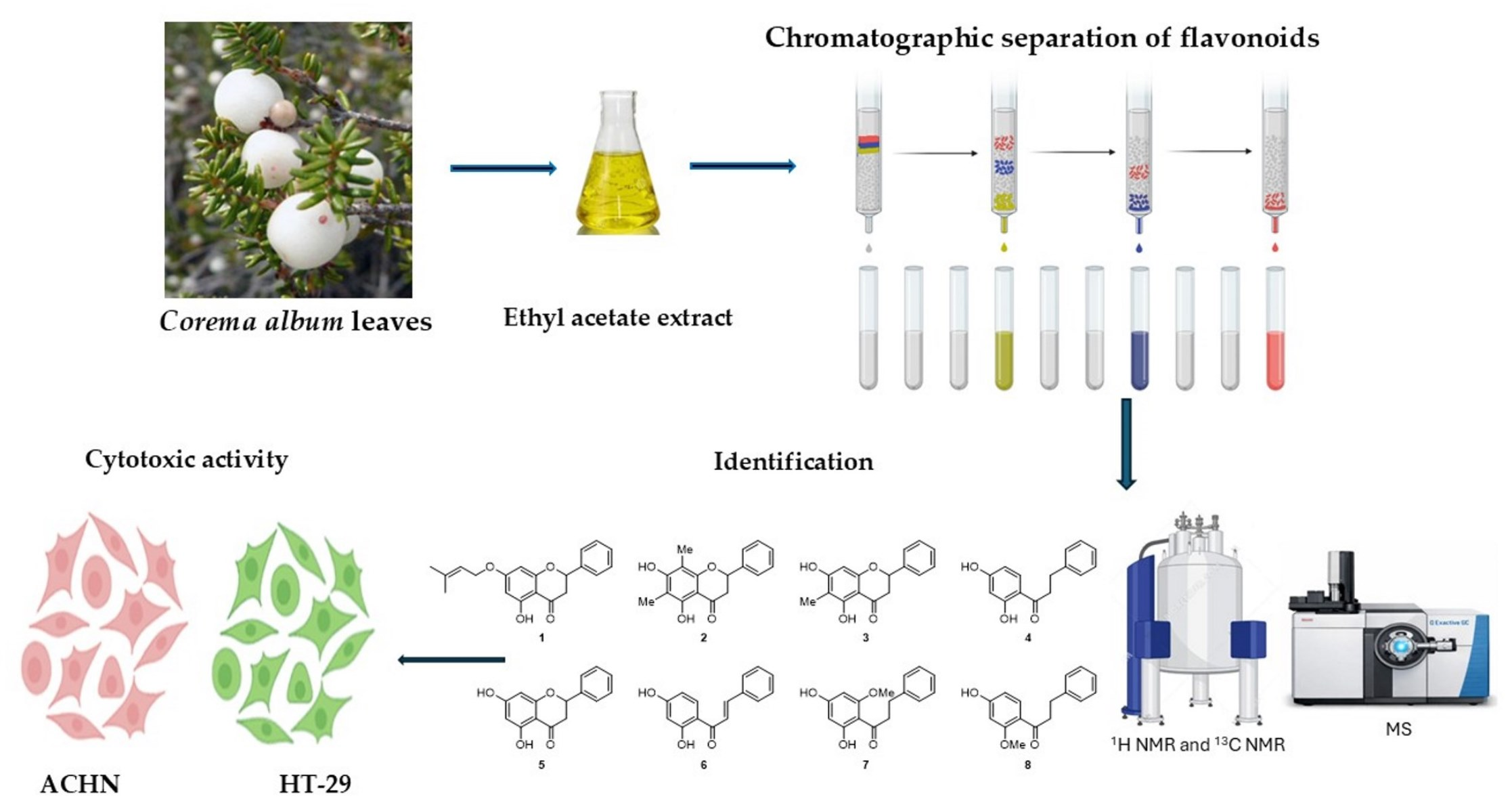
Cytotoxicity Evaluation of Chalcones and Flavanones from the Leaves of Corema album (L.) D. Don
 ,
,  , ,
, ,  , and
, and
Abstract
1. Introduction
2. Materials and Methods
2.1. Plant Material
2.2. Chemicals
2.3. Extraction
2.4. Isolation and Identification of the Compounds
2.5. NMR Analysis
2.6. MS Analysis
2.7. NMR and MS Data of the Isolated Compounds
2.8. Cell Lines
2.9. MTT Colorimetric Assay
2.10. Statistical Methods
3. Results
3.1. Phytochemistry
3.2. Cytotoxic Activity
4. Discussion
5. Conclusions
Supplementary Materials
Author Contributions
Funding
Institutional Review Board Statement
Informed Consent Statement
Data Availability Statement
Acknowledgments
Conflicts of Interest
References
- Villar, L. Corema D. Don. In Flora Ibérica; Castroviejo, S., Aedo, C., Gómez-Campo, C., Laínz, M., Montserrat, P., Morales, R., Muñoz Garmendia, F., Nieto Feliner, G., Rico, E., Talavera, S., et al., Eds.; Real Jardín Botánico, CSIC: Madrid, Spain, 1993; Volume 4, pp. 524–526. [Google Scholar]
- Canoyra, A.; Martín-Cordero, C.; Muñoz-Mingarro, D.; León-González, A.J.; Parsons, R.B.; Acero, N. Corema album Berry Juice as a Protective Agent Against Neurodegeneration. Pharmaceuticals 2024, 17, 1535. [Google Scholar] [CrossRef]
- Martín-Cordero, C.; Martinez-Force, E.; Acero de Mesa, N.; Muñoz-Mingarro, D.; León-González, A.J. Triacylglycerol Composition of Seed Oil from Corema album Berries. Molecules 2025, 30, 914. [Google Scholar] [CrossRef]
- León-González, A.J.; Acero, N.; Muñoz-Mingarro, D.; Navarro, I.; Martín-Cordero, C. Chalcones as Promising Lead Compounds on Cancer Therapy. Curr. Med. Chem. 2015, 22, 3407–3425. [Google Scholar] [CrossRef]
- Gomes, M.N.; Muratov, E.N.; Pereira, M.; Peixoto, J.C.; Rosseto, L.P.; Cravo, P.V.L.; Andrade, C.H.; Neves, B.J. Chalcone Derivatives: Promising Starting Points for Drug Design. Molecules 2017, 22, 1210. [Google Scholar] [CrossRef] [PubMed]
- Chen, Z.; Liu, M. Natural Compounds in Cancer Therapy: Revealing the Role of Flavonoids in Renal Cell Carcinoma Treatment. Biomolecules 2025, 15, 620. [Google Scholar] [CrossRef]
- Singla, N.; Mittal, P.; Babu, M.A.; Menon, S.V.; Ray, S.; Ali, H.; Gupta, G. Pinocembrin as a Novel Anticancer Agent: Exploring Preclinical Evidence Along with Therapeutic Potential. World J. Exp. Med. 2025, 15, 110482. [Google Scholar] [CrossRef] [PubMed]
- León-González, A.J.; López-Lázaro, M.; Espartero, J.L.; Martín-Cordero, C. Cytotoxic Activity of Dihydrochalcones Isolated from Corema album Leaves Against HT-29 Colon Cancer Cells. Nat. Prod. Commun. 2013, 8, 1934578X1300800918. [Google Scholar] [CrossRef]
- Jakupovic, J.; Grenz, M.; Bohlmann, F.; Mungai, G.M. 12β-Hydroxyabieta-7,13-diene and other constituents from East African Helichrysum species. Phytochemistry 1990, 29, 1589–1590. [Google Scholar] [CrossRef]
- Zdero, C.; Bohlmann, F. Glycerol derivatives and other constituents from Metalasia species. Phytochemistry 1990, 29, 2179–2180. [Google Scholar] [CrossRef]
- Krasnov, E.A.; Ermilova, E.V.; Kadyrova, T.V.; Raldugin, V.A.; Bagryanskaya, I.Y.; Gatilov, Y.V.; Druganov, A.G.; Semenov, A.A.; Tolstikov, G.A. Phenolic components of Empetrum nigrum extract and the crystal structure of one of them. Chem. Nat. Compd. 2000, 36, 493–496. [Google Scholar] [CrossRef]
- Byrne, L.T.; Cannon, J.R.; Gawad, P.H.; Joshi, B.S.; Skelton, B.W.; Toia, R.F.; White, A.H. The crystal structure of (S)-(–)-6-Bromo-5,7-dihydroxy-8-methyl-2-phenyl-2,3-dihydro-4H-1-benzopyran-4-one [(–)-6-bromocryptostrobin] and a 13C N.M.R. study of (±)-cryptostrobin and related substances. Revision of the structures of the natural products (±)-lawinal, u. Aust. J. Chem. 1982, 35, 1851–1858. [Google Scholar] [CrossRef]
- Wollenweber, E.; Dörr, M.; Stelzer, R.; Arriaga Giner, F.J. Lipophilic Phenolics from the leaves of Empetrum nigrum. Chemical structures and exudate localization. Bot. Acta 1992, 105, 300–305. [Google Scholar] [CrossRef]
- Whaley, A.K.; Minakov, D.A.; Orlova, A.A.; Ponkratova, A.O.; Fock, E.; Rukoyatkina, N.; Gambaryan, S.; Luzhanin, V.G. Analysis of Empetrum nigrum L. lipophilic secondary metabolites, their metabolomic profiles and antioxidant activity. J. Essent. Oil Res. 2023, 35, 310–323. [Google Scholar] [CrossRef]
- Tanrisever, N.; Fronczek, F.R.; Fischer, N.H.; Williamson, G.B. Ceratiolin and Other Flavonoids from Ceratiola ericoides. Phytochemistry 1986, 26, 175–179. [Google Scholar] [CrossRef]
- Nyokat, N.; Yen, K.H.; Hamzah, A.S.; Lim, I.F.; Saaidin, A.S. Isolation and synthesis of pinocembrin and pinostrobin from Artocarpus odoratissimus. Malays. J. Anal. Sci. 2017, 21, 1156–1161. [Google Scholar] [CrossRef]
- Saba, A.R. Isolamento e Caratterizzazione Chimico-Strutturale di Metaboliti Secondari dal Genere Ononis e Seseli. Ph.D. Thesis, Università Degli Studi di Cagliari, Cagliari, Italy, 2011. [Google Scholar]
- Basnet, P.; Kadota, S.; Hase, K.; Namba, T. Five new C-methyl flavonoids, potent aldose reductase inhibitors from Matteuccia orientalis TREV. Chem. Pharm. Bull. 1995, 43, 1558–1564. [Google Scholar] [CrossRef][Green Version]
- Insanu, M.; Ramadhania, Z.M.; Halim, E.N.; Hartati, R.; Wirasutisna, K.R. Isolation of 5,7-Dihydroxy, 6,8-Dimethyl Flavanone from Syzygium aqueum with Its Antioxidant and Xanthine Oxidase Inhibitor Activities. Pharmacogn. Res. 2018, 10, 60–63. [Google Scholar] [CrossRef] [PubMed] [PubMed Central]
- Matsuura, S. The Structure of Cryptostrobin and Strobopinin, the Flavanones from the Heartwood of Pinus strobus. J. Pharm. Soc. Jpn. 1957, 77, 296–305. [Google Scholar] [CrossRef][Green Version]
- Li, X.-Q.; Yang, Y.-Y.; Chen, L.-J.; Zhang, Y.; Chen, Y.-G. Compounds from Lotus corniculatus. Chem. Nat. Compd. 2019, 55, 719–721. [Google Scholar] [CrossRef]
- Mathenge, S.G.; Juma, F.D.; Nganga, J.N. Cytotoxic C-benzylated dihydrochalcones from Uvaria acuminata. Chem. Pharm. Bull. 2004, 52, 138–141. [Google Scholar] [CrossRef]
- Winkel-Shirley, B. Flavonoid biosynthesis. A colorful model for genetics, biochemistry, cell biology, and biotechnology. Plant Physiol. 2001, 126, 485–493. [Google Scholar] [CrossRef]
- Kron, K.A.; Judd, W.S.; Stevens, P.F.; Crayn, D.M.; Anderberg, A.A.; Gadek, P.A.; Quinn, C.J.; Luteyn, J.L. Phylogenetic Classification of Ericaceae: Molecular and morphological Evidence. Bot. Rev. 2002, 68, 335–423. [Google Scholar] [CrossRef]
- Angiosperm Phylogeny Group (APGII). An update of the Angiosperm Phylogeny Group classification for the orders and families of flowering plants: APG II. Bot. J. Linn. Soc. 2003, 141, 399–436. [Google Scholar] [CrossRef]
- Angiosperm Phylogeny Group (APGIV). An update of the Angiosperm Phylogeny Group classification for the orders and families of flowering plants: APG IV. Bot. J. Linn. Soc. 2016, 181, 1–20. [Google Scholar] [CrossRef]
- Kenari, F.; Molnár, S.; Perjési, P. Reaction of Chalcones with Cellular Thiols: The Effect of the 4-Substitution of Chalcones and Protonation State of the Thiols on the Addition Process. Diastereoselective Thiol Addition. Molecules 2021, 26, 4332. [Google Scholar] [CrossRef]
- Guzy, J.; Vasková-Kubálková, J.; Rozmer, Z.; Fodor, K.; Mareková, M.; Poskrobová, M.; Perjési, P. Activation of Oxidative Stress Response by Hydroxyl Substituted Chalcones and Cyclic Chalcone Analogues in Mitochondria. FEBS Lett. 2010, 584, 567–570. [Google Scholar] [CrossRef] [PubMed]
- Chen, T.H.; Wang, H.C.; Chang, C.J.; Lee, S.Y. Mitochondrial glutathione in cellular redox homeostasis and disease manifestation. Int. J. Mol. Sci. 2024, 25, 1314. [Google Scholar] [CrossRef] [PubMed]
- Liu, T.; Sun, L.; Zhang, Y.; Wang, Y.; Zheng, J. Imbalanced GSH/ROS and sequential cell death. J. Biochem. Mol. Toxicol. 2022, 36, e22942. [Google Scholar] [CrossRef]
- Zhao, Y.; Ye, X.; Xiong, Z.; Ihsan, A.; Ares, I.; Martínez, M.; Lopez-Torres, B.; Martínez-Larrañaga, M.R.; Anadón, A.; Wang, X.; et al. Cancer metabolism: The role of ROS in DNA damage and induction of apoptosis in cancer cells. Metabolites 2023, 13, 796. [Google Scholar] [CrossRef]
- Dinkova-Kostova, A.T.; Massiah, M.A.; Bozak, R.E.; Hicks, R.J.; Talalay, P. Potency of Michael reaction acceptors as inducers of enzymes that protect against carcinogenesis depends on their reactivity with sulfhydryl groups. Proc. Natl. Acad. Sci. USA 2001, 98, 3404–3409. [Google Scholar] [CrossRef]
- Karthikeyan, C.; Moorthy, N.S.; Ramasamy, S.; Vanam, U.; Manivannan, E.; Karunagaran, D.; Trivedi, P. Advances in Chalcones with Anticancer Activities. Recent Pat. Anti-Cancer Drug Discov. 2015, 10, 97–115. [Google Scholar] [CrossRef] [PubMed]
- Saifullah, M.K.; Ahasan, M.; Kaleem, M.; Raneem, E.; Gupta, A.; Amir, M.; Alam, M.M.; Akhter, M.; Tasneem, S.; Shaquiquz-zaman, M. A Comprehensive Review of Structure–Activity Relationships: Exploration of Chalcone Derivatives as Anticancer Agents, Target-Based and Cell Line-Specific Insights. Med. Drug Discov. 2025, 28, 100230. [Google Scholar] [CrossRef]
- Mbaveng, A.T.; Damen, F.; Simo Mpetga, J.D.; Awouafack, M.D.; Tane, P.; Kuete, V.; Efferth, T. Cytotoxicity of crude extract and isolated constituents of the Dichrostachys cinerea bark towards multifactorial drug-resistant cancer cells. Evid.-Based Complement. Altern. Med. 2019, 2019, 8450158. [Google Scholar] [CrossRef]
- Villena, J.; Montenegro, I.; Said, B.; Werner, E.; Flores, S.; Madrid, A. Ultrasound assisted synthesis and cytotoxicity evaluation of known 2′,4′-dihydroxychalcone derivatives against cancer cell lines. Food Chem. Toxicol. 2021, 148, 111969. [Google Scholar] [CrossRef] [PubMed]
- Li, J.; Hu, J.; Yang, Y.; Zhang, H.; Liu, Y.; Fang, Y.; Qu, L.; Lin, A.; Luo, P.; Jiang, A.; et al. Insights into the mechanisms of drug resistance in renal cell carcinoma: From multi-omics perspective. Int. J. Surg. 2026. [Google Scholar] [CrossRef]
- Elbatreek, M.H.; Mahdi, I.; Ouchari, W.; Mahmoud, M.F.; Sobeh, M. Current advances on the therapeutic potential of pinocembrin: An updated review. Biomed. Pharmacother. 2023, 157, 114032. [Google Scholar] [CrossRef]
- Tous Mohedano, M.; Mao, J.; Chen, Y. Optimization of pinocembrin biosynthesis in Saccharomyces cerevisiae. ACS Synth. Biol. 2023, 12, 144–152. [Google Scholar] [CrossRef]
- Landis-Piwowar, K.R.; Milacic, V.; Dou, Q.P. Relationship between the methylation status of dietary flavonoids and their growth-inhibitory and apoptosis-inducing activities in human cancer cells. J. Cell. Biochem. 2008, 105, 514–523. [Google Scholar] [CrossRef]
- Lv, H.W.; Wang, Q.L.; Luo, M.; Zhu, M.D.; Liang, H.M.; Li, W.J.; Cai, H.; Zhou, Z.B.; Wang, H.; Tong, S.Q.; et al. Phytochemistry and pharmacology of natural prenylated flavonoids. Arch. Pharm. Res. 2023, 46, 207–272. [Google Scholar] [CrossRef]
- Liu, X.; Cheng, J.; Zhu, X.; Zhang, G.; Yang, S.; Guo, X.; Jiang, H.; Ma, Y. De novo biosynthesis of multiple pinocembrin derivatives in Saccharomyces cerevisiae. ACS Synth. Biol. 2020, 9, 3042–3051. [Google Scholar] [CrossRef] [PubMed]



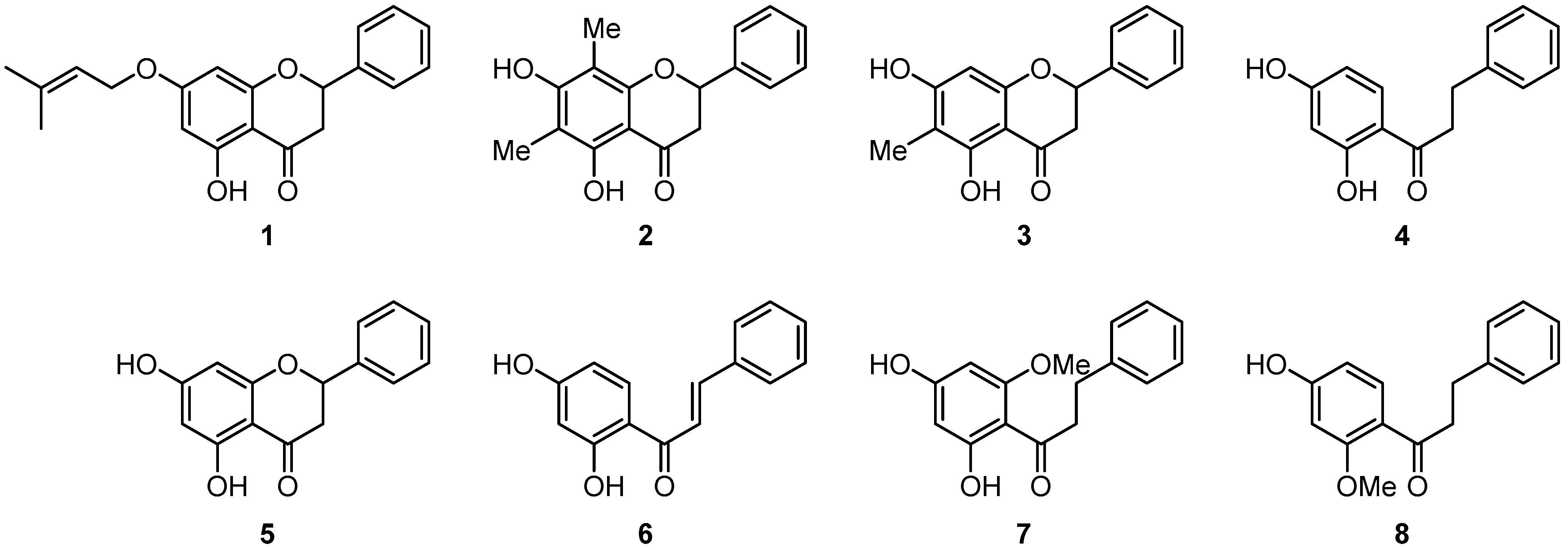
| IC50 (µM) | ||
|---|---|---|
| Compound | HT-29 | ACHN |
| 7-O-prenyl-pinocembrin (1) | >100 | >100 |
| 6,8-dimethylpinocembrin (2) | >100 | 28.74 ± 0.35 |
| 6-methylpinocembrin (3) | >100 | 64.36 ± 0.53 |
| 2′,4′-dihydroxydihydrochalcone (4) | 62.23 ± 1.06 | 54.68 ± 1.62 |
| Pinocembrin (5) | >100 | 91.28 ± 3.03 |
| 2′,4′-dihydroxychalcone (6) | 13.31 ± 0.48 | 9.43 ± 0.34 |
| 2′,4′-dihydroxy-6′-methoxy-dihydrochalcone (7) | >100 | 44.00 ± 0.36 |
| 2′-methoxy-4′-hydroxydihydrochalcone (8) | 75.69 ± 0.74 | 65.51 ± 0.83 |
| Doxorubicin | 11.42 ± 0.26 | 3.92 ± 0.11 |
Disclaimer/Publisher’s Note: The statements, opinions and data contained in all publications are solely those of the individual author(s) and contributor(s) and not of MDPI and/or the editor(s). MDPI and/or the editor(s) disclaim responsibility for any injury to people or property resulting from any ideas, methods, instructions or products referred to in the content. |
© 2026 by the authors. Licensee MDPI, Basel, Switzerland. This article is an open access article distributed under the terms and conditions of the Creative Commons Attribution (CC BY) license.
Share and Cite
Canoyra, A.; Acero, N.; Muñoz-Mingarro, D.; León-González, A.J.; Espartero, J.L.; Martín-Cordero, C. Cytotoxicity Evaluation of Chalcones and Flavanones from the Leaves of Corema album (L.) D. Don. Biomolecules 2026, 16, 509. https://doi.org/10.3390/biom16040509
Canoyra A, Acero N, Muñoz-Mingarro D, León-González AJ, Espartero JL, Martín-Cordero C. Cytotoxicity Evaluation of Chalcones and Flavanones from the Leaves of Corema album (L.) D. Don. Biomolecules. 2026; 16(4):509. https://doi.org/10.3390/biom16040509
Chicago/Turabian StyleCanoyra, Antonio, Nuria Acero, Dolores Muñoz-Mingarro, Antonio J. León-González, José Luis Espartero, and Carmen Martín-Cordero. 2026. "Cytotoxicity Evaluation of Chalcones and Flavanones from the Leaves of Corema album (L.) D. Don" Biomolecules 16, no. 4: 509. https://doi.org/10.3390/biom16040509
APA StyleCanoyra, A., Acero, N., Muñoz-Mingarro, D., León-González, A. J., Espartero, J. L., & Martín-Cordero, C. (2026). Cytotoxicity Evaluation of Chalcones and Flavanones from the Leaves of Corema album (L.) D. Don. Biomolecules, 16(4), 509. https://doi.org/10.3390/biom16040509