

Oxidative Stress in Diabetic Cardiomyopathy: Molecular Mechanisms and Emerging Therapeutic Targets
 , ,
, ,  ,
,  , , and
Abstract
1. Introduction
2. Pathophysiology of Diabetic Cardiomyopathy
3. Sources of Oxidative Stress in Diabetic Cardiomyopathy
3.1. Cellular Types Involved
3.2. Mitochondrial Dysfunction and ROS Overproduction
3.3. NADPH Oxidases (NOX Enzymes)
3.4. Xanthine Oxidoreductase and Aldehyde Oxidase
3.5. Uncoupled Nitric Oxide Synthase (NOS)
3.6. Advanced Glycation End-Products (AGEs) and RAGE Signaling
3.7. Endoplasmic Reticulum Stress and the Unfolded Protein Response (UPR)
4. Molecular Targets of Oxidative Damage in the Heart
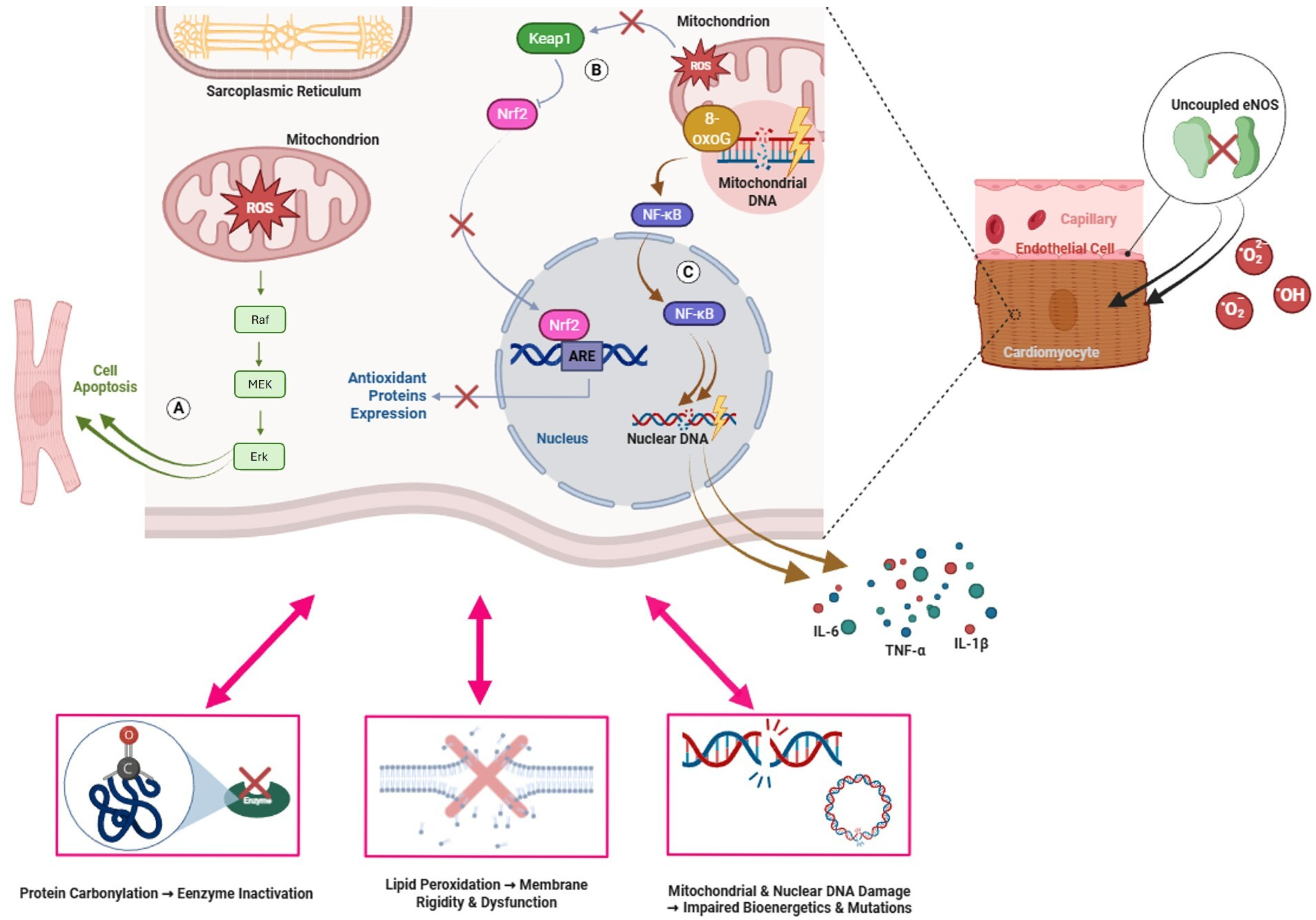
4.1. Lipids: Lipid Peroxidation and Membrane Damage
4.2. Proteins: Carbonylation and Enzymatic Inactivation
4.3. DNA: Mitochondrial and Nuclear Damage
4.4. Redox-Sensitive Signaling Pathways
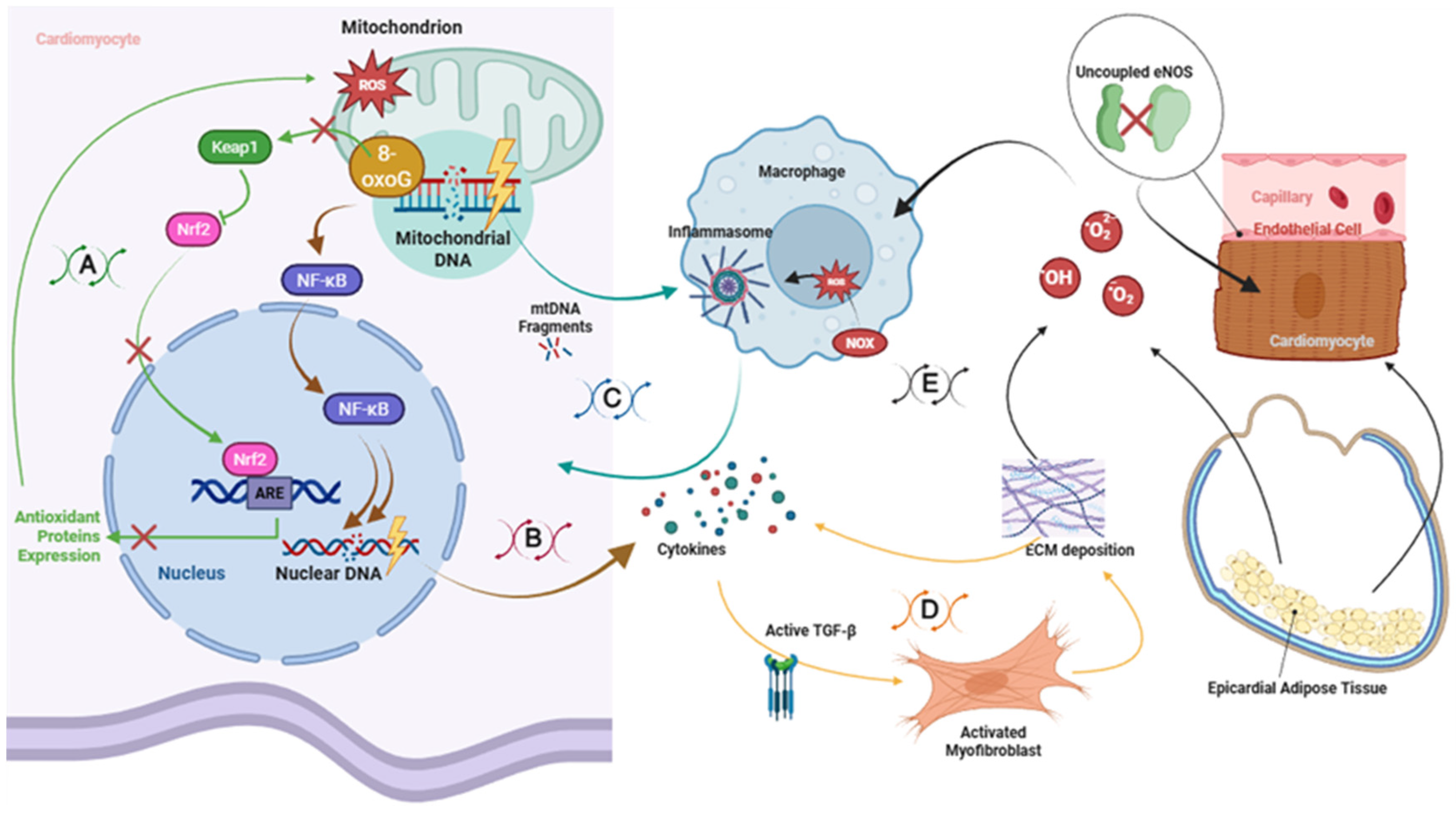
5. Inflammatory and Fibrotic Crosstalk
6. Antioxidant Defense Mechanisms and Their Impairment
7. Emerging Therapeutic Strategies
7.1. Mitochondria- and Enzyme-Targeted Redox Modulation
7.2. Natural Compounds and Nutraceuticals
7.3. Looking to the Future: Gene Therapy and Redox Enzyme Modulation
7.4. Lifestyle Interventions
7.5. Advanced Therapeutic Approaches
8. Challenges and Future Directions
9. Conclusions
Author Contributions
Funding
Institutional Review Board Statement
Informed Consent Statement
Data Availability Statement
Conflicts of Interest
Abbreviations
| AGEs | Advanced glycation end-products |
| ALA | Alpha-lipoic acid |
| AMPK | AMP-activated protein kinase |
| ARE | Antioxidant response element |
| ATP | Adenosine triphosphate |
| BH4 | Tetrahydrobiopterin |
| CoQ10 | Coenzyme Q10 |
| DCM | Diabetic cardiomyopathy |
| DRP1 | Dynamin-related protein 1 |
| EAT | Epicardial adipose tissue |
| eNOS | Endothelial nitric oxide synthase |
| ER | Endoplasmic reticulum |
| ERK | Extracellular signal-regulated kinase |
| FADH2 | Flavin adenine dinucleotide (reduced form) |
| GPx | Glutathione peroxidase |
| GSH | Reduced glutathione |
| HDL | High-density lipoprotein |
| HFpEF | Heart failure with preserved ejection fraction |
| IL | Interleukin |
| IRE1α | Inositol-requiring enzyme 1 alpha |
| JNK | c-Jun N-terminal kinase |
| Keap1 | Kelch-like ECH-associated protein 1 |
| MAPKs | Mitogen-activated protein kinases |
| MDA | Malondialdehyde |
| MFN | Mitofusin |
| mtDNA | Mitochondrial DNA |
| NADH | Nicotinamide adenine dinucleotide (reduced form) |
| NADPH | Nicotinamide adenine dinucleotide phosphate |
| NF-κB | Nuclear factor kappa-light-chain-enhancer of activated B cells |
| NO | Nitric oxide |
| NOX | NADPH oxidase |
| Nrf1 | Nuclear factor erythroid 2-related factor 1 |
| Nrf2 | Nuclear factor erythroid 2-related factor 2 |
| OPA1 | Optic atrophy protein 1 |
| PERK | Protein kinase RNA-like endoplasmic reticulum kinase |
| PKC | Protein kinase C |
| RAGE | Receptor for advanced glycation end-products |
| ROS | Reactive oxygen species |
| SIRT1 | Sirtuin-1 |
| SOD | Superoxide dismutase |
| TGF-β | Transforming growth factor beta |
| TNF-α | Tumor necrosis factor alpha |
| UPR | Unfolded protein response |
| 4-HNE | 4-hydroxy-2-nonenal |
| 8-OH-dG | 8-hydroxy-2′-deoxyguanosine |
References
- Chen, S.; Cao, Z.; Chen, W.; Zhao, J.; Jiao, L.; Prettner, K.; Kuhn, M.; Pan, A.; Bärnighausen, T.W.; Bloom, D.E. The Global Macroeconomic Burden of Diabetes Mellitus. Nat. Med. 2026, 32, 126–138. [Google Scholar] [CrossRef] [Scilit]
- Zhao, N.; Yu, X.; Zhu, X.; Song, Y.; Gao, F.; Yu, B.; Qu, A. Diabetes Mellitus to Accelerated Atherosclerosis: Shared Cellular and Molecular Mechanisms in Glucose and Lipid Metabolism. J. Cardiovasc. Trans. Res. 2024, 17, 133–152. [Google Scholar] [CrossRef] [Scilit]
- Chen, D.; Sindone, A.; Huang, M.L.H.; Peter, K.; Jenkins, A.J. Diabetic Cardiomyopathy: Insights into Pathophysiology, Diagnosis and Clinical Management. J. Mol. Cell. Cardiol. 2025, 206, 55–69. [Google Scholar] [CrossRef] [Scilit]
- Salvatore, T.; Pafundi, P.C.; Galiero, R.; Albanese, G.; Di Martino, A.; Caturano, A.; Vetrano, E.; Rinaldi, L.; Sasso, F.C. The Diabetic Cardiomyopathy: The Contributing Pathophysiological Mechanisms. Front. Med. 2021, 8, 695792. [Google Scholar] [CrossRef] [Scilit] [PubMed]
- Jin, S.; Kang, P.M. A Systematic Review on Advances in Management of Oxidative Stress-Associated Cardiovascular Diseases. Antioxidants 2024, 13, 923. [Google Scholar] [CrossRef] [Scilit] [PubMed]
- Caturano, A.; Rocco, M.; Tagliaferri, G.; Piacevole, A.; Nilo, D.; Di Lorenzo, G.; Iadicicco, I.; Donnarumma, M.; Galiero, R.; Acierno, C.; et al. Oxidative Stress and Cardiovascular Complications in Type 2 Diabetes: From Pathophysiology to Lifestyle Modifications. Antioxidants 2025, 14, 72. [Google Scholar] [CrossRef] [Scilit]
- Tang, Z.; Wang, P.; Dong, C.; Zhang, J.; Wang, X.; Pei, H. Oxidative Stress Signaling Mediated Pathogenesis of Diabetic Cardiomyopathy. Oxid. Med. Cell. Longev. 2022, 2022, 5913374. [Google Scholar] [CrossRef] [Scilit] [PubMed]
- Li, B.; Ming, H.; Qin, S.; Nice, E.C.; Dong, J.; Du, Z.; Huang, C. Redox Regulation: Mechanisms, Biology and Therapeutic Targets in Diseases. Signal Transduct. Target. Ther. 2025, 10, 72. [Google Scholar] [CrossRef] [Scilit]
- Shaito, A.; Aramouni, K.; Assaf, R.; Parenti, A.; Orekhov, A.; Yazbi, A.E.; Pintus, G.; Eid, A.H. Oxidative Stress-Induced Endothelial Dysfunction in Cardiovascular Diseases. Front. Biosci. 2022, 27, 105. [Google Scholar] [CrossRef] [Scilit]
- D’Oria, R.; Schipani, R.; Leonardini, A.; Natalicchio, A.; Perrini, S.; Cignarelli, A.; Laviola, L.; Giorgino, F. The Role of Oxidative Stress in Cardiac Disease: From Physiological Response to Injury Factor. Oxid. Med. Cell Longev. 2020, 2020, 5732956. [Google Scholar] [CrossRef] [Scilit]
- García-Sánchez, A.; Gámez-Nava, J.I.; Díaz-de La Cruz, E.N.; Cardona-Muñoz, E.G.; Becerra-Alvarado, I.N.; Aceves-Aceves, J.A.; Sánchez-Rodríguez, E.N.; Miranda-Díaz, A.G. The Effect of Visceral Abdominal Fat Volume on Oxidative Stress and Proinflammatory Cytokines in Subjects with Normal Weight, Overweight and Obesity. Diabetes Metab. Syndr. Obes. 2020, 13, 1077–1087. [Google Scholar] [CrossRef] [Scilit] [PubMed]
- Fakih, W.; Alhelou, C.; Mroueh, A.; Kindo, M.; Mommerot, A.; Mazzucotelli, J.P.; Pieper, M.P.; Ohlmann, P.; Morel, O.; Schini-Kerth, V.; et al. Human Epicardial Adipose Tissue-Derived Factors Promote Atrial Endothelial Dysfunction: Role of pro-Inflammatory Cytokines and AT1R/NADPH Oxidases/SGLT2 pro-Oxidant Pathway. Eur. Heart J. 2024, 45, ehae666.3728. [Google Scholar] [CrossRef] [Scilit]
- Galis, P.; Bartosova, L.; Farkasova, V.; Bartekova, M.; Ferenczyova, K.; Rajtik, T. Update on Clinical and Experimental Management of Diabetic Cardiomyopathy: Addressing Current and Future Therapy. Front. Endocrinol. 2024, 15, 1451100. [Google Scholar] [CrossRef] [Scilit] [PubMed]
- Yang, H.-M. GLP-1 Agonists in Cardiovascular Diseases: Mechanisms, Clinical Evidence, and Emerging Therapies. J. Clin. Med. 2025, 14, 6758. [Google Scholar] [CrossRef] [Scilit]
- Huang, K.; Luo, X.; Liao, B.; Li, G.; Feng, J. Insights into SGLT2 inhibitor treatment of diabetic cardiomyopathy: Focus on the mechanisms. Cardiovasc. Diabetol. 2023, 22, 86. [Google Scholar] [CrossRef] [Scilit]
- Abdullah, A.R.; Seliem, M.A.; Khidr, E.G.; Sobhy, A.M.; El-Shiekh, R.A.; Hafeez, M.S.A.E.; El-Husseiny, A.A. A Comprehensive Review on Diabetic Cardiomyopathy (DCM): Histological Spectrum, Diagnosis, Pathogenesis, and Management with Conventional Treatments and Natural Compounds. Naunyn-Schmiedeberg’s Arch. Pharmacol. 2025, 398, 9929–9969. [Google Scholar] [CrossRef] [Scilit]
- Huo, J.-L.; Feng, Q.; Pan, S.; Fu, W.-J.; Liu, Z.; Liu, Z. Diabetic Cardiomyopathy: Early Diagnostic Biomarkers, Pathogenetic Mechanisms, and Therapeutic Interventions. Cell Death Discov. 2023, 9, 256. [Google Scholar] [CrossRef] [Scilit]
- Ridwan, M.; Dimiati, H.; Syukri, M.; Lesmana, R. Potential Molecular Mechanism Underlying Cardiac Fibrosis in Diabetes Mellitus: A Narrative Review. Egypt. Heart J. 2023, 75, 46. [Google Scholar] [CrossRef] [Scilit]
- Grubić Rotkvić, P.; Planinić, Z.; Liberati Pršo, A.-M.; Šikić, J.; Galić, E.; Rotkvić, L. The Mystery of Diabetic Cardiomyopathy: From Early Concepts and Underlying Mechanisms to Novel Therapeutic Possibilities. Int. J. Mol. Sci. 2021, 22, 5973. [Google Scholar] [CrossRef] [Scilit]
- Spartalis, M.; Pantelidis, P.; Kontogiannis, C.; Paschou, S.A.; Spartalis, E.; Iliopoulos, D.C.; Siasos, G. The Complex Relationship Between Diabetes and Cardiac Arrhythmias: Pathophysiologyand Mechanisms. Curr. Pharm. Des. 2022, 28, 2129–2130. [Google Scholar] [CrossRef] [Scilit]
- Caturano, A.; Galiero, R.; Vetrano, E.; Sardu, C.; Rinaldi, L.; Russo, V.; Monda, M.; Marfella, R.; Sasso, F.C. Insulin–Heart Axis: Bridging Physiology to Insulin Resistance. Int. J. Mol. Sci. 2024, 25, 8369. [Google Scholar] [CrossRef] [Scilit]
- Sivri, D.; Akdevelioğlu, Y. Effect of Fatty Acids on Glucose Metabolism and Type 2 Diabetes. Nutr. Rev. 2025, 83, 897–907. [Google Scholar] [CrossRef] [Scilit] [PubMed]
- Lee, H.K. Fatty Acid Overload to Compromised Oxidative Phosphorylation Activates Inflammation in Type 2 Diabetes: Hidden Beasts and How to Find Them. J. Diabetes Investig. 2020, 11, 290–293. [Google Scholar] [CrossRef] [Scilit] [PubMed]
- Dikalov, S.; Panov, A.; Dikalova, A. Critical Role of Mitochondrial Fatty Acid Metabolism in Normal Cell Function and Pathological Conditions. Int. J. Mol. Sci. 2024, 25, 6498. [Google Scholar] [CrossRef] [Scilit] [PubMed]
- Yang, Y.; Wu, Y.; Sun, X.-D.; Zhang, Y. Reactive Oxygen Species, Glucose Metabolism, and Lipid Metabolism. In Oxidative Stress; Huang, C., Zhang, Y., Eds.; Springer: Singapore, 2021; pp. 213–235. [Google Scholar]
- Dabravolski, S.A.; Sadykhov, N.K.; Kartuesov, A.G.; Borisov, E.E.; Sukhorukov, V.N.; Orekhov, A.N. The Role of Mitochondrial Abnormalities in Diabetic Cardiomyopathy. Int. J. Mol. Sci. 2022, 23, 7863. [Google Scholar] [CrossRef] [Scilit]
- Rottenberg, H.; Hoek, J.B. The Path from Mitochondrial ROS to Aging Runs through the Mitochondrial Permeability Transition Pore. Aging Cell 2017, 16, 943–955. [Google Scholar] [CrossRef] [Scilit]
- Palma, F.R.; Gantner, B.N.; Sakiyama, M.J.; Kayzuka, C.; Shukla, S.; Lacchini, R.; Cunniff, B.; Bonini, M.G. ROS Production by Mitochondria: Function or Dysfunction? Oncogene 2024, 43, 295–303. [Google Scholar] [CrossRef] [Scilit]
- Al Kury, L.T. Calcium Homeostasis in Ventricular Myocytes of Diabetic Cardiomyopathy. J. Diabetes Res. 2020, 2020, 1942086. [Google Scholar] [CrossRef] [Scilit]
- Wani, Z.A.; Sharma, A.K.; Muzamil, S.; Mir, M.N.; Malik, I.A.; Naik, R.A.; Malik, S.S.; Badroo, I.A.; Hurra, A.R.; Lone, Y. Molecular Pathways of Oxidative Stress in Diabetes: Redox Imbalance and Insulin Pathway Dysregulation. Mol. Biol. Rep. 2025, 53, 222. [Google Scholar] [CrossRef] [Scilit]
- Liu, S.; Liu, J.; Wang, Y.; Deng, F.; Deng, Z. Oxidative Stress: Signaling Pathways, Biological Functions, and Disease. MedComm 2025, 6, e70268. [Google Scholar] [CrossRef] [Scilit]
- Tashkandi, A.J.; Gorman, A.; McGoldrick Mathers, E.; Carney, G.; Yacoub, A.; Setyaningsih, W.A.W.; Kuburas, R.; Margariti, A. Metabolic and Mitochondrial Dysregulations in Diabetic Cardiac Complications. Int. J. Mol. Sci. 2025, 26, 3016. [Google Scholar] [CrossRef] [Scilit] [PubMed]
- Srivastava, S.P.; Kopasz-Gemmen, O.; Thurman, A.; Rajendran, B.K.; Selvam, M.M.; Kumar, S.; Srivastava, R.; Suresh, M.X.; Kumari, R.; Goodwin, J.E.; et al. The Molecular Determinants Regulating Redox Signaling in Diabetic Endothelial Cells. Front. Pharmacol. 2025, 16, 1563047. [Google Scholar] [CrossRef] [Scilit] [PubMed]
- Salvatore, T.; Galiero, R.; Caturano, A.; Vetrano, E.; Rinaldi, L.; Coviello, F.; Di Martino, A.; Albanese, G.; Colantuoni, S.; Medicamento, G.; et al. Dysregulated Epicardial Adipose Tissue as a Risk Factor and Potential Therapeutic Target of Heart Failure with Preserved Ejection Fraction in Diabetes. Biomolecules 2022, 12, 176. [Google Scholar] [CrossRef] [Scilit] [PubMed]
- Tian, Y.; Wang, P.; Dong, Z. Heart-Guarding or Heart-Harming? The Dual Role of Epicardial Adipose Tissue in Cardiovascular Health and Disease. Int. J. Obes. 2025, 49, 2156–2167. [Google Scholar] [CrossRef] [Scilit]
- Akoumianakis, I.; Akawi, N.; Antoniades, C. Exploring the Crosstalk between Adipose Tissue and the Cardiovascular System. Korean Circ. J. 2017, 47, 670. [Google Scholar] [CrossRef] [Scilit]
- Nan, J.; Li, J.; Lin, Y.; Saif Ur Rahman, M.; Li, Z.; Zhu, L. The interplay between mitochondria and store-operated Ca2+ entry: Emerging insights into cardiac diseases. J. Cell Mol. Med. 2021, 25, 9496–9512. [Google Scholar] [CrossRef] [Scilit]
- Ahola, S.; Pazurek, L.A.; Mayer, F.; Lampe, P.; Hermans, S.; Becker, L.; Amarie, O.V.; Fuchs, H.; Gailus-Durner, V.; de Angelis, M.H.; et al. Opa1 processing is dispensable in mouse development but is protective in mitochondrial cardiomyopathy. Sci. Adv. 2024, 10, eadp0443. [Google Scholar] [CrossRef] [Scilit] [PubMed] [PubMed Central]
- Peoples, J.N.; Saraf, A.; Ghazal, N.; Pham, T.T.; Kwong, J.Q. Mitochondrial Dysfunction and Oxidative Stress in Heart Disease. Exp. Mol. Med. 2019, 51, 1–13. [Google Scholar] [CrossRef] [Scilit]
- Liu, Q.; Wang, S.; Cai, L. Diabetic Cardiomyopathy and Its Mechanisms: Role of Oxidative Stress and Damage. J. Diabetes Investig. 2014, 5, 623–634. [Google Scholar] [CrossRef] [Scilit]
- Giacco, F.; Brownlee, M. Oxidative Stress and Diabetic Complications. Circ. Res. 2010, 107, 1058–1070. [Google Scholar] [CrossRef] [Scilit]
- Zhou, Z.; Arroum, T.; Luo, X.; Kang, R.; Lee, Y.J.; Tang, D.; Hüttemann, M.; Song, X. Diverse functions of cytochrome c in cell death and disease. Cell Death Differ. 2024, 31, 387–404. [Google Scholar] [CrossRef] [Scilit] [PubMed]
- Grivennikovam, V.G.; Vinogradov, A.D. Partitioning of superoxide and hydrogen peroxide production by mitochondrial respiratory complex I. Biochim. Biophys. Acta—Bioenerg. 2013, 1827, 446–454. [Google Scholar] [CrossRef] [Scilit] [PubMed]
- Wu, J.; Jin, Z.; Zheng, H.; Yan, L.J. Sources and implications of NADH/NAD(+) redox imbalance in diabetes and its complications. Diabetes Metab. Syndr. Obes. 2016, 9, 145–153. [Google Scholar] [CrossRef] [Scilit] [PubMed]
- Morse, P.T.; Arroum, T.; Wan, J.; Pham, L.; Vaishnav, A.; Bell, J.; Pavelich, L.; Malek, M.H.; Sanderson, T.H.; Edwards, B.F.P.; et al. Phosphorylations and Acetylations of Cytochrome c Control Mitochondrial Respiration, Mitochondrial Membrane Potential, Energy, ROS, and Apoptosis. Cells 2024, 13, 493. [Google Scholar] [CrossRef] [Scilit]
- An, Y.; Xu, B.; Wan, S.; Ma, X.; Long, Y.; Xu, Y.; Jiang, Z. The Role of Oxidative Stress in Diabetes Mellitus-Induced Vascular Endothelial Dysfunction. Cardiovasc. Diabetol. 2023, 22, 237. [Google Scholar] [CrossRef] [Scilit]
- Hansen, S.S.; Aasum, E.; Hafstad, A.D. The Role of NADPH Oxidases in Diabetic Cardiomyopathy. Biochim. Biophys. Acta—Mol. Basis Dis. 2018, 1864, 1908–1913. [Google Scholar] [CrossRef] [Scilit]
- Ren, X.; Ren, L.; Wei, Q.; Shao, H.; Chen, L.; Liu, N. Advanced Glycation End-Products Decreases Expression of Endothelial Nitric Oxide Synthase through Oxidative Stress in Human Coronary Artery Endothelial Cells. Cardiovasc. Diabetol. 2017, 16, 52. [Google Scholar] [CrossRef] [Scilit]
- Ye, Z.; Wang, S.; Wan, Z.; Huang, B.; Guo, J. Targeting NADPH oxidase-driven oxidative stress in diabetic cardiomyopathy: Mechanisms and therapeutic perspectives. Front. Pharmacol. 2025, 16, 1610429. [Google Scholar] [CrossRef] [Scilit]
- Okuyama, T.; Shirakawa, J.; Nakamura, T.; Murase, T.; Miyashita, D.; Inoue, R.; Kyohara, M.; Togashi, Y.; Terauchi, Y. Association of the Plasma Xanthine Oxidoreductase Activity with the Metabolic Parameters and Vascular Compli-cations in Patients with Type 2 Diabetes. Sci. Rep. 2021, 11, 3768. [Google Scholar] [CrossRef] [Scilit]
- Kotozaki, Y.; Satoh, M.; Nasu, T.; Tanno, K.; Tanaka, F.; Sasaki, M. Human Plasma Xanthine Oxidoreductase Activity in Cardiovascular Disease: Evidence from a Population-Based Study. Biomedicines 2023, 11, 754. [Google Scholar] [CrossRef] [Scilit]
- Polito, L.; Bortolotti, M.; Battelli, M.G.; Bolognesi, A. Xanthine oxidoreductase: A leading actor in cardiovascular disease drama. Redox Biol. 2021, 48, 102195. [Google Scholar] [CrossRef] [Scilit]
- Kundu, T.K.; Velayutham, M.; Zweier, J.L. Aldehyde oxidase functions as a superoxide generating NADH oxidase: An important redox regulated pathway of cellular oxygen radical formation. Biochemistry 2012, 51, 2930–2939. [Google Scholar] [CrossRef] [Scilit] [PubMed]
- Chen, C.H.; Sun, L.; Mochly-Rosen, D. Mitochondrial aldehyde dehydrogenase and cardiac diseases. Cardiovasc. Res. 2010, 88, 51–57. [Google Scholar] [CrossRef] [Scilit] [PubMed]
- Saghir, S.A.; Ansari, R.A.; Munir, S.T. Fate of chemicals following exposure III: Metabolism (biotransformation). In Encyclopedia of Toxicology, 4th ed.; Wexler, P., Ed.; Academic Press: Cambridge, MA, USA, 2024; pp. 635–668. [Google Scholar] [CrossRef] [Scilit]
- Harkin, C.; Cobice, D.; Watt, J.; Kurth, M.J.; Brockbank, S.; Bolton, S.; Johnston, F.; Strzelecka, A.; Lamont, J.V.; Moore, T.; et al. Analysis of reactive aldehydes in urine and plasma of type-2 diabetes mellitus patients through liquid chromatography-mass spectrometry: Reactive aldehydes as potential markers of diabetic nephropathy. Front. Nutr. 2023, 9, 997015. [Google Scholar] [CrossRef] [Scilit] [PubMed]
- Youn, J.Y.; Gao, L.; Cai, H. The p47phox- and NADPH oxidase organiser 1 (NOXO1)-dependent activation of NADPH oxidase 1 (NOX1) mediates endothelial nitric oxide synthase (eNOS) uncoupling and endothelial dysfunction in a streptozotocin-induced murine model of diabetes. Diabetologia 2012, 55, 2069–2079. [Google Scholar] [CrossRef] [Scilit]
- Thum, T.; Fraccarollo, D.; Schultheiss, M.; Froese, S.; Galuppo, P.; Widder, J.D.; Tsikas, D.; Ertl, G.; Bauersachs, J. Endothelial nitric oxide synthase uncoupling impairs endothelial progenitor cell mobilization and function in diabetes. Diabetes 2007, 56, 666–674. [Google Scholar] [CrossRef] [Scilit]
- Wautier, M.P.; Chappey, O.; Corda, S.; Stern, D.M.; Schmidt, A.M.; Wautier, J.L. Activation of NADPH oxidase by AGE links oxidant stress to altered gene expression via RAGE. Am. J. Physiol. Endocrinol. Metab. 2001, 280, E685–E694. [Google Scholar] [CrossRef] [Scilit]
- Adamopoulos, C.; Piperi, C.; Gargalionis, A.N.; Dalagiorgou, G.; Spilioti, E.; Korkolopoulou, P.; Diamanti-Kandarakis, E.; Papavassiliou, A.G. Advanced glycation end products upregulate lysyl oxidase and endothelin-1 in human aortic endothelial cells via parallel activation of ERK1/2-NF-κB and JNK-AP-1 signaling pathways. Cell Mol. Life Sci. 2016, 73, 1685–1698. [Google Scholar] [CrossRef] [Scilit]
- Koyama, Y.; Takeishi, Y.; Arimoto, T.; Niizeki, T.; Shishido, T.; Takahashi, H.; Nozaki, N.; Hirono, O.; Tsunoda, Y.; Nitobe, J.; et al. High serum level of pentosidine, an advanced glycation end product (AGE), is a risk factor of patients with heart failure. J. Card. Fail. 2007, 13, 199–206. [Google Scholar] [CrossRef] [Scilit]
- Kang, Z.; Chen, F.; Wu, W.; Liu, R.; Chen, T.; Xu, F. UPRmt and coordinated UPRER in type 2 diabetes. Front. Cell Dev. Biol. 2022, 10, 974083. [Google Scholar] [CrossRef] [Scilit]
- Congur, I.; Mingrone, G.; Guan, K. Targeting Endoplasmic Reticulum Stress as a Potential Therapeutic Strategy for Diabetic Cardiomyopathy. Metabolism 2025, 162, 156062. [Google Scholar] [CrossRef] [Scilit] [PubMed]
- Gianazza, E.; Brioschi, M.; Fernandez, A.M.; Banfi, C. Lipoxidation in Cardiovascular Diseases. Redox Biol. 2019, 23, 101119. [Google Scholar] [CrossRef] [Scilit] [PubMed]
- Huynh, K.; Kiriazis, H.; Du, X.J.; Love, J.E.; Gray, S.P.; Jandeleit-Dahm, K.A.; McMullen, J.R.; Ritchie, R.H. Targeting the upregulation of reactive oxygen species subsequent to hyperglycemia prevents type 1 diabetic cardiomyopathy in mice. Free Radic. Biol. Med. 2013, 60, 307–317. [Google Scholar] [CrossRef] [Scilit] [PubMed]
- Dham, D.; Roy, B.; Gowda, A.; Pan, G.; Sridhar, A.; Zeng, X.; Thandavarayan, R.A.; Palaniyandi, S.S. 4-Hydroxy-2-Nonenal, a Lipid Peroxidation Product, as a Biomarker in Diabetes and Its Complications: Challenges and Opportunities. Free Radic. Res. 2021, 55, 547–561. [Google Scholar] [CrossRef] [Scilit]
- Dalle-Donne, I.; Aldini, G.; Carini, M.; Colombo, R.; Rossi, R.; Milzani, A. Protein Carbonylation, Cellular Dysfunction, and Disease Progression. J. Cell. Mol. Med. 2006, 10, 389–406. [Google Scholar] [CrossRef] [Scilit]
- Mihm, M.J.; Yu, F.; Weinstein, D.M.; Reiser, P.J.; Bauer, J.A. Intracellular Distribution of Peroxynitrite during Doxorubicin Cardiomyopathy: Evidence for Selective Impairment of Myofibrillar Creatine Kinase. Br. J. Pharmacol. 2002, 135, 581–588. [Google Scholar] [CrossRef] [Scilit]
- Ide, T.; Tsutsui, H.; Hayashidani, S.; Kang, D.; Suematsu, N.; Nakamura, K.; Utsumi, H.; Hamasaki, N.; Takeshita, A. Mitochondrial DNA Damage and Dysfunction Associated with Oxidative Stress in Failing Hearts After Myocardial Infarction. Circ. Res. 2001, 88, 529–535. [Google Scholar] [CrossRef] [Scilit]
- Suri, S.; Mitra, P.; Abhilasha, A.; Saxena, I.; Garg, M.K.; Bohra, G.K.; Sharma, P. Altered expression of specific antioxidant (SOD1 and SOD2) and DNA repair (XRCC1 and OGG1) genes in patients with newly diagnosed type-2 diabetes mellitus. Minerva Endocrinol. 2024, 49, 398–405. [Google Scholar] [CrossRef] [Scilit]
- Golbidi, S.; Botta, A.; Gottfred, S.; Nusrat, A.; Laher, I.; Ghosh, S. Glutathione administration reduces mitochondrial damage and shifts cell death from necrosis to apoptosis in ageing diabetic mice hearts during exercise. Br. J. Pharmacol. 2014, 171, 5345–5360. [Google Scholar] [CrossRef] [Scilit]
- Rudokas, M.W.; McKay, M.; Toksoy, Z.; Eisen, J.N.; Bögner, M.; Young, L.H.; Akar, F.G. Mitochondrial Network Remodeling of the Diabetic Heart: Implications to Ischemia Related Cardiac Dysfunction. Cardiovasc. Diabetol. 2024, 23, 261. [Google Scholar] [CrossRef] [Scilit]
- Wang, H.; Yu, W.; Wang, Y.; Wu, R.; Dai, Y.; Deng, Y.; Wang, S.; Yuan, J.; Tan, R. P53 Contributes to Cardiovascular Diseases via Mitochondria Dysfunction: A New Paradigm. Free Radic. Biol. Med. 2023, 208, 846–858. [Google Scholar] [CrossRef] [Scilit] [PubMed]
- Wang, X.; Liu, R.; Liu, D. The Role of the MAPK Signaling Pathway in Cardiovascular Disease: Pathophysiological Mechanisms and Clinical Therapy. Int. J. Mol. Sci. 2025, 26, 2667. [Google Scholar] [CrossRef] [Scilit] [PubMed]
- Xu, Z.; Sun, J.; Tong, Q.; Lin, Q.; Qian, L.; Park, Y.; Zheng, Y. The Role of ERK1/2 in the Development of Diabetic Cardiomyopathy. Int. J. Mol. Sci. 2016, 17, 2001. [Google Scholar] [CrossRef] [Scilit] [PubMed]
- Guo, Q.; Jin, Y.; Chen, X.; Ye, X.; Shen, X.; Lin, M.; Zeng, C.; Zhou, T.; Zhang, J. NF-κB in Biology and Targeted Therapy: New Insights and Translational Implications. Signal Transduct. Target. Ther. 2024, 9, 53. [Google Scholar] [CrossRef] [Scilit]
- Liu, T.; Zhang, L.; Joo, D.; Sun, S.-C. NF-κB Signaling in Inflammation. Signal Transduct. Target. Ther. 2017, 2, 17023. [Google Scholar] [CrossRef] [Scilit]
- He, X.; Ma, Q. Disruption of Nrf2 Synergizes with High Glucose to Cause Heightened Myocardial Oxidative Stress and Severe Cardiomyopathy in Diabetic Mice. J. Diabetes Metab. 2012, 7, 2–9. [Google Scholar] [CrossRef]
- Ma, Q. Role of Nrf2 in Oxidative Stress and Toxicity. Annu. Rev. Pharmacol. Toxicol. 2013, 53, 401–426. [Google Scholar] [CrossRef] [Scilit]
- Bugger, H.; Abel, E.D. Molecular Mechanisms of Diabetic Cardiomyopathy. Diabetologia 2014, 57, 660–671. [Google Scholar] [CrossRef] [Scilit]
- Iacobellis, G. Epicardial Adipose Tissue in Contemporary Cardiology. Nat. Rev. Cardiol. 2022, 19, 593–606. [Google Scholar] [CrossRef] [Scilit]
- Iacobellis, G.; Corradi, D.; Sharma, A.M. Epicardial Adipose Tissue: Anatomic, Biomolecular and Clinical Relationships with the Heart. Nat. Rev. Cardiol. 2005, 2, 536–543. [Google Scholar] [CrossRef] [Scilit]
- Cho, E.J. Epicardial Adipose Tissue (Pericoronary Adipose Tissue) in Cardiovascular Diseases. Int. J. Heart Fail. 2025, 7, 240. [Google Scholar] [CrossRef] [Scilit] [PubMed]
- Marchington, J.M.; Mattacks, C.A.; Pond, C.M. Adipose Tissue in the Mammalian Heart and Pericardium: Structure, Foetal Development and Biochemical Properties. Comp. Biochem. Physiol. Part. B Comp. Biochem. 1989, 94, 225–232. [Google Scholar] [CrossRef] [Scilit] [PubMed]
- Sacks, H.S.; Fain, J.N.; Bahouth, S.W.; Ojha, S.; Frontini, A.; Budge, H.; Cinti, S.; Symonds, M.E. Adult Epicardial Fat Exhibits Beige Features. J. Clin. Endocrinol. Metab. 2013, 98, E1448–E1455. [Google Scholar] [CrossRef] [Scilit] [PubMed]
- Cinti, F.; Leccisotti, L.; Sorice, G.P.; Capece, U.; D’Amario, D.; Lorusso, M.; Gugliandolo, S.; Morciano, C.; Guarneri, A.; Guzzardi, M.A.; et al. Dapagliflozin Treatment Is Associated with a Reduction of Epicardial Adipose Tissue Thickness and Epicardial Glucose Uptake in Human Type 2 Diabetes. Cardiovasc. Diabetol. 2023, 22, 349. [Google Scholar] [CrossRef] [Scilit]
- Morciano, C.; Gugliandolo, S.; Capece, U.; Di Giuseppe, G.; Mezza, T.; Ciccarelli, G.; Soldovieri, L.; Brunetti, M.; Avolio, A.; Splendore, A.; et al. SGLT2 Inhibition and Adipose Tissue Metabolism: Current Outlook and Perspectives. Cardiovasc. Diabetol. 2024, 23, 449. [Google Scholar] [CrossRef] [Scilit]
- Gruzdeva, O.V.; Dyleva, Y.A.; Belik, E.V.; Sinitsky, M.Y.; Stasev, A.N.; Kokov, A.N.; Brel, N.K.; Krivkina, E.O.; Bychkova, E.E.; Tarasov, R.S.; et al. Relationship between Epicardial and Coronary Adipose Tissue and the Expression of Adiponectin, Leptin, and Interleukin 6 in Patients with Coronary Artery Disease. J. Pers. Med. 2022, 12, 129. [Google Scholar] [CrossRef] [Scilit]
- Zhao, Y.X.; Zhu, H.J.; Pan, H.; Liu, X.M.; Wang, L.J.; Yang, H.B.; Li, N.S.; Gong, F.Y.; Sun, W.; Zeng, Y. Comparative Proteome Analysis of Epicardial and Subcutaneous Adipose Tissues from Patients with or without Coronary Artery Disease. Int. J. Endocrinol. 2019, 2019, 6976712. [Google Scholar] [CrossRef] [Scilit]
- Bodenstab, M.L.; Varghese, R.T.; Iacobellis, G. Cardio-Lipotoxicity of Epicardial Adipose Tissue. Biomolecules 2024, 14, 1465. [Google Scholar] [CrossRef] [Scilit]
- Goldman, S.A.; Requena-Ibanez, J.A.; Devesa, A.; Santos-Gallego, C.G.; Badimon, J.J.; Fuster, V. Uncovering the Role of Epicardial Adipose Tissue in Heart Failure with Preserved Ejection Fraction. JACC Adv. 2023, 2, 100657. [Google Scholar] [CrossRef] [Scilit]
- Zhu, R.; Wang, W.; Gao, Y.; Wang, J.; Li, B.; Cheng, Z.; Ji, C.; Gu, H.; Yuan, X.; Yang, S.; et al. Insulin Resistance Aggravates Myocardial Fibrosis in Non-Diabetic Hypertensive Patients by Altering the Function of Epicardial Adipose Tissue: A Cardiac Magnetic Resonance Study. Diabetol. Metab. Syndr. 2025, 17, 133. [Google Scholar] [CrossRef] [Scilit]
- Janssen-Telders, C.; Eringa, E.C.; De Groot, J.R.; De Man, F.S.; Handoko, M.L. The Role of Epicardial Adipose Tissue Remodelling in Heart Failure with Preserved Ejection Fraction. Cardiovasc. Res. 2025, 121, 860–870. [Google Scholar] [CrossRef] [Scilit]
- Cui, C.; Qin, H.; Zhu, X.; Lu, X.; Wang, B.; Wang, X.; Wang, J.; Jiao, J.; Chu, M.; Wang, C.; et al. Unsupervised machine learning reveals epicardial adipose tissue subtypes with distinct atrial fibrosis profiles in patients with persistent atrial fibrillation: A prospective 2-center cohort study. Heart Rhythm 2022, 19, 2033–2041. [Google Scholar] [CrossRef] [Scilit]
- Thanassoulis, G.; Massaro, J.M.; O’Donnell, C.J.; Hoffmann, U.; Levy, D.; Ellinor, P.T.; Wang, T.J.; Schnabel, R.B.; Vasan, R.S.; Fox, C.S.; et al. Pericardial Fat ss Associated with Prevalent Atrial Fibrillation: The Framingham Heart Study. Circ. Arrhythmia Electrophysiol. 2010, 3, 345–350. [Google Scholar] [CrossRef] [Scilit] [PubMed]
- Caturano, A.; Galiero, R.; Pafundi, P.C. Atrial Fibrillation and Stroke. A Review on the Use of Vitamin K Antagonists and Novel Oral Anticoagulants. Medicina 2019, 55, 617. [Google Scholar] [CrossRef] [Scilit] [PubMed]
- Zhao, L.; Zhu, Q.; Li, M.; Yang, H.; Zhao, Y. Revisiting Brown Adipose Tissue Whitening: Physiological Mechanisms and Pathophysiological Consequences. J. Physiol. 2025, 603, 5299–5326. [Google Scholar] [CrossRef] [Scilit] [PubMed]
- Da Eira, D.; Jani, S.; Ceddia, R.B. An Obesogenic Diet Impairs Uncoupled Substrate Oxidation and Promotes Whitening of the Brown Adipose Tissue in Rats. J. Physiol. 2023, 601, 69–82. [Google Scholar] [CrossRef] [Scilit]
- Hill, B.G. Insights into an Adipocyte Whitening Program. Adipocyte 2015, 4, 75–80. [Google Scholar] [CrossRef] [Scilit]
- Kotzbeck, P.; Giordano, A.; Mondini, E.; Murano, I.; Severi, I.; Venema, W.; Cecchini, M.P.; Kershaw, E.E.; Barbatelli, G.; Haemmerle, G.; et al. Brown Adipose Tissue Whitening Leads to Brown Adipocyte Death and Adipose Tissue Inflammation. J. Lipid Res. 2018, 59, 784–794. [Google Scholar] [CrossRef] [Scilit]
- Murano, I.; Barbatelli, G.; Parisani, V.; Latini, C.; Muzzonigro, G.; Castellucci, M.; Cinti, S. Dead Adipocytes, Detected as Crown-like Structures, Are Prevalent in Visceral Fat Depots of Genetically Obese Mice. J. Lipid Res. 2008, 49, 1562–1568. [Google Scholar] [CrossRef] [Scilit]
- Cinti, S.; Mitchell, G.; Barbatelli, G.; Murano, I.; Ceresi, E.; Faloia, E.; Wang, S.; Fortier, M.; Greenberg, A.S.; Obin, M.S. Adipocyte Death Defines Macrophage Localization and Function in Adipose Tissue of Obese Mice and Humans. J. Lipid Res. 2005, 46, 2347–2355. [Google Scholar] [CrossRef] [Scilit]
- Kralova Lesna, I.; Kralova, A.; Cejkova, S.; Fronek, J.; Petras, M.; Sekerkova, A.; Thieme, F.; Janousek, L.; Poledne, R. Characterisation and comparison of adipose tissue macrophages from human subcutaneous, visceral and perivascular adipose tissue. J. Transl. Med. 2016, 14, 208. [Google Scholar] [CrossRef] [Scilit]
- Menghoum, N.; Badii, M.C.; Leroy, M.; Parra, M.; Roy, C.; Lejeune, S.; Vancraeynest, D.; Pasquet, A.; Brito, D.; Casadei, B.; et al. Exploring the impact of metabolic comorbidities on epicardial adipose tissue in heart failure with preserved ejection fraction. Cardiovasc. Diabetol. 2025, 24, 134. [Google Scholar] [CrossRef] [Scilit] [PubMed]
- Yang, H.; Xiong, B.; Xiong, T.; Wang, D.; Yu, W.; Liu, B.; She, Q. Identification of Key Genes and Mechanisms of Epicardial Adipose Tissue in Patients with Diabetes through Bioinformatic Analysis. Front. Cardiovasc. Med. 2022, 9, 927397. [Google Scholar] [CrossRef] [Scilit] [PubMed]
- Nevola, R.; Alfano, M.; Pafundi, P.C.; Brin, C.; Gragnano, F.; Calabrò, P.; Adinolfi, L.E.; Rinaldi, L.; Sasso, F.C.; Caturano, A. Cardiorenal Impact of SGLT-2 Inhibitors: A Conceptual Revolution in The Management of Type 2 Diabetes, Heart Failure and Chronic Kidney Disease. Rev. Cardiovasc. Med. 2022, 23, 106. [Google Scholar] [CrossRef] [Scilit] [PubMed]
- Manubolu, V.S.; Lakshmanan, S.; Kinninger, A.; Ahmad, K.; Susarla, S.; Seok, H.J.; Hamal, S.; Dahal, S.; Roy, S.K.; Budoff, M.J. Effect of Semaglutide on Epicardial Adipose Tissue in Type 2 Diabetes: Insights From the STOP (Semaglutide Treatment effect On coronary atherosclerosis Progression) Randomized Trial. J. Am. Coll. Cardiol. 2024, 84, 865–867. [Google Scholar] [CrossRef] [Scilit]
- Cinti, F.; Morciano, C.; Guarneri, A.; Cappannoli, L.; Sorice, G.; Gugliandolo, S.; Capece, U.; Splendore, A.; Avolio, A.; Mezza, T.; et al. Coronary Flow Reserve Increase after 4-Year Dapagliflozin Treatment in Patients with Type 2 Diabetes: The DAPAHEART Follow-up Study. Cardiovasc. Diabetol. 2025, 24, 351. [Google Scholar] [CrossRef] [Scilit]
- Cersosimo, A.; Salerno, N.; Sabatino, J.; Scatteia, A.; Bisaccia, G.; De Rosa, S.; Dellegrottaglie, S.; Bucciarelli-Ducci, C.; Torella, D.; Leo, I. Underlying Mechanisms and Cardioprotective Effects of SGLT2i and GLP-1Ra: Insights from Cardiovascular Magnetic Resonance. Cardiovasc. Diabetol. 2024, 23, 94. [Google Scholar] [CrossRef] [Scilit]
- Ziegler, A.K.; Scheele, C. Human Adipose Depots’ Diverse Functions and Dysregulations during Cardiometabolic Disease. npj Metab. Health Dis. 2024, 2, 34. [Google Scholar] [CrossRef] [Scilit]
- Cinti, S. Adipose Organ Development and Remodeling. Compr. Physiol. 2018, 8, 1357–1431. [Google Scholar] [CrossRef] [Scilit]
- Galeone, A.; Annicchiarico, A.; Buccoliero, C.; Barile, B.; Luciani, G.B.; Onorati, F.; Nicchia, G.P.; Brunetti, G. Diabetic Cardiomyopathy: Role of Cell Death, Exosomes, Fibrosis and Epicardial Adipose Tissue. Int. J. Mol. Sci. 2024, 25, 9481. [Google Scholar] [CrossRef] [Scilit]
- Lieb, D.C.; Parson, H.K.; Mamikunian, G.; Vinik, A.I. Cardiac autonomic imbalance in newly diagnosed and established diabetes is associated with markers of adipose tissue inflammation. Exp. Diabetes Res. 2012, 2012, 878760. [Google Scholar] [CrossRef] [Scilit] [PubMed]
- Abad-Jiménez, Z.; López-Domènech, S.; Díaz-Rúa, R.; Iannantuoni, F.; Gómez-Abril, S.Á.; Periañez-Gómez, D.; Morillas, C.; Víctor, V.M.; Rocha, M. Systemic Oxidative Stress and Visceral Adipose Tissue Mediators of NLRP3 Inflammasome and Autophagy Are Reduced in Obese Type 2 Diabetic Patients Treated with Metformin. Antioxidants 2020, 9, 892. [Google Scholar] [CrossRef] [Scilit] [PubMed]
- Perri, A.; Lofaro, D.; La Russa, A.; Lupinacci, S.; Toteda, G.; Curti, A.; Urso, A.; Bonofiglio, R.; La Russa, D.; Pellegrino, D.; et al. Proinflammatory Profile of Visceral Adipose Tissue and Oxidative Stress in Severe Obese Patients Carrying the Variant rs4612666 C of NLRP3 Gene. Minerva Endocrinol. 2021, 46, 309–316. [Google Scholar] [CrossRef] [Scilit] [PubMed]
- Luo, B.; Li, B.; Wang, W.; Liu, X.; Xia, Y.; Zhang, C.; Zhang, M.; Zhang, Y.; An, F. NLRP3 gene silencing ameliorates diabetic cardiomyopathy in a type 2 diabetes rat model. PLoS ONE 2014, 9, e104771. [Google Scholar] [CrossRef] [Scilit]
- Wen, H.; Gris, D.; Lei, Y.; Jha, S.; Zhang, L.; Huang, M.T.; Brickey, W.J.; Ting, J.P. Fatty acid-induced NLRP3-ASC inflammasome activation interferes with insulin signaling. Nat. Immunol. 2011, 12, 408–415. [Google Scholar] [CrossRef] [Scilit]
- Liu, W.; Zhang, X.; Zhao, M.; Zhang, X.; Chi, J.; Liu, Y.; Lin, F.; Fu, Y.; Ma, D.; Yin, X. Activation in M1 but Not M2 Macrophages Contributes to Cardiac Remodeling after Myocardial Infarction in Rats: A Critical Role of the Calcium Sensing Receptor/NRLP3 Inflammasome. Cell Physiol. Biochem. 2015, 35, 2483–2500. [Google Scholar] [CrossRef] [Scilit]
- Ding, K.; Song, C.; Hu, H.; Yin, K.; Huang, H.; Tang, H. The Role of NLRP3 Inflammasome in Diabetic Cardiomyopathy and Its Therapeutic Implications. Oxid. Med. Cell. Longev. 2022, 2022, 3790721. [Google Scholar] [CrossRef] [Scilit]
- Turner, N.A. Inflammatory and fibrotic responses of cardiac fibroblasts to myocardial damage associated molecular patterns (DAMPs). J. Mol. Cell. Cardiol. 2016, 94, 189–200. [Google Scholar] [CrossRef] [Scilit]
- Saxena, A.; Chen, W.; Su, Y.; Rai, V.; Uche, O.U.; Li, N.; Frangogiannis, N.G. IL-1 Induces Proinflammatory Leukocyte Infiltration and Regulates Fibroblast Phenotype in the Infarcted Myocardium. J. Immunol. 2013, 191, 4838–4848. [Google Scholar] [CrossRef] [Scilit]
- Khalil, H.; Kanisicak, O.; Prasad, V.; Correll, R.N.; Fu, X.; Schips, T.; Vagnozzi, R.J.; Liu, R.; Huynh, T.; Lee, S.-J.; et al. Fibroblast-Specific TGF-β–Smad2/3 Signaling Underlies Cardiac Fibrosis. J. Clin. Investig. 2017, 127, 3770–3783. [Google Scholar] [CrossRef] [Scilit]
- Wu, H.; Li, G.N.; Xie, J.; Li, R.; Chen, Q.H.; Chen, J.Z.; Wei, Z.H.; Kang, L.N.; Xu, B. Resveratrol ameliorates myocardial fibrosis by inhibiting ROS/ERK/TGF-β/periostin pathway in STZ-induced diabetic mice. BMC Cardiovasc. Disord. 2016, 16, 5. [Google Scholar] [CrossRef] [Scilit] [PubMed]
- Maleszewska, M.; Moonen, J.-R.A.J.; Huijkman, N.; Van De Sluis, B.; Krenning, G.; Harmsen, M.C. IL-1β and TGFβ2 Synergistically Induce Endothelial to Mesenchymal Transition in an NFκB-Dependent Manner. Immunobiology 2013, 218, 443–454. [Google Scholar] [CrossRef] [Scilit] [PubMed]
- Kaludercic, N.; Di Lisa, F. Mitochondrial ROS Formation in the Pathogenesis of Diabetic Cardiomyopathy. Front. Cardiovasc. Med. 2020, 7, 12. [Google Scholar] [CrossRef] [Scilit] [PubMed]
- Zhao, J. Molecular Mechanisms of AGE/RAGE-Mediated Fibrosis in the Diabetic Heart. World J. Diabetes 2014, 5, 860. [Google Scholar] [CrossRef] [Scilit]
- Chen, C.-C.; Kuo, C.-H.; Leu, Y.-L.; Wang, S.-H. Corylin Reduces Obesity and Insulin Resistance and Promotes Adipose Tissue Browning through SIRT-1 and Β3-AR Activation. Pharmacol. Res. 2021, 164, 105291. [Google Scholar] [CrossRef] [Scilit]
- Bindu, S.; Pillai, V.B.; Gupta, M.P. Role of Sirtuins in Regulating Pathophysiology of the Heart. Trends Endocrinol. Metab. 2016, 27, 563–573. [Google Scholar] [CrossRef] [Scilit]
- Bagul, P.K.; Dinda, A.K.; Banerjee, S.K. Effect of resveratrol on sirtuins expression and cardiac complications in diabetes. Biochem. Biophys. Res. Commun. 2015, 468, 221–227. [Google Scholar] [CrossRef] [Scilit]
- Ayissi, V.B.O.; Ebrahimi, A.; Schluesenner, H. Epigenetic Effects of Natural Polyphenols: A Focus on SIRT1-mediated Mechanisms. Mol. Nutr. Food Res. 2014, 58, 22–32. [Google Scholar] [CrossRef] [Scilit]
- Ceriello, A. New Insights on Oxidative Stress and Diabetic Complications May Lead to a “Causal” Antioxidant Therapy. Diabetes Care 2003, 26, 1589–1596. [Google Scholar] [CrossRef] [Scilit]
- Rains, J.L.; Jain, S.K. Oxidative Stress, Insulin Signaling, and Diabetes. Free Radic. Biol. Med. 2011, 50, 567–575. [Google Scholar] [CrossRef] [Scilit]
- Baynes, J.W.; Thorpe, S.R. Role of Oxidative Stress in Diabetic Complications: A New Perspective on an Old Paradigm. Diabetes 1999, 48, 1–9. [Google Scholar] [CrossRef] [Scilit] [PubMed]
- Jaiswal, A.K. Nrf2 signaling in coordinated activation of antioxidant gene expression. Free Radic. Biol. Med. 2004, 36, 1199–1207. [Google Scholar] [CrossRef] [Scilit] [PubMed]
- Uruno, A.; Yagishita, Y.; Yamamoto, M. The Keap1–Nrf2 System and Diabetes Mellitus. Arch. Biochem. Biophys. 2015, 566, 76–84. [Google Scholar] [CrossRef] [Scilit] [PubMed]
- Qin, S.; Chen, Z.; Wen, Y.; Yi, Y.; Lv, C.; Zeng, C.; Chen, L.; Shi, M. Phytochemical Activators of Nrf2: A Review of Therapeutic Strategies in Diabetes. Acta Biochim. Biophys. Sin. 2022, 55, 11–22. [Google Scholar] [CrossRef] [Scilit]
- Patti, M.E.; Butte, A.J.; Crunkhorn, S.; Cusi, K.; Berria, R.; Kashyap, S.; Miyazaki, Y.; Kohane, I.; Costello, M.; Saccone, R.; et al. Coordinated Reduction of Genes of Oxidative Metabolism in Humans with Insulin Resistance and Diabetes: Potential Role of PGC1 and NRF1. Proc. Natl. Acad. Sci. USA 2003, 100, 8466–8471. [Google Scholar] [CrossRef] [Scilit]
- Morrish, F.; Gingras, H.; Noonan, J.; Huang, L.; Sweet, I.R.; Kuok, I.T.; Knoblaugh, S.E.; Hockenbery, D.M. Mitochondrial Diabetes in Mice Expressing a Dominant-Negative Allele of Nuclear Respiratory Factor-1 (Nrf1) in Pancreatic β-Cells. Biochem. Biophys. Res. Commun. 2024, 737, 150478. [Google Scholar] [CrossRef] [Scilit]
- Li, J.; Yan, J.; Tu, G.; Jiang, W.; Qiu, Y.; Su, Y.; Miao, C.; Luo, Z.; Horng, T. NRF1 coordinates mitochondrial adaptations to dampen intracellular ROS and inflammatory responses during ischemia reperfusion. Cell Death Discov. 2025, 11, 236. [Google Scholar] [CrossRef] [Scilit]
- Młynarska, E.; Hajdys, J.; Czarnik, W.; Fularski, P.; Leszto, K.; Majchrowicz, G.; Lisińska, W.; Rysz, J.; Franczyk, B. The Role of Antioxidants in the Therapy of Cardiovascular Diseases—A Literature Review. Nutrients 2024, 16, 2587. [Google Scholar] [CrossRef] [Scilit]
- Li, Y.; El-Sehrawy, A.A.M.A.; Shankar, A.; Srivastava, M.; Mohammed, J.S.; Hjazi, A.; Singh, M.; Sapaev, I.B.; Mustafa, Y.F.; Abosaoda, M.K. Effects of Coenzyme Q10 Supplementation on Metabolic Indicators in Patients with Type 2 Diabetes: A Systematic Review and Meta-Analysis. Clin. Ther. 2025, 47, 235–243. [Google Scholar] [CrossRef] [Scilit]
- Sharma, A.; Fonarow, G.C.; Butler, J.; Ezekowitz, J.A.; Felker, G.M. Coenzyme Q10 and Heart Failure: A State-of-the-Art Review. Circ. Heart Fail. 2016, 9, e002639. [Google Scholar] [CrossRef] [Scilit]
- Tang, Y.; Zhang, Z.; Yan, T.; Chen, K.; Xu, G.; Xiong, S.; Wu, D.; Chen, J.; Jose, P.A.; Zeng, C.; et al. Irisin Attenuates Type 1 Diabetic Cardiomyopathy by Anti-Ferroptosis via SIRT1-Mediated Deacetylation of P53. Cardiovasc. Diabetol. 2024, 23, 116. [Google Scholar] [CrossRef] [Scilit]
- Spillmann, F.; Van Linthout, S.; Tschope, C. Cardiac Effects of HDL and Its Components on Diabetic Cardiomyopathy. Endocr. Metab. Immune Disord. Drug Targets 2012, 12, 132–147. [Google Scholar] [CrossRef] [Scilit] [PubMed]
- Carpintero, R.; Gruaz, L.; Brandt, K.J.; Scanu, A.; Faille, D.; Combes, V.; Grau, G.E.; Burger, D. HDL Interfere with the Binding of T Cell Microparticles to Human Monocytes to Inhibit Pro-Inflammatory Cytokine Production. PLoS ONE 2010, 5, e11869. [Google Scholar] [CrossRef] [Scilit] [PubMed]
- Coronado, M.T.; Pozzi, A.O.; Punchard, M.A.; González, P.; Fantidis, P. Inflammation as a Modulator of the HDL Cholesterol-Induced Inteleukin-10 Production by Human Circulating Mononuclear Cells. Atherosclerosis 2009, 202, 183–184. [Google Scholar] [CrossRef] [Scilit] [PubMed]
- Van Linthout, S.; Spillmann, F.; Lorenz, M.; Meloni, M.; Jacobs, F.; Egorova, M.; Stangl, V.; De Geest, B.; Schultheiss, H.-P.; Tschöpe, C. Vascular-Protective Effects of High-Density Lipoprotein Include the Downregulation of the Angiotensin II Type 1 Receptor. Hypertension 2009, 53, 682–687. [Google Scholar] [CrossRef] [Scilit]
- Perségol, L.; Vergès, B.; Foissac, M.; Gambert, P.; Duvillard, L. Inability of HDL from Type 2 Diabetic Patients to Counteract the Inhibitory Effect of Oxidised LDL on Endothelium-Dependent Vasorelaxation. Diabetologia 2006, 49, 1380–1386. [Google Scholar] [CrossRef] [Scilit]
- Thai, P.N.; Miller, C.V.; King, M.T.; Schaefer, S.; Veech, R.L.; Chiamvimonvat, N.; Bers, D.M.; Dedkova, E.N. Ketone Ester D-β-Hydroxybutyrate-(R)-1,3 Butanediol Prevents Decline in Cardiac Function in Type 2 Diabetic Mice. J. Am. Heart Assoc. 2021, 10, e020729. [Google Scholar] [CrossRef] [Scilit]
- Byrne, N.J.; Rajasekaran, N.S.; Abel, E.D.; Bugger, H. Therapeutic Potential of Targeting Oxidative Stress in Diabetic Cardiomyopathy. Free Radic. Biol. Med. 2021, 169, 317–342. [Google Scholar] [CrossRef] [Scilit]
- Ashor, A.W.; Siervo, M.; Lara, J.; Oggioni, C.; Afshar, S.; Mathers, J.C. Effect of Vitamin C and Vitamin E Supplementation on Endothelial Function: A Systematic Review and Meta-Analysis of Randomised Controlled Trials. Br. J. Nutr. 2015, 113, 1182–1194. [Google Scholar] [CrossRef] [Scilit]
- Biswas, S.K. Does the Interdependence between Oxidative Stress and Inflammation Explain the Antioxidant Paradox? Oxid. Med. Cell Longev. 2016, 2016, 5698931. [Google Scholar] [CrossRef] [Scilit]
- Murphy, M.P. Targeting Lipophilic Cations to Mitochondria. Biochim. Biophys. Acta—Bioenerg. 2008, 1777, 1028–1031. [Google Scholar] [CrossRef] [Scilit] [PubMed]
- Sies, H. Oxidative Stress: A Concept in Redox Biology and Medicine. Redox Biol. 2015, 4, 180–183. [Google Scholar] [CrossRef] [Scilit] [PubMed]
- Tsutsui, H.; Kinugawa, S.; Matsushima, S. Oxidative Stress and Heart Failure. Am. J. Physiol. Heart Circ. Physiol. 2011, 301, H2181–H2190. [Google Scholar] [CrossRef] [Scilit] [PubMed]
- Chen, X.; Xie, N.; Feng, L.; Huang, Y.; Wu, Y.; Zhu, H.; Tang, J.; Zhang, Y. Oxidative Stress in Diabetes Mellitus and Its Complications: From Pathophysiology to Therapeutic Strategies. Chin. Med. J. 2025, 138, 15–27. [Google Scholar] [CrossRef] [Scilit]
- Nahar, N.; Sohag, M.d.S.U. Advancements in Mitochondrial-Targeted Antioxidants: Organelle-Specific Drug Delivery for Disease Management. Adv. Redox Res. 2025, 17, 100142. [Google Scholar] [CrossRef] [Scilit]
- Smith, R.A.J.; Porteous, C.M.; Gane, A.M.; Murphy, M.P. Delivery of Bioactive Molecules to Mitochondria In Vivo. Proc. Natl. Acad. Sci. USA 2003, 100, 5407–5412. [Google Scholar] [CrossRef] [Scilit]
- Parker, A.M.; Lees, J.G.; Tate, M.; Phang, R.J.; Velagic, A.; Deo, M.; Bishop, T.; Krieg, T.; Murphy, M.P.; Lim, S.Y.; et al. MitoQ Protects Against Oxidative Stress-Induced Mitochondrial Dysregulation in Human Cardiomyocytes. J. Mol. Cell. Cardiol. Plus 2025, 13, 100469. [Google Scholar] [CrossRef] [Scilit]
- Ni, R.; Cao, T.; Xiong, S.; Ma, J.; Fan, G.-C.; Lacefield, J.C.; Lu, Y.; Tissier, S.L.; Peng, T. Therapeutic Inhibition of Mitochondrial Reactive Oxygen Species with Mito-TEMPO Reduces Diabetic Cardiomyopathy. Free Radic. Biol. Med. 2016, 90, 12–23. [Google Scholar] [CrossRef] [Scilit]
- Wilcox, C.S. Effects of Tempol and Redox-Cycling Nitroxides in Models of Oxidative Stress. Pharmacol. Ther. 2010, 126, 119–145. [Google Scholar] [CrossRef] [Scilit]
- Heumüller, S.; Wind, S.; Barbosa-Sicard, E.; Schmidt, H.H.H.W.; Busse, R.; Schröder, K.; Brandes, R.P. Apocynin Is Not an Inhibitor of Vascular NADPH Oxidases but an Antioxidant. Hypertension 2008, 51, 211–217. [Google Scholar] [CrossRef] [Scilit]
- Qiu, J.; Liu, D.; Li, P.; Zhou, L.; Zhou, L.; Liu, X.; Zhang, Y.; Yuan, M.; Tse, G.; Li, G.; et al. NADPH Oxidase Mediates Oxidative Stress and Ventricular Remodeling through SIRT3/FOXO3a Pathway in Diabetic Mice. Antioxidants 2022, 11, 1745. [Google Scholar] [CrossRef] [Scilit] [PubMed]
- Bravo-Sánchez, E.; Peña-Montes, D.; Sánchez-Duarte, S.; Saavedra-Molina, A.; Sánchez-Duarte, E.; Montoya-Pérez, R. Effects of Apocynin on Heart Muscle Oxidative Stress of Rats with Experimental Diabetes: Implications for Mitochondria. Antioxidants 2021, 10, 335. [Google Scholar] [CrossRef] [Scilit] [PubMed]
- Dama, A.; Shpati, K.; Daliu, P.; Dumur, S.; Gorica, E.; Santini, A. Targeting Metabolic Diseases: The Role of Nutraceuticals in Modulating Oxidative Stress and Inflammation. Nutrients 2024, 16, 507. [Google Scholar] [CrossRef] [Scilit] [PubMed]
- Amin, A.; Akhtar, M.S.; Khalil, A.A.K.; Ali, S.; Zaman, W. Natural Products in Medicinal Chemistry: Targeting Inflammatory Pathways with Plant-Derived Compounds. Med. Chem. Res. 2026, 35, 61–84. [Google Scholar] [CrossRef] [Scilit]
- Huang, S.H.; Xu, M.; Wu, H.M.; Wan, C.X.; Wang, H.B.; Wu, Q.Q.; Liao, H.H.; Deng, W.; Tang, Q.Z. Isoquercitrin Attenuated Cardiac Dysfunction Via AMPKα-Dependent Pathways in LPS-Treated Mice. Mol. Nutr. Food Res. 2018, 62, e1800955. [Google Scholar] [CrossRef] [Scilit]
- Fuloria, S.; Mehta, J.; Chandel, A.; Sekar, M.; Rani, N.N.I.M.; Begum, M.Y.; Subramaniyan, V.; Chidambaram, K.; Thangavelu, L.; Nordin, R.; et al. A Comprehensive Review on the Therapeutic Potential of Curcuma longa Linn. in Relation to its Major Active Constituent Curcumin. Front. Pharmacol. 2022, 13, 820806. [Google Scholar] [CrossRef] [Scilit]
- Shay, K.P.; Moreau, R.F.; Smith, E.J.; Smith, A.R.; Hagen, T.M. Alpha-Lipoic Acid as a Dietary Supplement: Molecular Mechanisms and Therapeutic Potential. Biochim. Biophys. Acta—Gen. Subj. 2009, 1790, 1149–1160. [Google Scholar] [CrossRef] [Scilit]
- Ritchie, R.H.; Abel, E.D. Basic Mechanisms of Diabetic Heart Disease. Circ. Res. 2020, 126, 1501–1525. [Google Scholar] [CrossRef] [Scilit]
- Tan, Y.; Ichikawa, T.; Li, J.; Si, Q.; Yang, H.; Chen, X.; Goldblatt, C.S.; Meyer, C.J.; Li, X.; Cai, L.; et al. Diabetic Downregulation of Nrf2 Activity via ERK Contributes to Oxidative Stress-Induced Insulin Resistance in Cardiac Cells In Vitro and In Vivo. Diabetes 2011, 60, 625–633. [Google Scholar] [CrossRef] [Scilit]
- Zhao, Q.D.; Viswanadhapalli, S.; Williams, P.; Shi, Q.; Tan, C.; Yi, X.; Bhandari, B.; Abboud, H.E. NADPH Oxidase 4 Induces Cardiac Fibrosis and Hypertrophy Through Activating Akt/mTOR and NFκB Signaling Pathways. Circulation 2015, 131, 643–655. [Google Scholar] [CrossRef] [Scilit]
- Mihanfar, A.; Akbarzadeh, M.; Ghazizadeh Darband, S.; Sadighparvar, S.; Majidinia, M. SIRT1: A promising therapeutic target in type 2 diabetes mellitus. Arch. Physiol. Biochem. 2024, 130, 13–28. [Google Scholar] [CrossRef] [Scilit] [PubMed]
- Cohen, K.; Waldman, M.; Abraham, N.G.; Laniado-Schwartzman, M.; Gurfield, D.; Aravot, D.; Arad, M.; Hochhauser, E. Caloric Restriction Ameliorates Cardiomyopathy in Animal Model of Diabetes. Exp. Cell Res. 2017, 350, 147–153. [Google Scholar] [CrossRef] [Scilit] [PubMed]
- Le Douairon Lahaye, S.; Bekono, F.R.; Broderick, T. Physical activity and diabetic cardiomyopathy: Myocardial adaptation depending on exercise load. Curr. Diabetes Rev. 2014, 10, 371–390. [Google Scholar] [CrossRef] [Scilit] [PubMed]
- Faria, A.; Persaud, S.J. Cardiac Oxidative Stress in Diabetes: Mechanisms and Therapeutic Potential. Pharmacol. Ther. 2017, 172, 50–62. [Google Scholar] [CrossRef] [Scilit]
- Di Mauro, V.; Iafisco, M.; Salvarani, N.; Vacchiano, M.; Carullo, P.; Ramírez-Rodríguez, G.B.; Patrício, T.; Tampieri, A.; Miragoli, M.; Catalucci, D. Bioinspired Negatively Charged Calcium Phosphate Nanocarriers for Cardiac Delivery of MicroRNAs. Nanomedicine 2016, 11, 891–906. [Google Scholar] [CrossRef] [Scilit]
- Caturano, A.; Nilo, R.; Nilo, D.; Russo, V.; Santonastaso, E.; Galiero, R.; Rinaldi, L.; Monda, M.; Sardu, C.; Marfella, R.; et al. Advances in Nanomedicine for Precision Insulin Delivery. Pharmaceuticals 2024, 17, 945. [Google Scholar] [CrossRef] [Scilit]
- Du, X.; Zeng, Q.; Luo, Y.; He, L.; Zhao, Y.; Li, N.; Han, C.; Zhang, G.; Liu, W. Application Research of Novel Peptide Mitochondrial-Targeted Antioxidant SS-31 in Mitigating Mitochondrial Dysfunction. Mitochondrion 2024, 75, 101846. [Google Scholar] [CrossRef] [Scilit]
- Chenxi, Z.; Hemmat, A.; Thi, N.; Afrand, M. Nanoparticle-Enhanced Drug Delivery Systems: An up-to-Date Review. J. Mol. Liq. 2025, 424, 126999. [Google Scholar] [CrossRef] [Scilit]
- Krako Jakovljevic, N.; Pavlovic, K.; Jotic, A.; Lalic, K.; Stoiljkovic, M.; Lukic, L.; Milicic, T.; Macesic, M.; Stanarcic Gajovic, J.; Lalic, N.M. Targeting Mitochondria in Diabetes. Int. J. Mol. Sci. 2021, 22, 6642. [Google Scholar] [CrossRef] [Scilit]
- Murphy, M.P.; Hartley, R.C. Mitochondria as a Therapeutic Target for Common Pathologies. Nat. Rev. Drug Discov. 2018, 17, 865–886. [Google Scholar] [CrossRef] [Scilit]
- Xiong, Z.; Liao, Y.; Zhang, Z.; Wan, Z.; Liang, S.; Guo, J. Molecular Insights into Oxidative-Stress-Mediated Cardiomyopathy and Potential Therapeutic Strategies. Biomolecules 2025, 15, 670. [Google Scholar] [CrossRef] [Scilit]
- Jia, G.; Hill, M.A.; Sowers, J.R. Diabetic Cardiomyopathy: An Update of Mechanisms Contributing to This Clinical Entity. Circ. Res. 2018, 122, 624–638. [Google Scholar] [CrossRef] [Scilit]
- Choudhury, P.; Kosuru, R.; Cai, Y. Editorial: The Complex Phenotype of Diabetic Cardiomyopathy: Clinical Indicators and Novel Treatment Targets. Front. Endocrinol. 2024, 15, 1497352. [Google Scholar] [CrossRef] [Scilit]
- Zhou, L.; Mei, S.; Ma, X.; Wuyun, Q.; Cai, Z.; Chen, C.; Ding, H.; Yan, J. Multi-Omics Insights into the Pathogenesis of Diabetic Cardiomyopathy: Epigenetic and Metabolic Profiles. Epigenomics 2025, 17, 33–48. [Google Scholar] [CrossRef] [Scilit]
- Galiero, R.; Caturano, A.; Vetrano, E.; Monda, M.; Marfella, R.; Sardu, C.; Salvatore, T.; Rinaldi, L.; Sasso, F.C. Precision Medicine in Type 2 Diabetes Mellitus: Utility and Limitations. Diabetes Metab. Syndr. Obes. 2023, 16, 3669–3689. [Google Scholar] [CrossRef] [Scilit]
- Oikonomou, E.K.; Khera, R. Machine Learning in Precision Diabetes Care and CardiovascularRisk Prediction. Cardiovasc. Diabetol. 2023, 22, 259. [Google Scholar] [CrossRef] [Scilit]



| Therapeutic Strategy | Representative Agents/Approaches | Primary Molecular Targets | Mechanism of Redox Modulation | Evidence | Refs. |
|---|---|---|---|---|---|
| Mitochondria-targeted redox therapies | MitoQ, MitoTEMPO, SS-31 (elamipretide), Tempol | Mitochondrial electron transport chain, cardiolipin | Direct modulation of mitochondrial ROS production or catalytic detoxification of superoxide and related radicals; preservation of electron transport chain function and interruption of self-amplifying oxidative damage cycles | Preclinical (robust); early clinical (SS-31) | [159,160,161,162,179] |
| NOX inhibition | Apocynin, NOX2/NOX4 inhibitors | NADPH oxidase isoforms | Source-specific reduction in ROS generation and attenuation of redox-driven inflammatory and fibrotic signaling | Preclinical | [162,163,164,165,172] |
| Redox-sensitive transcriptional reprogramming | Nrf2 activation strategies | Keap1–Nrf2 axis | Restoration of endogenous antioxidant and cytoprotective gene expression; re-establishment of redox homeostasis | Preclinical | [8,171] |
| Metabolic–redox regulators | SIRT1 activation (e.g., resveratrol), AMPK modulation | SIRT1, AMPK pathways | Recalibration of redox-sensitive metabolic signaling, mitochondrial biogenesis, and stress resistance | Preclinical; limited clinical | [130,167,173] |
| Nutraceutical redox modulators | Resveratrol, curcumin, α-lipoic acid | NF-κB, SIRT1, AMPK, endogenous antioxidant systems | Modulation of redox-sensitive inflammatory and metabolic pathways rather than direct ROS scavenging | Preclinical; heterogeneous clinical | [130,167,168,169] |
| Advanced delivery systems | Nanocarriers, mitochondria-targeted peptides | Subcellular redox compartments | Improved tissue and organelle specificity of redox-targeted interventions | Preclinical | [177,178,179,180,181] |
Disclaimer/Publisher’s Note: The statements, opinions and data contained in all publications are solely those of the individual author(s) and contributor(s) and not of MDPI and/or the editor(s). MDPI and/or the editor(s) disclaim responsibility for any injury to people or property resulting from any ideas, methods, instructions or products referred to in the content. |
© 2026 by the authors. Licensee MDPI, Basel, Switzerland. This article is an open access article distributed under the terms and conditions of the Creative Commons Attribution (CC BY) license.
Share and Cite
Capece, U.; Nilo, D.; Morciano, C.; Nilo, R.; Spiezia, S.; Sircana, M.C.; Russo, V.; Perrone, M.A.; Bonfrate, L.; Acierno, C.; et al. Oxidative Stress in Diabetic Cardiomyopathy: Molecular Mechanisms and Emerging Therapeutic Targets. Biomolecules 2026, 16, 470. https://doi.org/10.3390/biom16030470
Capece U, Nilo D, Morciano C, Nilo R, Spiezia S, Sircana MC, Russo V, Perrone MA, Bonfrate L, Acierno C, et al. Oxidative Stress in Diabetic Cardiomyopathy: Molecular Mechanisms and Emerging Therapeutic Targets. Biomolecules. 2026; 16(3):470. https://doi.org/10.3390/biom16030470
Chicago/Turabian StyleCapece, Umberto, Davide Nilo, Cassandra Morciano, Roberto Nilo, Serenella Spiezia, Marta Chiara Sircana, Vincenzo Russo, Marco Alfonso Perrone, Leonilde Bonfrate, Carlo Acierno, and et al. 2026. "Oxidative Stress in Diabetic Cardiomyopathy: Molecular Mechanisms and Emerging Therapeutic Targets" Biomolecules 16, no. 3: 470. https://doi.org/10.3390/biom16030470
APA StyleCapece, U., Nilo, D., Morciano, C., Nilo, R., Spiezia, S., Sircana, M. C., Russo, V., Perrone, M. A., Bonfrate, L., Acierno, C., Sasso, F. C., & Caturano, A. (2026). Oxidative Stress in Diabetic Cardiomyopathy: Molecular Mechanisms and Emerging Therapeutic Targets. Biomolecules, 16(3), 470. https://doi.org/10.3390/biom16030470