


Abstract
Ganglioside GM3, a fundamental glycosphingolipid on the mammalian cell surface, is a key regulator of transmembrane signaling and cellular recognition. In oncology, GM3 acts as a tumor suppressor by modulating the activity of various receptor tyrosine kinases (RTKs) and their downstream pathways. Recent studies highlight its function in the tumor microenvironment (TME), specifically its ability to impede pathological angiogenesis. This review summarizes the molecular mechanisms by which GM3 interferes with pro-angiogenic signaling, such as the VEGF/VEGFR axis, and discusses how this inhibition can be used for therapy. We explore the clinical potential of GM3-based strategies, including monoclonal antibodies and cancer vaccines, discussing the potential of targeting GM3 to reshape the TME and suppress tumor-associated vascularization.
1. Introduction
Tumor angiogenesis is a critical driver of cancer progression and a prerequisite for metastasis. Although anti-angiogenic therapies targeting the Vascular Endothelial Growth Factor (VEGF) pathway, such as bevacizumab, are standard of care, their long-term efficacy is frequently compromised by drug resistance and compensatory mechanisms [1]. Consequently, characterizing novel regulatory molecules within the tumor microenvironment (TME) is necessary to identify therapeutic targets that enhance current regimens [2]. Aberrant cell surface glycosylation is a hallmark of cancer. Gangliosides, sialic acid-containing glycosphingolipids, are widely expressed on the plasma membrane and modulate cell–cell interactions and signal transduction [3,4,5]. Although some complex gangliosides (e.g., GD2, GD3) are known to promote tumor growth [6,7], GM3 (monosialodihexosylganglioside) plays a unique role [8,9,10]. As the simplest and most abundant ganglioside, GM3 is increasingly recognized as a functional modulator of receptor tyrosine kinases (RTKs) rather than merely a structural component [11,12]. Recent studies suggest that GM3 is a potential therapeutic target for various diseases (includes aortic aneurysms, infectious viruses, and cancer vaccines) [13,14,15]. GM3-based interventions have demonstrated efficacy across diverse pathologies, from cardiovascular and metabolic disorders to malignancies [16].
Here, we review the antitumor potential of GM3, focusing specifically on its anti-angiogenic properties. We outline the biosynthesis and structural characteristics of GM3, examine its crosstalk with key angiogenic pathways (VEGF/VEGFR and EGFR), and discuss its dual role in the TME. Finally, we highlight recent advances in GM3-based therapeutic strategies, including cancer vaccines and synergistic combination therapies, offering a perspective on future clinical applications.
2. Ganglioside GM3: Biosynthesis, Structure, and Biological Functions
2.1. Biosynthesis and Molecular Characteristics
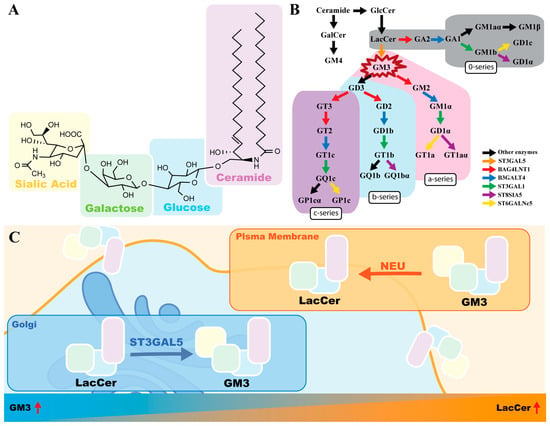
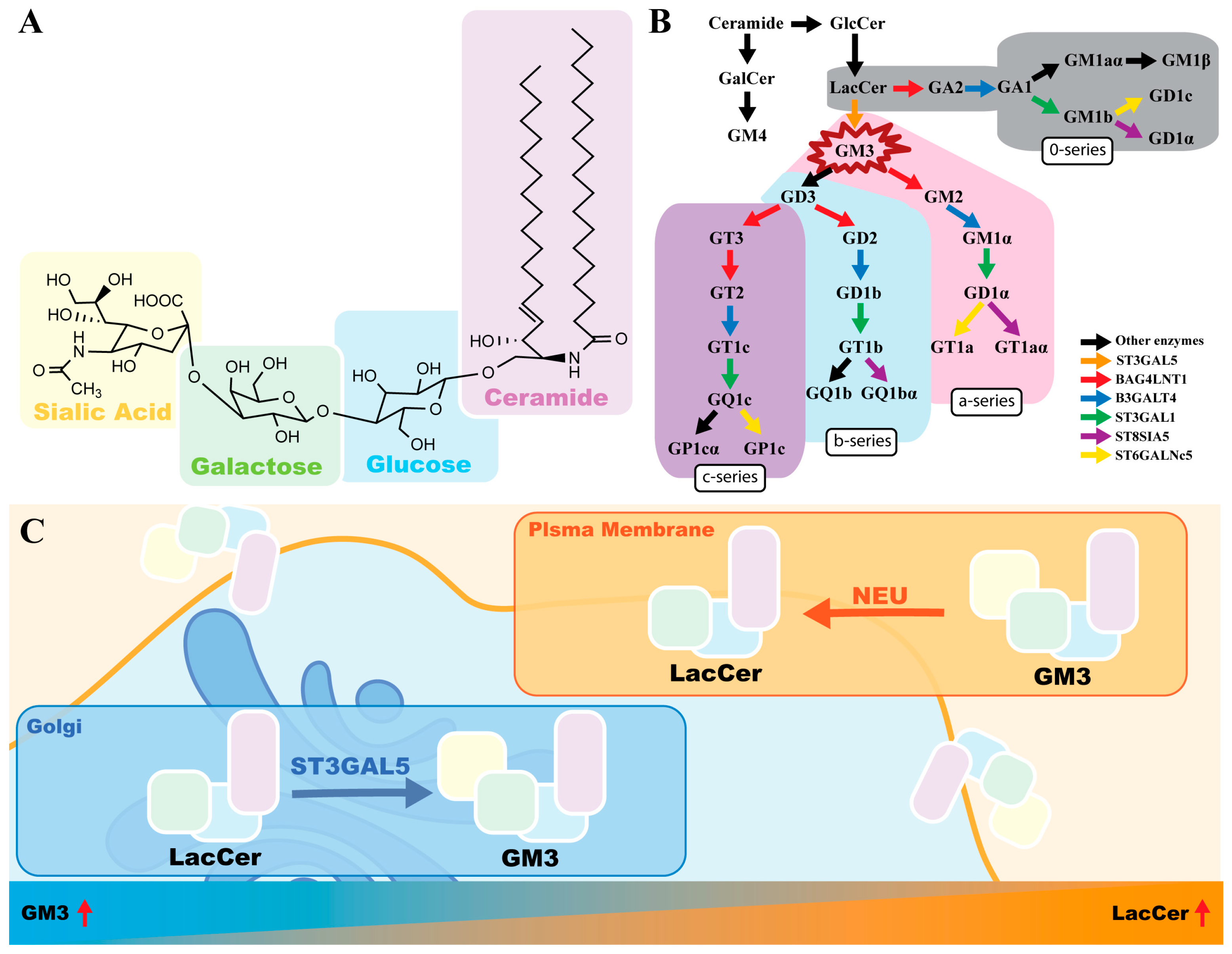
Gangliosides are sialic acid-containing glycosphingolipids that distribute across vertebrate plasma membranes and mediate cell signaling and membrane organization. Structurally, GM3 comprises a hydrophobic ceramide moiety anchored within the outer leaflet of the lipid bilayer and a hydrophilic oligosaccharide headgroup extending into the extracellular space (Figure 1A). This amphiphilic nature drives GM3 to partition into sphingolipid- and cholesterol-enriched microdomains, or lipid rafts. Within these specialized domains, GM3 regulates transmembrane signaling proteins, most notably RTKs, by modulating their lateral mobility and phosphorylation states [17,18].
Figure 1.
Gangliosides and GM3. (A) GM3 structure consists of a ceramide (violet part), a glucose (blue part), a galactose (green part), and a sialic acid (yellow part). (B) Biosynthesis and categorization of gangliosides, in which GM3 plays a central role as the simplest ganglioside. Colorized arrows represent different gangliosides synthetase, such as the blue arrows representing B3GALT4 and the black arrow indicating other enzymes. (C) The metabolic cycle between GM3 and LacCer. The steady-state level of cell surface GM3 is maintained by the balance between Golgi-resident ST3GAL5 (biosynthesis) and plasma membrane-associated NEU3 (biodegradation).
As the foundational member of the a-series lineage, GM3 serves as the simplest and most abundant precursor for synthesizing more complex ganglioside species [19,20] (Figure 1B). Its biogenesis primarily occurs in the Golgi apparatus (Figure 1C), where GM3 synthase (ST3GAL5) transfers a sialic acid residue from CMP-sialic acid to lactosylceramide (LacCer) [3]. Rather than being passively determined by continuous biosynthetic cascades, steady-state GM3 levels are actively maintained through spatial coordination with specific degrading enzymes at the cell surface.
2.2. Dynamic Regulation of GM3: The LacCer/GM3 Ratio
The physiological abundance of surface GM3 relies heavily on localized degradation mechanisms. Sialidase Neu3, a unique plasma membrane-associated enzyme, specifically targets GM3 to cleave its sialic acid residue, regenerating LacCer directly at the cell surface [21,22]. This enzymatic activity establishes a dynamic LacCer/GM3 ratio that profoundly dictates membrane microdomain organization and subsequent cellular signaling (Figure 1C).
This lipid balance is particularly critical in the tumor microenvironment. GM3 typically functions as a tumor suppressor and anti-angiogenic factor by restricting RTK signaling within lipid rafts. Its aglycone precursor, LacCer, however, actively promotes cell proliferation, migration, and angiogenesis [22]. Aberrant upregulation of Neu3 in various human cancers disrupts this equilibrium, leading to a high LacCer/low GM3 state. By depleting GM3 from membrane microdomains and concurrently enriching them with LacCer, Neu3 dismantles the inhibitory constraints on RTKs, fueling malignant transformation and tumor angiogenesis [23,24]. Therefore, targeting this Neu3-driven shift in the LacCer/GM3 balance thus emerges as a compelling strategy for restraining tumor progression.
2.3. Structural Heterogeneity: The Significance of Lipid and Sialic Acid Diversity
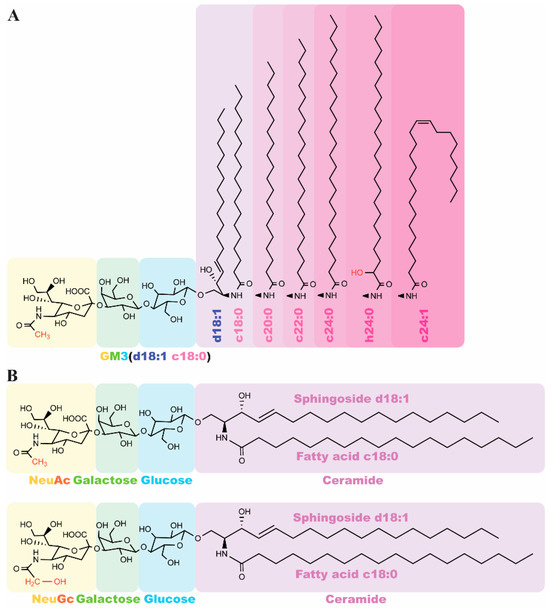
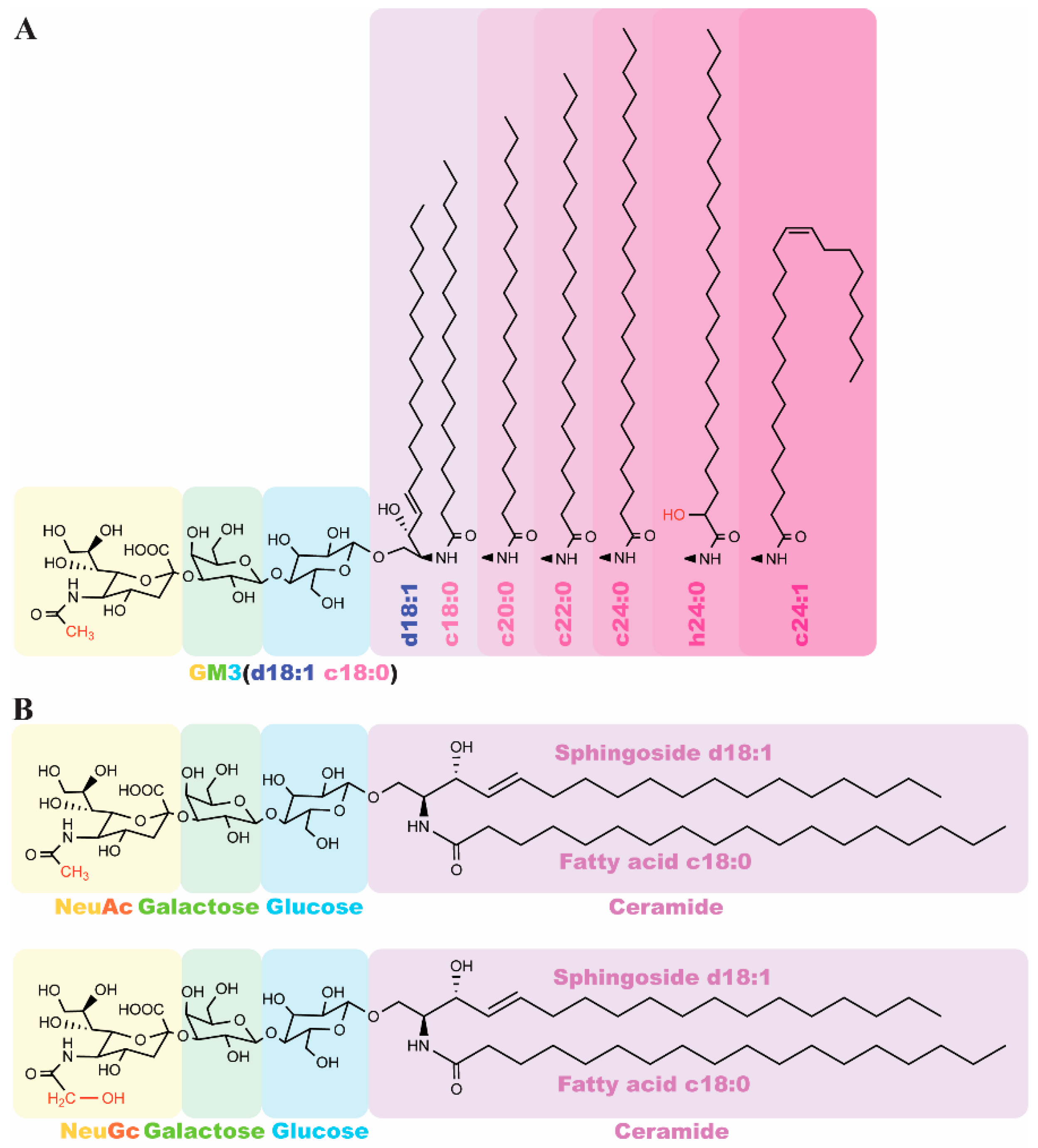
The biological functionality of GM3 is affected by its structural heterogeneity, arising from variations in the ceramide moiety and the sialic acid residue. As illustrated in Figure 2A, while the sphingosine base (d18:1) is relatively conserved, the fatty acyl chains exhibit significant diversity in length, saturation, and hydroxylation. The core structure (e.g., d18:1–C18:0, highlighted in purple) can be modified by replacing the fatty acid with longer chains (C24:0), unsaturated variants (C24:1), or α-hydroxylated forms (h24:0).
Figure 2.
Structures of different gangliosides GM3. (A) The molecular diversity of the GM3(d18:1) lipid tail. Variations in the ceramide fatty acid include chain elongation (C18:0 vs. C24:0), α-hydroxylation (h24:0), and desaturation (C24:1). The core structure GM3(d18:1/C18:0) is depicted in purple to illustrate the site of acyl chain substitution. (B) Molecular composition of GM3 isoforms. Both variants share a conserved ceramide (violet) and lactose core (glucose: blue; galactose: green). They diverge at the terminal sialic acid (yellow), defined as either N-acetylneuraminic acid (Neu5Ac) or N-glycolylneuraminic acid (Neu5Gc).
These specific GM3 isoforms serve as more precise clinical biomarkers than total GM3 levels. For instance, in patients with lymphoma, while total GM3 remains stable, the specific levels of GM3 (d18:1–16:0) and GM3 (d18:1–24:1) are significantly elevated [25]. Similarly, in metabolic research, GM3 (d18:1–h24:1) has been identified as a superior indicator for screening hyperglycemia and dyslipidemia [26]. However, the role of very-long-chain fatty acid (VLCFA) GM3 species, such as h24:0 and h24:1, appears complex, with some studies indicating decreased levels in patients with chronic inflammation and insulin resistance [27,28]. Collectively, these findings suggest that specific GM3 sub-species provide high diagnostic accuracy for various pathological states.
Beyond the lipid tail, the diversity of the sialic acid residue further dictates GM3’s physiological behavior (Figure 2B). The oligosaccharide headgroup, composed of glucose (blue) and galactose (green), is capped by a sialic acid (yellow) that exists primarily as N-acetylneuraminic acid (Neu5Ac) or N-glycolylneuraminic acid (Neu5Gc). While Neu5Ac is the predominant form in healthy humans, Neu5Gc is typically absent due to the evolutionary loss of the CMAH enzyme. While dietary exposure to Neu5Gc is primarily associated with intestinal inflammation and cancer, circulating exogenous Neu5Gc can also be hijacked by distant tumor tissues [29,30]. Hypoxia in TME upregulates specific lysosomal transporters and metabolic pathways, thereby further facilitating the aberrant accumulation of Neu5GcGM3 in non-intestinal solid tumors. Mechanistically, exogenous Neu5Gc from glycoconjugates enters human cells via non-clathrin-mediated pinocytosis/endocytosis and is delivered to lysosomes. There, lysosomal sialidase releases free Neu5Gc, which is subsequently exported into the cytosol by a specific lysosomal sialic acid transporter. Once in the cytosol, it becomes metabolically active and is incorporated into newly synthesized gangliosides [31]. Through this systemic distribution and unique cellular uptake mechanism, non-intestinal malignancies such as breast cancer and melanoma can aberrantly express Neu5GcGM3 on their cell surface, positioning it as a high-priority target for tumor vaccines and targeted immunotherapies.
2.4. Physiological Roles and Pathological Implications
Beyond its structural role, GM3 acts as a dynamic rheostat for transmembrane signaling. By partitioning into lipid rafts, GM3 interacts with various growth factor receptors (e.g., EGFR, FGFR, IGFR) and integrins, thereby modulating fundamental cellular processes such as proliferation, differentiation, and adhesion [17,32,33]. Under physiological conditions, GM3 maintains cellular homeostasis by restraining the excessive activation of these RTKs.
Although this review focuses on the tumor microenvironment, briefly examining GM3’s dysregulation in other pathological states—such as metabolic, neurological, and fibrotic disorders—provides essential mechanistic parallels for understanding cancer progression. In metabolic syndromes, elevated plasma GM3 levels are strongly associated with insulin resistance in Type 2 diabetes, primarily through the inhibition of insulin receptor signaling in adipocytes and skeletal muscle [34,35]. Conversely, GM3 deficiency—often resulting from ST3GAL5 mutations—leads to severe neurodevelopmental pathologies such as epilepsy and salt-and-pepper syndrome, highlighting its importance in neural maturation and synaptic stability [36,37,38]. These insights into GM3’s control over systemic metabolism and neural signaling serve as a valuable reference point for understanding the metabolic reprogramming and neural crosstalk often observed within the tumor microenvironment.
Recent evidence has expanded the therapeutic relevance of GM3 to organ-specific fibrosis and cystic diseases. For instance, GM3 is a critical regulator of the Transforming Growth Factor-β (TGF-β) signaling pathway, which is the primary driver of cardiac fibrosis [34,39,40]. While fibroblasts are essential for wound healing and re-epithelialization following minor injury, severe damage can trigger excessive extracellular matrix (ECM) secretion, leading to fibrotic tissue replacement and organ dysfunction. Notably, GM3 has been shown to inhibit the TGF-β pathway, suggesting its potential as a therapeutic agent to prevent excessive cardiac fibrosis and facilitate chondrocyte regeneration. Importantly, these GM3-mediated mechanisms in tissue fibrosis are highly analogous to the desmoplasia and activation of cancer-associated fibroblasts (CAFs) in the tumor stroma, which are critical drivers of tumor angiogenesis and metastasis. GM3 and its downstream ganglioside derivatives serve as major regulators of cystogenesis; studies indicate that the elimination of GM3 production can have a beneficial effect on slowing cyst formation in polycystic organ diseases [41].
In the specific context of oncology, a vast body of research suggests that increased GM3 content exerts a potent inhibitory effect on various malignancies, including ovarian, colorectal, gastric, and bladder cancers [42,43,44]. These antitumor activities are largely mediated through the dual modulation of the Epidermal Growth Factor (EGF) and Vascular Endothelial Growth Factor (VEGF) signaling pathways, which, respectively, suppress tumor cell proliferation and block pathological angiogenesis. The pleiotropic nature of GM3—ranging from its role in immune cell modulation (such as T cell activation) to its direct interference with oncogenic RTKs—suggests that GM3 supplements and GM3-targeted antibodies have therapeutic potential [45]. Notably, recent advancements have extended this potential into adoptive cell therapy. Sutherland et al. demonstrated a non-genetic approach where T cells and natural killer (NK) cells were chemically conjugated with the 14F7hT antibody targeting Neu5GcGM3. These immune cells exhibited specific tumor-homing capabilities and potent cytotoxicity against Neu5GcGM3-positive cancer cells without the complexities or toxicities often associated with genetic engineering, highlighting a novel therapeutic avenue for GM3-targeted immunotherapy [46].
3. GM3-Mediated Suppression of Tumor Malignancy
3.1. Suppression of Oncogenic Signaling via RTK Modulation
During malignant transformation, aberrant cell surface glycosylation frequently results in the active shedding of gangliosides into the TME via micelles and membrane vesicles [47]. Unlike complex gangliosides that generally promote progression, GM3 typically functions as a natural inhibitor of tumor growth. As summarized in Table 1, GM3 levels are often inversely correlated with the degree of malignancy, showing higher abundance in benign tumors compared to their invasive counterparts. This tumor-suppressive effect is largely mediated through direct interference with the phosphorylation of multiple RTKs; for instance, in gliomas and bladder cancers, GM3 blocks the activation of EGFR, PDGFR, and FGFR signaling.
Recent studies highlight GM3 as a regulator of proliferation and a potential chemotherapeutic agent for high-grade gliomas [48]. Exogenous GM3 effectively inhibits proliferation and induces apoptosis in primary human brain tumors—including glioblastoma multiforme (GBM), astrocytomas, and oligodendrogliomas—without significantly affecting normal neural cells. In vivo, GM3 administration significantly prolongs symptom-free survival in murine xenograft models and rats with meningeal gliomatosis. Additionally, GM3 rapidly suppresses glioma cell invasion prior to the onset of proliferative arrest or apoptosis. However, ganglioside-mediated effects on invasion remain context-dependent [49]. In certain glioma cell lines, exogenous GM3 paradoxically upregulates the secretion of matrix metalloproteinases (MMP-2 and MMP-9) in vitro, suggesting a capacity to stimulate extracellular matrix degradation under specific conditions. Care must also be taken to distinguish the direct lipid effects of ganglioside GM3 from findings derived from the “GM3” malignant glioma cell line [50], where CIITA-induced growth suppression involves the downregulation of PDGFR-β, the upregulation of p27, and the modulation of the PI3K/Akt and MAPK pathways. At the lipid level, GM3 extensively modulates these same downstream cascades while interfering with HSPA8 phosphorylation to suppress tumor growth.
Similarly, in ovarian cancer, GM3 attenuates invasiveness by upregulating Caveolin-1, which sequesters and inactivates c-Src kinase, leading to the downregulation of malignancy markers like α-SMA. Beyond endogenous signaling, GM3 and its aberrant structural derivatives have emerged as viable immunotherapeutic targets [9]. Immunohistochemical analyses reveal that GM3 is strongly expressed in human ovarian cancer tissues but scarcely in normal tissues. Novel monoclonal antibodies specific to GM3 (such as MAb-1) have demonstrated the ability to significantly suppress cell growth and induce robust antibody-dependent cellular cytotoxicity (ADCC) in ovarian cancer cell lines (e.g., OVHM and ID8), indicating significant translational potential [51]. Tumor-specific variants offer an optimized therapeutic window; for example, NeuGcGM3—a variant incorporating dietary sialic acid due to the human CMAH gene mutation—acts as a highly specific neoantigen across various solid tumors. Chimeric antigen receptor (CAR) T cells engineered with single-chain variable fragments (e.g., from the 14F7 antibody) targeting NeuGcGM3 have successfully controlled NeuGcGM3-positive ovarian tumor xenografts in vivo without eliciting off-target toxicity [9]. This NeuGcGM3-targeting strategy is also being integrated into innovative delivery platforms, such as artificial cell-derived vesicles (ACDVs) from cytotoxic T and NK92 cells. Conjugating these vesicles with anti-NeuGcGM3 antibodies (like 14F7hT) significantly enhances tumor cell interaction, internalization, and targeted cytotoxicity. Additionally, other derivatives, such as de-N-acetyl GM3 (d-GM3), are specifically expressed in metastatic tumor cells and are strongly correlated with enhanced metastatic phenotypes through the activation of urokinase-like plasminogen activator (uPA) and MMP-2 [52]. Although primarily characterized in melanoma, the presence of these aberrant GM3 variants underscores the broader significance of targeting ganglioside modifications in highly aggressive and metastatic neoplastic diseases.
The regulatory role of GM3 extends to cell adhesion and metastasis. In human bladder cancer, clinical observations reveal that large amounts of GM3 accumulate predominantly in superficial rather than invasive tumors, suggesting a protective role against tumor penetration. Elevating GM3 levels—whether through the intravesical administration of exogenous GM3 or the genetic overexpression of GM3 synthase—profoundly reduces cell adhesion, motility, invasion, and orthotopic tumor growth while promoting apoptosis. Exogenous GM3 not only reduces EGF-induced phosphorylation to arrest proliferation [44,53] but also acts as a cofactor for CD9 to regulate integrin-mediated motility. Importantly, GM3 intercepts the TGF-β signaling pathway, halting epithelial–mesenchymal transition (EMT). In breast cancer, the perturbation of GM3 levels significantly impacts the PI3K/Akt and NFAT1 signaling axes, crucial drivers of tumor metastasis [54,55,56]. Conversely, in melanoma, specific aberrant derivatives such as de-N-acetyl GM3 (d-GM3) and Neu5GcGM3 act as specific markers for enhanced metastatic phenotypes. These variants can dynamically interact with the uPAR/Integrin α5β1 axis and upregulate urokinase-like plasminogen activator (uPA) to trigger the p38/MAPK cascade and MMP-2 secretion, underscoring the context-dependent nature of ganglioside signaling [52]. Because these abnormal variants and specific molecular conformations (such as the highly immunogenic GM3 lactone) are largely absent in normal tissues, they serve as potent targets for antitumor vaccines and immunotherapy. Targeted interventions, including IgG3 monoclonal antibodies against GM3 lactone (e.g., DH2) and recombinant adeno-associated virus (rAAV)-mediated delivery of anti-Neu5GcGM3 antibodies (e.g., 14F7), have proven highly effective in inducing antibody-dependent cytotoxicity (ADCC) and continuously suppressing melanoma growth in vivo [54,57].
In leukemia models such as K562 cells, GM3 extends beyond growth suppression to actively dictate cell fate [58]. Specifically, GM3 acts as a decisive lineage switch: its accumulation drives the cells exclusively toward a “GM3-rich” megakaryocytoid lineage (marked by platelet peroxidase and GPIIIa expression), whereas its downregulation is associated with erythroid differentiation. This fate-determining capability is highly unique to GM3, as other gangliosides (such as GM1, GM2, or GD1a) fail to induce similar morphological changes [59]. Mechanistically, this accumulation is driven by the PKC/ERK/CREB signaling axis. Activation of ERK leads to CREB binding directly to the GM3 synthase promoter to stimulate transcription—a process strictly independent of the PI3K pathway—further highlighting its role as a lineage-determining factor [58].
From a clinical translation perspective, targeting GM3 as a tumor-associated carbohydrate antigen (TACA) has historically been hindered by its poor immunogenicity [60]. To overcome this, innovative metabolic glycoengineering strategies have been successfully applied in leukemia models. By treating cancer cells with specific biosynthetic precursors (such as ManNPhAc), tumors can be metabolically hijacked to express artificial, highly immunogenic GM3 derivatives (e.g., GM3NPhAc). Subsequent vaccination against these engineered GM3 neo-antigens elicits robust, antigen-specific T cell-dependent cytotoxicity, which significantly suppresses tumor growth and prolongs survival. Additionally, the broader systemic importance of GM3 in clinical therapy is evident in GM3 synthase deficiency models [20]. The profound loss of GM3 structurally alters the cell surface proteome and RTK abundance, paradoxically increasing cellular sensitivity to targeted EGFR inhibitors like erlotinib and revealing a novel therapeutic vulnerability. Beyond its role in signaling modulation and immunotherapy, GM3 holds promise as a diagnostic biomarker. Lipidomic profiling of breast cancer patients has revealed elevated GM3 levels particularly in the luminal B subtype, suggesting that its expression patterns can reflect the specific molecular landscapes of the tumor [61].
Table 1.
Expression and functional roles of ganglioside GM3 in various malignancies.
3.2. Impact on Cell Adhesion and Invasive Phenotype
The transition from a stationary to an invasive phenotype is a hallmark of cancer progression, often facilitated by the loss of inhibitory glycosphingolipids. GM3 regulates this process by stabilizing intercellular adhesion and disrupting the migratory machinery of cancer cells. As highlighted in Table 1, the depletion of GM3 in infiltrating tumors often coincides with the accumulation of longer-chain glycolipids, which favor a more aggressive behavior.
One key mechanism involves the regulation of the urokinase-type plasminogen activator (uPA) and its receptor (uPAR) signaling. GM3 participates in the organization of sphingolipid-rich microdomains (lipid rafts), which are essential for the assembly of uPAR-related invasive complexes. By perturbing these microregions, GM3 effectively dampens the proteolytic activity required for extracellular matrix degradation [11,65].
GM3 importance is also supported by its interaction with scaffold proteins and integrins. In bladder cancer and ovarian carcinoma, GM3 functions as a critical cofactor. Research indicates that GM3 stabilizes a complex involving CD9 and integrin α5β1, which inhibits tumor cell migration. In ovarian cancer specifically, GM3 overexpression has been found to upregulate Caveolin-1, which sequesters c-Src kinase in an inactive state, thereby suppressing cell motility [66].
However, it is crucial to note that structural modifications can reverse these functions. In metastatic melanoma, a specific variant known as Neu5GcGM3 is highly expressed. Unlike native GM3, d-GM3 promotes invasion by activating the p38 MAPK pathway through the uPAR/integrin axis. Conversely, the role of GM3 appears to be tissue-specific, as studies in murine breast cancer models demonstrate that silencing GM3 synthase could inhibit lung metastasis by modulating the PI3K/Akt pathway and NFAT1 expression [67]. Together, these findings suggest that while GM3 generally reinforces cellular cohesion, its effect on invasion depends on the specific signaling context of the tumor.
Furthermore, the structural heterogeneity of GM3 isoforms fundamentally dictates their contradictory roles in cancer progression. A primary source of this heterogeneity lies in the sialic acid headgroup. Humans are genetically deficient in synthesizing Neu5Gc due to an irreversible mutation in the CMAH gene [68]. Consequently, the incorporation of dietary-derived Neu5Gc introduces a seemingly minor structural variation—a single additional oxygen atom at the C-5 position—that drastically alters GM3 function [30]. While endogenous Neu5AcGM3 typically exerts tumor-suppressive effects by maintaining tissue homeostasis and dampening RTK signaling, Neu5GcGM3 acts as a potent pro-tumorigenic driver. The presence of Neu5GcGM3, particularly when interacting with circulating anti-Neu5Gc antibodies, triggers chronic inflammation (xenosialitis) that actively promotes tumor progression and immune evasion [69].
Beyond sialic acid modification, the heterogeneity of the ceramide lipid tail—such as variations in acyl chain length (e.g., C16:0 vs. C24:0) and degree of hydroxylation—further contributes to these contradictory functions. Distinct ceramide structures dictate the specific partitioning of GM3 isoforms within diverse lipid raft microdomains, thereby selectively recruiting or repelling different signalosome complexes [70]. Thus, the net biological effect of GM3 in the tumor microenvironment is not monolithic, but rather a dynamic outcome governed by the balance of these structurally distinct, and often functionally opposing, isoforms.
4. GM3 as a Potent Inhibitor of Tumor Angiogenesis
Angiogenesis, the formation of new blood vessels from pre-existing ones, is an early hallmark of malignant transformation and a prerequisite for tumor expansion beyond a few millimeters. This complex process is driven by a balance between pro-angiogenic and anti-angiogenic factors within the TME. While complex gangliosides like GM2 and GD1a are known to promote a pro-angiogenic environment, GM3 exerts a distinctive inhibitory influence on vascular remodeling.
4.1. Interference with the VEGF/HIF-1α Signaling Axis
Angiogenesis is a complex and dynamic process essential for tumor growth and metastasis, regulated by a delicate balance of biomolecules including growth factors and chemokines. While the VEGF pathway is established as the primary driver of tumor-associated neovascularization—prompting the widespread clinical use of monoclonal antibodies and tyrosine kinase inhibitors (TKIs)—the efficacy of these therapies is often limited by acquired drug resistance and tumor recurrence [71]. GM3 functions as a physiological disruptor of the angiogenic axis. Unlike standard agents that primarily block receptor activity, GM3 targets both the production of angiogenic ligands and their upstream transcriptional regulators. A central mechanism underlying this inhibition is the modulation of hypoxia-inducible factor 1-alpha (HIF-1α). Under the hypoxic conditions typical of the tumor microenvironment, GM3 prevents the stabilization of HIF-1α, thereby abrogating the transcriptional regulation of VEGF and other pro-angiogenic genes.
GM3 weakens these metabolic events by blocking the nuclear translocation of HIF-1α. A reciprocal relationship exists where HIF-1α can suppress ST3GAL5 expression, suggesting that GM3 loss may facilitate tumor progression to sustain an angiogenic switch [72]. Crucially, reversing this loss can halt tumor progression, as evidenced by studies using the GM3 synthase up-regulator, valproic acid (VPA). In A431 epidermoid carcinoma and U87MG glioma cells, VPA treatment induced an approximate 8-fold increase in ST3GAL5 expression, resulting in significant GM3 accumulation [73]. This restoration of GM3 was directly linked to the inhibition of EGFR phosphorylation and cell proliferation—a conclusion further validated when the effects were reversed by blocking glucosylceramide synthesis. Thus, by restoring GM3, therapeutic agents can target a broad signaling network, leading to the concurrent reduction in VEGF-mediated angiogenesis and EGFR-dependent growth.
4.2. Direct Blockade of the VEGFR2 Receptor
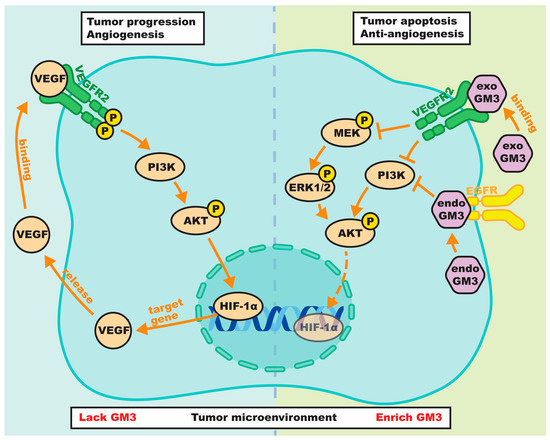
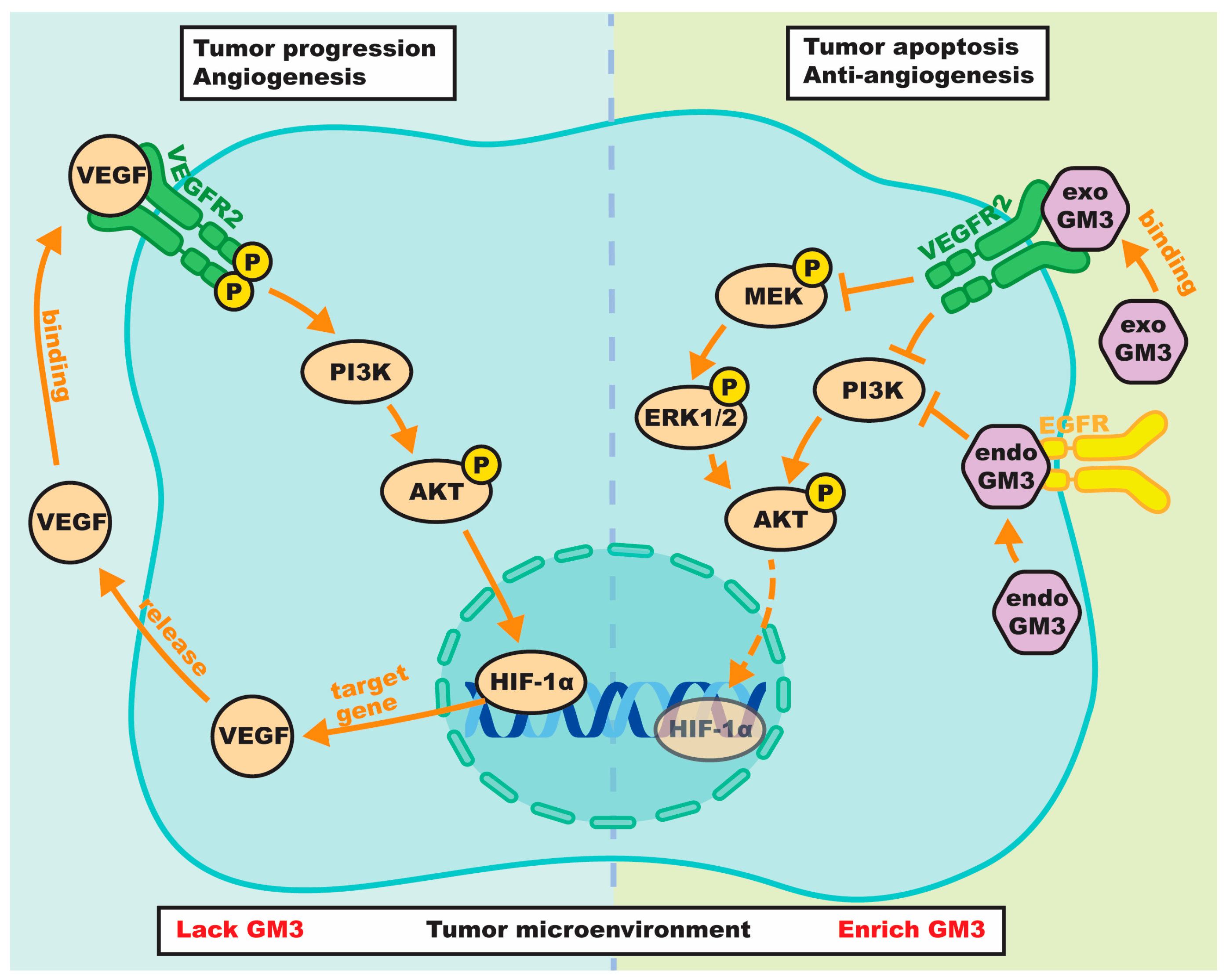
Direct interference with the vascular endothelial growth factor receptor 2 (VEGFR2) represents another mechanism of regulation by GM3. As illustrated in Figure 3, the activation of VEGFR2 typically requires ligand binding followed by receptor dimerization and subsequent tyrosine phosphorylation. This cascade activates multiple downstream pathways, including MEK-ERK1/2 and PI3K-Akt, which collectively promote cell survival, migration, and increased vascular permeability.
Figure 3.
The effect of GM3 on the VEGF signaling pathway. Upon VEGF binding, VEGFR-2 undergoes dimerization and tyrosine phosphorylation, triggering downstream signaling cascades including MEK/ERK1/2, PI3K/Akt, and HIF-1α pathways that promote cell survival, migration, and vascular permeability. Exogenous GM3 inhibits these processes by interacting with the immunoglobulin-like domains 2 and 3 of VEGFR-2 via its sialic acid moiety. Additionally, endogenous GM3 interferes with VEGFR-2 dimerization, leading to suppressed HIF-1α nuclear transcription. Both mechanisms synergistically inhibit tumor-associated angiogenesis.
The inhibitory action of GM3 on this axis is twofold, involving both exogenous and endogenous mechanisms that synergistically suppress angiogenic signaling. Exogenous GM3 within the tumor microenvironment directly interacts with the extracellular immunoglobulin-like structural domains of VEGFR2, specifically binding to amino acids in domains 2 and 3 [74]. This interaction pre-empts the VEGF ligand-binding site, effectively preventing receptor dimerization and reducing the interaction between VEGFR2 and its ligand. Notably, this blockade counteracts pro-angiogenic signaling, as GM3 has been shown to neutralize the proliferative effects of complex gangliosides like GD1a.
Concurrently, endogenous GM3 located within the plasma membrane creates an internal blockade that prevents the relay of activating signals to cytoplasmic mediators. This regulation is highly specific: the depletion of GM3 using synthesis inhibitors (e.g., NB-DNJ) results in the hyper-phosphorylation of VEGFR2 and Akt, a phenotype that is fully reversible upon GM3 replenishment [75]. Functionally, these dual mechanisms translate into marked suppression of endothelial cell migration and microvessel permeability. These findings demonstrate that GM3 administration blocks neovascularization and inhibits primary tumor growth.
As a result of these dual approaches, the phosphorylation of ERK and Akt is significantly inhibited. This suppression of the kinase network is not limited to the VEGF axis but reflects a broader regulatory role of GM3 on the cellular kinase. Mechanistic studies, particularly in keratinocyte models, revealed that GM3 also negatively regulated the insulin receptor (IR) and insulin-like growth factor-1 receptor (IGF-1R) pathways [76]. Specifically, GM3 acts by hindering the formation of the signaling complex involving IR, IGF-1R, and insulin receptor substrate 1 (IRS-1), thereby blocking the downstream activation of PI3K/Akt.
The consequence of this broad kinase inhibition is a decisive shift in cell fate. Disruption of these survival signals (ERK1/2, PI3K, Akt) by GM3 or ganglioside-targeting agents has been shown to trigger pro-apoptotic cascades, characterized by the upregulation of caspase-3 and BAX [77]. Consequently, the restoration of GM3 levels induces metabolic suppression and apoptosis in tumor cells. Importantly, this inhibitory efficacy is not confined to the tumor cells themselves but extends to the broader angiogenic microenvironment.
4.3. Broader Impact on Angiogenic Microenvironment
Beyond direct receptor interference, GM3 reshapes the vascular niche by modulating auxiliary signaling molecules. GM3 has been found to dose-dependently reduce NO levels in macrophages; since NO production is known to facilitate vasodilation and attract existing capillaries, its reduction further contributes to the localized anti-vascular effect [78]. In vivo models further demonstrate that environments enriched with GM3 result in sparsely vascularized and extensively necrotic solid tumors, contrasting sharply with the dense vascular networks observed in GM3-deficient tissues [79].
In addition to its antitumor role, GM3 exhibits a fundamental protective function in vascular homeostasis. Our group previously demonstrated that exogenous GM3 effectively inhibited atherosclerosis through a multi-step mechanism. Specifically, instead of merely acting as a passive lipid, GM3 incorporation altered the physicochemical properties of low-density lipoprotein (LDL). This modification reduces LDL susceptibility to oxidation and macrophage uptake, while simultaneously impairing endothelial monocyte adhesion [80]. Extending this vascular protective profile, recent findings by Zhang et al. revealed that GM3 also prevented abdominal aortic aneurysm (AAA) progression [13]. This was achieved by blocking transferrin receptor 1 (TFR1)-mediated iron uptake, thereby suppressing ferroptosis in vascular smooth muscle cells. Collectively, these findings indicate that GM3 maintains vascular homeostasis by regulating lipid metabolism, inflammation, and cell survival.
5. Therapeutic Strategies Targeting GM3
Given the tumor-suppressive function of GM3, several immunotherapeutic strategies, including cancer vaccines and monoclonal antibodies, have been developed. Recent advances highlight that gangliosides act as functional components of membrane lipid rafts, making these microdomains essential therapeutic targets for disrupting cancer cell communication [81]. Natural GM3 is weakly immunogenic and typically elicits only IgM responses. However, chemically modified GM3 derivatives demonstrate improved immunogenicity. For example, N-phenylacetylated derivatives (GM3NPhAc) induce high titers of both IgG and IgM antibodies with high affinity and minimal cross-reactivity to endogenous GM3 [60]. Hexameric IgM antibodies have been engineered to specifically target GM3-positive melanoma cells [82,83,84].
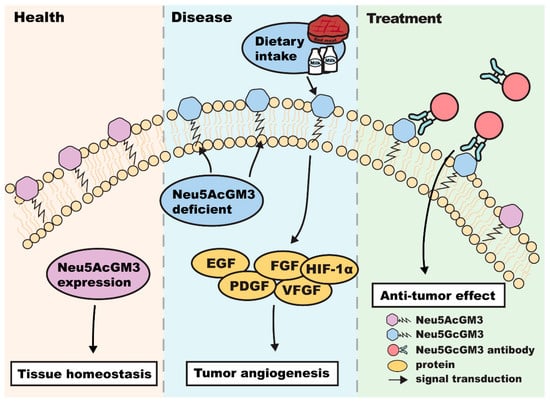
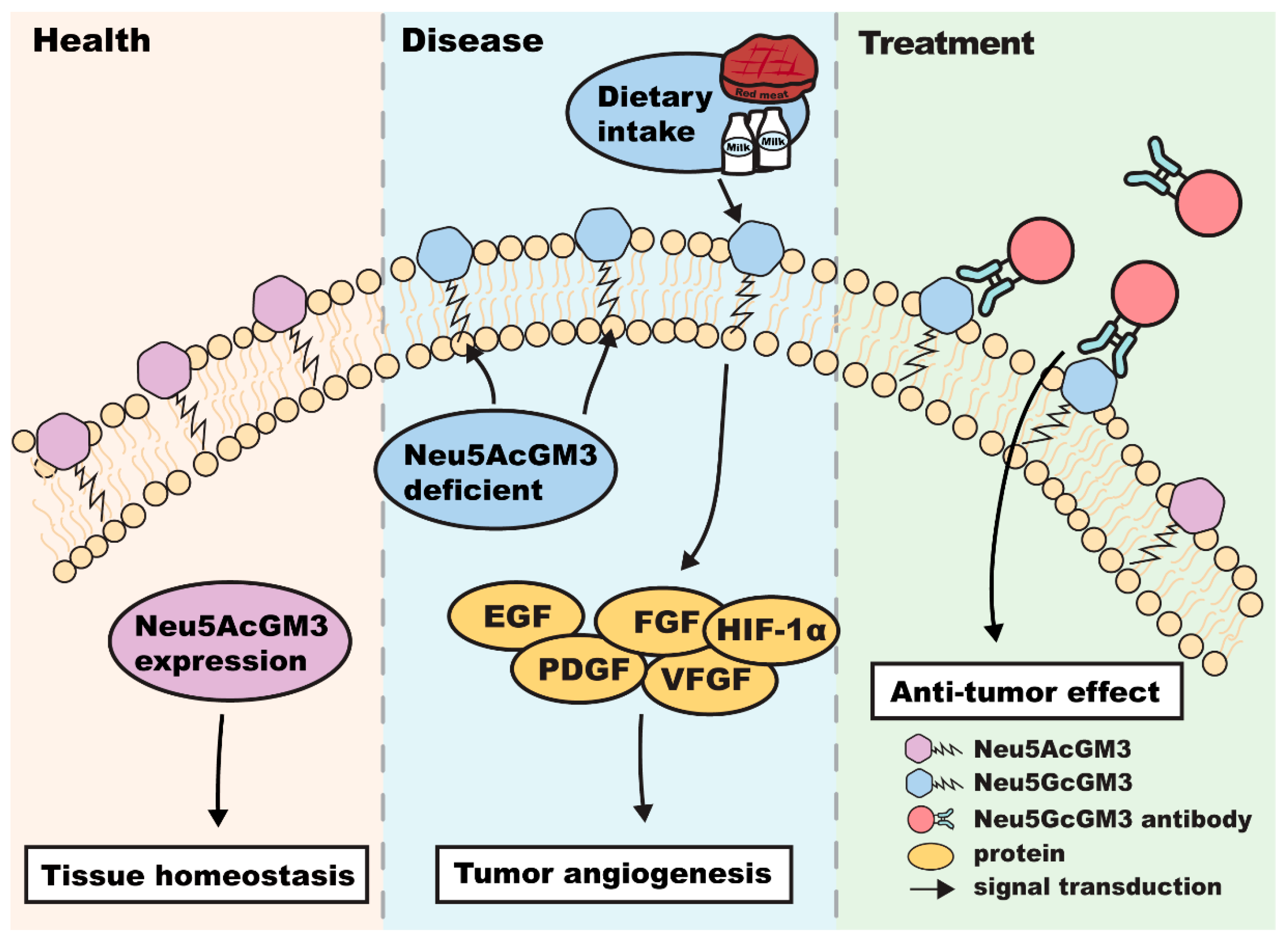
Another focus on this field is targeting N-glycolyl GM3 (Neu5GcGM3), a non-human sialic acid variant that acts as a neo-antigen [85]. As illustrated in Figure 4, the pathological accumulation of Neu5GcGM3 on the cell surface is driven by the metabolic incorporation of exogenous N-glycolylneuraminic acid—derived from dietary sources such as red meat and dairy—combined with a deficiency in the enzymes responsible for Neu5AcGM3 synthesis [86]. This altered sialylation profile facilitates the hyperphosphorylation of RTKs, including EGFR, PDGFR, and FGFR, which ultimately accelerates malignant transformation and tumor development [30]. To inhibit this signaling, humanized monoclonal antibodies, such as 14F7, have been developed to selectively bind to Neu5GcGM3. These antibodies block RTK signaling pathways and induce immune-mediated cytotoxicity against cancer cells [29,87,88].
Figure 4.
The mechanism of Neu5GcGM3 accumulation and antibody-mediated inhibition. In malignant states, the upregulation of Neu5GcGM3 on the cell surface is driven by the metabolic incorporation of exogenous N-glycolylneuraminic acid (derived from dietary sources such as red meat and dairy) and the simultaneous downregulation of enzymes responsible for Neu5AcGM3 synthesis. This modification enhances receptor tyrosine kinase (RTK) signaling (e.g., EGFR, PDGFR, FGFR). Anti-Neu5GcGM3 antibodies (e.g., 14F7) selectively bind to these neo-antigens, blocking downstream oncogenic signaling and triggering immune responses.
The Neu5GcGM3/very-small-size proteoliposome (VSSP) vaccine has shown efficacy in clinical trials [89]. In advanced melanoma patients, the VSSP vaccine extended survival to over 20 months [90]. Similar strategies using Neu5GcGM3 complexed with Neisseria meningitidis outer membrane proteins have been tested in breast cancer [91]. Glyco-engineered mouse models (β3Gn-T5 knockout) have confirmed the feasibility of generating high-affinity IgG antibodies against Neu5GcGM3 [51].
Beyond its standalone effects, GM3 can function as a targeting or stabilizing moiety in complex drug delivery systems. Our study demonstrated that GM3-functionalized reconstituted high-density lipoproteins (rHDLs) significantly enhanced the anti-atherosclerotic efficacy of statins through improved lesion targeting [92]. It suggests that GM3-based nanoplatforms could similarly be employed in oncology to co-deliver anti-angiogenic and chemotherapeutic agents, achieving synergistic tumor suppression.
However, anti-ganglioside therapy carries potential risks. The induction of anti-ganglioside antibodies (AGAs) has been linked to neurological conditions such as Guillain–Barré syndrome, an autoimmune polyneuropathy [93]. Since certain microbial infections can mimic ganglioside structures and trigger cross-reactive autoantibodies [94], distinguishing between therapeutic and pathological immune responses is critical for the safety of GM3-targeted therapies.
6. Conclusions and Future Perspectives
It is important to highlight the unique scope of this review. While recent comprehensive reviews have predominantly focused on the clinical landscape of Neu5Gc-containing glycoconjugates and their applications as tumor-associated antigens [30], our review offers a fundamentally distinct perspective. The core novelty of this work lies in conceptually repositioning GM3 and its structural isoforms not merely as passive structural biomarkers, but as dynamic regulatory hubs that specifically dictate tumor angiogenesis and profoundly remodel the TME. Ganglioside GM3 functions well beyond simple cell–cell recognition; by acting as a natural antagonist to RTKs—including EGFR, PDGFR, and VEGFR2—it actively inhibits the oncogenic signaling that drives tumor proliferation and invasion. Specifically, GM3 disrupts the VEGF/HIF-1α axis at both transcriptional and receptor levels, thereby suppressing tumor angiogenesis and vascular expansion.
Despite these established mechanisms, several highly controversial issues remain in the field. The most prominent debate centers on the paradoxical, context-dependent functions of GM3. Distinguishing between the universally tumor-suppressive native Neu5AcGM3 and the aberrantly expressed Neu5GcGM3 variant is essential. While endogenous Neu5AcGM3 dampens oncogenic signaling, the incorporation of non-human Neu5Gc, or specific variations in the ceramide lipid tail, can completely reverse these effects, driving immune evasion and tumor metastasis. Whether these contradictory roles are solely dictated by the structural heterogeneity of these GM3 isoforms, or if they are largely shaped by their specific cellular origins within the TME (e.g., cancer cells vs. cancer-associated fibroblasts), remains a subject of intense debate.
Translating these biological insights into clinical therapeutics highlights critical gaps of knowledge and translational hurdles, particularly regarding inadequate drug targeting and off-target toxicity. Meanwhile, novel nanomedicine strategies, such as bioinspired membrane vesicles, are continuously emerging to overcome these generic delivery challenges [95,96]. The identification of Neu5GcGM3 as a tumor-specific neo-antigen has provided a promising target for immunotherapy. Strategies utilizing humanized antibodies (e.g., 14F7) and vaccine formulations (e.g., VSSP) demonstrate the feasibility of targeting Neu5GcGM3-expressing malignancies. This approach potentially offers a dual mechanism: activating the immune system while simultaneously inhibiting oncogenic signaling.
However, clinical application faces challenges. Distinguishing between the tumor-suppressive Neu5AcGM3 and the targetable Neu5GcGM3 variant is essential to avoid off-target effects. Future research should prioritize the development of advanced delivery systems, such as lipid-based nanoparticles or liposomes, to enhance the bioavailability and stability of exogenous GM3 analogs. To overcome the biological barriers of GM3 delivery, biomimetic nanocarriers like rHDL have been developed to provide enhanced stability and lesion specificity. These systems can be engineered for pH-responsive release, capitalizing on the acidic microenvironment to trigger localized drug liberation [97]. Given the characteristic acidosis of the TME, such pH-sensitive delivery strategies represent a promising avenue for maximizing the local anti-angiogenic impact of GM3 while minimizing systemic side effects. Notably, rigorous monitoring for autoimmune risks, particularly anti-ganglioside antibody-induced neuropathies (e.g., Guillain–Barré syndrome) is required. Combining GM3-targeted immunotherapies with conventional anti-angiogenic agents may offer a synergistic strategy to inhibit tumor growth and metastasis effectively.
Author Contributions
Conceptualization, Y.C., M.Z. and H.Z.; investigation, M.Z. and H.Z.; writing—original draft preparation, M.Z. and H.Z.; writing—review and editing, S.Z., R.C. and Y.C.; funding acquisition, Y.C. All authors have read and agreed to the published version of the manuscript.
Funding
This review was funded by the National Natural Science Foundation of China (No. 81560083, No. 81970386, China).
Data Availability Statement
No new data were created or analyzed in this study.
Acknowledgments
During the preparation of this manuscript, the authors used Gemini 3 (Google) for the purposes of language editing, structural improvements, and literature summarization. The authors have reviewed and edited the output and take full responsibility for the content of this publication.
Conflicts of Interest
The authors declare no conflicts of interest.
Abbreviations
The following abbreviations are used in this manuscript:
| α-SMA | Alpha-smooth muscle actin |
| CAFs | Cancer-associated fibroblasts |
| CMP | Cytidine monophosphate |
| ECM | Extracellular matrix |
| EGF | Epidermal Growth Factor |
| EMT | Epithelial–mesenchymal transition |
| GM3 | Monosialodihexosylganglioside |
| HIF-1α | Hypoxia-inducible factor 1-alpha |
| IGFR | Insulin-like growth factor receptor |
| LacCer | Lactosylceramide |
| Neu3 | Sialidase Neu3 |
| Neu5Ac | N-acetylneuraminic acid |
| Neu5Gc | N-glycolylneuraminic acid |
| NK | Natural killer |
| PDGFR | Platelet-Derived Growth Factor Receptor |
| RTKs | Receptor tyrosine kinases |
| ST3GAL5 | GM3 synthase |
| TGF-β | Transforming growth factor-β |
| TME | Tumor microenvironment |
| uPAR | Urokinase-type plasminogen activator receptor |
| VEGF | Vascular Endothelial Growth Factor |
| VEGFR/VEGFR2 | Vascular Endothelial Growth Factor Receptor (2) |
| VSSP | Very-small-size proteoliposome |
References
- Monk, B.J.; Lorusso, D.; Fujiwara, K.; Sehouli, J. Optimal Bevacizumab Treatment Strategy in Advanced Ovarian Cancer: A Review. Cancer Treat. Rev. 2025, 137, 102945. [Google Scholar] [CrossRef] [Scilit]
- Yang, W. Cancer and Inflammation: Immunologic Interplay, Translational Advances, and Clinical Strategies. J. Explor. Res. Pharmacol. 2025, 10, e00045. [Google Scholar] [CrossRef] [Scilit]
- Fishman, P.H.; Brady, R.O. Biosynthesis and Function of Gangliosides. Science 1976, 194, 906–915. [Google Scholar] [CrossRef] [Scilit]
- Sandhoff, R.; Schulze, H.; Sandhoff, K. Ganglioside Metabolism in Health and Disease. Prog. Mol. Biol. Transl. Sci. 2018, 156, 1–62. [Google Scholar] [CrossRef] [Scilit]
- Sarkar, A.; Banerjee, S.; Biswas, K. Multi-Dimensional Role of Gangliosides in Modulating Cancer Hallmarks and Their Prospects in Targeted Cancer Therapy. Front. Pharmacol. 2023, 14, 1282572. [Google Scholar] [CrossRef] [Scilit] [PubMed]
- Caforio, M.; Sorino, C.; Caruana, I.; Weber, G.; Camera, A.; Cifaldi, L.; De Angelis, B.; Del Bufalo, F.; Vitale, A.; Goffredo, B.M.; et al. GD2 Redirected CAR T and Activated NK-Cell-Mediated Secretion of IFNγ Overcomes MYCN-Dependent IDO1 Inhibition, Contributing to Neuroblastoma Cell Immune Escape. J. Immunother. Cancer 2021, 9, e001502. [Google Scholar] [CrossRef] [Scilit]
- Galan, A.; Papaluca, A.; Nejatie, A.; Matanes, E.; Brahimi, F.; Tong, W.; Hachim, I.Y.; Yasmeen, A.; Carmona, E.; Klein, K.O.; et al. GD2 and GD3 Gangliosides as Diagnostic Biomarkers for All Stages and Subtypes of Epithelial Ovarian Cancer. Front. Oncol. 2023, 13, 1134763. [Google Scholar] [CrossRef] [Scilit] [PubMed]
- Hakomori, S.-I.; Handa, K. GM3 and Cancer. Glycoconj. J. 2015, 32, 1–8. [Google Scholar] [CrossRef] [Scilit]
- Cribioli, E.; Giordano Attianese, G.M.P.; Coukos, G.; Irving, M. CAR T Cells Targeting the Ganglioside NGcGM3 Control Ovarian Tumors in the Absence of Toxicity against Healthy Tissues. Front. Immunol. 2022, 13, 951143. [Google Scholar] [CrossRef] [Scilit]
- Bousquet, P.A.; Manna, D.; Sandvik, J.A.; Arntzen, M.Ø.; Moreno, E.; Sandvig, K.; Krengel, U. SILAC-Based Quantitative Proteomics and Microscopy Analysis of Cancer Cells Treated with the N-Glycolyl GM3-Specific Anti-Tumor Antibody 14F7. Front. Immunol. 2022, 13, 994790. [Google Scholar] [CrossRef] [Scilit]
- Wang, X.-Q.; Sun, P.; Go, L.; Koti, V.; Fliman, M.; Paller, A.S. Ganglioside GM3 Promotes Carcinoma Cell Proliferation via Urokinase Plasminogen Activator-Induced Extracellular Signal-Regulated Kinase-Independent p70S6 Kinase Signaling. J. Investig. Dermatol. 2006, 126, 2687–2696. [Google Scholar] [CrossRef] [Scilit] [PubMed]
- Hashiramoto, A.; Mizukami, H.; Yamashita, T. Ganglioside GM3 Promotes Cell Migration by Regulating MAPK and C-Fos/AP-1. Oncogene 2006, 25, 3948–3955. [Google Scholar] [CrossRef] [Scilit]
- Zhang, F.; Li, K.; Zhang, W.; Zhao, Z.; Chang, F.; Du, J.; Zhang, X.; Bao, K.; Zhang, C.; Shi, L.; et al. Ganglioside GM3 Protects Against Abdominal Aortic Aneurysm by Suppressing Ferroptosis. Circulation 2024, 149, 843–859. [Google Scholar] [CrossRef] [Scilit]
- Wang, K.; Wang, J.; Sun, T.; Bian, G.; Pan, W.; Feng, T.; Wang, P.; Li, Y.; Dai, J. Glycosphingolipid GM3 Is Indispensable for Dengue Virus Genome Replication. Int. J. Biol. Sci. 2016, 12, 872–883. [Google Scholar] [CrossRef] [Scilit]
- Zhang, J.; Terreni, M.; Liu, F.; Sollogoub, M.; Zhang, Y. Ganglioside GM3-Based Anticancer Vaccines: Reviewing the Mechanism and Current Strategies. Biomed. Pharmacother. 2024, 176, 116824. [Google Scholar] [CrossRef] [Scilit]
- Zhuang, H.; Huang, Z.; Birklé, S.; Chammas, R.; Tikkanen, R.; Chen, Y. Editorial: Pharmacology of Gangliosides. Front. Pharmacol. 2024, 15, 1449928. [Google Scholar] [CrossRef] [Scilit]
- Dam, D.H.M.; Wang, X.-Q.; Sheu, S.; Vijay, M.; Shipp, D.; Miller, L.; Paller, A.S. Ganglioside GM3 Mediates Glucose-Induced Suppression of IGF-1 Receptor–Rac1 Activation to Inhibit Keratinocyte Motility. J. Investig. Dermatol. 2017, 137, 440–448. [Google Scholar] [CrossRef] [Scilit]
- Li, T.; Wang, X.; Dong, P.; Yu, P.; Zhang, Y.; Meng, X. Chemoenzymatic Synthesis and Biological Evaluation of Ganglioside GM3 and Lyso-GM3 as Potential Agents for Cancer Therapy. Carbohydr. Res. 2021, 509, 108431. [Google Scholar] [CrossRef] [Scilit]
- Trinchera, M.; Parini, R.; Indellicato, R.; Domenighini, R.; dall’Olio, F. Diseases of Ganglioside Biosynthesis: An Expanding Group of Congenital Disorders of Glycosylation. Mol. Genet. Metab. 2018, 124, 230–237. [Google Scholar] [CrossRef] [Scilit] [PubMed]
- Dookwah, M.; Wagner, S.K.; Ishihara, M.; Yu, S.-H.; Ulrichs, H.; Kulik, M.J.; Zeltner, N.; Dalton, S.; Strauss, K.A.; Aoki, K.; et al. Neural-Specific Alterations in Glycosphingolipid Biosynthesis and Cell Signaling Associated with Two Human Ganglioside GM3 Synthase Deficiency Variants. Hum. Mol. Genet. 2023, 32, 3323–3341. [Google Scholar] [CrossRef] [Scilit] [PubMed]
- Sandhoff, K.; Harzer, K. Gangliosides and Gangliosidoses: Principles of Molecular and Metabolic Pathogenesis. J. Neurosci. 2013, 33, 10195–10208. [Google Scholar] [CrossRef] [Scilit]
- Rajesh, M.; Kolmakova, A.; Chatterjee, S. Novel Role of Lactosylceramide in Vascular Endothelial Growth Factor-Mediated Angiogenesis in Human Endothelial Cells. Circ. Res. 2005, 97, 796–804. [Google Scholar] [CrossRef] [Scilit]
- Kawamura, S.; Sato, I.; Wada, T.; Yamaguchi, K.; Li, Y.; Li, D.; Zhao, X.; Ueno, S.; Aoki, H.; Tochigi, T.; et al. Plasma Membrane-Associated Sialidase (NEU3) Regulates Progression of Prostate Cancer to Androgen-Independent Growth through Modulation of Androgen Receptor Signaling. Cell Death Differ. 2012, 19, 170–179. [Google Scholar] [CrossRef] [Scilit]
- Wada, T.; Hata, K.; Yamaguchi, K.; Shiozaki, K.; Koseki, K.; Moriya, S.; Miyagi, T. A Crucial Role of Plasma Membrane-Associated Sialidase in the Survival of Human Cancer Cells. Oncogene 2007, 26, 2483–2490. [Google Scholar] [CrossRef] [Scilit] [PubMed]
- Nishikawa, M.; Kurano, M.; Nitta, T.; Kanoh, H.; Inokuchi, J.; Yatomi, Y. Serum GM3(D18:1-16:0) and GM3(D18:1-24:1) Levels May Be Associated with Lymphoma: An Exploratory Study with Haematological Diseases. Sci. Rep. 2019, 9, 6308. [Google Scholar] [CrossRef] [Scilit] [PubMed]
- Veillon, L.; Go, S.; Matsuyama, W.; Suzuki, A.; Nagasaki, M.; Yatomi, Y.; Inokuchi, J.-I. Identification of Ganglioside GM3 Molecular Species in Human Serum Associated with Risk Factors of Metabolic Syndrome. PLoS ONE 2015, 10, e0129645. [Google Scholar] [CrossRef] [Scilit]
- Park, J.-W.; Park, W.-J.; Kuperman, Y.; Boura-Halfon, S.; Pewzner-Jung, Y.; Futerman, A.H. Ablation of Very Long Acyl Chain Sphingolipids Causes Hepatic Insulin Resistance in Mice Due to Altered Detergent-Resistant Membranes. Hepatology 2013, 57, 525–532. [Google Scholar] [CrossRef] [Scilit]
- Kanoh, H.; Nitta, T.; Go, S.; Inamori, K.; Veillon, L.; Nihei, W.; Fujii, M.; Kabayama, K.; Shimoyama, A.; Fukase, K.; et al. Homeostatic and Pathogenic Roles of GM 3 Ganglioside Molecular Species in TLR 4 Signaling in Obesity. EMBO J. 2020, 39, EMBJ2019101732. [Google Scholar] [CrossRef] [Scilit]
- Heinzelbecker, J.; Fauskanger, M.; Jonson, I.; Krengel, U.; Løset, G.Å.; Munthe, L.; Tveita, A. Chimeric Antigen Receptor T Cells Targeting the GM3(Neu5Gc) Ganglioside. Front. Immunol. 2024, 15, 1331345. [Google Scholar] [CrossRef] [Scilit]
- Blanco, R.; Muñoz, J.P. The Role of Non-Human Sialic Acid Neu5Gc-Containing Glycoconjugates in Human Tumors: A Review of Clinical and Experimental Evidence. Biomolecules 2025, 15, 253. [Google Scholar] [CrossRef] [Scilit]
- Bardor, M.; Nguyen, D.H.; Diaz, S.; Varki, A. Mechanism of Uptake and Incorporation of the Non-Human Sialic Acid N-Glycolylneuraminic Acid into Human Cells. J. Biol. Chem. 2005, 280, 4228–4237. [Google Scholar] [CrossRef] [Scilit] [PubMed]
- Wang, X.; Yan, Q.; Sun, P.; Liu, J.-W.; Go, L.; McDaniel, S.M.; Paller, A.S. Suppression of Epidermal Growth Factor Receptor Signaling by Protein Kinase C-α Activation Requires CD82, Caveolin-1, and Ganglioside. Cancer Res. 2007, 67, 9986–9995. [Google Scholar] [CrossRef] [Scilit]
- Toledo, M.S.; Suzuki, E.; Handa, K.; Hakomori, S. Effect of Ganglioside and Tetraspanins in Microdomains on Interaction of Integrins with Fibroblast Growth Factor Receptor. J. Biol. Chem. 2005, 280, 16227–16234. [Google Scholar] [CrossRef] [Scilit]
- Bass-Stringer, S.; Bernardo, B.C.; Yildiz, G.S.; Matsumoto, A.; Kiriazis, H.; Harmawan, C.A.; Tai, C.M.K.; Chooi, R.; Bottrell, L.; Ezeani, M.; et al. Reduced PI3K(P110α) Induces Atrial Myopathy, and PI3K-Related Lipids Are Dysregulated in Athletes with Atrial Fibrillation. J. Sport Health Sci. 2025, 14, 101023. [Google Scholar] [CrossRef] [Scilit]
- Inokuchi, J.; Kanoh, H.; Inamori, K.; Nagafuku, M.; Nitta, T.; Fukase, K. Homeostatic and Pathogenic Roles of the GM3 Ganglioside. FEBS J. 2022, 289, 5152–5165. [Google Scholar] [CrossRef] [Scilit]
- Simpson, M.A.; Cross, H.; Proukakis, C.; Priestman, D.A.; Neville, D.C.A.; Reinkensmeier, G.; Wang, H.; Wiznitzer, M.; Gurtz, K.; Verganelaki, A.; et al. Infantile-Onset Symptomatic Epilepsy Syndrome Caused by a Homozygous Loss-of-Function Mutation of GM3 Synthase. Nat. Genet. 2004, 36, 1225–1229. [Google Scholar] [CrossRef] [Scilit]
- Heide, S.; Jacquemont, M.-L.; Cheillan, D.; Renouil, M.; Tallot, M.; Schwartz, C.E.; Miquel, J.; Bintner, M.; Rodriguez, D.; Darcel, F.; et al. GM3 Synthase Deficiency in Non-Amish Patients. Genet. Med. 2022, 24, 492–498. [Google Scholar] [CrossRef] [Scilit] [PubMed]
- Abdulkareem, A.A.; Shirah, B.H.; Naseer, M.I. Whole Exome Sequencing Reveals a Novel Homozygous Variant in the Ganglioside Biosynthetic Enzyme, ST3GAL5 Gene in a Saudi Family Causing Salt and Pepper Syndrome. Genes 2023, 14, 354. [Google Scholar] [CrossRef] [Scilit] [PubMed]
- Guan, F.; Handa, K.; Hakomori, S. Specific Glycosphingolipids Mediate Epithelial-to-Mesenchymal Transition of Human and Mouse Epithelial Cell Lines. Proc. Natl. Acad. Sci. USA 2009, 106, 7461–7466. [Google Scholar] [CrossRef] [Scilit]
- Ryu, J.-S.; Seo, S.Y.; Jeong, E.-J.; Kim, J.-Y.; Koh, Y.-G.; Kim, Y.I.; Choo, Y.-K. Ganglioside GM3 Up-Regulate Chondrogenic Differentiation by Transform Growth Factor Receptors. Int. J. Mol. Sci. 2020, 21, 1967. [Google Scholar] [CrossRef] [Scilit]
- Natoli, T.A.; Smith, L.A.; Rogers, K.A.; Wang, B.; Komarnitsky, S.; Budman, Y.; Belenky, A.; Bukanov, N.O.; Dackowski, W.R.; Husson, H.; et al. Inhibition of Glucosylceramide Accumulation Results in Effective Blockade of Polycystic Kidney Disease in Mouse Models. Nat. Med. 2010, 16, 788–792. [Google Scholar] [CrossRef] [Scilit]
- Parlekar, B.; Livingstone, D.W.; Sutherland, A.R.; Medina, A.X.; Bernhard, W.; DeCoteau, J.; Hernández, T.; Geyer, C.R. Antibody-Targeted Artificial T Cell and Natural Killer Cell Derived Vesicles for Cancer Immunotherapy. J. Extracell. Vesicles 2026, 15, e70231. [Google Scholar] [CrossRef] [Scilit]
- Zhang, X.; Shan, S.; Shi, J.; Li, H.; Li, Z. Polyphenol from Millet Bran Increases the Sensitivity of Colorectal Cancer Cells to Oxaliplatin by Blocking the Ganglioside GM3 Catabolism. Food Funct. 2021, 12, 291–301. [Google Scholar] [CrossRef] [Scilit]
- Watanabe, R.; Ohyama, C.; Aoki, H.; Takahashi, T.; Satoh, M.; Saito, S.; Hoshi, S.; Ishii, A.; Saito, M.; Arai, Y. Ganglioside G(M3) Overexpression Induces Apoptosis and Reduces Malignant Potential in Murine Bladder Cancer. Cancer Res. 2002, 62, 3850–3854. [Google Scholar]
- Horie, M.; Takagane, K.; Itoh, G.; Kuriyama, S.; Yanagihara, K.; Yashiro, M.; Umakoshi, M.; Goto, A.; Arita, J.; Tanaka, M. Exosomes Secreted by ST3GAL5high Cancer Cells Promote Peritoneal Dissemination by Establishing a Premetastatic Microenvironment. Mol. Oncol. 2024, 18, 21–43. [Google Scholar] [CrossRef] [Scilit] [PubMed]
- Sutherland, A.R.; Parlekar, B.; Livingstone, D.W.; Medina, A.X.; Bernhard, W.; García, T.H.; DeCoteau, J.; Geyer, C.R. Antibody-Targeted T Cells and Natural Killer Cells for Cancer Immunotherapy. J. Nanobiotechnol. 2024, 22, 640. [Google Scholar] [CrossRef] [Scilit]
- Hakomori, S. Tumor Malignancy Defined by Aberrant Glycosylation and Sphingo(Glyco)Lipid Metabolism. Cancer Res. 1996, 56, 5309–5318. [Google Scholar]
- Noll, E.N.; Lin, J.; Nakatsuji, Y.; Miller, R.H.; Black, P.M. GM3 as a Novel Growth Regulator for Human Gliomas. Exp. Neurol. 2001, 168, 300–309. [Google Scholar] [CrossRef] [Scilit]
- Fujimoto, Y.; Izumoto, S.; Suzuki, T.; Kinoshita, M.; Kagawa, N.; Wada, K.; Hashimoto, N.; Maruno, M.; Nakatsuji, Y.; Yoshimine, T. Ganglioside GM3 Inhibits Proliferation and Invasion of Glioma. J. Neuro-Oncol. 2005, 71, 99–106. [Google Scholar] [CrossRef] [Scilit] [PubMed]
- Maidment, S.L.; Merzak, A.; Koochekpour, S.; Rooprai, H.K.; Rucklidge, G.J.; Pilkington, G.J. The Effect of Exogenous Gangliosides on Matrix Metalloproteinase Secretion by Human Glioma Cells in Vitro. Eur. J. Cancer 1996, 32, 868–871. [Google Scholar] [CrossRef] [Scilit] [PubMed]
- He, D.; Fan, X.; Liu, B.; Tian, Y.; Zhang, X.; Kang, L.; Tai, Y.; Liu, S.; Wang, Q.; Li, Q.; et al. Generation and Characterization of a IgG Monoclonal Antibody Specific for GM3 (NeuGc) Ganglioside by Immunizing β3Gn-T5 Knockout Mice. Sci. Rep. 2018, 8, 2561. [Google Scholar] [CrossRef] [Scilit]
- Liu, J.-W.; Sun, P.; Yan, Q.; Paller, A.S.; Gerami, P.; Ho, N.; Vashi, N.; Le Poole, I.C.; Wang, X. De-N-Acetyl GM3 Promotes Melanoma Cell Migration and Invasion through Urokinase Plasminogen Activator Receptor Signaling-Dependent MMP-2 Activation. Cancer Res. 2009, 69, 8662–8669. [Google Scholar] [CrossRef] [Scilit]
- Wang, H.; Isaji, T.; Satoh, M.; Li, D.; Arai, Y.; Gu, J. Antitumor Effects of Exogenous Ganglioside GM3 on Bladder Cancer in an Orthotopic Cancer Model. Urology 2013, 81, 210.e11–210.e15. [Google Scholar] [CrossRef] [Scilit]
- Piperno, G.M.; López-Requena, A.; Predonzani, A.; Dorvignit, D.; Labrada, M.; Zentilin, L.; Burrone, O.R.; Cesco-Gaspere, M. Recombinant AAV-Mediated in Vivo Long-Term Expression and Antitumour Activity of an Anti-Ganglioside GM3(Neu5Gc) Antibody. Gene Ther. 2015, 22, 960–967. [Google Scholar] [CrossRef] [Scilit]
- Marquina, G.; Waki, H.; Fernandez, L.E.; Kon, K.; Carr, A.; Valiente, O.; Perez, R.; Ando, S. Gangliosides Expressed in Human Breast Cancer. Cancer Res. 1996, 56, 5165–5171. [Google Scholar]
- Oliva, J.P.; Valdés, Z.; Casacó, A.; Pimentel, G.; González, J.; Alvarez, I.; Osorio, M.; Velazco, M.; Figueroa, M.; Ortiz, R.; et al. Clinical Evidences of GM3 (NeuGc) Ganglioside Expression in Human Breast Cancer Using the 14F7 Monoclonal Antibody Labelled with (99m)Tc. Breast Cancer Res. Treat. 2006, 96, 115–121. [Google Scholar] [CrossRef] [Scilit] [PubMed]
- Müthing, J.; Kemminer, S.E.; Conradt, H.S.; Sagi, D.; Nimtz, M.; Kärst, U.; Peter-Katalinić, J. Effects of Buffering Conditions and Culture pH on Production Rates and Glycosylation of Clinical Phase I Anti-Melanoma Mouse IgG3 Monoclonal Antibody R24. Biotechnol. Bioeng. 2003, 83, 321–334. [Google Scholar] [CrossRef] [Scilit] [PubMed]
- Choi, H.-J.; Park, Y.-G.; Kim, C.-H. Lactosylceramide α2,3-Sialyltransferase Is Induced via a PKC/ERK/CREB-Dependent Pathway in K562 Human Leukemia Cells. Mol. Cells 2007, 23, 138–144. [Google Scholar] [CrossRef] [Scilit]
- Nakamura, M.; Kirito, K.; Yamanoi, J.; Wainai, T.; Nojiri, H.; Saito, M. Ganglioside GM3 Can Induce Megakaryocytoid Differentiation of Human Leukemia Cell Line K562 Cells. Cancer Res. 1991, 51, 1940–1945. [Google Scholar] [PubMed]
- Qiu, L.; Gong, X.; Wang, Q.; Li, J.; Hu, H.; Wu, Q.; Zhang, J.; Guo, Z. Combining Synthetic Carbohydrate Vaccines with Cancer Cell Glycoengineering for Effective Cancer Immunotherapy. Cancer Immunol. Immunother. 2012, 61, 2045–2054. [Google Scholar] [CrossRef] [Scilit]
- Li, Q.; Sun, M.; Yu, M.; Fu, Q.; Jiang, H.; Yu, G.; Li, G. Gangliosides Profiling in Serum of Breast Cancer Patient: GM3 as a Potential Diagnostic Biomarker. Glycoconj. J. 2019, 36, 419–428. [Google Scholar] [CrossRef] [Scilit]
- Groux-Degroote, S.; Guérardel, Y.; Delannoy, P. Gangliosides: Structures, Biosynthesis, Analysis, and Roles in Cancer. ChemBioChem 2017, 18, 1146–1154. [Google Scholar] [CrossRef] [Scilit]
- Prinetti, A.; Aureli, M.; Illuzzi, G.; Prioni, S.; Nocco, V.; Scandroglio, F.; Gagliano, N.; Tredici, G.; Rodriguez-Menendez, V.; Chigorno, V.; et al. GM3 Synthase Overexpression Results in Reduced Cell Motility and in Caveolin-1 Upregulation in Human Ovarian Carcinoma Cells. Glycobiology 2010, 20, 62–77. [Google Scholar] [CrossRef] [Scilit] [PubMed]
- Dohi, T.; Nores, G.; Hakomori, S. An IgG3 Monoclonal Antibody Established after Immunization with GM3 Lactone: Immunochemical Specificity and Inhibition of Melanoma Cell Growth in Vitro and in Vivo. Cancer Res. 1988, 48, 5680–5685. [Google Scholar]
- Wang, X.-Q.; Sun, P.; Paller, A.S. Gangliosides Inhibit Urokinase-Type Plasminogen Activator (uPA)-Dependent Squamous Carcinoma Cell Migration by Preventing uPA Receptor/A5β1 Integrin/Epidermal Growth Factor Receptor Interactions. J. Investig. Dermatol. 2005, 124, 839–848. [Google Scholar] [CrossRef] [Scilit] [PubMed]
- Miura, Y.; Kainuma, M.; Jiang, H.; Velasco, H.; Vogt, P.K.; Hakomori, S. Reversion of the Jun-Induced Oncogenic Phenotype by Enhanced Synthesis of Sialosyllactosylceramide (GM3 Ganglioside). Proc. Natl. Acad. Sci. USA. 2004, 101, 16204–16209. [Google Scholar] [CrossRef] [Scilit] [PubMed]
- Gu, Y.; Zhang, J.; Mi, W.; Yang, J.; Han, F.; Lu, X.; Yu, W. Silencing of GM3 Synthase Suppresses Lung Metastasis of Murine Breast Cancer Cells. Breast Cancer Res. 2008, 10, R1. [Google Scholar] [CrossRef] [Scilit]
- Chou, H.H.; Takematsu, H.; Diaz, S.; Iber, J.; Nickerson, E.; Wright, K.L.; Muchmore, E.A.; Nelson, D.L.; Warren, S.T.; Varki, A. A Mutation in Human CMP-Sialic Acid Hydroxylase Occurred after the Homo-Pan Divergence. Proc. Natl. Acad. Sci. USA 1998, 95, 11751–11756. [Google Scholar] [CrossRef] [Scilit]
- Hedlund, M.; Padler-Karavani, V.; Varki, N.M.; Varki, A. Evidence for a Human-Specific Mechanism for Diet and Antibody-Mediated Inflammation in Carcinoma Progression. Proc. Natl. Acad. Sci. USA 2008, 105, 18936–18941. [Google Scholar] [CrossRef] [Scilit]
- D’Angelo, G.; Capasso, S.; Sticco, L.; Russo, D. Glycosphingolipids: Synthesis and Functions. FEBS J. 2013, 280, 6338–6353. [Google Scholar] [CrossRef] [Scilit]
- Liu, Z.-L.; Chen, H.-H.; Zheng, L.-L.; Sun, L.-P.; Shi, L. Angiogenic Signaling Pathways and Anti-Angiogenic Therapy for Cancer. Signal Transduct. Target. Ther. 2023, 8, 198. [Google Scholar] [CrossRef] [Scilit]
- Shimizu, T.; Nagane, M.; Suzuki, M.; Yamauchi, A.; Kato, K.; Kawashima, N.; Nemoto, Y.; Maruo, T.; Kawakami, Y.; Yamashita, T. Tumor Hypoxia Regulates Ganglioside GM3 Synthase, Which Contributes to Oxidative Stress Resistance in Malignant Melanoma. Biochim. Biophys. Acta (BBA)-Gen. Subj. 2020, 1864, 129723. [Google Scholar] [CrossRef] [Scilit]
- Kawashima, N.; Nishimiya, Y.; Takahata, S.; Nakayama, K. Induction of Glycosphingolipid GM3 Expression by Valproic Acid Suppresses Cancer Cell Growth. J. Biol. Chem. 2016, 291, 21424–21433. [Google Scholar] [CrossRef] [Scilit] [PubMed]
- Mukherjee, P.; Faber, A.C.; Shelton, L.M.; Baek, R.C.; Chiles, T.C.; Seyfried, T.N. Thematic Review Series: Sphingolipids. Ganglioside GM3 Suppresses the Proangiogenic Effects of Vascular Endothelial Growth Factor and Ganglioside GD1a. J. Lipid Res. 2008, 49, 929–938. [Google Scholar] [CrossRef] [Scilit]
- Chung, T.-W.; Kim, S.-J.; Choi, H.-J.; Kim, K.-J.; Kim, M.-J.; Kim, S.-H.; Lee, H.-J.; Ko, J.-H.; Lee, Y.-C.; Suzuki, A.; et al. Ganglioside GM3 Inhibits VEGF/VEGFR-2-Mediated Angiogenesis: Direct Interaction of GM3 with VEGFR-2. Glycobiology 2009, 19, 229–239. [Google Scholar] [CrossRef] [Scilit] [PubMed]
- Wang, X.-Q.; Lee, S.; Wilson, H.; Seeger, M.; Iordanov, H.; Gatla, N.; Whittington, A.; Bach, D.; Lu, J.-Y.; Paller, A.S. Ganglioside GM3 Depletion Reverses Impaired Wound Healing in Diabetic Mice by Activating IGF-1 and Insulin Receptors. J. Investig. Dermatol. 2014, 134, 1446–1455. [Google Scholar] [CrossRef] [Scilit] [PubMed]
- Horwacik, I.; Rokita, H. Targeting of Tumor-Associated Gangliosides with Antibodies Affects Signaling Pathways and Leads to Cell Death Including Apoptosis. Apoptosis 2015, 20, 679–688. [Google Scholar] [CrossRef] [Scilit]
- Park, J.; Kwak, C.; Ha, S.; Kwon, K.; Abekura, F.; Cho, S.; Chang, Y.; Lee, Y.; Ha, K.; Chung, T.; et al. Ganglioside GM3 Suppresses Lipopolysaccharide-induced Inflammatory Responses in rAW 264.7 Macrophage Cells through NF-κB, AP-1, and MAPKs Signaling. J. Cell. Biochem. 2018, 119, 1173–1182. [Google Scholar] [CrossRef] [Scilit]
- Zheng, C.; Guan, H.; Liu, Y.; Li, Z.; Bavaro, T.; Terreni, M.; Sollogoub, M.; Xu, J.; Zhang, Y. Chemoenzymatically Synthesized Ganglioside GM3 Analogues with Inhibitory Effects on Tumor Cell Growth and Migration. Eur. J. Med. Chem. 2019, 165, 107–114. [Google Scholar] [CrossRef] [Scilit]
- Ao, M.; Wang, K.; Zhou, X.; Chen, G.; Zhou, Y.; Wei, B.; Shao, W.; Huang, J.; Liao, H.; Wang, Z.; et al. Exogenous GM3 Ganglioside Inhibits Atherosclerosis via Multiple Steps: A Potential Atheroprotective Drug. Pharmacol. Res. 2019, 148, 104445. [Google Scholar] [CrossRef] [Scilit]
- Fantini, J. Lipid Rafts and Human Diseases: Why We Need to Target Gangliosides. FEBS Open Bio 2023, 13, 1636–1650. [Google Scholar] [CrossRef] [Scilit]
- Azuma, Y.; Ishikawa, Y.; Kawai, S.; Tsunenari, T.; Tsunoda, H.; Igawa, T.; Iida, S.; Nanami, M.; Suzuki, M.; Irie, R.F.; et al. Recombinant Human Hexamer-Dominant IgM Monoclonal Antibody to Ganglioside GM3 for Treatment of Melanoma. Clin. Cancer Res. 2007, 13, 2745–2750. [Google Scholar] [CrossRef] [Scilit]
- Yamamoto, S.; Yamamoto, T.; Saxton, R.E.; Hoon, D.S.; Irie, R.F. Anti-Idiotype Monoclonal Antibody Carrying the Internal Image of Ganglioside GM3. J. Natl. Cancer Inst. 1990, 82, 1757–1760. [Google Scholar] [CrossRef] [Scilit]
- Ravindranath, M.H.; Kelley, M.C.; Jones, R.C.; Amiri, A.A.; Bauer, P.M.; Morton, D.L. Ratio of IgG:IgM Antibodies to Sialyl Lewis(x) and GM3 Correlates with Tumor Growth after Immunization with Melanoma-Cell Vaccine with Different Adjuvants in Mice. Int. J. Cancer 1998, 75, 117–124. [Google Scholar] [CrossRef]
- Manni, M.; Mantuano, N.R.; Zingg, A.; Kappos, E.A.; Behrens, A.-J.; Back, J.; Follador, R.; Faridmoayer, A.; Läubli, H. Detection of N-Glycolyl-Neuraminic Acid-Containing Glycolipids in Human Skin. Front. Immunol. 2023, 14, 1291292. [Google Scholar] [CrossRef] [Scilit]
- Samraj, A.N.; Pearce, O.M.T.; Läubli, H.; Crittenden, A.N.; Bergfeld, A.K.; Banda, K.; Gregg, C.J.; Bingman, A.E.; Secrest, P.; Diaz, S.L.; et al. A Red Meat-Derived Glycan Promotes Inflammation and Cancer Progression. Proc. Natl. Acad. Sci. USA 2015, 112, 542–547. [Google Scholar] [CrossRef] [Scilit] [PubMed]
- Gabri, M.R.; Otero, L.L.; Gomez, D.E.; Alonso, D.F. Exogenous Incorporation of Neugc-Rich Mucin Augments n-Glycolyl Sialic Acid Content and Promotes Malignant Phenotype in Mouse Tumor Cell Lines. J. Exp. Clin. Cancer Res. 2009, 28, 146. [Google Scholar] [CrossRef] [Scilit]
- Tu, J.; Li, X.; Zhu, Y.; Li, S.; Zhang, G.; He, Y.; Zhang, C.; Lu, Z. Framework Humanization Enhances GM3(Neu5Gc)-Targeting CAR-T Cell Function by Reducing Tonic Signaling. Front. Immunol. 2025, 16, 1697732. [Google Scholar] [CrossRef] [Scilit]
- Alvarez, M.C.B.; Macías, A.A.; Saurez, M.G.; Fernández, M.L.E.; Lage, D.A. Bronchial Carcinoid Tumor Treated with Interferon and a New Vaccine against NeuGcGM3 Antigen Expressed in Malignant Carcinoid Cells. Cancer Biol. Ther. 2007, 6, 853–855. [Google Scholar] [CrossRef] [Scilit]
- Pérez, K.; Osorio, M.; Hernández, J.; Carr, A.; Fernández, L.E. NGcGM3/VSSP Vaccine as Treatment for Melanoma Patients. Hum. Vaccines Immunother. 2013, 9, 1237–1240. [Google Scholar] [CrossRef] [Scilit] [PubMed]
- Labrada, M.; Pablos, I.; Prete, F.; Hevia, G.; Clavell, M.; Benvenuti, F.; Fernández, L.E. Induction of Leukocyte Infiltration at Metastatic Site Mediates the Protective Effect of NGcGM3-Based Vaccine. Hum. Vaccines Immunother. 2014, 10, 2312–2320. [Google Scholar] [CrossRef] [Scilit]
- Wei, B.; Li, Y.; Ao, M.; Shao, W.; Wang, K.; Rong, T.; Zhou, Y.; Chen, Y. Ganglioside GM3-Functionalized Reconstituted High-Density Lipoprotein (GM3-rHDL) as a Novel Nanocarrier Enhances Antiatherosclerotic Efficacy of Statins in apoE−/− C57BL/6 Mice. Pharmaceutics 2022, 14, 2534. [Google Scholar] [CrossRef] [Scilit]
- Lleixà, C.; Martín-Aguilar, L.; Pascual-Goñi, E.; Franco, T.; Caballero, M.; de Luna, N.; Gallardo, E.; Suárez-Calvet, X.; Martínez-Martínez, L.; Diaz-Manera, J.; et al. Autoantibody Screening in Guillain-Barré Syndrome. J. Neuroinflamm. 2021, 18, 251. [Google Scholar] [CrossRef] [Scilit]
- Thomma, R.C.M.; Halstead, S.K.; de Koning, L.C.; Wiegers, E.J.A.; Gourlay, D.S.; Tio-Gillen, A.P.; van Rijs, W.; Andersen, H.; Antonini, G.; Arends, S.; et al. Large-Scale Profiling of Antibody Reactivity to Glycolipids in Patients with Guillain-Barré Syndrome. Brain 2025, 148, 4000–4015. [Google Scholar] [CrossRef] [Scilit]
- Zhao, H.; Huang, Z.; Sheng, Q.; Shao, W.; Zeng, M.; Wang, K.; Zhang, Y.; Qin, Y.; Xiong, Z.; Chen, L.; et al. Enhanced Anti-tumour Efficacy of iRGD-modified Cell-bound Membrane Vesicles (iRGD-CBMVs) as a Novel Drug Carrier. J. Extracell. Biol. 2025, 4, e70052. [Google Scholar] [CrossRef] [Scilit] [PubMed]
- Qin, Y.; Zhuang, H.; Ren, X.; Lan, M.; Fan, S.; Qiu, Z.; Zhao, J.; Chen, Y. Membrane Vesicles as Drug Delivery Systems: MISEV, In Vivo Fluorescence Imaging and Tracking, Specific Tissue Targeting, and Therapeutic Application in Diseases. Pharmaceutics 2025, 17, 1550. [Google Scholar] [CrossRef] [Scilit] [PubMed]
- Rong, T.; Wei, B.; Ao, M.; Zhao, H.; Li, Y.; Zhang, Y.; Qin, Y.; Zhou, J.; Zhou, F.; Chen, Y. Enhanced Anti-Atherosclerotic Efficacy of pH-Responsively Releasable Ganglioside GM3 Delivered by Reconstituted High-Density Lipoprotein. Int. J. Mol. Sci. 2021, 22, 13624. [Google Scholar] [CrossRef] [Scilit] [PubMed]
Disclaimer/Publisher’s Note: The statements, opinions and data contained in all publications are solely those of the individual author(s) and contributor(s) and not of MDPI and/or the editor(s). MDPI and/or the editor(s) disclaim responsibility for any injury to people or property resulting from any ideas, methods, instructions or products referred to in the content. |
© 2026 by the authors. Licensee MDPI, Basel, Switzerland. This article is an open access article distributed under the terms and conditions of the Creative Commons Attribution (CC BY) license.