Expanded Clinical Spectrum of Autosomal-Dominant STT3A-CDG


 , , , , and
Abstract
1. Introduction
2. Materials and Methods
2.1. Data Sources
2.2. Natural History Study
2.3. Phenotypic Extraction and Transferrin Glycoform Reference Intervals
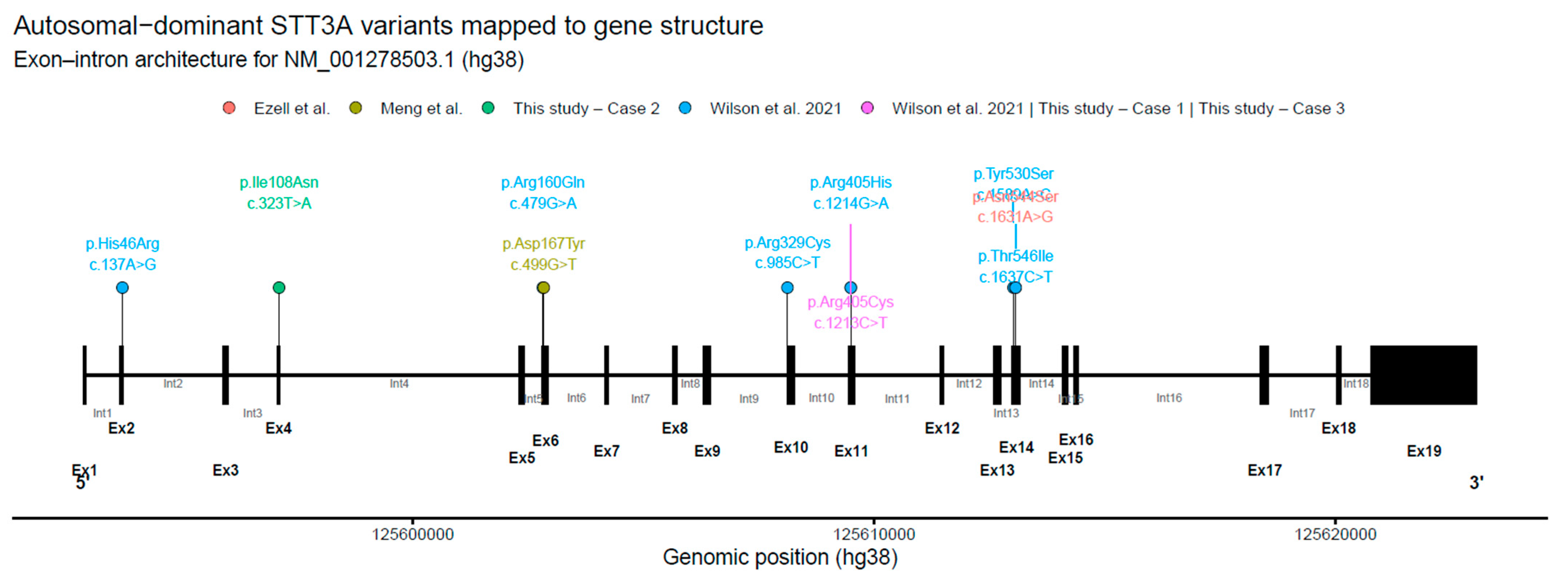
2.4. Variant Curation and Gene-Structure Visualization
3. Results
3.1. Initially Reported Autosomal-Dominant STT3A-CDG
3.2. Recently Reported Individuals Expanding the Phenotypic and Mechanistic Spectrum
3.3. Unpublished Cases Expanding the Phenotypic Spectrum of Dominant STT3A-CDG from the Natural History Study
3.4. Genotype Summary of Autosomal-Dominant STT3A-CDG
3.5. Phenotypic Summary of Dominant STT3A-CDG from All Published and Unpublished Cases
4. Discussion
5. Conclusions
Supplementary Materials
Author Contributions
Funding
Institutional Review Board Statement
Informed Consent Statement
Data Availability Statement
Acknowledgments
Conflicts of Interest
References
- Francisco, R.; Brasil, S.; Poejo, J.; Jaeken, J.; Pascoal, C.; Videira, P.A.; dos Reis Ferreira, V. Congenital disorders of glycosylation (CDG): State of the art in 2022. Orphanet J. Rare Dis. 2023, 18, 329. [Google Scholar] [CrossRef]
- Tinker, R.J.; Fisher, M.; Gimeno, A.F.; Gill, K.; Ivey, C.; Peterson, J.F.; Bastarache, L. Diagnostic delay in monogenic disease: A scoping review. Genet. Med. Off. J. Am. Coll. Med. Genet. 2024, 26, 101074. [Google Scholar] [CrossRef]
- Lipiński, P.; Tylki-Szymańska, A. Congenital Disorders of Glycosylation: What Clinicians Need to Know? Front. Pediatr. 2021, 9, 715151. [Google Scholar] [CrossRef]
- Sparks, S.E.; Krasnewich, D.M. Congenital Disorders of N-Linked Glycosylation and Multiple Pathway Overview. In GeneReviews®; Adam, M.P., Bick, S., Mirzaa, G.M., Pagon, R.A., Wallace, S.E., Amemiya, A., Eds.; University of Washington: Seattle, WA, USA, 1993. [Google Scholar]
- Ferreira, C.R.; Rahman, S.; Keller, M.; Zschocke, J.; ICIMD Advisory Group. An international classification of inherited metabolic disorders (ICIMD). J. Inherit. Metab. Dis. 2021, 44, 164–177. [Google Scholar] [CrossRef]
- Shah, R.; Eklund, E.A.; Radenkovic, S.; Sadek, M.; Shammas, I.; Verberkmoes, S.; Ng, B.G.; Freeze, H.H.; Edmondson, A.C.; He, M.; et al. ALG13-Congenital Disorder of Glycosylation (ALG13-CDG): Updated clinical and molecular review and clinical management guidelines. Mol. Genet. Metab. 2024, 142, 108472. [Google Scholar] [CrossRef]
- Shrimal, S.; Cherepanova, N.A.; Gilmore, R. Cotranslational and posttranslocational N-glycosylation of proteins in the endoplasmic reticulum. Semin. Cell Dev. Biol. 2015, 41, 71–78. [Google Scholar] [CrossRef]
- Kelleher, D.J.; Gilmore, R. An evolving view of the eukaryotic oligosaccharyltransferase. Glycobiology 2006, 16, 47R–62R. [Google Scholar] [CrossRef]
- Chang, I.J.; He, M.; Lam, C.T. Congenital disorders of glycosylation. Ann. Transl. Med. 2018, 6, 477. [Google Scholar] [CrossRef]
- Shrimal, S.; Ng, B.G.; Losfeld, M.-E.; Gilmore, R.; Freeze, H.H. Mutations in STT3A and STT3B cause two congenital disorders of glycosylation. Hum. Mol. Genet. 2013, 22, 4638–4645. [Google Scholar] [CrossRef]
- Ghosh, A.; Urquhart, J.; Daly, S.; Ferguson, A.; Scotcher, D.; Morris, A.A.M.; Clayton-Smith, J. Phenotypic Heterogeneity in a Congenital Disorder of Glycosylation Caused by Mutations in STT3A. J. Child Neurol. 2017, 32, 560–565. [Google Scholar] [CrossRef]
- Wilson, M.P.; Garanto, A.; Pinto e Vairo, F.; Ng, B.G.; Ranatunga, W.K.; Ventouratou, M.; Baerenfaenger, M.; Huijben, K.; Thiel, C.; Ashikov, A.; et al. Active site variants in STT3A cause a dominant type I congenital disorder of glycosylation with neuromusculoskeletal findings. Am. J. Hum. Genet. 2021, 108, 2130–2144. [Google Scholar] [CrossRef]
- Veitia, R.A.; Caburet, S.; Birchler, J.A. Mechanisms of Mendelian dominance. Clin. Genet. 2018, 93, 419–428. [Google Scholar] [CrossRef]
- Ezell, K.M.; Furuta, Y.; Oglesbee, D.; Pivnick, E.K.; Rinker, D.; Sheehan, J.H.; Tinker, R.J.; Hamid, R.; Cogan, J.D.; Rives, L.; et al. Review and metabolomic profiling of unsolved case reveals newly reported autosomal dominant congenital disorder of glycosylation, type Iw formerly thought to only be an autosomal recessive condition. Mol. Genet. Metab. Rep. 2024, 41, 101145. [Google Scholar] [CrossRef]
- Meng, L.; Fang, Z.; Jiang, L.; Zheng, Y.; Hong, S.; Deng, Y.; Xie, L. Heterozygous pathogenic STT3A variation leads to dominant congenital glycosylation disorders and functional validation in zebrafish. Orphanet J. Rare Dis. 2025, 20, 46. [Google Scholar] [CrossRef]
- Furuta, Y.; Tinker, R.J.; Hamid, R.; Cogan, J.D.; Ezell, K.M.; Oglesbee, D.; DeBerardinis, R.J.; Phillips, J.A.; Undiagnosed Diseases Network. A review of multiple diagnostic approaches in the undiagnosed diseases network to identify inherited metabolic diseases. Orphanet J. Rare Dis. 2024, 19, 427. [Google Scholar] [CrossRef]
- Sivadas, A.; Moore, K.; Ezell, K.; McMinn, A.; Furuta, Y.; Bunick, C.G.; Cassini, T.; Hamid, R.; Phillips, J.A.; Undiagnosed Disease Network; et al. Decoding Genetic Disease Through the Skin: Lessons From the UDN. Int. J. Dermatol. 2026. [Google Scholar] [CrossRef]
- Tinker, R.J.; Smith, L.M.; Bastarache, L.A.; Ezell, K.M.; Furuta, Y.; Hamid, R.; Cogan, J.D.; Phillips, J.A.; Joos, K.M.; Undiagnosed Diseases Network. The Undiagnosed Diseases Network (UDN) Solves Ocular Syndromic Diagnostic Dilemmas. Am. J. Ophthalmol. 2025, 280, 51–63. [Google Scholar] [CrossRef]
- Lam, C.; Scaglia, F.; Berry, G.T.; Larson, A.; Sarafoglou, K.; Andersson, H.C.; Sklirou, E.; Tan, Q.K.G.; Starosta, R.T.; Sadek, M.; et al. Frontiers in congenital disorders of glycosylation consortium, a cross-sectional study report at year 5 of 280 individuals in the natural history cohort. Mol. Genet. Metab. 2024, 142, 108509. [Google Scholar] [CrossRef]
- Shuey, M.M.; Stead, W.W.; Aka, I.; Barnado, A.L.; Bastarache, J.A.; Brokamp, E.; Campbell, M.; Carroll, R.J.; Goldstein, J.A.; Lewis, A.; et al. Next-generation phenotyping: Introducing phecodeX for enhanced discovery research in medical phenomics. Bioinformatics 2023, 39, btad655. [Google Scholar] [CrossRef]
- Robinson, P.N.; Köhler, S.; Bauer, S.; Seelow, D.; Horn, D.; Mundlos, S. The Human Phenotype Ontology: A Tool for Annotating and Analyzing Human Hereditary Disease. Am. J. Hum. Genet. 2008, 83, 610–615. [Google Scholar] [CrossRef]
- Nurk, S.; Koren, S.; Rhie, A.; Rautiainen, M.; Bzikadze, A.V.; Mikheenko, A.; Vollger, M.R.; Altemose, N.; Uralsky, L.; Gershman, A.; et al. The complete sequence of a human genome. Science 2022, 376, 44–53. [Google Scholar] [CrossRef]
- den Dunnen, J.T.; Dalgleish, R.; Maglott, D.R.; Hart, R.K.; Greenblatt, M.S.; McGowan-Jordan, J.; Roux, A.-F.; Smith, T.; Antonarakis, S.E.; Taschner, P.E.M. HGVS Recommendations for the Description of Sequence Variants: 2016 Update. Hum. Mutat. 2016, 37, 564–569. [Google Scholar] [CrossRef]
- Veitia, R.A. Exploring the Molecular Etiology of Dominant-Negative Mutations. Plant Cell 2007, 19, 3843–3851. [Google Scholar] [CrossRef]
- Hall, P.L.; Lam, C.; Wolfe, L.; Edmondson, A.; Acmg Laboratory Quality Assurance Committee. Biochemical testing for congenital disorders of glycosylation: A technical standard of the American College of Medical Genetics and Genomics (ACMG). Genet. Med. Off. J. Am. Coll. Med. Genet. 2025, 27, 101328. [Google Scholar] [CrossRef]
- Hall, P.L.; Liedke, K.; Turgeon, C.; White, A.; Pino, G.B.; Peck, D.; Studinski, A.; Gavrilov, D.; Tortorelli, S.; Oglesbee, D.; et al. Sensitivity of transferrin isoform analysis for PMM2-CDG. Mol. Genet. Metab. 2024, 143, 108564. [Google Scholar] [CrossRef]
- Tinker, R.J.; Bastarache, L.; Ezell, K.; Kobren, S.N.; Esteves, C.; Rosenfeld, J.A.; Macnamara, E.F.; Hamid, R.; Cogan, J.D.; Rinker, D.; et al. The contribution of mosaicism to genetic diseases and de novo pathogenic variants. Am. J. Med. Genet. A 2023, 191, 2482–2492. [Google Scholar] [CrossRef]
- Geiger, H.; Furuta, Y.; van Wyk, S.; Phillips, J.A.; Tinker, R.J. The Clinical Spectrum of Mosaic Genetic Disease. Genes 2024, 15, 1240. [Google Scholar] [CrossRef]


| Ezell et al. [14] | Meng et al. [15] | Unreported| (This Study) | Unreported (This Study) | Unreported (This Study) | |
|---|---|---|---|---|---|
| Sex | M | F | M | F | F |
| Consanguinity | − | − | − | ? | − |
| Ancestry | European | Chinese | European | European | European |
| Variant cDNA | c.1631A>G | c.499G>T | c.323T>A | c.1213C>T | c.1213C>T |
| Variant protein | p.Asn544Ser | p.Asp167Tyr | p.Ile108Asn | p.Arg405Cys | p.Arg405Cys |
| Mode of inheritance | de novo (AD) | de novo (AD) | Paternal (AD) | de novo (AD) | Maternal mosaic (AD) |
| Molecular test | GS | ES reanalysis | ES | ES | GS |
| Age at CDG diagnosis | 16 years | 5 years | 10 years | 18 months | 8 years |
| Biochemical studies | ↑ Mono-oligo/Di-oligo Tf (0.15); normal A-oligo/Di-oligo | − | − | ↑ Mono-oligo/Di-oligo (0.40); ↑ A-oligo/Di-oligo (0.018) | Normal transferrin profile |
| Gestational weeks | Full-term | Full-term | 30 weeks | Full-term | 27 weeks |
| IUGR | + | − | − | − | − |
| Birth weight (g) | 2693 | 2150 | − | − | 1040 |
| Birth length (cm) | 48 | 48 | − | − | 32 |
| Head circumference | Macrocephaly | Normal | − | − | Normal |
| Short stature | + | + | − | + | + |
| Failure to thrive | + | − | − | − | − |
| Dysmorphic features | Hypertelorism; narrow vertical palpebral fissures; bushy brows; bulbous nasal tip + midline nasal dimple. | ||||
| Long face | − | + | − | − | − |
| High anterior hairline | + | − | − | − | − |
| Short palpebral fissures | + | − | − | − | − |
| Hypertelorism | + | − | − | + | − |
| Eye shape abnormalities | Down-slanting, slit-like | Almond-shaped | − | − | Mild esotropia |
| Wide nasal bridge | + | − | − | + | − |
| Long/protruding ears | − | + | − | − | − |
| Thin upper lip vermilion | + | + | − | ? | − |
| Smooth/flat/long philtrum | + (Flat) | + (Long) | − | + (Smooth) | − |
| Prognathism | + (Maxillary) | ? | − | − | − |
| Inverted nipples | + | − | − | − | − |
| Abnormal fat distribution | − | − | − | − | − |
| Other facial features | Long mouth, attached earlobes | Midfacial hypoplasia, prominent forehead | − | − | Prominent forehead |
| Neurological | |||||
| Motor developmental delay | + | + | + | + | + |
| Speech delay | + | + | + | + | + |
| Learning problems | + | + | + | ? | + |
| Seizures | + | − | + | − | − |
| Abnormal muscle tone | Hypotonia | − | − | − | Hypotonia |
| Behavioral abnormalities | Autism, ADHD, anxiety | − | Aggression | − | ADHD, anxiety |
| Brain MRI | Normal | Arachnoid cyst, ventriculomegaly | Normal | − | Not performed |
| Spinal | − | − | Thoracic syrinx | Sacral dimple | − |
| Musculoskeletal | |||||
| Skeletal anomalies | Maxillary prognathism, syndactyly, pes planus | − | − | − | Motor coordination disorder |
| Osteoarthritis | − | − | − | − | − |
| Scoliosis | − | + (mild) | + | − | − |
| Long bone abnormalities | − | − | − | − | − |
| Muscle cramps | − | − | + | − | − |
| Muscle hypertrophy | − | − | − | − | − |
| Intellectual disability | + | − | − | − | Mild |
| Eye | − | Refractive errors | − | − | Hyperopia |
| ENT | High-arched palate | − | Laryngeal cleft | − | − |
| Cardiovascular | Prominent ascending aorta/root | − | Small ASD, VSD | PFO, bicuspid AV | Resolved PFO |
| Hematologic | − | − | Easy bruising | Mild anemia | Low vWF, low Factor VIII |
| Recurrent infections | − | − | + | + | − |
| Dermatologic | − | − | Livedo reticularis | − | − |
| Genitourinary | − | − | − | Anorectal malformation | − |
| Laboratory abnormalities | |||||
| Increased PT/APTT | − | − | − | − | + (APTT) |
| Decreased coagulation factors | − | − | − | Low FVIII | Low FVIII, low vWF |
| Increased transaminases | − | − | − | − | − |
| Abnormal hormone levels | − | − | − | − | On growth hormone for short stature |
| Feature | Observed Frequency (n of 21) | Comment | Novel in This Study |
|---|---|---|---|
| Growth/Prenatal | |||
| Intrauterine growth restriction | 3 of 21 | No | |
| Short stature | 11 of 21 | Childhood and adulthood | No |
| Failure to thrive | 3 of 21 | Primarily pediatric | No |
| Macrocephaly | 7 of 21 | Often progressive | No |
| Morbid obesity | 1 of 21 | Rapid pubertal weight gain | Yes |
| Dysmorphic features | |||
| Any facial dysmorphism | 18 of 21 | Typically subtle | No |
| High anterior hairline | 10 of 21 | Recurrent feature | No |
| Short palpebral fissures | 7 of 21 | Variable | No |
| Wide nasal bridge | 7 of 21 | Mild–moderate | No |
| Thin upper lip and/or philtrum abnormality | 9 of 21 | Common | No |
| Prognathism | 6 of 21 | Maxillary predominance | No |
| Protruding or low-set ears | 6 of 21 | Variable | No |
| Inverted nipples | 6 of 21 | Distinctive but not universal | No |
| Abnormal fat distribution | 4 of 21 | Hip or truncal fat pads | No |
| Neurodevelopmental | |||
| Motor developmental delay | 13 of 21 | Usually mild–moderate | No |
| Speech delay | 12 of 21 | Some non-verbal | No |
| Learning difficulties | 13 of 21 | Broad spectrum | No |
| Intellectual disability | 10 of 21 | Mild to severe | No |
| Seizures | 4 of 21 | Not a core feature | No |
| Abnormal muscle tone | 7 of 21 | Hyper- or hypotonia | No |
| Behavioral/Psychiatric | |||
| ADHD and/or anxiety | 5 of 21 | Mostly pediatric | No |
| Aggressive behavior | 3 of 21 | Rare | No |
| Musculoskeletal | |||
| Skeletal abnormalities | 12 of 21 | Metaphyseal/vertebral | No |
| Scoliosis | 5 of 21 | Usually mild | No |
| Osteoarthritis (adult) | 6 of 21 | Early onset | No |
| Muscle cramps | 8 of 21 | Adolescence/adulthood | No |
| Muscle hypertrophy | 4 of 21 | Often with cramps | No |
| Cardiovascular | |||
| Congenital heart defect | 5 of 21 | ASD, VSD, PFO, bicuspid AV | No |
| Genitourinary/Congenital anomalies | |||
| Anorectal malformation | 1 of 21 | Not previously reported | Yes |
| Hematologic | |||
| Easy bruising/bleeding | 4 of 21 | Variable | No |
| Coagulation factor deficiency | 5 of 21 | FVIII and/or vWF | Previously rare |
| Clinically significant bleeding diathesis | 3 of 21 | Marked vWF and/or FVIII deficiency | Yes (severity expansion) |
| Inheritance | |||
| Parental mosaic transmission | 1 of 21 | Molecularly confirmed | Yes |
| Biochemical | |||
| Abnormal transferrin glycosylation | 20 of 21 | Core feature | No |
| Normal transferrin profile | 1 of 21 | Does not exclude diagnosis | Yes |
| Fibroblast hypoglycosylation | 6 of 6 tested | Universal when tested | No |
| Autosomal-Dominant STT3A-CDG | Autosomal-Recessive STT3A-CDG | |
|---|---|---|
| Variant location | Highly conserved residues within the catalytic/active site of STT3A | Variants distributed outside the dominant-negative catalytic hotspot |
| Genetic/pathogenic mechanism | Dominant-negative disruption of OST-A catalytic activity | Loss of function due to reduced STT3A abundance and impaired N-glycosylation |
| Effect on STT3A protein levels | Near-normal STT3A mRNA and protein levels | Reduced STT3A abundance or function |
| Impact on OST-A function | Qualitative impairment of catalytic activity despite presence of wild-type protein | Quantitative reduction of overall OST-A activity |
| Core clinical features | Short stature, craniofacial dysmorphism, skeletal anomalies, muscle cramps, variable neurodevelopment | Severe neurodevelopmental impairment with multisystem involvement |
| Neurodevelopmental severity | Variable; intellectual disability in ~50%, many with preserved or progressive function | Severe, early-onset neurodevelopmental phenotype |
| Musculoskeletal involvement | Prominent (skeletal anomalies, muscle cramps, early-onset osteoarthritis) | Present but less emphasized |
| Craniofacial features | Macrocephaly and/or subtle dysmorphic features | Dysmorphic facial features |
| Speech development | Variable | Severe speech impairment, including absent or minimal speech in reported cases |
| Hematologic abnormalities | Variable; bleeding diathesis reported in some individuals | Factor VIII and von Willebrand factor deficiency reported |
| Feeding/growth | Variable | Failure to thrive and feeding difficulties |
| Overall severity | Variable, often milder neurological involvement | Generally more severe with consistent neurological impairment |
| Phenotypic variability | Marked inter-individual variability | Relatively homogeneous |
Disclaimer/Publisher’s Note: The statements, opinions and data contained in all publications are solely those of the individual author(s) and contributor(s) and not of MDPI and/or the editor(s). MDPI and/or the editor(s) disclaim responsibility for any injury to people or property resulting from any ideas, methods, instructions or products referred to in the content. |
© 2026 by the authors. Licensee MDPI, Basel, Switzerland. This article is an open access article distributed under the terms and conditions of the Creative Commons Attribution (CC BY) license.
Share and Cite
Al-Shahrani, H.; Szabó, E.; Staccone, C.; MacDonald, G.; Furuta, Y.; Schecter, D.; Edmondson, A.C.; McRae, A.; Baker, J.; Morava, E.; et al. Expanded Clinical Spectrum of Autosomal-Dominant STT3A-CDG. Biomolecules 2026, 16, 418. https://doi.org/10.3390/biom16030418
Al-Shahrani H, Szabó E, Staccone C, MacDonald G, Furuta Y, Schecter D, Edmondson AC, McRae A, Baker J, Morava E, et al. Expanded Clinical Spectrum of Autosomal-Dominant STT3A-CDG. Biomolecules. 2026; 16(3):418. https://doi.org/10.3390/biom16030418
Chicago/Turabian StyleAl-Shahrani, Hamdan, Evelin Szabó, Caroline Staccone, Georgia MacDonald, Yutaka Furuta, Daniel Schecter, Andrew C. Edmondson, Anne McRae, Josh Baker, Eva Morava, and et al. 2026. "Expanded Clinical Spectrum of Autosomal-Dominant STT3A-CDG" Biomolecules 16, no. 3: 418. https://doi.org/10.3390/biom16030418
APA StyleAl-Shahrani, H., Szabó, E., Staccone, C., MacDonald, G., Furuta, Y., Schecter, D., Edmondson, A. C., McRae, A., Baker, J., Morava, E., & Tinker, R. J. (2026). Expanded Clinical Spectrum of Autosomal-Dominant STT3A-CDG. Biomolecules, 16(3), 418. https://doi.org/10.3390/biom16030418