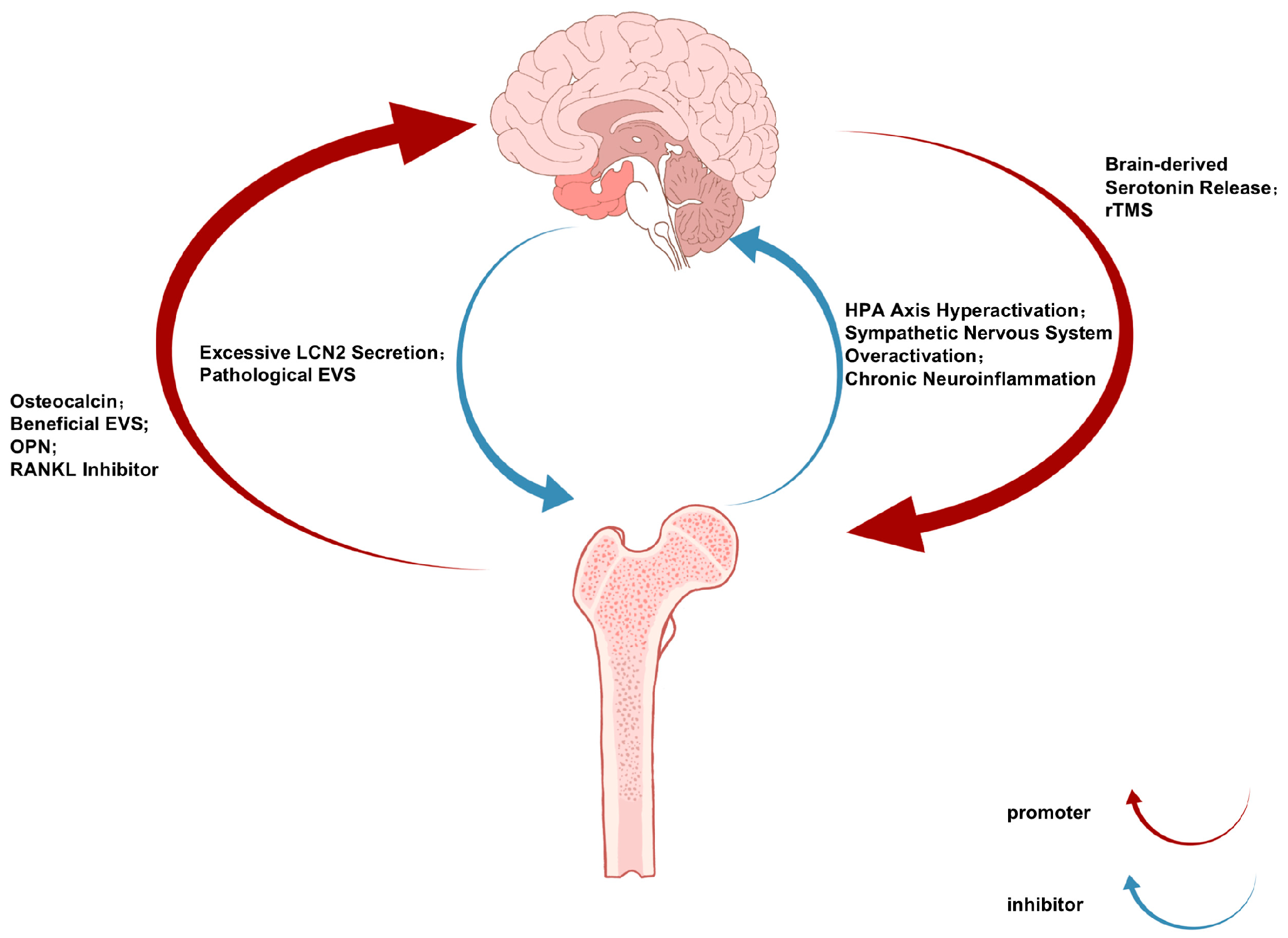
The Bone–Brain Axis: Novel Insights into the Bidirectional Crosstalk in Depression and Osteoporosis

Abstract
1. Introduction
1.1. Depression as a Global Health Challenge
1.2. The Skeletal System as an Endocrine Organ and the Emergence of the Bone–Brain Axis

1.3. Clinical and Epidemiological Evidence Linking Depression and Osteoporosis
1.4. Purpose and Scope of This Review
2. Mechanisms Underlying Depression-Mediated Skeletal Impairment
3. The Regulatory Effects of the Skeletal System on Depression
4. Clinical Translation Prospects of Bone–Brain Axis Research
5. Discussion
5.1. Integrative Framework and Clinical Significance
5.2. Critical Analysis of the Mechanistic Evidence
5.3. Methodological Considerations and Future Directions
5.4. Limitations and Concluding Synthesis
6. Conclusions
Author Contributions
Funding
Institutional Review Board Statement
Informed Consent Statement
Data Availability Statement
Conflicts of Interest
References
- Stecher, C.; Cloonan, S.; Domino, M.E. The Economics of Treatment for Depression. Annu. Rev. Public Health 2024, 45, 527–551. [Google Scholar] [CrossRef]
- Malhi, G.S.; Mann, J.J. Depression. Lancet 2018, 392, 2299–2312. [Google Scholar] [CrossRef] [PubMed]
- COVID-19 Mental Disorders Collaborators. Global prevalence and burden of depressive and anxiety disorders in 204 countries and territories in 2020 due to the COVID-19 pandemic. Lancet 2021, 398, 1700–1712. [Google Scholar] [CrossRef]
- Bisgaard, T.H.; Allin, K.H.; Keefer, L.; Ananthakrishnan, A.N.; Jess, T. Depression and anxiety in inflammatory bowel disease: Epidemiology, mechanisms and treatment. Nat. Rev. Gastroenterol. Hepatol. 2022, 19, 717–726. [Google Scholar] [CrossRef]
- Yu, X.Y.; Bai, Y.; Han, B.; Ju, M.Z.; Tang, T.C.; Shen, L.; Li, M.Y.; Yang, L.; Zhang, Z.; Hu, G.K.; et al. Extracellular vesicle-mediated delivery of circDYM alleviates CUS-induced depressive-like behaviours. J. Extracell. Vesicles 2022, 11, e12185. [Google Scholar] [CrossRef]
- Zhao, Y.; Suo, Y.N.; Yang, Z.B.; Hao, Y.; Li, W.S.; Su, Y.J.; Shi, Y.; Gao, Y.; Song, L.; Yin, X.; et al. Inspiration for the prevention and treatment of neuropsychiatric disorders: New insight from the bone-brain-axis. Brain Res. Bull. 2021, 177, 263–272. [Google Scholar] [CrossRef]
- Fukumoto, S.; Martin, T.J. Bone as an endocrine organ. Trends Endocrinol. Metab. 2009, 20, 230–236. [Google Scholar] [CrossRef]
- Li, P.; Tao, Z.; Zhao, X. The Role of Osteopontin (OPN) in Regulating Microglia Phagocytosis in Nervous System Diseases. J. Integr. Neurosci. 2024, 23, 169. [Google Scholar] [CrossRef]
- Dimitri, P.; Rosen, C. The Central Nervous System and Bone Metabolism: An Evolving Story. Calcif. Tissue Int. 2017, 100, 476–485. [Google Scholar] [CrossRef] [PubMed]
- Chen, H.Z.; Shang, D.W.; Wen, Y.G.; Liang, C. Bone-Derived Modulators That Regulate Brain Function: Emerging Therapeutic Targets for Neurological Disorders. Front. Cell Dev. Biol. 2021, 9, 683457. [Google Scholar] [CrossRef] [PubMed]
- Zhao, Y.H.; Peng, X.L.; Wang, Q.; Zhang, Z.Y.; Wang, L.L.; Xu, Y.Z.; Yang, H.L.; Bai, J.X.; Geng, D.C. Crosstalk Between the Neuroendocrine System and Bone Homeostasis. Endocr. Rev. 2024, 45, 95–124. [Google Scholar] [CrossRef]
- Rösch, G.; Zaucke, F.; Jenei-Lanzl, Z. Autonomic nervous regulation of cellular processes during subchondral bone remodeling in osteoarthritis. Am. J. Physiol.-Cell Physiol. 2023, 325, C365–C384. [Google Scholar] [CrossRef]
- Niwczyk, O.; Grymowicz, M.; Szczesnowicz, A.; Hajbos, M.; Kostrzak, A.; Budzik, M.; Maciejewska-Jeske, M.; Bala, G.; Smolarczyk, R.; Meczekalski, B. Bones and Hormones: Interaction between Hormones of the Hypothalamus, Pituitary, Adipose Tissue and Bone. Int. J. Mol. Sci. 2023, 24, 6840. [Google Scholar] [CrossRef]
- Zhao, X.B.; Wu, G.F.; Zhang, J.; Yu, Z.Y.; Wang, J.L. Activation of CGRP receptor-mediated signaling promotes tendon-bone healing. Sci. Adv. 2024, 10, eadg7380. [Google Scholar] [CrossRef] [PubMed]
- Qian, Z.J.; Li, H.C.; Yang, H.Y.; Yang, Q.; Lu, Z.H.; Wang, L.P.; Chen, Y.; Li, X. Osteocalcin attenuates oligodendrocyte differentiation and myelination via GPR37 signaling in the mouse brain. Sci. Adv. 2021, 7, eabi5811. [Google Scholar] [CrossRef]
- Wang, R.F.; Wang, J.; Zhang, Z.G.; Ma, B.; Sun, S.K.; Gao, L.; Gao, G.D. FGF21 alleviates endothelial mitochondrial damage and prevents BBB from disruption after intracranial hemorrhage through a mechanism involving SIRT6. Mol. Med. 2023, 29, 165. [Google Scholar] [CrossRef] [PubMed]
- Liu, G.Q.; Wang, J.K.; Wei, Z.L.; Fang, C.L.; Shen, K.; Qian, C.; Qi, C.; Li, T.; Gao, P.S.; Wong, P.C.; et al. Elevated PDGF-BB from Bone Impairs Hippocampal Vasculature by Inducing PDGFRβ Shedding from Pericytes. Adv. Sci. 2023, 10, e2206938. [Google Scholar] [CrossRef] [PubMed]
- Mosialou, I.; Kousteni, S. From brain to blood and back again: Linking chronic stress, myelopoiesis, and depression. Cell Stem Cell 2024, 31, 1721–1723. [Google Scholar] [CrossRef]
- Tang, Y.L.; Wang, Z.Y.; Cao, J.; Tu, Y.H. Bone-brain crosstalk in osteoarthritis: Pathophysiology and interventions. Trends Mol. Med. 2025, 31, 281–295. [Google Scholar] [CrossRef]
- Kashfi, S.S.; Abdollahi, G.; Hassanzadeh, J.; Mokarami, H.; Khani Jeihooni, A. The relationship between osteoporosis and depression. Sci Rep. 2022, 12, 11177. [Google Scholar] [CrossRef] [PubMed] [PubMed Central]
- Ma, M.; Liu, X.L.; Jia, G.X.; Liu, Z.C.; Zhang, K.; He, L.Z.; Geng, B.; Xia, Y.Y. The association between depression and bone metabolism: A US nationally representative cross-sectional study. Arch. Osteoporos. 2022, 17, 113. [Google Scholar] [CrossRef]
- Chen, K.; Wang, T.; Tong, X.; Song, Y.; Hong, J.; Sun, Y.; Zhuang, Y.; Shen, H.; Yao, X. Osteoporosis is associated with depression among older adults: A nationwide population-based study in the USA from 2005 to 2020. Public Health 2024, 226, 27–31. [Google Scholar] [CrossRef] [PubMed]
- Eiff, B.; Bullmore, E.T.; Clatworthy, M.R.; Fryer, T.D.; Pariante, C.M.; Mondelli, V.; Maccioni, L.; Hadjikhani, N.; Loggia, M.L.; Moskowitz, M.A.; et al. Extra-axial inflammatory signal and its relationship to peripheral and central immunity in depression. Brain 2024, 148, 635–646. [Google Scholar] [CrossRef] [PubMed]
- Massaccesi, L.; Corsi Romanelli, M.M.; Galliera, E. Brain-Bone Axis in Physiological and Pathological Conditions. Int. J. Mol. Sci. 2025, 26, 9822. [Google Scholar] [CrossRef]
- Houtenbos, S.P.; He, Y.Y.; Cazzanelli, P.; Soultoukis, G.; Wuertz-Kozak, K.; Schulz, T.J.; Wippert, P.M. The underlying mechanisms of the association of bone health with depression—An experimental study. Mol. Biol. Rep. 2025, 52, 163. [Google Scholar] [CrossRef]
- He, M.C.; Xia, S.H.; Pan, H.; Zhou, T.T.; Wang, X.L.; Li, J.M.; Li, X.M.; Zhang, Y. Chaihu-Shugan-San Ameliorated Osteoporosis of Mice with Depressive Behavior Caused by Chronic Unpredictable Mild Stress via Repressing Neuroinflammation and HPA Activity. Drug Des. Dev. Ther. 2024, 18, 5997–6015. [Google Scholar] [CrossRef]
- Picard, K.; Bisht, K.; Poggini, S.; Garofalo, S.; Golia, M.T.; Basilico, B.; Abdallah, F.; Albanese, N.C.; Amrein, I.; Vernoux, N.; et al. Microglial-glucocorticoid receptor depletion alters the response of hippocampal microglia and neurons in a chronic unpredictable mild stress paradigm in female mice. Brain Behav. Immun. 2021, 97, 423–439. [Google Scholar] [CrossRef]
- Lee, E.J.; Lialios, P.; Curtis, M.; Williams, J., IV; Kim, Y.; Salipante, P.; Hudson, S.; Esch, M.B.; Levi, M.; Kitlinska, J.; et al. Glucocorticoids Alter Bone Microvascular Barrier via MAPK/Connexin43 Mechanisms. Adv. Healthc. Mater. 2025, 14, 2404302. [Google Scholar] [CrossRef]
- Jorgensen, A.; Kalliokoski, O.; Forsberg, K.; Breitenstein, K.; Weimann, A.; Henriksen, T.; Hau, J.; Wörtvvein, G.; Poulsen, H.E.; Jorgensen, M.B. A chronic increase of corticosterone age-dependently reduces systemic DNA damage from oxidation in rats. Free Radic. Biol. Med. 2017, 104, 64–74. [Google Scholar] [CrossRef]
- Klein, G.L.; Bi, L.X.; Sherrard, D.J.; Beavan, S.R.; Ireland, D.; Compston, J.E.; Williams, W.G.; Herndon, D.N. Evidence supporting a role of glucocorticoids in short-term bone loss in burned children. Osteoporos. Int. 2004, 15, 468–474. [Google Scholar] [CrossRef]
- Shi, Y.; Oury, F.; Yadav, V.K.; Wess, J.; Liu, X.S.; Guo, X.E.; Murshed, M.; Karsenty, G. Signaling through the M(3) muscarinic receptor favors bone mass accrual by decreasing sympathetic activity. Cell Metab. 2010, 11, 231–238. [Google Scholar] [CrossRef]
- Jannin, A.; Vieillard, M.H.; Lion, G.; Chevalier, B.; Beron, A.; Vantyghem, M.C.; Cardot-Bauters, C.; Chapurlat, R.; Do Cao, C.; Espiard, S. Bone, a double victim in metastatic catecholamine secreting tumors. Ann. Endocrinol. 2025, 86, 101792. [Google Scholar] [CrossRef]
- Yang, X.Y.; Xiao, R.; Liu, B.Z.; Xie, B.; Yang, Z. The causal relationship of inflammation-related factors with osteoporosis: A Mendelian Randomization Analysis. Exp. Gerontol. 2025, 202, 112715. [Google Scholar] [CrossRef] [PubMed]
- Medina-Rodriguez, E.M.; Beurel, E. Blood brain barrier and inflammation in depression. Neurobiol. Dis. 2022, 175, 105926. [Google Scholar] [CrossRef] [PubMed]
- Huang, C.Y.; Zhang, F.C.; Li, P.; Song, C. Low-Dose IL-2 Attenuated Depression-like Behaviors and Pathological Changes through Restoring the Balances between IL-6 and TGF-β and between Th17 and Treg in a Chronic Stress-Induced Mouse Model of Depression. Int. J. Mol. Sci. 2022, 23, 13856. [Google Scholar] [CrossRef]
- Uzzan, S.; Azab, A.N. Anti-TNF-α Compounds as a Treatment for Depression. Molecules 2021, 26, 2368. [Google Scholar] [CrossRef]
- Ma, F.Q.; Zhang, W.M.; Zhou, G.W.; Qi, Y.; Mao, H.R.; Chen, J.; Lu, Z.L.; Wu, W.J.; Zou, X.R.; Deng, D.F.; et al. Epimedii Folium decoction ameliorates osteoporosis in mice through NLRP3/caspase-1/IL-1β β signalling pathway and gut-bone axis. Int. Immunopharmacol. 2024, 137, 112472. [Google Scholar] [CrossRef]
- Takeuchi, T.; Yoshida, H.; Tanaka, S. Role of interleukin-6 in bone destruction and bone repair in rheumatoid arthritis. Autoimmun. Rev. 2021, 20, 102884. [Google Scholar] [CrossRef]
- Li, C.H.; Ma, Z.Z.; Jian, L.L.; Wang, X.Y.; Sun, L.; Liu, X.Y.; Yao, Z.Q.; Zhao, J.X. Iguratimod inhibits osteoclastogenesis by modulating the RANKL and TNF-α signaling pathways. Int. Immunopharmacol. 2021, 90, 107219. [Google Scholar] [CrossRef]
- Gao, S.; Qi, L.J.; Li, N.H.; Li, X.; Zhang, J.; Zhang, Z.Q.; Liu, W. The role of the brain-bone axis in skeletal degenerative diseases and psychiatric disorders, A genome-wide pleiotropic analysis. Prog. Neuro-Psychopharmacol. Biol. Psychiatry 2025, 139, 111388. [Google Scholar] [CrossRef]
- Afridi, R.; Suk, K. Microglial Responses to Stress-Induced Depression: Causes and Consequences. Cells 2023, 12, 1521. [Google Scholar] [CrossRef] [PubMed]
- Wang, R.; Xu, F.; Xia, X.D.; Xiong, A.; Dai, D.X.; Ling, Y.L.; Sun, R.M.; Qiu, L.; Ding, Y.; Xie, Z.J. The effect of vitamin D supplementation on primary depression: A meta-analysis. J. Affect. Disord. 2024, 344, 653–661. [Google Scholar] [CrossRef] [PubMed]
- Kalinichenko, L.S.; Mühle, C.; Jia, T.Y.; Anderheiden, F.; Datz, M.; Eberle, A.L.; Eulenburg, V.; Granzow, J.; Hofer, M.; Hohenschild, J.; et al. Neutral sphingomyelinase mediates the co-morbidity trias of alcohol abuse, major depression and bone defects. Mol. Psychiatry 2021, 26, 7403–7416. [Google Scholar] [CrossRef] [PubMed]
- Almeida, O.P.; Page, A.; Sanfilippo, F.M.; Etherton-Beer, C. Prospective Association Between the Dispensing of Antidepressants and of Medications to Treat Osteoporosis in Older Age. Am. J. Geriatr. Psychiatry 2024, 32, 349–357. [Google Scholar] [CrossRef]
- Damanti, S.; Ramirez, G.A.; Da Prat, V.; Bertola, A.; Manzo, E.; Vadruccio, S.; Tresoldi, M.; Barreto, P.D.; Rolland, Y. Selective serotonin reuptake inhibitors and fractures in older nursing home residents: Data from the INCUR study. Maturitas 2022, 158, 37–39. [Google Scholar] [CrossRef]
- Schwan, S.; Hallberg, P. SSRIs, bone mineral density, and risk of fractures—A review. Eur. Neuropsychopharmacol. 2009, 19, 683–692. [Google Scholar] [CrossRef]
- Chen, X.; Zhang, M.; Qian, L.; Guo, Y.; Zhu, Y.; Taxi, W.; Liu, M.; Wang, K.; Song, L.; Zhang, C.; et al. Diosgenin activates ERα-dependent PI3K/AKT/GSK3β signaling to enhance brain-derived serotonin and alleviate postmenopausal bone loss. J. Adv. Res. 2025; in press. [Google Scholar] [CrossRef]
- Wang, H.; Zheng, X.Q.; Zhang, Y.; Huang, J.F.; Zhou, W.X.; Li, X.L.; Tian, H.J.; Wang, B.; Xing, D.; Fu, W.L.; et al. The endocrine role of bone: Novel functions of bone-derived cytokines. Biochem. Pharmacol. 2021, 183, 114308. [Google Scholar] [CrossRef]
- Li, J.J.; Lou, S.J.; Bian, X.P. Osteocalcin and GPR158: Linking bone and brain function. Front. Cell Dev. Biol. 2025, 13, 1564751. [Google Scholar] [CrossRef]
- Stephan, J.S.; Sleiman, S.F. Exercise Factors Released by the Liver, Muscle, and Bones Have Promising Therapeutic Potential for Stroke. Front. Neurol. 2021, 12, 600365. [Google Scholar] [CrossRef]
- Freus, N.K.; Wank, I.; Haefele, M.; Kalinichenko, L.S.; Müller, C.P.; Strobelt, S.; Ludwig, A.; Hess, A.; Kreitz, S. Pharmacological and resting state fMRI reveal Osteocalcin’s effects on mouse brain regions with high Gpr37 and Gpr158 expression. Sci. Rep. 2025, 15, 10116. [Google Scholar] [CrossRef]
- Çetereisi, D.; Kramvis, I.; Gebuis, T.; van der Loo, R.J.; Gouwenberg, Y.; Mansvelder, H.D.; Li, K.W.; Smit, A.B.; Spijker, S. Gpr158 Deficiency Impacts Hippocampal CA1 Neuronal Excitability, Dendritic Architecture, and Affects Spatial Learning. Front. Cell. Neurosci. 2019, 13, 465. [Google Scholar] [CrossRef]
- Bartecku, E.; Horinkova, J.; Krenek, P.; Damborska, A.; Tomandl, J.; Tomandlov, M.; Kucera, J.; Kucerova, J.F.; Bienertova-Vasku, J. Osteocalcin levels decrease during the treatment of an acute depressive episode. Front. Psychiatry 2022, 13, 893012. [Google Scholar] [CrossRef]
- Zhao, H.L.; Chen, Q.; Alam, A.; Cui, J.; Suen, K.C.; Soo, A.P.; Eguchi, S.; Gu, J.T.; Ma, D.Q. The role of osteopontin in the progression of solid organ tumour. Cell Death Dis. 2018, 9, 356. [Google Scholar] [CrossRef] [PubMed]
- Lu, Z.W.; Gao, F.; Teng, F.; Tian, X.H.; Guan, H.W.; Li, J.W.; Wang, X.S.; Liang, J.; Tian, Q.Y.; Wang, J. Exploring the pathogenesis of depression and potential antidepressants through the integration of reverse network pharmacology, molecular docking, and molecular dynamics. Medicine 2023, 102, e35793. [Google Scholar] [CrossRef]
- Li, P.; Gao, Y.; Du, S.; Mu, Z.; Tao, Z.; Zhang, X.; Zhao, X. SPP1/OPN Alleviates Post-Intracerebral Hemorrhage Depression and Cognitive Impairment via Nrf2/BDNF Signaling Activation in Mice. CNS Neurosci. Ther. 2025, 31, e70680. [Google Scholar] [CrossRef]
- Liu, X.X.; Chen, C.Y.; Jiang, Y.L.; Wan, M.D.; Jiao, B.; Liao, X.X.; Rao, S.S.; Hong, C.G.; Yang, Q.J.; Zhu, Y.; et al. Brain-derived extracellular vesicles promote bone-fat imbalance in Alzheimer’s disease. Int. J. Biol. Sci. 2023, 19, 2409–2427. [Google Scholar] [CrossRef] [PubMed]
- Jiang, Y.L.; Wang, Z.X.; Liu, X.X.; Wan, M.D.; Liu, Y.W.; Jiao, B.; Liao, X.X.; Luo, Z.W.; Wang, Y.Y.; Hong, C.G.; et al. The Protective Effects of Osteocyte-Derived Extracellular Vesicles Against Alzheimer’s Disease Diminished with Aging. Adv. Sci. 2022, 9, 2105316. [Google Scholar] [CrossRef]
- Sobacchi, C.; Menale, C.; Crisafulli, L.; Ficara, F. Role of RANKL Signaling in Bone Homeostasis. Physiology 2025, 40, 46–66. [Google Scholar] [CrossRef]
- Zhang, J.C.; Fujita, Y.; Chang, L.J.; Pu, Y.Y.; Qu, Y.G.; Wang, S.M.; Hashimoto, K. Beneficial effects of anti-RANKL antibody in depression-like phenotype, inflammatory bone markers, and bone mineral density in male susceptible mice after chronic social defeat stress. Behav. Brain Res. 2020, 379, 112397. [Google Scholar] [CrossRef] [PubMed]
- Jha, M.K.; Lee, S.; Park, D.H.; Kook, H.; Park, K.G.; Lee, I.K.; Suk, K. Diverse functional roles of lipocalin-2 in the central nervous system. Neurosci. Biobehav. Rev. 2015, 49, 135–156. [Google Scholar] [CrossRef]
- Liu, Y.F.; Liu, L.; Zhi, Z.W.; Chen, R.; Wang, Q.; Wang, M.C.; Wang, Y.Q.; Zhao, L.D. Higher serum lipocalin 2 is associated with post-stroke depression at discharge. BMC Neurol. 2023, 23, 294. [Google Scholar] [CrossRef]
- Ferreira, A.C.; Marques, F. The Effects of Stress on Hippocampal Neurogenesis and Behavior in the Absence of Lipocalin-2. Int. J. Mol. Sci. 2023, 24, 15537. [Google Scholar] [CrossRef]
- Ferreira, A.C.; Pinto, V.; Dá Mesquita, S.; Novais, A.; Sousa, J.C.; Correia-Neves, M.; Sousa, N.; Palha, J.A.; Marques, F. Lipocalin-2 is involved in emotional behaviors and cognitive function. Front. Cell. Neurosci. 2013, 7, 122. [Google Scholar] [CrossRef]
- Chen, G.J.; Tang, Q.M.; Yu, S.L.; Xie, Y.L.; Sun, J.W.; Li, S.; Chen, L.L. The biological function of BMAL1 in skeleton development and disorders. Life Sci. 2020, 253, 117636. [Google Scholar] [CrossRef]
- Poulsen, R.C.; Hearn, J.I.; Dalbeth, N. The circadian clock: A central mediator of cartilage maintenance and osteoarthritis development? Rheumatology 2021, 60, 3048–3057. [Google Scholar] [CrossRef]
- de Leeuw, M.; Verhoeve, S.I.; van der Wee, N.J.A.; van Hemert, A.M.; Vreugdenhil, E.; Coomans, C.P. The role of the circadian system in the etiology of depression. Neurosci. Biobehav. Rev. 2023, 153, 105383. [Google Scholar] [CrossRef] [PubMed]
- Pérocheau, D.; Laroche, F.; Perrot, S. Relieving pain in rheumatology patients: Repetitive transcranial magnetic stimulation (rTMS), a developing approach. Jt. Bone Spine 2014, 81, 22–26. [Google Scholar] [CrossRef] [PubMed]
- Zhu, H.Q.; Luo, J.; Wang, X.Q.; Zhang, X.A. Non-invasive brain stimulation for osteoarthritis. Front. Aging Neurosci. 2022, 14, 987732. [Google Scholar] [CrossRef]
- Perera, T.; George, M.S.; Grammer, G.; Janicak, P.G.; Pascual-Leone, A.; Wirecki, T.S. The Clinical TMS Society Consensus Review and Treatment Recommendations for TMS Therapy for Major Depressive Disorder. Brain Stimul. 2016, 9, 336–346. [Google Scholar] [CrossRef] [PubMed]
- Zhao, Y.L.; Sun, S.Y.; Qin, H.C.; Zhu, Y.L.; Luo, Z.W.; Qian, Y.; Chen, S. Research progress on the mechanism of exercise against depression. World J. Psychiatry 2024, 14, 1611. [Google Scholar] [CrossRef]
- Ng, C.A.; Gandham, A.; Mesinovic, J.; Owen, P.J.; Ebeling, P.R.; Scott, D. Effects of Moderate- to High-Impact Exercise Training on Bone Structure Across the Lifespan: A Systematic Review and Meta-Analysis of Randomized Controlled Trials. J. Bone Miner. Res. 2023, 38, 1612–1634. [Google Scholar] [CrossRef]
- Paoletti, I.; Coccurello, R. Irisin: A Multifaceted Hormone Bridging Exercise and Disease Pathophysiology. Int. J. Mol. Sci. 2024, 25, 13480. [Google Scholar] [CrossRef]
- He, Y.M.; Wang, Q.; Wu, H.D.; Dong, Y.M.; Peng, Z.F.; Guo, X.Y.; Jiang, N. The role of IGF-1 in exercise to improve obesity-related cognitive dysfunction. Front. Neurosci. 2023, 17, 1229165. [Google Scholar] [CrossRef]
- Kostka, M.; Morys, J.; Malecki, A.; Nowacka-Chmielewska, M. Muscle-brain crosstalk mediated by exercise-induced myokines—Insights from experimental studies. Front. Physiol. 2024, 15, 1488375. [Google Scholar] [CrossRef]
- Karsenty, G. Osteocalcin: A Multifaceted Bone-Derived Hormone. Annu. Rev. Nutr. 2023, 43, 55–71. [Google Scholar] [CrossRef]
- Keshishi, D.; Makunts, T.; Abagyan, R. Common osteoporosis drug associated with increased rates of depression and anxiety. Sci. Rep. 2021, 11, 23956. [Google Scholar] [CrossRef] [PubMed]
- Songpatanasilp, T.; Mumtaz, M.; Chhabra, H.; Yu, M.; Sorsaburu, S. Back pain in patients with severe osteoporosis on teriparatide or antiresorptives: A prospective observational study in a multiethnic population. Singap. Med. J. 2014, 55, 493–501. [Google Scholar] [CrossRef]
- Luo, B.B.; Zhou, X.; Tang, Q.M.; Yin, Y.; Feng, G.X.; Li, S.E.; Chen, L.L. Circadian rhythms affect bone reconstruction by regulating bone energy metabolism. J. Transl. Med. 2021, 19, 410. [Google Scholar] [CrossRef] [PubMed]
- Cajochen, C.; Schmidt, C. The Circadian Brain and Cognition. Annu. Rev. Psychol. 2025, 76, 115–141. [Google Scholar] [CrossRef] [PubMed]
- Qin, Y.; Chen, Z.H.; Wu, J.J.; Zhang, Z.Y.; Yuan, Z.D.; Guo, D.Y.; Chen, M.N.; Li, X.; Yuan, F.L. Circadian clock genes as promising therapeutic targets for bone loss. Biomed. Pharmacother. 2023, 157, 114019. [Google Scholar] [CrossRef] [PubMed]
- Schroder, E.A.; Harfmann, B.D.; Zhang, X.P.; Srikuea, R.; England, J.H.; Hodge, B.A.; Wen, Y.; Riley, L.A.; Yu, Q.; Christie, A.; et al. Intrinsic muscle clock is necessary for musculoskeletal health. J. Physiol. 2015, 593, 5387–5404. [Google Scholar] [CrossRef] [PubMed]
- Li, S.; Teguh, D.; Wu, D.; Liu, L.; Hu, C.; Yuan, J.; Inderjeeth, C.; Xu, J. Antidementia medication acetylcholinesterase inhibitors have therapeutic benefits on osteoporotic bone by attenuating osteoclastogenesis and bone resorption. J. Cell. Physiol. 2023, 238, 1823–1835. [Google Scholar] [CrossRef] [PubMed]

| Mechanism Category | Critical Effectors/Pathways | Skeletal Effects | Clinical Evidence |
|---|---|---|---|
| HPA axis activation | CRH, ACTH, cortisol | Inhibits osteoblast differentiation and promotes osteocyte apoptosis | Negative correlation between urinary cortisol and BMD in MDD patients |
| Sympathetic overactivity | Norepinephrine, β2-AR | Suppresses Wnt signaling and enhances RANKL expression | β-blockers demonstrate protective effects against stress-induced bone loss |
| 5-HT system dysregulation | Peripheral/CNS 5-HT | Peripheral 5-HT inhibits osteogenesis, and CNS 5-HT promotes bone formation | Controversial data on SSRIs’ skeletal effects |
| Mechanism Pathway | Key Findings | Study Type | Representative References |
|---|---|---|---|
| HPA Axis Activation | Elevated cortisol inhibits osteoblast function and promotes osteoclastogenesis | Experimental/Preclinical | [28] |
| Negative correlation between urinary cortisol and BMD in MDD patients | Clinical Study | [29,30] | |
| Sympathetic Overactivity | Norepinephrine via β2-AR suppresses Wnt/β-catenin and enhances RANKL | Experimental/Preclinical | [12,32] |
| Genetic SNS deficiency promotes bone mass accumulation (murine models) | Genetic/Experimental Study | [31] | |
| Chronic Inflammation | Pro-inflammatory cytokines (IL-6, TNF-α, IL-1β) are elevated in depression | Clinical Study | [35,36,37] |
| Cytokines redirect MSC differentiation, activate osteoclast precursors | Experimental/Preclinical | [38,39] | |
| Genetic loci (IL6R, TNF) are associated with both depression and skeletal diseases | Genetic Study | [40] | |
| Behavioral Factors | Reduced physical activity, vitamin D deficiency, and eating disorders | Clinical/Observational | [41,42] |
| Smoking and alcohol abuse are higher in depression | Clinical/Observational | [43] | |
| Pharmacological Effects | Long-term SSRI use increases fracture risk | Clinical Study | [44,45] |
| Inconsistent results on the antidepressant impact on BMD | Clinical Study | [46] | |
| Diosgenin enhances brain-derived serotonin to protect bone | Experimental Study | [47] |
| Bone-Derived Factor | Primary Producing Cells | Mechanism of Action | Association with Depression |
|---|---|---|---|
| Osteocalcin (ucOC) | Osteoblasts | Activates GPR158 receptor and enhances serotonergic neurotransmission | Reduced levels in depressed patients |
| Osteopontin | Osteoblasts | Not fully elucidated | Influences depression pathogenesis |
| Extracellular Vesicles | Bone cells | Cross BBB → improve cognitive function in AD mice | Demonstrated in AD models; depression relevance pending |
| RANKL | Osteoblasts | Modulates neuroinflammatory responses | Anti-RANKL therapy ameliorates depressive behaviors |
| Lipocalin-2 (LCN2) | Osteoblasts/Osteocytes | Inhibits hippocampal neuroplasticity | Serum levels positively correlate with post-stroke depression risk |
| Intervention Strategy | Molecular/Cellular Target | Effects on Depression | Effects on Bone | Development Stage |
|---|---|---|---|---|
| rTMS | Prefrontal cortex, motor cortex | Enhances emotional regulation and modulates limbic circuitry | Potential osteogenic effects and may elevate bone formation markers | Clinical validation |
| Combined aerobic-resistance exercise | Muscle–bone–brain axis | Reduces depressive symptoms and improves hippocampal neurogenesis | Increases bone mineral density and enhances bone microstructure | Clinically established |
| Osteocalcin analogs | GPR158 receptor | Potentiates serotonergic transmission and promotes antidepressant-like effects | Stimulates osteoblast activity and improves bone turnover balance | Preclinical development |
| Melatonin receptor agonists | Central/peripheral clocks | Restores sleep architecture and attenuates circadian mood fluctuations | Suppresses osteoclastogenesis and reduces nocturnal bone resorption | Clinical trials |
| LCN2-neutralizing antibodies | Choroid plexus LCN2 receptors | Normalizes tryptophan metabolism and restores 5-HT synthesis | Decreases bone loss and preserves trabecular architecture | Preclinical investigation |
Disclaimer/Publisher’s Note: The statements, opinions and data contained in all publications are solely those of the individual author(s) and contributor(s) and not of MDPI and/or the editor(s). MDPI and/or the editor(s) disclaim responsibility for any injury to people or property resulting from any ideas, methods, instructions or products referred to in the content. |
© 2026 by the authors. Licensee MDPI, Basel, Switzerland. This article is an open access article distributed under the terms and conditions of the Creative Commons Attribution (CC BY) license.
Share and Cite
Li, P.; Gao, Y.; Zhao, X. The Bone–Brain Axis: Novel Insights into the Bidirectional Crosstalk in Depression and Osteoporosis. Biomolecules 2026, 16, 213. https://doi.org/10.3390/biom16020213
Li P, Gao Y, Zhao X. The Bone–Brain Axis: Novel Insights into the Bidirectional Crosstalk in Depression and Osteoporosis. Biomolecules. 2026; 16(2):213. https://doi.org/10.3390/biom16020213
Chicago/Turabian StyleLi, Pengpeng, Yangyang Gao, and Xudong Zhao. 2026. "The Bone–Brain Axis: Novel Insights into the Bidirectional Crosstalk in Depression and Osteoporosis" Biomolecules 16, no. 2: 213. https://doi.org/10.3390/biom16020213
APA StyleLi, P., Gao, Y., & Zhao, X. (2026). The Bone–Brain Axis: Novel Insights into the Bidirectional Crosstalk in Depression and Osteoporosis. Biomolecules, 16(2), 213. https://doi.org/10.3390/biom16020213