Transcriptional Profiling Reveals Lineage-Specific Characteristics in ATR/CHK1 Inhibitor-Resistant Endometrial Cancer



Abstract
1. Introduction
2. Materials and Methods
2.1. Drug Preparation
2.2. Cell Lines and Culture Conditions
2.3. Cell Growth Assay
2.4. RNA Sequencing Analysis
2.5. TCGA Survival Analysis
2.6. Statistical Analysis
3. Results
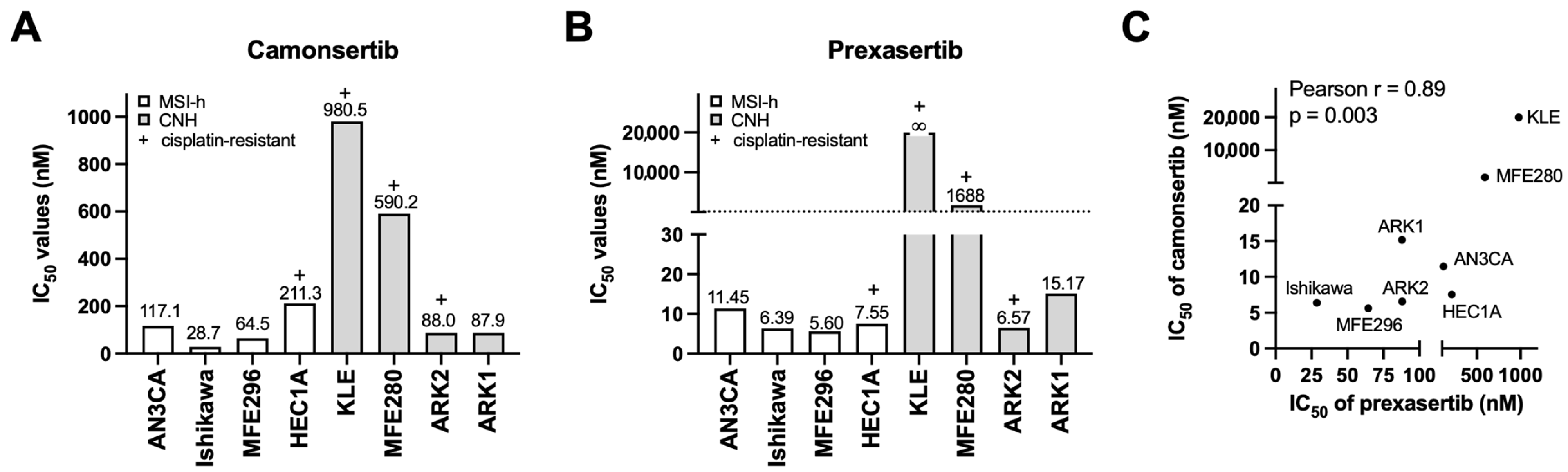
3.1. EC Cell Lines Display Correlated Sensitivity to ATR and CHK1 Inhibition
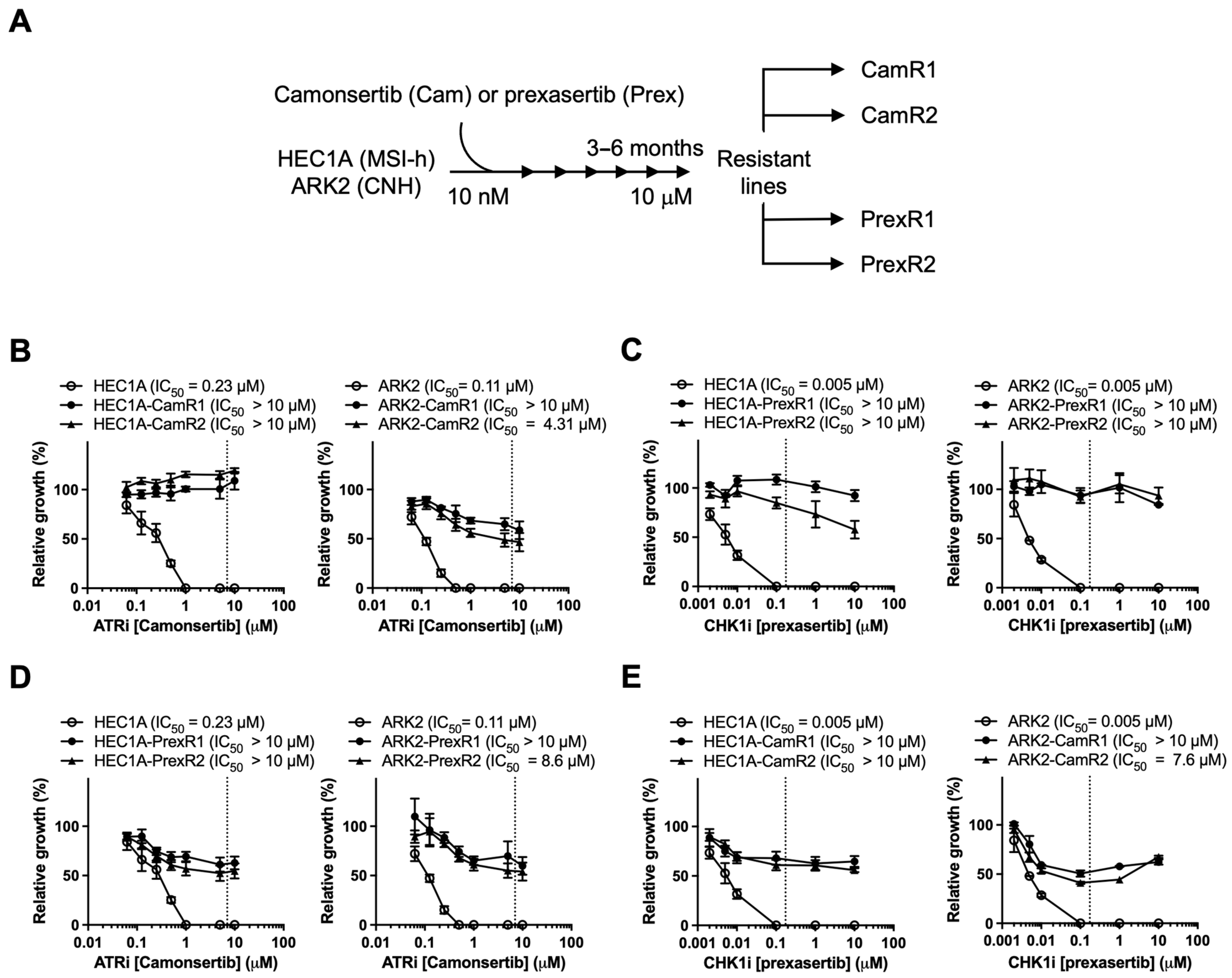
3.2. Resistant Lines Exhibit High-Level Resistance and Cross-Resistance Across the ATR-CHK1 Axis
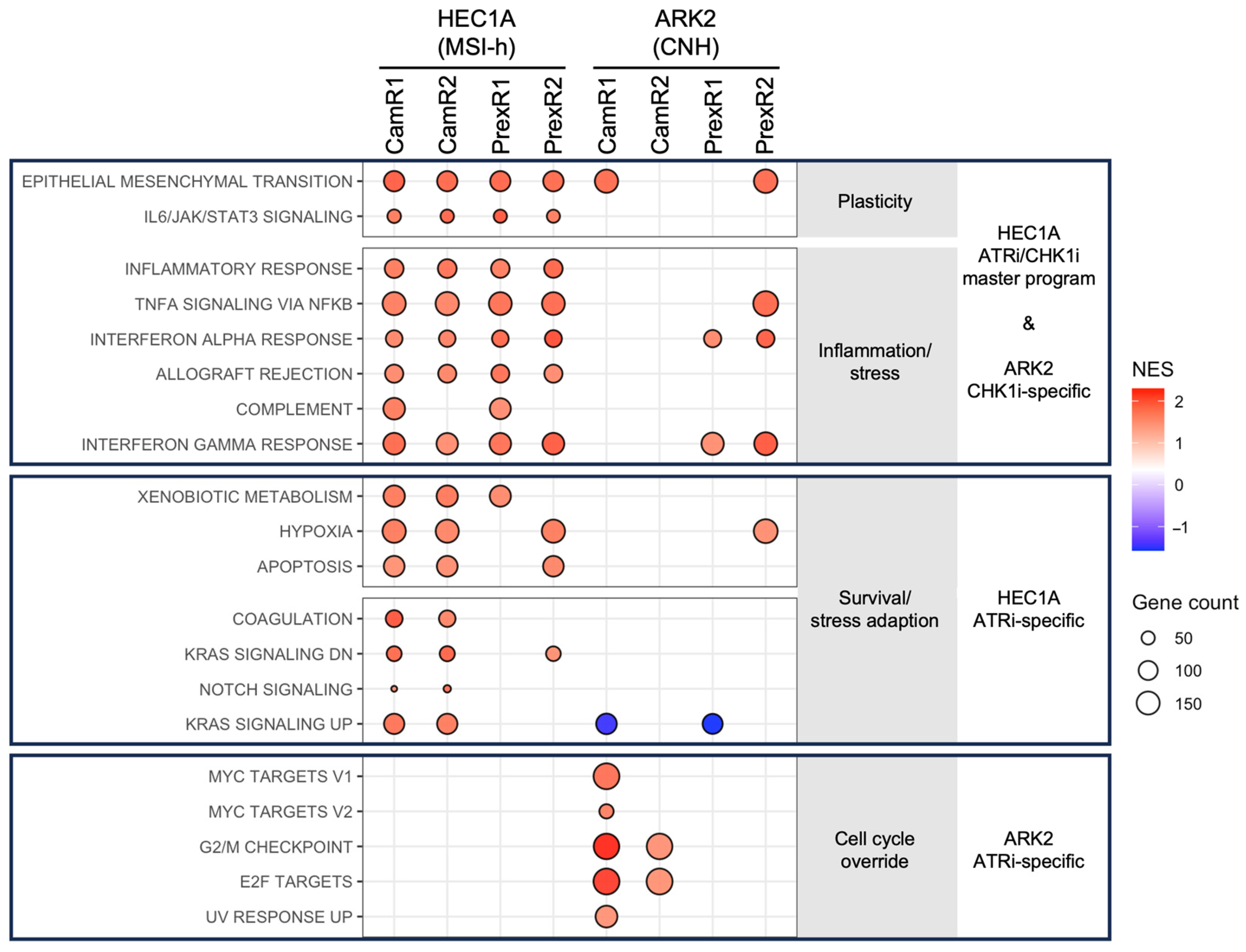
3.3. Transcriptomic Profiling Reveals Lineage-Associated and Inhibitor-Associated Enrichment Patterns
3.4. Differential Gene Expression Defines Convergent and Inhibitor-Associated Transcriptional Features
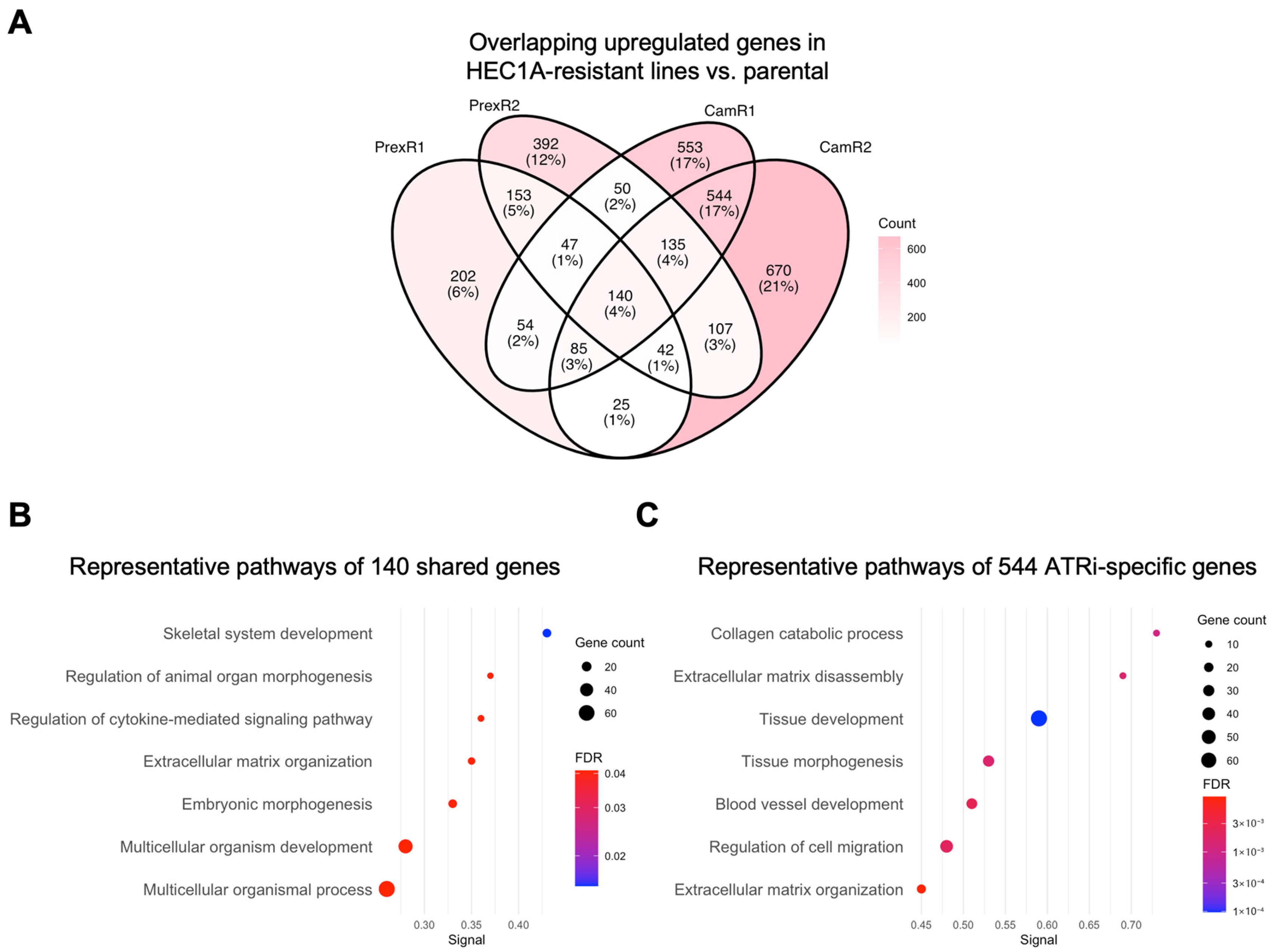
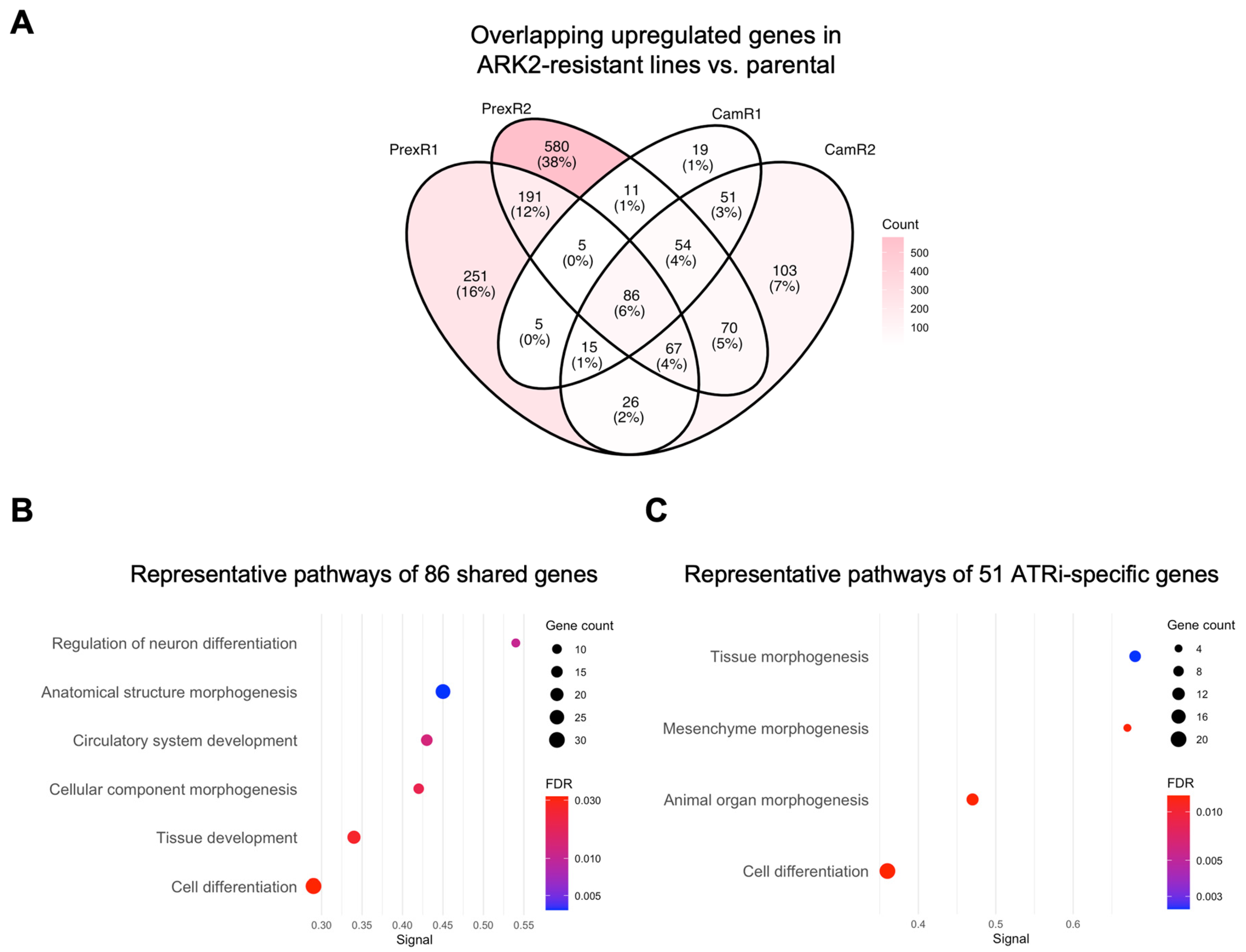
3.4.1. MSI-h Lineage: Shared Resistance Module with Additional ATRi-Associated Remodeling
3.4.2. CNH Lineage: Inhibitor-Associated Transcriptional Differences
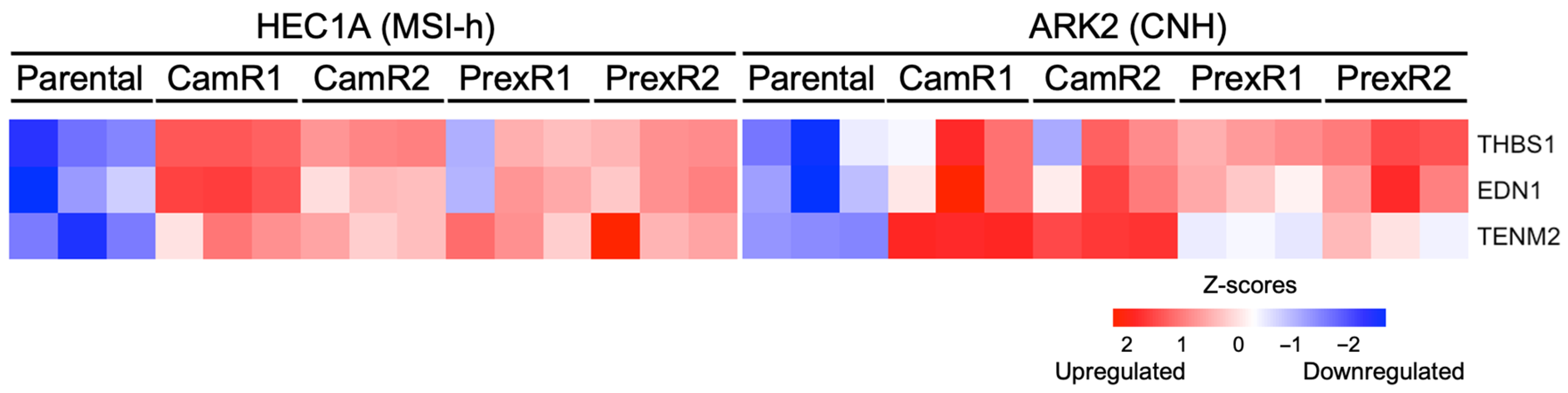
3.4.3. Consistency Analysis Identifies a Small Set of Genes Altered Across All Resistant Clones
3.4.4. Association of Resistance-Associated Genes with Disease-Specific Survival
4. Discussion
5. Conclusions
Supplementary Materials
Author Contributions
Funding
Institutional Review Board Statement
Informed Consent Statement
Data Availability Statement
Acknowledgments
Conflicts of Interest
Abbreviations
| ATR | Ataxia telangiectasia and Rad3-related kinase |
| ATRi | ATR inhibitor |
| CamR | Camonsertib-resistant |
| CHK1 | Cell cycle checkpoint kinase 1 |
| CHK1i | Cell cycle checkpoint kinase 1 inhibitor |
| CNH | Copy-number-high |
| CRISPR | Clustered regularly interspaced short palindromic repeats |
| DEG | Differentially expressed gene |
| EC | Endometrial cancer |
| ECM | Extracellular matrix |
| EDN1 | Endothelin-1 |
| EMT | Epithelial–mesenchymal transition |
| FDR | False discovery rate |
| GDF15 | Growth/differentiation factor 15 |
| GO | Gene ontology |
| GSEA | Gene set enrichment analysis |
| IL6 | Interleukin 6 |
| JAK | Janus kinases |
| MSI-h | Microsatellite instability-high |
| NES | Normalized enrichment score |
| NF-κB | Nuclear factor kappa-light-chain-enhancer of activated B cells |
| padj | Benjamini–Hochberg adjusted p-value |
| PrexR | Prexasertib-resistant |
| STAT3 | Signal transducer and activator of tanscription 3 |
| TENM2 | Teneurin-2 |
| THBS1 | Thrombospondin-1 |
| TNFα | Tumor necrosis factor-alpha |
References
- Siegel, R.L.; Kratzer, T.B.; Giaquinto, A.N.; Sung, H.; Jemal, A. Cancer statistics, 2025. CA Cancer J. Clin. 2025, 75, 10–45. [Google Scholar] [CrossRef] [Scilit]
- Cancer Facts & Figures 2025; American Cancer Society, Inc.: Atlanta, GA, USA, 2025; Available online: https://www.cancer.org/content/dam/cancer-org/research/cancer-facts-and-statistics/annual-cancer-facts-and-figures/2025/2025-cancer-facts-and-figures-acs.pdf (accessed on 10 December 2025).
- MacKay, H.J.; Freixinos, V.R.; Fleming, G.F. Therapeutic Targets and Opportunities in Endometrial Cancer: Update on Endocrine Therapy and Nonimmunotherapy Targeted Options. Am. Soc. Clin. Oncol. Educ. Book 2020, 40, 1–11. [Google Scholar] [CrossRef] [Scilit] [PubMed]
- Siegel, R.L.; Miller, K.D.; Jemal, A. Cancer statistics, 2018. CA Cancer J. Clin. 2018, 68, 7–30. [Google Scholar] [CrossRef] [Scilit] [PubMed]
- Zhao, L.; Li, X.; Jing, Y.; Tang, L.; Lin, F.; Zhang, Y.; Tang, Y.; Chen, C.; Yang, J.; Liu, X.; et al. Biomarkers and immunotherapy in endometrial cancer: Mechanisms and clinical applications. Front. Immunol. 2025, 16, 1684549. [Google Scholar] [CrossRef] [Scilit] [PubMed]
- Oaknin, A.; Gilbert, L.; Tinker, A.V.; Brown, J.; Mathews, C.; Press, J.; Sabatier, R.; O’Malley, D.M.; Samouelian, V.; Boni, V.; et al. Safety and antitumor activity of dostarlimab in patients with advanced or recurrent DNA mismatch repair deficient/microsatellite instability-high (dMMR/MSI-H) or proficient/stable (MMRp/MSS) endometrial cancer: Interim results from GARNET-a phase I, single-arm study. J. Immunother. Cancer 2022, 10, e003777. [Google Scholar] [CrossRef] [Scilit]
- Talhouk, A.; McConechy, M.K.; Leung, S.; Yang, W.; Lum, A.; Senz, J.; Boyd, N.; Pike, J.; Anglesio, M.; Kwon, J.S.; et al. Confirmation of ProMisE: A simple, genomics-based clinical classifier for endometrial cancer. Cancer 2017, 123, 802–813. [Google Scholar] [CrossRef] [Scilit]
- Bosse, T.; Nout, R.A.; McAlpine, J.N.; McConechy, M.K.; Britton, H.; Hussein, Y.R.; Gonzalez, C.; Ganesan, R.; Steele, J.C.; Harrison, B.T.; et al. Molecular Classification of Grade 3 Endometrioid Endometrial Cancers Identifies Distinct Prognostic Subgroups. Am. J. Surg. Pathol. 2018, 42, 561–568. [Google Scholar] [CrossRef] [Scilit]
- The Cancer Genome Atlas Research Network; Kandoth, C.; Schultz, N.; Cherniack, A.D.; Akbani, R.; Liu, Y.; Shen, H.; Robertson, A.G.; Pashtan, I.; Shen, R.; et al. Integrated genomic characterization of endometrial carcinoma. Nature 2013, 497, 67–73. [Google Scholar] [CrossRef] [Scilit]
- Baiden-Amissah, R.E.M.; Annibali, D.; Tuyaerts, S.; Amant, F. Endometrial Cancer Molecular Characterization: The Key to Identifying High-Risk Patients and Defining Guidelines for Clinical Decision-Making? Cancers 2021, 13, 3988. [Google Scholar] [CrossRef] [Scilit]
- Raffone, A.; Travaglino, A.; Mascolo, M.; Carotenuto, C.; Guida, M.; Mollo, A.; Insabato, L.; Zullo, F. Histopathological characterization of ProMisE molecular groups of endometrial cancer. Gynecol. Oncol. 2020, 157, 252–259. [Google Scholar] [CrossRef] [Scilit]
- Travaglino, A.; Raffone, A.; Stradella, C.; Esposito, R.; Moretta, P.; Gallo, C.; Orlandi, G.; Insabato, L.; Zullo, F. Impact of endometrial carcinoma histotype on the prognostic value of the TCGA molecular subgroups. Arch. Gynecol. Obstet. 2020, 301, 1355–1363. [Google Scholar] [CrossRef] [Scilit] [PubMed]
- Wang, M.; Ran, X.; Leung, W.; Kawale, A.; Saxena, S.; Ouyang, J.; Patel, P.S.; Dong, Y.; Yin, T.; Shu, J.; et al. ATR inhibition induces synthetic lethality in mismatch repair-deficient cells and augments immunotherapy. Genes Dev. 2023, 37, 929–943. [Google Scholar] [CrossRef] [Scilit] [PubMed]
- Rundle, S.; Bradbury, A.; Drew, Y.; Curtin, N.J. Targeting the ATR-CHK1 Axis in Cancer Therapy. Cancers 2017, 9, 41. [Google Scholar] [CrossRef] [Scilit] [PubMed]
- Gupta, N.; Huang, T.T.; Horibata, S.; Lee, J.M. Cell cycle checkpoints and beyond: Exploiting the ATR/CHK1/WEE1 pathway for the treatment of PARP inhibitor-resistant cancer. Pharmacol. Res. 2022, 178, 106162. [Google Scholar] [CrossRef] [Scilit]
- Lee, J.M.; Nair, J.; Zimmer, A.; Lipkowitz, S.; Annunziata, C.M.; Merino, M.J.; Swisher, E.M.; Harrell, M.I.; Trepel, J.B.; Lee, M.J.; et al. Prexasertib, a cell cycle checkpoint kinase 1 and 2 inhibitor, in BRCA wild-type recurrent high-grade serous ovarian cancer: A first-in-class proof-of-concept phase 2 study. Lancet Oncol. 2018, 19, 207–215. [Google Scholar] [CrossRef] [Scilit]
- Gupta, N.; Huang, T.T.; Nair, J.R.; An, D.; Zurcher, G.; Lampert, E.J.; McCoy, A.; Cimino-Mathews, A.; Swisher, E.M.; Radke, M.R.; et al. BLM overexpression as a predictive biomarker for CHK1 inhibitor response in PARP inhibitor-resistant BRCA-mutant ovarian cancer. Sci. Transl. Med. 2023, 15, eadd7872. [Google Scholar] [CrossRef] [Scilit]
- Giudice, E.; Huang, T.T.; Nair, J.R.; Zurcher, G.; McCoy, A.; Nousome, D.; Radke, M.R.; Swisher, E.M.; Lipkowitz, S.; Ibanez, K.; et al. The CHK1 inhibitor prexasertib in BRCA wild-type platinum-resistant recurrent high-grade serous ovarian carcinoma: A phase 2 trial. Nat. Commun. 2024, 15, 2805. [Google Scholar] [CrossRef] [Scilit]
- Lee, J.M.; MacLaughlan, S.; Matei, D.; Song, M.; Brubaker, L.; Rimmel, B.; Eskander, R.N.; Kyi, C.; Williams, H.; Duska, L.; et al. 744P A phase II study of ACR-368 in patients with ovarian (OvCa) or endometrial carcinoma (EnCa) and prospective validation of OncoSignature patient selection (NCT05548296). Ann. Oncol. 2024, 35, S564–S565. [Google Scholar] [CrossRef] [Scilit]
- Yap, T.A.; Fontana, E.; Lee, E.K.; Spigel, D.R.; Hojgaard, M.; Lheureux, S.; Mettu, N.B.; Carneiro, B.A.; Carter, L.; Plummer, R.; et al. Camonsertib in DNA damage response-deficient advanced solid tumors: Phase 1 trial results. Nat. Med. 2023, 29, 1400–1411. [Google Scholar] [CrossRef] [Scilit]
- Ruiz, S.; Mayor-Ruiz, C.; Lafarga, V.; Murga, M.; Vega-Sendino, M.; Ortega, S.; Fernandez-Capetillo, O. A Genome-wide CRISPR Screen Identifies CDC25A as a Determinant of Sensitivity to ATR Inhibitors. Mol. Cell 2016, 62, 307–313. [Google Scholar] [CrossRef] [Scilit]
- O’Leary, P.C.; Chen, H.; Doruk, Y.U.; Williamson, T.; Polacco, B.; McNeal, A.S.; Shenoy, T.; Kale, N.; Carnevale, J.; Stevenson, E.; et al. Resistance to ATR Inhibitors Is Mediated by Loss of the Nonsense-Mediated Decay Factor UPF2. Cancer Res. 2022, 82, 3950–3961. [Google Scholar] [CrossRef] [Scilit] [PubMed]
- Nair, J.; Huang, T.T.; Murai, J.; Haynes, B.; Steeg, P.S.; Pommier, Y.; Lee, J.M. Resistance to the CHK1 inhibitor prexasertib involves functionally distinct CHK1 activities in BRCA wild-type ovarian cancer. Oncogene 2020, 39, 5520–5535. [Google Scholar] [CrossRef] [Scilit] [PubMed]
- Lee, K.J.; Wright, G.; Bryant, H.; Wiggins, L.A.; Schuler, M.; Gassman, N.R. EGFR signaling promotes resistance to CHK1 inhibitor prexasertib in triple negative breast cancer. Cancer Drug Resist. 2020, 3, 980–991. [Google Scholar] [CrossRef] [Scilit] [PubMed]
- Pal, S.K.; Nguyen, C.T.; Morita, K.I.; Miki, Y.; Kayamori, K.; Yamaguchi, A.; Sakamoto, K. THBS1 is induced by TGFB1 in the cancer stroma and promotes invasion of oral squamous cell carcinoma. J. Oral. Pathol. Med. 2016, 45, 730–739. [Google Scholar] [CrossRef] [Scilit]
- Patwardhan, S.; Mahadik, P.; Shetty, O.; Sen, S. ECM stiffness-tuned exosomes drive breast cancer motility through thrombospondin-1. Biomaterials 2021, 279, 121185. [Google Scholar] [CrossRef] [Scilit]
- Tocci, P.; Cianfrocca, R.; Sestito, R.; Rosano, L.; Di Castro, V.; Blandino, G.; Bagnato, A. Endothelin-1 axis fosters YAP-induced chemotherapy escape in ovarian cancer. Cancer Lett. 2020, 492, 84–95. [Google Scholar] [CrossRef] [Scilit]
- Rosano, L.; Cianfrocca, R.; Tocci, P.; Spinella, F.; Di Castro, V.; Caprara, V.; Semprucci, E.; Ferrandina, G.; Natali, P.G.; Bagnato, A. Endothelin A receptor/beta-arrestin signaling to the Wnt pathway renders ovarian cancer cells resistant to chemotherapy. Cancer Res. 2014, 74, 7453–7464. [Google Scholar] [CrossRef] [Scilit]
- O’Neil, N.J.; Bailey, M.L.; Hieter, P. Synthetic lethality and cancer. Nat. Rev. Genet. 2017, 18, 613–623. [Google Scholar] [CrossRef] [Scilit]
- Gorecki, L.; Andrs, M.; Korabecny, J. Clinical Candidates Targeting the ATR-CHK1-WEE1 Axis in Cancer. Cancers 2021, 13, 795. [Google Scholar] [CrossRef] [Scilit]
- Ghorbian, S. Cancer cell plasticity and therapeutic resistance: Mechanisms, crosstalk, and translational perspectives. Hereditas 2025, 162, 188. [Google Scholar] [CrossRef] [Scilit]
- Ruscetti, M.; Leibold, J.; Bott, M.J.; Fennell, M.; Kulick, A.; Salgado, N.R.; Chen, C.C.; Ho, Y.J.; Sanchez-Rivera, F.J.; Feucht, J.; et al. NK cell-mediated cytotoxicity contributes to tumor control by a cytostatic drug combination. Science 2018, 362, 1416–1422. [Google Scholar] [CrossRef] [Scilit]
- Hu, X.; Li, J.; Fu, M.; Zhao, X.; Wang, W. The JAK/STAT signaling pathway: From bench to clinic. Signal Transduct. Target. Ther. 2021, 6, 402. [Google Scholar] [CrossRef] [Scilit]
- Chipumuro, E.; Marco, E.; Christensen, C.L.; Kwiatkowski, N.; Zhang, T.; Hatheway, C.M.; Abraham, B.J.; Sharma, B.; Yeung, C.; Altabef, A.; et al. CDK7 inhibition suppresses super-enhancer-linked oncogenic transcription in MYCN-driven cancer. Cell 2014, 159, 1126–1139. [Google Scholar] [CrossRef] [Scilit]
- Mahauad-Fernandez, W.D.; Yang, Y.C.; Lai, I.; Park, J.; Yao, L.; Evans, J.W.; Atibalentja, D.F.; Chen, X.; Kanakaveti, V.; Zhao, Z.; et al. Targeting the MYC oncogene with a selective bi-steric mTORC1 inhibitor elicits tumor regression in MYC-driven cancers. Cell Chem. Biol. 2025, 32, 994–1012.e11. [Google Scholar] [CrossRef] [Scilit]
- Catalano, M.; D’Angelo, A.; De Logu, F.; Nassini, R.; Generali, D.; Roviello, G. Navigating Cancer Complexity: Integrative Multi-Omics Methodologies for Clinical Insights. Clin. Med. Insights Oncol. 2025, 19, 11795549251384582. [Google Scholar] [CrossRef] [Scilit]



| Mutation Status | |||||||||
|---|---|---|---|---|---|---|---|---|---|
| Cell Line | Histology | Subtype | Cisplatin | TP53 | MSH6 | PMS2 | PIK3CA | PIK3R1 | PTEN |
| AN3CA | Endometrioid | MSI-h | Sensitive | R213Q | F1088SfsTer2 | wildtype | wildtype | R557_K561>Q | R130Q |
| Ishikawa | Endometrioid | MSI-h | Sensitive | M246V | I1183T, F1088SfsTer2 | Q604R | wildtype | L570P | V317fs |
| HEC1A | Endometrioid | MSI-h | Resistant | R248G | F1088SfsTer2 | R802Ter | G1049R | wildtype | wildtype |
| MFE296 | Endometrioid | MSI-h | Sensitive | Y220C | A1055V | wildtype | P539R | wildtype | R130Q |
| KLE | Endometrioid | CNH | Resistant | R175H | wildtype | wildtype | wildtype | wildtype | wildtype |
| MFE280 | Endometrioid | CNH | Resistant | X307_splice | wildtype | wildtype | H1047Y | wildtype | wildtype |
| ARK1 | Serous | CNH | Sensitive | R248W | wildtype | wildtype | E542K | wildtype | wildtype |
| ARK2 | Serous | CNH | Resistant | Q165Ter | wildtype | wildtype | wildtype | wildtype | wildtype |
Disclaimer/Publisher’s Note: The statements, opinions and data contained in all publications are solely those of the individual author(s) and contributor(s) and not of MDPI and/or the editor(s). MDPI and/or the editor(s) disclaim responsibility for any injury to people or property resulting from any ideas, methods, instructions or products referred to in the content. |
© 2026 by the authors. Licensee MDPI, Basel, Switzerland. This article is an open access article distributed under the terms and conditions of the Creative Commons Attribution (CC BY) license.
Share and Cite
Huang, T.-T.; Lee, J.-M. Transcriptional Profiling Reveals Lineage-Specific Characteristics in ATR/CHK1 Inhibitor-Resistant Endometrial Cancer. Biomolecules 2026, 16, 169. https://doi.org/10.3390/biom16010169
Huang T-T, Lee J-M. Transcriptional Profiling Reveals Lineage-Specific Characteristics in ATR/CHK1 Inhibitor-Resistant Endometrial Cancer. Biomolecules. 2026; 16(1):169. https://doi.org/10.3390/biom16010169
Chicago/Turabian StyleHuang, Tzu-Ting, and Jung-Min Lee. 2026. "Transcriptional Profiling Reveals Lineage-Specific Characteristics in ATR/CHK1 Inhibitor-Resistant Endometrial Cancer" Biomolecules 16, no. 1: 169. https://doi.org/10.3390/biom16010169
APA StyleHuang, T.-T., & Lee, J.-M. (2026). Transcriptional Profiling Reveals Lineage-Specific Characteristics in ATR/CHK1 Inhibitor-Resistant Endometrial Cancer. Biomolecules, 16(1), 169. https://doi.org/10.3390/biom16010169