Advances in Cytokines and Inflammatory Mechanisms in the Pathogenesis of Interstitial Cystitis/Bladder Pain Syndrome


Abstract
1. Introduction
2. Pathologic Features and Classification of IC/BPS

| IC/BPS with Hunner’s Lesions | IC/BPS Without Hunner’s Lesions | References | |
|---|---|---|---|
| Age at diagnosis | Usually at 60 s | Usually at 40 s | [12,14] |
| inflammation | Present | Absent or minimal | [11] |
| Epithelial denudation | Denuded | Preserved | [12] |
| Infiltrative inflammatory cell type | Lymphocytes and plasma cells predominate | Very low numbers of plasma cells | [15] |
| Bladder center symptom | Severity | Less severe | [16] |
| Average bladder capacity | Smaller | Larger | [14] |
| Interstitial Cystitis Symptom Index (ICSI) scores | Higher | Lower | [17] |
| Endoscopic management | Effective | Less effective | [18] |
| Surgical Management | Limited | Effective for urgency and frequency | [18] |
3. Inflammations and Cytokines in IC/BPS
3.1. Dysfunction of the Urinary Epithelium
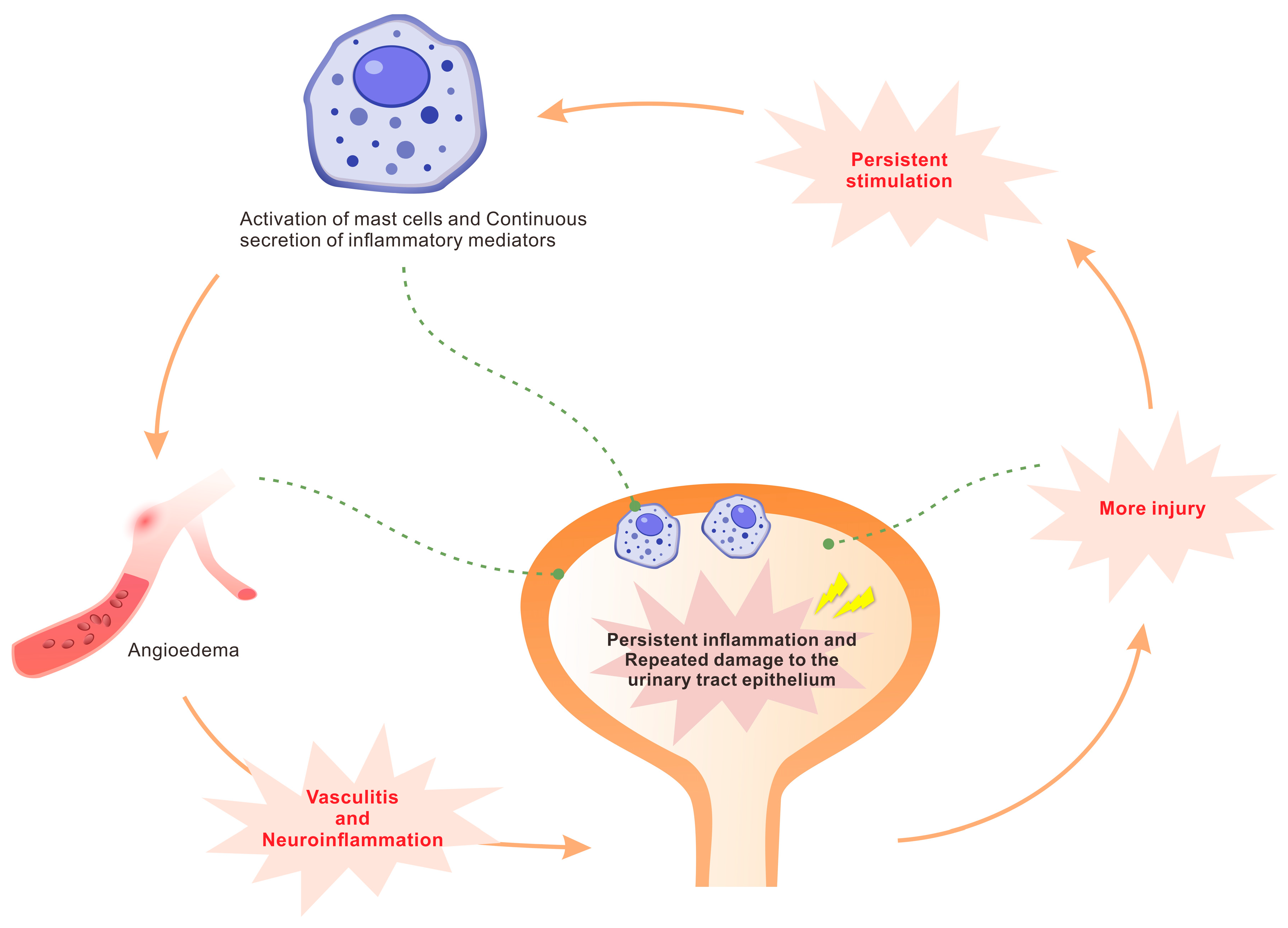
3.2. Mast Cell Proliferation and Activation
3.3. B-Cell Clonal Expansion and Autoimmunity
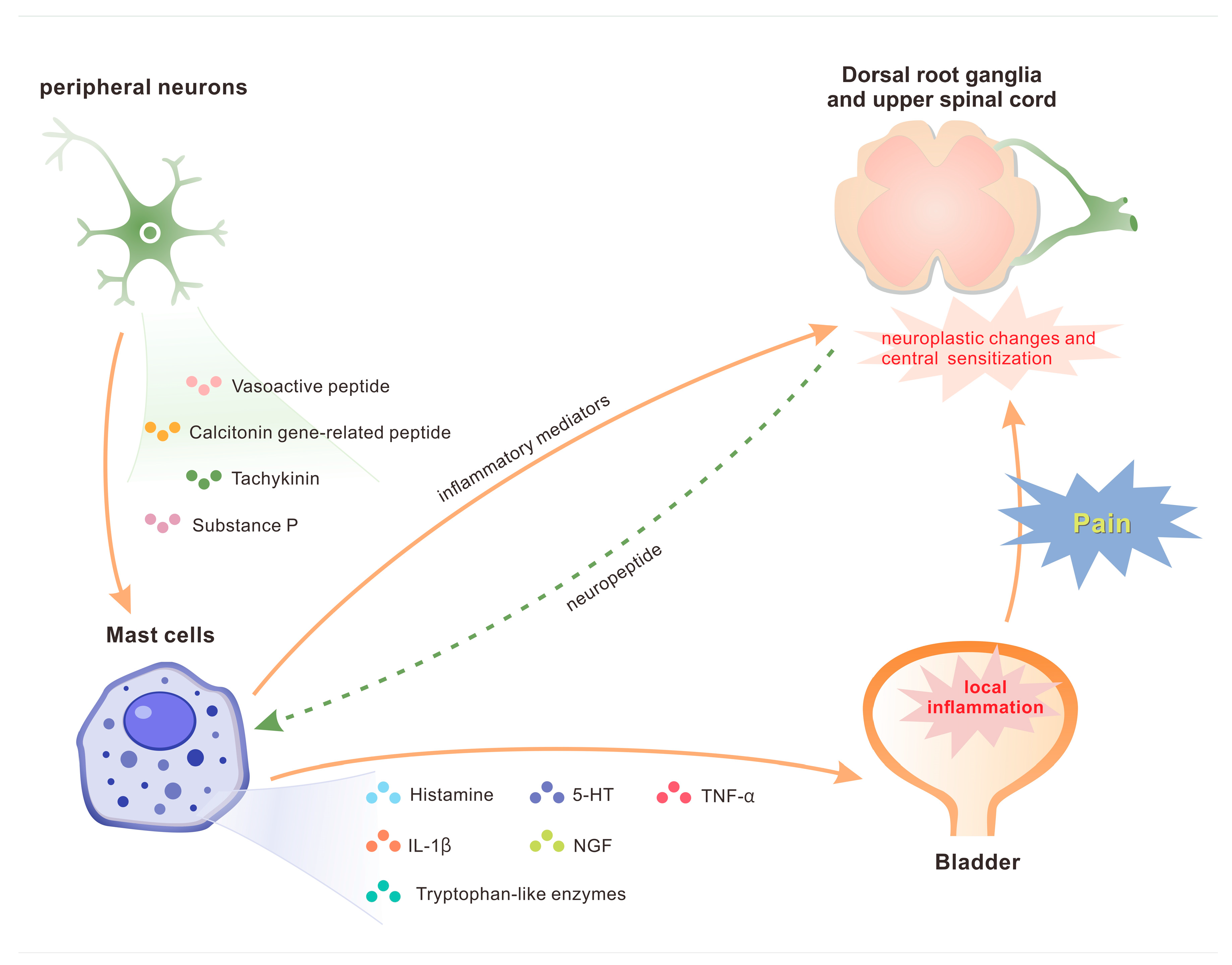
3.4. Neurogenic Inflammation and Pain
4. Conclusions and Outlook
Author Contributions
Funding
Institutional Review Board Statement
Informed Consent Statement
Data Availability Statement
Conflicts of Interest
References
- Magalhaes, T.F.; Baracat, E.C.; Doumouchtsis, S.K.; Haddad, J.M. Biomarkers in the Diagnosis and Symptom Assessment of Patients with Bladder Pain Syndrome: A Systematic Review. Int. Urogynecol. J. 2019, 30, 1785–1794. [Google Scholar] [CrossRef]
- Chrysanthopoulou, E.L.; Doumouchtsis, S.K. Challenges and Current Evidence on the Management of Bladder Pain Syndrome. Neurourol. Urodyn. 2014, 33, 1193–1201. [Google Scholar] [CrossRef] [PubMed]
- Lim, Y.; Leslie, S.W.; O’Rourke, S. Interstitial Cystitis/Bladder Pain Syndrome; StatPearls Publishing: Treasure Island, FL, USA, 2025. [Google Scholar]
- Ke, Q.-S.; Kuo, H.-C. Pathophysiology of Interstitial Cystitis/Bladder Pain Syndrome. Tzu Chi Med. J. 2015, 27, 139–144. [Google Scholar] [CrossRef]
- Jiang, Y.-H.; Peng, C.-H.; Liu, H.-T.; Kuo, H.-C. Increased Pro-Inflammatory Cytokines, C-Reactive Protein and Nerve Growth Factor Expressions in Serum of Patients with Interstitial Cystitis/Bladder Pain Syndrome. PLoS ONE 2013, 8, e76779. [Google Scholar] [CrossRef]
- Chennamsetty, A.; Khourdaji, I.; Goike, J.; Killinger, K.A.; Girdler, B.; Peters, K.M. Electrosurgical Management of Hunner Ulcers in a Referral Center’s Interstitial Cystitis Population. Urology 2015, 85, 74–78. [Google Scholar] [CrossRef]
- Peters, K.M.; Killinger, K.A.; Mounayer, M.H.; Boura, J.A. Are Ulcerative and Nonulcerative Interstitial Cystitis/Painful Bladder Syndrome 2 Distinct Diseases? A Study of Coexisting Conditions. Urology 2011, 78, 301–308. [Google Scholar] [CrossRef] [PubMed]
- Warren, J.W.; Howard, F.M.; Cross, R.K.; Good, J.L.; Weissman, M.M.; Wesselmann, U.; Langenberg, P.; Greenberg, P.; Clauw, D.J. Antecedent Nonbladder Syndromes in Case-Control Study of Interstitial Cystitis/Painful Bladder Syndrome. Urology 2009, 73, 52–57. [Google Scholar] [CrossRef]
- Warren, J.W. Bladder Pain Syndrome/Interstitial Cystitis as a Functional Somatic Syndrome. J. Psychosom. Res. 2014, 77, 510–515. [Google Scholar] [CrossRef] [PubMed]
- Logadottir, Y.; Delbro, D.; Lindholm, C.; Fall, M.; Peeker, R. Inflammation Characteristics in Bladder Pain Syndrome ESSIC Type 3C/Classic Interstitial Cystitis. Int. J. Urol. 2014, 21, 75–78. [Google Scholar] [CrossRef]
- Akiyama, Y.; Homma, Y.; Maeda, D. Pathology and Terminology of Interstitial Cystitis/Bladder Pain Syndrome: A Review. Histol. Histopathol. 2019, 34, 25–32. [Google Scholar] [CrossRef]
- Maeda, D.; Akiyama, Y.; Morikawa, T.; Kunita, A.; Ota, Y.; Katoh, H.; Niimi, A.; Nomiya, A.; Ishikawa, S.; Goto, A.; et al. Hunner-Type (Classic) Interstitial Cystitis: A Distinct Inflammatory Disorder Characterized by Pancystitis, with Frequent Expansion of Clonal B-Cells and Epithelial Denudation. PLoS ONE 2015, 10, e0143316. [Google Scholar] [CrossRef]
- Akiyama, Y.; Hanno, P. Phenotyping of Interstitial Cystitis/Bladder Pain Syndrome. Int. J. Urol. 2019, 26, 17–19. [Google Scholar] [CrossRef]
- Logadottir, Y.; Fall, M.; Kåbjörn-Gustafsson, C.; Peeker, R. Clinical Characteristics Differ Considerably between Phenotypes of Bladder Pain Syndrome/Interstitial Cystitis. Scand. J. Urol. Nephrol. 2012, 46, 365–370. [Google Scholar] [CrossRef] [PubMed]
- Homma, Y.; Akiyama, Y.; Tomoe, H.; Furuta, A.; Ueda, T.; Maeda, D.; Lin, A.T.; Kuo, H.-C.; Lee, M.-H.; Oh, S.-J.; et al. Clinical Guidelines for Interstitial Cystitis/Bladder Pain Syndrome. Int. J. Urol. 2020, 27, 578–589. [Google Scholar] [CrossRef] [PubMed]
- Akiyama, Y.; Luo, Y.; Hanno, P.M.; Maeda, D.; Homma, Y. Interstitial Cystitis/Bladder Pain Syndrome: The Evolving Landscape, Animal Models and Future Perspectives. Int. J. Urol. 2020, 27, 491–503. [Google Scholar] [CrossRef]
- Yu, J.; Lee, C.U.; Lee, K.-S.; Ko, K.J. Optimal Endoscopic Treatment and Partial Cystectomy with or without Bladder Augmentation for Hunner-Type Interstitial Cystitis. LUTS Low. Urin. Tract. Symptoms 2023, 15, 216–224. [Google Scholar] [CrossRef]
- Derisavifard, S.; Moldwin, R. Surgical Management of Interstitial Cystitis/Bladder Pain Syndrome. In Female Pelvic Surgery; Springer: Cham, Switzerland, 2020; pp. 317–329. ISBN 978-3-030-28319-3. [Google Scholar]
- Hannoodee, S.; Nasuruddin, D.N. Acute Inflammatory Response; StatPearls Publishing: Treasure Island, FL, USA, 2025. [Google Scholar]
- Lala, V.; Leslie, S.W.; Minter, D.A. Acute Cystitis; StatPearls Publishing: Treasure Island, FL, USA, 2025. [Google Scholar]
- Pahwa, R.; Goyal, A.; Jialal, I. Chronic Inflammation; StatPearls Publishing: Treasure Island, FL, USA, 2025. [Google Scholar]
- Grover, S.; Srivastava, A.; Lee, R.; Tewari, A.K.; Te, A.E. Role of Inflammation in Bladder Function and Interstitial Cystitis. Ther. Adv. Urol. 2011, 3, 19–33. [Google Scholar] [CrossRef] [PubMed]
- Schrepf, A.; O’Donnell, M.; Luo, Y.; Bradley, C.S.; Kreder, K.; Lutgendorf, S. Inflammation and Inflammatory Control in Interstitial Cystitis/Bladder Pain Syndrome: Associations with Painful Symptoms. Pain 2014, 155, 1755–1761. [Google Scholar] [CrossRef]
- Jiang, Y.-H.; Jhang, J.-F.; Hsu, Y.-H.; Kuo, H.-C. Usefulness of Urinary Biomarkers for Assessing Bladder Condition and Histopathology in Patients with Interstitial Cystitis/Bladder Pain Syndrome. Int. J. Mol. Sci. 2022, 23, 12044. [Google Scholar] [CrossRef]
- Corcoran, A.T.; Yoshimura, N.; Tyagi, V.; Jacobs, B.; Leng, W.; Tyagi, P. Mapping the Cytokine Profile of Painful Bladder Syndrome/Interstitial Cystitis in Human Bladder and Urine Specimens. World J. Urol. 2013, 31, 241–246. [Google Scholar] [CrossRef]
- Logadottir, Y.; Delbro, D.; Fall, M.; Gjertsson, I.; Jirholt, P.; Lindholm, C.; Peeker, R. Cytokine Expression in Patients with Bladder Pain Syndrome/Interstitial Cystitis ESSIC Type 3C. J. Urol. 2014, 192, 1564–1568. [Google Scholar] [CrossRef]
- Furuta, A.; Yamamoto, T.; Suzuki, Y.; Gotoh, M.; Egawa, S.; Yoshimura, N. Comparison of Inflammatory Urine Markers in Patients with Interstitial Cystitis and Overactive Bladder. Int. Urogynecol. J. 2018, 29, 961–966. [Google Scholar] [CrossRef]
- Shah, A.M.; Vodovotz, Y.; Yoshimura, N.; Chermansky, C.J.; Fitzgerald, J.; Tyagi, P. Temporally Complex Inflammatory Networks in an Animal Model Reveal Signatures for Interstitial Cystitis and Bladder Pain Syndrome Phenotype. Neurourol. Urodyn. 2023, 42, 1839–1848. [Google Scholar] [CrossRef]
- Jhang, J.-F.; Hsu, Y.-H.; Kuo, H.-C. Possible Pathophysiology of Ketamine-Related Cystitis and Associated Treatment Strategies. Int. J. Urol. 2015, 22, 816–825. [Google Scholar] [CrossRef] [PubMed]
- Jiang, Y.-H.; Jhang, J.-F.; Kuo, H.-C. Can We Use Urinary Cytokine/Chemokine Analysis in Discriminating Ulcer-Type Interstitial Cystitis/Bladder Pain Syndrome? Diagnostics 2022, 12, 1093. [Google Scholar] [CrossRef] [PubMed]
- Niimi, A.; Igawa, Y.; Aizawa, N.; Honma, T.; Nomiya, A.; Akiyama, Y.; Kamei, J.; Fujimura, T.; Fukuhara, H.; Homma, Y. Diagnostic Value of Urinary CXCL10 as a Biomarker for Predicting Hunner Type Interstitial Cystitis. Neurourol. Urodyn. 2018, 37, 1113–1119. [Google Scholar] [CrossRef]
- Lamale, L.M.; Lutgendorf, S.K.; Zimmerman, M.B.; Kreder, K.J. Interleukin-6, Histamine, and Methylhistamine as Diagnostic Markers for Interstitial Cystitis. Urology 2006, 68, 702–706. [Google Scholar] [CrossRef]
- Parsons, C.L. The Role of the Urinary Epithelium in the Pathogenesis of Interstitial Cystitis/Prostatitis/Urethritis. Urology 2007, 69, 9–16. [Google Scholar] [CrossRef] [PubMed]
- Soler, R.; Bruschini, H.; Freire, M.P.; Alves, M.T.; Srougi, M.; Ortiz, V. Urine Is Necessary to Provoke Bladder Inflammation in Protamine Sulfate Induced Urothelial Injury. J. Urol. 2008, 180, 1527–1531. [Google Scholar] [CrossRef]
- Southgate, J.; Varley, C.L.; Garthwaite, M.A.E.; Hinley, J.; Marsh, F.; Stahlschmidt, J.; Trejdosiewicz, L.K.; Eardley, I. Differentiation Potential of Urothelium from Patients with Benign Bladder Dysfunction. BJU Int. 2007, 99, 1506–1516. [Google Scholar] [CrossRef] [PubMed]
- Hauser, P.J.; Dozmorov, M.; Bane, B.L.; Slobodov, G.; Culkin, D.J.; Hurst, R.E. Abnormal Expression of Differentiation-Related Proteins and Proteoglycan Core Proteins in the Urothelium of Interstitial Cystitis Patients. J. Urol. 2008, 179, 764–769. [Google Scholar] [CrossRef] [PubMed]
- Hsu, S.-K.; Li, C.-Y.; Lin, I.-L.; Syue, W.-J.; Chen, Y.-F.; Cheng, K.-C.; Teng, Y.-N.; Lin, Y.-H.; Yen, C.-H.; Chiu, C.-C. Inflammation-Related Pyroptosis, a Novel Programmed Cell Death Pathway, and Its Crosstalk with Immune Therapy in Cancer Treatment. Theranostics 2021, 11, 8813–8835. [Google Scholar] [CrossRef]
- Broz, P. Pyroptosis: Molecular Mechanisms and Roles in Disease. Cell Res. 2025, 35, 334–344. [Google Scholar] [CrossRef]
- Song, Z.; Gong, Q.; Guo, J. Pyroptosis: Mechanisms and Links with Fibrosis. Cells 2021, 10, 3509. [Google Scholar] [CrossRef]
- Wang, K.; Sun, Q.; Zhong, X.; Zeng, M.; Zeng, H.; Shi, X.; Li, Z.; Wang, Y.; Zhao, Q.; Shao, F.; et al. Structural Mechanism for GSDMD Targeting by Autoprocessed Caspases in Pyroptosis. Cell 2020, 180, 941–955.e20. [Google Scholar] [CrossRef] [PubMed]
- Jorgensen, I.; Rayamajhi, M.; Miao, E.A. Programmed Cell Death as a Defence against Infection. Nat. Rev. Immunol. 2017, 17, 151–164. [Google Scholar] [CrossRef]
- Osman, N.I.; Bratt, D.G.; Downey, A.P.; Esperto, F.; Inman, R.D.; Chapple, C.R. A Systematic Review of Surgical Interventions for the Treatment of Bladder Pain Syndrome/Interstitial Cystitis. Eur. Urol. Focus. 2021, 7, 877–885. [Google Scholar] [CrossRef]
- Wang, X.; Yin, H.; Fan, L.; Zhou, Y.; Tang, X.; Fei, X.; Tang, H.; Peng, J.; Zhang, J.; Xue, Y.; et al. Shionone Alleviates NLRP3 Inflammasome Mediated Pyroptosis in Interstitial Cystitis Injury. Int. Immunopharmacol. 2021, 90, 107132. [Google Scholar] [CrossRef]
- Gamper, M.; Regauer, S.; Welter, J.; Eberhard, J.; Viereck, V. Are Mast Cells Still Good Biomarkers for Bladder Pain Syndrome/Interstitial Cystitis? J. Urol. 2015, 193, 1994–2000. [Google Scholar] [CrossRef]
- Theoharides, T.C.; Kempuraj, D.; Sant, G.R. Mast Cell Involvement in Interstitial Cystitis: A Review of Human and Experimental Evidence. Urology 2001, 57, 47–55. [Google Scholar] [CrossRef]
- Lowe, E.M.; Anand, P.; Terenghi, G.; Williams-Chestnut, R.E.; Sinicropi, D.V.; Osborne, J.L. Increased Nerve Growth Factor Levels in the Urinary Bladder of Women with Idiopathic Sensory Urgency and Interstitial Cystitis. Br. J. Urol. 1997, 79, 572–577. [Google Scholar] [CrossRef] [PubMed]
- Pang, X.; Sant, G.; Theoharides, T.C. Altered Expression of Bladder Mast Cell Growth Factor Receptor (c-Kit) in Interstitial Cystitis. Urology 1998, 51, 939–944. [Google Scholar] [CrossRef] [PubMed]
- Peeker, R.; Enerbäck, L.; Fall, M.; Aldenborg, F. Recruitment, Distribution and Phenotypes of Mast Cells in Interstitial Cystitis. J. Urol. 2000, 163, 1009–1015. [Google Scholar] [CrossRef]
- Dudeck, J.; Kotrba, J.; Immler, R.; Hoffmann, A.; Voss, M.; Alexaki, V.I.; Morton, L.; Jahn, S.R.; Katsoulis-Dimitriou, K.; Winzer, S.; et al. Directional Mast Cell Degranulation of Tumor Necrosis Factor into Blood Vessels Primes Neutrophil Extravasation. Immunity 2021, 54, 468–483.e5. [Google Scholar] [CrossRef] [PubMed]
- Moldwin, R.M.; Nursey, V.; Yaskiv, O.; Dalvi, S.; Macdonald, E.J.; Funaro, M.; Zhang, C.; DeGouveia, W.; Ruzimovsky, M.; Rilo, H.R.; et al. Immune Cell Profiles of Patients with Interstitial Cystitis/Bladder Pain Syndrome. J. Transl. Med. 2022, 20, 97. [Google Scholar] [CrossRef]
- Jiang, C.; Xu, M.; Zhu, J.; Yang, D.; Xue, B. CircTHBS1 Facilitates the Progression of Interstitial Cystitis Depending on the Regulation of miR-139-5p/MFN2 Axis. Drug Dev. Res. 2022, 83, 351–361. [Google Scholar] [CrossRef]
- Varricchi, G.; Rossi, F.W.; Galdiero, M.R.; Granata, F.; Criscuolo, G.; Spadaro, G.; de Paulis, A.; Marone, G. Physiological Roles of Mast Cells: Collegium Internationale Allergologicum Update 2019. Int. Arch. Allergy Immunol. 2019, 179, 247–261. [Google Scholar] [CrossRef]
- Mostafa, M.M.; Kamel, M.; Kamel, M.; Mahdy, A. Interstitial Cystitis/Bladder Pain Syndrome: Role of Bladder Inflammation in Bladder Function. Curr. Bladder Dysfunct. Rep. 2024, 19, 16–26. [Google Scholar] [CrossRef]
- Bosch, P.C. A Randomized, Double-Blind, Placebo Controlled Trial of Adalimumab for Interstitial Cystitis/Bladder Pain Syndrome. J. Urol. 2014, 191, 77–82. [Google Scholar] [CrossRef]
- Furuta, A.; Suzuki, Y.; Igarashi, T.; Koike, Y.; Kimura, T.; Egawa, S.; Yoshimura, N. Angiogenesis in Bladder Tissues Is Strongly Correlated with Urinary Frequency and Bladder Pain in Patients with Interstitial Cystitis/Bladder Pain Syndrome. Int. J. Urol. 2019, 26, 35–40. [Google Scholar] [CrossRef]
- Gee, E.; Milkiewicz, M.; Haas, T.L. P38 MAPK Activity Is Stimulated by Vascular Endothelial Growth Factor Receptor 2 Activation and Is Essential for Shear Stress-Induced Angiogenesis. J. Cell. Physiol. 2010, 222, 120–126. [Google Scholar] [CrossRef]
- Lin, H.-Y.; Lu, J.-H.; Chuang, S.-M.; Chueh, K.-S.; Juan, T.-J.; Liu, Y.-C.; Juan, Y.-S. Urinary Biomarkers in Interstitial Cystitis/Bladder Pain Syndrome and Its Impact on Therapeutic Outcome. Diagnostics 2021, 12, 75. [Google Scholar] [CrossRef]
- Peng, C.-H.; Jhang, J.-F.; Shie, J.-H.; Kuo, H.-C. Down Regulation of Vascular Endothelial Growth Factor Is Associated with Decreased Inflammation after Intravesical OnabotulinumtoxinA Injections Combined with Hydrodistention for Patients with Interstitial Cystitis--Clinical Results and Immunohistochemistry Analysis. Urology 2013, 82, 1452.e1–1452.e6. [Google Scholar] [CrossRef]
- Su, F.; Zhang, W.; Meng, L.; Zhang, W.; Liu, X.; Liu, X.; Chen, M.; Zhang, Y.; Xiao, F. Multimodal Single-Cell Analyses Outline the Immune Microenvironment and Therapeutic Effectors of Interstitial Cystitis/Bladder Pain Syndrome. Adv. Sci. 2022, 9, 2106063. [Google Scholar] [CrossRef]
- Horie, M.; Akiyama, Y.; Katoh, H.; Taguchi, S.; Nakamura, M.; Mizuguchi, K.; Ito, Y.; Matsushita, T.; Ushiku, T.; Ishikawa, S.; et al. APRIL/BAFF Upregulation Is Associated with Clonal B-Cell Expansion in Hunner-Type Interstitial Cystitis. J. Pathol. 2024, 264, 383–395. [Google Scholar] [CrossRef] [PubMed]
- Mackay, F.; Schneider, P.; Rennert, P.; Browning, J. BAFF AND APRIL: A Tutorial on B Cell Survival. Annu. Rev. Immunol. 2003, 21, 231–264. [Google Scholar] [CrossRef] [PubMed]
- Akiyama, Y.; Morikawa, T.; Maeda, D.; Shintani, Y.; Niimi, A.; Nomiya, A.; Nakayama, A.; Igawa, Y.; Fukayama, M.; Homma, Y. Increased CXCR3 Expression of Infiltrating Plasma Cells in Hunner Type Interstitial Cystitis. Sci. Rep. 2016, 6, 28652. [Google Scholar] [CrossRef] [PubMed]
- Ochs, R.L.; Stein, T.W.; Peebles, C.L.; Gittes, R.F.; Tan, E.M. Autoantibodies in Interstitial Cystitis. J. Urol. 1994, 151, 587–592. [Google Scholar] [CrossRef]
- Keller, J.J.; Liu, S.-P.; Lin, H.-C. A Case–Control Study on the Association between Rheumatoid Arthritis and Bladder Pain Syndrome/Interstitial Cystitis. Neurourol. Urodyn. 2013, 32, 980–985. [Google Scholar] [CrossRef] [PubMed]
- Doorenspleet, M.E.; Klarenbeek, P.L.; de Hair, M.J.H.; van Schaik, B.D.C.; Esveldt, R.E.E.; van Kampen, A.H.C.; Gerlag, D.M.; Musters, A.; Baas, F.; Tak, P.P.; et al. Rheumatoid Arthritis Synovial Tissue Harbours Dominant B-Cell and Plasma-Cell Clones Associated with Autoreactivity. Ann. Rheum. Dis. 2014, 73, 756–762. [Google Scholar] [CrossRef]
- Altuntas, C.Z.; Daneshgari, F.; Sakalar, C.; Goksoy, E.; Gulen, M.F.; Kavran, M.; Qin, J.; Li, X.; Tuohy, V.K. Autoimmunity to Uroplakin II Causes Cystitis in Mice: A Novel Model of Interstitial Cystitis. Eur. Urol. 2012, 61, 193–200. [Google Scholar] [CrossRef] [PubMed]
- Akiyama, Y.; Harada, K.; Miyakawa, J.; Kreder, K.J.; O’Donnell, M.A.; Daichi, M.; Katoh, H.; Hori, M.; Owari, K.; Futami, K.; et al. Th1/17 Polarization and Potential Treatment by an Anti-Interferon-γ DNA Aptamer in Hunner-Type Interstitial Cystitis. iScience 2023, 26, 108262. [Google Scholar] [CrossRef]
- Akiyama, Y.; Miyakawa, J.; Horie, M.; Saito, T.; Minagawa, T.; Ushiku, T.; Goto, A.; Kume, H.; Homma, Y.; Luo, Y.; et al. Molecular Characterization of Chronic Inflammatory Diseases of the Urinary Bladder Based on Next-Generation RNA Sequencing and Digital Image Analysis. Sci. Rep. 2025, 15, 38169. [Google Scholar] [CrossRef] [PubMed]
- van de Merwe, J.P. Interstitial Cystitis and Systemic Autoimmune Diseases. Nat. Rev. Urol. 2007, 4, 484–491. [Google Scholar] [CrossRef]
- Fallon, J.; Stern, I.T.; Laurent, M.; Birder, L.; Moldwin, R.M.; Stern, J.N.H. The Immune System in Interstitial Cystitis/Bladder Pain Syndrome and Therapeutic Agents. Continence 2023, 8, 101057. [Google Scholar] [CrossRef]
- Matsuda, M.; Huh, Y.; Ji, R.-R. Roles of Inflammation, Neurogenic Inflammation, and Neuroinflammation in Pain. J. Anesth. 2019, 33, 131–139. [Google Scholar] [CrossRef]
- Amaya, F.; Izumi, Y.; Matsuda, M.; Sasaki, M. Tissue Injury and Related Mediators of Pain Exacerbation. Curr. Neuropharmacol. 2013, 11, 592–597. [Google Scholar] [CrossRef]
- Ji, R.-R.; Xu, Z.-Z.; Gao, Y.-J. Emerging Targets in Neuroinflammation-Driven Chronic Pain. Nat. Rev. Drug Discov. 2014, 13, 533–548. [Google Scholar] [CrossRef]
- Ito, A.; Hagiyama, M.; Oonuma, J. Nerve-Mast Cell and Smooth Muscle-Mast Cell Interaction Mediated by Cell Adhesion Molecule-1, CADM1. J. Smooth Muscle Res. 2008, 44, 83–93. [Google Scholar] [CrossRef]
- Schrepf, A.; Bradley, C.S.; O’Donnell, M.; Luo, Y.; Harte, S.E.; Kreder, K.; Lutgendorf, S. Toll-like Receptor 4 and Comorbid Pain in Interstitial Cystitis/Bladder Pain Syndrome: A Multidisciplinary Approach to the Study of Chronic Pelvic Pain Research Network Study. Brain Behav. Immun. 2015, 49, 66–74. [Google Scholar] [CrossRef] [PubMed]
- Milligan, E.D.; Watkins, L.R. Pathological and Protective Roles of Glia in Chronic Pain. Nat. Rev. Neurosci. 2009, 10, 23–36. [Google Scholar] [CrossRef] [PubMed]
- Luo, X.; Chen, O.; Wang, Z.; Bang, S.; Ji, J.; Lee, S.H.; Huh, Y.; Furutani, K.; He, Q.; Tao, X.; et al. IL-23/IL-17A/TRPV1 Axis Produces Mechanical Pain via Macrophage-Sensory Neuron Crosstalk in Female Mice. Neuron 2021, 109, 2691–2706.e5. [Google Scholar] [CrossRef]
- Imamura, M.; Scott, N.W.; Wallace, S.A.; Ogah, J.A.; Ford, A.A.; Dubos, Y.A.; Brazzelli, M. Interventions for Treating People with Symptoms of Bladder Pain Syndrome: A Network Meta-analysis. Cochrane Database Syst. Rev. 2020, 2020, CD013325. [Google Scholar] [CrossRef]
- Friedlander, J.I.; Shorter, B.; Moldwin, R.M. Diet and Its Role in Interstitial Cystitis/Bladder Pain Syndrome (IC/BPS) and Comorbid Conditions. BJU Int. 2012, 109, 1584–1591. [Google Scholar] [CrossRef]
- Bassaly, R.; Downes, K.; Hart, S. Dietary Consumption Triggers in Interstitial Cystitis/Bladder Pain Syndrome Patients. Female Pelvic Med. Reconstr. Surg. 2011, 17, 36–39. [Google Scholar] [CrossRef]
- Funaro, M.G.; King, A.N.; Stern, J.N.H.; Moldwin, R.M.; Bahlani, S. Endoscopic Injection of Low Dose Triamcinolone: A Simple, Minimally Invasive, and Effective Therapy for Interstitial Cystitis with Hunner Lesions. Urology 2018, 118, 25–29. [Google Scholar] [CrossRef]
- Forrest, J.B.; Payne, C.K.; Erickson, D.R. Cyclosporine A for Refractory Interstitial Cystitis/Bladder Pain Syndrome: Experience of 3 Tertiary Centers. J. Urol. 2012, 188, 1186–1191. [Google Scholar] [CrossRef]
- Li, J.; Yi, X.; Ai, J. Broaden Horizons: The Advancement of Interstitial Cystitis/Bladder Pain Syndrome. Int. J. Mol. Sci. 2022, 23, 14594. [Google Scholar] [CrossRef] [PubMed]
- Abdal Dayem, A.; Kim, K.; Lee, S.B.; Kim, A.; Cho, S.-G. Application of Adult and Pluripotent Stem Cells in Interstitial Cystitis/Bladder Pain Syndrome Therapy: Methods and Perspectives. J. Clin. Med. 2020, 9, 766. [Google Scholar] [CrossRef] [PubMed]
- Fu, C.; Zhao, Y.; Zhou, X.; Lv, J.; Jin, S.; Zhou, Y.; Liu, F.; Feng, N. Gut Microbiota and Interstitial Cystitis: Exploring the Gut-Bladder Axis through Mendelian Randomization, Biological Annotation and Bulk RNA Sequencing. Front. Immunol. 2024, 15, 1395580. [Google Scholar] [CrossRef] [PubMed]


| Clinical Phenotype | Related Mechanisms |
|---|---|
| Urothelial cell desquamation | Damage to the mucosal layer or glycosaminoglycan layer, altered urinary epithelial permeability |
| Disruption of uroepithelial cell differentiation | |
| Pyroptosis of uroepithelial cells | |
| Lower urinary tract symptoms such as dysuria and urgency | Mast cell activation leading to release of vasoactive substances and inflammatory mediators |
| VEGF-induced vascular proliferation and glomerular-like changes | |
| Bladder pain | Mast cell degranulation, inflammatory mediators stimulate afferent neurons, inducing neuroplastic changes and central sensitization |
| Abnormal activation of Toll-like receptors | |
| Plasma cell and B cell infiltration | Clonal expansion of B cells |
| CXCR3 overexpression | |
| Elevated IL-6 suppresses regulatory T cells | |
| Autoimmune phenomena | Local immune response and specific B-cell clone selection |
| Th1/Th17-polarized immune response |
Disclaimer/Publisher’s Note: The statements, opinions and data contained in all publications are solely those of the individual author(s) and contributor(s) and not of MDPI and/or the editor(s). MDPI and/or the editor(s) disclaim responsibility for any injury to people or property resulting from any ideas, methods, instructions or products referred to in the content. |
© 2026 by the authors. Licensee MDPI, Basel, Switzerland. This article is an open access article distributed under the terms and conditions of the Creative Commons Attribution (CC BY) license.
Share and Cite
Xiao, Y.; Zhu, D.; Zhou, X. Advances in Cytokines and Inflammatory Mechanisms in the Pathogenesis of Interstitial Cystitis/Bladder Pain Syndrome. Biomolecules 2026, 16, 138. https://doi.org/10.3390/biom16010138
Xiao Y, Zhu D, Zhou X. Advances in Cytokines and Inflammatory Mechanisms in the Pathogenesis of Interstitial Cystitis/Bladder Pain Syndrome. Biomolecules. 2026; 16(1):138. https://doi.org/10.3390/biom16010138
Chicago/Turabian StyleXiao, Yulin, Donglin Zhu, and Xiangfu Zhou. 2026. "Advances in Cytokines and Inflammatory Mechanisms in the Pathogenesis of Interstitial Cystitis/Bladder Pain Syndrome" Biomolecules 16, no. 1: 138. https://doi.org/10.3390/biom16010138
APA StyleXiao, Y., Zhu, D., & Zhou, X. (2026). Advances in Cytokines and Inflammatory Mechanisms in the Pathogenesis of Interstitial Cystitis/Bladder Pain Syndrome. Biomolecules, 16(1), 138. https://doi.org/10.3390/biom16010138