Residue-Specific Dock-Loosen-Unfold Mechanism of GB1 on Nanoparticle Surfaces Revealed by Kinetic and Φ-Value Analysis

 ,
,
Abstract
1. Introduction
2. Materials and Methods
2.1. Chemicals
2.2. Protein Expression and Purification
2.3. Circular Dichroism (CD)
2.4. Fluorescence Spectroscopy
2.5. Stopped-Flow Measurement
2.6. Obtaining Apparent Dissociation Constant from Equilibrium Binding Isotherm
2.7. Obtaining Kinetic Parameters Using Two-Step Revisable Model
3. Results and Discussions
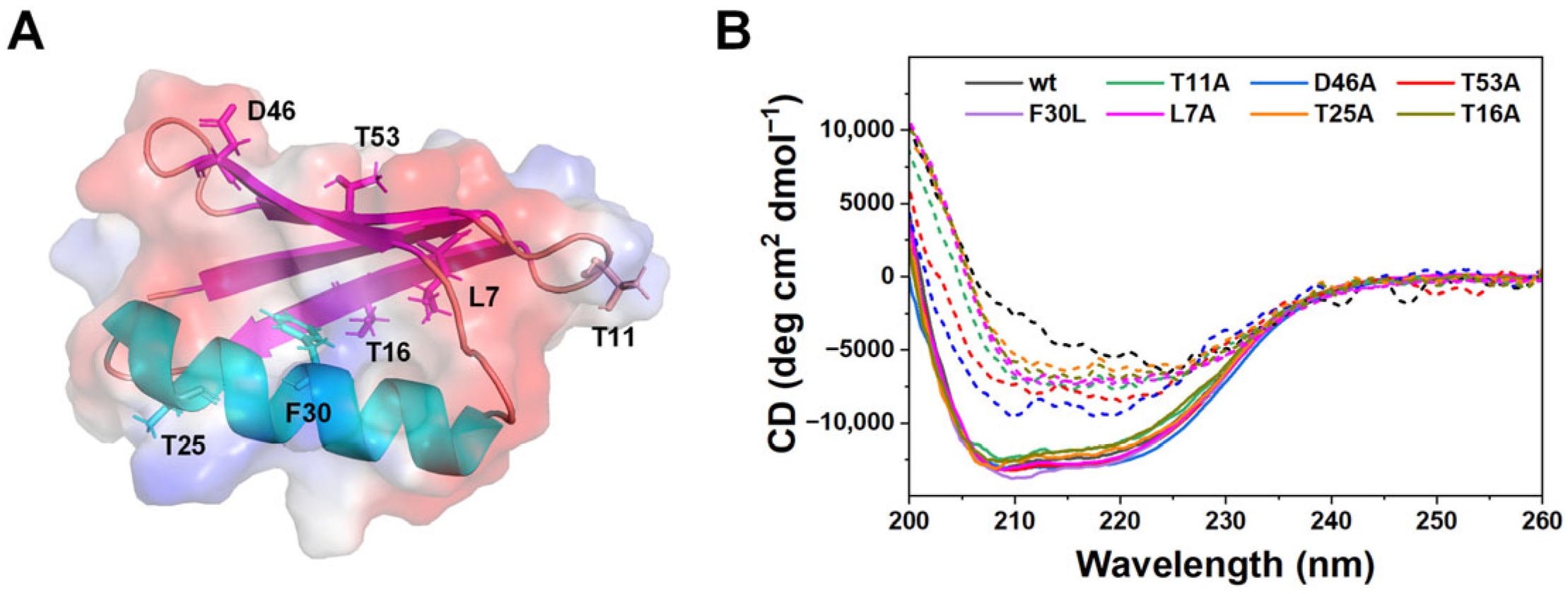
3.1. Native Fold Preservation and Surface-Induced Unfolding of GB1 Variants
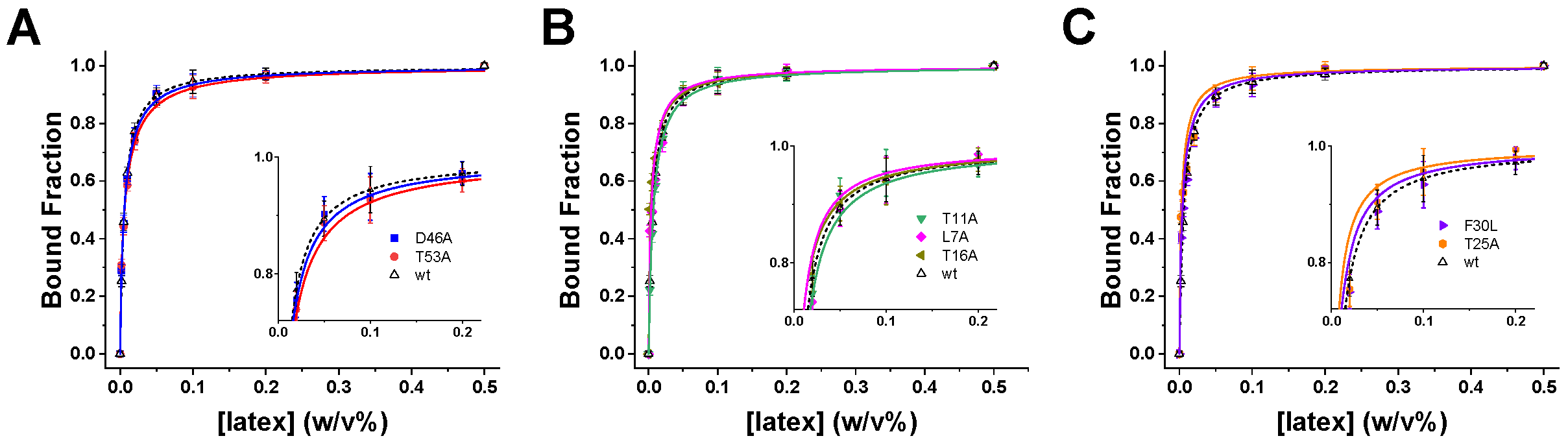
3.2. Adsorption Equilibria and Binding Affinity of GB1 Variants
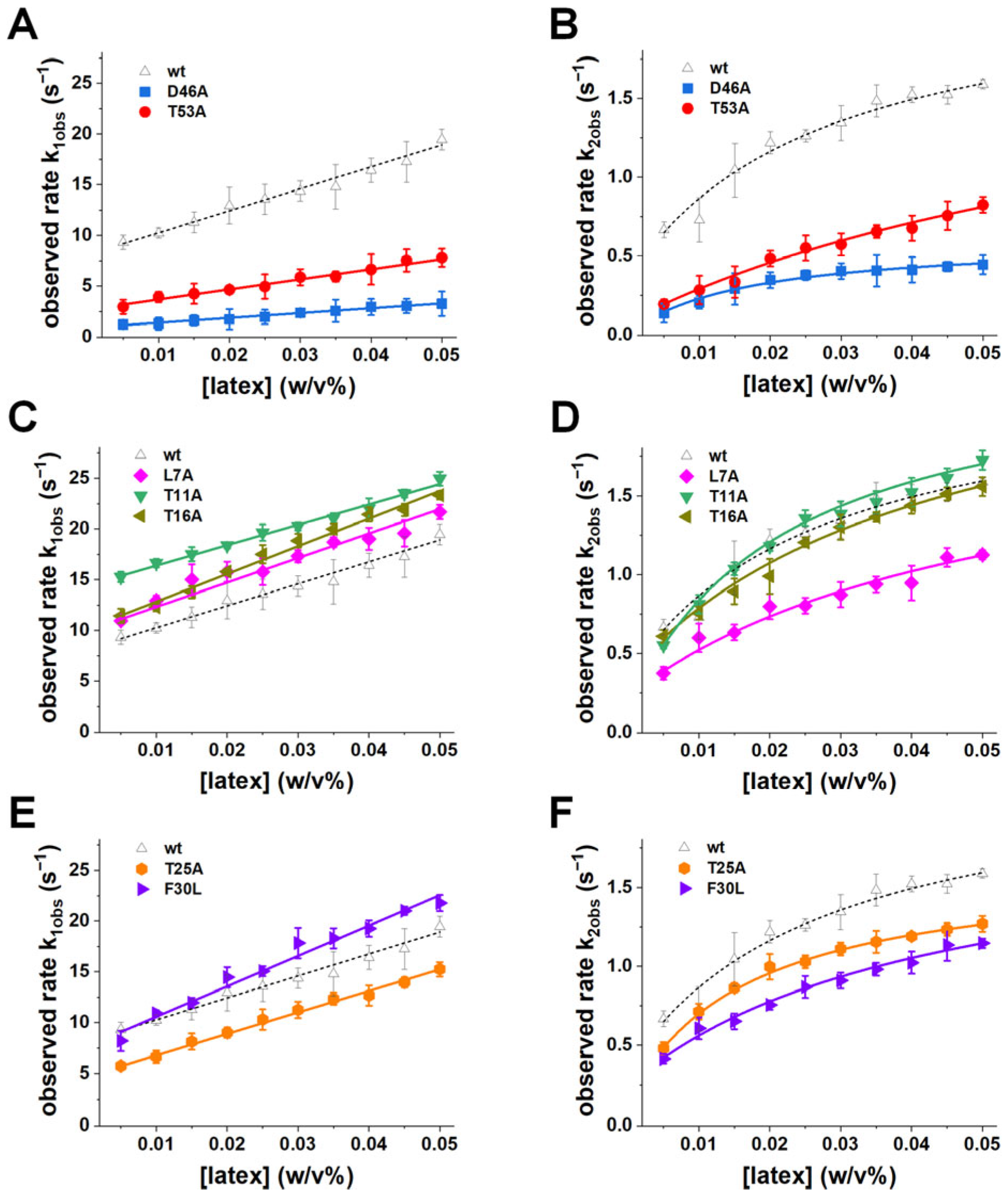
3.3. Kinetic Pathways of Adsorption-Induced Unfolding
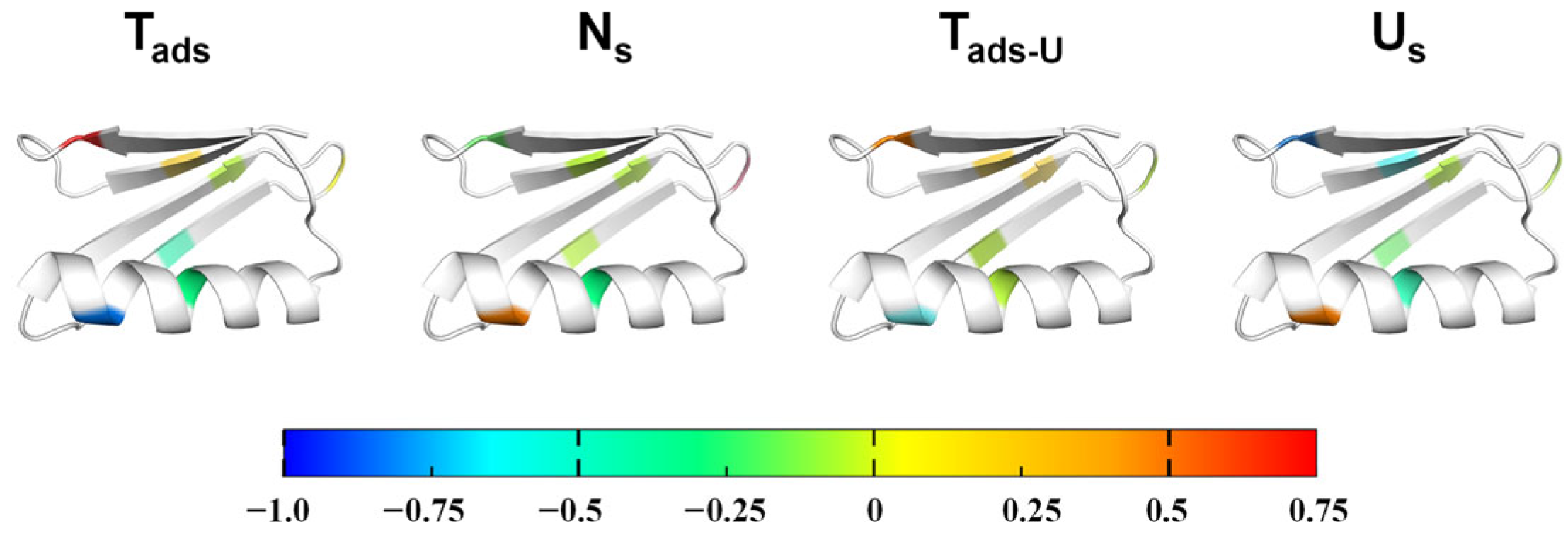
3.4. Φ-Value Analysis of Adsorption Transition States
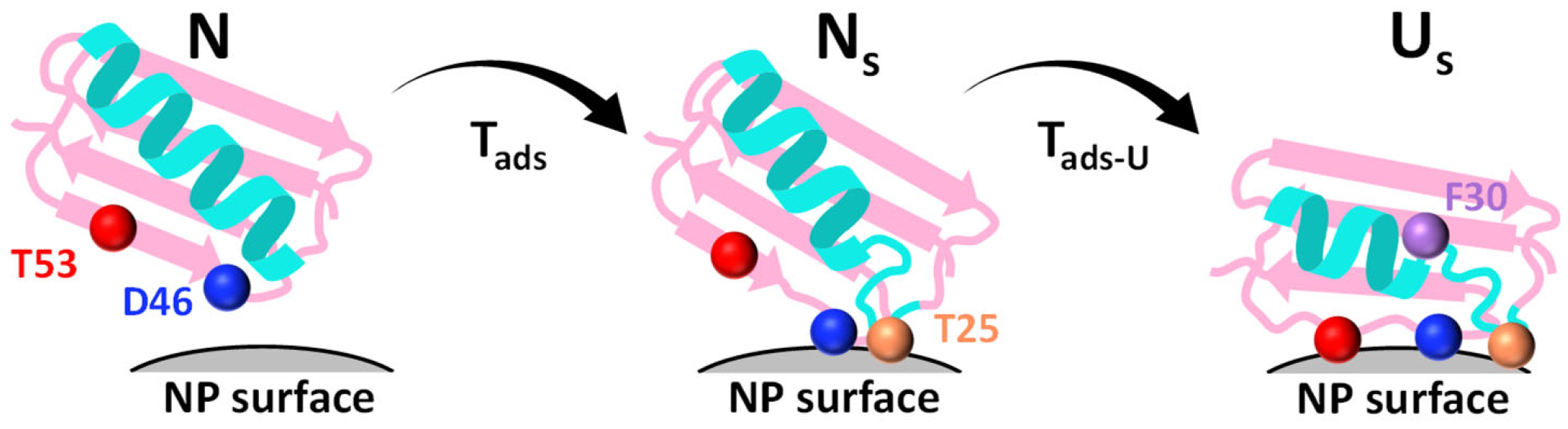
3.5. Mechanistic Model of GB1 Adsorption and Unfolding
4. Conclusions
Supplementary Materials
Author Contributions
Funding
Institutional Review Board Statement
Informed Consent Statement
Data Availability Statement
Conflicts of Interest
Abbreviations
| GB1 | The B1 domain of streptococcal protein G |
| Far-UV | Far ultraviolet |
| CD | Circular dichroism |
References
- Mayordomo, N.M.; Zatarain-Beraza, A.; Valerio, F.; Alvarez-Mendez, V.; Turegano, P.; Herranz-Garcia, L.; Lopez de Aguileta, A.; Cattani, N.; Alvarez-Alonso, A.; Fanarraga, M.L. The Protein Corona Paradox: Challenges in Achieving True Biomimetics in Nanomedicines. Biomimetics 2025, 10, 276. [Google Scholar] [CrossRef]
- Ma, X.; Zhao, Y.; Liang, X.J. Theranostic nanoparticles engineered for clinic and pharmaceutics. Acc. Chem. Res. 2011, 44, 1114–1122. [Google Scholar] [CrossRef] [PubMed]
- Mahmoudi, M.; Landry, M.P.; Moore, A.; Coreas, R. The protein corona from nanomedicine to environmental science. Nat. Rev. Mater. 2023, 8, 422–438. [Google Scholar] [CrossRef]
- Farokhzad, O.C.; Langer, R. Impact of nanotechnology on drug delivery. ACS Nano 2009, 3, 16–20. [Google Scholar] [CrossRef]
- Bertrand, N.; Grenier, P.; Mahmoudi, M.; Lima, E.M.; Appel, E.A.; Dormont, F.; Lim, J.M.; Karnik, R.; Langer, R.; Farokhzad, O.C. Mechanistic understanding of in vivo protein corona formation on polymeric nanoparticles and impact on pharmacokinetics. Nat. Commun. 2017, 8, 777. [Google Scholar] [CrossRef]
- Ban, Z.; Yuan, P.; Yu, F.; Peng, T.; Zhou, Q.; Hu, X. Machine learning predicts the functional composition of the protein corona and the cellular recognition of nanoparticles. Proc. Natl. Acad. Sci. USA 2020, 117, 10492–10499. [Google Scholar] [CrossRef]
- Fleischer, C.C.; Payne, C.K. Nanoparticle-cell interactions: Molecular structure of the protein corona and cellular outcomes. Acc. Chem. Res. 2014, 47, 2651–2659. [Google Scholar] [CrossRef]
- Bashiri, G.; Padilla, M.S.; Swingle, K.L.; Shepherd, S.J.; Mitchell, M.J.; Wang, K. Nanoparticle protein corona: From structure and function to therapeutic targeting. Lab Chip 2023, 23, 1432–1466. [Google Scholar] [CrossRef] [PubMed]
- Dominguez-Medina, S.; Kisley, L.; Tauzin, L.J.; Hoggard, A.; Shuang, B.; Indrasekara, A.S.; Chen, S.; Wang, L.Y.; Derry, P.J.; Liopo, A.; et al. Adsorption and Unfolding of a Single Protein Triggers Nanoparticle Aggregation. ACS Nano 2016, 10, 2103–2112. [Google Scholar] [CrossRef] [PubMed]
- Deng, Z.J.; Liang, M.; Monteiro, M.; Toth, I.; Minchin, R.F. Nanoparticle-induced unfolding of fibrinogen promotes Mac-1 receptor activation and inflammation. Nat. Nanotechnol. 2011, 6, 39–44. [Google Scholar] [CrossRef]
- Zhang, X.; Niebuur, B.J.; Chytil, P.; Etrych, T.; Filippov, S.K.; Kikhney, A.; Wieland, D.C.F.; Svergun, D.I.; Papadakis, C.M. Macromolecular pHPMA-Based Nanoparticles with Cholesterol for Solid Tumor Targeting: Behavior in HSA Protein Environment. Biomacromolecules 2018, 19, 470–480. [Google Scholar] [CrossRef]
- Rampado, R.; Crotti, S.; Caliceti, P.; Pucciarelli, S.; Agostini, M. Recent Advances in Understanding the Protein Corona of Nanoparticles and in the Formulation of “Stealthy” Nanomaterials. Front. Bioeng. Biotechnol. 2020, 8, 166. [Google Scholar] [CrossRef]
- Sousa, A.A.; Schuck, P.; Hassan, S.A. Biomolecular interactions of ultrasmall metallic nanoparticles and nanoclusters. Nanoscale Adv. 2021, 3, 2995–3027. [Google Scholar] [CrossRef]
- Xu, J.X.; Alom, M.S.; Yadav, R.; Fitzkee, N.C. Predicting protein function and orientation on a gold nanoparticle surface using a residue-based affinity scale. Nat. Commun. 2022, 13, 7313. [Google Scholar] [CrossRef] [PubMed]
- Park, S.J. Protein-Nanoparticle Interaction: Corona Formation and Conformational Changes in Proteins on Nanoparticles. Int. J. Nanomed. 2020, 15, 5783–5802. [Google Scholar] [CrossRef]
- Somarathne, R.P.; Amarasekara, D.L.; Kariyawasam, C.S.; Robertson, H.A.; Mayatt, R.; Gwaltney, S.R.; Fitzkee, N.C. Protein Binding Leads to Reduced Stability and Solvated Disorder in the Polystyrene Nanoparticle Corona. Small 2024, 20, e2305684. [Google Scholar] [CrossRef]
- Wang, X.; Lei, R.; Li, L.; Fei, X.; Ju, R.; Sun, X.; Cao, H.; Zhang, Q.; Chen, C.; Wang, X. Rearrangement of protein structures on a gold nanoparticle surface is regulated by ligand adsorption modes. Nanoscale 2021, 13, 20425–20436. [Google Scholar] [CrossRef]
- Guo, X.; Wang, J.; Zhang, J.; Wang, W. Conformational phase diagram for proteins absorbed on ultra-small nanoparticles studied by a structure-based coarse-grained model. Mol. Simul. 2014, 41, 1200–1211. [Google Scholar] [CrossRef]
- Mahmoudi, M.; Lynch, I.; Ejtehadi, M.R.; Monopoli, M.P.; Bombelli, F.B.; Laurent, S. Protein-nanoparticle interactions: Opportunities and challenges. Chem. Rev. 2011, 111, 5610–5637. [Google Scholar] [CrossRef] [PubMed]
- Ghosh, G.; Panicker, L. Protein-nanoparticle interactions and a new insight. Soft Matter 2021, 17, 3855–3875. [Google Scholar] [CrossRef]
- Payne, C.K. A protein corona primer for physical chemists. J. Chem. Phys. 2019, 151, 130901. [Google Scholar] [CrossRef]
- Lee, H. Effects of Nanoparticle Electrostatics and Protein-Protein Interactions on Corona Formation: Conformation and Hydrodynamics. Small 2020, 16, e1906598. [Google Scholar] [CrossRef]
- Sheng, Y.; Wang, W.; Chen, P. Interaction of an ionic complementary peptide with a hydrophobic graphite surface. Protein Sci. 2010, 19, 1639–1648. [Google Scholar] [CrossRef]
- Penna, M.J.; Mijajlovic, M.; Biggs, M.J. Molecular-Level Understanding of Protein Adsorption at the Interface between Water and a Strongly Interacting Uncharged Solid Surface. J. Am. Chem. Soc. 2014, 136, 5323–5331. [Google Scholar] [CrossRef]
- Gronenborn, A.M.; Filpula, D.R.; Essig, N.Z.; Achari, A.; Whitlow, M.; Wingfield, P.T.; Clore, G.M. A novel, highly stable fold of the immunoglobulin binding domain of streptococcal protein G. Science 1991, 253, 657–661. [Google Scholar] [CrossRef] [PubMed]
- McCallister, E.L.; Alm, E.; Baker, D. Critical role of beta-hairpin formation in protein G folding. Nat. Struct. Biol. 2000, 7, 669–673. [Google Scholar] [CrossRef] [PubMed]
- Alexander, P.; Orban, J.; Bryan, P. Kinetic analysis of folding and unfolding the 56 amino acid IgG-binding domain of streptococcal protein G. Biochemistry 1992, 31, 7243–7248. [Google Scholar] [CrossRef] [PubMed]
- Park, S.H.; Shastry, M.C.; Roder, H. Folding dynamics of the B1 domain of protein G explored by ultrarapid mixing. Nat. Struct. Biol. 1999, 6, 943–947. [Google Scholar] [CrossRef]
- Guo, Z.; Hong, H.; Yuan, G.; Qian, H.; Li, B.; Cao, Y.; Wang, W.; Wu, C.X.; Chen, H. Hidden Intermediate State and Second Pathway Determining Folding and Unfolding Dynamics of GB1 Protein at Low Forces. Phys. Rev. Lett. 2020, 125, 198101. [Google Scholar] [CrossRef]
- Pan, H.; Qin, M.; Meng, W.; Cao, Y.; Wang, W. How Do Proteins Unfold upon Adsorption on Nanoparticle Surfaces? Langmuir 2012, 28, 12779–12787. [Google Scholar] [CrossRef]
- Xiao, H.; Huang, B.; Yao, G.; Kang, W.; Gong, S.; Pan, H.; Cao, Y.; Wang, J.; Zhang, J.; Wang, W. Atomistic simulation of the coupled adsorption and unfolding of protein GB1 on the polystyrenes nanoparticle surface. Sci. China Phys. Mech. Astron. 2018, 61, 038711. [Google Scholar] [CrossRef]
- Engel, M.F.; van Mierlo, C.P.; Visser, A.J. Kinetic and structural characterization of adsorption-induced unfolding of bovine alpha -lactalbumin. J. Biol. Chem. 2002, 277, 10922–10930. [Google Scholar] [CrossRef]
- Tsai, D.H.; DelRio, F.W.; Keene, A.M.; Tyner, K.M.; MacCuspie, R.I.; Cho, T.J.; Zachariah, M.R.; Hackley, V.A. Adsorption and conformation of serum albumin protein on gold nanoparticles investigated using dimensional measurements and in situ spectroscopic methods. Langmuir 2011, 27, 2464–2477. [Google Scholar] [CrossRef]
- Halder, K.; Sengupta, P.; Chaki, S.; Saha, R.; Dasgupta, S. Understanding Conformational Changes in Human Serum Albumin and Its Interactions with Gold Nanorods: Do Flexible Regions Play a Role in Corona Formation? Langmuir 2023, 39, 1651–1664. [Google Scholar] [CrossRef]
- Nasir, I.; Lundqvist, M.; Cabaleiro-Lago, C. Size and surface chemistry of nanoparticles lead to a variant behavior in the unfolding dynamics of human carbonic anhydrase. Nanoscale 2015, 7, 17504–17515. [Google Scholar] [CrossRef]
- Gronenborn, A.M.; Frank, M.K.; Clore, G.M. Core mutants of the immunoglobulin binding domain of streptococcal protein G: Stability and structural integrity. FEBS Lett. 1996, 398, 312–316. [Google Scholar] [CrossRef]
- Sakaguchi, N.; Onoda, A.; Omata, K.; Umezawa, M. Changes in the Protein Secondary Structure on the Surface of Silica Nanoparticles with Different Sizes. Langmuir 2025, 41, 15143–15148. [Google Scholar] [CrossRef] [PubMed]
- Dai, J.; Chen, C.; Yin, M.; Li, H.; Li, W.; Zhang, Z.; Wang, Q.; Du, Z.; Xu, X.; Wang, Y. Interactions between gold nanoparticles with different morphologies and human serum albumin. Front. Chem. 2023, 11, 1273388. [Google Scholar] [CrossRef]
- Wang, G.; Lu, Y.; Hou, H.; Liu, Y. Probing the binding behavior and kinetics of silver nanoparticles with bovine serum albumin. RSC Adv. 2017, 7, 9393–9401. [Google Scholar] [CrossRef]
- Jarmoskaite, I.; AlSadhan, I.; Vaidyanathan, P.P.; Herschlag, D. How to measure and evaluate binding affinities. eLife 2020, 9, e57264. [Google Scholar] [CrossRef] [PubMed]
- Liu, J.; Liao, C.; Zhou, J. Multiscale Simulations of Protein G B1 Adsorbed on Charged Self-Assembled Monolayers. Langmuir 2013, 29, 11366–11374. [Google Scholar] [CrossRef] [PubMed]
- Lima, A.F.; Sousa, A.A. Kinetics and Timescales in Bio–Nano Interactions. Physchem 2023, 3, 385–410. [Google Scholar] [CrossRef]
- Jaiswal, S.; Manhas, A.; Pandey, A.K.; Priya, S.; Sharma, S.K. Engineered Nanoparticle-Protein Interactions Influence Protein Structural Integrity and Biological Significance. Nanomaterials 2022, 12, 1214. [Google Scholar] [CrossRef]
- Pustulka, S.M.; Ling, K.; Pish, S.L.; Champion, J.A. Protein Nanoparticle Charge and Hydrophobicity Govern Protein Corona and Macrophage Uptake. ACS Appl. Mater. Interfaces 2020, 12, 48284–48295. [Google Scholar] [CrossRef]
- Matouschek, A.; Kellis, J.T., Jr.; Serrano, L.; Fersht, A.R. Mapping the transition state and pathway of protein folding by protein engineering. Nature 1989, 340, 122–126. [Google Scholar] [CrossRef]
- Fersht, A.R.; Sato, S. Phi-value analysis and the nature of protein-folding transition states. Proc. Natl. Acad. Sci. USA 2004, 101, 7976–7981. [Google Scholar] [CrossRef]
- Fersht, A.R. From covalent transition states in chemistry to noncovalent in biology: From beta- to Phi-value analysis of protein folding. Q. Rev. Biophys. 2024, 57, e4. [Google Scholar] [CrossRef] [PubMed]
- Sheibani, S.; Basu, K.; Farnudi, A.; Ashkarran, A.; Ichikawa, M.; Presley, J.F.; Bui, K.H.; Ejtehadi, M.R.; Vali, H.; Mahmoudi, M. Nanoscale characterization of the biomolecular corona by cryo-electron microscopy, cryo-electron tomography, and image simulation. Nat. Commun. 2021, 12, 573. [Google Scholar] [CrossRef] [PubMed]
- Cipriani, B.; Lopez, H.; Brancolini, G. Distinct binding strategies of plasma proteins on gold surfaces: Flexibility versus stability in the protein corona formation. Front. Nanotechnol. 2025, 7, 1603727. [Google Scholar] [CrossRef]
- Rankovic, S.; Carr, K.D.; Decarreau, J.; Skotheim, R.; Kibler, R.D.; Ols, S.; Lee, S.; Chun, J.H.; Tooley, M.R.; Dauparas, J.; et al. Computational design of bifaceted protein nanomaterials. Nat. Mater. 2025, 24, 1635–1643. [Google Scholar] [CrossRef]
- Satzer, P.; Svec, F.; Sekot, G.; Jungbauer, A. Protein adsorption onto nanoparticles induces conformational changes: Particle size dependency, kinetics, and mechanisms. Eng. Life Sci. 2016, 16, 238–246. [Google Scholar] [CrossRef] [PubMed]
- Lee, S.; Jiao, M.; Zhang, Z.; Yu, Y. Nanoparticles for Interrogation of Cell Signaling. Annu. Rev. Anal. Chem. 2023, 16, 333–351. [Google Scholar] [CrossRef] [PubMed]





| wt * | D46A | T53A | F30L | T25A | L7A | T11A | T16A | |
|---|---|---|---|---|---|---|---|---|
| Ked (M) | 0.069 ± 0.007 | 0.101 ± 0.012 | 0.085 ± 0.004 | 0.048 ± 0.002 | 0.066 ± 0.003 | 0.058 ± 0.003 | 0.076 ± 0.004 | 0.074 ± 0.002 |
| n (M (w/v)−1) | 11.7 ± 1.2 | 16.82 ± 2.3 | 13.56 ± 1.6 | 9.56 ± 1.4 | 17.01 ± 2.6 | 11.59 ± 1.2 | 11.2 ± 1.1 | 12.64 ± 1.3 |
| wt * | D46A | T53A | F30L | T25A | L7A | T11A | T16A | |
|---|---|---|---|---|---|---|---|---|
| koff (s−1) | 8.20 ± 0.42 | 0.89 ± 0.09 | 2.61 ± 0.14 | 7.76 ± 0.48 | 4.95 ± 0.23 | 10.90 ± 0.45 | 14.37 ± 0.21 | 10.11 ± 0.63 |
| kon (M−1·s−1) | 17.87 ± 1.14 | 2.87 ± 0.18 | 7.65 ± 0.32 | 30.91 ± 1.60 | 12.02 ± 0.44 | 18.13 ± 1.25 | 18.02 ± 0.61 | 21.69 ± 1.55 |
| kf (s−1) | 0.38 ± 0.08 | 0.012 ± 0.04 | 0.044 ± 0.011 | 0.16 ± 0.03 | 0.25 ± 0.05 | 0.19 ± 0.04 | 0.34 ± 0.03 | 0.33 ± 0.04 |
| ku (s−1) | 2.24 ± 0.18 | 0.61 ± 0.09 | 1.04 ± 0.09 | 1.45 ± 0.07 | 1.56 ± 0.08 | 1.93 ± 0.11 | 3.52 ± 0.12 | 2.10 ± 0.11 |
| Φ | wt | D46A | T53A | F30L | T25A | L7A | T11A | T16A |
|---|---|---|---|---|---|---|---|---|
| Φads | - | 0.63 | 0.26 | −0.23 | −1.05 | −0.01 | −0.02 | −0.42 |
| ΦNs | - | −0.14 | −0.09 | −0.26 | 0.32 | 0.09 | 0.53 | 0 |
| Φads-U | - | 0.3 | 0.14 | −0.08 | −0.64 | 0.13 | 0.08 | 0.08 |
| ΦUs | - | −0.88 | −0.53 | −0.44 | 0.5 | −0.1 | −0.03 | −0.16 |
Disclaimer/Publisher’s Note: The statements, opinions and data contained in all publications are solely those of the individual author(s) and contributor(s) and not of MDPI and/or the editor(s). MDPI and/or the editor(s) disclaim responsibility for any injury to people or property resulting from any ideas, methods, instructions or products referred to in the content. |
© 2026 by the authors. Licensee MDPI, Basel, Switzerland. This article is an open access article distributed under the terms and conditions of the Creative Commons Attribution (CC BY) license.
Share and Cite
Liu, T.; Bian, Y.; Wang, S.; Li, Y.; Cao, Y.; Jiao, Y.; Pan, H. Residue-Specific Dock-Loosen-Unfold Mechanism of GB1 on Nanoparticle Surfaces Revealed by Kinetic and Φ-Value Analysis. Biomolecules 2026, 16, 114. https://doi.org/10.3390/biom16010114
Liu T, Bian Y, Wang S, Li Y, Cao Y, Jiao Y, Pan H. Residue-Specific Dock-Loosen-Unfold Mechanism of GB1 on Nanoparticle Surfaces Revealed by Kinetic and Φ-Value Analysis. Biomolecules. 2026; 16(1):114. https://doi.org/10.3390/biom16010114
Chicago/Turabian StyleLiu, Tingting, Yunqiang Bian, Siyu Wang, Yang Li, Yi Cao, Yonghua Jiao, and Hai Pan. 2026. "Residue-Specific Dock-Loosen-Unfold Mechanism of GB1 on Nanoparticle Surfaces Revealed by Kinetic and Φ-Value Analysis" Biomolecules 16, no. 1: 114. https://doi.org/10.3390/biom16010114
APA StyleLiu, T., Bian, Y., Wang, S., Li, Y., Cao, Y., Jiao, Y., & Pan, H. (2026). Residue-Specific Dock-Loosen-Unfold Mechanism of GB1 on Nanoparticle Surfaces Revealed by Kinetic and Φ-Value Analysis. Biomolecules, 16(1), 114. https://doi.org/10.3390/biom16010114