
Review

Harnessing Microbiome, Bacterial Extracellular Vesicle, and Artificial Intelligence for Polycystic Ovary Syndrome Diagnosis and Management

Department of Biochemistry and Molecular Biology, Indiana University, Indianapolis, IN 46202, USA
*
Author to whom correspondence should be addressed.
Biomolecules 2025, 15(6), 834; https://doi.org/10.3390/biom15060834
Submission received: 2 April 2025 / Revised: 1 June 2025 / Accepted: 4 June 2025 / Published: 7 June 2025
(This article belongs to the Special Issue Molecular Aspects of Female Infertility)

Abstract

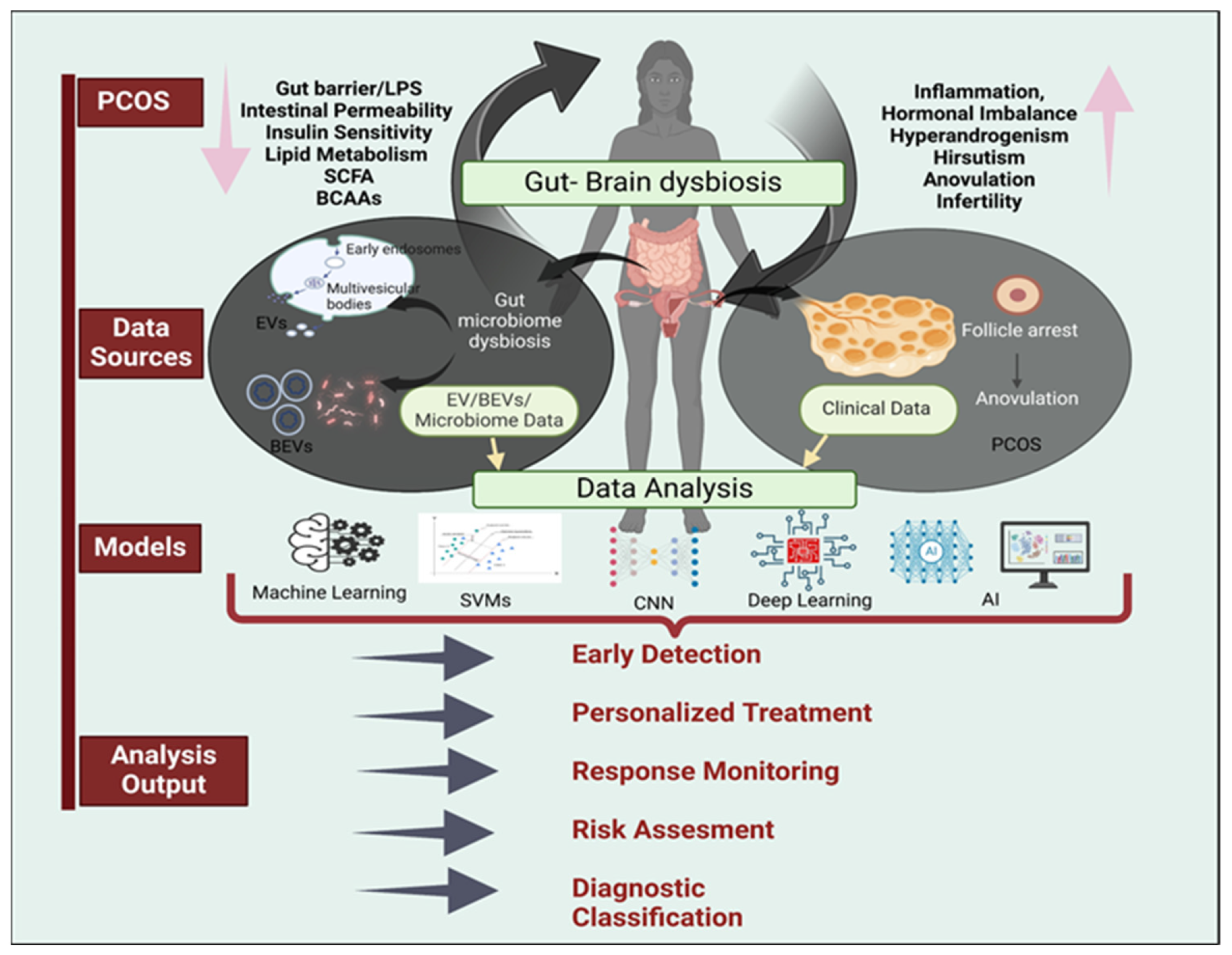
Polycystic ovary syndrome (PCOS) affects 6–19% of reproductive-age women worldwide, yet diagnosis remains challenging due to heterogeneous presentations and symptoms overlapping with other endocrine disorders. Recent studies have shown that gut dysbiosis plays a significant role in PCOS pathophysiology, with bacterial extracellular vesicles (BEVs) functioning as critical mediators of the gut–ovary axis. BEVs carry distinct cargos in PCOS patients—including specific miRNAs and inflammatory proteins—and show promise for both diagnostic and therapeutic applications. Artificial intelligence (AI) is emerging as a promising significant tool in PCOS research due to improved diagnostic accuracy and the capability to analyze complex datasets combining microbiome, BEV, and clinical parameters. These integrated approaches have the potential to better address PCOS multifactorial nature, enabling improved phenotypic classification and personalized treatment strategies. This review examines recent advances in the last 25 years in microbiome, BEV, and AI applications in PCOS research using PubMed, Web of Science, and Scopus databases. We explore the diagnostic potential of the AI-driven analysis of microbiome and BEV profiles, and address ethical considerations including data privacy and algorithmic bias. As these technologies continue to evolve, they hold increasing potential for the improvement of PCOS diagnosis and management, including the development of safer, more precise, and effective interventions.
Keywords: polycystic ovary syndrome (PCOS); artificial intelligence (AI); microbiome; extracellular vesicles (EV); bacterial extracellular vesicles (BEV); ovary; AI in PCOS diagnostic polycystic ovary syndrome (PCOS); artificial intelligence (AI); microbiome; extracellular vesicles (EV); bacterial extracellular vesicles (BEV); ovary; AI in PCOS diagnostic