Sub-Lethal 5-Fluorouracil Dose Challenges Planarian Stem Cells Promoting Transcriptional Profile Changes in the Pluripotent Sigma-Class Neoblasts
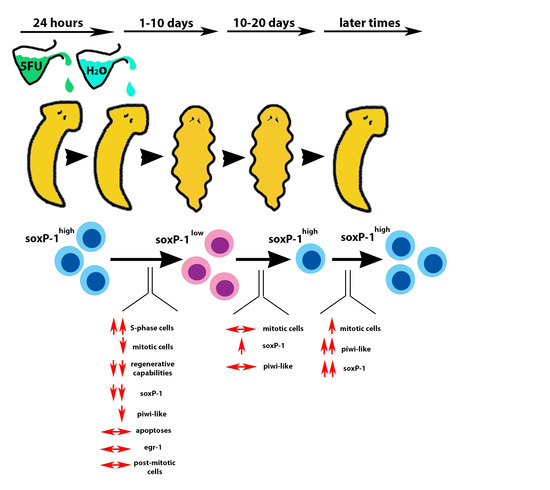
Abstract
Share and Cite
Gambino, G.; Ippolito, C.; Evangelista, M.; Salvetti, A.; Rossi, L. Sub-Lethal 5-Fluorouracil Dose Challenges Planarian Stem Cells Promoting Transcriptional Profile Changes in the Pluripotent Sigma-Class Neoblasts. Biomolecules 2021, 11, 949. https://doi.org/10.3390/biom11070949
Gambino G, Ippolito C, Evangelista M, Salvetti A, Rossi L. Sub-Lethal 5-Fluorouracil Dose Challenges Planarian Stem Cells Promoting Transcriptional Profile Changes in the Pluripotent Sigma-Class Neoblasts. Biomolecules. 2021; 11(7):949. https://doi.org/10.3390/biom11070949
Chicago/Turabian StyleGambino, Gaetana, Chiara Ippolito, Monica Evangelista, Alessandra Salvetti, and Leonardo Rossi. 2021. "Sub-Lethal 5-Fluorouracil Dose Challenges Planarian Stem Cells Promoting Transcriptional Profile Changes in the Pluripotent Sigma-Class Neoblasts" Biomolecules 11, no. 7: 949. https://doi.org/10.3390/biom11070949
APA StyleGambino, G., Ippolito, C., Evangelista, M., Salvetti, A., & Rossi, L. (2021). Sub-Lethal 5-Fluorouracil Dose Challenges Planarian Stem Cells Promoting Transcriptional Profile Changes in the Pluripotent Sigma-Class Neoblasts. Biomolecules, 11(7), 949. https://doi.org/10.3390/biom11070949