Article

Analytical Study of Electron-Driven Ionization Dynamics and Plasma Formation in Intense Laser Fields

by
Hristina Delibašić-Marković
1,*,
Veljko Vujčić
2,*,
Vladimir A. Srećković
3 and
Violeta Petrović
1
1
Faculty of Science, Department of Physics, University of Kragujevac, Radoja Domanovića 12, 34000 Kragujevac, Serbia
2
Astronomical Observatory, Volgina 7, 11060 Belgrade, Serbia
3
Institute of Physics Belgrade, University of Belgrade, Pregrevica 118, 11080 Belgrade, Serbia
*
Authors to whom correspondence should be addressed.
Atoms 2026, 14(5), 39; https://doi.org/10.3390/atoms14050039
Submission received: 28 March 2026 / Revised: 13 May 2026 / Accepted: 19 May 2026 / Published: 20 May 2026

Abstract

Laser-induced breakdown in water-rich biological media results from the interplay between primary photoionization processes and avalanche amplification of free electrons. Understanding this competition is essential for predicting ablation thresholds under ultrashort-pulse irradiation. In this work, we develop an analytical rate-equation model for the buildup of electron density in water-like biological tissues. It combines photoionization and chromophore ionization into a single seed-generation term, while avalanche ionization is described through a cascade gain factor. This formulation provides a framework for describing cascade electron-impact ionization processes in liquid-like media under strong-field excitation. Our approach gives an analytical expression for the temporal evolution of electron density driven by a Gaussian laser pulse and makes it possible to separate the contributions of direct ionization of water and ionization of chromophore centers. The analytical results are compared with numerical simulations that include carrier diffusion, bimolecular recombination and trapping. The comparison clarifies the roles of seed formation and cascade amplification in the growth of the electron population. The predicted dependence of threshold fluence on pulse duration agrees well with experimental data reported for water-like tissues such as the corneal tissues at a wavelength of 800 nm. The model provides a simple analytical picture of ultrafast plasma formation and electron-driven energy deposition in water-like biological media.

1. Introduction

Laser-induced breakdown (LIB) in transparent and water-rich media is governed by the generation and subsequent amplification of free electrons in a strong electromagnetic field. From a microscopic perspective, the growth of the free-electron population is strongly influenced by electron-driven impact processes, which govern the redistribution of energy and secondary ionization events in the medium. In this sense, LIB can be viewed as a coupled photoionization-electron impact ionization process, particularly in dense, water-like environments. The interplay between these microscopic ionization mechanisms directly determines the efficiency and localization of energy deposition in the medium. This process underlies a wide range of applications, including laser surgery, ophthalmology, and precision micromachining, and is more generally relevant for understanding energy deposition in systems such as laboratory plasmas and radiation-matter interaction, where electron-driven impact ionization plays a fundamental role [1,2,3,4]. For ultrashort laser pulses, the initial free-electron population is typically described through photoionization (PI) mechanisms, most notably multiphoton ionization (MPI) and tunneling ionization (TI), whose relative contribution depends on the Keldysh parameter and the laser wavelength [5,6]. In water and biological tissues, often approximated as wide-bandgap dielectric systems with an effective ionization energy of approximately 6.5–9 eV, these mechanisms define the seed electron density that initiates breakdown [7,8,9]. This energy scale determines the effective multiphoton order and leads to a pronounced wavelength dependence, with more efficient seed generation at shorter wavelengths, while at longer wavelengths the reduced seed efficiency enhances the relative importance of avalanche growth [3,8].
The subsequent evolution of the electron density is dominated by cascade (avalanche) ionization (CI), which amplifies the initial seed population through impact processes. Classical descriptions of optical breakdown in water and tissues can be traced to the models of Noack and Vogel [10] and Stuart et al. [11] and later extended by Loesel, Venugopalan, Rogov and others within the rate-equation framework [3,12,13]. These models successfully reproduce experimentally observed breakdown thresholds but are most often implemented numerically. While such approaches capture the full dynamics, they tend to obscure the relative roles of individual ionization mechanisms and make it difficult to extract simple scaling relations with respect to laser and material parameters. This limitation becomes particularly important in biologically relevant, water-rich media. Tissues such as the corneal epithelium and stroma (with a water content of about 78–85%) are commonly treated as effective dielectrics, but their response is modified by molecular constituents [3,12]. In addition to MPI and TI, seed electrons can be generated through chromophore-assisted (CH) absorption processes, while the subsequent dynamics are influenced by additional loss mechanisms, including recombination, diffusion, and trapping into localized or hydrated states [12]. Chromophore centers may also contribute to secondary electron generation through electron-impact excitation and ionization during cascade development [7,8,9,10]. Additional intermolecular ionization pathways, such as collective autoionization and intermolecular Coulombic decay (ICD), can further promote secondary electron emission through energy transfer between neighboring molecules or chromophore centers following multiphoton excitation [13,14]. Within the present framework, the electron-density dynamics are described through effective seed generation by MPI, TI, and chromophore-assisted ionization, followed by cascade amplification. In the standard description of ultrafast optical breakdown in water-rich media, the initially generated seed electrons gain energy through inverse Bremsstrahlung (IB) absorption and subsequently induce additional impact ionization events, leading to avalanche growth of the free-electron population. Qualitative illustrations of these coupled processes are presented by Vogel and coworkers in Ref. [1] and in many later studies based on the similar physical framework [2,3,4,10,11]. In heterogeneous biological environments, however, additional cumulative absorption pathways associated with chromophore centers may also contribute to the formation and temporal redistribution of the initial seed electron population prior to cascade amplification. At the same time, in water-rich and condensed aqueous media, the subsequent electron dynamics are further influenced by ultrafast localization, trapping, and solvation processes. In liquid water, the formation of pre-solvated electrons occurs on sub-picosecond timescales (typically 100–300 fs), followed by full solvation on a few-picosecond scale, which directly competes with CI during the pulse [15]. These effects are often omitted or only partially included in analytical descriptions, although they can significantly affect both the magnitude and temporal evolution of the electron density. Additionally, in dense molecular environments, recombination and trapping dynamics may also be accompanied by additional intermolecular interactions and correlated decay pathways contributing to secondary electron production [16,17].
In this work, we develop an analytically tractable rate-equation model for the evolution of free-electron density in water-like biological media. The model introduces a unified source term that combines MPI, TI, and CH ionization, while CI is retained as a separate amplification mechanism. The resulting backbone equation admits a closed-form analytical solution in the lossless case, which provides direct insight into the scaling of electron density with laser parameters and serves as a natural starting point for incorporating loss mechanisms. This formulation allows the total electron density to be decomposed into physically interpretable contributions and enables analytical estimates of breakdown-related quantities, such as threshold fluence, without relying exclusively on numerical simulations. The analytical results are validated against numerical solutions that include recombination, diffusion, and trapping and are further compared with experimental data for corneal tissues [18], establishing a direct link between the model and observable breakdown behavior. Finally, the present work contributes to the theoretical description of electron-driven ionization dynamics in complex media under ultrafast excitation conditions.
The paper is organized as follows: Section 2 introduces the theoretical framework and the analytical model. Section 3 presents the results and discussion, including comparison with numerical simulations and experimental data. Section 4 presents the conclusions.

2. Theoretical Framework

To describe the pulse-driven evolution of the free-electron density in water-like biological media, we adopt a rate-equation framework that combines seed electron generation and cascade amplification. The model is formulated in two steps. We first introduce a lossless backbone equation, which admits a closed-form analytical solution and serves to isolate the competition between the source and amplification terms, thereby providing a minimal reference framework in which the intrinsic structure of the ionization channels can be analyzed without the additional complexity of competing loss mechanisms. We then extend the same framework numerically by including trapping, recombination, and diffusion losses and finally relate the resulting electron-density dynamics to the breakdown threshold fluence.

2.1. Free-Electron Density Equation and Model Assumptions

In the present treatment, plasma formation is described through the time evolution of the free-electron density, n e t , generated by an ultrashort laser pulse in a water-like biological medium. The key quantity is therefore not the optical field itself, but the rate at which bound electrons are transferred into quasi-free states and the rate at which this free-electron population is subsequently amplified. In this sense, the model separates two physically different stages of the breakdown process: direct bound-to-free electron generation and free-carrier multiplication.
The first stage is represented by a total source term W S R C ( t ) , which collects all processes that create free electrons directly from bound states. In the present case, this source contains three contributions. The first two are MPI and TI, which correspond to the two-standard strong-field limits of host-medium ionization. The third is CH ionization, introduced here to account for molecular absorption centers embedded in the water-like media. This contribution is particularly relevant where local absorbers can modify the early-stage electron population and are often neglected or treated only implicitly in analytical models (for example, see Refs. [8,19]). Once this initial population has been created, its density may increase much more rapidly through CI, which is treated separately because it does not generate electrons directly from bound states but acts on those already present.
The incident pulse is represented by a Gaussian temporal envelope:
I t = I 0 e x p 4 l n 2 t t p 2 ,
where I 0 is the peak intensity and t p is the full width at half maximum (FWHM) of the pulse, with t p = 100 500 fs and peak intensities of I 0 = 10 12 10 14 W/cm2, corresponding to typical conditions for femtosecond LIB in water-like and corneal media [18,20]. This choice follows the standard treatment used in ultrashort-pulse breakdown models and provides a realistic temporal pulse shape while keeping the rate equation analytically tractable.
With these assumptions, the analytical backbone of the model is written as:
d n e d t = W S R C ( t ) + W C I ( t ) n e ,
where W C I ( t ) is the CI rate and
W S R C ( t ) = W M P I ( t ) + W T I ( t ) + W C H ( t ) .
is the total bound-to-free electron generation rate. In this form, the source term, W S R C ( t ) , determines how the initial free-electron population is built, while the multiplicative CI term determines how efficiently that population grows during the pulse. This separation is the basis of the analytical treatment developed below. Here, W M P I ( t ) , W T I ( t ) , and W C H ( t ) denote the multiphoton, tunneling, and CH ionization rates, respectively. Their explicit forms are adopted from established formulations in the literature, namely Equations (40) and (41) of Keldysh [5] for TI and MPI, respectively, and Equation (5) of Delibašić et al. [21] for CH ionization.
In this work, the MPI and TI contributions are combined in an additive form, following a commonly adopted approach in modeling LIB in dielectric and biological media [22], where individual ionization channels are treated as effective source terms. This formulation is not intended to represent a strict separation of physical mechanisms, but rather a practical approximation that allows different ionization pathways to be incorporated within a unified framework. Such an approach has been widely used in the literature (for example, see Refs. [22,23]) to capture the overall scaling of seed electron generation, particularly in regimes where a fully unified description would significantly complicate the analytical treatment. It should be emphasized that this additive formulation represents an effective approximation rather than a strict separation of physical mechanisms and is primarily intended to preserve analytical transparency while retaining the dominant contributions to seed electron generation.

2.2. Limiting Cases and Their Physical Interpretation

Before solving the full backbone equation, it is useful to examine several limiting cases that isolate the individual channels entering the model. The purpose of this step is not to replace the complete description of optical breakdown, but to separate the physical roles of the terms that appear in Equation (2). In particular, the source term W S R C ( t ) collects all mechanisms that transfer bound electrons into free states, whereas the W C I ( t ) n e term describes the subsequent multiplication of an already existing free-electron population. Earlier work used this strategy for multiphoton and avalanche ionization alone [24]. In the present case, the idea is extended to a broader physical picture: the seed population is not attributed to a single channel but may arise from MPI, TI, and CH ionization, each of which probes a different aspect of free-electron generation in a heterogeneous water-like medium. Considering these limits separately, therefore, provides a clearer interpretation of how the initial electron population is formed, how strongly each mechanism depends on wavelength and absorption, and how the onset of cascade amplification is conditioned by the structure of the source term itself.

2.2.1. Multiphoton Seed Generation

The MPI contribution is considered first, as it isolates the direct creation of free electrons from bound states in the medium, without requiring any pre-existing electron population. In this sense, it provides the most transparent representation of the initial source term entering the full rate-equation model. Physically, this mechanism corresponds to the simultaneous absorption of N photons whose combined energy exceeds the ionization potential, I p , thereby defining the initial seed population that is subsequently amplified by impact (avalanche) processes. Such a separation is consistent with earlier analytical descriptions of ultrashort-pulse plasma-mediated ablation, where the primary ionization stage was treated independently from subsequent cascade growth [24,25]. In the present formulation, however, MPI is not assumed to be the sole seeding mechanism, but rather one component of the total source term introduced in Equation (3).
In the MPI-only limit, the free-electron density obeys:
d n M P I d t = W M P I t ,       n M P I = 0 ,
where the boundary condition reflects the fact that the Gaussian pulse is centered at t = 0 , so that a finite ionization rate exists already on the leading edge of the pulse, t < 0 . Using the Keldysh expression for MPI (see Equation (41) in Ref. [5]) and substituting the Gaussian pulse from Equation (1), the rate can be written in the compact form:
W M P I ( t ) = K M P I e x p a N t 2 e x p 2 β N e x p a t 2 ,
where a = 4 l n 2 / t p 2 is the temporal-width parameter of the pulse, N = I p / ( ω ) + 1 denotes the effective multiphoton order (with x representing the integer part of x ), which, for water-like media with I p 6.5 –9 eV [2,9,13], corresponds to N 4 6 at λ = 800 nm and N 3 4 at λ = 400 nm. The parameter β = I 0 e 2 / ( 2 c m e ω 2 n r ε 0 I p ) quantifies the coupling between the laser intensity and the ionization probability and effectively controls the relative weight of higher-order contributions in the ionization rate. Here, is the reduced Planck constant, ω = 2 π c / λ is the angular frequency of the laser field, e is the elementary charge, c is the speed of light in vacuum, m e is the electron mass, n r is the effective refractive index of the medium, and ε 0 is the vacuum permittivity. For the conditions considered in this study, λ = 400 and 800 nm, while n r is taken in the range 1.33 1.38 , representative of water-like and corneal media [26]. The prefactor in Equation (5) is given by: K M P I = 2 ω / 9 π m e ω / 3 / 2 Φ m 2 N 2 I p / ω 1 / 2 β / 4 N e x p ( 2 N ) , where Φ m is a special function arising in the Keldysh formalism, related to the Dawson integral.
The corresponding electron density is obtained as:
n M P I ( t ) = K M P I t e x p a N τ 2 e x p 2 β N e x p a τ 2 d τ ,
which represents the cumulative contribution of direct multiphoton transitions over the temporal envelope of the pulse. For analytical purposes, Equation (6) may be written as a convergent series by expanding the nested exponential term: e x p 2 β N e x p a τ 2 = m = 0 2 β N m e x p a m τ 2 / m ! , so that the integrand becomes a sum of Gaussian functions, e x p a N τ 2 e x p a m τ 2 = e x p a N + m τ 2 . It is important to state here that this transformation has a clear physical interpretation: the MPI rate can be observed as a weighted sum of effective channels with broadened temporal widths a ( N + m ) , reflecting higher-order intensity-dependent corrections. Therefore, the electron density can then be written as a term-by-term integral: n M P I ( t ) = K M P I m = 0 2 β N m m ! t e x p a N + m τ 2 d τ , where each integral is evaluated using the Gaussian integral: t e x p γ τ 2 d τ = π 1 + e r f γ 1 / 2 t / 2 γ 1 / 2 . This yields the explicit analytical expression:
n M P I t = K M P I π 1 / 2 2 a 1 / 2 m = 0 2 β N m m ! N + m 1 / 2 1 + e r f a N + m 1 / 2 t .
Equation (7) represents the most useful explicit form of the MPI-only solution in the present context. It satisfies the physically appropriate condition n M P I ( ) = 0 , describes the monotonic buildup of the MPI-generated electron density during the pulse, and yields the total direct contribution in the limit t + . Since the effective multiphoton order decreases at shorter wavelengths [5], the MPI channel is expected to contribute more efficiently at shorter wavelengths due to the reduced effective multiphoton order, whereas at longer wavelengths the relative contribution of avalanche growth increases. In addition, the series representation in Equation (7) converges rapidly for moderate values of the parameter β N , corresponding to typical experimental intensities in the femtosecond regime [7,11,18], thereby providing a convenient analytical form. For larger values of β N , where higher-order terms become significant, the integral form given in Equation (6) remains preferable as a more stable and physically transparent representation.

2.2.2. Tunneling Seed Generation

In addition to MPI, seed electrons may also be generated through TI, which becomes relevant in the strong-field regime where the laser field significantly distorts the Coulomb potential and facilitates electron emission via tunneling. In this case, the ionization process is governed primarily by the instantaneous field strength, resulting in a different functional dependence of the ionization rate compared to the multiphoton mechanism. Consequently, the TI contribution represents an additional seed channel that is most pronounced near the peak of the pulse, where the instantaneous field strength is maximal.
When only the tunneling contribution is considered, the free-electron density is governed by:
d n T I d t = W T I t ,       n T I = 0 ,
where the tunneling rate W T I ( t ) describes the direct field-driven emission of electrons and therefore acts as a primary source term in the absence of avalanche processes. Starting from the Keldysh expression for TI (see Equation (40) in Ref. [5]) and substituting the Gaussian pulse from Equation (1), I ( t ) = I 0 e x p ( a t 2 ) , with a = ( 4 l n 2 ) / t p 2 , the rate may first be written as:
W T I ( t ) = K T I ( e x p a t 2 ) 5 / 4 e x p C T I ( e x p a t 2 ) 1 / 2 1 D T I e x p a t 2 .
Here, K T I sets the overall magnitude of the TI rate, C T I governs the dominant exponential suppression associated with barrier penetration, and D T I represents the higher-order correction retained from the Keldysh formulation. Their explicit forms are: K T I = 2 I p / 9 π 2 m e I p / 2 3 / 2 2 I 0 ( e ) 2 / m e I p 3 c n r ε 0 5 / 4 , D T I = m e I p c n r ε 0 ω 2 / 16 e 2 I 0 , C T I = π / 4 e 2 m e I p 3 c n r ε 0 / I 0 1 / 2 . Using the following relations: e x p a t 2 5 / 4 = e x p 5 a t 2 / 4 , 1 / ( e x p a t 2 ) 1 / 2 = e x p a t 2 / 2 , 1 / e x p a t 2 = e x p a t 2 , the exponent in Equation (9) can be rearranged as: C T I 1 D T I e x p a t 2 / ( e x p a t 2 ) 1 / 2 = C T I e x p a t 2 / 2 + C T I D T I e x p 3 a t 2 / 2 . Accordingly, the tunneling rate can be written in the compact form:
W T I ( t ) = K T I e x p 5 4 a t 2 C T I e x p a t 2 2 + C T I D T I e x p 3 a t 2 2 .
Equation (10) makes explicit the strongly nonlinear temporal structure of the TI contribution. In contrast to the MPI term, whose dependence can be organized around the effective multiphoton order, the TI rate is dominated by the field-dependent exponential factor associated with tunneling through the distorted potential barrier. Additionally, since the Keldysh parameter depends explicitly on both the laser wavelength and field strength, the relative contribution of TI is expected to increase at longer wavelengths, where the system progressively approaches the tunneling regime [1,2,3,4,16,17,18].
The corresponding electron density is obtained as:
n T I t = K T I t e x p 5 4 a τ 2 C T I e x p a τ 2 2 + C T I D T I e x p 3 a τ 2 2 d τ ,
which represents the cumulative contribution of TI over the pulse duration. For analytical purposes, the integrand may be expanded by treating the field-dependent exponential terms as following: e x p C T I e x p a τ 2 / 2 = m = 0 ( C T I ) m e x p m a τ 2 / 2 / m ! , e x p C T I D T I e x p 3 a τ 2 / 2 = n = 0 C T I D T I ) n e x p 3 n a τ 2 / 2 / n ! . Substitution into Equation (10) yields: W T I τ = K T I m , n = 0 C T I ) m ( C T I D T I ) n e x p a Λ m n τ 2 / m ! n ! , where Λ m n = 5 4 + m 2 + 3 n 2 . The electron density can therefore be written in the explicit analytical form:
n T I t = K T I m , n = 0 C T I ) m ( C T I D T I ) n m ! n ! F m n t ,
where
F m n ( t ) = π 1 / 2 2 a Λ m n 1 / 2 1 + e r f a Λ m n 1 / 2 t , Λ m n < 0 , t , Λ m n = 0 , π 1 / 2 2 a Λ m n 1 / 2 e r f i a Λ m n 1 / 2 t , Λ m n > 0 .
Equations (12) and (13) provide an explicit analytical representation of the TI-only solution, revealing that the tunneling contribution can be interpreted as a superposition of effective channels characterized by the scaling parameters Λ m n . In this picture, each term in the series corresponds to a distinct field-driven contribution with its own effective temporal behavior, reflecting the interplay between the Gaussian pulse envelope and the nonlinear dependence of the tunneling probability on the instantaneous field strength. The parameters Λ m n effectively control the temporal localization and growth rate of these individual contributions. This decomposition provides direct physical insight into the structure of the tunneling process, in contrast to the MPI case, where the dynamics are governed by a discrete multiphoton order and lead to a single-index expansion. Here, the emergence of a double-index series reflects the intrinsically non-polynomial, field-controlled nature of TI. At the same time, for practical evaluation, the integral form in Equation (11) remains preferable. This is because terms in Equation (11) with Λ m n > 0 give rise to contributions involving the rapidly growing imaginary error function, which can reduce numerical stability without altering the underlying physical content of the solution. For this reason, Equation (11) is retained as the principal analytical expression, while Equations (12) and (13) serve to elucidate the internal analytical structure of the tunneling dynamics. The series representation is retained primarily to expose the analytical structure of the solution and to enable a direct comparison with the MPI case, where a single-index expansion naturally arises. While it is not intended for numerical evaluation due to stability considerations, it provides valuable insight into the underlying scaling and decomposition of the TI contribution. Finally, for the parameter ranges considered in the present work, the series converges rapidly, and in practice the dominant contribution is captured by the first few terms (typically m , n   3–5), while higher-order contributions are progressively suppressed by the factorial structure of the expansion coefficients.

2.2.3. Chromophore-Assisted Seed Generation

In addition to direct PI channels, the presence of chromophores introduces a thermally mediated pathway for seed electron generation, governed by cumulative optical absorption [27]. In water-rich and biological media, even a relatively weak absorption by chromophores can lead to a significant local temperature rise, which in turn facilitates electron release through thermally activated processes. As a result, the CH contribution provides an additional source of seed electrons that is not directly tied to the instantaneous electric field but rather to the total energy deposited into the medium. This mechanism is particularly important in the context of LIB, where the initial electron population plays a critical role in triggering subsequent CI. The efficiency of this cumulative absorption pathway may also exhibit wavelength dependence through the spectral absorption properties of the chromophore centers [27,28,29] and the corresponding variation in the absorption coefficient. By gradually increasing the number of free electrons prior to the onset of strong cascade processes, chromophore absorption effectively pre-conditions the medium, lowering the requirements for breakdown and modifying the temporal evolution of plasma formation. Consequently, even when direct PI alone would produce a limited seed density, the CH channel can significantly enhance the overall ionization yield. This behavior reflects the cumulative nature of the process, which is more naturally described in terms of the laser fluence F ( t ) , directly quantifying the energy deposited into the medium over time. It should be emphasized, however, that the ionization process itself remains thermally activated, with the fluence entering the model only through its role in determining the effective temperature rise. In this sense, the use of F ( t ) represents a reduced description of the energy balance, where the temperature is treated as a local function of the absorbed energy, while neglecting spatial heat transport and relaxation processes. This description assumes a spatially uniform temperature increase and neglects heat diffusion and cooling processes, which is justified on ultrashort (sub-picosecond) timescales where energy deposition occurs faster than thermal transport [28].
Following Ref. [21], the CH ionization rate can be expressed in terms of the cumulative laser fluence F ( t ) = 0 t I ( t ) d t , which accounts for the total energy deposited into the medium up to time t . Although originally introduced in the context of longer pulse durations [21], the cumulative-fluence formulation remains applicable here as an effective description of chromophore-assisted energy accumulation and seed electron generation associated with localized absorption. For a Gaussian pulse, this quantity admits an analytical representation in terms of the error function, allowing the CH rate to be rewritten in the compact form:
W C H t = K C H d d t 2 k B T 0 + D C H e r f α t I p 3 2 e x p I p 2 k B T 0 + D C H e r f α t .
where the effective coefficients are introduced as follows: K C H = 3 π 1 / 2 n C H N b / 4 , D C H = I 0 π 1 / 2 μ a / α c C H ρ C H f C H , α = 4 l n 2 1 / 2 / t p . Here, K C H determines the overall magnitude of the chromophore-assisted contribution, while D C H characterizes the strength of the thermally induced response arising from cumulative absorption of the laser pulse. The parameter α sets the temporal scale of the Gaussian pulse in the error-function representation of the cumulative fluence. The remaining quantities are defined as follows: n C H denotes the chromophore density, N b is the density of available bound states, k B is the Boltzmann constant, T 0 is the initial temperature, I p is the ionization potential, μ a is the absorption coefficient of the chromophore-containing medium, c C H is the specific heat capacity, ρ C H is the mass density, and f C H is the chromophore volume fraction. In the present water-like/corneal setting, typical values are T 0 = 300   K , ρ C H 10 3   k g m 3 and c C H 3 4 × 10 3   J k g 1 K 1 , while the absorption coefficient is taken in the range μ a 10 500   m 1 [27]. The chromophore volume fraction is treated as an effective parameter in the range f C H 10 6 10 3 , while the chromophore density n C H and the density of available bound states N b are taken in the range 10 24 10 26   m 3 , representative of condensed biological media [28,29]. Importantly, the appearance of the error function in Equation (14) reflects the integrated nature of the energy deposition, in contrast to field-driven mechanisms, and directly encodes the temporal accumulation of absorbed energy. This makes the analytical form particularly suitable for linking the ionization dynamics to experimentally controllable pulse parameters such as duration and peak intensity [18,30].
The structure of Equation (14) reveals that the CH ionization rate can be written as a total time derivative of a thermally activated function. Introducing: Φ ( T ) = 2 k B T / I p 3 / 2 e x p I p / 2 k B T , and defining the effective temperature as: T ( t ) = T 0 + D C H e r f ( α t ) , Equation (13) can be recast in the compact form: W C H ( t ) = K C H d Φ ( T ( t ) ) / d t . This representation allows for a direct analytical integration of the governing equation:
d n C H d t = W C H ( t ) ,
yielding n C H t = n C H + K C H Φ T t Φ T 0 . Assuming that no chromophore-induced seed electrons are present prior to the arrival of the laser pulse, i.e., n C H ( ) = 0 , the solution reduces to:
n C H t = K C H T t κ 3 2 e x p κ T t T 0 κ 3 2 e x p κ T 0 ,
where κ = I p / ( 2 k B ) defines the characteristic thermal energy scale associated with the ionization process. However, the temperature profile T ( t ) = T 0 + D C H e r f ( α t ) formally extends below T 0 at early times ( t ), which is not consistent with the cumulative nature of chromophore heating. Since the absorbed energy can only increase the local temperature, it is convenient to introduce a regularized form: T ( t ) = T 0 + Δ T 1 + e r f ( α t ) / 2 , which preserves the temporal scaling while ensuring that T ( t ) remains bounded between T 0 and T 0 + Δ T . The parameter Δ T represents the effective temperature increase associated with cumulative energy deposition and is directly related to the absorbed laser fluence through the relation Δ T μ a F / ( ρ C H c C H ) , where μ a is already defined as the absorption coefficient, and ρ C H c C H denotes the volumetric heat capacity of the medium. In the present formulation, Δ T is treated as an effective parameter that captures the overall strength of the thermally mediated ionization channel. This regularization does not introduce a new physical mechanism but rather enforces the physically required constraint that the temperature remains bounded between its initial and asymptotic values. It can be interpreted as a reduced representation of the cumulative heating process in the absence of explicit heat transport, ensuring consistency with energy conservation while preserving the analytical structure of the model. As a result, the electron density evolves smoothly from zero to a finite asymptotic value, exhibiting a gradual increase followed by saturation without unphysical excursions.

2.2.4. Cascade Amplification

In contrast to the previously discussed seed-generation channels, CI does not transfer electrons directly from bound states into the conduction band but amplifies an already existing free-electron population through impact ionization [31]. In the standard picture of LIB, this mechanism represents the secondary stage of plasma formation: once seed electrons are present, they may acquire sufficient energy from the laser field to ionize additional bound electrons, leading to a multiplicative growth of the electron density. The CI-only limit is therefore not intended as a self-sufficient description of breakdown initiation but as an analytical tool for isolating the amplification stage of the full dynamics.
When only the cascade contribution is retained, the electron density satisfies the linear homogeneous equation:
d n C I d t = W C I ( t ) n C I ,   n C I ( t 0 ) = n 0 .
Here, W C I ( t ) is the time-dependent CI rate, while t 0 denotes the reference time at which a finite seed population is assumed to be already present. Physically, t 0 corresponds to the moment when primary ionization mechanisms (MPI, TI, or CH) have generated a nonzero electron density that can subsequently be amplified by cascade processes. In the full model, the transition from seed generation to cascade amplification is continuous, and the parameter t 0 should therefore be understood as a reference time introduced for analytical convenience rather than a sharply defined physical threshold. In practice, it corresponds to an early stage of the pulse where the electron density becomes sufficiently large for cascade processes to contribute appreciably. The quantity n 0 = n C I ( t 0 ) therefore represents the initial seed electron density available for avalanche growth. Unlike the source-driven cases considered above, Equation (16) requires a finite initial condition, n 0 0 . If n 0 = 0 , the solution remains identically zero for all t , which reflects the physical fact that CI cannot initiate breakdown in the absence of primary seed electrons but only amplifies those already generated by the source term.
Equation (17) is separable and may be written as: n C I 1 d n C I / d t = W C I ( t ) . Integrating from t 0 to t gives: n 0 n C I ( t ) d n / n = t 0 t W C I ( u ) d u , so that l n n C I ( t ) / n 0 = t 0 t W C I ( u ) d u . Hence, the general analytical solution of Equation (16) is:
n C I ( t ) = n 0 e x p t 0 t W C I ( u ) d u ,
This form makes explicit the multiplicative nature of the cascade process: the electron density grows through an exponential gain acting on the initial seed population, rather than through an additive source term. In this sense, W C I ( t ) can be interpreted as the instantaneous logarithmic growth rate of the electron density.
To obtain a closed-form expression, we assume that the temporal dependence of the cascade rate, taken from standard IB-based models of CI (see Ref. [9]), adapted here to follow the Gaussian pulse envelope introduced in Equation (1):
W C I t = K C I e x p 4 l n 2 t t p 2 D C I ,
where K C I = I 0 e 2 τ m / c n r m e ε 0 I p 1 + ω 2 τ m 2 and D C I = m e ω 2 τ m / M 1 + ω 2 τ m 2 ( M denotes an effective mass associated with heavy particles in the medium, typically of the order of 3 × 10 26   k g for water-like systems). Here, τ m denotes the effective momentum relaxation time of free electrons, which characterizes the average time between successive scattering events with the surrounding medium (in water and water-like media, it typically lies in the femtosecond range, τ m 1 10   f s ) [32]. Physically, it determines how efficiently electrons can gain energy from the oscillating laser field before this energy is redistributed through collisions. In addition, the appearance of the factor 1 + ω 2 τ m 2 1 reflects the frequency-dependent response of free electrons: for ω τ m 1 , electrons undergo frequent collisions and the energy transfer from the field is limited, whereas for ω τ m 1 , electrons respond more freely to the field, leading to more efficient energy absorption and stronger cascade growth. Since the optical frequency is directly related to the laser wavelength, this dependence also implies a wavelength-sensitive efficiency of IB heating and, consequently, of the cascade amplification process itself [30,31,32]. The first term in Equation (18), proportional to K C I , describes the field-driven energy gain of free electrons and follows the temporal profile of the laser pulse. Its magnitude is directly controlled by τ m , indicating that longer relaxation times allow electrons to accumulate more energy between collisions, thereby enhancing the probability of impact ionization. The second term, proportional to D C I , represents an effective reduction of the cascade efficiency associated with energy redistribution processes, including collisional damping and coupling to heavier particles in the medium. This parameter effectively accounts for collisional energy losses that do not contribute to impact ionization, such as excitation of molecular and vibrational modes of the medium.
Substituting Equation (19) into Equation (18) yields:
n C I t = n 0 e x p t 0 t K C I e x p 4 l n 2 u t p 2 D C I d u .
The integral presented in Equation (20) can be evaluated term by term. The first contribution corresponds to a Gaussian integral, while the second yields a linear dependence on time. Using the result: e x p 4 l n 2 u / t p 2 d u = t p π 1 / 2 / 4 l n 2 1 / 2 e r f 2 u l n 2 1 / 2 / t p , it is possible to write the following expression: t 0 t K C I e x p 4 l n 2 u / t p 2 d u =   t p π 1 / 2 4 l n 2 1 / 2 × K C I t p π 1 / 2 / 4 l n 2 1 / 2 e r f 2 t l n 2 1 / 2 / t p e r f 2 t 0 l n 2 1 / 2 / t p , while defining t 0 t D C I d u = D C I ( t t 0 ) . Bearing all this in mind, the analytical solution therefore takes the form:
n C I ( t ) = n 0 e x p K C I t p π 1 / 2 4 l n 2 1 / 2 e r f 2 l n 2 1 / 2 t p t e r f 2 l n 2 1 / 2 t p t 0 D C I ( t t 0 ) .
For compactness, introducing the parameters: a = 4 l n 2 / t p 2 and Γ = K C I t p π 1 / 2 / 4 l n 2 1 / 2 the solution can be written as:
n C I ( t ) = n 0 e x p Γ e r f ( a 1 / 2 t ) e r f ( a 1 / 2 t 0 ) D C I ( t t 0 ) .
This expression shows that the cascade-driven evolution of the electron density is governed by the competition between cumulative amplification, described by the error-function term, and a temporal reduction proportional to D C I . The error-function dependence reflects the fact that the effective gain is accumulated over the Gaussian pulse envelope, reaching its largest contribution near the pulse maximum, while the linear term introduces a gradual reduction of the net growth over time. In this form, the CI-only solution provides a direct analytical description of how an initial seed population n 0 evolves under the action of the pulse. It therefore serves as a useful reference for interpreting the amplification stage of the full model, where the electron density results from the combined effect of continuous seed generation and cascade growth.

2.3. General Analytical Solution of the Backbone Model

Having established the roles of the individual ionization channels, we return to Equation (2), which describes the evolution of the free-electron density under the combined action of seed generation and cascade amplification. The equation can be written in the standard linear form:
d n e d t W C I t n e = W S R C t ,
where W S R C ( t ) is given by Equation (3), and W C I ( t ) denotes the CI rate (see Equation (18)). This equation expresses the balance between the continuous injection of free electrons from bound states and their subsequent multiplication through impact ionization.
Equation (23) is a linear first-order nonhomogeneous differential equation. Its solution is obtained by the integrating-factor method. Introducing: ξ ( t ) = e x p t 0 t W C I ( u ) d u and multiplying Equation (23) by ξ ( t ) , one obtains: d d t ξ ( t ) n e ( t ) = ξ ( t ) W S R C ( t ) . Integration from t 0 to t gives: ξ ( t ) n e ( t ) = n e ( t 0 ) + t 0 t ξ ( s ) W S R C ( s ) d s , so that:
n e ( t ) = e x p t 0 t W C I u d u n e ( t 0 ) + t 0 t W S R C s e x p t 0 s W C I u d u d s .
The limits of integration in Equation (24) reflect the causal structure of the process. The lower limit, t 0 , denotes the time at which a finite electron population is present, while the upper limit t corresponds to the observation time. The integral over s accounts for electrons generated at each instant, whereas the inner exponential describes the cascade amplification accumulated from the time of their creation up to time t . The structure of Equation (22) separates the two contributions identified in the model. The source term W S R C ( t ) governs the formation of the seed population, while the exponential factor describes its subsequent amplification. Electrons generated earlier during the pulse experience a longer amplification time and therefore contribute more strongly to the final density. In the case of an ultrashort Gaussian pulse, the initial time t 0 may be chosen on the leading edge of the pulse, where the electron density is negligible, so that n e ( t 0 ) 0 . The solution then reduces to a purely source-driven form weighted by the cascade gain.
Equation (24) provides a closed analytical expression for the electron density in the absence of additional loss mechanisms. It combines all seed-generation channels within a single formulation and allows direct comparison with numerical solutions of the full model. The same expression serves as the starting point for evaluating breakdown conditions, since the threshold fluence is determined by the requirement that the electron density reaches a critical value [33]. In this way, the analytical solution captures the temporal relation between seed formation and cascade amplification, which governs LIB in the ultrafast regime.

2.4. Numerical Implementation Including Losses

The analytical solution derived in Section 2.3 is based on a lossless formulation, in which the evolution of the free-electron density is governed solely by seed generation and cascade amplification. While this approach allows for a closed-form solution and isolates the fundamental structure of the model, it does not account for processes that reduce the free-electron population during and after the laser pulse. In water-like biological media, several such processes are known to occur on timescales comparable to or shorter than the pulse duration. These include electron trapping into localized or solvated states [34], recombination with positive charge centers [35], and transport of electrons out of the interaction region [36]. To account for these effects, the same rate-equation framework is extended numerically by introducing explicit loss terms, without modifying the source or cascade contributions. The governing equation is written as:
d n e d t = W S R C t + W C I t n e L n e , t .
Here, L ( n e , t ) denotes the total rate at which free electrons are removed from the conduction-band population. The loss term is decomposed as:
L ( n e , t ) = L t r a p ( n e , t ) + L r e c ( n e , t ) + L d i f f ( n e , t ) ,
where each contribution represents a distinct physical mechanism. The term L t r a p ( n e , t ) describes electron trapping. In water and water-rich media, newly generated electrons do not remain indefinitely in a mobile, quasi-free state. Instead, they interact with the surrounding molecular environment and undergo localization, first forming short-lived pre-solvated states and subsequently more stable solvated electrons. These states are energetically bound and do not efficiently absorb energy from the laser field, which effectively removes the electrons from the population participating in CI. This process is modeled as a first-order loss: L t r a p ( n e , t ) = n e / τ t r a p , where τ t r a p is the characteristic trapping time. In water-like media, the trapping time typically lies in the range τ t r a p 100 300 fs, corresponding to ultrafast localization of pre-solvated electrons [36]. Next, the term L r e c ( n e , t ) accounts for recombination processes, in which free electrons recombine with positive charge centers. Since this process depends on the probability of particle encounters, it scales with the electron density squared and is written as: L r e c ( n e , t ) = β r e c n e 2 , where β r e c is the recombination coefficient. Typical values of the recombination coefficient are β r e c 10 13 10 11 m 3 s 1 , consistent with recombination processes in condensed aqueous media [37]. Finally, the term L d i f f ( n e , t ) represents the loss of electrons due to spatial transport out of the interaction region. In the present formulation, this effect is incorporated through an effective escape rate from the focal volume, written as: L d i f f n e , t = W D I F F n e , where the diffusion rate is given by: W D I F F = τ m Δ E 2.4 / w 0 2 + 1 / z R 2 / 3 m e [11]. Here, τ m is the momentum relaxation time, which characterizes the average time between electron-collision events and therefore determines how efficiently electrons undergo diffusive motion in the medium. The quantity Δ E denotes the characteristic kinetic energy of free electrons, which sets the scale of their velocity through the relation [35]: v 2 2 Δ E / m e ( Δ E 1 –10 eV, corresponding to typical kinetic energies of free electrons in SFI regimes). The factor τ m Δ E / 3 m e can therefore be interpreted as an effective diffusion coefficient, D e , within a kinetic (Drude-like) description of electron transport. The parameters w 0 and z R define the geometry of the interaction region, where w 0 is the beam waist radius and z R is the Rayleigh length. Typical values are w 0 1 –5 μm for the focal spot radius [34], while the Rayleigh length is given by z R = π w 0 2 / λ , yielding z R 5 –50 μm for near-infrared wavelengths [36]. These parameter ranges ensure that the loss mechanisms are evaluated on physically relevant timescales comparable to the pulse duration and electron dynamics.
The formulation presented with Equations (25) and (26) retains the structure of the analytical backbone model while incorporating the main physical mechanisms that limit the growth of the free-electron population. Trapping acts on ultrafast timescales and directly competes with cascade amplification [34], whereas recombination and diffusion become increasingly important at higher electron densities and at later stages of the evolution.

3. Results and Discussion

The electron-density dynamics are analyzed using both the analytical backbone model and its numerical extension, including trapping, recombination and diffusion losses. The analytical formulation is used to isolate the roles of the individual ionization channels and their temporal interplay under strong-field excitation, while the numerical model provides a more realistic description once loss mechanisms are included.
In particular, the simulations are performed for Gaussian laser pulses (see Equation (1)) with durations spanning the femtosecond-to-picosecond regime and central wavelengths of 400 nm and 800 nm. The 800 nm case corresponds to the Ti:sapphire excitation conditions used in the experiment [18] and is therefore employed for direct comparison with the measured ablation thresholds, while the 400 nm results are included to illustrate the wavelength dependence of the ionization dynamics. The focal spot diameter is taken as 8 μm, which defines the characteristic interaction volume and diffusion scale. The peak intensity range is chosen to reproduce the experimentally relevant fluence interval ( 1 7   J / c m 2 ), yielding characteristic intensities on the order of 10 13 10 14   W / c m 2 . Importantly, while the pulse duration is varied up to the picosecond regime in the threshold analysis, the time-resolved dynamics are evaluated within a restricted temporal window around the pulse maximum (typically t 300   f s ), where the dominant ionization processes and the rapid buildup of the free-electron population take place. Also, to ensure consistency with corneal media, the material parameters are fixed to the following values. The effective ionization potential is set to I p = 8   e V , reflecting the reduced gap in biological tissue compared to pure water due to molecular constituents, while the refractive index is fixed at n r = 1.35 . The chromophore density and the density of available bound states are taken as n C H = 10 25   m 3 and N b = 10 25   m 3 , with thermodynamic parameters ρ C H = 10 3   k g / m 3 and c C H = 3.5 × 10 3   J k g 1 K 1 , representative of water-rich biological media. The absorption coefficient, μ a , is varied in the range 10 500   m 1 and the chromophore fraction is fixed at f C H = 10 4 , corresponding to moderate absorption conditions relevant for corneal tissue. The transport and loss parameters are likewise fixed to ensure a consistent description of electron dynamics. The momentum relaxation time is set to τ m = 5   f s , while the trapping time is taken as τ t r a p = 200   f s , consistent with ultrafast localization of pre-solvated electrons in aqueous environments. The recombination coefficient is fixed at β r e c = 10 12   m 3 s 1 , and the characteristic electron energy is set to Δ E = 5   e V . The diffusion rate is evaluated using a focal radius w 0 = 4   μ m and the corresponding Rayleigh length z R 60   μ m . Under these conditions, the model provides a physically consistent description of electron-driven ionization dynamics in corneal tissue. While the temporal evolution of the electron density reflects the interplay between seed generation and cascade amplification on ultrafast timescales, the onset of breakdown is determined by the condition that the electron density reaches a critical value. In this sense, the model establishes a direct connection between the localized ultrafast dynamics and the macroscopic breakdown threshold, providing a physically grounded framework for interpreting plasma formation in biological media.
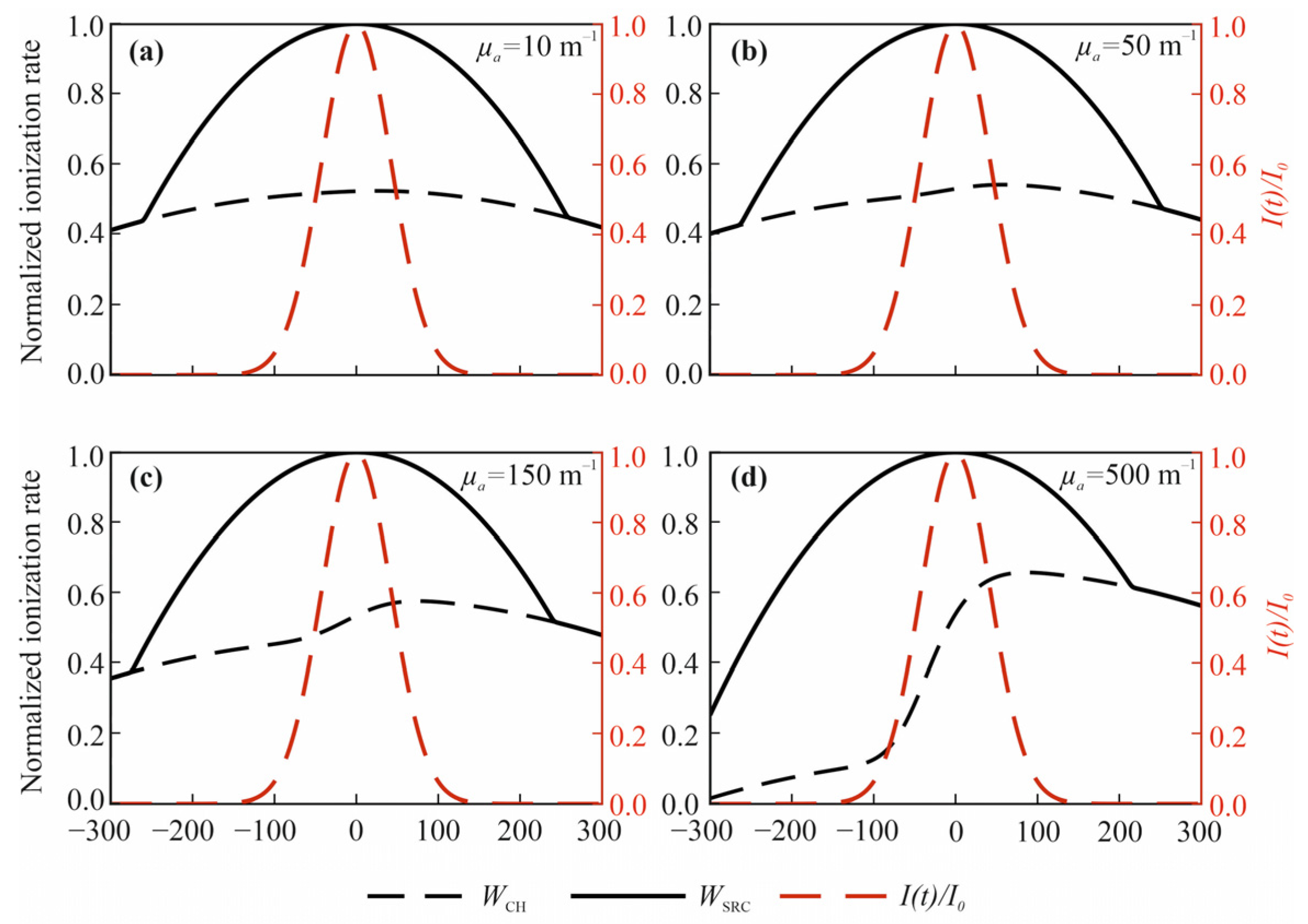
As a first step, in Figure 1, we examine the temporal structure of the ionization rates entering the rate-equation model introduced in Section 2. We analyze the source term W S R C ( t ) (Equation (3)), which follows the instantaneous laser intensity, and the CH contribution W C H ( t ) (Equation (14)), which represents absorption-mediated seed generation. The calculations are performed for Gaussian laser pulses at a central wavelength of 800 nm, consistent with Ti:sapphire excitation conditions, and for absorption coefficients spanning the range μ a = 10 500   m 1 . This interval corresponds to weakly to moderately absorbing water-rich biological media in the near-infrared spectral region [38] and is used here to probe the sensitivity of CH ionization under physiologically relevant conditions. To isolate the temporal dynamics of the individual mechanisms, the ionization rates are normalized to their respective maximum values, W ( t ) = W ( t ) / W m a x , enabling a direct comparison of their temporal localization relative to the laser pulse envelope. In addition, the normalized intensity profile I ( t ) / I 0 is also shown in Figure 1 for the reference, highlighting the femtosecond time window ( t 300   f s ) in which the dominant ionization processes and the initial buildup of free electrons take place.
The source-related contribution W S R C ( t ) , presented in Figure 1, remains broad and nearly symmetric over the entire range of μ a , indicating that it is predominantly governed by ionization channels directly tied to the laser pulse envelope. This behavior is expected, since direct PI processes respond to the instantaneous electric field and therefore inherit the temporal symmetry of the driving pulse. As a result, its temporal structure is only weakly affected by absorption, and it does not exhibit significant distortion even as μ a increases. In contrast, the CH contribution W C H ( t ) shows a systematic evolution from a quasi-symmetric to a strongly asymmetric temporal profile. For low absorption (see Figure 1a), W C H ( t ) remains weak and nearly symmetric, closely following the overall pulse envelope. In this regime, the absorbed energy is insufficient to produce a significant temperature rise, so the ionization probability remains effectively slaved to the instantaneous laser intensity. As μ a increases to 50   m 1 (Figure 1b), the magnitude of the response grows, but its temporal structure is still largely determined by the laser intensity. A qualitative transition occurs at intermediate absorption, presented in Figure 1c, where W C H ( t ) develops a noticeable asymmetric distortion, characterized by a slower decay on the trailing edge of the pulse. This behavior reflects the integrative nature of the CH mechanism: the ionization rate depends on the cumulative absorbed energy, which continues to increase even as the instantaneous laser intensity begins to decrease. Physically, this corresponds to a progressive buildup of lattice temperature, which enhances thermally assisted ionization even after the peak of the optical field has been reached. As a result, the effective ionization window extends toward later times. This effect becomes dominant for strong absorption (Figure 1d). In this regime, W C H ( t ) exhibits a clear temporal lag with respect to the laser intensity profile, with its maximum shifted toward the trailing edge of the pulse. This time lag is a direct consequence of the non-instantaneous thermal response of the medium: the temperature reaches its maximum only after sufficient energy has been deposited, not at the peak of the laser intensity. This non-instantaneous thermal response arises from the competition between two processes: the decreasing laser intensity and the increasing temperature due to cumulative energy deposition. The maximum of W C H t is therefore reached when the rate of thermally activated ionization growth is balanced by the decay of the driving field. Consequently, the production of seed electrons is no longer synchronized with the pulse maximum but is shifted to later times. Importantly, this temporal shift is not fully reflected in W S R C ( t ) , which retains a nearly symmetric profile. This indicates that direct ionization channels continue to provide an instantaneous contribution that anchors the overall response to the pulse center, preventing a complete temporal shift in the ionization dynamics. These results demonstrate that increasing absorption not only enhances the magnitude of the CH contribution but also fundamentally modifies the temporal pathway of seed generation. This integrative nature of the system alters the initial conditions for subsequent CI. The temporal overlap between seed generation and avalanche growth is modified, which is expected to play a decisive role in determining the electron-density formation and the breakdown threshold discussed in the following section.
Before analyzing the fully coupled ionization dynamics, it is essential to examine the contribution of each individual channel separately. In strong-field interactions with condensed media, different ionization mechanisms operate on distinct physical principles and timescales: direct channels such as MPI and TI are governed by the instantaneous electric field, whereas CH and cascade processes depend on cumulative energy deposition and electron multiplication. Treating these channels independently allows one to isolate their characteristic temporal signatures and validate the analytical descriptions derived for each mechanism in Section 2. This step is particularly important in rate-equation models, where multiple nonlinear processes are coupled, as it ensures that the behavior of the full system can be traced back to well-defined physical contributions.
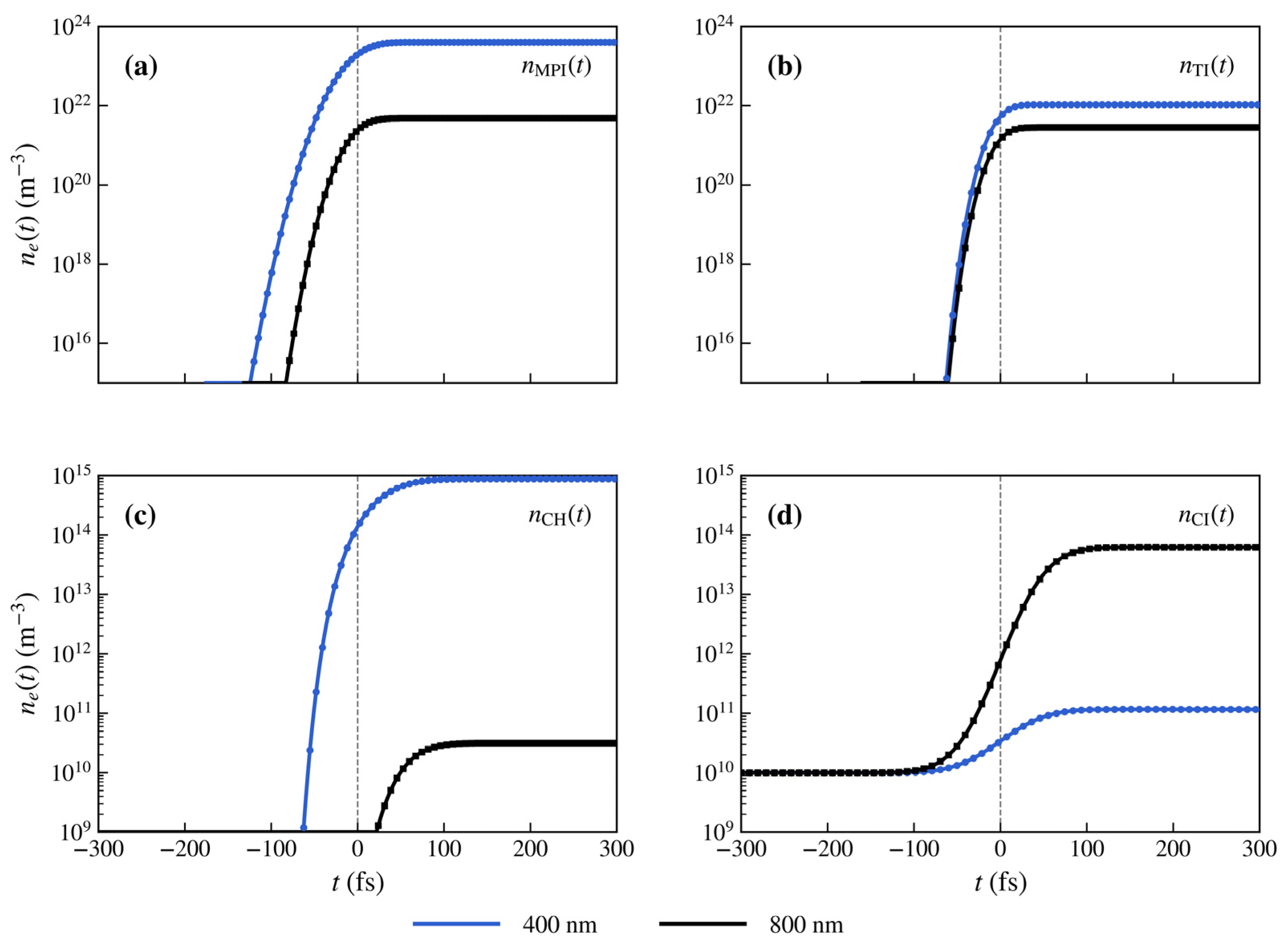
For the MPI channel shown in Figure 2a, the electron density exhibits a rapid rise followed by saturation after the pulse maximum. This reflects the strong nonlinear dependence of MPI on the instantaneous intensity: the rate of electron generation follows the laser field, while the density itself accumulates and therefore remains constant once the pulse has passed. The higher electron yield obtained at 400 nm compared to 800 nm is consistent with the reduction in the effective multiphoton order ( k 3   v s .   k 6 for I p 8   e V ), in agreement with the Keldysh framework [5] and breakdown studies in dielectrics [7,11]. The nearly parallel evolution of the curves at 400 nm and 800 nm indicates that the underlying dynamics are governed by the same mechanism, with the difference arising primarily from the wavelength dependence of the ionization rate. The TI channel, presented in Figure 2b, exhibits a similarly sharp onset, but with a more pronounced threshold-like behavior due to the exponential dependence of tunneling probability on the electric field strength. In terms of the Keldysh parameter γ , the 800 nm case corresponds to a deeper tunneling regime (smaller γ ), while at 400 nm the system remains closer to the multiphoton regime. This explains why both curves rise in a similar temporal window around t = 0 , yet maintain a systematic offset in magnitude. The close agreement between analytical and numerical results confirms that the transition between multiphoton and tunneling regimes is correctly captured. In contrast, the CH channel (Figure 2c) shows a delayed and more gradual buildup of electron density. This behavior is consistent with previous studies of laser interaction with water and biological media, where absorption-driven and thermally assisted ionization mechanisms introduce a temporal offset relative to direct photoionization channels [2,3,10,39]. The onset of CH-driven ionization occurs closer to the pulse maximum and extends into t > 0 , reflecting the fact that the ionization probability depends on cumulative energy deposition rather than on the instantaneous field. As a result, this channel continues to contribute even after the peak intensity has been reached, effectively sustaining seed generation on the trailing edge of the pulse. Finally, the CI channel (Figure 2d) displays a nonlinear growth characteristic of avalanche ionization. In this case, the electron density remains nearly constant for t < 0 and increases predominantly for t 0 , confirming that CI is a secondary process that requires pre-existing seed electrons. For this reason, a finite initial electron density n 0 = 10 10   m 3 is introduced in the model, representing a physically realistic background population due to impurities, thermal excitation, or preceding ionization events [9,11,36]. The stronger growth observed at 800 nm is a direct consequence of enhanced IB heating, which scales approximately as λ 2 within the Drude model [40]. The model, therefore, correctly reproduces the well-known wavelength scaling of avalanche ionization efficiency reported in breakdown studies [7,11]. The relative timing of the ionization channels clearly establishes their physical roles: MPI and TI provide the initial seed electrons on the leading edge and around the pulse maximum, the CH channel sustains electron production through cumulative absorption near and after t = 0 , and CI acts as a final amplification mechanism on the trailing edge. This temporal ordering reflects the interplay of ionization processes and explains why a multi-channel model is required to accurately describe electron-density buildup and breakdown thresholds. Overall, the agreement between analytical and numerical results, together with the consistency with established literature trends, confirms that the model captures the essential physical mechanisms governing both seed generation and avalanche amplification in laser-matter interaction.
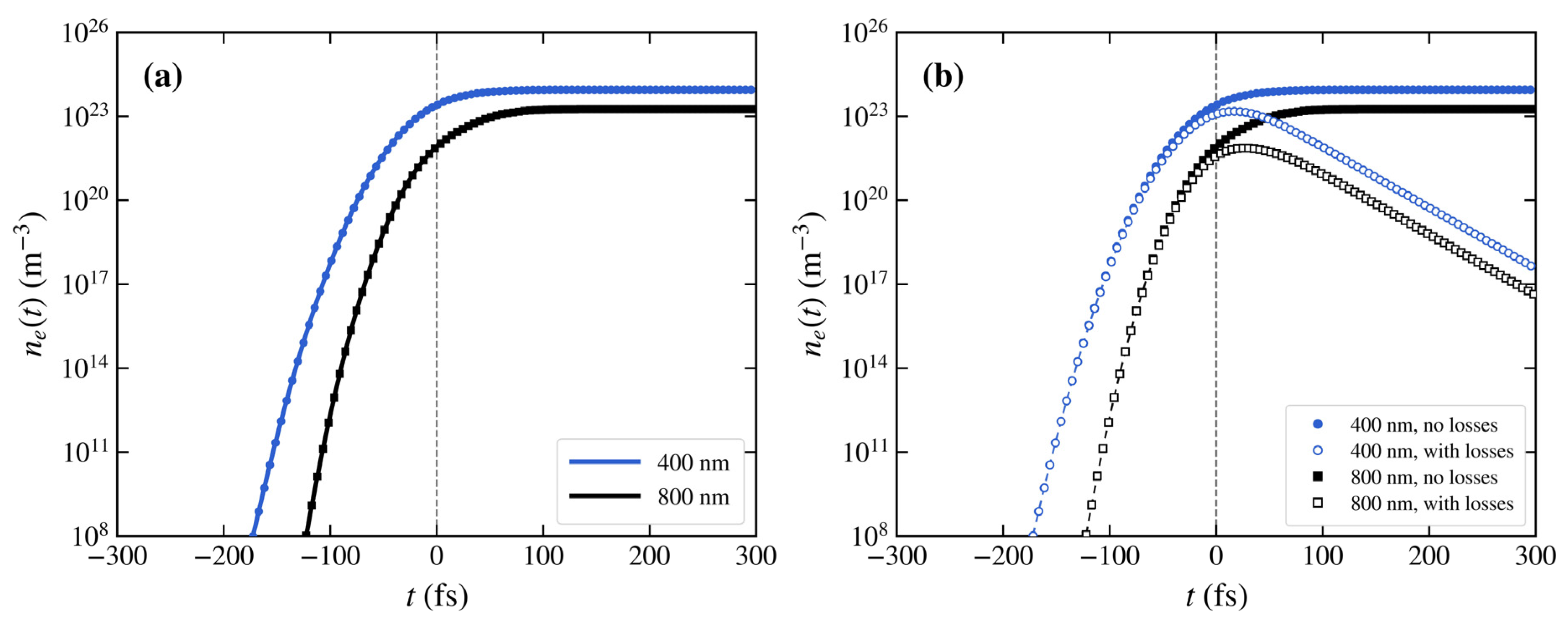
Building on the analysis of individual ionization channels, the next step is to consider their combined action, since the electron density in the system is determined by their simultaneous interplay. Continuous seed generation from MPI, TI, and CH channels must be considered together with cascade amplification, which depends on the existing electron population. Figure 3 therefore examines the solution of the full rate equation, where all mechanisms are coupled within the analytical framework given by Equation (24). This allows us to assess how the temporal distribution of seed generation is translated into electron-density buildup when amplification is considered. In addition, by comparing the solution obtained without losses to the case where trapping, recombination, and diffusion are included (see Equation (25)), we can isolate the role of dissipative processes in shaping the physically relevant electron-density evolution.
In contrast to the separate-channel analysis in Figure 2, Figure 3 shows the electron-density evolution when all ionization pathways are treated simultaneously within the full rate equation. Figure 3a presents the lossless solution, where the dynamics are governed by the interplay between continuous seed generation and cascade amplification. The initial rise closely follows the MPI behavior (Figure 2a), confirming that MPI provides the dominant seed population under the present conditions. This is expected, since MPI is the only mechanism that produces a substantial electron density already on the leading edge of the pulse, whereas TI is confined to the vicinity of the pulse maximum and CH develops later due to cumulative energy deposition [1,41,42]. In contrast to the isolated MPI case, where the density saturates after the pulse, the coupled solution continues to grow for t > 0 , reflecting the amplification of earlier-generated electrons by CI, as described by Equation (24) and widely reported in breakdown models [10,11]. The higher final density at 400 nm therefore originates from more efficient seed generation, while the similar temporal shape indicates that the amplification mechanism is the same for both wavelengths. Figure 3b shows how this behavior is modified when trapping, recombination, and diffusion are included. The initial rise remains largely unchanged, indicating that early-time dynamics are still governed by seed generation and the onset of avalanche growth. However, after the pulse maximum, the electron density reaches a peak and then decreases, marking the transition from amplification-dominated to loss-dominated dynamics. This delayed maximum arises because cascade amplification continues briefly after the intensity peak until the combined loss terms exceed the gain. Among the considered mechanisms, trapping dominates on the present time scale due to sub-picosecond electron localization in water-like media [8,41], while recombination contributes at higher densities and diffusion remains comparatively slow within the considered temporal window. The wavelength dependence in Figure 3b is reflected primarily in the absolute electron-density levels rather than in a qualitative change in the dynamics. The higher density at 400 nm results from more efficient seed generation, whereas both wavelengths exhibit a similar post-peak evolution, indicating that the turnover is governed by the balance between amplification and depletion. The onset of the decay therefore corresponds to the point at which loss processes overcome cascade gain, consistent with recent descriptions of ultrafast breakdown in condensed media [42].
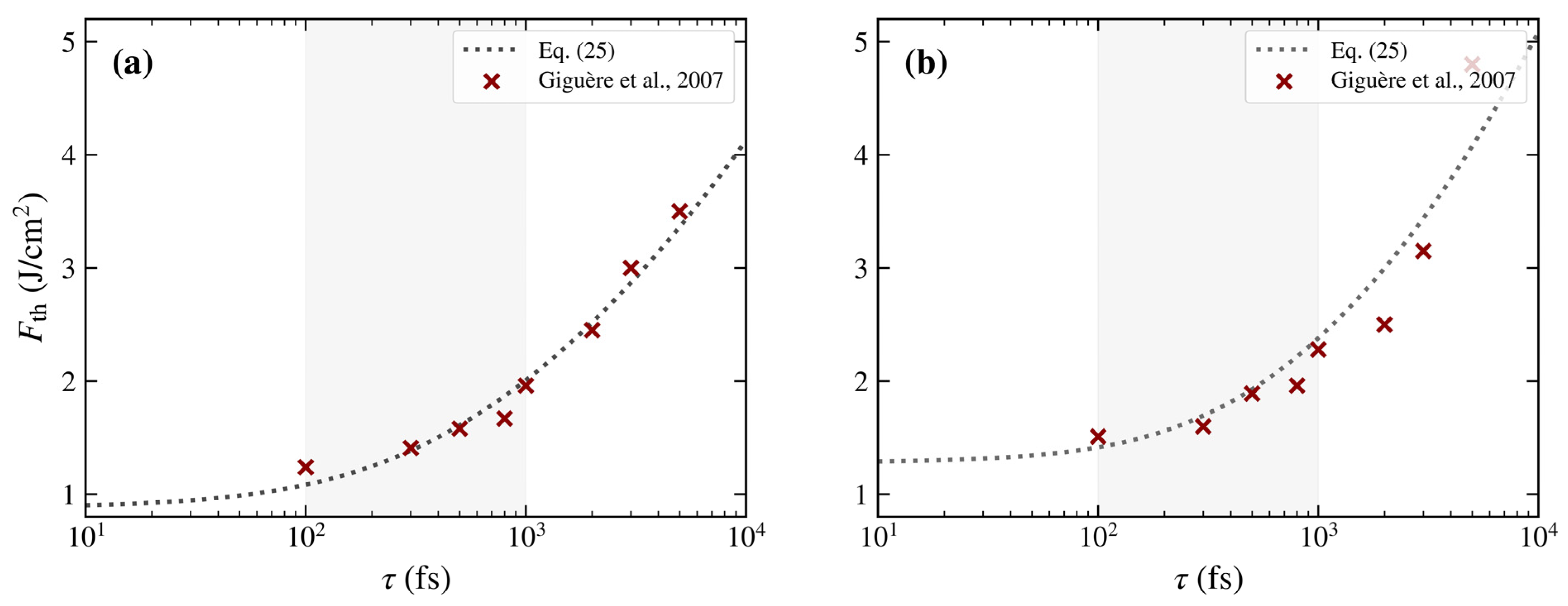
To connect the modeled electron-density dynamics with experimentally measured breakdown thresholds reported in [18], the extended rate-equation model (Equation (25)) is applied. In this formulation, the electron density n e ( t ) is evaluated for a given pulse duration τ and fluence F , while the breakdown threshold is defined by the condition m a x t n e ( t ; F , τ ) = n c r , where n c r denotes the critical plasma density, taken here as c m 3 for 800 nm excitation. In the present work, the critical density is used as an effective criterion for the onset of dense plasma formation and strong plasma absorption during ultrafast excitation, rather than as a direct description of the complete ablation process itself. Subsequent thermal, hydrodynamic, and material-removal processes may continue to evolve on longer timescales depending on the physical properties of the irradiated medium. The use of the abovementioned criterion is justified as an effective condition for the onset of strong plasma absorption and rapid energy deposition. Although breakdown in water and biological tissues may also involve hydrodynamic and cavitation processes, these occur on longer timescales and are typically initiated once a sufficiently dense electron plasma is formed, as discussed in previous studies (e.g., Refs. [1,13]). Figure 4 shows the resulting dependence F t h ( τ ) for corneal epithelium (Figure 4a) and stroma (Figure 4b), together with the corresponding experimental data from [18]. Both tissues are treated as water-like media due to their high water content and the dominance of water-mediated ionization dynamics under near-infrared femtosecond excitation. The shaded region marks the interval in which the pulse duration becomes comparable to the characteristic timescales of electron dynamics. Within this regime, the threshold reflects the coupled action of seed formation and subsequent amplification, whereas outside it, the dynamics approach limiting regimes dominated either by instantaneous photoionization (short pulses) or by cumulative processes (long pulses).
The results presented in Figure 4 show that the model successfully reproduces the experimentally observed increase in the threshold fluence with pulse duration for both corneal epithelium and stroma. In the short-pulse regime, the threshold remains relatively low and only weakly dependent on τ , reflecting efficient seed generation driven by strong instantaneous ionization and rapid cascade amplification. It should be noted that the present model is calibrated for pulse durations down to approximately 100 fs, consistent with the available experimental data, while for significantly shorter pulses ( 50   f s ) additional effects such as ponderomotive corrections and modifications of the effective multiphoton order may become relevant. As the pulse duration increases, the threshold rises, indicating that a higher fluence is required to reach the critical electron density due to the reduction of peak intensity and the increasing role of cumulative processes. In this regime, CH absorption, electron thermalization, and trapping-induced depletion contribute to limiting the effective electron-density buildup. The transition between these regimes is most pronounced within the shaded interval, where the threshold exhibits the strongest dependence on pulse duration and cannot be described by simple limiting scaling. A systematic shift toward higher threshold values is observed for the stroma (see Figure 4b), reflecting differences in effective material response, including variations in absorption and scattering, as well as the presence of collagen fibrils that modify local energy deposition and ionization conditions. Despite this, the model captures both the scaling and the relative offset between the two tissues. Experimental uncertainties reported in [18], typically on the order of 10–15%, are consistent with the level of agreement observed between the model and the data. The agreement is further supported by low error metrics, with root mean square error values of 0.116 J/cm2 (Figure 4a) and 0.345 J/cm2 (Figure 4b) and mean absolute percentage errors of 5.18% and 9.46%, respectively. The model parameters are chosen within physically established ranges for water-like media and are not fitted individually for each dataset, ensuring that the agreement reflects the robustness of the underlying physical description rather than parameter tuning. It should be noted, however, that the present rate-equation framework is intended to describe the dominant ionization and amplification dynamics on the level of the free-electron density. In more extreme femtosecond regimes, particularly for pulse durations well below 100 fs, very high intensities, or strongly inhomogeneous excitation volumes, additional effects such as nonequilibrium electron-energy distributions, nonlocal carrier transport, and transient deviations from local thermodynamic equilibrium may become important. These effects may modify the detailed early-time kinetics and spatial redistribution of electrons, but they do not change the main threshold-scaling trends captured here within the considered experimental range.


4. Conclusions

An analytical rate-equation framework has been developed to describe the formation of free-electron density and plasma formation in water-like biological media under ultrashort laser irradiation. By combining multiphoton, tunneling, and chromophore-assisted ionization into a unified source term and treating CI as a separate amplification process, the model resolves the internal structure of electron generation and its subsequent growth. The results show that the electron-density dynamics are governed by the temporal ordering of ionization channels within the pulse. Direct PI establishes the initial seed population on the leading edge and near the pulse maximum, while CH ionization introduces a delayed contribution driven by cumulative energy deposition, shifting electron production toward later times. This temporal redistribution modifies the conditions under which electron-impact-driven CI develops, since the avalanche process acts on a seed population whose structure is already shaped by both instantaneous and cumulative mechanisms.
When all channels are coupled, the electron-density evolution reflects a balance between early-time seed formation and post-peak amplification, followed by a transition to loss-dominated dynamics once trapping, recombination, and diffusion are included. The model reproduces the observed increase in threshold fluence with pulse duration and captures the relative behavior of corneal tissues without parameter fitting, indicating that the essential scaling of energy deposition is correctly described. Although simplified in its treatment of thermal and transport processes, the framework captures the dominant role of electron-impact ionization and cascade amplification in the buildup of dense electron populations in water-like media. Although simplified in its treatment of thermal, transport, and post-breakdown material dynamics, the presented framework captures the dominant role of electron-impact ionization and cascade amplification in the buildup of dense electron populations in water-like media. The analytical structure of the model further enables the individual ionization channels to be separated and interpreted in terms of their temporal and physical contributions to the overall breakdown dynamics. In this way, the present formulation provides a physically transparent connection between ultrafast seed electron generation, avalanche amplification, and experimentally observable threshold behavior in biologically relevant media. Future work will extend the model toward a more complete description of LIB by incorporating hydrodynamic response, post-ionization energy relaxation, and material-modification processes occurring on longer timescales following the initial plasma formation stage.

Author Contributions

Conceptualization, H.D.-M.; methodology, H.D.-M.; software, H.D.-M. and V.V.; validation, H.D.-M., V.V. and V.A.S.; formal analysis, H.D.-M.; investigation, H.D.-M.; resources, V.A.S. and V.P.; data curation, H.D.-M.; writing—original draft preparation, H.D.-M.; writing—review and editing, H.D.-M., V.V., V.A.S. and V.P.; visualization, H.D.-M.; supervision, V.P.; project administration, V.P.; funding acquisition, V.P. All authors have read and agreed to the published version of the manuscript.

Funding

This research was funded by the Science Fund of the Republic of Serbia, #GRANT 6821, Atoms and (bio)molecules-dynamics and collisional processes on short time scale—ATMOLCOL.

Data Availability Statement

The data presented in this study are available from the corresponding author upon request.

Acknowledgments

Authors would like to acknowledge the support received from the Science Fund of the Republic of Serbia, #GRANT 6821, Atoms and (bio)molecules-dynamics and collisional processes on short time scale—ATMOLCOL. Our appreciation also goes to the Serbian Ministry of Education, Science and Technological Development (Agreement No. 451-03-34/2026-03/200122). We acknowledge support of the Institute of Physics Belgrade, University of Belgrade, through a grant by the Ministry of Science, Technological Development and Innovations of the Republic of Serbia. Also, we acknowledge the networking opportunities from COST Actions: CA21101—Confined molecular systems: from a new generation of materials to the stars (COSY), CA21159—Understanding interaction of light with biological surfaces: possibility for new electronic materials and devices (PhoBioS), and CA22148—An international network for Non-linear Extreme Ultraviolet to hard X-ray techniques (NEXT).

Conflicts of Interest

The authors declare no conflicts of interest. The funders had no role in the design of the study; in the collection, analyses, or interpretation of data; in the writing of the manuscript; or in the decision to publish the results.

Abbreviations

The following abbreviations are used in this manuscript:
CHChromophore-assisted
CICascade (avalanche) ionization
FWHMFull width at half maximum
LIBLaser-induced breakdown
LIPLaser-induced plasma
MPIMultiphoton ionization
PIPhotoionization
SFIStrong-field ionization
TITunneling ionization
IBInverse Bremsstrahlung

References

  1. Vogel, A.; Venugopalan, V. Mechanisms of pulsed laser ablation of biological tissues. Chem. Rev. 2003, 103, 577–644. [Google Scholar] [CrossRef] [PubMed]
  2. Vogel, A.; Noack, J.; Hüttman, G.; Paltauf, G. Mechanisms of femtosecond laser nanosurgery of cells and tissues. Appl. Phys. B 2005, 81, 1015–1047. [Google Scholar] [CrossRef]
  3. Vogel, A.; Noack, J.; Nahen, K. Energy balance of optical breakdown in water at nanosecond to femtosecond time scales. Appl. Phys. B 1999, 68, 271–280. [Google Scholar] [CrossRef]
  4. Juhasz, T.; Loesel, F.H.; Kurtz, R.M.; Horvath, C.; Bille, J.F.; Mourou, G. Corneal refractive surgery with femtosecond lasers. IEEE J. Sel. Top. Quantum Electron. 1999, 5, 902–910. [Google Scholar] [CrossRef]
  5. Keldysh, L.V. Ionization in the field of a strong electromagnetic wave. J. Exp. Theor. Phys. 1964, 47, 1945. [Google Scholar]
  6. Popov, V.S. Tunnel and multiphoton ionization of atoms and ions in a strong laser field. Phys. Usp. 2004, 47, 855–885. [Google Scholar] [CrossRef]
  7. Stuart, B.C.; Feit, M.D.; Herman, S.; Rubenchik, A.M.; Shore, B.W.; Perry, M.D. Optical ablation by high-power short-pulse lasers. J. Opt. Soc. Am. B 1996, 13, 459–468. [Google Scholar] [CrossRef]
  8. Linz, N.; Freidank, S.; Liang, X.X.; Vogelmann, H.; Trickl, T.; Vogel, A. Wavelength dependence of nanosecond infrared laser-induced breakdown in water: Evidence for multiphoton initiation via an intermediate state. Phys. Rev. B 2015, 91, 134114. [Google Scholar] [CrossRef]
  9. Kennedy, P.K. A first-order model for computation of laser-induced breakdown thresholds in ocular and aqueous media. IEEE J. Quantum Electron. 1995, 31, 2241–2249. [Google Scholar] [CrossRef]
  10. Noack, J.; Vogel, A. Laser-induced plasma formation in water at nanosecond to femtosecond time scales. IEEE J. Quantum Electron. 1999, 35, 1156–1167. [Google Scholar] [CrossRef] [PubMed]
  11. Stuart, B.C.; Feit, M.D.; Rubenchik, A.M.; Shore, B.W.; Perry, M.D. Laser-induced damage in dielectrics with nanosecond to femtosecond pulses. Phys. Rev. Lett. 1995, 74, 2248–2251. [Google Scholar] [CrossRef]
  12. Loesel, F.H.; Niemz, M.H.; Bille, J.F.; Juhasz, T. Non-thermal ablation of neural tissue with femtosecond laser pulses. Appl. Phys. B 1998, 66, 121–128. [Google Scholar] [CrossRef]
  13. Ovcharenko, Y.; Lyamayev, V.; Katzy, R.; Devetta, M.; LaForge, A.; O’Keeffe, P.; Plekan, O.; Finetti, P.; Di Fraia, M.; Mudrich, M.; et al. Novel collective autoionization process observed in electron spectra of He clusters. Phys. Rev. Lett. 2014, 112, 073401. [Google Scholar] [CrossRef]
  14. Iablonskyi, D.; Nagaya, K.; Fukuzawa, H.; Motomura, K.; Kumagai, Y.; Mondal, S.; Tachibana, T.; Takanashi, T.; Nishiyama, T.; Matsunami, K.; et al. Slow interatomic Coulombic decay of multiply excited neon clusters. Phys. Rev. Lett. 2016, 117, 276806. [Google Scholar] [CrossRef] [PubMed]
  15. Kammel, R.; Ackermann, R.; Thomas, J.; Götte, J.; Skupin, S.; Tünnermann, A.; Nolte, S. Enhancing precision in fs-laser material processing by simultaneous spatial and temporal focusing. Light Sci. Appl. 2014, 3, e169. [Google Scholar] [CrossRef]
  16. Oelze, T.; Schütte, B.; Müller, M.; Müller, J.P.; Wieland, M.; Frühling, U.; Drescher, M.; Al-Shemmary, A.; Golz, T.; Stojanovic, N.; et al. Correlated electronic decay in expanding clusters triggered by intense XUV pulses from a Free-Electron-Laser. Sci. Rep. 2017, 7, 40736. [Google Scholar] [CrossRef]
  17. Kumagai, Y.; Fukuzawa, H.; Motomura, K.; Iablonskyi, D.; Nagaya, K.; Wada, S.-I.; Ito, Y.; Takanashi, T.; Sakakibara, Y.; You, D.; et al. Following the birth of a nanoplasma produced by an ultrashort hard-x-ray laser in xenon clusters. Phys. Rev. X 2018, 8, 031034. [Google Scholar] [CrossRef]
  18. Giguère, D.; Olivié, G.; Vidal, F.; Toetsch, S.; Girard, G.; Ozaki, T.; Kieffer, J.C.; Nada, O.; Brunette, I. Laser ablation threshold dependence on pulse duration for fused silica and corneal tissues: Experiments and modeling. J. Opt. Soc. Am. A 2007, 24, 1562–1568. [Google Scholar] [CrossRef] [PubMed]
  19. Delibašić-Marković, H.; Petrović, V.; Petrović, I. Theoretical investigation of electron dynamics in liquid media under nanosecond pulsed laser irradiation. Bull. Lebedev Phys. Inst. 2025, 52, 22–30. [Google Scholar] [CrossRef]
  20. Efimenko, E.S.; Malkov, Y.A.; Murzanev, A.A.; Stepanov, A.N. Femtosecond laser pulse-induced breakdown of a single water microdroplet. J. Opt. Soc. Am. B 2014, 31, 534–541. [Google Scholar] [CrossRef]
  21. Delibašić, H.; Petrović, V.; Petrović, I.; Molpeceres, C.; Lauzurica, S. Numerical modeling of plasma formation in skin tissues induced by nanosecond pulsed laser. Eur. Phys. J. D 2021, 75, 155. [Google Scholar] [CrossRef]
  22. Chen, Y.; Lei, H.; Wang, Q.; Xie, H.; Zhang, H.; Lu, X.; Zhang, N.; Huang, S.; Wu, Y.; Liu, J.; et al. Multiphoton resonance meets tunneling ionization: High-efficient photoexcitation in strong-field-dressed ions. Phys. Rev. Lett. 2024, 133, 113201. [Google Scholar] [CrossRef]
  23. Wang, S.; He, X.; Liang, Y.; Su, Y.; Fang, S.; Wei, Z. Transition from multiphoton to tunneling ionization in the process of high harmonic generation in solids. arXiv 2022, arXiv:2208.10032. [Google Scholar] [CrossRef]
  24. Alberucci, A.; Jisha, C.P.; Nolte, S. Application of the Green’s function formalism to the interplay between avalanche and multiphoton ionization induced by optical pulses. Phys. Rev. B 2024, 109, 144302. [Google Scholar] [CrossRef]
  25. Mirza, I.; Bulgakova, N.M.; Tomáštík, J.; Michálek, V.; Haderka, O.; Fekete, L.; Mocek, T. Ultrashort pulse laser ablation of dielectrics: Thresholds, mechanisms, role of breakdown. Sci. Rep. 2016, 6, 39133. [Google Scholar] [CrossRef]
  26. Bashkatov, A.N.; Genina, E.A.; Tuchin, V.V. Optical properties of skin, subcutaneous, and muscle tissues: A review. J. Innov. Opt. Health Sci. 2011, 4, 9–38. [Google Scholar] [CrossRef]
  27. Tau, O.; Henley, A.; Boichenko, A.N.; Kleshchina, N.N.; Riley, R.; Wang, B.; Winning, D.; Lewin, R.; Parkin, I.P.; Ward, J.M.; et al. Liquid-microjet photoelectron spectroscopy of the green fluorescent protein chromophore. Nat. Commun. 2022, 13, 507. [Google Scholar] [CrossRef] [PubMed]
  28. Jones, C.M.; List, N.H.; Martínez, T.J. Resolving the ultrafast dynamics of the anionic green fluorescent protein chromophore in water. Chem. Sci. 2021, 12, 11347–11363. [Google Scholar] [CrossRef] [PubMed]
  29. Onvlee, J.; Trippel, S.; Küpper, J. Ultrafast light-induced dynamics in the microsolvated biomolecular indole chromophore with water. Nat. Commun. 2022, 13, 7462. [Google Scholar] [CrossRef]
  30. Sun, H.; Han, M.; Mikael, A.; Shao, F.; Liu, Y.; Giese, G.; Niemz, M.; Bille, J. Femtosecond laser ablation threshold dependence on corneal depth and laser pulse width. Investig. Ophthalmol. Vis. Sci. 2006, 47, 548. [Google Scholar] [CrossRef]
  31. Rees, G.J.; David, J.P.R. Nonlocal impact ionization and avalanche multiplication. J. Phys. D Appl. Phys. 2010, 43, 243001. [Google Scholar] [CrossRef]
  32. Wilson, R.B.; Coh, S. Parametric dependence of hot electron relaxation timescales on electron-electron and electron-phonon interaction strengths. Commun. Phys. 2020, 3, 179. [Google Scholar] [CrossRef]
  33. Du, D.; Liu, X.; Squier, J.A.; Mourou, G.A. Laser-induced breakdown as a function of pulse duration: From 7 ns to 150 fs. In Laser-Induced Damage in Optical Materials: 1994; SPIE: Bellingham, WA, USA, 1995; Volume 2428, pp. 422–434. [Google Scholar] [CrossRef]
  34. Siefermann, K.R.; Liu, Y.; Lugovoy, E.; Link, O.; Faubel, M.; Buck, U.; Winter, B.; Abel, B. Binding energies, lifetimes and implications of bulk and interface solvated electrons in water. Nat. Chem. 2010, 2, 274–279. [Google Scholar] [CrossRef]
  35. Ma, J.; Wang, F.; Mostafavi, M. Ultrafast chemistry of water radical cation, H2O+, in aqueous solutions. Molecules 2018, 23, 244. [Google Scholar] [CrossRef]
  36. Novelli, F.; Chen, K.; Buchmann, A.; Ockelmann, T.; Hoberg, C.; Head-Gordon, T.; Havenith, M. The birth and evolution of solvated electrons in water. Proc. Natl. Acad. Sci. USA 2023, 120, e2216480120. [Google Scholar] [CrossRef] [PubMed]
  37. Bragg, A.E.; Kanu, G.U.; Schwartz, B.J. Nanometer-scale phase separation and preferential solvation in THF–water mixtures: Ultrafast electron hydration and recombination dynamics following CTTS excitation of I. J. Phys. Chem. Lett. 2011, 2, 2797–2804. [Google Scholar] [CrossRef]
  38. Jacques, S.L. Optical properties of biological tissues: A review. Phys. Med. Biol. 2013, 58, R37–R61. [Google Scholar] [CrossRef] [PubMed]
  39. Fang, Q.; Hu, X.H. Modeling of skin tissue ablation by nanosecond pulses from ultraviolet to near-infrared and comparison with experimental results. IEEE J. Quantum Electron. 2004, 40, 69–77. [Google Scholar] [CrossRef]
  40. Verma, S.; Arba Mosquera, S. A refined model for ablation through cavitation bubbles with ultrashort pulse lasers. Photonics 2024, 11, 1047. [Google Scholar] [CrossRef]
  41. Linz, N.; Freidank, S.; Liang, X.X.; Vogel, A. Wavelength dependence of femtosecond laser-induced breakdown in water and implications for laser surgery. Phys. Rev. B 2016, 94, 024113. [Google Scholar] [CrossRef]
  42. Rethfeld, B.; Ivanov, D.S.; Garcia, M.E.; Anisimov, S.I. Modelling ultrafast laser ablation. J. Phys. D Appl. Phys. 2017, 50, 193001. [Google Scholar] [CrossRef]
Figure 1. Temporal profiles of the normalized ionization rates for different absorption coefficients, μ a : (a) 10   m 1 , (b) 50   m 1 , (c) 150   m 1 , and (d) 500   m 1 . The solid black curve denotes W S R C ( t ) , the dashed black curve W C H ( t ) , and the red dashed line the normalized laser intensity I ( t ) / I 0 . All rates are normalized as W ( t ) = W ( t ) / W m a x .
Atoms 14 00039 g001
Figure 2. Time-dependent electron density n e ( t ) for individual ionization channels: (a) n M P I t , (b) n T I t , (c) n C H t , and (d) n C I t . Solid lines represent analytical solutions (Equation (7), Equation (11), Equation (16) and Equation (22), respectively), while symbols denote numerical results. Calculations are shown for wavelengths of 400 nm (blue) and 800 nm (black). The dashed vertical line indicates the pulse maximum.
Atoms 14 00039 g002
Figure 3. Electron-density evolution n e ( t ) in the full coupled model. (a) Semi-analytical solution (Equation (24)) and corresponding numerical result in the absence of losses. (b) Comparison with results including losses: solid curves (filled symbols) denote the lossless case, while open symbols represent solutions where trapping, recombination, and diffusion are added to the rate equation and treated numerically. The dashed vertical line marks the pulse maximum at t = 0 . Results are shown for 400 nm and 800 nm.
Atoms 14 00039 g003
Figure 4. Threshold fluence F t h as a function of pulse duration τ for: (a) corneal epithelium and (b) corneal stroma at 800 nm. Symbols denote experimental data [18], while the dashed line represents the model prediction obtained from Equation (25) using the critical-density criterion m a x t   n e = n c r .
Atoms 14 00039 g004
Disclaimer/Publisher’s Note: The statements, opinions and data contained in all publications are solely those of the individual author(s) and contributor(s) and not of MDPI and/or the editor(s). MDPI and/or the editor(s) disclaim responsibility for any injury to people or property resulting from any ideas, methods, instructions or products referred to in the content.