1. Introduction
Spectroscopy of light atomic systems provides data of exceptionally high precision, enabling the refinement of fundamental physical constants [
1,
2]. Exotic systems such as muonic hydrogen and muonic deuterium offer a unique opportunity to further enhance the experimental accuracy of such measurements. This has been exemplified by the determination of the proton charge radius through measurement of the Lamb shift in muonic hydrogen [
3].
Another quantity of fundamental importance is the Zemach radius of the proton,
RZ, which characterizes the combined spatial distributions of the proton’s charge and its magnetic dipole moment. Its precise determination is important not only for a deeper understanding of the fundamental structure of the proton but also because it serves as a limiting factor in testing the accuracy of modern high-precision quantum electrodynamics calculations. Previous extractions of
RZ from hyperfine-splitting measurements in ordinary and muonic hydrogen yielded values of
RZ = (1.037 ± 0.016) fm [
4],
RZ = (1.045 ± 0.016) fm [
5], and
RZ = (1.082 ± 0.037) fm [
6]. A more recent lattice-QCD study [
7] reported
, while an updated analysis, incorporating new spin-structure constraints, yielded
RZ = (1.036 ± 0.008) fm [
8]. In parallel, high-resolution spectroscopy experiments aiming to determine the hyperfine splitting of the ground state of muonic hydrogen—such as those conducted by the CREMA [
9] and FAMU [
10] collaborations—are expected to further reduce the experimental uncertainty of
RZ.
A central aspect of all these experiments is the muon transfer from muonic hydrogen to a heavier element, followed by a relaxation of the muon to the ground state, possibly accompanied by emission of characteristic X-rays. These X-rays serve as the primary observable in experiments and provide indirect information for the muon transfer dynamics. Precise modeling of the muon transfer process, including its energy dependence, background contributions, and sensitivity to experimental conditions, is essential for interpreting the experimental results. Several studies have addressed this topic, for example, the muon transition from muonic hydrogen to oxygen and sulfur molecules, which has been investigated in [
11,
12]. In these studies, a simple model expression for the collision energy-dependent muon transition rate to oxygen has been obtained by fitting to experimental data. However, recently, Stoilov et al. [
13] derived a more precise expression for this quantity under specific assumptions, building on the results of the FAMU collaboration [
14]. A comprehensive description must also include the interaction of muonic hydrogen with the surrounding atoms and molecules. The relevant cross-sections and rates of elastic and inelastic scattering of
pμ on hydrogen molecules, including the spin structure of
pμ, have already been provided by A. Adamczak in [
15].
Muonic spectroscopy experiments are inherently complex, and achieving the required precision in the directly measured quantity demands a detailed understanding of all underlying atomic and molecular processes. Consequently, realistic simulations of these processes play a crucial role both in the design and in the analysis of muonic experiments.
In this work, we present an analytical model that describes the time evolution of an ensemble of muonic hydrogen atoms in a gas mixture of
H2 +
O2, including the process of muon transfer to oxygen. The model accounts for the key physical processes affecting the energy and spin distributions of muonic hydrogen atoms. We analyze the influence of uncertainties in the model parameters and approximations using a Monte Carlo approach and perform time-dependent simulations to study the propagation of these uncertainties. Our simulations reveal the existence of a “minimum-uncertainty time”, at which the relative uncertainty of the muonic
X-ray emission reaches a minimum—providing a useful benchmark for optimizing experimental timing and precision. The simulated results are compared with experimental data from [
11], showing good agreement and indicating possible refinements in the current muon transfer parameters. The proposed model provides a flexible and transparent framework for simulating muonic processes and assessing their precision. It can be readily adapted to support the planning and optimization of future muonic hydrogen spectroscopy experiments. While similar models for muon transfer have been employed by the FAMU [
16] and CREMA [
17] collaborations, the present approach is formulated independently of any specific experimental setup, making it broadly applicable to the study of muonic systems.
This paper is organized as follows: In
Section 2, we review the analytical model. The model parameters and the approximations used are discussed in
Section 3. In
Section 4, we introduce estimators that quantify both the average behavior and the precision of our simulations. The main numerical results concerning the simulation precision are presented and discussed in
Section 6. The model’s ability to provide a rigorous description of muon transfer experiments is assessed in
Section 7. A comparison with the experimental data is provided in
Section 8, and the conclusions are outlined in
Section 9.
2. Muonic Hydrogen Decay Model
Modeling the time evolution of muonic hydrogen atoms in a gas mixture is a complex task due to the variety of processes that contribute to the change in the number and state of these atoms. In this section, we present an analytical model to describe the time, energy, and spin distribution of the
pμ atoms in a gaseous mixture of hydrogen and oxygen molecules. A key aspect of this investigation is determining the time evolution of the rate of muon transfer from hydrogen to oxygen in the gas. This quantity is essential for interpreting the experimentally accumulated data [
10,
11].
In our model, the state of a muonic hydrogen atom is described by two quantities—its kinetic energy and the total spin of the system. In the ground state of
pμ, the hydrogen nucleus and the muon spins can be coupled into singlet and triplet states, which will be denoted by
Fα = 0, 1, respectively. To simplify the problem, we discretize the kinetic energy into
n bins, denoted as
Ei for
. The state of
pμ is then represented as a 2
n-dimensional vector
N(iα)(
t) =
N(
Ei,
Fα,
t), whose time evolution is governed by the relation
where the vector
N(0) represents the initial distribution of
pμ atoms, and the (
i,
α)-th component of the vector
N(
t) gives the probability of finding a
pμ atom with energy
Ei and spin
F =
α at time
t. The 2
n × 2
n matrix
L encapsulates the contributions from various processes affecting the
pμ state. For simplicity,
L is divided into two components—a diagonal matrix
Ld and a dense matrix
Ls—such that
L =
Ld +
Ls.
The matrix
Ld accounts for processes such as muon decay and nuclear capture rates, represented by
λ0, and the formation rates of muonic oxygen (
Oμ), muonic deuterium (
dμ), and molecular ions (
ppμ) through the corresponding rates
,
λdμ, and
λppμ. Explicitly,
Ld is given by
where
I2n is the 2
n × 2
n identity matrix,
ϕ is the number density of the atoms of the gas mixture in LHD units, and
cp,
cd, and
cO are the number concentrations of hydrogen, deuterium, and oxygen atoms, respectively. The
n-dimensional vectors
correspond to the energy-dependent muon transfer rate from muonic hydrogen with spin
F =
α hydrogen to oxygen. All transition rates except
λ0 are normalized to the liquid hydrogen density
atoms/cm
3.
The transition matrix
Ls describes the elastic and inelastic scattering of muonic hydrogen by hydrogen molecules in the gas mixture:
Here,
is an
n-dimensional column vector of ones, and
are
n ×
n matrices comprising
pμ scattering rates on hydrogen. Specifically,
denotes the transition rate of a
pμ atom from a quantum state with spin
F =
α and kinetic energy
Ei to a state with
F =
β and
Ej.
In summary, solving the full continuous system of ODEs to find the muonic hydrogen evaluation is too costly, being both more time-consuming and potentially less accurate. Instead, after discretization, we compute the matrix exponential once, and subsequently obtain the exact (point-wise) time evolution through iterative multiplication by this matrix exponential. Matrix multiplication is a numerically stable operation, highly parallelizable, and computationally efficient.
The primary quantity of interest is the transfer rate from hydrogen to oxygen in the gas, expressed as the number of transfers from hydrogen to oxygen per unit time:
The emitted characteristic X-rays following the muon transfer to oxygen occur on a timescale much shorter (∼10
−13 s [
18]) than other simulated processes (∼10
−6 − 10
−10 s). Therefore, we can approximate the experimentally measurable X-ray emission rate as directly proportional to the muon transfer rate to oxygen in the gas. In the subsequent discussion, we will consider these two rates as equivalent:
3. Model Parameters and Sources of Errors
Constructing a realistic model for the muon transfer rate requires accounting for a large number of physical processes, each characterized by its own set of parameters known with varying degrees of precision. For some of these processes, limited or no experimental data are available. In addition, the numerical methods employed for the simulation of the model have inherent advantages and limitations, which necessitate the use of several assumptions and approximations.
In this section, we classify the different groups of parameters and sources of uncertainty, and analyze the impact of the approximations introduced. In some cases (e.g., numerical accuracy, time and energy discretization, pμ scattering rates), we assess their influence on the simulation results and argue that it is negligible. In others (e.g., the initial distribution of muonic hydrogen atoms, the muon transfer rate to oxygen λpO(E)), further investigation (presented in the following sections) is required.
3.1. Physical Constants
In our computations, we use the most recent values of the physical constants necessary to calculate the muon decay rate according to the presented model. These are provided in
Table 1.
3.2. Experimentally Controllable Quantities
Some of the model parameters depend on the specific conditions of a particular experiment. In order to maintain a certain level of concreteness, we focus on the physical variables’ values used in the measurements reported by Werthmüller et al. [
11]. These values are summarized in
Table 2. By using parameter values corresponding to a real experiment, we can compare the predictions of our model with the experimentally observed data provided in [
11].
3.3. Number Density of Atoms ϕ
To calculate the number density of atoms normalized to LHD,
ϕ in Equation (
2), we have adopted the ideal gas approximation. This simplifies
ϕ to a function of the pressure and temperature ratio:
ϕ(
P/
T) =
P/(
kBTN0) ≈ 0.3408 ×
P/
T, where
P is in units of bars. Since the hydrogen constitutes the predominant portion of the gas mixture, and at the temperature of interest only a small portion of the gas particles engage in inelastic scattering processes, this approximation is sufficiently accurate for our study. For the set of experimental parameters used in our simulations, the deviations due to this approximation remain within 1% [
22].
In our analysis, the uncertainties in the number of muon events stemming from ϕ are effectively accounted for through the uncertainties in temperature and pressure.
3.4. Initial Distribution of Muonic Hydrogen
It is known that the initial kinetic energy distribution of the muonic hydrogen,
N(0), does not conform to a simple Maxwellian profile. Experimental and theoretical studies suggest the existence of a high-energy
pμ population [
11,
23]. Therefore, for
pμ atoms in both singlet and triplet spin states, we adopt the “two-component model”, proposed in [
11], where a fraction
κ of
pμ atoms resides at an initial energy
of approximately 20 eV and the remaining fraction (1 −
κ) follows Maxwell statistics. In our simulations, we use
κ = 0.4 ± 0.1, which approximates the results presented in [
23] for the corresponding experimental parameters. We also assume that, at the onset of the process, the muonic hydrogen atoms are statistically distributed between the two hyperfine spin states: 1/4 in the singlet state (
F = 0) and 3/4 in the triplet state (
F = 1).
To account for the uncertainty in the position of the high-energy component in the initial pμ distribution, we introduce an uncertainty in as , where eV and eV, approximately matching the width of an energy bin.
3.5. Numerical Accuracy and Time Discretization
We verify that in computing the muon transfer rate, the numerical errors are several orders of magnitude smaller than the uncertainties introduced by the approximations and experimental parameter uncertainties discussed earlier. Consequently, these numerical errors can be considered negligible in our analysis.
We compute the time evolution of the muonic hydrogen distribution using discrete time steps. Since the matrix L governing this evolution is time-independent, this discretization does not introduce any errors. Therefore, the errors in the muon transfer rate arise solely from the accumulation of the numerical error during the evolutionary steps. Given the high precision of the numerical methods used, the numerical errors inherent in these approaches are minimal and do not significantly impact the overall accuracy and precision of the results.
3.6. pμ Atom Kinetic Energy Discretization
From Equations (
1) and (
4), it is evident that the errors due to the muon hydrogen kinetic energy discretization can be effectively incorporated into the uncertainties of the energy-dependent quantities—muonic hydrogen scattering rates, the transfer rate of muons to oxygen, and the initial distribution. When these discretization errors are smaller than the respective uncertainties, as is the case in the regime considered here, they do not significantly affect the precision of the simulation.
3.7. Muonic Hydrogen Scattering Rates λα,β
The elastic and inelastic scattering rates of muonic hydrogen,
, at a temperature of
T = 300 K, used in our simulations, are taken from Adamczak (private communications). They have been calculated using the theoretical framework and numerical procedures described in [
15], where differential cross-sections for muonic atom scattering from hydrogen molecules are computed. These rates, not available in tabulated form in the literature, are averaged over the Boltzmann distribution of the initial rotational levels of the
H2 molecule and over the Maxwellian kinetic energies of these molecules, for the given gas temperature. Furthermore, a downward spin-flip transition
F = 1 →
F = 0 is given for a single averaged value of the projection
Fz of the initial total spin
F = 1.
λα,β are computed with a relative uncertainty of
and an absolute uncertainty
s
−1 up to 100 eV, ensuring that their uncertainty can be safely neglected.
3.8. Transfer Rate of Muons from pμ to Oxygen λpO(E)
The collision energy-dependent transfer rate of muons from hydrogen in a singlet state to oxygen
is a key quantity for studying the time evolution of muon transfer to oxygen. Only recently was
obtained with sufficient accuracy [
13], thus enabling more precise simulations of such physical processes.
To obtain the
pμ kinetic energy-dependent transfer rate with respect to the laboratory reference frame,
, we proceed as follows: First, we express the collision energy in terms of the solid angle Ω between the momenta of the
pμ atom and the (point)
O2 molecule, and their kinetic energies
E and
correspondingly. Then, we average
over the kinetic energy of the oxygen molecule
and the solid angle Ω, weighted with the Maxwell distribution
fM(
T,
E) for temperature
T,
The use of Maxwell distribution of
O2 atoms in the gas is just an approximation, since the gas is a mixture of real gases. The associated uncertainty is assumed to be incorporated into the uncertainty of
(obtained under the assumption of Maxwell distribution over
Ec). Moreover, during the first tens of nanoseconds until thermalization occurs, the
O2 distribution is time-dependent; however, in the subsequent discussions, this time dependence will be neglected. The uncertainty of
is propagated into the uncertainty of
λpO(
E,
T) through Equation (
6).
The energy dependence of the muon transfer rate
λpO(
E) used in our simulations is characterized by relatively small uncertainties for
pμ energies up to
E ≃ 0.1 eV [
13]. For higher energies (
E ≳ 0.1 eV), however, the values of
λpO(
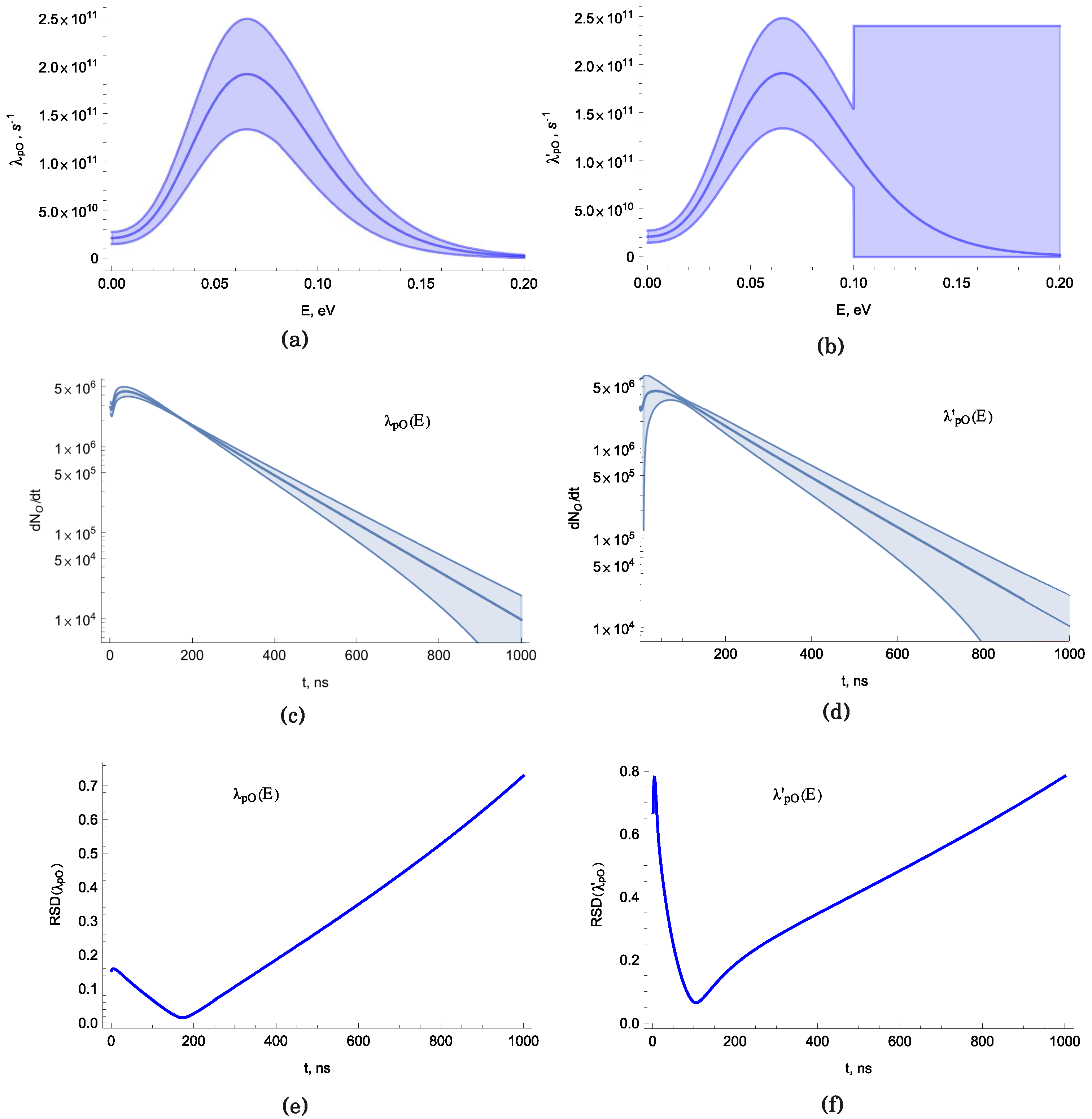
E) are known with lower precision. To address this, we consider two scenarios: a moderate one, where a smooth extrapolation of
λpO(
E) uncertainty is applied, and a conservative scenario, where for
E > 0.1 eV, the uncertainty is assumed to be significantly larger. In our simulations, we use the energy dependence of the muon transfer rate
λpO(
E) as given in [
13] in parametric form. It is characterized by relatively small uncertainties for
pμ energies up to
E ≃ 0.1 eV. For higher energies (
E ≳ 0.1 eV), however, the values of
λpO(
E) are not well constrained, and the associated uncertainty is not specified in [
13]. To account for this, we consider two extreme scenarios that bracket the plausible range of
λpO(
E): a moderate scenario, in which the uncertainty for
E < 0.1 eV is smoothly extrapolated to higher energies, and a conservative scenario, in which the uncertainty for
E > 0.1 eV is assumed to be significantly larger; see
Figure 1a,b.
The conservative uncertainty has been chosen “ad hoc” in order to ensure better compatibility with the experimental data reported in Ref. [
11]. At the same time, the imposed upper limit was selected such that it remains physically consistent with theoretical studies showing that
λpO(
E) decreases at higher collision energies [
24]. The resulting estimate can be regarded as a conservative uncertainty, as it likely overestimates the true uncertainty of
λpO(
E ≫ 0.1 eV). Nevertheless, this has no practical consequence for the low-energy muonic experiments considered here, since the fraction of high-energy muonic hydrogen atoms is negligible and does not influence the experimental outcomes. The 95% confidence intervals for both cases are shown in the upper panels of
Figure 1.
To the best of our knowledge, there are no experimental measurements of the muon transfer rate from the triplet state (F = 1) of muonic hydrogen to oxygen . Therefore, we assume that is equal to the transfer rate from the singlet state, i.e., . This approximation may introduce minor deviations from the actual time dependence of the muon transfer rate only in the first few tens of nanoseconds, prior to the thermalization of the gas. However, its impact is negligible at later times, as the pμ atoms in the excited state rapidly converge to their spin ground state (F = 0).
4. Estimators: Sample Mean, Sample Standard Deviation, and Sample Relative Standard Deviation
The time interval of 1 µs is divided into 1000 time slices of size Δ
tj+1 =
tj+1 −
tj = 1 ns, where
. For each parameter
X presented in
Section 3, and at each time
tj, we conducted a large number of Monte Carlo simulation runs (
Nrun = 1000), evaluating the respective muon transfer rates to oxygen, (d
NO/d
t(
xi;
tj)), with 1 ≤
i ≤
Nrun. For each run, a random value
xi of the parameter
X was selected, based on the distribution of its uncertainty, while all other quantities were kept at their mean values. Finally, for the (
j + 1)
th time bin, the relative standard deviation (
RSD) of (d
NO/d
t(
xi;
tj)) due to uncertainties in
X is computed as
where the mean and standard deviation of the muon transfer rate are defined as
Since we are primarily interested in the impact of the parameter
X’s uncertainty on the time distribution of the muon transfer rate from hydrogen to oxygen d
NO/d
t, in the following text, we adopt a simplified notation
RSDdNO/dt(
X;
tj) ≡
RSD(
X) and
μdNO/dt(
X;
tj) ≡
μ(
X). If necessary, the time variable
tj will be explicitly indicated.
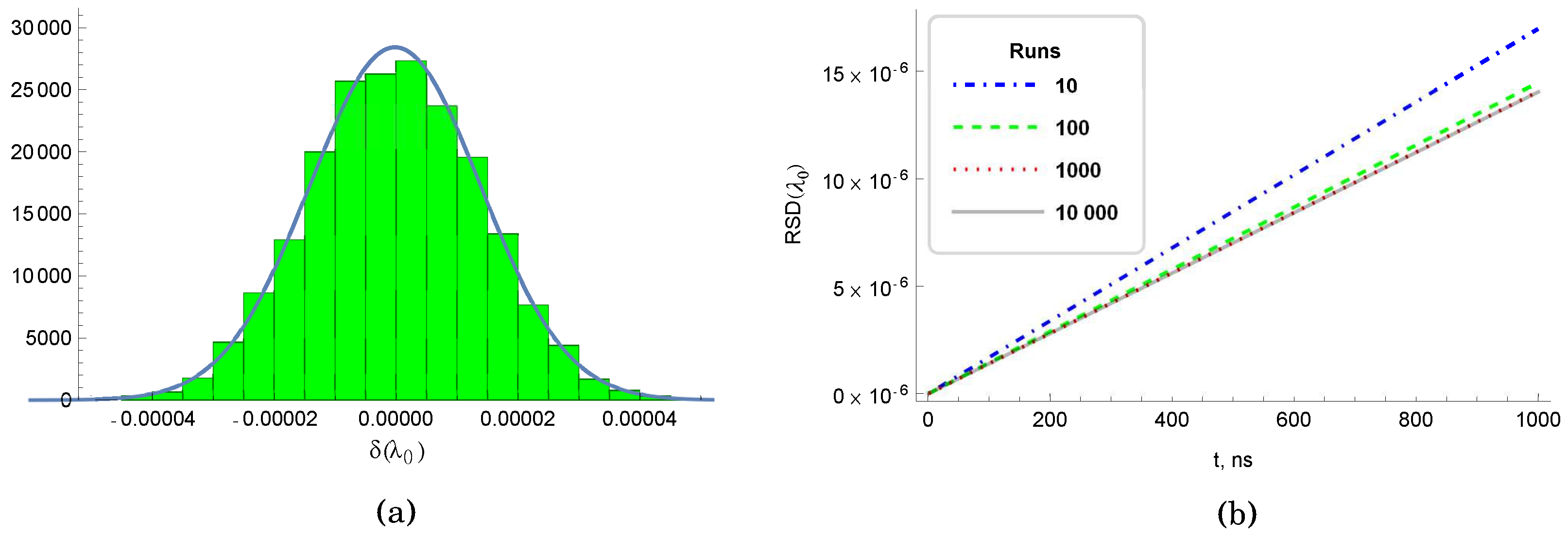
Two remarks are in order. First, our simulations show that relatively small uncertainties in the normally distributed parameters lead to uncertainties in the muon transfer events d
NO/d
t(
t) that follow a distribution very close to normal. This is illustrated in
Figure 2a, which presents a histogram of the relative uncertainty in d
NO/d
t(
t = 1000 ns), caused by the uncertainty in
λ0, for 10,000 runs. The solid curve represents a normal distribution with the same mean and standard deviation.
Second, to demonstrate that the chosen number of simulation runs is optimal for our investigation, we performed simulations with different values of
Nrun and plotted the results in
Figure 2b. The curves corresponding to
Nrun = 1000 and
Nrun = 10,000 are visually indistinguishable.
5. Sampling the Parameter Space
We assume that all quantities are statistically independent. This is clearly valid for the molecular concentrations, the muon hydrogen scattering rates, and the intrinsic properties such as masses. Regarding the temperature
T, pressure
P, and muon transfer rate to oxygen
λpO, we make the following proviso: We consider only the uncertainties in the initially measured values of
P and
T, as well as the corresponding uncertainty of the muon transfer rate
λpO(
E,
T). Possible temporal shifts and fluctuations of
P and
T and cross-correlations, arising from the interdependence of
P and
T through the equation of state, and between
T and
λpO(
E,
T) via (
6), are not taken into account.
Consequently, instead of analyzing all parameter uncertainties simultaneously, it is sufficient to perform one-at-a-time parameter sweeps, while keeping all the remaining parameters fixed. This approach is supported by the analytical considerations in
Section 6.5, where the leading contributions in the series expansion of the
RSD2 arise from terms linear in the individual variances
. In this way, we can easily identify the dominant sources of uncertainties, and densely traverse their respective parameter spaces.
Furthermore, we have conducted simulations by sampling both the full parameter space and a reduced space limited to the parameters contributing the largest uncertainties. Comparing these results, we confirm the validity of the reduced-parameter approximation within the investigated regime.
6. Propagation of Uncertainty in the Muon Transfer Rate: RSD Dynamics
In this section, we present the results of numerical simulations showing the impact of the uncertainties in a single physical variable on the precision of the simulated muon transfer rate to oxygen dNO/dt. We consider a time interval of 1 μs since this is approximately the time span of the most informative experimental observation.
6.1. Uncertainties in the Physical Constants
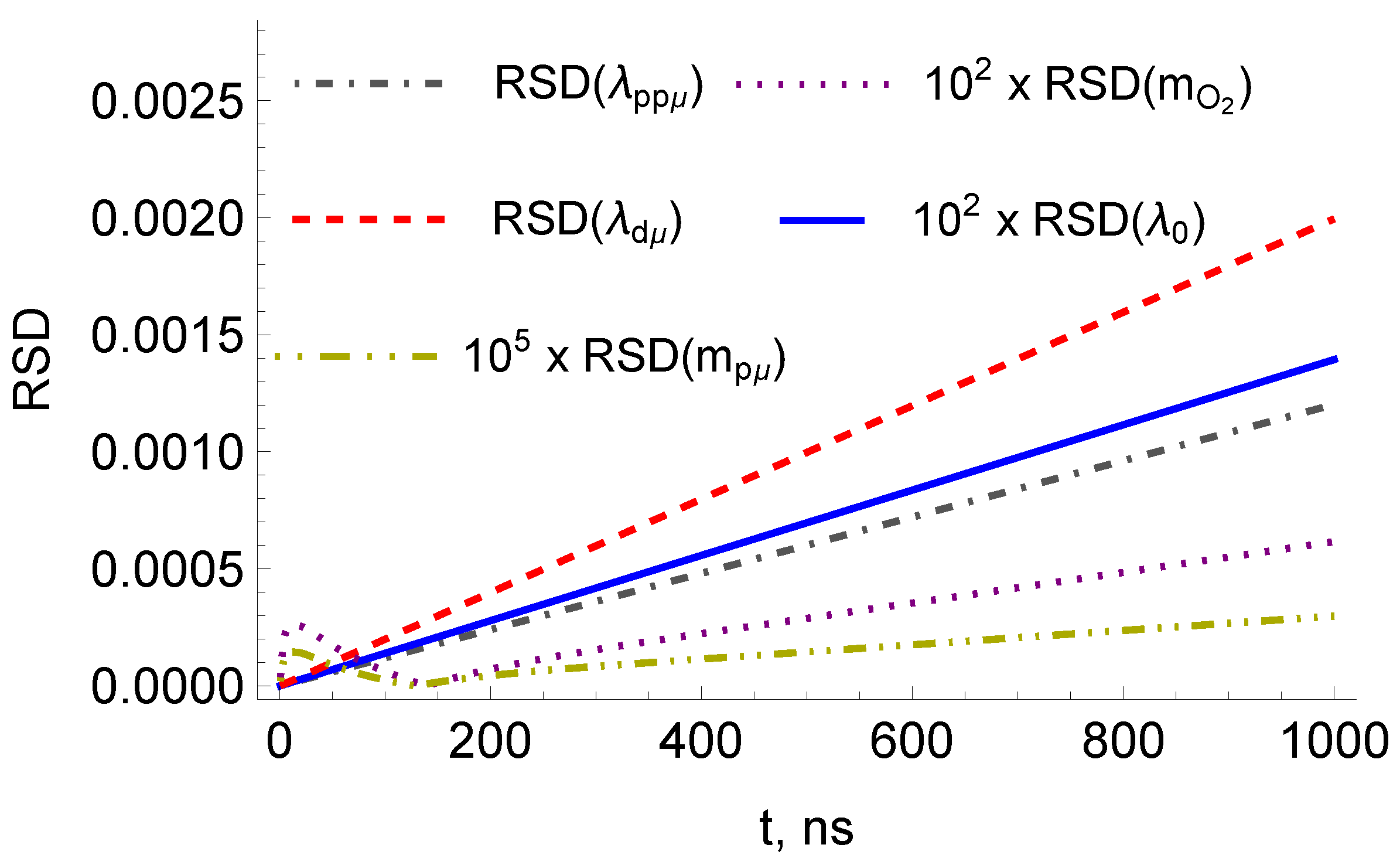
The impact of the uncertainties of the physical constants used in the simulations on the time distribution of the relative standard deviation of the muon transfer rate is shown in
Figure 3. The
RSD values due to the quantities listed in
Table 1 range from less than 1% (for
λppμ,
λdμ) to significantly lower values for other constants.
6.2. Uncertainties in the Controllable Experimental Parameters
Unlike the physical constants, the other parameters used in the simulations depend heavily on the conditions of the modeled experiment. In this study, we utilized the mean values and the uncertainties of the controllable parameters corresponding to the experiment described in [
11] (given in
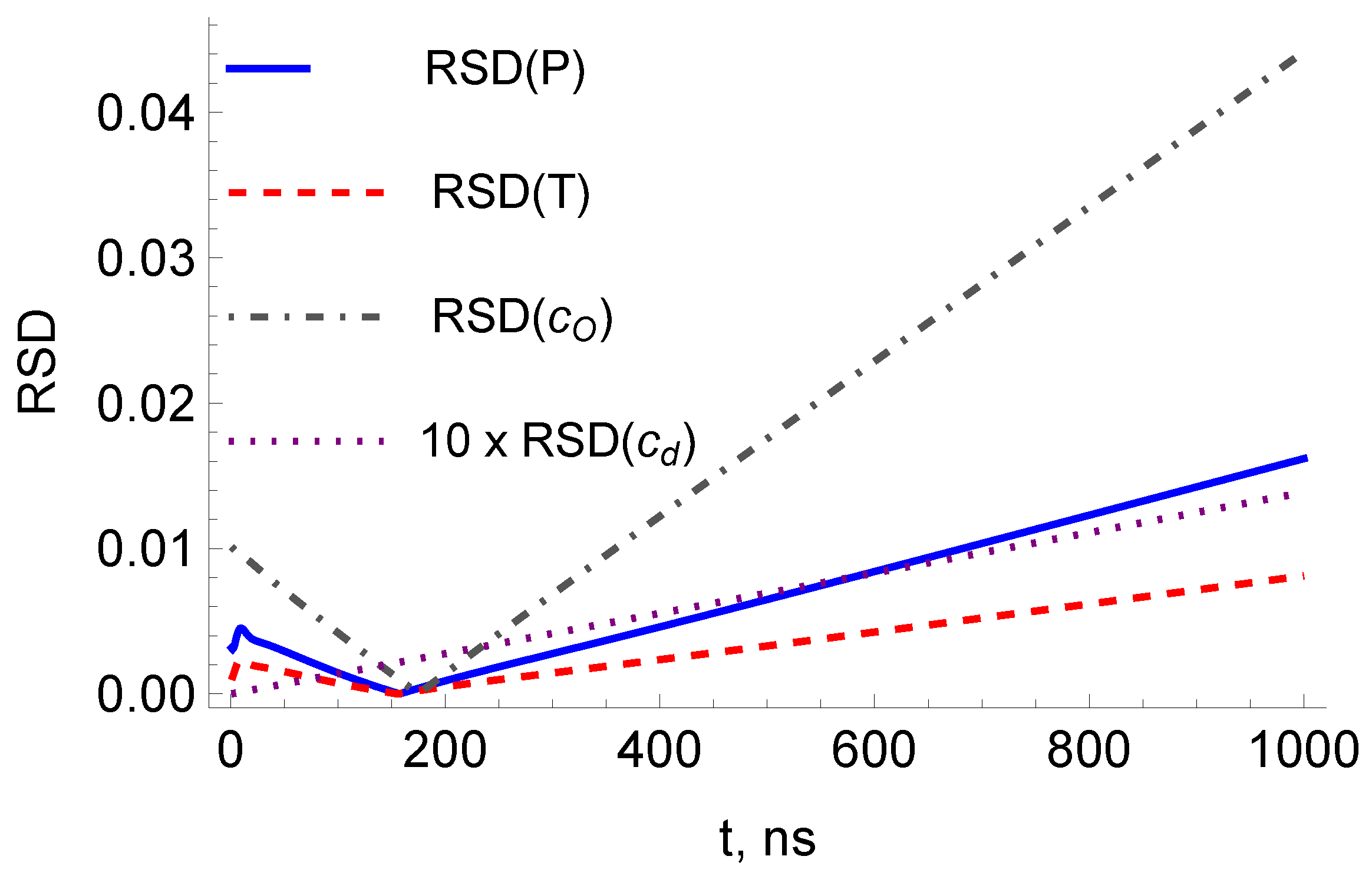
Table 2) to verify the results of our simulations. As shown in
Figure 4, the
RSD of the muon transfer events due to inaccuracies in the experimentally controlled parameters
P,
T,
cO, and
cd is significantly higher than that resulting from the uncertainties in the physical constants. As discussed in
Section 6.6, the effect of the uncertainties in these parameters on the experimentally observed data in precise muonic experiments can be estimated.
6.3. Uncertainty in the Initial Condition
The relative standard deviation in the muon transfer rate to oxygen, arising from the assumptions regarding the initial state of
pμ atoms as discussed in
Section 3.4, is shown in
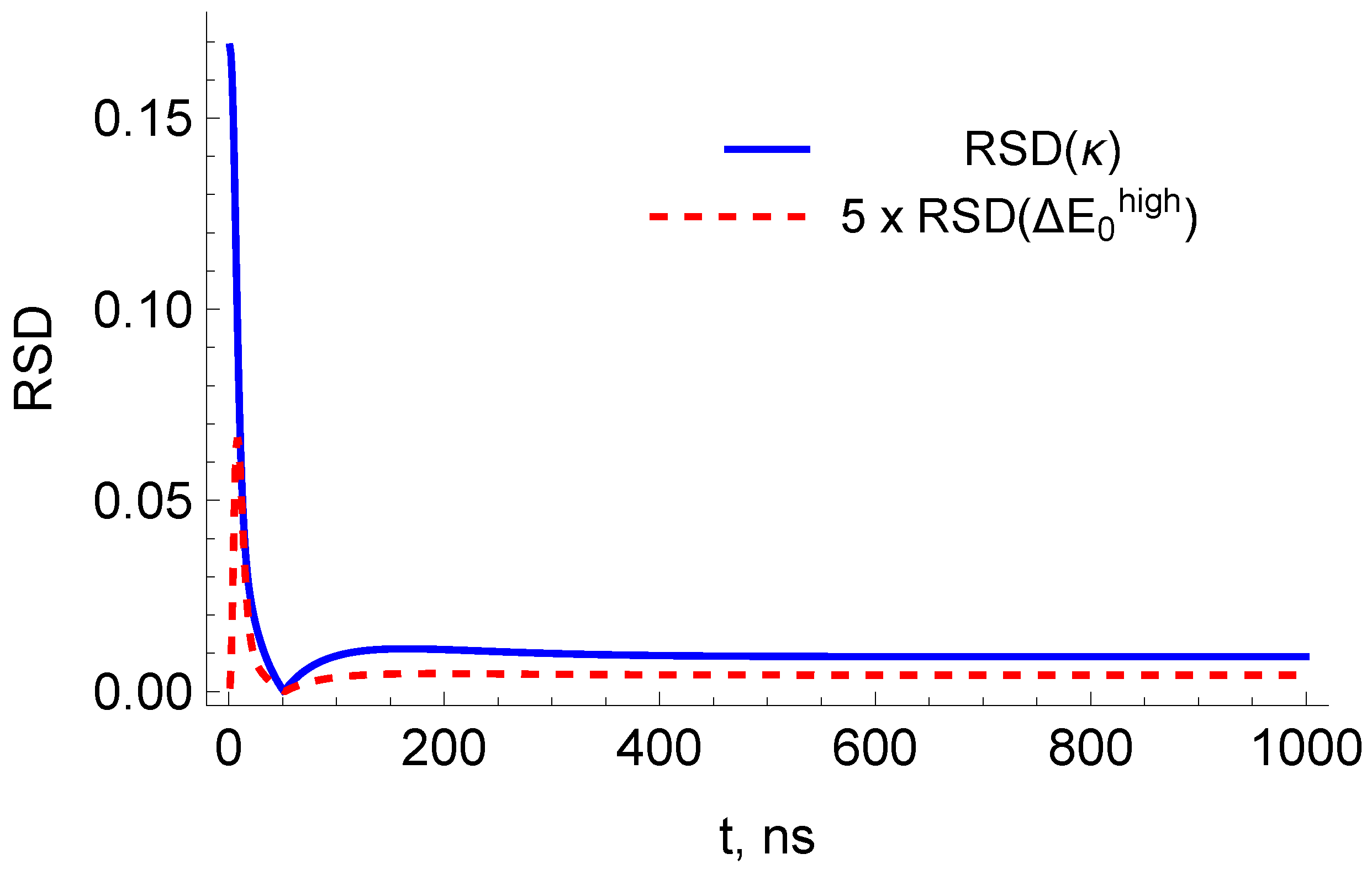
Figure 5. The uncertainties in the fraction of the high-energy component
κ and its mean energy
(both with normal distribution and standard deviations, respectively
σκ and
) result in significant variations in d
NO/d
t at the first moments after the formation of
pμ atoms. As expected, the initial energy distribution has a major impact during the thermalization phase of
pμ atoms, while its influence diminishes significantly—by approximately a factor of 20—once thermalization is complete. The figure demonstrates that
RSD due to uncertainties in the high-energy component fraction is an order of magnitude larger than that caused by its mean energy for the chosen uncertainties.
6.4. Uncertainty in λpO(E)
Simulations are performed under both moderate and conservative uncertainty scenarios for
λpO(
E) (see
Section 3.8), as depicted in the upper panels of
Figure 1. The resulting muon transfer rates are presented in the middle panels of the same figure, with shaded areas representing the standard deviation of d
NO/d
t. The relative standard deviations due to the uncertainties in
λpO(
E) as functions of time are shown in the bottom panels of
Figure 1.
It is evident that the relative 1σ deviations in RSD(λpO) induced by the uncertainty in λpO(E) () for a moderate (conservative) scenario are non-negligible. For times shortly after the formation of pμ atoms (0 ÷ 150 ns), these deviations reach approximately 15% (80%), and by t = 1000 ns, they exceed 70% (80%).
A comparison of the figures indicates that increasing the uncertainty in λpO(E) for E > 0.1 eV has minimal impact on the muon transfer rate for times t ≳ 100 ns. However, during the initial stages of the transfer process, the impact is significant—the relative standard deviation for the two scenarios differs by a factor of five.
Given that the value of d
NO/d
t(
t) decreases exponentially over time, the dominant influence of the uncertainty in
λpO(
E) on the muon transfer rate is observed at the beginning of the process, specifically for times
t ≲ 100 ns, as seen in
Figure 1.
6.5. Analytical Considerations
The uncertainty propagation in the muon transfer rate, characterized by its relative standard deviation, can be approximated as
where
σXk is the standard deviation of
, and the derivative with respect to
Xk is evaluated at the mean values
μXk of the respective parameters. The derivation of Equation (
10) assumes that approximating d
NO/d
t({
X}) by a first-order expansion is valid, and the random variables
Xk are statistically independent. From this expression, the general behavior of the relative standard deviation (
RSD) associated with a given parameter,
RSD(
Xk), can be qualitatively inferred by considering variations in
Xk while keeping the remaining parameters (
) fixed.
The parameters
cO, Λ
pO, and
ϕ(
P/
T) appear as multiplicative factors of
N(
t) in the expression (
4) for the muon transfer rate from hydrogen to oxygen. Therefore, determining the time of minimum uncertainty,
t0, when any of these parameters is initially uncertain, requires differentiating Equation (
4) with respect to time and setting the result equal to zero, which yields the difference in two competing terms that depend on both the initial uncertainty and time. This results in a distinct time of minimum uncertainty,
t0, which differs from the initial time of the process, particularly for the uncertainties associated with
cO,
P,
T, and Λ
pO (
Figure 1 and
Figure 4). Intuitively, this minimum arises because different contributions to the signal, those affecting the overall normalization and those governing the time evolution, compensate for each other at a specific time, thereby reducing the net sensitivity to variations in the parameter.
Approximate values of the time of minimum uncertainty
t0 in
RSD(
X), for single parameters
, can be found as a solution of the following equation:
where
μ(
X;
t0) is the mean muon transfer rate defined in Equation (
8). In the general case, the solution of Equation (
11) for
t0 and the slopes of
RSD(
X) at
t0 lack simple closed-form analytical expressions. For that reason, we refrain from presenting overly simplified formulas including linearization of the matrix exponents, though for some specific parameter combinations, this may be attainable.
Parameters such as
and
mpμ (
Figure 3), whose uncertainties are incorporated into the aforementioned ones, are not further considered in this context. Additionally, the impact of uncertainties in the initial conditions on the scaling with parameter uncertainties and the time dependence of
RSD(
κ) and
(
Figure 5) is not extensively discussed here, as these aspects can be analyzed in a similar manner.
To elucidate some key characteristics of the time-dependent behavior of RSD(X), in the following, we provide specific examples and additional commentary on the RSD({X}) time dependence and its scaling with parameter uncertainties.
6.6. Scaling of RSD with Parameter Uncertainties
Expression (
10) indicates that, for small deviations of the experimental parameters, the resulting change in d
NO/d
t must scale nearly linearly with the change in the parameter standard deviation. This assumption was confirmed through numerical simulations. In addition, the uncertainty distribution of d
NO/d
t was found to be close to normal, except in cases involving very large uncertainties in the model parameters.
6.7. Remarks on the RSD Time Dependence
In the presented simulations,
Figure 1,
Figure 3,
Figure 4 and
Figure 6, we observed that, in general, the time behavior of the relative standard deviation defined by various parameters tends to increase at large times. As we have already pointed out, the rate of change of d
NO/d
t and
RSD(
X) in time is linear in the first order of approximation, as shown in
Figure 3 and
Figure 4. This is evident when one considers the exponential time dependence of both d
NO/d
t(
t) and
μ(
t) as given by Equations (
1) and (
4), performs a Taylor expansion in time around (
t −
t0) of (d
NO/d
t(
xi;
tj) −
μ(
X;
tj)) in the definition of
σ(
X;
tj) (9), and substitutes the result in the definition of
RSD(
X) (
7). However, since the mean value of the muon transfer rate d
NO/d
tμ(
X) decreases exponentially with time, the effect of parameter uncertainties on the standard deviation becomes smaller at later times.
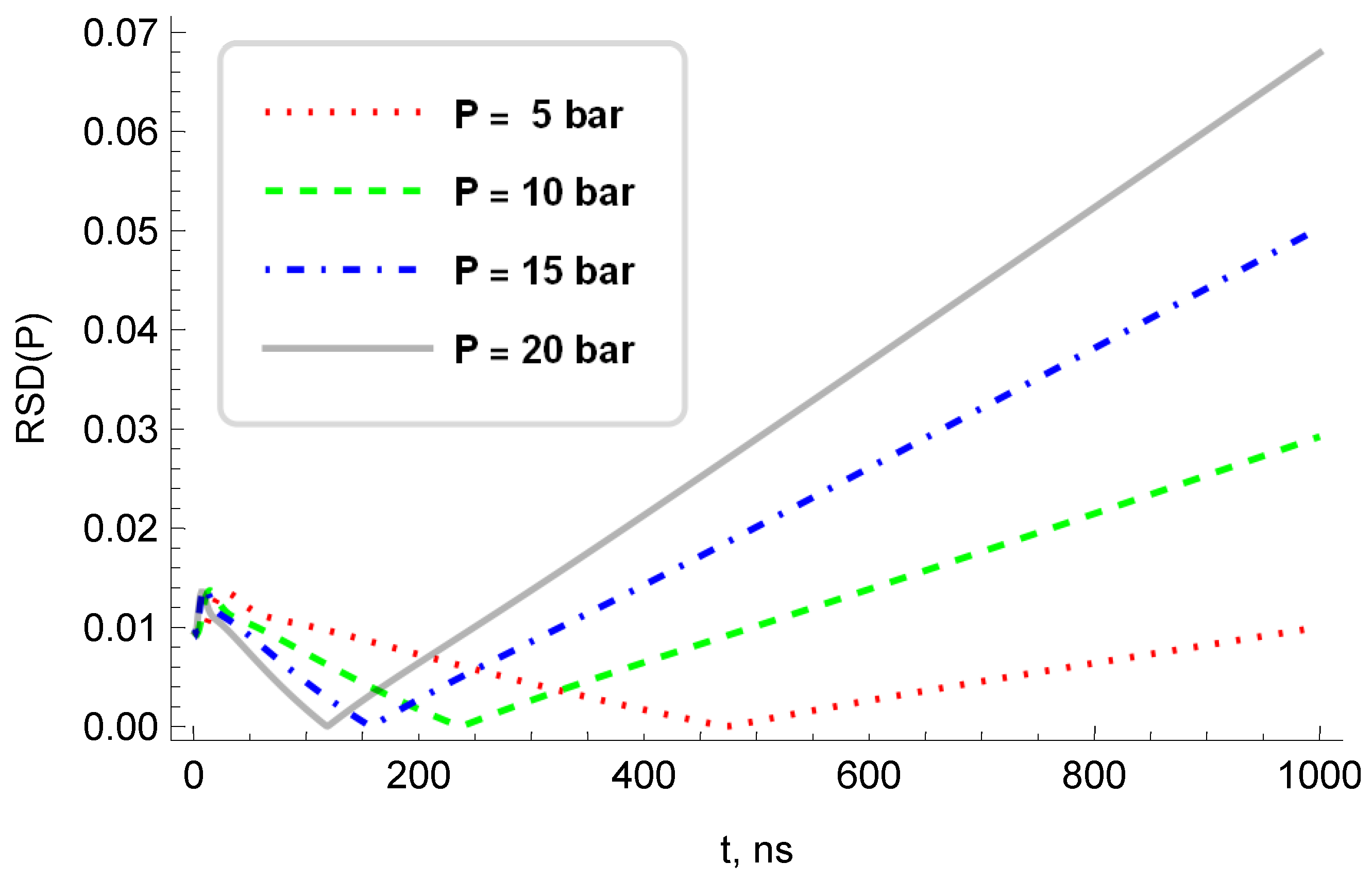
As we have already mentioned, for a given combination of experimental parameters, there exists a time interval where the impact of uncertainties in some of the parameters on the relative standard deviation becomes minimal. In the time dependence of RSD due to uncertainties in P, T, cO, λpO, a time of minimum uncertainty, t0, is observed at approximately a few hundred nanoseconds, for the range of change in the mean values of parameters we are interested in. This phenomenon is attributed to faster (slower) pμ atom depletion in the gas when the particular parameter has a larger (smaller) value.
For instance, this effect is illustrated for a few pressure values in
Figure 6. As the pressure
P increases from 5 bar to 20 bar, the time corresponding to the lowest
RSD shifts from
t0 ≈ 500 ns to
t0 ≈ 150 ns. A similar trend is observed for other parameters, reflecting the underlying relationship between these parameters and the muon transfer rate d
NO/d
t, as described by Equations (
1) and (
2).
This effect has several potential applications. For instance, identifying the time interval of low RSD allows for improved comparison of results between experiments and/or numerical simulations. For a specific experiment, it can also assist in calibration processes. Moreover, by optimizing the experimental parameters to exploit this effect, it may be possible to enhance the precision of the measurements, potentially by reducing the impact of parameter uncertainties during the critical interval of observation.
7. Self-Consistency Check of the Proposed Model with a Two-Step Muon Transfer Rate Fitted to Experimental Data
To validate the underlying principles and assumptions of the proposed model introduced in
Section 2 (Equations (
1)–(
4)), we compare its predictions with the experimental data reported in Ref. [
11]. In order to isolate the impact of the energy-dependent muon transfer rate
λpO(
E)—which introduces significant uncertainty in our simulations—we employ a simplified two-step muon transfer rate function
, obtained in Ref. [
11] by fitting to experimental data:
Although this parametrization is not physically motivated, it provides a useful benchmark for assessing the internal consistency of the proposed model. Since both the experimental data and the corresponding two-step transfer rate function
originate from the same work [
11], this comparison effectively constitutes a self-consistency check. In particular, if the present model is adequate, the use of
as input should reproduce results in close agreement with the experimental data from which it was originally derived.
The function
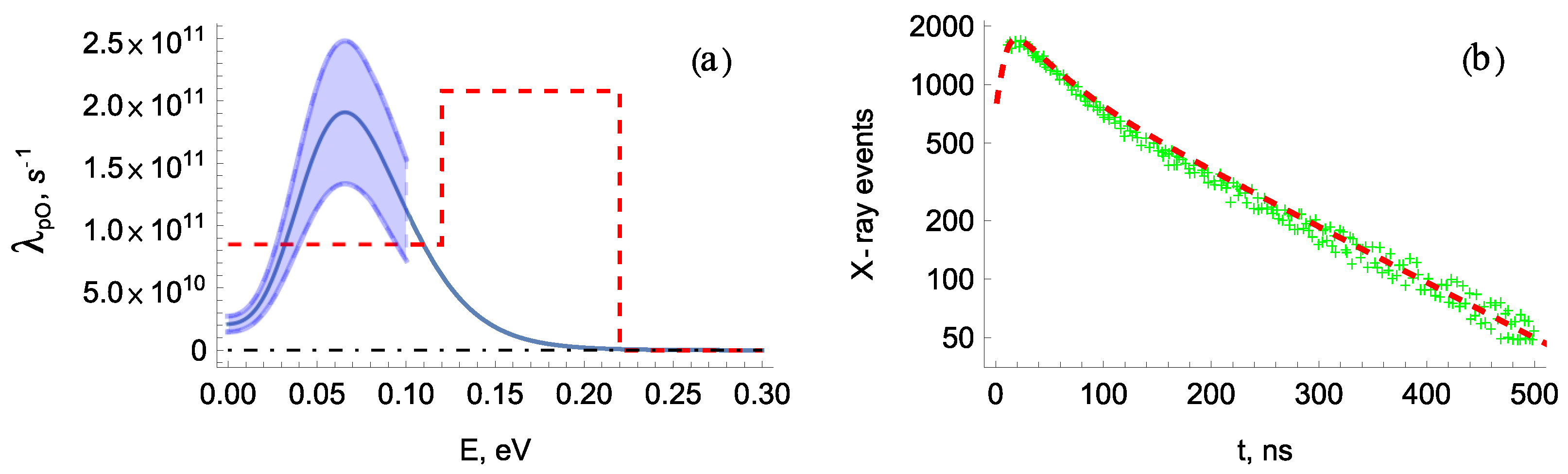
is shown in
Figure 7a by the dashed red line, while the muon transfer rate
λpO(
E) extracted from the FAMU experiment [
13] is shown by the solid blue line. In this comparison, we do not attempt to estimate the uncertainty of
λpO(
E) for
E > 0.1 eV; instead, we display only the 95% confidence interval up to
E = 0.1 eV, as reported in Ref. [
13] (shaded region). The zero transfer rate is indicated by the dash-dotted line. A notable difference between the two functions is observed: the two-step model underestimates the muon transfer rate for
E < 0.1 eV, while suggesting larger values at higher energies.
We simulate the time dependence of the characteristic X-ray emission rate using
, while keeping all other parameters fixed as specified in
Section 3. The results are shown in
Figure 7b (dashed red line). A very good agreement with the experimental data (green “+” symbols) is observed. The simulated and experimental results are consistent both at early times (
t < 100 ns) and at later times. This agreement not only supports the reliability of the proposed model but, in combination with observations from
Figure 7a, also suggests that further investigation of the energy dependence of the muon transfer rate to oxygen is necessary, particularly for
E > 0.1 eV, where the current uncertainty remains significant.
The physical interpretation of the elevated X-ray emission rate observed during the first tens of nanoseconds when the two-step transfer rate is used is as follows: For the range of parameter values considered, the thermalization of the pμ atoms occurs within approximately 10–20 ns. However, the simulations indicate that, up to about 100 ns, a non-negligible population of epithermal pμ atoms with energies in the range 0.1–0.3 eV persists. Since the function attains relatively large values in this energy range, it leads to an enhanced muon transfer rate to oxygen and, consequently, to increased X-ray emission. At later times (t > 100 ns), the epithermal pμ population is largely depleted due to ongoing thermalization and transfer processes, and only the low-energy region (E < 0.1 eV) contributes significantly. In this regime, both and λpO(E) yield similar behavior for the X-ray emission rate.
8. Simulations and Comparison with Experimental Data
In the previous section, we validated the proposed model’s predictability and self-consistency with a simplified two-step muon transfer function. Here, we will apply it to a real-world scenario by simulating the muon transfer rate from hydrogen to oxygen using the full set of model parameters as specified in
Section 3. In order to test the precision and accuracy of our model versus a real-world scenario, we simulated the muon transfer rate from hydrogen to oxygen using the experimental parameters from [
11] as specified in
Section 3. In line with the analysis in
Section 5 and
Section 6, we account for the uncertainties in the parameters that have the most significant impact on the simulation precision—namely, the pressure
P and temperature
T of the gas mixture, the oxygen concentration
cO, the initial distribution of
μp, and the transfer rate of muons to oxygen,
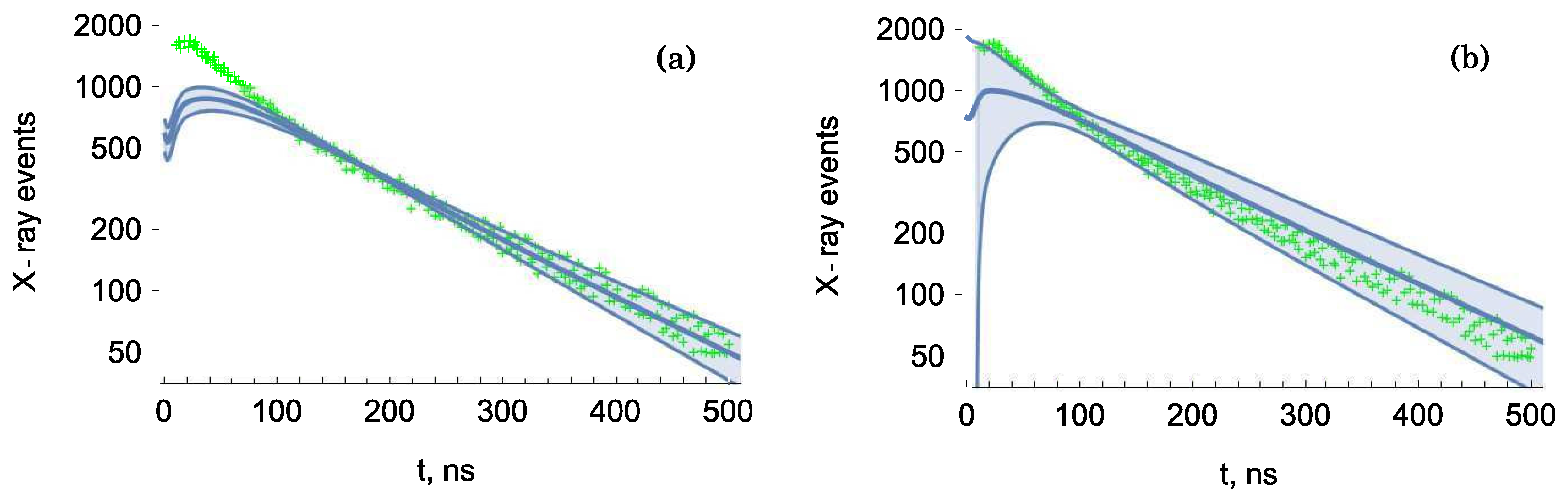
λpO. This approach allows for a Monte Carlo simulation that more densely traverses the parameter space. The simulation results showing the transfer rates from hydrogen to oxygen as a function of time along with their corresponding standard deviation are plotted alongside the experimental data from Werthmüller et al. [
11] in
Figure 8.
The simulations incorporate the transfer rate
λpO(
E) from [
13], using both moderate and conservative scenarios for its uncertainty, as shown in
Figure 1. The results for these scenarios are displayed in the left and right panels of
Figure 8, respectively. The measured X-ray event rates are expected to be proportional to the muon transfer rate on a logarithmic scale, with the scaling factor depending on specific experimental factors, such as detector efficiencies, the number of observed characteristic frequencies, the initial population of
pμ atoms in the target, and more. This scaling factor is determined by matching the average value of d
NO/d
t from the simulation to the experimental data fit at
t = 170 ns for
λpO and at 110 ns for
, as these times correspond to periods where the relative standard uncertainty in the muon transfer event rate is approximately minimal.
It is worth noting that in the full Monte Carlo simulation, where the uncertainties of multiple parameters are taken into account, a distinct time at which the overall uncertainty reaches a minimum is observed (visible in both panels of
Figure 8). This indicates that such a feature is also preserved in simulations involving multiple parameters. This behavior may have practical implications for more realistic calibration and optimization of muon experiments as a whole.
Figure 8 shows a very good agreement between the simulation and the experiment at times
t ≳ 150 ns. However, a notable discrepancy in the slope of the emission event rate is observed for
t ≲ 100 ns. The discrepancy results in a slight upward shift in the simulated curve relative to the experimental data for
t ≳ 150 ns in
Figure 8b, as the matching is performed at a time when the experimental behavior deviates from the expectations. This deviation is challenging to explain solely through the uncertainties in the physical constants (
Table 1) or the experimental parameters (
Table 2).
Several factors may contribute to this discrepancy. For instance, our approximation of the initial
pμ distribution as a “two-component” model, based on experimental [
11] and theoretical studies [
23], may be too simplistic. However, it could partly explain the discrepancy as the uncertainties stemming from this approximations could be significant in the first tens of nanoseconds, as can be seen in
Figure 5. The same reasoning applies to the neglected time dependence of Λ
pO and to the unknown transfer rate to oxygen from the
pμ triplet state (see
Section 3.8); their influence on the emitted radiation persists only until thermalization is achieved. Another potential reason is the lack of a reliable expression for the energy-dependent muon transfer rate
λpO(
E), for energies
E higher than 0.1 eV. In this case, we have to assume that the uncertainty in
λpO(
E) is larger for
E > 0.1 eV. When the conservative uncertainty estimate is used, all experimental data points fall within or very close to the 1
σ uncertainty band, as shown in
Figure 8b.
Our observations and those in [
11] suggest that the energy-dependent muon transfer rate
λpO(
E) for
E > 0.1 eV could be higher than currently assumed. The higher values of
λpO(
E) at elevated energies lead not only to faster but also to more prolonged and deeper depletion of high-energy muonic hydrogen in the gas mixture, which may account for the observed discrepancy. This is further supported by Werthmüller et al. [
11], who show that a specific functional dependence of
λpO(
E) can be constructed to reproduce the experimental results (see
Section 7). The physical origin of such heightened values of
λpO(
E) may be attributed to effects arising from the internal structure of
O2 and
pμ. Investigation of this hypothesis would require a dedicated study. In principle, the value of
λpO(
E) could be tested through an experiment designed to measure the muon transfer rate as a function of the collision energy, with high resolution, during the first tens of nanoseconds after
pμ formation, until the system is in a non-stationary state.
9. Conclusions
We study the characteristic time-dependent X-ray emission resulting from muon transitions to the lower-energy states in oxygen after their transfer from muonic hydrogen. In the developed model, the kinetic energy and spin distribution of pμ atoms is evolved in time by accounting for the possible channels that alter their state. The decay and scattering of muonic hydrogen, as well as its probability of transferring to another constituent of the surrounding medium, are modeled by using the relevant transition rate matrix. The impact of the uncertainties in the experimental parameters is investigated by means of the Monte Carlo method, and the main sources of uncertainty are identified. The results obtained from the proposed model are in good agreement with the available experimental data, especially at relatively long times. However, within the first hundred nanoseconds, there is a discrepancy that may be due to an unaccounted effect or inaccuracies in the rates used. Thus, the model provides a realistic description of processes involving muonic hydrogen, while different sources of uncertainty are assessed. Moreover, the presence of a minimum in the relative standard deviation can serve as a benchmark for comparing experiments and numerical simulations, aid in calibration processes, and enhance measurement precision by minimizing the impact of parameter uncertainties during the observation period. These results could be useful and may find application in the planning and analysis of both current and future muonic experiments.