1. Introduction
In multiply charged few-electron ions with 3s-3p resonance lines, lifetime measurements on short-lived 3p levels have attempted to test theoretical predictions, with only moderate success. A key problem is the excitation of any specific desired level, because the excitation energy is usually much higher than the photon energy provided by practical lasers. Instead, most experiments have relied on passing a beam of fast ions through a thin foil (beam–foil interaction and spectroscopy). This technique is efficient and has been applied up to one-electron ions of uranium, but it comes at the cost of non-selective excitation and it thus suffers the challenges and limitations of multi-exponential decay curve analysis [
1]. The ANDC (Arbitrary Normalization of Direct Cascades) scheme [
2] uses the observation of cascades into the level of interest for a combined decay curve evaluation with often much better accuracy than achieved with “naive” multi-exponential analysis, but even then the measurement rarely is accurate enough to test modern computations. In contrast, some atomic lifetimes have been measured accurately after beam–foil excitation, because they were from intercombination decays so much more long-lived than most cascades that their contribution provided a boost of the signal, but no detrimental distortion of the decay curve of interest [
3].
Besides some intercombination decays, some electric dipole ()-forbidden decays can be studied this way, as has been exploited in various ion traps, from small Kingdon traps to large heavy-ion storage rings and the electron beam ion traps in between. An accurate decay curve evaluation seems feasible if the decay component of interest is singular in lifetime, and very different from other contributions. For a while, this was assumed to be the case for those ions with -forbidden transitions in the ground configuration ( levels in B-like ions and up, levels in Al-like ions and up, etc.). However, it has been recognized that, in the latter ions, there are one or more 3d levels that have lifetimes of the same order of magnitude and may spoil the accuracy aimed at in lifetime measurements.
This tutorial discusses atomic structure properties and decay systematics of such 3d levels in Na- through Ca-like ions of mostly Fe with a pedagogical motivation. The lifetimes of assorted excited levels in Fe ions that are of possible astrophysical interest have already been reviewed elsewhere [
4]. Indeed, the spectra of Fe ions figure prominently in many astrophysical observations by the various space observatories with capabilities for extreme ultraviolet, soft-X-ray, and X-ray spectroscopy (such as the active
,
-
, and
spacecrafts that study Sun and many other stars and various astrophysical objects, or the upcoming
project that addresses the processes near black holes). Atomic transition rates are not observed directly in these spectroscopic measurements, but they are essential for the interpretation of the spectra. Certainly, most transition rates are available only from theory, but those predictions have to be verified by experiments on selected examples.
This article is a revised and expanded version of a poster paper entitled “Long 3d level lifetimes in highly charged ions of the iron group elements: a nuisance oir a feature?”, which was presented at the 1st International Online Conference on Atoms (IOCAT2026), 29–30 January 2026 [
5].
2. Atomic Structure
The resonance lines stick out by their intensity in many spectra, because they relate to the excitation of the least-bound valence electron from the ground state. These lines are particularly bright in few-electron spectra, especially the
ns-
np transitions of the alkali- and earth alkali-like elements and ions. Consequently, the transition rates of these transitions have been investigated by many techniques. For neutral atoms and singly charged ions, usually laser excitation has been applied and effected selective excitation, resulting in single-exponential decay curves that often are easily evaluated with an accuracy better than 1%. The 3s-3p transition in, for example, Na-like ions (
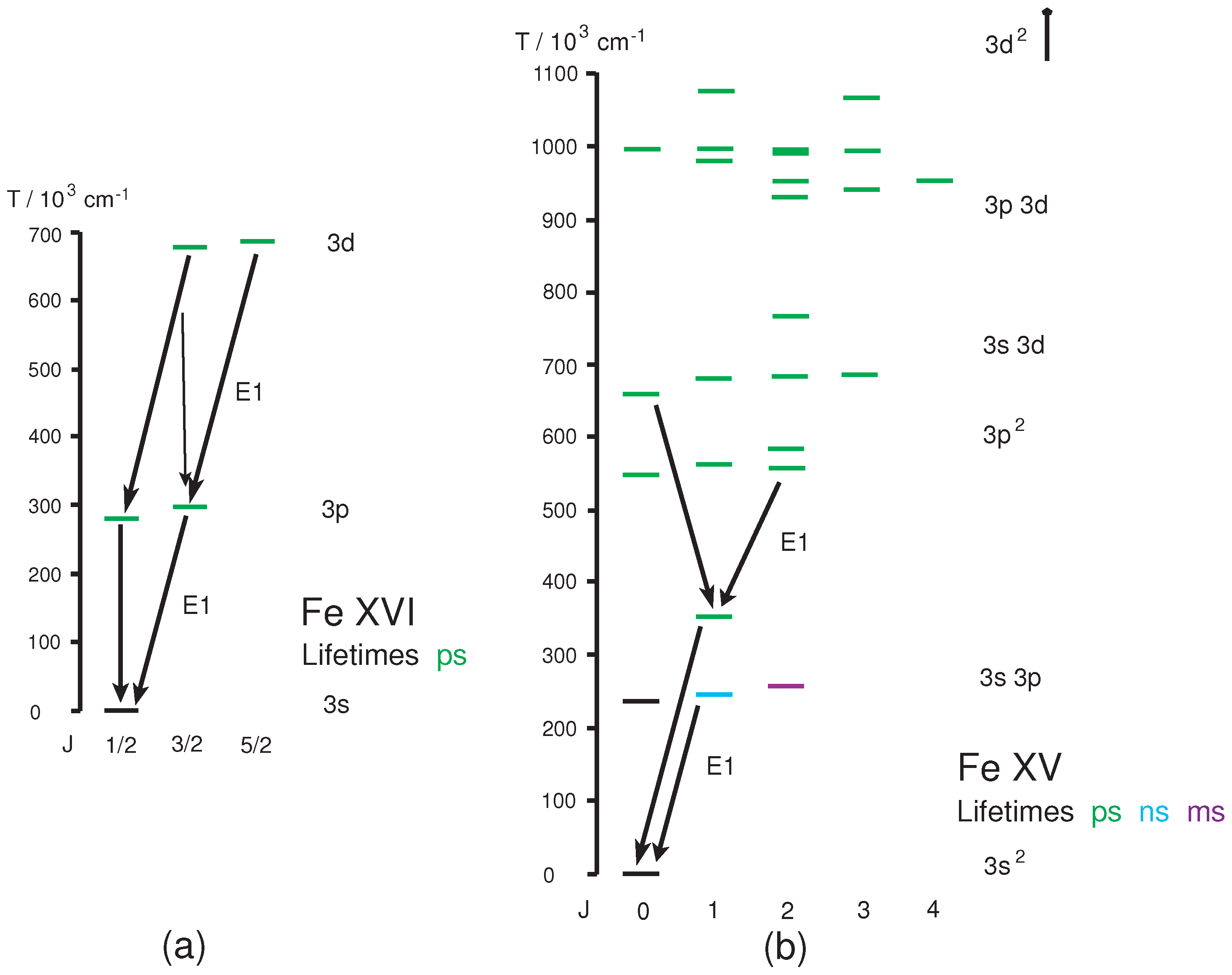
Figure 1a) is an intra-shell transition without change of the principal quantum number (
); the transition energy scales linearly with the atomic number
Z, as does the transition rate. The transition from the next higher level, 3d, is an electric dipole (
E1) transition with the same
Z scaling, and the transition rate is close to that of the 3s-3p resonance transition (typically a bit higher). Naively, one might then expect that the 3d level lifetime can be measured as accurately as the 3p level lifetime (the inverse of the transition rate), but that has not been achieved. An obvious reason for this is the higher level energy (roughly twice as high as the 3p level), which is reached (at least in atoms and singly charged ions) by fewer laser systems. The 3d levels have the same parity as the ground state, which suggests that we should use two-photon excitation. For whatever technical or theoretical reasons, the interest in studying the 3d levels appears to have been much lower than for the resonance level excitation. One viable reason may have been that the 3p level has
and
fine structure levels, of which the first can be excited without causing quantum beats, whereas the
fine structure levels of the 3d
2P
o term do not offer this selection. At high ion charges (and thus high
Z), the quantum beat frequencies are so high (and their amplitudes rather small) that their presence matters less—but no present laser can then reach up to the necessary level energy.
Apparently, physics-wise, no new insights are expected from (not so precise) lifetime measurements of the 3d levels over the results of (some very precise) measurements of the 3p level lifetimes, since both decay by electric dipole (
) transitions. However, physics often gains insights from proceeding systematically. The alkali-like atomic spectra all result from a single electron in the valence shell. Adding another electron to the same shell yields earth-alkali like spectra (e.g., Mg-like), which are somewhat more complex (
Figure 1b) and comprise more spectral lines. Singlet-triplet coupling results in the appearance of spin-changing intercombination transitions, which are also
transitions, but little changes concerning the 3d electrons. Adding yet another
electron (Al-like ions,
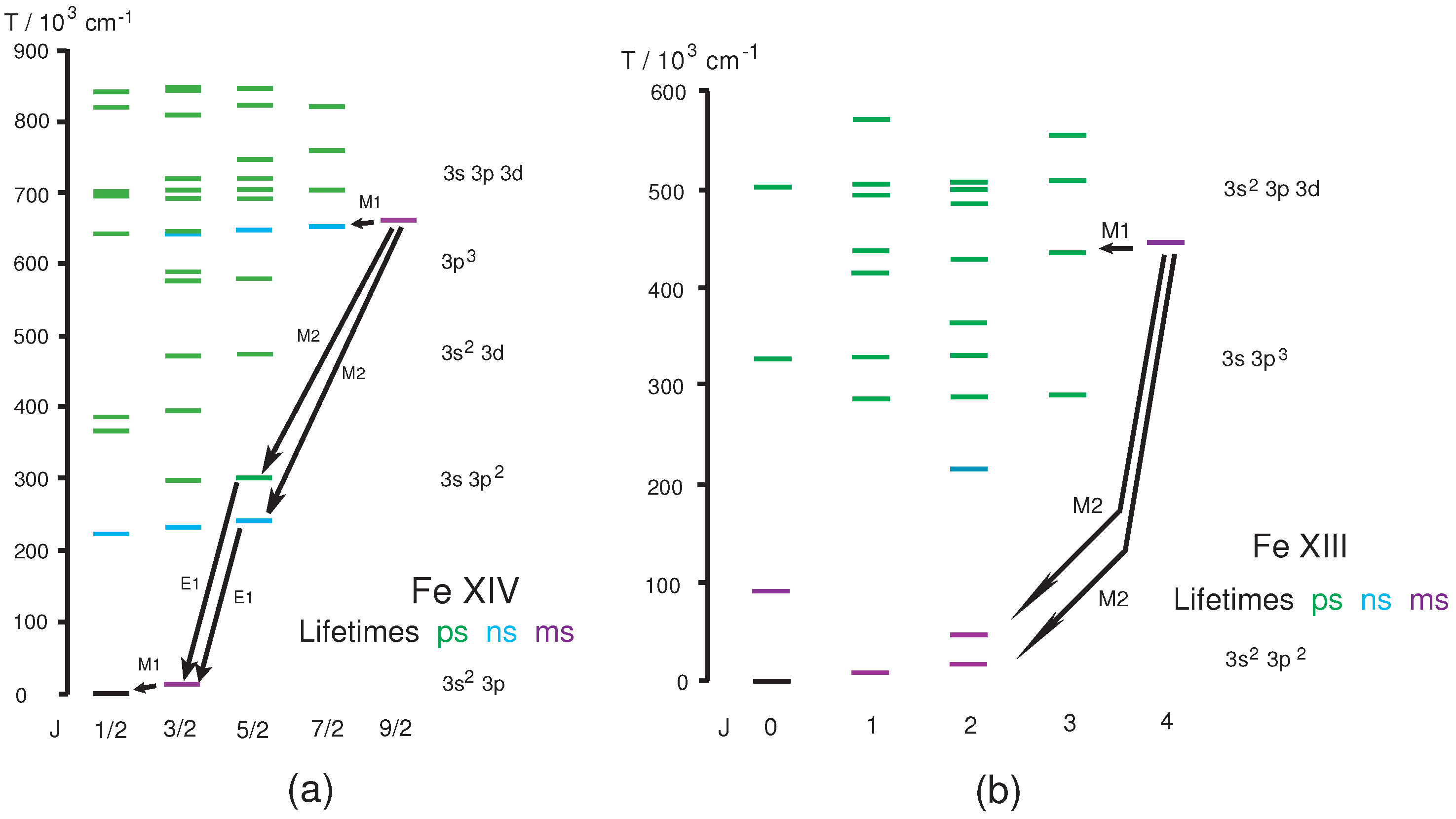
Figure 2a) causes two novel transitions: Firstly, the ground state shows fine structure splitting, with an
transition between the fine structure levels, which has been recognized in the 1940s as the origin of some of the brightest visible lines of the solar corona when observed during a solar eclipse [
7]. The second detail has been spotted only several decades later in solar corona spectra, but without time resolution [
8]: there is a
fine structure level in the 3s3p3d
4F
o term that has no
decay channel, but only a
decay path to another fine structure level of the same term. This fine structure level is orders of magnitude longer-lived than its companions and might spoil precision lifetime measurements on low-lying levels [
9]. The same situation extends to several ions with more electrons. The complications are the topic of this tutorial review, as well as some measurement options that might help to extract some insights about physics. Most of the examples chosen are from Fe ions. The actual lifetime data have been referenced in a recent review [
4] and will not be repeated systematically here.
3. Lifetime Ranges
The lifetimes of resonance levels in neutral atoms are on the order of 10 ns. For intra-shell
transitions, the transition rate scales linearly with the ion charge and thus also with the atomic number
Z. For the 3p resonance levels in Na-like Fe XVI (see
Figure 1a), this very coarse estimate points to a lifetime on the order of half a nanosecond. Measurements by beam–foil spectroscopy (see [
1]) have obtained lifetime values of 0.14 ns and 0.16 ns, respectively, for the 3p
2 levels [
10,
11]. The same experiments yielded lifetime values of 50 ps to 70 ps for the 3d
2 levels, all with measurements on
transitions in the EUV. The ion–foil interaction of a fast ion beam passing through a thin exciter foil is non-selective. Hence, a decay curve measured on a 3
level decay will also comprise the cascade from both 3d levels, and from all the cascades from higher levels that replenish the 3d levels. (The 3p
2 level is being fed only by the 3d
2 level, which in turn also has cascade contributions from so many higher lying levels.)
Many of the higher levels have lifetimes shorter than those of the 3p levels, because the transition energies of inter-shell transitions (n = 3–4, 5, 6, etc.) are higher than those of the n = 3–3 intra-shell transitions. The decays of short-lived levels combine as so-called growing-in cascades to the 3p decay curves, while high-n levels with their lower decay rates combine to form long-drawn slow cascade tails. Consequently, multi-exponential decay analysis has to deal with large numbers of decay components. One may measure the 3d decays (including their cascade tail) and use this complex curve in a correlated fit to the 3p level decay curve, which collects the same cascades in turn. This procedure achieves smaller uncertainties than simple approximations by a few exponential decay components to the data which represent many individual decays. However, the best evaluations of the resonance line decay curves in multiply charged Na-like ions have not exceeded uncertainties of roughly 7%. In contrast, measurements with selective level excitation of neutral atoms by laser light have reached uncertainties below 1%.
In ions with more electrons in the valence shell, the cascade situation is usually more complex, and the uncertainties of the extracted level lifetimes are often larger.
Figure 1b demonstrates this for the Mg-like Fe XV term system. The second-lowest
level is the 3s3p
1 resonance level. Its decay to the ground level is “technically” similar to the 3s-3p transitions in the Na-like ion, but there are two major cascades from 3p
2 levels (indicated in the figure), and one from a 3s3d level. However, all the transitions in this decay chain are
transitions, just as in the Na-like ion example.
There is a lower-lying level, 3s3p 3, which also decays to the ground state. However, the usual description of this decay involves singlet-triplet mixing. The spin-changing intercombination decay is an electric dipole () decay enabled by multiplet mixing. This intercombination transition rate is typically two to three orders lower than that of the resonance line, and thus this level has a lifetime of about 28 ns. Several decades ago, from the perspective of beam–foil spectroscopy, I would have called such a level “long-lived”, but we will discuss the truly long-lived levels later.
Much longer-lived is the 3s3p
3 level of the same term. It cannot decay by any
decay, since the only lower levels (of the same term) do not differ by parity, and the ground state differs by parity, but also by more than two units of the total angular momentum. Hence, there should be
decay channels within the 3s3p
3P
o term and a
transition to the ground state—all of a very low transition rate. The
and
transition rates are too low to be mentioned in standard databases, but, of course, they can be computed. For example, Safronova, Safronova and Beiersdorfer obtain a 3s3p
3P
o level lifetime of 24 ms for Fe XV and find that in this case the
rate (within the term) amounts to about ten times the
decay rate to the ground level [
12].
So the 3s3p 3Po level lifetime in Mg-like ions of iron group elements is on the order of a fraction of a second. Can such lifetimes be computed reliably? That is an interesting question and the principal motivation for level lifetime measurements.
By the way, the level schemes shown in the figures are partly based on experimental data collected in databases such as the Atomic Spectra Database (ASD) established at the US National Bureau of Standards (NBS) (later National Institute of Standards and Technology (NIST)) [
6] which in 2025 moved, in the care of the same team, to NASA Goddard and the University of Maryland College Park. This database also comprises transition rates. Most of the 3d levels and transitions discussed here are not covered in existing databases. Thus, the figures were augmented by computational results from various sources, including computations supplied on request by helpful colleagues for the benefit of some of my earlier publications. This is not the place to present and discuss those early results quantitatively, especially as modern atomic structure computation packages should be able to provide such results on demand—if applied competently. The big task of checking the atomic structure and level lifetime results by suitable measurements remains.
The level has no decay channel nor any single-photon decay channel to ground. In the absence of a non-zero nuclear spin (which implies hyperfine structure that assists with multiplet mixing), this level should be stable against electromagnetic decay (infinite level lifetime, just as the ground state). It might be collisionally populated and de-populated, depending on the ambient electron density, but that is another process. In short, in an atomic system with two electrons in the valence shell, we have levels with lifetimes ranging from shorter than a nanosecond to many milliseconds and possibly to “infinity”. We cannot (yet) measure atomic lifetimes over this full range. I want to demonstrate and discuss 3d levels with lifetimes ranging from less than a nanosecond (in Fe XVI) to many seconds and how to cope with lifetime measurements of these levels.
Lifetime Measurement Techniques
The lifetimes mentioned in the examples range from tens of picoseconds (10−11 s) to many seconds. Within a given ion, the span typically amounts to nine orders of magnitude. Atomic lifetimes up to dozens of nanoseconds in highly charged ions are best measured by beam–foil spectroscopy. Fast ions (with MeV-range energies) travel some 1 cm per nanosecond (3% of the speed of light). If one follows the light emission by a beam of ions that has been excited by being passed through a thin carbon foil, the distance from the foil (measured along the ion beam trajectory) is a measure of time after excitation. This technique works best for distances from a few μm (corresponding to the picosecond time range) to some 10 cm (corresponding to roughly 10 ns), for practical purposes and a typical high vacuum experiment chamber.
The lifetime range from many nanoseconds up is best measured electronically. The actual problem there is the control over the ion sample—the light emission of which one wants to detect and monitor over time. One way is to feed the ion beam into a heavy-ion storage ring where it can circulate for seconds or minutes. The practical range for atomic lifetime measurements here is 1 ms to 1 min, with the hope of extending the upper limit by even better ultra-high vacuum and cryogenic vacuum vessel operation. A different approach is to trap the ion cloud in a stationary ion trap and to excite the ions by a beam of fast electrons passing through. In such an electron beam ion trap (EBIT), the electron beam energy can be modulated and thus the end of an excitation process be defined from which to measure the time dependence of the photon emission. Atomic lifetimes from femtoseconds (measured via line broadening) to many seconds have been measured with such devices. For measurements as discussed here, a rather simple trap could serve and cover the range from milliseconds to seconds. All three devices and techniques have been amply described in the literature, including an earlier tutorial in this journal [
13] and references therein.
4. Examples
In the level schemes of Na- and Mg-like ions (see
Figure 1) up to levels with a single 3d electron (and with a few exceptions among the lowest triplet levels), all levels up to the 3p3d configuration (with total angular momentum up to
) can decay by electric dipole (
) transitions. In the 3d
2 configuration (not depicted), angular momentum quantum numbers up to
and total angular momentum quantum numbers up to
are possible. Those levels all seem to be able to decay (via
transitions) to the 3p3d configuration, and so on. If an inner electron (2s, 2p) is excited, the coupling rules may permit levels of higher
J which exceed the reach of
decays. Such levels often may be energetic enough to autoionise, but their very high
J value partly precludes the coupling to continuum levels. Those interesting levels have been discussed and referenced elsewhere [
14]; here, I want to limit the discussion to the peculiar role of single (or a few) 3d electrons.
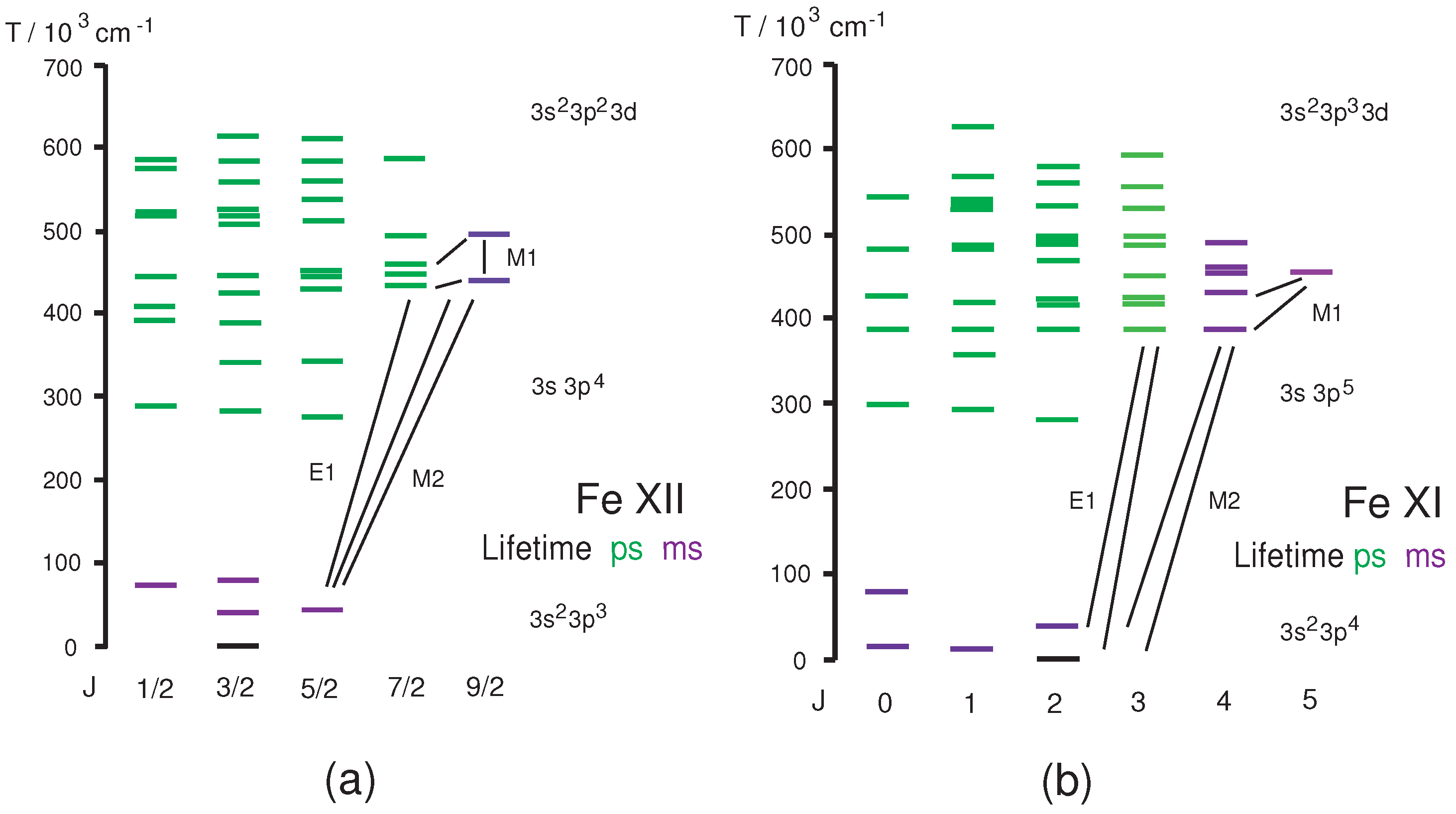
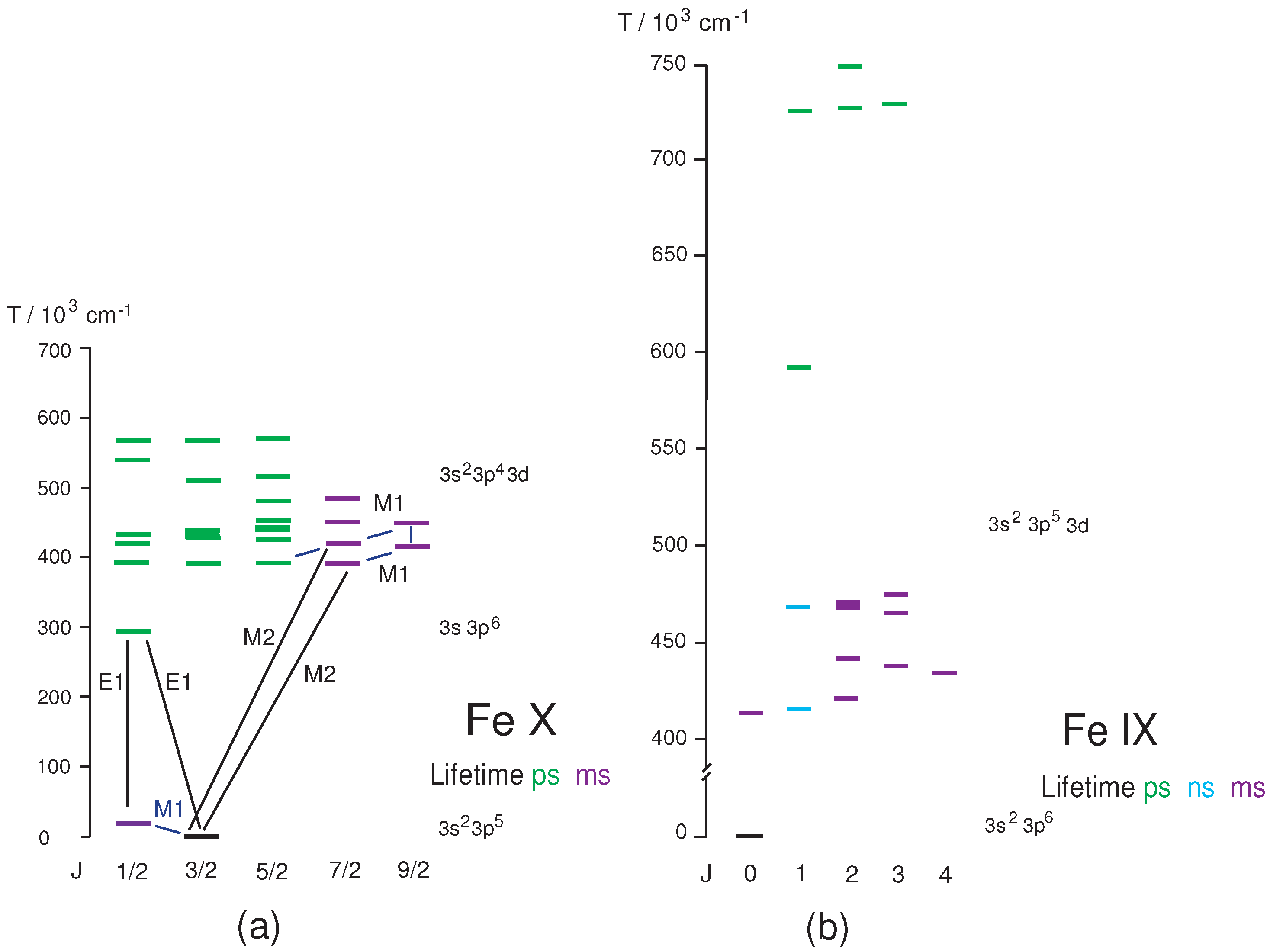
In the figures, no actual level lifetimes are given. However, several lifetime ranges have been indicated by colour coding. The general lifetime pattern has been established by theory. Only a few lifetime measurements have been performed on the long-lived 3d levels so far (for examples, see [
4]), and none of them with high precision yet. Apparently, there is no gross disagreement between prediction and measurement, but the reliability of theoretical transition rates still awaits verification by experiment.
4.1. Al-like Fe XIV
Figure 2a shows about 40 levels of Fe XIV up to 3s3p3d. Early computations of the levels and transitions comprised only the lower-
J levels, because a criterion (helping to manage the size of the computational effort) was applied whether there was a direct transition to the ground term. The implied assumption was that those levels mattered more. I see it almost the other way around—the high-
J levels then left out are of particular interest under some circumstances. Most of the levels in the diagram are coloured in green to represent picosecond time range level lifetimes. Three 3s3p
2 4 levels need a spin change to decay to the ground term. Their lifetimes are on the order of dozens of nanoseconds, and so are the lifetimes of two of the 3s3p3d
4 levels—for the same reason that their
decays require multiplet mixing. Lastly, two levels are special (purple colour): The upper fine structure level of the 3s
23p
2p
o ground term can decay to the lower level by a magnetic dipole (
) transition with a small
admixture. The level lifetime is close to 16.73 ms, as measured at a variety of ion traps (and most accurately at the Heidelberg electron beam ion trap [
15]). The other, almost equally long-lived such level, 3s3p3d
4, decays by a similar
(with
admixture) transition to the next lower fine structure level of its term. It can also decay (with a lower rate) by an
transition to either of two 3s3p
2 levels, from where an
transition can reach the
fine structure level of the ground term.
Evidently, the 3s3p3d
4 level indirectly repopulates the upper level of the ground term. If the two lifetimes are rather close to each other, an attempt at an accurate lifetime measurement of the 3s
23p
2 level has to consider both levels and the influence of one level lifetime on the measurement of the other (see discussion in [
16]). The transition rates vary somewhat differently with the atomic number
Z (because the transition energies scale differently), but a wider range of variation and much better data statistics than reached so far will be needed for decisive results.
4.2. Si-like Fe XIII
Figure 2b shows the levels of the lowest three electron configurations of Fe XIII. There are
-forbidden transitions among the five millisecond-lifetime levels of the 3s
23p
2 configuration (the transitions are not shown). Such transitions are of interest in plasma diagnostics, terrestrial or astrophysical, and they are well-established. Amusingly and rather similar to Fe XIV, there is a high-
J 3s
23p3d
3 level that decays to its neighbouring fine structure level by an
transition and to the ground configuration by two
transitions. It is desirable to observe the three major decay branches of the 3s
23p3d
3 level directly. Actually, the decay of the target level of that
transition, Fe XIII 3s
23p3d
3, has been identified in a combination of beam–foil measurements and solar observations [
17], but the
level of interest (in the same term!) has not [
18,
19].
At the TSR heavy-ion storage ring, lifetime measurements on the 3s
23p
2 1D
2 level in the ground configuration of the isoelectronic ion of Mn (Mn XII) [
20] show a decay curve with two major components, one with a time constant of some 10 ms and the second with a time constant of a few hundred milliseconds. This suggests that we should identify the first decay curve component with the 3s
23p
2 1D
2 level and the second with the 3s
23p3d
3 level, but doing that would be plain wrong. Theory reveals that both of these levels should have lifetimes near 10 ms (rather similar to the case of Al-like ions, with an
decay in the ground term and single long-lived 3d level), and thus neither can be extracted from the decay curve of the 3s
23p
2 1D
2 level with high accuracy. A reliable separation is usually feasible in cases in which the two decay components differ in lifetime by a factor of three or more.
The slow decay component cannot be identified with specific excited levels yet. For people with beam–foil experience, the tail might resemble the ubiquitous cascade tail generated by the chain of yrast levels (a Nordic word for levels of maximum angular momentum l for a given principal quantum number n), but the time scale is enormously different from that encountered in typical beam–foil experiments, by almost eight orders of magnitude. A more plausible hypothesis would assume further long-lived high-J levels in relatively low-n electron configurations, similar to the presently discussed long-lived 3d levels. Their decays might have a correspondingly lower transition rate, because the fine structure intervals of higher-n terms are so small. There is neither experimental nor computational information on possible candidate levels yet. However, the slow cascade observed is striking evidence that there must be such a level (or more).
4.3. P-like Fe XII
Figure 3a shows the levels of the three lowest configurations in Fe XII. There are five levels in the ground configurations, of which the four excited levels have (predicted) lifetimes in the range from 10 to 300 ms. Two of the 3s
23p
23d levels are predicted to have a high
J value of
. They have
decay channels in the same configuration and
decay branches to the
level of the ground configuration. Measurement yields level lifetimes of 4 ms and 11 ms, respectively [
21].
4.4. S-like Fe XI
Fe XI (S-like) (see
Figure 3b) has a 3s
23p
4 ground configuration with five levels closely related to that of Fe XIII. The highest total angular momentum in the ground configuration is
. However, the 3s
23p
33d configuration has five levels with
that can, in addition to
transitions in the same configuration, decay to the ground configuration by
transitions. There also is a
level that can undergo
transitions to some of the
levels and, in principle, but with a likely very low rate, an
decay to the ground configuration. The lifetime of the
level has been predicted as lying close to 100 ms [
22]. The lifetimes of only a few of the other long-lived levels have been measured (roughly). A particular problem for eventual lifetime experiments is the fact that the individual transition wavelengths are not yet known well enough. Instead of direct observations, the lifetime information therefore had to be derived (so far and only approximately) from the convoluted cascade tails found in observations of ground configuration level decays, i.e., from farther down the cascade chain.
4.5. Cl-like Fe X
Figure 4a shows the levels of the three lowest configurations of Fe X, with similarities to the aforementioned Fe XI case. There is a
-forbidden transition in the ground term. The
J values in the 3s
23p
43d configuration exceed those of the ground term by up to three units. Hence, four of the 3d levels (with
) can decay to the ground term by
transitions, or else decay by
transitions to the 3d
levels. Two 3d
levels can undergo
transitions to their neighbours or, with a very low rate, an
transition to the ground term (computed level lifetimes of 15 and 110 ms, respectively [
23,
24]). Amusingly, some of the 3d levels in Fe X and other ions have been observed via their decay contribution to lower levels, but not observed directly, because of the lack of suitable spectroscopic equipment at a heavy-ion storage ring [
25,
26]. Very recently, i.e., some 20 years later, the CoBIT team at Tokyo has observed UV spectra of Fe X in which the decays of long-lived 3d levels of Fe X appear [
27]. This is a promising entry into a wide field of spectra that may cover similar transitions in the neighbouring ions (other charge states, other elements) and, eventually, also level lifetimes (respectively transition rates).
4.6. Ar-like Fe IX
Figure 4b shows the 3p
6 ground state and the levels of the first excited configuration, 3p
53d, of Fe IX. The four highest levels among these are listed in the NIST ASD online database [
6], but without any transition rate information. I will discuss the lower levels only. There are three levels with total angular momentum
that consequently can undergo
decays to the
ground state. These three levels have (computed) lifetimes of 4.3 ps, 4.2 ns, and 83 ns, respectively [
28,
29,
30]. All other levels connect to each other only by
-forbidden
or
transitions, or by
transitions to ground. The (computed) level lifetimes range from 10 to 200 ms. The wavelength range of these transitions spans the width of the EUV spectrum, which requires a combination of moderate spectral resolution and time-resolved signal detection—a challenge for future work at electron beam ion traps.
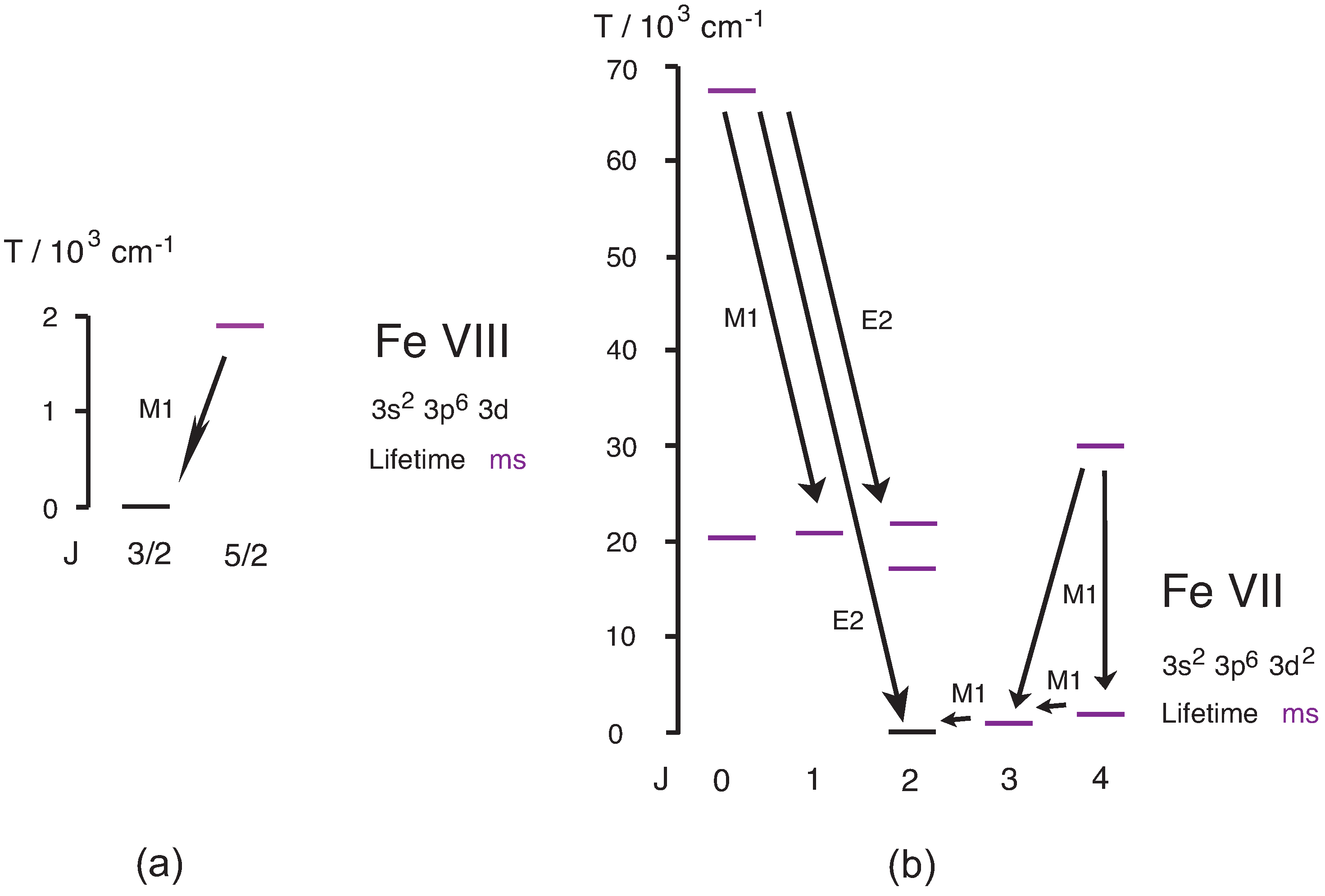
4.7. K-like Fe VIII
In neutral atoms and low ion charge states, potassium-like spectra are dominated by 4s-4p resonance lines. In highly charged ions, the level ordering is different, and the valence electron is not 4s, but 3d. Instead of the intra-shell
s-p resonance line, the first excitation is the
fine structure transition in the 3d
2D term (see
Figure 5a), with a wavelength of about 5450 nm (in the infrared (IR)). The level lifetime in Fe VIII has been computed by Biémont and Hansen as 14 s [
31]. There is no corresponding lifetime measurement yet in Fe VIII. The 3d
2 fine structure splitting increases steeply with the nuclear charge (
); thus, in heavier isoelectronic ions, the transition wavelength may be easier to detect and the much shorter level lifetime more practical to measure. For example, work at the Livermore electron beam ion trap has investigated the corresponding red line in Kr XVIII and found a level lifetime of about 23 ms, compatible with various predictions near 24 ms [
32]. A more recent measurement [
33] which separated ion production (in the NIST Gaithersburg electron beam ion trap) and observation in an improved detection geometry (in a so-called unitary ion trap [
34]) reduced the error bar and almost perfectly agreed with the predictions.
4.8. Ca-like Fe VII
Figure 5b demonstrates how rapidly the complexity increases with the number of electrons in the 3d valence shell. Within the ground configuration, about a dozen of
-forbidden transitions occur, with wavelengths (for Fe VII) from the visible to the infrared. A set of measurements at the Heidelberg heavy-ion storage ring TSR included a data set ascribed to the Fe VII 3p
63d
2 1S
0 level decay, with a lifetime value of about 30 ms [
26]. Moreover, the aforementioned Livermore EBIT experiment on K-like Kr XVIII [
32] has observed a stray signal that was tentatively associated with Ca-like Kr XVII. Though the measurements so far are sparse, they confirm the presence of millisecond level lifetimes in these Ca-like ions.
5. Discussion
The transition rates in the extreme cases among the above examples, Na-like Fe XVI (lifetimes near 60 ps, see [
6]) and Ca-like Kr XVII (lifetime near 23 ms [
32]), differ by nine orders of magnitude—for ions of almost the same ionisation stage and for electrons in nominally related 3d levels. This wide span, related to the dominance of decays due to different multipole orders in the expansion of the radiation field, merits further discussion. However, without delving into the details, the principal feature of electron couplings that may prevent
decays has been proven. A next step should be the measurement of more of these very long (millisecond- to second-range) 3d level lifetimes in various ion species, which in turn requires a more detailed knowledge of the level structure. A readily feasible computational structure estimate should facilitate the planning for actual spectroscopic observations that should reach a higher wavelength accuracy than present-day computations can deliver.
Atomic structure computations these days are no more fenced in tightly by limited computer resources; it should be possible to include all the 3d levels covered in
Figure 1,
Figure 2,
Figure 3,
Figure 4 and
Figure 5 as well as all transitions between them, including at least electric and magnetic dipole, quadrupole, and octupole transitions. Synthetic spectra produced on the basis of such computations ought to help experimenters plan and execute spectral surveys of wavelength ranges incompletely explored so far, within the EUV, VUV, UV and visible spectral ranges for which promising time-resolving detectors are available. This is a time-consuming process, because these 3d-level decays start at excited levels that are less populated than the low-lying levels involved in resonance lines. Hence, many of the signal rates to be expected may be challengingly low. Some measurement time could be saved, if a wide-band multichannel detector for the ultraviolet and visible spectral ranges was available that could provide list-mode event parameters such as detector channel and time after a reference signal in the range from, say, milliseconds to seconds. In the EUV, gated microchannel plates with a structured read-out anode can do that already, but I have not heard yet of comparable devices for the VUV, UV, visible, and IR ranges—but of promising developments in that sector.
Most plasma discharges used in the spectroscopic study of multiply charged ions last for nanoseconds up to microseconds. On longer time scales the plasmas expand out of the field of view of a given detector. When studying emission that involves levels of millisecond lifetimes, ion trapping is necessary, which may most easily be achieved with an electron beam ion trap of moderate magnetic field strength. Switching the electron beam energy and/or current is quite feasible in the millisecond range. Whether the lifetime measurements can be extended to the range of seconds is a question of ultrahigh vacuum and other factors that limit the storage time of ions in a given trap.
The FERRUM project at Stockholm has addressed some atomic lifetimes of the many long-lived levels in the ground configurations of singly charged ions of the iron group elements a few steps beyond the charge states discussed in the present text (see; for example, [
35,
36]). The heavy-ion storage ring CryRing used for those studies illustrates the need for excellent vacuum in order to achieve sufficiently long ion storage times. That device has meanwhile been relocated to GSI Darmstadt and refurbished, but the matching ion source and detection systems, including the laser system for excitation and quenching experiments, would have to be built anew for corresponding experiments. As a promising step in that direction, experiments are underway to recover capabilities that have been demonstrated at the ESR and TSR heavy-ion storage rings before, the time-resolved recording of visible light emitted by ions excited in the ion source (before injection into the large ion trap).
Another extension of investigation beyond the present horizon uses electron beam ion traps to find and identify transitions in the ground configuration of, say, Ca-like ions, by combining computation and wavelength measurements [
37]. The lines seen are from
-forbidden decays of 3d levels in ions beyond the better-researched iron group elements, in this case on Ge and Se ions. The longevity of these levels is a property that is not exploited directly nor measured, but it helps to populate the levels and lets their decays stick out of the background of the spectra.