


Abstract
We propose the diagnostics of plasma parameters in flare loops using the data of multi-wavelength observations in both shrinkage and expansion phases of the loops. The approach of a flare loop as an equivalent electric circuit is applied. We show that depending on plasma loop parameters, the shrinkage may be accompanied by an increase in the electric current in the loop rather than a decrease. The number density, temperature, electric current, radius, loop-top altitude, and loop volume are determined for the flare events on 16 April 2002 and 24 August 2002.
1. Introduction
The phenomenon of the shrinkage of flare loops during the impulsive phase of the flare, followed by the upward motion of the loops, was revealed in numerous observations [1,2,3,4,5,6,7]. The simulation of the shrinkage phenomenon was based mainly on magnetic reconnection, the following particular cases of which can be noted: a collapsing magnetic trap embedded in a standard 2D magnetic reconnection model [8] and the rainbow reconnection [9]. In addition, there is an alternative model of loop shrinkage based on the representation of a flare loop as an equivalent electric circuit [10,11] in which the shrinkage is induced by a slight decrease in the electric current [12].
In some flares, oscillations in UV [4] and X-ray emission [7] were observed in the course of the shrinking phase as well as in the radio emission during the altitude increase of a loop [3]. In addition, Li, and Gan [4] showed that the UV oscillations are manifested as vertical oscillations of the loop, to some extent similar to the oscillations observed by Wang and Solanki [13]. In this paper, we study the dynamics of the physical parameters of flare loops in the shrinkage and ascent phases; in so doing, we are based on the approach of the current-carrying loop as an equivalent electric (RLC) circuit. For an illustration, we present the corresponding analysis of flare loops in the flares of 16 April 2002 [4] and 24 August 2002 [3]. We will also show that the loop shrinkage can be accompanied by a decrease in the electric current [12] and its increase.
2. Loop Shrinkage in Terms of an Equivalent Electric Circuit
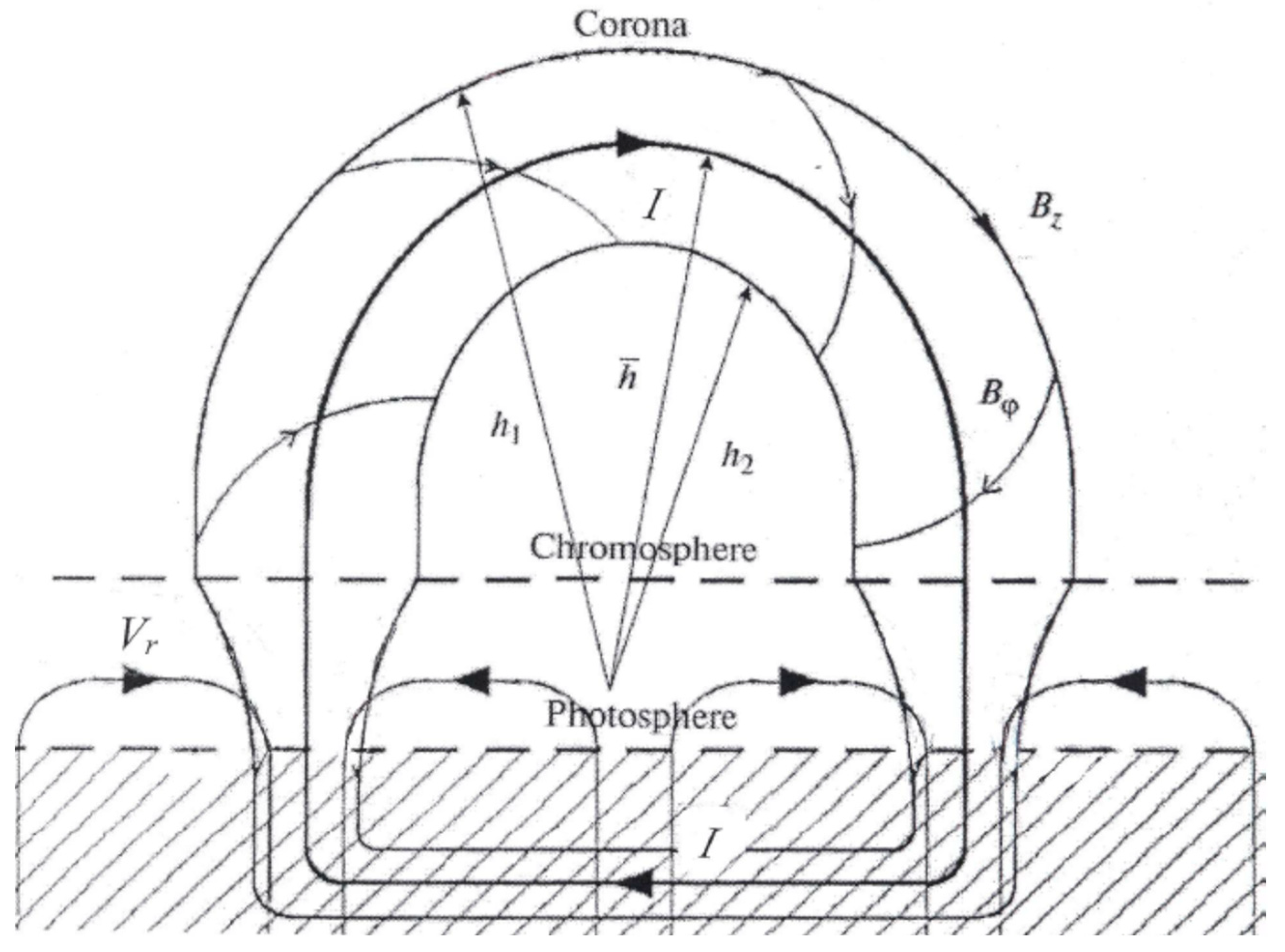
Consider a current-carrying magnetic loop (Figure 1), in which the electric current I flows from one loop foot point to the other through the coronal part of the loop and closes in the photosphere at a depth where zero level of the solar atmosphere is located, and the conductivity is isotropic [11]. The model of the current-carrying flare loop is supported by observations (see, e.g., [14,15]). For simplicity, we present the loop as a half-circle because it follows from the radio loop observed with the Nobeyama Radio Heliograph (NoRH) at 34 GHz [3]. An electric current is generated by the electromotive force (e.m.f.) located at the footpoints of the loop and arising from the interaction of photosphere convective flows with the loop magnetic field [16]. Here, is the radial component of the velocity of convective flow, (1–3) × is the half-width of the loop cross-section area and is the loop length in e.m.f. region.
Figure 1.
A sketch of a current-carrying flare loop. Here are the large, small, and. middle radii of the loop, respectively, and are the longitudinal and azimuthal components of the magnetic field.
The forces acting on the top of the current-carrying loop can be as follows [12].
where is the radius of the loop in the coronal part, which, in accordance with the observational data, we consider to be approximately constant, , is plasma number density in a loop, g = 2.74 × 104 cm s−2 is the acceleration of gravity. Here, the first term in Equation (1) means the upward pressure force of the magnetic field associated with the curvature of the magnetic field’s lines in an inhomogeneous atmosphere and refers to a unit volume. The second term is the downward magnetic tension force, the third term designates the upward Ampére force associated with the photospheric current, and the last term is the downward gravitational force.
In Equation (1), we neglected the force acting on the loop from the external magnetic field, which is possible for a typical electric current in the flaring loops, I > 1010 A, and [12]. In addition, in Equation (1), the mean values of the squares of the longitudinal and azimuthal components of the magnetic field and the mean large radius of the loop are used: . Keeping in mind that , we can write the equilibrium condition for the loop top:
Hence, the average height of the loop is proportional to the square of the electric current in the loop:
where M is the flux tube mass per unit length.
Equation (3) suggests that the height of the loop top (LT) is determined by the balance of Ampére force, magnetic pressure, and gravity. As a result, the average loop height depends on the square of the electric current and the plasma number density in the loop. A similar functional relationship exists for a current-carrying filament [17]. From Equation (3), it follows that the relative change in the loop altitude in the course of the flare is determined by the formula:
If the flare process is not accompanied by a change in the plasma number density in the loop (, then a decrease in the loop height ( can be caused by a decrease in the electric current:
For example, for a flare on 24 August 2002 [3], a decrease in the loop height at the initial stage of the shrinkage under condition should accompanied by a decrease in the current by ≈ −0.175 [12]. In reality, however, as seen from the further estimates, the decrease in the loop height can occur simultaneously with a significant increase in the plasma density inside the loop due, for example, to chromosphere evaporation. In this case, the relative change in the electric current with a change in the loop altitude is determined by the formula:
It follows that if , then the loop shrinkage may be accompanied by an increase in the current in the loop, rather than by a decrease, i.e., the loop in the shrinkage process accompanied by chromosphere evaporation becomes quite “heavy” and, to maintain stability, the Ampère force, which depends on the magnitude of the electric current, will increase.
3. An Oscillating Loop as an Equivalent RLC Circuit
In the impulse phase of the flare on 16 April 2002 [4], the loop shrank within 5 min, which, we believe, was caused by a decrease or an increase in the electric current. During the shrinkage process, the Transition Region and Coronal Explorer (TRACE) 195 Å data indicate vertical oscillations of the loop with a period p ≈ 154 s and an amplitude of 285 km (≈2% of the loop height). Assuming that the vertical oscillations of the loop are due to the oscillations of the electric current of small amplitude, , for which we can write the equation [11]
In Equation (7), the inductance and capacitance of the loop are defined by its coronal part [16]:
where is the loop length. But the Cowling resistance R(I) is determined mainly by the chromosphere part of a loop due to collisions of ions with the neutral component of the plasma. The period of the electric current oscillation is [16]
The condition of in-phase oscillations of the loop (lumped RLC circuit) requires that the inverse Alfvén time be greater than the oscillation frequency of the RLC circuit, which gives 2 × 10⁻² > (0.65–0.83) × 10−2 , as it follows from the Section 4.
4. Dynamics of Flare Loop Parameters Inferred from Multi-Wavelength Observations
The multi-wavelength approach based on radio, X-ray, and UV observations opens up new possibilities for diagnosing the plasma parameters of flare loops during the shrinkage of the loops and their subsequent expansion. Let us apply this approach to two flares with the shrinkage phenomenon.
4.1. Loop in the Flare on 24 August 2002
The X3.1 flare on 24 August 2002 started at 00:49 UT. It was observed with Geostationary Operational Environmental Satellite (GOES-08), Reuven Ramaty High Energy Solar Spectroscopic Imager (RHESSI), NoRH at 34 GHz, and the Nobeyama Radio Polarimeter (NoRP) at 17 and 35 GHz. The loop began to shrink at 00:53 UT during the rising phase of the soft X-ray flux; the shrinkage ended at 01:02 UT. After the impulsive phase of the flare (01:02 UT), the upward motion of the loop began, and the loop expansion was interrupted at 01:09 UT. As seen in Figure 2 presented in [3], the radio image of the loop at 34 GHz (NoRH) is approximately fitted with a half-circle. From 00:53 to 01:02 UT, the loop height decreased from cm to 1.6 i.e., by about 30%. The loop height at the ascent stage varied from h = 1.6 × 109 cm at 01:02 UT to 2.45 × 109 cm at 01:08 UT [3]. Oscillations of radio emission at 17 and 35 GHz began at the final stage of the loop shrinkage and ended at 01:10 UT. The oscillation period shows irregular changes at an average value of p 120 s. The loop half-width, according to NoRH 34 GHz data, was . In further estimations, we believe that the radius r of the loop in the shrinking phase and the subsequent recovery of the loop height to its original value changed insignificantly (see, e.g., [18,19]).
Li and Gan [3] presented GOES 08 soft X-ray light curves at 0.5–4.0 Å and 1.0–8.0 Å for the flare on 24 August 2002. We use these data to determine the plasma temperature in the loop T and the plasma emission measure at various flare stages according to the method described in [20]. The temperature and measure of the emission of the loop at each stage of the evolution of the flare process depend on the ratio of the observed X-ray fluxes [20]
In this case, the temperature in MK and the emission measure (EM) in units of are determined by the following empirical formulas:
We use the emission measure to determine the plasma number density in the loop from the known volume of the loop
The electric current in the loop I can be determined from Equation (9) for the oscillation period of the loop, assuming that the oscillations are associated with oscillations of the loop as an equivalent RLC circuit:
The results of the estimates of the shrinkage loop parameters in the course of the flare are given in Table 1.
Table 1.
Dynamics Loop Parameters of the Flare on 2002 August 24.
Based on Table 1, the following preliminary conclusions can be drawn.
- (i)
- In the shrinking phase (00:53–01:02 UT), an increase in the plasma temperature by more than a factor of 2.5 is observed, as well as an increase in the plasma density in the loop, approximately by a factor of three. These changes in the parameters are accompanied by a relative increase in the electric current , approximately by the factor of 1.48.
- (ii)
- At the stage of loop ascent (01:02–01:10 UT), accompanied by relatively small oscillations at 17 and 35 GHz, the plasma density inside the loop continues to increase approximately by a factor of 1.6, and the temperature decreases from 27.6 MK to 17.7 MK. Therefore, the above estimate of the magnitude of the electric current (14) reflects a certain average value at the stage of the loop expansion because the parameters that determine the period of oscillations: plasma density and the electric current magnitude, change during oscillations.
- (iii)
- The total electric current of about 1011 A contained a flare loop with r = 3.5 × 10⁶ m means a current density of j ≈ 10−2 Am−2. This value agrees with estimates of the density of the vertical electric current found using the vector magnetograms (e.g., [21,22]). In more powerful flares, the value of j can be an order of magnitude larger.
For the loop to keep the cross-section area during the shrinkage and reverse upward movement, the condition < 1 should be satisfied [17], where k is the Boltzmann constant, . At the current , the value of . At the maximum values of the density and temperature of the loop plasma (Table 1), the condition requires . In flare loops, the typical value of [23]. The inequality is also necessary for the stability of the loop against MHD disturbances.
As for the role of accelerated electrons transported into a loop in the creation of electric current, we have to note that these electrons can change the total electric current in the loop during a time of loop flight (of the order of seconds), which is less than oscillation period of the loop as an RLC circuit. Moreover, this current disappears in a few bounce periods as the result of reflections of electrons from the loop magnetic mirrors.
4.2. Loop in the Flare on 16 April 2002
The second example of a loop shrinkage is in the M2.5 flare on 16 April 2002, observed by RHESSI and TRACE [4]. A specific feature of this flare is the oscillatory shrinkage during an impulsive flare phase. The TRACE 195 Å loop exhibited vertical oscillations with a period of p ≈ 154 s and an amplitude of 284 km (2% of the loop height). In this case, the loop’s height decreased from cm to cm. At the initial and final stages of the shrinkage, the X-ray flux, according to GOES 1.0–8.0 Å data, was, respectively ). This flux corresponds to the loop luminosity in the soft X-ray range at the initial and final shrink stages, respectively,
On the other hand, the luminosity of the loop is expressed by the formula [24]
Assuming the probable temperature of the flare plasma we obtain
The emission measure of the flare loop at the initial Equation (1) and final Equation (2) shrinkage phases, respectively, is equal to
On the other side
A comparison of the values (19) and (20) gives at the initial stage of the loop shrinkage and at the final stage. From Equations (3) and (14), the dependence of the loop radius on the altitude and period of pulsations is determined:
Substituting the values of the period of pulsations and the height of the loop into (21), we obtain that the radius of the loop changes from cm to , during the loop shrinkage, i.e. remains practically constant within the probable accuracy of estimates. In this case, the plasma number density changes from to , i.e. the density changes are significant; this is likely to be associated with a certain decrease in the loop volume and chromosphere evaporation. Further, from Equation (3), the electric current magnitude is determined from the known values of , n, and r:
Let us find the conditions for the plasma beta <1. Currently and the loop radius , the value of . The condition < 1 at and requires .
5. Conclusions
The diagnostics of plasma parameters of flare loops proposed in this paper are based on the representation of a loop as an equivalent electric circuit. This approach makes it possible to estimate, for example, the magnitude of the electric current from the observed pulsation period. Based on the considered two events with shrinkage and pulsations observed in the radio, X-ray, and UV ranges [3,4], the following conclusions can be drawn.
With a change in the size of flare loops, almost all parameters of the loop plasma change: the electric current, magnetic field, plasma density and temperature. In this case, depending on the value of n in Equation (6), the loop shrinkage can be accompanied by a decrease in the electric current [12] and its increase. In the latter case, the loop “becomes heavier” due to both a decrease in its size and the evaporation of the chromosphere plasma into the loop during the flare impulsive phase. Furthermore, since the Ampére force must increase to maintain stability, the magnitude of the electric current must also increase.
The scatter of the observational data and a small number of oscillations make it possible to estimate the loop plasma parameters, particularly the electric current, only to an order of magnitude. Nevertheless, the presented estimates give an idea of the dynamics of the parameters of flare loops as their sizes decrease and increase. As shown in this study, the loop cross-sectional radius r changes insignificantly in this case.
The self-consistent diagnostics suggested in this paper can be used to determine the plasma parameters in flare loops in other events with shrinkage and oscillations.
Author Contributions
Investigation, V.Z. and A.S.; writing, V.Z. and A.S. All authors have read and agreed to the published version of the manuscript.
Funding
This research was partially founded by the Russian Science Foundation, grant no. 22-12-00308 (Section 4), and the State Assignment no. 0030-2021-0002, and no. 0040-2019-0025.
Institutional Review Board Statement
Not applicable.
Informed Consent Statement
Not applicable.
Data Availability Statement
All necessary data are contained in this paper.
Conflicts of Interest
The authors declare no conflict of interest.
References
- Sui, L.; Holman, G.D. Evidence for the Formation of a Large-Scale Current Sheet in a Solar Flare. Astropys. J. 2003, 596, L251–L254. [Google Scholar] [CrossRef]
- Sui, L.; Holman, G.D.; Dennis, B.R. Evidence for Magnetic Reconnection in Three Homologous Solar Flares Observed by RHESSI. Astropys. J. 2004, 612, 546–556. [Google Scholar] [CrossRef]
- Li, Y.P.; Gan, W.Q. The shrinkage of flare radio loops. Astropys. J. 2005, 629, L137–L139. [Google Scholar] [CrossRef]
- Li, Y.P.; Gan, W.Q. The oscillatory shrinkage in TRACE 195 A loops during a flare impulsive phase. Astropys. J. 2006, 644, L97–L100. [Google Scholar] [CrossRef]
- Shen, J.; Zhou, T.; Ji, H.; Wang, N.; Cao, W.; Wang, H. Early abnormal temperature structure of X-ray loop-top source of solar flares. Astrophys. J. 2008, 686, L37–L40. [Google Scholar] [CrossRef]
- Reznikova, V.E.; Melnikov, V.F.; Shibasaki, K. Dynamics of the Flaring Loop System of 2005 August 22 Observed in Microwaves and Hard X-rays. Astrophys. J. 2010, 724, 171–181. [Google Scholar] [CrossRef]
- Zhou, T.H.; Wang, J.F.; Li, D.; Song, Q.W.; Melnikov, V.; Ji, H.S. The contracting and unshearing motion of flare loops in the X7.1 flare on 2005 January 20 during its rising phase. Res. Astron. Astrophys. 2013, 13, 526–536. [Google Scholar] [CrossRef]
- Veronig, A.M.; Karlický, M.; Vršnak, B.; Temmer, M.; Magdalenić, J.; Dennis, B.R.; Ortuba, W.; Pötzi, W. X-ray sources and magnetic reconnection in the X3.9 flare of 2003 November 3. Astron. Astrophys. 2006, 446, 675–690. [Google Scholar] [CrossRef]
- Joshi, B.; Veronig, A.; Cho, K.S.; Bong, S.C.; Somov, B.V.; Moon, Y.J.; Lee, J.; Manohran, P.K.; Kim, Y.-H. Magnetic reconnection during the two-phase evolution of a solar eruptive flare. Astrophys. J. 2009, 706, 1438–1450. [Google Scholar] [CrossRef]
- Alfven, H.; Carlquist, P. Currents in the Solar Atmosphere and a Theory of Solar Flares. Solar Phys. 1967, 1, 220–228. [Google Scholar] [CrossRef]
- Zaitsev, V.V.; Stepanov, A.V.; Urpo, S.; Pohjolainen, S. LRC-circuit analog of current-carrying magnetic loop: Diagnostics of electric parameters. Astron. Astrophys. 1998, 337, 887–896. [Google Scholar]
- Zaitsev, V.V.; Stepanov, A.V. Evolution of Electric Current and Resistance in the Flare Loop in the Course of Loop Shrinkage. Geomag. Aeron. 2020, 60, 915–920. [Google Scholar] [CrossRef]
- Wang, T.J.; Solanki, S.K. Vertical oscillations of a coronal loop observed by TRACE. Astron. Astrophys. 2004, 421, L33–L36. [Google Scholar] [CrossRef]
- Hagyard, M.J. Observed nonpotential magnetic fields and the inferred flow of electric currents at a location of repeated flaring. Solar Phys. 1988, 115, 107–124. [Google Scholar] [CrossRef]
- Tan, B. Distribution of electric current in solar plasma loops. Adv. Space Sci. 2007, 39, 1826–1830. [Google Scholar] [CrossRef]
- Stepanov, A.V.; Zaitsev, V.V.; Nakariakov, V.M. Coronal Seismology: Waves and Oscillations in Stellar Coronae; Wiley-VCH Verlag GmbH&Co: Weinheim, Germany, 2012; pp. 23–29. ISBN 9783527645985. [Google Scholar] [CrossRef]
- Zaitsev, V.V.; Stepanov, A.V. Prominence activation by increase in electric current. JASTP 2018, 179, 149–153. [Google Scholar] [CrossRef]
- Klimchuk, J.A. Cross-Sectional Properties of Coronal Loops. Solar Phys. 2000, 193, 53–75. [Google Scholar] [CrossRef]
- Zaitsev, V.V.; Kronshtadtov, P.V. On the Constancy of the Width of Coronal Magnetic Loops. Geomag. Aeron. 2017, 57, 841–843. [Google Scholar] [CrossRef]
- Thomas, R.J.; Starr, R.; Crannell, C.J. Expressions to Determine Temperatures and Emission Measures for Solar X-Ray Events from Goes Measurements. Solar Phys. 1985, 95, 323–329. [Google Scholar] [CrossRef]
- Pevtsov, A.A.; Canfield, R.C.; McClymont, A.L. On the Subphotospheric Origin of Coronal Electric Currents. Astrophys. J. 1997, 491, 973–977. [Google Scholar] [CrossRef]
- Sharykin, I.N.; Kosovichev, A.G. Dynamics of Electric Currents, Magnetic Field Topology, and Helioseismic Response of a Solar Flare. Astrophys. J. 2015, 808, 72–81. [Google Scholar] [CrossRef]
- Aschwanden, M.J.; Newmark, J.S.; Delaboudinière, J.P.; Neupert, W.M.; Klimchuk, J.A.; Gary, G.A.; Portier-Fozzani, F.; Zucker, A. Three-dimensional Stereoscopic Analysis of Solar Active Region Loops. I. SOHO/EIT Observations at Temperatures of (1.0–1.5) × 106 K. Astrophys. J. 1999, 515, 842–867. [Google Scholar] [CrossRef]
- Giampapa, M.S.; Rosner, R.; Kashyap, V.; Fleming, T.A.; Schmitt, J.H.M.M.; Bookbinder, J.A. The Coronae of Low-Mass Dwarf Stars. Astrophys. J. 1996, 463, 707–725. [Google Scholar] [CrossRef]
Disclaimer/Publisher’s Note: The statements, opinions and data contained in all publications are solely those of the individual author(s) and contributor(s) and not of MDPI and/or the editor(s). MDPI and/or the editor(s) disclaim responsibility for any injury to people or property resulting from any ideas, methods, instructions or products referred to in the content. |
© 2023 by the authors. Licensee MDPI, Basel, Switzerland. This article is an open access article distributed under the terms and conditions of the Creative Commons Attribution (CC BY) license (https://creativecommons.org/licenses/by/4.0/).

