1. Introduction
Exact solutions to the Einstein field equations containing spacetime singularities have been known since the early days of general relativity. Moreover, the Penrose theorem ensures that the gravitational collapse of compact objects will generate geodesically incomplete spacetimes if a trapping surface occurs [
1] (albeit eternal point-like sources were shown to be mathematically incompatible with the Einstein equations [
2]).
It is generically expected that the quantum theory of gravity will fix this incomplete classical picture, although no general consensus has yet been reached as to how this happens and on what observable effects that could imply. One of the main difficulties in quantising the gravitational interaction is given by its non-linear nature already at the classical level. Building quantum states corresponding to the real objects that we see in the universe is, therefore, a strongly non-perturbative endeavour.
We will report here on the consequences stemming from the assumptions that (a) the expectation value of quantum gravity observables on states that are relevant for the description of reality must be very close to the classical solutions of the Einstein Equations, where experimental data support general relativity, and (b) those quantum states must be mathematically well-defined. The second assumption implies that not all classical solutions may be realised. A well-known example is the hydrogen atom, which should be unstable according to classical electrodynamics. Instead, quantum mechanics predicts discrete energy states for the electron, with the ground state spreading several orders of magnitude around the size of the nucleus.
The above point of view was taken in Ref. [
3] for studying the collapse of a ball of dust of mass
M, whose classical radius
in a finite amount of proper time [
4]. The main result that followed was that the ground state is much wider than the Planck length, and indeed of the order of the gravitational radius
, which appears as a concrete example of
classicalisation [
5,
6]. Moreover, the principal quantum number of the ground state is proportional to
(we use units with
,
and
, where
is the Planck length and
is the Planck mass). This property was also recovered in Ref. [
7], in which the existence of a proper quantum state reproducing the outer Schwarzschild geometry was considered to show that no central singularity could be possibly realised. In that context, the scaling of
with an integer number can then be interpreted as the quantisation of the horizon area [
8].
2. Quantum Dust Ball
The classical Oppenheimer–Snyder model [
4] describes the collapse of a ball of dust in general relativity. The trajectory of the areal radius
R of the ball is a geodesic in the Schwarzschild spacetime generated by the mass
M of the ball itself
Consequently, one obtains the conservation of the effective Hamiltonian [
3] (Numerical coefficients of order one are often omitted for the sake of clarity).
where
P is the momentum conjugated to
R and
E represents the conserved energy conjugated to the coordinate time
t. It is important to remark that Equation (
2) formally equals the Newtonian conservation law for the energy
, but the general relativistic equation differs because of the non-linear relation between
and the energy
E.
We next quantise the system by assuming the usual canonical commutator
and the operators
and
act on wavefunctions
satisfying the Schrödinger equation for a gravitational atom
The eigenstates of the above equation are given by
where
,
are generalised Laguerre polynomials with
(the angular momentum is zero) and the corresponding eigenvalues read
The width of the above eigenstates is given by
In Newtonian physics, there would be no restriction to the spectrum,
, and, since
, one practically recovers the classical singularity with energy density of the order of
. However, the non-linear relation for
in Equation (
6) yields the condition
The (minimum) quantum number,
, for the actual ground state,
, therefore, depends on the mass,
M, as required by the quantisation of the horizon area [
8] and the corpuscular model of black holes [
9,
10]. Moreover,
has a width
which grows with
M, hence hinting to
classicalisation in Einstein gravity [
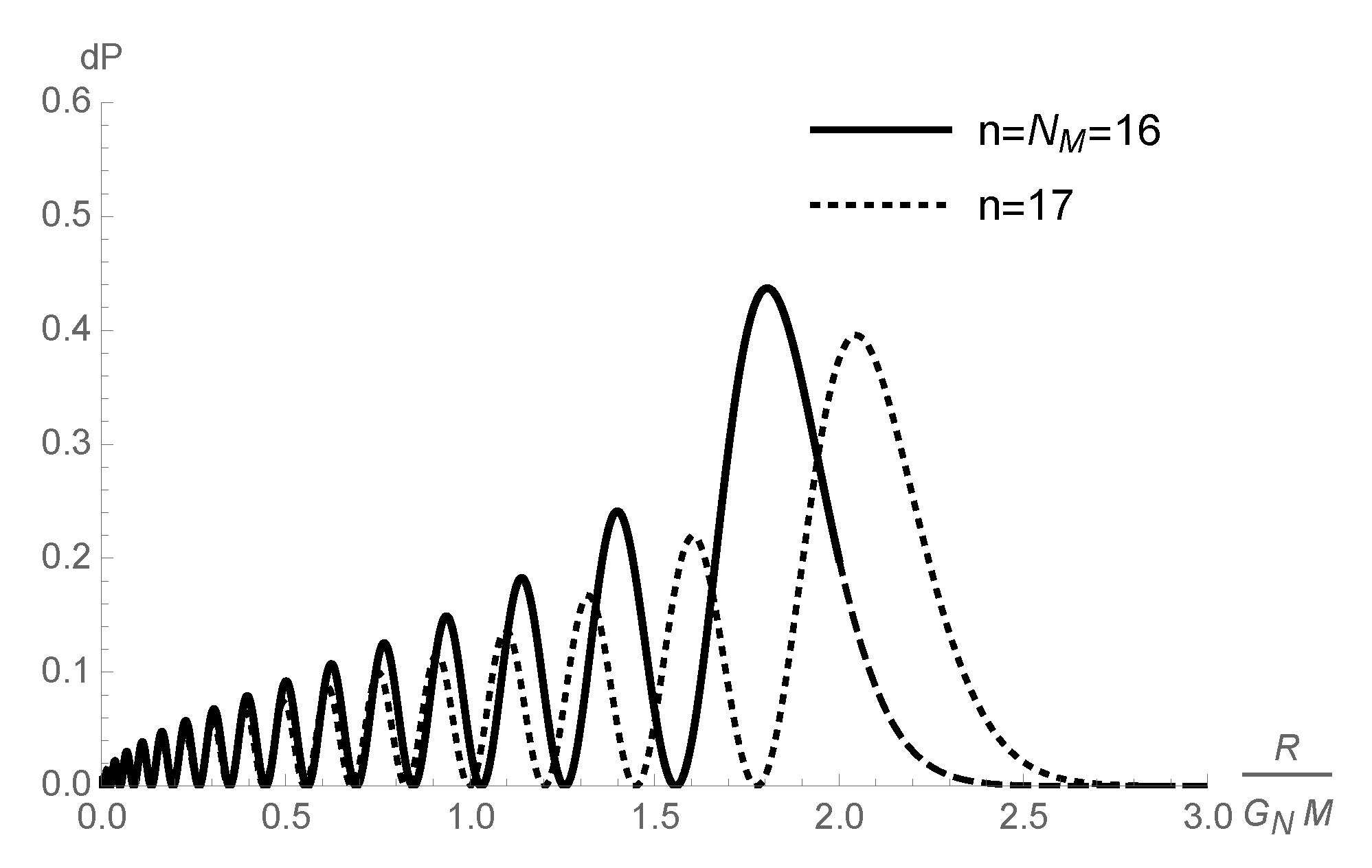
5]. The ground state,
, could be viewed as a black hole, since
(see
Figure 1 for an example), but we further need to check that the outer geometry is still very close to the Schwarzschild metric (
1) to support that conclusion.
3. Quantum Schwarzschild Geometry
We next try and reconstruct the geometry outside the collapsed object. For that purpose, we will use a scalar field
for simplicity [
7]. Of course, the field
should not be viewed as fundamental but as a convenient representation of the non-perturbative behaviour of gravity generated by a large compact source.
The important physical assumption is that the quantum gravity vacuum state
is the realisation of a universe in which no modes (of matter or gravity) are excited. It is not a priori obvious if it makes any sense at all to associate a Lorentzian metric
to such an absolute vacuum, but we further notice that this is the metric normally used to describe linearised gravity and to define both matter and gravitational excitations in this regime. The linearised theory should provide a reliable description for small matter sources (say with total energy
) and allow one to recover the Newtonian potential from simple tree-level graviton exchanges. Of course, the Newtonian potential is not a fundamental scalar, but it emerges from the (non-propagating) temporal polarisation of virtual gravitons (see, Ref. [
11]). For large sources (that is, with
), one should reconstruct the proper quantum state from the excitations of the linearised theory, which appears rather hopeless in this highly non-linear regime. In fact, one then usually assumes that there exists a classical background geometry to replace
with the solution
of the corresponding classical Einstein’s equations. Since we are interested in static and spherically symmetric configurations representing a black hole, we will just require that the quantum state of gravity effectively reproduces (as closely as possible) the expected Schwarzschild geometry (
1), which, in turn, contains only one metric function
. We will then see that requiring that
emerges from a properly defined quantum state leads to specific restrictions that could not otherwise be unveiled.
For the above reasons, we impose that
satisfies the free massless wave equation in Minkowski spacetime in spherical coordinates,
Normal modes will then be written in terms of spherical Bessel functions
as
. Annihilation operators
and creation operators
for these modes satisfy the usual harmonic oscillator algebra and a Fock space can be built starting from the quantum Minkowski vacuum
. We remark once more that this Fock space effectively represents excitations that reduce to temporally polarised gravitons in the linear regime and not the independent (propagating) gravitational degrees of freedom (corresponding to helicity-2 gravitational waves, which should play no role in purely static configurations).
Classical configurations usually emerge in the quantum theory as coherent states. The use of coherent states in quantum field theory to describe static configurations is supported, for instance, by calculations in electrodynamics [
12], in Newtonian physics [
13] and for the de Sitter spacetime [
14,
15]. A general coherent state can be written in terms of Fock states as
and we will then require that
where
is the “potential” in the Schwarzschild metric (
1). In particular, the occupation numbers for each mode
k is found to be given by
The state
is well-defined only if it is normalisable. This condition is tantamount to having a finite total occupation number
However, this integral diverges both in the infrared (IR) and the ultraviolet (UV), and no coherent quantum state exists in our Fock space, which can reproduce the classical potential in Equation (
13) exactly.
The actual occupation numbers
for
and
could be determined if we had a complete quantum theory of gravity, but here we will just consider generic behaviours that regularise the expression (
15). In particular, the IR divergence stems from the assumption of exact staticity, which lets the potential
extend to infinity. We can then introduce a cut-off
as a formal way to account for the finite lifetime
of a real source. The UV divergence would not be present if the source had finite size and, from the description of collapsed matter inside black holes in the previous section, we simply introduce a cut-off
. This again yields the horizon area quantisation [
8], that is
in which the logarithm appears because of the choice of a sharp UV cut-off and would be replaced with a more accurate description of the matter source. We also notice that the average radial momentum is given by
so that both
M and the typical wavelength
reproduce the scaling laws of the corpuscular model of black holes [
9].
Having defined a proper quantum state
, we can next obtain the corresponding geometry by replacing
in Equation (
1) with
where
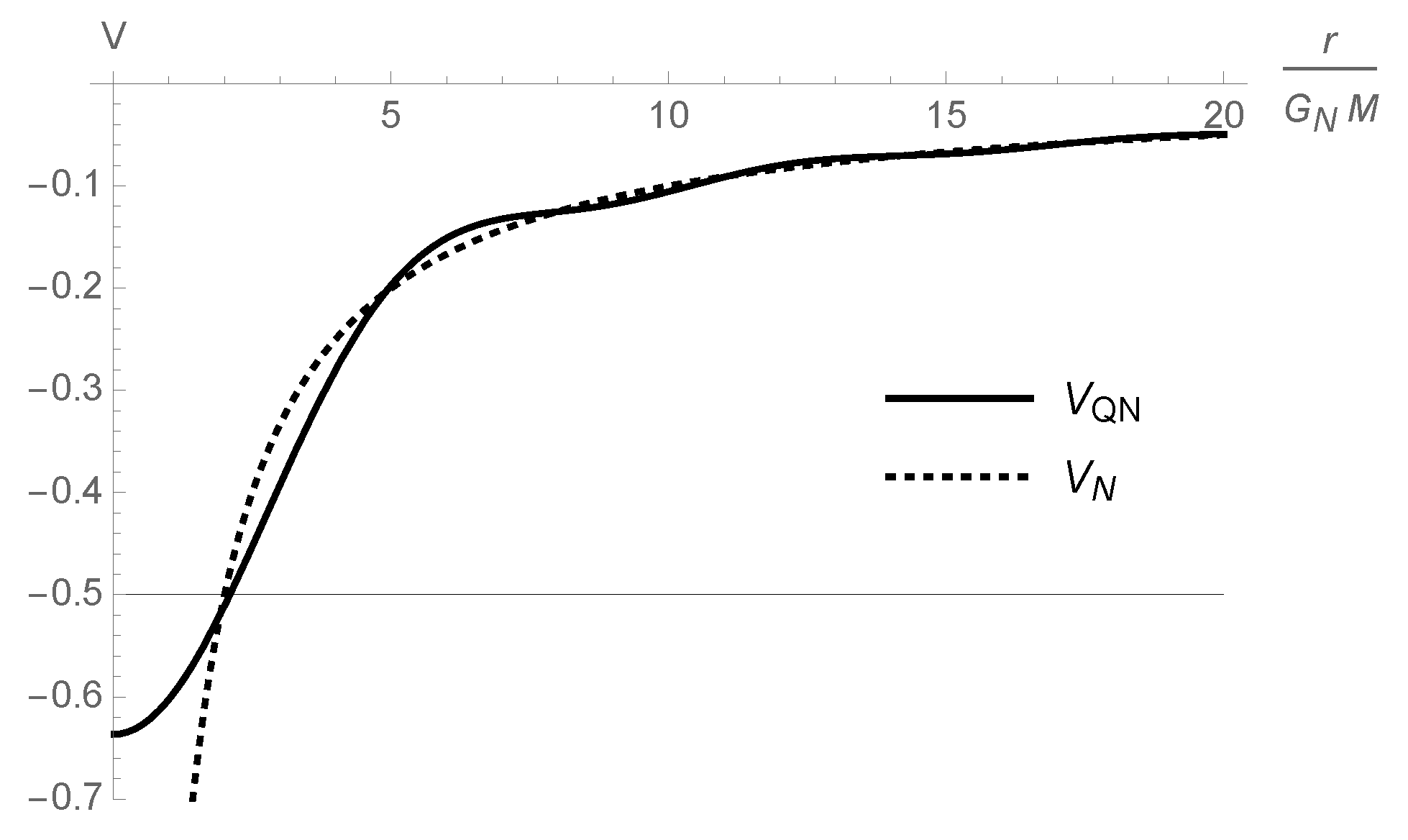
is the sine integral function. The quantum corrected metric still contains a horizon (see
Figure 2 for an example) but the Ricci scalar
and the Kretschmann scalar
, for
, whereas the Kretschmann scalar in the classical Schwarzschild spacetime diverges as
. This ensures that tidal forces remain finite at the centre, as can be seen more explicitly from the relative acceleration of radial geodesics for
(In the Schwarzschild spacetime
; thus, causing the “spaghettification” of infalling matter),
where
is the separation between two nearby radial geodesics. One can further compute the effective energy-momentum tensor
from the Einstein tensor
of the metric (
18) and find that the effective energy density
, with the effective radial pressure
and the effective tension
. The integral of these quantities over space, therefore, remains finite and the point
is said to be an
integrable singularity. Moreover, there is no second horizon, and the spacetime is not affected by any of the issues associated with inner Cauchy horizons. From the phenomenological point of view, it is important that the oscillations shown in
Figure 2 occur around the expected classical behaviour
and become smaller and smaller for decreasing values of
in the region
(we have just considered
here for the sake of simplicity).