Review

The Equation of State of Nuclear Matter: From Finite Nuclei to Neutron Stars


by
G. Fiorella Burgio
*,† and
Isaac Vidaña
INFN Sezione di Catania, Via S. Sofia 64, I-95123 Catania, Italy
*
Author to whom correspondence should be addressed.
These authors contributed equally to this work.
Universe 2020, 6(8), 119; https://doi.org/10.3390/universe6080119

Submission received: 30 June 2020 / Revised: 31 July 2020 / Accepted: 5 August 2020 / Published: 10 August 2020

Abstract

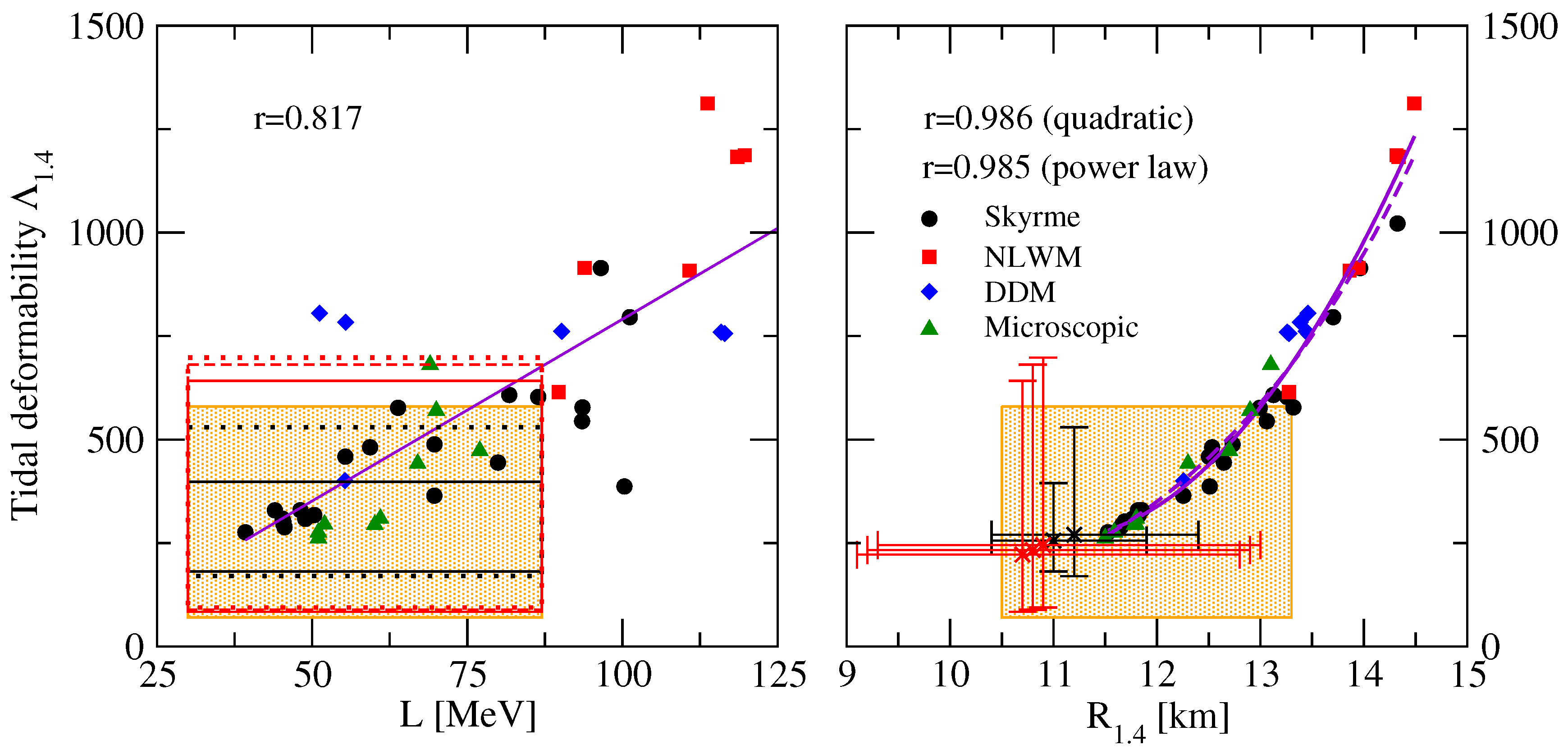
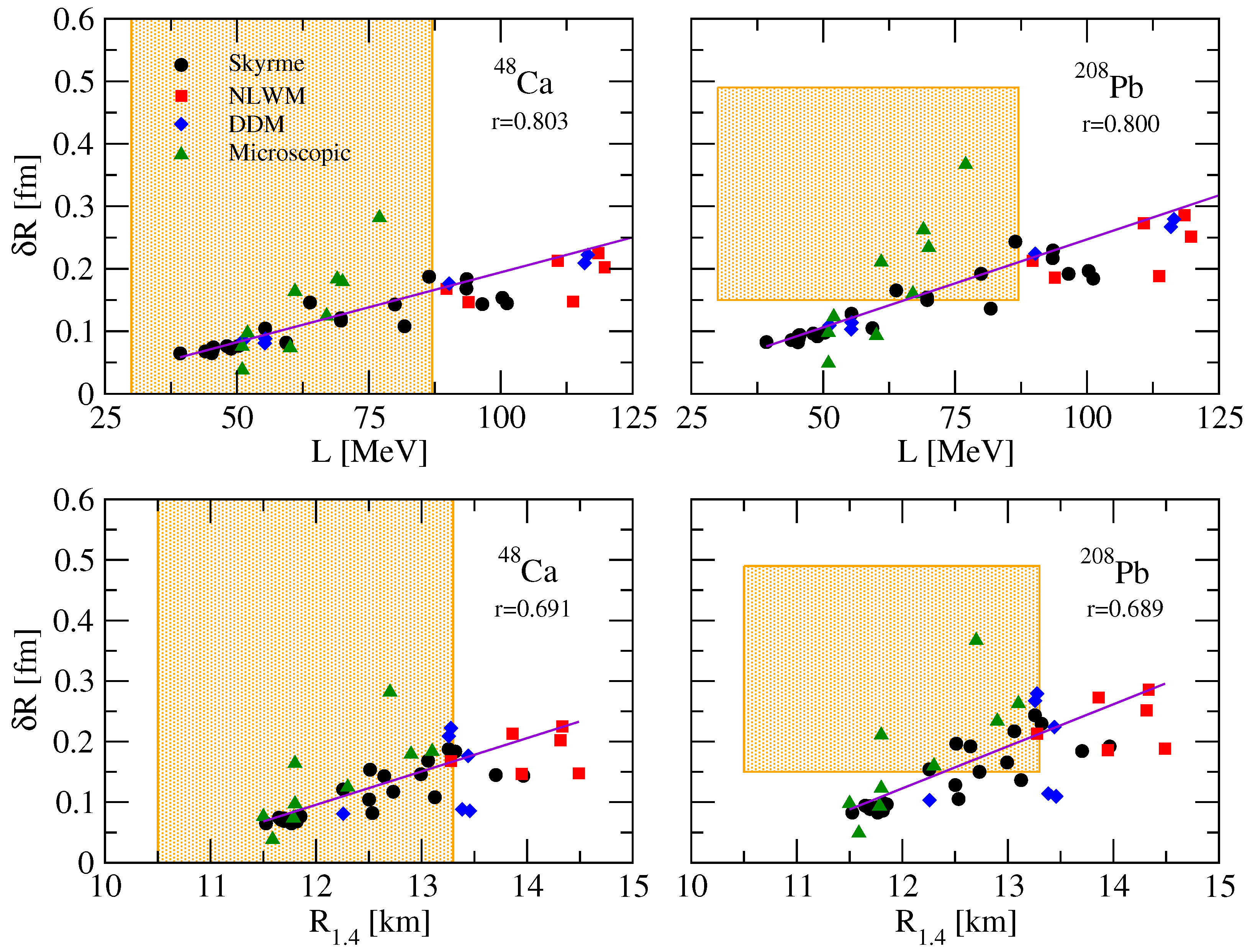
Background. We investigate possible correlations between neutron star observables and properties of atomic nuclei. In particular, we explore how the tidal deformability of a 1.4 solar mass neutron star, M1.4, and the neutron-skin thickness of 48Ca and 208Pb are related to the stellar radius and the stiffness of the symmetry energy. Methods. We examine a large set of nuclear equations of state based on phenomenological models (Skyrme, NLWM, DDM) and ab initio theoretical methods (BBG, Dirac–Brueckner, Variational, Quantum Monte Carlo). Results: We find strong correlations between tidal deformability and NS radius, whereas a weaker correlation does exist with the stiffness of the symmetry energy. Regarding the neutron-skin thickness, weak correlations appear both with the stiffness of the symmetry energy, and the radius of a M1.4. Our results show that whereas the considered EoS are compatible with the largest masses observed up to now, only five microscopic models and four Skyrme forces are simultaneously compatible with the present constraints on L and the PREX experimental data on the 208Pb neutron-skin thickness. We find that all the NLWM and DDM models and the majority of the Skyrme forces are excluded by these two experimental constraints, and that the analysis of the data collected by the NICER mission excludes most of the NLWM considered. Conclusion. The tidal deformability of a M1.4 and the neutron-skin thickness of atomic nuclei show some degree of correlation with nuclear and astrophysical observables, which however depends on the ensemble of adopted EoS.
Keywords: neutron star; equation of state; many-body methods of nuclear matter; neutron-skin thickness; GW170817 neutron star; equation of state; many-body methods of nuclear matter; neutron-skin thickness; GW170817